Mar 24, 2026
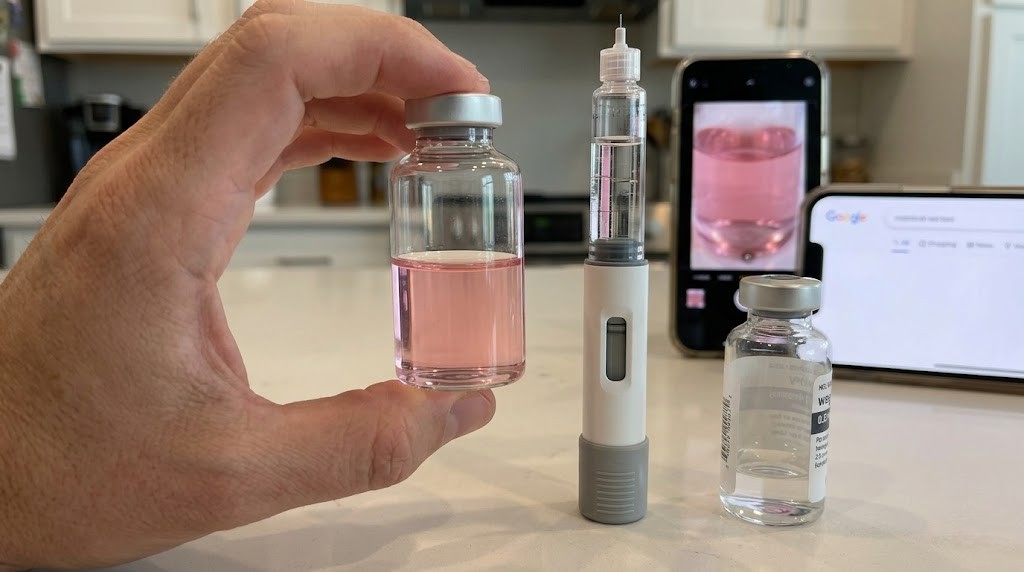
Some researchers open their semaglutide vial and see exactly what they expect. Clear liquid. Colorless. Indistinguishable from water. Others twist the cap off and freeze. The liquid is pink. Light pink, dark pink, sometimes closer to a soft rose. And the first thought is always the same: something is wrong with my medication. That thought is understandable. Nobody tells you ahead of time that compounded semaglutide can look dramatically different from the brand-name version you have seen in photos online. But here is the truth. Pink semaglutide is almost always perfectly normal. The color comes from vitamin B12, specifically cyanocobalamin or methylcobalamin, which compounding pharmacies add to the formulation for very good reasons. Vitamin B12 is naturally a deep reddish-pink compound. When dissolved at concentrations around 0.5 mg/mL, it tints the entire solution that familiar rosy hue.
This is not contamination. This is not degradation. This is an intentional additive that addresses a real nutritional concern that semaglutide creates in the body. The mechanism is straightforward: semaglutide slows gastric emptying and reduces stomach acid production, both of which impair dietary B12 absorption over time. By including B12 directly in the injection, compounding pharmacies solve a problem before it starts. So if you are staring at a pink vial right now, take a breath. You are probably holding a semaglutide-B12 blend that is working exactly as designed. But color matters. And not every color change is harmless. This guide covers every shade, every cause, and every warning sign you need to know.
Why semaglutide turns pink
The pink color in semaglutide has one primary cause. Vitamin B12.
Cyanocobalamin and methylcobalamin are both forms of vitamin B12 used in compounded semaglutide formulations. Both share a molecular structure built around a cobalt ion coordinated within a corrin ring, a structure chemically similar to the heme group in hemoglobin. That cobalt center absorbs light in the yellow-green portion of the visible spectrum, which means it reflects red and pink wavelengths back to your eyes. The result is a solution that ranges from pale pink to vivid rose depending on the B12 concentration.
Most compounding pharmacies use B12 at approximately 0.5 mg/mL. At this concentration, the color is unmistakable. You will not mistake it for clear liquid. But it should not be so dark that it looks like fruit juice or wine either. Think of it as a watercolor wash of pink, translucent and even throughout the vial.
Why pharmacies add B12 in the first place
Semaglutide belongs to the GLP-1 receptor agonist class. One of the primary mechanisms of action involves slowing gastric emptying, which is exactly why it suppresses appetite and helps with weight management. But this same mechanism creates a downstream nutritional problem. When food sits in the stomach longer and stomach acid production decreases, the body ability to extract vitamin B12 from dietary sources drops significantly.
B12 absorption requires intrinsic factor, a glycoprotein produced by parietal cells in the stomach lining. Those same parietal cells produce hydrochloric acid. When GLP-1 agonists suppress gastric acid secretion, intrinsic factor production often decreases in parallel. The result is a gradual depletion of B12 stores that can take months to become clinically apparent but may cause fatigue, dizziness, and neurological symptoms long before a blood test catches the deficiency.
By injecting B12 directly alongside semaglutide, the compounding pharmacy bypasses the entire digestive absorption pathway. The B12 goes straight into subcutaneous tissue and absorbs into the bloodstream without needing stomach acid or intrinsic factor. This is preventive medicine built directly into the formulation.
The chemistry behind the color
Cyanocobalamin appears as dark red crystals in its pure form. When dissolved in water or bacteriostatic water at pharmaceutical concentrations, the solution turns pink. The intensity of the pink depends on exactly how much B12 is present. Lower concentrations produce a barely-there blush. Higher concentrations create a more saturated pink that approaches light red.
Methylcobalamin behaves similarly but tends to be slightly less stable when exposed to light. This is one reason proper storage and refrigeration matters so much for compounded formulations containing methylcobalamin. Light exposure can degrade the molecule and alter the color over time, shifting it from a consistent pink toward something less uniform.
The key takeaway is simple. If your compounded semaglutide is pink and the label lists vitamin B12 as an ingredient, the color is exactly what it should be.
What normal semaglutide should look like
Not all semaglutide looks the same. The appearance depends entirely on where it comes from and what has been added to the formulation.
Brand-name semaglutide
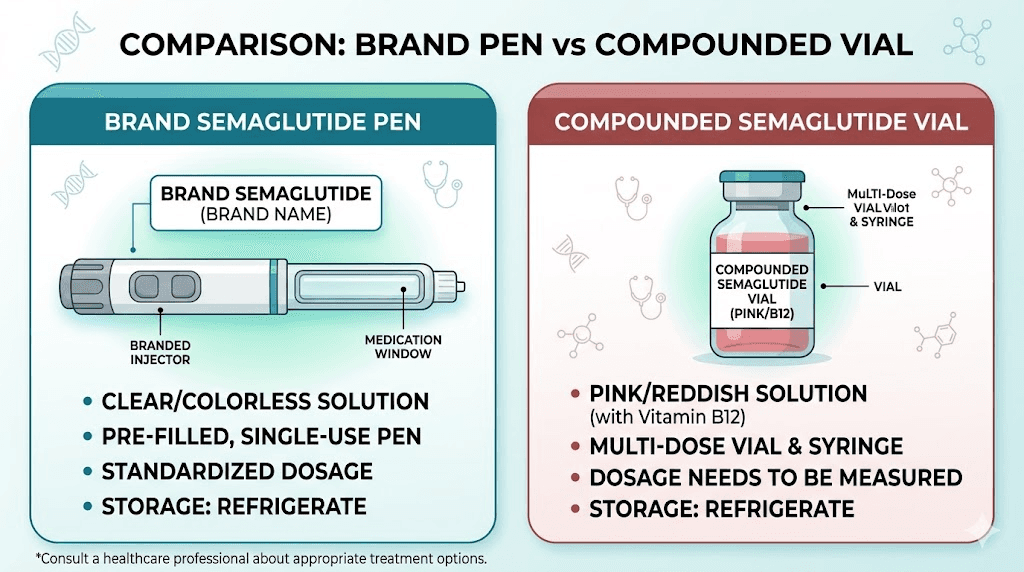
Ozempic and Wegovy are manufactured by Novo Nordisk. Both products contain semaglutide as the sole active pharmaceutical ingredient, along with inactive ingredients like disodium hydrogen phosphate dihydrate, propylene glycol, phenol, and water for injection. None of these additives contribute any visible color. Brand-name semaglutide is always clear, colorless, and free of particles. If your Ozempic or Wegovy pen contains pink, red, yellow, or cloudy liquid, do not use it. Contact the pharmacy or manufacturer immediately.
Compounded semaglutide
Compounded semaglutide is a different story entirely. These formulations are prepared by 503A or 503B compounding pharmacies that may add supplementary ingredients based on the prescribing provider specifications. The most common additive is vitamin B12, which turns the solution pink. But pharmacies may also include pyridoxine (vitamin B6), niacinamide (vitamin B3), glycine, or L-carnitine. Each of these can contribute slight color variations to the final product.
The color you see should match what the label describes. A semaglutide-glycine-B12 blend will be pink. A formulation with only glycine and no B12 will typically be clear. The label is your reference point. Always check it.
If you are unsure whether your compounded semaglutide should be pink, SeekPeptides maintains detailed guides on every major compounded formulation to help you understand exactly what you are working with.
Every semaglutide color decoded
Color is information. Here is what each shade means and whether it signals safety or danger.
Clear and colorless
This is the standard appearance for brand-name semaglutide and for compounded formulations that do not contain B12 or other colored additives. Clear and colorless semaglutide should be completely transparent. Hold the vial up to a light source. You should be able to see through it as easily as water. No haze, no tint, no floating particles. If your reconstituted semaglutide is clear after mixing, that is normal for formulations without B12.
Light pink
The most common color for compounded semaglutide containing B12 at standard concentrations around 0.5 mg/mL. Light pink is completely normal. The color should be uniform throughout the vial with no darker spots, streaks, or gradients. Think of the color of diluted cranberry juice or a very pale rose wine. This shade indicates the B12 is properly dissolved and evenly distributed in the solution.
Darker pink to light red
Some compounding pharmacies use higher B12 concentrations, or the formulation may include both cyanocobalamin and methylcobalamin. This can produce a deeper pink that borders on light red. As long as the color matches what you have seen in previous vials from the same pharmacy and the label confirms B12 content, a darker pink is not alarming. But if the color has changed dramatically from one vial to the next from the same pharmacy and same prescription, call them to confirm consistency.
Bright red or dark red
This warrants caution. While very high B12 concentrations can produce a red solution, most compounded semaglutide should not look like deep red liquid. If the solution is significantly redder than previous vials, or if the label does not mention B12, this could indicate contamination or degradation. Do not use it without contacting the pharmacy first.
Yellow or amber
Stop. Yellow or amber discoloration in semaglutide is a warning sign. This color typically indicates oxidation or chemical degradation of the peptide. Semaglutide molecules are sensitive to heat and light exposure. When they break down, the degradation products can produce a yellowish tint. A yellow solution may have lost potency, may contain breakdown products that are not intended for injection, or both. Do not inject yellow semaglutide. If your vial has turned yellow, check your storage conditions and contact the dispensing pharmacy.
Brown
Discard immediately. Brown semaglutide indicates severe degradation, extended heat exposure, or both. This medication is no longer safe to use regardless of what the expiration date says. Brown coloration means the peptide structure has likely been compromised beyond any reasonable margin of safety. Check whether the vial was exposed to heat during shipping or if it was left out of the refrigerator.
Cloudy or turbid
Cloudiness means particulate contamination, microbial growth, or protein aggregation. None of these are acceptable. Semaglutide solutions should always be transparent, whether they are clear, pink, or any other expected color. You should be able to see through the liquid clearly. If you cannot, the vial is compromised. Do not inject cloudy semaglutide under any circumstances. This is not a gray area. Cloudy means contaminated.
Particles or flakes visible
Visible particles floating in the solution indicate that something has precipitated out of the formulation or that foreign matter has entered the vial. This can happen when medication expires, when vials are stored improperly, or when contamination occurs during reconstitution. Any visible particulate matter means the vial should be discarded.
Compounded semaglutide additives that change color
Understanding what goes into your compounded semaglutide formulation helps you predict and verify the color you see. Each additive has its own visual signature.
Vitamin B12 (cyanocobalamin and methylcobalamin)
B12 is the dominant color contributor. At 0.5 mg/mL, the concentration most pharmacies use, it produces a distinct pink. Cyanocobalamin tends to be slightly more stable and produces a consistent pink over the shelf life of the product. Methylcobalamin is the bioactive form, meaning the body can use it directly without conversion. However, methylcobalamin is more sensitive to light degradation, which means the color might shift slightly over time if the vial is exposed to ambient light. Both forms are effective at preventing the B12 deficiency that GLP-1 medications can cause.
The reason B12 appears in so many compounded semaglutide formulations is not cosmetic. Research consistently shows that long-term GLP-1 receptor agonist use correlates with decreased B12 levels. Addressing this proactively through the injection itself is elegant pharmacology.
Vitamin B6 (pyridoxine)
Pyridoxine is added primarily to help with nausea, one of the most common side effects of semaglutide, especially during the dose titration phase. Vitamin B6 has a long history of use as an anti-nausea agent, particularly during pregnancy. In compounded semaglutide, it serves double duty: reducing GI discomfort and supporting amino acid metabolism.
Pure pyridoxine hydrochloride solution is nearly colorless to slightly yellowish. At the low concentrations used in compounded semaglutide, B6 alone would not produce a visible color change. But when combined with B12, it can slightly alter the overall hue, potentially pushing the pink toward a slightly warmer or more salmon-like tone. This is subtle and generally not noticeable unless you are comparing vials side by side.
Niacinamide (vitamin B3)
Niacinamide supports cellular energy metabolism and has been included in some compounded formulations to help offset the fatigue that some people experience on semaglutide. On its own, niacinamide in solution is colorless to slightly yellowish. Combined with B12, it does not dramatically change the expected pink color. The presence of niacinamide is more about function than appearance. If your label lists niacinamide and B12, expect the same pink color you would see with B12 alone, possibly with the faintest warm undertone.
Glycine
Glycine is an amino acid included in compounded semaglutide for multiple reasons. It acts as a buffer to maintain pH stability. It supports muscle preservation during weight loss. And it may help with sleep quality, which some semaglutide users find disrupted. Glycine in solution is completely colorless. It will not change the appearance of your semaglutide at all. If your formulation contains glycine and B12, the pink comes entirely from the B12. If it contains glycine without B12, the solution will be clear.
L-carnitine
L-carnitine facilitates fatty acid transport into mitochondria for energy production. Some compounding pharmacies add it to semaglutide formulations to enhance fat metabolism alongside the appetite suppression and metabolic effects of the GLP-1 agonist itself. L-carnitine solutions are typically colorless to very faintly yellow. At the concentrations used in compounded semaglutide, it contributes minimal visible color on its own.
When multiple additives combine in a single formulation, the color you see is the sum of all contributors. A semaglutide-glycine-B12 formulation will be pink. A semaglutide-glycine formulation without B12 will be clear. A formulation with B12, B6, and niacinamide together will be predominantly pink from the B12 with perhaps a slightly different quality to the hue. In every case, the label tells you what to expect.
Pink vs red: understanding the shade spectrum
Not all pink is created equal. And the line between pink and red matters more than most people realize.
Light pink, the color of diluted watermelon juice, is the standard and expected shade for compounded semaglutide with B12 at 0.5 mg/mL. This is the shade that thousands of people see when they open their vials from reputable compounding pharmacies. It is consistent, predictable, and reassuring once you know what causes it.
Medium pink, closer to a strawberry milkshake, can occur with slightly higher B12 concentrations or when the formulation is newer and has not had time for any light-related fading. This is still within the normal range. Check your label. If B12 is listed, medium pink is fine.
Dark pink approaching red is where attention sharpens. Some pharmacies do use higher B12 doses, and some formulations combine B12 with other ingredients that contribute warmth to the color. But if you have received the same prescription from the same pharmacy multiple times and this vial is dramatically darker than previous ones, that inconsistency deserves a phone call. Compounding pharmacies have quality control processes, but variation can occur. A simple call to confirm the batch is within specification takes two minutes and provides peace of mind.
True red, the color of cranberry juice concentrate, is unusual for standard compounded semaglutide. While very high B12 concentrations could theoretically produce this shade, most formulations do not use concentrations that would turn the solution this dark. If your semaglutide is truly red and this is different from what you normally receive, do not use it until you have confirmed with the pharmacy that the batch is correct.
The rule of thumb is consistency. Your compounded semaglutide should look roughly the same every time you get a new vial from the same pharmacy with the same prescription. Gradual, slight variation between batches is normal. A dramatic shift from light pink to dark red is not.
When pink semaglutide is completely safe to use
Pink semaglutide is safe when all of the following conditions are met. Every single one.
First, the label explicitly lists vitamin B12 (cyanocobalamin or methylcobalamin) as an ingredient. This is non-negotiable. The pink color must have an identified source. If the label does not mention B12 and the liquid is pink, something is wrong. Contact the pharmacy immediately.
Second, the color is uniform throughout the vial. Gently invert the vial a few times (do not shake it aggressively) and observe. The pink should be evenly distributed with no darker areas, streaks, or gradients. Uniform color means the B12 is properly dissolved and the solution is homogeneous.
Third, the solution is transparent. Hold the vial up to a light source, a window or a lamp. You should be able to see light passing through the liquid clearly. Pink and transparent is normal. Pink and cloudy is not. Transparency confirms the absence of particulate contamination or microbial growth.
Fourth, there are no visible particles. Look carefully, especially near the bottom of the vial and around the rubber stopper. Tilt the vial slowly and watch for any specks, flakes, or fibers moving through the liquid. Any visible particulate matter disqualifies the vial from use.
Fifth, the vial has been stored properly. Compounded semaglutide belongs in the refrigerator at 36 to 46 degrees Fahrenheit (2 to 8 degrees Celsius). If the vial has been out of the fridge for extended periods, exposed to direct sunlight, or frozen, the formulation may be compromised regardless of its color. Proper storage history is part of the safety equation.
Sixth, the medication has not expired. Check the beyond-use date on the label. Compounded medications have shorter expiration windows than manufactured drugs. Using a vial past its beyond-use date, even if the color looks fine, introduces unnecessary risk. If you are wondering about the shelf life of semaglutide, check the specific guidance for your formulation type.
When all six conditions are met, pink semaglutide from a licensed compounding pharmacy is as safe to use as any clear formulation. The color is a feature, not a flaw.
Warning signs that mean you should stop and not inject
Trust your eyes. They are your first line of defense.
Do not inject semaglutide that has turned yellow or brown. These colors indicate chemical degradation, oxidation, or heat damage. The peptide structure may be compromised, and injecting degraded semaglutide means injecting breakdown products of unknown safety and zero efficacy. If your vial was clear or pink and has shifted to yellow or amber, the medication has been damaged. Discard it.
Do not inject semaglutide that is cloudy. Cloudiness in any injectable medication is a red flag for microbial contamination or particulate formation. Even if the cloudiness is subtle, even if it clears slightly when you warm the vial in your hands, cloudiness means the sterility of the product is in question. The risk of injecting contaminated material far outweighs the cost of replacing a vial.
Do not inject semaglutide containing visible particles. Fibers, flakes, crystals, or any solid matter floating in the solution indicates that the formulation has destabilized or that foreign material has entered the vial. Particulate contamination can cause injection site reactions, abscess formation, or worse. One visual inspection takes thirty seconds. Do it every time.
Do not inject semaglutide that is pink when the label does not list B12. This is critical. If the liquid in your vial is pink and the ingredient list does not include cyanocobalamin, methylcobalamin, or any other B-vitamin, the color is unexplained. Unexplained color changes in pharmaceutical products always warrant investigation before use. Call the pharmacy. Ask them to verify the contents and explain the color.
Do not inject semaglutide that has been frozen. Freezing can cause the peptide to denature and aggregate. Even if the solution looks clear after thawing, the molecular structure of the semaglutide may be irreversibly altered. Ice crystal formation disrupts protein folding in ways that are not visible to the naked eye but absolutely affect safety and efficacy. If your shipment arrived in questionable condition, whether too hot or too cold, contact the pharmacy before using it.
Do not inject semaglutide from a vial with a compromised seal. If the rubber stopper shows signs of coring (pieces breaking off into the solution), if the crimp cap is loose, or if there is any indication that the vial has been tampered with or improperly sealed, the sterility cannot be guaranteed.
How storage affects semaglutide color over time
Storage is everything. The same vial of semaglutide can look completely different after two weeks of proper refrigeration versus two weeks on a bathroom counter. Temperature, light, and time are the three variables that determine whether your medication maintains its intended appearance and potency.
Temperature effects
Semaglutide should be stored at 36 to 46 degrees Fahrenheit (2 to 8 degrees Celsius). At these temperatures, the peptide remains stable and the solution retains its original color. Refrigerated semaglutide maintains its properties for the duration specified by the beyond-use date on the label.
At room temperature, degradation accelerates. How much depends on the specific temperature. A climate-controlled room at 68 degrees is very different from a bathroom that reaches 80 degrees during a hot shower. Most compounded semaglutide can tolerate brief periods at room temperature, typically limited time unrefrigerated, but extended exposure begins breaking down the peptide. The first visible sign of heat damage is often a shift toward yellow. By the time the solution looks amber, significant degradation has occurred.
Freezing is equally destructive but in a different way. Ice crystals physically disrupt the peptide structure. The solution may look fine after thawing, but the semaglutide molecules can be denatured beyond function. Never freeze semaglutide, and if it arrives frozen from shipping, request a replacement.
Light effects
Light, particularly ultraviolet light, accelerates the degradation of both semaglutide and its additives. Methylcobalamin is especially sensitive to light. A vial of B12-containing semaglutide left on a windowsill will lose B12 potency faster than one stored in a dark refrigerator. The visual sign of light degradation varies. In some cases the pink may fade. In others, the overall solution may shift toward a slightly different hue. Keep your vials in their original packaging inside the refrigerator. The cardboard box is not just packaging. It is light protection.
Time effects
Even under perfect storage conditions, compounded semaglutide has a finite shelf life. The beyond-use date printed on the label reflects the compounding pharmacy determination of how long the formulation remains stable and potent. As the expiration approaches, subtle changes may begin. These are not always visible, which is why the date matters more than the appearance. A vial that looks perfectly pink on its expiration date is still past its verified stability window, and using expired semaglutide introduces uncertainty about both safety and efficacy.
If you will not finish a vial before the beyond-use date, plan your dosing schedule to align with your supply. This avoids waste and ensures every injection comes from fresh, properly stored medication. For questions about how long a specific vial lasts, refer to your pharmacy or check guidelines for vial storage duration in the refrigerator.
Step by step visual inspection before every injection
This takes less than a minute. Do it every single time. No exceptions.
Step 1: Check the label
Before you even look at the liquid, read the label. Confirm the medication name, concentration, beyond-use date, and ingredient list. If B12 is listed, expect pink. If no B12 is listed, expect clear. If the beyond-use date has passed, stop. Get a new vial. Do not use expired medication.
Step 2: Check the seal
Examine the crimp cap and rubber stopper. The cap should be intact and firmly in place. If you are using a multi-dose vial that you have been drawing from, check that the stopper has not been cored (small pieces of rubber pushed into the vial by the needle). Hold the vial upside down and look at the stopper from the inside. Any rubber fragments in the solution mean the vial should be discarded.
Step 3: Check the color
Hold the vial at eye level against a white background if possible. A white piece of paper behind the vial works well. Assess the color. Is it consistent with what you expect based on the label ingredients? Is it the same shade as previous vials from this pharmacy? Has anything changed since you last drew from this vial? Compare against the semaglutide color guide if you are unsure.
Step 4: Check clarity
Hold the vial up to a light source. A lamp, a window, a flashlight on your phone. The liquid should be transparent, meaning you can see clearly through it. Pink and transparent is fine. Clear and transparent is fine. Any degree of haziness, cloudiness, or opacity is not fine. If you cannot read newsprint through the vial, the solution is too cloudy to use safely.
Step 5: Check for particles
Gently invert the vial two or three times. Do not shake it vigorously, as this can cause foaming that mimics cloudiness and can damage the peptide through mechanical stress. After inverting, hold the vial still and observe for thirty seconds. Watch for anything moving through the liquid: fibers, specks, crystals, or any solid matter. Tilt the vial at different angles. Check near the stopper where small particles can get trapped. If you see anything, discard the vial.
Step 6: Confirm storage history
Think back. Has this vial been in the refrigerator since you last used it? Was it left out during your last injection and forgotten on the counter? Did you travel with it recently? If there is any gap in the cold chain, assess how long the vial was at room temperature and whether that exceeds the allowable window. When in doubt, check the time limits for unrefrigerated semaglutide.
Only after all six steps confirm acceptable results should you proceed with drawing your dose and injecting.
What to do if your semaglutide color looks wrong
You have inspected your vial. Something looks off. Now what?
If the color is unexpectedly pink (and label does not list B12)
Do not inject. Set the vial aside and contact the dispensing pharmacy. Explain that the solution is pink but the label does not list vitamin B12 or any other ingredient that would explain the color. Ask them to verify the formulation for your specific vial lot number. This could be a labeling error, a dispensing error, or a sign of contamination. All three require pharmacy involvement to resolve. Never assume the color is fine if it does not match the ingredients listed.
If the color has changed from previous vials
Batch-to-batch variation in compounded medications does occur. Slight differences in pink intensity between two vials from the same pharmacy are usually within normal limits. But a significant color shift, going from light pink to dark red, for example, deserves a phone call. The pharmacy can check whether the formulation changed, whether a different B12 source was used, or whether there might be a quality concern with that batch.
If the solution has turned yellow or brown
Discard the vial. Do not contact the pharmacy to ask if it is still usable. Yellow or brown semaglutide is degraded semaglutide, and no conversation with a pharmacist will reverse chemical degradation. Request a replacement if the vial is within its beyond-use date and was stored properly, as this could indicate a manufacturing or shipping issue the pharmacy needs to know about.
If the solution is cloudy
Discard the vial. Cloudiness indicates microbial contamination, particulate formation, or protein aggregation. None of these can be fixed. Contact the pharmacy to report the issue and request a replacement. If you have other vials from the same batch, inspect them carefully as well.
If you see particles
Discard the vial. Visible particles mean the formulation has destabilized or been contaminated. Even a single visible fiber or speck disqualifies the entire vial. Report the issue to the pharmacy.
General rule
When in doubt, do not inject. The cost of replacing a vial of semaglutide is always less than the cost of injecting compromised medication. Always err on the side of caution. And if you are ever uncertain about what you are seeing, SeekPeptides offers resources and semaglutide tips that can help you assess the situation before making a decision.
How compounding pharmacies create semaglutide formulations
Understanding where your medication comes from helps you understand what you are looking at when you inspect the vial. Compounding pharmacies are not the same as pharmaceutical manufacturers. They operate under different regulations, use different processes, and produce different types of products.
503A vs 503B pharmacies
Section 503A compounding pharmacies prepare medications based on individual patient prescriptions. Each preparation is, in theory, customized for a specific patient. These pharmacies are regulated primarily at the state level by state boards of pharmacy.
Section 503B outsourcing facilities operate under more stringent FDA oversight and can compound medications in larger batches without individual prescriptions. They must comply with Current Good Manufacturing Practices (cGMP) similar to traditional pharmaceutical manufacturers. Products from 503B facilities generally have more standardized quality control, which can mean more consistent color and appearance between batches.
When choosing a source for compounded semaglutide, the pharmacy type matters. Empower Pharmacy, Olympia Pharmacy, Direct Meds, Brello, PeterMD, and Precision Peptides are all names you may encounter in the compounded semaglutide space. Each has its own formulation approach, additive profile, and resulting color.
The compounding process
Compounding pharmacies begin with pharmaceutical-grade semaglutide base powder. This powder is white to off-white. It is then dissolved in a sterile solution, typically bacteriostatic water containing benzyl alcohol as a preservative. If the prescription calls for B12, the cyanocobalamin or methylcobalamin is dissolved in the same solution. Additional additives like glycine, B6, or L-carnitine are added per the formulation specification.
The mixture is then filtered through a 0.22-micron sterile filter to remove any microbial contaminants or particulates. The filtered solution is aseptically filled into sterile vials, sealed with rubber stoppers, and crimped with aluminum caps. The resulting product is the vial that arrives at your door or pharmacy.
The pH is adjusted to ensure stability and comfort upon injection. Glycine often serves as both a buffering agent and a functional additive. The final pH typically falls between 7.0 and 8.0, which is close to physiological pH and minimizes injection site irritation.
The FDA salt form concern
The FDA has issued warnings about compounded semaglutide products using salt forms of the molecule, specifically semaglutide sodium and semaglutide acetate. The FDA position is that these salt forms are not the same as the semaglutide base used in approved products like Ozempic and Wegovy. The agency has raised concerns that the safety and efficacy of these salt forms have not been established through clinical trials.
This is relevant to the color conversation because different salt forms may behave differently in solution. If a pharmacy is using semaglutide sodium instead of semaglutide base, the color, stability, and behavior of the solution may not follow the same patterns described in this guide. Checking whether your compounding pharmacy uses the semaglutide base form is an important quality consideration. The compounded semaglutide guide covers this topic in more depth.
Quality indicators beyond color
Color is one quality indicator, but not the only one. Reputable compounding pharmacies also provide Certificates of Analysis (COAs) for their products, showing potency testing, sterility testing, endotoxin testing, and pH verification. If your pharmacy cannot provide a COA upon request, that is a significant red flag regardless of what color the solution looks like. A certificate of analysis confirms that the product contains the correct amount of semaglutide, that it is sterile, and that it meets all relevant quality specifications.
The relationship between semaglutide dosing and B12 intake
When your compounded semaglutide contains B12, every injection delivers a measured amount of both compounds. Understanding this relationship helps you appreciate why the pink color is not just cosmetic.
A typical compounded semaglutide vial might contain 5 mg of semaglutide and 0.5 mg/mL of B12 in a multi-dose format. When you draw your dose in units, the B12 comes along proportionally. At a low starting dose of 0.25 mg semaglutide, you might be getting roughly 25 to 50 mcg of B12 depending on the concentration and volume drawn. At higher maintenance doses, the B12 delivery increases accordingly.
For reference, the recommended daily allowance of B12 for adults is approximately 2.4 mcg. Even a small injection volume from a B12-containing semaglutide formulation delivers many times that amount, which is not a concern. B12 is water-soluble, and excess amounts are simply excreted by the kidneys. There is no established upper toxicity limit for B12 supplementation. This means the B12 in your pink semaglutide is providing nutritional insurance without any risk of overdose.
If you are working through the 5mg/mL dosage chart or using a semaglutide dosage calculator, the B12 component does not affect your semaglutide dose calculations. The semaglutide concentration is stated independently on the label, and your dose is based on that number alone.
Some people wonder whether the B12 in their compounded semaglutide is sufficient to prevent deficiency or if they need additional supplementation. This depends on individual factors including baseline B12 levels, dietary intake, and the specific dose of semaglutide being used. Higher semaglutide doses suppress more gastric acid and may require more B12 replacement. Checking B12 levels through periodic blood work is the most reliable way to know.
Comparing semaglutide color to tirzepatide color
If you have used both semaglutide and tirzepatide, or if you are considering switching, you may notice that compounded versions of both medications can appear colored. The reasons are identical. Compounding pharmacies add similar additives to both GLP-1 receptor agonists for similar reasons.
Tirzepatide color follows the same patterns. Brand-name Mounjaro is clear and colorless. Compounded tirzepatide without B12 is clear and colorless. Compounded tirzepatide with B12 is pink. Tirzepatide with B12 looks almost indistinguishable from semaglutide with B12, assuming similar B12 concentrations.
The same warning signs apply across both medications. Yellow means degradation. Cloudy means contamination. Particles mean discard. The color safety principles in this guide apply to any injectable GLP-1 agonist containing B12.
For those comparing the two medications more broadly, the semaglutide vs tirzepatide comparison covers mechanism differences, side effect profiles, and conversion guidance. And if you are switching from one to the other, the conversion chart provides dosing equivalency guidance.
Tirzepatide formulations can also include glycine, niacinamide, methylcobalamin, and levocarnitine as additives. The tirzepatide-glycine-B12 compound is one of the most common compounded tirzepatide formulations and has that same familiar pink appearance. If you are using both medications or rotating between them, the color comparison can actually serve as a quick consistency check. Both should be the same shade of pink if they contain the same B12 concentration.
Practical tips for new semaglutide users
Starting semaglutide for the first time can be overwhelming. Between learning how to inject with a syringe, figuring out injection sites, managing the first week of side effects, and now worrying about why your liquid is pink, there is a lot to process.
Here is a practical framework to simplify things.
When your first vial arrives, take a photo of it. Hold it against a white background with good lighting. This photo becomes your reference. Every subsequent vial from the same pharmacy and same prescription should look like this photo. If it does not, you have a visual baseline for comparison and a photo to share with the pharmacy when you call.
Write the date you first punctured the vial on the label with a permanent marker. This helps you track how long the vial has been in use and whether you are approaching the 28-day usage window that many compounded formulations specify.
Keep a simple log. Date, dose, injection site, vial appearance. This takes ten seconds per injection and creates a record that can be invaluable if you ever need to troubleshoot a color change, a loss of efficacy, or an unexpected side effect. Resources like the week-by-week results tracker can help structure this.
If you prefill syringes, be aware that the color may appear slightly different in a syringe versus a vial due to the smaller volume and different material (glass vial versus plastic syringe barrel). This is normal. The pink will look lighter in a thin syringe compared to a full vial simply because there is less liquid for the light to pass through.
For those who travel with semaglutide, invest in a proper GLP-1 travel case that maintains cold temperatures. Color changes during travel are often the first sign that your cold chain was compromised. If your semaglutide was pink when you left home and looks different when you reach your destination, the travel conditions may have affected the medication.
Understanding formulation beyond color
Color tells you about B12 content. But there is more to a compounded semaglutide formulation than what you can see.
Concentration matters
Compounded semaglutide comes in various concentrations, commonly 1 mg/mL, 2.5 mg/mL, and 5 mg/mL. The concentration determines how many units you draw for each dose. A higher concentration means a smaller injection volume for the same semaglutide dose. Understanding your specific concentration is essential for accurate dosing, whether you are following a dose chart or calculating independently.
The concentration does not directly affect color. A 1 mg/mL semaglutide with B12 and a 5 mg/mL semaglutide with B12 will be the same shade of pink if they contain the same B12 concentration. The B12 concentration is what determines the pink intensity, not the semaglutide concentration.
Reconstitution considerations
Some compounded semaglutide arrives as a lyophilized (freeze-dried) powder that requires reconstitution before use. If you are reconstituting with plain bacteriostatic water, the resulting solution should be clear. If the pharmacy provides a reconstitution solution that already contains B12, the reconstituted product will be pink.
When reconstituting, the volume of diluent you use matters. Mixing 5mg semaglutide or mixing 10mg semaglutide with bacteriostatic water requires specific ratios to achieve the target concentration. Adding too much water dilutes the medication. Adding too little concentrates it. The reconstitution calculator eliminates guesswork from this process.
After reconstitution, the solution should be completely clear (or evenly pink if B12 is present). If the powder does not dissolve completely, leaving visible particles or a cloudy suspension, do not inject. Gently swirl the vial, do not shake. If the powder still will not fully dissolve after gentle swirling over several minutes, contact the pharmacy.
Sublingual and oral formulations
Not all semaglutide is injectable. Sublingual semaglutide and oral semaglutide drops are alternative delivery methods that some providers prescribe. These formulations have different appearance standards than injectable products. Color expectations for sublingual or oral formulations may differ based on their specific inactive ingredients and delivery format. The visual inspection principles in this guide are specifically for injectable semaglutide.
Long-term considerations for semaglutide users
As you continue using semaglutide over weeks and months, the color of your medication becomes a familiar constant. But long-term use brings its own considerations.
B12 monitoring becomes more important the longer you use semaglutide. Even with B12 included in your compounded formulation, individual absorption and utilization varies. Ask your prescribing provider to include B12 levels in your regular blood panels. If levels are trending downward despite B12-containing semaglutide, additional supplementation may be needed. This is part of the monitoring protocols that informed semaglutide users follow.
Dose changes over time can affect your vial appearance. As you titrate up through the standard dose escalation, you draw larger volumes from the vial, which means the vial empties faster. A nearly empty vial may look slightly different from a full one simply because the liquid volume changes how light passes through. This is an optical effect, not a formulation change.
If you hit a weight loss plateau or feel like your compounded semaglutide is not working, color can be a diagnostic clue. If the solution looks the same as always, the issue is probably not medication degradation. Look at other factors: dietary changes, caloric intake, protein intake, exercise patterns, and dose adequacy. But if the color has shifted, if the solution has gone from pink to slightly yellow or from clear to slightly cloudy, that could indicate medication compromise.
When considering how long to stay on semaglutide, the formulation you are using matters. Some users eventually transition from compounded to brand-name, or vice versa. If you switch from a B12-containing compounded version to brand-name Ozempic, the loss of automatic B12 supplementation means you will need to address B12 intake through diet or separate supplements. If you take a break and then restart semaglutide after time off, remember to restart at a lower dose regardless of what your previous dose was.
Common myths about semaglutide color
Misinformation travels fast, especially in online communities. Here are the most common myths about semaglutide color and the reality behind each one.
Myth: Pink semaglutide is stronger than clear semaglutide
False. The pink color comes from B12, not from a higher concentration of semaglutide. A clear 5 mg/mL semaglutide vial and a pink 5 mg/mL semaglutide vial contain exactly the same amount of semaglutide per milliliter. The B12 is a supplementary ingredient that does not affect the potency of the GLP-1 agonist itself.
Myth: You should shake the vial if the color looks uneven
False. Never shake injectable peptide formulations. Vigorous shaking creates foam and can denature the peptide through mechanical stress. If the color appears uneven, gently invert the vial two or three times. If the color does not become uniform after gentle mixing, the formulation may have a problem. Contact the pharmacy.
Myth: Semaglutide that has turned slightly yellow is still fine if it smells normal
False. You should never smell injectable medications, and even if you did, degraded semaglutide does not have a detectable odor. Yellow discoloration indicates chemical breakdown regardless of any other sensory assessment. Discard it.
Myth: Freezing semaglutide and thawing it is fine as long as you do it slowly
False. The rate of thawing does not reverse the damage caused by ice crystal formation. Peptide denaturation from freezing is a structural change at the molecular level that cannot be undone by any thawing method. If your semaglutide froze, whether in the fridge on an overly cold shelf or during shipping, treat it as compromised.
Myth: Compounded semaglutide is less effective than brand-name because it looks different
False. Appearance and efficacy are unrelated when the formulation contains the correct active ingredient at the correct concentration. The FDA concerns about compounded semaglutide center on salt forms and regulatory oversight, not on the color imparted by supplementary vitamins. A properly compounded semaglutide with B12 that passes potency testing delivers the same pharmacological effect as brand-name semaglutide.
Managing side effects while using B12-containing semaglutide
The additives in your pink semaglutide are designed to mitigate some common side effects, but they do not eliminate all of them. Understanding what to expect helps you distinguish between normal adjustment and genuine problems.
Bloating is common during the first few weeks, especially at each dose increase. B12 and B6 do not directly address bloating, but proper dietary planning can help. Eating smaller meals, avoiding carbonated beverages, and focusing on the recommended foods for semaglutide users while limiting foods to avoid makes a measurable difference.
Constipation and GLP-1 related digestive slowdown affect many users. Glycine, if included in your formulation, may help slightly with gut motility, but dietary fiber, hydration, and sometimes supplementation remain the primary management strategies.
Acid reflux and burping including the notorious sulfur burps are among the most commonly reported GI side effects. These tend to improve over time as the body adjusts to the medication. The timing of your injection can sometimes influence whether GI symptoms peak during the day or overnight.
If you experience lightheadedness or leg cramps, these may relate to reduced caloric intake rather than the medication itself. Ensuring adequate electrolyte and fluid intake is essential. Supplements recommended for GLP-1 users can address common nutritional gaps.
Other side effects like insomnia, menstrual changes, and hair loss have been reported by some users. These are related to the semaglutide itself and the metabolic changes it triggers, not to the B12 or other additives. Understanding the full side effect profile helps you know what is expected versus what requires medical attention. The timeline question of when side effects begin varies by individual but most people notice GI effects within the first few days of each dose increase.
Drug interactions and combination considerations
The B12 in your pink semaglutide does not create additional drug interaction concerns beyond those of semaglutide alone. However, if you are taking other medications alongside semaglutide, understanding the interaction landscape is important.
Metformin and semaglutide is one of the most common combinations. Notably, metformin itself can impair B12 absorption, which makes the B12 in compounded semaglutide even more valuable for patients on both medications. The double B12-depleting effect of metformin plus semaglutide makes periodic B12 monitoring essential.
Phentermine and semaglutide is another combination that some providers prescribe, particularly during initial weight loss phases. The B12 component of compounded semaglutide does not interact with phentermine. The phentermine vs semaglutide comparison covers the pros and cons of each approach.
Natural supplements like berberine are sometimes used alongside semaglutide. Again, the B12 additive does not change the interaction profile. Alcohol use is a common question as well. Drinking on semaglutide carries specific risks related to delayed gastric emptying and blood sugar effects, but these are semaglutide effects, not B12 effects.
For users considering combining semaglutide and tirzepatide, this is a clinical decision that requires direct supervision from a qualified provider. The color of either medication does not inform this decision.
When to check in with your provider
The color of your semaglutide is one piece of a larger picture. Regular check-ins with your prescribing provider ensure that the overall treatment plan is working. Here are the non-negotiable reasons to reach out.
Unexpected color changes not explained by the label. We have covered this thoroughly. But it bears repeating because it is the most actionable visual observation you can make.
Loss of efficacy. If you were seeing steady monthly results and they have stalled despite adherence to dosing and dietary protocols, the issue could be dose-related, formulation-related, or physiological. Your provider can help distinguish between these causes.
Side effects that worsen over time instead of improving. Most semaglutide side effects peak early and diminish with continued use. If your GI symptoms are getting worse, not better, especially after weeks at the same dose, something may need adjustment.
Signs of B12 deficiency despite B12-containing semaglutide. Persistent fatigue, tingling in the hands or feet, difficulty concentrating, or headaches could indicate B12 deficiency even with supplementation. Blood work is the definitive test.
Changes in liver enzymes. Semaglutide can affect liver enzyme levels in some users. Regular blood panels that include a comprehensive metabolic panel will catch this early.
Questions about stopping semaglutide or managing withdrawal symptoms. If you are considering discontinuation, whether permanently or temporarily, your provider can guide the tapering process to minimize rebound effects.
Understanding injection technique with colored formulations
The color of your semaglutide does not change how you inject it. But for new users, seeing pink liquid in a syringe can feel different than seeing clear liquid, even though the technique is identical.
Draw your dose as prescribed. Proper syringe technique involves inserting the needle through the rubber stopper, inverting the vial, and drawing back the plunger to the correct unit marking. With pink semaglutide, you may actually find it easier to see the liquid level in the syringe compared to a clear solution, which can be nearly invisible against the syringe markings. This is a minor practical advantage of colored formulations.
Choose your injection site as you normally would. The abdomen, thigh, and upper arm are the standard subcutaneous injection sites. Rotate between sites to prevent lipodystrophy. The optimal GLP-1 injection sites and where to inject guides cover site selection in detail.
After injecting, if you notice a faint pink mark at the injection site, this is simply the B12 pigment in the small amount of liquid deposited subcutaneously. It fades quickly and is not an injection site reaction. True injection site reactions involve redness, swelling, heat, or pain that develops over hours, not the momentary pink tinge from the B12-containing solution. If you ever accidentally inject into muscle instead of subcutaneous tissue, the color of the medication does not change the protocol. Monitor the area and contact your provider if you experience unusual pain or swelling.
For those converting between unit measurements, the units to mg conversion and specific references like 40 units in mg, 50 units in mg, or 60 units in mg provide exact conversions for the most common dose volumes. Going the other direction, guides for 0.25 mg in units, 0.5 mg in units, 1 mg in units, and 2.5 mg in units are equally useful.
And if you are wondering about specific unit amounts like 20 units, 10 units, or 100 units, the answer always depends on your specific concentration. A peptide calculator removes the guesswork entirely. Accuracy matters. Whether you are asking if 20 units is too much or if 50 units is a lot, concentration is the variable that determines the answer.
Navigating the compounded semaglutide landscape
The market for compounded semaglutide has expanded significantly. With multiple pharmacies offering different formulations at different price points, understanding what you are getting and why it looks the way it does has never been more important.
Price should not be the only consideration. Low-cost compounded semaglutide is available, but the formulation, testing, and quality controls vary between providers. A cheaper product that uses semaglutide sodium salt instead of semaglutide base, or that does not provide a Certificate of Analysis, may not deliver the same safety profile regardless of its color.
SeekPeptides helps researchers navigate these decisions by providing comprehensive vendor comparisons, formulation breakdowns, and quality assessment criteria. Understanding what you are injecting, why it looks the way it does, and how to verify quality is central to using compounded peptides responsibly.
The qualification process for semaglutide varies by provider but generally requires a consultation with a licensed prescriber who will review your medical history, current medications, and treatment goals before issuing a prescription. The prescriber determines the formulation, including whether B12 and other additives are included. If you have a preference for a B12-containing (pink) formulation versus a clear one, discuss this with your provider before the prescription is written.
Storage best practices for B12-containing semaglutide
Because methylcobalamin is more light-sensitive than many other pharmaceutical compounds, B12-containing semaglutide deserves extra storage attention.
Keep the vial in its original box. The cardboard provides light protection that the glass vial alone does not. Store the box in the main compartment of your refrigerator, not in the door where temperatures fluctuate more with opening and closing. Not in the freezer. Not in the vegetable crisper where humidity is higher. The main shelf, toward the back where temperature is most stable.
Verify your refrigerator temperature periodically. A simple refrigerator thermometer costs a few dollars and tells you whether your fridge is actually maintaining 36 to 46 degrees Fahrenheit. Many consumer refrigerators run warmer or colder than the displayed setting. Your medication temperature should match peptide storage best practices, which apply across all injectable peptides.
When drawing doses from a multi-dose vial, minimize the time the vial spends outside the refrigerator. Remove it, draw your dose, and return it immediately. Leaving the vial on the bathroom counter while you prepare your injection site, prepare alcohol swabs, and gather supplies exposes it to unnecessary warmth and light.
If you are traveling, the semaglutide travel guide covers cold chain maintenance in detail. Airport security, hotel refrigerators, and the logistics of keeping medication cold during transit all require planning. The GLP-1 travel case guide covers the best options for portable cold storage.
For tirzepatide users who also use B12-containing compounded products, the storage principles are identical. Cold, dark, and upright. Same rules, same temperatures, same emphasis on minimizing exposure.
The bigger picture: why color literacy matters
This might seem like a lot of words about the color pink. But here is why it matters.
Injectable medications carry inherent risk. You are introducing a substance directly past your skin barrier and into your tissue. The body natural defenses against ingested contaminants, stomach acid, liver filtration, the entire first-pass metabolism, are bypassed completely. This means the quality of what you inject must be beyond reproach. Every time.
Visual inspection is your first-line quality check. It is fast, free, and requires no equipment beyond your own eyes and a light source. By knowing what colors are normal, what colors are dangerous, and what colors are ambiguous, you transform a moment of uncertainty into a moment of confident decision-making.
The users who get into trouble are not the ones who worry about pink semaglutide. They are the ones who inject medication they know looks wrong because they do not want to waste a dose or wait for a replacement. That is the mistake to avoid. The timeline of semaglutide results shows that this is a long-term protocol. Missing one dose while you verify a questionable vial will not derail your progress. But injecting compromised medication could create problems that derail far more than your schedule.
Color literacy is part of being an informed, responsible user. And SeekPeptides exists to ensure that every researcher and user has the information they need to make safe, confident decisions about their peptide protocols.
Knowing your GLP-1 medication inside and out
Whether your semaglutide is clear or pink, understanding the complete picture of your medication empowers you to use it safely and effectively. From reconstituting a 5mg vial to understanding the relationship between GLP-1 and brand names like Ozempic, knowledge builds confidence. Confidence builds consistency. And consistency drives results.
The average weight loss trajectory on GLP-1 medications shows that the users who achieve the best outcomes are the ones who maintain consistent dosing, follow proper storage protocols, and address concerns proactively rather than reactively. The before and after results that impress you online come from people who treated their medication seriously at every step, including the step where they looked at the vial before drawing each dose.
If you are still learning, that is fine. The GLP-1 reset guide and maintenance dose protocols provide frameworks for long-term use. Understanding the side effect differences between semaglutide and tirzepatide helps you evaluate whether your current medication is the best fit. And tools like the peptide cost calculator and semaglutide dosage calculator take the math out of daily management so you can focus on what matters: results.
The comparison with other peptides like sermorelin puts semaglutide in broader context. And understanding general GLP-1 injection technique alongside the syringe selection guide ensures you are equipped from every angle.
Frequently asked questions
Is pink semaglutide safe to inject?
Yes, as long as the label lists vitamin B12 (cyanocobalamin or methylcobalamin) as an ingredient. The pink color comes from B12, which is intentionally added to compounded semaglutide formulations. Verify that the solution is transparent, free of particles, uniform in color, properly stored, and within its expiration date before injecting. If all those criteria are met, pink semaglutide is completely safe.
Why does my semaglutide look different from the photos I see online?
Photos of brand-name semaglutide (Ozempic, Wegovy) show clear, colorless liquid because brand-name products do not contain B12 or other color-producing additives. Compounded semaglutide looks different because it often contains additional ingredients. If your medication is compounded, expect it to look different from brand-name photos. If your medication IS brand-name and looks colored, do not use it.
Can I tell the quality of my semaglutide just by looking at it?
Visual inspection identifies gross contamination, degradation, and color abnormalities, but it cannot verify potency, sterility, or endotoxin levels. A vial that looks perfect could still have subpotent semaglutide if the pharmacy made a compounding error. Visual inspection is necessary but not sufficient for complete quality assurance. Request a Certificate of Analysis from your pharmacy for full verification.
My semaglutide was pink last month but this vial is a slightly different shade of pink. Should I be concerned?
Slight batch-to-batch variation in compounded medications is normal. Compounding is not mass manufacturing, and minor differences in B12 dissolution, concentration precision, and raw material lots can produce subtle color differences. If the difference is slight and the formulation is the same on both labels, this is typically not concerning. If the difference is dramatic, a light blush versus a dark red, contact the pharmacy to confirm batch consistency.
Does the pink color mean my semaglutide has more ingredients and therefore more side effects?
The B12 that creates the pink color does not add clinically significant side effects. Vitamin B12 is one of the safest supplementary ingredients available, with no established upper toxicity limit. The semaglutide with B12 combination is designed to prevent deficiency, not to cause additional problems. Side effects you experience are almost certainly from the semaglutide itself, not from the B12.
What if my semaglutide started clear and turned pink over time?
A clear semaglutide solution should not turn pink over time. If this has happened, something has entered the vial that was not there initially. Possible causes include contamination during needle insertion or a labeling error where the vial actually did contain B12 but was not labeled as such. Do not use it. Contact the pharmacy with the lot number and describe what you are seeing.
Should I request semaglutide with or without B12?
This is a conversation to have with your prescribing provider. The benefits of B12 inclusion are real, particularly for long-term semaglutide users. The main reasons to request a formulation without B12 would be a documented B12 allergy (extremely rare) or a preference for managing B12 supplementation separately through oral supplements. Most providers recommend the B12-containing version for convenience and compliance.
Can I mix my own B12 into clear semaglutide?
Do not do this. Adding any substance to a sterile pharmaceutical vial introduces contamination risk, alters the pH and osmolality of the solution, and can potentially cause the semaglutide to precipitate or degrade. If you want B12 in your semaglutide, request it from the compounding pharmacy. If you want supplemental B12 separately, take it as a separate injection or oral supplement. Never mix pharmaceutical products outside of a compounding pharmacy environment.
External resources
FDA: Compounded versions of semaglutide - Official FDA guidance on compounded semaglutide safety and regulatory status
NIH Office of Dietary Supplements: Vitamin B12 fact sheet - Comprehensive reference on B12 forms, absorption, and supplementation
PubMed: Semaglutide research database - Peer-reviewed research on GLP-1 receptor agonists and nutritional impacts
USP Compounding Standards - United States Pharmacopeia standards for compounded sterile preparations
ASHP Drug Shortage Resource Center - Current information on GLP-1 medication availability and compounding regulations
The world of compounded semaglutide does not have to be confusing. Pink means B12. Clear means no B12. Yellow means degradation. Cloudy means contamination. That framework covers ninety-five percent of every color question you will ever have about the medication in your vial. For the other five percent, your pharmacy is a phone call away, and SeekPeptides members have access to detailed protocols, formulation guides, and community support to navigate every question that arises along the way. Whether you are in your first week or months into your protocol, informed use is safe use.
In case I do not see you, good afternoon, good evening, and good night. May your vials stay clear, your storage stay cold, and your protocols stay effective.