RECONSTITUTION CALCULATOR
Calculate exact concentration and injection volumes when mixing peptides
Reconstituting peptides means mixing freeze-dried peptide powder with bacteriostatic water.
The math determines your concentration (mcg/ml) and tells you exactly how much to draw in your syringe for each dose.
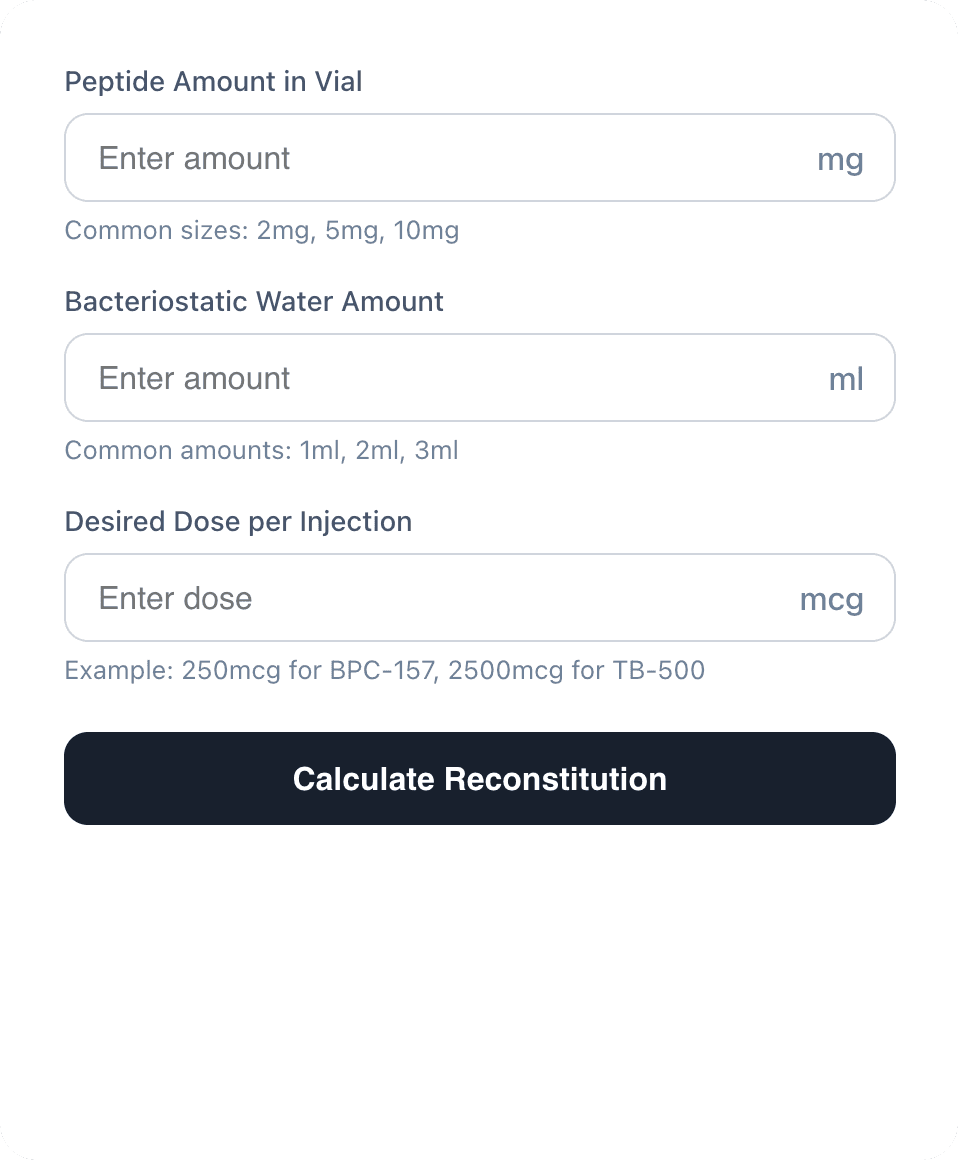
Get the concentration wrong and every dose is off. This calculator does the math instantly - enter your peptide amount (mg), water amount (ml), and target dose (mcg). Get your exact injection volume.
How peptide reconstitution works:
You receive peptides as lyophilized powder in a vial. Before you can inject, you must add bacteriostatic water. The amount of water you add determines concentration.
Example: 5mg peptide + 2ml water = 2,500mcg/ml concentration
If you need 250mcg per dose: 250mcg ÷ 2,500mcg/ml = 0.10ml to inject
More water = lower concentration = larger injection volumes. Less water = higher concentration = smaller injection volumes. Neither is better - choose based on your target dose size and syringe precision.
HOW
What you need:
Peptide vial (powder form)
Bacteriostatic water (0.9% benzyl alcohol)
3ml syringe for drawing water
Alcohol swabs
Refrigerator for storage
Reconstitution process:
Step 1: Remove plastic cap from peptide vial. Wipe rubber stopper with alcohol swab, let dry 10 seconds.
Step 2: Draw your chosen water amount into a 3ml syringe (typically 1-3ml).
Common amounts:
1ml for high concentration (smaller injections)
2ml for medium concentration (balanced)
3ml for low concentration (easier to measure small doses)
Step 3: CRITICAL TECHNIQUE - Aim needle at the inside wall of the vial, NOT directly at the powder. Inject water slowly down the glass wall. This prevents damage to peptide chains.
Step 4: DO NOT SHAKE. Let vial sit for 2-3 minutes. Powder dissolves on its own. Gentle swirling in circular motion is okay if needed.
Step 5: Solution should be clear. Cloudiness = contamination or damaged peptide. Don't use cloudy solutions.
Step 6: Refrigerate immediately at 2-8°C (36-46°F). Write reconstitution date on vial. Use within 2-4 weeks.
Why bacteriostatic water, not sterile water?
Bacteriostatic water contains benzyl alcohol preservative that prevents bacterial growth.
You're drawing multiple doses from one vial over weeks. Sterile water lacks preservative - bacteria can grow between uses.
Never use tap water or distilled drinking water. Not sterile. Will contaminate and destroy your peptide.
FREE TOOLS
FAQ
What is peptide reconstitution and why is it necessary?
Reconstitution is the process of adding bacteriostatic water to lyophilized (freeze-dried) peptide powder to create an injectable solution. Peptides are shipped as powder because they're more stable in this form. You must reconstitute them before use.
Can I use regular sterile water instead of bacteriostatic water?
How much bacteriostatic water should I add to my peptide vial?
How do I properly reconstitute peptides without damaging them?
How long do reconstituted peptides last in the refrigerator?
What does concentration mean and how does it affect my injections?
Can I reconstitute multiple vials at once to save time?
Why is my reconstituted peptide cloudy or has particles?