Mar 22, 2026
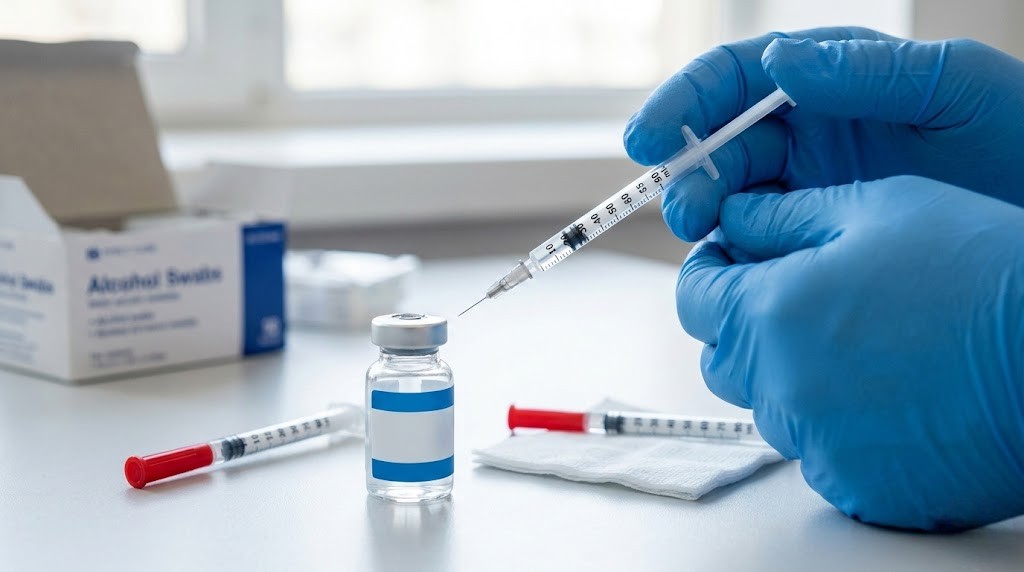
Some people draw up 50 units of semaglutide and get exactly 2.5 mg. Others draw up 50 units and get half that amount. Same syringe. Same medication name on the label. Completely different doses entering the body.
The difference comes down to one number that changes everything: concentration. And if you do not know the exact concentration of your semaglutide vial, every unit you draw is a guess. That is not a small problem. A dosing error with semaglutide does not just mean wasted medication. It means nausea that could have been avoided, appetite suppression that never arrives, or weeks of stalled progress while you wonder what went wrong.
Here is the reality. The number of units in 2.5 mg of semaglutide is not a fixed number. It ranges from 25 units to 250 units depending on what concentration you are working with. That range is enormous. And getting it wrong is one of the most common mistakes people make with compounded semaglutide.
This guide breaks down every concentration you will encounter, gives you the exact conversion math, and walks you through the process of calculating your dose with confidence. Whether you are using a 5 mg/mL vial, a 2.5 mg/mL formulation, or something else entirely, you will know exactly how many units to draw by the time you finish reading.
The quick answer: 2.5 mg of semaglutide in units by concentration
If you already know your vial concentration, here is your answer.
At 10 mg/mL concentration, 2.5 mg equals 25 units on a U-100 insulin syringe. At 5 mg/mL, it equals 50 units. At 2.5 mg/mL, it equals 100 units. And at 1 mg/mL, it equals 250 units.
Those numbers are not interchangeable. Drawing 50 units from a 2.5 mg/mL vial gives you only 1.25 mg, not 2.5 mg. That is half the intended dose. If you have been doing that for weeks, you now know why your results have been slower than expected.
Here is the complete conversion table:
Concentration | Units for 2.5 mg | Volume (mL) | Syringe needed |
|---|---|---|---|
10 mg/mL | 25 units | 0.25 mL | 0.3 mL or 0.5 mL syringe |
5 mg/mL | 50 units | 0.50 mL | 0.5 mL or 1 mL syringe |
3.33 mg/mL | 75 units | 0.75 mL | 1 mL syringe |
2.5 mg/mL | 100 units | 1.00 mL | 1 mL syringe (full) |
2 mg/mL | 125 units | 1.25 mL | Requires multiple draws |
1 mg/mL | 250 units | 2.50 mL | Not practical for single injection |
If your concentration is not listed above, do not worry. The formula works for any concentration, and we will walk through it step by step below. You can also use the SeekPeptides semaglutide dosage calculator to get your exact number instantly.
Understanding the conversion formula
The math behind semaglutide unit conversion is straightforward once you understand what a "unit" actually means on an insulin syringe. It is not a unit of semaglutide. It is a unit of volume.
A standard U-100 insulin syringe holds 1 mL of liquid, divided into 100 equal marks. Each mark represents 1 unit, which equals 0.01 mL. That is the entire system. Units on the syringe are just a way of measuring tiny volumes of liquid.
The formula is:
Units = (dose in mg / concentration in mg per mL) x 100
Breaking that down with real numbers helps. Say you need 2.5 mg and your vial is 5 mg/mL. Divide 2.5 by 5. That gives you 0.5 mL. Multiply by 100 to convert milliliters to units. You get 50 units.
Simple.
But here is where people get confused. They see "units" and think it is a standardized dose measurement, like IU for insulin. It is not. With semaglutide dosing in units, the unit number is meaningless without knowing the concentration. Fifty units from one vial is a completely different dose than 50 units from another.
You can also work the formula in reverse. If you know the units you drew and your concentration, you can calculate exactly how many milligrams you injected. The reverse formula is:
Dose in mg = (units / 100) x concentration in mg per mL
This is useful when you need to verify your dose or when switching between different semaglutide concentration charts. Our peptide calculator handles both directions automatically, but knowing the math yourself means you can always double check.
Why 2.5 mg is not a standard FDA approved dose
Before going deeper into the conversion details, you should understand something important about the 2.5 mg dose itself. It does not exist in any FDA approved semaglutide product.
Ozempic tops out at 2 mg per week. Wegovy reaches a maximum of 2.4 mg per week. Neither product comes in a 2.5 mg dose.
So why are people taking 2.5 mg?
The answer is compounded semaglutide. Compounding pharmacies create custom semaglutide formulations in multi-dose vials, and prescribers sometimes set 2.5 mg as a maintenance dose for patients who need slightly more than the standard Wegovy maximum but want to stay within a reasonable range. Some providers use it as a stepping stone between 2 mg and 3 mg in custom titration protocols.
This matters for unit conversion because compounded semaglutide comes in different concentrations than brand name products. You will not find pre-filled pens at this dose. You are working with vials and insulin syringes, which means you need to do the math yourself.
If you are currently on 2.4 mg of semaglutide and your provider has moved you to 2.5 mg, the additional 0.1 mg may seem trivial. But depending on your concentration, it can mean a meaningful difference in units drawn. At a 5 mg/mL concentration, 2.4 mg is 48 units while 2.5 mg is 50 units. Small on paper, but worth getting right.
Complete conversion charts for every common concentration
Different compounding pharmacies use different concentrations. Some standardize on 5 mg/mL. Others use 2.5 mg/mL, 3 mg/mL, or even 10 mg/mL for higher dose formulations. Your pharmacy label should state the concentration clearly. If it does not, call them before injecting anything.
5 mg/mL concentration (most common)
This is the concentration you will encounter most frequently with compounded semaglutide. At 5 mg/mL, every 10 units on your syringe equals 0.5 mg of semaglutide.
Dose (mg) | Units | Volume (mL) |
|---|---|---|
0.25 mg | 5 units | 0.05 mL |
0.5 mg | 10 units | 0.10 mL |
1.0 mg | 20 units | 0.20 mL |
1.5 mg | 30 units | 0.30 mL |
1.7 mg | 34 units | 0.34 mL |
2.0 mg | 40 units | 0.40 mL |
2.4 mg | 48 units | 0.48 mL |
2.5 mg | 50 units | 0.50 mL |
3.0 mg | 60 units | 0.60 mL |
At this concentration, 2.5 mg is exactly half a milliliter. That makes it easy to measure and leaves little room for error if you are using a 1 mL syringe with clear markings. The 5 mg/mL dosage chart covers all dose levels in detail.
This concentration is popular for a reason. The injection volumes stay small enough to be comfortable, and the unit increments are large enough to read accurately on standard syringes. If you have a choice, this is generally the most practical concentration for doses in the 1 to 3 mg range.
2.5 mg/mL concentration
Some pharmacies compound semaglutide at 2.5 mg/mL, especially for patients on lower doses who want more precise measurements. At this concentration, each 10 units equals 0.25 mg.
Dose (mg) | Units | Volume (mL) |
|---|---|---|
0.25 mg | 10 units | 0.10 mL |
0.5 mg | 20 units | 0.20 mL |
1.0 mg | 40 units | 0.40 mL |
1.5 mg | 60 units | 0.60 mL |
2.0 mg | 80 units | 0.80 mL |
2.5 mg | 100 units | 1.00 mL |
Notice the problem. At 2.5 mg/mL, a 2.5 mg dose requires 100 units, which is the entire capacity of a standard 1 mL insulin syringe. That means you are filling the syringe completely, leaving zero room for error. If you lose even a small amount to air bubbles or the dead space in the needle hub, you are getting less than 2.5 mg.
This is why many providers recommend the 5 mg/mL concentration for patients taking 2.5 mg or higher. The injection volume is more manageable and the margin for error is larger.
10 mg/mL concentration
Higher concentration formulations are less common but do exist, particularly from pharmacies that want to minimize injection volume for patients on larger doses.
Dose (mg) | Units | Volume (mL) |
|---|---|---|
0.5 mg | 5 units | 0.05 mL |
1.0 mg | 10 units | 0.10 mL |
2.0 mg | 20 units | 0.20 mL |
2.5 mg | 25 units | 0.25 mL |
3.0 mg | 30 units | 0.30 mL |
5.0 mg | 50 units | 0.50 mL |
At 10 mg/mL, the injection volume for 2.5 mg is tiny. Just 25 units, or a quarter of a milliliter. That is great for comfort, but it creates a different problem. Each unit on the syringe now represents 0.1 mg of semaglutide. Being off by just 2 or 3 units means a 0.2 to 0.3 mg dosing error. With lower concentrations, the same physical error results in a smaller dose discrepancy.
If you are working with a 10 mg/mL vial, use a 0.3 mL insulin syringe rather than a 1 mL syringe. The smaller syringe has more detailed markings and makes it easier to hit exactly 25 units. Our semaglutide injection guide covers syringe selection in detail.
3.33 mg/mL concentration
This concentration shows up when a 10 mg vial of lyophilized semaglutide is reconstituted with 3 mL of bacteriostatic water. It is common among people who mix their own peptides from powder.
Dose (mg) | Units | Volume (mL) |
|---|---|---|
0.25 mg | 7.5 units | 0.075 mL |
0.5 mg | 15 units | 0.15 mL |
1.0 mg | 30 units | 0.30 mL |
2.5 mg | 75 units | 0.75 mL |
3.33 mg | 100 units | 1.00 mL |
The awkward part of this concentration is that many common doses land on half-unit marks. Drawing 7.5 units precisely is difficult on most syringes. For the 2.5 mg dose specifically, 75 units is clean and easy to measure. But if you are titrating through lower doses on your way up, the math gets messy.
You can avoid this entirely by adjusting how much bacteriostatic water you add during reconstitution. Using 2 mL instead of 3 mL gives you a 5 mg/mL concentration with cleaner unit increments across all dose levels.
Step by step: calculating your exact dose
Grab your vial. Look at the label. Find the concentration. Now follow these steps.
Step 1: identify your vial concentration
The concentration will be listed as mg/mL on the pharmacy label. Common values are 1 mg/mL, 2.5 mg/mL, 5 mg/mL, and 10 mg/mL. If you reconstituted the semaglutide yourself, your concentration depends on how much bacteriostatic water you added.
For a 5 mg vial reconstituted with 2 mL of bacteriostatic water, the concentration is 2.5 mg/mL. With 1 mL of water, it would be 5 mg/mL. Our reconstitution calculator can confirm your concentration if you are unsure.
Step 2: apply the formula
Take your desired dose (2.5 mg) and divide it by your concentration. Then multiply by 100.
Example with a 5 mg/mL vial:
2.5 mg divided by 5 mg/mL = 0.5 mL
0.5 mL multiplied by 100 = 50 units
Example with a 2.5 mg/mL vial:
2.5 mg divided by 2.5 mg/mL = 1.0 mL
1.0 mL multiplied by 100 = 100 units
Step 3: select the right syringe
Match your syringe to the volume you need to draw.
For 25 units or less, use a 0.3 mL (30 unit) syringe. The markings are spaced further apart, making small volumes easier to read. For 26 to 50 units, a 0.5 mL (50 unit) syringe works well. For 51 to 100 units, you need a 1 mL (100 unit) syringe.
Never try to draw more than the syringe capacity. If your calculation exceeds 100 units, you either need a different syringe type or, more likely, a higher concentration vial. Check our guide on semaglutide dosage in units for more on syringe selection.
Step 4: draw and verify
Draw the calculated number of units from your vial. Hold the syringe at eye level with the needle pointing up. Check that the bottom of the plunger lines up with the correct unit marking. Tap out any air bubbles first, as they take up space and reduce your actual dose.
If you are new to this process, our complete guide to giving semaglutide injections with a syringe walks through every step with visual references.
Syringe types and how to read them correctly
Not all insulin syringes are created equal. The syringe you choose directly affects how accurately you can measure your 2.5 mg dose.
U-100 insulin syringes
These are what you should be using. Period. U-100 means 100 units per 1 mL. This is the standard for subcutaneous peptide injections and the basis for every conversion chart in this guide.
They come in three sizes:
0.3 mL (30 unit) syringes with half-unit markings. Best for doses under 25 units. Each small line represents 0.5 units.
0.5 mL (50 unit) syringes with single-unit markings. Good for doses between 10 and 50 units.
1 mL (100 unit) syringes with two-unit markings. Necessary for doses above 50 units, but less precise for small doses because each line represents 2 units.
For a 2.5 mg dose at 5 mg/mL (50 units), the 0.5 mL syringe is ideal. Every line represents exactly 1 unit, so you can hit 50 with precision. Using a 1 mL syringe for this same dose means the markings jump in increments of 2, which introduces potential for slight inaccuracy.
Tuberculin syringes
Some people use tuberculin (TB) syringes instead of insulin syringes. These are marked in milliliters rather than units, but the math converts directly. On a TB syringe, 0.5 mL is the same volume as 50 units on an insulin syringe.
TB syringes work fine, but most compounded semaglutide dosing instructions are written in units. Using a TB syringe means you need to convert everything to milliliters, which adds an extra step where errors can happen.
What NOT to use
Do not use U-40 syringes (designed for pet insulin). Do not use U-500 syringes (designed for concentrated insulin). Do not use oral syringes without needles. And absolutely do not try to extract medication from pre-filled Ozempic or Wegovy pens. The pens are designed for specific doses and extracting from them creates serious dosing risks.
Where 2.5 mg fits in the semaglutide dosing schedule
Understanding where 2.5 mg falls in the broader dosing landscape helps you appreciate why getting the conversion right matters so much at this level.
The standard semaglutide titration schedule starts low and increases gradually:
Weeks 1 to 4: 0.25 mg weekly
Weeks 5 to 8: 0.5 mg weekly
Weeks 9 to 12: 1.0 mg weekly
Weeks 13 to 16: 1.7 mg weekly
Week 17 onward: 2.4 mg weekly (Wegovy maximum)
The 2.5 mg dose sits just above the highest FDA approved maintenance dose. People reach this level through compounded formulations when 2.4 mg provides good but not optimal results, or when their provider uses a slightly different titration protocol. Some providers prescribe 2.5 mg because it is a rounder number that simplifies dosing instructions, especially at the 5 mg/mL concentration where it lands at a clean 50 units.
At 2.5 mg, you are taking a substantial dose. The appetite suppression should be significant. If you have titrated up to this level and are still not losing weight on semaglutide, the issue is almost certainly not the dose itself. It is more likely related to diet, timing, or other factors our troubleshooting guide covers in detail.
If you are coming from a lower dose, the jump to 2.5 mg should follow a gradual titration. Jumping from 1 mg directly to 2.5 mg, for example, significantly increases the risk of gastrointestinal side effects. Most providers increase by 0.25 to 0.5 mg every four weeks, giving the body time to adjust.
Compounded vs FDA approved semaglutide: why unit conversion matters more with compounded
This distinction is critical. It explains why you are reading this guide in the first place.
FDA approved products
Ozempic and Wegovy come in pre-filled injection pens. You do not need to convert anything. The pen dial shows milligrams, you click to your dose, and you inject. There are no units to calculate, no concentration to look up, and no syringe to choose. The device handles everything.
These pens use proprietary concentrations (0.68 mg/mL, 1.34 mg/mL, and 2.68 mg/mL for Ozempic) that do not correspond to round numbers in units. But it does not matter because you never interact with those numbers directly.
Compounded semaglutide
Compounded semaglutide arrives in a multi-dose vial. You draw from the vial into an insulin syringe, measure your dose in units, and inject. Every single dose requires you to know your concentration and calculate the correct number of units.
This is where mistakes happen. And at 2.5 mg, the stakes are higher than at lower doses. An error that gives you 3 mg instead of 2.5 mg delivers 20 percent more medication than intended, which can cause significant dizziness, nausea and burping, or fatigue. An error giving you 2 mg instead of 2.5 mg means 20 percent less medication, which can result in reduced appetite suppression and weight loss plateaus.
The most important thing you can do is verify your concentration every time you start a new vial. Different vials from the same pharmacy can have different concentrations if your prescription changes. And different pharmacies almost certainly use different concentrations. Never assume.
SeekPeptides members have access to detailed dosing protocols and concentration guides that eliminate the guesswork from compounded semaglutide dosing.
Reconstitution and how it determines your concentration
If you are working with lyophilized (freeze-dried) semaglutide powder rather than a pre-mixed liquid vial, the concentration is entirely in your hands. The amount of bacteriostatic water you add during reconstitution determines the concentration, which determines how many units you need to draw for any given dose.
Reconstitution math for common vial sizes
The formula is simple: concentration = total mg in vial / mL of water added.
For a 5 mg vial:
Add 1 mL water = 5 mg/mL concentration (2.5 mg = 50 units)
Add 2 mL water = 2.5 mg/mL concentration (2.5 mg = 100 units)
For a 10 mg vial:
Add 1 mL water = 10 mg/mL concentration (2.5 mg = 25 units)
Add 2 mL water = 5 mg/mL concentration (2.5 mg = 50 units)
Add 3 mL water = 3.33 mg/mL concentration (2.5 mg = 75 units)
The 5 mg reconstitution guide and our reconstitution calculator walk through this process in detail. If you are reconstituting for the first time, read those guides before touching your vial.
Which concentration should you target?
For a 2.5 mg dose, the sweet spot is 5 mg/mL. Here is why.
At 5 mg/mL, your 2.5 mg dose requires 50 units. That is easy to read on a 0.5 mL syringe. The injection volume (0.5 mL) is small enough to be comfortable but large enough that minor measurement errors do not dramatically change your dose.
At 10 mg/mL, you only need 25 units. That is great for injection comfort but harder to measure precisely on larger syringes. At 2.5 mg/mL, you need 100 units, which fills an entire 1 mL syringe. Maxing out the syringe capacity leaves no margin for air bubbles or measurement adjustments.
If you have not yet reconstituted your vial, our bacteriostatic water mixing guide explains exactly how much water to add for your desired concentration.
Safety considerations at the 2.5 mg dose level
At 2.5 mg per week, you are on a relatively high dose of semaglutide. The side effect profile at this level deserves attention, because dosing errors hit harder when the baseline dose is already substantial.
Overdose risks from miscalculation
Drawing too many units is the most dangerous conversion mistake. If you accidentally draw 75 units instead of 50 units from a 5 mg/mL vial, you have just injected 3.75 mg instead of 2.5 mg. That is 50 percent more than intended.
Symptoms of semaglutide overdose include severe nausea, vomiting, diarrhea, and in some cases hypoglycemia, especially if combined with other diabetes medications. These effects can last several days because semaglutide has a long half-life of approximately 7 days.
If you suspect an overdose, contact your healthcare provider. There is no antidote, but supportive care can manage symptoms. Our guide on semaglutide side effects and management covers what to expect and how to respond.
Underdose consequences
The opposite mistake, drawing too few units, is less immediately dangerous but still problematic. Consistently underdosing means you are not getting therapeutic benefit. You might conclude that semaglutide is not working when the real issue is inadequate dosing.
This is especially frustrating for people who have been waiting weeks for appetite suppression that never fully arrives. Before adjusting your dose upward, verify that you are actually receiving the dose you think you are. Double check your concentration. Redo the math. Use the semaglutide dosage calculator to confirm.
Injection site considerations
At 50 units from a 5 mg/mL vial, the injection volume is 0.5 mL. That is a moderate volume for a subcutaneous injection. The best injection sites for semaglutide include the abdomen (avoiding 2 inches around the navel), the front of the thighs, and the back of the upper arms.
Rotate injection sites weekly. Using the same spot repeatedly can cause lipodystrophy, which is localized changes in fat tissue that can affect absorption and appearance. Our GLP-1 injection guide covers site rotation in detail.
If your concentration requires a larger volume (like 100 units at 2.5 mg/mL), the injection may be slightly more uncomfortable. Some people find that warming the vial to room temperature before drawing reduces discomfort. Just do not leave it out for more than a few hours. Check our guide on semaglutide temperature stability for safe handling practices.
Common dosing mistakes and how to avoid them
After reviewing thousands of dosing questions, certain mistakes come up again and again. Here are the most frequent errors people make when converting 2.5 mg to units.
Mistake 1: using the wrong concentration in the formula
This is the number one error. Someone has a 5 mg/mL vial but uses 2.5 mg/mL in their calculation because the total vial contains 2.5 mg. The vial size (total mg) and the concentration (mg per mL) are different numbers. Always use the mg/mL value from your label, not the total milligrams in the vial.
Mistake 2: confusing different semaglutide products
People look up conversion charts for Ozempic concentrations and apply them to compounded semaglutide. Ozempic uses concentrations of 0.68, 1.34, and 2.68 mg/mL. Compounded semaglutide typically uses 2.5 or 5 mg/mL. These are completely different, and using the wrong chart means a completely wrong dose.
Mistake 3: not accounting for air bubbles
Air bubbles take up space in the syringe barrel. If you draw 50 units but have an air bubble displacing 5 units, you are only injecting 45 units of liquid, which is 2.25 mg instead of 2.5 mg. Always tap the syringe to move bubbles to the top and push them out before injecting.
Mistake 4: switching concentrations without recalculating
When you finish one vial and start another from a different pharmacy or batch, the concentration may differ. If your old vial was 5 mg/mL and your new one is 2.5 mg/mL, drawing the same 50 units now gives you only 1.25 mg. Always recalculate when starting a new vial. The units to mg conversion guide can help verify your new calculation.
Mistake 5: using a syringe that is too large
Using a 1 mL syringe to draw 25 units means the dose takes up only a quarter of the barrel. At that scale, the markings are so close together that a small misread translates to a meaningful dose error. Always use the smallest syringe that fits your required volume.
Mistake 6: rounding incorrectly
Some calculations produce fractional units. At 3.33 mg/mL concentration, a 2.5 mg dose requires exactly 75 units, which is clean. But a 0.25 mg dose at the same concentration requires 7.5 units. On a syringe marked in whole units, you cannot hit 7.5 precisely. This is another reason to choose concentrations that produce whole-number unit values for your dose.
Related dose conversions you should know
If you are taking 2.5 mg now, there is a good chance you have taken other doses in the past or will adjust in the future. Here are the unit conversions for common semaglutide doses at the most popular concentration (5 mg/mL):
Dose | Units at 5 mg/mL | Detailed guide |
|---|---|---|
0.25 mg | 5 units | |
0.5 mg | 10 units | |
1.0 mg | 20 units | |
1.7 mg | 34 units | |
2.0 mg | 40 units | |
2.4 mg | 48 units | |
2.5 mg | 50 units | This guide |
For a complete chart covering all dose levels and concentrations, our semaglutide dosing chart in units is the most comprehensive reference available.
If you are considering switching to tirzepatide, the unit conversion system works the same way but the concentrations and doses are different. Our tirzepatide vs semaglutide dosage chart and conversion chart cover the transition in detail. For tirzepatide specifically, see our 2.5 mg tirzepatide conversion guide.
What to do if your math does not match your expectations
Sometimes you run the calculation and the result seems wrong. Maybe the number of units is higher than you expected, or lower. Before assuming you made an error, consider these common scenarios.
Your pharmacy changed concentrations
Pharmacies occasionally adjust their standard formulations. If your previous vial was 5 mg/mL and you were drawing 50 units for 2.5 mg, but your new vial is 2.5 mg/mL, you now need 100 units for the same dose. That can feel wrong, but the math is correct. Always read the new label carefully.
You reconstituted with a different amount of water
If you reconstitute your own semaglutide, using a different amount of bacteriostatic water than last time changes your concentration. Our reconstitution calculator can verify what concentration you actually created based on the total mg in the vial and the water volume you added.
Your syringe markings look different
Different brands of insulin syringes have slightly different marking styles. Some mark every unit, others mark every 2 units. The 50-unit mark should always be at the halfway point on a 100-unit syringe, but the intermediate markings vary. If something looks off, count the lines between major markings to confirm what each line represents.
You are comparing units with someone else
Online forums are full of people sharing their doses in units without mentioning their concentration. Someone saying they take "50 units of semaglutide" tells you almost nothing about their actual dose. At 5 mg/mL that is 2.5 mg. At 2.5 mg/mL that is 1.25 mg. At 10 mg/mL that is 5 mg. Do not compare your units to anyone else unless you know both concentrations.
This is why SeekPeptides always recommends discussing doses in milligrams, not units. Milligrams are absolute. Units are relative to concentration.
Storage and handling after drawing your dose
Once you have calculated and drawn your 2.5 mg dose, proper handling of both the drawn syringe and the remaining vial matters.
The drawn syringe
Inject immediately after drawing. Do not pre-fill syringes and store them for later use. Semaglutide can adsorb to the syringe barrel over time, reducing your effective dose. The medication can also degrade faster in a syringe than in the original vial because of the increased surface area exposure.
The remaining vial
After drawing your dose, return the vial to the refrigerator immediately. Compounded semaglutide needs refrigeration at 36 to 46 degrees Fahrenheit (2 to 8 degrees Celsius). Do not freeze it.
Most compounded semaglutide vials remain stable for 28 to 56 days after first use, depending on the pharmacy formulation. Check your pharmacy label for the specific beyond use date. Our semaglutide refrigeration guide covers storage timelines in detail.
If your vial has been left out overnight or exposed to temperatures above 77 degrees Fahrenheit for extended periods, the medication may have degraded. Visual inspection is not enough to determine if it is still good. When in doubt, check what color semaglutide should be and consider whether to use it or request a replacement.
How many 2.5 mg doses are in your vial?
This depends on the total mg in the vial and any medication lost to dead space in the needle.
A 5 mg vial at any concentration contains exactly 2 doses of 2.5 mg. A 10 mg vial contains 4 doses. A 15 mg vial contains 6 doses. In practice, you may lose a small amount to the dead space in each needle, so the final draw might be slightly less than a full dose. If you are using a vial for several weeks, plan for this loss.
Adjusting from or to 2.5 mg
Dose adjustments are a normal part of semaglutide therapy. Whether you are titrating up to 2.5 mg or stepping down from it, the unit conversion changes with each adjustment.
Titrating up to 2.5 mg
If you are currently on 2 mg (40 units at 5 mg/mL) and moving to 2.5 mg, you are adding 10 units to each injection. That is a 25 percent dose increase, which is reasonable but may cause temporary side effects as your body adjusts.
The most common side effects during dose increases include nausea, constipation, and reduced appetite that feels more aggressive than at lower doses. These typically resolve within 1 to 2 weeks. Eating smaller, more frequent meals and staying hydrated helps. Our foods to avoid on semaglutide guide and recommended foods list can help you manage the transition.
Stepping down from 2.5 mg
Some people reduce their dose after reaching their weight loss goals or if side effects become problematic. If you are moving from 2.5 mg to 2 mg, that means going from 50 units to 40 units at 5 mg/mL. The change is straightforward, but be aware that semaglutide withdrawal symptoms can occur even with gradual dose reductions.
Reduced appetite suppression is the most noticeable effect of lowering the dose. Hunger signals typically return within 1 to 2 weeks of the reduction. This is normal and does not mean the medication has stopped working. It just means you are at a lower effective dose.
Switching to a different GLP-1 medication
If you are transitioning from semaglutide 2.5 mg to tirzepatide or another GLP-1 receptor agonist, the unit conversion does not transfer directly. Tirzepatide uses different dose ranges and different concentrations. A 2.5 mg dose of semaglutide is not equivalent to 2.5 mg of tirzepatide, either in units or in clinical effect.
Our semaglutide to tirzepatide conversion chart provides the clinical equivalency data you need, and the side effect comparison guide helps you understand what to expect from the switch.
Using calculators and tools to verify your dose
Manual calculation is important to understand, but using a calculator to double check is smart practice. Even experienced users can make arithmetic errors, especially early in the morning before coffee.
The SeekPeptides semaglutide dosage calculator takes your vial concentration and desired dose, then outputs the exact number of units to draw. It also shows the volume in milliliters and recommends the appropriate syringe size.
For reconstitution calculations, the peptide reconstitution calculator tells you how much bacteriostatic water to add to achieve your target concentration. And the general peptide calculator handles conversions for any peptide, not just semaglutide.
These tools are free to use. SeekPeptides members also get access to personalized protocol builders, weight-based dosing recommendations, and expert-reviewed titration schedules that go beyond basic unit conversion.
Additional considerations for the 2.5 mg dose
Timing your injection
Semaglutide is a once-weekly injection. The best time of day to take semaglutide is whenever you can be most consistent. Some people prefer mornings, others prefer evenings. What matters is picking a day and roughly the same time each week, then sticking to it.
At 2.5 mg, the appetite suppression effect is strong enough that timing relative to meals is less critical than at lower doses. But if you experience nausea after injection, taking it before bed can help you sleep through the worst of it. Our GLP-1 timing guide covers this strategy in detail.
Combining with other compounds
Many people on 2.5 mg semaglutide also use supplemental compounds. Semaglutide with B12 is a popular combination, as is semaglutide with glycine and semaglutide with methylcobalamin. Some compounding pharmacies even offer these compounds pre-mixed in the same vial.
If your vial contains semaglutide combined with other ingredients, the concentration listed on the label is still the semaglutide concentration. The additional compounds do not change the unit conversion math for your semaglutide dose.
Other people ask about combining semaglutide with phentermine or compare the two options via our phentermine vs semaglutide guide. At the 2.5 mg dose level, adding phentermine should only be done under medical supervision because the combined appetite suppression can be extreme.
Monitoring your progress
At 2.5 mg, you should be seeing meaningful results. Most people experience significant appetite suppression within the first week at this dose level. Weight loss typically ranges from 1 to 2 pounds per week at maintenance doses, though individual results vary considerably.
If you have been at 2.5 mg for more than 4 weeks without noticeable effects, something is off. The most common culprits are dosing errors (the subject of this entire guide), expired medication, or improper storage. Less commonly, individual metabolic factors or alcohol consumption can reduce effectiveness.
Track your weight weekly, not daily. Daily fluctuations from water retention and food volume can mask real progress. Our one month results guide and before and after semaglutide guide give you realistic expectations for what to anticipate at each stage.
Long term considerations
People taking 2.5 mg often wonder how long they will stay on semaglutide. The answer varies by individual goals and medical guidance. Some people maintain this dose indefinitely, while others eventually taper down after reaching their target weight.
Potential long term effects at this dose level include hair thinning (usually temporary and related to rapid weight loss rather than the medication itself), changes in menstrual cycles, and ongoing management of GLP-1 related fatigue.
Your provider can help you develop a plan for maintaining results whether you continue at 2.5 mg, reduce to a lower maintenance dose, or eventually discontinue. The semaglutide diet plan and exercise considerations play important roles in sustaining weight loss during and after treatment.
Alternative delivery methods at the 2.5 mg dose
While subcutaneous injection is the standard delivery method, some people explore alternatives.
Sublingual semaglutide (under the tongue) and oral semaglutide drops use different dosing systems entirely. Unit conversion does not apply to these formulations because they are not measured with insulin syringes. The bioavailability of oral and sublingual forms is also different from injectable, so 2.5 mg orally does not produce the same effect as 2.5 mg injected.
If you are considering switching delivery methods, our comparison of injectable vs oral peptides covers the tradeoffs in absorption, convenience, and effectiveness.
Vendor and pharmacy considerations
Not all compounded semaglutide is created equal. The source of your medication affects the concentration, the reconstitution requirements, and potentially the purity.
Different pharmacies and vendors use different standard concentrations. Empower Pharmacy typically provides pre-mixed vials at specific concentrations. Olympia Pharmacy may use different formulations. Direct Meds and BPI Labs have their own standards as well.
When switching pharmacies, never assume the concentration will be the same. Recalculate your units from scratch using the new label. This is one of the most overlooked causes of sudden changes in effectiveness or side effects when people think their new batch is "weaker" or "stronger" than the old one. In many cases, they simply drew the same number of units from a vial with a different concentration.
If you are evaluating where to source your semaglutide, understanding the difference between research and pharmaceutical grade peptides helps you make an informed decision about quality and safety.
Traveling with your 2.5 mg dose
Taking semaglutide on the road requires some planning, especially around dosing. Pre-calculate the number of units you need for each injection during your trip and write it down. Do not rely on doing the math from memory in a hotel room.
Bring the correct syringes. If you normally use 0.5 mL syringes for your 50-unit dose, pack enough for the duration of your trip plus a few extras in case of drops or errors. Our semaglutide travel guide covers everything from TSA regulations to keeping your vial cold during flights.
Frequently asked questions
Is 2.5 mg of semaglutide a high dose?
Yes. The maximum FDA approved dose of semaglutide for weight loss (Wegovy) is 2.4 mg per week. At 2.5 mg, you are slightly above that threshold. This dose is only available through compounded semaglutide and should be prescribed by a healthcare provider who is monitoring your response.
Can I use the same unit conversion for Ozempic?
No. Ozempic uses pre-filled pens with non-standard concentrations. The conversion charts in this guide apply to compounded semaglutide vials only. Ozempic pens display doses in milligrams and do not require unit conversion.
What if my syringe does not have a marking at exactly 50 units?
On a 1 mL (100-unit) syringe with 2-unit markings, 50 units falls exactly on a marked line (the halfway point). On a 0.5 mL (50-unit) syringe, 50 units is the maximum capacity. If you are using a 0.3 mL (30-unit) syringe, you cannot draw 50 units at all, and you need a larger syringe.
How do I know if my vial is 5 mg/mL or 2.5 mg/mL?
Check the pharmacy label on the vial. It should clearly state the concentration in mg/mL. If only the total mg is listed (for example, "Semaglutide 5 mg"), you need to know the total volume of liquid in the vial to calculate the concentration yourself. For lyophilized powder, the concentration depends on how much bacteriostatic water you added.
Is 50 units the same as 50 mg?
Absolutely not. Units measure volume on an insulin syringe (50 units = 0.5 mL). The mg content of those 50 units depends entirely on the concentration of the liquid. At 5 mg/mL, 50 units contains 2.5 mg. At 1 mg/mL, 50 units contains only 0.5 mg. Never confuse units with milligrams. See our semaglutide units to mg guide for a full explanation.
What happens if I accidentally inject more than 2.5 mg?
A mild overdose (for example, 3 mg instead of 2.5 mg) typically causes increased nausea, dizziness, and possible vomiting. These symptoms usually resolve within 24 to 48 hours. For larger overdoses, contact your healthcare provider immediately. Semaglutide has a long half-life, so effects from an overdose can persist for several days.
Should I draw 2.5 mg from the same vial each week or use separate vials?
Multi-dose vials are designed for multiple draws. A 10 mg vial at 5 mg/mL provides 4 doses of 2.5 mg (50 units each draw, totaling 200 units from a 2 mL vial). Just make sure you are tracking how much remains in the vial and using it within the stability window.
Can I take 2.5 mg if I was prescribed 2.4 mg?
Do not change your prescribed dose without consulting your provider. While the difference between 2.4 mg and 2.5 mg is small (about 4 percent), changing your dose without authorization is not recommended. If you believe a higher dose would benefit you, discuss it with your prescriber.
External resources
For researchers serious about getting every dose right, SeekPeptides provides comprehensive dosing protocols, concentration-specific guides, and calculators that eliminate conversion errors. Members access expert-reviewed titration schedules and personalized protocol support that goes far beyond what any chart can offer.
In case I do not see you, good afternoon, good evening, and good night. May your concentrations stay accurate, your syringes stay precise, and your doses stay consistent.