Mar 21, 2026
Your vial survived reconstitution. It survived storage. It survived four weeks of perfect refrigeration at exactly the right temperature. And then you packed it in a plastic bag with a gas station ice pack, threw it in your suitcase, and killed it before you even cleared security. This happens more often than most people think. The protein structure of GLP-1 receptor agonists is fragile. Heat denatures it. Freezing destroys it. Shaking degrades it. And yet, millions of people travel with these medications every week using storage methods that would make a pharmacist cringe. The difference between a medication that works and one that has quietly lost its potency often comes down to one thing: the case you carry it in.
A proper GLP-1 travel case is not a luxury. It is not an accessory. It is the single most important investment you make after the medication itself, because everything about your treatment results depends on the molecule arriving at your destination intact. Whether you are flying across the country with semaglutide, road-tripping with tirzepatide, or cruising internationally with compounded peptides, this guide covers every travel case option, every temperature protocol, every TSA rule, and every packing strategy that separates the people who arrive with working medication from those who arrive with expensive water.
SeekPeptides has become the most trusted resource for peptide education and protocol guidance, and traveling safely with your medication is one of the most commonly asked questions in our community. This guide answers all of them.
Why your GLP-1 medication needs a dedicated travel case
Most people store their GLP-1 medication properly at home. The refrigerator stays between 36 and 46 degrees Fahrenheit. The vial sits upright. Nobody shakes it. But the moment travel enters the equation, every single one of those controlled conditions disappears. Your car hits 120 degrees in a parking lot. The airplane cargo hold drops below freezing. Your hotel room thermostat is set to 78 degrees and there is no mini fridge. Each of these scenarios can compromise or destroy your medication entirely.
GLP-1 receptor agonists like semaglutide and tirzepatide are peptide-based biologics. They are proteins. And proteins are sensitive to temperature extremes in a way that most pills and tablets simply are not. When a peptide gets too hot, the amino acid chains unfold in a process called denaturation. The molecule changes shape. It can no longer bind to the GLP-1 receptor. And the medication becomes ineffective, sometimes partially, sometimes completely.
Freezing is even worse.
When a GLP-1 medication freezes, ice crystals form within the solution. These crystals physically tear apart the protein structure. Unlike heat damage, which can sometimes be partial and gradual, freezing damage is often total and irreversible. A frozen vial of tirzepatide should be discarded completely. There is no way to rescue it.
A dedicated travel case solves both problems. It maintains a temperature buffer between the medication and the outside world, keeping the contents within the safe 36 to 46 degree Fahrenheit range regardless of what is happening around it. The right case also protects against physical damage, prevents vials from rolling and cracking, shields syringes from contamination, and keeps everything organized for quick TSA inspections.
Temperature requirements for every major GLP-1 medication
Not all GLP-1 medications have the same temperature stability. Some can tolerate room temperature for weeks. Others need continuous refrigeration. Understanding your specific medication determines what kind of travel case you actually need.
Semaglutide storage windows
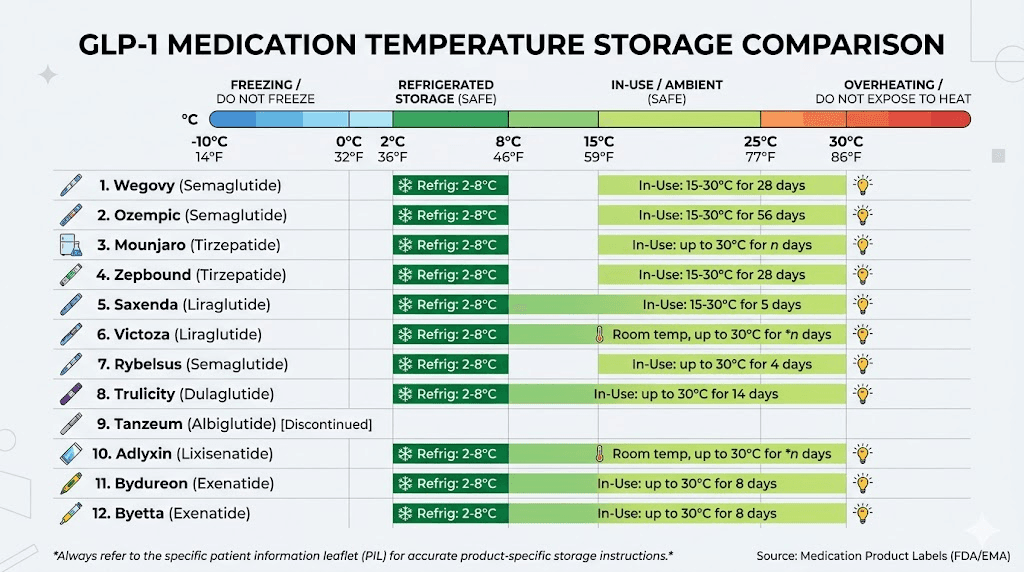
Semaglutide shelf life depends on the specific formulation. Ozempic pens, once opened, can remain at room temperature (59 to 86 degrees Fahrenheit) for up to 56 days. That is nearly two months of room temperature stability, which makes short trips relatively forgiving. However, unopened Ozempic pens must stay refrigerated until first use.
Wegovy is less flexible. Opened pens must stay refrigerated, and room temperature storage is not recommended by the manufacturer. Unopened Wegovy can tolerate room temperature (46 to 86 degrees Fahrenheit) for up to 28 days, but this should be treated as a backup window, not a storage strategy.
Compounded semaglutide is a different situation entirely. Compounded formulations typically have shorter stability windows than brand-name products. Most compounding pharmacies recommend continuous refrigeration and limit room temperature exposure to 24 to 72 hours depending on the formulation. If you are traveling with compounded semaglutide, you need the most robust travel case available because your margin for error is the smallest.
Tirzepatide storage windows
Tirzepatide has a room temperature tolerance of up to 21 days at or below 86 degrees Fahrenheit. Both Mounjaro and Zepbound pens follow this same guideline. Once out of the refrigerator, the 21-day clock starts ticking, and the pen cannot be returned to cold storage after reaching room temperature.
For compounded tirzepatide in vials, the stability window is typically shorter. Most compounding pharmacies specify refrigerated storage with limited room temperature exposure. Check your specific pharmacy label for exact guidance.
Retatrutide storage requirements
Retatrutide is still in clinical trials and primarily available as a research compound. Lyophilized (freeze-dried) retatrutide is relatively stable at room temperature before reconstitution, but once mixed with bacteriostatic water, it must be refrigerated and has limited stability. Travel with reconstituted retatrutide requires continuous cold chain maintenance.
Quick reference temperature table
Medication | Refrigerated range | Room temp tolerance | Max room temp days | Freeze safe? |
|---|---|---|---|---|
Ozempic (opened) | 36-46F (2-8C) | 59-86F (15-30C) | 56 days | No |
Wegovy (unopened) | 36-46F (2-8C) | 46-86F (8-30C) | 28 days | No |
Mounjaro/Zepbound | 36-46F (2-8C) | Up to 86F (30C) | 21 days | No |
Compounded semaglutide | 36-46F (2-8C) | Varies by pharmacy | 1-3 days typical | No |
Compounded tirzepatide | 36-46F (2-8C) | Varies by pharmacy | 1-3 days typical | No |
Reconstituted retatrutide | 36-46F (2-8C) | Not recommended | Minimize exposure | No |
The critical takeaway from this table is simple: nothing survives freezing, and compounded formulations need the most protection. If you are using brand-name pens with longer room temperature windows, a basic insulated case may be sufficient for short trips. If you are using compounded vials, you need active cooling. Understanding compounded semaglutide refrigeration requirements and tirzepatide refrigeration requirements before you travel prevents costly mistakes.
For those using semaglutide beyond 28 days, tracking your room temperature exposure timeline becomes essential during travel. Keep a simple note on your phone recording when the medication left the fridge. This running clock tells you exactly how much room temperature exposure time remains. Users who carry tirzepatide vials should do the same.
Types of GLP-1 travel cases compared
Travel cases for injectable medications fall into four main categories. Each has advantages and limitations depending on trip length, climate, and the specific medication you carry. Understanding these categories prevents you from buying a case that does not match your needs.
Insulated passive cooling cases
These are the most common and affordable option. Insulated cases use foam or thermal lining combined with gel ice packs to maintain cool temperatures. They work on the same principle as a lunch cooler. Pre-freeze the gel packs, place them in the case with a barrier layer between the packs and your medication, and the insulation maintains cold temperatures for a limited window.
Typical cooling duration ranges from 4 to 12 hours depending on insulation quality, ambient temperature, and how many gel packs you use. This makes insulated cases excellent for flights, day trips, and short road trips. They struggle in extreme heat and on multi-day trips without access to a freezer for recharging the gel packs.
Cost ranges from $15 to $60 depending on quality and brand. Look for cases with medical-grade insulation rather than generic cooler bags, because the temperature maintenance difference is significant.
Evaporative cooling cases (FRIO wallets)
FRIO cooling wallets use a different approach entirely. Instead of ice packs, they use polymer crystals that activate with water. You soak the wallet in water for 5 to 10 minutes, and the evaporation process keeps contents cool for 45 to 72 hours depending on humidity and ambient temperature.
The advantage is obvious. No freezer needed. No gel packs to recharge. Just water. This makes FRIO wallets ideal for camping, multi-day hikes, international travel to remote areas, and any situation where freezer access is limited.
The limitation is equally obvious. FRIO wallets do not achieve refrigerator-cold temperatures. They typically maintain temperatures around 64 to 72 degrees Fahrenheit, which is below the 86 degree danger threshold but well above actual refrigeration. For medications with generous room temperature windows (like opened Ozempic at 56 days), this works perfectly. For compounded formulations that need continuous refrigeration, a FRIO wallet alone is not sufficient.
Cost ranges from $20 to $45 depending on size. They are reusable hundreds of times.
USB-powered electric coolers
Electric coolers represent the premium end of medication travel cases. These battery-powered or USB-powered devices actively cool their contents to refrigerator temperatures, typically maintaining 36 to 46 degrees Fahrenheit continuously for 8 to 24 hours on a single charge.
Products like the 4AllFamily Nomad series use thermoelectric cooling technology to maintain precise temperatures. Many include digital temperature displays so you can verify the internal temperature at any time. Some models connect to car USB ports or portable battery packs for extended cooling.
Electric coolers are the right choice when you need guaranteed refrigeration temperatures for extended periods. If you are traveling with compounded semaglutide that requires continuous cold storage, or if you are traveling through extreme heat (desert climates, tropical destinations, summer road trips), an electric cooler provides the most reliable protection.
Cost ranges from $60 to $200 depending on features and brand. They are heavier and bulkier than passive options but provide the highest level of temperature control.
Stainless steel vial cases
For researchers and users who carry multiple vials, stainless steel cases with individual slots provide excellent physical protection. These cases are not coolers. They are organizers. They prevent vials from rolling, cracking, or having their labels damaged during transit.
Most vial cases accommodate 3 mL or 10 mL vials in individual foam-lined slots. Some include integrated space for syringes, alcohol wipes, and bacteriostatic water. The VialCase brand offers 4-slot, 12-slot, and 50-slot options for different travel needs.
These cases pair well with insulated pouches or gel packs for temperature control. They do not provide cooling on their own but protect against the physical damage that is equally dangerous to peptide integrity.
Cost ranges from $30 to $120 depending on capacity and material quality.
Travel case comparison table
Case type | Cooling method | Duration | Temp achieved | Best for | Price range |
|---|---|---|---|---|---|
Insulated passive | Gel ice packs | 4-12 hours | 36-50F | Flights, short trips | $15-60 |
FRIO evaporative | Water-activated crystals | 45-72 hours | 64-72F | Remote travel, no freezer access | $20-45 |
Electric USB | Thermoelectric | 8-24 hours | 36-46F | Compounded meds, extreme heat | $60-200 |
Stainless vial | None (organizer) | N/A | N/A | Multi-vial protection | $30-120 |
Choosing the right travel case for your specific GLP-1 medication
The case you need depends on three factors: which medication you carry, how long your trip lasts, and what climate you are traveling to. Getting this decision right saves money and prevents medication loss. Getting it wrong means either overspending on features you do not need or underspending on protection that was critical.
If you use brand-name semaglutide pens
Users on brand-name semaglutide have the most flexibility. An opened Ozempic pen tolerates 56 days at room temperature. For a weekend trip or a one-week vacation in moderate climates, a basic insulated pouch with a single gel pack is genuinely sufficient. The pen was designed for real-world use, including periods outside the fridge.
However, there are caveats. If you are heading to a destination where daytime temperatures exceed 86 degrees Fahrenheit, that room temperature tolerance becomes irrelevant. Phoenix in July, Dubai at any time of year, a parked car anywhere in summer. These scenarios exceed the safe range regardless of what the room temperature specifications say. For hot destinations, upgrade to an insulated case with multiple gel packs or an electric cooler.
Understanding semaglutide shelf life helps you plan. If your pen is already 40 days into its room temperature window, you have less margin than a fresh pen. Calculate the remaining safe days before you leave.
If you use brand-name tirzepatide pens
Tirzepatide gives you 21 days at room temperature. That is three weeks, which covers most vacations comfortably. But the shorter window compared to semaglutide means less room for error on extended trips. A 14-day cruise with 2 days of travel on each end pushes you to 18 days, very close to the limit if unexpected delays occur.
For trips approaching or exceeding 21 days, maintain refrigeration throughout. An electric cooler or a strategy of moving between hotel fridges and portable cooling bridges the gap safely.
If you use compounded formulations
Compounded users need the most robust setup. Period. Your compounded semaglutide or compounded tirzepatide was mixed by a pharmacy with specific storage requirements. Most compounding pharmacies mandate continuous refrigeration with only brief periods (1-3 hours) at room temperature for administration.
An electric USB cooler is the recommended choice for compounded medications. If budget is a constraint, use an insulated case with four gel packs (two active, two spare in a hotel freezer) and rotate them every 4-6 hours. Never rely on a FRIO wallet alone for compounded formulations, as they do not achieve actual refrigerator temperatures.
If you carry multiple medications
Some users take semaglutide and tirzepatide together, combine GLP-1 with NAD+, stack with L-carnitine, or use tirzepatide glycine B12 compounds. In these cases, you need a larger case with multiple compartments. Each medication should be separated to prevent cross-contamination and to allow different temperature monitoring for different stability profiles.
A stainless steel vial case inside an insulated cooler bag provides both organization and temperature control. The vial case keeps everything separated and protected. The cooler bag keeps everything cold. Together, they handle multi-medication travel effectively.
If you are also traveling with supplements or GLP-1 support supplements, keep those separate from the cold chain. Supplements do not need refrigeration and should be packed in their own bag to avoid cluttering the travel case.
How to pack your GLP-1 travel case properly
The case is only as good as the packing. Improperly packed travel cases cause more medication damage than missing cases entirely, because users develop a false sense of security. They see the insulated bag, assume everything is fine, and never check whether the internal arrangement is actually protecting the medication.
The freezing trap
This is the number one mistake. People place gel packs directly against their medication vial or pen. The gel pack is at 0 degrees Fahrenheit. The vial touches it. The medication freezes. And everything is ruined.
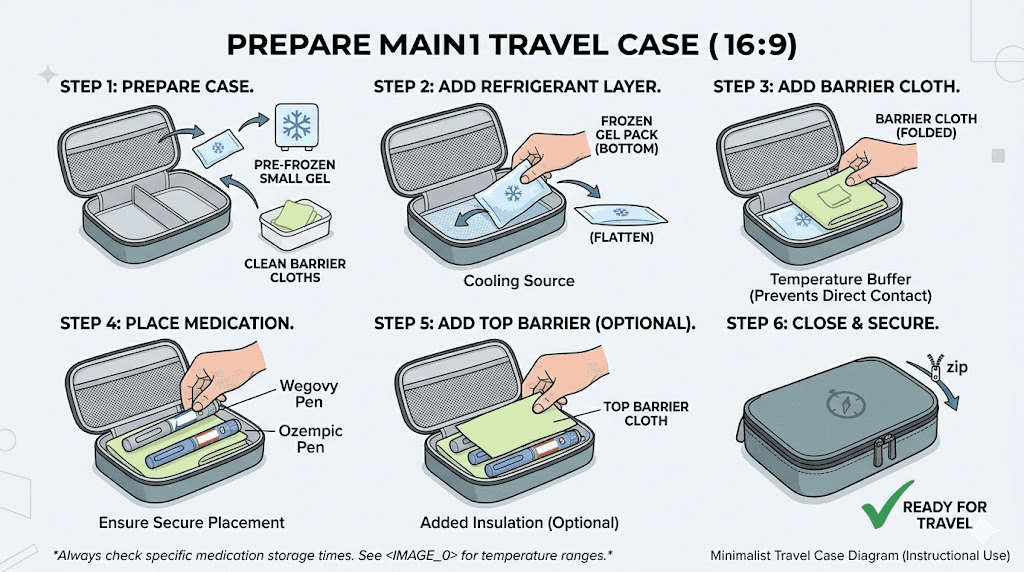
Always place a barrier between gel packs and medication. A small towel, a washcloth, a piece of bubble wrap, or the fabric divider that comes with most medical coolers. The medication should feel cool to the touch, not cold, and absolutely never frozen.
If you have ever wondered what happens if semaglutide gets warm or what happens when tirzepatide gets warm, the damage from warmth is actually less severe than freezing in many cases. Warmth causes gradual degradation. Freezing causes immediate structural destruction.
Layer-by-layer packing protocol
Start from the bottom. Place one gel pack at the bottom of the case. Add a barrier layer (towel or divider). Place your medication in the center. Add another barrier layer. Place a second gel pack on top. Close the case.
This sandwich approach provides cooling from both sides while the barriers prevent direct contact. The medication sits in a temperature-controlled zone between 36 and 50 degrees Fahrenheit for the maximum possible duration.
For longer trips, add a small adhesive thermometer strip to the inside of the case. These cost less than $5 for a pack of 10 and let you verify at a glance that the internal temperature is safe. If you open the case and the strip shows a temperature above 77 degrees Fahrenheit, move to a cooler environment immediately.
What to include in your travel case
Beyond the medication itself, pack these items in or alongside your travel case:
Medication vials or pens (upright when possible)
Pre-frozen gel ice packs (minimum 2, ideally 4 for redundancy)
Barrier material (small towel or fabric divider)
Adhesive thermometer strip
Insulin syringes (if using vials, not pens)
Alcohol swab packets
Sharps container or travel sharps solution
Prescription label or pharmacy printout
Copy of your prescription or doctor letter
Having everything in one organized kit makes TSA screening faster, prevents forgotten supplies, and ensures you can administer your dose wherever you are. If you use the SeekPeptides peptide calculator to determine your dose, screenshot your calculation before traveling so you have it available without internet access. The reconstitution calculator is equally valuable if you are reconstituting at your destination, and the peptide cost calculator helps you figure out how many doses to pack without over-ordering replacement supplies.
TSA rules for traveling with GLP-1 medications
Airport security is the biggest source of anxiety for people traveling with injectable medications. The concern is understandable. You are walking through a security checkpoint carrying needles, syringes, and liquid vials. But the rules are actually straightforward and firmly in your favor.
The TSA liquid exemption
Injectable medications are exempt from the 3-1-1 liquids rule. Your semaglutide vial, your tirzepatide pen, your bacteriostatic water, all of it can exceed 3.4 ounces and does not need to go in the quart-sized plastic bag. This exemption applies to all medically necessary liquids regardless of volume.
You should declare your medications to the TSA officer at the beginning of screening. Place your travel case in a separate bin so the officer can see it clearly. Most experienced TSA agents recognize medical coolers immediately and process them quickly.
Syringes and needles
Unused syringes are allowed in carry-on bags when accompanied by injectable medication. You do not need a separate prescription for the syringes themselves. However, having your medication clearly labeled helps avoid any confusion.
Used syringes and needles should be placed in a proper sharps container. While TSA permits used sharps in a sealed container, having a dedicated travel sharps solution shows that you are handling your medical waste responsibly and speeds up any inspection.
Ice packs and gel packs
This is where people get tripped up. Frozen gel packs are allowed in carry-on baggage when they accompany medically necessary items. However, the TSA technically requires that ice packs be fully frozen solid at the time of screening. Partially melted gel packs may be flagged.
There is an important exception. The TSA makes allowances for "medically necessary" ice packs "in reasonable quantities" regardless of their physical state. This means that even if your gel packs have partially melted during your time in the airport, a TSA officer should allow them through when they are clearly accompanying medication.
To minimize friction, freeze your gel packs the night before travel so they are rock solid at security. Label your cooler bag clearly as containing medication. And keep your prescription documentation accessible.
X-ray safety
GLP-1 medications pass safely through TSA X-ray machines. The X-ray energy used in airport screening equipment does not affect the molecular structure of peptide-based medications. You do not need to request a manual inspection to avoid X-ray exposure.
TSA pre-check and global entry
If you travel frequently with GLP-1 medications, TSA PreCheck or Global Entry enrollment significantly reduces screening friction. PreCheck passengers go through streamlined screening where medical items are rarely questioned. The investment pays for itself in reduced stress alone.
Air travel protocols for GLP-1 medications
Flying with GLP-1 medications requires specific preparation that goes beyond what a road trip demands. The combination of security screening, variable cabin temperatures, baggage risks, and time zone changes creates unique challenges.
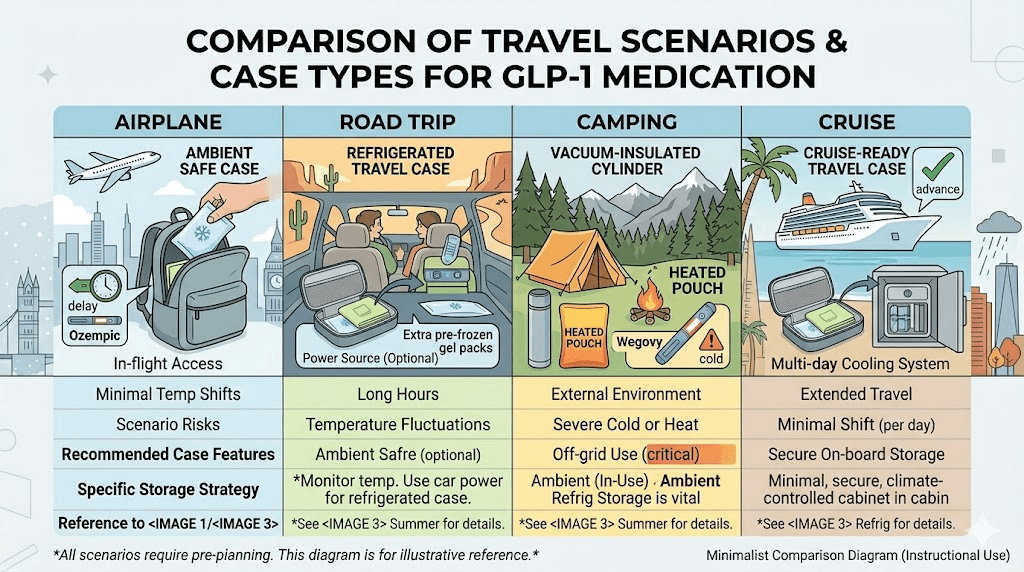
Never check your medication
This rule has zero exceptions. Never place your GLP-1 medication in checked luggage. Cargo holds can reach temperatures below freezing at cruising altitude. Bags get lost, delayed, or rerouted to wrong destinations. A vial that freezes in the cargo hold is destroyed. A vial that sits on a tarmac in Phoenix for three hours is compromised. Neither scenario is recoverable.
Your medication belongs in your carry-on bag or personal item. Period.
Pre-flight checklist
The morning of your flight, before you leave for the airport:
Verify gel packs are frozen solid
Pack medication with proper barrier layers
Check thermometer strip reads safe range
Confirm prescription label is visible and current
Place travel case in carry-on (accessible for security)
Screenshot your dosage calculator results for offline reference
Bring extra supplies (syringes, alcohol wipes) in case of travel delays
During the flight
Airplane cabin temperatures typically range from 65 to 75 degrees Fahrenheit, which is within the safe room temperature range for most GLP-1 medications. If your travel case is in the overhead bin, the temperature up there tends to be slightly warmer but still within acceptable limits for short flights.
For long-haul flights (6+ hours), keep your travel case under the seat in front of you where temperatures are more consistent. Avoid placing it near the aircraft wall where temperatures can fluctuate, especially near windows that get direct sunlight.
Layovers and connections
Extended layovers are where medications face the greatest risk. Airport temperatures vary widely. Gate areas near windows can get very warm. If your layover exceeds 3 hours and your gel packs are melting, consider these options:
Ask an airport restaurant if they can place your gel packs in their freezer for 30 minutes
Purchase a bag of ice from an airport vendor and place it around (not touching) your case
Find a cooler gate area away from windows
Some airports have nursing rooms or medical rooms with refrigerators
Injection timing around flights
If your injection day falls on a travel day, administer your dose before heading to the airport. Injecting in an airport bathroom or on the plane is technically possible but introduces contamination risks and unnecessary stress. The best time to take your GLP-1 shot on a travel day is at home, before you leave.
If you must inject during travel, use an alcohol wipe on the injection site, use a standard injection site you are comfortable with, and dispose of the needle in your sharps container immediately. Our guides on stomach injection technique and syringe injection technique cover proper administration if you need a refresher before your trip.
Road trip strategies for GLP-1 medications
Road trips present different challenges than air travel. You have more storage space and fewer security concerns, but temperature control becomes much harder. Cars heat up fast. Trunks are ovens. And the temptation to toss your medication bag in the back seat and forget about it for six hours is real.
Never leave medication in a parked car
A car interior can reach 130 to 170 degrees Fahrenheit within 30 minutes on a sunny day. Even with windows cracked. Even in the shade. Even in moderate climates. This is far beyond the 86-degree maximum for any GLP-1 medication.
If you stop for lunch, gas, a bathroom break, or any reason at all, take your medication case with you. Treat it like your phone or wallet. It never stays in the car unattended.
Car cooling strategies
The best approach for road trips is a dedicated small cooler that stays in the front passenger area, not the trunk. The front area benefits from air conditioning. The trunk does not. A quality insulated case with fresh gel packs, refreshed every 4 to 6 hours, maintains safe temperatures through a full day of driving.
If you have a USB-powered electric cooler, plug it into the car USB port for continuous cooling. This eliminates the need for gel pack management entirely and provides the most reliable temperature control for long drives.
Another option is a standard 12V car cooler or mini fridge. Many modern cars have 12V outlets in the center console that can power small thermoelectric coolers. These maintain refrigerator temperatures indefinitely while the car is running.
Hotel storage at your destination
When you arrive at your hotel, immediately transfer your medication to proper refrigerated storage. Most hotels handle this in one of three ways:
First option: request a room with a mini fridge. Most hotels offer this for free upon request, especially when you mention it is for medication. Call ahead or note it in your reservation.
Second option: ask the front desk to store your medication in their kitchen or staff refrigerator. Label the medication clearly with your name, room number, and "MEDICAL - DO NOT DISCARD." Most hotels accommodate this willingly.
Third option: if neither works, fill the ice bucket with ice from the hotel ice machine, create a barrier (plastic bag or towel), and nest your medication inside. Replace the ice every 6 to 8 hours. This is a last resort but works for overnight stays.
Cruise ship travel with GLP-1 medications
Cruises present a unique combination of challenges. You are traveling internationally. You are going through port security. Your cabin may or may not have proper refrigeration. And shore excursions take you away from any cold storage for hours at a time.
Cabin refrigeration
Most modern cruise cabins include a mini fridge or mini bar that can be cleared for medication storage. When you book your cruise, contact Guest Services and request medical refrigeration. Many cruise lines will provide a dedicated medical-grade refrigerator at no charge when notified in advance.
If your cabin mini fridge is the hotel-style type that does not reach true refrigerator temperatures (some only cool to 45-50 degrees), request a room change or use the ship medical center refrigerator. The ship always has proper medical cold storage available.
Shore excursion protocols
Shore days require portable cold storage. Pack your medication in your insulated travel case with fresh gel packs from the cabin fridge. A FRIO wallet works excellently for shore days because it does not require frozen gel packs and maintains safe-below-86-degree temperatures through water evaporation alone.
If your shore excursion runs longer than 6 hours in a hot climate, carry extra cooling capacity. A second set of gel packs or a double FRIO wallet provides extended protection.
Customs and port security
When entering and exiting ports, keep medications in their original labeled containers when possible. Personal-use quantities of prescription medication are permitted through customs without issue. Carry your prescription documentation and a doctor letter in case a customs officer asks questions.
Avoid carrying commercial quantities or unlabeled vials through international borders, as this can trigger additional screening and delays.
International travel considerations
International travel adds layers of complexity that domestic trips do not have. Different countries have different rules about importing medications, prescription documentation requirements, and what constitutes a "personal use" quantity.
Documentation you need
For international travel with GLP-1 medications, carry all of the following:
Original prescription label on the medication
Printed prescription from your prescribing provider
A travel letter from your doctor stating the medication name, dose, and medical necessity
Your doctor contact information in case customs needs verification
Some countries require that medications be in their original pharmacy packaging. If you are using reconstituted compounded medications in generic vials, the travel letter from your doctor becomes especially important.
Restricted countries
Most countries in North America, Europe, and Asia permit personal-use quantities of prescription injectable medications without special permits. However, some Middle Eastern countries and parts of Southeast Asia have stricter controlled substance regulations that may apply to certain peptide medications.
Research your destination country regulations before traveling. Your country embassy website typically has a section on importing medications.
Time zone adjustments for injection schedules
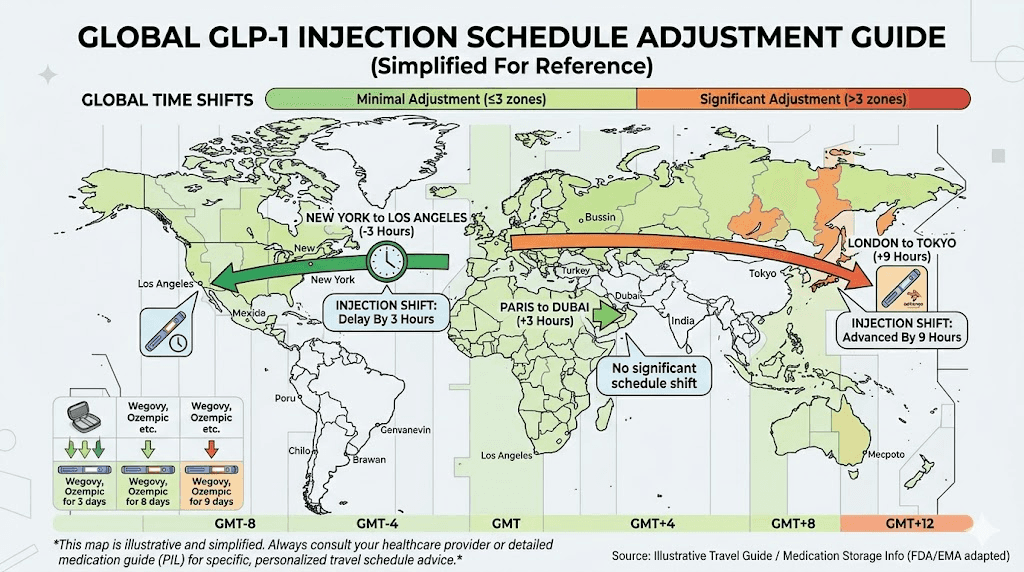
Crossing time zones means your injection schedule needs adjustment. The key rule is maintaining minimum spacing between doses:
Semaglutide: minimum 48 hours (2 days) between doses when shifting injection day
Tirzepatide: minimum 72 hours (3 days) between doses when shifting injection day
Retatrutide: follow your research protocol spacing, typically weekly
If you fly east (losing hours), your injection day arrives sooner than expected. If you fly west (gaining hours), it arrives later. In both cases, maintain the minimum spacing above and adjust your day at the destination. Most weekly GLP-1 medications have a flexible enough window that a 1-2 day shift causes no issues.
For detailed dosing guidance, the semaglutide dosage calculator and tirzepatide dosage guide at SeekPeptides provide weight-based protocols that account for schedule flexibility. If you are on a semaglutide dosage chart or tirzepatide compound dosage chart, take a photo of your current dose level before traveling so you do not have to remember exact numbers while jet-lagged.
What to do if your medication gets warm or cold
Despite best efforts, temperature excursions happen. Your gel packs melt faster than expected. Your hotel fridge dies overnight. You accidentally leave your semaglutide out overnight. Knowing how to assess the situation and whether your medication is still viable prevents unnecessary waste and unnecessary risk.
Heat exposure assessment
If your medication was exposed to temperatures above 86 degrees Fahrenheit, the key question is: for how long?
Brief exposure (under 30 minutes) to moderate heat (86-100 degrees) typically does not cause significant degradation for most GLP-1 formulations. The medications are designed to survive brief handling at room temperature during normal use.
Extended exposure (several hours) to high heat (above 100 degrees) is more concerning. The medication may have lost some potency. It will not become dangerous to use, but it may be less effective. If you have no replacement available, using a heat-exposed vial is better than skipping doses entirely, but obtain a fresh supply as soon as possible.
If your semaglutide arrived hot from a shipping issue or was left in extreme heat for hours, contact your pharmacy. Most will replace heat-damaged medication at no charge.
Freezing damage assessment
There is no gray area with freezing. If your medication froze, even partially, discard it. Frozen GLP-1 medications should not be used. Period.
Visual signs of freeze damage include:
Visible ice crystals in the solution
Cloudiness or particles that were not present before
Unusual color changes
Solution that looks "stringy" or has strands floating in it
If you are unsure whether your medication froze, look at the solution carefully against a light background. Clear, colorless solution with no particles is a good sign but does not guarantee the protein structure is intact. When in doubt, replace it.
Visual inspection guidelines
Every time you open your travel case, perform a quick visual check of your medication:
Color: Should match what it looked like when you packed it. Semaglutide should be clear and colorless. Tirzepatide is also typically clear and colorless.
Clarity: No cloudiness, floating particles, or strings
Volume: No leaking (check for wet spots in the case)
Smell: Should have no odor. Any unusual smell suggests contamination
Building a DIY GLP-1 travel kit on a budget
You do not need to spend $200 on a premium electric cooler if your travel needs are modest. A reliable DIY travel kit costs under $25 and works effectively for trips under 12 hours.
Budget travel kit assembly
What you need:
Insulated lunch bag with zipper closure ($8-15 at any store)
Two reusable gel ice packs ($5-8 for a pack of 4)
Small hand towel for barrier layers ($2-3)
Adhesive liquid crystal thermometer strip ($3-5 for 10 strips)
Small ziplock bag for syringes and wipes
Total cost: $18-31
This kit provides 4-8 hours of cooling depending on ambient temperature and insulation quality. For a domestic flight with no extended layovers, this is more than adequate. The thermometer strip is the key differentiator from just throwing everything in a bag and hoping for the best. It gives you real-time temperature verification.
Upgrading the budget kit
For an additional $15-20, you can add a vacuum-insulated stainless steel container (thermos style). Pre-chill the container in the refrigerator overnight. Place your medication inside with a small gel pack. The vacuum insulation extends cooling time to 12-18 hours, rivaling the performance of dedicated medical coolers at a fraction of the cost.
This approach works especially well for reconstituted medications in standard 3 mL or 10 mL vials, which fit perfectly in most wide-mouth thermos containers.
GLP-1 travel case features to look for
If you decide to purchase a dedicated medical travel case, certain features matter more than others. Marketing claims like "medical grade" and "TSA approved" are common but sometimes meaningless. Here is what actually matters.
Essential features
Temperature verification: A built-in or included thermometer is the most important feature. Without it, you are guessing. Cases with digital temperature displays or analog thermometer strips let you verify that your medication is in the safe range at any time.
Vial/pen compartments: Individual slots or elastic holders prevent medications from shifting, rolling, or clashing during transit. Loose vials in a cooler bag will bump against gel packs and each other, potentially cracking glass or dislodging stoppers.
Gel pack pockets: Dedicated pockets for gel packs that separate them from the medication compartment prevent freezing damage without requiring you to remember a barrier layer. This is a design feature that eliminates the most common packing mistake.
External pocket for documents: A zip pocket on the outside for your prescription, doctor letter, and documentation makes TSA screening smoother. You can hand the entire case to the officer with documentation visible.
Nice-to-have features
Waterproof exterior: Protects against spills, rain, and condensation from gel packs leaking through the case.
Locking zipper: Prevents accidental opening and adds a layer of security in shared accommodations.
Shoulder strap: Frees your hands during airport navigation and excursions.
Modular inserts: Removable dividers that let you configure the case for different medication combinations.
Features that do not matter
"TSA approved" labels: There is no official TSA approval certification for cooler bags. All medically necessary items are permitted. The label is marketing.
Brand-specific designs: Cases marketed specifically for "Ozempic" or "Mounjaro" are generic medical coolers with brand names in the product listing. A general medical cooler works identically for any GLP-1 medication.
Traveling with compounded GLP-1 medications specifically
Compounded medications present unique travel challenges that brand-name pen users do not face. If you are using compounded semaglutide or compounded tirzepatide, this section addresses your specific concerns.
Shorter stability windows
Compounded formulations typically have shorter expiration dates and less room temperature tolerance than brand-name products. While an Ozempic pen can sit at room temperature for 56 days, a compounded semaglutide vial might only tolerate 24-72 hours outside the fridge depending on the compounding pharmacy formulation.
This means your travel case needs to maintain actual refrigerator temperatures, not just "below 86 degrees." A FRIO wallet alone is insufficient. You need either a gel-pack-based insulated case with frequent gel pack changes or an electric cooler.
Vial handling considerations
Compounded medications come in glass vials, not pens. Vials are more fragile during transport. They can crack if dropped. Rubber stoppers can become contaminated if exposed to non-sterile surfaces. And pre-filled syringes may lose sterility if the plunger is jostled.
Use a case with individual vial slots and keep vials upright when possible. If you are traveling with bacteriostatic water for reconstitution at your destination, pack the dry lyophilized powder and the water separately. Lyophilized peptides are far more temperature-stable than reconstituted solutions.
Documentation for compounded medications
Compounded medications do not have the recognizable packaging of brand-name products. A TSA officer who recognizes an Ozempic pen may not recognize a plain glass vial with a compounding pharmacy label. Carry your prescription, your pharmacy receipt, and your doctor letter. Having the compounding pharmacy phone number on hand is also helpful in case verification is needed.
For international travel with compounded medications, extra documentation is critical. Some countries may not recognize compounded medications as legitimate pharmaceuticals. Your doctor travel letter should explicitly state that the medication is a compounded prescription and describe what it contains.
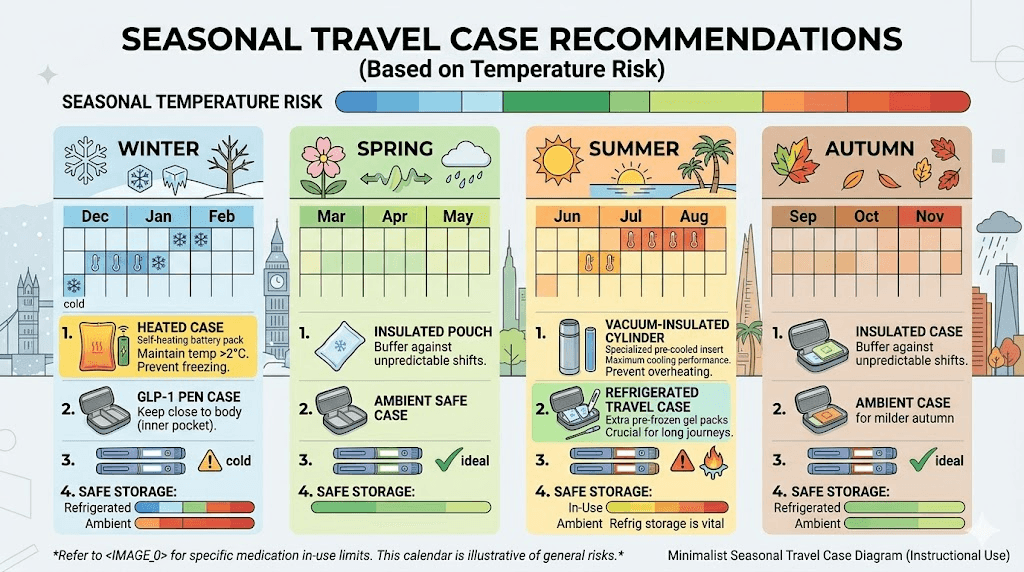
Seasonal travel considerations for GLP-1 medications
The time of year changes everything about your travel case strategy. A case that works perfectly for a November conference fails spectacularly for a July road trip. Planning by season prevents medication loss.
Summer travel (June through September)
Summer is the highest-risk season for GLP-1 travel. Ambient temperatures regularly exceed 86 degrees Fahrenheit across most of the United States. Gel packs melt faster. Car interiors become dangerous. Even walking from the airport to a taxi with your case exposed to direct sunlight can push internal temperatures into the danger zone.
Summer travel demands either an electric cooler or aggressive gel pack management. Freeze four gel packs instead of two. Wrap your case in an additional insulating layer (even a sweatshirt works). Minimize time between air-conditioned environments. And never, under any circumstances, leave your medication case in a vehicle.
If you are experiencing cold sensitivity from semaglutide, summer travel actually has an upside. The warmer ambient temperatures counteract the cold intolerance that some users report. Pack a light layer anyway, as aircraft cabins can be aggressively air conditioned.
Winter travel (December through February)
Winter introduces the opposite problem: freezing. This is especially dangerous for users who assume cold weather means their medication is automatically safe. It is not. If the temperature drops below 32 degrees Fahrenheit, your medication can freeze.
During winter travel, keep your medication case close to your body. An insulated case in your jacket pocket or inside a bag worn against your torso uses your body heat as a natural temperature buffer. Never leave medication in a car during cold weather any more than you would in summer. Overnight temperatures in many regions drop well below freezing, and a vial left in the car overnight is destroyed by morning.
The irony of winter travel is that many hotels and resorts crank the heat indoors, creating the opposite problem in hotel rooms. A room at 75 degrees with no mini fridge means your medication sits at room temperature for 8-12 hours overnight. For compounded medications, this may exceed their tolerance. Request a mini fridge regardless of season.
Spring and fall travel
Moderate seasons are the easiest for GLP-1 travel. Ambient temperatures typically stay within the safe range, gel packs last longer, and the risk of both freezing and overheating is minimal. A basic insulated case with standard gel packs handles most spring and fall trips without issues.
The exception is destinations with extreme weather patterns regardless of season. Desert locations, tropical islands, and high-altitude destinations where nighttime temperatures plummet all require the same precautions as summer or winter travel.
Travel case maintenance and care
Your travel case is reusable equipment that needs proper maintenance. A case that gets thrown in a closet after each trip and pulled out dirty and mildewed before the next one provides compromised protection.
After each trip
Remove all gel packs and let them dry completely before returning them to the freezer. Condensation trapped inside a ziplock bag grows mold and bacteria. Wipe the interior of the case with a mild disinfectant wipe and let it air dry with the zipper open for 24 hours. Check the insulation for tears, gaps, or compression that reduces its effectiveness.
Gel pack management
Gel packs lose effectiveness over time. The gel inside gradually separates, and the packs take longer to freeze and thaw faster. Replace gel packs every 6-12 months or whenever you notice they are not staying frozen as long as they used to. Keep spare gel packs in the freezer so they are always ready for last-minute trips.
FRIO wallet reactivation
FRIO wallets can be reactivated hundreds of times, but the polymer crystals eventually degrade. If your FRIO wallet is not cooling as effectively after soaking, it may be time for a replacement. Most FRIO wallets last 2-3 years with regular use.
Electric cooler battery care
If you use a USB-powered electric cooler, charge the battery fully before storage and top it off before each trip. Lithium batteries degrade faster when stored at very low or very high charge levels. Aim to store at roughly 50% charge between trips and charge to 100% the day before departure.
Managing side effects during travel
Travel can amplify GLP-1 side effects. Changes in diet, hydration, sleep, and activity levels during travel interact with medication effects in ways that catch people off guard.
Gastrointestinal effects and travel
The most common GLP-1 side effects involve the digestive system. Nausea, constipation, diarrhea, and bloating are all more likely during travel because of disrupted eating patterns, dehydration from flying, and exposure to unfamiliar foods.
Strategies that help:
Hydrate aggressively during flights (the cabin air is extremely dry)
Eat bland, familiar foods on travel days
Avoid fatty foods, which worsen GLP-1 nausea
Pack safe snack options in your carry-on
Avoid alcohol on travel days (amplifies dehydration and GI effects)
Fatigue and jet lag
GLP-1 fatigue is a real side effect that compounds with jet lag. Both semaglutide fatigue and tirzepatide tiredness are well-documented, and crossing multiple time zones makes both significantly worse. Plan for extra rest on your first day at the destination. Avoid scheduling demanding activities immediately after arrival. If fatigue is already a problem for you before travel, consider whether semaglutide energy effects or tirzepatide energy effects suggest a dose timing adjustment before your trip.
Injection site reactions during travel
Injection site reactions can be more noticeable during travel due to increased physical activity (walking, carrying luggage) and changes in clothing that may irritate the injection area. If you typically inject in the abdomen and plan to be very active, consider using a thigh injection site instead, as it is less affected by waistband friction and movement.
Special travel scenarios
Camping and outdoor adventures
For camping trips without electricity or refrigeration, the FRIO wallet is your best option. It requires only water to activate and maintains below-86-degree temperatures for 45 to 72 hours. Combined with a shaded storage location in your tent or pack, this keeps medications safe through a typical camping weekend.
For extended backcountry trips, consider timing your injection so it falls before departure or after return. A 7-day backpacking trip can be scheduled around a weekly injection by simply dosing the day before you leave.
Beach and tropical vacations
Heat is the primary enemy in tropical climates. A travel case that maintains safe temperatures in moderate climates may fail in 95-degree humidity. For tropical destinations, use an electric cooler or double up on insulation. Keep your medication case in the shade at all times, never on a beach towel or pool chair in direct sunlight.
At the resort, use the room mini fridge immediately upon arrival. If the fridge is stocked with minibar items, request that they be removed or rearranged to accommodate your medication.
Business travel
Frequent business travelers benefit most from a compact, professional-looking travel case that does not draw attention in meeting rooms or client offices. Black insulated cases that resemble standard tech bags blend seamlessly into professional settings. Keep a permanent travel kit packed and ready to go so you never forget supplies when leaving on short notice.
Extended travel (2+ weeks)
For extended trips, carrying your full medication supply becomes a logistics challenge. Calculate the exact number of doses you need for the trip duration plus 2-3 extra doses for delays. If you are on a tirzepatide escalation schedule or a semaglutide dose chart, pack the doses for each week clearly labeled. Users on microdosing protocols or split-dose schedules need extra supplies since their dosing frequency is higher than standard weekly protocols.
For very long trips, consider whether you can arrange prescription transfers or refills at your destination. Many pharmacy chains in the United States allow prescription transfers between locations. For international destinations, this is more complex and should be arranged before departure.
Common travel mistakes that destroy GLP-1 medications
After everything covered above, these are the mistakes that still catch people. Read this list before every trip as a final safety check.
Mistake 1: Gel packs directly touching the medication
This freezes the medication. Always use a barrier. Always.
Mistake 2: Checking medication in luggage
Cargo holds freeze. Bags get lost. There is zero upside and massive downside.
Mistake 3: Leaving medication in a parked car
Cars become ovens in minutes. Take it with you. Every time.
Mistake 4: No temperature verification
Without a thermometer strip, you are guessing. A $3 strip eliminates guesswork entirely.
Mistake 5: Packing only enough for the exact trip
Flights get delayed. Trips get extended. Pack 2-3 extra doses minimum.
Mistake 6: Forgetting prescription documentation
International travel without prescription proof can result in medication confiscation. Domestic travel without it can cause extended TSA delays.
Mistake 7: Using a room temperature case for compounded medications
A FRIO wallet keeps things below 86 degrees. Compounded medications often need actual refrigeration. Know your medication requirements and match the case accordingly.
Mistake 8: Shaking the case vigorously
Tossing your travel case, dropping it, or letting it bounce around in the trunk can cause physical agitation that degrades peptide solutions. Handle the case gently, especially if carrying reconstituted vials.
Mistake 9: Not knowing your dosing schedule
Travelers who do not know their exact syringe dosage or unit-to-mg conversion end up guessing doses on the road. Before departure, confirm your exact dose, the number of units you draw, and the injection volume. Write it down or screenshot it.
Mistake 10: Ignoring the return trip
People plan meticulously for the outbound journey and completely forget the return. Gel packs that were frozen for departure are now liquid. The hotel freezer they relied on is in a different city. Pack return-trip cooling supplies separately or plan to re-freeze gel packs at your accommodation the night before heading home.
Missed dose protocols while traveling
Travel delays, time zone confusion, and disrupted routines sometimes mean a missed dose. Knowing the rules for each medication prevents panic and bad decisions.
Semaglutide missed dose
If fewer than 5 days (120 hours) have passed since your missed semaglutide dose, take it as soon as you remember and return to your regular schedule. If more than 5 days have passed, skip the missed dose and take your next dose on the regular day.
For detailed guidance on missed doses and appetite suppression timelines, see our semaglutide timing guide. Users restarting after a break should also review our guide on restarting semaglutide to understand how missed doses during travel may affect re-titration.
Tirzepatide missed dose
If fewer than 4 days (96 hours) have passed since your missed tirzepatide dose, take it as soon as possible. If more than 4 days have passed, skip it and resume on your next regular dose day.
Taking tirzepatide a day early is generally safe if it helps you stay on schedule during travel. The minimum spacing between doses is 72 hours (3 days).
Setting reminders
Set your injection reminder to your home time zone for the first day or two of travel, then shift to local time. Most phones allow you to specify time zone in alarm settings. This prevents the confusion of "is it injection day back home or here?" that leads to accidental double-dosing or skipping.
Travel and weight management on GLP-1 medications
Travel disrupts more than just medication storage. It disrupts the entire lifestyle framework that makes GLP-1 medications effective. Diet changes, reduced activity, alcohol consumption, and stress eating all accelerate on vacation.
Maintaining results while traveling
The appetite suppression from your GLP-1 medication works in your favor here. Use it. When your appetite is suppressed, make intentional food choices rather than defaulting to airport fast food and resort buffets. The medication is doing the hard work of reducing cravings. Your job is to steer those reduced cravings toward quality food choices.
If you are tracking your weight loss timeline, expect a temporary stall or slight gain during extended travel. This is normal. Sodium from restaurant food causes water retention. Disrupted sleep affects cortisol. Reduced exercise lowers daily expenditure. These are temporary factors that resolve within a week of returning to normal routine.
Protein intake during travel
The biggest nutritional mistake during travel is inadequate protein. GLP-1 medications reduce appetite significantly, and when combined with travel convenience foods (which are typically high carb, low protein), muscle loss can accelerate. Pack protein shakes or protein bars for easy supplementation. Aim for at least 0.7 grams of protein per pound of body weight even while traveling. Pairing your medication with creatine supplementation also supports muscle retention during periods of reduced activity, like long flights or recovery days.
For meal ideas that work with limited options and reduced appetite, browse our GLP-1 breakfast ideas, dinner ideas, and GLP-1 recipes for weight loss. Having a few go-to meal options in mind before you travel prevents defaulting to whatever the airport food court offers.
Alcohol deserves special mention. If you plan to drink during your trip, understand the interaction between alcohol and semaglutide or alcohol and tirzepatide before you order that poolside cocktail. GLP-1 medications slow gastric emptying, which changes how alcohol absorbs and how quickly it affects you. Many users report feeling the effects of alcohol much faster and more intensely than before starting treatment. For those who do choose to drink, our guide to the best alcohol options on tirzepatide identifies lower-risk choices.
Emergency protocols when things go wrong
No matter how well you plan, travel throws curveballs. Knowing how to respond prevents panic decisions and saves medication when possible.
Your gel packs melted early
If your gel packs melt before you reach your destination, assess the situation before panicking. Check your thermometer strip. If the internal case temperature is still below 77 degrees Fahrenheit and you are within a few hours of reaching a refrigerator, your medication is likely fine. Brand-name medications with generous room temperature windows (56 days for Ozempic, 21 days for Mounjaro) can handle this situation without issue.
For compounded medications with shorter windows, act quickly. Find ice. A convenience store, a restaurant, a hotel lobby, anywhere with a freezer. Place your medication case near the ice source (not directly on it) to bring the temperature down while you arrange proper refrigeration.
Your medication fell and the vial cracked
If a glass vial cracks, the medication is contaminated and must be discarded regardless of temperature. This is why vial cases with individual foam slots exist. They prevent the exact scenario that ruins medication. If you drop a pen, inspect it for visible damage. Small dents in the pen body usually do not affect the medication inside. Cracks in the viewing window or damage to the injection mechanism mean the pen should not be used.
You forgot your medication at home
This happens more often than anyone admits. If you realize before your flight, consider whether you have time to go back. If not, contact your prescribing provider and pharmacy. Many pharmacies can process an emergency supply at a local branch near your destination. Prescription transfer between pharmacy locations within the same chain is usually straightforward.
If no transfer is possible, missing one weekly dose of a GLP-1 medication is not dangerous. You may notice reduced appetite suppression and some mild rebound effects, but one missed dose does not undo your progress. Resume your normal schedule when you return.
Your medication looks different than usual
During travel, inspect your medication each time you open the case. If the solution has changed color, developed particles, become cloudy, or looks different from what you remember, do not use it. Temperature damage and contamination both alter the visual appearance of peptide medications. A red or discolored semaglutide vial is a clear sign of degradation. Trust your eyes.
Traveling with GLP-1 oral formulations
Not everyone uses injectable GLP-1 medications. If you are taking oral semaglutide drops, tirzepatide drops, or semaglutide troches, your travel needs are different but not simpler.
Oral liquids and drops
GLP-1 oral liquids still require temperature control. The peptide in a liquid formulation is just as temperature-sensitive as an injectable. Store oral drops the same way you would store injectable formulations, in an insulated case with appropriate cooling for the specific product requirements.
The advantage of oral formulations for travel is no syringes, no sharps containers, and no TSA concerns about needles. The liquid itself may still trigger TSA questioning if it exceeds 3.4 ounces, but the same medical exemption applies. Declare it as medication and you are good.
For guidance on oral liquid dosing schedules during travel, maintain the same timing you use at home. Oral formulations taken on an empty stomach still require the 30-minute fasting window before and after dosing, which can be tricky during travel meals. Set an alarm for 30 minutes before your planned breakfast to take your dose.
Sublingual formulations
Sublingual semaglutide and orally disintegrating tablets like tirzepatide ODT are among the most travel-friendly GLP-1 options. No liquid, no syringe, minimal temperature sensitivity compared to reconstituted solutions. They still benefit from cool storage but are far more forgiving during brief temperature excursions.
Patches
GLP-1 patches like Onmorlo and Gentle Patches eliminate most travel storage concerns entirely. Patches store at room temperature, require no syringes, and work continuously without injection timing logistics. If travel is a major part of your lifestyle and you are considering GLP-1 options, patches deserve serious consideration for the convenience factor alone.
Pre-trip preparation timeline
Effective GLP-1 travel preparation starts before the day of departure. Here is a timeline that prevents last-minute scrambling.
One week before travel
Verify you have enough medication for the full trip plus 2-3 extra doses
Request prescription refill if running low
Test your travel case: pack it, freeze gel packs, check temperature maintenance over 8 hours
For international travel, gather documentation (prescription copy, doctor letter)
Research your destination climate and hotel refrigerator availability
Contact hotels to confirm mini fridge availability
Two days before travel
Freeze all gel packs (minimum 24 hours in freezer)
Charge electric cooler battery if applicable
Organize travel kit contents (syringes, wipes, sharps container)
Calculate your dosage in units and take screenshots for offline reference
Determine which injection day falls during the trip
Morning of departure
Transfer medication from fridge to travel case
Verify gel packs are frozen solid
Pack with proper barrier layers
Check thermometer strip reads safe range
Place prescription documentation in external case pocket
If injection day is today, dose at home before leaving
Complete GLP-1 travel checklist
Print this list. Screenshot it. Save it to your phone. Use it before every trip.
Medication supplies:
GLP-1 medication (doses needed + 2-3 extra)
Insulin syringes (if using vials)
Alcohol swab packets (extra)
Sharps container or travel sharps disposal
Bacteriostatic water (if reconstituting during trip)
Cooling and storage:
Insulated travel case or medical cooler
Gel ice packs (minimum 2, frozen solid)
Barrier material (towel or divider)
Adhesive thermometer strip
FRIO wallet (backup or for excursions)
Documentation:
Prescription label on medication
Printed prescription copy
Doctor travel letter (for international travel)
Pharmacy contact information
Dosage calculator screenshot (offline reference)
Comfort and support:
Anti-nausea supplies (ginger chews, peppermint)
High-protein travel snacks
Electrolyte packets
Water bottle (stay hydrated)
Travel probiotic (for digestive support)
For researchers serious about optimizing their peptide protocols, SeekPeptides offers the most comprehensive resource available, with evidence-based guides, dosing calculators, proven protocols, and a community of thousands who have navigated these exact questions. Members access detailed medication management guides, supplement recommendations, home monitoring tools, and personalized protocol support that makes traveling with peptides straightforward and stress-free. Whether you are on your first week of semaglutide or managing a long-term maintenance protocol, the SeekPeptides community has the answers.
Frequently asked questions
Can I bring my GLP-1 medication on a plane?
Yes. Injectable medications including semaglutide and tirzepatide are permitted in carry-on bags and are exempt from TSA liquid restrictions. Declare your medication at the security checkpoint and keep it in your carry-on, never in checked luggage. Syringes are also allowed when accompanied by the injectable medication.
How long can semaglutide stay out of the fridge while traveling?
Opened Ozempic pens tolerate room temperature (59-86F) for up to 56 days. Wegovy is less forgiving and should remain refrigerated when opened. Compounded semaglutide typically tolerates only 24-72 hours at room temperature depending on the formulation. Always check your pharmacy label for specific guidance.
What happens if my GLP-1 medication freezes during travel?
Discard it. Freezing causes irreversible damage to the protein structure of GLP-1 medications. Ice crystals physically destroy the peptide chains that make the medication work. This is why a barrier layer between gel packs and medication is essential in every travel case.
Do I need a prescription to travel with injectable medication?
For domestic travel, having the prescription label on your medication is strongly recommended but not legally required by TSA. For international travel, carry your prescription, a doctor travel letter, and keep medication in original labeled containers whenever possible.
What is the best travel case for tirzepatide?
For trips under 12 hours, an insulated case with frozen gel packs provides adequate protection. For longer trips or hot climates, a USB-powered electric cooler maintains precise refrigerator temperatures continuously. For trips without freezer access, a FRIO evaporative wallet keeps temperatures below the 86F danger threshold for 45-72 hours using only water.
Can I inject my GLP-1 medication while on a plane?
Technically yes, but it is not recommended. Airport bathroom or airplane lavatory conditions are not sterile. Administer your dose at home before departure whenever possible. If you must inject during travel, use alcohol wipes thoroughly and choose a familiar injection site.
How do I adjust my injection schedule when crossing time zones?
Maintain minimum dose spacing: 48 hours for semaglutide and 72 hours for tirzepatide. Shift your injection day gradually at your destination rather than trying to match your home schedule exactly. A 1-2 day shift in injection timing does not affect efficacy for weekly medications.
Is it safe to use a GLP-1 medication that got warm during a flight?
Brief exposure (under 30 minutes) to moderate heat typically does not significantly damage the medication. Extended exposure to high heat (above 100F for hours) may reduce potency. The medication does not become unsafe to use, but it may be less effective. Replace it with a fresh supply when possible.