Mar 10, 2026
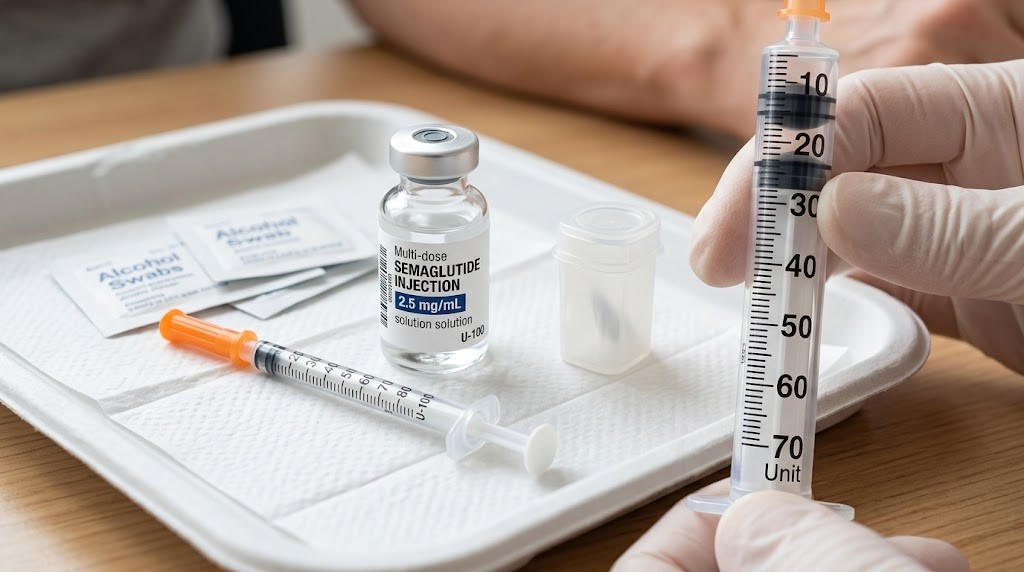
You are measuring 60 units on your insulin syringe. The liquid sits right at the line. But here is the problem that catches thousands of researchers off guard every single week: 60 units does not equal a fixed number of milligrams. It never has. The milligram dose hiding inside those 60 units depends entirely on the concentration printed on your vial, and getting this wrong means either underdosing (wasting weeks of progress) or overdosing (inviting side effects you did not need to experience).
This is not a trivial math exercise. Compounding pharmacies ship semaglutide in at least six different concentrations.
A 5 mg/mL vial and a 10 mg/mL vial look nearly identical on your shelf. Same clear liquid. Same small bottle. But 60 units from one delivers 3.0 mg while 60 units from the other delivers 6.0 mg. That is double the dose from the exact same syringe marking. The consequences of confusing these two concentrations range from stalled weight loss to severe nausea that keeps you in bed for days.
This guide breaks down exactly what 60 units of semaglutide equals in milligrams at every common concentration. You will find conversion tables, the formula to calculate any dose yourself, and the specific mistakes that lead to dosing errors. Whether you are using compounded semaglutide from a pharmacy or working with research-grade vials, the math works the same way. SeekPeptides members use our semaglutide dosage calculator to verify these conversions instantly, but understanding the underlying math matters just as much as having the right tool.
The quick answer: 60 units of semaglutide at every concentration
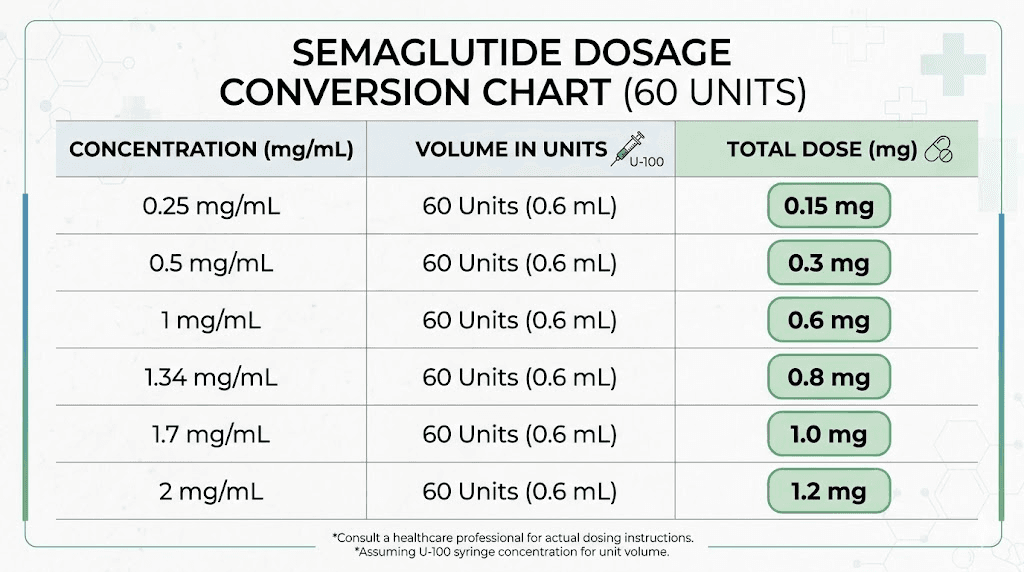
Before diving into the details, here is what you came for. The table below shows exactly how many milligrams 60 units of semaglutide contains at each common concentration.
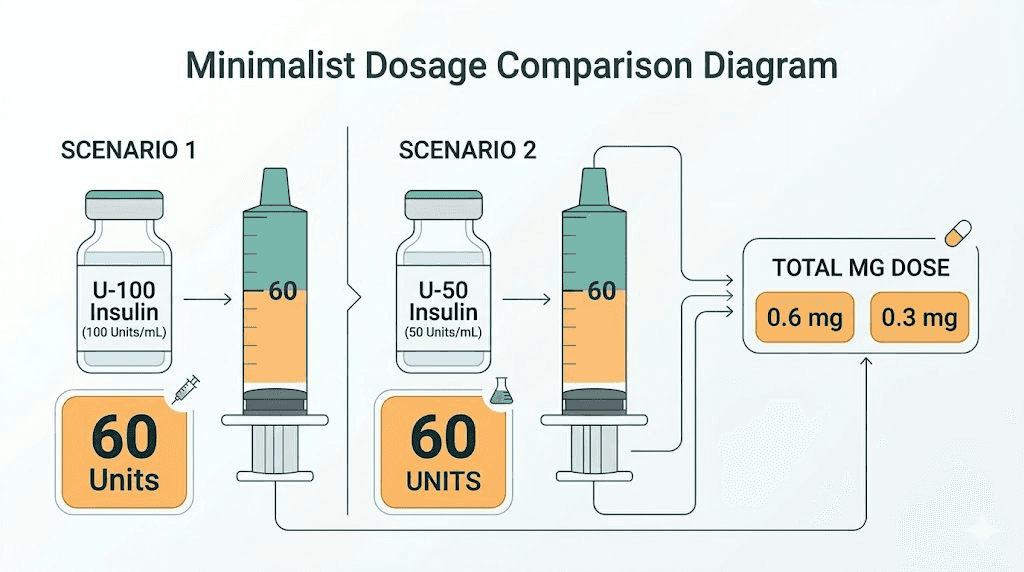
Remember: 60 units on an insulin syringe always equals 0.6 mL of liquid. The concentration of your vial determines how many milligrams of semaglutide are dissolved in that 0.6 mL.
Vial concentration | 60 units equals | Volume drawn | Typical dose stage |
|---|---|---|---|
1 mg/mL | 0.6 mg | 0.6 mL | Above starting dose |
2 mg/mL | 1.2 mg | 0.6 mL | Moderate escalation |
2.5 mg/mL | 1.5 mg | 0.6 mL | Mid-range therapeutic |
3 mg/mL | 1.8 mg | 0.6 mL | Upper-mid escalation |
5 mg/mL | 3.0 mg | 0.6 mL | High therapeutic dose |
10 mg/mL | 6.0 mg | 0.6 mL | Well above standard max |
The range is dramatic. At the lowest concentration, 60 units gives you just 0.6 mg. At the highest, the same syringe reading delivers 6.0 mg, which is more than double the maximum standard maintenance dose for weight loss. This ten-fold difference across concentrations is exactly why checking your vial label before every injection is not optional. It is essential.
Understanding the conversion formula
The math behind this conversion is straightforward once you see the pattern. Every insulin syringe treats 100 units as equal to 1 mL. This is a volume measurement, not a weight measurement. When you draw 60 units, you are pulling exactly 0.6 mL of liquid into the syringe regardless of what medication is inside.
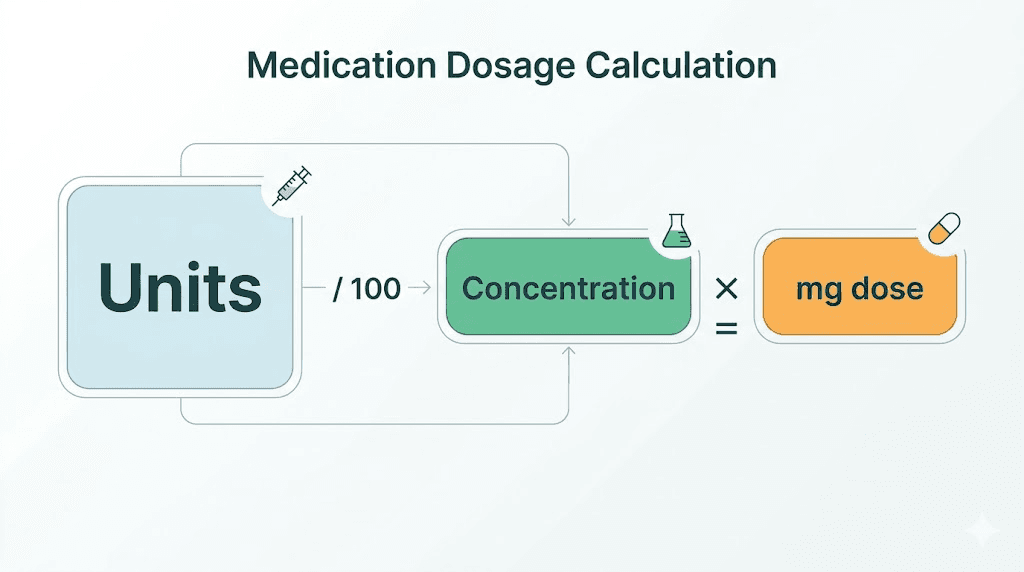
The formula looks like this:
Dose in mg = (Units / 100) x Concentration in mg/mL
For 60 units, the first part of the equation is always the same: 60 divided by 100 equals 0.6 mL. Then you multiply 0.6 by whatever concentration is printed on your vial.
Walking through each concentration step by step
At 1 mg/mL: 60 / 100 = 0.6 mL. Then 0.6 x 1 = 0.6 mg. This concentration is relatively uncommon for semaglutide but does exist in certain compounded formulations.
At 2 mg/mL: 0.6 mL x 2 = 1.2 mg. You will find this concentration from some pharmacies. At 1.2 mg, you are in the mid-range of the standard dosing escalation schedule, between the 1.0 mg and 1.7 mg stages.
At 2.5 mg/mL: 0.6 mL x 2.5 = 1.5 mg. This is one of the most common compounded concentrations. A dose of 1.5 mg sits comfortably between the third and fourth escalation steps.
At 3 mg/mL: 0.6 mL x 3 = 1.8 mg. At this dose, you are near the upper end of the escalation schedule, approaching the 1.7 mg maintenance level that many researchers find effective.
At 5 mg/mL: 0.6 mL x 5 = 3.0 mg. This is the concentration you will encounter most frequently from compounding pharmacies. At 3.0 mg, you are above the standard 2.4 mg maximum, which means 60 units from a 5 mg/mL vial is a significant dose. If your target is 2.4 mg from this concentration, you would need 48 units instead.
At 10 mg/mL: 0.6 mL x 10 = 6.0 mg. This is an extremely high concentration vial. Drawing 60 units from it would deliver 6.0 mg, which is far beyond any standard protocol. At this concentration, even small syringe errors produce large dosing swings. Most researchers using 10 mg/mL vials draw much smaller volumes.
The reverse formula: converting mg back to units
Sometimes you know the milligram dose you want and need to figure out how many units to draw. The reverse formula handles this:
Units = (Desired dose in mg / Concentration in mg/mL) x 100
Say you want 1.0 mg from a 5 mg/mL vial. You divide 1.0 by 5, getting 0.2 mL, then multiply by 100 to get 20 units. This reverse calculation is equally important for avoiding errors. Our semaglutide dosage calculator handles both directions automatically, but knowing the formula gives you a way to double-check any result.
For a deeper breakdown of the general semaglutide units to mg conversion process, that dedicated guide covers every edge case you might encounter.
Why concentration matters more than you think
Here is where things get dangerous for people who do not pay attention. Two vials sitting on your refrigerator shelf can look completely identical. Same size. Same cap color. Same clear liquid. One is 2.5 mg/mL. The other is 5 mg/mL.
If you draw 60 units from the wrong one, you get double your intended dose.
That is not a theoretical risk. It happens. And the consequences are real. Going from 1.5 mg to 3.0 mg in a single jump skips three escalation stages. The standard protocol increases doses gradually over 16 to 20 weeks for a reason. Your body needs time to adapt. Skipping stages by accidentally doubling your dose triggers the gastrointestinal side effects that make people want to quit entirely.
Common concentrations from compounding pharmacies
Compounding pharmacies produce semaglutide in several concentrations. The most common ones you will encounter are 2 mg/mL, 2.5 mg/mL, 3 mg/mL, and 5 mg/mL. Less common but still available are 1 mg/mL and 10 mg/mL. Some pharmacies like Empower Pharmacy tend to use specific concentrations, while others like Belmar Pharmacy may offer different options.
The concentration is always printed on the vial label as mg/mL. Find this number before you do anything else. Write it down. Put it on a sticky note next to your syringe. Whatever it takes to make sure you never confuse vials. If you are using a semaglutide with B12 blend, the concentration listed on the label refers specifically to the semaglutide component.
How concentration changes the math at every unit marking
To really understand the impact of concentration differences, look at how the milligram dose changes at several common unit markings across two frequently used concentrations:
Units drawn | At 2.5 mg/mL | At 5 mg/mL | Difference |
|---|---|---|---|
0.25 mg | 0.50 mg | 2x | |
0.50 mg | 1.00 mg | 2x | |
0.625 mg | 1.25 mg | 2x | |
1.00 mg | 2.00 mg | 2x | |
1.25 mg | 2.50 mg | 2x | |
60 units | 1.50 mg | 3.00 mg | 2x |
2.50 mg | 5.00 mg | 2x |
The ratio is always consistent: doubling the concentration doubles the dose at every unit level. But 2x is an enormous difference when we are talking about a potent GLP-1 receptor agonist. The difference between 1.5 mg and 3.0 mg is not just more medication. It is a completely different stage of the protocol with a completely different side effect profile.
Where 60 units falls in the semaglutide dosing schedule
Understanding what dose stage 60 units represents helps you determine whether the amount you are drawing makes sense for where you are in your protocol. The standard semaglutide dosing schedule for weight management progresses through five stages:
Stage | Weekly dose | Duration | 60 units equals this at... |
|---|---|---|---|
1 | 0.25 mg | Weeks 1-4 | Not applicable (too high at any concentration) |
2 | 0.5 mg | Weeks 5-8 | Not standard at any common concentration |
3 | 1.0 mg | Weeks 9-12 | Not a match |
4 | 1.7 mg | Weeks 13-16 | Close at 3 mg/mL (1.8 mg) |
5 | 2.4 mg | Week 17+ | Close at 4 mg/mL (2.4 mg) |
At the most common 5 mg/mL concentration, 60 units delivers 3.0 mg, which exceeds the standard maximum. At 2.5 mg/mL, 60 units gives you 1.5 mg, which falls between stage 3 and stage 4. And at 3 mg/mL, 60 units provides 1.8 mg, which is close to the stage 4 dose of 1.7 mg.
If your healthcare provider prescribed 60 units specifically, they already factored in the concentration of your particular vial. Do not assume 60 units is the same dose your friend takes, because their vial concentration may differ entirely. Compare compounded semaglutide dose charts from different pharmacies and the unit counts for the same milligram dose can look wildly different.
What 60 units means at 5 mg/mL specifically
Since the 5 mg/mL concentration is the most widely used from compounding pharmacies, it deserves its own breakdown. At this concentration:
60 units = 0.6 mL = 3.0 mg of semaglutide
This exceeds the standard maximum dose of 2.4 mg by 0.6 mg
Some protocols do use doses above 2.4 mg under supervision
If you intended 2.4 mg, you need 48 units, not 60
If you intended 2.0 mg, you need 40 units
If you intended 1.0 mg, you need 20 units
Drawing 60 units from a 5 mg/mL vial when your target is 2.4 mg means you are taking 25% more semaglutide than intended. Over the course of a month, that is an entire extra dose worth of excess medication. The gastrointestinal consequences of consistent overdosing include persistent nausea, constipation, and fatigue that many researchers attribute to the medication itself when the real culprit is simply too high a dose.
How to read your insulin syringe correctly
Syringe errors cause more dosing problems than math errors. The physical act of reading the markings, aligning the plunger, and avoiding bubbles introduces multiple points where things can go wrong.
The three syringe sizes you might use
Insulin syringes come in three standard sizes. Each one has different line spacing, which affects how easy it is to draw exactly 60 units.
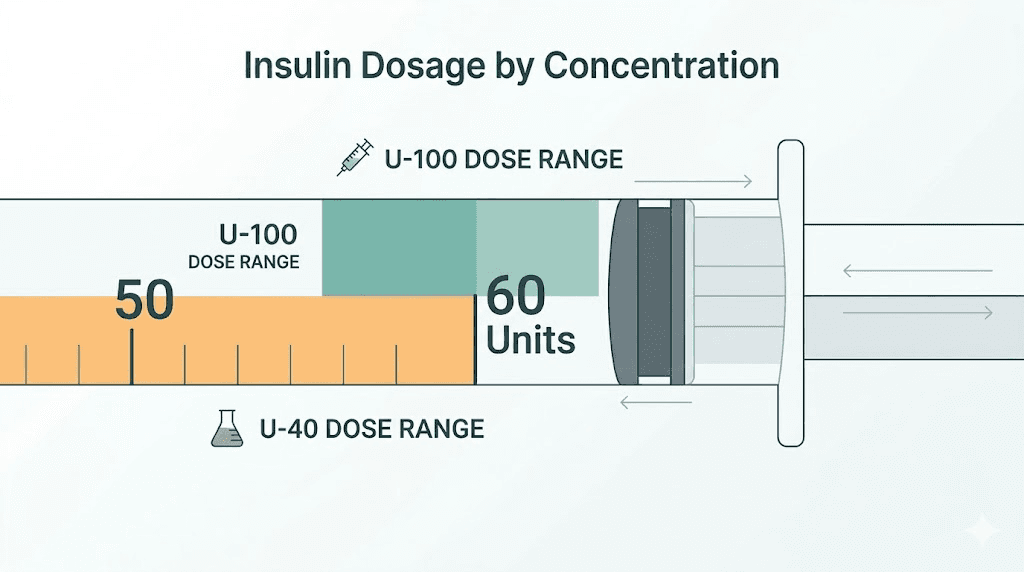
1 mL (100-unit) syringe: This is the most common choice for semaglutide injections. The 60-unit mark sits at the 60% point of the barrel. Lines are typically spaced at 2-unit intervals, meaning you can see markings at 58, 60, and 62 units clearly. This is the easiest syringe to use for a 60-unit dose.
0.5 mL (50-unit) syringe: This syringe only goes up to 50 units. You cannot draw 60 units with it. If you only have 50-unit syringes available and need a 60-unit dose, you would need to do two separate draws, which is not recommended. Get the right syringe size instead.
0.3 mL (30-unit) syringe: Even smaller. Maximum capacity is 30 units. Completely inadequate for a 60-unit dose. These syringes are designed for the early starting doses of semaglutide where precision at low volumes matters most.
For 60 units, always use a 1 mL (100-unit) insulin syringe. The markings are clear, the barrel is long enough to read accurately, and you have room for the full dose without pushing the plunger to its limit. When learning how to inject semaglutide with a syringe, syringe selection is the first decision that matters.
Reading the meniscus correctly
Liquid in a syringe forms a slight curve at the edges called a meniscus. Always read the flat bottom of this curve, not the edges that climb up the barrel walls. Reading the wrong part of the meniscus can throw your measurement off by 1 to 3 units, which translates to measurable milligram differences depending on concentration.
Hold the syringe at eye level. Not above, not below. Directly at eye level. Looking down at the syringe makes the liquid level appear higher than it actually is. Looking up makes it appear lower. Both angles introduce errors that compound over weeks of dosing.
Eliminating air bubbles
Air bubbles inside the syringe barrel displace liquid. A bubble sitting below the plunger means you have less semaglutide than the unit marking suggests. If you see bubbles after drawing your dose:
Hold the syringe with the needle pointing up
Flick the barrel gently with your fingernail
Wait for bubbles to rise to the top
Push the plunger slightly to expel the air
Re-draw liquid if needed to reach exactly 60 units
This process takes seconds but protects your dosing accuracy. A large air bubble could mean the difference between 58 and 60 units, which at a 5 mg/mL concentration is the difference between 2.9 mg and 3.0 mg. Attention to detail at this stage directly affects your week-by-week results.
Common mistakes when drawing 60 units
Knowing the right number means nothing if you make errors during preparation. These are the five most common mistakes researchers make when working with a 60-unit dose.
Mistake 1: using the wrong syringe scale
Not all syringes mark every unit. Some 100-unit syringes have markings at every 2 units (2, 4, 6, 8...) while others mark every unit (1, 2, 3, 4...). On a 2-unit scale syringe, the lines at 58, 60, and 62 are clearly distinguishable. But if you mistake the 58 mark for 60, you are short 2 units, which equals 0.1 mg at a 5 mg/mL concentration.
Count the small lines between the numbered markings on your syringe before your first use. If there are 5 small lines between 50 and 60, each line represents 2 units. If there are 10 small lines, each represents 1 unit. Do this once and write it down.
Mistake 2: confusing vials after reconstitution
If you have multiple vials in your refrigerator, perhaps a semaglutide vial next to a bacteriostatic water bottle, or a semaglutide vial next to a tirzepatide vial, grabbing the wrong one is easier than you think. Label everything. Use different colored tape. Store different medications on different shelves. One moment of inattention can send your protocol sideways.
Proper peptide storage practices include clear labeling with the medication name, concentration, date of reconstitution, and expiration date.
Mistake 3: not accounting for dead space
The hub of an insulin syringe (where the needle meets the barrel) holds a small amount of liquid called dead space. In most modern insulin syringes, this dead space is minimal (about 0.5 to 1 unit). But when you are trying to get the last dose out of a vial, dead space matters. You might draw what looks like 60 units but actually have 59 units of semaglutide and 1 unit of air or dead space medication that never gets injected.
Mistake 4: drawing too fast
Pulling the plunger quickly creates negative pressure inside the syringe that draws air into the barrel alongside the liquid. This produces micro-bubbles that are harder to see and harder to remove than one large bubble. Draw slowly. Let the liquid fill the barrel at its own pace. Patience at this step saves you from the tap-flick-redraw cycle.
Mistake 5: assuming 60 units is your dose without checking
Just because you read about someone taking 60 units online does not mean 60 units is the right dose for you. Their vial concentration might differ. Their body weight might differ. Their place in the escalation schedule might be weeks or months ahead of yours. Always verify your target milligram dose first, then calculate the units based on your specific vial concentration.
If the math feels uncertain, use a dosage calculator to confirm. Two seconds of verification prevents weeks of dosing errors.
How 60 units compares to other common semaglutide doses
Context helps. Knowing where 60 units sits relative to other common unit doses gives you a clearer picture of what you are actually taking and whether it aligns with standard protocols.
Side-by-side comparison at 5 mg/mL
The following table uses the most common compounded concentration of 5 mg/mL to show where 60 units falls among frequently prescribed amounts:
Units | mL drawn | mg at 5 mg/mL | Dose stage | Detailed guide |
|---|---|---|---|---|
5 | 0.05 mL | 0.25 mg | Stage 1 (starting) | |
10 | 0.10 mL | 0.50 mg | Stage 2 | |
20 | 0.20 mL | 1.00 mg | Stage 3 | |
34 | 0.34 mL | 1.70 mg | Stage 4 | |
40 | 0.40 mL | 2.00 mg | Between 4 and 5 | |
48 | 0.48 mL | 2.40 mg | Stage 5 (max standard) | |
50 | 0.50 mL | 2.50 mg | Above standard max | |
60 | 0.60 mL | 3.00 mg | Well above max | This guide |
100 | 1.00 mL | 5.00 mg | Full vial equivalent |
At 5 mg/mL, 60 units puts you 25% above the standard maximum dose. This is a significant amount. While some protocols do use above-standard doses, this level should only be reached after a full escalation period and under appropriate guidance. Jumping directly to 60 units (3.0 mg) at this concentration without proper titration dramatically increases the risk of adverse effects.
The same 60 units at 2.5 mg/mL
Now consider the same 60 units from a 2.5 mg/mL vial. At this lower concentration, 60 units equals only 1.5 mg, which is a perfectly reasonable mid-protocol dose between stage 3 (1.0 mg) and stage 4 (1.7 mg). This is precisely why the same unit number can be either a concerning overdose or a normal therapeutic amount, depending entirely on concentration.
Researchers sometimes experience stalled weight loss and wonder if they need to increase their dose. The first question to ask is not "should I take more units" but rather "what milligram dose am I actually taking?" You might discover that your 60 units is already higher than you thought, or lower than you assumed.
Reconstitution and how it affects your 60-unit dose
If you are working with lyophilized (freeze-dried) semaglutide that requires reconstitution, the amount of bacteriostatic water you add directly determines the concentration. This means you control the concentration, which means you control what 60 units equals.
Reconstitution math for a 5 mg vial
Start with a 5 mg semaglutide vial. The amount of water you add determines the resulting concentration:
Bac water added | Resulting concentration | 60 units equals |
|---|---|---|
1 mL | 5.0 mg/mL | 3.0 mg |
2 mL | 2.5 mg/mL | 1.5 mg |
2.5 mL | 2.0 mg/mL | 1.2 mg |
5 mL | 1.0 mg/mL | 0.6 mg |
Adding more water makes the solution weaker, which means more units for the same milligram dose. Less water makes it stronger, which means fewer units for the same dose. The 5 mg reconstitution chart walks through every common water volume in detail.
For researchers working with 5 mg vials, adding 2 mL of bacteriostatic water is one of the most popular choices because it produces a clean 2.5 mg/mL concentration where the math stays simple. At that concentration, 60 units gives you exactly 1.5 mg.
Reconstitution math for a 10 mg vial
Working with a 10 mg semaglutide vial changes the numbers significantly:
Bac water added | Resulting concentration | 60 units equals |
|---|---|---|
1 mL | 10.0 mg/mL | 6.0 mg |
2 mL | 5.0 mg/mL | 3.0 mg |
4 mL | 2.5 mg/mL | 1.5 mg |
5 mL | 2.0 mg/mL | 1.2 mg |
10 mL | 1.0 mg/mL | 0.6 mg |
The 10 mg reconstitution chart shows that adding 2 mL of water produces a 5 mg/mL concentration. At that strength, 60 units is 3.0 mg. But adding 4 mL instead creates 2.5 mg/mL, where 60 units drops to 1.5 mg. Choosing the right amount of water is a decision that follows you through every injection for the life of that vial.
Use the peptide reconstitution calculator to determine exactly how much bacteriostatic water to add for your target concentration. Getting reconstitution right means your unit markings translate to predictable, consistent milligram doses.
Compounded semaglutide blends and 60 units
Many compounding pharmacies now offer semaglutide blended with additional ingredients. These blends add complexity to the conversion because the concentration listed on the label still refers only to the semaglutide component.
Semaglutide with B12
The semaglutide with B12 combination is one of the most popular blends. The B12 (usually as methylcobalamin or cyanocobalamin) adds nutritional support during weight loss. When you draw 60 units from a semaglutide/B12 blend labeled as 5 mg/mL semaglutide, you still get 3.0 mg of semaglutide. The B12 is an additional component that does not change the semaglutide math.
Check the semaglutide with B12 dosage chart for concentration-specific guidance on these blends. The methylcobalamin formulation is the most common B12 form used in these combinations.
Semaglutide with glycine
Some formulations include glycine as a stabilizer. Glycine helps maintain the peptide structure during storage. Again, the semaglutide concentration on the label tells you the conversion math. Sixty units from a glycine-containing vial labeled at 5 mg/mL still equals 3.0 mg of semaglutide. The glycine does not affect the dosing calculation.
Semaglutide with niacinamide
Niacinamide blends follow the same principle. The niacinamide (vitamin B3) supports metabolic function during weight management. Focus on the semaglutide concentration for your unit-to-mg conversion. Any additional ingredients are supplementary to the dosing math.
Semaglutide with L-carnitine
The L-carnitine combination adds an amino acid that supports fat metabolism. As with all blends, the semaglutide concentration drives the conversion. Sixty units from a 5 mg/mL semaglutide/L-carnitine blend is still 3.0 mg of semaglutide regardless of the L-carnitine content.
The bottom line with all blends: additional ingredients do not change your semaglutide dose calculation. Find the semaglutide concentration, apply the formula, and ignore the supplementary ingredients for dosing purposes.
Side effects to expect at different 60-unit dose levels
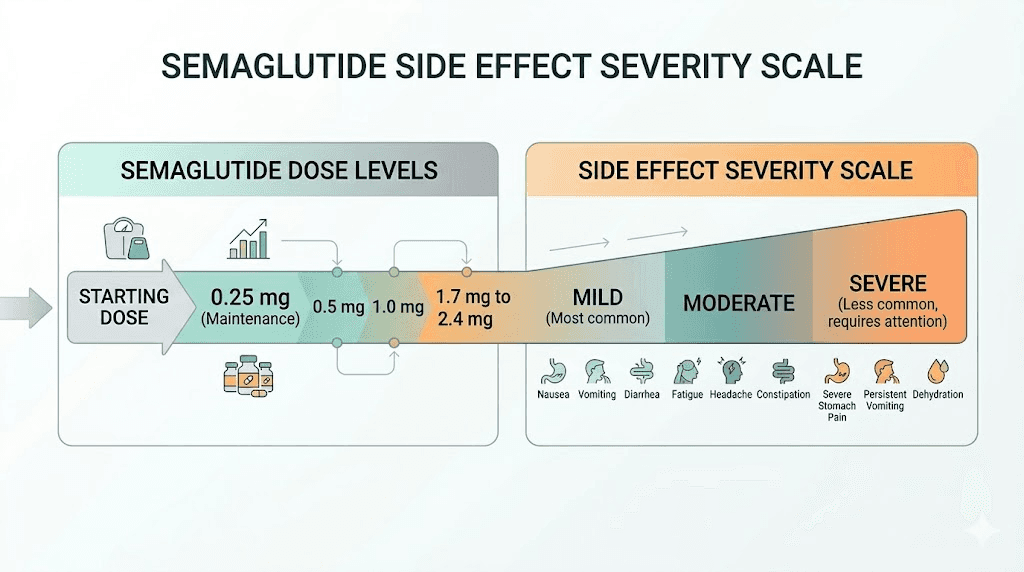
The milligram dose you get from 60 units determines which side effects you are most likely to experience. Lower doses tend to be better tolerated. Higher doses increase both efficacy and adverse effects. Here is what the research suggests at the dose levels that 60 units can deliver.
At 0.6 mg (1 mg/mL concentration)
This dose falls between the stage 1 and stage 2 levels. Side effects at this range are generally mild. Some people experience minor bloating or slight appetite changes. Most researchers tolerate this dose well, particularly if they have already completed a few weeks at the 0.25 mg starting dose. The onset of side effects at this level is typically gradual.
At 1.2 to 1.5 mg (2 to 2.5 mg/mL concentration)
Now you are in the moderate therapeutic range. Appetite suppression becomes more noticeable. Gastrointestinal effects including nausea, constipation, and sulfur burps are more common at this level. Many researchers report that these effects diminish after 2 to 4 weeks at a stable dose. Weight loss typically becomes measurable at this stage.
If you are experiencing persistent fatigue on semaglutide at this dose, it may be related to reduced caloric intake rather than the medication itself. Ensuring adequate nutrition through proper food choices can help manage energy levels.
At 1.8 mg (3 mg/mL concentration)
Approaching the upper therapeutic range, this dose produces strong appetite suppression in most people. Gastrointestinal side effects are more frequent, though still manageable for most researchers who have titrated up properly. The appetite suppression timeline at this dose level tends to be rapid, often noticeable within the first day or two after injection.
At 3.0 mg (5 mg/mL concentration)
This is above the standard maximum. Side effects at this level are significantly more common and more intense. Nausea, dizziness, constipation, and reduced energy are all more likely. Some researchers at this dose report difficulty maintaining adequate nutrition because appetite suppression is so strong. If you are not losing weight at lower doses, increasing to 3.0 mg should only be considered after verifying that lower doses were given adequate time to work (typically 4 to 8 weeks per stage).
Managing nutrition on semaglutide becomes especially important at higher doses. Even when appetite is minimal, your body still needs protein, vitamins, and minerals to function properly during weight loss.
At 6.0 mg (10 mg/mL concentration)
This dose is far beyond standard protocols. Side effects at this level would likely be severe. There is limited clinical data supporting doses this high for weight management. If your calculation suggests 60 units from a 10 mg/mL vial, double-check the math. It is almost certain that a dose this high is either a calculation error or intended for a very different purpose than standard weight loss protocols.
Pharmacy-specific dosage charts for 60 units
Different compounding pharmacies ship semaglutide at different concentrations. Knowing which pharmacy prepared your vial tells you the likely concentration, which tells you what 60 units delivers.
Empower Pharmacy
Empower Pharmacy commonly compounds semaglutide at 5 mg/mL. At this concentration, 60 units = 3.0 mg. Empower is one of the largest compounding pharmacies in the country and ships semaglutide both with and without B12 blends.
Olympia Pharmacy
Olympia Pharmacy also commonly uses 5 mg/mL concentrations. The same math applies: 60 units = 3.0 mg. Their semaglutide formulations follow standard compounding practices, and concentration is always listed on the vial label.
Belmar Pharmacy
Belmar Pharmacy offers semaglutide at various concentrations depending on the prescriber request. Always check the specific vial label rather than assuming a standard concentration. At 2.5 mg/mL, 60 units would be 1.5 mg. At 5 mg/mL, it would be 3.0 mg. The difference matters enormously.
Strive Pharmacy
Strive Pharmacy provides semaglutide at concentrations that may vary by formulation. Check the Strive Pharmacy semaglutide dosage chart for specific concentration details. As always, verify the concentration printed on your actual vial before drawing any dose.
Other pharmacies
Pharmacies like Direct Meds, Lavender Sky, Elevate Health, WeightCare, and Belle Health each compound semaglutide at their own standard concentrations. The one universal rule: read your vial label. The concentration printed there is the only number that matters for your conversion.
Storing semaglutide after drawing 60 units
Once you have drawn 60 units into your syringe, inject it promptly. Do not pre-fill syringes and store them for later use unless specifically instructed to do so. Semaglutide in the original vial maintains stability under proper refrigeration conditions, but once drawn into a syringe, the stability profile changes.
Vial storage between doses
After withdrawing your 60-unit dose, the remaining semaglutide in the vial should go back into the refrigerator immediately. Compounded semaglutide typically lasts 28 to 90 days in the refrigerator depending on the pharmacy and formulation. Keep the vial between 2 and 8 degrees Celsius (36 to 46 degrees Fahrenheit).
If your semaglutide accidentally gets left out, the stability depends on how long and at what temperature. Brief excursions at room temperature are generally tolerable. The compounded semaglutide room temperature stability guide covers specific timeframes. If it got warm, assess the situation before using it for your next dose.
Expiration considerations
Compounded semaglutide comes with a beyond-use date (BUD) that differs from the expiration dates on manufactured medications. This date is typically 30 to 90 days from compounding. Using expired semaglutide may result in reduced potency, meaning your 60 units might not deliver the full milligram dose you calculated. Check the semaglutide shelf life guide for detailed stability information.
Some researchers wonder whether compounded semaglutide truly expires or if it just loses potency gradually. The answer depends on storage conditions, but using medication past its beyond-use date introduces uncertainty into every dose you draw.
Injection technique for a 60-unit dose
A 60-unit dose means you are injecting 0.6 mL of liquid subcutaneously. This is a moderate injection volume, larger than the 0.1 to 0.25 mL doses used during early escalation but smaller than a full 1.0 mL injection. The technique matters for both comfort and absorption.
Choosing your injection site
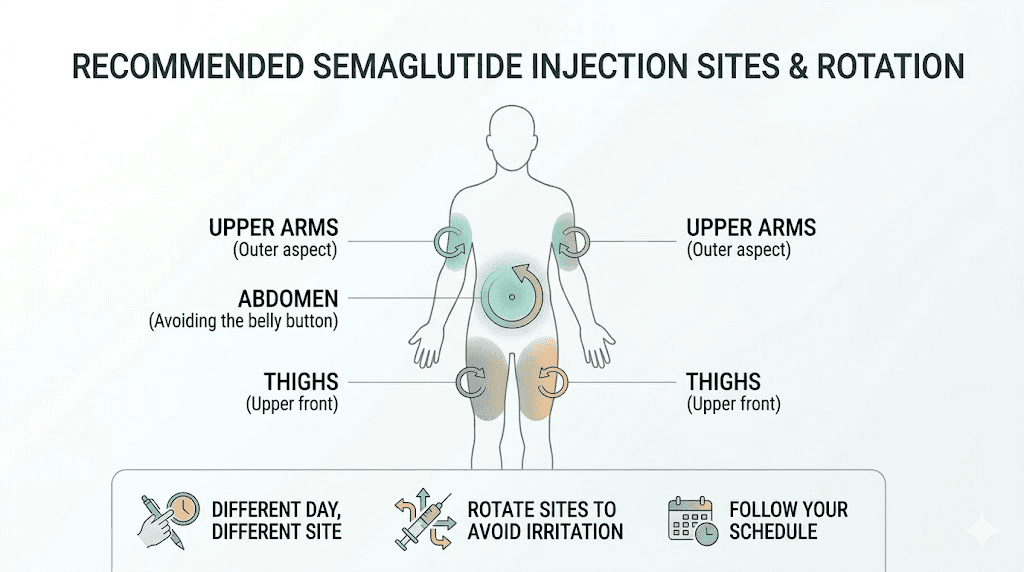
The three primary injection sites for semaglutide are the abdomen, thigh, and upper arm. The best injection site depends on your body composition and personal preference. For a 0.6 mL volume, the abdomen typically provides the most comfortable experience because of the larger subcutaneous fat layer available in most people.
Rotate injection sites between doses. Do not inject into the same spot repeatedly. Rotation prevents localized irritation, lumps, and inconsistent absorption. If you injected into your left abdomen last week, try the right abdomen or thigh this week.
Injection speed
Push the plunger slowly. For 60 units (0.6 mL), a 10 to 15 second injection time is appropriate. Injecting too quickly can cause a stinging sensation and may result in some of the liquid backing out through the injection site. After pushing the plunger completely, hold the needle in place for 5 to 10 seconds before withdrawing. This gives the liquid time to disperse into the subcutaneous tissue.
What to do if you accidentally inject into muscle
If your needle penetrates deeper than the subcutaneous layer and enters muscle, the semaglutide will still be absorbed, but potentially at a different rate. The guide on accidental intramuscular semaglutide injection covers what to expect and whether you need to adjust anything. For most people, a single intramuscular injection is not harmful, but subcutaneous administration is the intended route for consistent absorption.
Timing your 60-unit injection
Semaglutide is a once-weekly injection. The best time of day to take semaglutide is whenever you can be most consistent. Some researchers prefer morning injections so they can manage any initial nausea during the day. Others prefer evening injections so they can sleep through the early hours when side effects are most noticeable.
Pick a day and a time. Stick with it. Consistency matters more than the specific day or time you choose. If you need to shift your injection day occasionally, semaglutide has a long enough half-life to tolerate a day or two of variation. Some researchers even explore splitting their dose across two injections per week for better tolerance, though this approach changes the units-per-injection calculation.
When 60 units is too much or too little
Sixty units is not inherently the right or wrong dose. It depends entirely on your concentration and where you are in your protocol. Here are the scenarios where 60 units might need adjustment.
Signs you might be overdosing
If your 60-unit dose is delivering more milligrams than appropriate for your stage, you might notice:
Persistent nausea that does not improve after 2 to 3 weeks
Severe constipation that does not respond to fiber and hydration
Complete loss of appetite (unable to eat even small meals)
Significant fatigue that limits daily activities
Dizziness or lightheadedness
Rapid weight loss exceeding 1 to 2 percent of body weight per week
If you are experiencing several of these symptoms, verify your milligram dose by recalculating units against your vial concentration. You might discover you are taking more than you thought.
Signs you might be underdosing
If 60 units from a low-concentration vial is delivering fewer milligrams than your target:
Minimal or no appetite suppression
No measurable weight change after 4 or more weeks
No side effects whatsoever (mild initial side effects are common and expected)
Feeling as though the medication is not working
Before concluding that semaglutide is not working, verify your actual milligram dose. Many cases of stalled weight loss on semaglutide trace back to a lower-than-intended dose caused by concentration confusion or reconstitution errors. The semaglutide plateau guide covers other factors that can stall progress.
Adjusting your dose
Never adjust your semaglutide dose without recalculating the units for your specific concentration. If you want to move from your current milligram dose to the next standard stage, work backwards from the target milligrams:
Target mg / Your concentration in mg/mL x 100 = New unit count
For example, moving from 1.5 mg to 1.7 mg using a 2.5 mg/mL vial: 1.7 / 2.5 x 100 = 68 units. That is only 8 units more than your current 60, but those 8 units represent a meaningful 13% increase in dose. Small unit changes produce real milligram changes. Precision matters.
Switching concentrations mid-protocol
Researchers sometimes switch pharmacies or receive a refill at a different concentration. This is where 60-unit dosing gets dangerous if you are not paying attention.
The scenario
You have been taking 60 units from a 2.5 mg/mL vial (1.5 mg per dose) for six weeks. Your pharmacy switches you to a 5 mg/mL vial. If you continue drawing 60 units out of habit, you are now taking 3.0 mg, double your previous dose with zero titration. This is exactly the kind of sudden increase that triggers severe nausea, bloating, and other unpleasant effects.
How to adjust
When switching to a new concentration, recalculate immediately:
Old dose: 60 units at 2.5 mg/mL = 1.5 mg
New vial: 5 mg/mL
Units needed for same dose: 1.5 / 5 x 100 = 30 units
Your 60 units becomes 30 units. Cut in half. If you do not make this adjustment, you double your dose overnight. The semaglutide syringe dosage conversion chart makes these pharmacy-switch calculations quick and straightforward.
Switching from semaglutide to tirzepatide
Some researchers transition from semaglutide to tirzepatide for various reasons. If you are considering this switch, the unit-to-mg relationship changes completely because tirzepatide is a different medication with different concentrations and different dosing stages. The semaglutide to tirzepatide conversion chart handles this transition, and the switching guide covers the practical steps.
If semaglutide is not producing the results you expected, it is worth exploring whether tirzepatide might work better for your goals. The two medications have different mechanisms that suit different metabolic profiles.
Oral semaglutide and how 60 units does not apply
Oral semaglutide formulations, including oral semaglutide drops and sublingual semaglutide, use completely different dosing measurements. There are no "units" in oral dosing because there is no syringe involved. Oral semaglutide doses are measured in milligrams directly.
If someone tells you they take "60 units" of oral semaglutide, they are confused about their dosing. Oral formulations typically come in measured doses (3 mg, 7 mg, 14 mg tablets or calibrated liquid drops). The unit-to-mg conversion discussed in this article applies exclusively to injectable semaglutide measured with an insulin syringe.
Using calculators and tools to verify your dose
SeekPeptides provides several tools that make dose verification quick and reliable. Rather than doing the math in your head before each injection, use a calculator to confirm your conversion, especially when you are tired, rushed, or handling a new vial.
Semaglutide dosage calculator
The semaglutide dosage calculator takes your vial concentration and desired milligram dose, then tells you exactly how many units to draw. Enter 60 units and your concentration to see the milligram result, or enter your target milligrams to find the correct unit count. Either direction works instantly.
Peptide reconstitution calculator
If you are reconstituting your own semaglutide, the reconstitution calculator tells you how much bacteriostatic water to add for your target concentration. This upstream calculation ensures that your downstream unit-to-mg conversion gives you the dose you actually want.
General peptide calculator
The general peptide calculator works for semaglutide and any other injectable peptide. If you are running multiple compounds simultaneously, this tool keeps all your dosing calculations organized in one place.
SeekPeptides members also get access to detailed peptide dosage calculation guides, comprehensive dosage charts, and protocol builders that account for individual factors most generic resources ignore.
How many doses does your vial contain at 60 units per injection
Knowing how many 60-unit doses you can pull from a single vial helps with planning, ordering, and budgeting. The answer depends on your total vial volume.
Vial size | Total volume | Number of 60-unit (0.6 mL) doses | Approximate weeks |
|---|---|---|---|
2 mL vial | 2.0 mL | 3 full doses (with 0.2 mL remaining) | 3 weeks + partial |
3 mL vial | 3.0 mL | 5 full doses | 5 weeks |
5 mL vial | 5.0 mL | 8 full doses (with 0.2 mL remaining) | 8 weeks + partial |
The remaining liquid after your last full dose can sometimes yield a partial dose, but accurately drawing less than a full 60 units from a nearly empty vial can be tricky. Some researchers use the final partial draw as a reduced-dose week, which can serve as a natural mini-taper before starting a new vial.
For cost planning, use the peptide cost calculator to estimate your per-dose and per-week expenses at 60 units.
Combining semaglutide with other compounds
If you are taking semaglutide alongside other peptides or medications, the 60-unit dose does not change, but interactions and timing matter.
Semaglutide with phentermine
Some researchers use phentermine and semaglutide together for enhanced appetite suppression. The comparison between these two approaches shows they work through different mechanisms. When combining, the semaglutide dose calculation stays the same. Your 60 units delivers whatever milligrams your concentration dictates, regardless of other medications.
Semaglutide with tirzepatide
Taking semaglutide and tirzepatide simultaneously is uncommon and generally not recommended, but some protocols explore alternating between them. If you are alternating, keep each medication calculation completely separate. Your semaglutide units use your semaglutide concentration. Your tirzepatide units use your tirzepatide concentration. Never cross-apply concentrations.
Semaglutide with berberine
Some researchers add berberine alongside semaglutide for additional metabolic support. Berberine is an oral supplement, so it does not affect your semaglutide injection calculation. Your 60 units remains 60 units.
Special considerations for 60 units
Travel with pre-drawn syringes
If you need to travel with semaglutide and are considering pre-drawing your 60-unit dose, know that most experts recommend drawing fresh from the vial at the time of injection. If you must pre-draw, use a sterile syringe, cap it securely, and refrigerate it. Use within 24 hours for best results.
Missed doses
If you miss your weekly 60-unit injection, take it as soon as you remember within a few days. If more than 5 days have passed since your missed dose, skip that week and resume your regular schedule. Do not double up to 120 units to compensate. That would deliver double your milligram dose, which is exactly the kind of sudden increase that causes severe side effects.
Starting or stopping mid-protocol
If you are just beginning semaglutide, 60 units is almost never the right starting dose regardless of concentration. Even at the weakest 1 mg/mL concentration, 60 units delivers 0.6 mg, which is above the standard 0.25 mg starting dose. Most protocols recommend starting with a much smaller number of units. Check the first week on semaglutide guide for proper starting protocols.
If you are considering stopping semaglutide, do not stop abruptly from a 60-unit dose. The cold turkey stopping guide explains why gradual dose reduction is preferred. Withdrawal symptoms can include rebound appetite and rapid weight regain. Many researchers find that a structured taper over 4 to 8 weeks minimizes these effects.
Exercise and activity level
Your activity level does not change what 60 units equals in milligrams, but it does affect how your body responds to that dose. Some researchers find they can lose weight on semaglutide without exercise, while others combine it with physical activity for enhanced results. At higher doses (like 3.0 mg from a 5 mg/mL vial), reduced appetite can make fueling workouts challenging. Plan your nutrition accordingly.
Quick reference: 60 units at every concentration
One final table for easy reference. Bookmark this page and come back whenever you need a quick answer.
Concentration | 60 units = | Standard stage equivalent | Risk level |
|---|---|---|---|
1 mg/mL | 0.6 mg | Between stage 1 and 2 | Low (below therapeutic range for most) |
2 mg/mL | 1.2 mg | Between stage 3 and 4 | Moderate (standard therapeutic) |
2.5 mg/mL | 1.5 mg | Between stage 3 and 4 | Moderate (common mid-protocol dose) |
3 mg/mL | 1.8 mg | Near stage 4 | Moderate-high (approaching upper stages) |
5 mg/mL | 3.0 mg | Above stage 5 maximum | High (exceeds standard max) |
10 mg/mL | 6.0 mg | Far above any standard | Very high (likely calculation error) |
For researchers serious about getting their semaglutide dosing right, SeekPeptides offers comprehensive protocol guides, dosage calculators, and a community of experienced researchers who have navigated these exact calculations. Membership provides access to detailed dosing charts for every concentration, reconstitution guides, and personalized protocol support that goes far beyond what any single conversion table can offer.
Frequently asked questions
Is 60 units of semaglutide a high dose?
It depends entirely on your vial concentration. At 2.5 mg/mL, 60 units equals 1.5 mg, which is a moderate mid-protocol dose. At 5 mg/mL, 60 units equals 3.0 mg, which exceeds the standard maximum of 2.4 mg. Always check your concentration before judging whether a unit count is high or low. The guide on whether 50 units is a lot covers similar considerations.
Can I use a 50-unit syringe to draw 60 units?
No. A 50-unit syringe has a maximum capacity of 0.5 mL, and 60 units requires 0.6 mL. You must use a 100-unit (1 mL) syringe for a 60-unit dose. Using the wrong syringe size is one of the most common syringe dosage errors.
What if my vial has a concentration not listed here?
Use the formula: 60 / 100 x your concentration = mg dose. For example, at 4 mg/mL: 0.6 x 4 = 2.4 mg. The formula works for any concentration. You can also plug your numbers into the semaglutide dosage calculator for instant verification.
How many mL is 60 units?
Sixty units always equals 0.6 mL on a standard insulin syringe (which measures 100 units per 1 mL). This volume is the same regardless of what medication is in the syringe or what concentration the vial contains.
Can I take 60 units twice per week instead of once?
Some researchers explore split dosing strategies, but taking 60 units twice per week would double your weekly milligram dose. If you want to split your weekly dose across two injections, each injection should be 30 units (half), not 60. Always calculate your total weekly milligrams to ensure you are not accidentally doubling your intake.
Why does my pharmacy give me a different number of units than my friend?
Your pharmacies likely use different concentrations. If your friend takes 30 units from a 5 mg/mL vial, they get 1.5 mg. If you take 60 units from a 2.5 mg/mL vial, you also get 1.5 mg. Same milligram dose, different unit counts. This is why comparing unit numbers between people is meaningless without knowing both concentrations.
Does semaglutide with B12 change the 60-unit calculation?
No. The B12 (or any other blend ingredient like glycine, pyridoxine, or L-carnitine) is an additional component. The semaglutide concentration listed on the label tells you the semaglutide content per mL. Your 60-unit calculation uses only that number.
What foods should I eat on injection day?
Light, easily digestible foods help minimize nausea on injection day, especially at higher doses. The best foods to eat on semaglutide guide and the complete semaglutide diet plan provide meal ideas optimized for researchers using GLP-1 medications.
Is 60 units safe?
Safety depends on the milligram dose, which depends on concentration. At 2.5 mg/mL, 60 units delivers 1.5 mg, a dose within the standard therapeutic range. At 5 mg/mL, 60 units delivers 3.0 mg, which is above standard and should only be used under appropriate guidance. Verify your milligram dose and compare it to the standard dosing schedule.
External resources
In case I do not see you, good afternoon, good evening, and good night. May your conversions stay accurate, your concentrations stay consistent, and your progress stay steady.