Mar 20, 2026
You are overpaying for semaglutide. Most people are. The gap between what brand-name GLP-1 medications cost and what compounded versions actually run is staggering, often $800 to $1,200 per month in pure savings. But here is the problem nobody talks about when they search for cheap compound semaglutide. The cheapest option is not always the safest option. And the safest option is not always the most expensive one either.
Finding affordable compounded semaglutide requires more than comparing price tags. It demands understanding what you are actually getting for your money, which pharmacies follow proper manufacturing standards, and why some providers charge $99 per month while others charge $497 for what appears to be the same medication. The differences matter more than most people realize, and those differences can affect everything from how quickly semaglutide works to whether it works at all.
This guide breaks down every angle of affordable compounded semaglutide. Pricing comparisons. Pharmacy verification. Red flags that signal danger. Regulatory changes that shifted the entire landscape. And specific steps you can take right now to find quality medication at a price that does not destroy your budget. Whether you are new to GLP-1 therapy or switching from brand-name medications, the information here could save you hundreds of dollars monthly while keeping your protocol safe and effective.
What compounded semaglutide actually is and why it costs less
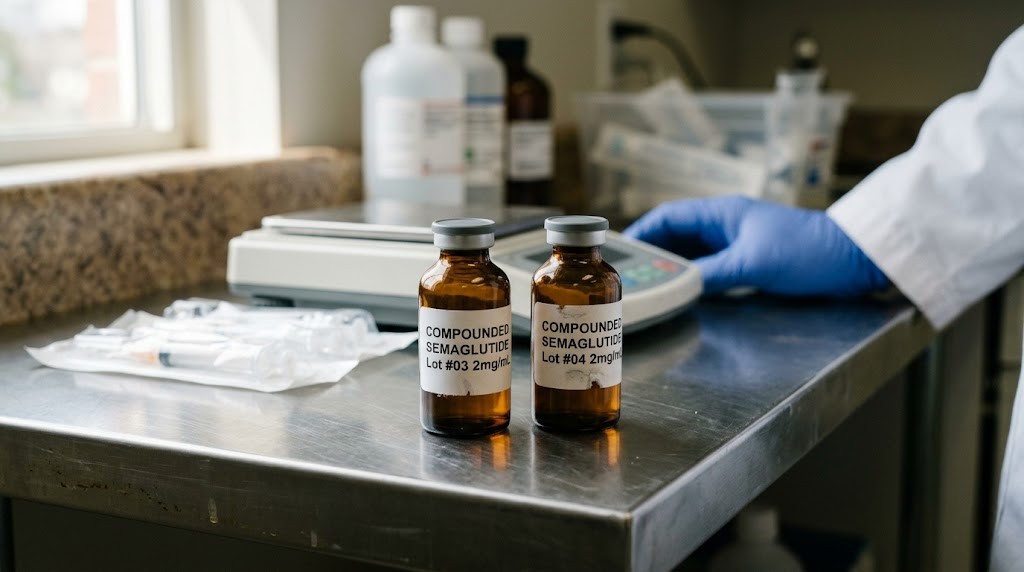
Compounded semaglutide is not a generic version of Ozempic or Wegovy. That distinction matters. It is a medication prepared by a compounding pharmacy using the same active ingredient, semaglutide, but mixed and formulated specifically for individual patients or produced in batches by outsourcing facilities. The reason it costs less comes down to manufacturing scale, regulatory pathways, and the absence of brand-name pharmaceutical marketing budgets.
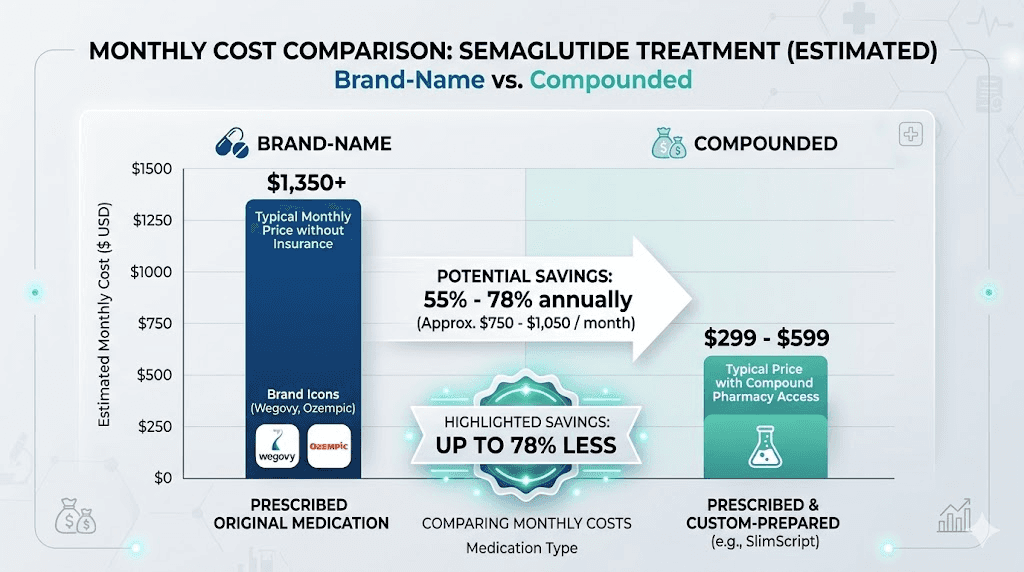
Brand-name semaglutide carries enormous costs. Novo Nordisk spends billions on clinical trials, FDA approval processes, marketing campaigns, and distribution networks. Those costs get passed directly to patients. Ozempic runs approximately $997 per month without insurance. Wegovy averages around $1,349 per month. For many people, those numbers make consistent treatment impossible.
Compounded versions skip most of those overhead costs. A licensed compounding pharmacy purchases pharmaceutical-grade semaglutide powder, reconstitutes it according to USP standards, and dispenses it at a fraction of brand-name pricing. Monthly costs typically range from $99 to $399 depending on the pharmacy, dosage, and whether additional compounds like B12 or glycine are included in the formulation.
But cheaper does not mean identical.
The FDA has noted that some compounding facilities use different salt forms of semaglutide, such as semaglutide acetate or semaglutide sodium, rather than the base form used in FDA-approved products. These salt forms have not been independently tested for safety and effectiveness. This is not a minor technical detail. It affects how the medication behaves in your body, how it is absorbed, and potentially how well it suppresses appetite. Understanding these differences is critical before you commit to any provider, regardless of price.
How compounding pharmacies source semaglutide
Legitimate compounding pharmacies purchase bulk semaglutide from FDA-registered suppliers. The raw material goes through quality testing before being formulated into injectable solutions. Reputable pharmacies test every batch for potency, sterility, and endotoxins. They follow USP 797 sterile compounding standards and maintain proper cold chain storage throughout the entire process.
Less reputable operations cut corners. They may source from unverified suppliers, skip batch testing, or use improper storage conditions. The medication might arrive at the correct price point but contain inconsistent dosing, contamination, or degraded active ingredient. This is why the cheapest option on the market deserves the most scrutiny, not the least. When you are injecting something into your body, the injection process is only as safe as the medication itself.
503A versus 503B pharmacies
Two types of compounding pharmacies exist, and the difference between them affects both cost and safety.
503B outsourcing facilities operate under FDA oversight. They follow current Good Manufacturing Practices, test every batch, and can produce medications without individual patient prescriptions for distribution to healthcare facilities. These facilities face regular FDA inspections and must meet stringent quality standards. Their products tend to cost slightly more but carry significantly less risk.
503A pharmacies operate under state pharmacy board oversight. They compound medications for individual patients with valid prescriptions. Quality standards vary by state, and inspection frequency differs dramatically. Some 503A pharmacies maintain excellent standards. Others do the bare minimum. The variability is the problem.
When searching for cheap compound semaglutide, knowing which type of pharmacy fills your prescription is not optional information. It is essential. If a provider will not tell you which pharmacy compounds their medication, that silence speaks volumes.
The real cost breakdown: what you should expect to pay
Pricing for compounded semaglutide varies more than most people expect. The range is enormous, and understanding why helps you separate legitimate value from suspicious pricing.
Here is what the market looks like right now.
Budget tier ($99 to $149 per month): These providers typically offer compounded semaglutide through telehealth platforms with high patient volume. Some achieve low pricing through bulk purchasing agreements with compounding pharmacies. Others cut costs in ways that should concern you, such as minimal medical oversight, no follow-up consultations, or sourcing from facilities with limited quality controls. At this price point, you need to verify everything. Check the pharmacy license. Ask for certificates of analysis. Confirm cold chain shipping.
Mid-range tier ($150 to $299 per month): This is where most legitimate compounded semaglutide falls. Providers at this price point typically include medical consultations, dosage adjustments, and medications from established compounding pharmacies. Monthly costs here represent genuine savings of 70 to 80 percent compared to brand-name options. Many providers in this range use established compounding pharmacies with verifiable track records.
Premium tier ($300 to $497 per month): Higher-priced compounded semaglutide often includes additional compounds like methylcobalamin, niacinamide, or L-carnitine. Some premium providers include comprehensive lab work, regular physician consultations, and diet planning. The medication itself may not be meaningfully different from mid-range options, but the wraparound services add value for some patients.
Hidden costs that inflate the real price
The advertised monthly price rarely tells the whole story. Watch for these additions that can push your actual cost significantly higher.
Initial consultation fees range from $50 to $199 and may not be included in the advertised monthly rate. Some providers bury this cost in the enrollment process. Others waive it if you commit to a multi-month plan. Always ask before signing up.
Lab work requirements can add $100 to $300 depending on what testing the provider requires. Some accept recent labs from your primary care physician. Others insist on their own panels. The labs themselves may be medically appropriate, but the cost matters when you are already trying to save money.
Shipping fees add $10 to $30 per month for cold chain delivery. Semaglutide requires refrigeration, so proper shipping with ice packs and insulated packaging is non-negotiable. If a provider ships without cold chain protection, that is not savings. That is degraded medication.
Supplies like syringes, alcohol swabs, and sharps containers add another $10 to $25 monthly. Most providers include basic supplies. Budget providers often do not. Factor these into your comparison.
When you add everything up, a $99 per month advertised price might actually cost $175 to $200 monthly. A $249 per month price that includes everything might be the better deal. Always calculate the total cost of treatment, not just the medication sticker price. Use a peptide cost calculator to compare options accurately.
How to find legitimate affordable compounding pharmacies
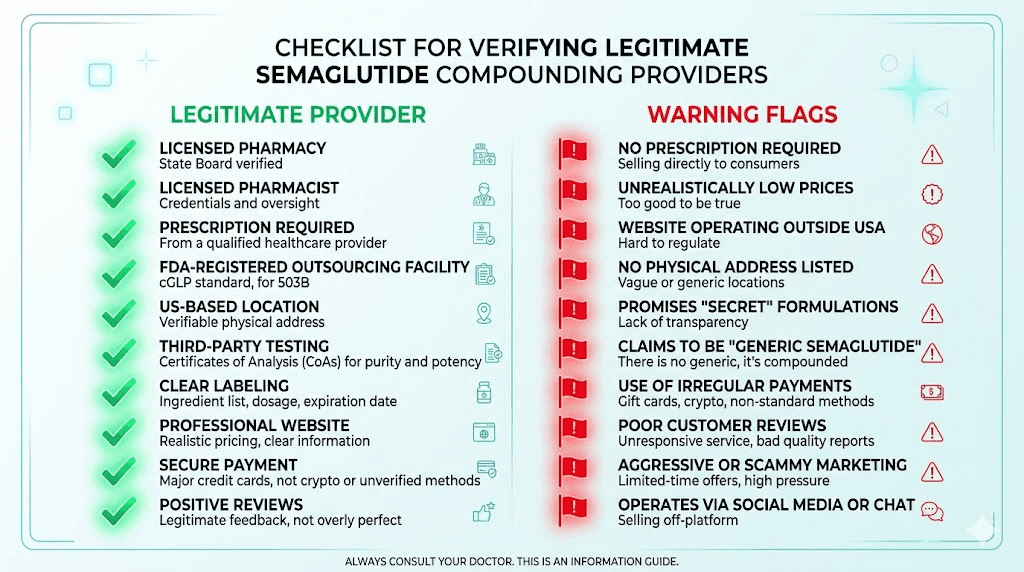
Finding cheap compound semaglutide that is actually safe requires specific verification steps. Skip any of these and you are gambling with your health.
Step 1: verify the pharmacy license
Every compounding pharmacy must hold a valid state license. You can verify this through your state board of pharmacy website. If the provider uses a 503B outsourcing facility, check the FDA registered outsourcing facility list. This takes five minutes and eliminates the most dangerous operators immediately.
A pharmacy that will not disclose its name or license number is not protecting proprietary information. It is hiding something. Walk away.
Step 2: ask for certificates of analysis
Reputable pharmacies test every batch of compounded semaglutide for potency, purity, sterility, and endotoxins. They produce certificates of analysis (COAs) documenting these results. Any legitimate pharmacy will provide COAs on request. If they refuse or claim testing is unnecessary, find another provider.
What to look for on a COA:
Potency results confirming the labeled dose matches the actual content (target: 90 to 110 percent of stated potency)
Sterility testing showing no bacterial or fungal growth
Endotoxin testing within acceptable limits
Testing date that corresponds to your medication batch
Step 3: confirm the semaglutide form
This step catches a problem most people never think to check. The FDA-approved form of semaglutide uses the base molecule. Some compounding pharmacies use semaglutide sodium or semaglutide acetate, which are different salt forms. The FDA has explicitly stated these alternative forms have not been shown to be safe and effective.
Ask your provider which form of semaglutide their pharmacy uses. If they cannot answer this question, they do not understand their own product well enough to be selling it. Base form semaglutide is what you want. Accept nothing less.
Step 4: verify cold chain shipping
Semaglutide is a peptide that degrades when exposed to heat. Proper shipping requires insulated packaging, ice packs or gel packs, and expedited delivery. If your medication arrives warm, it may have lost potency. Some providers offer temperature monitoring strips inside shipments so you can verify the medication stayed within safe ranges during transit.
Budget providers sometimes skip cold chain shipping to save $5 to $10 per order. That savings comes directly out of your medication effectiveness. The difference between properly stored semaglutide and heat-damaged product can be the difference between losing weight and wondering why semaglutide is not working.
Step 5: evaluate the prescribing process
A legitimate provider requires a medical evaluation before prescribing semaglutide. This should include review of your medical history, current medications, contraindications, and treatment goals. Many telehealth platforms accomplish this through questionnaires followed by physician review, which is acceptable. But a provider that prescribes without any medical evaluation is operating outside standard care practices.
The prescribing process matters because semaglutide interacts with other medications, carries risks for certain conditions, and requires proper dosing protocols to be effective. A provider who skips this step to process orders faster is prioritizing volume over your safety.
Comparing popular affordable semaglutide providers
The telehealth market for compounded semaglutide has exploded. Dozens of providers now compete for patients seeking affordable GLP-1 therapy. Not all of them deserve your business. Here is what matters when comparing options.
When evaluating any provider, look beyond the monthly price. Consider what pharmacy fills their prescriptions, what is included in the cost, how dosage adjustments are handled, and what happens if you experience side effects like fatigue or constipation. A provider that charges $50 more per month but includes physician follow-ups and dosage management often delivers better results than the cheapest option with zero medical support.
Several established compounding pharmacies have built strong reputations in the GLP-1 space. Empower Pharmacy operates as a 503B outsourcing facility with FDA oversight and extensive batch testing. Olympia Pharmacy has served the compounding market for years and maintains PCAB accreditation. Belmar Pharmacy is another established name with documented quality protocols.
Understanding which pharmacy your provider uses tells you far more about quality than the provider marketing page ever will. Some telehealth companies are essentially middlemen, connecting you with a prescriber and forwarding your prescription to a compounding pharmacy. The pharmacy doing the actual compounding is where quality lives or dies.
What separates good providers from risky ones
Good providers are transparent about their pharmacy partnerships. They disclose which facility compounds their medications. They provide clear pricing with no hidden fees. They require medical evaluations and offer follow-up care. They ship with proper cold chain packaging and provide tracking information. And they can answer specific questions about the semaglutide formulation they use.
Risky providers hide behind vague language. They advertise prices that seem impossibly low. They require minimal or no medical information before prescribing. They ship without temperature protection. They cannot or will not tell you which pharmacy fills their orders. And they disappear when problems arise.
The market includes legitimate providers like Direct Meds, BPI Labs, WeightCare, Elevate Health, and Levity, each with different pricing structures, service levels, and pharmacy partnerships. Research each option using the verification steps above before committing. A few hours of research now prevents months of frustration with ineffective medication later.
FDA regulations and the semaglutide shortage resolution
The regulatory landscape for compounded semaglutide changed dramatically. Understanding these changes is essential for anyone searching for affordable options because they directly affect what is available, what is legal, and what risks you face.
Semaglutide injection products were in shortage from 2022 through early 2025. During the shortage, the FDA permitted compounding pharmacies to produce copies of commercially available semaglutide under Section 503A and 503B of the Federal Food, Drug, and Cosmetic Act. This created a massive market for compounded semaglutide, with hundreds of providers launching telehealth platforms to sell it.
Then the shortage ended.
On February 21, 2025, the FDA determined the semaglutide shortage was resolved. This triggered significant regulatory changes. 503A pharmacies were given until April 22, 2025 to stop compounding semaglutide. 503B outsourcing facilities had until May 22, 2025. After those dates, compounding semaglutide was only permitted in specific circumstances, such as documented patient allergies to inactive ingredients in FDA-approved products or when a meaningfully different formulation is medically necessary.
What this means for cheap compound semaglutide in practice
The end of the shortage did not eliminate compounded semaglutide entirely. Legal challenges, including a lawsuit filed by the Outsourcing Facilities Association against the FDA, have created ongoing uncertainty. Some providers continue operating while litigation proceeds. Others have adapted their offerings to comply with the new restrictions.
For patients seeking affordable semaglutide, this regulatory shift means several things. First, the number of legitimate providers has decreased. Pharmacies that only entered the market to capitalize on the shortage have exited. Second, remaining providers must document medical necessity for each patient, which adds a layer of legitimacy to the prescribing process. Third, pricing has stabilized somewhat as the speculative gold rush mentality fades.
The regulatory environment continues to evolve. Court decisions, FDA enforcement actions, and legislative proposals all affect the availability of compounded semaglutide. Staying informed about these changes is not optional if you rely on compounded medication for your weight loss protocol.
Is compounded semaglutide still legal?
Yes, but with important caveats. Compounded semaglutide remains legal when prescribed for patients with documented medical needs that cannot be met by commercially available products. This might include allergies to specific inactive ingredients in Ozempic or Wegovy, need for custom dosing strengths not available commercially, or medical conditions requiring a modified formulation.
What is no longer legal is routine compounding of semaglutide as a cheaper alternative to brand-name products without medical justification. The distinction matters legally and practically. Providers operating within the current framework must document why each patient needs a compounded product rather than an FDA-approved one.
If a provider tells you none of this applies to them or that they are exempt from these regulations, consider that a significant red flag. Legitimate providers acknowledge the regulatory reality and operate within it.
Compounded semaglutide versus brand-name: effectiveness comparison
The question everyone asks. Is cheap compound semaglutide as effective as Ozempic or Wegovy?
The honest answer is complicated.
FDA-approved semaglutide has extensive clinical trial data supporting its effectiveness. Wegovy demonstrated an average of 15 percent body weight loss over 17 months in the STEP trials. Ozempic has robust data for glycemic control in type 2 diabetes. These results come from controlled studies with standardized manufacturing, consistent dosing, and rigorous monitoring.
Compounded semaglutide has no comparable clinical trial data. It uses the same active ingredient, which suggests it should work similarly if properly formulated and dosed. Many patients report excellent results with compounded versions. But without controlled studies, the effectiveness is supported by pharmacological logic and patient reports rather than formal evidence.
The real-world effectiveness of any semaglutide product, compounded or brand-name, depends on factors beyond the medication itself. Diet choices, activity levels, injection timing, injection site selection, and consistency with the protocol all influence outcomes. You can use the most expensive brand-name product available and still see poor results if your protocol is flawed.
Where compounded versions might differ
Potency consistency is the primary concern. Brand-name products undergo rigorous batch testing with tight specifications. Every Ozempic pen delivers the exact labeled dose. Compounded products from high-quality pharmacies come close to this standard but may show slightly more batch-to-batch variation. Products from low-quality compounders can vary significantly, leading to inconsistent appetite suppression and unpredictable results.
Formulation differences also matter. Brand-name semaglutide contains specific inactive ingredients designed to optimize stability and absorption. Compounded versions may use different preservatives, buffers, or stabilizers. These differences can affect how the medication feels after injection, how long it remains stable in the fridge, and how your body absorbs the active ingredient.
None of this means compounded semaglutide does not work. Millions of patients have used it successfully. But it means that quality varies, and the provider and pharmacy you choose directly impact your results. Choosing the absolute cheapest option maximizes price risk alongside cost savings.
Semaglutide formulation options that affect cost
Compounded semaglutide comes in several formulations, and each carries different pricing. Understanding your options helps you choose the right balance of cost and convenience.
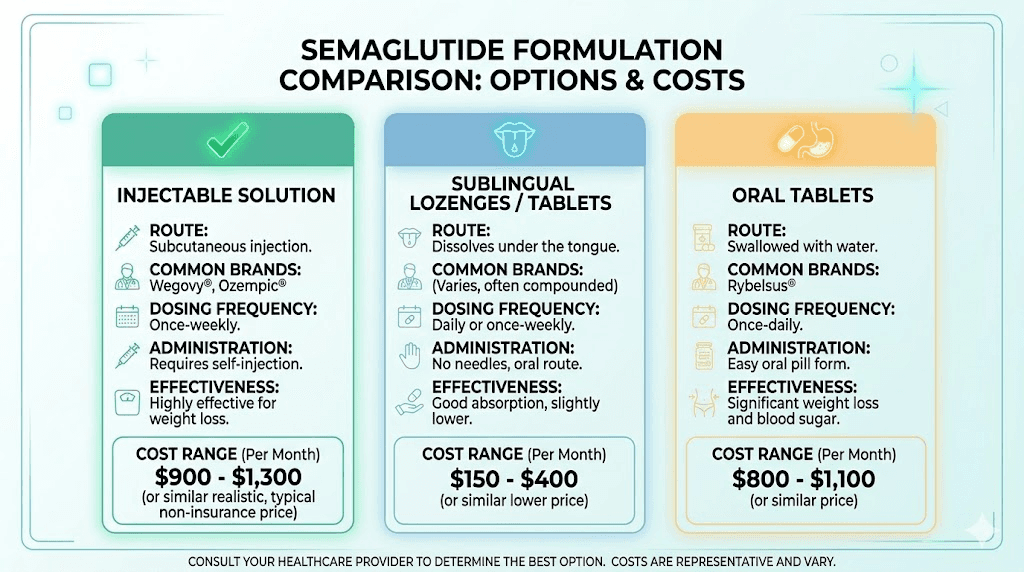
Standard injectable semaglutide
The most common and typically most affordable option. Standard compounded semaglutide is a subcutaneous injectable, similar to how you would use the semaglutide dosage calculator to determine your dose from a vial. You draw the medication with a syringe and inject it once weekly. This format requires reconstitution knowledge if you are receiving lyophilized powder, or it arrives pre-mixed and ready to inject.
Cost: typically $99 to $249 per month for the medication alone.
Semaglutide with B12
Many compounding pharmacies add vitamin B12 (typically as methylcobalamin) to their semaglutide formulations. The rationale is that GLP-1 medications can affect B12 absorption over time, and adding it directly to the injection ensures adequate levels. Some patients report that the B12 addition helps with semaglutide-related fatigue and energy levels.
Cost: adds $20 to $50 per month compared to standard formulations. Whether the addition provides meaningful clinical benefit is debatable, but many patients prefer it.
Semaglutide with glycine
The semaglutide glycine B12 blend has become increasingly popular. Glycine serves as a stabilizer that may improve the medication shelf life and potentially support amino acid balance during weight loss. Some providers offer this as their standard formulation at minimal additional cost.
Sublingual and oral formulations
Sublingual semaglutide and oral semaglutide drops offer needle-free alternatives. These formulations dissolve under the tongue or are swallowed as liquid. They tend to cost slightly more due to the additional formulation complexity. Bioavailability differs from injectable forms, which may require dose adjustments.
Cost: typically $149 to $349 per month. The convenience of avoiding injections appeals to many patients, though troches and drops may not provide identical results to injectable forms at the same nominal dose.
Choosing the right formulation for your budget
If cost is your primary concern, standard injectable semaglutide without additional compounds offers the lowest price point. It requires comfort with self-injection using a syringe, proper storage, and basic reconstitution skills if applicable. But it delivers the same active ingredient as premium formulations at the lowest possible cost.
If you need the added compounds, understand exactly why before paying the premium. Adding B12 because you are genuinely deficient is smart medicine. Adding it because the marketing page said it was better is just spending more money.
Red flags: when cheap semaglutide is too cheap
Some deals are not deals at all. They are traps. Recognizing the warning signs before you hand over your credit card prevents problems that range from wasted money to genuine health risks.
Prices dramatically below market rate
When compounded semaglutide costs $129 to $249 per month from established providers, a company advertising $49 per month should raise immediate questions. The raw material alone has a floor price. Add compounding labor, quality testing, cold chain shipping, medical oversight, and business operations, and the math simply does not work below certain price points.
Providers offering impossibly low prices may be selling heavily diluted formulations, using untested semaglutide sources, skipping quality testing, or operating outright scams. The FDA has documented cases of compounded GLP-1 products containing incorrect concentrations, wrong ingredients, or no active ingredient at all.
No prescription requirement
Semaglutide is a prescription medication. Period. Any provider selling it without requiring a prescription is operating illegally and demonstrates a fundamental disregard for patient safety. This is not a gray area. No prescription means no medical evaluation, no contraindication screening, no dosage guidance, and no accountability.
Refusal to identify the compounding pharmacy
You have every right to know which pharmacy compounds your medication. Legitimate providers are proud of their pharmacy partnerships and willingly share this information. Providers who refuse to disclose their pharmacy are either using a facility they know would not pass scrutiny or operating without a proper pharmacy altogether.
No cold chain shipping
Semaglutide degrades at room temperature over time. Extended exposure to heat during shipping can significantly reduce potency. If your medication arrives in a standard envelope or box without insulation and ice packs, the provider is not taking the medication stability seriously. Your product may look fine but deliver suboptimal results. This connects directly to patients who wonder why they see no weight loss after weeks on semaglutide.
Pressure tactics and urgency marketing
Limited time offers. Act now. Only 3 spots left. These tactics signal a company more interested in sales velocity than patient outcomes. Legitimate medical providers do not create artificial urgency around prescription medications. Your health decisions should never be rushed by countdown timers.
No follow-up care or dosage management
Semaglutide requires dose titration. You start low and increase gradually to minimize side effects and find your effective dose. Understanding proper compounded semaglutide dosing charts is important, but having medical guidance for adjustments is even more critical. A provider that ships your first month of medication and disappears is not providing healthcare. They are selling a product and hoping for the best.
If you experience side effects like dizziness, bloating, sulfur burps, or more serious reactions, you need access to a medical professional who can adjust your protocol. Budget providers that eliminate this support are not saving you money. They are shifting risk onto you.
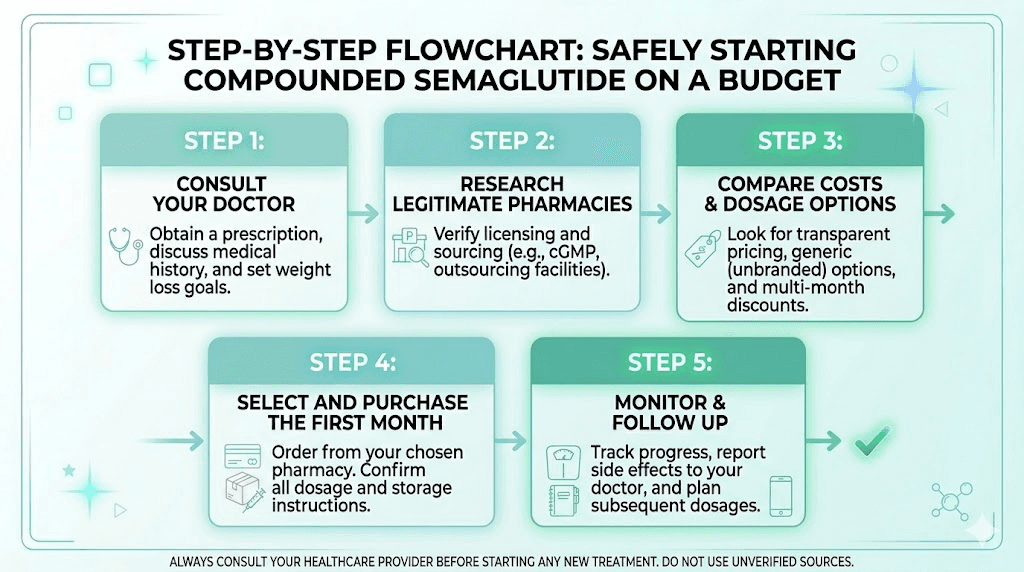
How to start compounded semaglutide safely on a budget
Finding cheap compound semaglutide that actually works requires a systematic approach. Here is the step-by-step process that protects both your wallet and your health.
Step 1: determine your medical eligibility
Before comparing prices, confirm that semaglutide is appropriate for you. GLP-1 medications are typically prescribed for individuals with a BMI of 30 or higher, or a BMI of 27 or higher with at least one weight-related health condition. Understanding how to qualify for semaglutide saves you time and money by confirming eligibility before you start the enrollment process with any provider.
Step 2: research providers using the verification checklist
Apply every verification step from the section above. License check. Pharmacy identification. COA availability. Shipping methods. Prescribing process. Create a shortlist of 3 to 5 providers that pass all checks.
Step 3: calculate true monthly cost
For each shortlisted provider, calculate the total monthly cost including consultation fees, medication, shipping, supplies, and any membership or platform fees. Compare apples to apples. A provider charging $199 all-inclusive is often cheaper than one advertising $129 plus $49 consultation plus $15 shipping plus $25 supplies.
Step 4: start with the standard dose protocol
Most semaglutide protocols begin at 0.25mg weekly for the first four weeks, then increase to 0.5mg, and continue titrating upward based on response and tolerance. Starting at the standard dose helps you assess the medication quality before committing to multiple months. If the medication produces expected effects, such as appetite suppression within the first week or two, you can proceed with confidence.
Step 5: monitor results and adjust
Track your response systematically. Week-by-week results should show a pattern of gradual improvement. If you see no appetite suppression, no weight change, and no side effects after the first month, the medication may be underdosed or ineffective. This is when the quality of your provider matters most, because you need medical guidance to determine whether to increase the dose, switch formulations, or investigate the medication quality.
If you reach a weight loss plateau, your provider should help troubleshoot rather than simply suggesting you buy more medication. Good providers view plateaus as clinical problems to solve, not sales opportunities.
Alternative ways to save on semaglutide
Compounding is not the only path to affordable semaglutide. Several other strategies can reduce your costs significantly, and some may work better depending on your insurance situation and medical history.
Manufacturer savings programs
Novo Nordisk offers savings cards and patient assistance programs for both Ozempic and Wegovy. Eligible patients can pay as little as $25 per month for brand-name medication with these programs. The catch is that eligibility requirements vary, they typically do not apply to patients with government insurance, and the savings may be temporary promotional offers.
Insurance negotiation and prior authorization
Many insurance plans now cover GLP-1 medications for weight management, especially after Blue Cross Blue Shield expanded coverage. If your initial claim is denied, appeal the decision with supporting documentation from your physician. Prior authorization processes are cumbersome but often result in approval when proper medical justification is provided.
Multi-month purchase plans
Many compounding providers offer significant discounts for 3-month or 6-month commitments. The monthly rate drops by 15 to 30 percent compared to month-to-month purchasing. The risk is committing to a provider before you know if the medication works for you. A practical compromise is starting with a single month, confirming the medication is effective, and then switching to a multi-month plan for savings.
Payment plans and financing
Some providers offer Afterpay or similar financing options that spread the cost across installments without interest. This does not reduce the total cost but makes the monthly payment more manageable. Be cautious with financing that charges interest, as the total cost over time may exceed what you would pay for brand-name medication with insurance.
Considering alternative GLP-1 options
If semaglutide pricing remains prohibitive, other GLP-1 options exist. Tirzepatide (the active ingredient in Mounjaro and Zepbound) is also available in compounded form, though cheap compounded tirzepatide faces similar quality considerations. Some patients find that switching to tirzepatide provides better results. Others explore emerging options like retatrutide for additional receptor activity.
Understanding the side effect profiles of different GLP-1 medications helps you choose the option that offers the best combination of effectiveness, tolerability, and cost for your specific situation.
Managing side effects on a budget
Side effect management often generates additional costs that people do not anticipate when choosing the cheapest semaglutide option. Planning for these costs upfront prevents surprises and helps you maintain your protocol through the adjustment period.
Constipation is one of the most common side effects. Over-the-counter fiber supplements, stool softeners, and magnesium citrate typically cost $10 to $20 per month. Adjusting your diet on semaglutide can reduce constipation naturally without additional supplements.
Nausea management during dose titration usually resolves with simple strategies. Eating smaller meals, avoiding fatty foods, and timing your injection relative to meals all help. Anti-nausea medications like ondansetron are available by prescription and cost $5 to $15 with most pharmacy discount cards.
Hair loss affects some GLP-1 users and can be distressing. It typically relates to rapid weight loss rather than the medication itself. Ensuring adequate protein intake, maintaining proper supplementation, and managing the rate of weight loss can minimize this side effect.
The key insight about side effects and budget is this: the cheapest semaglutide option that causes severe side effects due to inconsistent dosing or contamination is infinitely more expensive than a slightly pricier option that works smoothly. Side effects from low-quality medication may require doctor visits, lab work, or switching providers, all of which cost money and waste time.
Storage and handling to protect your investment
When you are paying for compounded semaglutide, every drop matters. Proper storage and handling ensure you get full value from your purchase rather than watching potency degrade from preventable mistakes.
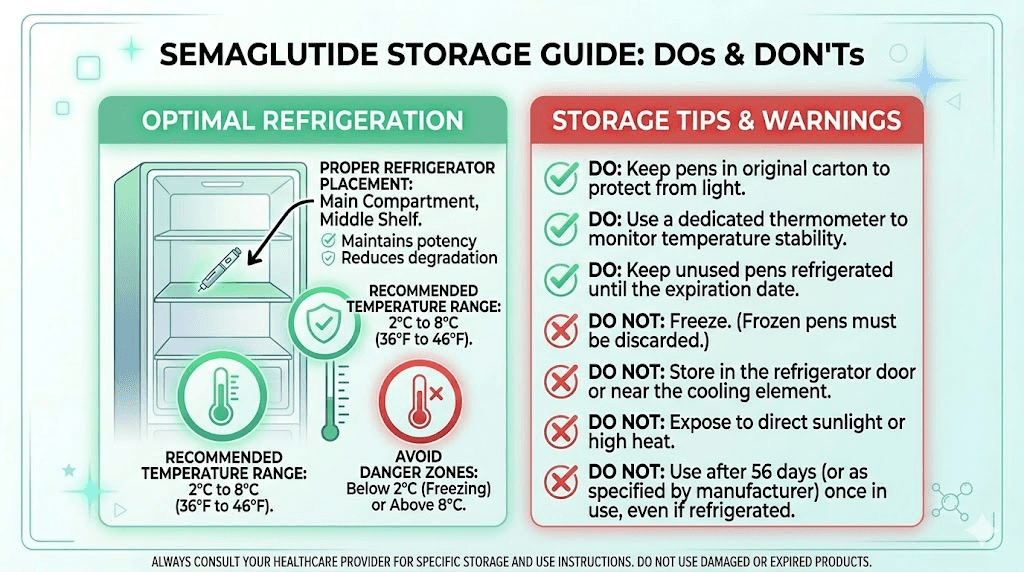
Refrigerator storage is essential. Keep your semaglutide between 36 and 46 degrees Fahrenheit (2 to 8 degrees Celsius). Do not freeze it. Do not store it in the refrigerator door where temperature fluctuates with opening and closing. The middle shelf toward the back provides the most consistent temperature.
If your semaglutide gets left out overnight, the impact depends on how long and at what temperature. Brief exposure to room temperature is usually fine. Extended exposure to heat is not. When in doubt, check the semaglutide shelf life guidelines and err on the side of caution. Replacing a $30 vial is cheaper than injecting degraded medication for weeks without knowing why your results stalled.
For those who travel with semaglutide, invest in a proper medical travel cooler. These range from $15 to $40 and maintain refrigeration temperature for 24 to 48 hours. A small investment that protects your entire monthly supply during trips.
The color of your semaglutide can indicate quality issues. Clear to slightly yellowish is normal. If the solution is cloudy, contains particles, or appears red or discolored, do not use it. Contact your provider for a replacement. Quality pharmacies will replace compromised medication without argument.
Reconstitution: doing it right saves money
If your compounded semaglutide arrives as lyophilized powder, proper reconstitution is critical. Mistakes during this process can destroy an entire vial, turning your affordable medication into expensive waste.
The reconstitution process involves adding bacteriostatic water to the powder vial in the correct amount. For a 5mg vial, the standard is to add the proper volume of bacteriostatic water to achieve your target concentration. Use the semaglutide reconstitution chart to determine exact volumes based on your vial size and desired dose per injection.
Common reconstitution mistakes that waste money:
Injecting water directly onto the powder cake instead of letting it run down the vial wall, which can cause foaming and protein degradation
Shaking the vial instead of gently swirling it, which can break the semaglutide molecules
Using regular sterile water instead of bacteriostatic water, which shortens the usable life of the reconstituted solution
Adding too much or too little water, resulting in inaccurate dosing for every subsequent injection from that vial
Getting reconstitution right means every dose from that vial delivers the intended amount. Getting it wrong means you are either overdosing, underdosing, or injecting degraded medication. For a 5mg semaglutide vial, proper technique stretches your supply and ensures consistent results throughout the vial life.
Dosing on a budget: making your supply last
Smart dosing practices can extend your semaglutide supply and reduce your effective monthly cost without compromising results.
Start at the lowest effective dose. Many patients rush to higher doses because they want faster results. But starting at 0.25mg and following the standard titration schedule gives your body time to respond to lower doses, which are less expensive per week. Some patients achieve excellent appetite suppression and weight loss at 0.5mg or 1mg, never needing to reach the higher doses that consume more medication per injection.
The semaglutide dosage chart in units helps you measure precise doses from a multi-use vial. Accurate drawing technique with the right syringe minimizes waste. Use insulin syringes with fine gauge needles for precise measurement. A semaglutide syringe dosage chart provides visual references for correct measurements.
Understanding unit to mg conversions is essential when working with compounded vials. The concentration of your specific vial determines how many units correspond to your prescribed dose. Getting this wrong means either wasting medication by taking too much or getting inadequate results by taking too little. Both outcomes cost you money.
Consider whether splitting your dose across the week might improve tolerability while using the same total amount. Some patients find that taking half their weekly dose on two separate days reduces side effects while maintaining effectiveness. This does not save medication, but it can reduce the side-effect related costs of managing nausea or needing additional medical visits.
When to consider switching from compounded to brand-name
Compounded semaglutide serves many patients well, but situations exist where switching to brand-name might actually save money or deliver better outcomes.
If your insurance covers Wegovy or Ozempic with a low copay, brand-name becomes the obvious financial winner. A $25 copay beats even the cheapest compounded option. Insurance coverage for GLP-1 medications has expanded significantly, so checking your current benefits annually is worthwhile even if you were denied previously.
If you are experiencing inconsistent results with compounded semaglutide, the variability in compounding quality might be the cause. Switching to brand-name for even one or two months can help determine whether the medication works for you at standardized doses. If brand-name produces clear results and compounded did not, the compounded product quality was likely the issue.
If you need very specific dose titration at higher doses, brand-name pen devices offer more precise delivery than drawing from vials with syringes. At doses above 1mg, the accuracy advantage of pre-filled pens becomes more significant.
Conversely, if compounded semaglutide is working well for you, switching to brand-name purely for brand perception wastes money without improving outcomes. The goal is effective treatment at an affordable price, not brand loyalty.
What SeekPeptides members know about navigating GLP-1 costs
Understanding the compounded semaglutide landscape requires more than a single article. The regulatory environment shifts. New providers enter the market. Pricing changes. Pharmacy quality fluctuates. Having access to current, reliable information separates patients who find genuine value from those who waste money on substandard products.
SeekPeptides members access comprehensive provider databases, updated pharmacy quality reports, dosing calculators, and community feedback from thousands of patients navigating the same decisions. When the FDA announces regulatory changes, SeekPeptides members get detailed analysis of what it means for their protocols within days, not months.
The difference between paying too much for semaglutide and finding the right balance of cost and quality often comes down to information. Having a reliable resource like SeekPeptides removes the guesswork and helps you make decisions backed by evidence, community experience, and expert guidance rather than marketing claims.
Frequently asked questions
Is compounded semaglutide the same as Ozempic?
Compounded semaglutide uses the same active ingredient as Ozempic but is not identical. The formulation, inactive ingredients, and manufacturing standards differ. Compounded versions are not FDA-approved, meaning they have not undergone the same clinical testing for safety and effectiveness. When sourced from a reputable pharmacy, compounded semaglutide should perform similarly, but consistency can vary. Read our complete comparison for more details.
What is the cheapest way to get semaglutide right now?
The cheapest legitimate option is typically compounded semaglutide from a verified telehealth provider using a licensed compounding pharmacy, with monthly costs ranging from $99 to $199. Always verify the pharmacy license, ask for certificates of analysis, and confirm cold chain shipping before choosing the lowest-priced option. Use our peptide cost calculator to compare total treatment costs across providers.
Is compounded semaglutide still available after the FDA ended the shortage?
Yes, but with restrictions. Compounded semaglutide is now available only for patients with documented medical needs that cannot be met by commercially available products. This includes allergies to inactive ingredients or needs for custom formulations. The regulatory landscape continues to evolve through legal challenges. Check the latest peptide regulation news for updates.
How can I tell if my compounded semaglutide is legitimate?
Request certificates of analysis for your batch showing potency, sterility, and endotoxin testing results. Verify the compounding pharmacy license through your state board of pharmacy. Confirm the pharmacy uses base form semaglutide rather than semaglutide sodium or acetate. Check that the medication arrives with cold chain shipping. The medication should be clear to slightly yellow with no particles or cloudiness. See our semaglutide color guide for visual reference.
Can I switch between compounded and brand-name semaglutide?
Yes, you can switch between compounded and brand-name semaglutide. The active ingredient is the same, so the transition does not require a washout period. However, potency differences between formulations mean you should discuss dosage adjustments with your prescriber when switching. Monitor your response carefully during the first two weeks after any switch. Our guide on how long semaglutide takes to suppress appetite provides timeline expectations.
What side effects should I watch for with cheap compounded semaglutide?
The side effects of compounded semaglutide should mirror those of brand-name versions. Common effects include nausea, constipation, dizziness, and fatigue. If you experience unusual side effects not typically associated with semaglutide, this may indicate a quality issue with the compounded product. Contact your provider immediately and consider switching to a different pharmacy.
How do I store compounded semaglutide to make it last?
Store compounded semaglutide in the refrigerator at 36 to 46 degrees Fahrenheit. Keep it on a middle shelf away from the door. Reconstituted semaglutide typically lasts 28 to 42 days in the fridge depending on the pharmacy formulation. Do not freeze it. Avoid leaving it at room temperature for extended periods. Proper storage protects your investment and ensures consistent potency throughout the vial.
Should I choose semaglutide or tirzepatide if cost is my main concern?
Both are available in compounded form at similar price points. The choice between semaglutide and tirzepatide should be based on medical factors, not just cost. Tirzepatide acts on both GLP-1 and GIP receptors, which may provide different results for some patients. If semaglutide has not worked well for you, tirzepatide might be more effective. Compare side effect profiles before deciding.
External resources
For researchers serious about optimizing their GLP-1 protocols without overpaying, SeekPeptides offers the most comprehensive resource available, with evidence-based guides, provider comparisons, dosing calculators, and a community of thousands who have navigated these exact cost decisions successfully.
In case I do not see you, good afternoon, good evening, and good night. May your semaglutide stay potent, your pharmacy stay legitimate, and your savings stay substantial.