Feb 22, 2026
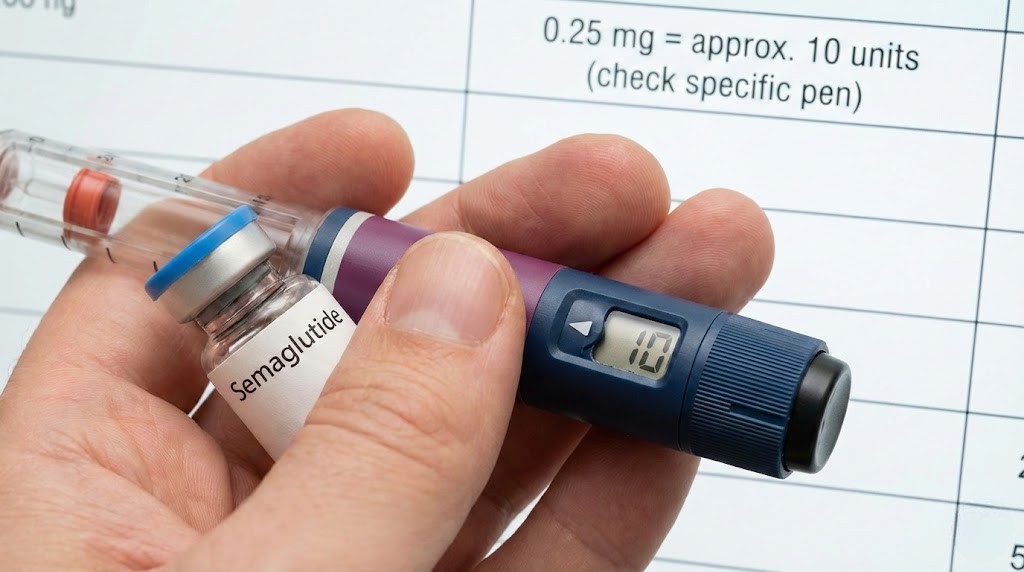
Before you draw up your next dose, check the concentration on your vial. That single number changes everything. A person using a 5 mg/mL vial needs to draw 5 units to get 0.25 mg of semaglutide. Someone with a 2.5 mg/mL vial needs 10 units for that same 0.25 mg. And if the vial reads 1 mg/mL, the correct measurement jumps to 25 units. Same dose. Same medication. Completely different numbers on the syringe.
This is where dosing errors happen. The FDA has documented cases of people drawing 50 units when they meant to draw 5, all because they confused milligrams, milliliters, and syringe units on a compounded semaglutide vial. These are not small mistakes. They are potentially dangerous ones that send people to emergency rooms with severe nausea, vomiting, and dangerously low blood sugar.
The 0.25 mg dose is typically the starting point for semaglutide treatment, whether prescribed as Ozempic for type 2 diabetes or Wegovy for weight management. It is intentionally low. The goal during these first four weeks is not dramatic weight loss or significant blood sugar reduction. It is giving your body time to adjust to a GLP-1 receptor agonist while minimizing the gastrointestinal side effects that make so many people quit before the medication has a chance to work. Getting this starting dose right, measured precisely in the correct number of units for your specific concentration, sets the foundation for everything that follows. This guide walks through every concentration you might encounter, the exact math behind each conversion, step-by-step measurement instructions, and the common mistakes that trip up even experienced users. Whether you are using brand-name Ozempic, Wegovy, or a compounded semaglutide formulation, you will know exactly how many units to draw by the time you finish reading.
The quick answer: 0.25 mg of semaglutide in units by concentration
Here is the direct answer. The number of units depends entirely on the concentration printed on your vial or pen label.
Vial concentration | Units for 0.25 mg | Volume (mL) | Common source |
|---|---|---|---|
1 mg/mL | 25 units | 0.25 mL | Some compounding pharmacies |
2 mg/mL | 12.5 units | 0.125 mL | Select compounded formulations |
2.5 mg/mL | 10 units | 0.10 mL | Common compounded semaglutide |
3 mg/mL | 8.3 units | 0.083 mL | Some compounding pharmacies |
5 mg/mL | 5 units | 0.05 mL | Common compounded semaglutide |
The most common concentrations you will encounter are 2.5 mg/mL and 5 mg/mL. If your vial says 2.5 mg/mL, draw to the 10-unit mark. If it says 5 mg/mL, draw to the 5-unit mark. That is it. But understanding why these numbers differ, and how to verify them yourself, matters enormously for your safety.
For a deeper breakdown of every semaglutide concentration and corresponding unit measurement, see our complete semaglutide dosage conversion chart in units. If you want the math done for you automatically, the semaglutide dosage calculator handles the conversion in seconds.
Why concentration changes everything about your measurement
Concentration is the single most important number on your vial. It tells you how much active semaglutide is dissolved in each milliliter of solution. A vial labeled 5 mg/mL contains five milligrams of semaglutide in every single milliliter of liquid. A vial labeled 2.5 mg/mL contains half that amount per milliliter.
Think of it like coffee. A double espresso and a regular drip coffee both contain caffeine. But the espresso packs far more caffeine into a much smaller volume. You would not drink a full cup of espresso the same way you drink a cup of drip coffee. The concentration is different, so the volume you consume must change to get the same amount of caffeine.
Semaglutide works the same way.
When your vial has a higher concentration, you need less liquid to get the same dose. When the concentration is lower, you need more liquid. The milligram dose stays constant at 0.25 mg. The volume you draw, measured in units on your insulin syringe, changes based on that concentration number. This is why two people can both be taking 0.25 mg of semaglutide and drawing completely different numbers of units. Neither is wrong. They simply have different concentrations. For a complete visual reference, our semaglutide dosage chart in units covers every standard dose at every concentration.
The danger comes when someone assumes their concentration is the same as what they read about online. A forum post might say "draw 10 units for your starting dose." That advice is perfectly correct for a 2.5 mg/mL vial. But if you have a 5 mg/mL vial and draw 10 units, you just took 0.50 mg, double the intended starting dose. That kind of error leads to severe nausea, constipation, vomiting, and other gastrointestinal distress that could have been completely avoided.
Understanding insulin syringes: units, milliliters, and milligrams explained
The confusion between units, milliliters, and milligrams causes more dosing errors than any other factor. These three measurements describe different things, and mixing them up is the fastest path to a bad experience.
What units actually measure
Units on an insulin syringe measure volume, not dose. A standard U-100 insulin syringe divides one milliliter into 100 equal parts. Each tiny line on the syringe represents one unit. Ten units equals 0.1 mL. Fifty units equals 0.5 mL. One hundred units equals the full 1.0 mL capacity of the syringe.
The word "units" comes from insulin measurement, where 100 units of insulin happen to be dissolved in 1 mL of solution. For semaglutide, these markings simply tell you how much liquid you are drawing. They do not tell you how many milligrams of semaglutide are in that liquid. That depends on the concentration.
Milliliters measure liquid volume
One milliliter is a standard unit of liquid volume. On a U-100 insulin syringe, 1 mL equals 100 units. On a tuberculin syringe, the markings show milliliters directly. Both syringes can measure the same volumes, just with different labeling systems. For semaglutide dosing, most people use insulin syringes because the unit markings make small volumes easier to measure precisely. Our guide on how to give a semaglutide injection with a syringe covers syringe selection in detail.
Milligrams measure active drug
Milligrams measure the actual amount of semaglutide medication. When a doctor prescribes 0.25 mg, they mean 0.25 milligrams of the active ingredient. This number stays the same regardless of which syringe you use or what concentration your vial contains. The prescription is always in milligrams. Your job is to translate that milligram dose into the correct number of units for your specific vial.
Here is the relationship in one sentence: your semaglutide dosage in units depends on the concentration (mg/mL) of the solution in your vial, which determines how much volume (units) you need to draw to get the prescribed milligram dose.
Common syringe sizes for semaglutide
Most people measuring semaglutide use one of three insulin syringe sizes. The 30-unit (0.3 mL) syringe works best for small doses like 0.25 mg at higher concentrations, because each unit marking is larger and easier to read. The 50-unit (0.5 mL) syringe offers a good middle ground. The 100-unit (1.0 mL) syringe works for larger volumes but makes it harder to measure tiny doses precisely because the markings are closer together.
For a 0.25 mg dose at 5 mg/mL concentration, where you only need 5 units, a 30-unit syringe gives you the most accuracy. Each graduation is easier to see and the plunger movement per unit is larger. Trying to draw exactly 5 units on a 100-unit syringe is like trying to measure a teaspoon with a measuring cup. It can be done, but precision suffers. Learn more about syringe selection in our semaglutide syringe dosage chart.
The conversion formula you need to memorize
One formula handles every semaglutide dose conversion you will ever need. It works for 0.25 mg, 0.50 mg, 1.0 mg, or any other dose at any concentration.
Units = (Dose in mg / Concentration in mg/mL) x 100
That is it. Three numbers, one division, one multiplication. Let us walk through it with the 0.25 mg dose at each common concentration.
At 5 mg/mL
Units = (0.25 / 5) x 100 = 0.05 x 100 = 5 units
You divide 0.25 by 5 to get 0.05 mL. Then multiply by 100 to convert milliliters to units. Five units. Draw to the 5-unit line on your syringe. For detailed charts at this concentration, see our semaglutide 5 mg/mL dosage chart.
At 2.5 mg/mL
Units = (0.25 / 2.5) x 100 = 0.1 x 100 = 10 units
Half the concentration means double the volume. Ten units. Draw to the 10-unit line. Our compounded semaglutide dose chart shows this calculation for every dose in the escalation schedule.
At 1 mg/mL
Units = (0.25 / 1) x 100 = 0.25 x 100 = 25 units
At the lowest common concentration, you need five times the volume compared to a 5 mg/mL vial. Twenty-five units. Draw to the 25-unit line. This is why concentration matters so much. The same 0.25 mg dose requires anywhere from 5 to 25 units depending on what is in your vial.
Practice problems to verify your understanding
Try these yourself before checking the answers.
Problem 1: Your vial reads 3 mg/mL. How many units is 0.25 mg?
Answer: (0.25 / 3) x 100 = 8.33 units. Round to 8 units on a standard syringe.
Problem 2: Your vial reads 2 mg/mL. How many units is 0.25 mg?
Answer: (0.25 / 2) x 100 = 12.5 units. Draw halfway between the 12 and 13 unit marks.
Problem 3: Your pharmacy switches you from a 2.5 mg/mL vial to a 5 mg/mL vial. You were drawing 10 units. What do you draw now?
Answer: 5 units. The concentration doubled, so the volume halves.
If you want a tool that does this math for you instantly, use our peptide calculator or the dedicated semaglutide dosage calculator. Plug in your concentration and desired dose, and the calculator returns the exact number of units.
Complete conversion charts for 0.25 mg at every concentration
These tables cover the full dose escalation schedule at each concentration, with the 0.25 mg starting dose highlighted. Bookmark this section. You will reference it every time your dose changes.
5 mg/mL concentration chart
This is the most common concentration for compounded semaglutide vials. Each unit on your syringe contains 0.05 mg of semaglutide.
Dose (mg) | Units | Volume (mL) | Typical phase |
|---|---|---|---|
0.25 mg | 5 units | 0.05 mL | Weeks 1-4 (starting dose) |
0.50 mg | 10 units | 0.10 mL | Weeks 5-8 |
1.0 mg | 20 units | 0.20 mL | Weeks 9-12 |
1.7 mg | 34 units | 0.34 mL | Weeks 13-16 |
2.4 mg | 48 units | 0.48 mL | Maintenance |
At 5 mg/mL, the 0.25 mg dose is a tiny volume. Just 5 units. This is where a 30-unit syringe becomes essential for accuracy. On a 100-unit syringe, 5 units is barely visible. For the full escalation at this concentration, see our semaglutide 5 mg vial dosage chart.
2.5 mg/mL concentration chart
The second most common concentration for compounded formulations. This one offers a clean mathematical relationship that makes dosing straightforward.
Dose (mg) | Units | Volume (mL) | Typical phase |
|---|---|---|---|
0.25 mg | 10 units | 0.10 mL | Weeks 1-4 (starting dose) |
0.50 mg | 20 units | 0.20 mL | Weeks 5-8 |
1.0 mg | 40 units | 0.40 mL | Weeks 9-12 |
1.7 mg | 68 units | 0.68 mL | Weeks 13-16 |
2.4 mg | 96 units | 0.96 mL | Maintenance |
Notice how the numbers are exactly double those in the 5 mg/mL chart. That is because the concentration is exactly half. This mathematical relationship makes cross-referencing easy. If someone tells you their dose in units at one concentration, you can quickly calculate what it would be at another. For B12-enhanced formulations at this concentration, check our compounded semaglutide with B12 dosage chart.
1 mg/mL concentration chart
Less common but still found at certain compounding pharmacies. The lower concentration means larger injection volumes.
Dose (mg) | Units | Volume (mL) | Typical phase |
|---|---|---|---|
0.25 mg | 25 units | 0.25 mL | Weeks 1-4 (starting dose) |
0.50 mg | 50 units | 0.50 mL | Weeks 5-8 |
1.0 mg | 100 units | 1.00 mL | Weeks 9-12 |
At this concentration, higher doses require very large volumes. A 1.0 mg dose needs a full 100-unit (1 mL) syringe. Doses above 1.0 mg would require multiple injections or a larger syringe. This is one reason why higher-concentration formulations are more popular, they keep injection volumes manageable as doses escalate. For a comprehensive view of all semaglutide dosage charts in milliliters, we have a dedicated guide.
Understanding B12-enhanced formulations
Many compounding pharmacies add vitamin B12 (cyanocobalamin or methylcobalamin) to their semaglutide formulations. The semaglutide concentration in these vials follows the same standards, typically 2.5 mg/mL or 5 mg/mL of semaglutide with an additional B12 component. The B12 does not change your unit calculations for the semaglutide dose. If your vial says "semaglutide 5 mg/mL with cyanocobalamin," you still draw 5 units for 0.25 mg of semaglutide. Learn more about these combined formulations in our semaglutide with B12 complete guide and semaglutide B12 dosage chart.
How to draw up exactly 0.25 mg of semaglutide step by step
Knowing the correct number of units is half the equation. Drawing that exact amount into your syringe with precision is the other half. Here is the complete process, from vial preparation to injection readiness.
What you need before starting
Your semaglutide vial (check the concentration label)
An insulin syringe (30-unit preferred for small doses)
Alcohol swabs
A clean, flat surface with good lighting
Your dosing chart or this guide for reference
Make sure your vial has been stored properly. If it has been refrigerated as recommended, let it sit at room temperature for 15 to 30 minutes before injecting. Cold medication can cause more discomfort at the injection site. Check our guide on compounded semaglutide fridge storage to verify your vial is still within its use window.
Step 1: verify your concentration
Read the label on your vial carefully. Find the concentration expressed as mg/mL. Write it down if that helps. Double-check it against the chart above to confirm how many units you need. This step takes five seconds and prevents the most common dosing error.
Step 2: clean the vial top
Swab the rubber stopper on top of your vial with an alcohol wipe. Let it air dry for a few seconds. This removes any bacteria that could contaminate the solution. Even if you just opened a new vial, clean the stopper first. Every time.
Step 3: prepare the syringe
Remove the syringe from its sterile packaging. Pull the cap off the needle. Draw air into the syringe by pulling the plunger back to the number of units you plan to draw. If you need 5 units of semaglutide, pull the plunger to the 5-unit mark with air.
Step 4: inject air into the vial
Insert the needle through the rubber stopper. Push the plunger down to inject all the air into the vial. This air replaces the liquid volume you are about to remove and prevents a vacuum from forming inside the vial. Without this step, drawing medication becomes difficult because the vacuum fights against the plunger.
Step 5: draw the medication
With the needle still in the vial, turn the vial upside down. Make sure the needle tip is submerged in the liquid. Slowly pull the plunger back to your target number of units. Pull slightly past your target to account for air bubbles.
Step 6: remove air bubbles
With the vial still inverted, look at the syringe for air bubbles. Tap the barrel of the syringe gently with your fingernail. Air bubbles will float toward the needle end. Once the bubbles are at the top, push the plunger forward slowly to push the air back into the vial. Then pull the plunger back to your exact target. Air bubbles are not dangerous in a subcutaneous injection, but they reduce the accuracy of your dose.
Step 7: verify the measurement
Hold the syringe at eye level with the needle pointing up. Confirm the bottom of the plunger rubber stopper (the flat edge closest to the needle) aligns exactly with your target unit line. For 5 units at a 5 mg/mL concentration, the stopper edge should sit precisely on the 5-unit mark. If it is off, push or pull the plunger gently to adjust.
Remove the syringe from the vial. You are now ready to inject. For the best injection sites and technique, see our guide on the best injection site for semaglutide and where to inject GLP-1.
Common mistakes when measuring 0.25 mg of semaglutide
Even with clear instructions, certain errors show up repeatedly. Being aware of them cuts your risk of a dosing mistake dramatically.
Mistake 1: assuming all vials have the same concentration
This is the most dangerous error. Someone reads online that "10 units equals 0.25 mg" and draws 10 units from a 5 mg/mL vial. That gives them 0.50 mg, double the intended dose. The advice they read was correct for a 2.5 mg/mL vial, not theirs. Always check your own vial concentration first. Always. If you are unsure whether your unit count is too much, cross-reference it with the formula above.
Mistake 2: confusing the syringe markings
Different syringe sizes have different graduation intervals. On a 100-unit syringe, each small line typically represents 2 units. On a 30-unit syringe, each small line represents 1 unit. If you misread the graduation spacing, you could be drawing double or half your intended dose. Always count the lines between numbered markings to understand your specific syringe graduation. Our semaglutide syringe dosage conversion chart illustrates the differences between syringe types.
Mistake 3: not accounting for air bubbles
A large air bubble in the syringe displaces medication. If you draw to the 10-unit mark but there is a 2-unit air bubble inside the barrel, you only have 8 units of actual medication. That means you are getting less than 0.25 mg. Small air bubbles of 1 unit or less are negligible, but larger ones need to be removed before verifying your measurement.
Mistake 4: reading the wrong part of the plunger
The plunger has a rubber stopper at the end. It has both a rounded top and a flat bottom edge. Always read the measurement at the flat bottom edge closest to the needle. Reading from the wrong edge can introduce a 1-2 unit error, which at small doses like 5 units represents a 20-40% dosing discrepancy.
Mistake 5: using the wrong syringe type entirely
U-100 insulin syringes and tuberculin syringes both measure small volumes, but their markings differ. A tuberculin syringe shows milliliters directly. An insulin syringe shows units. Using a tuberculin syringe and drawing to the "5" mark gives you 5 mL, not 5 units. That would be 500 units worth of volume. While physically impossible to draw that much from a small vial, the mental confusion between syringe types contributes to errors. Stick with U-100 insulin syringes for semaglutide. For comprehensive guidance on how to calculate peptide dosages, we have a detailed walkthrough.
Why 0.25 mg is the starting dose: the clinical rationale
You might wonder why the starting dose is so low. At 0.25 mg per week, semaglutide is not expected to produce significant weight loss or major blood sugar changes. The dose is intentionally subtherapeutic. It exists for one reason: tolerability.
Semaglutide is a GLP-1 receptor agonist. It mimics a hormone your body produces naturally after eating. When you introduce an external source of this hormone, your digestive system needs time to adjust. Starting at a full therapeutic dose would overwhelm the GLP-1 receptors in your gut, leading to severe nausea, vomiting, and diarrhea in a large percentage of users.
Clinical trials for both Ozempic and Wegovy used a gradual dose escalation protocol specifically to reduce these gastrointestinal side effects. The STEP 1 trial, published in the New England Journal of Medicine, started participants at 0.25 mg weekly for four weeks before increasing. Even with this gradual approach, approximately 44% of participants experienced nausea at some point during treatment. Without the gradual increase, that number would have been significantly higher.
The 0.25 mg dose also gives your healthcare provider a baseline. They can assess how your body responds to a minimal amount of the medication before committing to higher doses. Some people are more sensitive to GLP-1 agonists than others. For these individuals, even the 0.25 mg starting dose may produce noticeable appetite suppression and mild nausea. Starting low identifies these sensitive responders early. Learn about how quickly you can expect effects in our guide on how fast semaglutide works and how long semaglutide takes to work.
So the 0.25 mg phase is not wasted time. It is essential preparation. Your body is building tolerance to GLP-1 receptor activation, your digestive system is recalibrating, and your provider is gathering data on your individual response. Trying to skip this phase or rush through it is one of the most common reasons people abandon semaglutide before experiencing its full benefits. For more on appetite changes during this phase, see how long it takes for semaglutide to suppress appetite and whether semaglutide suppresses appetite immediately.
The complete semaglutide dose escalation schedule
After your first four weeks at 0.25 mg, the dose increases in a structured pattern. Understanding this full schedule helps you plan ahead, know what syringe measurements are coming, and set realistic expectations for each phase.
Wegovy (weight management) escalation
Phase | Weeks | Dose | Units at 5 mg/mL | Units at 2.5 mg/mL |
|---|---|---|---|---|
Month 1 | Weeks 1-4 | 0.25 mg | 5 units | 10 units |
Month 2 | Weeks 5-8 | 0.50 mg | 10 units | 20 units |
Month 3 | Weeks 9-12 | 1.0 mg | 20 units | 40 units |
Month 4 | Weeks 13-16 | 1.7 mg | 34 units | 68 units |
Month 5+ | Week 17 onward | 2.4 mg | 48 units | 96 units |
Ozempic (type 2 diabetes) escalation
Phase | Weeks | Dose | Units at 5 mg/mL | Units at 2.5 mg/mL |
|---|---|---|---|---|
Month 1 | Weeks 1-4 | 0.25 mg | 5 units | 10 units |
Month 2 | Weeks 5-8 | 0.50 mg | 10 units | 20 units |
Maintenance | Week 9+ | 1.0 mg | 20 units | 40 units |
Optional increase | If needed | 2.0 mg | 40 units | 80 units |
The key difference between these schedules is the target maintenance dose. Wegovy is approved for weight management at 2.4 mg weekly. Ozempic targets type 2 diabetes management at 1.0 mg weekly, with an optional increase to 2.0 mg. Both start at the same 0.25 mg dose for the same reason: gradual GLP-1 receptor adaptation. For unit-specific breakdowns at each dose level, see our guides on how many units is 1.7 mg of semaglutide and how many units is 2.4 mg of semaglutide.
When dose escalation gets delayed
Not everyone moves up on schedule. If you experience significant side effects at any dose, most providers recommend staying at that dose for an additional four weeks rather than increasing. The escalation timeline is a guide, not a mandate. Some people take eight weeks at 0.25 mg before moving to 0.50 mg. Others tolerate the increases easily and follow the standard schedule. The goal is reaching the effective dose with minimal side effects, not racing through the escalation as fast as possible.
For troubleshooting slow progress at the starting dose, check our articles on 4 weeks on semaglutide with no weight loss and why you are not losing weight on semaglutide.
What to expect during your first four weeks at 0.25 mg
Setting realistic expectations for the 0.25 mg phase prevents discouragement and helps you distinguish normal adjustment symptoms from genuine concerns.
Week 1: the adjustment begins
Most people feel little to nothing after their first injection. Maybe a slight decrease in appetite. Maybe a subtle sense of fullness after meals. Some feel absolutely no difference at all. All of these responses are normal.
A smaller group experiences noticeable side effects right from the first dose. Mild nausea that comes and goes throughout the day. A general feeling of being full even when eating small amounts. Occasional fatigue as the body adjusts to altered appetite signals. These typically peak around 24 to 48 hours after injection and fade before the next weekly dose. Read our complete breakdown of semaglutide fatigue if tiredness becomes a concern.
Week 2: patterns emerge
By the second injection, most people begin noticing some appetite changes. Portions that previously felt normal now feel large. Cravings, especially for high-calorie foods, may diminish slightly. These are the earliest signs that semaglutide is engaging GLP-1 receptors in the brain appetite centers.
Weight change during week 2 is typically minimal. Perhaps a pound or two, mostly from reduced food intake rather than direct metabolic effects. If you experience no weight change at all during the first two weeks, that is entirely expected. The medication is working at the receptor level even when the scale does not move. For the best dietary approach during this phase, see our guides on foods to avoid on semaglutide and foods to eat while on semaglutide.
Weeks 3-4: finding your rhythm
The second half of the 0.25 mg phase is about establishing routine. You develop a rhythm with your weekly injections. You learn how your body responds. You identify which foods sit well and which ones cause discomfort. Many people notice that rich, fatty, or overly sweet foods become less appealing. This is not willpower. It is the GLP-1 receptor activation changing food reward signals in the brain.
By week four, side effects from the 0.25 mg dose have typically stabilized or resolved. If nausea persists through all four weeks without improvement, discuss this with your provider before escalating to 0.50 mg. Persistent side effects at the lowest dose may indicate a need for slower escalation. For strategies to manage digestive issues, our semaglutide constipation treatment guide and semaglutide burping guide offer practical solutions.
Weight loss expectations at 0.25 mg
Clinical trial data shows minimal weight loss during the 0.25 mg phase. Most participants lost between 0 and 3 pounds over the first four weeks. Some lost nothing. A few gained weight because appetite changes had not yet taken effect. The significant weight loss that semaglutide is known for, the 12-15% body weight reduction seen in clinical trials, occurs at the higher maintenance doses over 68 weeks of treatment. The 0.25 mg phase is preparation, not results time.
Do not judge the medication effectiveness based on these first four weeks. If you are concerned about early progress, our guide on semaglutide one-month results provides realistic benchmarks. And if you are wondering how long you should stay on semaglutide for weight loss, we cover the timeline from start to maintenance.
Compounded semaglutide vs brand name: what changes for your dose measurement
The semaglutide molecule is the same whether it comes from Novo Nordisk as brand-name Ozempic or Wegovy, or from a compounding pharmacy. But the delivery systems differ significantly, and this affects how you measure your dose.
Brand-name pens (Ozempic and Wegovy)
Ozempic and Wegovy come in pre-filled pen injectors with built-in dose selectors. You do not need to draw medication from a vial. You do not need to calculate units. You dial the pen to the prescribed dose in milligrams and inject. The pen handles the volume calculation internally.
The Ozempic pen comes in two strengths. The 2 mg pen delivers doses of 0.25 mg or 0.5 mg. The 4 mg pen delivers doses of 0.5 mg or 1.0 mg. The Wegovy pen comes in five fixed-dose strengths: 0.25 mg, 0.5 mg, 1.0 mg, 1.7 mg, and 2.4 mg.
If you are using one of these brand-name pens, you do not need to convert anything to units. The pen does the work. You dial and inject. For a comparison of brand-name options and alternatives, see our Ozempic alternatives guide and our explanation of whether GLP-1 is the same as Ozempic.
Compounded semaglutide (vials)
Compounded semaglutide comes in multi-dose vials. You draw each dose using an insulin syringe, which means you need to know your concentration and calculate the correct number of units. This is where everything in this guide applies.
Common compounded formulations include:
Semaglutide 2.5 mg/mL in 1 mL or 2.5 mL vials
Semaglutide 5 mg/mL in 1 mL or 2 mL vials
Semaglutide with B12 at either concentration, combined with cyanocobalamin or methylcobalamin
Semaglutide with glycine as a stabilizer, same concentration calculations apply. See our semaglutide with glycine guide
Each compounding pharmacy may use different vial sizes and concentrations. Some pharmacies include dosing charts with their vials. Others do not. Never assume. Always verify the concentration on your specific vial before drawing any dose. For pharmacy-specific dosing guides, we cover Empower pharmacy semaglutide, Olympia semaglutide, Strive pharmacy semaglutide, BPI Labs semaglutide, and Direct Meds semaglutide.
Reconstituted semaglutide from lyophilized powder
Some research-grade semaglutide comes as a freeze-dried powder that you reconstitute yourself with bacteriostatic water. In this case, you control the concentration based on how much water you add. If you add 2 mL of water to a 5 mg vial, you get a 2.5 mg/mL concentration. If you add 1 mL to the same 5 mg vial, you get 5 mg/mL.
This adds another variable to your dosing calculation. You must know exactly how much water you added to determine your concentration, which then determines your unit measurement. For detailed mixing instructions, see our guides on how to reconstitute semaglutide, how to reconstitute 5 mg semaglutide, and how much bacteriostatic water to mix with 5 mg semaglutide. For 10 mg vials, see our 10 mg mixing guide. Use our peptide reconstitution calculator to determine the exact concentration after mixing.
Reconstitution math: creating your own concentration
If you are working with lyophilized semaglutide, the concentration you create determines everything about your dosing. Here is how the math works.
The concentration formula
Concentration (mg/mL) = Total semaglutide (mg) / Total water added (mL)
For a 5 mg vial:
Water added | Resulting concentration | Units for 0.25 mg |
|---|---|---|
1 mL | 5 mg/mL | 5 units |
2 mL | 2.5 mg/mL | 10 units |
2.5 mL | 2 mg/mL | 12.5 units |
5 mL | 1 mg/mL | 25 units |
For a 10 mg vial:
Water added | Resulting concentration | Units for 0.25 mg |
|---|---|---|
2 mL | 5 mg/mL | 5 units |
4 mL | 2.5 mg/mL | 10 units |
5 mL | 2 mg/mL | 12.5 units |
10 mL | 1 mg/mL | 25 units |
The choice of how much water to add involves a tradeoff. Less water creates a higher concentration, meaning smaller injection volumes but more difficulty measuring tiny doses accurately. More water creates a lower concentration, meaning larger injection volumes but easier precision with the syringe. For the 0.25 mg starting dose, adding 2 mL to a 5 mg vial (creating 2.5 mg/mL) is often the best balance. Ten units is easy to measure on any syringe size. See our semaglutide 5 mg mixing chart and 10 mg mixing chart for complete reference tables.
Always record how much water you add. Write it on the vial with a marker. You will need this number every time you calculate a dose, and it is easy to forget weeks later. For general reconstitution guidance, our semaglutide reconstitution chart covers the process visually.
Switching between concentrations without changing your dose
Pharmacies occasionally change the concentration they dispense. Your previous vial might have been 2.5 mg/mL. The new one reads 5 mg/mL. Your dose is still 0.25 mg. How do you adjust?
Apply the same formula. The dose in milligrams stays constant. Only the units change.
Scenario: moving from 2.5 mg/mL to 5 mg/mL
At 2.5 mg/mL, you were drawing 10 units for 0.25 mg. At 5 mg/mL, you now draw 5 units for the same 0.25 mg. The concentration doubled, so the volume halves.
Double-check yourself: 5 units at 5 mg/mL = (5/100) x 5 = 0.25 mg. Confirmed.
Scenario: moving from 5 mg/mL to 2.5 mg/mL
The reverse. You were drawing 5 units. Now you draw 10 units. The concentration halved, so the volume doubles.
Scenario: moving from 1 mg/mL to 5 mg/mL
At 1 mg/mL, you drew 25 units. At 5 mg/mL, you draw 5 units. The concentration increased five-fold, so the volume drops to one-fifth.
The most important thing when switching concentrations is to recalculate before your first injection with the new vial. Do not draw from memory. Do not assume it is the same. Run the formula. Verify the number. Then inject. If you are also considering switching medications entirely, see our semaglutide to tirzepatide conversion chart or switching from semaglutide to tirzepatide dosage chart.
Dosing at other common milligram amounts in units
Once you understand the 0.25 mg conversion, every other dose follows the same logic. Here are quick references for the doses you will encounter as you escalate, along with links to our detailed guides for each one.
0.50 mg in units
Concentration | Units |
|---|---|
5 mg/mL | 10 units |
2.5 mg/mL | 20 units |
1 mg/mL | 50 units |
For detailed breakdowns at this level, see 10 units of semaglutide is how many mg and our semaglutide dosing chart in units.
1.0 mg in units
Concentration | Units |
|---|---|
5 mg/mL | 20 units |
2.5 mg/mL | 40 units |
1 mg/mL | 100 units |
See our guides on 20 units of semaglutide is how many mg and how many mg is 40 units of semaglutide.
Higher doses
At 1.7 mg and 2.4 mg, the unit counts increase significantly, especially at lower concentrations. A 2.4 mg dose at 2.5 mg/mL requires 96 units, nearly a full 1 mL syringe. At 5 mg/mL, the same dose requires only 48 units. This is another reason why higher-concentration vials are preferred for maintenance dosing. See how many mg is 50 units of semaglutide and 100 units of semaglutide is how many mg for reference at these higher volumes. For the complete semaglutide units to mg conversion, our dedicated guide covers every combination.
Storage and handling at the 0.25 mg dose level
Proper storage directly affects the potency of each dose you draw. A degraded medication means you might be getting less than 0.25 mg even if your syringe measurement is perfect.
Before first use
Unopened semaglutide vials should be refrigerated at 36 to 46 degrees Fahrenheit (2 to 8 degrees Celsius). Brand-name pens come with specific storage instructions in the packaging. Compounded vials typically follow the same temperature range. Keep them in the main compartment of your refrigerator, not in the door where temperature fluctuates, and never in the freezer. See our detailed guide on how long semaglutide is good for before opening.
After first use
Once you puncture the vial with a needle for your first dose, the clock starts. Most compounded semaglutide vials should be used within 28 days of first puncture when stored in the refrigerator. Some formulations have longer stability windows. Check the label or consult your pharmacy for the specific expiration window. Our guide on whether semaglutide expires after 28 days explores this topic in depth.
Temperature excursions
What happens if your vial gets left out overnight? Semaglutide can generally tolerate brief room temperature exposure. Brand-name Ozempic can be stored at room temperature (up to 86 degrees Fahrenheit) for up to 56 days after first use. Compounded formulations may be less stable outside refrigeration. If your vial was left at room temperature for a few hours, it is likely fine. If it was exposed to heat above 86 degrees or left out for multiple days, consult your pharmacy before using it. Read our guide on what happens if semaglutide gets warm for specific scenarios.
Visual inspection before each dose
Before drawing any dose, look at the solution in your vial. It should be clear and colorless. If it appears cloudy, discolored, or contains visible particles, do not use it. These changes may indicate degradation or contamination. Check our guide on what color semaglutide should be and whether you can use expired semaglutide for more on identifying compromised medication.
If you travel frequently, our traveling with semaglutide guide covers how to maintain proper storage on the go.
Optimizing your 0.25 mg experience
The starting dose phase responds well to certain lifestyle adjustments. These are not requirements, but they can significantly improve your comfort and outcomes during the first four weeks.
Timing your injection
Semaglutide is a once-weekly injection. The day and time you choose is up to you, but consistency matters. Pick a day and approximate time that you can maintain every week. Many people find that injecting in the evening allows them to sleep through the peak of any mild nausea that might occur in the first 12 to 24 hours after injection. Others prefer morning injections so they can monitor how they feel throughout the day. Either approach works. Our guide on the best time of day to take semaglutide and best time to take your GLP-1 shot discusses the tradeoffs in detail.
Eating around your dose
Avoid large, heavy meals on injection day. Start with smaller portions and see how your body responds. Foods high in protein and low in fat tend to be better tolerated during the adjustment phase. Greasy, fried, or very rich foods are the most common triggers for nausea in early semaglutide use. Our semaglutide diet plan covers meal strategies optimized for GLP-1 medications.
Hydration matters more than you think
Semaglutide slows gastric emptying, which can affect how much fluid you drink. Dehydration worsens every common side effect: nausea, headaches, constipation, fatigue. Aim for at least 64 ounces of water daily. More if you exercise or live in a warm climate. Sipping water throughout the day is better than drinking large amounts at once, since large fluid volumes on a slower-emptying stomach can increase nausea.
Supplements and companion medications
Some people add B12 supplementation during semaglutide treatment, as GLP-1 agonists may affect B12 absorption over time. Others use protein supplements to maintain muscle mass while losing weight. If you are considering complementary approaches, see our guides on protein shakes for GLP-1 users, combining phentermine and semaglutide, and whether semaglutide gives you energy or contributes to GLP-1 fatigue.
Tracking your progress
Keep a simple log during these first four weeks. Note your injection day, any side effects, appetite changes, and weekly weight. This data becomes invaluable when discussing dose escalation with your provider. It also helps you identify patterns. Maybe nausea is worse when you inject after eating. Maybe appetite suppression is strongest on days three and four post-injection. These insights let you optimize your routine as doses increase. See our guide on semaglutide before and after results for what realistic progress looks like over time.
Managing side effects at the 0.25 mg starting dose
The 0.25 mg dose produces the mildest side effects in the entire escalation schedule. But even at this low dose, some people experience symptoms that need management.
Nausea
The most commonly reported side effect. At 0.25 mg, nausea is typically mild and intermittent. Eat smaller meals. Avoid lying down right after eating. Ginger tea or ginger supplements may help. If nausea is severe or persistent, talk to your provider about anti-nausea strategies before your next injection.
Constipation
Semaglutide slows gastric motility. This can reduce the frequency and ease of bowel movements. Increase fiber intake gradually, drink more water, and consider a gentle osmotic laxative if dietary changes are not enough. Our complete semaglutide constipation treatment guide provides a step-by-step approach.
Fatigue
Reduced food intake means reduced caloric energy. Some people feel more tired during the first weeks, especially if they significantly cut calories in response to diminished appetite. Make sure you are eating enough to sustain daily activities, even if portions are smaller. Focus on nutrient-dense foods over empty calories. Our semaglutide fatigue guide covers energy management strategies.
Headaches
Often related to dehydration or reduced food intake rather than a direct medication effect. Increase water consumption and ensure you are eating regular meals, even if smaller ones. Persistent headaches warrant discussion with your provider. See our GLP-1 headache complete guide for more information.
Dizziness
Less common at 0.25 mg but possible. Usually tied to rapid changes in blood sugar levels, especially in people with type 2 diabetes. Monitor blood sugar more frequently during the first weeks if applicable. Our semaglutide dizziness guide covers when this symptom warrants medical attention.
Injection site reactions
Mild redness, swelling, or itching at the injection site occurs in a small percentage of users. Rotate injection sites with each weekly dose. Common sites include the abdomen, thigh, and upper arm. If reactions persist or worsen, consult your provider. For injection technique that minimizes site reactions, see how to inject GLP-1 and our peptide injections guide.
When you are ready to move up from 0.25 mg
After four weeks at 0.25 mg, most people are ready to escalate to 0.50 mg. Here are the signs that indicate you are ready, and a few that suggest you should stay at 0.25 mg a little longer.
Signs you are ready for 0.50 mg
Minimal or no side effects during weeks 3-4
Appetite suppression has stabilized or plateaued
No persistent nausea, vomiting, or diarrhea
Your provider has confirmed the escalation
Signs you should extend 0.25 mg for another 4 weeks
Ongoing nausea that has not improved
Significant gastrointestinal distress (vomiting, severe diarrhea)
Difficulty eating enough to maintain basic nutrition
Your provider recommends a slower escalation
There is no penalty for staying at 0.25 mg longer. The goal is tolerability, not speed. People who rush through dose escalation often experience worse side effects that derail their entire treatment plan. A steady, comfortable escalation leads to better long-term adherence and outcomes.
When you do move to 0.50 mg, simply double your unit measurement at the same concentration. If you were drawing 5 units for 0.25 mg at 5 mg/mL, you will draw 10 units for 0.50 mg. If you were drawing 10 units at 2.5 mg/mL, you will draw 20 units. Same formula, higher numbers. If you are experiencing a semaglutide plateau later in your treatment, that is a different issue entirely, and our guide covers strategies for breaking through.
How semaglutide compares to other GLP-1 options at the starting dose
If you are exploring GLP-1 receptor agonists beyond semaglutide, understanding how starting doses compare can help inform your conversation with your provider.
Tirzepatide, marketed as Mounjaro and Zepbound, starts at 2.5 mg weekly rather than 0.25 mg. The numbers look very different because tirzepatide and semaglutide are different molecules with different potencies. A 2.5 mg starting dose of tirzepatide is not "ten times stronger" than 0.25 mg of semaglutide. They simply use different milligram scales. For a detailed comparison, see our semaglutide vs tirzepatide comparison, side effects comparison, and dosage chart comparison.
Oral semaglutide (Rybelsus) is another option that uses milligram dosing rather than injection units entirely. The oral starting dose is 3 mg daily, not weekly. The bioavailability of oral semaglutide is much lower than injectable, which is why the milligram doses appear higher. For more on non-injectable options, see our oral semaglutide drops guide and sublingual semaglutide guide.
Phentermine is sometimes used alongside or as an alternative to semaglutide for weight loss. It works through a completely different mechanism, stimulating the central nervous system rather than activating GLP-1 receptors. Our phentermine vs semaglutide comparison breaks down the differences in approach, effectiveness, and side effect profiles.
Verifying your dose: the double-check system
Medical professionals use a double-check system for medication dosing. You should too. Before every injection, run through this quick verification process.
Check 1: Read the vial label. What is the concentration? Write it down.
Check 2: Run the formula. Dose (mg) divided by concentration (mg/mL) times 100 equals units. Write down the number.
Check 3: Compare to your chart. Does the calculated number match the conversion chart for your concentration? If yes, proceed.
Check 4: Verify after drawing. With the syringe filled, hold it at eye level. Does the plunger sit at the correct unit mark? Count the graduation lines from zero to confirm.
This takes less than 30 seconds. It catches errors before they reach your body. For a permanent reference you can keep near your supplies, bookmark our semaglutide 10 mg dosage chart or 5 mg dosage chart depending on your vial size.
SeekPeptides members access comprehensive dosing references, personalized protocol builders, and expert-reviewed guides that simplify every step of the semaglutide dosing process. From initial measurement to long-term dose optimization, the platform provides the tools and guidance that prevent the confusion responsible for so many dosing errors.
Advanced considerations for experienced users
Microdosing below 0.25 mg
Some people, particularly those who are very sensitive to medications or have a low body weight, start below the standard 0.25 mg dose. A 0.125 mg dose at 5 mg/mL concentration would be 2.5 units, an extremely small volume that is difficult to measure accurately even with a 30-unit syringe. If microdosing is necessary, a lower concentration solution (like 1 mg/mL or 2.5 mg/mL) makes the measurement more practical by increasing the volume.
Splitting the weekly dose
Some providers suggest splitting the weekly dose into two smaller injections for patients who experience significant nausea. Instead of one 0.25 mg injection per week, you would take 0.125 mg twice per week. This maintains the same total weekly dose while reducing peak drug levels that can trigger gastrointestinal symptoms. The unit calculations follow the same formula, just with a smaller milligram number in the equation.
Accounting for dead space in syringes
Every syringe has a small amount of "dead space" in the hub where the needle connects to the barrel. This dead space holds a tiny volume of medication that never gets injected. For doses as small as 5 units, dead space can represent a meaningful percentage of the total dose. Low dead-space syringes minimize this issue and are worth requesting from your pharmacy if you are dosing at high concentrations where volumes are very small. For more on injection equipment, see our peptide injection pen guide.
Pharmacy-specific dosing references for 0.25 mg
Different compounding pharmacies format their dosing instructions differently. Some include detailed charts. Others provide minimal guidance. Knowing how to read your specific pharmacy vial label reduces confusion and helps you verify the correct unit measurement independently.
Empower pharmacy formulations
Empower is one of the largest compounding pharmacies dispensing semaglutide. Their vials typically come in 2.5 mg/mL and 5 mg/mL concentrations, often combined with cyanocobalamin (B12). The semaglutide concentration is clearly printed on the label. At 2.5 mg/mL, your 0.25 mg starting dose equals 10 units. At 5 mg/mL, it equals 5 units. Empower usually includes a dosing chart in the packaging, but always cross-reference it with the formula to confirm. See our full Empower pharmacy semaglutide guide for concentration details and dosing tables.
Olympia pharmacy formulations
Olympia pharmacy compounds semaglutide at standard concentrations. Their labeling is straightforward, showing the concentration per milliliter on the front of the vial. At 5 mg/mL, your 0.25 mg dose is 5 units. Olympia vials often come with clear reconstitution or dosing instructions included. Our Olympia semaglutide guide provides pharmacy-specific charts that match their vial formats.
Other pharmacy references
Several other compounding pharmacies supply semaglutide with varying label formats and concentrations. For pharmacy-specific dosing references, we have created dedicated guides for Strive pharmacy semaglutide, IVIM semaglutide dosing, and BPI Labs semaglutide. Each guide shows how to read that pharmacy specific label format and convert your prescribed milligram dose to the correct number of units.
Regardless of which pharmacy supplies your semaglutide, the conversion formula remains identical. Concentration determines units. The pharmacy just changes the packaging and labeling format around that core mathematical relationship. Our peptide cost calculator can also help you compare the value of different pharmacy formulations based on total doses per vial.
Understanding your vial size and total doses available
Vial size directly impacts how long your supply lasts at the 0.25 mg starting dose. Understanding total available doses helps you plan refills and avoid running out mid-escalation.
5 mg total semaglutide vials
A 5 mg vial at 5 mg/mL concentration holds exactly 1 mL of solution. At the 0.25 mg starting dose (5 units per injection), this gives you 20 weekly doses, roughly 5 months of treatment at this dose level. However, you will only spend 4 weeks at 0.25 mg before escalating, so the remaining doses cover higher dose levels. At 0.50 mg (10 units), the same vial provides 10 doses. At 1.0 mg (20 units), you get 5 doses. Plan your refills accordingly. See our semaglutide 5 mg in 2 mL dosage chart for alternate vial formats at this total dose.
10 mg total semaglutide vials
A 10 mg vial at 5 mg/mL concentration holds 2 mL of solution. This doubles all the dose counts from the 5 mg vial. At 0.25 mg per week, the theoretical yield is 40 doses, far more than you would use before the vial expires. The practical advantage of a 10 mg vial is that it carries you through multiple phases of dose escalation without needing a refill. At 2.4 mg maintenance dose, a 10 mg vial provides approximately 4 weekly doses. For complete escalation planning at this vial size, reference our semaglutide 10 mg vial dosage chart and 10 mg dosage chart.
Stability window vs total doses
Here is the critical constraint most people overlook. Even if your vial contains enough medication for 40 doses at the starting level, the stability window after first puncture is typically 28 days. That means you can only use the vial for about 4 weekly injections before the expiration clock runs out. You do not want to waste medication by opening a large vial when you only need a few doses at a given level. Discuss vial sizing with your pharmacy based on your current dose and expected escalation schedule. Our peptide storage after reconstitution guide and guide on how long reconstituted peptides last cover stability timelines for different formulations.
Frequently asked questions
Is 0.25 mg the same as 25 units of semaglutide?
Only if your vial concentration is 1 mg/mL. At that specific concentration, 0.25 mg does equal 25 units (0.25 mL). But at 2.5 mg/mL, 0.25 mg equals 10 units, and at 5 mg/mL it equals just 5 units. The concentration on your vial determines the conversion. See our semaglutide units to mg conversion guide for a complete reference.
Can I use a 100-unit syringe to measure 5 units?
Technically yes, but it is not recommended. On a 100-unit syringe, 5 units is a tiny amount at the very bottom of the barrel. The graduation marks are close together, making it difficult to read precisely. A 30-unit or 50-unit syringe provides much better accuracy for small doses. The semaglutide syringe dosage chart covers syringe selection for every dose level.
What happens if I accidentally take more than 0.25 mg?
Taking a double dose (0.50 mg instead of 0.25 mg) will likely cause more pronounced gastrointestinal side effects, primarily nausea, vomiting, and diarrhea. In most cases, this is uncomfortable but not dangerous. Stay hydrated, eat bland foods when possible, and contact your healthcare provider. Do not skip your next scheduled dose unless your provider advises you to. The effects of the overdose will diminish over several days.
How do I know what concentration my vial is?
The concentration is printed on the vial label, typically expressed as mg/mL (for example, "semaglutide 5 mg/mL"). If your vial lists total content (like "5 mg in 1 mL"), divide the total milligrams by the total milliliters to get the concentration. If you reconstituted the vial yourself, divide the total semaglutide in the vial by the amount of bacteriostatic water you added.
Should I eat before or after my 0.25 mg injection?
There is no strict requirement. Some people tolerate the injection better on a light stomach, while others prefer to have eaten a small meal beforehand. Avoid large, heavy meals immediately before or after injection. Experiment during your first four weeks to find what works best for you. Our best time of day to take semaglutide guide includes meal timing strategies.
How many doses can I get from one vial at 0.25 mg?
This depends on vial size and concentration. A 5 mg vial at 5 mg/mL concentration holds 1 mL of solution. At 0.25 mg per dose (5 units or 0.05 mL per dose), you can theoretically get 20 doses from one vial. A 10 mg vial at 5 mg/mL holds 2 mL, giving you approximately 40 doses at the starting level. However, account for medication lost to dead space and ensure the vial is used within its stability window after first puncture.
Can I use the same vial when I escalate to 0.50 mg?
Yes. If your vial has enough medication remaining and is still within its use-by window, you simply draw more units for the higher dose. At 5 mg/mL, you move from drawing 5 units (0.25 mg) to drawing 10 units (0.50 mg) from the same vial.
What if my pharmacy gives me a different concentration than before?
Recalculate your units using the formula before injecting. The milligram dose prescribed by your provider does not change. Only the number of units on the syringe changes. If you are unsure, call the pharmacy to confirm the correct unit measurement for your prescribed milligram dose at the new concentration.
Is 0.25 mg of compounded semaglutide the same as 0.25 mg of Ozempic?
The semaglutide molecule is the same. However, compounded versions are not FDA-approved and may have slight differences in formulation, inactive ingredients, and stability. The milligram dose of active semaglutide should be equivalent. See our compounded semaglutide complete guide for a deeper comparison.
For researchers serious about optimizing their peptide protocols, SeekPeptides offers the most comprehensive resource available, with evidence-based guides, proven protocols, and a community of thousands who have navigated these exact questions. The platform dosing tools, including the semaglutide dosage calculator and reconstitution calculator, eliminate the guesswork from every conversion. SeekPeptides members access detailed dosing protocols, personalized guidance, and expert support that make dosing errors a thing of the past.
External resources
In case I do not see you, good afternoon, good evening, and good night. May your measurements stay precise, your concentrations stay clear, and your starting dose stay smooth.