Dec 18, 2025
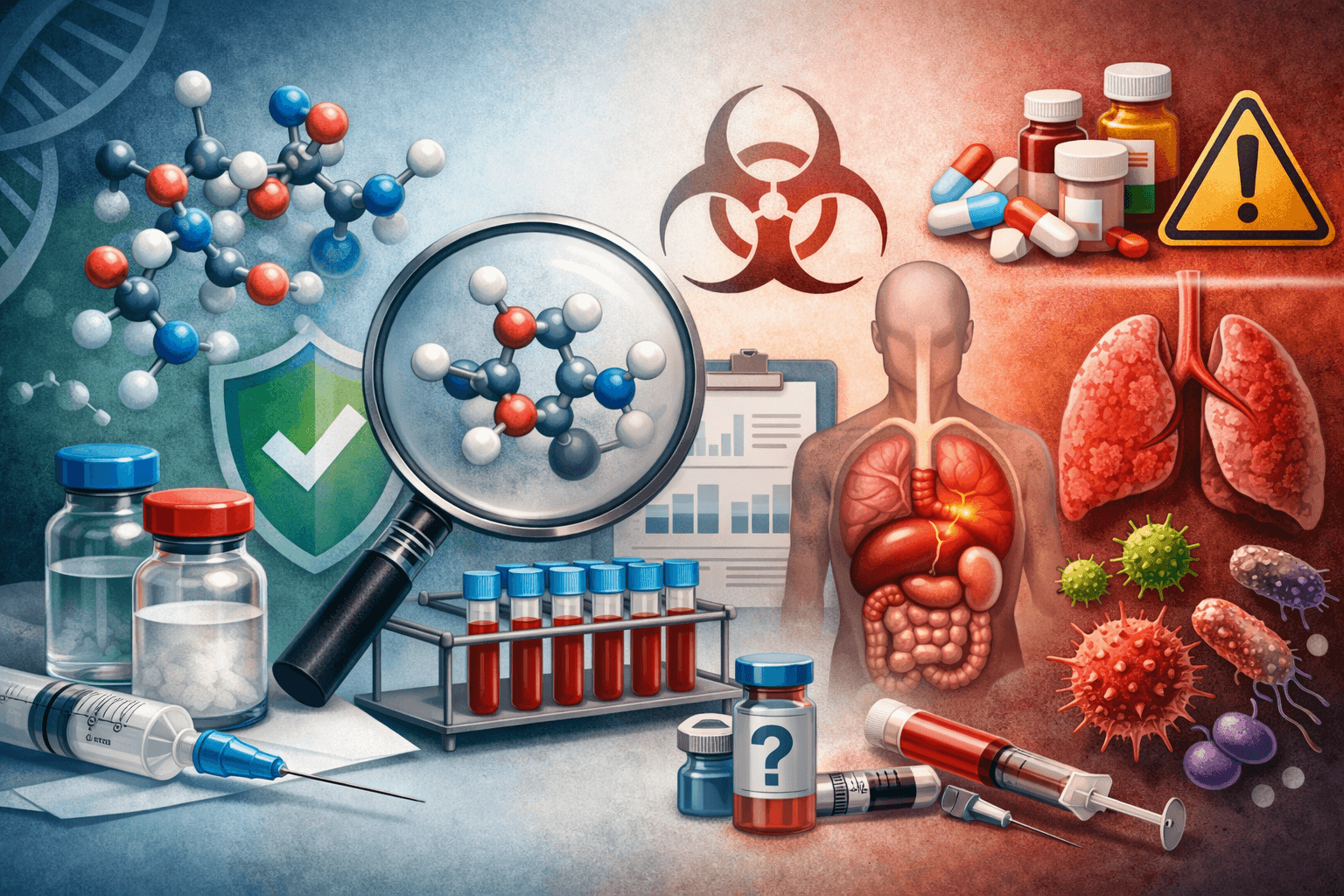
Peptides have excellent safety profiles when used properly. Most therapeutic peptides cause minimal side effects. They work with your body's natural systems rather than overriding them.
But "safe" doesn't mean "risk-free." Understanding potential risks, contraindications, and safety practices helps you use peptides responsibly.
This guide covers everything about peptide safety - side effects, contraindications, quality concerns, proper usage, and how to minimize risks.
The safety fundamentals
Why peptides are generally safe
Natural breakdown: Peptides metabolize into amino acids - the same building blocks your body uses for protein. No toxic metabolites.
Work with natural systems: Growth hormone peptides stimulate your pituitary. They don't replace hormones. Healing peptides enhance natural repair processes.
No hormonal suppression: Unlike steroids or SARMs, most peptides don't shut down natural hormone production. Read our peptides vs SARMs comparison.
Specific targeting: Peptides bind to specific receptors. Targeted effects mean fewer systemic side effects.
Decades of research: Many peptides studied since the 1970s-1980s. Long safety track record.
Important context
Research vs pharmaceutical: Research peptides aren't FDA-approved for human use. They're sold "for research purposes only." You assume responsibility.
Quality matters: Safety depends heavily on sourcing quality peptides from reputable suppliers. Poor quality = higher risk.
Individual variation: Same peptide affects people differently. What's safe for most may not suit everyone.
Not medical advice: This guide is educational. Consult healthcare provider before using peptides, especially with pre-existing conditions.
Common side effects by peptide type
Growth hormone peptides
Examples: Ipamorelin, CJC-1295, GHRP-2, GHRP-6, Hexarelin
Common side effects (usually mild and temporary):
Water retention:
Frequency: 20-30% of users
Severity: Mild
Duration: 1-2 weeks (resolves as body adapts)
Why: GH increases fluid retention temporarily
Management: Reduce sodium, stay hydrated
Increased appetite:
Frequency: 30-50% with GHRP-6, less with Ipamorelin
Severity: Mild to moderate
Duration: 1-2 hours post-injection
Why: Ghrelin receptor activation (hunger hormone)
Management: Time injections strategically
Tiredness post-injection:
Frequency: 10-20% of users (first week)
Severity: Mild
Duration: 30-60 minutes after injection
Why: Body adjusting to increased GH
Management: Resolves within 1-2 weeks
Joint discomfort:
Frequency: 5-10% of users (rare)
Severity: Mild
Duration: Temporary with continued use
Why: Increased fluid in joints
Management: Reduce dose temporarily
Numbness/tingling (hands/feet):
Frequency: 5% of users (rare)
Severity: Mild
Duration: Temporary
Why: Mild carpal tunnel from water retention
Management: Usually resolves, reduce dose if persistent
Read our complete Ipamorelin vs CJC-1295 guide.
Healing peptides
Examples: BPC-157, TB-500, GHK-Cu
Common side effects (minimal):
Very minimal side effects
Occasional mild nausea (rare, <5%)
Injection site reactions (if technique poor)
Headache (very rare, <2%)
Dizziness (very rare, <2%)
Minimal side effects
Temporary fatigue (first few injections)
Mild head pressure (rare, <5%)
No significant adverse effects in studies
GHK-Cu:
Excellent safety profile
Rare injection site reactions
Very well tolerated
Compare BPC-157 vs TB-500 safety.
Weight loss peptides (GLP-1 agonists)
Examples: Semaglutide, Tirzepatide, Liraglutide
Common side effects (mostly GI-related):
Nausea:
Frequency: 40-50% of users initially
Severity: Mild to moderate
Duration: Usually 1-3 weeks (improves with continued use)
Management: Start low dose, increase gradually, eat smaller meals
Constipation:
Frequency: 20-30% of users
Severity: Mild to moderate
Management: Increase fiber, water, consider stool softener
Diarrhea:
Frequency: 15-20% of users
Severity: Mild
Duration: Usually temporary
Management: Probiotics, reduce fatty foods
Fatigue:
Frequency: 20-30% initially
Severity: Mild to moderate
Duration: 2-4 weeks (improves as caloric deficit stabilizes)
Management: Adequate protein, electrolytes, patience
Reduced appetite (intended effect):
Not a side effect - this is the mechanism
Goal: 15-20% reduction in caloric intake
Result: Weight loss
Read our semaglutide vs tirzepatide comparison.
Serious but rare (seek medical attention):
Severe abdominal pain (possible pancreatitis, <1%)
Persistent vomiting (dehydration risk)
Vision changes (diabetic retinopathy concerns)
Severe allergic reaction (extremely rare)
Contraindications: when NOT to use peptides
Absolute contraindications (do not use)
Active cancer or history of cancer:
Growth hormone peptides can accelerate cell growth
GH stimulates IGF-1, which promotes cell proliferation
Risk: Could accelerate cancer growth
Exception: Years in remission with oncologist approval
Pregnancy or breastfeeding:
Insufficient safety data in pregnancy
Unknown effects on fetal development
Unknown transfer in breast milk
Wait until after pregnancy and nursing
Active pancreatitis:
Especially critical for GLP-1 peptides
GLP-1s can cause pancreatic inflammation
History of pancreatitis = high risk
Absolute contraindication for semaglutide/tirzepatide
Family history of medullary thyroid cancer (MTC):
GLP-1 agonists linked to thyroid C-cell tumors in rodent studies
Unknown risk in humans with genetic predisposition
Not worth the risk
Multiple Endocrine Neoplasia syndrome type 2 (MEN 2):
Same concern as MTC family history
Genetic predisposition to thyroid tumors
Absolute contraindication for GLP-1 peptides
Age under 18:
Natural hormone production still developing
Unknown effects on development
Not studied in children
Exception: Some peptides prescribed by doctors for specific conditions
Relative contraindications (use with extreme caution)
Diabetes (especially Type 1):
GLP-1 peptides affect blood sugar
Requires careful monitoring
Dosing adjustments needed
Medical supervision recommended
Diabetic retinopathy:
Rapid weight loss can worsen retinopathy
GLP-1 peptides may increase risk
Ophthalmologist monitoring required
Slow, gradual weight loss preferred
Kidney disease:
Peptides metabolized by kidneys
Reduced clearance with kidney dysfunction
Dose adjustments may be needed
Medical monitoring recommended
History of eating disorders:
Appetite suppression peptides can worsen disordered eating
Risk of excessive restriction
Psychological support needed
Proceed with extreme caution
Active gallbladder disease:
Rapid weight loss increases gallstone risk
GLP-1 peptides slow gallbladder emptying
Monitor for gallbladder symptoms
May need prophylactic medication
Severe gastroparesis:
GLP-1 peptides slow stomach emptying
Can worsen gastroparesis symptoms
May be contraindicated depending on severity
Autoimmune conditions:
Peptides that enhance immune function may affect autoimmune conditions
Proceed with caution
Monitor disease activity
Taking other medications:
GLP-1 peptides affect absorption of oral medications
Timing adjustments may be needed
Consult pharmacist about interactions
Quality and sourcing safety
Why quality matters
Purity issues:
Low purity (below 95%) = more impurities
Impurities can cause allergic reactions
May be ineffective or cause unexpected side effects
Target: 97-99%+ purity
Contamination risks:
Bacterial contamination (improper manufacturing)
Heavy metal contamination (low-quality synthesis)
Endotoxins (bacterial breakdown products)
Cross-contamination with other compounds
Degraded peptides:
Improper storage damages peptides
Degraded peptides less effective
May cause side effects
Fake or mislabeled products:
Some suppliers sell fake peptides
Wrong peptide entirely
No active ingredient
Dangerous substitutes
How to ensure quality
Choose reputable suppliers:
Third-party testing (HPLC/mass spectrometry)
COAs (Certificates of Analysis) for each batch
Batch-specific documentation
Transparent business practices
Good reputation in community
Verify testing:
Request COAs before purchase
Check batch numbers match
Verify 97-99%+ purity
Look for third-party labs (not in-house only)
Red flags to avoid:
No testing documentation
Prices too good to be true ($20 for BPC-157 = fake)
Selling liquid peptides (red flag)
No contact information
Vague product descriptions
Promises of "pharmaceutical grade" without proof
Prefer lyophilized peptides:
Freeze-dried powder = stable
2-3 year shelf life
Minimal degradation
Gold standard
Read our complete best peptide vendors guide.
Administration safety
As you know proper technique reduces risks significantly.
Reconstitution safety
Use sterile technique:
Wash hands thoroughly
Alcohol swab all vial tops
Don't touch needle tips
Work on clean surface
Use bacteriostatic water:
Contains 0.9% benzyl alcohol (preservative)
Prevents bacterial growth
Extends peptide life to 28 days
Never use tap water or sterile water
Calculate doses correctly:
Use our reconstitution calculator
Double-check math
Start with lowest dose
Errors in calculation = dosing problems
Storage after reconstitution:
Refrigerate immediately (2-8°C)
Use within 28 days
Protect from light
Don't freeze
Read our complete reconstitution guide.
Injection safety
Use proper supplies:
Insulin syringes (29-31 gauge)
Alcohol swabs
Sharps container for disposal
Never reuse needles
Injection technique:
Clean injection site with alcohol
Pinch skin fold
Insert needle at 45-90 degree angle
Inject slowly
Withdraw and apply pressure
Rotate injection sites:
Don't inject same spot repeatedly
Prevents tissue damage
Reduces scarring
Common sites: abdomen, thigh, deltoid
Dispose properly:
Use sharps container
Never throw needles in trash
Follow local disposal regulations
Free sharps containers at pharmacies
Never share needles:
Risk of bloodborne infections
HIV, Hepatitis B/C transmission
Each person needs own supplies
The dosing safety
Start conservatively:
Begin with minimum effective dose
BPC-157: Start 250mcg
Ipamorelin: Start 100-200mcg
Semaglutide: Start 0.25mg
Increase gradually:
Assess response for 1-2 weeks
Increase by 20-50% if needed
Don't rush to high doses
More isn't always better
Use dosage calculators:
Don't exceed recommendations:
Optimal range exists for each peptide
Higher doses = more side effects
Diminishing returns beyond optimal range
Follow established protocols
Long-term safety considerations
Growth hormone peptides
Long-term use (Ipamorelin/CJC):
Safe for extended periods (years)
No tolerance development (unlike Hexarelin)
No natural GH suppression
Periodic breaks not required
Monitor blood sugar if prone to diabetes
Potential long-term concerns:
Insulin resistance (monitor blood sugar)
Joint health (usually improves, rarely worsens)
IGF-1 levels (consider testing annually)
Healing peptides
Long-term use (BPC-157, TB-500):
Typically used short-term (4-8 weeks)
Can use longer for chronic issues
No known tolerance
No suppression
Use as needed basis
Safety for extended use:
Excellent safety profiles
Minimal long-term risks
Most use periodically for injuries
No evidence of harm from extended use
Compare BPC-157 vs TB-500 long-term safety.
Weight loss peptides
Long-term use (Semaglutide):
Studied for 1-2+ years continuously
Maintains effectiveness
No tolerance development
Weight regain common if stopped
Consider maintenance dose
Potential long-term concerns:
Gallbladder issues (increased risk with rapid weight loss)
Bone density (from rapid weight loss, not peptide itself)
Muscle loss (ensure adequate protein)
Rebound weight gain if stopped abruptly
Monitoring recommendations:
Regular blood sugar checks
Kidney function tests (if at risk)
Gallbladder monitoring (if symptoms)
Weight and body composition tracking
Monitoring and safety practices
Track progress and side effects
Keep a log:
Date and time of injections
Doses administered
Any side effects
Progress metrics (weight, measurements, pain levels)
Overall feeling
Monitor key metrics:
Muscle growth: Weight, measurements, strength
Healing: Pain levels (1-10), range of motion, function
Weight loss: Scale weight, body composition, energy
Watch for concerning signs:
Severe pain at injection sites
Allergic reactions (rash, swelling, difficulty breathing)
Persistent nausea/vomiting
Severe headaches
Vision changes
Chest pain or difficulty breathing
When to stop immediately:
Severe allergic reaction
Signs of pancreatitis (severe abdominal pain)
Unexplained swelling or pain
Any serious adverse reaction
Seek medical attention if severe
Consider bloodwork
Baseline testing (before starting):
Complete blood count (CBC)
Comprehensive metabolic panel (CMP)
Lipid panel
HbA1c (blood sugar)
IGF-1 (if using GH peptides)
Thyroid panel
Follow-up testing (6-12 weeks):
Repeat relevant markers
Confirm peptides working (IGF-1 elevation)
Check for adverse effects (liver, kidney)
Adjust protocol based on results
When bloodwork is especially important:
Pre-existing health conditions
Using GH peptides long-term
Higher doses
Over age 40
Medical supervision
Consider doctor involvement:
Pre-existing health conditions
Taking other medications
Higher risk profile
Want professional monitoring
Access to pharmaceutical peptides
Telemedicine options:
Many doctors prescribe pharmaceutical peptides
Remote consultations available
Prescription for certain peptides (sermorelin, some GLP-1s)
Legitimate medical oversight
Being honest with doctors:
Tell doctor if using research peptides
Important for medication interactions
Critical for emergency medical care
Allows proper monitoring
Special populations
Older adults (over 50)
Considerations:
May respond better to GH peptides (declining natural GH)
Start with lower doses
Monitor blood sugar more carefully
Increased risk of insulin resistance
May need lower doses for same effect
Safety advantages:
GH peptides may improve markers of aging
Healing peptides excellent for age-related injuries
Generally well-tolerated
Women
Considerations:
Generally same safety profile as men
May need slightly lower doses (body weight)
Monitor for menstrual cycle changes (rare)
GH peptides safe for women
No virilization risk (unlike steroids)
Pregnancy/breastfeeding:
Absolute contraindication
Unknown effects on fetus
Wait until after nursing
Use contraception during peptide use
Athletes and competitors
Testing concerns:
Some peptides banned by WADA
GH secretagogues often banned
BPC-157 banned by WADA
Varies by sport and organization
Check your sport's regulations
Detection:
Most peptides difficult to detect
Detection methods improving
Half-lives short (out of system quickly)
Risk varies by peptide
Comparing peptide safety to alternatives
Peptides vs steroids
Peptides:
No testosterone suppression
Minimal side effects
Work with natural systems
No PCT required
Legal status (research use)
Steroids:
Suppress natural testosterone
Significant side effects
Override natural systems
Require PCT
Controlled substances
Peptides significantly safer profile.
Peptides vs SARMs
Peptides:
Various mechanisms
Minimal suppression
Better long-term safety
Broader applications
Suppress testosterone
Require PCT
Liver stress (oral)
Limited applications
Read our complete peptides vs SARMs comparison.
Peptides vs HGH
Peptides (Ipamorelin/CJC):
Stimulate natural GH
No suppression
90-95% cheaper
Safer long-term
Pharmaceutical HGH:
Direct replacement
Shuts down natural production
$1,500-3,000/month
Requires lifelong use
Peptides safer and more sustainable.
Emergency situations
Allergic reactions
Symptoms:
Rash or hives
Swelling (face, tongue, throat)
Difficulty breathing
Rapid heartbeat
Dizziness or fainting
Action:
Stop peptide immediately
Seek emergency medical care (call 911)
Use EpiPen if available (severe reaction)
Don't use that peptide again
Prevention:
Test small dose first time
Watch for 30 minutes post-injection
Have antihistamine available
Suspected pancreatitis
Symptoms (especially with GLP-1 peptides):
Severe abdominal pain (upper abdomen)
Pain radiating to back
Nausea and vomiting
Fever
Action:
Stop peptide immediately
Seek emergency medical care
Don't restart without medical clearance
Severe dehydration
Symptoms (with weight loss peptides):
Extreme thirst
Dark urine or no urination
Dizziness when standing
Rapid heartbeat
Confusion
Action:
Increase fluid intake immediately
Electrolyte solution (Pedialyte, sports drinks)
Seek medical care if severe
Common with excessive vomiting/diarrhea
Harm reduction strategies
Start low, go slow:
Minimum effective dose initially
Increase gradually
Give body time to adapt
Source quality products:
Verify testing documentation
Pay for quality
Use proper technique:
Sterile reconstitution
Proper injection method
Clean supplies
Monitor closely:
Track doses and effects
Watch for side effects
Adjust protocol based on response
Educate yourself:
Read guides on specific peptides
Understand mechanisms
Know contraindications
Use calculators properly
Consider medical supervision:
Especially if higher risk
Bloodwork monitoring
Professional guidance
Frequently asked questions
Q: Are peptides safe?
A: When sourced from quality suppliers and used properly, peptides have excellent safety profiles. Most side effects are mild and temporary. Read our complete safety guide.
Q: What are the most common side effects?
A: GH peptides: water retention, increased appetite (temporary). Healing peptides: minimal. Weight loss peptides: nausea, constipation (usually temporary).
Q: Can I use peptides long-term?
A: Many peptides safe long-term. Ipamorelin/CJC: yes (years). BPC-157: as needed. Semaglutide: studied 1-2+ years.
Q: Do peptides suppress natural hormones?
A: Most don't. GH peptides stimulate production (no suppression). Healing peptides: no hormonal effects. Unlike steroids or SARMs.
Q: How do I minimize risks?
A: Source from quality vendors, use proper reconstitution, start with low doses, monitor closely, follow safety guidelines.
Q: When should I NOT use peptides?
A: Active cancer, pregnancy/breastfeeding, active pancreatitis (for GLP-1s), family history of MTC (for GLP-1s), under 18 years old. See complete contraindications above.
Q: Do I need bloodwork?
A: Recommended but not required. Especially important with pre-existing conditions, long-term use, or GH peptides. Baseline and follow-up testing ideal.
Q: Are research peptides less safe than pharmaceutical?
A: Quality research peptides from reputable suppliers can be 97-99% pure (comparable to pharmaceutical). Safety depends on source quality.
Q: What's the safest peptide to start with?
A: BPC-157 has excellent safety profile with minimal side effects. Ipamorelin also very safe. Both good first peptides.
Q: Can I use peptides with other medications?
A: Depends on medications. GLP-1 peptides affect absorption of oral meds. Consult doctor about interactions. Be transparent with healthcare providers.
The bottom line
Peptides have excellent safety profiles when used responsibly. Most side effects are mild and temporary. Serious adverse events are rare.
Keys to safe use:
Source from quality vendors
Start with low doses
Use proper reconstitution and injection techniques
Monitor for side effects
Know contraindications
Adjust based on response
Safest peptides:
BPC-157: Minimal side effects
Ipamorelin/CJC-1295: Well-tolerated
TB-500: Excellent safety profile
Higher monitoring needed:
GLP-1 peptides: Watch for GI issues, pancreatitis
Pre-existing conditions: Medical supervision recommended
Long-term use: Periodic bloodwork
Remember: "Safe" doesn't mean "risk-free." Understand risks, follow guidelines, monitor closely, and you'll minimize problems while maximizing results.
Plan your safe protocol:
Related resources
In case I don’t see you, good afternoon, good evening, and good night.