Mar 23, 2026
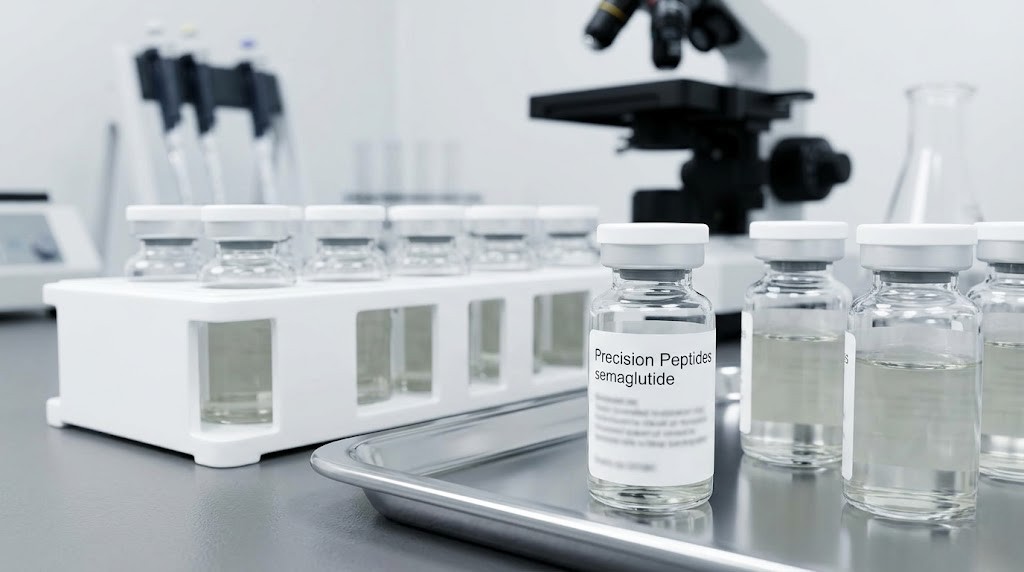
Experienced researchers know something most beginners do not about choosing a semaglutide vendor. The flashy website means nothing. The promises mean less. What matters, the only thing that truly matters, is what independent lab results reveal about the powder sitting inside that vial. And when it comes to Precision Peptide Co, the picture is complicated. Some researchers report exactly the quality they expected. Others describe products that felt like expensive water. The gap between those two experiences tells you everything about why vendor selection requires more than a quick Google search and a credit card.
The research peptide market has exploded alongside the GLP-1 revolution, and compounded semaglutide sits at the center of that storm. Dozens of vendors compete for researchers who want access to this powerful peptide without navigating the traditional pharmaceutical pathway. Precision Peptide Co positions itself as a premium option in that crowded landscape, emphasizing third-party testing and transparency. But does the reality match the marketing? That is what this guide will answer, with data, with user reports, and with the context you need to make a genuinely informed decision about whether Precision Peptide Co deserves your research budget or whether better alternatives exist.
SeekPeptides has analyzed vendor after vendor in this space, building what we believe is the most comprehensive library of peptide source reviews available anywhere. This review applies that same rigorous framework to Precision Peptide Co, examining purity claims, pricing structure, user feedback, and the practical details that determine whether your research succeeds or fails.
What is Precision Peptide Co?
Precision Peptide Co operates as an online research peptide vendor selling a range of compounds for scientific and laboratory use. The company markets itself on quality assurance, claiming that every batch undergoes third-party laboratory testing before reaching customers. Lab results, according to their website, appear directly on each product page so researchers can verify purity before purchasing.
That transparency claim is significant. Many vendors in the research peptide space offer vague quality promises without backing them up. Precision Peptide Co at least attempts to differentiate by making testing data accessible. Whether those results are current, comprehensive, and genuinely independent is a separate question entirely, one we will examine in detail below.
The company website lists products across several categories. Semaglutide, branded as their "Sema" product line, occupies a prominent position in their catalog alongside a GLP-1 analogue product called GLP-S. They also carry other research peptides beyond the weight loss category, though their weight loss peptide offerings appear to generate the most customer interest.
One detail worth noting immediately. All products carry the standard research-use disclaimer. Nothing is sold for human consumption. This is standard across the research peptide industry, and it carries meaningful implications for quality assurance, regulatory oversight, and what recourse you have if something goes wrong. If you are new to navigating the legal landscape of peptide research, understanding this distinction matters enormously.
Company background and market position
Precision Peptide Co entered a market already populated by established vendors like Peptide Sciences, Biomax Peptides, and dozens of smaller operations. The research peptide market lacks the regulatory framework that governs pharmaceutical manufacturers, meaning quality varies wildly between vendors. Some maintain pharmaceutical-grade standards. Others cut corners that compromise purity, potency, or both.
Where does Precision Peptide Co fall on that spectrum? Reviews suggest somewhere in the middle. They are not a fly-by-night operation that disappears after a few months, but they also lack the established track record of vendors who have been serving the research community for a decade or more. For researchers evaluating whether to trust their peptide safety to this particular vendor, that middle-ground positioning creates genuine uncertainty.
The company website appears professional and relatively well-organized. Product pages include descriptions, claimed purity percentages, and links to certificates of analysis. Shipping reportedly covers domestic orders, though international availability varies. Payment methods have been a point of discussion among reviewers, with some noting that Bitcoin was the primary or only accepted payment method at various points, a factor that some researchers find concerning due to the difficulty of disputing charges or tracking transactions.
Precision Peptide Co semaglutide products
The centerpiece of any vendor review targeting the keyword "precision peptides semaglutide" needs to be a detailed examination of what this company actually sells under the semaglutide umbrella. Precision Peptide Co lists their semaglutide offering under the brand name "Sema" and a separate listing called "GLP-S" which appears to be a GLP-1 analogue product.
Understanding what peptides are and specifically how semaglutide works to suppress appetite is essential context before evaluating any vendor product. Semaglutide is a GLP-1 receptor agonist that mimics the incretin hormone your body naturally produces after eating. It slows gastric emptying, reduces appetite signaling in the brain, and has demonstrated significant effects in clinical trials on weight management and blood glucose control.
Product specifications
Based on available information from the Precision Peptide Co website and product listings, their semaglutide products include the following reported specifications:
Purity claim: Third-party tested, with COA (Certificate of Analysis) reportedly available on product pages
Form: Lyophilized powder requiring reconstitution before use
Research use only: Not approved or intended for human consumption
Quantity-based discounts: Available for bulk research orders
The lyophilized powder format is standard across research peptide vendors. Once you receive the vial, you would need bacteriostatic water to reconstitute it following proper peptide reconstitution protocols. If you are working with a 5mg vial, our guide on reconstituting 5mg semaglutide walks through the exact process. For 10mg vials, see our guide on mixing bacteriostatic water with 10mg semaglutide.
What Precision Peptide Co does not provide, at least not transparently on their website, is detailed pricing information that researchers can easily compare against competitors. This opacity is a red flag for some researchers and a standard business practice for others. Either way, it makes comparison shopping more difficult than it needs to be.
Third-party testing and purity verification
This is where the rubber meets the road for any peptide vendor. Claims of quality mean nothing without verifiable data. Precision Peptide Co states that every batch undergoes third-party testing, with results displayed on product pages. That claim, if accurate, puts them ahead of vendors who offer no testing whatsoever.
But third-party testing exists on a spectrum. Not all testing is created equal.
The gold standard involves HPLC (High-Performance Liquid Chromatography) testing combined with mass spectrometry, conducted by an independent laboratory with no financial ties to the vendor. The test should verify both identity (confirming the compound is actually semaglutide) and purity (measuring what percentage of the sample is the target compound versus impurities or degradation products). Understanding peptide research standards helps you interpret what these numbers actually mean for your work.
What to look for in a Certificate of Analysis
A legitimate COA from a reputable testing lab should include several key elements. The laboratory name and contact information should be clearly identified. The batch number should match what is printed on your vial. The date of testing should be recent, not from months or years ago. Purity percentage should be above 98% for research-grade semaglutide, with 99%+ being ideal. The testing methodology should be specified, typically HPLC.
When evaluating Precision Peptide Co COAs, researchers should verify these elements independently. Can you contact the listed laboratory? Does the batch number match? Is the testing date relevant to your purchase? These verification steps take minutes but can save you significant money and frustration.
For context on what constitutes acceptable purity in the research peptide market, our guide on pure peptides and lab quality standards provides the benchmarks you need. Anything below 95% purity should raise immediate concerns. Impurities in peptide products can range from harmless manufacturing byproducts to genuinely problematic contaminants, and without proper testing, you simply do not know what you are working with.
The trust problem in research peptides
Here is the uncomfortable reality of the research peptide market. Vendors can fabricate COAs. They can display outdated results that no longer represent current production batches. They can use in-house testing dressed up to look independent. And because research peptides exist in a regulatory gray area, there is no government agency routinely auditing these claims.
This does not mean Precision Peptide Co is doing any of these things. It means you should approach all vendor claims, from every company in this space, with healthy skepticism. The researchers who get the best results are the ones who verify rather than trust, who request recent COAs for their specific batch, and who compare results against what they observe in their own work.
Experienced researchers sometimes send samples to independent labs for verification testing. While this adds cost, it provides definitive answers about what you actually received versus what the vendor claimed to send. If you are spending significant amounts on research materials, this investment in verification can pay for itself many times over by ensuring your peptide dosing protocols work with accurately characterized compounds.
How Precision Peptide Co compares to other semaglutide vendors
Context matters enormously when evaluating any vendor. Precision Peptide Co does not exist in isolation. It competes with dozens of other sources, each with different strengths, weaknesses, and track records. Understanding where this vendor fits in the broader landscape helps you make informed decisions about whether their offering represents the best value for your specific research needs.
Vendor comparison framework
When comparing semaglutide vendors, five factors matter most:
1. Verified purity and testing transparency
Precision Peptide Co claims third-party testing with results on product pages. This puts them ahead of vendors with no testing claims but behind vendors who use well-known, independently verifiable laboratories. Companies like Peptide Sciences have built their reputation on extensive testing documentation over many years. Newer vendors still need to prove consistency.
2. Price relative to verified quality
Without transparent pricing on the Precision Peptide Co website, direct comparison becomes difficult. Research peptide semaglutide typically ranges from $30 to $80 per 5mg vial at research-grade quality, though prices fluctuate based on purity, vendor reputation, and market conditions. Our peptide cost calculator can help you evaluate whether what you are paying represents reasonable value.
3. Consistency between batches
This is where user reviews become crucial. A vendor can produce one excellent batch and follow it with a substandard one. Consistency over time separates reliable vendors from unreliable ones. The mixed reviews for Precision Peptide Co suggest inconsistency may be an issue, though the sample size of public reviews is limited enough that definitive conclusions are premature.
4. Customer service and dispute resolution
When problems arise, and they inevitably do with any vendor, how the company responds matters enormously. Payment methods factor into this equation. Vendors accepting only cryptocurrency make disputes significantly harder to resolve than those accepting credit cards with chargeback protection. This is worth considering regardless of which vendor you choose.
5. Track record and longevity
Established vendors like Empower Pharmacy and Olympia Pharmacy have years of documented history. For comparison, you might also explore reviews of Direct Meds, Belmar Pharmacy, Amino USA, Brello Health, WeightCare, and BPI Labs to see how different vendors stack up across these criteria.
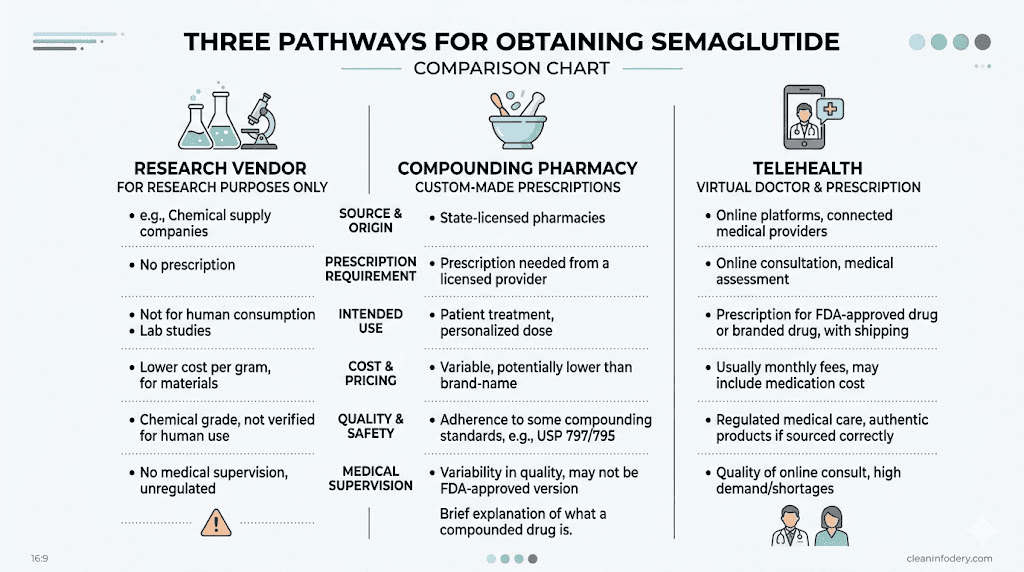
Research peptide vendors vs compounding pharmacies vs telehealth
An important distinction that many researchers overlook is the difference between research peptide vendors (like Precision Peptide Co), licensed compounding pharmacies, and telehealth platforms. Each operates under different regulatory frameworks with different implications for quality, legality, and safety.
Research peptide vendors sell products labeled "for research use only." They operate outside FDA oversight for pharmaceutical products, meaning quality depends entirely on the vendor voluntary standards. Precision Peptide Co falls in this category.
Compounding pharmacies operate under state and federal pharmacy regulations. 503A pharmacies compound for individual prescriptions. 503B outsourcing facilities can produce larger quantities under FDA oversight. Products from these facilities, like those reviewed in our 503B compounding pharmacy guide, carry more regulatory assurance than research-grade products.
Telehealth platforms connect patients with prescribers who can authorize compounded medications from licensed pharmacies. These carry the most regulatory protection but also the highest costs. Our reviews of platforms like Levity and Belle Health cover this pathway in detail.
For researchers evaluating their options, understanding where and how to buy semaglutide within the appropriate legal and safety framework for their situation is essential. SeekPeptides members get access to detailed vendor comparison tools and community-sourced quality reports that go far beyond what any single review can cover.
User reviews and reputation analysis
What do actual customers say about Precision Peptide Co? The answer depends entirely on where you look, which itself tells you something important about the inconsistency of experiences with this vendor.
Trustpilot reviews
Precision Peptide Co has a presence on Trustpilot with reviews spanning multiple years. The overall sentiment is mixed, with some customers reporting positive experiences and others describing significant problems. One reviewer praised fast shipping and reliable delivery. Another reported ordering products that produced no discernible effects, effectively comparing the purchase to buying water at premium prices.
The range of experiences suggests one of several possibilities. Batch-to-batch variation in product quality could explain why some researchers report excellent results while others report none. Alternatively, differences in storage and handling practices after purchase could account for the variation. Without controlled testing, attributing positive or negative outcomes to the vendor specifically versus other variables remains difficult.
Forum and community feedback
Online peptide research communities provide additional data points, though with important caveats about potential bias in both directions. Some community members have reported satisfactory transactions with Precision Peptide Co, particularly noting the availability of COAs and the range of products offered. Others have flagged concerns about:
Product potency inconsistency: Multiple reports of products seeming less effective than expected, suggesting potential purity or concentration issues
Payment method limitations: Bitcoin-only payment at certain periods, which removes consumer protections available with credit card transactions
Communication gaps: Difficulty reaching customer service when issues arise
Shipping delays: Some orders taking longer than promised to arrive, which matters for temperature-sensitive compounds like semaglutide that require proper temperature management during shipping
One particularly telling observation from multiple reviewers is the phrase "hit or miss." When experienced researchers use that language about a vendor, it signals a level of uncertainty that makes long-term research planning difficult. Consistency, more than any single factor, determines whether a vendor relationship is sustainable.
Comparing review profiles
For perspective, consider how this compares to other vendors in the space. Established compounding pharmacies and telehealth platforms typically show more consistent review profiles, with fewer dramatic swings between glowing praise and sharp criticism. Research peptide vendors as a category tend to show more volatility in reviews because the regulatory framework provides fewer quality guarantees.
This does not automatically disqualify Precision Peptide Co. It does mean you should factor review inconsistency into your risk assessment when deciding how to allocate your research budget. For researchers new to getting started with peptides, choosing a vendor with a more established and consistent track record may reduce the learning curve considerably.
How to evaluate any semaglutide vendor
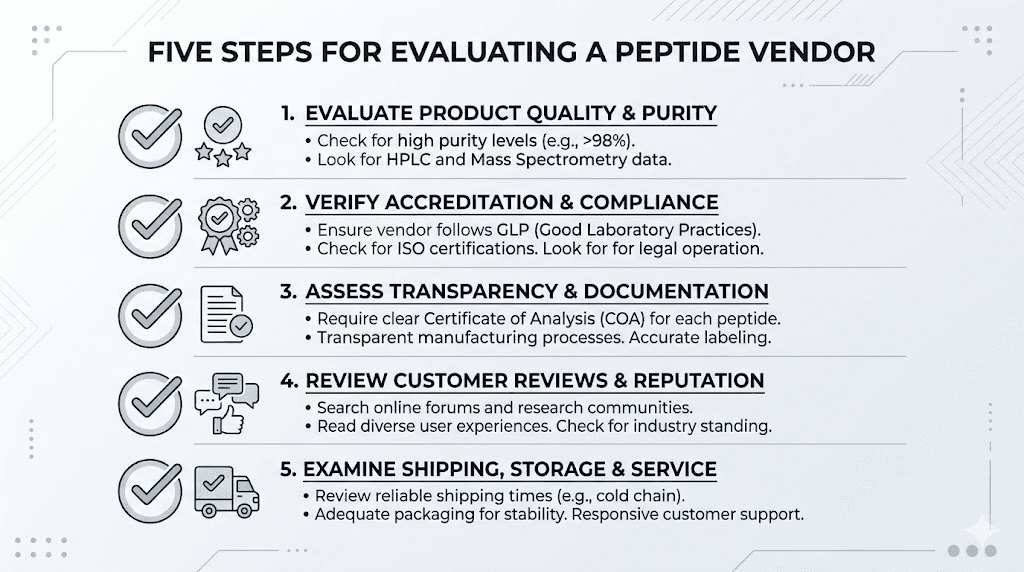
Whether you ultimately choose Precision Peptide Co or explore other options, having a systematic framework for vendor evaluation protects your investment and your research outcomes. Here is the framework experienced researchers use.
Step 1: verify the Certificate of Analysis
Do not just look at it. Verify it. Contact the testing laboratory listed on the COA. Confirm they actually tested that batch. Check whether the lab is accredited and independent from the vendor. A legitimate testing lab will confirm or deny having performed specific tests, though they may not share results directly due to client confidentiality agreements.
Step 2: start with a small order
Never commit significant budget to an untested vendor. Order one vial. Test it in your research. Evaluate results before scaling up. This approach limits your financial exposure while providing real-world data about product quality. Many common peptide mistakes stem from over-committing to an unproven source.
Step 3: compare across multiple metrics
Price per milligram matters, but it should not be your only consideration. Factor in verified purity (a cheaper product at lower purity may actually cost more per milligram of active compound), shipping conditions (temperature control matters for semaglutide stability), payment protection (can you dispute charges if the product is defective?), and customer service responsiveness. The peptide cost calculator helps quantify the financial side of this comparison.
Step 4: check for recent reviews
A vendor with great reviews from three years ago may have changed ownership, suppliers, or quality standards since then. Focus on reviews from the past 6-12 months. Look for patterns rather than individual outliers, since every vendor has the occasional unhappy customer, but consistent themes in complaints signal systemic issues.
Step 5: assess their knowledge base
Quality vendors invest in education. They provide reconstitution guides, storage recommendations, and dosage information (for research purposes). Vendors who just list products with minimal information may be less invested in the researcher experience. Resources like our peptide dosage calculation guide and peptide injection guide fill gaps that vendors often leave.
Understanding semaglutide for research
Whether you source from Precision Peptide Co or anywhere else, understanding the compound itself determines whether your research succeeds. Semaglutide is not a simple molecule, and working with it effectively requires understanding its pharmacology, proper handling, and realistic timelines.
How semaglutide works
Semaglutide belongs to the GLP-1 receptor agonist class of peptides. It mimics the action of glucagon-like peptide-1, a hormone your body produces in the intestines after eating. This hormone signals satiety to the brain, slows stomach emptying, and influences insulin secretion. The result is reduced appetite, lower food intake, and improved glycemic control.
What makes semaglutide unique among GLP-1 agonists is its modified amino acid sequence and fatty acid side chain, which extends its half-life to approximately seven days. This is why dosing typically occurs weekly rather than daily, a significant advantage for research protocols and compliance. Understanding how quickly semaglutide begins working helps set realistic expectations for research timelines.
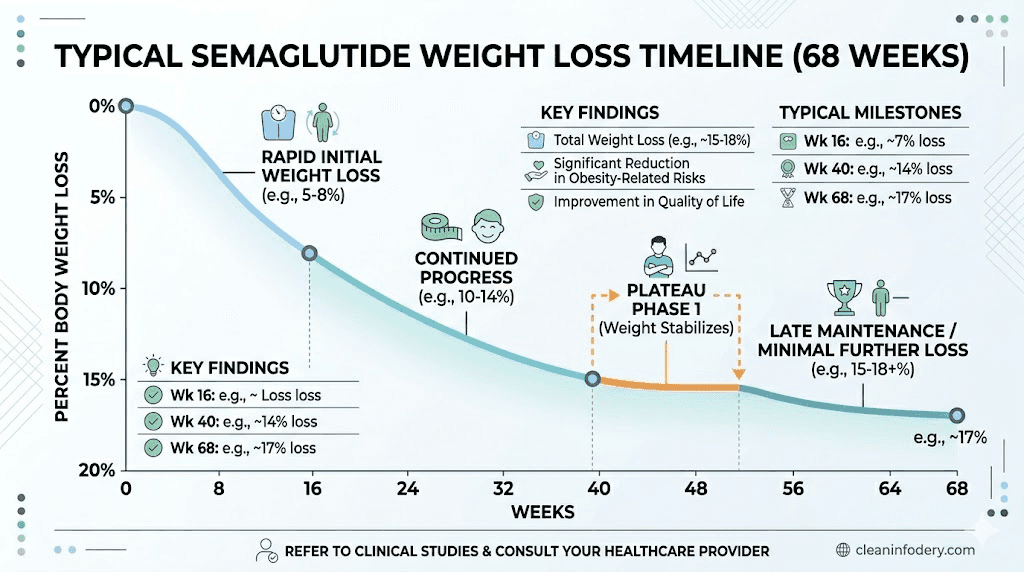
The clinical data behind semaglutide is extensive. The STEP trials demonstrated average weight loss of 14.9% of body weight at 68 weeks with the 2.4mg weekly dose. The SELECT cardiovascular outcomes trial showed a 20% reduction in major adverse cardiovascular events. These are not small effects. They represent some of the most significant clinical outcomes ever demonstrated for a weight management compound, which explains why semaglutide results have generated such intense research interest.
Available formulations
Semaglutide exists in several forms that researchers may encounter:
Injectable (subcutaneous): The most common research format. Lyophilized powder reconstituted with bacteriostatic water and administered via insulin syringe injection. This is what Precision Peptide Co and most research vendors supply.
Sublingual: An emerging format gaining attention. Our sublingual semaglutide guide covers how this delivery method works, though bioavailability differs from injectable administration.
Oral drops: Another alternative delivery method reviewed in our oral semaglutide drops guide. Convenience increases but absorption variability may affect research consistency.
For most research applications, the injectable format provides the most predictable pharmacokinetics and the most directly comparable data to clinical trials. This is why the lyophilized powder format sold by Precision Peptide Co and similar vendors remains the standard.
Semaglutide enhanced formulations
Many compounding pharmacies and some vendors offer semaglutide combined with other compounds. Common combinations include semaglutide with B12 for energy support, semaglutide with glycine for nausea management, and semaglutide with methylcobalamin for enhanced metabolic support. The semaglutide glycine B12 blend has become particularly popular for researchers looking to address multiple research endpoints simultaneously.
Precision Peptide Co appears to offer primarily standalone semaglutide rather than combination products. Researchers interested in combination formulations may need to explore compounding pharmacy sources like Empower Pharmacy or Olympia Pharmacy.
Dosing and reconstitution essentials
Getting semaglutide dosing right is critical regardless of your source. Precision Peptide Co sells lyophilized powder, which means you handle the reconstitution process yourself. Done correctly, this produces a stable solution suitable for research. Done incorrectly, you compromise both the compound and your results.
Reconstitution protocol
The standard reconstitution process involves adding bacteriostatic water to the lyophilized powder in the vial. The amount of water you add determines the concentration of your solution, which directly impacts how many units correspond to each milligram dose.
For a 5mg vial, adding 2mL of bacteriostatic water creates a concentration of 2.5mg/mL. Our detailed guide on mixing bacteriostatic water with 5mg semaglutide walks through each step with exact measurements. For larger 10mg vials, the 10mg reconstitution guide provides the equivalent detail.
Critical reconstitution rules that apply regardless of vendor:
Never shake the vial. Swirl gently. Semaglutide is a delicate peptide that can denature with aggressive agitation.
Direct the bacteriostatic water stream against the glass wall of the vial, not directly onto the powder cake.
Allow the solution to sit if the powder does not dissolve immediately. Room temperature and patience work better than heat or shaking.
Use sterile technique throughout. Wipe vial tops with alcohol swabs. Use clean needles for each step.
The peptide reconstitution calculator removes the guesswork by computing exact volumes and concentrations based on your specific vial size and desired dose.
Dosing charts and calculations
Once reconstituted, you need to know exactly how many units on your syringe correspond to your target dose. This varies based on your reconstitution concentration. For standard semaglutide dosing references:
Semaglutide 5mg/mL dosage chart for concentrated preparations
Semaglutide 10mg dosage chart for larger vial sizes
Semaglutide dosage chart in units for insulin syringe measurements
Semaglutide reconstitution chart for quick reference
The semaglutide dosage calculator on SeekPeptides automates these calculations completely. Enter your vial size, the amount of bacteriostatic water added, and your target dose. The calculator outputs the exact syringe measurement in units. No math required. No room for error.
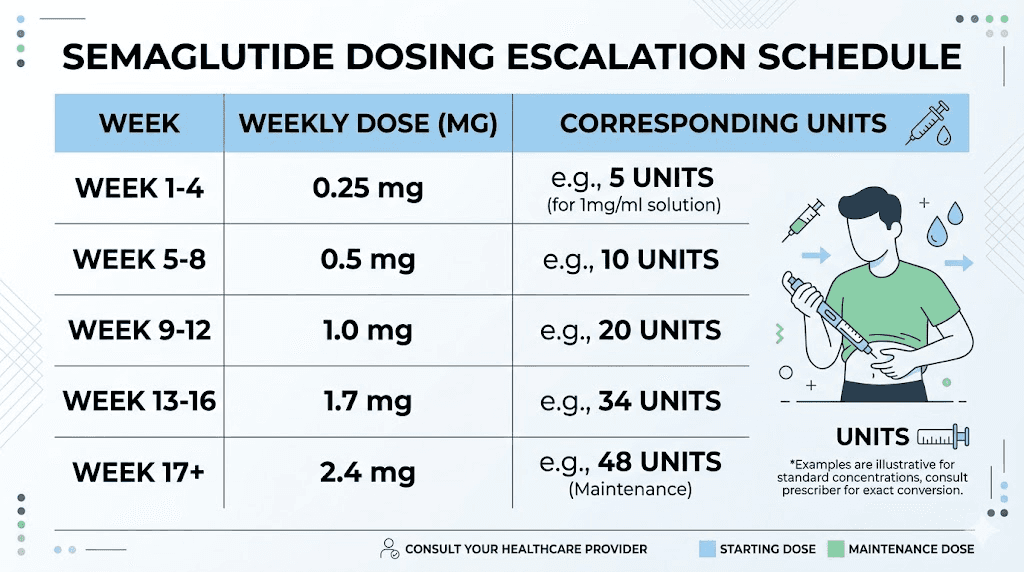
Standard research dosing protocols for semaglutide typically follow an escalation schedule. Week 1 through 4 begins at 0.25mg weekly. Weeks 5 through 8 increase to 0.5mg. Further escalation to 1mg, 1.7mg, and potentially 2.4mg occurs at four-week intervals based on research objectives and tolerance observations. Our guides on how many units for 0.25mg, units for 1mg, and units for 1.7mg provide the specific syringe readings for each dose level.
Storage and handling requirements
Proper storage directly impacts whether the semaglutide you purchased maintains its potency throughout your research protocol. This is true for Precision Peptide Co products and any other source. Lyophilized (unreconstituted) semaglutide is relatively stable, but once reconstituted, the clock starts ticking.
Before reconstitution
Lyophilized semaglutide powder should be stored in a refrigerator at 2-8 degrees Celsius (36-46 degrees Fahrenheit). In this form, the compound maintains stability for extended periods. Semaglutide shelf life in lyophilized form can extend for months when properly stored, making it feasible to purchase ahead of immediate research needs.
If your Precision Peptide Co order arrives warm due to shipping conditions, that is cause for concern. Our guide on what happens when semaglutide gets warm explains the degradation risks and how to assess whether a heat-exposed product is still viable. Temperature excursions during shipping represent one of the risks of purchasing from any vendor, and proper cold-chain packaging is a quality indicator worth evaluating.
After reconstitution
Once you add bacteriostatic water, reconstituted semaglutide should be refrigerated and used within a defined timeframe. How long semaglutide lasts in the fridge depends on several factors: the bacteriostatic water used (which contains preservative), sterile technique during reconstitution, and storage temperature consistency.
General guidance suggests using reconstituted semaglutide within 28-30 days, though some researchers report maintaining potency for longer periods under ideal conditions. Our detailed analysis of how long semaglutide remains good covers the variables that influence degradation rates.
Key storage rules:
Always refrigerate after reconstitution, never freeze
Keep away from light, as UV exposure accelerates peptide degradation
Do not leave at room temperature for extended periods
If accidentally left out overnight, assess viability based on temperature and duration
Monitor solution color for signs of degradation, clear to slightly opalescent is normal
Proper storage is one area where the vendor selection matters less than your own practices. Even the highest quality product from the most reputable vendor will degrade if stored improperly. Take the time to get your peptide storage setup right before making any purchase.
Side effects and safety considerations
Any comprehensive review of a semaglutide source must address what researchers should be prepared for when working with this compound. Side effects are well-documented in clinical literature and consistent across sources, meaning you should expect similar profiles whether your semaglutide comes from Precision Peptide Co or a pharmacy.
Common side effects
The most frequently reported effects during semaglutide research include gastrointestinal symptoms. Nausea tops the list, affecting a significant percentage of users, particularly during dose escalation phases. Bloating, constipation, and acid reflux are also common. Sulfur burps are a distinctive side effect that catches many researchers off guard.
Fatigue is another widely reported effect, particularly in the early weeks. Dizziness can occur, especially with caloric restriction. Some users report sleep disturbances, while others experience changes in menstrual patterns.
Most gastrointestinal side effects decrease in severity over 4-8 weeks as the body adapts. The dose escalation protocol exists specifically to minimize these effects by allowing gradual adaptation.
Injection site considerations
For subcutaneous injection protocols, choosing the right injection site matters for both comfort and absorption. The abdomen, upper thigh, and upper arm are standard rotation sites. Proper injection technique using the guidance in our semaglutide injection guide minimizes discomfort and reduces the risk of injection site reactions.
When to be concerned
Certain effects warrant immediate attention: severe abdominal pain (potential pancreatitis indicator), significant changes in vision, signs of allergic reaction (swelling, difficulty breathing), or persistent vomiting that prevents hydration. These are rare but serious potential complications documented in clinical trials.
Understanding the withdrawal process is also important for researchers planning to conclude their protocols. Abrupt cessation can lead to rebound appetite and other effects that proper tapering can minimize.
What results to realistically expect
Setting accurate expectations is crucial for any research protocol. Semaglutide produces real, measurable effects, but timelines and magnitudes vary based on dose, individual factors, diet, and activity levels.
Timeline of effects
Our first week on semaglutide guide details what the earliest phase typically looks like: subtle appetite changes, minimal side effects at the starting dose, and little to no measurable weight change. This is normal. Patience during the first month is essential.
By week four, more noticeable effects typically emerge. Appetite suppression becomes more apparent. Some weight change may be measurable, though not seeing weight loss at four weeks does not necessarily indicate product failure. Many factors influence the timeline.
The week-by-week results timeline provides the most detailed breakdown of expected changes at each stage. Clinical data suggests that meaningful results typically emerge between weeks 8-16, with maximum effects appearing around week 68 in the landmark clinical trials.
For visual reference, our before and after semaglutide collection provides documented examples of outcomes across different timelines and doses.
Factors that influence results
If your Precision Peptide Co semaglutide does not seem to be producing expected results, consider these variables before blaming the product:
Dose adequacy: Results correlate strongly with dose. The 0.25mg starting dose is a tolerance-building phase, not a therapeutic dose. Most significant results occur at 1mg and above. Patience through the escalation matters.
Dietary factors: Semaglutide works best alongside appropriate nutrition. Our guides on foods to avoid on semaglutide, best foods to eat on semaglutide, and the comprehensive semaglutide diet plan cover nutritional strategies that maximize outcomes.
Activity levels: While weight loss without exercise is possible, physical activity significantly enhances results and helps preserve lean mass during caloric deficit.
Product quality: This is where vendor selection becomes directly relevant to outcomes. If your semaglutide is underdosed, impure, or degraded, no amount of dietary compliance or patience will produce full results. This is the core argument for choosing vendors with the strongest verification processes.
Individual biology: Response to semaglutide varies between individuals. Genetic factors, metabolic health, medication interactions, and hormonal status all influence outcomes. Not losing weight on semaglutide can have many explanations beyond product quality.
Semaglutide plateaus
Weight loss plateaus are common and expected. Our semaglutide plateau guide covers the physiological reasons behind stalls and evidence-based strategies for working through them. Understanding that plateaus are normal prevents the premature conclusion that your product has stopped working.
Comparing semaglutide to other GLP-1 options
Researchers exploring Precision Peptide Co for semaglutide may also want to understand how semaglutide compares to other compounds in the GLP-1 receptor agonist class. The competitive landscape has expanded significantly.
Semaglutide vs tirzepatide is the most common comparison. Tirzepatide is a dual GIP/GLP-1 receptor agonist that has shown slightly greater weight loss in head-to-head trials. Our side effect comparison details the differences in tolerability profiles between these two compounds.
For researchers considering newer options, the three-way comparison between semaglutide, tirzepatide, and retatrutide covers the latest generation of GLP-1 compounds. Retatrutide, a triple receptor agonist, has shown even more impressive results in clinical trials, though its availability is more limited.
Other comparisons worth exploring include phentermine vs semaglutide for researchers evaluating traditional appetite suppressants against GLP-1 compounds, and sermorelin vs semaglutide for those interested in growth hormone secretagogue pathways.
The decision between these compounds depends on research objectives, budget, availability, and tolerance profiles. For many researchers, semaglutide remains the default choice due to its extensive clinical evidence base and widespread availability from vendors like Precision Peptide Co and numerous alternatives.
Making your final decision
After reviewing all available data on Precision Peptide Co, here is where things stand.
Strengths:
Claims third-party testing with COAs on product pages
Offers semaglutide in standard research formats
Quantity-based discounts available for bulk orders
Has been operating long enough to accumulate a review history
Concerns:
Mixed reviews suggesting inconsistent product quality between batches
Payment method limitations (Bitcoin-only at times) reducing consumer protection
Communication and customer service issues reported by some customers
Pricing opacity makes comparison shopping difficult
Relatively newer market presence compared to established vendors
Verdict:
Precision Peptide Co is not the worst option in the research peptide market, but it is also not clearly the best. The inconsistency theme in reviews is the most concerning finding. For researchers who value predictability and consistency above all else, more established vendors with longer track records and more uniform reviews may represent safer choices.
For researchers willing to do their own verification, starting with small test orders, and checking COAs independently, Precision Peptide Co could be worth evaluating. But approach with open eyes and realistic expectations about the uncertainty involved.
For researchers serious about optimizing their peptide protocols, SeekPeptides offers the most comprehensive resource available, with evidence-based guides, vendor comparison tools, proven protocols, and a community of thousands who have navigated these exact vendor selection questions.
Frequently asked questions
Is Precision Peptide Co a legitimate company?
Precision Peptide Co appears to be a real business with an established web presence, product listings, and customer reviews on platforms like Trustpilot. They claim third-party testing for their products. However, "legitimate" and "consistently high quality" are different standards. The mixed review profile suggests variable experiences among researchers.
Does Precision Peptide Co test their semaglutide?
The company claims that every batch undergoes third-party testing, with Certificates of Analysis displayed on product pages. Researchers should independently verify these claims by contacting the listed testing laboratory and confirming the batch number matches their order. Our peptide testing labs guide explains what to look for in legitimate testing documentation.
How much does Precision Peptide Co semaglutide cost?
Precision Peptide Co does not prominently display pricing on their website, making direct price comparison difficult. Research-grade semaglutide typically ranges from $30 to $80 per 5mg vial across the market, though prices vary by vendor, purity, and order quantity. Use our peptide cost calculator to evaluate whether any vendor pricing represents fair value.
What payment methods does Precision Peptide Co accept?
Reviews indicate that Bitcoin has been the primary or sole payment method at various times. This is significant because cryptocurrency payments offer no chargeback protection if products are defective or undelivered. Some researchers view this as a red flag, while others accept it as standard in the research peptide market. Verify current payment options before ordering.
How do I reconstitute semaglutide from Precision Peptide Co?
The reconstitution process is the same regardless of vendor. Add bacteriostatic water to the lyophilized powder, swirl gently until dissolved, and store refrigerated. Our complete semaglutide reconstitution guide provides step-by-step instructions with exact measurements. The reconstitution calculator computes volumes automatically.
How should I store semaglutide from Precision Peptide Co?
Store lyophilized powder in the refrigerator at 2-8 degrees Celsius. After reconstitution, keep refrigerated and use within 28-30 days for optimal potency. Never freeze reconstituted semaglutide. Protect from light and avoid temperature fluctuations. Our peptide storage guide covers all the details.
Are there better alternatives to Precision Peptide Co for semaglutide?
Several alternatives exist depending on your requirements. Licensed compounding pharmacies like Empower Pharmacy and Olympia Pharmacy offer compounded semaglutide under regulatory oversight. Telehealth platforms provide prescription access with physician involvement. Other research vendors like Peptide Sciences have longer track records. The best choice depends on your priorities around quality verification, price, legal framework, and customer service expectations.
What should I do if my Precision Peptide Co semaglutide seems ineffective?
First, evaluate variables beyond product quality: dose level, administration technique, storage conditions, and dietary compliance. If those factors check out, consider sending a sample to an independent lab for purity verification. Compare your experience against the vendor COA claims. If there is a significant discrepancy, document everything and explore dispute resolution options. Our guide on why semaglutide may not be producing results covers all possible explanations systematically.
External resources
In case I do not see you, good afternoon, good evening, and good night. May your vendors stay transparent, your peptides stay pure, and your research stay productive.