Feb 18, 2026
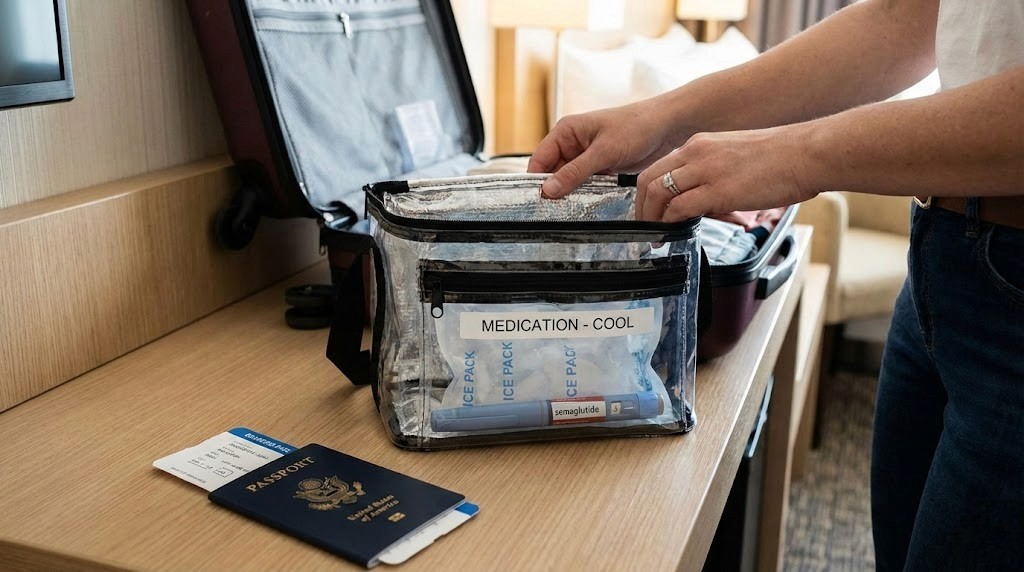
Tired of conflicting advice about traveling with semaglutide? One source says you need a prescription letter notarized in triplicate. Another says just toss it in your carry-on and go. The truth sits somewhere in the middle, and getting it wrong can mean confiscated medication, degraded peptide, or a missed dose that throws off your entire protocol.
Here is the reality. Millions of people fly, drive, and cross international borders with injectable medications every single week. Diabetics have done it for decades with insulin. The process is not complicated. But semaglutide has specific storage requirements that make travel slightly more nuanced than packing a bottle of pills. Temperature matters. Timing matters. Documentation can matter depending on where you are going.
This guide covers everything. TSA screening procedures for injectable medications. Cold chain storage solutions for flights and road trips. How to adjust your dosing schedule across time zones without doubling up or missing a window. What you need for domestic flights versus international border crossings. And the specific mistakes that ruin semaglutide potency before you even arrive at your destination. Whether you are flying coast to coast, driving to a weekend getaway, or heading overseas for two weeks, the information here will keep your medication safe and your protocol on track. SeekPeptides members often ask about travel logistics, and this guide answers every question we have encountered.
Understanding semaglutide storage requirements before you pack
Before you even think about packing, you need to understand why semaglutide storage matters so much. This is not a tablet you can throw in a Ziploc bag. Semaglutide is a GLP-1 receptor agonist peptide, and like most peptides, it is sensitive to temperature extremes. Heat degrades it. Freezing destroys it. And once the damage is done, there is no reversing it.
The peptide molecule itself unfolds when exposed to temperatures outside its stable range. Scientists call this denaturation. Think of it like cooking an egg. Once that protein structure changes, you cannot uncook it. The same principle applies to your semaglutide. A vial that sat in a hot car for three hours may look identical to a fresh one, but the active compound inside could be partially or fully degraded.
That is why understanding the specific temperature windows for your particular semaglutide product matters so much before you travel.
Temperature ranges for different semaglutide products
Not all semaglutide products share the same storage rules. The differences matter, especially when you are planning how long your medication can be outside a refrigerator during travel. If you are using a brand-name pen like Ozempic, the rules differ from Wegovy, and both differ from compounded semaglutide formulations.
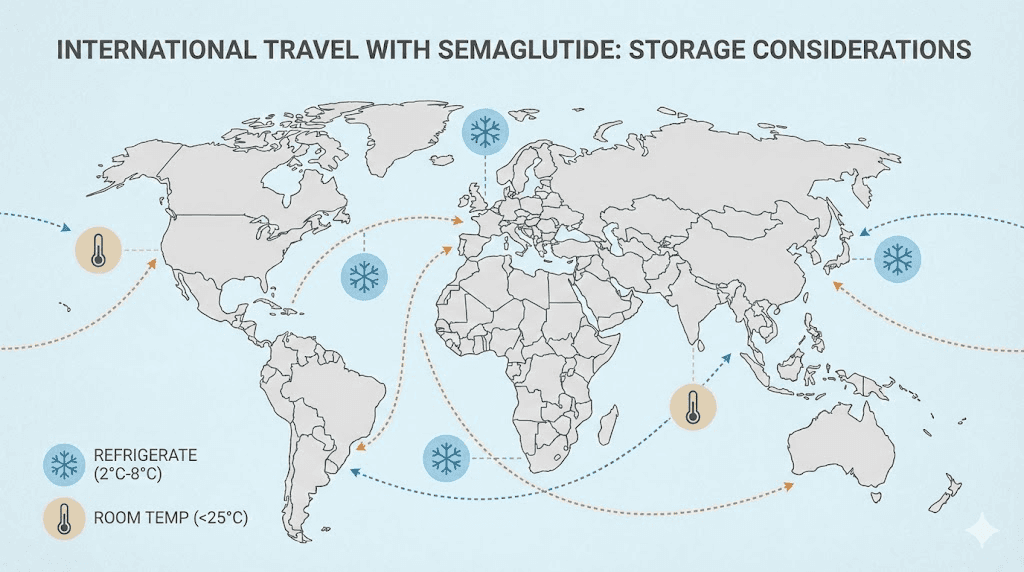
Unused semaglutide pens and vials must stay refrigerated between 36 and 46 degrees Fahrenheit. That translates to 2 to 8 degrees Celsius. This is standard pharmaceutical cold chain storage, the same range your refrigerator maintains.
Once you start using an Ozempic pen, it can remain at room temperature, up to 86 degrees Fahrenheit or 30 degrees Celsius, for up to 56 days. Wegovy has a shorter room temperature window of 28 days at the same temperature ceiling. Compounded semaglutide varies by pharmacy, but many formulations remain stable at room temperature for approximately 72 hours. After that, potency becomes questionable. You can check the specifics of your compounded formulation using the semaglutide dosage calculator to understand how concentration changes might affect your protocol.
The critical number to remember is 86 degrees Fahrenheit. Above that threshold, degradation accelerates rapidly. And freezing, even briefly, causes irreversible damage to the peptide structure. A single freeze event can render your entire supply useless.
What happens when semaglutide gets too hot or too cold
Heat exposure above 86 degrees Fahrenheit triggers aggregation. The peptide molecules clump together instead of remaining in their proper dissolved state. You might notice the solution becoming cloudy or developing visible particles. Sometimes the damage is invisible to the naked eye but still destroys efficacy.
Freezing is worse. When the water in the solution forms ice crystals, those crystals physically shear the peptide molecules apart. The freeze-thaw cycle is particularly destructive. Even if the solution looks normal after thawing, the molecular structure is compromised. This is why proper refrigeration for compounded semaglutide is so important, and why understanding how long compounded semaglutide lasts in the fridge helps you plan travel timing around your supply.
For context, a parked car in direct sunlight can reach internal temperatures exceeding 122 degrees Fahrenheit in under an hour. That is nearly 40 degrees above the maximum safe storage temperature. Even 20 minutes in those conditions can compromise your medication. This single fact shapes every road trip decision you will make with semaglutide.
How to inspect your semaglutide after travel
Always check your medication after any travel day. Hold the vial or pen up to light and examine the solution. It should be clear and colorless. If you notice cloudiness, particles floating in the solution, discoloration, or any change from its normal appearance, do not use it. Degraded semaglutide will not hurt you in most cases, but it will not work properly either. You will be injecting a solution with reduced or zero potency, which means you might not lose weight on semaglutide and wonder what went wrong when the real culprit was a storage failure during travel.
TSA rules for flying with semaglutide
The Transportation Security Administration has clear guidelines for traveling with injectable medications. The rules are more accommodating than most people expect. You do not need special permits. You do not need advance approval. You do need to know what to expect at the security checkpoint so the process goes smoothly.
Here is the bottom line. TSA allows injectable medications in carry-on bags. Period. This includes semaglutide pens, semaglutide vials, syringes, needles, and the cooling supplies needed to keep everything at the right temperature.
What TSA actually requires
TSA requires that you declare your injectable medications and associated supplies to the screening officer before your bags go through the X-ray machine. This means telling the agent, verbally, that you have injectable medication in your carry-on. You do not need to fill out any forms. You do not need to show them ahead of time. Just mention it.
Medically necessary liquids are exempt from the standard 3.4-ounce liquid rule. Your semaglutide solution, your bacteriostatic water, and even your ice packs all fall under this exemption. You do not need to fit them into a quart-size plastic bag with your shampoo and toothpaste. They get screened separately.
Unused syringes are permitted when they accompany injectable medication. You cannot bring a bag of empty syringes without the corresponding medication. But when packed together, both are allowed. If you are using a pen device, the needle tips packed alongside the pen are treated the same way.
TSA does not legally require a prescription. However, having your prescription label visible or carrying a copy of your prescription dramatically speeds up the screening process. Without it, agents may ask additional questions, call a supervisor, or subject your medication to additional testing. With it, the process typically takes less than a minute of extra time. Understanding semaglutide dosage in units helps you explain your medication clearly if agents ask questions.
Step-by-step airport screening process
Approach the conveyor belt with your carry-on. Remove your medication bag or cooler from your carry-on and place it in a separate bin. Tell the TSA officer that you have injectable medication. They will likely nod and wave you through, or they may direct you to a secondary screening area for a quick inspection.
If your ice packs are frozen solid, they pass through without issue. If they are partially melted, agents may test them using a small strip or electronic device to verify they are not a prohibited substance. This takes about 30 seconds. Fully melted ice packs are treated as liquids and fall under the medical liquid exemption since they accompany your medication.
Your semaglutide can go through the X-ray machine. X-ray screening does not damage injectable medications, including peptide-based drugs. The energy levels used in baggage screening are far too low to affect molecular structures. Do not ask for a hand inspection based on X-ray concerns. It is unnecessary and slows down the line.
After screening, repack your medication immediately. Get it back into the insulated cooler bag as quickly as possible to maintain temperature.
What to pack in your carry-on medication kit
Think of your travel medication kit as a self-contained unit. Everything you need for your semaglutide protocol should be in one bag that you can pull out at security and repack quickly. Here is what goes inside.
Your semaglutide pen or vial. Your syringes and needles if using vials. Alcohol swabs for injection site preparation. Your bacteriostatic water for mixing with 5mg semaglutide if you are traveling with unreconstituted compounded product. A prescription label or copy of your prescription. Ice packs or gel packs. An insulated cooler bag or medical cooling case. A sharps disposal container for used needles.
Keep the original pharmacy label on your medication. If it came in a box with your name and prescription details, bring the box. Even if TSA does not demand it, international customs officers might. And the extra five seconds of credibility it provides at any checkpoint is worth the space it takes in your bag.
Choosing the right cooling solution for travel
Your cooling solution can make or break your travel experience with semaglutide. Too little cooling and your medication overheats. Too aggressive and you risk accidental freezing. The right approach depends on how long you will be traveling, what mode of transportation you are using, and whether you will have access to a refrigerator at your destination.
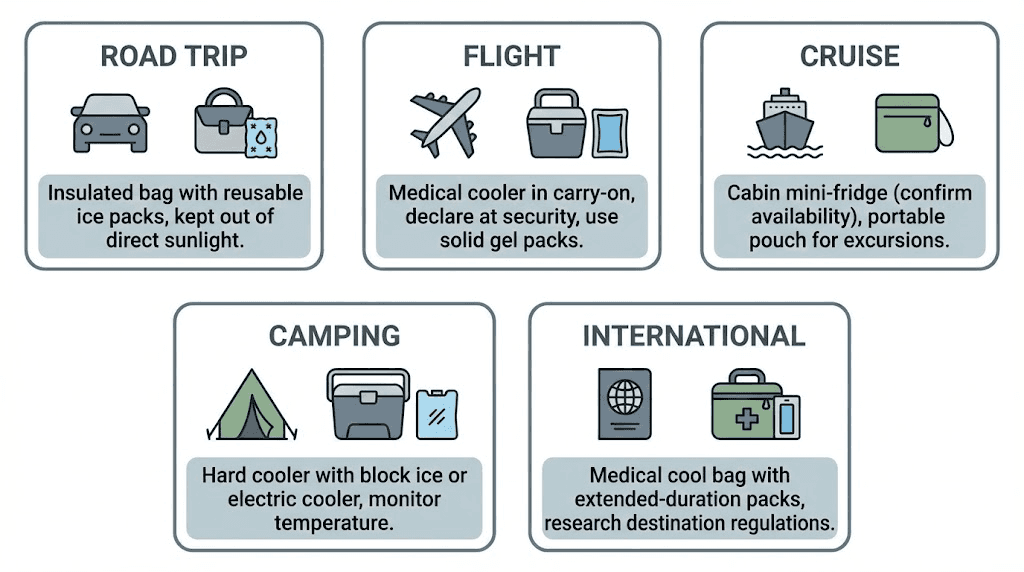
Insulated cooler bags with gel packs
The simplest and most popular option. An insulated lunch bag or small soft cooler lined with gel packs can maintain safe temperatures for 8 to 12 hours depending on ambient conditions. This covers most domestic flights including connections.
The key detail that people get wrong is direct contact. Never place your semaglutide vial or pen directly against a frozen gel pack. The surface temperature of a freshly frozen gel pack can be well below 32 degrees Fahrenheit. Direct contact creates a localized freezing zone around your medication. Always use a barrier. A washcloth, a small towel, a layer of bubble wrap, anything that creates space between the ice and the medication.
Place your gel packs on the bottom and sides of the cooler. Wrap your semaglutide in the barrier material. Place it in the center of the cooler where the temperature will be coldest but not freezing. This arrangement maintains refrigerator-like temperatures without the risk of contact freezing. If you also travel with other peptides, the same principles apply to products like tirzepatide storage in the fridge and tirzepatide refrigeration requirements.
FRIO evaporative cooling wallets
FRIO wallets use evaporative cooling technology. You soak the wallet in water for a few minutes, and the crystals inside absorb the water and slowly release cooling through evaporation. They maintain temperatures between 64 and 79 degrees Fahrenheit, which is within the room temperature range allowed for in-use semaglutide pens.
FRIO wallets are excellent for secondary cooling when your primary ice packs run out. They are lightweight, reusable, and do not require freezing. But they do not reach true refrigerator temperatures. For unused semaglutide that needs to stay between 36 and 46 degrees, FRIO wallets alone are not sufficient. They work as a backup layer, not a primary cooling solution.
Think of them as insurance. If your flight is delayed three hours and your ice packs are melting, a FRIO wallet prevents your medication from reaching dangerous temperatures. It buys you time.
Phase-change material coolers
These are the premium option. Phase-change material coolers use specially engineered materials that absorb and release heat at a precise temperature. Medical-grade PCM coolers can maintain a consistent 36 to 46 degree range for 24 to 48 hours depending on external conditions.
They are more expensive than basic insulated bags. But for long international flights, multi-leg journeys, or situations where you will not have refrigerator access for extended periods, they provide the most reliable temperature control available. Some models even include temperature indicator strips that change color if the internal temperature exceeds safe limits.
What about electric coolers
Portable electric coolers powered by USB or car outlets exist and they work well for road trips. They maintain precise temperatures as long as they have power. The downside is battery life. Most portable units last 4 to 8 hours on battery alone. Fine for a day trip. Risky for a long flight without outlet access.
Some travelers use them in combination with other methods. Electric cooler in the car, switch to gel pack cooler for the flight, then back to electric or a hotel refrigerator at the destination. Layering cooling methods gives you redundancy. And redundancy matters when your medication costs what it does.
Road trip strategies for semaglutide
Road trips present a unique challenge because cars become ovens. Fast. Even on a mild 75-degree day, the interior of a parked car can exceed 100 degrees in under 30 minutes. On a hot summer day, interior temperatures can blow past 130 degrees. Your semaglutide would not survive that.
The good news is that road trips also give you more control. You can bring a larger cooler. You have access to power outlets. And you can stop at convenience stores for fresh ice if needed. Here is how to handle it right.
In-vehicle storage rules
Never put your medication in the trunk. Trunks heat up faster than the cabin because they lack air conditioning circulation. Never put your medication in the glove compartment, which is one of the hottest spots in any vehicle. Your medication cooler belongs in the cabin, ideally on the floor behind the front seat where it is shaded from direct sunlight and benefits from the air conditioning.
Keep the air conditioning running while you are driving. If you stop for food, take the cooler with you. Yes, every time. Even a 20-minute restaurant stop on a warm day can push temperatures in a parked car into the danger zone. The question of whether expired semaglutide still works becomes relevant when storage failures silently degrade medication before the expiration date.
Treat the cooler like your wallet. It goes where you go.
Long road trip cooling strategies
For trips lasting more than a day, you need a replenishment plan for your cooling packs. Frozen gel packs from home will hold temperature for roughly 8 to 12 hours in a good insulated bag. After that, you need a refresh.
Hotels with mini-fridges or full-size refrigerators solve this overnight. Put your medication in the fridge when you arrive. Refreeze your gel packs in the freezer compartment. By morning, everything is cold again and ready for another day on the road.
If you are camping or staying somewhere without refrigeration, plan your cooling supply accordingly. You can buy bags of ice at gas stations and convenience stores along your route. Double-bag the ice in Ziploc bags to prevent leaks, and use the same barrier method to prevent direct contact with your medication. Some travelers bring a separate food cooler that they refresh with store-bought ice, and nestle their medication cooler inside it for double insulation.
For electric cooler users, most modern vehicles provide constant USB or 12-volt power while the engine runs. Some even provide power when the engine is off, depending on the vehicle settings. Check your specific car before relying on this for overnight cooling.
What about summer heat specifically
Summer deserves special attention. When outdoor temperatures exceed 90 degrees Fahrenheit, every stop becomes a logistics decision. Can you park in the shade? Can you bring the cooler inside? Is there a faster route that involves fewer stops?
Consider adjusting your injection timing around road trips. If you normally inject on Wednesdays and you are driving all day Wednesday, you could inject Tuesday evening or Thursday morning instead. Semaglutide allows flexibility of up to two days in either direction from your scheduled dose, as long as you maintain at least 48 hours between injections. Use the best time of day to take semaglutide guidelines to find a window that aligns with your travel schedule.
Managing your dosing schedule while traveling
Semaglutide is a once-weekly injection. That weekly schedule provides enormous flexibility for travelers. You are not dealing with a daily medication that demands precise timing across time zones. But there are rules, and breaking them can cause side effects or reduced efficacy.
The 48-hour rule
This is the single most important rule for semaglutide dosing flexibility. You must maintain at least 48 hours between doses. That means if you normally inject on Friday evenings, you can inject as early as Wednesday evening or as late as Sunday evening and stay within safe parameters.
If you miss your injection window by more than five days, do not try to catch up. Skip that dose entirely and resume on your next regularly scheduled day. Doubling up is never the answer. A double dose significantly increases the risk of nausea, vomiting, and other gastrointestinal side effects. Understanding semaglutide constipation treatment and semaglutide fatigue helps you manage side effects that can be amplified by dosing errors.
The practical implication for travel is significant. If your flight schedule makes your normal injection day inconvenient, simply shift it by a day or two. Flying all day Saturday? Inject Friday night before you leave. Arriving at your destination Sunday morning? Inject Sunday afternoon once you are settled. The flexibility is built into the medication.
Crossing time zones domestically
Domestic time zone changes within the United States involve a maximum shift of three hours between the East Coast and West Coast. This is small enough that most people do not need to adjust their dosing schedule at all.
If you inject at 7 PM Eastern on Fridays and fly to Los Angeles, 7 PM Pacific is really 10 PM Eastern. That three-hour shift is irrelevant for a weekly injection. Just inject at whatever time is convenient on your usual day, using local time as your reference. The 48-hour minimum between doses provides all the buffer you need for domestic travel.
Crossing time zones internationally
International travel can involve much larger time shifts. Flying from New York to Tokyo crosses 14 time zones. London to Sydney crosses 10. These shifts require slightly more thought, though semaglutide weekly dosing makes it far less complicated than managing a twice-daily medication.
The recommended approach is gradual adjustment. If you are traveling east, shift your injection time one to two hours earlier each day in the days leading up to your trip. If traveling west, shift one to two hours later. By the time you arrive, your body and your dosing schedule are roughly aligned with local time.
For most travelers, this level of precision is unnecessary. Because semaglutide is once weekly, a shift of even 6 to 8 hours in injection timing creates zero clinical issues. The 48-hour spacing rule is the only hard constraint. As long as you respect that minimum gap, your body will not notice a time zone shift in your injection schedule.
If your trip lasts less than a week, you might not even need to inject while traveling. If your last dose was three days before departure and your trip is five days, you can inject the day you return home and still be within the safe window. Planning your dose timing around your semaglutide treatment timeline helps you maintain momentum in your protocol.
What happens if you miss a dose while traveling
Life happens. Flights get cancelled. Medication gets left behind. Coolers malfunction. If you miss a scheduled dose, here is the decision tree.
Missed by one to two days. Take your dose as soon as possible. No adjustments needed. Resume your regular schedule the following week.
Missed by three to five days. Take your dose as soon as you can. You may want to resume your regular weekly schedule from this new day going forward to simplify timing. Or you can shift back to your original day over the next couple of weeks by adjusting a day at a time.
Missed by more than five days. Skip this dose entirely. Resume on your next regularly scheduled day. Do not double up. You may experience a temporary return of appetite during the gap, which is normal. Understanding how quickly semaglutide suppresses appetite and the timeline for appetite suppression helps set expectations for how you will feel during a missed dose.
Missing one dose does not reset your progress. Semaglutide has a half-life of approximately one week, which means that after missing a single dose, you still have significant levels of the drug in your system. Understanding semaglutide withdrawal symptoms helps you distinguish normal fluctuations from genuine problems.
Flying with semaglutide: complete airport walkthrough
Let us walk through an actual travel day from start to finish. No theoretical guidelines. Just exactly what happens when you show up at the airport with semaglutide in your bag.
Morning of your flight
Take your cooler bag out of the refrigerator. Check that your gel packs are fully frozen. Verify that your semaglutide vial or pen is in good condition, solution is clear, no particles visible. Place the barrier layer in the cooler. Nest your medication inside. Add gel packs around the sides and on top. Close it up.
If you are injecting that day, consider doing it before you leave for the airport. Injecting at home eliminates the need to find a clean, private space in an airport or airplane bathroom. Plus, you avoid any risk of turbulence complicating the injection process. Read about the semaglutide reconstitution process beforehand so you are not doing it for the first time in a hotel room.
At the security checkpoint
Place your cooler bag in a separate bin on the conveyor. Tell the screening officer you have injectable medication. They will likely wave it through. If selected for additional screening, stay calm. The agent will open the bag, may swab the outside of your medication and cooler components for explosive residue, and will return everything to you in under two minutes.
Do not get nervous. Do not over-explain. A simple statement works. Something like: "I have prescribed injectable medication and cooling packs in this bag." That is it. TSA agents see injectable medications hundreds of times per day. You are not an anomaly. You are a Tuesday.
On the plane
Keep your cooler bag under the seat in front of you, not in the overhead bin. Overhead bins can get warm from cabin heating, and you want easy access in case you need to check on your medication during a long flight. The space under the seat stays cooler because it is closer to the floor and further from the ceiling heating vents.
For flights longer than six hours, consider peeking at your gel packs during the flight. If they are mostly melted, your medication is likely still fine since the insulation maintains temperature even after gel packs lose their full freeze. But awareness helps you prioritize getting to a refrigerator after landing.
After landing
Get to your accommodation and get your medication into a refrigerator as quickly as reasonably possible. This does not mean sprinting through the terminal. It means making refrigerator access a priority in your arrival sequence. Check into the hotel, locate the mini-fridge, store your medication. Then go explore.
If your accommodation does not have a fridge, most hotel front desks will store medication in their kitchen refrigerator upon request. Just ask. They handle this regularly for diabetic guests and are accustomed to the request. Some travelers call ahead to confirm refrigerator availability before booking. A quick phone call prevents arrival-day surprises.
International travel with semaglutide
Domestic travel is straightforward. International travel adds layers. Different countries have different rules about importing medications, and some are stricter than others. The consequences of getting it wrong range from mild inconvenience to having your medication confiscated at customs.
Documentation you need
For international travel, carry a prescription or a letter from your prescribing physician. The letter should include your name, the medication name (both brand name and generic), the dosage and concentration, a statement that the medication is medically necessary, and your physician contact information.
Some experienced travelers also carry a translated copy of this letter in the language of their destination country. This is not universally required, but it eliminates language barrier issues at customs. A pharmacist or translation service can produce a certified translation for a modest fee. If you are traveling to multiple countries on one trip, a letter in English and the primary language of your destination usually suffices. Most customs agents in major international airports speak functional English, but having a translated document shows preparation and intent.
Country-specific considerations
Most Western countries, including Canada, the United Kingdom, Australia, and European Union member states, allow travelers to bring a 30 to 90 day personal supply of prescription medications with valid documentation. The process mirrors the TSA experience. Declare it, show documentation if asked, and move on.
Some countries have stricter rules. Japan requires advance notification for certain medications and may require you to apply for an import certificate called a Yakkan Shoumei before arrival. The United Arab Emirates and several other Middle Eastern countries have extensive lists of controlled substances that require pre-approval. While GLP-1 medications are generally not classified as controlled substances, compounded versions without brand-name packaging may raise questions.
Southeast Asian countries vary widely. Thailand and Singapore have relatively straightforward processes with documentation. Some others may require letters in the local language. Research your specific destination well in advance.
The safest approach for any international destination is to check the medication import regulations on the destination country embassy website or their Ministry of Health portal at least four to six weeks before departure. This gives you time to obtain any additional documentation or approvals required.
Compounded semaglutide across borders
This deserves its own section because it is the most common source of international travel complications for semaglutide users. Brand-name products like Ozempic and Wegovy are recognized pharmaceutical products with international registration. Customs officers worldwide know what they are.
Compounded semaglutide is different. It comes in vials without the brand-name packaging and global pharmaceutical registrations that customs officers recognize. Some countries do not distinguish between compounded and manufactured medications. Others treat unbranded injectables with heightened suspicion. If you are using compounded semaglutide, extra documentation becomes critical for international travel. A detailed prescription letter that specifies the compound, concentration, and medical necessity is essential.
If you are currently using compounded semaglutide and planning significant international travel, consider discussing with your prescriber whether a short-term switch to a brand-name product for the duration of your trip makes logistical sense. This is not always necessary or practical, but for destinations with strict customs enforcement, it eliminates ambiguity entirely.
Bringing enough supply
Pack more than you need. If your trip is two weeks, bring three to four weeks of supply. Flight delays, trip extensions, lost luggage on connecting flights, or a vial that breaks during transit can all leave you short. Having a backup ensures one unexpected event does not derail your protocol.
Divide your supply between two separate bags if possible. Keep your current in-use pen or vial in your carry-on cooler. Pack your backup supply in a separate insulated pouch within the same carry-on. If one cooler fails, the other remains viable. Never put any semaglutide in checked luggage. Cargo holds are not temperature controlled, and extreme cold at cruising altitude can freeze your medication.
Injecting while traveling: practical logistics
You have your medication safely at your destination. Now you need to actually inject. The process is the same as at home, but the environment is different. Hotel rooms, Airbnbs, cruise ship cabins, and even public restrooms in a pinch all work. The key is maintaining the same hygiene standards you use at home.
Setting up a clean injection area
Wash your hands thoroughly. Clean a flat surface with an alcohol wipe if you are working in a hotel bathroom or desk area. Lay out your supplies: medication, syringe or pen, alcohol swab, sharps container. The same preparation you do at home applies everywhere else.
If you are using compounded semaglutide from a vial, you need a stable, level surface for reconstitution if the vial is lyophilized. A hotel desk or bathroom counter works fine. Just make sure the surface is clean and the lighting is adequate. Follow your standard reconstitution process for 5mg semaglutide exactly as you do at home. If you need to use bacteriostatic water for 10mg semaglutide, measure carefully even in unfamiliar settings.
Injecting on a plane
Can you inject semaglutide on an airplane? Technically yes. Is it ideal? Not really. Airplane bathrooms are cramped, turbulence can strike at any moment, and the hygiene of those tiny sinks is questionable at best. If you can avoid it by timing your dose before or after your flight, do so.
If you absolutely must inject during a flight, use the lavatory for privacy and a flat surface (the small shelf above the sink). Bring alcohol wipes for both the surface and your injection site. Use your pen device if possible since pens are simpler to use in tight spaces than vial-and-syringe setups. Dispose of any needle tips in your portable sharps container, not in the airplane trash.
Sharps disposal while traveling
Used needles require proper disposal. At home, you use a sharps container. While traveling, you need a portable solution. Small, travel-sized sharps containers are available at most pharmacies and online. They are TSA-approved for carry-on luggage when accompanying injectable medications.
In a pinch, a thick plastic container with a screw-top lid, like an empty laundry detergent bottle, works as a temporary sharps container. Never put loose needles in regular trash, even in a hotel room. Housekeeping staff can be injured by improperly disposed sharps. When you return home, transfer the contents of your travel sharps container into your regular one for proper disposal.
Injecting in different climates
Climate can affect your injection experience. In cold environments, the semaglutide solution may feel more viscous when injected, which can cause mild stinging. Letting the medication warm to room temperature for 15 to 20 minutes before injection makes the process more comfortable. Do not microwave it. Do not run it under hot water. Just set it out on the counter.
In hot, humid climates, you may sweat more at the injection site. Make sure the skin is dry after cleaning with alcohol. Moisture can interfere with the adhesion of any bandage you use and can cause the needle to slide. Understanding proper GLP-1 injection technique and the best injection sites for GLP-1 ensures consistent results regardless of where you are in the world.
Handling travel-related side effects
Travel itself can amplify some semaglutide side effects. Dehydration from flying. Changed eating patterns at your destination. Jet lag disrupting your sleep and appetite. Alcohol on vacation. All of these interact with your semaglutide protocol in ways worth understanding before you leave.
Nausea and flying
The most common semaglutide side effect is nausea, and it can be worse at altitude. Cabin pressure, reduced oxygen, and the general discomfort of sitting in a cramped seat for hours can all amplify gastrointestinal symptoms. If you are prone to semaglutide-related nausea, consider taking your dose two to three days before flying rather than on the day of your flight.
Stay hydrated. Airplane cabins have extremely low humidity, typically between 10 and 20 percent. This accelerates dehydration, which worsens nausea. Drink water steadily throughout the flight. Avoid carbonated beverages and heavy meals right before or during the flight. Simple, bland foods like crackers or rice can settle your stomach if nausea strikes. Following a semaglutide diet plan that accounts for travel days can reduce gastrointestinal discomfort significantly. Knowing the best foods to eat while on semaglutide helps you make smart choices at airports and on the road.
Constipation on the road
Travel constipation is common even without semaglutide. Add semaglutide, which slows gastric emptying, to the equation and the problem compounds. Sitting for extended periods in a car or plane reduces gut motility. Dehydration worsens things further. And travel diets tend to be lower in fiber than home cooking.
Counter this proactively. Increase water intake during travel days. Pack fiber-rich snacks like nuts, dried fruit, or fiber bars. Walk around the airport during layovers. Stop at rest areas during road trips and take a short walk. If you already have a semaglutide constipation treatment routine at home, bring those supplies with you. Magnesium citrate supplements, for example, are lightweight and easy to pack.
Fatigue and jet lag
Semaglutide can cause fatigue in some users, especially during dose increases. Combine that with jet lag, disrupted sleep, and the general exhaustion of travel, and you may feel more tired than expected during the first day or two at your destination.
Plan for it. Schedule low-key activities for your first day after a major time zone shift. Stay hydrated. Get sunlight exposure in the morning to help reset your circadian rhythm. Understand that semaglutide fatigue layered on top of travel fatigue is temporary. It resolves as your body adjusts to the new time zone and your medication schedule stabilizes. If you are concerned about energy levels, read about whether semaglutide affects energy levels to set realistic expectations.
Alcohol and semaglutide on vacation
Vacations often involve alcohol. Semaglutide and alcohol have a complicated relationship. The medication slows gastric emptying, which means alcohol stays in your stomach longer and gets absorbed differently than it would without the medication. Many semaglutide users report getting intoxicated faster and experiencing worse hangovers.
This is not a reason to avoid all alcohol on vacation. It is a reason to be aware and adjust accordingly. Drink less than you normally would. Hydrate between alcoholic drinks. Eat something before drinking. And pay attention to how your body responds because your tolerance may be significantly lower than it was before starting semaglutide. Check our detailed guide on drinking alcohol on semaglutide for specific recommendations. If you are also considering tirzepatide, the same principles apply, and you can read about drinking on tirzepatide as well.
Specific travel scenarios and how to handle them
Every trip is different. A weekend road trip to the beach requires different preparation than a two-week backpacking trip through Southeast Asia. Here are detailed protocols for the most common travel scenarios semaglutide users face.
Scenario 1: domestic weekend trip (1-3 days)
This is the simplest scenario. You may not even need to inject during the trip if your dosing schedule aligns. Pack your medication in a small insulated bag with two gel packs as a precaution. If you are staying at a hotel with a mini-fridge, store the medication there upon arrival.
If you do need to inject during the trip, the process is identical to injecting at home. Clean surface, clean hands, standard technique. The semaglutide dosage calculator can help you verify your dose before injecting in an unfamiliar environment where distractions are more likely. Check your semaglutide 5mg/ml dosage chart to confirm the correct number of units.
For a weekend road trip, your biggest risk is leaving medication in a hot car. Bring the cooler inside wherever you go. Restaurants. Rest stops. Tourist attractions. Make it a habit. Understanding how many mg is 40 units of semaglutide or how many mg is 50 units helps you measure correctly even when you are away from your usual routine.
Scenario 2: domestic flight (same day)
Pack your carry-on medication kit as described earlier. Declare at security. Store under the seat. After landing, get to a fridge within a reasonable timeframe. For same-day flights where you depart in the morning and arrive by evening, your gel packs will maintain temperature easily.
The only wrinkle is delays. If your flight is delayed by several hours, check your cooling packs during the wait. Airport restaurants and bars often have ice available. Ask a bartender for a cup of ice, and you can refresh your cooling if needed. It is not elegant, but it works.
Scenario 3: multi-leg international flight (12-24 hours of travel)
This is where preparation matters most. You could be in transit for 18 to 24 hours including layovers. Your cooling solution needs to last the entire journey.
Use your best insulated cooler with extra gel packs. If possible, use a phase-change material cooler designed for extended temperature maintenance. Pack a backup FRIO wallet as an insurance layer. If you have a long layover, some airport lounges have refrigerators that staff will let you use for medication storage upon request.
Consider your injection timing carefully. If your weekly dose falls during your travel day, inject before leaving for the airport. A 24-hour travel day is exhausting enough without adding injection logistics. Plan ahead with tools like the peptide calculator to ensure your dosing math is right before departure.
Scenario 4: cruise ship travel
Cruise ships are actually one of the easiest travel environments for semaglutide users. Your cabin typically has a small refrigerator. The ship medical center can store medication if needed. You unpack once and stay put for the duration of the voyage.
The challenge is port excursions. If you leave the ship for a day of sightseeing in a tropical destination, your medication stays safely refrigerated on board. But if you are doing an overnight excursion, you need a portable cooling solution for that night away from the ship.
Notify the ship medical center that you have injectable medication. They can provide emergency storage if your cabin refrigerator malfunctions. And they may have sharps disposal containers available so you do not need to carry a full one through customs at each port.
Scenario 5: camping or remote travel
No electricity. No refrigerator. Potentially hot conditions. This is the most challenging scenario.
Your options are limited but workable. A high-quality insulated cooler with multiple gel packs can maintain temperature for 24 to 48 hours if you keep it sealed, in the shade, and away from heat sources. An evaporative cooler like a FRIO wallet provides backup cooling that requires only water, no electricity or freezing.
For multi-day camping trips, consider bringing pre-frozen water bottles as supplementary cooling mass. As they melt, they provide cold water for drinking and maintain cooler temperature. Replace them with fresh ice if you pass a store.
The most practical approach for extended remote travel is to time your last dose right before departing and plan your return before the next dose is due. With a weekly dosing schedule, a six-day camping trip means you may only need your medication to survive one injection event during the trip.
What to do if something goes wrong
Even with perfect planning, things go wrong. Medications get left behind. Coolers malfunction. Bags get lost. Vials break. Here is your contingency plan for common travel emergencies involving semaglutide.
Your medication was left at home
If you realize before departure and have time, go back for it. If you are already at the airport or have already left, you have a few options. Contact your prescribing physician or pharmacy. Many pharmacies can transfer a prescription to a location near your destination. Some telemedicine services can issue a new prescription that you can fill at a local pharmacy upon arrival.
If you cannot obtain replacement medication at your destination, missing one weekly dose is not catastrophic. As discussed earlier, semaglutide has a long half-life and one missed dose does not reset your progress. Resume your normal schedule when you return home. Knowing how fast semaglutide works in your system helps you understand that a brief interruption will not erase weeks of progress.
Your medication got too hot
If you suspect heat exposure, inspect the solution immediately. Cloudiness or particles mean the medication is compromised. Discard it and obtain a replacement.
If the solution looks normal but you know it was exposed to temperatures above 86 degrees Fahrenheit for an extended period (more than a few minutes), use your judgment. Brief exposure, like carrying it through a hot parking lot for five minutes, is unlikely to cause significant degradation. Hours in a hot car is a different story. When in doubt, replace it. Using degraded medication is not dangerous, but it is pointless if it has lost potency. This is similar to the question of using expired semaglutide, where potency is the primary concern.
Your medication froze
Discard it. No exceptions. Even if it thaws and looks normal, the peptide structure has been damaged. Freezing damage is invisible to the naked eye but destroys efficacy. Do not use medication that you know or suspect has been frozen. This applies to leaving medication in the car overnight in cold climates, gel packs that froze the vial through direct contact, or checked luggage that reached freezing temperatures in the cargo hold. Understanding the difference between lyophilized and liquid peptides explains why liquid formulations are particularly vulnerable to freeze damage.
Your vial broke during travel
This is why you pack backups. If your primary vial breaks, switch to your backup supply. If you do not have a backup, contact your pharmacy about obtaining a replacement at your destination.
To prevent breakage, wrap vials in protective padding. Bubble wrap, foam padding, or even a clean sock provides cushioning against the bumps and jolts of travel. Keep vials upright in your cooler to reduce stress on the glass. And never pack them in checked luggage where they will be subjected to rough baggage handling.
You cannot find a pharmacy at your destination
For domestic travel in the United States, major pharmacy chains like CVS, Walgreens, and Rite Aid can fill transferred prescriptions. For international travel, semaglutide brand names may be available at local pharmacies under different names or may require a local prescription. Ozempic, for example, is sold in over 100 countries under the same brand name.
Compounded semaglutide is harder to replace internationally. Most countries do not have an equivalent compounding infrastructure, and importing compounded medications is often restricted. This is another reason brand-name products are logistically simpler for international travel if your prescriber and insurance allow it. Resources from SeekPeptides can help you understand the differences between research versus pharmaceutical grade peptides and make informed decisions about what to travel with.
Travel packing checklist for semaglutide
Here is your complete packing checklist. Print it or save it to your phone. Run through it the night before every trip. Missing one item can create a cascading problem.
Essential items
Semaglutide pen or vial in the amount needed for your trip plus at least one backup dose. Syringes and needles if using vials, plus extras. Alcohol swabs. Insulated cooler bag or medical cooling case. Gel packs or phase-change material packs, frozen solid before departure. Barrier material like a washcloth or small towel to prevent direct contact between ice packs and medication. Portable sharps disposal container.
Documentation
Prescription label on medication, either the original pharmacy label or a separate copy. Prescriber letter stating medical necessity if traveling internationally. Translated prescription for non-English speaking destinations. Contact information for your prescribing physician. Contact information for your pharmacy. List of pharmacy locations near your destination.
Backup supplies
Extra dose of semaglutide in a separate insulated pouch. Additional gel packs. FRIO wallet or secondary cooling method. Extra syringes and needles. Bacteriostatic water if using compounded lyophilized product. Make sure you know how much bacteriostatic water to mix with 5mg semaglutide or 10mg semaglutide before you leave.
Comfort and management items
Anti-nausea medication like ginger chews or over-the-counter options. Fiber supplements for constipation prevention. Water bottle for hydration. Small snack bag with semaglutide-friendly foods. The peptide reconstitution calculator bookmarked on your phone for reference.
Tips for specific semaglutide formulations
Not all semaglutide is the same when it comes to travel convenience. Your specific formulation determines some of the practical details of how you pack and manage your medication on the road.
Ozempic pens
Ozempic pens are arguably the most travel-friendly semaglutide option. The pen is self-contained with no reconstitution required. Dose dialing is built in. And an in-use pen can remain at room temperature for up to 56 days, which covers nearly any trip length without needing to maintain cold chain.
If you are starting a new pen during your trip, it needs to come from the refrigerator. But once you prime it and take your first dose, the 56-day room temperature clock starts. For many travelers, this means bringing one in-use pen at room temperature and one backup pen in the cooler. The unit-based dosing information for semaglutide helps you track exactly how many doses remain in your pen before you travel.
Wegovy pens
Wegovy pens function similarly to Ozempic pens but have a shorter room-temperature window of 28 days. Still ample for most trips. The single-dose pen design means each injection uses one pen, and unused pens must stay refrigerated until use. Pack your needed doses in the cooler and use them as needed throughout the trip.
Compounded semaglutide vials
Compounded semaglutide requires more travel logistics. You need syringes, needles, possibly bacteriostatic water, and the vial itself. If the product is lyophilized (freeze-dried powder), you may need to reconstitute it during travel, which adds complexity.
If your trip is short, consider reconstituting before you leave so you are traveling with a ready-to-use solution. This eliminates the need to bring bacteriostatic water and reduces the supplies you need to pack. Reconstituted compounded semaglutide typically maintains stability for 28 to 30 days under refrigeration, though check with your specific compounding pharmacy for their product stability data. The complete guide to compounded semaglutide has detailed stability information.
For longer trips where reconstitution during travel is necessary, practice the process at home several times before your trip. You want the procedure to be routine, not something you are figuring out for the first time in a dimly lit hotel bathroom. The peptide reconstitution calculator can verify your measurements before and during travel.
Oral semaglutide
If you are using oral semaglutide drops, travel becomes significantly simpler. No needles. No coolers (for most formulations). No TSA declarations about injectables. Just pack the medication according to its specific storage requirements, which are typically less restrictive than injectable formulations.
Oral semaglutide must be taken on an empty stomach with a small amount of plain water, then you wait 30 minutes before eating. This timing requirement can be tricky during travel days when meal schedules are unpredictable. Set a phone alarm to maintain consistency. The injectable versus oral peptides comparison breaks down the practical differences in detail.
Combining semaglutide travel with other peptides or medications
Many semaglutide users also take other medications or supplements that require consideration during travel. If your protocol includes multiple compounds, the storage and logistics multiply accordingly.
Semaglutide with B12
Many semaglutide formulations include B12, especially compounded versions. If you are using semaglutide with B12 or semaglutide with methylcobalamin, the storage requirements are the same as plain semaglutide. The B12 component does not change the temperature sensitivity. Pack and store as you would regular semaglutide.
Traveling with semaglutide and glycine
If your formulation includes semaglutide with glycine, the same cooling rules apply. Glycine is included as a stabilizer in many compounded formulations, and it does not alter the fundamental storage requirements.
Traveling with tirzepatide alongside semaglutide
Some protocols involve transitioning between semaglutide and tirzepatide, or users may travel with both if they are in the process of switching from tirzepatide to semaglutide. Both require similar cold chain storage. Pack them in the same cooler but keep them clearly labeled to avoid confusion. The semaglutide to tirzepatide conversion chart helps you manage dosing during transitions that coincide with travel. For tirzepatide-specific storage, review whether tirzepatide expires and how long compounded tirzepatide can stay out of the fridge.
Traveling with semaglutide and phentermine
If you are taking phentermine alongside semaglutide, phentermine is a controlled substance in many jurisdictions. This adds an extra layer of documentation for international travel. Make sure you have prescriptions for both medications clearly documented. Check our guides on combining phentermine and semaglutide and the phentermine versus semaglutide comparison for protocol details.
Other GLP-1 medications
If you are exploring other GLP-1 options for travel, understanding the broader landscape helps. Semaglutide versus tirzepatide is the most common comparison, but newer compounds like retatrutide are also entering the picture. Read about retatrutide versus semaglutide if you are considering alternatives. For understanding side effect differences, the semaglutide versus tirzepatide side effects comparison provides clarity.
Travel nutrition while on semaglutide
Your diet changes on semaglutide. Appetite is reduced. Portion sizes shrink. Food tolerances shift. Travel already disrupts eating patterns, and semaglutide amplifies every disruption. Planning your nutrition for travel days and your destination can prevent uncomfortable gastrointestinal episodes and keep your energy stable.
Airport and airplane food strategy
Airport food is heavy, greasy, and oversized. Everything your semaglutide-altered stomach does not want. Instead of relying on airport options, pack your own travel snacks. Protein bars. Nuts. Dried fruit. Rice cakes. Cheese sticks. Small, nutrient-dense items that do not require refrigeration and will not overwhelm your reduced capacity.
On the plane, decline the full meal if it does not appeal to you. A reduced appetite is normal, and understanding how long semaglutide takes to suppress appetite provides context. Do not force yourself to eat a full tray just because it is served. Eat what your body asks for and skip the rest. Keeping a list of foods to eat while on semaglutide on your phone makes it easier to make quick decisions at airport shops and restaurants.
Eating at your destination
Vacation eating presents temptations and challenges. Buffets, unfamiliar cuisines, social pressure to eat and drink excessively. Your semaglutide is working whether you are at home or at an all-inclusive resort. Trust the appetite signal. Eat slowly. Choose protein-rich options. And remember that you will enjoy the food more by eating appropriate portions than by overeating and spending the evening dealing with nausea.
Following a semaglutide diet plan does not mean you cannot enjoy vacation food. It means being intentional about portions and choices. If you are traveling to a region with a cuisine you love, sample widely but in smaller amounts. Your taste buds are not reduced, just your capacity.
Staying hydrated during travel
Dehydration is the hidden enemy of semaglutide users during travel. The medication already reduces thirst signals for some users. Air travel further dehydrates you. Hot climates compound the issue. And tourist activities often involve more walking and sun exposure than your typical daily routine.
Carry a reusable water bottle and fill it at every opportunity. Set phone reminders to drink if you tend to forget. Aim for at least half your body weight in ounces per day, and more in hot climates or during physically active days. Dehydration worsens every semaglutide side effect, from nausea to constipation to fatigue. The long-term semaglutide guide emphasizes hydration as a foundational element of any successful protocol.
Travel insurance and semaglutide
Most standard travel insurance policies cover medical emergencies but not routine medication replacement. If your semaglutide is lost, damaged, or confiscated during travel, your insurance may not cover the cost of replacement. This is an area where policy details matter.
What standard travel insurance covers
Emergency medical treatment if you have an adverse reaction. Evacuation if you need medical care not available at your destination. Trip cancellation or interruption for qualifying medical reasons. What it typically does not cover is the cost of replacing medication that was damaged, lost, or stolen during travel.
Specialty medication travel coverage
Some insurers offer riders or specialty policies that cover medication replacement during travel. If you are on an expensive brand-name semaglutide like Wegovy, the replacement cost can be significant. Checking with your insurer before departure about medication coverage is worth the five-minute phone call.
Credit card travel benefits
Many premium credit cards include travel insurance that covers lost or damaged personal items, which may include medication. Check your card benefits before purchasing separate travel insurance. You may already have coverage you do not know about.
Returning home: getting back on track
The return home is as important as the departure. How you resume your semaglutide protocol after travel affects your continued progress. Getting back on schedule quickly prevents the disruptions that turn a one-week vacation into a month-long protocol setback.
Resuming your regular schedule
If you maintained your regular dosing schedule during travel, congratulations. Nothing changes. Continue as normal.
If your schedule shifted by a day or two, you have two options. Option one is to return to your original day immediately if it is within the 48-hour minimum spacing rule. Option two is to adopt the new day as your regular injection day going forward. Either approach is medically acceptable.
If you missed a dose entirely, take your next scheduled dose on your regular day and continue from there. Do not try to make up for the missed dose. The guide for people not seeing results on semaglutide covers how to stay consistent even when protocols get disrupted.
Post-travel medication inspection
Inspect all remaining semaglutide when you unpack. Check solution clarity. Verify that sealed pens and vials were maintained at proper temperatures throughout the trip. If anything looks questionable, discard it and use a fresh supply. The cost of one vial, and our peptide cost calculator can help you budget is far less than weeks of using degraded medication that provides no benefit.
Restocking your supply
Travel often uses backup supplies. Reorder immediately so you are not caught short before your next trip or even your next regular dose. Many pharmacies offer auto-refill programs that ensure you always have supply on hand. If you are using compounded semaglutide from a specific pharmacy like Empower Pharmacy, Olympia Pharmacy, or Direct Meds, check their processing times so your next batch arrives before you run out.
Frequently asked questions
Can I bring semaglutide on a plane?
Yes. TSA allows all injectable medications in carry-on bags. Declare the medication and cooling supplies to the screening officer. Medically necessary liquids are exempt from the 3.4-ounce rule. Keep your prescription label visible to speed up the process. Learn more about semaglutide dosage units in case agents ask about your medication.
Does semaglutide need to stay refrigerated during travel?
Unused semaglutide must stay between 36 and 46 degrees Fahrenheit. In-use Ozempic pens can stay at room temperature (up to 86 degrees Fahrenheit) for 56 days. Wegovy pens allow 28 days at room temperature. Compounded semaglutide refrigeration needs vary by pharmacy, so check your specific product labeling.
Can semaglutide go through an X-ray machine?
Yes. Airport X-ray machines do not damage injectable medications, including peptide-based drugs like semaglutide. The radiation levels used for baggage screening are far too low to affect molecular structures. There is no need to request a hand inspection.
What if my semaglutide freezes during travel?
Discard it immediately. Freezing causes irreversible damage to the peptide structure even if the solution appears normal after thawing. Always use a barrier between your medication and ice packs to prevent contact freezing. Understanding the difference between lyophilized and liquid peptides helps you understand why frozen liquid formulations cannot be saved.
Can I take semaglutide internationally?
Most countries allow travelers to bring a 30 to 90 day personal supply of prescription medication with valid documentation. Carry a prescription and a physician letter stating medical necessity. Some countries like Japan and the United Arab Emirates have additional requirements. Check destination regulations four to six weeks before departure.
What if I miss a dose of semaglutide while traveling?
If you miss by one to five days, take the dose as soon as possible. If you miss by more than five days, skip that dose and resume on your next scheduled day. Never double dose. One missed dose does not reset your progress due to the medication long half-life. Review our guide on semaglutide withdrawal for more detail on what to expect.
How do I adjust my semaglutide dose for time zone changes?
For domestic time zone changes of up to three hours, no adjustment is needed. For larger international time shifts, gradually shift your injection time by one to two hours per day in the days before departure. The 48-hour minimum spacing between doses is the only hard rule. Weekly dosing provides ample flexibility for time zone crossing.
Is compounded semaglutide harder to travel with than Ozempic or Wegovy?
Compounded semaglutide requires more preparation. It may not be recognized by international customs officers, may have shorter room-temperature stability windows, and requires additional supplies like syringes and bacteriostatic water. The compounded semaglutide guide covers these logistics in detail. For hassle-free international travel, brand-name products are logistically simpler.
External resources
For those serious about maintaining their semaglutide protocol through every trip, every season, and every curveball that travel throws at them, SeekPeptides offers comprehensive protocol guides, dosing tools, and a community of experienced users who have navigated these exact challenges. Members get access to detailed storage guides, stability databases, and expert-reviewed travel protocols that cover scenarios most generic guides miss entirely.
In case I do not see you, good afternoon, good evening, and good night. May your medication stay cold, your flights stay smooth, and your protocol stay uninterrupted.