Feb 10, 2026
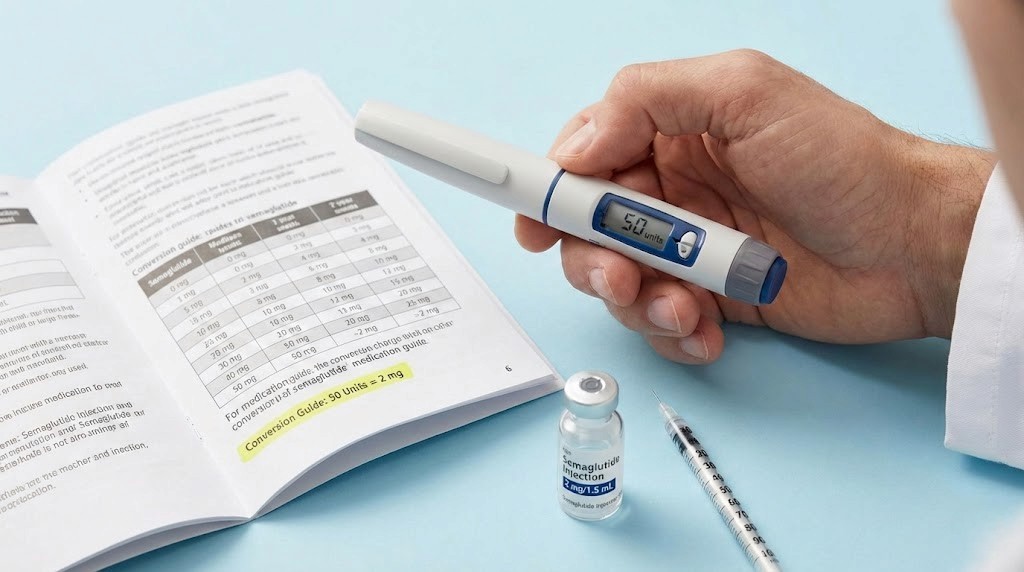
You are wasting semaglutide. Right now. With every injection. And the reason is simpler than you think. A miscalculated conversion between units and milligrams means you could be injecting 50% more or 50% less than your target dose, burning through expensive peptide at an alarming rate or, worse, getting zero therapeutic benefit because the actual milligram amount landing in your tissue is nowhere near what you intended. The question "how many mg is 50 units of semaglutide" seems like it should have one straightforward answer. It does not. The answer changes completely depending on the concentration of your specific vial, and getting this wrong is one of the most common and most costly mistakes in peptide dosing.
Here is the core problem. Fifty units on an insulin syringe always equals 0.5 mL of liquid. Always. That part never changes. But the milligrams of semaglutide dissolved in that 0.5 mL? That depends entirely on concentration. At a 1 mg/mL concentration, 50 units delivers 0.5 mg. At a 5 mg/mL concentration, those same 50 units deliver 2.5 mg, which is five times more active compound from the exact same volume. Miss this distinction and you are either underdosing into ineffectiveness or overdosing into unnecessary side effects.
This guide breaks down exactly what 50 units means in milligrams for every common semaglutide concentration on the market.
You will find conversion formulas, reference tables, syringe reading techniques, and practical protocols that eliminate guesswork from your dosing. Whether you are using brand-name Ozempic, Wegovy, or a compounded formulation, the math works the same way, and by the end of this article, you will never second-guess a 50-unit measurement again. Resources like the semaglutide dosage calculator from SeekPeptides can help verify your math, but understanding the underlying conversion is what separates confident dosing from dangerous guesswork.
The quick answer: what 50 units actually equals in mg
Fifty units equals 0.5 mg, 1.0 mg, 1.25 mg, 1.5 mg, or 2.5 mg of semaglutide. The answer depends on one variable: concentration.
That single sentence confuses more people than almost any other aspect of peptide dosing. It sounds contradictory. How can the same measurement produce five different amounts? The confusion stems from a fundamental misunderstanding about what "units" actually measure on an insulin syringe. Units measure volume, not drug quantity. Every 100 units on a standard U-100 insulin syringe equals exactly 1 mL of liquid. So 50 units always means you are drawing 0.5 mL. The concentration of the solution, meaning how many milligrams of semaglutide are dissolved in each milliliter, determines the actual drug amount in that volume.
Here is the quick reference:
1 mg/mL concentration: 50 units = 0.5 mL = 0.5 mg
2 mg/mL concentration: 50 units = 0.5 mL = 1.0 mg
2.5 mg/mL concentration: 50 units = 0.5 mL = 1.25 mg
3 mg/mL concentration: 50 units = 0.5 mL = 1.5 mg
5 mg/mL concentration: 50 units = 0.5 mL = 2.5 mg
If you are on a standard titration schedule and your target dose is 0.5 mg, you would draw 50 units from a 1 mg/mL vial. But if your compounding pharmacy sent you a 5 mg/mL vial and you draw 50 units thinking you are getting 0.5 mg, you just injected 2.5 mg, which is the maximum weekly dose typically reserved for people who have titrated up over months. That kind of error creates severe nausea, vomiting, and potentially dangerous blood sugar drops. Understanding the semaglutide dosage conversion chart is not optional. It is essential for safe and effective dosing, and resources like our dosing chart in units make this process far more intuitive.
The rest of this guide walks through each concentration in detail, provides the universal formula so you can calculate any dose at any concentration, and covers the practical skills you need to measure 50 units accurately on different syringe types. If you already know your concentration, you have your answer from the list above. If you want to understand why, keep reading.
Why units and mg are not the same thing
This is where most dosing errors begin. People assume that units on a syringe correspond to a fixed drug amount. They do not. The confusion is understandable because in insulin dosing, one unit of insulin is a standardized biological measurement. But when you repurpose an insulin syringe to measure semaglutide or any other peptide, the unit markings become nothing more than volume measurements.
Think of it this way. A measuring cup holds 250 mL whether you fill it with water or maple syrup. The cup measures volume. The density and composition of what you pour in determines the weight. Insulin syringes work the same way. The syringe measures how much liquid you draw, not how much drug is in that liquid.
One hundred units on a U-100 insulin syringe equals 1 mL. Period. That is a fixed relationship. Fifty units equals 0.5 mL. Twenty-five units equals 0.25 mL. This never changes regardless of what substance fills the syringe. The syringe dosage conversion chart makes this relationship crystal clear with visual guides for every common measurement.
Now here is where concentration enters the picture. If your semaglutide solution has 2 mg dissolved in every milliliter (2 mg/mL), then drawing 0.5 mL (50 units) gives you exactly 1 mg of semaglutide. But if that same solution had 5 mg per milliliter, the same 0.5 mL pull delivers 2.5 mg. The syringe did not change. The volume did not change. Only the concentration changed, and with it, the actual drug amount.
This distinction matters enormously for semaglutide specifically because this peptide is available in a wide range of concentrations. Brand-name products like Ozempic use concentrations around 1.34 mg/mL and 2.68 mg/mL. Wegovy uses different concentrations for each pen strength. Compounded semaglutide from pharmacies can come in 1 mg/mL, 2 mg/mL, 2.5 mg/mL, 3 mg/mL, or 5 mg/mL formulations. Each of these produces a dramatically different milligram dose when you draw 50 units. Reviewing a semaglutide reconstitution chart before your first injection helps prevent dangerous miscalculations.
The concept applies identically to other GLP-1 receptor agonists. If you are also researching tirzepatide dosage in units, the same volume-versus-concentration principle governs every calculation. Understanding this foundation once means you can accurately dose any injectable peptide, not just semaglutide.
Common semaglutide concentrations and what 50 units means for each
Not all semaglutide vials are created equal. The concentration printed on your label dictates everything about your dosing math. Below is a detailed breakdown of the five most common concentrations you will encounter, what 50 units delivers for each, and where you are most likely to find that particular formulation. Checking your specific product against the 5 mg/mL dosage chart or the general mixing chart provides an additional layer of verification before injecting.
1 mg/mL concentration
At 1 mg/mL, 50 units delivers 0.5 mg of semaglutide.
This is one of the lower concentrations available, typically found in compounded formulations designed for people in the early stages of their titration schedule. The math here is straightforward because the concentration creates a clean 1:1 relationship between volume in mL and milligrams. Drawing 0.1 mL gives you 0.1 mg. Drawing 0.5 mL gives you 0.5 mg. Drawing 1.0 mL gives you 1.0 mg.
For someone targeting the standard starting dose of 0.25 mg per week, they would draw 25 units from a 1 mg/mL vial. For the second-tier dose of 0.5 mg, they draw exactly 50 units. This concentration makes titration clean and intuitive, which is why many compounding pharmacies favor it for new patients. The 20-unit conversion guide covers the lower end of measurements at this concentration if you are starting with an even smaller dose.
The downside? A 1 mg/mL concentration means you need to inject larger volumes to reach higher doses. At the 2.4 mg maintenance dose, you would need to draw 240 units, which exceeds the capacity of a standard 1 mL insulin syringe. That is why higher concentrations exist.
2 mg/mL concentration
At 2 mg/mL, 50 units delivers 1.0 mg of semaglutide.
This is a common compounded concentration that balances ease of measurement with practical injection volumes. Fifty units at this concentration puts you at the 1.0 mg dose, which is the third step in the standard titration ladder. Many people spend significant time at this dose because it represents the point where appetite suppression becomes noticeably strong for the majority of users.
Reviewing how long semaglutide takes to suppress appetite helps calibrate expectations at each dose level. At 2 mg/mL, the measurement markings on your syringe become particularly useful. Twenty-five units gives you 0.5 mg. Fifty units gives you 1.0 mg. Seventy-five units gives you 1.5 mg. One hundred units gives you the full 2.0 mg. Clean multiples make mental math easier and reduce the chance of measurement error.
This concentration is popular with compounding pharmacies that serve patients in the middle of their titration journey. If your pharmacy switched you from a 1 mg/mL to a 2 mg/mL formulation, you need to halve your unit measurement to maintain the same milligram dose. Going from drawing 50 units at 1 mg/mL (0.5 mg) to drawing 50 units at 2 mg/mL (1.0 mg) doubles your dose overnight. That mistake creates significant gastrointestinal side effects and is one of the most frequently reported errors in common peptide mistakes that beginners make.
2.5 mg/mL concentration
At 2.5 mg/mL, 50 units delivers 1.25 mg of semaglutide.
This concentration creates somewhat awkward numbers for common doses, but it has practical advantages. It allows the full 2.4 mg maintenance dose to be delivered in just under 1 mL (96 units), which fits neatly within a standard insulin syringe capacity. Some compounding pharmacies use this concentration specifically for that reason.
The 1.25 mg dose that 50 units delivers at this concentration falls between the standard 1.0 mg and 1.7 mg titration steps. Some practitioners use 1.25 mg as an intermediate step for patients who tolerate 1.0 mg well but experience significant side effects at 1.7 mg. Using the peptide calculator helps verify these non-standard doses, especially when working with concentrations that do not produce round numbers.
If you are working with a 2.5 mg/mL vial and targeting standard doses, here are the unit measurements: 10 units for 0.25 mg, 20 units for 0.5 mg, 40 units for 1.0 mg, 50 units for 1.25 mg, 68 units for 1.7 mg, and 96 units for 2.4 mg. Notice how the numbers become less intuitive. That is the trade-off with this concentration. Keeping a dosing chart in units nearby eliminates any confusion when working with these figures.
3 mg/mL concentration
At 3 mg/mL, 50 units delivers 1.5 mg of semaglutide.
Some Ozempic pen configurations use concentrations close to this range. The 8 mg/3 mL Ozempic pen, for instance, has a concentration of approximately 2.68 mg/mL, which is not exactly 3 mg/mL but close enough that people sometimes round up in casual conversation. Actual 3 mg/mL formulations are more commonly found in compounded products.
At this concentration, 50 units puts you squarely between the 1.0 mg and 1.7 mg standard doses. The 1.5 mg level is not an official titration step in the Ozempic or Wegovy protocols, but compounding pharmacies and some practitioners use it as an intermediate dose when patients need a gentler transition. Understanding how fast semaglutide works at different dose levels helps you evaluate whether an intermediate step like 1.5 mg makes sense for your situation.
The measurement math at 3 mg/mL goes like this. For the 0.25 mg starting dose, you draw approximately 8.3 units, which is tricky to measure precisely. For 0.5 mg, approximately 16.7 units. For 1.0 mg, approximately 33.3 units. These fractional unit measurements make a 3 mg/mL concentration harder to work with for low-dose titration. It shines at higher doses: 50 units for 1.5 mg, 56.7 units for 1.7 mg, and 80 units for 2.4 mg. Consider using the reconstitution calculator to double-check any dose that falls on a fractional unit marking.
5 mg/mL concentration
At 5 mg/mL, 50 units delivers 2.5 mg of semaglutide.
This is the highest commonly available concentration for compounded semaglutide, and it is where dosing errors become most dangerous. A small measurement mistake at 5 mg/mL translates to a large milligram error. Misjudge by just 10 units (a tiny tick mark on the syringe) and you are off by 0.5 mg, which is an entire dose level in the standard titration schedule.
The 5 mg/mL dosage chart is the single most important reference for anyone working with this concentration. At 5 mg/mL, 50 units delivers 2.5 mg, which slightly exceeds the standard maximum maintenance dose of 2.4 mg. Someone who draws 50 units from a 5 mg/mL vial thinking they are getting a moderate dose is actually at the maximum therapeutic ceiling. If they intended 0.5 mg, they just took five times their target.
The unit measurements for standard doses at 5 mg/mL concentration are extremely small. Five units for 0.25 mg. Ten units for 0.5 mg. Twenty units for 1.0 mg. Thirty-four units for 1.7 mg. Forty-eight units for 2.4 mg. Those tiny measurements demand precision that standard insulin syringes struggle to provide. The 5 mg mixing chart and 10 mg mixing chart provide visual references that make these small-volume draws more manageable.
If you have been prescribed a 5 mg/mL formulation, take extra care with every measurement. Read the syringe at eye level. Use the flattest part of the meniscus. And always double-check your math against a conversion chart before injecting.
The universal conversion formula
You do not need to memorize conversion tables for every concentration. One formula handles everything.
mg = (units / 100) x concentration (mg/mL)
That is it. Three numbers. One multiplication. Let us break it down piece by piece so it becomes second nature.
The first part, units divided by 100, converts your syringe reading from units into milliliters. Since a U-100 insulin syringe defines 100 units as 1 mL, dividing any unit measurement by 100 gives you the volume in milliliters. Fifty units divided by 100 equals 0.5 mL. Twenty units divided by 100 equals 0.2 mL. Simple.
The second part multiplies that volume by the concentration. If your vial says 2 mg/mL, you multiply the mL volume by 2. If it says 5 mg/mL, multiply by 5. The result is your dose in milligrams.
Let us apply this to 50 units across all concentrations:
1 mg/mL: (50 / 100) x 1 = 0.5 x 1 = 0.5 mg
2 mg/mL: (50 / 100) x 2 = 0.5 x 2 = 1.0 mg
2.5 mg/mL: (50 / 100) x 2.5 = 0.5 x 2.5 = 1.25 mg
3 mg/mL: (50 / 100) x 3 = 0.5 x 3 = 1.5 mg
5 mg/mL: (50 / 100) x 5 = 0.5 x 5 = 2.5 mg
The formula also works in reverse. If you know the milligrams you want and need to find the units to draw, rearrange it:
units = (desired mg / concentration) x 100
Want 1.7 mg from a 5 mg/mL vial? That is (1.7 / 5) x 100 = 34 units. Want 0.25 mg from a 2 mg/mL vial? That is (0.25 / 2) x 100 = 12.5 units. The semaglutide dosage calculator performs this math instantly if you prefer a digital check, and many members of SeekPeptides keep it bookmarked for quick reference during preparation.
One critical note. This formula assumes you are using a U-100 insulin syringe, which is the standard in nearly all countries. U-40 and U-50 syringes exist but are rare for human use. If you happen to use a non-standard syringe, the units-to-mL ratio changes and the formula needs adjustment. Stick with U-100 syringes for semaglutide dosing and the math stays clean. Our syringe dosage guide covers the rare situations where non-standard syringes come into play.
Complete 50-unit conversion reference table
The table below consolidates every scenario you might encounter when drawing 50 units of semaglutide. Bookmark it, screenshot it, or print it out and keep it near your preparation area. Having this reference visible during every injection prevents the kind of mental math errors that accumulate into significant dosing mistakes over time.
For related conversions at different unit measurements, the 40-unit conversion guide and 20-unit conversion guide follow the same logic with their respective volumes.
50 Units of Semaglutide: Complete Conversion Table
Concentration: 1 mg/mL | Volume: 0.5 mL | Dose: 0.5 mg | Titration step: Week 5-8 (second dose level) | Common source: Compounded formulations
Concentration: 1.34 mg/mL | Volume: 0.5 mL | Dose: 0.67 mg | Titration step: Non-standard dose | Common source: Ozempic 2 mg/1.5 mL pen
Concentration: 2 mg/mL | Volume: 0.5 mL | Dose: 1.0 mg | Titration step: Week 9-12 (third dose level) | Common source: Compounded formulations
Concentration: 2.5 mg/mL | Volume: 0.5 mL | Dose: 1.25 mg | Titration step: Between third and fourth levels | Common source: Compounded formulations
Concentration: 2.68 mg/mL | Volume: 0.5 mL | Dose: 1.34 mg | Titration step: Non-standard dose | Common source: Ozempic 8 mg/3 mL pen
Concentration: 3 mg/mL | Volume: 0.5 mL | Dose: 1.5 mg | Titration step: Between third and fourth levels | Common source: Compounded formulations
Concentration: 5 mg/mL | Volume: 0.5 mL | Dose: 2.5 mg | Titration step: At or above maximum dose | Common source: Compounded formulations
Notice the volume column. Every row reads 0.5 mL. That is the point. Fifty units always equals 0.5 mL regardless of what is dissolved in the solution. The concentration column is the only variable that changes the milligram dose. Internalize this and you will never confuse units with milligrams again. If you frequently switch between semaglutide and tirzepatide, the semaglutide to tirzepatide conversion chart provides equivalent dose comparisons across both peptides.
For anyone working with reconstituted semaglutide from lyophilized powder, the concentration you create depends on how much bacteriostatic water you add. The bacteriostatic water mixing guide for 10 mg walks through the exact volumes needed to achieve each target concentration. Adding 2 mL of bacteriostatic water to a 10 mg vial creates a 5 mg/mL solution. Adding 4 mL creates 2.5 mg/mL. Adding 10 mL creates 1 mg/mL. The amount of diluent you choose determines every subsequent measurement, so getting this step right is foundational to accurate dosing.
How to read your semaglutide vial label
The label on your semaglutide vial or pen contains every piece of information you need to calculate your dose. But labels can be confusing, especially when they present information in different formats across different products. Knowing exactly where to look saves time and prevents errors.
Every semaglutide product label includes three critical pieces of information. First, the total amount of semaglutide in the container, expressed in milligrams. Second, the total volume of solution, expressed in milliliters. Third, the concentration, which is either printed directly or can be calculated by dividing the total milligrams by the total milliliters.
Brand-name products present this information clearly. An Ozempic pen might read "2 mg/1.5 mL," which tells you the pen contains 2 mg of semaglutide dissolved in 1.5 mL of solution. Divide 2 by 1.5 and you get a concentration of approximately 1.34 mg/mL. The higher-dose Ozempic pen reads "8 mg/3 mL," giving a concentration of approximately 2.68 mg/mL. Knowing the difference between these two pens is critical if you ever switch between them, and our B12 dosage chart covers the added complexity when semaglutide comes combined with vitamin B12.
Compounded semaglutide labels often express concentration directly. You will see "5 mg/mL" or "2 mg/mL" printed on the vial. This is more straightforward. The number before the slash is your concentration value for the formula. No division needed.
Some labels also show the total vial content in a way that requires you to calculate concentration. A label reading "10 mg semaglutide in 2 mL" means you need to divide 10 by 2 to get 5 mg/mL. A label reading "5 mg in 2.5 mL" means a concentration of 2 mg/mL. Always perform this division and verify the concentration before your first draw from any new vial. The general mixing chart provides visual references for the most common vial sizes and their resulting concentrations.
Watch for these common label-reading pitfalls. Some compounded formulations include additional ingredients like vitamin B12 or L-carnitine, and the label may list the total combined weight rather than the semaglutide weight alone. A label reading "5 mg/mL semaglutide with B12" means the 5 mg/mL refers specifically to the semaglutide concentration. The B12 is additional. But a label reading "total peptide content: 7 mg/mL" on a semaglutide-B12 blend requires you to determine what portion is semaglutide. The compounded semaglutide with B12 dosage chart and complete B12 guide address this specific scenario in detail.
If you ever receive a vial where the label is smudged, partially torn, or uses abbreviations you do not recognize, contact your pharmacy before using it. Guessing at concentration is never worth the risk.
Common dosing mistakes with 50 units
Knowing the correct conversion is only half the battle. You also need to know what goes wrong in practice. These are the most frequently reported errors that lead to incorrect semaglutide dosing, and every single one of them is preventable.
Mistake 1: Assuming 50 units is always the same dose. This is the error this entire article exists to correct. Someone hears "take 50 units" from a friend, reads it in a forum post, or remembers it from a previous vial with a different concentration. They draw 50 units from their current vial without checking the concentration. At best, they underdose. At worst, they massively overdose. Every new vial demands a fresh concentration check, even if it looks identical to the last one. Our beginner mistakes guide ranks this as the number-one error across all injectable peptides.
Mistake 2: Confusing U-100 and U-40 syringes. U-100 syringes are standard. One hundred units equals 1 mL. But U-40 syringes, occasionally used in veterinary medicine, define 40 units as 1 mL. If someone accidentally uses a U-40 syringe and draws to the "50" mark, they actually have 1.25 mL instead of 0.5 mL. That is 2.5 times more volume than intended. At a 5 mg/mL concentration, this mistake delivers 6.25 mg instead of 2.5 mg. Always verify your syringe type before drawing. The peptide injections guide covers syringe selection in detail.
Mistake 3: Not accounting for dead space. Every syringe has a small amount of dead space in the hub where the needle attaches. Standard insulin syringes with fixed needles have minimal dead space, typically less than 5 units. But syringes with detachable needles can have 7-10 units of dead space. If you draw 50 units in a syringe with 8 units of dead space, only 42 units actually enter your tissue. Over weeks of injections, this systematic under-delivery adds up. The injection pen guide explains how pen devices eliminate this variable entirely.
Mistake 4: Drawing from a vial that has been reconstituted with the wrong amount of diluent. If instructions say to add 2 mL of bacteriostatic water to a 10 mg vial (creating 5 mg/mL) but you accidentally add 4 mL (creating 2.5 mg/mL), every subsequent dose will be half what you calculate. This error compounds with every injection across the entire vial. The reconstitution chart prevents this by providing exact water volumes for every target concentration.
Mistake 5: Rounding unit measurements. When your target dose requires drawing 33.3 units, rounding to 33 or 34 seems insignificant. At low concentrations like 1 mg/mL, it is. The difference between 33 and 34 units at 1 mg/mL is just 0.01 mg. But at 5 mg/mL, that same one-unit rounding error equals 0.05 mg, and consistently rounding in one direction shifts your weekly dose over time. Use the most precise syringe available and try to match the marking as closely as possible.
Mistake 6: Switching pharmacies without checking concentration. Your original pharmacy may have compounded semaglutide at 2 mg/mL. A new pharmacy might use 5 mg/mL as their standard. If you transfer your prescription and keep drawing the same number of units, your dose changes by a factor of 2.5. Always verify concentration when switching suppliers, and consult the Strive pharmacy dosage chart or the chart specific to your provider to understand their formulation.
Where 50 units fits in a typical semaglutide protocol
Semaglutide is prescribed on a gradual titration schedule. You do not start at your target dose. You build up to it over weeks, allowing your body to adjust and minimizing gastrointestinal side effects. Understanding where 50 units falls in this schedule depends entirely on your concentration, but for most formulations, 50 units represents a clinically meaningful dose somewhere in the middle of the titration ladder.
The standard semaglutide titration follows this progression:
Weeks 1-4: 0.25 mg once weekly
Weeks 5-8: 0.5 mg once weekly
Weeks 9-12: 1.0 mg once weekly
Weeks 13-16: 1.7 mg once weekly
Week 17 onward: 2.4 mg once weekly (maintenance)
Each step lasts a minimum of four weeks. Some practitioners extend steps to six or eight weeks if a patient is responding well at a lower dose or experiencing significant side effects. The timeline for noticeable results varies, and our guide on how long semaglutide takes to work sets realistic expectations for each phase of the titration.
Now let us map 50 units to specific titration steps by concentration:
At 1 mg/mL: 50 units = 0.5 mg = the second dose level (weeks 5-8). This is early-stage dosing where most people begin noticing appetite changes.
At 2 mg/mL: 50 units = 1.0 mg = the third dose level (weeks 9-12). This is a mid-range therapeutic dose where weight loss typically accelerates.
At 2.5 mg/mL: 50 units = 1.25 mg = between the third and fourth dose levels. This is a non-standard but increasingly common intermediate dose.
At 3 mg/mL: 50 units = 1.5 mg = between the third and fourth dose levels, closer to the fourth step.
At 5 mg/mL: 50 units = 2.5 mg = at or slightly above the maximum maintenance dose. This is a high therapeutic dose.
The implications are significant. If you are in week 3 of your titration (targeting 0.25 mg) and your vial is 5 mg/mL, drawing 50 units would give you ten times your intended dose. That is not a minor error. Understanding how long to stay on semaglutide and the importance of each titration step helps reinforce why gradual dose increases exist. The body needs time to adapt to GLP-1 receptor agonism, and skipping steps creates unnecessary suffering.
For context on how these doses translate to real-world outcomes, our article on why some people do not lose weight on semaglutide explores the relationship between dose, adherence, and results. Often, the issue is not the dose itself but incorrect measurement leading to subtherapeutic levels that never reach the effective range.
Using an insulin syringe to measure 50 units accurately
Accurate measurement is a physical skill. Knowing the math means nothing if you cannot translate it into a precise draw from your vial. Here is a step-by-step method for measuring exactly 50 units on a standard U-100 insulin syringe.
Step 1: Gather your materials. You need your semaglutide vial, an unused insulin syringe (U-100, either 0.5 mL or 1 mL capacity), and an alcohol swab. A well-lit workspace with a flat surface is essential. Do not try to measure while standing, in dim lighting, or while distracted. The complete injection guide covers workspace preparation in more detail.
Step 2: Inspect the syringe. Hold the syringe up to the light and verify the unit markings. On a 1 mL syringe, the 50-unit mark sits exactly at the halfway point. On a 0.5 mL syringe, 50 units is at the very top of the barrel. If you are using a 0.5 mL syringe, 50 units fills it completely. For most purposes, a 1 mL syringe is easier to work with because the 50-unit mark falls in the middle of the barrel with clear markings on either side for reference.
Step 3: Clean the vial stopper. Wipe the rubber stopper with an alcohol swab and let it dry for at least ten seconds. This prevents contaminants from entering the vial on the needle tip.
Step 4: Draw air into the syringe. Pull the plunger back to the 50-unit mark, filling the barrel with air. This air injection prevents a vacuum from forming in the vial, which makes drawing smoother and more accurate.
Step 5: Inject air and invert. Push the needle through the rubber stopper and inject the air. Then, without removing the needle, turn the vial upside down so the stopper faces the floor. The syringe should now hang below the inverted vial. This position uses gravity to help the solution flow into the syringe.
Step 6: Draw the solution slowly. Pull the plunger back past the 50-unit mark, drawing slightly more than you need. Check for air bubbles. If you see any, tap the syringe barrel firmly with your fingernail to push the bubbles to the top (nearest the needle), then gently push the plunger forward to expel the bubbles back into the vial.
Step 7: Adjust to exactly 50 units. With all air bubbles removed, slowly push the plunger until the front edge of the rubber stopper aligns with the 50-unit marking. Read the syringe at eye level with the flat part of the plunger stopper touching the 50-unit line. Do not read from above or below, as parallax error can shift your reading by several units.
Step 8: Remove and verify. Pull the needle out of the vial and hold the syringe horizontally at eye level for a final check. The plunger edge should sit cleanly on the 50-unit line. If it is off, you can make a micro-adjustment by gently pressing or pulling the plunger.
This technique works identically whether you are measuring semaglutide, tirzepatide, or any other injectable peptide. Mastering it once applies to everything. For tirzepatide-specific measurements, the tirzepatide dosage chart in units provides the same level of granular guidance.
One additional tip. Some researchers find it helpful to practice drawing and measuring with bacteriostatic water before working with their actual peptide. This builds muscle memory without wasting expensive compound, and our guide on storing peptides after reconstitution explains why minimizing unnecessary needle punctures into your peptide vial also helps preserve stability.
What happens if you inject the wrong amount
Dosing errors with semaglutide are not abstract risks. They produce real, measurable consequences that range from mildly unpleasant to medically significant. Understanding what happens on either side of the error spectrum helps motivate the precision this medication demands.
If you inject too much (overdosing):
Semaglutide overdose primarily manifests as severe gastrointestinal distress. The mechanism is straightforward. Semaglutide slows gastric emptying and suppresses appetite through GLP-1 receptor activation. Too much activation too quickly overwhelms the digestive system.
At double the intended dose, you can expect pronounced nausea lasting 24-72 hours, potential vomiting, and significant appetite loss that may persist for several days. At triple the intended dose or higher, the nausea becomes severe. Some people experience vomiting that prevents adequate hydration, which can lead to dehydration, electrolyte imbalances, and the need for medical intervention. In rare cases, severe overdose has been associated with pancreatitis, a painful and potentially dangerous inflammation of the pancreas.
The long half-life of semaglutide, approximately seven days, means there is no quick fix for an overdose. You cannot "flush" it out. The excess medication will remain active in your system for days, and the side effects will persist until the drug clears. This is fundamentally different from a short-acting medication overdose where symptoms resolve in hours. Understanding semaglutide pharmacokinetics and withdrawal patterns provides additional context on how the drug behaves in your body over time.
If you realize you have injected significantly more than intended, contact a healthcare provider immediately. Do not attempt to "compensate" by skipping the next dose without professional guidance. Stay hydrated, avoid solid food if nauseous, and monitor for severe symptoms including persistent vomiting, severe abdominal pain, or signs of dehydration.
If you inject too little (underdosing):
Underdosing is less acutely dangerous but more insidiously harmful. The immediate risk is minimal. You simply get less drug than intended. But chronic underdosing, especially if systematic (like always using the wrong concentration), means you may spend weeks or months at a subtherapeutic level, wondering why the medication is not working.
This is a major contributor to the frustration described in our article on why some people are not losing weight on semaglutide. They believe they are on an adequate dose. Their physician might increase the dose on paper. But if the measurement error persists across refills, the actual milligrams reaching their system remain below the effective threshold.
Consistent underdosing also disrupts the titration process. If you are supposed to be at 1.0 mg but are actually injecting 0.5 mg due to a concentration miscalculation, your body adapts to the lower dose. When you eventually correct the error and jump to the true 1.0 mg, you may experience the side effects that would have been mitigated by a gradual transition. In some cases, people end up needing to restart their titration from a lower dose, losing weeks of progress.
The error tolerance narrows as concentration increases. At 1 mg/mL, a 10-unit measurement mistake changes your dose by just 0.1 mg. Clinically negligible for most people. At 5 mg/mL, that same 10-unit error shifts your dose by 0.5 mg, an entire titration step. This is why high-concentration formulations demand extreme precision and why many practitioners recommend lower concentrations for patients who are new to injectable medications.
How 50 units compares to other common semaglutide doses
Fifty units is not inherently a high, low, or standard dose. Its clinical significance depends entirely on concentration. But understanding how the milligram amounts that 50 units delivers compare to other commonly prescribed doses helps put your specific situation into context.
The most commonly prescribed semaglutide doses for weight management, in ascending order, are 0.25 mg, 0.5 mg, 1.0 mg, 1.7 mg, and 2.4 mg per week. For type 2 diabetes management under the Ozempic label, the doses cap at 0.5 mg and 1.0 mg weekly, with 2.0 mg as the maximum. These dose levels were established through extensive clinical trials and represent the range where the drug demonstrates clear therapeutic benefit with manageable side effects.
At a 2 mg/mL concentration, 50 units delivers exactly 1.0 mg. This positions the measurement right at the boundary where weight loss typically shifts from moderate to significant. Research data from the STEP clinical trials showed that the 1.0 mg dose produced approximately 10-12% body weight reduction over 68 weeks, compared to roughly 6-8% at 0.5 mg and 15-17% at 2.4 mg. The dose-response curve is real, and every half-milligram matters. Tracking how fast semaglutide produces results at your specific dose helps set appropriate expectations.
For people using 5 mg/mL compounded semaglutide, 50 units delivers 2.5 mg, which exceeds the FDA-approved maximum of 2.4 mg weekly for weight management. While some providers prescribe doses above 2.4 mg, this falls outside established clinical trial data, and the risk-benefit profile at higher doses is less well characterized. If you are drawing 50 units at 5 mg/mL, verify with your prescriber that this dose is intentional.
Comparing across peptides provides additional context. If you are considering switching from semaglutide to tirzepatide, the dose equivalencies are not straightforward. A 1.0 mg dose of semaglutide does not equate to 1.0 mg of tirzepatide. The dose conversion chart maps the approximate equivalencies based on clinical response data. Similarly, newer triple-agonist peptides like retatrutide operate on different dose scales entirely, and the retatrutide dose chart reflects its unique pharmacology.
For weight loss specifically, understanding where your dose falls relative to the full therapeutic range helps you and your provider make informed decisions about titration timing. Our guides on peptides for weight loss and the best peptides for fat loss compare semaglutide dose-response profiles against other weight management peptides so you can evaluate options comprehensively.
Compounded vs brand-name semaglutide: concentration differences
The semaglutide market has expanded dramatically. Brand-name products like Ozempic and Wegovy share shelf space with compounded formulations from hundreds of pharmacies. The dosing considerations for 50 units differ meaningfully between these categories, and understanding the differences protects you from some of the most common conversion errors.
Brand-name semaglutide (Ozempic, Wegovy):
Ozempic pens come in two configurations. The lower-dose pen contains 2 mg in 1.5 mL (concentration: 1.34 mg/mL) and delivers the 0.25 mg and 0.5 mg doses. The higher-dose pen contains 8 mg in 3 mL (concentration: 2.68 mg/mL) and delivers the 1.0 mg and 2.0 mg doses. These pens have built-in dose selectors that click to preset milligram amounts, so you do not typically measure in "units" when using them as designed. However, some people extract semaglutide from Ozempic pens using an insulin syringe, which brings units back into the equation. If you draw 50 units from the 1.34 mg/mL pen, you get 0.67 mg. From the 2.68 mg/mL pen, you get 1.34 mg. Neither of these matches a standard titration dose cleanly.
Wegovy uses single-dose prefilled pens at five specific strengths: 0.25 mg/0.5 mL, 0.5 mg/0.5 mL, 1 mg/0.5 mL, 1.7 mg/0.75 mL, and 2.4 mg/0.75 mL. The concentrations are 0.5 mg/mL, 1 mg/mL, 2 mg/mL, 2.27 mg/mL, and 3.2 mg/mL, respectively. Each pen is designed for a single injection, so measuring in units is not part of the intended workflow. But knowing the concentrations helps if you ever need to compare or convert between brand and compounded products. Our Ozempic alternatives guide explores the full landscape of brand-name and compounded options available.
Compounded semaglutide:
Compounded formulations offer more flexibility in concentration. The most common concentrations are 1 mg/mL, 2 mg/mL, 2.5 mg/mL, and 5 mg/mL. Some pharmacies offer 3 mg/mL or even 10 mg/mL formulations, though the latter is uncommon and introduces significant measurement challenges.
The advantage of compounded semaglutide is that pharmacies can create concentrations that align with standard titration doses at convenient unit measurements. A 2 mg/mL formulation makes the math easy: 12.5 units for 0.25 mg, 25 units for 0.5 mg, 50 units for 1.0 mg. Clean numbers reduce errors. A 5 mg/mL formulation minimizes injection volume, important for people who prefer smaller injections, but requires more precise measurement.
The challenge with compounded formulations is variability between pharmacies. Two pharmacies may use different concentrations as their "standard." If you switch pharmacies, your unit measurements must change even though your milligram dose stays the same. The Direct Meds semaglutide guide and the Strive pharmacy dosage chart illustrate how different providers format their products and dosing instructions.
Another consideration is that compounded semaglutide may come as a lyophilized (freeze-dried) powder that you reconstitute yourself, or as a pre-mixed liquid. If you reconstitute it yourself, the concentration depends on how much bacteriostatic water you add, which means you control the concentration and must calculate it accurately. The 10 mg mixing chart and 5 mg mixing chart walk through this process step by step, showing how different reconstitution volumes produce different concentrations.
Some compounded semaglutide products include added ingredients, most commonly vitamin B12 (cyanocobalamin). The compounded B12 dosage chart addresses these combination products specifically. The presence of B12 does not change the semaglutide concentration or dosing calculations, but it is important to verify that the labeled concentration refers to the semaglutide component specifically.
Regardless of whether you use brand-name or compounded semaglutide, the formula remains the same. Units divided by 100 gives volume in mL. Volume multiplied by concentration gives milligrams. The math does not care about the brand. It only cares about concentration.
Storage and handling after drawing 50 units
Once you have drawn 50 units of semaglutide into your syringe, the clock starts ticking. Proper handling between drawing and injecting, as well as correct storage of your remaining vial contents, directly affects the potency and safety of your peptide.
Between drawing and injecting:
Inject as soon as possible after drawing. Semaglutide in a syringe is exposed to more surface area and potential contaminants than semaglutide in a sealed vial. Ideally, inject within minutes of drawing. If you need to delay, cap the syringe with its protective cover, store it upright (needle up) in the refrigerator, and use it within a few hours.
Do not pre-fill syringes days in advance. While some peptides tolerate pre-filled storage, the practice introduces contamination risk and potential degradation from contact with syringe materials. Draw your dose fresh before each injection.
Storing the remaining vial:
After drawing your 50-unit dose, re-cap the vial and return it to the refrigerator immediately. Semaglutide should be stored at 36-46 degrees Fahrenheit (2-8 degrees Celsius). It can tolerate room temperature (up to 86 degrees Fahrenheit or 30 degrees Celsius) for limited periods, but prolonged warmth degrades the peptide. The question of whether compounded semaglutide needs refrigeration has a definitive answer: yes, for optimal potency and shelf life.
Track how long your vial has been open. Multi-use vials of compounded semaglutide typically maintain stability for 28-42 days after the first needle puncture, depending on the formulation and preservatives used. Brand-name Ozempic pens are labeled for 56 days after first use. After these periods, potency may decrease even if the product looks unchanged. Our guide on how long compounded semaglutide lasts in the fridge provides specific timelines for different formulations and storage conditions.
Never use semaglutide that appears cloudy, discolored, or contains visible particles. Fresh semaglutide solution is clear and colorless. Any change in appearance suggests degradation or contamination. The expired semaglutide guide explains what happens when the peptide degrades and why using compromised product is both wasteful and potentially unsafe.
For general peptide storage principles that apply across all injectable compounds, our articles on storing peptides after reconstitution, peptide fridge life, and peptide powder stability cover the science behind degradation pathways and how to maximize shelf life. These principles apply directly to semaglutide.
One practical detail that many people overlook: avoid storing your semaglutide vial in the refrigerator door. The door experiences the most temperature fluctuation from opening and closing. Store vials on a middle shelf toward the back where temperatures remain most stable. A dedicated peptide storage box or zip-lock bag helps prevent accidental contamination from food items.
Frequently asked questions
Is 50 units of semaglutide a lot?
It depends on the concentration. At 1 mg/mL, 50 units delivers 0.5 mg, which is a low-to-moderate dose. At 5 mg/mL, 50 units delivers 2.5 mg, which meets or exceeds the maximum standard maintenance dose. The same syringe measurement can represent anything from an early-titration dose to the therapeutic ceiling. Always check your vial concentration before evaluating whether a unit measurement is "high" or "low." The dosing chart in units maps each unit measurement to its clinical significance across all common concentrations.
How do I know what concentration my semaglutide is?
Check the label on your vial or pen. It will show either the concentration directly (e.g., "5 mg/mL") or the total contents (e.g., "10 mg in 2 mL"), from which you can calculate concentration by dividing milligrams by milliliters. If the label is unclear, contact your pharmacy. Never guess. A guide to reading reconstitution charts helps decode labels for self-reconstituted formulations.
Can I use the same syringe to measure 50 units of different peptides?
No. Never reuse syringes between different peptides or between injections. Each draw requires a new, sterile syringe to prevent contamination and cross-contamination. The injection guide covers proper disposal and syringe selection for different injectable peptides.
What if my target dose does not align with clean unit markings?
Some concentrations require drawing to fractional unit marks. If your target dose at a given concentration requires drawing 33.3 units, aim for the mark between 33 and 34 as closely as possible. For doses that consistently require fractional measurements, consider asking your pharmacy for a different concentration that aligns better with standard syringe markings, or use the peptide calculator to find the concentration that produces the cleanest unit values for your dose.
Does 50 units mean 50 mg?
Absolutely not. This is one of the most dangerous misconceptions in peptide dosing. Fifty units on an insulin syringe equals 0.5 mL of liquid, and the milligrams of active drug in that volume depend on concentration. At most common semaglutide concentrations, 50 units contains between 0.5 mg and 2.5 mg, not 50 mg. Fifty milligrams would be a massive overdose. Understanding the unit-to-mg conversion prevents this critical misunderstanding.
Should I draw 50 units differently for subcutaneous vs intramuscular injection?
The drawing technique is identical regardless of injection route. You draw 50 units the same way whether you plan a subcutaneous or intramuscular injection. The difference occurs at the injection site, not during measurement. Semaglutide is administered subcutaneously (into the fat layer beneath the skin), not intramuscularly. Accidentally injecting intramuscularly may alter absorption rates. The peptide injections guide explains proper subcutaneous technique in detail.
If my doctor prescribed 50 units, what dose am I on?
Your doctor should have specified the concentration of your specific formulation alongside the unit measurement. If they said "draw 50 units" without specifying concentration, contact them for clarification. Many prescriptions list both the milligram dose and the unit equivalent for the prescribed concentration, such as "1.0 mg (50 units from 2 mg/mL vial)." If yours only shows units, ask your pharmacist to verify the intended milligram dose.
Is it better to use a lower concentration so 50 units gives a smaller dose?
Lower concentrations are generally easier and safer for people in the early titration stages because measurement errors produce smaller milligram deviations. A 10-unit mistake at 1 mg/mL equals 0.1 mg. The same mistake at 5 mg/mL equals 0.5 mg. If you are uncomfortable with precise measurements, a lower concentration provides a wider margin of safety. Discuss concentration options with your prescriber or pharmacy. The mixing chart shows how different reconstitution volumes create different concentrations from the same amount of peptide powder.
Can I split a 50-unit dose into two injections?
Technically, you can draw 25 units twice instead of 50 units once. Some people split their weekly semaglutide dose into two smaller injections to reduce peak-related side effects like nausea. If 50 units at your concentration represents your full weekly dose, splitting it into two 25-unit injections three to four days apart may improve tolerability. Discuss this approach with your healthcare provider before making changes. Our article on appetite suppression timing explores how split dosing can smooth out the appetite-suppressant effect throughout the week.
Does the 50-unit conversion apply to semaglutide tablets?
No. Unit measurements and concentration-based conversions apply exclusively to injectable semaglutide. Oral semaglutide (Rybelsus) is dosed in milligrams and comes in 3 mg, 7 mg, and 14 mg tablets. There is no unit conversion needed for tablets because you are swallowing a fixed milligram amount, not drawing a variable volume from a vial.
Can I drink alcohol while on semaglutide?
Alcohol interacts with semaglutide in several ways, from increased nausea to changes in blood sugar regulation. Our comprehensive guide on drinking alcohol while on semaglutide covers the specific risks, timing considerations, and practical guidelines for people who choose to consume alcohol during their semaglutide protocol.
How does the 50-unit calculation change if I switch to tirzepatide?
The formula is identical. Units divided by 100 gives mL, multiplied by concentration gives mg. But tirzepatide has different standard concentrations and dose ranges. The therapeutic doses for tirzepatide are 2.5 mg, 5 mg, 7.5 mg, 10 mg, 12.5 mg, and 15 mg, which are much higher milligram amounts than semaglutide. The tirzepatide dosage in units guide and the conversion chart between the two peptides provide the detailed math for switching.
Additional considerations for accurate dosing
Beyond the core conversion math, several practical factors influence how accurately you deliver 50 units of semaglutide to your body. These details matter more than most people realize, and paying attention to them separates consistent results from frustrating variability.
Temperature affects viscosity. Cold semaglutide drawn directly from the refrigerator is slightly more viscous than room-temperature semaglutide. This makes it harder to draw smoothly and can create tiny air bubbles that are difficult to see. Let your vial sit at room temperature for 15-20 minutes before drawing. The solution flows more easily, air bubbles are more visible, and the injection itself is more comfortable. Just do not leave it out for hours. The refrigeration guide explains the safe window for room-temperature exposure.
Syringe quality varies. Not all insulin syringes are created equal. Higher-quality syringes have smoother plunger action, clearer markings, and less dead space. Brands like BD Ultra-Fine and Easy Touch are well-regarded for precision. Cheap, unbranded syringes from overseas suppliers may have inconsistent markings or sticky plungers that make precise measurement harder. The small cost difference is insignificant compared to the value of the semaglutide you are measuring.
Injection site affects absorption. While 50 units delivers a fixed volume and milligram dose regardless of where you inject, the rate of absorption varies by injection site. Abdominal injections tend to produce faster absorption than thigh or upper arm injections. This does not change the total amount absorbed but may influence peak drug levels and the timing of side effects. Rotating injection sites is recommended to prevent lipodystrophy (changes in fat tissue at the injection site) and to maintain consistent absorption. The how peptides work guide explains the pharmacokinetic principles behind absorption variability.
For anyone exploring the broader landscape of GLP-1 and weight management peptides, SeekPeptides offers comprehensive resources covering everything from peptides for women to fat-burning peptides for men, targeted approaches for belly fat, and menopause-specific protocols. Understanding how semaglutide fits within this broader context helps you make more informed decisions about your weight management strategy.
Consistency matters more than perfection. If you consistently draw 48 units instead of 50 because of how your syringe markings align with your eyesight, that 2-unit variation is far less problematic than randomly hitting 42 one week and 58 the next. Systematic consistency, even with a small offset, produces more predictable results than erratic measurements. Pick your technique, refine it, and apply it the same way every time.
Track your doses. Keep a simple log of each injection: date, time, units drawn, concentration, and calculated milligrams. This record proves invaluable if you experience unexpected side effects, need to troubleshoot lack of results, or switch pharmacies. It also helps your healthcare provider make more informed dose adjustments. Members at SeekPeptides access tracking tools and community support that simplify this process, along with detailed protocols and calculators that make dose management more efficient.
The research landscape for GLP-1 receptor agonists continues expanding rapidly. Newer peptides like retatrutide, combination therapies involving cagrilintide and semaglutide, and delivery innovations like GLP-1 patches are reshaping the field. Understanding your current semaglutide dosing fundamentals positions you to navigate these developments intelligently as they become available.
For researchers evaluating different delivery methods and providers, our guides on Thrive GLP-1, Evolv GLP-1, MMIT GLP-1, and bioactive precision peptides provide detailed comparisons that help identify the best fit for your specific goals. The GLP-1 hair loss guide also addresses one of the most commonly asked questions about long-term GLP-1 use.
Whether you are just starting your semaglutide journey at 0.25 mg or fine-tuning a maintenance dose of 2.4 mg, the fundamental principle remains the same. Know your concentration. Do the math. Measure carefully. Those three steps transform 50 units from an ambiguous number into a precise, predictable dose that supports your health goals.
For those considering alternative or adjacent peptide protocols alongside semaglutide, our resources on weight loss and muscle gain, best fat-burning peptides, and peptide solutions provide starting points for exploring complementary approaches. And for anyone concerned about sourcing quality, the grey market peptides guide, legality guide, and testing labs guide cover the verification steps that protect your health and investment.
Understanding the relationship between tirzepatide and semaglutide also helps contextualize your dosing decisions. If you ever consider switching from tirzepatide to semaglutide or vice versa, the tirzepatide vs semaglutide dosage chart maps equivalent therapeutic effects across both peptides. Related tirzepatide resources including the reconstitution chart, reconstitution guide, compound dosage chart, compound dosing chart, and microdosing chart provide the same level of dosing precision for tirzepatide that this article provides for semaglutide.
For those who have been researching tirzepatide unit conversions specifically, our articles on how many units is 2.5 mg of tirzepatide, how many units is 5 mg, how many mg is 20 units, and how many mg is 40 units follow the same formula-based approach covered in this semaglutide guide. The math is universal. Only the concentrations and therapeutic dose ranges change.
Additional tirzepatide context is available through our guides on dosing for weight loss, before and after results, how fast tirzepatide works, oral tirzepatide, tirzepatide with niacinamide, tirzepatide with B12, and the comprehensive dose chart. Proper storage practices for tirzepatide mirror semaglutide requirements, and our guides on tirzepatide refrigeration, fridge life, and room temperature stability complete the storage picture.
Similarly, retatrutide is generating significant research interest as a triple-agonist peptide. Our complete dose guide, dose schedule, dosage calculator, reconstitution chart, cost guide, and buying guide provide the same comprehensive dosing framework for this emerging peptide.
The peptide cost calculator also helps you understand the financial implications of different concentrations. Higher-concentration vials may cost more upfront but deliver more doses per vial, potentially lowering the per-injection cost. The do peptides expire guide ensures you use your vials within their stability window so none of that investment goes to waste.
For researchers who are serious about optimizing their peptide protocols, SeekPeptides provides the most comprehensive resource available, with evidence-based guides, proven protocols, dosing calculators, and a community of thousands who have navigated these exact questions. Membership delivers access to detailed conversion tools, personalized protocol guidance, and expert-reviewed content that goes far beyond what any single article can cover.
External resources
In case I do not see you, good afternoon, good evening, and good night. May your conversions stay accurate, your concentrations stay verified, and your doses stay precise.