Feb 18, 2026
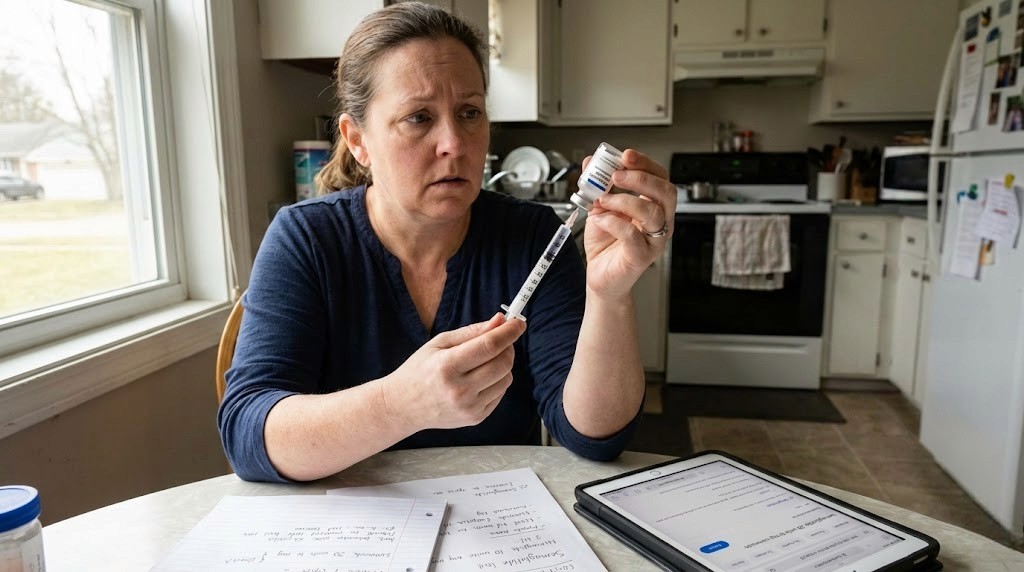
Twenty units on a syringe can mean wildly different things depending on what is inside the vial. That is the problem. A person drawing 20 units from a 2.5 mg/mL compounded vial injects 0.5 mg. Someone else drawing the same 20 units from a 5 mg/mL vial injects 1.0 mg, double the dose. And a third person using a 10 mg/mL concentration? They just took 2.0 mg in a single shot. Same syringe marking. Three completely different milligram doses. Three completely different risk profiles.
This single confusion has sent hundreds of people to emergency rooms. The FDA has documented cases of patients accidentally injecting up to 20 times their intended semaglutide dose, mostly with compounded formulations. Poison control centers reported a nearly 1,500 percent increase in calls related to injectable weight-loss drugs, driven almost entirely by dosing errors with compounded semaglutide vials.
So is 20 units too much? The honest answer is that it depends entirely on your vial concentration, where you are in your titration schedule, and how your body responds to this particular medication. This guide will walk through every scenario, show you exactly what 20 units translates to at every common concentration, explain the warning signs that your dose is too high, and lay out what to do if something goes wrong. No guessing. No vague reassurance. Just the math, the clinical data, and the practical steps you need to stay safe.
What 20 units actually means in milligrams
Before you can answer whether 20 units is too much, you need to know what 20 units means for your specific vial. Units on an insulin syringe measure volume, not drug strength. One hundred units equals 1 mL. So 20 units equals 0.2 mL of liquid. That is a fixed volume.
The milligram dose you receive depends entirely on the concentration of the solution in your vial. Here is the math, broken down for every common concentration you will encounter with compounded semaglutide.
The concentration-to-dose conversion table
For a 1 mg/mL vial, 20 units (0.2 mL) delivers 0.2 mg of semaglutide. This is below the lowest standard starting dose of 0.25 mg per week.
For a 2 mg/mL vial, 20 units delivers 0.4 mg. Still a relatively low dose, roughly in the loading phase range.
For a 2.5 mg/mL vial (one of the most common compounded concentrations), 20 units delivers 0.5 mg. This matches the second step in the standard semaglutide dosage in units titration schedule.
For a 3 mg/mL vial, 20 units delivers 0.6 mg. This falls between titration steps and could cause more GI side effects than expected if your body has not adjusted.
For a 5 mg/mL vial (another very common compounded concentration), 20 units delivers 1.0 mg. This is the third step in the Wegovy titration schedule and should only be reached after 8 weeks of gradual dose escalation.
For a 10 mg/mL vial, 20 units delivers 2.0 mg. This is close to the maximum maintenance dose of 2.4 mg and should never be a starting dose.
For a 12.5 mg/mL vial, 20 units delivers 2.5 mg. This exceeds the FDA-approved maximum weekly dose and puts you at serious risk of adverse events.
You can verify your own numbers using our semaglutide dosage calculator. Plug in your vial concentration, and it will tell you exactly how many milligrams each unit marking delivers. No mental math required. No room for error.
The formula you should memorize
The calculation is simple. Milligrams equals units divided by 100, multiplied by your vial concentration in mg/mL.
So for 20 units from a 5 mg/mL vial: (20 / 100) x 5 = 1.0 mg.
Write this formula on a sticky note. Tape it to your medicine cabinet. Use it every single time you draw a dose. The five seconds it takes to double-check your math could save you from a miserable week of nausea, or worse, a trip to the emergency room. For a deeper walkthrough of this conversion, check our guide on 20 units of semaglutide is how many mg.
Why compounded vials create confusion
Brand-name pens like Ozempic and Wegovy use pre-filled click mechanisms. You dial to 0.25 mg, 0.5 mg, or whatever your dose is. The pen does the math for you. There is no syringe to read.
Compounded semaglutide comes in multi-dose vials. You draw the dose yourself using a tuberculin syringe. And different compounding pharmacies use different concentrations. Some ship 2.5 mg/mL. Others ship 5 mg/mL. Some use 10 mg/mL or even higher. The label might be small, the print might be hard to read, and if you are used to one concentration and switch pharmacies, the units-to-milligrams ratio changes completely.
The FDA documented this exact scenario in a safety alert. Patients who switched between concentrations or pharmacies drew the same number of units they were used to, not realizing the new vial was twice or four times as concentrated. The result was severe nausea, vomiting, dehydration, and in some cases hospitalization for acute pancreatitis or dangerously low blood sugar.
If you want to understand the broader landscape of compounded semaglutide, including how to evaluate pharmacies and read labels correctly, that guide covers it in detail.
The standard semaglutide titration schedule
Semaglutide is not a medication you start at full strength. The dose escalation protocol exists for a reason. It gives your GLP-1 receptors time to adjust. It lets your GI tract adapt to dramatically slower gastric emptying. And it allows your provider to monitor for serious side effects before increasing to higher doses.
The FDA-approved Wegovy escalation
Weeks 1 through 4: 0.25 mg once weekly. Weeks 5 through 8: 0.5 mg once weekly. Weeks 9 through 12: 1.0 mg once weekly. Weeks 13 through 16: 1.7 mg once weekly. Week 17 onward: 2.4 mg once weekly (maintenance dose).
Each step lasts exactly four weeks. The total ramp-up takes 16 weeks, about four months, before you reach the maintenance dose. Some providers extend individual steps to 6 or 8 weeks if patients experience significant side effects at a new dose level.
This matters because 20 units could place you anywhere on this schedule depending on your concentration. At 2.5 mg/mL, 20 units puts you at 0.5 mg, the week 5-8 dose. At 5 mg/mL, you are at 1.0 mg, the week 9-12 dose. At 10 mg/mL, you are at 2.0 mg, nearly the full maintenance dose. If you are in your first month and accidentally take a maintenance-level dose, you have essentially skipped three months of gradual adaptation.
The semaglutide dosage chart in units maps out exactly which unit markings correspond to which milligram doses at each common concentration. Keep it bookmarked.
Why skipping steps causes problems
The dose escalation protocol is not arbitrary caution. Clinical data from the STEP trials shows clear dose-dependent increases in side effects. At the 2.4 mg maintenance dose, 43.9 percent of participants reported nausea compared to 16.1 percent on placebo. Vomiting hit 24.5 percent versus 6.3 percent. Diarrhea reached 29.7 percent versus 15.9 percent.
But here is the critical detail. Most of these side effects occurred during dose escalation, not at steady state. Your body adapts over time. The 4-week steps give your GI system a chance to recalibrate. Skip those steps, and you get hit with the full force of GLP-1 receptor activation all at once.
Research from the STEP 1 trial published in the New England Journal of Medicine showed that only 4.3 percent of participants discontinued treatment due to GI adverse events when following the proper titration schedule. That number would be dramatically higher if patients jumped straight to high doses.
If you are wondering about your own timeline and what to expect, our articles on how fast semaglutide works and how long semaglutide takes to work break down the expected weight loss timeline at each dose level.
When 20 units is perfectly fine
Not every scenario involving 20 units is dangerous. In fact, for many people, 20 units is exactly the right dose at the right time. Context matters more than the number on the syringe.
Low-concentration vials at the loading phase
If your compounding pharmacy supplies a 1 mg/mL or 2 mg/mL vial, 20 units delivers just 0.2 to 0.4 mg. These doses fall within or below the initial loading phase. You are unlikely to experience anything beyond mild nausea, if that. For someone in their first four weeks, this is a perfectly appropriate dose.
Standard concentration at mid-titration
At 2.5 mg/mL, 20 units delivers 0.5 mg. This is the standard second-step dose in the Wegovy protocol. If you have completed four weeks at 0.25 mg without significant GI issues, stepping up to 0.5 mg is exactly what the clinical guidelines recommend. Twenty units at this concentration is textbook dosing.
Higher concentration with established tolerance
At 5 mg/mL, 20 units delivers 1.0 mg. If you have been on semaglutide for 8 or more weeks and have successfully tolerated 0.5 mg, moving to 1.0 mg follows the approved schedule. Your GLP-1 receptors have had two months to adapt. Your GI tract has adjusted to the slower gastric emptying. Twenty units here is right on target.
The key question is not whether 20 units is too much in the abstract. It is whether the milligram dose that 20 units delivers matches where you should be in your titration schedule. If those two things align, you are fine.
For help navigating the exact unit-to-mg math at different concentrations, our semaglutide syringe dosage chart provides a visual reference you can print and keep near your supplies.
When 20 units is too much
There are clear situations where drawing 20 units from your vial crosses into dangerous territory. These are not hypothetical scenarios. They happen regularly, and the consequences range from a miserable few days to emergency hospitalization.
Starting a high-concentration vial without adjusting units
This is the number one cause of semaglutide overdoses with compounded formulations. You have been drawing 20 units from a 2.5 mg/mL vial, getting 0.5 mg per week. Your pharmacy switches you to a 5 mg/mL vial. You draw the same 20 units out of habit. Now you just took 1.0 mg instead of 0.5 mg. You doubled your dose overnight.
Worse, some pharmacies compound at 10 mg/mL or higher. If someone accustomed to a 2.5 mg/mL vial draws 20 units from a 10 mg/mL vial, they receive 2.0 mg. That is a 4x overdose relative to their previous dose. This exact pattern has generated hundreds of poison control calls and FDA adverse event reports.
Every time you receive a new vial, check the label. Compare the concentration to your previous vial. Recalculate your units using the formula above. If the concentration changed, your unit count must change too. Our 5mg vial dosage chart and 10mg dosage chart provide concentration-specific references.
First injection ever at 20 units from 5+ mg/mL
If this is your first week on semaglutide and you are using a 5 mg/mL vial, 20 units puts you at 1.0 mg. That is four times the recommended starting dose. Your GLP-1 receptors have never been activated by an exogenous agonist. Your gastric emptying rate is about to drop dramatically. And your body has zero tolerance built up.
The clinical trials started every participant at 0.25 mg for good reason. Even at that low dose, some people experience nausea and reduced appetite. Jumping to 1.0 mg on day one is like running a marathon without training. The biology simply does not support it.
For first-time dosing, check the semaglutide 5mg/mL dosage chart to find the correct unit marking for 0.25 mg at your specific concentration (it would be 5 units on a 5 mg/mL vial).
Taking 20 units when you have not been escalating properly
Some people try to speed up the titration process. They feel fine at 0.25 mg after two weeks and jump to 0.5 mg. Then after another week, they jump to 1.0 mg. This aggressive self-escalation frequently backfires.
The four-week intervals are not just about GI tolerance. They also allow your provider to monitor for less obvious complications. Gallbladder issues, for instance, tend to develop over weeks of treatment. Pancreatitis risk, while rare, increases with higher doses. Rushing through the titration means you miss the window to catch these problems early.
If you have been escalating faster than the recommended schedule, 20 units at a moderate concentration could deliver a dose your body is not ready for, even if the milligram amount seems reasonable on paper. Your individual tolerance matters as much as the number.
Combining with other medications that enhance effects
Semaglutide taken alongside insulin or sulfonylureas carries an increased risk of hypoglycemia. If you are on combination therapy and drawing 20 units from a higher-concentration vial, the blood sugar impact can be more severe than semaglutide alone would cause.
Similarly, if you are taking phentermine with semaglutide, the appetite-suppressing effects stack. What might be a tolerable dose of semaglutide alone could cause dangerous levels of appetite suppression and nausea when combined with other weight loss medications.
Warning signs your dose is too high
Your body tells you when the dose is wrong. The trick is knowing which signals mean "normal adjustment" and which ones mean "this dose is too high and needs to change." Here is how to tell the difference.
Normal side effects during titration
Mild nausea that comes and goes during the first week at a new dose is expected. About 44 percent of people on 2.4 mg reported nausea in the STEP trials, but most described it as mild to moderate. Light queasiness after meals, reduced appetite that feels manageable, occasional soft stools: these are signs that semaglutide is working and your GI system is adjusting.
Normal adjustment side effects typically peak in the first 2 to 3 days after a dose increase, improve steadily over the following week, do not prevent you from eating or drinking, and do not cause significant pain.
For a complete overview, our guide on semaglutide fatigue covers why tiredness happens and when it signals a problem versus a normal adaptation phase.
Red flags that indicate your dose is too high
Persistent vomiting. If you are vomiting multiple times per day and it does not improve after 48 hours, your dose is too high. Clinical trials showed vomiting in 24.5 percent of participants at 2.4 mg, but the majority had episodes that resolved within days. Ongoing, forceful vomiting suggests overdosing or a serious adverse reaction.
Inability to keep fluids down. This is more serious than nausea alone. Semaglutide slows gastric emptying significantly. At excessive doses, this effect intensifies to the point where even small sips of water come back up. Dehydration follows quickly, and it compounds every other side effect.
Severe abdominal pain. Mild cramping can happen. Sharp, persistent pain in your upper abdomen that radiates to your back is a completely different situation. This pattern suggests pancreatitis, which has been documented in clinical trials at higher semaglutide doses. In the STEP 1 trial, 3 of 1,306 participants on semaglutide developed acute pancreatitis compared to zero in the placebo group.
Dizziness or confusion. These are hallmarks of hypoglycemia, low blood sugar. Semaglutide alone rarely causes severe hypoglycemia unless the dose is excessive. But compounded with dehydration from vomiting, reduced food intake from extreme appetite suppression, and interaction with other diabetes medications, blood sugar can drop to dangerous levels. Sweating, shakiness, rapid heartbeat, and difficulty concentrating all point to this problem.
Heart rate changes. A sustained increase in resting heart rate of 15 or more beats per minute can indicate excessive GLP-1 receptor stimulation. Clinical data shows a modest mean increase of 1 to 4 beats per minute at therapeutic doses. Anything significantly beyond that warrants medical evaluation.
Injection site reactions that worsen. Significant redness, swelling, or hard lumps at your injection site that grow rather than shrink over 48 hours could indicate a reaction to an excessive dose concentration. Normal injection sites show mild redness that fades within hours.
If you experience persistent vomiting, abdominal pain, or signs of low blood sugar, contact your healthcare provider immediately. These are not wait-and-see situations. The guide on semaglutide withdrawal symptoms covers what happens when you stop the medication, which is relevant if your provider decides to pause treatment after a dosing error.
What happens if you accidentally take too much
Mistakes happen. Syringes are small. Concentration labels can be confusing. If you realize you drew too much or suspect your dose was higher than intended, here is what you need to know.
The immediate timeline
Semaglutide has a half-life of approximately one week. That means the drug stays active in your body for days after injection. There is no antidote. No reversal agent. Once the medication is injected, you wait for your body to metabolize it naturally.
Symptoms of an excessive dose typically appear within 2 to 6 hours after injection. Nausea comes first, often severe. Vomiting may follow within hours. Diarrhea and abdominal cramping often accompany or follow the vomiting. In serious overdose cases, symptoms can persist for 3 to 7 days before gradually improving.
What the emergency room does
If you go to an ER for a semaglutide overdose, the treatment is supportive care. Intravenous fluids to prevent and treat dehydration. Anti-nausea medications like ondansetron (Zofran) to manage vomiting. Blood glucose monitoring to catch and treat hypoglycemia. Pain management if abdominal pain is severe.
There is no stomach pumping for an injected medication. There is no dialysis that clears semaglutide from the blood. The ER keeps you stable and comfortable while the drug works its way through your system. Most patients are discharged within 24 hours if symptoms are manageable, though severe cases may require longer observation.
What to do at home after a mild overdose
If you took a moderately higher dose than intended (say, double your normal dose but not dramatically higher) and your symptoms are uncomfortable but manageable, these steps can help.
Stay hydrated. Sip water, electrolyte drinks, or broth throughout the day. Small, frequent sips work better than large gulps, since semaglutide has already slowed your stomach. Dehydration is the biggest risk with excessive nausea and vomiting, so keeping fluids down is priority number one.
Eat small, bland meals. Crackers, toast, rice, bananas. Nothing greasy, spicy, or heavy. Your stomach is processing food much more slowly than normal, so small portions prevent that overwhelming fullness that triggers more nausea.
Monitor your blood sugar. If you have a glucometer, check every few hours, especially if you are on other diabetes medications. Symptoms of low blood sugar include sweating, trembling, confusion, rapid heartbeat, and extreme hunger. If your readings drop below 70 mg/dL, drink fruit juice or eat glucose tablets and recheck in 15 minutes.
Skip your next scheduled dose. Do not take your regular weekly injection as planned. Your provider may want you to wait an extra week before resuming, or restart at a lower dose. Do not make this decision alone. Call your prescriber.
Our article on the best foods to eat while on semaglutide covers which foods are easiest to tolerate when GI side effects are high, and which ones to avoid completely.
When to call 911 or go to the ER
Seek emergency care if you experience any of the following after taking too much semaglutide. Vomiting that does not stop for more than 6 hours. Inability to keep any fluids down. Severe abdominal pain, especially upper abdominal pain radiating to the back (possible pancreatitis). Confusion, slurred speech, or loss of consciousness (severe hypoglycemia). Blood sugar below 54 mg/dL. Rapid heart rate that does not slow with rest. Signs of severe dehydration: no urination for 8+ hours, very dark urine, dry mouth, sunken eyes.
Do not try to ride out severe symptoms. Semaglutide overdose rarely causes death in otherwise healthy adults, but complications like severe dehydration, pancreatitis, and acute kidney injury can become life-threatening without medical support.
How to calculate your correct dose every time
Prevention beats treatment. Every single time. Here is a step-by-step system for making sure you draw the right number of units, no matter what concentration your pharmacy sends.
Step 1: Read the vial label
Find the concentration printed on your vial. It will say something like "semaglutide 5 mg/mL" or "semaglutide 2.5 mg per mL." This number is the only thing that matters for your dose calculation. Write it down.
If the label is unclear, if the print is too small, or if you cannot find the concentration, call your pharmacy before injecting anything. Never guess at a concentration.
Step 2: Know your prescribed milligram dose
Your provider prescribed a specific milligram dose for this week. Maybe it is 0.25 mg. Maybe it is 0.5 mg. Maybe it is 1.0 mg. This is the target number. If you do not know your prescribed dose, call your provider. Do not estimate based on what you think you should be taking.
Step 3: Do the math
Units to draw = (prescribed dose in mg / concentration in mg per mL) x 100.
Example: Your prescribed dose is 0.5 mg. Your vial is 5 mg/mL. Units = (0.5 / 5) x 100 = 10 units. Not 20. Ten.
Another example: Your prescribed dose is 1.0 mg. Your vial is 2.5 mg/mL. Units = (1.0 / 2.5) x 100 = 40 units.
Notice how the same milligram dose requires completely different unit counts depending on concentration. This is why memorizing "I always draw 20 units" is dangerous. You need to recalculate whenever your vial concentration changes.
Our semaglutide dosage calculator does this math instantly. Bookmark it. Use it before every injection until the calculation becomes second nature.
Step 4: Double-check with a conversion chart
Keep a printed conversion chart near your injection supplies. Charts specific to your concentration make it impossible to draw the wrong amount, assuming you read the chart correctly. We have concentration-specific charts for 5 mg/mL vials, 10 mg vials, 5 mg total dose vials, and reconstitution charts that cover the full unit-to-mg mapping.
Step 5: Use the right syringe
Always use a tuberculin syringe (also called an insulin syringe) marked in units. Never use a syringe marked only in milliliters without unit markings. The unit markings are easier to read precisely, and they align with the conversion charts your pharmacy provides.
Most compounding pharmacies supply 1 mL (100 unit) insulin syringes. Some supply 0.5 mL (50 unit) syringes, which have finer markings and allow more precise dosing at lower volumes. If your prescribed dose requires less than 10 units, ask your pharmacy for a smaller syringe to reduce measurement error.
Step 6: Verify after drawing
After you pull the plunger to your target unit line, hold the syringe at eye level. Check that the top of the plunger (the flat rubber edge) sits exactly at your target line. If it is even slightly above, push the plunger forward until it aligns precisely. A few extra units can mean a meaningful milligram difference at higher concentrations.
For a complete walkthrough of the injection process, our GLP-1 injection guide covers site selection, technique, and common mistakes to avoid.
Common dosing mistakes and how to avoid them
The same errors come up again and again with compounded semaglutide. Most are preventable with basic awareness.
Mistake 1: Not checking the new vial concentration
Your pharmacy may change suppliers. Your vial concentration can change between refills without anyone explicitly telling you. The box looks the same. The vial looks the same. But the concentration on the tiny label has doubled. And your usual unit count now delivers twice the milligrams.
Prevention: Check the concentration label on every new vial before your first draw. Compare it to your previous vial. If it changed, recalculate your units before injecting.
Mistake 2: Confusing 0.5 mL with 50 units
Some people hear their pharmacist say "draw to the 0.5 line" and pull to the 50-unit mark instead of the 0.5 mL mark on a different syringe type. On a 100-unit syringe, 50 units is 0.5 mL. These are the same thing. But on a syringe marked in mL fractions rather than units, the 0.5 line means 0.5 mL, which is 50 units, not 5 units.
Prevention: Know what type of syringe you have. Read the markings on your specific syringe. If units and mL markings are both present, always think in units for consistency with dosing charts.
Mistake 3: Reconstituting incorrectly
If you receive lyophilized (freeze-dried) semaglutide and reconstitute it yourself, the amount of bacteriostatic water you add determines the final concentration. Add too little water, and the concentration is higher than expected. Draw your usual units, and you overdose.
Prevention: Follow the reconstitution instructions exactly. Measure the bacteriostatic water precisely using a syringe, not a dropper or by eyeballing it. After reconstituting, calculate your new concentration: total mg of powder divided by total mL of water added. Our semaglutide reconstitution guide and 10mg reconstitution walkthrough provide step-by-step instructions with exact measurements.
Mistake 4: Drawing from the wrong vial
If you keep multiple medications in the same refrigerator (semaglutide plus B12, or semaglutide alongside another peptide), it is entirely possible to grab the wrong vial. If your B12 vial and semaglutide vial look similar, one momentary lapse can mean injecting the wrong substance entirely.
Prevention: Label your vials clearly. Store different medications on different shelves. Read the label every time you pick up a vial, even if you are "sure" it is the right one.
Mistake 5: Injecting twice in one week
Semaglutide is a once-weekly injection. If you forget whether you already injected this week, you might take a second dose. Double your weekly dose in one week can produce significant side effects, even if each individual dose was correct.
Prevention: Use a medication tracking app or a simple calendar. Mark the date and time of every injection. If you cannot remember whether you injected, skip the dose and resume on your next scheduled day. Missing one week is far safer than doubling up.
If you are exploring whether to switch between GLP-1 medications, our guides on switching from tirzepatide to semaglutide and the conversion chart cover the dose equivalencies you need.
20 units across different semaglutide brands and formulations
The semaglutide market is more complex than most people realize. Different brands, different delivery systems, and different compounding pharmacies all use different concentrations. Here is how 20 units translates across the major options.
Ozempic (for type 2 diabetes)
Ozempic comes in pre-filled pens, not vials. You do not draw units manually. The pen clicks to deliver 0.25 mg, 0.5 mg, 1.0 mg, or 2.0 mg depending on the pen model. The concept of "20 units" does not directly apply because the pen mechanism handles the dosing internally. If someone tells you they take "20 units of Ozempic," they are likely confused about the terminology or using a non-standard setup.
Wegovy (for weight management)
Wegovy also uses pre-filled pens with fixed doses at each titration step: 0.25, 0.5, 1.0, 1.7, and 2.4 mg. Again, no manual unit drawing required. The pen delivers the exact milligram dose for that step. Twenty units is not a concept that applies to Wegovy pens.
If you are curious about how GLP-1 and Ozempic relate to each other, or how branded options compare, that guide clarifies the differences.
Compounded semaglutide (vials)
This is where 20 units becomes relevant and potentially dangerous. Compounded formulations come in multi-dose vials at varying concentrations. We covered the math above, but the key point bears repeating: you MUST know your concentration before drawing any units.
The most common compounded concentrations are 2.5 mg/mL and 5 mg/mL. Some specialty pharmacies compound at 1 mg/mL for patients who need very low starting doses, and others go as high as 10 or 12.5 mg/mL for patients on higher maintenance doses who want to inject smaller volumes.
Providers like Empower Pharmacy and Olympia Pharmacy each use their own concentration standards. Switching between compounding pharmacies without recalculating your units is one of the most common causes of accidental overdose.
Compounded semaglutide with B12
Many compounding pharmacies add vitamin B12 (cyanocobalamin or methylcobalamin) to their semaglutide formulations. The B12 does not change the semaglutide concentration math, but it does mean the label might display the information differently. You might see "semaglutide 5 mg/mL + B12 1 mg/mL" or similar. Focus on the semaglutide concentration for your dosing calculation. The B12 is along for the ride.
Our guides on semaglutide with B12 and semaglutide methylcobalamin explain the rationale behind the combination and what benefits, if any, the added B12 provides.
Oral semaglutide
Oral semaglutide (Rybelsus) uses a completely different dosing system. It comes in tablets measured in milligrams (3, 7, or 14 mg), and the bioavailability is much lower than injectable forms, roughly 1 percent. Twenty units is not a concept that applies to oral formulations at all. The tablet doses are not equivalent to the same milligram amounts given by injection.
If you are comparing delivery methods, our article on oral semaglutide drops discusses the emerging sublingual options and how they compare to standard injectable dosing.
How your body weight affects the right dose
Semaglutide dosing is not based on body weight. The FDA-approved titration schedule is the same whether you weigh 150 pounds or 350 pounds. This surprises many people who expect weight-based dosing like some other medications.
However, your starting weight can influence how you respond to a given dose. A 350-pound person may notice less dramatic appetite suppression at 0.25 mg than a 150-pound person taking the same dose. This does not mean the heavier person should start at a higher dose. It means they might need to progress through the titration schedule to reach the dose that produces meaningful results, while still following the same 4-week step intervals.
The relevant metric is not whether 20 units is too much for your body weight. It is whether the milligram dose 20 units delivers is appropriate for your current stage in the titration protocol. A 200-pound person in week one should not be taking 1.0 mg any more than a 300-pound person should.
Some providers do adjust maintenance doses based on response. If a patient reaches 2.4 mg and is still not achieving clinically meaningful weight loss (defined as at least 5 percent of body weight), the medication may not be the right fit. But the answer is never to exceed the maximum approved dose. It is to reconsider the treatment approach entirely.
Our article on 4 weeks on semaglutide with no weight loss discusses realistic timelines and when lack of progress actually signals a problem versus normal early-stage adjustment.
The FDA warnings about compounded semaglutide dosing
The FDA has issued multiple safety communications about compounded semaglutide, and dosing errors are at the center of every warning.
The 2024 safety alert
In mid-2024, the FDA warned that it had received reports of people overdosing on compounded semaglutide by injecting up to 20 times their intended dose. The agency specifically called out the differences between compounded vials and brand-name pens.
Pre-filled pens have built-in safety features. They prevent you from dialing a dose higher than what the pen is designed to deliver. They click in precise increments. And they display the dose in milligrams, not units.
Compounded vials offer none of these protections. You draw from the vial with a syringe. You choose how many units to draw. If you misread the concentration, miscalculate the conversion, or simply pull the plunger too far, nothing stops you from injecting a dangerous amount.
Poison control center data
CNN reported that poison control centers saw a nearly 1,500 percent increase in calls related to injectable weight-loss drugs between 2021 and 2023. The spike tracked almost perfectly with the rise of compounded semaglutide use. The most common scenario: a patient received a different concentration than they were used to and drew the same number of units.
A case series published in academic literature documented multiple patients who presented with severe nausea, vomiting, abdominal pain, and dehydration after compounded semaglutide dosing errors. All patients experienced notable symptoms lasting multiple days. Most required IV fluids and anti-nausea medication.
For context on the broader compounded versus brand-name comparison, our guide on compounded semaglutide storage covers handling differences, and the article about how long compounded semaglutide lasts in the fridge addresses stability concerns that can also affect potency and dosing accuracy.
Dose-dependent side effects: what the clinical data shows
Higher doses mean more side effects. This relationship is clear in the clinical trial data and helps explain why 20 units at a high concentration can produce dramatically worse symptoms than 20 units at a low concentration.
GI side effects by dose level
The STEP clinical trial program tested semaglutide 2.4 mg against placebo in thousands of adults with overweight or obesity. The gastrointestinal data paints a clear dose-dependent picture.
At the 0.25 mg starting dose, most participants reported minimal or no GI symptoms. Nausea affected a modest percentage, similar to what you might feel from a rich meal. At 0.5 mg, nausea became more noticeable but remained manageable for the vast majority. Most episodes resolved within a few days.
At 1.0 mg, the numbers climbed. More participants reported moderate nausea, and some experienced vomiting for the first time. This is the dose where dose-escalation-related side effects became clinically significant in the trial data.
At 1.7 mg, GI symptoms peaked during the transition period. This step generated the most complaints about nausea and diarrhea across the entire titration schedule.
At the 2.4 mg maintenance dose, 43.9 percent reported nausea at some point during treatment. Vomiting occurred in 24.5 percent. Diarrhea in 29.7 percent. Constipation in 24.2 percent. But crucially, 99.5 percent of GI events were non-serious, and 98.1 percent were mild to moderate.
The takeaway: even at the maximum dose, most side effects are uncomfortable but not dangerous when you arrive at that dose through proper titration. The danger comes from landing at a high dose without the gradual build-up.
Serious adverse events
Beyond GI discomfort, higher semaglutide doses carry documented risks for specific serious events. Acute pancreatitis occurred in 3 of 1,306 semaglutide participants in STEP 1 (about 0.23 percent). Cholelithiasis (gallstones) occurred at higher rates in the semaglutide groups compared to placebo. And acute kidney injury has been reported, primarily in patients who became severely dehydrated from persistent vomiting.
A recent phase 2 trial explored semaglutide doses up to 16 mg weekly in patients with type 2 diabetes and overweight. The study found continued dose-dependent weight loss at these higher doses but also increased adverse event rates. This research is ongoing and is not currently relevant to standard dosing, but it underscores the principle that more drug means more side effects.
For a side-by-side comparison of how semaglutide stacks up against the other major GLP-1 option, our semaglutide vs tirzepatide side effects guide compares the safety profiles in detail.
What to tell your provider if you are concerned about your dose
Open communication with your prescribing provider is not optional when it comes to semaglutide dosing. Here is exactly what information to bring to that conversation.
Before your appointment, gather these details
Your current vial concentration. The exact number of units you draw. The milligram dose that converts to (show them your math). How many weeks you have been at your current dose. Any side effects you are experiencing, with approximate frequency and severity. Whether your pharmacy has changed the concentration at any point during treatment.
Questions to ask
Is my current milligram dose appropriate for where I am in the titration schedule? Should I move to the next dose level, or stay where I am longer? Are my side effects within the normal range, or do they suggest my dose is too high? If I need to reduce my dose, what should the new unit count be at my vial concentration? Should I switch to a different concentration to make dosing easier and safer?
Some providers are not deeply familiar with compounded semaglutide concentrations, especially if they typically prescribe brand-name pens. If your provider seems unsure about unit-to-milligram conversions for compounded vials, share the conversion formula and the concentration from your vial label. Good providers welcome this kind of patient engagement.
Our compounded semaglutide dose chart can serve as a reference you bring to your appointment. Having a printed chart makes the conversation concrete rather than abstract.
Microdosing semaglutide: when less is the strategy
Not everyone needs to reach the 2.4 mg maintenance dose. A growing number of patients and providers are finding success with lower maintenance doses, sometimes far below 20 units at standard concentrations.
Who benefits from lower doses
Patients with smaller amounts of weight to lose (15 to 25 pounds) often reach their goals at 0.5 or 1.0 mg. Older adults or those with lower body weights may experience adequate appetite suppression at lower doses. Patients who maintain their weight loss through dietary and exercise changes may step down to a reduced dose for long-term maintenance. And some individuals simply cannot tolerate higher doses without debilitating side effects.
The microdosing approach
Some clinicians prescribe sub-therapeutic doses for patients who want modest appetite support without the aggressive GI side effects of standard dosing. These microdoses typically range from 0.1 to 0.25 mg per week, well below what 20 units would deliver at most concentrations.
The evidence for semaglutide microdosing is primarily anecdotal and clinician-reported rather than supported by large randomized trials. But the rationale is sound: GLP-1 receptors exist on a continuum of activation, and partial activation may produce partial benefits with fewer side effects.
If you are interested in lower-dose strategies, our guides on how long semaglutide takes to suppress appetite and whether semaglutide suppresses appetite immediately explain what to expect at different dose levels.
Long-term dosing considerations
Once you reach your maintenance dose and stabilize, the 20-units question takes on a different character. Now the concern shifts from acute overdose risk to long-term safety and sustainability.
How long you stay on semaglutide
Clinical guidelines treat obesity as a chronic condition requiring ongoing management. Most providers prescribe semaglutide indefinitely, similar to how blood pressure medication is used long-term. Studies show that patients who discontinue semaglutide regain about two-thirds of their lost weight within one year.
This means your 20 units (or whatever your weekly dose converts to) becomes a lifelong commitment for many people. The importance of accurate dosing does not diminish over time. In fact, long-term use requires continued vigilance because complacency is when mistakes creep in. Our article on how long to stay on semaglutide covers the evidence for continued use and when stepping down might make sense.
Dose adjustments over time
Your provider may adjust your maintenance dose based on several factors. Continued weight loss progress. Side effect tolerance. Lab values (kidney function, liver function, lipase levels). Changes in other medications. And your overall quality of life on the medication.
If you plateau on your current dose, the answer is not to draw more units yourself. It is to discuss options with your provider, which might include moving to the next standard dose, adding supportive medications, or optimizing diet and exercise factors that compound with semaglutide effectiveness.
Our guide on why you might not be losing weight on semaglutide covers the non-dose factors that often explain weight loss plateaus.
Switching formulations
Over the course of long-term treatment, you may switch between compounding pharmacies, change from compounded to brand-name (or vice versa), or adjust your vial concentration for practical reasons. Every switch requires recalculating your units. This is not a one-time concern.
Create a dosing card that you update with every pharmacy change. Include your current concentration, your prescribed milligram dose, and the unit count that delivers that dose. Keep it with your injection supplies. It takes 30 seconds to create and could prevent the single most common semaglutide dosing error.
Comparing 20 units of semaglutide to 20 units of tirzepatide
If you are also considering or currently using tirzepatide, understand that 20 units means something completely different for each medication. The concentrations, the titration schedules, and the potency profiles are all different.
Tirzepatide concentration differences
Compounded tirzepatide comes in its own set of concentrations, often different from semaglutide. Twenty units from a tirzepatide vial delivers a milligram amount based on the tirzepatide concentration, which is not interchangeable with semaglutide concentrations. The medications are different drugs with different dosing ranges.
Brand-name tirzepatide (Mounjaro, Zepbound) uses pre-filled pens with fixed doses, similar to Wegovy and Ozempic. The concept of 20 units does not apply to these pens.
Cross-medication dosing is not equivalent
If you are switching from semaglutide to tirzepatide (or vice versa), the unit counts do not transfer. Twenty units of semaglutide is not equivalent to 20 units of tirzepatide. The drugs have different receptor binding profiles, different half-lives, and different dose-response curves.
Our semaglutide to tirzepatide conversion chart and the broader semaglutide vs tirzepatide comparison page cover the evidence-based equivalencies that providers use when transitioning patients between these medications.
For tirzepatide-specific dosing help, our tirzepatide dosage in units guide and tirzepatide dosage chart in units provide the same kind of concentration-specific conversion tables.
Storage and potency: how they affect your effective dose
Even if you calculate your units perfectly, the actual milligram dose you receive can be affected by how you store and handle your semaglutide.
Temperature degradation
Compounded semaglutide is a peptide. Peptides degrade when exposed to heat, light, and repeated temperature fluctuations. If your vial has been left at room temperature for extended periods, or if it went through a warm shipping experience, the actual potency may be lower than what the label states.
This means your 20 units might deliver less than the calculated milligrams. While this sounds like it would be safer (lower effective dose), it creates an unpredictable situation. You might increase your units to compensate for perceived low potency, then receive a new, fully potent vial and accidentally overdose.
Our guides on whether compounded semaglutide needs refrigeration and how long it lasts in the fridge cover optimal storage practices.
Expiration and degradation
Using semaglutide past its expiration date or beyond the manufacturer-stated beyond-use date after reconstitution means the drug has had more time to degrade. The concentration printed on the label may no longer reflect reality. Some patients draw more units thinking the medication has weakened, creating an overdose risk when they start a fresh vial.
Our article on whether you can use expired semaglutide and how long semaglutide stays good explain the stability data and when to discard a vial.
The bottom line: always dose based on what the label says, not on how you feel the medication is performing. If you suspect potency issues, get a fresh vial and recalculate based on the labeled concentration. Never self-adjust units to compensate for perceived weakness.
Special populations and 20 units
Certain groups face unique risks with semaglutide dosing that make the 20-units question even more critical.
People with type 2 diabetes on combination therapy
If you take semaglutide alongside insulin or sulfonylureas, the hypoglycemia risk is real and dose-dependent. At higher semaglutide doses (which 20 units may deliver depending on concentration), the blood sugar lowering effects stack with your other diabetes medications. Monitor your glucose closely after any dose change, and report readings below 70 mg/dL to your provider immediately.
People with a history of pancreatitis
A personal or family history of pancreatitis increases your risk when using GLP-1 receptor agonists. While the absolute risk remains low (roughly 0.23 percent in the STEP trials), higher doses may amplify this risk. If you have had pancreatitis before, erring on the side of lower doses and slower titration makes sense. Discuss this history with your provider before escalating past the lower titration steps.
People with kidney disease
Semaglutide itself does not require dose adjustment for kidney impairment. However, the GI side effects (particularly vomiting and diarrhea) can cause dehydration, which hits people with existing kidney disease much harder. Acute kidney injury has been reported in semaglutide users, almost always in the context of severe dehydration from GI side effects. If you have reduced kidney function, maintaining hydration is critical, and your threshold for seeking medical care after a dosing error should be lower.
People over 65
Older adults may be more sensitive to semaglutide side effects, particularly dehydration, hypoglycemia, and falls related to dizziness. While the FDA does not require dose adjustments based on age, many geriatric specialists recommend slower titration and lower maintenance doses for patients over 65. Twenty units from a high-concentration vial is more dangerous for an older adult than for a younger one, simply because the margin for complications is narrower.
People who are pregnant or breastfeeding
Semaglutide is contraindicated in pregnancy. It should be discontinued at least two months before planned conception due to its long half-life. If you are breastfeeding, data on semaglutide transfer to breast milk is limited. Any dosing question, including whether 20 units is appropriate, becomes secondary to the fundamental question of whether you should be taking the medication at all during this period.
For breastfeeding-specific guidance, our article on GLP-1 while breastfeeding covers the current evidence and provider recommendations.
Building a safe dosing routine
The best protection against dosing errors is a consistent routine that removes as many variables as possible.
The injection day checklist
Pick the same day each week. Set a recurring alarm. When the alarm goes off, follow these steps in order every single time.
Check the vial label. Confirm the concentration matches what you expect. Refer to your dosing card. Confirm the unit count for your prescribed milligram dose at this concentration. Draw the dose slowly. Hold the syringe at eye level. Verify the plunger position before injecting. Record the date, time, and dose in your tracking system. Store the vial properly in the refrigerator immediately after use.
This takes less than 3 minutes. It eliminates the most common dosing errors. And it creates a record you can share with your provider if questions arise.
What to do on travel days
Traveling with semaglutide introduces additional variables: temperature changes, time zone shifts, unfamiliar environments where you might rush your injection. Plan ahead. Bring a cooler bag with ice packs for the vial. Set your alarm to your home timezone so you do not accidentally shift your injection day. And never draw your dose in a moving vehicle, turbulent airplane, or other unsteady environment where syringe accuracy could be compromised.
For a full travel preparation guide, our article on traveling with semaglutide covers TSA rules, storage requirements, and injection logistics on the road.
Using digital tools
Several apps allow you to log injections, set reminders, and track side effects over time. Your provider can use this data to make informed decisions about dose adjustments. The more objective data you bring, the better the clinical decisions will be.
[SeekPeptides](https://www.seekpeptides.com/) provides tools that simplify this process. Our semaglutide dosage calculator handles the math instantly, and the reconstitution calculator ensures proper mixing for those who reconstitute their own vials. SeekPeptides members also get access to detailed dosing protocols and safety guides tailored to their specific situation, taking the guesswork out of every injection.
Frequently asked questions
Is 20 units of semaglutide the same as 20 mg?
No. Units measure volume on a syringe, not drug weight. Twenty units equals 0.2 mL of liquid. The milligram dose depends on your vial concentration. At 5 mg/mL, 20 units delivers 1.0 mg. At 2.5 mg/mL, it delivers 0.5 mg. Always calculate based on your specific concentration.
Can 20 units of semaglutide cause an overdose?
It depends on the concentration. At 10 mg/mL, 20 units delivers 2.0 mg, which is near the maximum approved dose and dangerous for someone not yet at that stage. At 2.5 mg/mL, 20 units delivers only 0.5 mg, which is a standard early-phase dose. The concentration determines the risk.
What should I do if I accidentally drew 20 units instead of 10?
If you have not injected yet, push the excess back into the vial and redraw to the correct mark. If you already injected, note the time and the amount. Monitor for excessive nausea, vomiting, or abdominal pain. Contact your provider to report the error. Skip your next scheduled dose if advised. Stay hydrated and eat small bland meals.
How many units should I actually be drawing?
That depends on your prescribed dose and your vial concentration. Use the formula: units = (prescribed mg / concentration mg per mL) x 100. For example, if you are prescribed 0.25 mg and have a 5 mg/mL vial, draw 5 units. If prescribed 0.5 mg from the same vial, draw 10 units. Our calculator makes this instant.
Does body weight affect whether 20 units is too much?
The FDA-approved semaglutide titration schedule is the same regardless of body weight. A 150-pound person and a 350-pound person follow the same dose escalation steps. Your weight does not determine whether 20 units is safe. Your vial concentration and your position in the titration schedule do.
Is it dangerous to take 20 units every week indefinitely?
If 20 units at your concentration corresponds to your prescribed maintenance dose (determined after proper titration), weekly administration is the standard protocol. Semaglutide is designed for ongoing weekly use. The danger arises only when 20 units delivers more milligrams than your body is adapted to handle.
What is the maximum safe dose of semaglutide per week?
The FDA-approved maximum weekly dose for weight management (Wegovy) is 2.4 mg. For type 2 diabetes (Ozempic), the maximum is 2.0 mg weekly. Doses above these levels are not FDA-approved and carry increased risk of adverse events. Research into higher doses (up to 16 mg) is underway but has not resulted in regulatory approval.
My pharmacy changed my vial concentration. Do I need to change my units?
Yes. Absolutely. This is the single most important dosing safety message in this entire article. If your concentration changed, your unit count must change to maintain the same milligram dose. Recalculate using the formula. Verify with a dosing chart. And if in doubt, call your pharmacy or provider before your next injection.
Can I split 20 units into two smaller injections?
Some providers recommend splitting doses for patients who experience severe nausea from their weekly injection. Instead of 20 units once weekly, you might inject 10 units twice weekly. This delivers the same total milligram dose but spreads the peak drug levels more evenly. Discuss this approach with your provider. Do not split doses on your own without medical guidance.
How do I know if my side effects are from the dose being too high versus normal adjustment?
Normal adjustment: mild nausea that peaks 1-3 days after injection and fades by day 5. Reduced appetite without severe food aversion. Occasional loose stools. Slight fatigue. Dose too high: persistent vomiting lasting more than 48 hours. Inability to keep fluids down. Severe abdominal pain. Dizziness or confusion. Rapid heart rate. If your symptoms match the second list, your dose is likely too high and requires medical attention.
External resources
STEP 1 trial: once-weekly semaglutide in adults with overweight or obesity (NEJM)
Gastrointestinal tolerability of once-weekly semaglutide 2.4 mg (PMC)
Administration errors of compounded semaglutide reported to a poison control center (PubMed)
This is not medical advice. Semaglutide is a prescription medication. Work with your healthcare provider to determine the right dose for your situation. If you suspect a dosing error, contact your provider or poison control (1-800-222-1222) immediately.
SeekPeptides members access detailed, concentration-specific dosing protocols, safety monitoring guides, and direct support for questions exactly like this one. When precision matters this much, having a reliable resource behind every injection makes a real difference.
In case I do not see you, good afternoon, good evening, and good night.