Feb 24, 2026
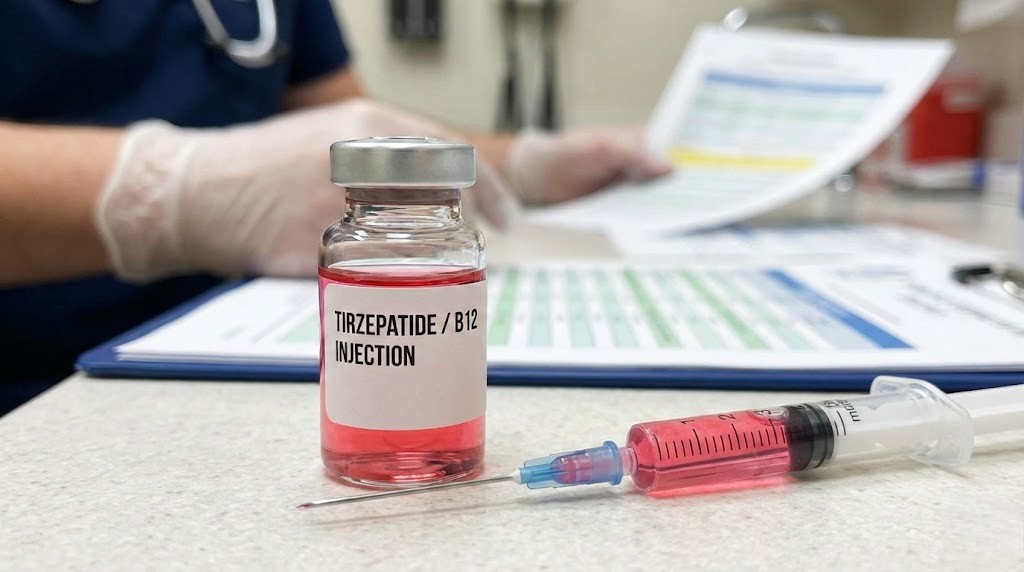
Before you draw up your next dose, take a close look at what is inside that vial. The color of your tirzepatide tells a story. Sometimes it tells you everything is fine. Other times, it is screaming at you to stop.
Most people receiving compounded tirzepatide with B12 expect a clear liquid, similar to what they see in advertisements for brand-name pens. Then the vial arrives and it is pink. Or reddish. Maybe even a deep salmon color that looks nothing like what they imagined. Panic sets in. Is this safe? Did the pharmacy make a mistake? Should I inject this into my body?
The answer depends on exactly what shade you are looking at, what your pharmacy told you to expect, and whether the color has changed since you first opened the vial. Getting this wrong matters. Injecting a contaminated or degraded medication can cause injection site reactions, reduced effectiveness, or worse. But throwing away perfectly good medication because you did not understand the normal color wastes money and delays your weight loss progress.
This guide covers every color variation you might encounter with tirzepatide, from the crystal-clear liquid inside FDA-approved pens to the distinctive pink hue of compounded formulations containing B12. You will learn exactly what causes the color, what range of shades is normal, what warning signs demand immediate attention, and how storage conditions change what you see in the vial. By the end, you will never second-guess the color of your tirzepatide again.
The quick answer: what color is tirzepatide with B12?
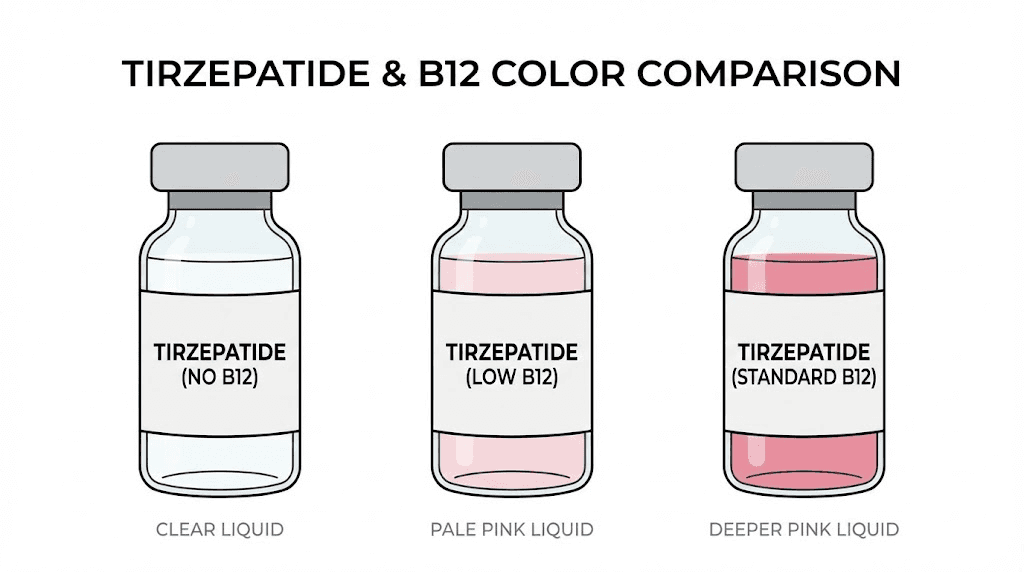
Tirzepatide compounded with vitamin B12 is pink. The shade ranges from a pale, barely-there blush to a deeper reddish-pink that some people describe as light salmon or strawberry. This color comes entirely from the B12 component, specifically cyanocobalamin, which has a naturally occurring red-pink pigment at the molecular level.
That is the short answer.
But the short answer is not enough to keep you safe. The specific shade you see depends on several factors: the concentration of B12 in your formulation, which form of B12 the pharmacy used, the total volume of solution in the vial, and how the medication has been stored since it left the compounding facility. Understanding these variables is what separates someone who confidently uses their medication from someone who throws away perfectly good tirzepatide out of fear.
FDA-approved tirzepatide products like Mounjaro and Zepbound look completely different. These come as clear, colorless to slightly yellow solutions in single-dose prefilled pens. They contain no B12. No pink. No red. If your brand-name pen contains a pink or red liquid, something is seriously wrong and you should not use it.
Compounded tirzepatide without B12 also appears clear and colorless, similar to the brand-name versions. The pink color only shows up when a compounding pharmacy adds vitamin B12 to the formulation. If you are using a compounded product and you were not told it contains B12, but the liquid is pink, contact your pharmacy immediately to confirm the formulation.
Why tirzepatide with B12 turns pink: the science behind the color
The pink color has nothing to do with tirzepatide itself. Pure tirzepatide peptide dissolves into a colorless solution. The color comes entirely from vitamin B12.
Vitamin B12, in its most common supplemental form called cyanocobalamin, contains a corrin ring structure at its molecular core. This ring has a cobalt atom sitting at the center, coordinated with four nitrogen atoms. The arrangement of electrons around this cobalt center absorbs specific wavelengths of visible light, primarily in the green and yellow portions of the spectrum. When those wavelengths get absorbed, the light that passes through (and reaches your eyes) appears red to pink. This is the same principle that makes hemoglobin in your blood appear red, though the specific metal and ring structure differ.
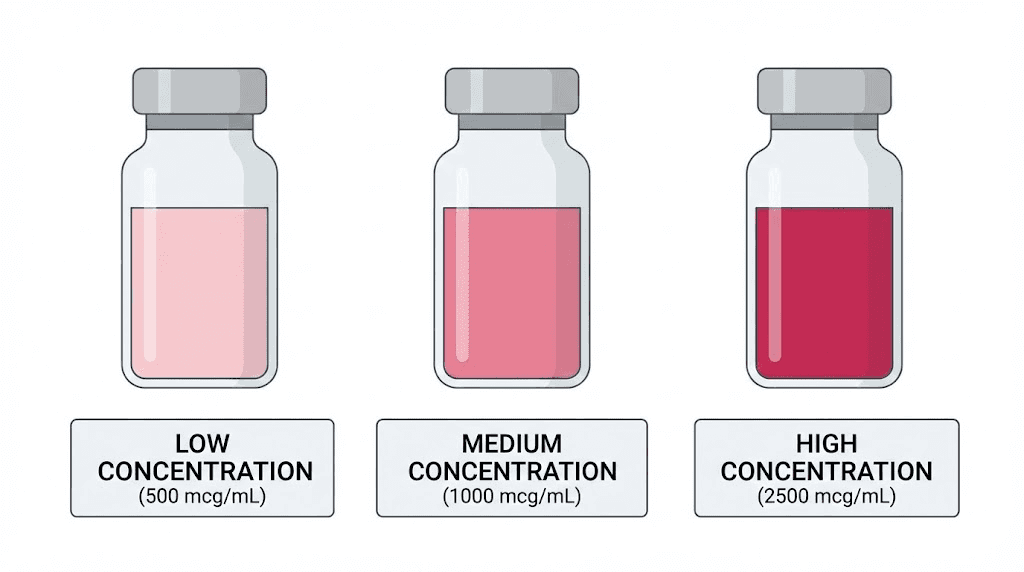
The intensity of the color follows a straightforward rule. More B12 molecules in solution means more light gets absorbed. More absorption means a deeper, more saturated pink or red color. Fewer B12 molecules means less absorption, resulting in a paler, more subtle pink that some people barely notice.
This is basic chemistry. Not contamination. Not degradation. Not a manufacturing error. The B12 in your tirzepatide is doing exactly what B12 does in every context where it dissolves in water: it turns the solution pink.
Why the shade varies between vials
Even within the same formulation from the same pharmacy, you might notice slight color differences between batches. This happens for several reasons that are all completely normal. The exact amount of B12 in each vial can vary within acceptable pharmaceutical tolerances, typically plus or minus a small percentage. The pH of the solution can shift the apparent color slightly. Even the thickness of the glass vial and the ambient lighting in your room can make the same solution look different on different days.
What matters is not that every vial looks identical. What matters is that the color falls within the expected range for your specific formulation and that it has not changed dramatically since you received it.
Compounded tirzepatide vs FDA-approved: a complete visual comparison
Understanding the visual differences between compounded and FDA-approved tirzepatide prevents unnecessary confusion. These are fundamentally different products in terms of appearance, packaging, and what you should expect to see.
FDA-approved tirzepatide (Mounjaro and Zepbound)
Both Mounjaro and Zepbound contain the same active ingredient, tirzepatide, manufactured by Eli Lilly. The solution inside these prefilled pens is described in the official prescribing information as "clear, colorless to slightly yellow." Most users report that the liquid looks completely clear, like water, though a very faint yellow tint is within normal specifications.
These pens never contain B12, glycine, niacinamide, or any other additive that would change the color. If your FDA-approved pen contains liquid that is pink, red, cloudy, or has visible particles, do not use it. Contact your pharmacy or the manufacturer.
Each pen is color-coded on the label to indicate dosage strength. The 2.5 mg pen features a gray color indicator. The 5 mg pen uses purple. The 12.5 mg pen is blue. The 15 mg pen uses orange. These colors refer to the pen casing and label only, not the liquid inside, which remains clear across all dose strengths.
Compounded tirzepatide without B12
Some compounding pharmacies prepare tirzepatide without B12 as an additive. These formulations typically appear clear and colorless, very similar to the FDA-approved versions. The solution might contain glycine as a stabilizer, but glycine is colorless in solution and does not change the appearance.
If you receive compounded tirzepatide that was prepared without B12 and the liquid has any color at all, that warrants a call to your pharmacy. Colorless tirzepatide should remain colorless.
Compounded tirzepatide with B12
This is the formulation that causes the most confusion. The tirzepatide with B12 combination produces a distinctly pink to reddish solution. The pharmacy should inform you about this expected color when they dispense the medication. Many pharmacies include documentation with the shipment explaining the pink appearance.
Common compounded formulations include:
Tirzepatide with cyanocobalamin (B12): Pink to red
Tirzepatide with glycine and B12: Pink to red (glycine does not affect color)
Tirzepatide with methylcobalamin: Pink to red (similar shade to cyanocobalamin)
Tirzepatide with niacinamide: Clear to very faint yellow (no B12 means no pink)
Visual comparison table
Formulation | Expected color | Clarity | Contains B12? |
|---|---|---|---|
Mounjaro/Zepbound (FDA) | Clear to slightly yellow | Clear, no particles | No |
Compounded (no B12) | Clear, colorless | Clear, no particles | No |
Compounded (low B12) | Pale pink | Clear, no particles | Yes (0.25 mg/mL) |
Compounded (standard B12) | Medium pink | Clear, no particles | Yes (0.5 mg/mL) |
Compounded (high B12) | Deep pink to light red | Clear, no particles | Yes (1.0 mg/mL) |
Notice that one factor remains constant across every formulation in that table: clarity. Regardless of color, the solution should always be clear. You should be able to see through it. If you cannot, something is wrong.
Different forms of B12 and how they affect color
Not all vitamin B12 is created equal, at least not chemically. Compounding pharmacies use several different forms of B12, and while the color differences between them are subtle, understanding the distinction helps you know what to expect from your specific formulation.
Cyanocobalamin
This is the most commonly used form of B12 in compounded tirzepatide formulations. Cyanocobalamin is a synthetic form of B12 where the cobalt atom is bonded to a cyanide group. Despite containing cyanide, the amount is toxicologically insignificant. The body converts cyanocobalamin into its active forms (methylcobalamin and adenosylcobalamin) after absorption.
In solution, cyanocobalamin produces the classic deep red to pink color that most people associate with B12. It is highly stable, which is one reason compounding pharmacies prefer it. The color remains consistent over the shelf life of the product when stored properly.
Methylcobalamin
Some pharmacies use methylcobalamin, the naturally occurring active form of B12. This form also produces a red-pink color in solution, though some pharmacists note it can appear slightly different in hue compared to cyanocobalamin. The color difference is minor and primarily related to concentration and excipients rather than a fundamentally different appearance.
Methylcobalamin is less stable than cyanocobalamin and more sensitive to light degradation. This means the color might fade faster if the medication is exposed to light. Pharmacies using methylcobalamin often emphasize the importance of light-protected storage.
Hydroxocobalamin
Less commonly used in compounded tirzepatide, hydroxocobalamin also produces a red-pink color. This form is sometimes preferred for certain medical applications because the body retains it longer than cyanocobalamin. In solution, it produces a deep red color that can appear slightly more orange-tinted than cyanocobalamin, though this varies with concentration.
The bottom line on B12 forms and color
You cannot reliably determine which form of B12 is in your tirzepatide just by looking at the color. All three common forms produce shades within the pink-to-red spectrum. The concentration of B12 matters far more for color intensity than which chemical form the pharmacy used. If you want to know which form of B12 is in your medication, check the label or ask your pharmacy directly.
How B12 concentration changes the color of your tirzepatide
The relationship between B12 concentration and color intensity is direct and predictable. Higher concentrations produce deeper colors. Lower concentrations produce paler colors. Understanding the typical concentration ranges helps you set accurate expectations for what your vial should look like.
Low concentration: 0.25 mg/mL
At this concentration, the B12 produces a very subtle pink tint. Some people describe it as barely noticeable, especially under fluorescent lighting. You might see it more clearly if you hold the vial against a white background. In a dimly lit room, you might not notice the color at all and think the solution is clear.
This concentration still provides meaningful B12 supplementation. The pale color does not indicate less effectiveness. It simply reflects fewer B12 molecules per milliliter of solution.
Standard concentration: 0.5 mg/mL
This is a common concentration used by many compounding pharmacies. At 0.5 mg/mL, the pink color is unmistakable. The solution looks distinctly pink, similar to a very diluted cranberry juice or pink lemonade. This is the shade most people think of when they hear "tirzepatide with B12."
Higher concentration: 1.0 mg/mL
At 1.0 mg/mL, the color deepens to a pronounced pink or light red. Some people describe this as salmon, light strawberry, or even a muted red. The solution remains clear, meaning you can still see through it, but the color is now impossible to miss. If you are used to a paler pink from a previous pharmacy or batch, this deeper shade might surprise you.
Why your new vial might look different from the last one
Compounding pharmacies may adjust B12 concentrations between batches or formulations. Your prescriber might request a different concentration. Even within the same prescription, acceptable manufacturing tolerances allow for slight variation. If your new vial looks noticeably different from your previous one but still falls within the pink-to-light-red range and remains clear without particles, it is likely fine. But calling your pharmacy to confirm is always the safe choice.
When comparing colors, keep the lighting consistent. Natural daylight gives the most accurate color reading. Fluorescent lights can wash out subtle pinks, while warm incandescent bulbs can make pink appear more saturated than it really is. Always compare vials under the same lighting conditions.
Other additives that affect tirzepatide color
B12 is not the only additive found in compounded tirzepatide. Several other ingredients commonly appear in these formulations, and understanding their color properties helps you identify what is normal for your specific product.
Glycine
Glycine is one of the most common additives in compounded tirzepatide. It serves as a stabilizer, helping the tirzepatide peptide maintain its structure and potency during storage. Glycine dissolves completely in water and produces no color whatsoever. If your formulation contains tirzepatide with glycine but no B12, the solution should be clear and colorless.
When combined with B12, glycine does not alter the pink color. The B12 is entirely responsible for any color you see. A formulation listed as "tirzepatide/glycine/B12" will look the same shade of pink as a formulation listed as "tirzepatide/B12" at the same B12 concentration.
Niacinamide (vitamin B3)
Niacinamide can contribute a very faint yellow tint to the solution. On its own, this is barely perceptible. When combined with B12, the yellow from niacinamide and the pink from B12 can interact visually to produce a shade that appears slightly warmer or more salmon-toned compared to B12 alone. This is normal and does not indicate any problem.
Vitamin B6 (pyridoxine)
Pyridoxine (vitamin B6) can also add a slight yellow tint. Similar to niacinamide, the color contribution is minimal on its own. When combined with B12, the overall appearance remains within the pink spectrum but might trend slightly toward a warmer hue.
L-carnitine
Some formulations include L-carnitine for its potential metabolic benefits. L-carnitine is colorless in solution and does not affect the visual appearance of the tirzepatide formulation.
Multiple additive combinations
A formulation containing tirzepatide, glycine, B12, and niacinamide will look pink due to the B12, with possibly a very faint warm shift from the niacinamide. The overall impression remains within normal parameters. If you receive a formulation with multiple additives and the color looks unexpected, compare it against the specific additives listed on your label. If nothing on your label should produce color but the solution is tinted, contact your pharmacy.
Normal colors you should expect in your tirzepatide vial
This section provides a definitive reference for every normal color you might encounter across different tirzepatide products. Bookmark this page and return to it whenever you receive a new vial.
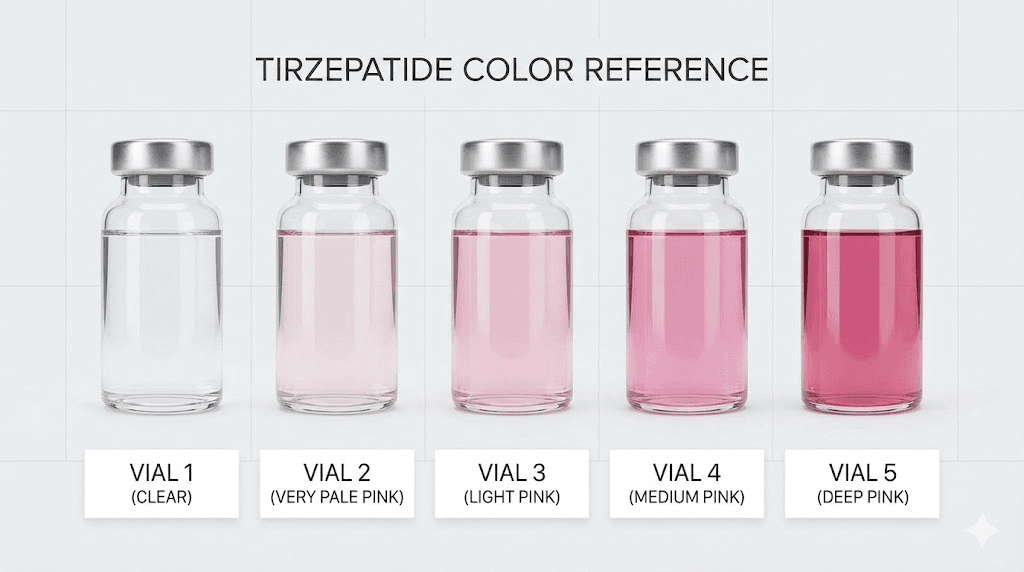
Clear and colorless
This is what you should see with:
FDA-approved Mounjaro and Zepbound prefilled pens
Compounded tirzepatide without B12
Compounded tirzepatide with glycine only (no B12)
The solution looks like water. Hold it up to a light and you should see straight through without any tint or haze.
Clear with a faint yellow tint
This falls within the acceptable range for FDA-approved pens. The prescribing information states "colorless to slightly yellow," so a very subtle yellow is perfectly normal. This does not indicate degradation. The tirzepatide peptide itself can produce this faint yellow depending on concentration and formulation buffers.
Pale pink (barely noticeable)
This indicates a low concentration of B12 in a compounded formulation. You might need good lighting to even notice it. Hold the vial against white paper for the clearest view. This is completely normal for low-dose B12 additions.
Medium pink (clearly visible)
The most common appearance for standard compounded tirzepatide with B12. The pink is obvious and consistent throughout the solution. No one would mistake this for colorless. This is the classic look of tirzepatide/B12 formulations and is entirely normal.
Deep pink to light red
Higher B12 concentrations produce this deeper shade. It might alarm you if you expected a light pink, but this is within normal range for formulations with 1.0 mg/mL or higher B12 content. The key indicator remains clarity. If the solution is deep pink but still completely clear (you can see through it), the color alone is not a concern.
Warning signs: when tirzepatide color means something is wrong
Now the critical section. Not all colors are normal. Some visual changes demand that you stop, do not inject, and contact your pharmacy or healthcare provider immediately. Getting this right can protect your health.
Cloudiness or turbidity
This is the number one red flag. Tirzepatide solutions, whether clear or pink, should always be transparent. You should be able to read text through the vial (accounting for the curve of the glass distorting the letters). If the solution looks cloudy, milky, hazy, or you cannot see through it clearly, do not use it.
Cloudiness can indicate:
Protein aggregation (the tirzepatide peptide clumping together)
Microbial contamination
Chemical degradation
Incompatibility between ingredients
Any of these situations makes the medication potentially unsafe. Protein aggregates can trigger immune reactions at the injection site or systemically. Contaminated medication poses infection risk. Degraded medication may be ineffective or produce harmful byproducts.
Visible particles or floating matter
Hold the vial up to a light and look carefully. Tilt it gently. Watch for any specks, fibers, crystals, or clumps floating in the solution or settled at the bottom. Even a single visible particle means you should not use that vial.
Particles can come from:
Degraded peptide forming insoluble aggregates
Contamination during manufacturing or storage
Rubber stopper fragments from repeated needle punctures
Crystallization of dissolved components
If you see particles, do not try to filter them out. Do not shake the vial hoping they dissolve. Contact your pharmacy for a replacement.
Dramatic color changes
If your tirzepatide was pink when you first received it and has turned noticeably darker, lighter, or shifted to a different color entirely, this could indicate chemical degradation. Normal color variation between batches is one thing. A color change within the same vial over time is different and concerning.
Specifically watch for:
Pink turning brown or amber: Could indicate oxidative degradation of the B12 or the peptide
Pink turning orange: May suggest B12 degradation, particularly with light-sensitive forms like methylcobalamin
Any color becoming noticeably darker: Could reflect concentration changes from solvent evaporation or chemical breakdown
Color fading to clear: B12 degradation from light exposure, the medication may have lost potency
Green or blue tint
No normal tirzepatide formulation, whether compounded or FDA-approved, should ever appear green or blue. This is a clear indication of contamination or a compounding error. Do not use the medication. Contact your pharmacy immediately.
Separation or layering
The solution should be homogeneous, meaning the same throughout. If you see layers, with one color on top and another on the bottom, or a film forming on the surface, the formulation has become unstable. This can happen with improper storage, particularly if the medication was left out of the fridge for too long or exposed to extreme temperatures.
What to do when you spot a warning sign
Follow this protocol:
Do not inject the medication
Take a photo of the vial with good lighting for documentation
Note the lot number, expiration date, and pharmacy name on the label
Contact your compounding pharmacy and describe what you see
Ask for a replacement vial
If you already injected medication that looked abnormal and experience any unusual symptoms, contact your healthcare provider
You are not overreacting by calling your pharmacy about a suspicious-looking vial. Pharmacists would rather answer a cautious question than treat a preventable adverse event.
How storage affects the color of tirzepatide with B12
Proper storage does more than maintain potency. It also maintains the visual appearance you use as your first-line safety check. Understanding how storage conditions affect color helps you distinguish between normal variation and genuine warning signs.
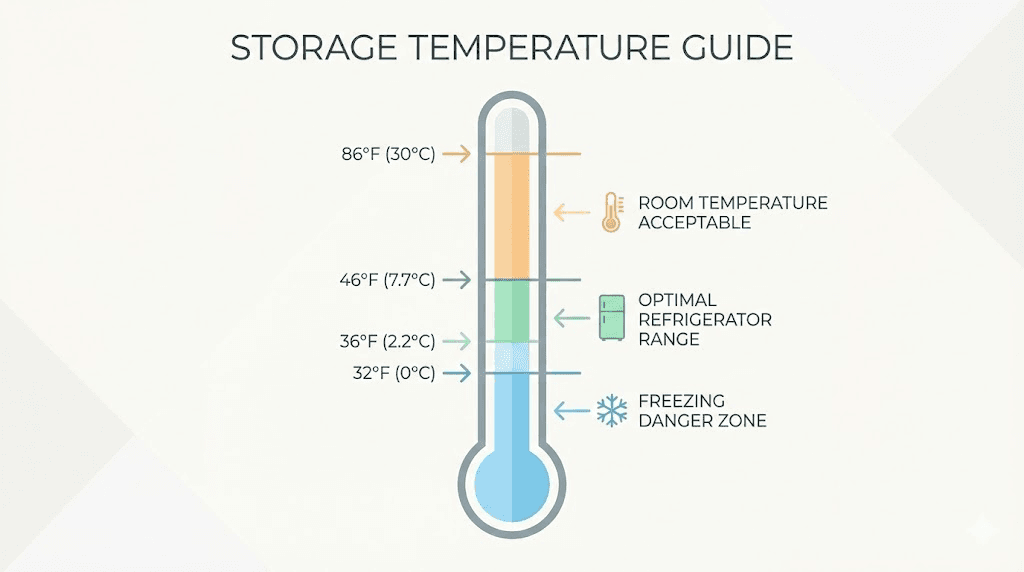
Proper refrigeration: 36 to 46 degrees Fahrenheit (2 to 8 degrees Celsius)
This is the gold standard for compounded tirzepatide storage. At these temperatures, the peptide remains stable, the B12 retains its characteristic pink color, and microbial growth is suppressed. A properly refrigerated vial should maintain consistent color throughout its beyond-use date (BUD), which for most compounded tirzepatide is 28 days after the vial is first punctured.
Keep the vial in its original packaging when possible. The outer box or bag provides protection from light, which is particularly important for preserving tirzepatide stability.
Room temperature exposure
Most compounded tirzepatide can tolerate room temperature (up to 77 to 86 degrees Fahrenheit or 25 to 30 degrees Celsius) for limited periods, typically up to 21 days according to many pharmacy guidelines. During room temperature storage, the color should remain stable for the first few days. Extended exposure to warmer temperatures may gradually affect both the B12 and the peptide, potentially causing subtle color shifts.
If you need to keep your tirzepatide out of the fridge for travel or other reasons, monitor the color more closely than you would with a refrigerated vial. Any noticeable change during room-temperature storage warrants extra scrutiny.
Light exposure and photodegradation
Light is one of the biggest enemies of B12 stability. Cyanocobalamin and especially methylcobalamin are photosensitive, meaning light energy can break down their molecular structure. When this happens, the characteristic pink color can fade. The medication might go from a nice pink to a paler shade, or the color might shift toward a more brownish or yellowish tone.
This matters because the color change reflects actual chemical degradation. A vial of tirzepatide with B12 that has been sitting on a sunny windowsill for several days is not the same medication it was when it arrived. The B12 has degraded, and the tirzepatide peptide may have been affected as well.
Always store your vial away from direct sunlight. Keep it in the box. Store it in the fridge, preferably not in the door where the light hits every time you open it. The middle shelves or vegetable drawer offer the best combination of consistent temperature and light protection.
Freezing
Never freeze tirzepatide. Freezing can cause the peptide molecules to aggregate irreversibly, meaning they clump together and cannot be separated again. When a frozen and thawed vial is examined, you might see cloudiness, particles, or unusual color changes. The solution may look normal at first but develop problems as it warms.
If your vial accidentally froze (perhaps the refrigerator was set too cold or it was placed near the back wall of the fridge where temperatures can drop below freezing), do not use it. Contact your pharmacy for a replacement.
Heat exposure
Temperatures above 86 degrees Fahrenheit (30 degrees Celsius) accelerate degradation of both the peptide and the B12. Extended heat exposure can cause:
Color darkening or brownish shifts
Cloudiness from peptide aggregation
Visible particle formation
Loss of potency even without visible changes
If your medication was shipped without adequate cold chain protection, or if it sat in a hot mailbox or delivery vehicle for hours, inspect it carefully before use. When in doubt, contact your pharmacy.
How to properly inspect your tirzepatide before every injection
Visual inspection should become a habit, something you do automatically every single time you prepare a dose. This takes less than 30 seconds and could save you from injecting a compromised medication.
Step 1: Check the label
Before you even look at the liquid, confirm you are holding the right medication. Check the drug name, concentration, your name (if on the label), the beyond-use date or expiration date, and the pharmacy name. Compare the formulation description on the label to what your prescriber ordered. This is where you confirm whether your compounded tirzepatide should contain B12 or not, which tells you whether to expect pink or clear.
Step 2: Check the expiration or beyond-use date
Compounded medications have a BUD (beyond-use date) rather than a traditional expiration date. This is typically 28 days from the date the vial was first punctured, or a specific date printed on the label. Do not use medication past this date, even if it looks perfectly normal. Chemical degradation does not always produce visible changes.
Step 3: Hold the vial up to a light source
Natural daylight near a window provides the best lighting for inspection. Hold the vial at eye level against a bright background. Look through the solution, not just at it. You are checking for clarity, meaning you should be able to see through the liquid clearly.
Step 4: Check for particles
With the vial held up to light, gently tilt and rotate it. Watch for any specks, fibers, flakes, or clumps. Check the bottom of the vial for any settled material. Check the surface for any film or bubbles that should not be there. Small air bubbles are normal, especially in a multi-dose vial that has been punctured before. But solid particles are not.
Step 5: Evaluate the color
Compare the color to what you expect based on your formulation. Pink for B12-containing formulations. Clear for non-B12 formulations. Colorless to slightly yellow for FDA-approved pens. Note whether the color has changed since your last dose from this same vial.
Step 6: Gently roll, never shake
If you see anything settled at the bottom, try gently rolling the vial between your palms. If the material dissolves and the solution returns to a clear (though possibly colored) state, it might have been minor crystallization. If it does not dissolve, or if rolling creates more cloudiness, do not use the vial.
Never vigorously shake a peptide solution. Shaking can cause the delicate peptide molecules to aggregate, creating the very particles and cloudiness you are trying to avoid. Think of it like this: peptides are large, carefully folded molecules. Shaking them is like putting a house of cards in an earthquake.
Step 7: Smell check (optional but useful)
Normal tirzepatide solutions, whether colored or not, should have little to no odor. A foul or unusual smell could indicate microbial contamination. This is not a definitive test, but if something smells wrong in addition to looking wrong, the evidence for discarding the vial becomes even stronger.
What does semaglutide with B12 look like?
Since many people switch between tirzepatide and semaglutide, or use them at different points in their weight loss journey, understanding the visual similarities helps prevent confusion.
The short answer: semaglutide with B12 looks very similar to tirzepatide with B12. Both produce pink solutions because the color comes from the B12, not the peptide itself. The shade depends on the same factors: B12 concentration, B12 form, and other additives.
FDA-approved semaglutide products (Ozempic, Wegovy, Rybelsus) do not contain B12 and appear as clear, colorless solutions, similar to Mounjaro and Zepbound. The pink color only appears in compounded versions that specifically include B12.
If you are switching from tirzepatide to semaglutide or vice versa and both formulations contain B12, expect similar colors. If you are switching from a compounded formulation (pink) to an FDA-approved product (clear), the visual difference is dramatic but completely expected. Similarly, converting between medications requires understanding that the appearance change has nothing to do with the effectiveness of the new medication.
The compounded semaglutide with B12 dosage charts use the same B12 concentrations as tirzepatide formulations, so the color ranges are essentially identical.
Mounjaro and Zepbound pen identification guide
For users of FDA-approved tirzepatide, the color conversation is entirely different. Here, color refers to the pen casing and label, not the liquid inside.
Mounjaro pen colors by dose
Dose | Pen color indicator | Liquid inside |
|---|---|---|
2.5 mg | Gray | Clear to slightly yellow |
5 mg | Purple | Clear to slightly yellow |
7.5 mg | Green | Clear to slightly yellow |
10 mg | Dark green | Clear to slightly yellow |
12.5 mg | Blue | Clear to slightly yellow |
15 mg | Orange | Clear to slightly yellow |
These color codes help prevent dosing errors. Always verify the dose printed on the pen matches your prescription, and double-check the pen color as a secondary confirmation. The color coding system makes it much harder to accidentally inject the wrong dose, which is especially important for people titrating up through the dose schedule.
Why FDA pens never contain B12
Mounjaro and Zepbound are manufactured as single-ingredient products approved by the FDA. Adding B12 would create a different product requiring separate approval. The decision to add B12 is made by individual prescribers working with compounding pharmacies, which is why B12 only appears in compounded formulations. This distinction is important because it means the visual expectations for brand-name pens and compounded vials are completely different.
Common questions about pharmacy-to-pharmacy color variations
One of the most frequent concerns people report is that their new vial from a different pharmacy looks different from their previous one. This section addresses why this happens and when it matters.
Why different pharmacies produce different shades
Compounding pharmacies operate independently, and each one may use slightly different formulations, B12 concentrations, B12 forms, or additional excipients. Even two pharmacies preparing "tirzepatide/glycine/B12" might use different B12 concentrations. One might use 0.5 mg/mL cyanocobalamin while another uses 1.0 mg/mL methylcobalamin. The result would be noticeably different shades of pink.
This is normal. Different pharmacies means different appearances. The medication can still be equally safe and effective despite looking different.
When to worry about pharmacy differences
Contact your new pharmacy if the color is dramatically outside the expected range. Pink to red is expected for B12 formulations. Clear is expected for non-B12 formulations. Anything else, such as brown, green, extremely dark, or completely unexpected hues, warrants verification. Also contact them if the solution is cloudy when it should be clear, or if you see particles.
Batch-to-batch variation within the same pharmacy
Even from the same pharmacy, consecutive vials might show slight color differences. Manufacturing tolerances allow small variations in B12 content. Raw material lots from B12 suppliers can differ slightly. The pH of the solution, which can vary within acceptable ranges, affects the apparent color. These variations are small, usually limited to a slightly lighter or darker pink, and are completely normal.
Members of SeekPeptides frequently discuss pharmacy variations in the community forums, sharing their experiences with different providers and comparing notes on what they receive. This kind of peer knowledge helps you set realistic expectations for what your vial should look like.
Why compounding pharmacies add B12 to tirzepatide
Understanding why B12 is in your formulation in the first place helps you appreciate the color as a feature, not a bug. Compounding pharmacies do not add B12 randomly. There are specific clinical reasons behind this combination.
B12 deficiency risk during GLP-1 therapy
GLP-1 receptor agonists like tirzepatide reduce appetite and slow gastric emptying. Both of these effects mean you eat less food. Less food means fewer opportunities to absorb B12 from dietary sources. Over weeks and months of therapy, this reduced intake can lead to declining B12 levels.
Research suggests that GLP-1 medications are associated with reductions in vitamin B12 levels over time. The delayed gastric emptying can reduce stomach acid production and alter the environment needed for B12 liberation from food. The longer someone uses tirzepatide, the greater their risk of developing B12 insufficiency or outright deficiency.
Symptoms of B12 deficiency
B12 deficiency produces symptoms that overlap frustratingly with common tirzepatide side effects:
Fatigue and low energy: Often attributed to reduced caloric intake
Brain fog and poor concentration: Mistaken for a dietary side effect
Mood changes: Depression, irritability, anxiety
Tingling in hands or feet: Peripheral neuropathy from B12 depletion
Weakness: Often blamed on muscle-related side effects
Because these symptoms mirror common GLP-1 side effects, B12 deficiency often goes unrecognized in people taking tirzepatide. Adding B12 directly to the injection bypasses this problem entirely.
The bypass advantage of injectable B12
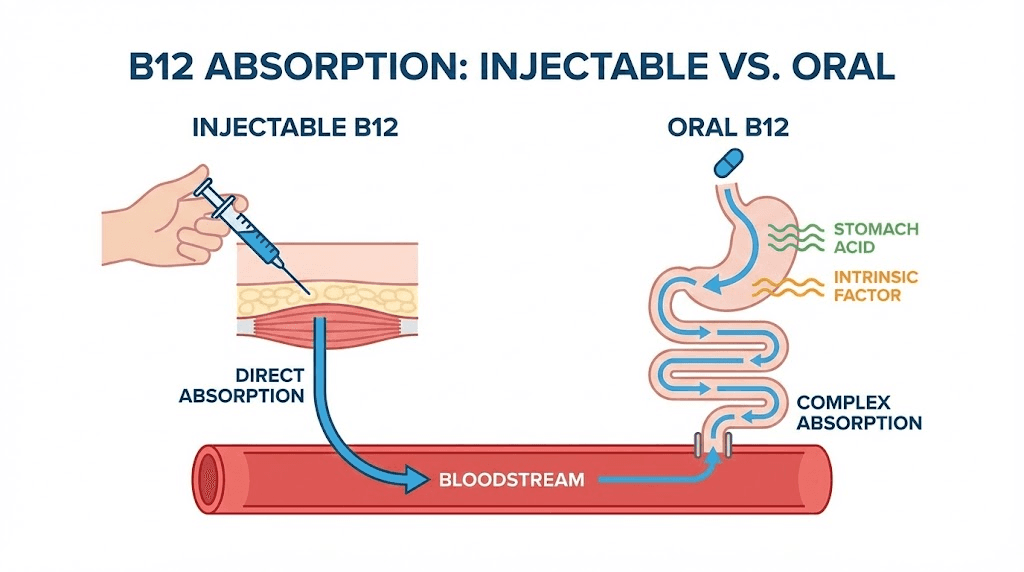
When B12 is compounded directly into the tirzepatide injection, it enters the bloodstream through subcutaneous or intramuscular absorption. This completely bypasses the digestive system, avoiding the very absorption issues that tirzepatide creates. You do not need stomach acid to absorb B12 from an injection. You do not need intrinsic factor. The B12 goes directly where it needs to go.
This is one reason SeekPeptides emphasizes the importance of understanding your compounded formulation. Knowing why each ingredient is there helps you make informed decisions about your protocol and recognize when something looks exactly as it should.
B12 supports energy during caloric restriction
Vitamin B12 is an essential cofactor for cellular energy production. It plays a critical role in converting food into ATP (adenosine triphosphate), the molecule your cells use as fuel. During the significant caloric restriction that often accompanies tirzepatide therapy, maintaining adequate B12 levels helps prevent the profound fatigue that can derail a weight loss program.
Multiple dietary considerations come into play when using GLP-1 medications. B12-rich foods like meat, fish, and dairy might be consumed in smaller quantities due to reduced appetite. Supplementation through the injection addresses this gap proactively rather than waiting for deficiency symptoms to appear.
Who needs to be most careful about B12 monitoring
While adding B12 to tirzepatide provides a baseline level of supplementation, certain groups need to pay extra attention to their B12 status and should discuss more frequent monitoring with their healthcare provider.
People taking metformin
Metformin, commonly prescribed for type 2 diabetes, is independently associated with reduced B12 absorption. If you take both metformin and tirzepatide, your risk of B12 deficiency is compounded (no pun intended). Even with B12 in your tirzepatide injection, you may need additional supplementation or more frequent blood level monitoring.
People over 65
Age-related changes in stomach acid production reduce the ability to absorb B12 from food. Older adults on tirzepatide face a double challenge: reduced dietary intake from the medication and reduced absorption efficiency from aging. The B12 in compounded tirzepatide helps, but may not fully compensate for age-related absorption decline.
People with gastrointestinal conditions
Conditions like celiac disease, Crohn disease, or other malabsorption syndromes already impair B12 absorption. Adding tirzepatide further reduces dietary intake. These individuals benefit most from injectable B12 supplementation, whether through their tirzepatide formulation or separate B12 injections.
People who have had bariatric surgery
Previous bariatric surgery, particularly gastric bypass, permanently alters the digestive anatomy in ways that reduce B12 absorption. Tirzepatide use in post-bariatric patients requires careful nutritional monitoring, and the B12 in compounded formulations provides valuable but potentially insufficient supplementation.
Vegetarians and vegans
Plant-based diets provide little to no naturally occurring B12. If reduced appetite from tirzepatide further decreases the small amount of B12-fortified foods these individuals consume, deficiency can develop rapidly. The injectable route through compounded tirzepatide is especially valuable for this group.
The difference between looking at color and verifying quality
This is perhaps the most important concept in this entire guide. Visual inspection is necessary but insufficient for confirming medication quality. Color tells you some things but cannot tell you everything.
What color can tell you
Color confirms that B12 is present (pink) or absent (clear). It can indicate gross contamination (unexpected colors). It can reveal degradation if the color changes significantly over time. It can show you whether the medication has been exposed to light (B12 color fading). These are valuable screening indicators that take seconds to check.
What color cannot tell you
Color cannot verify the actual concentration of tirzepatide in the vial. It cannot confirm sterility. It cannot prove the medication is free of bacterial endotoxins. It cannot verify that the tirzepatide peptide is structurally intact and biologically active. It cannot confirm the B12 is at the labeled concentration. In short, color cannot replace laboratory testing.
Certificate of Analysis
Reputable compounding pharmacies provide a Certificate of Analysis (COA) for their formulations, either on request or proactively. A COA documents third-party testing of the medication for:
Identity (confirming the medication is what the label says)
Potency (confirming the concentration matches the label)
Sterility (confirming no microbial contamination)
Endotoxin levels (confirming safety for injection)
pH and stability
If your pharmacy cannot or will not provide a COA, consider whether you are comfortable using their products. The SeekPeptides community regularly discusses pharmacy verification and quality markers, helping members identify trustworthy compounding sources.
Beyond-use dating
Even if the color looks perfect, medication that has passed its beyond-use date should not be used. Chemical degradation does not always produce visible changes. A vial that looks pink and clear on day 35 might have significantly reduced potency compared to day 1. Follow the dates on your label strictly. If your pharmacy labeled the vial with a BUD of 28 days and you are on day 29, get a new vial.
What to do if your tirzepatide looks wrong: a step-by-step action plan
You open a new vial or pull your current vial from the fridge, and something looks off. Here is exactly what to do, in order.
Step 1: Do not inject
This is not the time for "it is probably fine" thinking. When it comes to injectable medications, caution is always the right call. Set the vial down.
Step 2: Document what you see
Take multiple photos under good lighting. Photograph the vial against a white background. Photograph it held up to a light. Capture the label clearly, including the lot number and BUD. These photos will be valuable when you contact the pharmacy.
Step 3: Note any changes
Is this a new vial that arrived looking wrong? Or has the color changed since you started using this vial? The answer affects the likely cause. A new vial that looks wrong might indicate a manufacturing or shipping issue. A color change in a vial you have been using might indicate storage problems or contamination from repeated punctures.
Step 4: Contact your pharmacy
Call, do not email (time matters for injectable medications). Describe exactly what you see. Share your photos if possible. Ask whether the appearance matches their quality specifications for that lot. Ask whether other patients have reported similar concerns with the same batch.
Step 5: Request a replacement
Reputable pharmacies will replace suspicious vials without argument. If your pharmacy pushes back on replacing a vial that does not look right, consider whether this is the right pharmacy for your tirzepatide needs.
Step 6: Do not discard until your pharmacy responds
In some cases, the pharmacy may want the vial returned for quality investigation. Keep it refrigerated and set aside until you hear back. If they confirm it should be discarded, follow their instructions for proper disposal.
Step 7: If you already injected and feel unwell
If you used medication that you now realize looked abnormal and you experience any symptoms, including unusual pain at the injection site, redness, swelling, fever, or systemic symptoms like nausea or malaise, contact your healthcare provider. Most injection site reactions from compromised medication are mild and self-limiting, but medical evaluation ensures nothing serious is developing.
Comparing tirzepatide formulations from popular compounding pharmacies
Different compounding pharmacies have developed their own tirzepatide formulations, and the appearance varies based on their specific recipes. Understanding what each pharmacy typically produces helps set accurate expectations.
Pharmacies using B12 formulations
Most major compounding pharmacies that add B12 to their tirzepatide compounds produce solutions in the pink spectrum. The exact shade depends on their B12 concentration. Empower Pharmacy formulations tend to follow standard B12 concentrations, producing a predictable medium pink. Other pharmacies like Strive Pharmacy, Southend Pharmacy, and ProRx each have their own formulation profiles.
Checking your specific pharmacy documentation, the label, or calling directly is always the most reliable way to know what your specific product should look like. Pharmacy-specific guides can also provide reference information about expected appearance and formulation details.
Pharmacies using non-B12 formulations
Some pharmacies compound tirzepatide with glycine alone, without B12. These formulations appear clear and colorless. If you are switching from a B12 pharmacy to a non-B12 pharmacy (or vice versa), the color change will be dramatic but entirely expected. Communicate with your prescriber about which formulation you are receiving so you know what to look for.
Long-term visual monitoring of your tirzepatide
As you continue using tirzepatide over weeks and months, developing a habit of visual monitoring becomes second nature. Here are some practices that experienced users recommend.
Take a reference photo of each new vial
When you receive a new vial, photograph it immediately. This gives you a Day 1 reference point. If the color changes during use, you can compare against your original photo under similar lighting. This is especially useful for multi-dose vials that you will use over 4 weeks.
Note changes in a simple log
You do not need anything elaborate. A note on your phone or a line in a journal works. Record the date, vial lot number, appearance, and anything notable. Over time, this log helps you understand normal variation and quickly spot anything outside your personal baseline.
Compare consistently
Always check your vial under the same lighting conditions. The kitchen fluorescent and the bedroom lamp can make the same vial look like two different colors. Pick one well-lit spot and use it every time.
Trust your instincts
If something looks wrong to you, even if you cannot articulate exactly what, trust that feeling. Your brain is excellent at pattern recognition. If the vial looks different in a way that makes you uncomfortable, calling the pharmacy takes two minutes. The peace of mind is worth it.
For researchers serious about optimizing their tirzepatide protocols, SeekPeptides offers the most comprehensive resource available, with evidence-based guides, proven protocols, and a community of thousands who have navigated these exact questions.
Advanced considerations for tirzepatide color
How tirzepatide concentration affects overall appearance
Tirzepatide itself comes in various concentrations from compounding pharmacies, commonly 5 mg/mL, 10 mg/mL, and 20 mg/mL. Higher tirzepatide concentrations mean smaller injection volumes for the same dose. The tirzepatide peptide itself can contribute a very faint yellowish tint at higher concentrations, though this is usually overwhelmed by the pink from B12 when both are present.
At extremely high concentrations, the solution may appear slightly more viscous (thicker) than at lower concentrations. This does not affect color per se, but can affect how the color appears due to the slightly different light refraction through a denser solution.
Temperature-dependent color shifts
You might notice your tirzepatide looks slightly different when cold (straight from the fridge) versus after it has warmed to room temperature for injection. This is a normal optical phenomenon. Cold solutions can appear slightly more saturated in color, while warmer solutions may look marginally paler. The difference is subtle and does not indicate any chemical change.
Many people allow their tirzepatide to warm slightly before injection to reduce discomfort. A slight color shift during this warming period is expected and harmless.
Vial volume and color perception
Compounded tirzepatide typically comes in multi-dose vials that are not filled to the top. A common configuration is a 5 mL vial containing 0.5 to 2 mL of solution. When looking at a small volume of pale pink liquid in a large clear vial, the color can be harder to perceive than the same liquid in a completely full vial. This is simply because there is less colored liquid for light to pass through. It does not mean the B12 concentration is low or that anything is wrong.
Frequently asked questions
Is it normal for tirzepatide with B12 to be bright pink?
Yes. Bright pink is within the normal range for compounded tirzepatide containing B12, particularly formulations with higher B12 concentrations (0.5 to 1.0 mg/mL). The important factors are clarity (you should see through it) and the absence of particles. Bright pink that is clear and particle-free is safe. Bright pink that is cloudy or contains particles is not. If you receive a brighter pink than expected, confirming the B12 concentration with your pharmacy provides the best reassurance.
My tirzepatide looks different from my friend who uses the same pharmacy. Is that normal?
Often yes. Your friend may be on a different concentration, a different formulation (B12 versus no B12), or even a different batch. Even identical prescriptions can show slight color variation between batches due to normal manufacturing tolerances. Compare the details on your labels before assuming anything is wrong.
Can I tell if my tirzepatide is still good just by looking at the color?
Not entirely. Color is one indicator among several. A medication that looks normal in color could still be past its beyond-use date, contaminated with bacteria you cannot see, or degraded in potency without visible change. Color inspection is a necessary first step but should be combined with checking the BUD, ensuring proper storage conditions have been maintained, and obtaining a COA from your pharmacy.
What if my tirzepatide was pink and now looks clear?
A shift from pink to clear in a B12-containing formulation suggests B12 degradation, most commonly caused by light exposure. The tirzepatide peptide itself may or may not be affected. Contact your pharmacy and describe the change. They will likely recommend replacing the vial, as the degradation that faded the B12 color may have also impacted the peptide stability.
Does the color of tirzepatide affect how well it works?
The pink color from B12 does not affect the effectiveness of tirzepatide for weight loss or blood sugar management. The tirzepatide peptide works the same whether the solution is clear or pink. The B12 provides its own separate benefits for energy and nutrient status, but the color itself has no pharmacological significance.
Should I switch to a non-B12 formulation if the pink color concerns me?
That is a conversation to have with your prescriber. The pink color is cosmetic, not a safety concern. If the color genuinely causes you anxiety every injection, a non-B12 formulation removes that stress. However, you would lose the potential B12 supplementation benefits. Your prescriber can help you weigh both factors and decide whether separate B12 supplementation makes more sense for your situation.
My pharmacy sent tirzepatide labeled with B12 but the liquid is clear. Should I use it?
Contact your pharmacy before using it. If the label says it contains B12 but the solution shows no color, either the B12 concentration is extremely low (possible but unusual), the B12 has degraded (possible if exposed to light), or there was a labeling error (possible at any pharmacy). Do not assume anything. Let the pharmacy investigate and confirm before you inject.
Is the red color in tirzepatide with B12 from blood or dye?
Neither. The color comes from the vitamin B12 molecule itself, specifically the cobalt-containing corrin ring structure. No dyes are added. No blood or blood products are involved. The color is an inherent physical property of vitamin B12 in solution, the same way chlorophyll makes plants green and carotenoids make carrots orange.
External resources
In case I do not see you, good afternoon, good evening, and good night. May your vials stay clear, your colors stay consistent, and your protocols stay effective.