Dec 19, 2025
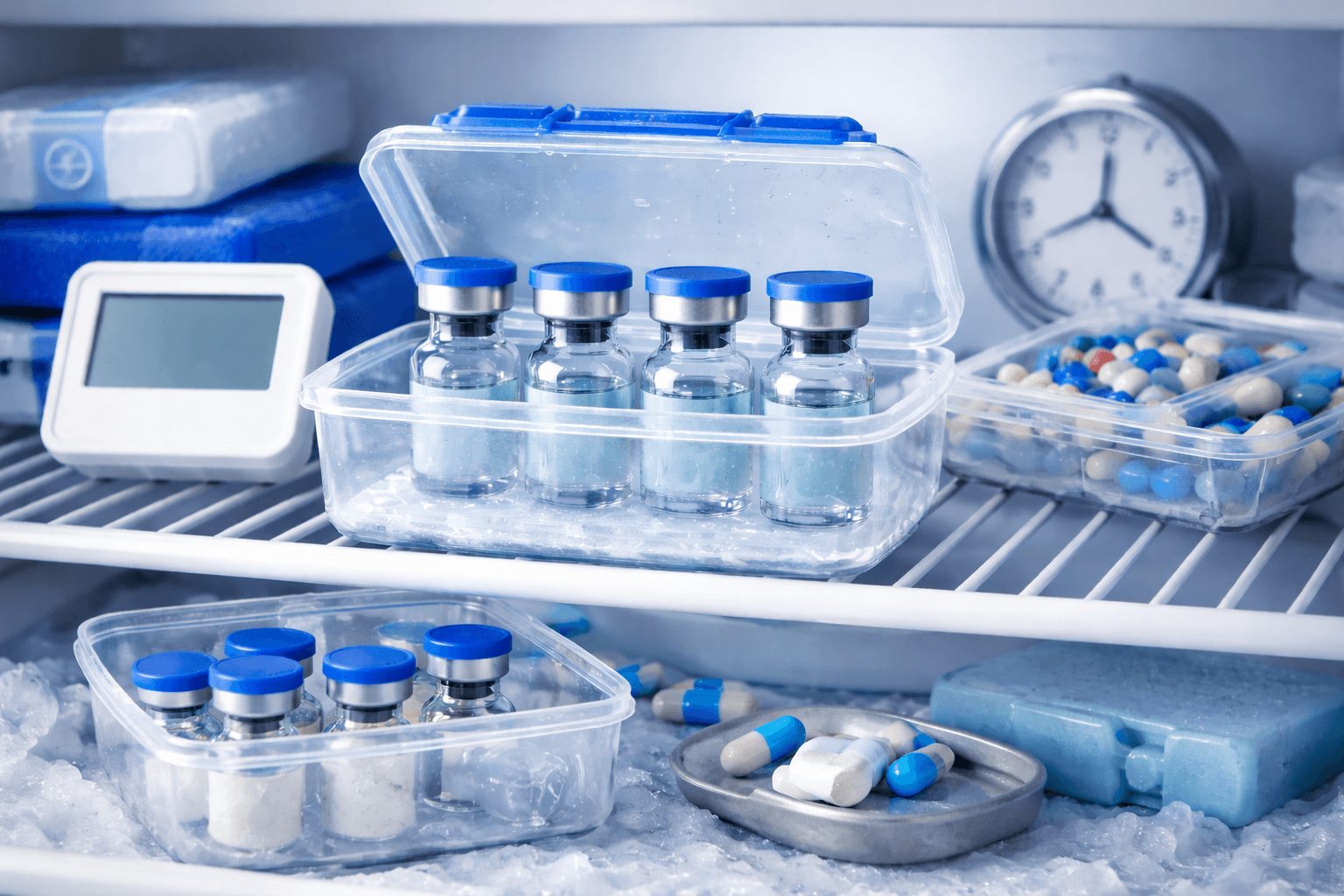
Peptides have different shelf lives depending on their form.
Lyophilized powder lasts 2-3 years when refrigerated.
Once reconstituted, peptides last 28 days with bacteriostatic water.
Proper storage is critical. Poor storage = degraded peptides = wasted money and poor results.
Temperature, light exposure, and water type all affect stability.
This guide covers everything about peptide storage - shelf life, stability factors, optimal conditions, travel tips, and how to tell if peptides have degraded.
Here is a quick storage guide
Before reconstitution (powder)
Storage: Refrigerate at 2-8°C (36-46°F)
Shelf life: 2-3 years when properly stored
Freezer: Can freeze for longer storage (3-5 years)
Room temperature: Survives short periods (days to weeks) but refrigeration preferred
After reconstitution (liquid)
Storage: Refrigerate immediately at 2-8°C
Shelf life: 28 days with bacteriostatic water
Freezer: Not recommended (can damage peptide structure)
Room temperature: Begins degrading within hours, use within days max
Key rules
Always refrigerate reconstituted peptides
Use bacteriostatic water (not sterile water)
Mark reconstitution date on vial
Protect from light (store in box)
Use within 28 days after reconstitution
Never shake vials vigorously
Understanding peptide stability
Why peptides degrade
Chemical breakdown: Peptide bonds can break down over time, especially in liquid form.
Oxidation: Oxygen exposure damages peptide structures.
Bacterial contamination: Without preservatives, bacteria grow in liquid solutions.
Temperature fluctuation: Heat accelerates degradation significantly.
Light exposure: UV light damages peptide molecules.
pH changes: Improper pH causes structural changes.
Learn more about how peptides work.
Lyophilized vs liquid stability
Extremely stable
Water removed = minimal degradation
2-3 years shelf life (refrigerated)
3-5 years (frozen)
Can survive room temp short periods
Liquid (reconstituted):
Much less stable
Degradation begins immediately
28 days max with bacteriostatic water
1-3 days with sterile water
Must stay refrigerated
This is why peptides ship as powder: Stability during shipping, longer shelf life, easier storage.
Never buy pre-mixed liquid peptides - massive red flag for quality.
Shelf life by peptide type
Different peptides have slightly different stability profiles.
Growth hormone peptides
Powder: 2-3 years (refrigerated)
Reconstituted: 28 days
Relatively stable peptide
Powder: 2-3 years (refrigerated)
Reconstituted: 28 days
Very stable due to modifications
GHRP-2/GHRP-6:
Powder: 2-3 years
Reconstituted: 21-28 days
Standard stability
MK-677 (oral):
Tablets/capsules: 2 years at room temperature
No reconstitution needed
Healing peptides
Powder: 2-3 years (refrigerated)
Reconstituted: 28 days
Very stable peptide
Can handle brief room temp exposure
Use our BPC-157 dosage calculator.
Powder: 2-3 years (refrigerated)
Reconstituted: 28 days
Stable peptide
Use our TB-500 dosage calculator.
GHK-Cu:
Powder: 2 years (refrigerated)
Reconstituted: 21 days (slightly less stable)
Sensitive to oxidation
Weight loss peptides
Powder: 2-3 years (refrigerated)
Reconstituted: 28 days
Modified for stability (long half-life)
Tirzepatide:
Powder: 2-3 years
Reconstituted: 28 days
Similar stability to semaglutide
Liraglutide:
Powder: 2 years
Reconstituted: 28 days
General stability ranking
Most stable (easiest to store):
Modified peptides (CJC-1295 DAC, Semaglutide)
Simple sequences (BPC-157)
Average stability:
Most therapeutic peptides
Standard GH peptides
Healing peptides
Less stable (more careful storage):
Copper peptides (GHK-Cu)
Complex longer sequences
Unmodified natural peptides
All still follow same basic storage rules.
Optimal storage conditions
Temperature
Refrigerator (2-8°C / 36-46°F):
Ideal for all peptides
Both powder and reconstituted
Standard refrigerator works
Don't use freezer section for reconstituted
Freezer (-20°C / -4°F):
Optional for powder storage
Extends life to 3-5 years
Useful for long-term stockpiling
Never freeze reconstituted peptides
Room temperature (20-25°C / 68-77°F):
Powder: Survives days to weeks
Reconstituted: Degrades rapidly (hours to days)
Avoid if possible
Emergency only
Heat (>25°C / >77°F):
Accelerates degradation significantly
Powder: Still survives short periods
Reconstituted: Degrades within hours
Never leave in hot car, direct sunlight
Light exposure
Direct light: Damages peptide molecules, especially UV.
Solution: Store in original box or dark container.
Amber vials: Some suppliers use amber (brown) glass for light protection.
Refrigerator door: Keep peptides in back of fridge, not in door (less light exposure, more stable temperature).
Humidity
Low humidity preferred: Moisture can affect powder peptides.
Sealed vials protect: Rubber stoppers keep moisture out.
Condensation risk: When moving peptides from fridge to room temp, condensation can form. Let vials warm to room temp before opening.
Vials
Original vials best: Peptides ship in sterile vials, keep them there.
Rubber stoppers: Maintain sterility, allow multiple punctures.
Vial size: Standard 3ml, 5ml, or 10ml depending on peptide amount.
Never transfer: Don't move peptides to different containers (contamination risk).
Syringes and needles
Storage: Room temperature, in original packaging.
Shelf life: Years if unopened, sterile.
Single use: Never reuse syringes or needles.
Sharps container: For safe disposal after use.
Bacteriostatic water
Before opening: Room temperature, 2-3 year shelf life.
After opening: Refrigerate, use within 28 days.
Multiple vials: Consider buying 30ml bottles (last through full protocol).
Read our complete bacteriostatic water guide.
Coolers for travel
Small medical coolers: For traveling with peptides.
Ice packs: Reusable gel packs maintain 2-8°C.
Insulation: Keeps peptides cool for 12-24 hours.
TSA compliant: Peptides can travel in checked or carry-on bags with proper cooling.
Why bacteriostatic water extends life
Bacteriostatic water contains 0.9% benzyl alcohol:
Prevents bacterial growth
Extends peptide life to 28 days
Industry standard for peptide reconstitution
Sterile water has no preservative:
Bacteria can grow
Peptide degrades rapidly
Use within 1-3 days
Not recommended
This is why we always recommend bacteriostatic: Worth the extra $10-15 for 28-day stability.
Learn how to reconstitute peptides properly.
Reconstitution timing
Don't reconstitute all vials at once: Only reconstitute what you'll use in next 28 days.
Example (BPC-157 protocol):
Need 6 vials for 8-week protocol
Reconstitute vial 1, use for 10 days
Reconstitute vial 2, use for 10 days
Continue until protocol complete
Powder stays stable for years, no rush to reconstitute.
Marking vials
Label each vial after reconstitution:
Reconstitution date
Concentration (e.g., "5mg in 2ml")
Expiration (28 days from recon date)
Sharpie marker: Write directly on vial.
Tape labels: If prefer removable.
Track in log: Note reconstitution dates in journal/app.
How to tell if peptides have degraded
Visual inspection (reconstituted)
Fresh peptide solution should be:
Clear (transparent)
Colorless (or very slight tint)
No particles or cloudiness
No discoloration
Signs of degradation:
Cloudiness or haziness
Yellow or brown tint
Visible particles floating
Crystallization
Oily film on surface
If any of these present: Don't use, peptide has degraded.
Effectiveness loss
Subjective but important:
Results diminishing despite same dose
No change in injury healing progression
Reduced effectiveness compared to fresh vial
This can indicate: Peptide losing potency over time.
Solution: Reconstitute fresh vial, see if results improve.
Smell test
Fresh peptides: Minimal to no odor.
Degraded/contaminated: Foul or unusual smell.
If smells bad: Bacterial contamination likely, discard.
Sterility loss
Signs of contamination:
Cloudiness developing
Smell changes
Visible particles
Color changes
Prevention: Always use sterile technique, alcohol swabs, clean needles.
Storage by protocol length
Short protocols (4-6 weeks)
What you need: 2-4 vials typically
Strategy:
Keep powder vials in fridge
Reconstitute one vial at a time
Use within 28 days
Reconstitute next vial as needed
Simple and safe: Minimal waste, optimal freshness.
Long protocols (8-12 weeks)
What you need: 6-12 vials typically
Strategy:
Store powder vials in fridge or freezer
Plan reconstitution schedule
Mark calendar for vial changes
Calculate exact needs with cost calculator
Bulk buying: Save 10-20% ordering supply upfront.
Stockpiling for future use
Buying ahead:
Take advantage of sales
Ensure supply availability
Stock favorite peptides
Storage:
Keep as powder (don't reconstitute)
Freezer for 3-5 year storage
Fridge for 2-3 year storage
Mark purchase dates
Rotate stock: Use oldest vials first.
About traveling with peptides
Domestic travel
Powder peptides (unreconstituted):
Can travel at room temp for days
Put in checked bag or carry-on
No cooling required for short trips
Refrigerate upon arrival
Reconstituted peptides:
Need cooling (small medical cooler)
Ice packs for 12-24 hours
TSA allows medical supplies
Refrigerate at destination
Syringes and supplies:
Pack in original packaging
TSA allows medical syringes
Carry prescription letter (optional but helpful)
International travel
Check destination laws: Peptide legality varies by country.
Powder preferred: Easier to travel with, no cooling needed.
Consider timing: Maybe wait to start protocol until after trip.
Customs: Research peptides can cause questions, have documentation ready.
Weekend trips
Short trips (2-3 days):
Small cooler with ice pack
Reconstituted peptides stay cold
Bring pre-loaded syringes (use within 24 hours)
Medium trips (4-7 days):
Small medical cooler
Multiple ice packs
Access to fridge at destination
Extended travel
Long trips (weeks):
Don't reconstitute before leaving
Travel with powder vials
Buy bacteriostatic water at destination
Reconstitute after arrival
Bulk storage strategies
Buying in bulk
Cost savings: 10-20% discount on 10+ vials
Supply security: Ensure availability
Long-term storage: Powder stable for years
Calculate needs: Use peptide cost calculator
Freezer storage
For powder only (never reconstituted):
-20°C or colder
3-5 year stability
Vacuum-sealed vials
Minimal moisture exposure
Thawing:
Move to fridge day before use
Let warm to room temp before opening
Prevents condensation
Never microwave to thaw
Organization system
Label everything:
Peptide name
Batch number
Purchase date
Expiration date
Organize by type:
Healing peptides together
GH peptides together
Weight loss peptides together
Track inventory:
Spreadsheet or app
Note when vials used
Reorder before running out
Common storage mistakes
Using sterile water instead of bacteriostatic
Problem: Peptide only lasts 1-3 days.
Reality: Bacterial growth without preservative.
Solution: Always use bacteriostatic water.
Leaving reconstituted peptides at room temp
Problem: Rapid degradation.
Reality: Loses significant potency within hours to days.
Solution: Refrigerate immediately after reconstitution, always return to fridge between uses.
Freezing reconstituted peptides
Problem: Ice crystals damage peptide structure.
Reality: May reduce effectiveness significantly.
Solution: Never freeze reconstituted peptides. Only freeze powder.
Shaking vials vigorously
Problem: Can damage peptide structure.
Reality: Peptides are delicate molecules.
Solution: Gentle swirling only, never shake hard.
Reconstituting too many vials at once
Problem: Excess peptides expire before use (28-day window).
Reality: Wasted money and peptides.
Solution: Reconstitute one vial at a time, as needed.
No temperature monitoring
Problem: Don't realize fridge failed or temp fluctuated.
Reality: Peptides may have degraded without knowing.
Solution: Cheap fridge thermometer ($5), check regularly.
Exposing to light
Problem: UV light damages peptides.
Reality: Gradual potency loss.
Solution: Store in original box or opaque container.
Storage by peptide category
Healing peptides
Very stable
Powder: 2-3 years refrigerated
Reconstituted: Full 28 days
Can handle brief room temp
Stable peptide
Same storage as BPC-157
Reconstitute as needed
GHK-Cu:
Slightly less stable (copper complex)
Use within 21 days after reconstitution
Protect from light more carefully
Oxidation sensitive
Compare BPC-157 vs TB-500 protocols.
Growth hormone peptides
Standard stability
28 days reconstituted
Multiple daily doses (use vial faster)
Very stable (modified peptide)
Full 28 days reliability
Less temperature sensitive
GHRP-2/GHRP-6:
Standard stability
Use within 28 days
No special requirements
Weight loss peptides
Modified for stability
Full 28 days after reconstitution
Once weekly dosing = vial lasts longer
Tirzepatide:
Similar stability to semaglutide
Long half-life peptide
Stable for full 28 days
Compare semaglutide vs tirzepatide.
Emergency scenarios
Power outage
Powder peptides: Can survive days to weeks at room temp, will be fine.
Reconstituted peptides:
Use within 24 hours if fridge fails
If longer outage, consider discarding
Room temp = rapid degradation
Prevention: Small battery-powered cooler, ice packs.
Accidentally frozen
Powder: Perfectly fine, freezing actually extends life.
Reconstituted:
May be damaged
Visual inspection for crystals
If looks clear, might still work but potency uncertain
Consider reconstituting fresh vial
Left in hot car
Powder:
Hours: Probably fine
Days: Likely degraded
Visual inspection won't help
Effectiveness test only way to know
Reconstituted:
Likely degraded significantly
Discard and reconstitute fresh
Dropped and shattered
Safety first: Clean up carefully, glass hazard.
Peptide loss: Can't salvage, need new vial.
Prevention: Store peptides in back of fridge, stable surface.
Contamination suspected
Signs: Cloudiness, smell, particles.
Action: Discard immediately, don't risk infection.
Prevention: Sterile technique, alcohol swabs, clean needles.
Frequently asked questions
Q: How long do peptides last in powder form?
A: 2-3 years when refrigerated. 3-5 years when frozen. Lyophilized peptides are very stable.
Q: How long after reconstitution?
A: 28 days with bacteriostatic water. Only 1-3 days with sterile water. Always refrigerate.
Q: Can I freeze reconstituted peptides?
A: No. Ice crystals damage peptide structure. Only freeze powder. Refrigerate reconstituted peptides.
Q: What happens if I use expired peptides?
A: Reduced effectiveness, not dangerous. Peptides degrade (lose potency) but don't become toxic. Just won't work as well.
Q: How can I tell if peptides are still good?
A: Reconstituted should be clear, colorless, no particles. If cloudy, discolored, or smells bad - discard. Powder harder to tell - test by using.
Q: Can peptides survive shipping?
A: Yes. Ships as powder, stable at room temp for days. Reputable vendors use proper packaging. Refrigerate upon arrival.
Q: Should I store peptides in freezer or fridge?
A: Fridge sufficient for powder (2-3 years). Freezer optional for longer storage (3-5 years). Always refrigerate reconstituted, never freeze.
Q: What's the shelf life of BPC-157?
A: Powder: 2-3 years refrigerated. Reconstituted: 28 days. Very stable peptide. Use our BPC-157 calculator.
Q: Do I need special storage equipment?
A: No. Standard refrigerator works. Optional: small medical cooler for travel, fridge thermometer, storage labels.
Q: Can I travel with peptides?
A: Yes. Powder travels easily (no cooling needed). Reconstituted needs small cooler with ice packs. TSA allows medical supplies. Check destination laws for international.
The bottom line
Peptide storage is straightforward: refrigerate everything, use bacteriostatic water, reconstitute one vial at a time.
Key storage rules:
Powder: Refrigerate (2-3 years) or freeze (3-5 years)
Reconstituted: Refrigerate immediately, use within 28 days
Bacteriostatic water: Always (not sterile water)
Light: Protect from direct exposure
Temperature: Keep cold, avoid heat
Shelf life summary:
Lyophilized powder: 2-3 years (fridge) or 3-5 years (freezer)
Reconstituted with bacteriostatic water: 28 days
Reconstituted with sterile water: 1-3 days (not recommended)
Smart storage practices:
Reconstitute one vial at a time
Mark reconstitution date on vial
Keep in original vials
Store in back of fridge
Never shake vigorously
Discard if cloudy, discolored, or smells bad
Planning your supply:
Source quality peptides from reputable vendors and store properly for maximum effectiveness.
Related resources
In case I don’t see you, good afternoon, good evening, and good night. Take care of yourself.