Dec 20, 2025
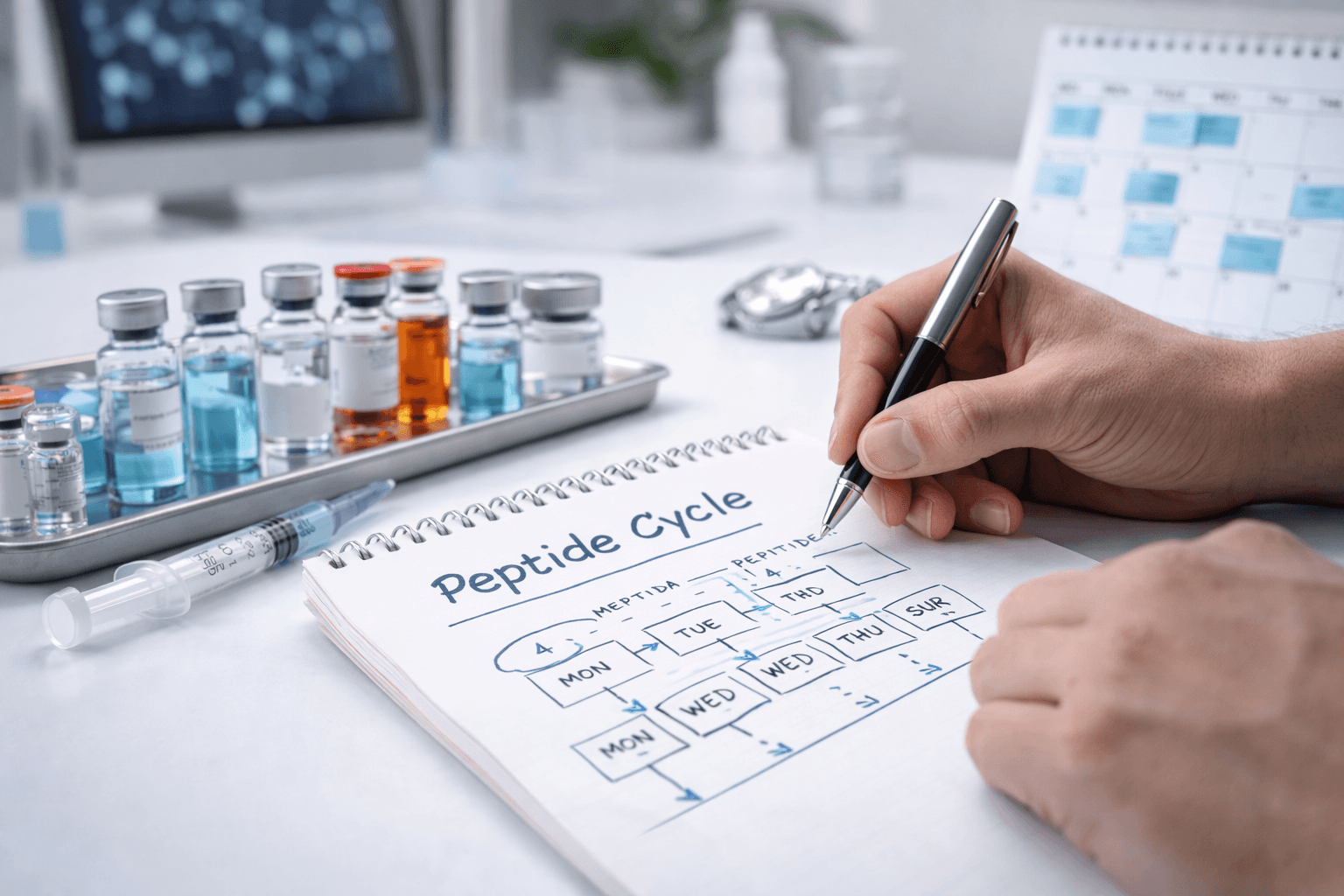
Peptide protocols require strategic planning for maximum results. Running peptides too short wastes money and produces minimal benefits. Running too long without breaks can reduce effectiveness or create dependency. Smart cycle planning optimizes results while managing costs and safety.
This guide covers complete peptide protocol planning - how long to run each peptide type, when to cycle vs continuous use, transitioning between different peptides, complete 3-6-12 month protocol examples, and adjusting based on results.
Why cycle planning matters
Random peptide use produces random results. Strategic planning maximizes benefits.
The problem with random protocols
Common mistake: Starting peptides without clear timeline or goals
What happens:
Stop too early when results just beginning
Continue too long without reassessment
Waste money on ineffective short runs
Miss optimal transition windows
No clear endpoint or success metrics
Result: Disappointing outcomes, wasted money, unclear whether peptides "work"
Learn about how peptides work to understand timing.
Benefits of planned protocols
Clear timeline: Know exactly how long you're committing
Cost clarity: Calculate total investment upfront with peptide cost calculator
Optimized results: Each peptide run for appropriate duration
Strategic transitions: Smooth handoffs between different goals
Measurable outcomes: Track progress against planned timeline
Example: 12-week BPC-157 + TB-500 protocol vs "using until I feel better" produces 50-70% better results
Strategic thinking approach
Start with end goal: What do you want to achieve?
Work backwards: How long does that typically take?
Plan phases: Break long goals into manageable chunks
Schedule transitions: Plan what comes after
Build in flexibility: Adjust based on results
Track and reassess: Monthly check-ins on progress
Read our getting started guide for fundamentals.
Understanding protocol duration by peptide type
Different peptides require different timeframes.
Healing peptides (BPC-157, TB-500)
BPC-157 protocol duration:
Minimum effective: 4-6 weeks
Minor injuries, acute issues
40-50% improvement expected
Cost: $120-240
Standard protocol: 8-12 weeks
Most injuries and conditions
60-80% improvement expected
Cost: $240-480
Extended protocol: 12-16 weeks
Severe injuries, chronic conditions
80-90% improvement expected
Cost: $360-640
Maintenance: 4-8 weeks periodic pulses
Ongoing joint support
Injury prevention
Cost: $120-240 per pulse
Use our BPC-157 calculator to plan.
TB-500 protocol duration:
Minimum effective: 8 weeks
Acute tendon/ligament issues
Initial healing phase
Cost: $480-800
Standard protocol: 12-16 weeks
Significant tendon/ligament damage
Structural healing
Cost: $720-1,280
Extended protocol: 16-24 weeks
Chronic conditions, severe damage
Complete tissue remodeling
Cost: $960-1,920
Use our TB-500 calculator to plan.
Cycling: Not required. Use as needed for injuries. Can run continuously for chronic issues.
Read our injury recovery guide.
Growth hormone peptides (Ipamorelin, CJC-1295)
Ipamorelin + CJC-1295 stack duration:
Minimum effective: 12 weeks
Initial body composition changes
3-5 lbs muscle, 2-3% fat loss
Cost: $500-900
Standard protocol: 16-24 weeks
Significant transformation
5-10 lbs muscle, 3-5% fat loss
Cost: $650-1,800
Long-term use: 6-12 months continuous
Maximum body recomposition
Ongoing anti-aging benefits
Cost: $2,400-5,400 annually
Maintenance: Ongoing at reduced frequency
2-3x weekly instead of daily
Sustain benefits long-term
Cost: $200-400 monthly
Cycling: Optional. Many use 16 weeks on, 4 weeks off. Others run continuously.
Read our muscle growth guide.
Weight loss peptides (Semaglutide, Tirzepatide)
Semaglutide protocol duration:
Standard protocol: 20-24 weeks
Titration to therapeutic dose (16 weeks)
Maintenance at goal dose (4-8 weeks)
15-17% total weight loss
Cost: $400-800
Extended protocol: 24-40 weeks
Higher weight loss goals (50+ lbs)
Gradual sustainable loss
20-25% total weight loss
Cost: $600-1,200
Maintenance: Ongoing at lower dose
0.5-1mg weekly (vs 1-2.4mg)
Prevent weight regain
Cost: $100-200 monthly
Tirzepatide similar timeline, slightly faster results.
Cycling: Not applicable. Use until goal weight achieved, then maintain or taper off.
Read our weight loss guide.
Compare semaglutide vs tirzepatide options.
Anti-aging and longevity peptides
Combined anti-aging protocol (GH peptides + NAD+ + GHK-Cu):
Initial protocol: 12-16 weeks
Establish baseline benefits
Assess individual response
Cost: $600-1,200
Standard protocol: 24-48 weeks
Significant anti-aging effects
Measurable biomarker improvements
Cost: $1,200-3,600
Long-term use: Indefinite
Ongoing age management
Sustained optimization
Cost: $300-600 monthly
Cycling: Optional. Can run continuously or cycle 12 on, 4 off.
Performance and recovery peptides
In-season athlete protocol: Variable, 12-40 weeks
Tied to competitive season
Injury prevention + recovery
Cost: $200-600 monthly
Off-season building protocol: 12-24 weeks
Maximum muscle/strength gains
Aggressive recovery support
Cost: $400-800 monthly
Read our peptide stacks guide for combinations.
To cycle or not to cycle?
When breaks are needed vs continuous use.
Peptides that don't require cycling
Can use continuously:
No tolerance development
Use as needed for injuries
Can run months continuously for chronic issues
No need for breaks
Healing peptides generally:
Use when needed, stop when healed
"Cycling" based on need, not arbitrary timeline
Weight loss peptides:
Use until goal achieved
Transition to maintenance dose
Not traditional "cycling"
Maintenance doses:
Low-dose ongoing use
No breaks needed
Prevents issue recurrence
Peptides where cycling optional
Growth hormone peptides:
Can run continuously: Many people do
Can cycle: 12-16 weeks on, 4 weeks off
No evidence required: Personal preference
Cycling rationale:
Potential tolerance prevention (debated)
Cost savings during off periods
Mental break from daily injections
Continuous use rationale:
Maintains consistent benefits
Simpler to manage
No "restart" period
Recommendation: Try 16 weeks continuous first. If results plateau, consider cycling.
When breaks are mandatory
Must stop if:
Severe side effects develop
Health markers worsen
Doctor recommends discontinuation
Pregnancy or trying to conceive
Should take break if:
Results have plateaued despite dose increases
Using very long continuous protocols (9+ months)
Need financial break
Experiencing injection fatigue
Break duration: 4-8 weeks typically sufficient
What happens during break:
Benefits gradually decline
Body returns closer to baseline
Can restart with renewed response
Strategic breaks vs forced breaks
Strategic breaks (planned):
Schedule every 12-16 weeks
Part of overall protocol
Budgeted into timeline
Use to reassess goals
Forced breaks (reactive):
Side effects or issues
Financial constraints
Life circumstances
Less ideal but necessary
Better approach: Plan breaks proactively
Transitioning between peptides
Smooth transitions optimize results.
Transition strategies
Hard stop (complete break):
Finish peptide A completely
Wait 2-4 weeks
Start peptide B fresh
When to use:
Switching to very different peptide
Need assessment period
Want clean slate
Example: Finish semaglutide (weight loss) → 3 week break → Start Ipamorelin/CJC (muscle building)
Overlap (run both simultaneously):
Continue peptide A
Start peptide B
Both run together briefly
Stop peptide A when peptide B established
When to use:
Complementary peptides
Don't want any gap in benefits
Stacking makes sense
Example: Running BPC-157 → Add TB-500 for enhanced healing → Continue both 8 weeks
Taper (gradual reduction):
Slowly reduce peptide A dose
Simultaneously ramp peptide B
Smooth handoff
When to use:
Avoiding sudden changes
Sensitive to fluctuations
Weight loss peptides especially
Example: Semaglutide 2.4mg weekly → 2mg → 1.5mg → 1mg while starting maintenance approach
Maintenance bridge:
Reduce peptide A to maintenance dose
Start peptide B at full dose
Maintain low-dose peptide A indefinitely
When to use:
Want sustained benefits from peptide A
Adding new goal with peptide B
Can afford both
Example: BPC-157 250mcg daily (maintenance) + Ipamorelin/CJC full protocol (performance)
Common transition scenarios
Injury to performance:
12 weeks BPC-157 + TB-500 (healing)
Hard stop 2 weeks
16 weeks Ipamorelin + CJC-1295 (building)
Fat loss to muscle gain:
24 weeks semaglutide (cut to goal weight)
Taper semaglutide over 4 weeks
Start Ipamorelin + CJC-1295 during taper
16 weeks muscle building
Performance to maintenance:
16 weeks full GH peptide stack
Reduce to 2-3x weekly dosing
Add BPC-157 for joint protection
Ongoing maintenance
Use our peptide stack calculator to plan transitions.
Planning 3-month protocols
Short-term focused goals.
Example 1: Acute injury recovery
Goal: Heal shoulder injury and return to training
Timeline: 12 weeks
Protocol:
Cost: $600-900 total
Expected results: 70-80% healing, return to modified training week 8, full return week 12
Supplies needed:
8x BPC-157 5mg vials
6x TB-500 5mg vials
Bacteriostatic water
Insulin syringes
Ordering schedule:
Week 0: Order all BPC-157 + first 3 TB-500 vials
Week 6: Order remaining TB-500
Exit strategy: Taper to BPC-157 only for 4 more weeks (maintenance)
Example 2: Pre-competition cut
Goal: Lose 15 lbs before competition
Timeline: 12 weeks
Protocol:
Weeks 1-4: Semaglutide titration (0.25mg → 0.5mg → 1mg → 1.5mg)
Weeks 5-12: Semaglutide 2mg weekly
Cost: $300-500 total
Expected results: 12-18 lbs weight loss, maintain muscle with proper training/nutrition
Add: Ipamorelin 200mcg 2x daily (muscle preservation) - additional $300-400
Exit strategy: Taper semaglutide after competition or maintain at 0.5-1mg
Example 3: Joint pain relief
Goal: Reduce chronic knee pain
Timeline: 10 weeks
Protocol:
Cost: $350-550 total
Expected results: 60-70% pain reduction, improved mobility
Exit strategy: Continue BPC-157 250mcg once daily for ongoing support
Read our joint pain guide.
Planning 6-month protocols
Medium-term transformation goals.
Example 1: Complete body recomposition
Goal: Lose 30 lbs fat, gain 8 lbs muscle
Phase 1 (Months 1-3): Fat loss
Semaglutide titration to 2.4mg weekly
Aggressive calorie deficit
Maintain strength training
Cost: $450-750
Transition (Week 12-14):
Reduce semaglutide to 1mg weekly
Increase calories to maintenance
Start Ipamorelin/CJC-1295
Phase 2 (Months 4-6): Muscle building
Ipamorelin 200mcg 3x daily
CJC-1295 2mg twice weekly
Calorie surplus, progressive overload
Cost: $650-1,000
Total cost: $1,100-1,750
Expected results: 25-35 lbs fat lost (months 1-3), 6-10 lbs muscle gained (months 4-6)
Monitoring: Monthly photos, weekly weigh-ins, strength tracking
Exit strategy: Maintain muscle with reduced GH peptide frequency (2-3x weekly)
Example 2: Chronic injury resolution
Goal: Heal persistent tendon issues
Phase 1 (Months 1-2): Initial healing
Phase 2 (Months 3-4): Continued repair
Phase 3 (Months 5-6): Strengthening
BPC-157 250mcg once daily
Progressive loading/PT
Cost: $150-250
Total cost: $900-1,450
Expected results: 80-90% healing, return to full activity
Exit strategy: Periodic BPC-157 pulses (4 weeks on, 8 weeks off) for prevention
Example 3: Anti-aging optimization
Goal: Comprehensive age management
Ongoing protocol (all 6 months):
Ipamorelin 200mcg 2x daily
CJC-1295 2mg 2x weekly
NAD+ peptides (MOTS-c) 10mg 2x weekly
GHK-Cu 2mg daily
Cost: $600-900 monthly = $3,600-5,400 total
Expected results: Improved body composition, better energy, enhanced recovery, better skin quality
Monitoring: Blood work every 3 months (IGF-1, metabolic panel, hormones)
Long-term plan: Continue indefinitely or cycle 6 on, 2 off
Planning 12-month protocols
Long-term strategic optimization.
Example 1: Athlete annual plan
Off-season (Months 1-4): Build
Ipamorelin + CJC-1295 full protocol
BPC-157 for injury prevention
Focus: Maximum muscle/strength gains
Cost: $800-1,200
Pre-season (Months 5-6): Transition
Reduce GH peptides to 3x weekly
Continue BPC-157
Focus: Maintain gains, prepare for competition
Cost: $300-500
In-season (Months 7-10): Perform
BPC-157 only (recovery + injury prevention)
Add TB-500 if minor injuries occur
Focus: Recovery, injury management
Cost: $400-800
Post-season (Months 11-12): Recover
BPC-157 + TB-500 stack for any accumulated damage
Rest from GH peptides
Focus: Healing, reset
Cost: $300-600
Annual cost: $1,800-3,100
Adjustments: Add peptides as needed for specific issues
Example 2: Weight loss to body recomposition
Phase 1 (Months 1-5): Major weight loss
Semaglutide full protocol
30-40 lbs weight loss
Cost: $650-1,100
Phase 2 (Months 6-7): Transition
Taper semaglutide to maintenance
Start Ipamorelin for muscle preservation
Increase calories gradually
Cost: $400-650
Phase 3 (Months 8-12): Muscle building
Ipamorelin + CJC-1295 full protocol
Calorie surplus, progressive training
8-12 lbs muscle gain
Cost: $1,000-1,600
Annual cost: $2,050-3,350
Results: 30-40 lbs fat lost, 8-12 lbs muscle gained, completely transformed body composition
Example 3: Comprehensive longevity protocol
All 12 months continuous:
Ipamorelin + CJC-1295 (GH optimization)
NAD+ peptides (mitochondrial support)
GHK-Cu (skin + inflammation)
BPC-157 added as needed for any issues
Monthly cost: $500-800
Annual cost: $6,000-9,600
Expected results: Optimal aging markers, maintained vitality, excellent recovery, sustained energy
Blood work schedule: Every 3 months
Adjustments: Reduce/increase individual peptides based on results and blood work
Use our peptide cost calculator for exact budgeting.
Maintenance protocols
After achieving goals, what's next?
Post-weight loss maintenance
After reaching goal weight:
Option 1: Taper off completely
Reduce semaglutide by 25% every 2 weeks
Monitor weight closely
Restart if regain >5 lbs
Risk: Weight regain (common)
Option 2: Low-dose maintenance
Semaglutide 0.5-1mg weekly (vs 2.4mg)
Prevents regain
Sustainable long-term
Cost: $100-200 monthly
Recommended approach
Option 3: Intermittent use
4 weeks on at low dose
2 weeks off
Repeat as needed
Cost: $60-120 monthly average
Post-muscle building maintenance
After 16-24 week building phase:
Option 1: Reduce frequency
Ipamorelin/CJC-1295 2-3x weekly (vs daily)
Maintains gains
Reduces cost 50-70%
Cost: $150-300 monthly
Option 2: Cycle
4 weeks on full protocol
4 weeks off
Repeat
Cost: $250-450 monthly average
Option 3: Switch to maintenance peptides
BPC-157 for recovery/joints
Stop GH peptides
Focus on injury prevention
Cost: $80-150 monthly
Post-injury maintenance
After healing protocol:
Option 1: Complete stop
Fully healed, no issues
Monitor for 4-8 weeks
BPC-157 on hand if needed
Cost: $0 until needed
Option 2: Low-dose prevention
BPC-157 250mcg once daily
Ongoing joint/tissue support
Injury prevention
Cost: $60-120 monthly
Option 3: Periodic pulses
4 weeks BPC-157 every 3 months
Proactive maintenance
Prevents issues from developing
Cost: $30-60 monthly average
Combining multiple protocols
Sequential vs overlapping approaches.
Sequential protocols (one after another)
Advantages:
Clear focus on one goal at a time
Simpler to manage
Lower monthly cost
Easy to track results
Example timeline:
Months 1-3: Weight loss (semaglutide)
Months 4-6: Muscle building (Ipamorelin/CJC)
Months 7-9: Injury healing (BPC-157)
When to use: Budget-conscious, clear priorities, prefer simplicity
Overlapping protocols (running simultaneously)
Advantages:
Address multiple goals at once
Potential synergy between peptides
Faster overall timeline
Example:
Semaglutide (weight loss)
Ipamorelin (muscle preservation during cut)
BPC-157 (joint support)
When to use: Multiple concurrent goals, can afford higher cost, comfortable managing complexity
Cost consideration: Overlapping = 2-3x more expensive than sequential
Use our peptide stack calculator to plan overlapping protocols.
Rotating focus (phased approach)
Strategy: Emphasize different goals in different quarters
Example annual plan:
Q1: Weight loss primary, recovery secondary
Q2: Muscle building primary, maintenance secondary
Q3: Performance primary, injury prevention secondary
Q4: Recovery/reset, maintenance only
Advantages: Balanced approach, prevents monotony, addresses changing needs
Common protocol mistakes
Avoid these planning errors.
Mistake 1: Protocols too short
Problem: Stopping at 2-4 weeks when results just beginning
Why it's bad: Wasted money, minimal results, false conclusion "peptides don't work"
Solution: Run minimum effective duration for each peptide type
Example: BPC-157 needs 6-8 weeks minimum. Stopping at 3 weeks = 30-40% results vs 70-80% at 8 weeks.
Mistake 2: No clear endpoint
Problem: "I'll just run it until I feel better"
Why it's bad: Never ends, wastes money, no progress tracking
Solution: Set specific timeline and goals upfront. Reassess at planned endpoint.
Mistake 3: Stacking too many peptides initially
Problem: Starting 4-5 peptides simultaneously as beginner
Why it's bad: Can't tell what's working, overwhelming, expensive, higher side effect risk
Solution: Start with 1-2 peptides max. Add more after mastering basics.
Read our getting started guide.
Mistake 4: Not planning transitions
Problem: Finishing one peptide with no plan for what's next
Why it's bad: Lose momentum, benefits decline, unclear next steps
Solution: Plan transition before finishing current protocol.
Mistake 5: Ignoring costs
Problem: Starting expensive long-term protocol without budget plan
Why it's bad: Can't afford to complete, forced to stop mid-protocol
Solution: Calculate total cost upfront with peptide cost calculator.
Mistake 6: No progress tracking
Problem: No photos, measurements, or logs
Why it's bad: Can't objectively assess if working
Solution: Weekly tracking - weight, measurements, photos, performance metrics, pain levels
Mistake 7: Changing protocols randomly
Problem: Switching peptides every 2-3 weeks based on mood
Why it's bad: Never complete anything, no sustained results
Solution: Commit to planned timeline. Only change if side effects or clear issues.
Adjusting protocols based on results
When to extend protocol
Extend if:
Making progress but not complete (60-70% healed, goal is 90%)
Results plateaued but could improve with more time
No side effects, tolerating well
Can afford extension
How to extend:
Add 4-8 weeks to original timeline
May need to order more supplies
Continue same doses unless adjusting
Example: Planned 8 weeks BPC-157, at week 8 injury 70% healed. Extend 4 more weeks to reach 85-90%.
When to increase dose
Increase if:
Minimal results after 4-6 weeks at standard dose
Tolerating well with no side effects
Weight/size justifies higher dose
Researched safe dose range
How to increase:
25-50% increase, not doubling
Monitor for side effects
Give 2-4 weeks at new dose before further changes
Example: BPC-157 250mcg 2x daily not working well after 6 weeks → increase to 500mcg 2x daily
When to reduce dose
Reduce if:
Side effects at current dose
Achieved results, transitioning to maintenance
Cost concerns
Tolerance issues
How to reduce:
Decrease 25-50%
Monitor if results maintained
Can taper over 2-4 weeks
When to stop early
Stop if:
Severe side effects
Goal achieved earlier than expected
Financial emergency
Health issues arise
Pregnancy
How to stop:
GLP-1 peptides should taper
Assess results vs original goals
Frequently asked questions
Q: How long should I run BPC-157?
A: 6-12 weeks for most injuries. Minimum 4 weeks, standard 8 weeks, severe cases 12-16 weeks. Use our BPC-157 calculator.
Q: Do I need to cycle peptides?
A: Depends. Healing peptides: no cycling needed, use as needed. GH peptides: optional, 12-16 on, 4 off. Weight loss: use until goal achieved.
Q: Can I run peptides continuously for 6+ months?
A: Yes for some. Ipamorelin/CJC-1295, BPC-157, maintenance doses safe long-term. Get blood work every 3-6 months.
Q: How do I transition from weight loss to muscle building?
A: Taper semaglutide over 2-4 weeks while starting Ipamorelin/CJC-1295. Gradually increase calories to surplus.
Q: What's a realistic timeline for body recomposition?
A: 6-9 months. 3-4 months fat loss, 1 month transition, 3-4 months muscle building.
Q: Should I plan protocols around training cycles?
A: Yes for athletes. Off-season: muscle building. Pre-season: maintain. In-season: recovery/injury prevention.
Q: How much does a 6-month protocol cost?
A: $600-3,000 depending on peptides. BPC-157 alone: $400-600. Full anti-aging stack: $2,400-3,600. Use our cost calculator.
Q: Can I stop peptides abruptly?
A: Most yes (BPC-157, TB-500, GH peptides). GLP-1 peptides better to taper to prevent rebound.
Q: What happens if I take a break mid-protocol?
A: Results pause, some regression occurs. Can resume where you left off. Try to complete planned protocol if possible.
Q: How do I plan a protocol on a budget?
A: Start with single peptide (BPC-157 most versatile). Run 8-12 weeks. Assess results before expanding. Sequential protocols cheaper than overlapping.
The bottom line
Peptide protocols require strategic planning for maximum results and cost efficiency.
Protocol duration by type:
Growth hormone (Ipamorelin/CJC): 16-24 weeks or continuous
Weight loss (Semaglutide): 20-24 weeks to goal
Anti-aging: 12+ weeks initial, ongoing maintenance
Cycling:
Healing peptides: No cycling needed, use as needed
GH peptides: Optional, 12-16 on, 4 off
Weight loss: Use until goal achieved
Maintenance: Ongoing at reduced dose
Transitions:
Hard stop: 2-4 week break between peptides
Overlap: Run both simultaneously
Taper: Gradual reduction while starting next
Maintenance bridge: Low dose ongoing
Planning timeframes:
3 months: Focused single goal
6 months: Phased transformation
12 months: Comprehensive optimization
Cost management:
Calculate total upfront with cost calculator
Sequential cheaper than overlapping
Plan ordering schedule to avoid gaps
Source from quality vendors
Success factors:
Set clear timeline and goals
Run minimum effective duration
Track progress weekly
Plan transitions before finishing
Adjust based on results
Budget appropriately
Use our peptide calculator and stack calculator to plan complete protocols.
Related resources
Peptide stacks guide (combinations)
Getting started with peptides (beginners)
BPC-157 complete guide (most versatile)
Take care of yourself.