Feb 10, 2026
Switching from semaglutide to tirzepatide is not a simple milligram-to-milligram swap. The two medications target different receptor pathways, carry different potencies, and demand completely different titration schedules. Get the conversion wrong and you risk weeks of unnecessary nausea, stalled progress, or worse. Get it right, and the transition can reignite weight loss that plateaued months ago.
That is exactly why a proper conversion chart matters. Not a generic table copied from a drug label, but a practical reference that accounts for compounded formulations, real-world switching timelines, and the nuances that clinical trials rarely capture. Thousands of people make this switch every month. Some breeze through it. Others spend weeks battling gastrointestinal side effects because nobody told them the first four weeks require patience, not panic.
This guide breaks down every dose equivalency, every titration step, and every practical consideration for converting from semaglutide to tirzepatide. Whether you are on branded Ozempic switching to Mounjaro, or moving between compounded semaglutide and compounded tirzepatide, the conversion logic remains the same. The charts ahead will give you the exact reference points you need, along with the context to use them correctly. SeekPeptides has compiled this from clinical trial data, prescribing guidelines, and practical switching protocols used by weight management providers nationwide.
Why semaglutide and tirzepatide are not interchangeable at equal doses
The fundamental reason you cannot simply swap milligrams comes down to receptor pharmacology. Semaglutide activates one receptor. Tirzepatide activates two.
Semaglutide is a pure GLP-1 receptor agonist. It mimics the incretin hormone glucagon-like peptide-1, which your gut naturally releases after eating. That single receptor activation slows gastric emptying, reduces appetite through hypothalamic signaling, and improves insulin sensitivity in peripheral tissues. Effective, proven, and responsible for the weight loss results that made Ozempic and Wegovy household names.
Tirzepatide does all of that and adds a second mechanism. As a dual GIP/GLP-1 receptor agonist, it simultaneously activates glucose-dependent insulinotropic polypeptide receptors. This is not a minor addition. GIP receptors are expressed throughout adipose tissue, the pancreas, and the central nervous system. When activated alongside GLP-1 receptors, the combined signaling produces synergistic effects on appetite suppression, fat metabolism, and glucose regulation that exceed what either pathway achieves alone.
In vitro studies confirm this synergy. Tirzepatide produces a cAMP response in human pancreatic beta cells that is significantly higher than what GLP-1 or GIP stimulation achieves independently. That amplified cellular response translates directly into clinical outcomes, which is why tirzepatide outperforms semaglutide at comparable dose tiers in every head-to-head comparison published to date.
The pharmacokinetic profiles differ as well. Semaglutide has a half-life of approximately 7 days. Tirzepatide has a mean half-life of roughly 5 days, though its sustained receptor binding and accumulation with repeated dosing create effective coverage across the full weekly dosing interval. Both medications reach steady-state concentrations after approximately 4 to 5 weeks of consistent dosing, which is why titration periods exist.
What does this mean for conversion? Simple. A milligram of semaglutide and a milligram of tirzepatide are not pharmacologically equivalent. Tirzepatide milligram doses are numerically higher because the molecule distributes its activity across two receptor systems. Converting requires understanding relative potency, not arithmetic equivalence.
The complete semaglutide to tirzepatide conversion chart
No universally standardized conversion formula exists between these two medications. The FDA has not published an official crosswalk, and no single head-to-head trial was designed specifically to establish dose equivalencies. However, clinical trial data from the SURPASS program, real-world switching studies, and prescribing patterns from weight management clinics have converged on approximate equivalencies that are now widely used.
Branded medication conversion (Wegovy/Ozempic to Zepbound/Mounjaro)
The following chart maps semaglutide doses to their approximate tirzepatide equivalents based on clinical efficacy data and published switching guidelines.
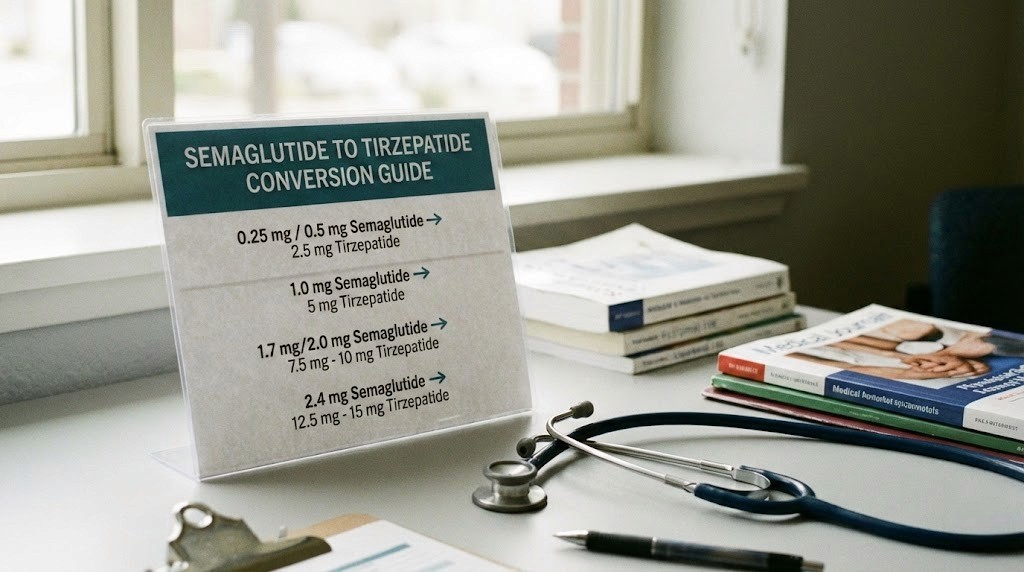
Semaglutide 0.25 mg weekly converts to tirzepatide 2.5 mg weekly. This is the introductory dose for both medications. Since 0.25 mg semaglutide is itself a starter dose not intended for maintenance, the conversion is straightforward. Both doses serve the same purpose of allowing the body to adjust to GLP-1 receptor activation before therapeutic escalation.
Semaglutide 0.5 mg weekly converts to tirzepatide 2.5 to 5 mg weekly. At this dose, semaglutide is beginning to produce meaningful appetite suppression. The equivalent tirzepatide range starts at the initial dose and extends to the first maintenance level. Most providers recommend starting at 2.5 mg regardless and titrating up based on tolerance and response.
Semaglutide 1.0 mg weekly converts to tirzepatide 5 to 7.5 mg weekly. This is the standard maintenance dose for Ozempic and a mid-range dose for Wegovy. The tirzepatide equivalent falls in the moderate range, where most patients experience significant appetite reduction and measurable weight loss.
Semaglutide 1.7 mg weekly converts to tirzepatide 7.5 to 10 mg weekly. This dose exists only in the Wegovy titration schedule. At this level, patients are typically experiencing strong appetite suppression. The tirzepatide equivalent pushes into the upper-moderate range.
Semaglutide 2.0 mg weekly converts to tirzepatide 10 to 12.5 mg weekly. The maximum Ozempic dose corresponds to the upper tier of tirzepatide dosing. At this level, the dual agonism of tirzepatide begins to show its most pronounced advantage over pure GLP-1 therapy.
Semaglutide 2.4 mg weekly converts to tirzepatide 12.5 to 15 mg weekly. The maximum Wegovy dose aligns with the highest tirzepatide doses. Importantly, tirzepatide goes up to 15 mg, which has no semaglutide equivalent. This means patients who have maximized their semaglutide response may still have room to escalate with tirzepatide.
Compounded medication conversion
Compounded semaglutide and tirzepatide follow the same dose equivalency principles, but the concentrations you encounter will differ from branded products. Compounded semaglutide typically comes in vials at concentrations of 5 mg/mL or 10 mg/mL. Compounded tirzepatide commonly appears at concentrations of 10 mg/mL, 20 mg/mL, or even 30 mg/mL.
The conversion chart stays the same. 1 mg of compounded semaglutide is pharmacologically equivalent to 1 mg of branded semaglutide, assuming proper compounding standards. The same principle applies to tirzepatide. What changes is the volume you inject. A 5 mg dose of tirzepatide from a 10 mg/mL vial requires 0.5 mL (50 units on an insulin syringe). The same dose from a 20 mg/mL vial requires just 0.25 mL (25 units).
This is where syringe conversion charts become critical. Many switching errors with compounded formulations happen not because people misunderstand the dose equivalency, but because they miscalculate the volume needed from their specific vial concentration. Use a peptide calculator to verify exact volumes before every injection, especially during the transition period.
Unit-based conversion for insulin syringes
Most people administering compounded formulations use insulin syringes marked in units rather than milliliters. Understanding the relationship between milligrams, milliliters, and syringe units is essential for accurate dosing during conversion.
One milliliter equals 100 units on a standard insulin syringe. From there, calculating your draw volume is straightforward math. If your tirzepatide vial is 10 mg/mL and you need 2.5 mg, you divide 2.5 by 10 to get 0.25 mL, which equals 25 units. If the concentration is 20 mg/mL, that same 2.5 mg dose requires only 0.125 mL, or 12.5 units.
For those switching from semaglutide at 5 mg/mL to tirzepatide at 10 mg/mL, here is how the syringe volumes translate across the full conversion range. At a semaglutide dose of 0.5 mg (10 units from a 5 mg/mL vial), your tirzepatide starting dose of 2.5 mg draws to 25 units from a 10 mg/mL vial. At semaglutide 1.0 mg (20 units), tirzepatide 5 mg equals 50 units. At semaglutide 2.0 mg (40 units), tirzepatide 10 mg equals 100 units, which fills an entire 1 mL insulin syringe.
If your tirzepatide concentration is 20 mg/mL, all those unit numbers get cut in half. And that distinction matters enormously during a transition. Drawing the wrong volume from a higher-concentration vial is one of the most common errors people report in peptide forums and online communities. Double-check your concentration label every single time.
The standard switching protocol step by step
Understanding the conversion chart is half the equation. Knowing how to actually execute the switch, including timing, titration, and monitoring, completes the picture. Here is the evidence-based protocol that most weight management providers follow.
Step 1: Determine your current semaglutide dose and stability
Before switching, you need clarity on two things. First, what is your current weekly semaglutide dose? Not what you started at, not what was prescribed months ago, but what you are actually injecting right now. Second, are you stable on that dose? Stable means you have been at the same dose for at least four weeks without dose adjustments, you tolerate it without significant gastrointestinal distress, and your weight loss trajectory is established (even if plateaued).
If you are mid-titration on semaglutide, switching adds unnecessary complexity. Finish your current titration step first. Reach stability. Then convert.
Step 2: Complete a washout period
The washout period is the gap between your last semaglutide injection and your first tirzepatide injection. Clinical guidance recommends waiting at least 7 days. This aligns with semaglutide having a half-life of approximately 7 days, meaning roughly half the drug clears your system in that window.
In practice, most people simply replace their next scheduled injection. If you inject semaglutide every Monday, take your final semaglutide dose on Monday and begin tirzepatide the following Monday. That gives you a full 7-day washout that coincides naturally with your dosing schedule.
Research shows switching within 3 to 10 days of each other is generally well tolerated. You do not need to wait until semaglutide is completely eliminated from your system. Both medications act on GLP-1 receptors, so there is overlap in mechanism, not conflict. The washout period exists primarily to avoid stacking side effects, not because of pharmacological incompatibility.
Here is the timing breakdown based on how many days have passed since your last semaglutide dose. If one day has passed, wait six more. If three days, wait four more. If five days, wait two more. If seven or more days have passed, you can start tirzepatide immediately.
Step 3: Start tirzepatide at 2.5 mg regardless of your previous semaglutide dose
This is the single most important rule. It does not matter if you were on 2.4 mg of semaglutide, the absolute maximum dose. You start tirzepatide at 2.5 mg.
Why? Because tirzepatide activates GIP receptors in addition to GLP-1 receptors. Your body has never experienced GIP receptor agonism from an exogenous medication before. Even though you have tolerance to GLP-1 activation from months or years of semaglutide use, the GIP component is entirely new to your system. Starting at a higher dose based on your semaglutide history would expose your GIP-naive body to a potent signal it has not had time to adapt to.
The result of skipping the starting dose? Severe nausea, vomiting, and gastrointestinal distress that can last days. Some providers have experimented with starting patients at 5 mg when converting from high-dose semaglutide, and while some tolerate it fine, the risk-benefit ratio favors the conservative approach. Four weeks at 2.5 mg is a small investment for a significantly smoother transition.
Step 4: Follow the tirzepatide titration schedule
After starting at 2.5 mg, increase by one dose tier every four weeks. The standard tirzepatide titration schedule looks like this.
Weeks 1 through 4: 2.5 mg weekly. This is the adjustment phase. Appetite suppression may be less than what you experienced on semaglutide because the dose is low. Do not panic. Your body is calibrating to the new dual-receptor signal.
Weeks 5 through 8: 5 mg weekly. This is where most people begin feeling meaningful appetite reduction again. For those who were on lower semaglutide doses (0.5 to 1.0 mg), this may already match or exceed your previous level of appetite control.
Weeks 9 through 12: 7.5 mg weekly. The effects intensify. Weight loss typically accelerates at this tier, particularly for those who had plateaued on semaglutide.
Weeks 13 through 16: 10 mg weekly. A strong therapeutic dose. Clinical trial data shows tirzepatide 10 mg produces 3.15 kg more weight loss than semaglutide 2 mg over 40 weeks and reduces HbA1c by an additional 0.36 percentage points.
Weeks 17 through 20: 12.5 mg weekly. Near-maximum dosing. Most patients do not need to go beyond this level to achieve their goals.
Weeks 21 and beyond: 15 mg weekly. The maximum approved dose. Reserved for cases where lower doses produce insufficient response. At this level, clinical trials show weight loss of approximately 20.2% of body weight over 72 weeks, compared to 13.7% with maximum-dose semaglutide.
Not everyone needs to reach 15 mg. Many people find their optimal dose at 7.5 or 10 mg. The titration schedule is a ceiling, not a mandate. Work with your provider to identify the dose that delivers adequate appetite suppression and weight loss without intolerable side effects.
Why people switch from semaglutide to tirzepatide
Nobody switches medications because everything is going perfectly. The decision to move from semaglutide to tirzepatide almost always involves one of several specific triggers, and understanding your reason for switching helps predict how the conversion will go.
Weight loss plateau
The most common reason. Semaglutide produces impressive early results. The first 16 to 24 weeks often deliver the most dramatic changes. But metabolic adaptation is real. Your body adjusts its energy expenditure downward as weight decreases, recalibrating hormonal signals related to hunger and satiety. Eventually, the same dose that was suppressing appetite effectively becomes less potent relative to your body adaptation.
Switching to tirzepatide introduces a second receptor pathway your body has not adapted to. The GIP receptor activation provides a new stimulus for appetite suppression and metabolic regulation that can break through semaglutide plateaus. One study showed patients who switched from a GLP-1 medication to tirzepatide lost an additional 2.1 kg over 12 weeks, directly overcoming their previous stall.
If your weight loss has stalled on semaglutide despite being at maximum dose, tirzepatide offers a genuine path forward rather than simply adding more of the same pharmacological approach.
Insufficient results at maximum semaglutide dose
Some people respond modestly to semaglutide. They lose weight, but not enough to reach their goals, even at 2.4 mg weekly. The clinical data explains why tirzepatide may work better for these individuals. In the SURPASS-2 trial, tirzepatide 15 mg produced nearly double the weight loss of semaglutide 1 mg. And in a direct comparison trial published in the New England Journal of Medicine, the maximum tolerated dose of tirzepatide achieved 20.2% body weight loss compared to 13.7% with maximum semaglutide over 72 weeks.
That 6.5 percentage point difference is clinically significant. For a 200-pound person, it represents an additional 13 pounds of weight loss. Tirzepatide does not just do what semaglutide does at a higher dose. It adds an entirely different mechanism that targets fat metabolism through pathways semaglutide cannot reach.
Intolerable side effects on semaglutide
Nausea, constipation, heartburn, and gastrointestinal discomfort affect a significant percentage of semaglutide users. While these symptoms often resolve with dose stabilization, some people never fully adapt. Persistent nausea at every dose increase, chronic constipation that does not respond to dietary adjustments, or severe heartburn that disrupts daily life are legitimate reasons to try a different medication.
Interestingly, large real-world studies involving over 18,000 patients show that gastrointestinal side effect rates are similar between tirzepatide and semaglutide users. However, individual response varies enormously. People who cannot tolerate semaglutide sometimes tolerate tirzepatide perfectly well, and vice versa. The dual-receptor mechanism distributes the pharmacological load differently across tissues, which may explain the individual variation.
Inadequate blood sugar control
For people with type 2 diabetes, blood sugar management is often the primary goal. The SURPASS-2 trial demonstrated that all tirzepatide doses reduced HbA1c more than semaglutide 1 mg. Tirzepatide 10 mg produced an additional 0.36% HbA1c reduction compared to semaglutide 2 mg (an indirect comparison), and tirzepatide 15 mg achieved a 0.4% additional reduction. More patients on tirzepatide reached the composite endpoint of HbA1c at or below 6.5% with at least 10% weight loss and no hypoglycemia. Specifically, 51% achieved this on tirzepatide 10 mg compared to just 22% on semaglutide 1 mg.
For anyone whose semaglutide treatment has not brought their HbA1c to target, tirzepatide represents a meaningful escalation in therapeutic potency.
Insurance or cost considerations
Medication coverage changes frequently. Some insurance plans cover Mounjaro or Zepbound but not Ozempic or Wegovy, or vice versa. Compounded tirzepatide pricing varies from compounded semaglutide pricing. When the cost calculation shifts, switching becomes practical rather than purely clinical. The conversion chart ensures the transition is medically sound regardless of the financial motivation.
What the clinical trial data actually shows
Understanding the evidence behind the conversion chart matters because it helps you set realistic expectations for the switch. Three landmark studies provide the foundation.
SURPASS-2: the head-to-head trial
This 40-week, randomized, open-label trial enrolled 1,879 adults with type 2 diabetes. Participants had a mean baseline HbA1c of 8.28% and a mean body weight of 93.7 kg. They were randomized to tirzepatide 5 mg, 10 mg, or 15 mg, or semaglutide 1 mg, all as weekly injections added to metformin therapy.
The results were clear. Mean HbA1c reductions from baseline were 2.01% with tirzepatide 5 mg, 2.24% with tirzepatide 10 mg, 2.30% with tirzepatide 15 mg, and 1.86% with semaglutide 1 mg. All tirzepatide doses were both noninferior and statistically superior to semaglutide for glycemic control.
Weight loss showed an even more dramatic separation. Compared to semaglutide 1 mg, tirzepatide produced additional weight loss of 1.9 kg (5 mg dose), 3.6 kg (10 mg dose), and 5.5 kg (15 mg dose). Patients on tirzepatide 15 mg lost almost twice as much weight as those on semaglutide 1 mg.
The composite endpoint, achieving HbA1c at or below 6.5% with 10% or greater weight loss and no hypoglycemia, was reached by 32% on tirzepatide 5 mg, 51% on tirzepatide 10 mg, and 60% on tirzepatide 15 mg. Only 22% of semaglutide patients achieved this same composite outcome.
The obesity comparison trial
A phase 3b trial compared maximum tolerated doses of tirzepatide (10 or 15 mg) against maximum tolerated semaglutide (1.7 or 2.4 mg) in participants with obesity but without type 2 diabetes. Over 72 weeks of treatment, the least-squares mean percent change in body weight was negative 20.2% with tirzepatide and negative 13.7% with semaglutide.
That 6.5 percentage point difference represents a substantial clinical advantage. For context, if a 220-pound individual takes maximum semaglutide, they might expect to lose approximately 30 pounds. Switch to maximum tirzepatide, and the expected loss increases to approximately 44 pounds. That additional 14 pounds can be the difference between reaching a healthy BMI and remaining in the overweight category.
Indirect comparison analysis
Because no trial directly compared tirzepatide against semaglutide 2 mg (the higher Ozempic dose), researchers conducted adjusted indirect comparisons using data from the SURPASS and SUSTAIN trial programs. The analysis found that tirzepatide 10 mg produced 3.15 kg more weight loss and 0.36% greater HbA1c reduction than semaglutide 2 mg. Tirzepatide 15 mg produced 5.15 kg more weight loss and 0.4% greater HbA1c reduction. Tirzepatide 5 mg showed no statistically significant difference from semaglutide 2 mg for either outcome.
This analysis is important for conversion purposes. It suggests that the true therapeutic equivalence of semaglutide 2 mg sits somewhere around tirzepatide 5 mg, with higher tirzepatide doses representing genuine therapeutic escalation rather than simple equivalency.
Managing side effects during the conversion
The transition from semaglutide to tirzepatide comes with a predictable side effect profile. Knowing what to expect, when to expect it, and how to manage it makes the difference between a tolerable switch and a miserable one.
The gastrointestinal adjustment period
Gastrointestinal side effects are the most common issue during any GLP-1 medication change. Nausea, diarrhea, vomiting, constipation, and abdominal discomfort top the list. These symptoms are most pronounced during the first 2 to 4 weeks after each dose increase and typically resolve as your body adapts to the new dosing level.
Here is what makes the semaglutide-to-tirzepatide conversion unique. Your body already has GLP-1 receptor tolerance from semaglutide therapy. That means the GLP-1 component of tirzepatide may cause fewer gastrointestinal issues than it would for someone starting from scratch. However, the GIP receptor activation is entirely new. Your gastrointestinal tract, your pancreas, and your adipose tissue have never experienced exogenous GIP stimulation before.
Most switching patients report milder gastrointestinal side effects than they experienced during their initial semaglutide titration. But some report unexpected symptoms they did not experience with semaglutide. This variability is normal and reflects the additional pharmacological pathway at work.
Nausea management strategies
If nausea develops during the transition, these evidence-based strategies help. Eat smaller meals more frequently rather than three large meals. Avoid fatty, fried, or heavily seasoned foods during the first two weeks at each new dose. Stay well hydrated, as dehydration amplifies nausea. Ginger, whether as tea, supplements, or fresh root, has demonstrated anti-nausea effects in clinical settings. Peppermint tea or peppermint oil capsules provide additional gastrointestinal relief for many people.
Timing your injection can also matter. Some people find that injecting in the evening, before bed, allows them to sleep through the peak nausea window. Others prefer morning injections so the nausea resolves by bedtime. Experiment to find what works best for your body.
If nausea is severe or persists beyond three weeks at a given dose, talk to your provider. Temporary dose reduction, extended time at a given tier before escalating, or prescription antiemetics may be appropriate. The goal is not to suffer through side effects. It is to find the right pace of titration for your individual response.
Constipation and digestive changes
Both semaglutide and tirzepatide slow gastric emptying, which can cause constipation. If you managed this side effect on semaglutide, the same strategies apply during the transition. Adequate fiber intake (25 to 30 grams daily), consistent hydration (at least 64 ounces of water daily), and regular physical activity all support healthy digestion. Gut health is a critical consideration during any medication transition.
Some people experience the opposite problem, loose stools or diarrhea, particularly during the early weeks. This usually resolves as GIP receptor tolerance develops. If it persists, reducing caffeine intake and avoiding sugar alcohols (common in protein bars and sugar-free foods) can help.
Injection site considerations
Both medications are injected subcutaneously, typically in the abdomen, thigh, or upper arm. The injection technique does not change between medications. However, if you were using a branded semaglutide pen and are switching to a vial-and-syringe format (common with compounded tirzepatide), the physical process differs.
Drawing from a vial requires accurate reconstitution (if using lyophilized powder), proper air bubble management, and precise volume measurement. If you have not used insulin syringes before, take time to practice the technique. The reconstitution calculator and injection guide at SeekPeptides walk through the process step by step.
Energy and appetite changes during transition
Expect a temporary reduction in appetite suppression during the first few weeks. You are starting tirzepatide at 2.5 mg regardless of where you were on semaglutide, and that low dose may not provide the same appetite control you are used to. This is temporary. As you titrate up, appetite suppression returns and, for most people, exceeds what semaglutide provided.
Some people also report fatigue during the first one to two weeks. Tirzepatide-related tiredness is typically mild and self-limiting. Adequate sleep, hydration, and balanced nutrition help your body adapt more quickly.
Compounded formulation conversion specifics
A significant number of people switching from semaglutide to tirzepatide are doing so with compounded medications rather than branded products. The conversion principles remain identical, but the practical details around reconstitution, concentration, and volume measurement deserve dedicated attention.
Understanding concentration differences
Compounded semaglutide typically comes in one of several concentrations. The most common are 5 mg/mL and 10 mg/mL. Some formulations include additional ingredients like vitamin B12 or cyanocobalamin.
Compounded tirzepatide concentrations vary more widely. Common formulations include 10 mg/mL, 20 mg/mL, and 30 mg/mL. Some also include B12 or other adjuncts like niacinamide or vitamin B12.
When converting from compounded semaglutide at 5 mg/mL to compounded tirzepatide at 10 mg/mL, the volume change is significant. Your semaglutide injection of 0.5 mg required drawing 0.1 mL (10 units). Your tirzepatide starting dose of 2.5 mg requires 0.25 mL (25 units) from a 10 mg/mL vial. That is 2.5 times the volume. Not a problem per se, but worth noting so the larger draw volume does not cause confusion.
If your tirzepatide is 20 mg/mL, the math shifts. That same 2.5 mg dose requires only 0.125 mL (12.5 units). Round up or down to the nearest half-unit mark based on your syringe graduation. The SeekPeptides peptide calculator handles all of these concentration-to-volume calculations automatically, eliminating manual math errors.
Reconstitution considerations when switching
If your compounded tirzepatide arrives as lyophilized (freeze-dried) powder, you need to reconstitute it before use. This involves adding bacteriostatic water to the vial, gently swirling until dissolved, and then calculating your injection volume based on the resulting concentration.
The amount of bacteriostatic water you add determines the final concentration. Adding 1 mL to a 10 mg vial gives you 10 mg/mL. Adding 2 mL gives you 5 mg/mL. This flexibility lets you choose a concentration that works best for your syringe precision and desired injection volume. The peptide reconstitution calculator simplifies this process.
Important storage notes: once reconstituted, compounded tirzepatide should be refrigerated between 36 and 46 degrees Fahrenheit (2 to 8 degrees Celsius). Most reconstituted formulations remain stable for 28 to 30 days when refrigerated. Do not freeze. Do not leave at room temperature for extended periods. Follow the same storage protocols you used for your semaglutide.
Semaglutide with B12 to tirzepatide conversion
Many compounded semaglutide formulations include vitamin B12. When switching to tirzepatide, you have two options. You can choose a tirzepatide formulation that also includes B12 (these exist from many compounding pharmacies), or you can supplement B12 separately. The conversion chart itself does not change based on B12 inclusion. The semaglutide-to-tirzepatide dose equivalency is based purely on the active medication, not adjunct ingredients.
If you valued the B12 in your semaglutide formulation, ask your compounding pharmacy whether B12-enhanced tirzepatide is available. If not, a separate B12 supplement or injection can maintain the same benefit.
Advanced conversion scenarios
Not every switch follows the textbook path. Here are the most common real-world scenarios that the basic conversion chart does not fully address.
Switching while mid-titration on semaglutide
If you need to switch before completing your semaglutide titration, say, moving from 0.5 mg semaglutide directly to tirzepatide, the approach stays the same. Start tirzepatide at 2.5 mg. The fact that you were on a low semaglutide dose actually simplifies the transition because there is less pharmacological momentum to manage.
However, your GLP-1 receptor tolerance is lower than someone who has been on maximum semaglutide for months. This means you may experience more pronounced GLP-1-related side effects during tirzepatide titration than a long-term semaglutide user would. Take the titration slowly. Do not rush past the 2.5 mg and 5 mg steps.
Switching from semaglutide to tirzepatide and back again
Some people try tirzepatide, find they prefer semaglutide, and want to switch back. The reverse conversion follows similar principles but in reverse. After stopping tirzepatide, wait at least 5 to 7 days (given tirzepatide approximate 5-day half-life), then restart semaglutide. If you were previously stable on a specific semaglutide dose, your provider may allow you to resume closer to that dose rather than re-titrating from scratch, depending on how long you were off semaglutide.
Converting from microdosing semaglutide to tirzepatide
Microdosing involves using sub-therapeutic doses for maintenance after reaching weight goals. If you are microdosing semaglutide at something like 0.125 mg or 0.25 mg weekly, the conversion to tirzepatide microdosing would logically start at 1.25 mg or 2.5 mg tirzepatide. However, microdosing protocols are not standardized, and the conversion ratios at sub-therapeutic levels are less well characterized than at standard doses.
If you are microdosing for maintenance, discuss the specific conversion with your provider. The general 2.5 mg tirzepatide starting dose may actually be an escalation from your microdose semaglutide, which could be either beneficial (if you need more appetite support) or unnecessary (if you are maintaining well at minimal doses).
Dealing with a weight loss plateau that tirzepatide does not break
Sometimes the switch itself is not enough. If you have plateaued on semaglutide and the transition to tirzepatide does not reignite weight loss after reaching an equivalent or higher dose tier, additional factors need attention. Exercise optimization, dietary composition (not just caloric restriction), sleep quality, stress management, and hormonal factors all influence outcomes independent of medication choice.
SeekPeptides members access comprehensive protocol resources that address these compounding factors alongside medication optimization, providing a holistic approach to breaking through plateaus.
Conversion chart for specific branded products
The generic conversion table above applies broadly. But if you are switching between specific branded products, here are the exact dose mappings.
Ozempic (semaglutide) to Mounjaro (tirzepatide) for type 2 diabetes
Ozempic is available in three dose levels: 0.5 mg, 1 mg, and 2 mg weekly. Mounjaro offers six dose levels: 2.5, 5, 7.5, 10, 12.5, and 15 mg weekly. The conversion maps as follows. Ozempic 0.5 mg maps to Mounjaro 2.5 mg starting dose with a target of 5 mg. Ozempic 1 mg maps to Mounjaro 2.5 mg starting dose with a target of 5 to 7.5 mg. Ozempic 2 mg maps to Mounjaro 2.5 mg starting dose with a target of 7.5 to 10 mg.
Notice the pattern. Regardless of where you are on Ozempic, you start Mounjaro at 2.5 mg. The target dose, which represents approximate therapeutic equivalence, differs based on your Ozempic history, but the starting point is universal.
Wegovy (semaglutide) to Zepbound (tirzepatide) for weight management
Wegovy follows a five-step titration: 0.25, 0.5, 1.0, 1.7, and 2.4 mg weekly. Zepbound uses the same six-step tirzepatide titration as Mounjaro. The conversion follows. Wegovy 0.25 to 0.5 mg maps to Zepbound 2.5 mg starting dose. Wegovy 1.0 mg maps to Zepbound 2.5 mg start with a 5 mg target. Wegovy 1.7 mg maps to Zepbound 2.5 mg start with a 7.5 to 10 mg target. Wegovy 2.4 mg maps to Zepbound 2.5 mg start with a 10 to 15 mg target.
The key insight with the Wegovy-to-Zepbound conversion is that Zepbound extends to 15 mg, a dose level with no Wegovy equivalent. This gives patients who have maxed out on Wegovy additional room to titrate upward if needed, potentially accessing greater weight loss than semaglutide can deliver at any dose.
Tracking your progress after conversion
Switching medications resets your baseline in several ways. Tracking the right metrics helps you and your provider determine whether the conversion is working and when dose adjustments are appropriate.
What to track weekly
Body weight is the most obvious metric, but it fluctuates daily due to hydration, food volume, and hormonal cycles. Weigh yourself at the same time each day (morning, after using the bathroom, before eating) and track the weekly average rather than any single reading. Expect weight to fluctuate or even increase slightly during the first 2 to 4 weeks at 2.5 mg tirzepatide because the dose is lower than your previous semaglutide level.
Appetite level on a 1-to-10 scale helps quantify the subjective experience. Rate your hunger and cravings at consistent times. As you titrate up, these scores should decrease. If they do not decrease by the time you reach the dose tier equivalent to your previous semaglutide level, discuss acceleration with your provider.
Side effects should be logged daily during the first 4 weeks and at each dose change. Note the type of symptom, severity (mild, moderate, severe), timing relative to injection, and duration. This log becomes invaluable for dose optimization conversations with your provider.
What to track monthly
Waist circumference captures visceral fat loss that the scale might miss, especially if you are simultaneously gaining or maintaining muscle. Measure at the same anatomical landmark (typically the navel) with the same tape at the same time of day.
Blood pressure, fasting glucose, and (if you have diabetes) HbA1c levels provide objective metabolic markers. Both semaglutide and tirzepatide improve these parameters, but the rate and magnitude of improvement on tirzepatide may differ from your semaglutide experience.
Energy levels, sleep quality, and overall wellbeing are subjective but important. Some people report improved energy on tirzepatide compared to semaglutide. Others find the transition period temporarily draining. Documenting these patterns helps identify your optimal dose.
When to expect results after switching
Weeks 1 to 4 (2.5 mg): Minimal new weight loss. Appetite suppression may decrease compared to your semaglutide experience. This is the accommodation phase. Do not evaluate the switch based on this period.
Weeks 5 to 8 (5 mg): Appetite suppression returns for most patients. Weight loss may resume at a rate comparable to or slightly below your best semaglutide period. Tirzepatide begins showing its effects more clearly at this dose.
Weeks 9 to 16 (7.5 to 10 mg): This is where the conversion typically pays off. Weight loss exceeds what semaglutide was producing at equivalent potency. Appetite suppression is strong. Blood sugar improvements become measurable in lab work.
Weeks 17 and beyond (12.5 to 15 mg): Maximum therapeutic benefit. The full dual-agonist effect is active. This is the dose range where tirzepatide clinical superiority over semaglutide becomes most apparent.
Patience during the first 8 weeks is critical. Judging the switch too early leads to premature conclusions. Give the conversion at least 12 weeks before assessing whether tirzepatide is meaningfully better than semaglutide for your individual situation.
Common mistakes during the semaglutide to tirzepatide conversion
Even with a clear conversion chart, mistakes happen. These are the errors that providers and patients report most frequently, and avoiding them will make your transition significantly smoother.
Mistake 1: Starting tirzepatide at an equivalent dose instead of 2.5 mg
This is the most dangerous mistake. A patient on 2.4 mg semaglutide looks at the conversion chart, sees that 12.5 to 15 mg tirzepatide is the equivalent, and starts there. The result is almost always severe nausea, vomiting, and several days of misery. Your GIP receptors have no tolerance built up. Starting high overwhelms a system that needs gradual introduction. Always start at 2.5 mg.
Mistake 2: Not waiting long enough between medications
Taking tirzepatide 2 or 3 days after your last semaglutide dose means both medications are active in your system simultaneously. While this is not dangerous in most cases, it concentrates GLP-1 receptor activation beyond what either medication provides alone, increasing the chance of anxiety, nausea, and gastrointestinal distress. Wait the full 7 days.
Mistake 3: Confusing concentrations when switching compounded formulations
Your semaglutide was 5 mg/mL and you drew 20 units for your 1 mg dose. Your new tirzepatide is 20 mg/mL. You assume 20 units will give you a comparable dose. It will not. Twenty units from a 20 mg/mL vial delivers 4 mg of tirzepatide, not 1 mg. This kind of error can produce a significant overdose or underdose. Always recalculate from scratch when the concentration changes. Use the peptide calculator every time.
Mistake 4: Panicking during the low-dose adjustment period
At 2.5 mg tirzepatide, appetite control is minimal. If you were on high-dose semaglutide, the sudden absence of strong appetite suppression feels like regression. People panic, assume the switch is not working, and either skip ahead in the titration or abandon the conversion entirely. This is premature. The adjustment period is temporary. The therapeutic benefit comes with titration.
Mistake 5: Titrating too quickly
The standard protocol increases doses every 4 weeks. Some patients, eager to reach their target dose, push for increases every 2 weeks. This shortcuts the accommodation process, leads to more severe side effects at each step, and can create a pattern where the body never fully adjusts to any dose level. Four weeks per step is the minimum for a reason. If anything, err on the side of slower titration.
Mistake 6: Not accounting for dietary changes
Semaglutide and tirzepatide affect appetite differently. Some people find that certain foods they tolerated on semaglutide become less tolerable on tirzepatide, particularly fatty or greasy items. Continuing the same diet without adjustment can worsen gastrointestinal symptoms during the transition. Pay attention to how your body responds to specific foods and adjust accordingly.
Contraindications and safety warnings
Not everyone is a candidate for switching from semaglutide to tirzepatide. Before initiating the conversion, certain conditions must be ruled out.
Absolute contraindications
Do not switch to tirzepatide if you have a personal or family history of medullary thyroid carcinoma. Both semaglutide and tirzepatide carry boxed warnings about thyroid C-cell tumor risk based on rodent studies. If this applies to you, neither medication is appropriate.
Multiple Endocrine Neoplasia syndrome type 2 (MEN 2) is another absolute contraindication. Known allergy to tirzepatide or any of its excipients rules out the switch. If you experienced anaphylaxis or severe hypersensitivity on semaglutide, discuss the risk of cross-reactivity with your provider, though the two molecules are structurally different enough that cross-reactivity is uncommon.
Current pregnancy or active breastfeeding contraindicate both medications. If you become pregnant during the conversion, discontinue tirzepatide immediately and contact your provider.
Situations requiring close monitoring
If you take insulin or sulfonylureas alongside your GLP-1 medication, switching to tirzepatide requires careful blood sugar monitoring. Tirzepatide is more potent for glycemic control than semaglutide, and adding it to an existing insulin regimen without dose adjustment can cause hypoglycemia. Your provider may need to reduce your insulin dose when starting tirzepatide.
History of pancreatitis warrants extra caution. Both medications can potentially exacerbate pancreatic inflammation. If you had pancreatitis while on semaglutide, discuss the risk-benefit of tirzepatide specifically with your gastroenterologist.
Gastroparesis or severe gastrointestinal motility disorders can be worsened by the delayed gastric emptying that both medications cause. If you have a diagnosed motility disorder, the switch requires gastroenterology input.
Peptide safety is a critical consideration for any medication transition, and the conversion from semaglutide to tirzepatide is no exception. Working with a qualified healthcare provider throughout the process is not optional. It is essential.
The missed dose protocol during conversion
Missing a dose during the conversion period is more consequential than missing a dose during stable therapy. Here is how to handle it at each stage.
During the washout period
If your planned tirzepatide start date arrives and you realize you missed your last semaglutide dose (meaning you have been medication-free for longer than 7 days), you can start tirzepatide immediately. The extended washout actually simplifies the transition because semaglutide levels have dropped further.
During early tirzepatide titration
If you miss a tirzepatide dose within the first 4 weeks (at 2.5 mg), and it has been fewer than 96 hours (4 days) since the missed injection, take it as soon as you remember. If more than 96 hours have passed, skip that dose entirely and resume on your next regularly scheduled injection day.
Missing doses during early titration delays the accommodation process and can extend the period of reduced appetite suppression. Consistency during the first 8 to 12 weeks is especially important for a smooth transition.
During dose escalation
If you miss a dose during the escalation phase (when increasing from one tier to the next), follow the same 96-hour rule. However, if you miss two or more consecutive doses at any point during the conversion, do not simply resume at your last dose. Contact your provider. They may recommend stepping back one dose tier to re-establish tolerance before continuing the titration.
How the conversion affects blood sugar management
For people with type 2 diabetes, the semaglutide-to-tirzepatide conversion is as much about glycemic control as weight loss. The conversion chart translates directly into blood sugar management expectations.
The temporary glycemic gap
During the washout period and early low-dose tirzepatide phase, blood sugar control may temporarily worsen. You are going from a therapeutic semaglutide dose to a sub-therapeutic tirzepatide dose, and the GLP-1 receptor stimulation decreases before it ramps back up.
For most patients, this glycemic gap is mild and brief, lasting 2 to 4 weeks. But if your diabetes management relies heavily on your GLP-1 medication, your provider may recommend temporary increases in other diabetes medications (metformin, SGLT2 inhibitors, or basal insulin) to bridge the gap.
Monitor fasting blood glucose daily during the first 4 weeks of the conversion. If readings consistently exceed your pre-switch baseline by more than 30 mg/dL, contact your provider for adjustment recommendations.
Glycemic improvement timeline
As tirzepatide doses increase, glycemic control typically surpasses what semaglutide was providing. At 5 mg tirzepatide, control is roughly equivalent to semaglutide 1 mg. By 10 mg, tirzepatide produces HbA1c reductions 0.36% greater than semaglutide 2 mg. At 15 mg, the advantage grows to 0.4%. For patients with diabetes, this means the conversion is not just a lateral move. It is a therapeutic escalation. The SURPASS-2 data confirms that 60% of patients on tirzepatide 15 mg achieved HbA1c at or below 6.5% alongside meaningful weight loss, a composite outcome that only 22% of semaglutide patients matched.
Hypoglycemia risk during conversion
Neither semaglutide nor tirzepatide causes hypoglycemia when used alone. The risk emerges when they are combined with insulin or sulfonylureas. During the conversion, the changing GLP-1/GIP receptor stimulation can alter your insulin sensitivity unpredictably. If you take insulin, monitor closely and err on the side of reducing insulin doses during the transition rather than risking low blood sugar events.
Frequently asked questions
Can I switch from semaglutide to tirzepatide without a washout period?
While some providers allow an immediate switch, the recommended approach is waiting at least 7 days after your last semaglutide injection. This reduces the risk of stacking GLP-1 receptor stimulation from both medications simultaneously, which can intensify gastrointestinal side effects. Research shows switching within 3 to 10 days is generally well tolerated, but a full 7-day washout aligned with your weekly injection schedule is the safest approach.
Will I regain weight during the transition period?
Minor weight fluctuations during the first 2 to 4 weeks are common and typically reflect water retention shifts rather than actual fat regain. The lower tirzepatide starting dose provides less appetite suppression than your previous semaglutide dose, which may lead to slightly increased food intake. However, significant weight regain in such a short period is unlikely if you maintain reasonable dietary habits. Weight loss resumes and often accelerates as you titrate up to therapeutic tirzepatide doses.
Is the semaglutide to tirzepatide conversion the same for Ozempic and Wegovy?
The conversion principles are identical because both contain the same active molecule (semaglutide). The only difference is the available dose range. Ozempic goes up to 2 mg weekly while Wegovy extends to 2.4 mg. Regardless of which branded product you are on, the target tirzepatide dose is determined by your current semaglutide milligram dose, not the brand name. The semaglutide dosage calculator can help verify your current dose before beginning the conversion process.
How long does the full conversion take from start to target dose?
The minimum conversion timeline depends on your target tirzepatide dose. Reaching 5 mg takes 8 weeks (4 weeks at 2.5 mg plus 4 weeks at 5 mg). Reaching 10 mg takes 16 weeks. Reaching the maximum 15 mg takes 24 weeks. Many people find their optimal dose before reaching 15 mg, so the full conversion may be shorter than the maximum timeline suggests. Your provider may extend individual steps beyond 4 weeks if side effects require more accommodation time.
Can I use the conversion chart for compounded semaglutide and tirzepatide?
Yes. The milligram-to-milligram conversion is identical for branded and compounded formulations because the active molecules are the same. The only difference with compounded products is the concentration of the solution, which affects the volume you draw into your syringe. Always verify your vial concentration and calculate the correct injection volume using a reconstitution calculator before each dose.
What if tirzepatide does not work as well as semaglutide for me?
While most people experience equal or better results on tirzepatide, individual responses vary. If you have titrated to an equivalent or higher tirzepatide dose and your results are inferior to what semaglutide provided, discuss switching back with your provider. Some people respond better to pure GLP-1 agonism than dual GIP/GLP-1 agonism. There is no failure in returning to the medication that works best for your biology.
Does the conversion chart account for semaglutide with B12 formulations?
The conversion chart is based solely on the semaglutide active ingredient, not on adjunct ingredients like vitamin B12. Whether your compounded semaglutide includes B12, L-carnitine, or other additives, the dose equivalency to tirzepatide remains unchanged. If you want to continue receiving B12 with your tirzepatide, ask about tirzepatide-B12 combination formulations from your compounding pharmacy.
Should I change my diet when switching from semaglutide to tirzepatide?
No dramatic dietary changes are necessary, but paying attention to food tolerances during the transition is wise. Some people find that fatty or greasy foods cause more nausea on tirzepatide than they did on semaglutide, particularly during the first weeks at each new dose. Eating smaller meals more frequently, staying hydrated, and temporarily reducing high-fat food intake can smooth the transition. As your body adjusts, you can gradually reintroduce foods based on tolerance.
External resources
SURPASS-2 Trial: Tirzepatide versus Semaglutide (New England Journal of Medicine)
Efficacy of Tirzepatide vs Semaglutide 2mg Indirect Comparison (PubMed Central)
Switching to Tirzepatide from GLP-1 RAs: Clinical Expectations (Endocrine Practice)
For researchers committed to optimizing their metabolic health protocols, SeekPeptides provides the most comprehensive resource available, with evidence-based conversion guides, personalized protocol builders, and a community of thousands who have navigated these exact medication transitions.
In case I do not see you, good afternoon, good evening, and good night. May your conversions stay accurate, your titrations stay smooth, and your results stay consistent.