Dec 20, 2025
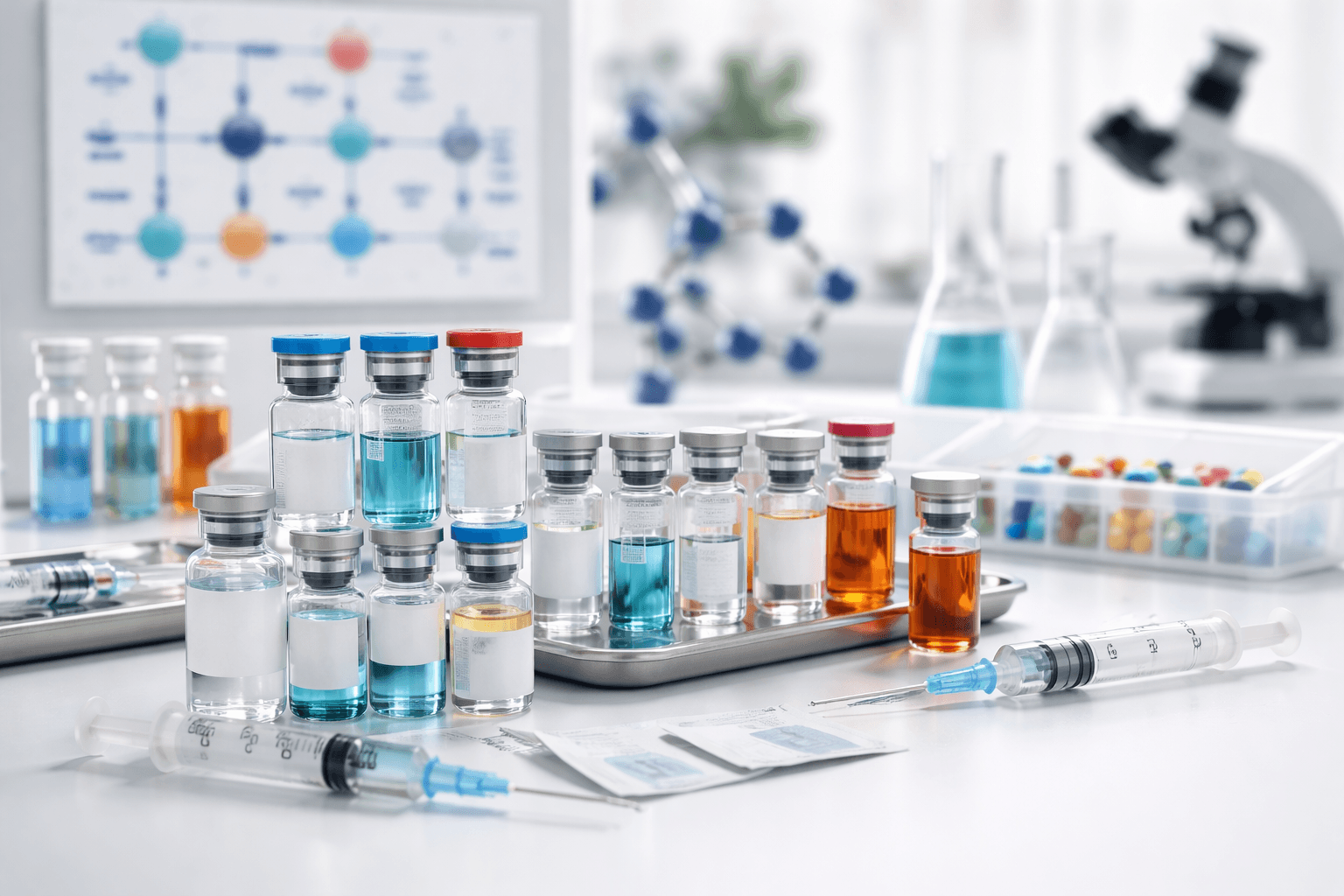
Peptide stacking means using multiple peptides simultaneously to achieve synergistic effects. While single peptides work well, strategic combinations often produce superior results by targeting multiple biological pathways.
This guide covers everything about peptide stacking - why stack, proven combinations for specific goals, dosing protocols, what not to stack, managing multiple injections, costs, and safety considerations.
Why stack peptides?
Understanding the rationale behind combining peptides.
Synergistic mechanisms
Different peptides = different pathways: Each peptide works through unique mechanisms.
Example - healing stack:
BPC-157: Promotes angiogenesis (blood vessel formation)
TB-500: Enhances cell migration to injury
Together: Faster healing than either alone
Complementary actions: Stacking targets problems from multiple angles simultaneously.
Learn about how peptides work at the cellular level.
Faster results
Single peptide: 6-8 weeks for significant results typically
Well-designed stack: 4-6 weeks for comparable or better results
Example - muscle growth:
Ipamorelin alone: 8-12 weeks for noticeable gains
Ipamorelin + CJC-1295 stack: 6-8 weeks for better gains
Time savings: 25-40% faster results with strategic stacking
Addressing multiple goals
Common scenario: Want muscle growth AND fat loss AND recovery
Single peptide approach: Choose one goal, sacrifice others
Stack approach: Address all goals simultaneously
Example:
Ipamorelin/CJC-1295: Muscle + fat loss
BPC-157: Recovery + injury prevention
Result: Comprehensive body recomposition + recovery
Cost efficiency
Surprising fact: Stacking can be more cost-effective than sequential single peptides.
Sequential approach:
12 weeks BPC-157 ($360)
Then 12 weeks TB-500 ($1,440)
Total: $1,800 over 24 weeks
Stack approach:
12 weeks BPC-157 + TB-500 ($600)
Total: $600 for better results in half the time
Use our peptide cost calculator to compare approaches.
Best peptide stacks by goal
Proven combinations for specific outcomes.
Injury healing stack
Gold standard: BPC-157 + TB-500
Why this works:
BPC-157: Promotes blood vessel formation, reduces inflammation
TB-500: Cell migration to injury, reduces scar tissue
Complementary mechanisms = 50-70% faster healing
Protocol:
BPC-157: 250-500mcg twice daily
TB-500: 5mg twice weekly (weeks 1-4), then 2-3mg twice weekly
Duration: 8-12 weeks
Cost: $400-700 for complete protocol
Expected results: 60-80% healing in 8-12 weeks (vs 12-16 weeks single peptide)
Read our injury recovery guide.
Enhanced healing stack (triple)
Maximum healing: BPC-157 + TB-500 + GHK-Cu
Why add GHK-Cu:
Potent anti-inflammatory
Improves tissue quality
Reduces excessive scarring
Enhances collagen organization
Protocol:
BPC-157: 500mcg twice daily
TB-500: 5mg twice weekly
GHK-Cu: 2mg daily
Duration: 12 weeks
Cost: $600-900 for complete protocol
Best for: Severe injuries, chronic conditions, failed conservative treatment
Expected results: 70-90% healing, excellent tissue quality
Muscle growth and performance stack
Classic stack: Ipamorelin + CJC-1295
Why this works:
Ipamorelin: Stimulates GH release (pulse)
CJC-1295: Extends GH elevation (sustained)
Together: Optimal GH profile for muscle growth
Protocol:
Ipamorelin: 200-300mcg 2-3x daily
CJC-1295: 2mg twice weekly
Duration: 12-16 weeks minimum
Cost: $500-900 for 12-week protocol
Expected results: 5-10 lbs lean muscle gain (with proper training), 2-5% body fat reduction
Read our muscle growth guide.
Advanced muscle and recovery stack
For serious athletes: Ipamorelin + CJC-1295 + BPC-157
Why add BPC-157:
Accelerates recovery between workouts
Prevents injuries from heavy training
Supports joint health
Reduces inflammation
Protocol:
Ipamorelin: 200mcg 3x daily
CJC-1295: 2mg twice weekly
BPC-157: 250mcg twice daily
Duration: 12-16 weeks
Cost: $600-1,000 for 12-week protocol
Best for: Competitive athletes, heavy training volume, injury-prone individuals
Expected results: Enhanced muscle growth + superior recovery + injury prevention
Weight loss stack
Most effective: Semaglutide + Ipamorelin
Why this works:
Semaglutide: Powerful appetite suppression, 15-17% weight loss
Ipamorelin: Preserves muscle mass during deficit, enhances fat burning
Protocol:
Semaglutide: Titrate from 0.25mg to 1-2.4mg weekly (standard schedule)
Ipamorelin: 200mcg 2x daily
Duration: 20-24 weeks
Cost: $700-1,200 for complete protocol
Expected results: 20-25% weight loss while maintaining muscle mass
Alternative: Tirzepatide instead of semaglutide (slightly more effective)
Read our weight loss stack guide.
Compare semaglutide vs tirzepatide.
Joint pain and arthritis stack
Best combination: BPC-157 + GHK-Cu
Why this works:
BPC-157: Promotes tissue healing in joint structures
GHK-Cu: Potent anti-inflammatory, improves cartilage quality
Protocol:
BPC-157: 250-500mcg twice daily
GHK-Cu: 1-2mg daily
Duration: 8-12 weeks
Cost: $300-500 for complete protocol
Expected results: 60-80% pain reduction, improved mobility, better quality of life
Read our joint pain guide.
Tendon and ligament stack
Optimal combination: TB-500 + BPC-157
Why this works:
TB-500: Specifically promotes tendon/ligament healing
BPC-157: Enhances blood supply to poorly vascularized tissues
Protocol:
TB-500: 5mg twice weekly (loading), then 2-3mg twice weekly
BPC-157: 250-500mcg twice daily
Duration: 12 weeks minimum
Cost: $500-800 for complete protocol
Expected results: 50-70% faster healing than natural recovery
Read our tendon repair guide.
Anti-aging and longevity stack
Comprehensive approach: Ipamorelin + CJC-1295 + GHK-Cu
Why this works:
Ipamorelin/CJC-1295: Restore youthful GH levels (decline 15% per decade after 30)
GHK-Cu: Skin quality, tissue remodeling, anti-inflammatory
Protocol:
Ipamorelin: 200mcg 2x daily
CJC-1295: 2mg twice weekly
GHK-Cu: 2mg daily (or topical for skin)
Duration: 12-24 weeks, can maintain long-term
Cost: $600-900 per month
Expected results: Improved body composition, better skin, enhanced energy, improved sleep, better recovery
Best for: People over 40, comprehensive wellness optimization
Energy and recovery stack
Daily performance: Ipamorelin + BPC-157
Why this works:
Ipamorelin: Better sleep quality, enhanced recovery, daytime energy
BPC-157: Systemic recovery, reduces inflammation, supports gut health
Protocol:
Ipamorelin: 200-300mcg 2-3x daily
BPC-157: 250mcg twice daily
Duration: 8-12 weeks
Cost: $350-600 for complete protocol
Best for: Busy professionals, athletes in-season, anyone needing consistent high performance
Read our energy guide.
How to dose peptide stacks
Managing multiple peptides requires organization.
Dosing schedules
Twice daily peptides:
BPC-157: Morning and evening (12 hours apart)
Ideally 8am and 8pm
Daily peptides:
GHK-Cu: Once daily (morning preferred)
Can combine with BPC-157 morning dose
Twice weekly peptides:
Multiple times daily:
Ipamorelin: 2-3x daily (morning, afternoon, before bed)
Best timing: 8am, 2pm, 9pm
Combining injections
Can you mix peptides in one syringe? Sometimes, but not always recommended.
Safe to mix:
BPC-157 + TB-500 (if both reconstituted similarly)
Ipamorelin + CJC-1295 (common practice)
Don't mix:
Different concentrations (math becomes complex)
If unsure about compatibility
GHK-Cu with others (copper binding concerns)
Best practice: Separate injections, rotate sites
Injection site rotation
With stacks, rotation is critical: Multiple daily injections = tissue damage risk
Rotation strategy:
Divide abdomen into quadrants
Use different quadrant each injection
Track rotation with simple log
Example schedule (BPC-157 twice daily + Ipamorelin 3x daily = 5 injections/day):
8am BPC-157: Upper right abdomen
8am Ipamorelin: Upper left abdomen
2pm Ipamorelin: Lower right abdomen
8pm BPC-157: Lower left abdomen
9pm Ipamorelin: Rotate to thigh or upper arm
Learn proper injection technique.
Using calculators
Essential for stacks: Use dosage calculators to avoid errors
Available calculators:
Stack calculator (plan complete protocols)
Cost calculator (budget planning)
Reconstitution: Use reconstitution calculator for each peptide
Learn how to calculate peptide dosages.
What not to stack
Some combinations don't make sense or create issues.
Redundant stacks
Avoid: Multiple peptides with identical mechanisms
Examples of redundant stacks:
Semaglutide + Tirzepatide (both GLP-1 agonists, no added benefit)
Ipamorelin + Sermorelin + CJC-1295 (all GH releasers, excessive)
Multiple healing peptides beyond BPC-157 + TB-500 + GHK-Cu
Problem: Wasted money, no synergy, potentially excessive dosing
Better: Choose the most effective from each category
Conflicting goals
Avoid: Stacks with opposing mechanisms
Example: Extreme weight loss + muscle growth stack
Semaglutide: Severe calorie deficit
Ipamorelin/CJC-1295: Need surplus for muscle growth
Conflict: Can't be in deficit and surplus simultaneously
Solution: Focus on one primary goal, support with complementary peptides
Overly complex stacks
Problem with 5+ peptides:
Difficult to manage dosing
Can't tell what's working
Excessive injection frequency
Very expensive
Higher side effect risk
Recommendation: Maximum 3-4 peptides in a stack
Exception: Experienced users may handle more complex protocols
Incompatible safety profiles
Consider individual contraindications:
Example issue: Someone with pancreatitis history
Should avoid GLP-1 peptides (semaglutide/tirzepatide)
Can use BPC-157, TB-500, Ipamorelin safely
Example issue: Active cancer concerns
Should avoid growth-promoting peptides (GH releasers)
Healing peptides generally okay (consult doctor)
Read our peptide safety guide.
Managing side effects in stacks
More peptides = more potential side effects.
Identifying culprits
Challenge: Which peptide causing side effect?
Strategy:
Start one peptide at a time (1-2 weeks apart)
Note any side effects before adding next
If side effects appear, you know which peptide
Alternative: Start all at minimum doses, increase one at a time
Common stack side effects
GH peptide stacks (Ipamorelin + CJC-1295):
Water retention (temporary, 1-2 weeks)
Increased appetite
Mild fatigue post-injection initially
Management: Stay hydrated, expect adaptation within 2 weeks
Healing peptide stacks (BPC-157 + TB-500):
Very minimal side effects
Occasional mild nausea (<5% of users)
Generally very well tolerated
Weight loss stacks (Semaglutide + others):
Nausea (40-50% initially from semaglutide)
Constipation
Fatigue
Management: Slower titration, anti-nausea meds, fiber/hydration
Adjusting protocols
If side effects problematic:
Reduce dose of suspected culprit peptide
Slow titration schedule
Temporarily remove one peptide
Add peptides back one at a time
Don't: Push through severe side effects
When to stop: Severe reactions, persistent intolerable side effects, signs of serious issues
Timing and cycling stacks
Strategic approach to stack duration and breaks.
Optimal stack duration
Healing stacks (BPC-157 + TB-500):
8-12 weeks minimum
Continue until injury 80-90% healed
Can extend to 16 weeks if needed
Muscle growth stacks (Ipamorelin + CJC-1295):
12-16 weeks minimum
Can run 6-12 months continuously
Many use indefinitely with breaks
Weight loss stacks (Semaglutide + Ipamorelin):
20-24 weeks for complete protocol
Until goal weight achieved
Transition to maintenance dosing
Anti-aging stacks:
12 weeks minimum for initial results
Many run indefinitely (long-term wellness)
Periodic breaks optional but not required
Cycling vs continuous use
Cycling (time on, time off):
Potentially prevents tolerance (debated)
Gives body "reset" period
Reduces long-term cost
Continuous use:
Maintains consistent benefits
Simpler to manage
Appropriate for most peptides
Which peptides to cycle?:
GH peptides: Some cycle 12 weeks on, 4 weeks off (optional)
Healing peptides: No cycling needed, use as needed
Weight loss peptides: Use until goal achieved
Which don't need cycling?:
BPC-157: No tolerance development
TB-500: Can use continuously for chronic issues
GHK-Cu: Long-term use safe
Transitioning between stacks
Strategic approach: Plan stack sequence
Example progression:
Months 1-3: Fat loss stack (Semaglutide + Ipamorelin)
Months 4-6: Muscle building stack (Ipamorelin + CJC-1295 + BPC-157)
Months 7-9: Maintenance (Ipamorelin only or low-dose)
Transition tips:
Complete one protocol before starting next
2-4 week break between major changes (optional)
Maintain one peptide while switching others (continuity)
Budgeting for peptide stacks
Stacks cost more than single peptides but offer better value.
Cost breakdown by stack type
Healing stack (BPC-157 + TB-500, 12 weeks):
BPC-157: $180-360
TB-500: $360-600
Supplies: $50
Total: $590-1,010
Muscle growth stack (Ipamorelin + CJC-1295, 12 weeks):
Ipamorelin: $240-400
CJC-1295: $240-400
Supplies: $50
Total: $530-850
Weight loss stack (Semaglutide + Ipamorelin, 20 weeks):
Semaglutide: $400-800
Ipamorelin: $400-600
Supplies: $80
Total: $880-1,480
Triple healing stack (BPC-157 + TB-500 + GHK-Cu, 12 weeks):
BPC-157: $180-360
TB-500: $360-600
GHK-Cu: $180-360
Supplies: $80
Total: $800-1,400
Use our peptide cost calculator for exact budgeting.
Cost-saving strategies
Buy in bulk:
10+ vials: 10-20% discount typically
Calculate total need before ordering
Source strategically:
Compare vendors (prices vary $10-30 per vial)
Use our best vendors guide
Don't sacrifice quality for savings
Optimize protocols:
Start with conservative doses
Only increase if needed
Avoid unnecessary peptides
Plan long-term:
Sequential protocols cheaper than overlapping stacks sometimes
Match peptides to current primary goal
Return on investment
Compare to alternatives:
Healing stack ($600-1,000):
vs Physical therapy: $2,000-5,000
vs Surgery: $10,000-50,000
ROI: Potentially saves thousands
Muscle growth stack ($530-850 per 12 weeks):
vs Personal training: $1,200-2,400 per 12 weeks
vs Supplements alone: Limited effectiveness
ROI: Better results at lower cost
Weight loss stack ($880-1,480):
vs Commercial programs: $500-2,000 (less effective)
vs Bariatric surgery: $15,000-30,000
ROI: Comparable results, fraction of cost
Safety considerations for stacks
More peptides = more care required.
Individual peptide safety
Start with safe peptides:
BPC-157: Excellent safety profile
Ipamorelin: Very well-tolerated
GHK-Cu: Natural, safe
TB-500: Good safety profile
More caution with:
Semaglutide/Tirzepatide: Side effects common (manageable)
Any peptide you haven't used before
Read our peptide safety guide.
Drug interactions
Generally safe with most medications
Specific considerations:
GLP-1 peptides + diabetes meds: Monitor blood sugar
GH peptides + insulin: Potential interaction
Any peptide + immunosuppressants: Consult doctor
Best practice: Disclose peptide use to healthcare provider
Monitoring health markers
Recommended blood work:
Before starting stack (baseline)
6-12 weeks into protocol
After completing protocol
What to monitor:
Complete metabolic panel
Liver/kidney function
Hormone levels (IGF-1, testosterone if using GH peptides)
Glucose/HbA1c (if using GLP-1s)
Inflammatory markers (if using for inflammation)
Frequency: Every 3-6 months during long-term use
When to seek medical help
Stop immediately if:
Severe allergic reaction (rash, swelling, difficulty breathing)
Severe abdominal pain (potential pancreatitis with GLP-1s)
Signs of infection at injection sites
Unexplained severe symptoms
Consult doctor for:
Persistent bothersome side effects
Unexpected changes in health markers
Chronic health conditions
Taking multiple medications
Advanced stacking strategies
For experienced peptide users.
Rotating peptides
Strategy: Change peptides every 8-12 weeks while maintaining similar effects
Example rotation (muscle/recovery focus):
Weeks 1-12: Ipamorelin + CJC-1295
Weeks 13-24: BPC-157 + Ipamorelin
Weeks 25-36: Back to Ipamorelin + CJC-1295
Benefit: Prevents potential tolerance, targets goals from different angles
Goal-specific phasing
Periodization approach: Match stack to training phase
Example for athlete:
Off-season (12 weeks): Muscle growth stack (Ipamorelin + CJC-1295 + BPC-157)
Pre-competition (8 weeks): Injury prevention (BPC-157 only)
In-season (variable): Recovery support (BPC-157 + TB-500 as needed)
Benefit: Optimizes results, manages costs, prevents overuse
Maintenance protocols
After initial protocol: Some use low-dose maintenance
Example:
Initial: BPC-157 500mcg 2x daily + TB-500 5mg 2x weekly (12 weeks)
Maintenance: BPC-157 250mcg daily (ongoing)
Benefit: Sustains benefits at lower cost
Not needed for: Weight loss peptides (use only until goal achieved)
Frequently asked questions
Q: Can I stack any peptides together?
A: Most peptides can be stacked safely, but avoid redundant combinations (multiple peptides with identical mechanisms). Use our stack calculator to plan.
Q: What's the best beginner stack?
A: BPC-157 + TB-500 for healing or Ipamorelin + CJC-1295 for muscle/recovery. Both well-tolerated and proven.
Q: How many peptides can I stack at once?
A: 2-3 peptides ideal for most people. Maximum 4-5 for experienced users. Beyond that becomes complex and potentially wasteful.
Q: Should I start all peptides in a stack at once?
A: Better to start one peptide, assess tolerance for 1-2 weeks, then add others. Helps identify any problematic peptides.
Q: Can I mix different peptides in the same syringe?
A: Sometimes (Ipamorelin + CJC-1295 commonly mixed), but safer to inject separately. Especially avoid mixing GHK-Cu with others.
Q: Do stacks cost more than single peptides?
A: Yes initially, but often more cost-effective long-term. Faster results = less total time on peptides. Use our cost calculator.
Q: What's the most effective healing stack?
A: BPC-157 + TB-500 for most injuries. Add GHK-Cu for severe cases or inflammation.
Q: What's the best muscle growth stack?
A: Ipamorelin + CJC-1295. Add BPC-157 for enhanced recovery and injury prevention.
Q: Can I stack peptides with SARMs or steroids?
A: Possible but increases risk and complexity. Better to master peptides first. Compare peptides vs SARMs.
Q: Where do I buy peptides for stacking?
A: Research peptide suppliers with third-party testing. Buy all peptides from same quality vendor for consistency.
Q: How do I manage multiple daily injections?
A: Strict site rotation, use calendar or app to track doses, pre-load syringes (store refrigerated). Learn proper injection technique.
The bottom line
Peptide stacking produces superior results through synergistic mechanisms.
Most effective stacks:
Healing: BPC-157 + TB-500 ($400-700 for 12 weeks)
Muscle growth: Ipamorelin + CJC-1295 ($500-900 for 12 weeks)
Weight loss: Semaglutide + Ipamorelin ($880-1,480 for 20 weeks)
Joint pain: BPC-157 + GHK-Cu ($300-500 for 12 weeks)
Stacking guidelines:
Start with 2-3 peptides maximum
Use complementary mechanisms (not redundant)
Begin peptides sequentially (assess tolerance)
Rotate injection sites carefully
Use calculators to plan dosing
Benefits:
25-40% faster results than single peptides
Address multiple goals simultaneously
Better overall outcomes
Often more cost-effective long-term
Safety:
Read individual peptide safety profiles
Start one peptide at a time
Monitor for side effects
Get baseline blood work
Avoid overly complex stacks
Getting started:
Choose stack based on primary goal
Source from quality vendors
Use our stack calculator to plan
Track progress weekly
Most people start with BPC-157 + TB-500 (healing) or Ipamorelin + CJC-1295 (performance).
Related resources
Peptide stack calculator (plan protocols)
BPC-157 vs TB-500 (healing stack)
Ipamorelin vs CJC-1295 (growth stack)
Best peptide stack for weight loss (fat loss)