Apr 2, 2026
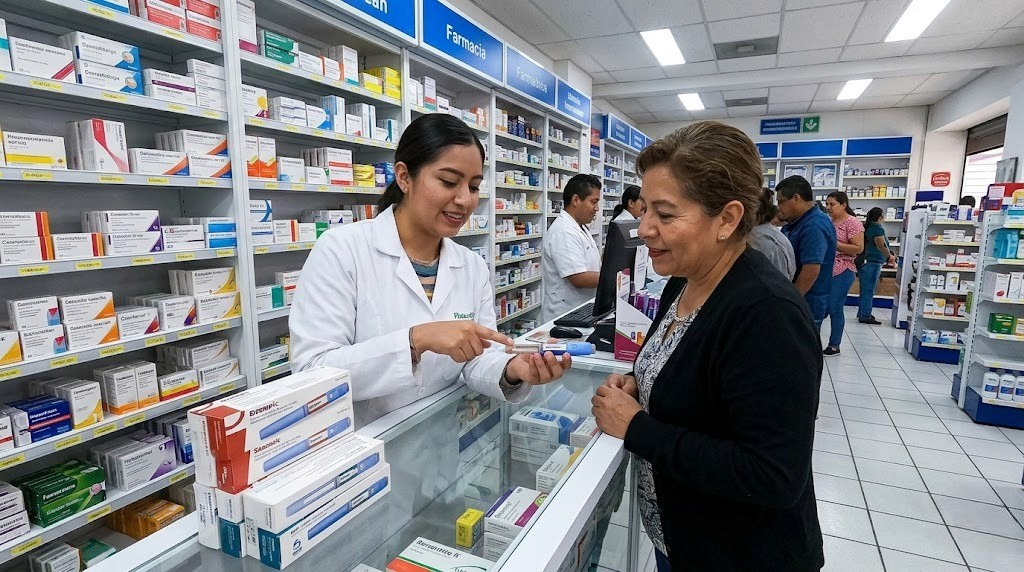
Americans pay more for GLP-1 medications than almost anyone else on earth. The same Ozempic pen that costs $1,350 at a U.S. pharmacy sits behind the counter in Mexico City for $200. That is not a typo. And for tirzepatide, the gap is even wider.
This price difference has created a wave of medical tourism that shows no signs of slowing down. Thousands of people cross the border every month, some driving to Tijuana for a day trip, others flying to Cancun and adding a pharmacy run to their vacation. The savings can reach $1,000 per month on the exact same medication, same manufacturer, same dose.
But buying GLP-1 medications in Mexico is not as simple as walking into a Walgreens south of the border. There are real risks. Counterfeit medications. Storage problems in hot climates. Legal gray areas at the border crossing. The World Health Organization has issued multiple warnings about fake semaglutide found in international markets, and the FDA has seized hundreds of counterfeit Ozempic units.
This guide covers everything you need to know about accessing GLP-1 medications in Mexico. Which medications are available, where to find them, how much they actually cost, how to verify authenticity, and what happens when you try to bring them back across the border. Whether you are considering a border town pharmacy run or planning to use a Mexican clinic during an extended stay, the information here will help you make a safer, more informed decision.
SeekPeptides has tracked the evolving landscape of GLP-1 access for years, and the Mexico option comes up constantly in our community. Here is what our research shows.
Which GLP-1 medications are available in Mexico
Mexico carries most of the same brand-name GLP-1 medications you find in the United States, though availability varies by location and demand often outstrips supply. Understanding exactly what you can find, and under which brand names, prevents confusion at the pharmacy counter.
Semaglutide (Ozempic and Wegovy)
Ozempic is the most widely available GLP-1 medication in Mexican pharmacies. Novo Nordisk distributes it through authorized channels, and you can find it at major pharmacy chains in most cities. The injectable pen comes in the same dose strengths available in the United States: 0.25 mg, 0.5 mg, 1 mg, and 2 mg.
Wegovy, the higher-dose semaglutide specifically approved for weight management, has more limited availability. Some pharmacies carry it, but stock fluctuates significantly. If you are looking specifically for semaglutide dosing at weight loss levels (1.7 mg or 2.4 mg), you may need to call ahead to confirm availability.
Rybelsus, the oral semaglutide tablet, is also available in Mexico. For those interested in oral semaglutide options, the tablet form can be easier to transport across the border than injectable pens, though the oral bioavailability is lower than injections.
Tirzepatide (Mounjaro)
Mounjaro arrived in Mexican pharmacies and has become increasingly available, particularly in major cities and border towns. Eli Lilly distributes tirzepatide under the Mounjaro brand name in Mexico, the same formulation used in the United States.
We have a dedicated guide on tirzepatide availability in Mexico that covers specific pharmacies, pricing by dose, and tips for verifying authentic Mounjaro KwikPens. If tirzepatide is your specific medication, that guide goes deeper into the details.
Available dose strengths typically include 2.5 mg, 5 mg, 7.5 mg, 10 mg, 12.5 mg, and 15 mg. Higher doses may be harder to find due to demand. Understanding your tirzepatide dosage requirements before your trip helps you know exactly what to ask for.
What about retatrutide and other newer GLP-1 medications
Retatrutide, the triple-agonist that targets GLP-1, GIP, and glucagon receptors simultaneously, is not yet commercially available in Mexico through standard pharmacies. It remains in clinical trials globally. Some grey market sources claim to offer it, but these carry significant risks. For current information on retatrutide pricing and access, our dedicated guide tracks the latest developments.
Other GLP-1 related medications you might encounter in Mexico include liraglutide (Saxenda/Victoza). The differences between semaglutide and liraglutide are significant, so do not accept a substitution without understanding what you are getting.
GLP-1 cost comparison: Mexico versus the United States
The numbers tell a dramatic story.
In the United States, a monthly supply of Ozempic costs between $900 and $1,350 without insurance. Wegovy runs even higher at $1,350 to $1,650. Mounjaro falls in a similar range at $1,000 to $1,200 per month. These are list prices, and while manufacturer coupons and insurance can reduce them, millions of Americans pay close to full price.
In Mexico, the same medications cost a fraction of that amount.
Semaglutide pricing in Mexico
Ozempic pens in Mexican pharmacies typically range from $150 to $300 USD, depending on the dose strength, pharmacy location, and whether you are buying in a tourist area or a local neighborhood pharmacy. That represents savings of 60% to 85% compared to U.S. prices.
Wegovy, when available, costs between $175 and $465 USD depending on the dose. The higher doses cost more, but even the most expensive Wegovy in Mexico costs less than the cheapest Ozempic in the United States.
For those exploring compounded semaglutide as an alternative, Mexico pharmacies generally stock the brand-name products rather than compounded versions. The brand-name pricing in Mexico is already competitive with U.S. compounding pharmacy prices, which typically run $200 to $500 per month.
Tirzepatide pricing in Mexico
Mounjaro KwikPens in Mexico start around $89 USD for the 2.5 mg dose at major pharmacy chains. Higher doses range from $120 to $250 USD per month. Compare that to U.S. prices exceeding $1,000 monthly, and the savings become obvious.
If you have been researching affordable tirzepatide options, Mexico represents one of the most significant cost reductions available. Even after factoring in travel costs, the math works out for most people within the first month or two of treatment.
Complete pricing comparison table
Medication | USA price (monthly) | Mexico price (monthly) | Savings |
|---|---|---|---|
Ozempic 0.5 mg | $900-$1,100 | $150-$200 | 75-85% |
Ozempic 1 mg | $900-$1,350 | $180-$250 | 70-82% |
Wegovy 1.7 mg | $1,350-$1,650 | $200-$350 | 75-85% |
Wegovy 2.4 mg | $1,350-$1,650 | $250-$465 | 65-82% |
Mounjaro 2.5 mg | $1,000-$1,200 | $89-$120 | 88-92% |
Mounjaro 5 mg | $1,000-$1,200 | $100-$150 | 85-90% |
Mounjaro 10 mg | $1,000-$1,200 | $150-$250 | 75-85% |
Rybelsus 14 mg | $900-$1,000 | $120-$200 | 78-87% |
These prices fluctuate based on demand, pharmacy location, and currency exchange rates. Border town pharmacies sometimes charge slightly more than pharmacies in interior cities because they cater to American buyers. However, even at the higher end of Mexican pricing, the savings are substantial.
Use the peptide cost calculator on our site to estimate your total treatment costs over several months, factoring in travel expenses and medication pricing.
Where to buy GLP-1 medications in Mexico
Location matters. A lot.
Not all pharmacies in Mexico are created equal, and the difference between a reputable pharmacy chain and a questionable storefront could be the difference between genuine medication and a counterfeit that does nothing, or worse, contains harmful ingredients.
Major pharmacy chains (safest option)
The safest way to purchase GLP-1 medications in Mexico is through one of the major pharmacy chains. These companies operate hundreds of locations, source directly from manufacturers, and maintain cold chain storage requirements.
Farmacia del Ahorro operates over 1,800 locations across Mexico. They are one of the largest pharmacy chains in the country and consistently stock Ozempic and Mounjaro. Their inventory systems are centralized, so staff can check availability at nearby locations if their store is out of stock.
Farmacia San Pablo has a strong presence in Mexico City and central Mexico. They have documented availability of both semaglutide and tirzepatide products, and their pharmacists typically speak some English in tourist-adjacent locations.
Farmacia Guadalajara is another major chain with widespread coverage. They tend to be more strict about prescription requirements, which is actually a good sign, as it suggests they follow proper pharmaceutical protocols.
Costco Mexico also carries pharmaceutical products, including GLP-1 medications. If you have a Costco membership, it works in Mexican locations too. Pricing can be competitive even compared to other Mexican pharmacies.
Understanding how these medications work before purchasing is important. Our guide on how long GLP-1 takes to start working explains the timeline you should expect.
Border town pharmacies
Border towns represent the most accessible option for Americans who do not want to fly into Mexico. Several cities along the U.S.-Mexico border have developed pharmacy districts that specifically cater to American buyers.
Tijuana sits just across from San Diego and is the most popular destination for pharmacy tourism. The Zona Rio area has several large pharmacies with English-speaking staff. Driving across takes about 30 minutes each way, though border wait times can extend the return trip significantly.
Los Algodones is a tiny town near Yuma, Arizona, that has become famous for medical and dental tourism. The town essentially exists to serve American visitors, and pharmacies line the main streets. Parking on the U.S. side and walking across is the standard approach.
Nogales sits across from Nogales, Arizona, and has a well-established pharmacy district within walking distance of the border crossing. The area is smaller than Tijuana but easier to navigate.
Ciudad Juarez borders El Paso, Texas, and has major pharmacy chains within easy reach of the international bridges. The city is larger and more spread out than other border options, so having a specific pharmacy destination planned ahead of time helps.
Nuevo Progreso in Tamaulipas draws visitors from the Rio Grande Valley in Texas. It is walkable from the U.S. side and has multiple pharmacies, though quality varies more here than in larger border cities. This is also where counterfeit medications have been specifically documented, so extra vigilance is necessary.
If you are traveling with medication, our guide on GLP-1 travel cases covers the best options for keeping your medication at proper temperature during the trip.
Interior Mexico cities
If you are visiting Mexico for vacation or business, major interior cities offer the same medications at prices that are sometimes lower than border towns, since border pharmacies often add a premium for American buyers.
Mexico City, Guadalajara, Monterrey, Cancun, Puerto Vallarta, and Merida all have major pharmacy chains with reliable stock. In these cities, you are more likely to encounter pharmacists who follow proper prescription protocols and maintain appropriate medication storage.
Online Mexican pharmacies
Some Mexican pharmacies offer online ordering with delivery within Mexico. This can work if you are staying in Mexico for an extended period, but shipping medications across the border through mail is illegal under most circumstances. The FDA monitors incoming packages and can seize medications shipped from foreign pharmacies.
For domestic alternatives, explore affordable compounded semaglutide or compounded tirzepatide options that do not require crossing any borders.
Prescription requirements in Mexico
This is where things get complicated. And where many online guides give you dangerously incomplete information.
Legally, GLP-1 medications are prescription-only in Mexico. COFEPRIS, the Mexican equivalent of the FDA, classifies semaglutide and tirzepatide as prescription medications that should only be dispensed with a valid prescription from a licensed Mexican physician. Your U.S. prescription is not valid in Mexico.
In practice, enforcement varies dramatically.
Some pharmacies, particularly in border towns and tourist areas, will sell injectable GLP-1 medications without asking for a prescription. Pharmacy staff may not be trained on regulatory requirements, or they may simply prioritize the sale over compliance. This does not make it legal. It means enforcement is inconsistent.
COFEPRIS has announced sanctions against pharmacies that sell prescription medications without proper documentation, and crackdowns have increased in recent years as GLP-1 demand has surged. Getting caught without a prescription could mean having your medication confiscated, and it also means you have no medical oversight for a medication that requires proper dosing and monitoring.
Getting a legitimate Mexican prescription
The safest approach is to obtain a prescription from a Mexican physician. This is easier than it sounds. Many border town clinics and medical tourism facilitators offer consultations specifically for this purpose. Costs typically range from $30 to $80 USD for a visit.
Some advantages of getting a proper prescription:
A Mexican doctor can verify that GLP-1 medication is appropriate for you
The prescription provides legal documentation if questioned at the border
Reputable pharmacies are more likely to provide genuine medication when filling a proper prescription
You get a medical record that documents your treatment
Many clinics near border crossings have streamlined this process for American patients. Some even coordinate directly with specific pharmacies. While this adds $30 to $80 to your trip cost, it provides a layer of legal protection and medical oversight that buying without a prescription does not.
Before starting any GLP-1 medication, understanding qualification requirements and BMI guidelines for GLP-1 treatment helps you have an informed conversation with the prescribing physician.
Safety concerns and counterfeit medications
This section could save your health. Maybe your life. Read it carefully.
The global demand for GLP-1 medications has created an enormous counterfeit market. The World Health Organization issued a global alert in June 2024 specifically about fake semaglutide products found in multiple countries. The FDA has seized hundreds of counterfeit Ozempic units that entered the U.S. supply chain. And Mexico, with its more fragmented pharmaceutical distribution network, is particularly vulnerable to counterfeits.
Documented counterfeit incidents
In October 2023, the WHO identified counterfeit semaglutide with batch number LP6F832 in Brazil and another batch (MP5E511) in the UK where the lot number was genuine but the product was falsified. In December 2023, counterfeits reached the United States. In April 2025, Novo Nordisk notified the FDA about several hundred units of counterfeit Ozempic in the U.S. drug supply chain, specifically products with lot number PAR0362 and serial numbers starting with 51746517.
A Texas man purchased what he believed was Ozempic in Nuevo Progreso, Mexico, only to discover it was likely insulin. The blood sugar crash that can result from injecting insulin when you do not have diabetes is dangerous and potentially fatal. This is not a theoretical risk. It has happened.
Counterfeit GLP-1 products may contain the wrong active ingredient, too little or too much of the active ingredient, harmful contaminants, no active ingredient at all, or entirely different medications. None of these outcomes are acceptable when you are injecting something into your body.
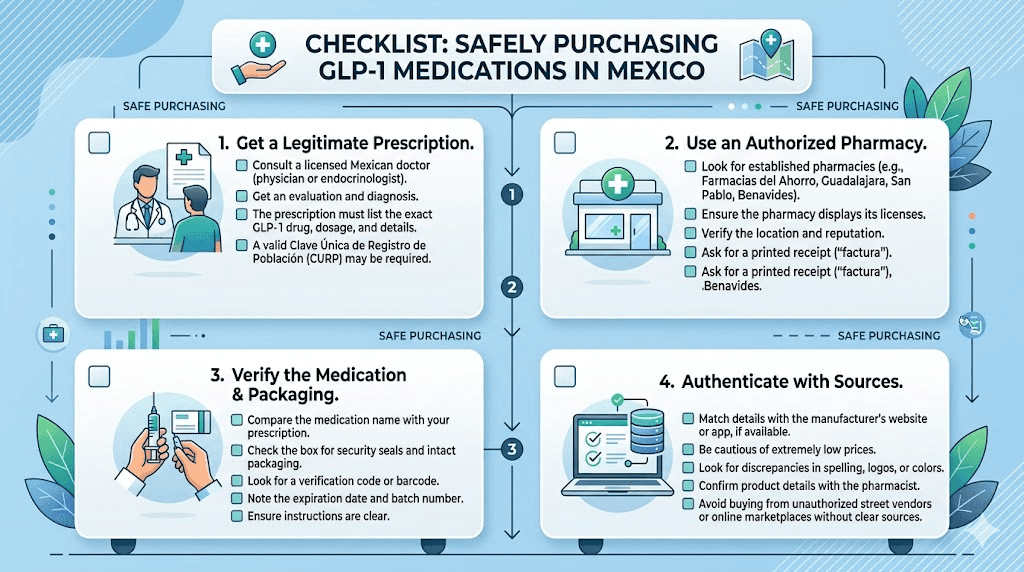
How to verify authentic GLP-1 medication
Verification takes effort, but it is worth every minute.
Check the packaging carefully. Genuine Ozempic pens from Novo Nordisk have specific branding, holographic security seals, and consistent printing quality. The box should include a lot number, expiration date, and barcode that scans properly. Counterfeit packaging often has subtle printing errors, slightly wrong colors, or missing security features.
Verify the lot number. Novo Nordisk and Eli Lilly both have verification systems. You can contact their customer service lines to confirm whether a specific lot number is legitimate. This takes a few minutes but provides definitive confirmation.
Inspect the pen or vial. Genuine Ozempic solution should be clear and colorless. If it appears cloudy, discolored, or contains particles, do not use it. Our guide on what color semaglutide should be provides detailed visual references. For tirzepatide with B12 compounds, the expected color differs from plain tirzepatide.
Buy only from major pharmacy chains. Farmacia del Ahorro, Farmacia San Pablo, Farmacia Guadalajara, and Costco Mexico source directly from manufacturers through authorized distribution channels. Small independent pharmacies, street vendors, and market stalls carry dramatically higher counterfeit risk.
Check the temperature. GLP-1 medications require refrigeration. If the pharmacy hands you a pen from a shelf (not a refrigerator), walk away. If the medication feels warm, do not buy it. Understanding GLP-1 refrigeration requirements helps you assess whether a pharmacy is storing medication properly. Our guide on what happens when semaglutide gets warm explains exactly what temperature exposure does to the medication.
Examine the price. If the price seems dramatically lower than other pharmacies in the area, be suspicious. Counterfeits are typically sold at below-market prices to attract buyers. A deal that seems too good to be true probably is.
Storage and transport concerns
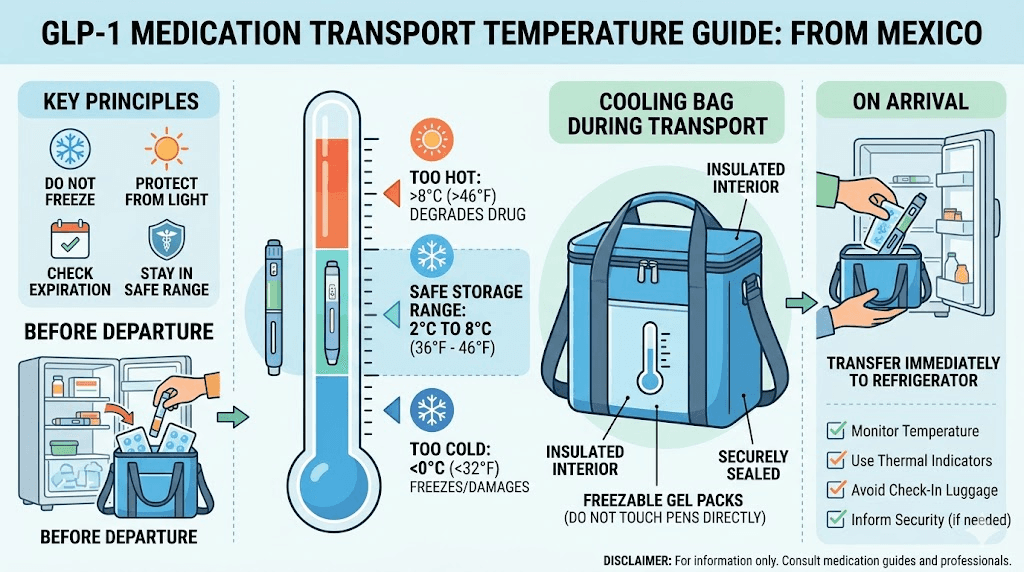
GLP-1 medications are temperature-sensitive proteins. They need to stay refrigerated (36-46 degrees Fahrenheit or 2-8 degrees Celsius) until first use. After first use, most can stay at room temperature for a limited period, but "room temperature" does not mean the interior of a hot car crossing back through Tijuana in August.
If you are purchasing medication in Mexico and transporting it back to the United States, you need a proper cooling solution. A medical-grade insulated bag with ice packs works. A regular cooler with ice also works, but keep the medication from direct contact with ice to prevent freezing, which can also damage the protein.
For semaglutide specifically, our semaglutide shelf life guide covers how long the medication remains effective at different temperatures. Tirzepatide has similar requirements, covered in our tirzepatide shelf life guide.
The drive from Tijuana to San Diego might only take 30 minutes, but border wait times can extend to 2-3 hours during peak periods. Plan your cooling solution to last at least 4-5 hours to be safe. If your semaglutide gets too warm, the protein can degrade and lose effectiveness without any visible change to the solution.
Bringing GLP-1 medications from Mexico into the United States
This is the part most guides gloss over. And it is arguably the most important section, because getting this wrong can mean losing your medication at the border or facing legal complications.
FDA and CBP regulations
Technically, importing prescription drugs into the United States for personal use is illegal in most circumstances. The FDA position is clear: drugs purchased from other countries often have not been approved by the FDA for use and sale in the U.S., or they may not meet FDA safety and efficacy standards.
However, there is a practical reality. The FDA has a personal importation policy that allows CBP (Customs and Border Protection) to exercise discretion on a case-by-case basis. In practice, small quantities of legitimate medications for personal use are generally allowed through, provided certain conditions are met.
Rules for crossing with medication
Maximum supply: You may bring up to a 90-day supply of medication across the border. Anything more than that may be considered commercial quantity and confiscated.
Original packaging required: Medications must be in their original, sealed, manufacturer packaging. Do not remove pens from their boxes. Do not transfer medication to different containers. The packaging is part of the verification.
Prescription documentation: Having a prescription, whether from a U.S. physician or a Mexican physician, significantly reduces the risk of confiscation. A U.S. prescription is ideal. A Mexican prescription with an English translation also helps. No prescription at all increases your risk.
Declaration: If asked, declare the medication. Attempting to hide prescription medications is far riskier than declaring them openly. CBP officers generally understand that people purchase medications in Mexico for cost reasons, and a straightforward declaration with proper documentation typically results in being waved through.
Controlled substances are different. GLP-1 medications are not controlled substances, which works in your favor. The stricter importation rules apply primarily to narcotics and controlled pharmaceuticals. Injectable medications may receive additional scrutiny simply because they are injectable, but GLP-1 pens in original packaging are generally recognized by experienced CBP officers.
What CBP officers look for
CBP officers at the Mexican border have seen thousands of people bringing medications across. They are looking for red flags: commercial quantities, controlled substances, unpackaged medications, and people who seem evasive about what they are carrying.
Being prepared helps. Have your medication visible and organized. Have your prescription ready if asked. Know the generic and brand names of what you are carrying. If an officer asks, explain simply that you purchased your prescribed medication at a Mexican pharmacy for cost savings. This is a routine interaction that thousands of people have every day.
For detailed guidance on traveling with your medication, our traveling with semaglutide guide and traveling with tirzepatide guide cover both domestic and international travel scenarios.
TSA considerations
If you are flying back from an interior Mexican city rather than driving across the border, TSA rules apply when you re-enter the United States. Injectable medications are allowed through TSA checkpoints. You do not need to declare them at security, but having them in original packaging with your name on the prescription makes the process smoother.
GLP-1 pens are treated the same as insulin pens by TSA, meaning they are specifically exempted from the liquid restrictions that apply to other items. Keep them in an easily accessible part of your carry-on, and do not pack them in checked luggage where temperature is uncontrolled.
How to plan a GLP-1 pharmacy trip to Mexico
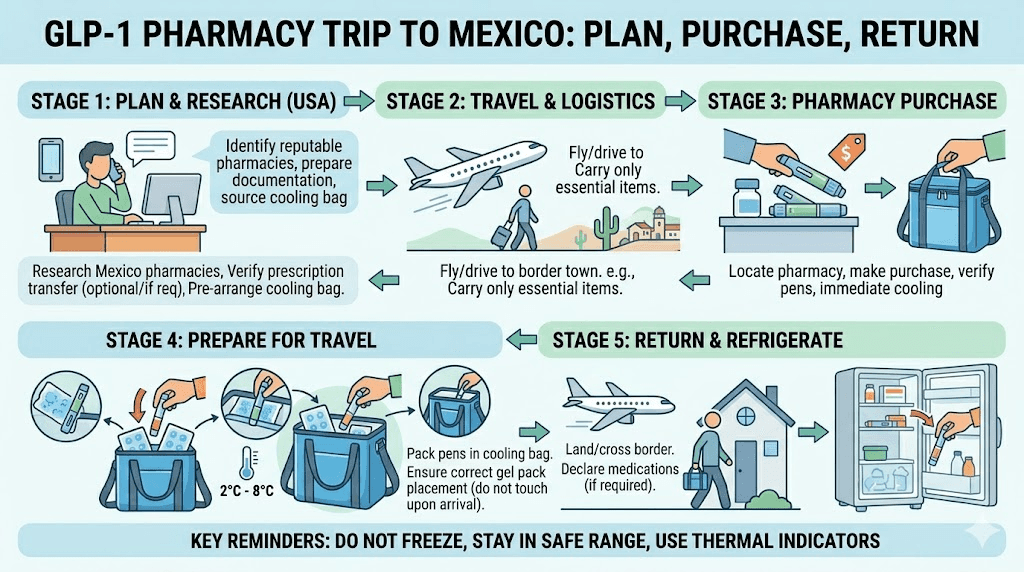
Planning makes the difference between a smooth, cost-effective trip and a frustrating waste of time. Here is a practical approach based on what our community members report.
Before you go
Know your medication and dose. This sounds obvious, but showing up at a Mexican pharmacy unsure whether you need 0.5 mg or 1 mg semaglutide, or whether you want Ozempic versus Wegovy, creates confusion. Review your current semaglutide dosage or tirzepatide dosage in units before your trip.
Call ahead if possible. Major pharmacy chains have phone numbers listed online, and some have English-speaking staff or online inventory systems. Confirming that your specific medication and dose are in stock prevents a wasted trip.
Prepare your documentation. Bring your U.S. prescription or medical records showing your GLP-1 treatment. Even if the Mexican pharmacy does not require it, having documentation makes the border crossing smoother.
Get a cooling bag or case. GLP-1 pens need to stay cold. Medical-grade insulated bags with gel ice packs are the gold standard. Regular coolers work too. Just make sure your solution will maintain temperature for the duration of your trip plus buffer time for unexpected delays.
Research the exchange rate. Mexican pharmacies price in pesos. Knowing the current exchange rate prevents overpaying. Most pharmacies accept U.S. dollars, but the exchange rate they apply is usually less favorable than the market rate. Paying in pesos from an ATM withdrawal often saves 3-5%.
At the pharmacy
Ask to see the medication before purchasing. Check the packaging for proper branding, lot numbers, expiration dates, and security features. Verify the medication comes from a refrigerator. Confirm the medication matches what you use at home.
Do not be pressured into buying a different medication than what you came for. If a pharmacy is out of Ozempic and suggests a "just as good" alternative from an unfamiliar manufacturer, politely decline and try another pharmacy. Stick with brand-name products from known manufacturers like Novo Nordisk (semaglutide) and Eli Lilly (tirzepatide).
Get a receipt. The receipt serves as proof of legitimate purchase and can be helpful at the border. It also provides a record for your own tracking if you monitor your GLP-1 injection schedule.
The return trip
Keep medications in your carry-on or personal bag, not in your trunk where temperatures are uncontrolled. If driving, have your documentation accessible rather than buried in luggage. At the border, be straightforward if asked about what you are bringing across.
Budget extra time for the border crossing. Wait times vary dramatically by day of week and time of day. Saturday afternoons heading north from Tijuana can mean 2-3 hour waits. Early morning on a Tuesday might be 20 minutes. Check current wait times online before heading to the border.
Cost analysis: is a Mexico pharmacy trip worth it
The math depends on where you live, how often you plan to make the trip, and how much you currently pay for your medication.
For border state residents
If you live in California, Arizona, New Mexico, or Texas, the economics are overwhelmingly favorable. A day trip to a border town costs essentially nothing beyond gas and time. If you purchase a 3-month supply of Ozempic at $200 per pen versus $1,200 in the United States, you save $3,000 in a single trip. Factoring in $50 for gas, $60 for a Mexican doctor visit, and $20 for a cooling bag, your total trip cost is about $730 for three months of Ozempic versus $3,600 in the United States.
That is $2,870 in savings. Per trip. And you can do this every three months.
For non-border residents
If you need to fly to a border city, the economics still work but require larger purchases to justify the travel cost. A round-trip flight to San Diego runs $200 to $400 depending on where you start. Add a hotel if needed. But if you purchase 3 months of medication saving $3,000, a $400 flight still leaves you $2,500 ahead.
Some people combine Mexico pharmacy trips with vacations to Cancun, Puerto Vallarta, or Mexico City. The pharmacy visit becomes an incidental part of the trip rather than the sole purpose, which makes the economics work regardless of distance.
Compared to domestic alternatives
Before committing to a Mexico trip, consider whether domestic alternatives might close the price gap sufficiently. Compounded semaglutide from U.S. pharmacies runs $200 to $500 per month. Compounded tirzepatide is similarly priced. Insurance coverage for GLP-1 may also reduce your costs. Blue Cross Blue Shield plans have expanded their GLP-1 coverage recently. And HSA/FSA funds can be applied to GLP-1 medications purchased domestically.
Use the cost calculator to compare your specific situation across these different options.
What to know about using GLP-1 medications from Mexico
Whether you buy your GLP-1 in Houston or Guadalajara, the medication works the same way if it is genuine. The important thing is knowing how to use it properly and what to expect.
Starting your medication
If this is your first time using a GLP-1 medication, proper injection technique matters. Our guides on how to inject GLP-1, best injection sites, and optimal timing for your shot cover the fundamentals.
Most GLP-1 medications require a gradual dose titration. You do not start at the full dose. Semaglutide typically begins at 0.25 mg weekly for the first four weeks, then increases to 0.5 mg. Understanding the semaglutide timeline or tirzepatide timeline helps set realistic expectations.
Managing side effects
GLP-1 side effects are the same regardless of where you purchased the medication. The most common issues include nausea, constipation, dizziness, fatigue, and bloating. These typically improve as your body adjusts over the first few weeks.
For tirzepatide specifically, common side effects include constipation, diarrhea, headaches, and body aches. Our comprehensive guide on semaglutide versus tirzepatide side effects compares the two medications head to head.
One critical consideration when purchasing medication abroad: you may not have easy access to your prescribing physician if something goes wrong. Know the semaglutide withdrawal symptoms to watch for. Understand injection site reactions and when they require medical attention. Having a U.S. physician who knows you are on GLP-1 therapy provides a safety net even if you purchased the medication in Mexico.
Diet and nutrition on GLP-1
GLP-1 medications suppress appetite significantly, which means nutrition becomes more important, not less. When you are eating less food overall, every meal needs to count. Our guides on foods to eat on semaglutide, foods to avoid on tirzepatide, and GLP-1 breakfast ideas provide practical meal planning guidance.
Protein intake deserves special attention. Protein shakes designed for GLP-1 users can help maintain muscle mass during weight loss. Recommended supplements and electrolyte support round out the nutritional picture. The semaglutide diet plan and tirzepatide diet plan offer structured approaches.
Monitoring your progress
Track your results consistently. Week-by-week semaglutide results show what typical progress looks like. Average monthly weight loss on GLP-1 provides benchmarks to compare against. If you hit a plateau, our guides on why semaglutide stops working and breaking through a semaglutide plateau cover the troubleshooting process.
SeekPeptides provides monitoring tools that help you track injection schedules, side effects, and progress over time. Consistent tracking is especially important when you are managing your own medication supply rather than getting it through a U.S. physician office.
Alternatives to buying GLP-1 in Mexico
Mexico is not the only path to affordable GLP-1 access. Before planning a cross-border pharmacy trip, consider whether these alternatives might work for your situation.
Compounded GLP-1 medications
U.S. compounding pharmacies produce semaglutide and tirzepatide at significantly lower prices than brand-name versions. Compounded semaglutide typically costs $200 to $500 per month, and compounded tirzepatide falls in a similar range. These are legal U.S. products that do not require border crossings or international pharmacy visits.
The tradeoff is that compounded medications may differ from brand-name versions in formulation, though the active ingredient is the same. Understanding semaglutide reconstitution and tirzepatide reconstitution is important if you receive lyophilized (powder) formulations rather than pre-mixed pens.
Insurance coverage expansion
Insurance coverage for GLP-1 weight loss medications has expanded significantly. Many plans now cover tirzepatide and semaglutide for weight management, not just diabetes. Check with your insurer specifically about Wegovy and Zepbound coverage. Some plans require prior authorization or a documented BMI threshold, but the coverage landscape is much more favorable than it was even a year ago.
Our guides on Anthem GLP-1 coverage and Blue Cross Blue Shield coverage detail what specific plans offer. FSA eligibility for semaglutide is another financial option worth exploring.
Telehealth GLP-1 providers
Online telehealth platforms have emerged that offer GLP-1 prescriptions with medication included at bundled prices. These typically use compounded formulations and charge $200 to $600 per month including the medication. The convenience of not visiting a pharmacy at all, either domestic or international, appeals to many users.
We have reviewed several of these platforms, including Fella Health, IVIM Health, and others. Each has different pricing structures, medication options, and medical oversight levels.
Manufacturer savings programs
Both Novo Nordisk and Eli Lilly offer savings cards and patient assistance programs that can reduce out-of-pocket costs significantly. These programs have eligibility requirements, but if you qualify, they can bring brand-name medication costs down to ranges that compete with Mexican pharmacy pricing, without the travel.
Oral GLP-1 options
Oral formulations of GLP-1 medications are becoming more available and may offer different pricing dynamics. Oral tirzepatide and oral semaglutide drops provide needle-free options that some users prefer. The oral versus injection comparison covers efficacy differences between delivery methods.
Legal considerations and risk assessment
Buying medication in another country involves legal nuances that go beyond pharmacy regulations. Understanding the full picture helps you make an informed decision.
Federal law versus enforcement reality
Under strict interpretation of federal law, importing prescription drugs for personal use is not legal. The FDA personal importation policy provides enforcement discretion but does not change the underlying law. This means that while CBP officers typically allow small quantities of legitimate medication through, they have the legal authority to confiscate it.
In practice, confiscation of clearly legitimate, small-quantity, personal-use GLP-1 medications is rare. The enforcement focus is on controlled substances, large quantities suggesting resale, and counterfeit products. But "rare" is not "impossible," and you should understand that you are operating in a legal gray area.
What to do if your medication is confiscated
If CBP confiscates your medication, you can request a review. Having documentation, a legitimate prescription, original packaging, and a receipt from a recognized pharmacy, strengthens your case. However, there is no guaranteed right to reclaim confiscated medication, and the review process can take weeks.
This is another reason why purchasing only a 90-day supply is advisable. If you lose one month of medication to confiscation, the financial impact is limited. If you tried to bring a year of supply across the border and lost it all, the situation would be far more painful.
Medical liability considerations
When you purchase medication in Mexico without ongoing U.S. medical oversight, you assume greater responsibility for your own health monitoring. GLP-1 medications can affect menstrual cycles, kidney function, blood clotting, and liver enzymes. Having a U.S. physician who knows about your GLP-1 use, even if you purchase the medication elsewhere, provides important medical backup.
Regular blood work and check-ups are especially important for self-managed GLP-1 therapy. The semaglutide blood work guide explains what tests to request and how to interpret results.
Common mistakes to avoid
Our community has shared hundreds of experiences buying GLP-1 medications in Mexico. These are the mistakes that come up most frequently.
Buying from the wrong pharmacy
Not every storefront with a green cross is a reputable pharmacy. Some small pharmacies in tourist areas are essentially souvenir shops that happen to sell medication. They may purchase inventory from questionable sources, store medication improperly, or sell products past their expiration dates.
Stick with the major chains. The few dollars you might save at a smaller pharmacy are not worth the counterfeit risk.
Not checking the expiration date
Some pharmacies, particularly smaller ones, may sell medication that is close to expiration. Since you are likely buying a multi-month supply, check that the expiration date gives you enough runway to use all the medication before it expires. Understanding semaglutide expiration rules and tirzepatide expiration helps you assess whether the remaining shelf life is adequate.
Inadequate temperature control during transport
This is probably the most common mistake. People buy genuine, properly stored medication, then let it get warm during the drive or flight home. An ice pack that melts after 90 minutes does not help if your border wait is 3 hours.
Invest in a proper cooling solution. Medical-grade insulated bags with phase-change gel packs maintain temperature for 8-12 hours. That is enough for almost any Mexico pharmacy trip scenario.
Buying more than 90 days of supply
The 90-day limit exists for legal reasons, and exceeding it increases your risk at the border. Some people try to buy 6 months or a year of supply to reduce trip frequency. This looks like commercial importation to CBP officers and dramatically increases confiscation risk.
The better approach: plan quarterly trips if you live near the border, or combine them with regular vacation travel to Mexico.
Accepting substitutions
If a pharmacy is out of your specific medication and dose, do not accept a substitute without thorough verification. "We have something just as good" from an unfamiliar manufacturer should be a red flag. The comparison between different GLP-1 medications shows they are not interchangeable without proper medical guidance. Switching between medications requires understanding the conversion dosing and ideally medical supervision.
Skipping the Mexican doctor visit
The $30 to $80 cost of a Mexican physician consultation is some of the best money you can spend on this trip. It provides legal documentation, medical oversight, and prescription validity. Trying to save that small amount by buying without a prescription creates unnecessary risk.
The bigger picture: why GLP-1 costs differ so dramatically
Understanding why the same pen costs $200 in Mexico and $1,200 in the United States provides context for the entire medical tourism phenomenon.
Pharmaceutical companies practice tiered pricing globally. They charge more in wealthy countries and less in developing economies. This is not unique to GLP-1 medications. It applies to most brand-name pharmaceuticals. The U.S. market, with its complex insurance system and lack of government price negotiation, consistently pays the highest prices globally.
Mexico has a different pharmaceutical market structure. Government purchasing programs negotiate prices aggressively. Competition from local distributors creates pricing pressure. And the patient population is more price-sensitive, which limits how much manufacturers can charge.
The result is that the exact same medication, from the same manufacturing facility, distributed through authorized channels, costs dramatically less simply because of where it is sold. This is not a quality difference. It is a pricing strategy difference.
This pricing disparity is unlikely to change quickly. While the U.S. is making incremental progress on drug pricing through legislation and Medicare negotiation, the gap with Mexican prices will remain substantial for the foreseeable future. That means the economic incentive for cross-border pharmacy purchases will persist.
SeekPeptides tracks these pricing trends and regulatory developments to help our community stay informed about all their options. Whether you choose to purchase in Mexico, use compounded medications domestically, or work through insurance, having complete information empowers better decisions.
GLP-1 in Mexico for expats and long-term visitors
Not everyone buying GLP-1 in Mexico is making a quick border run. A growing number of Americans live in Mexico full-time or spend several months a year there. For these people, the access equation is completely different.
Living in Mexico with GLP-1 therapy
If you live in Mexico, accessing GLP-1 medications becomes significantly simpler. You can establish a relationship with a local physician, get regular prescriptions, and purchase from the same pharmacy consistently. This eliminates most of the risks associated with one-time border pharmacy purchases.
Mexican physicians in major cities are fully trained on GLP-1 medications. Many have experience prescribing Ozempic and Mounjaro for both diabetes management and weight loss. The medical education system in Mexico covers the same pharmaceutical knowledge as U.S. medical schools, and many Mexican doctors have trained at U.S. institutions.
A local physician can also order blood work through Mexican laboratories, which costs a fraction of U.S. lab pricing. A comprehensive metabolic panel that costs $500 in the United States might run $50 to $100 in Mexico. This makes regular monitoring affordable and accessible.
For expats managing their own protocols, understanding injection tracking methods and home monitoring tools becomes especially important. Without the automated prescription refill reminders from a U.S. pharmacy, you need your own system.
Snowbirds and seasonal residents
Many Americans spend winters in Mexico, living there for 3 to 6 months. This creates a natural purchasing window. You can obtain a local prescription, buy medication month by month at Mexican prices, and save the cost of shipping or traveling specifically for pharmacy purposes.
The key consideration for seasonal residents is continuity. Make sure your medication supply bridges the gap when you return to the United States. Running out of GLP-1 medication suddenly can cause withdrawal effects and rebound appetite. Plan your last Mexican purchase to provide enough supply until you can refill through your U.S. source.
If you are considering whether to stop semaglutide abruptly versus tapering, that decision should be medical, not based on running out of medication. Planning prevents that situation entirely.
Medical tourism packages
Some medical tourism facilitators in Mexico now offer GLP-1 packages that bundle a physician consultation, prescription, medication, and follow-up monitoring into a single service. These range from $250 to $500 per month, which is competitive with U.S. compounded options but includes brand-name medication and medical oversight.
These services are most developed in Tijuana, Cancun, Mexico City, and Merida. They typically cater to English-speaking patients and handle insurance documentation if you want to seek partial reimbursement from a U.S. insurer (which is rarely successful but sometimes possible for the physician consultation portion).
The quality of these services varies significantly. Look for facilitators that use licensed physicians, dispense from major pharmacy chains, and provide real follow-up rather than just a one-time prescription mill. Ask for references from other patients and check online reviews before committing.
GLP-1 dosing and administration when buying in Mexico
One critical consideration that many Mexico buying guides overlook: making sure you understand your dosing protocol thoroughly before purchasing abroad, where pharmacist counseling may be limited by language barriers or time constraints.
Understanding your dose before you buy
GLP-1 medications use different measurement systems that can create confusion. Semaglutide pens display doses in milligrams, but compounded versions may measure in units. Tirzepatide uses milligrams for pen doses but units for vial-drawn doses. Before your trip, know exactly which product and dose you need.
For semaglutide, our semaglutide conversion chart translates between milligrams and units. The semaglutide dosage calculator helps determine your exact requirements based on your current treatment stage.
For tirzepatide, the dosage chart in units provides the reference you need. Understanding how units convert to milligrams prevents dosing errors that could range from ineffective (too little) to dangerous (too much).
Injection technique refresher
If you have been receiving injections at a physician office and are transitioning to self-administration with Mexico-purchased medication, brush up on proper technique. The semaglutide injection guide and tirzepatide injection guide walk through the process step by step.
Key points for self-injection: rotate injection sites to prevent lipodystrophy, inject subcutaneously (not intramuscularly), and allow the medication to warm slightly toward room temperature for 15-30 minutes before injecting if it has been refrigerated. If you accidentally inject into muscle, the medication will still absorb but may cause more injection site discomfort.
The best injection sites for GLP-1 include the abdomen (around the navel), the front of the thighs, and the back of the upper arms. Our guides on stomach injection technique and thigh injection technique cover the specifics of each site.
Managing your supply schedule
When you purchase medication in bulk from Mexico (up to a 90-day supply), you need to track your usage carefully to avoid running out unexpectedly or having medication expire before you use it.
Most GLP-1 pens have a limited lifespan once first used. Ozempic pens are good for 56 days after first use. Mounjaro KwikPens last 21 days after first use. This means you need to plan which pens to open when, ensuring none expire before completion.
If you are on a lower dose that does not consume a full pen within the usage window, understanding dose scheduling flexibility helps maximize each pen. Some users ask about taking injections early or adjusting their schedule to align with medication supply logistics.
Comparing GLP-1 medication options available in Mexico
If you are open to different GLP-1 medications, Mexico gives you an opportunity to compare options at much lower price points than the United States. Understanding the differences helps you make the best choice for your goals.
Semaglutide versus tirzepatide: which to buy
This is the fundamental question many Mexico pharmacy visitors face. Both medications are available, both are effective for weight loss, and both cost dramatically less than in the United States. So which one should you choose?
Our comprehensive semaglutide versus tirzepatide comparison covers the clinical differences in detail. The short version: tirzepatide tends to produce greater weight loss in clinical trials (up to 22.5% body weight versus 15% for semaglutide at maximum doses). Tirzepatide is a dual agonist targeting both GLP-1 and GIP receptors, while semaglutide targets only GLP-1.
However, semaglutide has a longer track record, more post-market safety data, and wider availability in Mexican pharmacies. It also costs less per dose in Mexico, though both are dramatically cheaper than U.S. prices.
The dosage comparison chart shows equivalent doses side by side. If you are currently on one medication and considering switching, the conversion chart provides the dosing translation.
When to consider switching medications
Some people use a Mexico pharmacy trip as an opportunity to try a different GLP-1 medication at a fraction of the U.S. cost. If semaglutide has stopped working or tirzepatide has plateaued, switching to the other medication sometimes restarts weight loss.
Our guide on switching from semaglutide to tirzepatide covers the medical considerations. The reverse switch is also covered. These are conversations to have with a physician before making the change, not decisions to make in a Mexican pharmacy aisle.
The retatrutide question
Some Mexico pharmacy visitors ask about retatrutide, the next-generation triple-agonist that targets GLP-1, GIP, and glucagon receptors simultaneously. In clinical trials, retatrutide has shown weight loss exceeding 24% of body weight, surpassing both semaglutide and tirzepatide.
As of now, retatrutide is not commercially available in Mexico through legitimate pharmacy channels. It remains in clinical trials. Any source claiming to sell retatrutide in a Mexican pharmacy is selling either a counterfeit, a research chemical, or something else entirely. For those interested in retatrutide, our retatrutide purchasing guide tracks legitimate availability. The dosage chart and pricing information provide context for when it does become available.
Understanding the differences between tirzepatide and retatrutide helps set realistic expectations about what each medication offers and when the next generation will actually be accessible.
Specific GLP-1 medications: Mexico buying guides
Each medication has its own availability pattern, pricing structure, and verification considerations in Mexico. Here are the specifics.
Ozempic buying guide
Ozempic is the most available GLP-1 medication in Mexican pharmacies. Novo Nordisk has established distribution throughout the country, and most major pharmacy chains stock multiple dose strengths consistently.
When purchasing Ozempic, look for the distinctive blue pen with Novo Nordisk branding. The packaging should include a multi-language insert (Spanish and sometimes English). The pen should feel weighted and solid. Counterfeits sometimes have lighter pens with inferior construction.
Verify the NovoFine needle pack is included and sealed. Check that the dose selector clicks precisely through each number. These physical characteristics are harder to replicate than packaging alone.
For dosing guidance after purchase, our semaglutide dosage chart in units and optimal timing guide cover everything you need for proper administration.
Wegovy buying guide
Wegovy availability is less consistent than Ozempic in Mexico. The medication is often in short supply globally, and Mexican pharmacies may not always have the specific dose strength you need.
If you cannot find Wegovy at the higher weight-loss doses (1.7 mg or 2.4 mg), some physicians prescribe Ozempic at equivalent doses instead. The active ingredient is identical. The difference is regulatory approval and dosing packaging. Discuss this option with your prescribing physician before making substitutions.
Mounjaro buying guide
Mounjaro (tirzepatide) from Eli Lilly is increasingly available in Mexico. The KwikPen comes in a distinctive box with Eli Lilly branding and the purple color scheme. Each pen is pre-filled for a specific dose.
Our comprehensive tirzepatide in Mexico guide covers specific pharmacy locations, pricing by dose strength, and detailed verification steps for authentic Mounjaro. If tirzepatide is your medication of choice, that dedicated guide provides more granular information than this overview.
For understanding your dosing requirements before purchase, the tirzepatide dosing chart and starting dose guidance are essential references.
Rybelsus buying guide
Rybelsus (oral semaglutide tablets) offers a unique advantage for Mexico purchases: tablets are easier to transport than injectable pens. They do not require refrigeration, which eliminates the temperature control challenge entirely.
The tradeoff is lower bioavailability compared to injectable semaglutide. You need a higher dose orally to achieve similar blood levels. The tablet must be taken on an empty stomach with minimal water, which requires more discipline than a weekly injection.
Available in 3 mg, 7 mg, and 14 mg tablets, Rybelsus is a reasonable option if the logistics of transporting injectable medication concern you. Our guide on sublingual semaglutide covers additional oral delivery considerations.
What the future holds for GLP-1 access in Mexico
The GLP-1 landscape is shifting rapidly, both in Mexico and globally. Several trends will shape how Americans access these medications in Mexico over the coming years.
Demand continues to surge. As more people learn about the dramatic cost savings, border town pharmacies face increasing stock pressure. Medications that were reliably available a year ago now occasionally sell out, especially at popular doses. This trend will likely intensify, potentially pushing prices upward from their current levels, though they will almost certainly remain far below U.S. pricing.
COFEPRIS is increasing enforcement. Mexican regulators have signaled more aggressive action against pharmacies that sell prescription medications without proper documentation. This may make obtaining medications without a Mexican prescription more difficult in the future, reinforcing the value of establishing a relationship with a Mexican physician now.
New GLP-1 medications are entering the market. As retatrutide and other next-generation medications complete clinical trials and receive approval, they will likely appear in Mexican pharmacies at prices far below U.S. launch costs. Cagrilintide, survodutide, and orforglipron are all in the pipeline. Tracking survodutide developments and orforglipron comparisons helps you understand what options may become available.
Oral formulations are expanding. The convenience of oral GLP-1 medications eliminates many of the challenges associated with purchasing injectables in Mexico. No cold chain issues. No syringe questions at the border. As oral tirzepatide and improved oral semaglutide formulations reach the Mexican market, the logistics of cross-border purchasing become dramatically simpler.
U.S. drug pricing may eventually narrow the gap. Medicare is beginning to negotiate drug prices, and several states are exploring importation programs. These changes are slow, but they could gradually reduce the price differential that drives medical tourism. Until then, Mexico remains one of the most accessible and cost-effective options for Americans seeking affordable GLP-1 therapy.
SeekPeptides continues tracking all of these developments. Our regulatory news coverage and GLP-1 legal developments keep our community informed as the landscape evolves.
Frequently asked questions
Can I buy Ozempic over the counter in Mexico?
Legally, no. Ozempic is a prescription medication in Mexico. In practice, some pharmacies sell it without a prescription, but this is technically against COFEPRIS regulations. Getting a Mexican physician prescription costs $30 to $80 and provides legal protection. Buying from a pharmacy that does not ask for a prescription may also indicate less rigorous quality control practices.
How much does Ozempic cost in Mexico compared to the USA?
Ozempic costs approximately $150 to $300 USD per pen in Mexico versus $900 to $1,350 in the United States. That represents 60% to 85% savings. Tirzepatide (Mounjaro) shows even greater savings, starting around $89 USD in Mexico versus over $1,000 in the U.S. Use the cost calculator to estimate your specific savings.
Is it legal to bring GLP-1 medication from Mexico to the USA?
Technically, personal importation of prescription drugs is not legal under federal law. However, FDA enforcement policy allows CBP officers discretion for personal-use quantities up to a 90-day supply. In practice, small quantities of legitimate medication in original packaging with prescription documentation are generally allowed through border crossings. There is no guarantee, but confiscation of properly documented personal-use GLP-1 medication is uncommon.
How do I know if Ozempic from Mexico is real?
Buy only from major pharmacy chains (Farmacia del Ahorro, San Pablo, Guadalajara, Costco). Check packaging for Novo Nordisk branding, holographic seals, lot numbers, and expiration dates. Verify the medication comes from refrigerated storage. Contact Novo Nordisk customer service to verify the lot number. If the price seems too low or the pharmacy seems questionable, find another source.
Do I need a Mexican prescription to buy semaglutide in Mexico?
Legally yes, but enforcement varies. Some pharmacies sell without requiring one. We strongly recommend obtaining a Mexican prescription from a local clinic, both for legal protection at the border and for medical safety. Consultations typically cost $30 to $80 and take about 30 minutes.
Which Mexican border town is best for buying GLP-1 medication?
Tijuana (near San Diego) has the most options and best-established medical tourism infrastructure. Los Algodones (near Yuma, AZ) is the most walkable and easiest to navigate. Nogales (near Tucson) is smaller but well-organized. The best choice depends on which border crossing is most accessible from your location.
Can I get a 6-month supply in Mexico?
You can purchase whatever quantity is available at the pharmacy, but you should only bring up to a 90-day supply across the border. Larger quantities increase confiscation risk at CBP and may be treated as commercial importation. If you need more than 90 days, plan multiple trips or combine with domestic sourcing options.
Is compounded semaglutide available in Mexican pharmacies?
Mexican pharmacies generally stock brand-name products (Ozempic, Wegovy) rather than compounded versions. Compounded semaglutide is more of a U.S. market phenomenon. For compounded semaglutide information, domestic U.S. pharmacies are the primary source. In Mexico, you get the same brand-name product that costs $900+ in the United States, just at a dramatically lower price.
Can I buy GLP-1 needles and syringes in Mexico?
Yes. Insulin syringes and pen needles are widely available at Mexican pharmacies, often without a prescription. If you use a vial-and-syringe format rather than pre-filled pens, you can purchase compatible syringes in Mexico at very low cost. Our guide on mixing with bacteriostatic water covers the supplies you need.
What happens if I get side effects from medication bought in Mexico?
Side effects from genuine GLP-1 medications are the same regardless of where you purchased them. Headaches, sulfur burps, fatigue, and constipation are the most common issues. Managing them follows the same approaches as U.S.-purchased medication. The concern is if you experience unusual side effects that suggest counterfeit medication. Seek immediate medical attention if you experience blood sugar crashes, severe injection site reactions, or symptoms inconsistent with known GLP-1 side effects.
Should I buy Ozempic or Mounjaro in Mexico?
Both are available and both are dramatically cheaper than in the United States. The choice depends on your clinical situation. Mounjaro (tirzepatide) tends to produce greater weight loss in clinical studies and targets two receptors versus one. Ozempic (semaglutide) has a longer safety record and wider availability. Our detailed comparison helps you understand the differences. Discuss with your physician before switching medications based on price alone.
Are there GLP-1 patches or oral options available in Mexico?
Rybelsus (oral semaglutide tablets) is available in many Mexican pharmacies. GLP-1 patches like Onmorlo may have more limited availability. Oral options are particularly attractive for Mexico purchases because they do not require refrigeration during transport, eliminating the cold chain logistics challenge entirely.
What if my GLP-1 medication gets warm during the trip back?
Brief temperature excursions (under 2 hours at moderate temperatures) generally do not damage GLP-1 medications significantly. However, extended heat exposure degrades the protein. Use a proper cooling bag with gel ice packs rated for at least 4-5 hours. Our guides on semaglutide temperature exposure and tirzepatide temperature exposure explain the specific risks.
External resources
For those serious about optimizing their GLP-1 protocol, whether purchased domestically or internationally, SeekPeptides offers the most comprehensive resource available, with evidence-based guides, proven protocols, and a community of thousands who have navigated these exact questions. Members access detailed dosing calculators, side effect management strategies, and real-world guidance from experienced users who understand the complexities of GLP-1 therapy.
In case I do not see you, good afternoon, good evening, and good night. May your medications stay authentic, your savings stay substantial, and your results stay consistent.