Dec 22, 2025
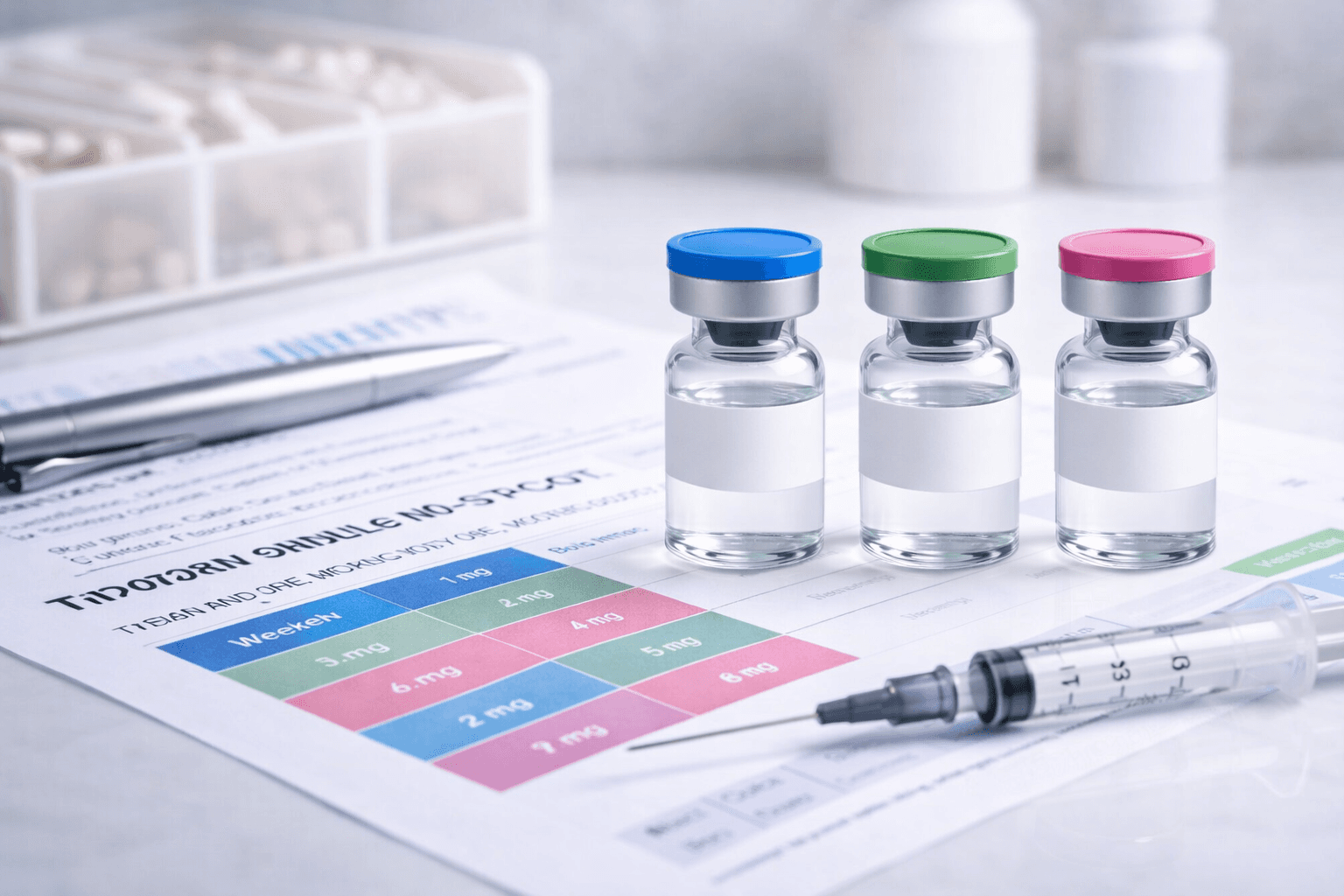
Getting retatrutide dosage right is the difference between manageable side effects and treatment-ending nausea.
The data is clear: participants who started at higher doses or escalated too quickly had nearly double the gastrointestinal side effects compared to those who titrated gradually.
This guide provides complete dosage charts based on clinical trial protocols, reconstitution calculations, injection instructions, and practical guidance for every phase of treatment.
Important disclaimer: Retatrutide is an investigational drug not yet approved by the FDA. These protocols are based on clinical trial data and are provided for educational purposes. Always work with a qualified healthcare provider.
Quick reference: retatrutide dosage chart
This chart reflects the escalation schedule used in Phase 2 and Phase 3 clinical trials:
Standard titration protocol (2mg start → 12mg target)
Week | Dose | Notes |
|---|---|---|
1-4 | 2 mg | Starting dose |
5-8 | 4 mg | First escalation |
9-12 | 6 mg | (Some protocols skip this step) |
13-16 | 9 mg | Second major escalation |
17+ | 12 mg | Maximum/maintenance dose |
Alternative protocols by target dose
Target: 8 mg maintenance
Week | Dose |
|---|---|
1-4 | 2 mg |
5-8 | 4 mg |
9-12 | 6 mg |
13+ | 8 mg |
Target: 4 mg maintenance
Week | Dose |
|---|---|
1-4 | 2 mg |
5+ | 4 mg |
Key principle: Start low, go slow. Increase every 4 weeks unless side effects require holding at current dose longer.
For context on why dosing matters for this peptide, see our GLP-3 peptide guide which explains retatrutide's mechanism.
Understanding retatrutide dosing
Why gradual titration matters
Retatrutide activates three powerful receptor systems simultaneously. Your body needs time to adjust to each:
GLP-1 receptor: Slows gastric emptying, reduces appetite
GIP receptor: Enhances insulin signaling, affects fat metabolism
Glucagon receptor: Increases energy expenditure, promotes fat oxidation
Jumping to high doses overwhelms these systems, causing:
Severe nausea and vomiting
Treatment discontinuation
Longer overall time to reach therapeutic doses
The data: In the Phase 2 NEJM study, participants who started at 4 mg instead of 2 mg had significantly higher rates of gastrointestinal side effects. Slow titration doesn't just feel better—it actually leads to better adherence and outcomes.
Dosing fundamentals
Administration:
Once weekly subcutaneous injection
Same day each week (consistency matters)
Preferably at the same time of day
Half-life: Approximately 6 days, supporting weekly dosing
Dose escalation: Every 4 weeks, unless:
Side effects require holding current dose
Individual tolerance suggests faster/slower progression
Healthcare provider recommends adjustment
Clinical trial doses tested
The Phase 2 obesity trial tested multiple dosing arms:
Dose arm | 48-week weight loss | Side effect profile |
|---|---|---|
1 mg fixed | -8.9% | Lowest side effects |
4 mg fixed | -17.1% | Moderate side effects |
8 mg escalated | -22.8% | Higher but manageable |
12 mg escalated | -24.2% | Highest side effects |
Placebo | -2.1% | Baseline comparison |
Key insight: 8 mg produces nearly the same results as 12 mg with fewer side effects—making it a potential "sweet spot" for many users.
Detailed week-by-week protocol
This expanded chart includes practical guidance for each phase:
Phase 1: Initiation (Weeks 1-4)
Dose: 2 mg once weekly
What to expect:
Reduced appetite (often noticed within days)
Possible mild nausea (usually transient)
Some reduction in food cravings
Minimal weight loss during this phase
Tips:
Establish your injection routine
Track symptoms in a journal
Note your baseline weight and measurements
Don't expect dramatic results yet
Side effects at this phase:
Usually mild if present
Most common: slight nausea, mild fullness
If severe: contact your provider before escalating
Phase 2: First escalation (Weeks 5-8)
Dose: 4 mg once weekly
What to expect:
More noticeable appetite suppression
Possible increase in nausea (typically resolves in 1-2 weeks)
Beginning of measurable weight loss
Some may notice improved energy
Tips:
Eat smaller, more frequent meals
Avoid high-fat and fried foods
Stay well-hydrated (minimum 64 oz water daily)
If nausea is severe, hold at 2 mg for 2 more weeks
Side effects at this phase:
GI symptoms often peak here
Nausea, occasional vomiting, bloating possible
Most symptoms improve by week 7-8
Phase 3: Building dose (Weeks 9-12)
Dose: 6 mg once weekly
What to expect:
Significant appetite reduction
Noticeable weight loss (often 5-10% by week 12)
Body adapting to medication
Side effects often improving from week 5-8
Tips:
Continue hydration focus
Prioritize protein intake to preserve muscle
Consider light exercise if energy permits
Monitor for any new symptoms
Note: Some protocols skip 6 mg and go directly from 4 mg to 8 mg. Discuss with your provider.
Phase 4: Therapeutic dose (Weeks 13-16)
Dose: 8 mg or 9 mg once weekly
What to expect:
Strong appetite suppression
Significant ongoing weight loss
Possible temporary GI flare during escalation
Many reach 10-15% weight loss by this phase
Tips:
This is where most people stabilize
8 mg may be sufficient for many—higher isn't always better
Continue lifestyle optimization
Regular check-ins with healthcare provider
Phase 5: Maximum dose (Week 17+)
Dose: 12 mg once weekly (if tolerated and needed)
What to expect:
Maximum therapeutic effect
Continued weight loss (averaging 20%+ by 48 weeks in trials)
GI side effects may be manageable or may persist
Some achieve 25-30%+ weight loss
Tips:
Not everyone needs to reach 12 mg
Lower doses may provide sufficient results
Balance efficacy with tolerability
Maintenance may involve dose reduction
For general peptide dosing principles, see our peptide dosage calculator guide.
Reconstitution and calculation guide
If using lyophilized (powder) retatrutide, you'll need to reconstitute before injection.
Reconstitution basics
You'll need:
Retatrutide vial (typically 5 mg, 10 mg, or 20 mg)
Bacteriostatic water
Sterile syringe for reconstitution
Insulin syringes for injection
Alcohol swabs
Standard reconstitution volumes:
Vial size | Bacteriostatic water | Concentration |
|---|---|---|
5 mg | 2.0 mL | 2.5 mg/mL |
10 mg | 2.0 mL | 5.0 mg/mL |
20 mg | 2.0 mL | 10.0 mg/mL |
Dose calculation formula
Formula:
Example calculations (10 mg vial with 2 mL water = 5 mg/mL):
Desired dose | Calculation | Volume | Syringe units (U-100) |
|---|---|---|---|
2 mg | 2 ÷ 5 = 0.4 | 0.4 mL | 40 units |
4 mg | 4 ÷ 5 = 0.8 | 0.8 mL | 80 units |
6 mg | 6 ÷ 5 = 1.2 | 1.2 mL | 120 units (split into 2 injections) |
8 mg | 8 ÷ 5 = 1.6 | 1.6 mL | 160 units (split into 2 injections) |
12 mg | 12 ÷ 5 = 2.4 | 2.4 mL | 240 units (use multiple vials or split) |
Important: If your calculated volume exceeds 1 mL, consider:
Using a higher concentration (less water)
Splitting into two injection sites
Using a larger vial size
Vial requirements by dose
How many vials do you need?
Weekly dose | 5 mg vials needed | 10 mg vials needed |
|---|---|---|
2 mg | 1 vial lasts ~2.5 weeks | 1 vial lasts 5 weeks |
4 mg | 1 vial lasts ~1.25 weeks | 1 vial lasts 2.5 weeks |
8 mg | 2 vials per 1.25 weeks | 1 vial lasts 1.25 weeks |
12 mg | 3 vials per 1.25 weeks | 2 vials per 1.6 weeks |
For detailed reconstitution instructions, see our how to reconstitute peptides guide.
Injection technique
Proper injection technique ensures consistent dosing and minimizes discomfort.
Step-by-step injection guide
Preparation:
Wash hands thoroughly with soap and water
Gather supplies: reconstituted retatrutide, insulin syringe, alcohol swabs
Check solution is clear (discard if cloudy or contains particles)
Allow solution to reach room temperature if refrigerated
Drawing the dose:
Clean vial top with alcohol swab, let dry
Draw calculated volume of air into syringe
Insert needle into vial, inject air
Invert vial and withdraw exact dose
Remove air bubbles by tapping syringe gently
Confirm correct volume
Injection:
Choose injection site (abdomen, thigh, or upper arm)
Clean site with alcohol swab, let dry completely
Pinch skin to create fold (optional but recommended)
Insert needle at 90° angle (or 45° if very lean)
Depress plunger slowly and steadily
Wait 5-10 seconds before withdrawing needle
Apply gentle pressure with gauze if needed
Dispose of needle in sharps container
Injection site rotation
Rotate weekly to prevent:
Lipohypertrophy (fatty lumps)
Injection site reactions
Inconsistent absorption
Rotation pattern example:
Week | Site |
|---|---|
1 | Right abdomen |
2 | Left abdomen |
3 | Right thigh |
4 | Left thigh |
5 | Right abdomen (repeat) |
Spacing: Each injection should be at least 1 inch from previous sites.
For storage guidance, see our peptide storage guide.
Side effect management by dose
Understanding what to expect at each dose level helps you prepare and respond appropriately.
Side effects by dose level
Dose | Nausea | Diarrhea | Constipation | Vomiting |
|---|---|---|---|---|
2 mg | ~15% | ~10% | ~8% | ~5% |
4 mg | ~25% | ~18% | ~12% | ~10% |
8 mg | ~35% | ~28% | ~18% | ~15% |
12 mg | ~43% | ~33% | ~25% | ~21% |
Placebo | ~11% | ~13% | ~9% | ~4% |
Note: These are approximate rates from clinical trials. Individual experiences vary.
Managing common side effects
Nausea:
Eat smaller, more frequent meals
Avoid fatty, fried, and spicy foods
Stay upright after eating (don't lie down)
Ginger tea or ginger supplements may help
Take anti-nausea medication if prescribed
Diarrhea:
Stay well-hydrated
Consider electrolyte replacement
Avoid trigger foods
Take OTC anti-diarrheal if persistent
Constipation:
Increase fiber intake gradually
Drink plenty of water
Consider stool softeners
Light exercise can help
Appetite loss (beyond desired effect):
Prioritize protein-rich, nutrient-dense foods
Eat even when not hungry (small amounts)
Consider protein shakes if solid food is difficult
When to contact your provider
Contact immediately if:
Severe abdominal pain
Signs of pancreatitis (severe pain radiating to back)
Severe vomiting that won't stop
Signs of dehydration
Allergic reaction (rash, swelling, difficulty breathing)
Unusual symptoms not listed here
Contact for guidance if:
Side effects persist beyond 2 weeks
Side effects interfere with daily life
You're considering dose adjustment
You've missed doses and need guidance
For comprehensive safety information, see our peptide safety guide.
Dosing adjustments and special considerations
Holding or reducing dose
When to hold at current dose:
Moderate-to-severe GI symptoms
Symptoms that haven't resolved after 3-4 weeks
Any concerning side effects
When to reduce dose:
Symptoms intolerable at current level
Significant weight loss plateau doesn't require maximum dose
Maintenance phase after reaching goals
How to hold:
Stay at current dose for an additional 2-4 weeks
Then attempt escalation again
If symptoms recur, may need to maintain at lower dose
Missed dose protocol
If you miss a dose:
Take it as soon as you remember if within 4-5 days
If more than 5 days, skip and resume normal schedule
Never double dose to make up for missed injection
If you frequently miss doses:
Set weekly reminders
Choose a consistent day (many choose Sunday)
Consider adjusting day if schedule conflicts
Population considerations
For those with kidney impairment:
Limited data available
Slower titration may be warranted
More frequent monitoring recommended
Discuss with provider before starting
For those with liver impairment:
Retatrutide is hepatically metabolized
Caution in moderate-to-severe liver disease
May need dose adjustments
Requires provider guidance
For women:
Similar dosing to men in trials
May have stronger appetite suppression effects
Some may need slower titration
Contraception recommended during treatment
For older adults:
May need slower titration
Increased monitoring for dehydration
Start at lowest dose
More frequent check-ins
Comparing retatrutide dosing to other medications
Retatrutide vs. semaglutide (Wegovy)
Parameter | Retatrutide | Semaglutide |
|---|---|---|
Starting dose | 2 mg weekly | 0.25 mg weekly |
Maintenance dose | 8-12 mg weekly | 2.4 mg weekly |
Titration period | 12-16 weeks | 16-20 weeks |
Escalation frequency | Every 4 weeks | Every 4 weeks |
Maximum trial weight loss | ~24-29% | ~15-17% |
Retatrutide vs. tirzepatide (Zepbound)
Parameter | Retatrutide | Tirzepatide |
|---|---|---|
Starting dose | 2 mg weekly | 2.5 mg weekly |
Maintenance dose | 8-12 mg weekly | 10-15 mg weekly |
Titration period | 12-16 weeks | 16-20 weeks |
Escalation frequency | Every 4 weeks | Every 4 weeks |
Maximum trial weight loss | ~24-29% | ~21-22% |
Key differences:
Retatrutide adds glucagon receptor activity
Slightly greater weight loss potential
Similar side effect profiles
Similar titration approach
For comprehensive weight loss peptide comparisons, see our best peptides for weight loss guide.
Long-term considerations
Maintenance dosing
After reaching goal weight:
Some continue at therapeutic dose indefinitely
Others may reduce to lower maintenance dose (4-8 mg)
Weight regain is common if medication is stopped
Long-term studies are ongoing
Duration of treatment
Based on clinical trial data:
Weight loss continues for at least 48-68 weeks
Plateau may not occur even at 48 weeks
Long-term (multi-year) data not yet available
Treatment may be indefinite for weight maintenance
Monitoring recommendations
Regular check-ins should include:
Weight and body composition
Blood pressure and heart rate
Blood glucose and HbA1c
Lipid panel
Liver and kidney function
Review of symptoms and side effects
Frequently asked questions
What is the starting dose for retatrutide?
The standard starting dose is 2 mg once weekly, based on Phase 2 and Phase 3 clinical trials. Some protocols may start at 1 mg, but 2 mg is most common. Starting low minimizes side effects and allows the body to adapt.
How often should I increase my retatrutide dose?
Dose increases typically occur every 4 weeks, following the clinical trial schedule. However, if you're experiencing significant side effects, you should hold at your current dose for an additional 2-4 weeks before attempting to increase.
What is the maximum dose of retatrutide?
The maximum dose studied in clinical trials is 12 mg weekly. However, many people achieve excellent results at 8 mg, and the maximum dose isn't necessary or appropriate for everyone. Work with your provider to find your optimal dose.
How much weight can I expect to lose?
In Phase 2/3 trials, participants lost an average of 24-29% of body weight at the highest doses over 48-68 weeks. Results vary based on individual factors, lifestyle, and adherence.
What if I miss a dose?
If less than 4-5 days have passed since your scheduled injection, take the dose as soon as you remember. If more than 5 days have passed, skip the missed dose and resume your normal schedule the following week. Never double up on doses.
Can I split my weekly dose into multiple injections?
This is not typically recommended, as clinical trials used once-weekly dosing. However, if your calculated volume exceeds 1 mL, you may need to split the dose into two injection sites during the same administration.
How long should I stay on retatrutide?
Duration depends on individual goals and response. Clinical trials lasted 48-68 weeks, with ongoing weight loss throughout. Many may need long-term or indefinite treatment to maintain weight loss. Discuss with your provider.
What should I do if side effects are severe?
If side effects are severe, contact your healthcare provider immediately. You may need to hold your current dose, reduce to a previous lower dose, or consider additional supportive medications. Never try to "push through" severe symptoms.
Is the dosing the same for men and women?
Clinical trials used the same dosing for both men and women. However, women may experience stronger appetite suppression effects and may benefit from slower titration in some cases.
How should I store reconstituted retatrutide?
Store reconstituted retatrutide refrigerated at 2-8°C (35.6-46.4°F). Use within 2-4 weeks of reconstitution. Keep away from light. Never freeze reconstituted solution.
The bottom line on retatrutide dosing
Proper dosing is fundamental to retatrutide success. The clinical trial data is clear:
Key principles:
Start at 2 mg weekly
Increase by one dose level every 4 weeks
Hold if side effects are significant
8-12 mg is the typical maintenance range
Slower is better than faster
Remember:
This medication is investigational and not FDA-approved
Work with a qualified healthcare provider
Individualize based on your response
Patience during titration pays off
For more information on retatrutide and related peptides, explore our related guides below.
Related guides
GLP-3 peptide guide – Understanding retatrutide's mechanism
Best peptides for weight loss – Comprehensive options
Peptide dosage calculator – Accurate measurements
How to reconstitute peptides – Preparation guide
In case I don’t see you, good afternoon, good evening, and good night. Take care of yourself. <3