Feb 11, 2026
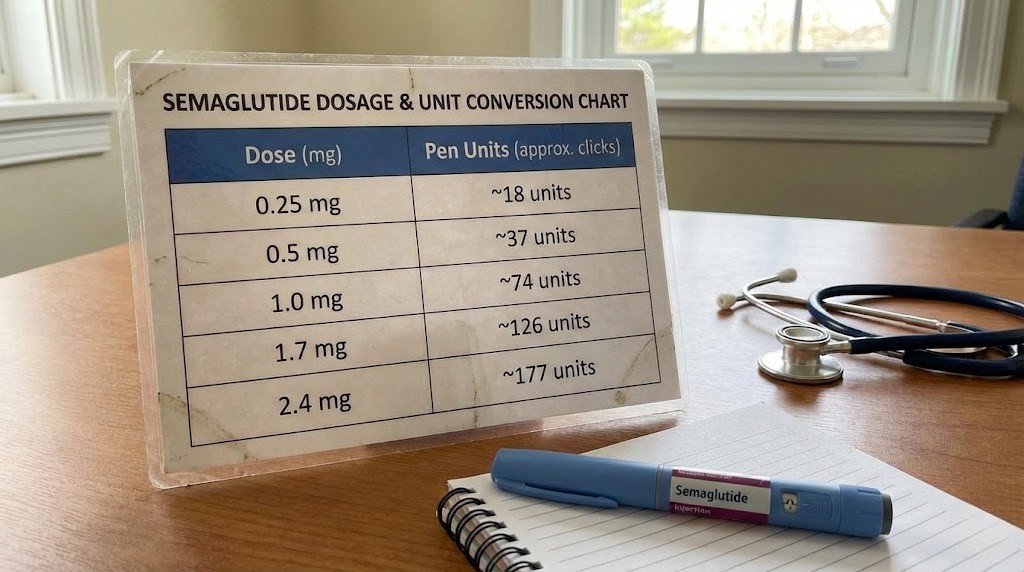
You draw up 50 units of semaglutide from your vial. You inject it. Three days later, you realize something feels wrong. The nausea is worse than it should be. You check your math again. That 50 units was not 0.25mg like you thought. At your concentration, it was actually 0.5mg. You doubled your dose by accident. Now you are paying for it with side effects that could have been avoided if you had just used the right dosage chart from the start.
This happens more often than most people admit. A unit is not a universal measurement. It changes based on your concentration. What measures as 25 units in one vial might need to be 50 units in another to get the exact same dose. The confusion costs people wasted medication, uncomfortable side effects, and slower progress toward their weight loss goals. Some throw away entire vials because they cannot figure out the math. Others underdose for weeks and wonder why nothing is happening.
The problem is not that semaglutide dosing is complicated. The problem is that most dosage charts only show one concentration, usually 5mg/mL, and assume you can figure out the rest on your own. But if your compounded semaglutide comes at 2.5mg/mL or 3.33mg/mL, those charts become useless. You need a different set of numbers. You need to know exactly how many units to draw for every dose at every concentration. That is what this guide provides. Complete dosage charts for every common semaglutide concentration.
The formula to calculate units for any custom mix. Side-by-side comparisons so you can see how the same 0.5mg dose requires different unit measurements depending on your vial. Weight-based considerations. Pharmacy-specific dosing. Everything in one place so you never have to guess again.
This is the comprehensive reference. Whether you are using a 3mg vial at 1mg/mL, a 5mg vial at 2.5mg/mL, or a 10mg vial at 5mg/mL, you will find your exact dosage chart here. SeekPeptides members use these charts to dose accurately from day one, avoiding the trial-and-error phase that wastes both medication and time. You will learn how Ozempic pen units differ from compounded syringe units, why your pharmacy might give you a specific concentration, and how to troubleshoot when your calculations do not match what you expected. By the end, you will know exactly how many units to draw for every single dose, regardless of your vial size or concentration.
What units actually mean on a semaglutide syringe
A unit is a volume measurement, not a dose measurement. This distinction matters because people often confuse the two. When you see "50 units" marked on your insulin syringe, that refers to 0.5mL of liquid volume. The actual amount of semaglutide in that 0.5mL depends entirely on your concentration. If your vial is mixed at 5mg/mL, those 50 units contain 2.5mg of semaglutide. If your vial is mixed at 2.5mg/mL, those same 50 units contain only 1.25mg. Same syringe marking, different dose.
Most compounded semaglutide users work with U-100 insulin syringes. U-100 means the syringe holds 100 units per 1mL of volume. Each unit mark represents 0.01mL. So 10 units equals 0.1mL, 25 units equals 0.25mL, 50 units equals 0.5mL, and 100 units equals 1mL. This standardization makes it easier to measure small volumes accurately, which is critical when your therapeutic dose might be just 0.25mg or 0.5mg of actual medication.
The confusion starts when people see dosing instructions that say "take 0.5mg" but their syringe only has unit markings. You cannot directly measure milligrams on a syringe. You can only measure volume. To convert your milligram dose into units, you need to know your concentration. That is the missing link. Your concentration tells you how many milligrams of semaglutide are dissolved in each milliliter of liquid. Once you know that number, the math becomes straightforward, and tools like the peptide calculator can verify your calculations instantly.
Most pharmaceutical semaglutide products like Ozempic and Wegovy avoid this confusion entirely by using pre-filled pens that deliver fixed doses. You turn a dial to 0.5mg, and the pen automatically dispenses the correct volume. No math required. But compounded semaglutide from pharmacies comes in vials that you reconstitute yourself, which means you are responsible for calculating the correct unit measurement based on your specific concentration. That is where errors happen, especially during the first few doses when you are still learning the system.
Understanding units also helps you waste less medication. If you draw up 60 units when you only needed 50, that extra 10 units goes into your body whether you intended it or not. There is no way to push it back into the vial safely. Some people try to "eyeball" the measurement and end up with inconsistent doses week to week. Others panic when their unit calculation seems too high or too low and second-guess whether they mixed their vial correctly. Having a clear grasp of what units represent and how they relate to your actual dose eliminates that uncertainty. You draw the right amount every time, and resources like the semaglutide dosage calculator can double-check your work before you inject.
The universal formula for calculating semaglutide units
Every semaglutide unit calculation follows the same formula. Desired dose in milligrams divided by concentration in milligrams per milliliter, multiplied by 100. That gives you units. The formula looks like this: units equals parenthesis desired dose in mg divided by concentration in mg per mL close parenthesis times 100. This works for any concentration and any dose, which is why it is called universal. Once you memorize it, you can calculate units for custom concentrations that are not listed in standard charts.
Let me walk through an example. You want to take 0.5mg of semaglutide. Your vial is mixed at 2.5mg/mL concentration. Plug those numbers into the formula: 0.5 divided by 2.5 equals 0.2. Multiply 0.2 by 100 to convert to units. You get 20 units. So you draw up 20 units on your U-100 syringe to deliver a 0.5mg dose from a 2.5mg/mL vial. Simple.
Now change the concentration. Same 0.5mg dose, but your vial is 5mg/mL. The formula becomes: 0.5 divided by 5 equals 0.1. Multiply by 100. You get 10 units. Same dose, different concentration, different unit measurement. This is why you cannot use someone else dosage chart unless their concentration matches yours exactly. The units will be wrong, and you will either underdose or overdose depending on the direction of the mismatch.
The multiplication by 100 at the end converts milliliters into units because U-100 syringes have 100 units per milliliter. If you were using a U-50 syringe, which has 50 units per milliliter, you would multiply by 50 instead. But U-100 is the standard for compounded semaglutide, so the 100 multiplier is almost always correct. This standardization is one reason why peptide dosage calculations have become more accessible even for people without medical training.
Some people prefer to think of the formula in reverse. Instead of calculating units from a desired dose, they calculate what dose they are getting from a certain number of units. The rearranged formula is: dose in mg equals parenthesis units divided by 100 close parenthesis times concentration in mg per mL. So if you draw up 30 units from a 3.33mg/mL vial, the calculation is: 30 divided by 100 equals 0.3. Multiply 0.3 by 3.33. You get approximately 1mg. This reverse calculation is useful for double-checking your work or figuring out what dose you accidentally took if you realize you drew up the wrong amount.
Why does this matter so much? Because small errors compound over time. If you consistently underdose by 10%, your weight loss will plateau earlier than expected. If you consistently overdose by 10%, your side effects will be worse than necessary. Accurate unit calculations keep you in the therapeutic range where semaglutide works best. The peptide reconstitution calculator helps you verify your concentration before you even start calculating units, ensuring your foundation is correct from the beginning.
Complete semaglutide dosage chart for 5mg per mL concentration
The 5mg/mL concentration is one of the most common for compounded semaglutide. Many pharmacies default to this strength because it allows for relatively low unit measurements across the full titration schedule. A 5mg vial reconstituted with 1mL of bacteriostatic water produces this concentration. A 10mg vial with 2mL also produces 5mg/mL. This standardization makes it easier to switch between vial sizes without changing your unit measurements, which is why experienced users often request this concentration specifically.
At 5mg/mL, the standard starting dose of 0.25mg requires just 5 units. That is a small volume, easy to measure accurately even for beginners. As you titrate up to 0.5mg, you draw 10 units. At 1mg, you draw 20 units. The 2.4mg maintenance dose, which is the maximum approved dose for weight loss, requires 48 units. These measurements stay well within the capacity of a standard 0.5mL or 1mL insulin syringe, giving you plenty of room for error without running out of syringe space.
Here is the complete dosage chart for 5mg/mL concentration:
Dose (mg) | Units on U-100 Syringe | Volume (mL) | Typical Week in Titration |
|---|---|---|---|
0.25 | 5 | 0.05 | Weeks 1 through 4 |
0.5 | 10 | 0.1 | Weeks 5 through 8 |
1.0 | 20 | 0.2 | Weeks 9 through 12 |
1.7 | 34 | 0.34 | Weeks 13 through 16 |
2.4 | 48 | 0.48 | Week 17 and beyond |
Some people need doses between these standard steps. If your provider prescribes 0.75mg, you draw 15 units. For 1.5mg, draw 30 units. For 2mg, draw 40 units. The formula scales linearly, so any dose is easy to calculate. This flexibility is one advantage compounded semaglutide has over pre-filled pens, which only deliver specific fixed doses. You can fine-tune your dose to the exact milligram if your provider thinks that will improve your results or reduce side effects.
At 5mg/mL, a 5mg vial contains enough semaglutide for a complete 20-week titration schedule if you follow the standard escalation protocol. Week 1 through 4 at 0.25mg uses 0.2mL total. Week 5 through 8 at 0.5mg uses 0.4mL total. Week 9 through 12 at 1mg uses 0.8mL total. You run out of medication around week 13, which is when most people order their second vial to continue up to the 1.7mg and 2.4mg doses. This predictability helps with planning and budgeting, especially if you are using resources like the peptide cost calculator to estimate your monthly expenses.
This concentration also works well for maintenance dosing. If you stay at 1mg long-term, each 5mg vial lasts 5 weeks. At 2.4mg maintenance, each vial lasts about 2 weeks. The math is simple: vial size in mg divided by weekly dose in mg equals weeks of supply. For people who need long-term semaglutide therapy, understanding this math helps you avoid running out of medication unexpectedly, and guides like how to store peptides after reconstitution ensure your supply stays potent for the full duration.
Complete semaglutide dosage chart for 2.5mg per mL concentration
The 2.5mg/mL concentration is popular among people who prefer drawing larger unit measurements for better accuracy. Smaller unit numbers like 5 or 10 can be harder to see on a syringe, especially if you have vision challenges or shaky hands. Doubling the unit measurement by using a lower concentration makes the dose easier to measure precisely. A 5mg vial reconstituted with 2mL of bacteriostatic water produces 2.5mg/mL. A 10mg vial with 4mL also produces this concentration, though 4mL is a large volume that might require splitting across multiple vials or using a larger vial size.
At 2.5mg/mL, your unit measurements double compared to 5mg/mL. The 0.25mg starting dose becomes 10 units instead of 5. The 0.5mg dose becomes 20 units instead of 10. The 1mg dose becomes 40 units instead of 20. You are injecting the same amount of semaglutide, just in a larger volume of liquid. Some people find this more comfortable because the injection feels more substantial, while others prefer smaller volumes to minimize injection site reactions. Neither approach is wrong, it is just personal preference informed by experience.
Here is the complete dosage chart for 2.5mg/mL concentration:
Dose (mg) | Units on U-100 Syringe | Volume (mL) | Typical Week in Titration |
|---|---|---|---|
0.25 | 10 | 0.1 | Weeks 1 through 4 |
0.5 | 20 | 0.2 | Weeks 5 through 8 |
1.0 | 40 | 0.4 | Weeks 9 through 12 |
1.7 | 68 | 0.68 | Weeks 13 through 16 |
2.4 | 96 | 0.96 | Week 17 and beyond |
One challenge with 2.5mg/mL is that the higher doses require larger unit measurements that approach the capacity limits of standard insulin syringes. The 2.4mg maintenance dose requires 96 units, which is 96% of a 1mL syringe capacity. If you accidentally overfill even slightly, you might exceed 100 units and waste medication. Some people switch to a larger syringe at higher doses, but that introduces another variable. Others switch to a higher concentration like 5mg/mL once they reach maintenance dosing to keep unit measurements more manageable, though this requires ordering a new vial mixed at the different strength.
The advantage of 2.5mg/mL becomes most apparent at the low end of the dose range. Measuring 10 units for the 0.25mg starting dose is easier than measuring 5 units, especially if you are new to peptide injections and still getting comfortable with syringe technique. The larger volume also means less concentrated medication, which some people report causes fewer injection site reactions like redness or swelling. There is no clinical data proving this, but anecdotal reports are consistent enough that it might be worth considering if you have sensitive skin or a history of injection site issues.
At 2.5mg/mL, a 5mg vial lasts the same number of doses as a 5mg/mL vial, but each dose takes up more volume. Your 5mg vial at 2.5mg/mL concentration contains 2mL of liquid instead of 1mL. Four weeks at 0.25mg uses 0.4mL. Four weeks at 0.5mg uses 0.8mL. You will run out of volume before you reach the higher doses unless you use a 10mg vial or plan to switch concentrations mid-titration. Understanding these volume constraints is part of proper planning, and articles like semaglutide mixing charts help you visualize how different bacteriostatic water amounts affect your final concentration and usable volume.
Complete semaglutide dosage chart for 3.33mg per mL concentration
The 3.33mg/mL concentration occupies a middle ground between 2.5mg/mL and 5mg/mL. It offers moderately sized unit measurements without pushing syringe capacity limits at higher doses. Many compounding pharmacies use this concentration because it optimizes the balance between measurement accuracy and total doses per vial. A 10mg vial reconstituted with 3mL of bacteriostatic water produces 3.33mg/mL. This is one of the most common pharmacy defaults, especially for patients who order larger vial sizes to reduce per-dose costs.
At 3.33mg/mL, the unit measurements fall between the previous two concentrations. The 0.25mg starting dose requires approximately 7.5 units, though most people round to 8 units for easier measurement since syringe markings typically show every 2 units. The 0.5mg dose requires 15 units. The 1mg dose requires 30 units. The 2.4mg maintenance dose requires 72 units. These are comfortable measurements that avoid both the very small units of 5mg/mL and the near-capacity units of 2.5mg/mL.
Here is the complete dosage chart for 3.33mg/mL concentration:
Dose (mg) | Units on U-100 Syringe | Volume (mL) | Typical Week in Titration |
|---|---|---|---|
0.25 | 7.5 (round to 8) | 0.075 | Weeks 1 through 4 |
0.5 | 15 | 0.15 | Weeks 5 through 8 |
1.0 | 30 | 0.3 | Weeks 9 through 12 |
1.7 | 51 | 0.51 | Weeks 13 through 16 |
2.4 | 72 | 0.72 | Week 17 and beyond |
The fractional unit measurement for 0.25mg is the only quirk with this concentration. Technically, 7.5 units is the correct calculation, but standard insulin syringes do not have a 7.5 unit marking. You have to eyeball the midpoint between 6 and 8, or round up to 8 units. Rounding to 8 units gives you approximately 0.267mg instead of 0.25mg, which is a 7% increase. For most people, this difference is clinically insignificant during the first four weeks of titration. Your body is still adapting to semaglutide, and a slightly higher dose might even help you get into the therapeutic range faster. However, if you are particularly sensitive to medication or have a history of severe nausea on GLP-1 agonists, you might prefer a concentration that avoids fractional units altogether.
One advantage of 3.33mg/mL is how well it scales across vial sizes. A 10mg vial at this concentration contains exactly 3mL of liquid, which fits perfectly in a standard 3mL vial. A 15mg vial would contain 4.5mL, still manageable. This makes it easier for pharmacies to batch-prepare vials at consistent concentrations, which is why you often see 3.33mg/mL as the default option when ordering from compounding pharmacies. If you are comparing options, guides like compounded semaglutide dose charts can show you how different pharmacies structure their concentrations and what that means for your unit calculations.
At 3.33mg/mL, a 10mg vial provides 10 total milligrams of semaglutide across 3mL of volume. If you use 0.5mg per week, that vial lasts 20 weeks. If you use 1mg per week, it lasts 10 weeks. If you reach 2.4mg maintenance, it lasts about 4 weeks. This concentration offers good longevity at moderate doses, which is ideal for people who have found their effective dose and want to maintain it long-term without constantly reordering vials. Proper storage practices, as outlined in how long peptides last in the fridge, ensure that 3mL vial stays potent for the full duration of your treatment cycle.
Complete semaglutide dosage chart for 2mg per mL concentration
The 2mg/mL concentration is less common but sometimes preferred by people who want very large unit measurements for maximum accuracy. This concentration also allows you to use more bacteriostatic water per vial, which can extend the shelf life of your reconstituted semaglutide by maintaining better sterility with a larger liquid volume. A 10mg vial reconstituted with 5mL of bacteriostatic water produces 2mg/mL. This requires a 5mL vial or larger, which not all pharmacies stock, so you might need to request this concentration specifically rather than getting it as a default.
At 2mg/mL, unit measurements are significantly larger than higher concentrations. The 0.25mg starting dose requires 12.5 units, typically rounded to 12 or 13. The 0.5mg dose requires 25 units. The 1mg dose requires 50 units. The 2.4mg maintenance dose requires 120 units, which exceeds the capacity of a standard 1mL insulin syringe. You would need to either split the dose across two injections or use a 3mL syringe, which has larger unit markings that might be harder to read accurately. This concentration is impractical for higher doses but works well if you plan to stay at 1mg or below long-term.
Here is the complete dosage chart for 2mg/mL concentration:
Dose (mg) | Units on U-100 Syringe | Volume (mL) | Typical Week in Titration |
|---|---|---|---|
0.25 | 12.5 (round to 12 or 13) | 0.125 | Weeks 1 through 4 |
0.5 | 25 | 0.25 | Weeks 5 through 8 |
1.0 | 50 | 0.5 | Weeks 9 through 12 |
1.7 | 85 | 0.85 | Weeks 13 through 16 |
2.4 | 120 (requires 3mL syringe or split dose) | 1.2 | Week 17 and beyond |
The primary use case for 2mg/mL is when you need very large unit measurements for ease of reading. Older adults or people with vision impairment sometimes find it easier to draw up 25 units instead of 10 units because the syringe markings are further apart. The larger volume also means a slower injection if you are using a smaller gauge needle, which some people find more comfortable. However, these benefits come with the trade-off of requiring larger syringes or split doses at higher doses, which adds complexity and increases the risk of dosing errors.
Another scenario where 2mg/mL makes sense is if you are combining semaglutide with another injectable medication like B12 and want to mix them in the same syringe. The larger volume gives you more room to add a second medication without exceeding syringe capacity. However, mixing medications requires careful sterile technique and understanding of drug compatibility, so this is not recommended unless your provider specifically instructs you to do so. Resources like semaglutide with B12 explain when and how these combinations work best.
At 2mg/mL, a 10mg vial contains 5mL of liquid. If you use 0.5mg per week, that vial lasts 20 weeks, the same duration as higher concentrations because the total milligrams are unchanged. But the 5mL volume requires more storage space in your refrigerator and increases the surface area exposed to potential contamination each time you draw a dose. Some data suggests that larger volume vials have slightly higher contamination risk over extended periods, though proper sterile technique mitigates this. Articles like bacteriostatic water for peptides explain how the preservatives in bacteriostatic water protect against bacterial growth even in larger volumes.
Complete semaglutide dosage chart for 1mg per mL concentration
The 1mg/mL concentration represents the lowest concentration typically used for compounded semaglutide. It produces the largest possible unit measurements, which maximizes measurement accuracy but also maximizes injection volume. This concentration is rarely used for long-term therapy because the high doses required at maintenance would exceed standard syringe capacities, but it has niche applications for people who need extremely precise measurements at low doses or who are splitting vials into multiple smaller doses for cost savings.
At 1mg/mL, the unit measurements are five times larger than 5mg/mL. The 0.25mg starting dose requires 25 units. The 0.5mg dose requires 50 units. The 1mg dose requires 100 units, which is exactly the full capacity of a 1mL syringe. Going beyond 1mg requires either switching to a 3mL syringe or splitting your dose across two injections per week. For the 2.4mg maintenance dose, you would need 240 units, which equals 2.4mL and definitely requires a larger syringe or multiple injections. This makes 1mg/mL impractical for most people past the initial titration phase.
Here is the complete dosage chart for 1mg/mL concentration:
Dose (mg) | Units on U-100 Syringe | Volume (mL) | Typical Week in Titration |
|---|---|---|---|
0.25 | 25 | 0.25 | Weeks 1 through 4 |
0.5 | 50 | 0.5 | Weeks 5 through 8 |
1.0 | 100 (full 1mL syringe) | 1.0 | Weeks 9 through 12 |
1.7 | 170 (requires 3mL syringe or split dose) | 1.7 | Weeks 13 through 16 |
2.4 | 240 (requires 3mL syringe or split dose) | 2.4 | Week 17 and beyond |
One legitimate use for 1mg/mL is when you are microdosing semaglutide, taking doses below the standard 0.25mg starting dose. Some people begin at 0.1mg or 0.15mg to minimize side effects, especially if they have a history of severe nausea with GLP-1 medications. At 1mg/mL, a 0.1mg dose requires just 10 units, which is easy to measure accurately. At 5mg/mL, that same 0.1mg dose would require only 2 units, which is difficult to see on most syringes and increases the risk of measurement error. For microdosing protocols, lower concentrations like 1mg/mL offer a real practical advantage despite their impracticality at higher doses.
Another scenario is cost management through vial sharing. Some people split a 10mg vial among multiple users or across multiple treatment cycles by reconstituting at 1mg/mL, which produces 10mL of liquid. This large volume allows for more discrete doses to be drawn over time. However, the sterility risks increase with each needle puncture into the vial, and the longer storage time required to use 10mL of medication raises concerns about potency degradation. This is not a recommended practice unless you fully understand the sterile technique and storage requirements involved, and resources like peptide storage guidelines become essential reading.
At 1mg/mL, a 10mg vial contains 10mL of liquid. If you use 0.25mg per week, that vial lasts 40 weeks, nearly 10 months. But no compounded semaglutide maintains full potency for 10 months even with perfect refrigeration. Most data suggests reconstituted semaglutide degrades measurably after 8 to 12 weeks in the refrigerator, even with bacteriostatic water preservation. So while the math says a 10mL vial at 1mg/mL could last 40 weeks, the reality is you would likely see reduced efficacy long before using the full vial. Articles like how long reconstituted peptides last in the fridge provide more specific data on semaglutide stability timelines.
Ozempic pen units versus compounded semaglutide units
Ozempic pens and compounded semaglutide use completely different unit systems, which creates massive confusion when people switch between the two. An Ozempic pen does not measure units in the same way a U-100 insulin syringe does. The pen dose selector shows your dose directly in milligrams. When you turn the dial to 0.5, you are selecting 0.5mg of semaglutide, not 0.5 units. The pen automatically calculates the correct volume to dispense based on its internal concentration, which is 1.34mg/mL for Ozempic pens. You never need to think about units or do any math. Just turn the dial and inject.
Compounded semaglutide works differently because you are measuring volume in units on a syringe, and that volume translates to a dose based on your specific concentration. There is no automatic conversion. You have to calculate how many units to draw for your desired milligram dose, or you have to look it up in a dosage chart like the ones in this guide. This manual calculation step is where errors happen, especially for people transitioning from Ozempic pens to compounded semaglutide for the first time.
The confusion gets worse because some people incorrectly assume that the dose selector numbers on an Ozempic pen are the same as units on a syringe. They see "0.5" on the pen dial and think that translates to 50 units on a syringe. But that is only true if your compounded semaglutide concentration happens to be 1mg/mL. At 5mg/mL, a 0.5mg dose is 10 units, not 50. At 2.5mg/mL, it is 20 units. The pen dial number and the syringe unit number are unrelated unless your concentration aligns perfectly with 1mg/mL, which is uncommon.
Here is a side-by-side comparison showing how Ozempic pen doses translate to units at different compounded semaglutide concentrations:
Dose (mg) | Ozempic Pen Dial | Units at 1mg/mL | Units at 2mg/mL | Units at 2.5mg/mL | Units at 3.33mg/mL | Units at 5mg/mL |
|---|---|---|---|---|---|---|
0.25 | 0.25 | 25 | 12.5 | 10 | 7.5 | 5 |
0.5 | 0.5 | 50 | 25 | 20 | 15 | 10 |
1.0 | 1.0 | 100 | 50 | 40 | 30 | 20 |
1.7 | Not available on 0.25/0.5 pen | 170 | 85 | 68 | 51 | 34 |
2.0 | 2.0 (on 2mg pen only) | 200 | 100 | 80 | 60 | 40 |
Another source of confusion is that Ozempic pens come in different strengths. The 0.25mg/0.5mg pen is designed for the first 8 weeks of titration and only dispenses those two doses. The 1mg pen dispenses 0.5mg, 1mg, or higher doses up to 2mg if you have the 2mg pen. Wegovy pens, which are the same semaglutide molecule but marketed specifically for weight loss, come in single-dose pens that deliver 0.25mg, 0.5mg, 1mg, 1.7mg, or 2.4mg with no dose adjustment required. Each pen is pre-filled with the exact amount needed for one dose, eliminating any calculation entirely. When people switch from these pre-filled systems to compounded vials, the sudden need to calculate units feels overwhelming, and mistakes are common during the first few doses.
One advantage of compounded semaglutide is flexibility. With an Ozempic pen, you can only take the doses programmed into the pen dial. If your provider wants you to take 0.75mg, you cannot do that with a pen. You would have to take 0.5mg or 1mg, neither of which is what was prescribed. With compounded semaglutide, you calculate the exact unit measurement for 0.75mg at your concentration and draw that amount. This precision is especially valuable for people who need customized titration schedules due to side effects or slower-than-typical weight loss. Tools like the semaglutide 5mg/mL dosage chart help bridge the gap between pen-based dosing and syringe-based dosing by showing you exactly how to replicate your pen dose with a compounded vial.
Full titration schedule with units at every concentration
The standard semaglutide titration schedule follows a 20-week escalation protocol designed to minimize side effects while gradually reaching the therapeutic dose. Most people start at 0.25mg per week for 4 weeks, increase to 0.5mg for 4 weeks, then 1mg for 4 weeks, then 1.7mg for 4 weeks, and finally reach 2.4mg maintenance by week 17. This slow escalation allows your body to adapt to the appetite suppression and gastrointestinal changes caused by semaglutide, reducing the risk of severe nausea, vomiting, or other side effects that might force you to discontinue treatment early.
However, the unit measurements you draw for each of these doses depend entirely on your concentration. The same 0.25mg starting dose could be 5 units, 10 units, or 25 units depending on whether your vial is mixed at 5mg/mL, 2.5mg/mL, or 1mg/mL. This variability means you cannot follow someone else titration schedule unless you know their concentration matches yours. The following table shows the complete titration schedule with unit measurements for every common concentration, allowing you to follow the standard protocol regardless of how your pharmacy mixed your vial.
Week | Dose (mg) | Units at 1mg/mL | Units at 2mg/mL | Units at 2.5mg/mL | Units at 3.33mg/mL | Units at 5mg/mL |
|---|---|---|---|---|---|---|
1 to 4 | 0.25 | 25 | 12.5 | 10 | 7.5 | 5 |
5 to 8 | 0.5 | 50 | 25 | 20 | 15 | 10 |
9 to 12 | 1.0 | 100 | 50 | 40 | 30 | 20 |
13 to 16 | 1.7 | 170 | 85 | 68 | 51 | 34 |
17+ | 2.4 | 240 | 120 | 96 | 72 | 48 |
Not everyone follows this exact schedule. Some people experience intolerable side effects at 0.5mg and choose to stay at 0.25mg for an additional 4 to 8 weeks before attempting another increase. Others tolerate semaglutide well and increase doses every 2 weeks instead of every 4 weeks, reaching maintenance faster. Your provider might also prescribe intermediate doses like 0.75mg or 1.5mg if you need a more gradual escalation. The beauty of compounded semaglutide is that you can calculate the unit measurement for any custom dose using the universal formula, giving you complete control over your titration speed. Resources like peptide dosing guides explain how to adapt the standard schedule to your individual tolerance and goals.
Some people never reach 2.4mg maintenance. Research shows that many people achieve their weight loss goals at 1mg or 1.7mg and choose to stay at that dose long-term. The STEP 1 trial showed an average weight loss of 14.9% at 2.4mg over 68 weeks, but some participants lost nearly as much weight at lower doses with fewer side effects. If you reach your goal weight or body composition at 1mg, there is no reason to escalate further unless your provider recommends it for other metabolic benefits. Staying at a lower maintenance dose also reduces your medication costs and might lower your long-term risk of side effects, making it an attractive option for people focused on sustainability rather than maximum results.
Weight-based dosing is another approach some providers use instead of the standard fixed-dose titration. The idea is to calculate your dose based on your current body weight rather than following the universal schedule. For example, a provider might prescribe 0.01mg per kilogram of body weight for the starting dose. A 100kg person would start at 1mg, while a 50kg person would start at 0.5mg. This approach is more common in research settings than clinical practice, but some providers believe it optimizes the balance between efficacy and side effects by tailoring the dose to individual body size. If your provider prescribes weight-based dosing, you will need to calculate your milligram dose first, then convert that to units using the formula specific to your concentration. Tools like the peptide calculator for weight loss can help with these calculations.
How vial size affects your unit calculations
Vial size determines how much bacteriostatic water you add during reconstitution, which in turn determines your final concentration. A 5mg vial mixed with 1mL of water produces 5mg/mL concentration. The same 5mg vial mixed with 2mL of water produces 2.5mg/mL concentration. Same amount of semaglutide powder, different concentration, different unit measurements. Understanding this relationship is critical because your pharmacy might send you a different vial size than you expected, and you need to adjust your reconstitution volume to maintain your preferred concentration.
The most common vial sizes for compounded semaglutide are 3mg, 5mg, and 10mg. Some pharmacies also offer 15mg or 20mg vials for people who need long-term supplies or who are splitting vials among family members for cost savings. Larger vials are usually more cost-effective on a per-milligram basis, but they require more bacteriostatic water to reach your desired concentration, and they take up more space in your refrigerator. There is also a practical limit to how large a vial can be before it becomes unwieldy to handle or difficult to draw from consistently.
Here is how different vial sizes combine with bacteriostatic water volumes to produce common concentrations:
Vial Size | Bacteriostatic Water Volume | Final Concentration | Total Liquid Volume |
|---|---|---|---|
3mg | 0.6mL | 5mg/mL | 0.6mL |
3mg | 1.2mL | 2.5mg/mL | 1.2mL |
5mg | 1mL | 5mg/mL | 1mL |
5mg | 2mL | 2.5mg/mL | 2mL |
10mg | 2mL | 5mg/mL | 2mL |
10mg | 3mL | 3.33mg/mL | 3mL |
10mg | 4mL | 2.5mg/mL | 4mL |
10mg | 5mL | 2mg/mL | 5mL |
10mg | 10mL | 1mg/mL | 10mL |
One common mistake is assuming that you must use a specific amount of bacteriostatic water with a specific vial size. Some guides say "always mix 5mg with 1mL" without explaining that this is just one option. If you want a different concentration for easier unit measurements or to extend the number of doses per vial, you can adjust the water volume accordingly. The only constraint is that your final liquid volume must fit inside your vial. A standard 3mL vial can only hold about 2.5mL of liquid safely, so trying to mix a 10mg vial with 10mL of water would require a larger vial. Your pharmacy usually provides an appropriately sized vial based on the amount of bacteriostatic water recommended for your concentration, but it is worth double-checking before you start mixing.
Another consideration is cost per dose. Larger vials generally cost less per milligram of semaglutide, but they require proportionally more bacteriostatic water, which is an additional cost. Bacteriostatic water is inexpensive, usually a few dollars per 10mL vial, but it still adds up if you are reconstituting multiple vials per month. Some people try to save money by using sterile water or saline instead of bacteriostatic water, but this is not recommended because those alternatives lack the preservatives that prevent bacterial growth. Without preservatives, your reconstituted semaglutide would need to be used within a few days instead of several weeks, making it impractical for typical dosing schedules. Articles like how much bacteriostatic water to add to peptides provide more details on proper reconstitution practices.
Vial size also affects storage duration. A 3mg vial at 5mg/mL concentration contains 0.6mL of liquid. If you use 0.5mg per week at 10 units per dose, that vial lasts 6 weeks. A 10mg vial at the same concentration contains 2mL of liquid and lasts 20 weeks at the same dose. But semaglutide degrades over time even when refrigerated, so using a 10mg vial over 20 weeks means the last few doses might be less potent than the first few. Most experts recommend using reconstituted semaglutide within 8 to 12 weeks for optimal potency, which suggests that smaller vials might actually provide more consistent results even if they cost slightly more per milligram. Guides like do peptides expire explain how to recognize signs of degradation and when to discard old vials.
Compounded semaglutide from popular pharmacies
Different compounding pharmacies use different default concentrations for their semaglutide products, which means the unit measurements you need might vary depending on where you order from. Some pharmacies standardize on 5mg/mL for all vial sizes. Others use 3.33mg/mL for 10mg vials but 5mg/mL for 5mg vials. A few offer multiple concentration options and let you choose based on your preferences. Knowing what concentration your pharmacy provides is essential before you can calculate your units correctly, and you should verify this information before reconstituting your first vial.
Empower Pharmacy, one of the largest compounding pharmacies in the US, typically ships semaglutide vials with bacteriostatic water included and provides a dosing card that shows unit measurements for their standard concentration. Most Empower vials are mixed at 2.5mg/mL or 5mg/mL depending on the vial size ordered. If you order a 5mg vial, they often recommend 2mL of bacteriostatic water for 2.5mg/mL concentration. If you order a 10mg vial, they might recommend 2mL for 5mg/mL concentration. Their dosing cards usually show a titration schedule with unit measurements already calculated, which eliminates guesswork for most users. However, if you prefer a different concentration, you can request a custom reconstitution volume and calculate your own unit measurements using the charts in this guide.
Strive Compounding Pharmacy is another popular option, especially for people who want combination semaglutide products that include vitamin B12 or other adjunct compounds. Strive often uses 3.33mg/mL as their default concentration for 10mg vials because it provides a good balance between unit measurement size and total doses per vial. Their semaglutide with B12 products follow the same concentration standards, though the addition of B12 slightly increases the total liquid volume. If you switch from plain semaglutide to a B12 combo product from Strive, your unit measurements should remain the same as long as the semaglutide concentration is unchanged. Resources like Strive Pharmacy semaglutide dosage charts provide pharmacy-specific guidance for these combination products.
Hallandale Pharmacy is known for offering large-volume vials at competitive prices. They frequently ship 15mg or 20mg vials that are designed to last several months at typical maintenance doses. These large vials are usually mixed at 2mg/mL or 2.5mg/mL to keep the total liquid volume manageable. A 20mg vial at 2mg/mL requires 10mL of bacteriostatic water, which produces a large liquid volume but extends the cost per dose significantly. Hallandale often includes detailed reconstitution instructions and dosing charts with their shipments, but if you prefer a different concentration, you can adjust the bacteriostatic water amount and recalculate your units using the universal formula.
Other pharmacies like Wells Pharmacy, Olympia Pharmacy, and various telemedicine-affiliated compounders each have their own standards. Some provide pre-filled syringes instead of vials, which eliminates unit calculations entirely but removes the flexibility to adjust doses.
Others provide vials with no bacteriostatic water and expect you to source your own, giving you complete control over concentration but requiring more knowledge and preparation. If you are ordering from a new pharmacy for the first time, always ask what concentration they use by default, whether they include bacteriostatic water, and whether they provide dosing instructions. Having this information before your vial arrives prevents confusion and reduces the risk of dosing errors during your first injection.
One advantage of working with SeekPeptides is access to pharmacy-specific dosing protocols that account for these variations. Many people waste their first vial by mixing it incorrectly or drawing the wrong unit measurements because they did not realize their pharmacy uses a non-standard concentration. Members can cross-reference their pharmacy information with detailed dosing charts and reconstitution guides to ensure accuracy from the first dose. This is especially valuable if you are switching pharmacies mid-treatment and need to adjust your unit calculations to match a new concentration while maintaining the same milligram dose.
Common unit calculation mistakes and how to fix them
The most frequent mistake people make is forgetting to check their concentration before calculating units. You might have used a 5mg/mL vial for months, memorized all the unit measurements, and then switched to a 10mg vial from a different pharmacy that comes at 3.33mg/mL. If you keep using your old unit measurements, you will overdose or underdose depending on which direction the concentration changed. Always verify your concentration before calculating units for a new vial, even if the vial size looks the same. The concentration label should be on the vial itself or on the paperwork from your pharmacy. If it is not clearly marked, calculate it yourself using the formula: vial size in mg divided by bacteriostatic water volume in mL equals concentration in mg per mL.
Another common mistake is rounding incorrectly when unit calculations produce fractional numbers. If your calculation shows 7.5 units, some people round down to 7 units to be conservative, while others round up to 8 units to avoid underdosing. Neither approach is wrong, but you should be consistent. Rounding down every time means you are systematically underdosing by a small percentage, which could slow your weight loss progress. Rounding up every time means you are systematically overdosing, which could increase side effects. Most experts recommend rounding to the nearest even number for fractional calculations, so 7.5 becomes 8, but 6.5 becomes 6. This balances out over time and minimizes cumulative error.
A third mistake is using the wrong type of syringe. U-100 insulin syringes are standard for compounded semaglutide, but some people accidentally use U-40 or U-50 syringes, which have different unit markings. A U-40 syringe has 40 units per 1mL instead of 100 units per 1mL, so the unit markings are spaced differently. If you draw up 20 units on a U-40 syringe thinking it is a U-100 syringe, you are actually drawing 50 units worth of volume, which is 2.5 times more than intended. This can lead to severe overdosing and dangerous side effects. Always check the syringe packaging to confirm it is labeled U-100 before using it for semaglutide dosing. The syringe barrel should also have "U-100" printed on it for easy verification.
Some people make the mistake of confusing total vial size with dose size. If you have a 10mg vial, that does not mean you take 10mg per dose. It means the vial contains 10mg total, which you divide into multiple smaller doses over several weeks or months.
New users sometimes think "10mg vial" means a single 10mg dose and panic about the safety of such a high dose. This confusion usually gets cleared up quickly, but it highlights the importance of understanding the difference between vial size, which is total medication content, and dose size, which is the amount you take per injection. Guides like what are peptides provide foundational knowledge that helps prevent these conceptual errors.
Another mistake is failing to prime the syringe before measuring your dose. When you first insert the needle into the vial, there is often a small air gap at the tip of the needle. If you draw your dose without priming, that air gap becomes part of your measurement, and you end up with slightly less semaglutide than intended. To prime the syringe, draw up a small amount of liquid, expel it back into the vial to remove air bubbles, and then draw your actual dose. This ensures your unit measurement is accurate and not diluted by air. It is a small step that takes a few extra seconds but prevents cumulative underdosing over time.
One more mistake is not accounting for dead volume in the vial. After you have drawn multiple doses from a vial, there eventually comes a point where you cannot physically withdraw any more liquid even though the vial is not completely empty. This dead volume is usually 0.05mL to 0.1mL and represents medication you paid for but cannot use.
Some people try to tilt the vial or use longer needles to extract the last few drops, which is fine as long as you maintain sterile technique.
Others accept the dead volume as unavoidable waste and order a new vial slightly before the old one is completely empty to avoid running out. Either approach works, but you should factor dead volume into your calculations when estimating how many doses a vial will provide. A 2mL vial does not truly provide 20 full doses at 10 units each because 0.1mL of dead volume means you lose one dose worth of medication. Resources like common peptide mistakes beginners make cover these practical details that formal dosing guides often overlook.
When to adjust your concentration for better unit accuracy
Sometimes your current concentration produces unit measurements that are difficult to measure accurately, and switching to a different concentration can solve the problem. If you are using 5mg/mL and your dose requires 5 units, which is very small and hard to see on most syringes, switching to 2.5mg/mL doubles your unit measurement to 10 units. That larger measurement is easier to read and reduces the risk of drawing up slightly too much or too little. This is especially useful for people with vision impairment, hand tremors, or anyone new to injections who has not yet developed a steady technique.
On the other hand, if your current concentration produces unit measurements that approach or exceed the capacity of your syringe, you might want to switch to a higher concentration. If you are using 2mg/mL and your dose requires 100 units, you are using the full capacity of a 1mL syringe with no room for error. One small slip and you overdraw, wasting medication. Switching to 5mg/mL drops your unit measurement to 40 units, giving you much more margin for error and making it easier to measure accurately without maxing out the syringe. This is particularly relevant for people at higher maintenance doses like 2.4mg who would need 120 units at 2mg/mL but only 48 units at 5mg/mL.
Another reason to adjust concentration is when you are switching between doses frequently. Some people experiment with different doses week to week to find their optimal balance between efficacy and side effects. If your concentration produces awkward fractional unit measurements like 7.5 or 12.5 units, you end up rounding every dose, which introduces small errors that accumulate over time. Switching to a concentration that produces whole-number unit measurements for your most common doses simplifies the math and improves consistency. For example, if you frequently take 0.75mg, a 2.5mg/mL concentration produces 30 units, which is easy to measure, while a 5mg/mL concentration produces 15 units, also easy. But a 3.33mg/mL concentration produces 22.5 units, which requires rounding.
Cost is another factor. Higher concentrations require less bacteriostatic water per vial, which reduces your reconstitution costs slightly. They also produce smaller injection volumes, which means less waste if you accidentally overdraw or need to expel air bubbles. Lower concentrations require more bacteriostatic water and produce larger injection volumes, but they might extend the number of doses per vial if you are at a low maintenance dose. For example, a 10mg vial at 1mg/mL produces 10mL of liquid, which is 100 doses at 10 units each if your dose is 0.1mg. The same 10mg vial at 5mg/mL produces only 2mL of liquid, which is 40 doses at 5 units each. If you are microdosing, the lower concentration actually provides more doses despite using more bacteriostatic water.
You can change your concentration at any time by reconstituting a new vial with a different amount of bacteriostatic water. If you currently have a 5mg vial mixed with 1mL and you want to switch to 2.5mg/mL, you would mix your next 5mg vial with 2mL instead. Your unit measurements change, but the milligram dose you are taking stays the same. Just make sure to recalculate your units using the new concentration before drawing your first dose from the new vial, and consider labeling the vial with the concentration to avoid confusion later. Tools like the semaglutide reconstitution chart show you exactly how much bacteriostatic water to add for any desired concentration.
One scenario where concentration adjustment is particularly valuable is when transitioning from a pre-filled pen to compounded semaglutide. Ozempic pens use 1.34mg/mL concentration internally, but you never think about it because the pen does the conversion automatically. When you switch to compounded semaglutide, you might initially choose a concentration that produces similar unit measurements to what you are used to seeing on the pen dial. For example, if you were taking 0.5mg on an Ozempic pen and you see "0.5" on the dial, you might prefer a 1mg/mL compounded concentration that produces 50 units for a 0.5mg dose, because 50 visually resembles 0.5. This is psychologically easier for some people during the transition, even though mathematically any concentration works fine as long as you calculate correctly. Resources like Ozempic alternatives help you navigate this transition with confidence.
Frequently asked questions
How many milligrams is 50 units of semaglutide?
It depends on your concentration. At 5mg/mL, 50 units equals 2.5mg. At 2.5mg/mL, 50 units equals 1.25mg. At 1mg/mL, 50 units equals 0.5mg. You cannot convert units to milligrams without knowing your concentration. Use the formula: dose in mg equals parenthesis units divided by 100 close parenthesis times concentration in mg per mL. For detailed examples, see how many mg is 50 units of semaglutide.
How many milligrams is 40 units of semaglutide?
At 5mg/mL, 40 units equals 2mg. At 2.5mg/mL, 40 units equals 1mg. At 3.33mg/mL, 40 units equals approximately 1.33mg. The conversion depends entirely on your vial concentration. Calculate it yourself using the formula or check a concentration-specific dosage chart like the ones earlier in this guide. For more context, see how many mg is 40 units of semaglutide.
How many milligrams is 20 units of semaglutide?
At 5mg/mL, 20 units equals 1mg. At 2.5mg/mL, 20 units equals 0.5mg. At 2mg/mL, 20 units equals 0.4mg. Always check your concentration before converting units to milligrams. If your vial label does not show the concentration, calculate it by dividing your vial size in mg by the bacteriostatic water volume in mL. For specific scenarios, see 20 units of semaglutide is how many mg.
Can I use the same unit measurements if I switch from a 5mg vial to a 10mg vial?
Only if both vials are mixed at the same concentration. If your 5mg vial was reconstituted with 1mL for 5mg/mL and your 10mg vial is reconstituted with 2mL for 5mg/mL, then yes, your unit measurements stay the same. But if your 10mg vial is reconstituted with 3mL for 3.33mg/mL, your unit measurements change even though your milligram dose does not. Always recalculate when switching vial sizes unless you are certain the concentration matches. Resources like semaglutide 10mg vial dosage charts clarify these scenarios.
What happens if I accidentally inject twice the intended dose?
Accidental overdosing with semaglutide usually causes increased gastrointestinal side effects like nausea, vomiting, diarrhea, and abdominal pain. These symptoms typically appear within 6 to 12 hours of injection and can last 24 to 48 hours. Severe overdoses might cause dehydration from persistent vomiting or diarrhea, which requires medical attention. If you accidentally double your dose, monitor for symptoms, stay hydrated, eat bland foods, and contact your provider if symptoms become severe. Do not take your next scheduled dose until symptoms fully resolve. Most people recover without intervention, but it is better to prevent overdoses by carefully measuring units and double-checking calculations before every injection. Guides like peptide safety and risks provide more information on managing dosing errors.
How do I know if I am using a U-100 syringe?
Check the syringe packaging or the barrel of the syringe itself. It should be labeled "U-100" somewhere visible. U-100 syringes have 100 unit markings over 1mL of capacity. Each small line represents 1 or 2 units depending on the syringe size. If your syringe is labeled U-40 or U-50, do not use it for semaglutide dosing unless you recalculate your units based on the different scale. Using the wrong syringe type is one of the most dangerous dosing errors because it can lead to overdosing by 2 to 3 times the intended amount. When in doubt, order new U-100 syringes from a verified medical supply source rather than risk using the wrong type. For injection technique details, see what is a peptide injection.
Can I mix different concentrations of semaglutide in the same syringe?
Technically yes, but it is not recommended because it makes dosing calculations extremely complicated and increases the risk of errors. If you have two vials at different concentrations and you want to draw from both to reach a specific dose, you would need to calculate the partial dose from each vial and then add the unit measurements together. For example, if you want 1mg total and you have one vial at 5mg/mL and another at 2.5mg/mL, you could draw 10 units from the 5mg/mL vial to get 0.5mg and then draw 20 units from the 2.5mg/mL vial to get another 0.5mg, totaling 30 units for 1mg. But this introduces more opportunities for calculation errors and contamination. It is safer to use one vial at a time and reconstitute new vials at your preferred concentration rather than trying to mix concentrations mid-treatment.
How long does reconstituted semaglutide stay potent?
Reconstituted semaglutide typically maintains full potency for 8 to 12 weeks when stored properly in the refrigerator at 2 to 8 degrees Celsius. Bacteriostatic water contains preservatives that prevent bacterial growth, which extends shelf life compared to sterile water or saline. Some data suggests semaglutide remains stable up to 16 weeks, but most experts recommend using it within 12 weeks to ensure optimal efficacy. After that point, the peptide structure begins degrading, and you might notice reduced appetite suppression or slower weight loss even though you are taking the same dose. If your vial is older than 12 weeks, consider ordering a fresh vial even if there is medication remaining. For more details, see how long compounded semaglutide lasts in the fridge.
External resources
The following external resources provide authoritative information on semaglutide dosing, clinical efficacy, and safety. These are peer-reviewed studies and official prescribing information from pharmaceutical manufacturers and regulatory agencies.
STEP 1 Trial - New England Journal of Medicine: The landmark clinical trial demonstrating 14.9% average weight loss with semaglutide 2.4mg over 68 weeks, establishing the efficacy and safety profile for weight management.
Semaglutide Pharmacokinetics and Dosing - National Institutes of Health: Detailed pharmacokinetic analysis of semaglutide including half-life, steady-state concentrations, and dose-response relationships that inform titration protocols.
Wegovy Prescribing Information - FDA: Official prescribing information including dosing schedules, contraindications, warnings, and adverse event data from clinical trials.
Ozempic Product Information - European Medicines Agency: Comprehensive product information for Ozempic including dosing guidance for type 2 diabetes and off-label weight management use.
ADA Standards of Care - Diabetes Care Journal: American Diabetes Association guidelines on GLP-1 receptor agonist dosing and management, including semaglutide titration recommendations.
Compounded Semaglutide Safety Review - PubMed Central: Analysis of compounded semaglutide safety, efficacy, and quality compared to pharmaceutical formulations, with implications for dosing accuracy and clinical outcomes.
These resources complement the practical dosing information in this guide by providing the clinical and regulatory context behind standard titration schedules and safety recommendations. For individuals using compounded semaglutide, understanding both the practical unit calculations and the clinical evidence base helps ensure safe and effective treatment.
Members of SeekPeptides gain access to regularly updated dosing protocols that incorporate the latest research findings and pharmacy-specific guidance. Instead of searching through scattered resources and trying to piece together dosing information from multiple sources, members receive comprehensive protocols tailored to their specific vial size, concentration, and treatment goals. This integrated approach reduces dosing errors and helps people achieve their weight loss goals more efficiently by combining clinical knowledge with practical implementation support.
Understanding semaglutide dosing in units instead of just milligrams transforms your ability to use compounded semaglutide safely and effectively. Every concentration requires different unit measurements for the same milligram dose, and using the wrong calculation leads to underdosing that stalls progress or overdosing that causes unnecessary side effects. The universal formula, concentration-specific charts, and practical troubleshooting guidance in this guide give you the tools to dose accurately regardless of your vial size, pharmacy, or treatment phase. Whether you are starting your first week at 0.25mg or maintaining long-term at 2.4mg, knowing exactly how many units to draw eliminates guesswork and keeps your treatment on track. Calculate once, verify twice, and inject with confidence knowing your dose is exactly what your provider prescribed.
In case I do not see you, good afternoon, good evening, and good night. May your units stay accurate, your concentrations stay consistent, and your results stay on track.