Feb 26, 2026
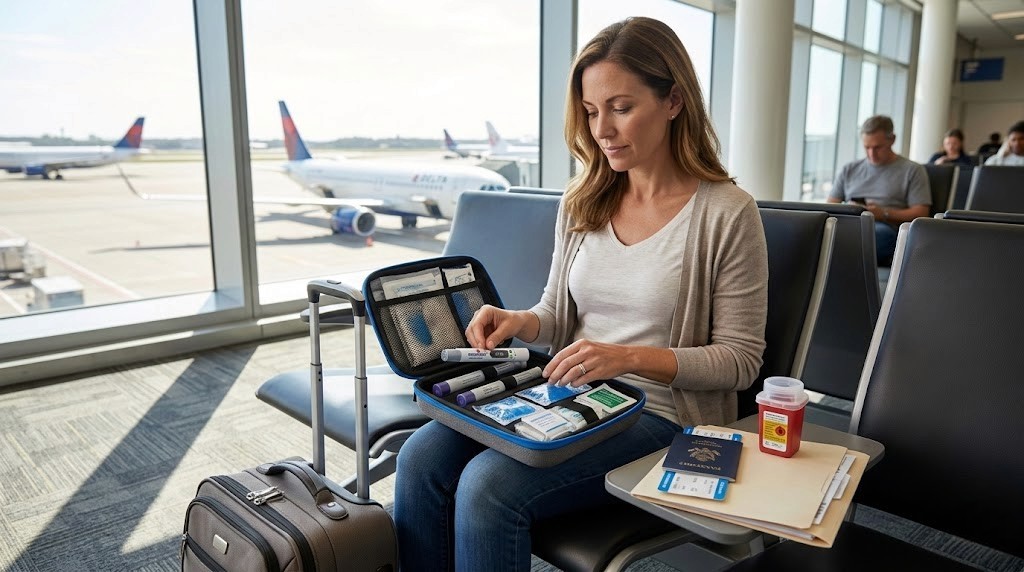
Before you throw a tirzepatide vial into your suitcase and head to the airport, stop. That single mistake could destroy weeks of progress and waste hundreds of dollars. Temperature swings in a checked bag can render the medication useless. A missing document at an international customs checkpoint can mean confiscation. And skipping your dose because you did not plan ahead? That throws your entire protocol off track.
Traveling with tirzepatide is not complicated. But it does require planning.
The good news is that thousands of people fly, drive, cruise, and even camp with injectable medications every single week. The TSA has clear rules. Airlines accommodate it. Hotels can help with refrigeration. You just need to know the specific steps before you leave, and most of them take less than 30 minutes to prepare. Whether you are taking a weekend road trip, flying across the country, boarding a cruise ship, or heading internationally for two weeks, this guide covers every scenario you will encounter. From proper tirzepatide refrigeration requirements to TSA screening procedures, dosing schedule adjustments across time zones, and emergency backup plans when things go wrong, every detail is here.
SeekPeptides members regularly ask about travel protocols, and the questions follow a predictable pattern. Can I bring needles through airport security? Will my medication survive a 10-hour flight? What happens if it gets warm? How do I handle time zone changes and injection timing? Every one of those questions gets a detailed answer below.
Why traveling with tirzepatide requires careful planning
Tirzepatide is a peptide. Peptides are proteins. And proteins are sensitive to temperature, light, and physical agitation. That sensitivity is what makes travel planning essential rather than optional. Unlike a bottle of pills you can toss into a bag and forget about, injectable tirzepatide demands awareness of its environment at every stage of your journey. The molecule itself is fragile compared to small-molecule medications. Heat unfolds the protein structure. Freezing shatters it with ice crystals. Excessive shaking can cause aggregation, where the molecules clump together and lose their biological activity.
This is not unique to tirzepatide. Every injectable peptide, from reconstituted research peptides to commercial insulin pens, shares these vulnerabilities. If you have traveled with insulin before, the rules are almost identical. If you are also traveling with semaglutide alongside tirzepatide or any other GLP-1 medication, the same storage and documentation principles apply to all of them.
The standard storage requirement for tirzepatide is refrigeration between 36 and 46 degrees Fahrenheit (2 to 8 degrees Celsius). Once removed from refrigeration, it can survive at room temperature, defined as up to 86 degrees Fahrenheit (30 degrees Celsius), for a maximum of 21 days. After those 21 days, or after exposure to temperatures above 86 degrees Fahrenheit, the medication should be discarded.
That 21-day window is generous. Most trips fall well within it.
But here is where travelers get into trouble. A parked car in summer can reach 150 degrees Fahrenheit inside. The cargo hold of an airplane can drop below freezing at cruising altitude. A hotel minibar might freeze items placed too close to the cooling element. Direct sunlight through a window can heat a vial well past safe limits in minutes. Each of these scenarios degrades the peptide structure, reducing potency or destroying the medication entirely.
The other planning consideration is legal. Injectable medications come with needles and syringes. Crossing borders means navigating customs regulations that vary by country. Even domestically, having proper documentation prevents unnecessary delays and confiscation. The tirzepatide syringe and dosage information on your prescription label is your first line of defense at any checkpoint.
Then there is the protocol disruption factor. Travel changes your eating patterns, sleep schedule, activity level, and stress load. All of these interact with tirzepatide. If you are still in the early weeks of your protocol and adjusting to a starting dose, your side effect profile may be unpredictable. Experienced users on a stable dose have a much easier time traveling because they already know how the medication affects them. If you are new to tirzepatide and have an upcoming trip, consider stabilizing on your current dose for at least two to three weeks before departure rather than adjusting your microdose schedule mid-travel.
Your weight loss progress will not be derailed by a well-planned trip. The people who struggle are the ones who do not plan at all, skip doses unnecessarily, or let their medication spoil from heat exposure. This guide exists so you do not become one of them.
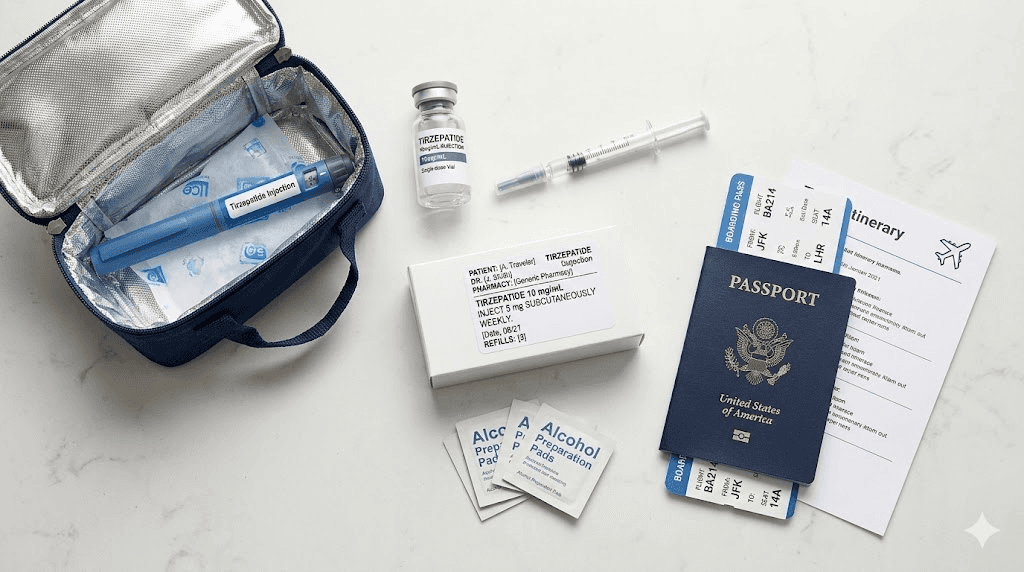
Temperature storage rules every traveler must know
Understanding the temperature rules is the foundation of safe tirzepatide travel. Get this right and everything else falls into place.
The three temperature zones
Safe zone (refrigerated): 36 to 46 degrees Fahrenheit (2 to 8 degrees Celsius). This is where tirzepatide should live when you are not traveling. In your home refrigerator, away from the freezer compartment, on a middle shelf. The medication maintains full potency for its entire shelf life at this range. Understanding tirzepatide shelf life helps you plan how far in advance to stock up before a trip.
Acceptable zone (room temperature): up to 86 degrees Fahrenheit (30 degrees Celsius). Tirzepatide can remain in this range for up to 21 days without significant potency loss. This is your travel window. For most trips, this is all you need. No special cooling equipment required for short trips in moderate climates.
Danger zone: above 86 degrees Fahrenheit or below 32 degrees Fahrenheit. Heat degrades the peptide bonds. Freezing causes ice crystal formation that physically damages the protein structure. Either extreme can make the medication ineffective. And once damaged, the medication cannot be restored to its original potency by returning it to proper temperature. If you suspect your tirzepatide has gotten too warm, do not use it. Inspect the solution for cloudiness, particles, or discoloration before administration.
The 21-day rule in practice
Once tirzepatide leaves refrigeration, the 21-day countdown begins. This is not a suggestion. It is a firm limit based on stability testing.
For practical travel planning, this means a two-week vacation is well within safe limits even without refrigeration, provided you keep the medication below 86 degrees Fahrenheit. A three-week trip pushes the boundary. Anything longer requires refrigerated storage at your destination.
One critical detail that catches travelers off guard: the 21-day clock does not reset. If your medication sat at room temperature for five days before your trip, you only have 16 days remaining. Track cumulative time outside the refrigerator, not just the current trip duration. This is especially important for compounded tirzepatide out-of-fridge time limits.
Brand-name vs compounded tirzepatide storage differences
Brand-name tirzepatide (Mounjaro, Zepbound) comes in pre-filled single-dose pens with manufacturer-tested stability data. The 21-day room temperature window applies specifically to these products.
Compounded tirzepatide is different. Compounding pharmacies set their own beyond-use dates based on their specific formulation and testing. Some compounded versions may have shorter or longer out-of-fridge stability windows. Always check your pharmacy label for the specific beyond-use date and storage instructions for your particular formulation. The compounded tirzepatide expiration date on your label is the definitive reference.
If you are traveling with reconstituted compounded tirzepatide from a multi-dose vial, the stability window may be shorter than pre-filled pens. Some compounding pharmacies recommend using reconstituted vials within 28 days of mixing, regardless of refrigeration. Check the reconstitution instructions and the reconstitution chart specific to your formulation for accurate timelines.
Flying with tirzepatide: TSA rules and airport security
Flying is the most common travel concern. And it is also the most straightforward, because the TSA has clear, published rules about injectable medications.
The TSA liquid exemption
Tirzepatide is classified as a medically necessary liquid. This means it is exempt from the standard 3-1-1 liquid restriction (3.4 ounces per container, one quart-sized bag). You can bring as much tirzepatide as you need for your trip in your carry-on bag. There is no quantity limit for medically necessary medications.
You must declare it at the security checkpoint. When you reach the conveyor belt, inform the TSA officer that you are carrying injectable medication. They will likely ask you to remove it from your bag for separate screening. This screening may include a visual inspection, an X-ray, or trace explosive testing on the container surface.
The entire process typically adds less than five minutes to your screening time. Arrive a few minutes earlier than usual to account for it, but do not stress about it. TSA officers screen thousands of travelers with injectable medications daily. The rise of GLP-1 medications has made this even more routine. The TSA Cares helpline (855-787-2227) is available to pre-arrange accommodations if you have concerns about the screening process or need additional assistance.
Needles and syringes through security
Unused syringes and needles are permitted through TSA checkpoints when accompanied by injectable medication. You do not need to declare them separately, but keeping them together with your medication in a clear, organized case prevents confusion. Having your tirzepatide syringe dosage information visible on the prescription label helps officers quickly verify everything.
Carry a travel sharps container for used needles. Disposing of needles in airplane trash is not acceptable, and flight attendants may direct you to proper disposal. A small, portable sharps container fits easily in any carry-on.
Documentation for domestic flights
Technically, the TSA does not require a prescription for domestic flights. But carrying one is strongly recommended. A current prescription label on the medication packaging is usually sufficient. For additional peace of mind, carry:
The original pharmacy packaging with your name and prescription number
A copy of the prescription or a physician letter on official letterhead
Your prescribing physician contact information
Your health insurance card
This documentation is not just for TSA. It protects you in case of medication loss, emergency medical situations, or if you need a refill while traveling. Keep digital copies of everything in your phone or cloud storage as backup. Photographing your prescription labels before departure takes 30 seconds and could save you hours of frustration if physical documents are lost. For travelers using compounded tirzepatide from pharmacies like Empower Pharmacy or other compounding sources, make sure the pharmacy label clearly shows all required information including your name, the medication, and the dispensing pharmacy contact details.
Carry-on vs checked luggage
Always, always, always pack tirzepatide in your carry-on. Never in checked luggage. This is not a guideline. It is a non-negotiable rule.
The cargo hold of a commercial aircraft is pressurized but not temperature-controlled to the same degree as the cabin. Temperatures can swing from extreme heat on the tarmac to well below freezing at cruising altitude. Either extreme destroys the medication. Beyond temperature, checked bags can be lost, delayed, or damaged. If your medication is in a checked bag that does not arrive, you have no way to continue your protocol until the bag is found or you obtain a replacement.
Keep the medication with you at all times. In your carry-on, in your personal item, or in a dedicated medication bag. Never out of your direct control. This applies equally to brand-name pens and compounded tirzepatide vials. Some travelers split their supplies between two carry-on bags when traveling with a companion, so that if one bag is delayed or searched extensively, they still have medication available in the other.
If you are traveling with a multi-dose vial and need to administer an injection during a long flight, the airplane lavatory works. It is not ideal, but it is private and sufficient. Clean the injection site with an alcohol swab, follow your normal stomach injection technique or preferred injection site, and dispose of the needle in your travel sharps container. Do not ask flight attendants to dispose of sharps for you.
Cooling packs through airport security
The TSA permits medically necessary ice packs and cooling packs in reasonable quantities, regardless of their physical state. This means frozen, partially melted, or fully liquid cooling packs are all allowed when they accompany medication. The officer may inspect them, but they will not confiscate them if they are clearly associated with your medication.
Place a thin barrier, a cloth or paper towel, between frozen cooling packs and your medication vial. Direct contact with a frozen pack can cause the tirzepatide to freeze, which damages it permanently. A partially thawed pack is actually safer than a fully frozen one for this reason.
International travel with tirzepatide
Crossing international borders adds complexity. Each country has its own regulations for importing medications, and injectable medications receive extra scrutiny because they come with needles.
Documentation requirements for international travel
Unlike domestic flights, international travel requires documentation. At minimum, carry:
A letter from your prescribing physician on official letterhead, stating the medical necessity for tirzepatide, including your name, medication name, dosage, route of administration, and treatment duration
The original prescription with your name and the medication details
Medication in original pharmacy packaging with labels clearly visible
A copy of the prescription translated into the local language of your destination (for non-English-speaking countries)
Your health insurance documentation and travel insurance policy
Request the physician letter at least two weeks before departure. Some countries require the letter to include specific language or formatting. A generic note may not satisfy certain customs authorities.
Quantity limits by country
Most countries allow travelers to bring a 30-day supply of prescription medications for personal use. Some countries allow up to 90 days. Very few restrict amounts below 30 days for standard medications.
The critical factor is that tirzepatide must clearly be for personal use. Bringing quantities that exceed a reasonable personal supply can trigger importation concerns. If your trip is longer than 30 days and you need to bring a larger supply, having detailed documentation from your physician explaining the treatment duration is essential.
Region-specific considerations
European Union and Schengen countries: The Schengen medical certificate system allows travelers to carry medications across Schengen borders for up to 30 days. While tirzepatide is not a controlled substance in most EU countries, carrying the certificate prevents unnecessary delays. Contact the embassy or consulate of your destination country to confirm requirements.
United Kingdom: Carry your prescription and a physician letter. The UK allows personal medication supplies for up to three months. Keep medications in original packaging.
Japan: Japan has strict rules for importing medications. While tirzepatide is not a controlled substance there, injectable medications require advance notification through the Yakkan Shoumei (import certificate) process for quantities exceeding a one-month supply. Start this process at least two weeks before travel.
Singapore: Strong pharmaceutical regulations apply. Carry a valid prescription and keep medications in original packaging. Quantities exceeding a three-month supply may require a Health Sciences Authority permit.
Australia: Travelers can bring a three-month supply of prescription medications. Declare all medications on the incoming passenger card. Keep medications in original packaging with pharmacy labels.
Middle East: Regulations vary significantly by country. The UAE, Saudi Arabia, and other Gulf states have strict pharmaceutical import rules. Contact the specific embassy before travel and obtain written authorization if required.
Mexico and Central America: Generally more relaxed for personal medication quantities. Carry a prescription and keep original packaging. If you are sourcing tirzepatide in Mexico, be aware of different formulation and quality standards compared to US compounding pharmacies. Bringing your own supply from a trusted US compounder like Strive Pharmacy or Southend Pharmacy is generally preferable to purchasing locally.
Canada: Relatively straightforward for US travelers. Carry your prescription and keep medication in original packaging. Canada allows a reasonable supply for personal use, typically up to 90 days. No special permits required for tirzepatide.
South America: Regulations vary by country. Brazil, Argentina, and Chile generally allow personal medication quantities with a prescription. Less-developed countries may have less organized customs processes, making clear documentation even more important. Keep medications visible and organized to avoid unnecessary delays.
Customs declaration tips
When going through customs, declare your medication proactively rather than waiting to be asked. Place your medication bag and documentation in an easily accessible location. Officers respond better to organized, transparent travelers than to those who appear to be concealing items.
If a customs officer questions your medication, remain calm. Present your physician letter and prescription. Explain that tirzepatide is a prescribed weekly injection for metabolic health. Most officers are familiar with GLP-1 medications at this point, as they have become widely prescribed globally. Understanding the relationship between GLP-1 medications can help you explain the medication class if asked. Some officers may recognize brand names like Mounjaro or Zepbound more readily than the generic name tirzepatide, so mentioning the brand can sometimes speed things along.
For frequent international travelers, consider keeping a laminated card with your medication information in multiple languages. Include the medication name (generic and brand), the dosage, the administration route (subcutaneous injection), and the medical condition being treated. This small preparation eliminates language barriers at customs checkpoints and demonstrates that you are a prepared, legitimate medical traveler. SeekPeptides members can find downloadable travel documentation templates in the resource library.
Road trips and car travel with tirzepatide
Road trips present a different set of challenges than air travel. There is no TSA to worry about, but temperature control becomes the primary concern, especially during summer months.
The car temperature problem
A parked car in direct sunlight can reach 150 degrees Fahrenheit or higher within 30 minutes. Even on a mild 75-degree day, a closed car can reach 100 degrees Fahrenheit quickly. The dashboard, center console, and trunk are the worst locations for any medication.
Never leave tirzepatide in a parked car. Not for a quick grocery stop. Not for a restaurant meal. Not while you check into a hotel. The temperature rises too fast and the consequences are irreversible. If you suspect exposure, check our guide on what happens when tirzepatide gets warm to assess whether the medication is still viable.
Keeping tirzepatide cool during drives
For short drives (under 4 hours in moderate temperatures), a simple insulated pouch with a cooling pack is sufficient. Place the medication in the passenger cabin, not the trunk. The cabin is climate-controlled while you are driving. The trunk is not. If you have left semaglutide or other medications out overnight before and wondered about the damage, the same principles apply here. Our guide on accidentally leaving GLP-1 medication unrefrigerated covers the practical assessment steps.
For longer road trips, especially in summer, invest in a medical-grade travel cooler. These are specifically designed for injectable medications and maintain temperature ranges far more reliably than a regular cooler with ice. Regular coolers risk getting too cold (freezing the medication) or warming up too quickly once ice melts.
If you are using a regular cooler as a backup, wrap the tirzepatide vial or pen in a cloth and place it in the center of the cooler, away from ice or frozen packs. The goal is to keep it cool, not frozen. Monitor the temperature periodically if possible.
Rest stop and hotel strategies
At rest stops, take the medication with you. A five-minute bathroom break in August heat can expose the medication to dangerous temperatures if left in the car.
At hotels, place the medication in the room refrigerator immediately upon arrival. Be cautious with hotel minibars, as they often have inconsistent temperatures. Place the medication in the center of the refrigerator, away from the back wall and away from any freezer compartment. If the minibar does not have a temperature control, use the main hotel refrigerator by requesting one from the front desk.
Some hotels will store medication in their kitchen refrigerators if you ask. This is especially useful if your room does not have a refrigerator. Ask at check-in and explain that it is a prescription medication requiring cold storage.
Airbnb and vacation rental considerations
Vacation rentals usually include a full-size kitchen refrigerator, which solves the storage problem immediately. Place your medication on a middle shelf, not in the door (temperature fluctuates most there) and not near the back wall (risk of freezing in older units). Use a small thermometer to verify the refrigerator is actually maintaining proper temperature, as rental unit appliances are not always well-maintained.
For remote cabins or properties without reliable electricity, treat the situation like a camping trip and use your insulated cooler with gel packs. If the rental has a generator that cycles on and off, the intermittent power can cause temperature swings in the refrigerator that may push your medication outside safe ranges.
Regardless of accommodation type, always have your cooler bag ready as a backup. Refrigerators malfunction. Power outages happen. Having a plan B means you never lose medication to circumstances outside your control. If you have been tracking your tirzepatide results, the last thing you want is a storage failure interrupting your progress during a trip.
Cruise ship travel with tirzepatide
Cruises combine many travel challenges into one trip: air travel to the port, embarkation security screening, multi-day storage needs, and potentially visiting multiple countries with different customs regulations.
Embarkation and onboard security
Cruise ship security operates similarly to airport security but is typically less strict about medical items. Declare your medication and carry your prescription documentation. Most cruise lines explicitly state that injectable medications are permitted when accompanied by appropriate documentation.
Contact your cruise line before departure to confirm their specific policies. Some lines require advance notice for medical needs. Others handle it at embarkation with no pre-notification required. Major cruise lines like Royal Caribbean, Carnival, Norwegian, and Disney Cruise Line all regularly accommodate passengers with injectable medications. Having your dosage chart documented and readily accessible makes any onboard medical discussions simpler.
Cabin storage options
Most cruise cabins include a small refrigerator or minibar. Request a cabin with a refrigerator if one is not standard. Explain to your booking agent that you have a prescription medication requiring cold storage. Cruise lines accommodate this routinely.
If the cabin refrigerator is insufficient, the ship medical center will store medication for you. This is a common service on major cruise lines. Check with guest services on the first day.
For excursions at ports of call, use an insulated travel pouch with a cooling pack to maintain temperature while off the ship. Plan your dosing schedule so that injection days do not fall on heavy excursion days if possible.
Port-of-call customs
When visiting ports in different countries, you technically pass through customs each time you disembark. For most Caribbean, Mediterranean, and Asian cruise itineraries, you will not be questioned about medications you are keeping on your person for the day. However, carry a copy of your prescription and physician letter when going ashore, just in case.
For longer shore excursions or overnight stays in port, take only what you need for that day and leave the remaining supply on the ship in the cabin refrigerator. If you are on a longer cruise and using higher doses, confirm with the medical center that your storage needs can be met for the full voyage duration.
Camping, hiking, and outdoor adventures with tirzepatide
Outdoor adventures are entirely possible while on tirzepatide. But they require the most creative temperature management solutions.
Short outdoor trips (1 to 3 days)
For weekend camping trips, a simple insulated pouch with a cooling pack handles the job. The 21-day room temperature window means that even without any cooling, the medication is fine for a few days as long as temperatures stay below 86 degrees Fahrenheit.
In summer heat, an evaporative cooling pouch is a lightweight, electricity-free option. These pouches use water evaporation to lower internal temperatures by 15 to 20 degrees below ambient. Just soak the pouch in water, and it provides cooling for 24 to 48 hours.
Extended backcountry trips
Multi-day backpacking trips in hot weather present the biggest challenge. Without access to electricity or refrigeration, you need passive cooling solutions.
Strategies that work in the backcountry:
Keep medication in the center of your pack, insulated from external heat
Store the pack in shade whenever possible
Use natural water sources, place the sealed vial in a waterproof bag and submerge it in a cool stream to bring the temperature down
At camp, hang the medication bag in shade rather than leaving it in a tent (tents become ovens in sunlight)
Consider timing your trip to avoid the hottest months, or bring enough doses for a shorter trip and resume at home
If your trip falls during injection day, follow the injection site guidelines and maintain proper hygiene. Pack alcohol swabs and a small sharps container. Inject in a clean area, ideally inside your tent with clean hands.
Winter camping and cold weather
Cold weather creates the opposite problem. Freezing destroys tirzepatide. In below-freezing conditions, keep the medication close to your body. An inside jacket pocket maintains body temperature and prevents freezing. At night, bring it into your sleeping bag.
Never leave the medication in an unheated tent or car overnight in freezing conditions. The tirzepatide refrigeration guidelines specify a minimum of 36 degrees Fahrenheit, so anything below freezing is too cold.
Best medical cooler bags and travel cases for tirzepatide
Investing in a proper medical cooler is the single most useful thing you can do for tirzepatide travel. The right case eliminates most temperature anxiety and makes travel routine rather than stressful.
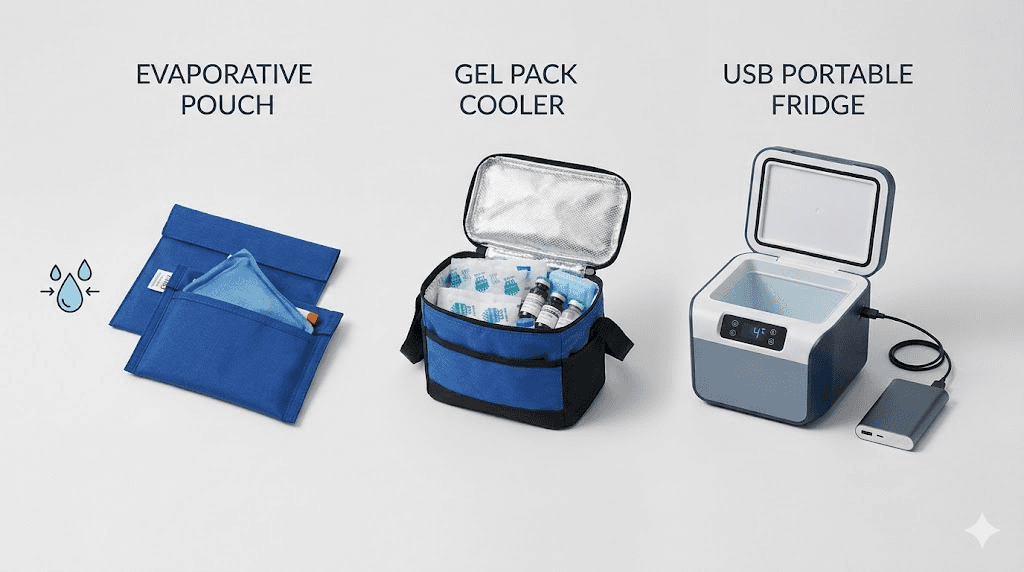
Types of medical coolers
Evaporative cooling pouches. These use water evaporation to cool. Soak the pouch, and it maintains below-room-temperature conditions for 24 to 48 hours. No electricity needed. Lightweight and compact. Best for short trips in hot climates. FRIO pouches are the most widely known brand in this category and keep contents under 77 degrees Fahrenheit for up to 48 hours even in 100-degree heat.
Gel pack insulated coolers. These use frozen gel packs inside an insulated case. They maintain refrigerator temperatures for 8 to 14 hours depending on the case quality and ambient temperature. Best for day trips, flights, and car travel. The 4AllFamily Companion and Nomad cases are popular options that work well for tirzepatide pens.
USB-powered portable refrigerators. These are small electronic coolers that maintain exact refrigerator temperatures (36 to 46 degrees Fahrenheit) as long as they have power. They can also work without power using gel packs for 8 to 33 hours depending on the model. Best for extended travel, multi-week trips, or situations where reliable cooling is critical. The 4AllFamily Voyager and Explorer models offer this level of protection.
What to look for in a medical cooler
Temperature range that matches tirzepatide requirements (36 to 86 degrees Fahrenheit)
TSA-approved for air travel
Capacity for the number of pens or vials you are bringing
Duration of cooling that exceeds your longest expected period without access to a refrigerator
A barrier system that prevents direct contact between frozen packs and medication
Compact enough to fit in your carry-on or personal item
For most travelers, a gel pack insulated cooler in the $30 to $60 range is sufficient. Frequent travelers or those visiting hot climates may want to invest in a USB-powered option for the added peace of mind. Understanding proper peptide storage after reconstitution will help you choose the right cooler capacity for multi-dose vials.
Temperature monitoring options
A small digital thermometer inside your cooler bag eliminates guesswork. Several inexpensive options exist:
Basic digital thermometer. Under $10, shows current temperature. You check it manually. Simple and reliable
Min/max recording thermometer. Records the highest and lowest temperatures reached since last reset. Costs $10 to $20. Useful for checking what happened during a flight when you could not access your bag
Bluetooth-connected smart thermometer. Sends temperature data to your phone in real time. Alerts you if temperature goes outside your set range. Costs $20 to $50. Best for peace of mind during long journeys
If you discover your medication was exposed to temperatures outside the safe range, the tirzepatide expiration and stability information can help you assess whether the exposure was likely damaging enough to warrant discarding the dose. Short excursions slightly above 86 degrees Fahrenheit are less concerning than sustained exposure well above that threshold. If you routinely travel with peptides, understanding how long peptides maintain stability in various forms gives you broader context for temperature management decisions.
Managing your injection schedule across time zones
Tirzepatide is a once-weekly injection. That weekly frequency provides significant flexibility for travel. But crossing multiple time zones still requires some thought to maintain consistent dosing.
The 72-hour minimum rule
The most important scheduling rule is this: you must wait at least 72 hours (3 days) between tirzepatide doses. Never administer two doses within a 72-hour window, regardless of time zone changes. This rule protects you from the only real scheduling danger, which is doubling up.
In practice, this means you have a large window of flexibility. If your usual injection day is Wednesday, you could inject as early as Monday or as late as Friday of the following week and still maintain the 72-hour minimum from the previous dose. That flexibility makes time zone management simple for the vast majority of trips.
Eastbound travel (losing hours)
Flying east, you lose hours. If you fly from Los Angeles to London, you lose 8 hours. Your Wednesday injection that you would normally give at 8 AM Pacific time becomes 4 PM London time on the same calendar day.
For most eastbound travel, simply inject at your usual time based on your home time zone. Your body does not care about what the clock says. The medication works the same whether you inject at 8 AM or 4 PM. As long as you maintain the 72-hour gap, timing within a given day does not affect efficacy.
Westbound travel (gaining hours)
Flying west, you gain hours. Your day is longer. This actually makes scheduling easier. If you inject on Wednesday morning at 8 AM Eastern time and then fly to Hawaii, you arrive earlier in the day local time. No adjustment needed.
Significant time zone changes (6+ hours)
For trips involving time changes of 6 or more hours (such as US to Asia or US to the Middle East), consider these strategies:
Pre-trip adjustment. Shift your injection day one day earlier or later before departure so it falls at a convenient time at your destination
Destination timing. Once at your destination, inject at a comfortable time in the new time zone and maintain that schedule for the duration of the trip
Return adjustment. When you return home, shift back to your normal schedule, maintaining the 72-hour minimum
The flexibility of choosing the best time to take your GLP-1 shot means you can pick whatever time works at your destination without worrying about reduced effectiveness. Morning, afternoon, or evening, it makes no difference to the medication.
Missed dose protocol while traveling
If you miss your scheduled injection day while traveling, the tirzepatide dosing flexibility guidelines provide a clear recovery path:
If you remember within 4 days (96 hours) of your scheduled dose, take it as soon as possible
If more than 4 days have passed, skip the missed dose entirely and take the next dose on your regular schedule
Never take two doses to make up for a missed one
Missing a single dose is not catastrophic. The medication has a long half-life (approximately 5 days), meaning it remains active in your system well beyond the weekly dosing interval. You may notice slightly reduced appetite suppression toward the end of the extended interval, but one missed dose will not significantly impact your overall results. If you are tracking your tirzepatide weight loss timeline, a single missed dose during travel is unlikely to cause a noticeable setback.
Dose splitting for travel flexibility
Some users follow a split-dose protocol, dividing their weekly dose into two smaller injections. This approach offers additional scheduling flexibility during travel because you have two opportunities per week to find a good injection window rather than just one. However, dose splitting should only be done under guidance from your provider and according to your established protocol, not as an improvised travel hack.
If you are using a microdosing protocol with more frequent injections, the same 72-hour minimum rule applies between each dose. More frequent dosing means more injection supplies to pack and more opportunities for schedule disruption during travel. Plan accordingly and bring extra supplies.
Tracking your schedule while traveling
Set multiple reminders on your phone for injection days. Travel disrupts routines, and it is surprisingly easy to lose track of which day of the week it is when you are in a different time zone, on vacation, and out of your normal rhythm. A phone alarm labeled with the exact time and dose eliminates any confusion. Some users also set a reminder for 24 hours before their dose, so they can confirm the medication is at the right temperature and their supplies are ready.
Reference your tirzepatide dosing chart to confirm your exact unit measurement before each injection, especially if you are drawing from a multi-dose vial where measuring precision matters. Traveling fatigue and unfamiliar environments can lead to measurement errors that would not happen at home. The compounded tirzepatide dosage calculator is useful for double-checking your numbers if you are uncertain about your vial concentration while on the road.
What to do if your tirzepatide gets warm or is exposed to temperature extremes
Despite careful planning, things go wrong. Flights get delayed on hot tarmacs. Cooler packs melt faster than expected. A hotel refrigerator malfunctions overnight. Here is how to assess and respond.
Visual inspection protocol
Before using any tirzepatide that may have experienced temperature excursions, inspect the solution carefully. Normal tirzepatide solution should be:
Clear and colorless to slightly yellow
Free of particles, flakes, or floating material
Not cloudy or hazy
Free of crystallization
If the solution looks normal after a brief temperature excursion, it is likely still usable. But "brief" is the key word. A few hours at moderate warmth (under 100 degrees Fahrenheit) is different from 8 hours in a hot car.
When to discard
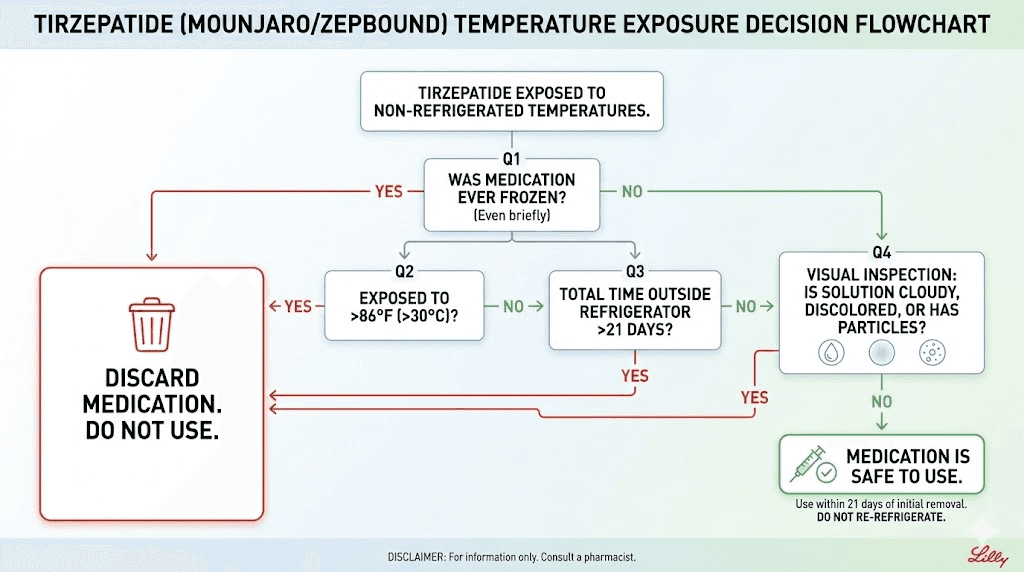
Discard tirzepatide if:
It has been above 86 degrees Fahrenheit for an extended period (several hours or more)
It has been frozen at any point
It has been at room temperature for more than 21 cumulative days
The solution is cloudy, discolored, or contains particles
You cannot confirm the temperature it was exposed to
When in doubt, discard. The cost of a wasted vial is far less than the risk of injecting degraded medication with unknown potency. Check our guide on what happens if you use expired tirzepatide for more context on why using compromised medication is not worth the risk.
The "do not re-refrigerate" myth
The standard guidance states that once tirzepatide leaves refrigeration, it should not go back in the refrigerator. This guidance exists because repeated temperature cycling (cold to warm to cold) can accelerate degradation. However, the practical reality is that returning medication to a refrigerator after a brief period at room temperature is not immediately harmful. The concern is about cumulative temperature stress over time, not about a single return to cold storage.
For travel purposes, if you take medication out for a flight and then place it in a hotel refrigerator, that is a single temperature transition. It is not the same as cycling the medication in and out of the fridge repeatedly over weeks. Use common sense and prioritize consistent cold storage when available.
Complete travel packing checklist for tirzepatide
A good checklist prevents the most common travel mistakes. Print this, screenshot it, or save it to your phone before every trip.
Medication and supplies
Tirzepatide vials or pens (bring one extra dose beyond your trip duration)
Syringes and needles (if using vials, bring extras in case of drops or contamination). Reference the proper syringe dosage guide for your concentration
Alcohol swabs (individually wrapped, one per injection plus extras)
Travel sharps container for used needles
Bacteriostatic water (if your protocol requires reconstitution, check the mixing guide for 10mg tirzepatide)
Temperature management
Insulated medical cooler bag or pouch
Cooling gel packs (at least two, in case one fails or melts early)
Cloth barrier for between frozen packs and medication
Small digital thermometer (optional but useful for extended trips)
Documentation
Current prescription with your name and medication details
Physician letter on official letterhead (essential for international travel)
Original pharmacy packaging with labels
Health insurance card
Travel insurance documentation
Translated prescription (for non-English-speaking destinations)
Destination country embassy contact information
Backup plan items
Name and address of a pharmacy or clinic at your destination (in case you need a replacement)
Contact information for your prescribing physician (for emergency prescriptions)
Digital copies of all documentation stored in your phone or cloud storage
A second set of supplies in a separate bag (if checking one bag and carrying one on)
Compounded vs brand-name tirzepatide: travel-specific differences
The distinction between compounded and brand-name tirzepatide matters more during travel than at any other time. The packaging, storage requirements, and documentation considerations differ in ways that directly affect your travel preparation.
Brand-name advantages for travel
Brand-name tirzepatide (Mounjaro, Zepbound) comes in pre-filled single-dose pens. These pens are sealed, sterile, and manufacturer-tested for stability. Each pen is clearly labeled with the medication name, dosage, and manufacturer information. Customs officers and TSA agents recognize these immediately.
The single-dose format also means no reconstitution required, no carrying extra bacteriostatic water, and no concerns about contamination during multi-use vial handling in non-sterile travel environments.
Compounded tirzepatide travel considerations
Compounded tirzepatide typically comes in multi-dose vials that require reconstitution or are pre-reconstituted by the pharmacy. For travel, this creates a few additional considerations:
Labeling. Ensure your compounding pharmacy provides clear, professional labels with your name, medication details, and beyond-use date. Poorly labeled vials cause more customs delays than any other issue
Multiple vials. If you are bringing more than one vial, carry documentation explaining the multi-dose nature and expected usage
Reconstitution supplies. If you need to reconstitute during travel, bring sterile bacteriostatic water in its original sealed packaging. Review the tirzepatide reconstitution process before departure so you can do it efficiently in a hotel room
Stability differences. Compounded formulations may have different stability profiles than brand-name products. Your pharmacy beyond-use date is the definitive reference, not the brand-name 21-day window
If you are currently using a compounded tirzepatide starting dose, verify your specific vial storage requirements with the dispensing pharmacy before travel. Some compounded formulations with B12, glycine, or niacinamide additives may have different temperature sensitivity.
Emergency situations and medication replacement while traveling
The worst-case scenario is losing your medication, whether through confiscation, loss, damage, or theft. Having a plan for this contingency turns a crisis into an inconvenience.
Before you leave: set up emergency contacts
Call your prescribing physician before departure and let them know you are traveling. Ask if they can send an emergency prescription to a pharmacy at your destination if needed. Many physicians will agree to this in advance, making the actual emergency process much faster.
Research pharmacies at your destination. For domestic travel, chain pharmacies (CVS, Walgreens, Walmart) can often transfer or fill emergency prescriptions quickly. For international travel, identify an English-speaking pharmacy or clinic near your accommodation.
If your medication is lost or destroyed
Call your prescribing physician immediately. Explain the situation and request an emergency prescription. If traveling domestically, your physician can often call in a prescription to a local pharmacy within hours.
For international travel, your options depend on the country. In many developed nations, visiting a local physician who can prescribe tirzepatide or an equivalent GLP-1 medication is possible but time-consuming. In some cases, a physician abroad may prescribe an alternative like semaglutide instead, making it useful to understand the differences between semaglutide and tirzepatide side effects and the conversion dosing between the two. Travel medical insurance that covers prescription replacement is invaluable here.
If you cannot obtain replacement medication during your trip, missing one or two weekly doses is not medically dangerous. You may experience reduced appetite suppression and some return of hunger, but there are no dangerous withdrawal effects. Read about what happens when GLP-1 levels drop to understand what to expect if you miss multiple doses. Your tirzepatide duration of action provides a buffer, as the medication remains active in your system for several days beyond the weekly dosing window.
If your medication is confiscated
In rare cases, customs authorities may confiscate medication. If this happens:
Remain calm and cooperative
Request a written receipt or documentation of the confiscation
Ask for the reason and the process to appeal or retrieve the medication
Contact your country embassy or consulate for assistance
Follow your emergency replacement plan
Confiscation is extremely rare for properly documented prescription medications. It almost exclusively happens when documentation is missing, the medication is not in original packaging, or the quantity suggests commercial importation rather than personal use.
Travel insurance and medication coverage
Standard travel insurance often does not cover medication loss or replacement. Review your policy carefully before departure.
What to look for in travel medical insurance
A good travel medical policy for tirzepatide users should include:
Prescription medication replacement coverage
Emergency medical consultation coverage (to obtain new prescriptions abroad)
Medical evacuation coverage (for serious adverse events)
Trip interruption coverage that includes medical reasons
Some credit cards include travel medical coverage as a benefit. Check your card benefits before purchasing separate insurance. If your credit card coverage is insufficient, dedicated travel medical insurance through providers like World Nomads, Allianz, or IMG Global is typically $30 to $100 for a week-long international trip. Given the cost of tirzepatide, even at the most affordable compounding pharmacy prices, a single lost or damaged vial can cost more than a full travel insurance policy. The math overwhelmingly favors purchasing coverage.
Documenting your medication for insurance claims
Before departure, photograph all medication, packaging, and labels. Keep copies of your prescription and receipts showing the cost of the medication. If you need to file a claim for lost or damaged medication, this documentation speeds the process significantly.
Managing side effects while traveling
Travel already disrupts routines. Combine that disruption with tirzepatide side effects and you need strategies for managing both simultaneously.
Gastrointestinal considerations
The most common tirzepatide side effects are gastrointestinal: nausea, reduced appetite, and changes in bowel habits. Travel often exacerbates these through different foods, irregular meal timing, and dehydration from flying or heat. If you experience tirzepatide-related digestive issues, travel can make them more uncomfortable.
Strategies for managing GI side effects while traveling:
Stay hydrated, especially during flights and in hot climates. Dehydration worsens nausea and constipation
Eat small, frequent meals rather than large infrequent ones. Follow the eating guidelines for tirzepatide even when dining options are limited
Pack bland snacks (crackers, rice cakes, protein bars) for times when local food is too rich or unfamiliar
Carry anti-nausea medication (ginger candies, Dramamine, or prescribed anti-emetics)
Know which foods to avoid on tirzepatide, especially high-fat and heavily spiced dishes that can trigger nausea
If constipation is an issue, pack fiber supplements or a gentle laxative. Changes in diet, activity level, and hydration during travel commonly worsen constipation. Staying active and drinking water throughout your trip helps more than any medication.
Fatigue and energy management
Some users experience fatigue on tirzepatide, especially at higher doses or after recent dose escalations. Jet lag compounds this effect. If you recently increased your dose, consider waiting until after your trip to adjust further. Traveling on a stable, well-tolerated dose is much easier than traveling during an adjustment period.
General GLP-1 fatigue management strategies include maintaining protein intake, staying hydrated, and being realistic about your travel activity schedule. You might not have the energy for a 15-mile hike the day after your injection.
Injection timing for comfort
If you know your injection causes temporary side effects (nausea, fatigue, or injection site reactions), time your injection for a rest day during your trip. Inject the evening before a low-activity day rather than the morning of a sightseeing marathon. Understanding injection site reactions and how to minimize them helps you plan comfortable injection timing during travel.
If injection site redness or itching is common for you, be aware that heat and humidity can worsen these reactions. Injecting in the evening when you will be in an air-conditioned room rather than out in the sun reduces discomfort. Refer to the injection site reaction treatment guide for remedies you can pack in your travel kit.
Headaches, body aches, and general malaise
Travel-related dehydration, poor sleep, and altitude changes can trigger tirzepatide headaches that would not occur at home. Flying is particularly problematic because the cabin humidity drops to around 10 to 20 percent, far below the 30 to 65 percent most people find comfortable. That dry air, combined with the appetite-suppressing effects of tirzepatide that make you less likely to eat and drink during flights, creates a perfect storm for headaches.
Some users also report body aches and muscle pain that worsens with the physical demands of travel, including carrying luggage, walking through airports, and spending hours in cramped airplane seats. Pack over-the-counter pain relief and stay ahead of hydration rather than catching up after symptoms start.
If you experience sleep difficulties on tirzepatide, jet lag amplifies the problem. Melatonin, limiting screen time before bed, and adjusting to the local time zone as quickly as possible all help. Anxiety related to tirzepatide may also increase in unfamiliar travel environments. If you know you are sensitive, discuss short-term anti-anxiety strategies with your provider before departing.
Menstrual cycle considerations for traveling women
Some women report changes in their menstrual cycle on tirzepatide. If tirzepatide affects your period, travel can compound the unpredictability. Pack accordingly with extra supplies, and be aware that time zone changes and travel stress can independently affect your cycle timing, making it even harder to predict while on the medication.
Maintaining your diet and nutrition protocol while traveling
Tirzepatide reduces appetite, but travel disrupts eating patterns. Maintaining adequate nutrition while managing reduced hunger requires deliberate planning.
Protein is the priority
Muscle preservation on tirzepatide depends on adequate protein intake, typically 0.7 to 1 gram per pound of body weight daily. Travel makes hitting this target harder. Airport food leans toward carbohydrates. Hotel continental breakfasts are mostly bread and pastries. Restaurant portions may be protein-light.
Pack portable protein sources: protein bars, jerky, protein powder packets, and nuts. These fill gaps when meal options are limited. A shaker bottle and single-serving protein powder packets take up minimal space and provide reliable nutrition regardless of your location. Following a structured tirzepatide diet plan is harder while traveling, but prioritizing protein at every meal keeps you on track.
Hydration strategy
Dehydration worsens every tirzepatide side effect: nausea, constipation, fatigue, and dizziness. Flying is inherently dehydrating. Hot climates increase fluid loss. Alcohol consumption at vacation destinations adds to the problem.
Bring a refillable water bottle and aim for at least 80 ounces daily. Add electrolyte packets for hot climates or heavy activity days. If you experience dizziness related to GLP-1 medications, dehydration is often the primary cause, and maintaining hydration during travel is the most effective prevention.
Review the recommended supplements to take alongside tirzepatide and pack any that support hydration and electrolyte balance. If you are following a structured tirzepatide meal plan, photograph or print the plan and bring it with you. Having a reference for target macros and meal structure helps you make better food decisions when confronted with unfamiliar restaurant menus and hotel breakfast buffets.
Handling reduced appetite at restaurants
One of the most noticeable effects of tirzepatide is dramatically reduced appetite. At home, this is manageable. At a restaurant with friends or family who are ordering full entrees, it can feel socially awkward to order a side salad.
Strategies that work: order appetizer portions as your entree. Share dishes. Request a to-go box with your meal and take half before you start eating. Order protein-rich items first and eat those before touching sides. Nobody at the table needs to know you are on medication if you do not want to disclose that. Eating smaller portions while traveling is entirely normal behavior.
The recommended food lists for GLP-1 medications provide useful guidance on high-protein, low-fat options that are gentle on the stomach and available at most restaurants worldwide.
Alcohol considerations
Many travelers drink more alcohol on vacation than at home. Tirzepatide amplifies alcohol sensitivity in some users, meaning fewer drinks produce stronger effects. If you drink alcohol while on tirzepatide, start slowly, pace yourself, and alternate every alcoholic drink with water. Excessive alcohol combined with tirzepatide increased nausea risk and dehydration, which is especially problematic in hot vacation climates.
Traveling with alternative tirzepatide formats
Not all tirzepatide comes in injectable vial or pen form. Alternative formats create different travel considerations.
Oral tirzepatide
If you are using oral tirzepatide, travel is significantly simpler. No needles, no syringes, no sharps containers, and no special temperature management in most cases. Oral formulations typically have broader temperature stability than injectable forms, though you should still avoid extreme heat. The comparison between tablet and injection formats shows that travel convenience is one of the primary reasons some users switch to oral administration.
The oral versus injectable comparison makes it clear that travel convenience is one of the biggest advantages of oral formats. If you travel frequently and find injectable travel preparation burdensome, discuss switching formats with your provider.
Sublingual tirzepatide
Sublingual (under the tongue) tirzepatide formulations share the travel convenience of oral formats. No injection supplies needed. The sublingual dosage chart typically shows the same dosing schedule as injectable, but check with your pharmacy about temperature storage requirements for your specific sublingual formulation.
Tirzepatide ODT (orally dissolving tablets)
The tirzepatide ODT format dissolves on the tongue without water, making it the most travel-friendly option available. No liquids, no needles, no temperature sensitivity concerns in normal conditions. Pack them in their original container with your prescription label and you are ready to go.
Tirzepatide drops
Tirzepatide drops are liquid but do not require needles. They still fall under the TSA liquid medication exemption and should be declared at security. Store them as directed by your pharmacy, typically at room temperature or refrigerated depending on the formulation.
Traveling with tirzepatide alongside other peptides or medications
Many users do not travel with tirzepatide alone. Stacking peptides or combining tirzepatide with other medications means more vials, more supplies, and more complex storage requirements.
Common travel combinations
If you are using tirzepatide with vitamin B12, the B12 component typically does not require refrigeration and is more stable than tirzepatide alone. Tirzepatide compounded with glycine and B12 may have different stability characteristics than plain tirzepatide, so check your specific formulation requirements. Some tirzepatide-glycine formulations are specifically designed for improved stability.
Travelers who also use AOD-9604 with tirzepatide or combine GLP-1 medications with other injectable peptides need to plan for multiple vials with potentially different storage requirements. Some peptides are more temperature-sensitive than tirzepatide. Others are less so. If you are combining phentermine with tirzepatide, the phentermine tablets need no special temperature storage but may require additional documentation for international travel since phentermine is a controlled substance in many countries.
Separate storage for different peptides
When traveling with multiple injectable peptides, label each vial clearly and keep them organized. A medication organizer bag with separate compartments prevents confusion and makes security screening faster. Include a master list of all medications, dosages, and schedules in case you need to explain your regimen to a medical professional while traveling.
If you are also using a semaglutide protocol alongside tirzepatide, or recently switched between the two medications, make sure your documentation reflects which medication you are currently taking. The semaglutide travel guide covers semaglutide-specific storage details that differ slightly from tirzepatide.
Returning home: post-travel medication assessment
When you return from a trip, take a few minutes to assess your medication and protocol before settling back into your normal routine.
Inspect your medication
Check every vial or pen that traveled with you. Look for cloudiness, particles, color changes, or any sign of degradation. If anything looks different from when you packed it, err on the side of caution and use a fresh vial from your refrigerated home supply. Review the expected appearance of your specific formulation to know what normal looks like.
Resume your regular schedule
If your injection schedule shifted during travel, transition back to your regular day and time at home. Maintain the 72-hour minimum between your last travel dose and your first home dose. If your schedule drifted significantly, pick the most convenient day going forward and commit to it. Consistency matters more than the specific day of the week.
If you missed one or two doses during an extended trip, you may notice increased appetite and reduced satiety in the days immediately following your return. This is temporary. Resume your normal dose and the effects will return within one to two injections. Do not increase your dose to compensate for missed doses. If you are concerned about stalled weight loss after a travel interruption, focus on clean eating, hydration, and consistent dosing for two to three weeks before making any protocol changes.
Restock for the next trip
After returning, take inventory of your supplies. Note how many doses you used, how many backup supplies you needed, and whether your cooling solution performed adequately. Use this information to refine your packing list for the next trip. Many seasoned travelers keep a pre-packed medication travel kit ready at all times, so packing for the next trip takes minutes instead of hours.
For researchers who travel frequently, SeekPeptides provides comprehensive protocol management resources that help track dosing schedules, storage timelines, and dosage charts that make travel administration straightforward. Having your complete protocol documented digitally means you always have access to your dosing details regardless of where you are in the world.
Frequently asked questions
Can I bring tirzepatide on a plane?
Yes. Tirzepatide is a medically necessary medication exempt from TSA liquid restrictions. Pack it in your carry-on with your prescription documentation, declare it at the security checkpoint, and bring any syringes and needles alongside the medication. The TSA screens injectable medications routinely and the process takes less than five minutes. Check your dosage details are visible on the pharmacy label.
How long can tirzepatide stay out of the fridge while traveling?
Brand-name tirzepatide (Mounjaro, Zepbound) can remain at room temperature, up to 86 degrees Fahrenheit, for up to 21 cumulative days. Compounded tirzepatide may have different stability windows, so check your pharmacy label for the specific beyond-use date and storage instructions.
Do I need a prescription to travel with tirzepatide?
For domestic US flights, the TSA does not require a prescription, but carrying one is strongly recommended. For international travel, a prescription and a physician letter are essential. Some countries require translated documentation. Always carry medication in original pharmacy packaging with visible labels.
Can I put tirzepatide back in the fridge after it has been at room temperature?
The standard guidance recommends against returning tirzepatide to the refrigerator once it reaches room temperature, because repeated temperature cycling can degrade the medication. However, a single transition from refrigerator to room temperature and back to a hotel refrigerator during travel is generally considered acceptable. The concern is about repeated cycling, not a single travel event.
What happens if my tirzepatide freezes during travel?
Freezing destroys tirzepatide. Ice crystals physically damage the peptide structure, and the damage cannot be reversed by thawing. If your medication has frozen, discard it and use a backup dose or obtain a replacement. This is why you should never pack tirzepatide in checked luggage or place it directly against a frozen ice pack without a barrier. Refer to the full refrigeration guide for proper storage details.
Should I change my injection day when traveling across time zones?
For most trips, no adjustment is needed. Inject at your usual time based on your home time zone, or at a convenient time in the new time zone, as long as you maintain at least 72 hours between doses. Tirzepatide can be injected at any time of day, so time zone shifts within a few hours are irrelevant. For trips crossing 6 or more time zones, consider adjusting your injection day by one day before departure.
Can I travel with compounded tirzepatide internationally?
Yes, but extra documentation is important. Compounded medications may receive more scrutiny at customs because they look different from commercially manufactured products. Ensure your compounding pharmacy provides professional labels with your name, medication name, dosage, pharmacy contact information, and beyond-use date. Carry a physician letter that specifically mentions compounded tirzepatide. The compounded tirzepatide expiration label should be clearly visible.
What if I run out of tirzepatide while traveling?
Contact your prescribing physician for an emergency prescription. For domestic travel, they can often call in a prescription to a local pharmacy. For international travel, you may need to visit a local clinic. Missing one or two weekly doses is not medically dangerous, though you may experience increased appetite. Carrying one extra dose beyond your trip duration is the simplest prevention. If you are concerned about tirzepatide losing effectiveness after a gap, rest assured that a short break during travel does not cause resistance.
Can I exercise normally while traveling on tirzepatide?
Yes. Exercise routines can continue during travel, though you may want to moderate intensity on injection days if you experience fatigue or nausea post-injection. Hot climates increase the risk of dehydration during exercise, which amplifies tirzepatide side effects. If you plan to maintain weight loss without intense exercise during your trip, the medication continues working through appetite suppression regardless of your activity level.
Is it safe to take tirzepatide at a different time of day while traveling?
Absolutely. Tirzepatide can be administered at any time of day, with or without food. The best time to take your GLP-1 shot is whatever time is most convenient for your travel schedule. Some travelers prefer injecting in the evening before bed so any temporary nausea occurs during sleep rather than during activities.
How do I handle tirzepatide if my flight is delayed and I am stuck at the airport?
If your medication is in a cooler bag, check the cooling pack status. A well-insulated bag with a good gel pack maintains temperature for 8 to 14 hours, which covers most flight delays. If the delay is extreme and your cooling has failed, remember the 21-day room temperature window. As long as the airport terminal is air-conditioned below 86 degrees Fahrenheit, your medication is fine without active cooling. If you are in a hot location with no air conditioning, ask airport staff about refrigerated storage options in airport lounges or restaurants.
External resources
For researchers serious about optimizing their tirzepatide protocols and getting comprehensive travel guidance, SeekPeptides offers the most complete resource available, with evidence-based storage guides, detailed dosing charts, reconstitution calculators, and a community of thousands who have navigated these exact questions.
In case I do not see you, good afternoon, good evening, and good night. May your medication stay potent, your cooler bags stay cold, and your travels stay worry-free.