Feb 10, 2026
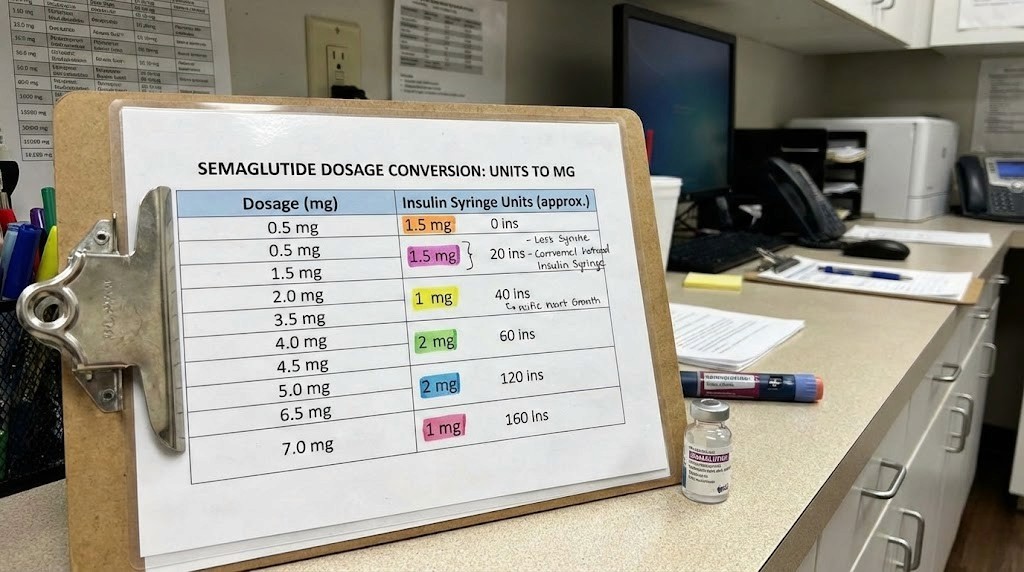
One misread line on a syringe can mean five times the intended dose. That is not a hypothetical. The FDA has documented multiple cases of patients drawing 50 units when they meant to draw 5, all because they confused milligrams, milliliters, and syringe units on a compounded semaglutide vial. The numbers looked similar. The consequences were not.
Here is the problem. Your prescription says 0.25 mg. Your syringe measures in units. Your vial label reads 5 mg/ml. Three different measurement systems, one injection, and zero room for error. Without a proper semaglutide syringe dosage conversion chart, you are guessing. And guessing with a GLP-1 receptor agonist that controls blood sugar, appetite, and gastric emptying is not a risk worth taking.
This guide eliminates the guesswork. You will find complete conversion charts for every common semaglutide concentration, from 1 mg/ml through 5 mg/ml and everything between. Each chart maps milligrams to milliliters to syringe units so you can verify your dose in seconds. We cover the standard semaglutide dosage calculator math, the week-by-week escalation schedule converted into units, the most dangerous mistakes people make with insulin syringes, and the specific differences between branded pens and compounded vials that change your numbers entirely. Whether you are on week one at 0.25 mg or maintaining at 2.4 mg, your exact unit count is in this article. SeekPeptides built these charts from clinical dosing references and real-world compounding pharmacy protocols so every number you see here has been cross-verified.
Why semaglutide dosing in units confuses so many people
The confusion starts with language. Doctors prescribe semaglutide in milligrams. Pharmacists compound it at a concentration measured in milligrams per milliliter. And patients draw it with syringes marked in units. Three measurement systems that all describe the same injection but use completely different numbers to do it.
A U-100 insulin syringe holds 1 ml of liquid. That single milliliter is divided into 100 units. So when you draw 10 units, you are pulling 0.1 ml of liquid into the syringe. The milligram dose depends entirely on concentration.
Think about it this way.
If your vial is 5 mg/ml, then 10 units (0.1 ml) contains 0.5 mg of semaglutide. But if your vial is 2.5 mg/ml, those same 10 units contain only 0.25 mg. Same number on the syringe. Half the medication. This is where errors happen, and they happen constantly with compounded semaglutide because concentrations vary between pharmacies.
Branded products like Ozempic and Wegovy avoid this problem entirely. They use pre-filled pens with dose selectors. You dial to your prescribed dose in milligrams and the pen delivers the correct volume automatically. No math required. No unit conversions. No room for the kind of five-fold dosing errors the FDA has flagged.
Compounded semaglutide is different. It arrives in a multi-dose vial. You draw each dose yourself with an insulin syringe. And unless you understand exactly how concentration, volume, and units relate to each other, you will either underdose (wasting medication and delaying results) or overdose (triggering severe nausea, vomiting, and potentially dangerous blood sugar drops).
The relationship between units and milligrams is not fixed. It changes with every different concentration. That single fact is responsible for nearly every dosing error reported to the FDA. People assume 20 units always equals 1 mg. It does not. Twenty units equals 1 mg only when the concentration is exactly 5 mg/ml. At 2 mg/ml, twenty units equals only 0.4 mg. At 10 mg/ml, twenty units would be 2 mg, a potentially dangerous amount for someone in early dose escalation.
The universal conversion formula you need to memorize
Before looking at any chart, learn this formula. It works for every concentration of semaglutide, every vial size, and every insulin syringe:
Units = (Desired dose in mg / Concentration in mg per ml) x 100
That is it. Three numbers and one calculation. Let us walk through a real example to lock it in.
Say your prescribed dose is 0.5 mg and your vial concentration is 5 mg/ml.
Units = (0.5 / 5) x 100 = 10 units
Now try 1 mg at the same concentration.
Units = (1.0 / 5) x 100 = 20 units
Simple enough. But watch what happens when the concentration changes. Same 0.5 mg dose, but now your vial is 2.5 mg/ml.
Units = (0.5 / 2.5) x 100 = 20 units
Double the units for the same milligram dose. If you used a chart designed for 5 mg/ml and drew only 10 units, you would get half your intended dose. If you used a chart designed for 2.5 mg/ml on a 5 mg/ml vial and drew 20 units, you would get double. Either way, the result is wrong.
This is why matching your chart to your exact vial concentration matters more than anything else in this entire process. Before you draw a single dose, check the label. Confirm the mg/ml. Then use only the chart that matches. The peptide reconstitution calculator on our site can help verify your math if you want a second check.
The reverse formula for checking your dose
Sometimes you need to work backwards. You have already drawn a certain number of units and want to confirm the milligram amount. The reverse formula is equally straightforward:
Dose in mg = (Units drawn / 100) x Concentration in mg per ml
Example: You drew 35 units from a 5 mg/ml vial.
Dose in mg = (35 / 100) x 5 = 1.75 mg
This reverse check takes five seconds and can catch errors before they reach your body. Make it a habit. Every single time.
Semaglutide dosage conversion chart: 5 mg/ml concentration
The 5 mg/ml concentration is the most common formulation from compounding pharmacies. If your vial label says 5 mg/ml, 5mg/1ml, or lists 5 milligrams per milliliter, this is your chart. Use it alongside the complete 5mg/ml dosage guide for additional context.
5 mg/ml semaglutide conversion chart:
Dose (mg) | Volume (ml) | Insulin syringe units | Typical phase |
|---|---|---|---|
0.125 mg | 0.025 ml | 2.5 units | Microdose start |
0.25 mg | 0.05 ml | 5 units | Week 1-4 initiation |
0.375 mg | 0.075 ml | 7.5 units | Gradual titration |
0.5 mg | 0.1 ml | 10 units | Week 5-8 escalation |
0.75 mg | 0.15 ml | 15 units | Intermediate step |
1.0 mg | 0.2 ml | 20 units | Week 9-12 escalation |
1.25 mg | 0.25 ml | 25 units | Gradual titration |
1.5 mg | 0.3 ml | 30 units | Intermediate step |
1.7 mg | 0.34 ml | 34 units | Week 13-16 escalation |
2.0 mg | 0.4 ml | 40 units | Higher maintenance |
2.4 mg | 0.48 ml | 48 units | Full maintenance |
2.5 mg | 0.5 ml | 50 units | Maximum dose |
At this concentration, the math stays clean. Every 0.25 mg increment equals exactly 5 units. That neat relationship is one reason compounding pharmacies favor the 5 mg/ml concentration, it reduces confusion and makes dose escalation straightforward.
Notice the initiation dose of 0.25 mg requires drawing just 5 units. On a standard 100-unit insulin syringe, that is a very small amount of liquid, barely visible in the barrel. Some people find it easier to use a smaller insulin syringe (like a 0.3 ml or 0.5 ml syringe) for these low doses because the markings are more spread out and easier to read accurately.
Semaglutide dosage conversion chart: 2.5 mg/ml concentration
The 2.5 mg/ml concentration appears frequently in compounded formulations, especially those combined with B12 (cyanocobalamin). At half the strength of the 5 mg/ml vials, every dose requires double the units. Do not skip this distinction. It is the most common source of underdosing.
2.5 mg/ml semaglutide conversion chart:
Dose (mg) | Volume (ml) | Insulin syringe units | Typical phase |
|---|---|---|---|
0.125 mg | 0.05 ml | 5 units | Microdose start |
0.25 mg | 0.1 ml | 10 units | Week 1-4 initiation |
0.375 mg | 0.15 ml | 15 units | Gradual titration |
0.5 mg | 0.2 ml | 20 units | Week 5-8 escalation |
0.75 mg | 0.3 ml | 30 units | Intermediate step |
1.0 mg | 0.4 ml | 40 units | Week 9-12 escalation |
1.25 mg | 0.5 ml | 50 units | Maximum for this vial |
See the problem? At 2.5 mg/ml, you hit the syringe capacity limit (50 units = 0.5 ml on a standard 1 ml syringe) at just 1.25 mg. If your provider prescribes anything above 1.25 mg and you have 2.5 mg/ml vials, you would technically need more than half a syringe per injection. Some pharmacies solve this by providing larger vials or higher concentrations for patients on maintenance doses.
The semaglutide B12 dosage chart covers the specific unit calculations for combination formulations since the B12 component does not change the semaglutide concentration math but does affect total vial volume planning.
Semaglutide dosage conversion chart: 3 mg/ml concentration
Some compounding pharmacies formulate semaglutide at 3 mg/ml. This concentration falls between the two most common options and requires its own chart. Using a 2.5 or 5 mg/ml chart with a 3 mg/ml vial would produce incorrect doses, guaranteed.
3 mg/ml semaglutide conversion chart:
Dose (mg) | Volume (ml) | Insulin syringe units | Typical phase |
|---|---|---|---|
0.125 mg | 0.042 ml | 4.2 units | Microdose start |
0.25 mg | 0.083 ml | 8.3 units | Week 1-4 initiation |
0.5 mg | 0.167 ml | 16.7 units | Week 5-8 escalation |
0.75 mg | 0.25 ml | 25 units | Intermediate step |
1.0 mg | 0.333 ml | 33.3 units | Week 9-12 escalation |
1.5 mg | 0.5 ml | 50 units | Higher maintenance |
1.7 mg | 0.567 ml | 56.7 units | Escalation phase |
2.0 mg | 0.667 ml | 66.7 units | High maintenance |
2.4 mg | 0.8 ml | 80 units | Full maintenance |
Notice the fractional units. At 3 mg/ml, doses like 0.25 mg convert to 8.3 units, a number that does not land on a clean syringe marking. In practice, you would round to 8 units (0.24 mg) or draw to the closest line you can identify. This imprecision is one reason the 3 mg/ml concentration is less popular than 5 mg/ml or 2.5 mg/ml. The math simply does not produce clean numbers for most standard doses.
If your pharmacy provides 3 mg/ml vials, consider asking them about alternative concentrations. If switching is not an option, use a syringe with clearly marked half-unit increments and round to the nearest half-unit. The peptide calculator can help you determine the exact volume for any fractional dose.
Semaglutide dosage conversion chart: 2 mg/ml concentration
The 2 mg/ml concentration is standard in some branded products and appears in certain compounded formulations. At this lower concentration, unit counts climb higher for each milligram dose, meaning you inject more volume per dose.
2 mg/ml semaglutide conversion chart:
Dose (mg) | Volume (ml) | Insulin syringe units | Typical phase |
|---|---|---|---|
0.125 mg | 0.0625 ml | 6.25 units | Microdose start |
0.25 mg | 0.125 ml | 12.5 units | Week 1-4 initiation |
0.5 mg | 0.25 ml | 25 units | Week 5-8 escalation |
0.75 mg | 0.375 ml | 37.5 units | Intermediate step |
1.0 mg | 0.5 ml | 50 units | Week 9-12 escalation |
1.25 mg | 0.625 ml | 62.5 units | Higher titration |
1.5 mg | 0.75 ml | 75 units | Higher maintenance |
2.0 mg | 1.0 ml | 100 units | Full syringe |
At 2 mg/ml, the maximum dose you can draw in a single standard insulin syringe is 2.0 mg (the entire 100 units). The standard Wegovy maintenance dose of 2.4 mg would require more than a full syringe, which is not practical. This concentration works best for the early and mid-range escalation doses.
If you are currently using semaglutide for weight loss at maintenance doses above 2 mg, you will need a higher concentration vial. Talk to your prescribing provider or pharmacist about switching to 5 mg/ml as you approach the higher dose tiers.
Semaglutide dosage conversion chart: 1 mg/ml concentration
The 1 mg/ml concentration is the lowest you will commonly encounter. It appears in certain compounded formulations, particularly for patients starting at very low doses who want maximum precision at the initiation level. The trade-off is volume. Maintenance doses become impractical at this concentration.
1 mg/ml semaglutide conversion chart:
Dose (mg) | Volume (ml) | Insulin syringe units | Typical phase |
|---|---|---|---|
0.125 mg | 0.125 ml | 12.5 units | Microdose start |
0.25 mg | 0.25 ml | 25 units | Week 1-4 initiation |
0.5 mg | 0.5 ml | 50 units | Week 5-8 escalation |
0.75 mg | 0.75 ml | 75 units | Intermediate step |
1.0 mg | 1.0 ml | 100 units | Full syringe |
At 1 mg/ml, you max out the syringe at just 1 mg. The initiation dose of 0.25 mg already requires 25 units, which consumes a quarter of the syringe. And the standard escalation dose of 0.5 mg takes half the syringe. This concentration is rarely used for long-term treatment because patients outgrow it quickly during dose escalation.
One advantage: precision. At 1 mg/ml, each unit on the syringe equals exactly 0.01 mg. That granularity makes it ideal for patients who are sensitive to semaglutide and need extremely fine dose adjustments during the first few weeks.
Semaglutide dosage conversion chart: 10 mg/ml concentration
Some compounding pharmacies now offer semaglutide at 10 mg/ml, a high-concentration formulation that packs more medication into smaller volumes. This can be convenient for patients on higher maintenance doses because each injection requires less liquid. But the margin for error doubles compared to 5 mg/ml.
10 mg/ml semaglutide conversion chart:
Dose (mg) | Volume (ml) | Insulin syringe units | Typical phase |
|---|---|---|---|
0.25 mg | 0.025 ml | 2.5 units | Week 1-4 initiation |
0.5 mg | 0.05 ml | 5 units | Week 5-8 escalation |
1.0 mg | 0.1 ml | 10 units | Week 9-12 escalation |
1.7 mg | 0.17 ml | 17 units | Week 13-16 escalation |
2.0 mg | 0.2 ml | 20 units | Higher maintenance |
2.4 mg | 0.24 ml | 24 units | Full maintenance |
2.5 mg | 0.25 ml | 25 units | Maximum dose |
5.0 mg | 0.5 ml | 50 units | High dose research |
The advantage is clear. Full maintenance at 2.4 mg requires just 24 units, a tiny injection volume. But notice the initiation dose of 0.25 mg converts to only 2.5 units. That is a minuscule amount of liquid, barely a droplet, and extremely difficult to measure accurately on a standard insulin syringe. A one-unit error at this concentration equals 0.1 mg, which is 40% of the intended 0.25 mg starting dose.
If your pharmacy compounds at 10 mg/ml, use a 0.3 ml insulin syringe with half-unit markings for the early escalation doses. Standard 1 ml syringes simply do not offer enough precision at these volumes. Refer to the semaglutide mixing chart for 10 mg vials for reconstitution details specific to this concentration.
Week-by-week dose escalation schedule in units
The standard semaglutide dose escalation follows a five-tier schedule over 16 to 20 weeks. Most providers start at 0.25 mg and increase every four weeks. Here is what that looks like converted into syringe units for the two most common concentrations.
Standard escalation at 5 mg/ml:
Weeks | Dose (mg) | Units to draw | Injections per vial (5mg vial) |
|---|---|---|---|
Weeks 1-4 | 0.25 mg | 5 units | 20 doses |
Weeks 5-8 | 0.5 mg | 10 units | 10 doses |
Weeks 9-12 | 1.0 mg | 20 units | 5 doses |
Weeks 13-16 | 1.7 mg | 34 units | ~3 doses |
Week 17+ | 2.4 mg | 48 units | ~2 doses |
Standard escalation at 2.5 mg/ml:
Weeks | Dose (mg) | Units to draw | Injections per vial (2.5mg vial) |
|---|---|---|---|
Weeks 1-4 | 0.25 mg | 10 units | 10 doses |
Weeks 5-8 | 0.5 mg | 20 units | 5 doses |
Weeks 9-12 | 1.0 mg | 40 units | 2-3 doses |
Weeks 13-16 | 1.7 mg | 68 units | ~1.5 doses |
Week 17+ | 2.4 mg | 96 units | ~1 dose |
The vial efficiency difference is dramatic. At 5 mg/ml, a single 5 mg vial holds 20 initiation doses. At 2.5 mg/ml, the same total semaglutide content only provides 10. And by maintenance, a 2.5 mg/ml vial barely covers a single dose. This is why cost calculations must account for concentration, not just the milligram total on the label.
Some providers modify this schedule based on patient tolerance. Common modifications include staying at a dose for 8 weeks instead of 4, adding intermediate steps like 0.375 mg or 0.75 mg, or dropping back a tier if gastrointestinal side effects become severe. Each modification changes your unit count, so recalculate using the formula or charts above whenever your dose changes.
How insulin syringe markings work with semaglutide
Not all insulin syringes are marked the same way. Understanding your specific syringe matters as much as understanding your vial concentration. The wrong syringe can introduce errors even when your math is perfect.
Standard U-100 insulin syringe sizes
Three common insulin syringe sizes exist for subcutaneous injection:
1 ml syringe (100 units total): Marked in 2-unit increments. Each small line equals 2 units. The numbered markings typically show 10, 20, 30, 40, 50, 60, 70, 80, 90, 100. This syringe works well for doses of 10 units and above but becomes imprecise for very small doses like the 2.5 or 5 unit amounts needed during early escalation with high-concentration vials.
0.5 ml syringe (50 units total): Marked in 1-unit increments. Each small line equals 1 unit. Numbered markings at 5, 10, 15, 20, 25, 30, 35, 40, 45, 50. This is the sweet spot for most semaglutide dosing. It covers the entire range of initiation through moderate maintenance doses and offers enough precision to measure 5 units accurately.
0.3 ml syringe (30 units total): Marked in half-unit increments. Each small line equals 0.5 units. This syringe provides the highest precision and is ideal for the very small volumes required during early escalation with 5 mg/ml or 10 mg/ml concentrations. If your dose is 5 units or less, this syringe gives you the best accuracy.
The choice matters. Drawing 5 units on a 1 ml syringe means hitting the 2.5 small line, which falls between two markings and is genuinely difficult to read. Drawing those same 5 units on a 0.3 ml syringe means reaching a clearly marked numbered line. Same dose, vastly different accuracy.
Reading syringe markings correctly
Hold the syringe at eye level with the needle pointing up. The top of the black rubber plunger should align with your target line. Not the bottom of the plunger. Not the top of the dome shape. The flat top edge of the plunger where it meets the barrel.
Common reading errors include measuring from the wrong edge of the plunger (adding or subtracting 1 to 2 units), parallax from looking at the syringe from above or below instead of straight on, and confusing the major and minor graduation marks. These small errors compound over weeks of dosing.
For reference on proper injection technique with peptide injections, our complete guide covers everything from syringe selection to injection site rotation.
Branded pens versus compounded vials: why the numbers differ
If you have used both Ozempic or Wegovy and compounded semaglutide, you may have noticed the dosing systems are completely different. They are. And confusing one system for the other is dangerous.
How branded pens dose semaglutide
Ozempic and Wegovy use pre-filled pen injectors. You do not draw medication from a vial. Instead, you turn a dose selector dial to your prescribed milligram amount and press a button. The pen delivers a pre-measured volume from a sealed cartridge.
The Ozempic pen comes in three configurations:
0.25 mg / 0.5 mg pen: Contains 2 mg total in 1.5 ml (concentration 1.34 mg/ml). Delivers either 0.25 mg or 0.5 mg per click.
1 mg pen: Contains 4 mg total in 3 ml (concentration 1.34 mg/ml). Delivers 1 mg per click.
2 mg pen: Contains 8 mg total in 3 ml (concentration 2.68 mg/ml). Delivers 2 mg per click.
Wegovy uses single-dose pens at five different strengths: 0.25 mg, 0.5 mg, 1 mg, 1.7 mg, and 2.4 mg. One pen equals one dose. You press the pen against your skin and it auto-injects.
Notice that branded pen concentrations (1.34 mg/ml, 2.68 mg/ml) do not match any common compounding pharmacy concentration. If someone tells you that 20 units of semaglutide equals 1 mg because that is what it works out to with their pen, that math does not apply to your 5 mg/ml compounded vial. At 5 mg/ml, 20 units equals 1 mg. But at the Ozempic pen concentration of 1.34 mg/ml, 20 units would equal only 0.268 mg. Completely different amounts from completely different systems.
This is precisely why generic advice like "draw 20 units" without specifying the concentration is meaningless and potentially harmful. Always verify your concentration before applying any conversion chart.
When switching between branded and compounded semaglutide
If you are transitioning between semaglutide formulations, confirm the new concentration with your pharmacy before your first injection. The milligram dose stays the same. The units do not. A provider who prescribes 1 mg weekly does not change that prescription when you switch between branded and compounded products. But you absolutely must recalculate the units based on your new vial concentration.
Talk to your prescriber and pharmacist during any transition. Get the specific conversion in writing if possible. And verify it yourself with the formula: Units = (mg dose / mg per ml concentration) x 100.
Compounded semaglutide with B12: how it changes your conversion
Many compounding pharmacies formulate semaglutide combined with cyanocobalamin (vitamin B12). The compounded semaglutide with B12 dosage chart follows the same unit conversion principles because the B12 is dissolved in the same solution. The semaglutide concentration listed on the label already accounts for the B12 component.
In other words, a vial labeled "semaglutide 5 mg/ml with B12" still requires the same 5 units for a 0.25 mg semaglutide dose. The B12 does not change the volume or the unit math. It is simply along for the ride in the same milliliter of solution.
What the B12 does affect is the total volume per vial and the number of doses you get. Some B12 combination vials come in larger sizes (2.5 ml or 3 ml instead of 1 ml) to accommodate both compounds. More volume means more doses per vial, which affects your cost per dose calculation.
The common mistake people make with B12 combinations is assuming the total milligrams listed on the vial include both semaglutide and B12 together. They do not. If your label says "Semaglutide 5 mg/ml + Cyanocobalamin 1 mg/ml," the semaglutide concentration for your conversion chart is 5 mg/ml. Ignore the B12 number when calculating semaglutide units. They are listed separately because they are dosed separately.
The five most dangerous semaglutide dosing mistakes
The FDA Adverse Event Reporting System has flagged semaglutide dosing errors as a recurring safety concern, particularly with compounded formulations. These five mistakes account for the vast majority of reported incidents.
Mistake 1: Using a chart for the wrong concentration
This is the single most common error. A patient receives a 2.5 mg/ml vial but follows a chart designed for 5 mg/ml. They draw 5 units thinking they are getting 0.25 mg. In reality, at 2.5 mg/ml, 5 units only delivers 0.125 mg, half the intended dose. They wonder why the medication is not working. On the flip side, someone with a 5 mg/ml vial following a 2.5 mg/ml chart draws 10 units for their 0.25 mg dose and actually gets 0.5 mg, double what was prescribed.
Prevention: Check your vial label before every single injection. Write the concentration on a piece of tape and stick it to your vial. Use only the chart that matches your exact concentration.
Mistake 2: Confusing units with milligrams
A prescription says "0.5 mg weekly." A patient draws to the 50-unit mark thinking 50 equals 0.5. At 5 mg/ml, 50 units actually delivers 2.5 mg, five times the intended dose. This is the exact scenario the FDA documented in multiple adverse event reports.
Prevention: Always convert mg to units using the formula before drawing. Never assume the unit number on your syringe corresponds to your mg dose.
Mistake 3: Using a tuberculin syringe instead of an insulin syringe
Tuberculin (TB) syringes and insulin syringes look nearly identical. Both are small, both have fine needles, both measure in increments. But TB syringes are marked in milliliters (0.1, 0.2, 0.3) while insulin syringes are marked in units (10, 20, 30). Drawing to the "10" line on a TB syringe means 1.0 ml, which equals 100 units on an insulin syringe. That is a ten-fold dosing error.
Prevention: Confirm your syringe says "U-100" or "insulin" on the packaging. TB syringes will typically show ml markings only.
Mistake 4: Not accounting for dead space in the syringe
Every syringe has a small amount of dead space in the needle hub where medication becomes trapped and cannot be injected. In standard syringes, this dead space is approximately 0.03 to 0.07 ml (3 to 7 units). Over time, this wasted medication adds up, particularly with expensive compounded formulations.
Prevention: Use low dead-space syringes when possible. Some insulin syringes are designed specifically to minimize this waste. Factor the dead space loss into your vial dose calculations, especially if you are tracking cost per dose. Our peptide cost calculator can account for this waste factor.
Mistake 5: Drawing air bubbles and counting them as medication
Air bubbles in the syringe take up space that should contain medication. A 5-unit dose with a 2-unit air bubble actually delivers only 3 units of medication, a 40% underdose. Small bubbles are common when drawing from multi-dose vials and easy to miss if you are not checking carefully.
Prevention: After drawing your dose, hold the syringe needle-up and gently tap the barrel to move bubbles to the top. Push the plunger up slowly until the bubbles escape and a tiny drop of medication appears at the needle tip. Then verify your unit measurement is still correct, as pushing out bubbles may change the volume in the barrel. Learn more about proper technique in our guide to peptide preparation.
How to read your vial label correctly
The vial label contains everything you need for accurate dosing. But compounding pharmacy labels are not standardized the same way branded pharmaceutical labels are, so formatting varies. Here is what to look for and where the confusion typically hides.
Key information on every label
Total semaglutide content: Usually listed as a total milligram amount (e.g., "Semaglutide 5 mg"). This tells you how much total semaglutide is in the entire vial.
Concentration: Listed as mg/ml (e.g., "5 mg/ml"). This is the number you use in the conversion formula. It tells you how many milligrams are in each milliliter of solution.
Total volume: Listed as ml (e.g., "1 ml" or "2.5 ml"). This tells you how much liquid is in the vial.
The relationship: Total content = Concentration x Volume. A 5 mg/ml vial with 1 ml total volume contains 5 mg of semaglutide. A 5 mg/ml vial with 2 ml total volume contains 10 mg.
Where labels get confusing
Some pharmacies label their vials with total content only ("Semaglutide 10 mg") without explicitly stating the concentration. If your vial says "10 mg" and you know the total volume is 2 ml, divide: 10 mg / 2 ml = 5 mg/ml. That is your concentration.
Other labels include both semaglutide and B12 totals, which can be confusing. A label might read "Semaglutide 12.5 mg / B12 2.5 mg / 2.5 ml." The semaglutide concentration is 12.5 / 2.5 = 5 mg/ml. The B12 is separate. Do not add them together.
If any part of your label is unclear, call your pharmacy before injecting. They compounded it and they know exactly what is inside. Never guess at a concentration. The semaglutide mixing chart also covers how to verify concentrations after reconstitution if you received lyophilized powder.
Reconstituted semaglutide: calculating units from powder vials
Not all compounded semaglutide arrives pre-mixed. Some pharmacies ship lyophilized (freeze-dried) powder that you reconstitute yourself with bacteriostatic water. With reconstituted semaglutide, the concentration depends on how much water you add. You control it.
The reconstitution math
A vial containing 5 mg of lyophilized semaglutide can produce different concentrations depending on the water volume:
Powder amount | Water added | Final concentration | Units for 0.25 mg |
|---|---|---|---|
5 mg | 1 ml | 5 mg/ml | 5 units |
5 mg | 2 ml | 2.5 mg/ml | 10 units |
5 mg | 2.5 ml | 2 mg/ml | 12.5 units |
10 mg | 2 ml | 5 mg/ml | 5 units |
10 mg | 3 ml | 3.33 mg/ml | 7.5 units |
The choice of water volume involves a tradeoff. Less water means higher concentration and smaller injection volumes, but also less precision for small doses. More water means lower concentration and larger injection volumes, but greater measurement accuracy for small doses.
For most people, adding enough water to achieve 5 mg/ml provides the best balance. The 10 mg semaglutide reconstitution guide walks through the exact steps for the most common vial size.
Critical reconstitution rules
When mixing your own semaglutide, these rules protect both accuracy and potency:
Always swirl gently. Never shake. Shaking creates foam that makes volume measurements inaccurate and can damage the peptide structure. The solution should be clear and colorless when fully dissolved. If it looks cloudy or contains particles, do not use it.
Use only bacteriostatic water (not sterile water, not saline) unless your pharmacy specifically instructs otherwise. Bacteriostatic water contains a preservative that allows multi-dose use over several weeks. Sterile water does not contain a preservative, which means the vial must be used within 24 hours of mixing. Understanding how to mix peptides with bacteriostatic water properly is essential for anyone using reconstituted formulations.
Record the exact amount of water you add. Write it on the vial with a permanent marker. This number determines your concentration, which determines your units. If you forget how much water you added, your conversion chart becomes meaningless. Proper storage after reconstitution is equally important, since improper temperatures can degrade the peptide and change its effective concentration over time.
Quick reference: common dose questions answered in units
These are the most frequently searched semaglutide unit conversion questions. Each answer specifies the concentration because without it the answer is incomplete.
How many units is 0.25 mg of semaglutide?
At 5 mg/ml: 5 units. At 2.5 mg/ml: 10 units. At 2 mg/ml: 12.5 units. At 1 mg/ml: 25 units. At 10 mg/ml: 2.5 units.
How many units is 0.5 mg of semaglutide?
At 5 mg/ml: 10 units. At 2.5 mg/ml: 20 units. At 2 mg/ml: 25 units. At 1 mg/ml: 50 units. At 10 mg/ml: 5 units.
How many units is 1 mg of semaglutide?
At 5 mg/ml: 20 units. At 2.5 mg/ml: 40 units. At 2 mg/ml: 50 units. At 1 mg/ml: 100 units (full syringe). At 10 mg/ml: 10 units.
How many units is 1.7 mg of semaglutide?
At 5 mg/ml: 34 units. At 2.5 mg/ml: 68 units. At 3 mg/ml: 56.7 units. At 10 mg/ml: 17 units.
How many units is 2.4 mg of semaglutide?
At 5 mg/ml: 48 units. At 2.5 mg/ml: 96 units. At 3 mg/ml: 80 units. At 10 mg/ml: 24 units.
How many mg is 20 units of semaglutide?
At 5 mg/ml: 1 mg. At 2.5 mg/ml: 0.5 mg. At 2 mg/ml: 0.4 mg. At 10 mg/ml: 2 mg. This question perfectly illustrates why concentration matters. The same 20 units can mean anything from 0.4 mg to 2 mg depending on your vial. Check your label. Then check it again. The 40 units conversion guide covers the math for higher unit amounts in detail.
How many mg is 40 units of semaglutide?
At 5 mg/ml: 2 mg. At 2.5 mg/ml: 1 mg. At 2 mg/ml: 0.8 mg. At 10 mg/ml: 4 mg.
Converting from Ozempic pen doses to compounded syringe units
Patients switching from Ozempic to compounded semaglutide often need to translate their pen dose into syringe units. The milligram dose does not change, but the delivery method and concentration are different. Here is how to make the switch cleanly.
Ozempic to compounded vial conversion
Ozempic pen dose | Compounded dose (same mg) | Units at 5 mg/ml | Units at 2.5 mg/ml |
|---|---|---|---|
0.25 mg (starter) | 0.25 mg | 5 units | 10 units |
0.5 mg (low maintenance) | 0.5 mg | 10 units | 20 units |
1.0 mg (standard maintenance) | 1.0 mg | 20 units | 40 units |
2.0 mg (high maintenance) | 2.0 mg | 40 units | 80 units |
Wegovy to compounded vial conversion
Wegovy pen dose | Compounded dose (same mg) | Units at 5 mg/ml | Units at 2.5 mg/ml |
|---|---|---|---|
0.25 mg (month 1) | 0.25 mg | 5 units | 10 units |
0.5 mg (month 2) | 0.5 mg | 10 units | 20 units |
1.0 mg (month 3) | 1.0 mg | 20 units | 40 units |
1.7 mg (month 4) | 1.7 mg | 34 units | 68 units |
2.4 mg (maintenance) | 2.4 mg | 48 units | 96 units |
The critical thing to remember during any switch is that you are taking the same medication at the same dose. Only the delivery mechanism changes. If your Wegovy dose was 1.7 mg and you are now using a 5 mg/ml compounded vial, you draw 34 units. The semaglutide to tirzepatide conversion chart provides the equivalent math if you are switching medications entirely rather than just changing formulations.
Semaglutide dosing in units for diabetes versus weight loss
Semaglutide is approved for two distinct conditions at different dose ranges. The units change accordingly.
Type 2 diabetes dosing (Ozempic)
For type 2 diabetes management, the maximum maintenance dose is 2 mg weekly (not 2.4 mg). The escalation schedule typically looks like this:
Phase | Dose (mg) | Units at 5 mg/ml | Duration |
|---|---|---|---|
Initiation | 0.25 mg | 5 units | 4 weeks |
Escalation 1 | 0.5 mg | 10 units | 4+ weeks |
Escalation 2 | 1.0 mg | 20 units | 4+ weeks |
Maximum | 2.0 mg | 40 units | Ongoing |
Weight management dosing (Wegovy)
For weight management, the target maintenance dose is 2.4 mg weekly. The escalation schedule adds an extra tier:
Phase | Dose (mg) | Units at 5 mg/ml | Duration |
|---|---|---|---|
Initiation | 0.25 mg | 5 units | 4 weeks |
Escalation 1 | 0.5 mg | 10 units | 4 weeks |
Escalation 2 | 1.0 mg | 20 units | 4 weeks |
Escalation 3 | 1.7 mg | 34 units | 4 weeks |
Maintenance | 2.4 mg | 48 units | Ongoing |
The 0.4 mg difference between the diabetes maximum (2 mg) and the weight loss maintenance (2.4 mg) translates to 8 units at 5 mg/ml, or 16 units at 2.5 mg/ml. Not a huge difference on paper, but clinically significant for both efficacy and side effects.
If you are using semaglutide for weight loss and have not reached the full 2.4 mg maintenance dose, you may not be seeing optimal results. However, some patients respond well at lower doses. The key is working with your provider to find the dose that balances results with tolerability, and knowing exactly how many units that dose translates to for your specific concentration.
Managing side effects during dose escalation in units
Gastrointestinal side effects peak during dose escalation, not at any specific milligram amount. According to clinical trial data from the STEP trials, 43.9% of patients taking semaglutide 2.4 mg experienced nausea at some point during treatment, with the majority of episodes occurring during or immediately after dose increases.
The good news: 98.1% of reported gastrointestinal events were mild to moderate, and most resolved within 4 to 6 weeks as tolerance developed. The pattern is predictable. You increase your dose, nausea appears within the first week at the new dose, it peaks around days 3 to 7, then gradually fades. By week 3 at any given dose, most people feel normal again.
Modified escalation schedules in units
If standard escalation causes intolerable nausea, providers often slow the process. Here are common modified schedules with unit conversions at 5 mg/ml:
Conservative escalation (8-week steps instead of 4):
Weeks | Dose | Units at 5 mg/ml |
|---|---|---|
Weeks 1-8 | 0.25 mg | 5 units |
Weeks 9-16 | 0.5 mg | 10 units |
Weeks 17-24 | 1.0 mg | 20 units |
Weeks 25-32 | 1.7 mg | 34 units |
Week 33+ | 2.4 mg | 48 units |
Micro-titration escalation (half-step increases):
Weeks | Dose | Units at 5 mg/ml |
|---|---|---|
Weeks 1-4 | 0.125 mg | 2.5 units |
Weeks 5-8 | 0.25 mg | 5 units |
Weeks 9-12 | 0.375 mg | 7.5 units |
Weeks 13-16 | 0.5 mg | 10 units |
Weeks 17-20 | 0.75 mg | 15 units |
Weeks 21-24 | 1.0 mg | 20 units |
Continue adding ~5 units every 4 weeks |
The micro-titration approach is growing in popularity because it dramatically reduces nausea and vomiting. Instead of doubling the dose every four weeks (0.25 to 0.5 to 1.0), you increase by about 5 units at a time. The body adapts more gradually. Results take longer to appear but compliance is significantly higher because people do not quit from unbearable side effects.
SeekPeptides members access detailed micro-titration protocols with exact unit calculations for every concentration, along with side effect management strategies tailored to each escalation phase.
How to calculate doses per vial in units
Knowing how many doses your vial contains prevents running out mid-cycle and helps you plan refills accurately. The calculation is straightforward once you know your concentration, total volume, and weekly dose.
Doses per vial formula
Number of doses = Total vial volume in ml x Concentration in mg per ml / Weekly dose in mg
Or expressed differently: Total mg in vial / Weekly dose in mg = Number of weekly doses
Practical examples
5 mg/ml, 1 ml vial (5 mg total):
At 0.25 mg/week: 5 / 0.25 = 20 doses (20 weeks supply)
At 0.5 mg/week: 5 / 0.5 = 10 doses (10 weeks supply)
At 1.0 mg/week: 5 / 1.0 = 5 doses (5 weeks supply)
At 2.4 mg/week: 5 / 2.4 = ~2.1 doses (roughly 2 weeks supply)
5 mg/ml, 2 ml vial (10 mg total):
At 0.25 mg/week: 10 / 0.25 = 40 doses (40 weeks supply)
At 1.0 mg/week: 10 / 1.0 = 10 doses (10 weeks supply)
At 2.4 mg/week: 10 / 2.4 = ~4.2 doses (roughly 4 weeks supply)
2.5 mg/ml, 1 ml vial (2.5 mg total):
At 0.25 mg/week: 2.5 / 0.25 = 10 doses
At 0.5 mg/week: 2.5 / 0.5 = 5 doses
At 1.0 mg/week: 2.5 / 1.0 = 2.5 doses
Keep in mind that syringe dead space (the medication trapped in the needle hub) reduces your effective yield by approximately 3 to 7 units per injection. Over 10 injections from one vial, that wasted medication adds up to 30 to 70 units, or 0.15 to 0.35 ml at any concentration. On a small 1 ml vial at maintenance doses, this waste can cost you nearly an entire dose.
Proper storage determines how long your vial stays effective. Compounded semaglutide requires refrigeration and has a limited shelf life after reconstitution. If your vial contains more doses than you can use before it expires, you are paying for wasted medication regardless of your unit accuracy. Learn about compounded semaglutide fridge life to plan your refills optimally.
Semaglutide versus tirzepatide: understanding the unit differences
Many patients switch between semaglutide and tirzepatide during their weight management journey. The two medications use completely different dosing schedules, and the unit conversions do not translate between them.
Semaglutide escalates from 0.25 mg to 2.4 mg. Tirzepatide escalates from 2.5 mg to 15 mg. The milligram amounts are not equivalent because the medications have different potencies and mechanisms. A 5 mg dose of tirzepatide is not the same as 5 mg of semaglutide.
If you are switching from semaglutide to tirzepatide, your provider will determine the appropriate starting dose based on your current semaglutide level. The semaglutide to tirzepatide dose conversion chart maps these transitions in detail. And the tirzepatide dosage chart in units covers the unit math for every tirzepatide concentration.
The critical point: never use a semaglutide conversion chart for tirzepatide or vice versa. The concentrations are different, the doses are different, and the escalation schedules are different. They are separate medications requiring separate charts, separate math, and separate conversations with your provider.
For a complete side-by-side comparison, the tirzepatide versus semaglutide dosage chart puts both schedules next to each other for easy reference.
Using the semaglutide dosage calculator for verification
Even with charts, human error is possible. A calculator provides an independent verification of your math. The SeekPeptides semaglutide dosage calculator takes three inputs: your prescribed dose in milligrams, your vial concentration in mg/ml, and your syringe size. It outputs the exact number of units to draw.
Here is why using a calculator matters beyond simple convenience.
When you do the math by hand, you rely on memory, mental arithmetic, and syringe reading, three separate opportunities for error. A calculator eliminates the arithmetic step entirely. You still need to read your syringe correctly, but at least the target number is verified.
The best practice is a three-step verification:
Calculate the units by hand using the formula
Verify with the calculator
Read the syringe at eye level to confirm you drew the correct amount
This triple-check takes less than a minute and virtually eliminates dosing errors. Given that semaglutide treatment runs for months or years, that minute per week is among the most valuable minutes you will spend on your health protocol.
The general peptide calculator on the site handles any peptide at any concentration, not just semaglutide. Useful if you are also working with BPC-157 or TB-500 protocols alongside your GLP-1 regimen.
Storing your vials to maintain accurate dosing
Your conversion chart is only as reliable as your medication. Degraded semaglutide can lose potency without any visible change to the solution. That means your 5 units could deliver less than 0.25 mg of active medication even though you measured perfectly, all because the peptide broke down in storage.
Temperature requirements
Unopened vials belong in the refrigerator at 36 to 46 degrees Fahrenheit (2 to 8 degrees Celsius). After first use, most compounding pharmacy guidelines allow room temperature storage for up to 28 days, though refrigeration is preferred throughout.
Never freeze semaglutide. Freezing can cause the peptide to aggregate and lose effectiveness. If your vial accidentally freezes, discard it. The cost of a replacement vial is less than the cost of weeks of ineffective dosing with degraded medication.
The expired semaglutide guide explains what happens to the peptide as it ages and how to tell when degradation has become significant enough to affect your results.
Light exposure
Semaglutide is sensitive to light. Store vials in their original packaging or in an opaque container. Do not leave vials on a bathroom counter or windowsill where they receive direct or indirect sunlight. Even ambient room light over extended periods can contribute to degradation.
Contamination prevention
Every time you pierce the rubber stopper with a needle, you introduce a potential contamination pathway. Clean the stopper with an alcohol swab before every draw. Use a new sterile needle each time. And pay attention to the Beyond-Use Date (BUD) printed on your vial, which is different from the expiration date and tells you how long the opened vial remains safe for multi-dose use.
Understanding how peptides last in the fridge helps you plan your ordering schedule to avoid waste from expired medication.
Printable quick reference card
Tape this to your medicine cabinet. Before each injection, check your vial label concentration, find the matching column, and draw the listed units.
Your dose | 1 mg/ml | 2 mg/ml | 2.5 mg/ml | 3 mg/ml | 5 mg/ml | 10 mg/ml |
|---|---|---|---|---|---|---|
0.25 mg | 25u | 12.5u | 10u | 8.3u | 5u | 2.5u |
0.5 mg | 50u | 25u | 20u | 16.7u | 10u | 5u |
1.0 mg | 100u | 50u | 40u | 33.3u | 20u | 10u |
1.7 mg | -- | 85u | 68u | 56.7u | 34u | 17u |
2.0 mg | -- | 100u | 80u | 66.7u | 40u | 20u |
2.4 mg | -- | -- | 96u | 80u | 48u | 24u |
The dashes (--) indicate doses that would exceed a standard 100-unit insulin syringe capacity at that concentration. If your needed dose shows a dash, you need a higher concentration vial.
SeekPeptides offers printable reference cards and dosing tools for members who want physical backups alongside the digital calculators.
When to contact your provider about dosing
Some situations require professional guidance beyond what any chart or calculator can provide. Contact your prescribing provider before your next injection if:
Your pharmacy switched your vial concentration without telling you. This happens more often than you would expect, especially when pharmacies experience supply chain disruptions. If your new vial looks different, has a different label format, or lists a different mg/ml, do not assume the units are the same.
You accidentally took more than your prescribed dose. Semaglutide overdose symptoms include severe nausea, vomiting, and potentially dangerous drops in blood sugar. If you injected significantly more than intended, contact your provider or poison control promptly.
Your dose was changed but you are not sure how to convert the new amount to units. Rather than guessing, one phone call to your pharmacy can provide the exact unit count for your specific vial.
You are experiencing persistent side effects even at lower doses. Your provider may recommend a modified escalation schedule with different unit increments. Knowing exactly how long semaglutide takes to work at each dose level can help set realistic expectations during these adjustments.
You want to switch between semaglutide and tirzepatide. The switching dosage chart provides general equivalencies, but your provider should confirm the appropriate starting dose for the new medication based on your individual response and medical history.
Frequently asked questions
Can I use a regular syringe instead of an insulin syringe for semaglutide?
Standard medical syringes measure in milliliters, not units. While you can technically use one, the markings are designed for larger volumes and offer poor precision for the small amounts needed for semaglutide. Stick with U-100 insulin syringes for safe, accurate dosing. The peptide injection guide covers syringe selection in detail.
Do semaglutide units differ between brands?
Units on an insulin syringe are standardized. One unit always equals 0.01 ml. What differs between brands is the concentration of semaglutide in the solution. The same number of units drawn from different concentrations delivers different milligram doses. Always base your conversion on your specific vial concentration, not on what someone using a different product reports.
What happens if I draw slightly more or fewer units than prescribed?
A difference of 1 to 2 units on a standard syringe is unlikely to cause problems. At 5 mg/ml, 1 extra unit adds just 0.05 mg, which is clinically insignificant. However, consistent over-drawing or under-drawing accumulates over time. If you routinely draw 2 extra units per week, that is an additional 0.1 mg weekly, which over a month becomes a full extra dose worth of medication. Aim for accuracy every time.
Why does my pharmacy say a different unit count than this chart?
Either the concentration is different or the chart source uses a different concentration assumption. Verify the mg/ml on your vial label and compare it to the concentration listed on whatever chart your pharmacy provided. If they match and the numbers still differ, call the pharmacy. Mathematical conversion should produce identical results.
Can I split a dose across two injections if the unit count is too high for one syringe?
Yes. Some patients at maintenance doses with lower-concentration vials need to split their dose across two injections. Draw half the total units in one syringe, inject, then draw the remaining units and inject at a different site. The total semaglutide absorbed is the same. Discuss this approach with your provider first to confirm it is appropriate for your situation.
How do I convert units to ml for a semaglutide injection?
Divide the number of units by 100. That gives you the volume in milliliters. So 20 units = 0.2 ml, 48 units = 0.48 ml, 5 units = 0.05 ml. This works regardless of the medication or concentration because the insulin syringe standardizes 100 units to 1 ml.
Is there a difference between IU (international units) and insulin syringe units?
Yes, and this distinction matters. International Units (IU) are a biological measurement of activity used for hormones like HGH and insulin. Insulin syringe units are a volume measurement where 100 units equals 1 ml. Semaglutide is not measured in IU. When you see "units" in semaglutide dosing, it always refers to syringe volume markings, not international biological units. Do not confuse the two systems.
External resources
For researchers serious about optimizing their semaglutide protocols, SeekPeptides offers the most comprehensive resource available, with evidence-based guides, verified conversion tools, and a community of thousands who have navigated these exact dosing questions.
In case I do not see you, good afternoon, good evening, and good night. May your conversions stay accurate, your syringes stay precise, and your doses stay consistent.