Feb 10, 2026
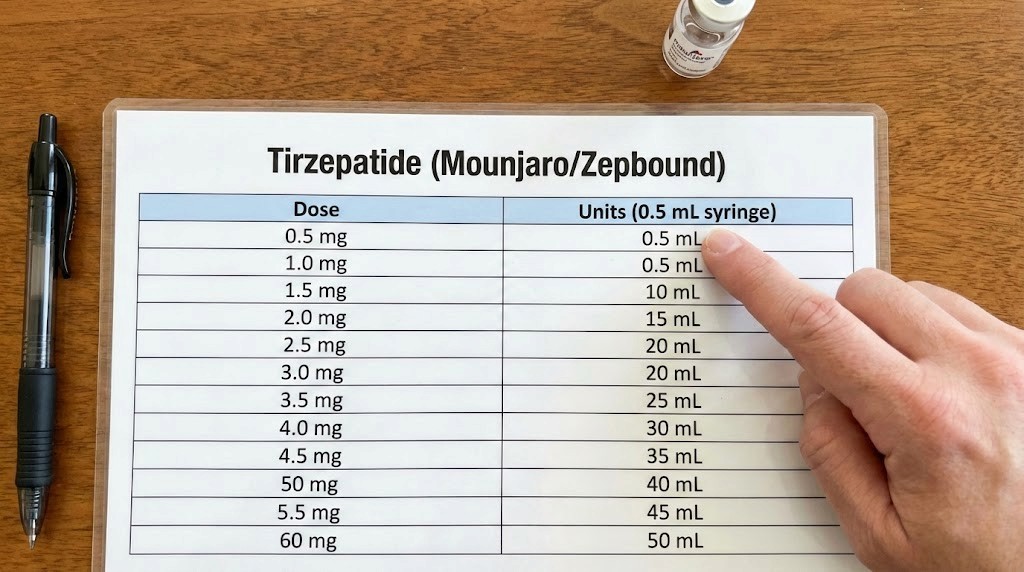
You are wasting tirzepatide. Not because you bought the wrong vial or stored it incorrectly, but because you drew the wrong number of units from a syringe you thought you understood. It happens constantly. Someone reads a dosage chart online, draws 25 units, and assumes they injected 2.5 mg. Maybe they did. Maybe they injected 5 mg. Maybe they injected 10 mg. The answer depends entirely on one number they probably did not check: the concentration printed on their vial.
That single variable, concentration, changes everything about tirzepatide dosage in units. A vial labeled 10 mg/mL behaves completely differently from one labeled 20 mg/mL when you draw the same number of units into an insulin syringe. Miss this detail and you are either underdosing (wasting time and money) or overdosing (risking nausea, vomiting, and side effects that could have been avoided entirely). Neither outcome is acceptable when the math is this straightforward.
This guide exists because most tirzepatide dosage charts online give you one table for one concentration and call it a day. That is not enough. Compounding pharmacies ship tirzepatide at 5 mg/mL, 10 mg/mL, 20 mg/mL, 30 mg/mL, and even 40 mg/mL. Brand name pens like Mounjaro and Zepbound use their own fixed concentrations. If you do not know which chart matches your vial, you are guessing. And guessing with a tirzepatide dose is not something anyone should accept.
What follows is every conversion chart you will ever need. Every concentration. Every dose from 2.5 mg to 15 mg. Every syringe unit value calculated and verified. Plus the actual math behind the numbers so you never have to trust a chart blindly again. Bookmark this page. You will come back to it.
Why units matter more than milligrams for tirzepatide
Here is the fundamental problem. Your doctor prescribes tirzepatide in milligrams. Your syringe measures in units. These are not the same measurement system, and converting between them requires knowing your vial concentration. Without that bridge, milligrams and units are two languages that do not translate.
An insulin syringe, the standard U-100 type used for subcutaneous injections, divides each milliliter into 100 units. So 1 mL equals 100 units. Half a milliliter equals 50 units. A quarter milliliter equals 25 units. This part is simple.
The complication arrives when you ask: how many milligrams of tirzepatide are in those units? That depends on concentration. If your vial contains 10 mg per mL, then 100 units (1 mL) contains 10 mg. But if your vial contains 20 mg per mL, those same 100 units contain 20 mg, double the dose. Same syringe. Same number of units drawn. Completely different amount of medication entering your body.
This is why understanding how many units equal your target dose matters so much. The conversion is not difficult, but getting it wrong has real consequences. Underdosing means the medication works slower or not at all. Overdosing means unnecessary side effects, from nausea to vomiting to diarrhea, that could set your progress back weeks.
The SURMOUNT-1 clinical trial showed that participants on 15 mg of tirzepatide lost an average of 22.5% of their body weight over 72 weeks. Participants on 5 mg lost 16%. The difference between these outcomes is the dose. And the difference between getting the right dose and the wrong dose is understanding how to read your syringe against your specific vial concentration.
The universal conversion formula
Every chart in this guide is built from one formula. Learn it, and you will never need to depend on a chart alone.
Step 1: Volume in mL = Desired dose in mg divided by concentration in mg/mL
Step 2: Units on syringe = Volume in mL multiplied by 100
That is it. Two steps. For example, if you want 5 mg from a 10 mg/mL vial: 5 divided by 10 equals 0.5 mL. Then 0.5 multiplied by 100 equals 50 units. You draw to the 50-unit mark on your insulin syringe.
Now the same 5 mg from a 20 mg/mL vial: 5 divided by 20 equals 0.25 mL. Then 0.25 multiplied by 100 equals 25 units. Half the volume. Half the units drawn. Same dose of medication.
See how concentration changes everything? The peptide calculator on SeekPeptides automates this math for you, but understanding the formula means you can always verify your numbers independently. And you should always verify your numbers independently.
Understanding U-100 insulin syringes
Nearly all tirzepatide users use U-100 insulin syringes. The "U-100" designation means the syringe is calibrated so that 100 units equals exactly 1 mL. These syringes typically come in three sizes: 0.3 mL (30 units), 0.5 mL (50 units), and 1 mL (100 units).
For tirzepatide dosing, the syringe size you need depends on your concentration and dose. With a 10 mg/mL vial, a 15 mg dose requires drawing 150 units, which exceeds a 1 mL syringe. That is why higher concentrations exist. They let you fit larger doses into smaller, more manageable injection volumes.
Each small line on a U-100 syringe typically represents 1 unit (on a 0.3 mL syringe) or 2 units (on a 1 mL syringe). For precise dosing, use the smallest syringe that can hold your required volume. The smaller the syringe, the easier it is to read the markings accurately, and accuracy matters when a few units can mean a significant difference in your actual dose.
Complete tirzepatide dosage chart for 5 mg/mL concentration
The 5 mg/mL concentration is less common but still shows up from certain compounding pharmacies, particularly for patients just starting their compounded tirzepatide protocol at lower doses. It requires drawing larger volumes, which means you will need a 1 mL syringe for most doses.
Dose (mg) | Volume (mL) | Units on syringe |
|---|---|---|
1.25 mg | 0.25 mL | 25 units |
2.5 mg | 0.50 mL | 50 units |
5 mg | 1.00 mL | 100 units |
7.5 mg | 1.50 mL | 150 units (exceeds 1 mL syringe) |
10 mg | 2.00 mL | 200 units (exceeds 1 mL syringe) |
Notice the limitation immediately. At 5 mg/mL, you can only practically dose up to 5 mg with a single 1 mL syringe draw. Anything above 5 mg requires either multiple injections or switching to a higher concentration vial. This is why most people on standard titration schedules eventually move to 10 mg/mL or higher concentrations as their dose increases.
For those using this concentration during the initial 2.5 mg phase, the 50-unit draw is straightforward. It sits right at the halfway mark on a 1 mL syringe, which is easy to read and hard to get wrong. If you are microdosing tirzepatide at even lower amounts like 1.25 mg, the 25-unit mark is equally clean.
Complete tirzepatide dosage chart for 10 mg/mL concentration
This is the most common concentration for compounded tirzepatide. The majority of compounding pharmacies default to 10 mg/mL, and it works well for the standard dose range from 2.5 mg through 10 mg. It strikes a balance between manageable injection volumes and precise measurement.
Dose (mg) | Volume (mL) | Units on syringe |
|---|---|---|
1.25 mg | 0.125 mL | 12.5 units |
2.5 mg | 0.25 mL | 25 units |
5 mg | 0.50 mL | 50 units |
7.5 mg | 0.75 mL | 75 units |
10 mg | 1.00 mL | 100 units |
12.5 mg | 1.25 mL | 125 units (exceeds 1 mL syringe) |
15 mg | 1.50 mL | 150 units (exceeds 1 mL syringe) |
At 10 mg/mL, the math produces clean numbers for most standard doses. The 2.5 mg starting dose equals 25 units. The common maintenance dose of 5 mg equals 50 units. And 10 mg, which is where many people find their sweet spot for significant weight loss results, fills an entire 1 mL syringe at 100 units.
The challenge appears at 12.5 mg and 15 mg. These doses exceed what a single 1 mL syringe can hold, which means you either need to split the dose across two injections or move to a 20 mg/mL concentration. Most providers recommend switching concentrations rather than splitting injections, because split injections mean two needle sticks per week and twice the opportunity for injection site reactions.
One important note: 5 mg of tirzepatide equals exactly 50 units at this concentration. This makes the 10 mg/mL vial extremely popular because 50 units is easy to measure on any standard insulin syringe. There is no guessing, no estimating between lines. You draw to the bold 50-unit mark and inject.
Complete tirzepatide dosage chart for 20 mg/mL concentration
The 20 mg/mL concentration is where higher-dose tirzepatide users find their freedom. Every dose from 2.5 mg through 15 mg fits comfortably within a 1 mL syringe, and even the maximum 15 mg dose only requires 75 units. No split injections. No syringe overflows.
Dose (mg) | Volume (mL) | Units on syringe |
|---|---|---|
2.5 mg | 0.125 mL | 12.5 units |
5 mg | 0.25 mL | 25 units |
7.5 mg | 0.375 mL | 37.5 units |
10 mg | 0.50 mL | 50 units |
12.5 mg | 0.625 mL | 62.5 units |
15 mg | 0.75 mL | 75 units |
This concentration is the workhorse for people who have titrated up to 10 mg or higher. Notice that 40 units at 20 mg/mL delivers 8 mg of tirzepatide, not the 4 mg you would get at 10 mg/mL. This is exactly the kind of mistake that catches people off guard when they switch concentrations without recalculating their draw volume.
The half-unit marks (12.5, 37.5, 62.5) can be tricky to measure precisely on a standard insulin syringe. If your dose falls on a half unit, use a 0.3 mL syringe with 1-unit markings for better accuracy. Some people round to the nearest whole unit, like drawing 13 units instead of 12.5, which adds 0.25 mg to the dose. On a weekly injection, that small variance is clinically insignificant, but precision-minded researchers prefer exact measurements.
For anyone considering this concentration, compounded tirzepatide at 20 mg/mL typically costs more per vial than 10 mg/mL but requires less volume per injection. This means the vial lasts for more doses, which often makes it more cost-effective over a full titration cycle. Check our peptide cost calculator to compare the actual cost per dose between concentrations.
Complete tirzepatide dosage chart for 30 mg/mL concentration
Some compounding pharmacies offer 30 mg/mL tirzepatide for patients on higher maintenance doses who want even smaller injection volumes. At this concentration, a full 15 mg dose requires only 50 units, which is the same volume as a 5 mg dose from a 10 mg/mL vial.
Dose (mg) | Volume (mL) | Units on syringe |
|---|---|---|
2.5 mg | 0.083 mL | 8.3 units |
5 mg | 0.167 mL | 16.7 units |
7.5 mg | 0.25 mL | 25 units |
10 mg | 0.333 mL | 33.3 units |
12.5 mg | 0.417 mL | 41.7 units |
15 mg | 0.50 mL | 50 units |
The advantage of 30 mg/mL is obvious: small injection volumes across the entire dose range. Even at 15 mg, you are only drawing half a milliliter. Smaller volumes generally mean less discomfort at the injection site and less medication sitting in the subcutaneous tissue at once.
The disadvantage is the precision problem. Look at the 2.5 mg dose: 8.3 units. That third of a unit is impossible to measure precisely on a standard insulin syringe. Even the 10 mg dose at 33.3 units requires estimating between markings. This concentration works best for higher doses where the rounding error becomes proportionally smaller. Drawing 33 units instead of 33.3 for a 10 mg dose means you are getting 9.9 mg instead of 10 mg. Clinically meaningless. But drawing 8 units instead of 8.3 for a 2.5 mg dose means you are getting 2.4 mg instead of 2.5 mg. Still clinically insignificant, but the percentage error is larger.
If you are using this concentration during the early weeks of tirzepatide treatment, consider whether a lower concentration vial might give you more precise measurements during the critical titration phase when your body is adjusting to the medication.
Complete tirzepatide dosage chart for 40 mg/mL concentration
The 40 mg/mL concentration is the highest you will commonly encounter from compounding pharmacies. It packs the most medication into the least volume, which is ideal for people on maintenance doses of 10 mg or higher who want the smallest possible injection.
Dose (mg) | Volume (mL) | Units on syringe |
|---|---|---|
2.5 mg | 0.0625 mL | 6.25 units |
5 mg | 0.125 mL | 12.5 units |
7.5 mg | 0.1875 mL | 18.75 units |
10 mg | 0.25 mL | 25 units |
12.5 mg | 0.3125 mL | 31.25 units |
15 mg | 0.375 mL | 37.5 units |
At 40 mg/mL, a 15 mg dose is just 37.5 units. That is an incredibly small injection volume, less than 0.4 mL. For perspective, that is roughly the amount of liquid in a large teardrop. The injection itself takes seconds and creates minimal discomfort.
But the precision concern is even more pronounced here. The 2.5 mg starting dose requires only 6.25 units. On most insulin syringes, each small marking represents either 1 or 2 units, making 6.25 essentially impossible to measure accurately. If you are starting tirzepatide for the first time and your pharmacy sends a 40 mg/mL vial, ask them to reconsider. This concentration should be reserved for maintenance doses of 7.5 mg and above, where the unit values are large enough to measure accurately.
For anyone researching what 20 units means in milligrams, at 40 mg/mL concentration, 20 units delivers 8 mg of tirzepatide. That same 20 units at 10 mg/mL would only deliver 2 mg. This is precisely why you must always check your concentration before drawing any dose.
Brand name tirzepatide: Mounjaro and Zepbound unit reference
Brand name tirzepatide products, Mounjaro (for type 2 diabetes) and Zepbound (for weight management), work differently from compounded vials. They come in pre-filled injection pens with fixed doses. You do not draw from a vial. You do not measure units. The pen delivers a precise, factory-measured dose every time you click the button.
Each pen delivers its labeled dose in exactly 0.5 mL of solution. That means every Mounjaro and Zepbound pen has its own unique concentration:
Pen dose | Volume per injection | Effective concentration | Equivalent units (if using syringe) |
|---|---|---|---|
2.5 mg | 0.5 mL | 5 mg/mL | 50 units |
5 mg | 0.5 mL | 10 mg/mL | 50 units |
7.5 mg | 0.5 mL | 15 mg/mL | 50 units |
10 mg | 0.5 mL | 20 mg/mL | 50 units |
12.5 mg | 0.5 mL | 25 mg/mL | 50 units |
15 mg | 0.5 mL | 30 mg/mL | 50 units |
This table reveals something elegant about the brand name design: every pen delivers exactly 50 units (0.5 mL), regardless of the dose. Eli Lilly achieved this by adjusting the concentration inside each pen strength. The 2.5 mg pen contains a 5 mg/mL solution. The 15 mg pen contains a 30 mg/mL solution. Same volume, different concentrations, different doses.
Why does this matter? Because if you are comparing notes with someone using brand name Mounjaro and they mention "50 units," that tells you nothing about their actual dose. You need to know which pen strength they are using. Conversely, if someone on compounded tirzepatide says they draw 50 units, you need to know their vial concentration. The unit number alone is meaningless without context.
This distinction matters most when switching between brand name and compounded tirzepatide, or when discussing dosages online. Always specify both the dose in milligrams and the concentration when sharing information. "I take 50 units" is incomplete. "I take 50 units from a 10 mg/mL vial, which gives me 5 mg" is complete.
The standard tirzepatide titration schedule in units
Tirzepatide follows a specific titration protocol designed to minimize side effects while building up to an effective dose. The FDA-approved schedule starts low and increases by 2.5 mg every four weeks. Most compounding pharmacy protocols follow this same approach because the clinical data behind it is solid.
Here is the complete titration schedule showing the unit draw for the two most common concentrations:
Phase | Weekly dose | Duration | Units at 10 mg/mL | Units at 20 mg/mL |
|---|---|---|---|---|
Starting dose | 2.5 mg | Weeks 1-4 | 25 units | 12.5 units |
First increase | 5 mg | Weeks 5-8 | 50 units | 25 units |
Second increase | 7.5 mg | Weeks 9-12 | 75 units | 37.5 units |
Third increase | 10 mg | Weeks 13-16 | 100 units | 50 units |
Fourth increase | 12.5 mg | Weeks 17-20 | 125 units* | 62.5 units |
Maximum dose | 15 mg | Week 21+ | 150 units* | 75 units |
*Exceeds 1 mL syringe capacity. Requires concentration change or split injection.
The 4-week minimum at each dose level is not arbitrary. It takes approximately 4 to 5 half-lives for tirzepatide to reach steady-state blood levels. The half-life of tirzepatide is about 5 days, which means steady state arrives around week 3 to 4 at each dose. Increasing before steady state means you are adjusting the dose before you even know how the current dose actually affects you.
Some providers extend each phase to 6 or even 8 weeks, particularly for patients who experience gastrointestinal side effects during titration. The SURMOUNT-1 trial protocol allowed one dose de-escalation for intolerable side effects, which underscores that slower titration is acceptable and sometimes preferred. Side effects beyond nausea, including anxiety in some patients, often resolve after the body adjusts to each new dose level.
For those not yet ready for standard titration, microdosing tirzepatide offers an alternative approach that starts even lower than 2.5 mg. Microdose protocols typically begin at 1 mg or 1.25 mg and increase in smaller increments. This approach requires the most precise syringe work, which is why a lower concentration vial (5 mg/mL or 10 mg/mL) paired with a 0.3 mL syringe produces the best accuracy for microdosing.
How to read your syringe correctly for tirzepatide
Drawing the right number of units means nothing if you read the syringe wrong. And syringe reading errors are more common than most people realize. The most frequent mistake is confusing the markings on different syringe sizes.
Reading a 1 mL (100-unit) syringe
A 1 mL insulin syringe has major markings at every 10 units (10, 20, 30, and so on up to 100). Between each major marking, there are typically 5 smaller lines, each representing 2 units. So the lines between 10 and 20 represent 12, 14, 16, and 18 units.
To draw 25 units on this syringe (a common draw for 2.5 mg at 10 mg/mL), you would pull the plunger to the midpoint between the 20 and 30 markings. The halfway point between two major lines is 5 units above the lower marking. On a 1 mL syringe, this means estimating between the second and third small lines above 20. It is doable but requires attention.
Reading a 0.5 mL (50-unit) syringe
This syringe has major markings at every 5 units and minor markings at every 1 unit. It is significantly easier to read for doses under 50 units. For the 25-unit draw, you simply pull to the bold 25-unit marking. No estimation needed.
Reading a 0.3 mL (30-unit) syringe
The smallest common insulin syringe has markings at every 0.5 units (on most brands) or every 1 unit. This is the precision instrument for microdosing and low-volume draws. If your dose is under 30 units, this syringe gives you the most accurate measurement possible with standard equipment.
Whichever syringe you use, follow this technique: hold the syringe at eye level with the markings facing you. The bottom edge of the plunger stopper (the flat, dark rubber piece inside the syringe barrel) indicates your volume. Do not read from the top of the stopper or the curved edge. The flat bottom is your reading line. This seems like a minor detail until you realize that reading from the wrong edge of the stopper can shift your measurement by 1 to 2 units, enough to alter your dose meaningfully at higher concentrations.
Proper injection technique extends beyond syringe reading. Our guide on peptide injection devices covers different administration tools, while understanding what a peptide injection actually involves helps newcomers feel confident about the process.
Concentration switching: when and how to change vials safely
At some point during titration, most compounded tirzepatide users need to switch concentrations. The trigger is usually reaching a dose that exceeds what their current concentration can deliver in a single syringe draw. The most common switch happens between 10 mg/mL and 20 mg/mL when the dose reaches 12.5 mg or 15 mg.
When to switch concentrations
The general guideline is straightforward: switch when your required draw volume exceeds 0.8 mL (80 units) on your current concentration. Beyond 80 units, the syringe becomes harder to read accurately, and the injection volume starts causing more discomfort.
Current concentration | Switch recommended at | Suggested new concentration |
|---|---|---|
5 mg/mL | 5 mg dose (100 units) | 10 mg/mL |
10 mg/mL | 10 mg dose (100 units) | 20 mg/mL |
20 mg/mL | Rarely needed | 30 or 40 mg/mL |
The critical safety step when switching is recalculating your unit draw from scratch. Do not assume your new vial works the same as your old one. Go back to the formula: dose in mg divided by new concentration, then multiply by 100 for units. Write the new number down. Double check it. Then draw.
A real example: you have been drawing 75 units from a 10 mg/mL vial to get your 7.5 mg weekly dose. Your pharmacy sends a 20 mg/mL vial for your next refill. If you draw the same 75 units from the new vial, you will inject 15 mg, double your intended dose. The correct draw is 37.5 units. This kind of error sends people to urgent care with severe nausea and vomiting. It is 100% preventable by recalculating whenever your concentration changes.
Some pharmacies are excellent about labeling and include a dosing card with each shipment.
Others are not. Always check the label on your vial yourself. Never assume. Reconstituting tirzepatide from lyophilized powder adds another variable, because your concentration depends on how much bacteriostatic water you add, which is something the tirzepatide reconstitution chart covers in detail.
What to do with leftover medication from the old concentration
When you switch concentrations mid-vial, you may have leftover medication in the old vial. Do not mix vials of different concentrations. Do not combine leftover medication into a new vial. Use what remains in the old vial at the old concentration, then start the new vial fresh. If you have questions about how long tirzepatide lasts in the fridge after opening, most compounded vials remain stable for 28 to 42 days when properly refrigerated, depending on the pharmacy specifications.
Side-by-side quick reference: same dose, different concentrations
This is the chart to print, laminate, and keep next to your supplies. It shows exactly how many units to draw for each standard dose across all five common concentrations. One glance tells you what you need.
Dose | 5 mg/mL | 10 mg/mL | 20 mg/mL | 30 mg/mL | 40 mg/mL |
|---|---|---|---|---|---|
1.25 mg | 25 units | 12.5 units | 6.25 units | 4.2 units | 3.1 units |
2.5 mg | 50 units | 25 units | 12.5 units | 8.3 units | 6.25 units |
5 mg | 100 units | 50 units | 25 units | 16.7 units | 12.5 units |
7.5 mg | 150 units* | 75 units | 37.5 units | 25 units | 18.75 units |
10 mg | 200 units* | 100 units | 50 units | 33.3 units | 25 units |
12.5 mg | 250 units* | 125 units* | 62.5 units | 41.7 units | 31.25 units |
15 mg | 300 units* | 150 units* | 75 units | 50 units | 37.5 units |
*Exceeds standard 1 mL (100 unit) insulin syringe capacity
This comprehensive table is the core reference for the entire article. Notice how the same 10 mg dose can be 200 units, 100 units, 50 units, 33 units, or 25 units depending on nothing more than which vial you are holding. The medication is the same. The dose is the same. Only the concentration and the corresponding syringe draw change.
Comparing this to semaglutide dosage charts reveals a similar pattern. Every injectable peptide follows the same concentration-dependent math. If you are also on semaglutide or considering a switch from semaglutide to tirzepatide, the unit conversion principles are identical. Only the specific numbers change.
Common dosage mistakes and how to avoid them
After years of seeing questions in forums, communities, and clinical settings, the same mistakes appear over and over. Every one of them is preventable. Here are the most dangerous errors and exactly how to avoid each one.
Mistake 1: using the wrong concentration chart
This is the most common and most dangerous error. Someone looks up a tirzepatide dosage chart, finds a nice table, and uses it without checking whether the chart concentration matches their vial. If the chart is for 10 mg/mL and your vial is 20 mg/mL, every dose you draw is double what you intended.
Prevention: Before using any chart, verify three things. First, check your vial label for the concentration (it will say something like "10 mg/mL" or "20 mg per mL"). Second, confirm the chart you are referencing lists the same concentration. Third, verify one calculation manually using the formula: dose divided by concentration, multiplied by 100 equals units. If your manual calculation matches the chart, you are good.
Mistake 2: assuming all compounding pharmacies use the same concentration
They do not. One pharmacy might send 10 mg/mL. Another sends 20 mg/mL. A third might send 15 mg/mL. If you switch pharmacies or receive a new shipment, always check the label. Never assume it is the same as last time.
Prevention: Read your vial label every single time you draw a dose. Make it a habit. Even if you have used the same pharmacy for months, formulations can change without notice. Different peptide suppliers operate under different formulation standards.
Mistake 3: confusing units with milligrams
Units and milligrams are not interchangeable. Someone might say "I take 25 units of tirzepatide" and mean 2.5 mg (from a 10 mg/mL vial). But another person saying "25 units" from a 20 mg/mL vial is taking 5 mg, twice the dose. Understanding tirzepatide dosage in units requires always specifying the concentration alongside the unit count.
Prevention: Always communicate your dose in milligrams. If someone asks how much you take, say "5 mg" not "50 units." If you need to discuss units (for practical measurement reasons), always include the concentration: "50 units from a 10 mg/mL vial."
Mistake 4: using the wrong syringe type
Not all syringes are U-100. Some specialized syringes use different unit scales. If you accidentally use a U-40 syringe (designed for veterinary insulin), the markings represent different volumes. Drawing to the "25" line on a U-40 syringe gives you 0.625 mL instead of the 0.25 mL you expected, a 2.5x overdose.
Prevention: Only use U-100 insulin syringes for tirzepatide. Check the syringe packaging. It should clearly state "U-100" or "for U-100 insulin." If it says anything else, do not use it.
Mistake 5: not accounting for dead space
Every syringe has a small amount of "dead space" in the hub where the needle connects to the barrel. This space can hold 0.02 to 0.07 mL of solution that never gets injected. For larger volumes (50+ units), dead space is negligible. For very small volumes (under 10 units), it can represent a meaningful percentage of your dose.
Prevention: Use low dead space (LDS) syringes when dosing under 15 units. These syringes are designed to minimize the volume trapped in the hub. They cost slightly more than standard syringes but waste significantly less medication, especially at higher concentrations where every unit contains more milligrams.
Comparing tirzepatide units to semaglutide units
Many people arrive at tirzepatide after using semaglutide first. If that is you, the unit conversions might feel familiar because the math is identical. But the actual numbers differ because tirzepatide and semaglutide come in different concentrations and use different dose ranges.
Semaglutide typical doses range from 0.25 mg to 2.4 mg per week. Tirzepatide doses range from 2.5 mg to 15 mg per week, roughly 6 to 10 times higher in milligram terms. This does not mean tirzepatide is "stronger." The two molecules have different potencies, receptor binding profiles, and pharmacokinetics. You cannot simply multiply your semaglutide dose to find your tirzepatide dose.
The tirzepatide vs semaglutide dosage chart provides a detailed comparison of how doses align between these two GLP-1 receptor agonists. For those planning to make the change, our semaglutide to tirzepatide conversion chart walks through the transition step by step. The semaglutide vs tirzepatide comparison page covers the broader differences beyond just dosing.
From a practical syringe standpoint, someone using compounded semaglutide at 5 mg/mL who draws 10 units gets 0.5 mg of semaglutide. Someone using compounded tirzepatide at 10 mg/mL who draws the same 10 units gets 1 mg of tirzepatide. Same syringe draw, completely different medications at completely different doses. This is why transferring your "syringe habits" from one medication to another without recalculating is dangerous.
The conversion principles for semaglutide syringe dosage follow the same formula: mg divided by concentration equals mL, mL times 100 equals units. If you have mastered this formula for one peptide, you have mastered it for all of them. The semaglutide dosage calculator handles the math automatically for those who prefer a digital tool.
Weight loss outcomes by dose: what the research shows
Understanding the charts is important. But the reason you are measuring these doses in the first place matters too. What does each dose level actually deliver in terms of results?
The SURMOUNT-1 trial, published in the New England Journal of Medicine, randomized 2,539 adults with obesity or overweight to tirzepatide 5 mg, 10 mg, or 15 mg weekly for 72 weeks. The results were striking.
At 5 mg weekly, participants lost an average of 16% of their body weight. That translates to about 35 pounds for someone starting at 220 pounds. At 10 mg, average weight loss jumped to 21.4%, roughly 47 pounds from the same starting weight. And at 15 mg, participants lost 22.5%, approximately 50 pounds. The placebo group lost 2.4%.
The jump from 5 mg to 10 mg produced the most dramatic improvement: an additional 5.4 percentage points of body weight lost. The jump from 10 mg to 15 mg added only 1.1 percentage points. This suggests that for many people, 10 mg represents the point of diminishing returns, where side effects increase more than benefits. Your provider can help determine your optimal maintenance dose based on your individual response, tolerance, and goals.
For context on what these results look like in practice, tirzepatide before and after results and male-specific tirzepatide transformations show real outcomes across different dose levels. If weight loss stalls despite correct dosing, troubleshooting tips for tirzepatide plateaus can help identify the issue.
Managing side effects during dose titration
Every dose increase brings the possibility of temporary side effects. The most common are gastrointestinal: nausea, vomiting, diarrhea, decreased appetite, and constipation. In the SURMOUNT-1 trial, 24-26% of participants experienced nausea at some point during the study, most commonly during dose escalation phases.
The good news is that these side effects typically peak in the first 1 to 2 weeks after a dose increase and then diminish as your body adjusts. This is why the 4-week minimum at each dose level exists. It gives your GI system time to adapt before adding more medication.
Side effect management by dose phase
At 2.5 mg (25 units at 10 mg/mL): This starting dose is sub-therapeutic for weight loss. Its purpose is purely acclimation. Most people experience mild nausea or decreased appetite. Some feel nothing at all. If side effects are severe at this dose, it may indicate sensitivity that warrants an even slower start through microdosing protocols.
At 5 mg (50 units at 10 mg/mL): The first therapeutic dose. This is where most people start noticing both appetite suppression and gastrointestinal effects. Eating smaller meals, avoiding high-fat foods, and staying hydrated helps significantly. Fatigue is also reported at this phase.
At 7.5 mg (75 units at 10 mg/mL): Side effects tend to be milder at this increase if you tolerated 5 mg well. The body appears to develop some tolerance to the GI effects with consistent exposure.
At 10 mg (100 units at 10 mg/mL or 50 units at 20 mg/mL): This is where the majority of weight loss occurs. Side effects are typically manageable by this phase because your body has been adapting for 12+ weeks. If you are switching from a 10 mg/mL vial to a 20 mg/mL vial at this point, remember that your unit draw changes from 100 to 50.
At 12.5-15 mg (62.5-75 units at 20 mg/mL): The highest doses. GI side effects can resurge temporarily. Appetite suppression at these doses is often profound, and some people struggle to eat enough to maintain adequate nutrition. Monitoring caloric intake becomes as important as monitoring the dose itself.
Special dosing situations: B12 blends, niacinamide formulations, and more
Compounding pharmacies do not always ship plain tirzepatide. Many offer blended formulations that combine tirzepatide with other compounds, most commonly vitamin B12, niacinamide, or L-carnitine. These blends change the label but should not change your dosing calculation, as long as the tirzepatide concentration is clearly stated.
Tirzepatide with B12 is the most popular blend. The vitamin B12 is included to help prevent the B12 deficiency that GLP-1 medications can sometimes cause through reduced food intake and altered gastric acid production. The B12 does not affect the tirzepatide concentration or your unit draw. If the label says 10 mg/mL tirzepatide with B12, you calculate units exactly as you would for plain 10 mg/mL tirzepatide.
Tirzepatide with niacinamide follows the same principle. The niacinamide is added for its potential metabolic benefits, but the tirzepatide dose calculation remains unchanged. Always base your unit draw on the tirzepatide concentration listed on the label, regardless of what other compounds are in the formulation.
One blend that does require extra attention is any formulation where the total solute concentration is high enough to change the solution viscosity. Very concentrated solutions (40 mg/mL or higher) can be slightly thicker, which means they flow through the needle more slowly. Use a slightly larger gauge needle (27G instead of 30G) or inject more slowly to account for the increased viscosity. This does not change the dose, just the injection experience.
For researchers exploring alternatives to injectable administration, oral tirzepatide is in development and represents a future where syringe measurements may become less relevant. Until then, understanding units remains essential for anyone using injectable tirzepatide.
Storage and handling: protecting your doses
Correct dosing means nothing if the medication in your vial has degraded. Tirzepatide is a protein-based molecule that is sensitive to temperature, light, and contamination. Proper storage ensures that the concentration on the label matches the actual concentration in the solution, which keeps your unit calculations accurate.
Refrigeration is required. Store unopened vials at 2-8 degrees Celsius (36-46 degrees Fahrenheit). Once opened, most compounded tirzepatide vials remain stable for 28 to 42 days in the refrigerator, depending on the pharmacy specifications. Tirzepatide must stay refrigerated to maintain potency, and leaving it at room temperature for extended periods can degrade the molecule and reduce the actual dose you receive.
The practical impact of degradation is insidious. A partially degraded vial might still look clear and normal. But the effective tirzepatide concentration could be lower than the label states. So when you draw 50 units expecting 5 mg (from a 10 mg/mL vial), you might only be getting 4 mg or 3.5 mg. Your dose is right on paper but wrong in reality. This is one reason people sometimes stop losing weight without changing anything, degraded medication delivering less drug than expected.
For general peptide storage best practices, storing peptides after reconstitution and peptide refrigeration timelines provide comprehensive guidance that applies across all peptide types, including tirzepatide.
Tirzepatide versus retatrutide: understanding the dose difference
Retatrutide is the next-generation GLP-1 compound that adds a third receptor target to tirzepatide dual-agonist mechanism. It is still in clinical trials, but early data shows even more impressive weight loss results. If you are following retatrutide development, understanding how its dosing compares to tirzepatide can be helpful context.
Retatrutide uses a different dose range (starting at 1 mg and going up to 12 mg in trials), different titration timing, and different concentrations when compounded. The retatrutide vs tirzepatide dosage chart provides a direct comparison. The complete retatrutide dosing guide covers the full protocol, and the retatrutide dosage chart gives the same kind of concentration-based unit conversion tables you have seen here for tirzepatide.
The key takeaway: every injectable peptide follows the same mg-to-units conversion math. If you have learned to calculate tirzepatide units from this guide, you can apply the same formula to retatrutide, semaglutide, or any other injectable. The formula never changes. Only the specific numbers do.
Tools for double-checking your calculations
SeekPeptides provides several free calculators that automate the math covered in this guide. These tools are particularly useful for verifying your manual calculations and catching errors before they become injections.
The peptide calculator handles general mg-to-units conversions for any peptide at any concentration. Enter your medication concentration and desired dose, and it outputs the exact number of units to draw. The peptide reconstitution calculator works upstream of dosing, telling you how much bacteriostatic water to add to a lyophilized powder to achieve your target concentration. And the peptide cost calculator helps you compare the per-dose cost between different concentrations and suppliers.
These calculators are free to use without an account. But for researchers who want deeper protocol support, SeekPeptides members access personalized protocol builders, detailed weight-based dosing guides, and expert-reviewed titration schedules that account for individual factors like body weight, tolerance, and goals. The platform has become the most trusted resource for evidence-based peptide education, with thousands of researchers relying on its protocols and weight loss calculators for accurate dosing.
When your prescribed dose does not match a clean unit number
Real-world dosing does not always produce clean numbers. Your provider might prescribe 3.75 mg during a slow titration. At 10 mg/mL, that is 37.5 units, a half-unit measurement. At 20 mg/mL, it is 18.75 units, a quarter-unit measurement. These fractional units are genuinely difficult to measure on standard syringes.
Strategies for handling fractional units
Option 1: Use a smaller syringe. A 0.3 mL syringe with half-unit markings can measure 18.5 or 19 units with reasonable precision. This is the preferred approach for anything requiring quarter-unit or half-unit accuracy.
Option 2: Round to the nearest whole unit. Rounding 37.5 to 38 or 37 adds or subtracts 0.1 mg from a 10 mg/mL vial. On a weekly dose that represents a 2.7% variance, which is well within the acceptable range for clinical outcomes. Most providers consider any variance under 5% to be clinically insignificant.
Option 3: Ask your pharmacy for a cleaner concentration. If your dose consistently lands on awkward unit numbers, your pharmacy may be able to prepare a concentration that produces cleaner math. For instance, switching from 20 mg/mL to 15 mg/mL changes a 7.5 mg dose from 37.5 units to 50 units, a much cleaner draw.
Option 4: Use the concentration that gives you the cleanest numbers for your current dose. This approach means changing vials as you titrate, which some people find inconvenient. But it guarantees the most accurate dosing at every step of the protocol.
Tracking your doses: why documentation matters
Keeping a simple log of your injections might seem unnecessary when you have a chart taped to your fridge. But dose tracking serves several important purposes beyond just remembering whether you injected this week.
First, it creates a record that your provider can review. If tirzepatide is not working as fast as expected, a dose log helps your provider verify that your unit draws, concentrations, and injection frequency have been correct throughout your protocol. Without a log, troubleshooting becomes guesswork.
Second, it helps you catch patterns. Maybe your nausea is worse when you inject on Monday evenings versus Saturday mornings. Maybe switching injection sites from your abdomen to your thigh changed how quickly the medication absorbs. These observations only emerge from consistent tracking.
A basic dose log should include: date, time, dose in mg, concentration of vial, units drawn, injection site, and any side effects noted. You can track this in a spreadsheet, a notes app, or a paper journal. The format does not matter. Consistency does.
SeekPeptides members get access to progress tracking tools that integrate dose logging with weight tracking, side effect monitoring, and protocol adjustments, all in one place. For researchers serious about optimizing their protocols, this kind of integrated tracking significantly accelerates progress toward goals.
Frequently asked questions
How many units is 2.5 mg of tirzepatide?
It depends on your vial concentration. At 10 mg/mL, 2.5 mg equals 25 units. At 20 mg/mL, it equals 12.5 units. At 5 mg/mL, it equals 50 units. Always check your concentration before drawing.
How many units is 5 mg of tirzepatide?
At 10 mg/mL, 5 mg equals 50 units. At 20 mg/mL, it equals 25 units. At 40 mg/mL, it equals 12.5 units. The formula is always: dose divided by concentration, times 100.
How many mg is 40 units of tirzepatide?
At 10 mg/mL, 40 units delivers 4 mg. At 20 mg/mL, 40 units delivers 8 mg. At 5 mg/mL, 40 units delivers 2 mg. The formula reversed is: units divided by 100, multiplied by concentration.
Can I use the same dosage chart for Mounjaro and compounded tirzepatide?
No. Mounjaro pens deliver a fixed dose in a fixed volume (0.5 mL per injection). Compounded vials have variable concentrations. The charts in this guide are specifically for syringe-based dosing from compounded vials. If you are using a brand name pen, the dose is pre-measured and no unit calculation is needed.
What syringe should I use for tirzepatide?
Use a U-100 insulin syringe. For doses under 30 units, a 0.3 mL syringe gives the most precise measurement. For doses between 30 and 50 units, a 0.5 mL syringe works well. For doses above 50 units, use a 1 mL syringe. Always choose the smallest syringe that fits your dose for maximum accuracy. Our injection device guide covers all available options.
What happens if I accidentally draw too many units?
If you realize the error before injecting, simply push the plunger back, discard the solution safely, and redraw the correct amount. If you have already injected, contact your healthcare provider. The severity depends on how much extra you took. An extra 5-10 units at 10 mg/mL adds 0.5-1 mg, which is unlikely to cause serious problems but may increase nausea. A significant overdose (double dose or more) warrants immediate medical attention.
How do I convert units back to milligrams?
Reverse the formula. Divide your syringe units by 100 to get mL. Then multiply mL by your vial concentration in mg/mL. Example: 75 units divided by 100 equals 0.75 mL. At 10 mg/mL, 0.75 times 10 equals 7.5 mg.
Is tirzepatide dosing different for men and women?
The FDA-approved dosing protocol is the same regardless of sex. However, individual responses can vary. Some providers adjust titration speed based on body weight, metabolic markers, and side effect tolerance rather than sex alone. Male-specific tirzepatide outcomes and weight loss strategies for women offer gender-specific context.
Can I use a tuberculin syringe instead of an insulin syringe?
Tuberculin (TB) syringes measure in mL, not units. You can use them, but you must read the mL markings instead of unit markings. A 0.5 mL draw on a TB syringe is equivalent to 50 units on a U-100 insulin syringe. Most people find insulin syringes easier for this purpose because the unit markings align directly with the dosage charts.
Should I switch to a higher concentration as my dose increases?
Generally yes. When your required draw volume exceeds 80 units (0.8 mL), switching to a higher concentration reduces injection volume and improves measurement accuracy. Discuss timing with your provider or pharmacist.
External resources
For researchers serious about optimizing their tirzepatide protocols, SeekPeptides offers the most comprehensive resource available, with evidence-based guides, verified dosing calculators, and a community of thousands who have navigated these exact questions. Members access personalized protocol builders, detailed titration schedules, and expert support that goes far beyond what any single chart can provide.
In case I do not see you, good afternoon, good evening, and good night. May your calculations stay accurate, your concentrations stay verified, and your results stay consistent.