Mar 11, 2026

Before you click that buy button on Peaka GLP-1 slimming pearls, stop. Read this first. The GLP-1 supplement market has exploded into a multi-billion dollar industry, and products like Peaka GLP-1 sit right at the center of the chaos. They promise the appetite-crushing power of prescription medications like semaglutide and tirzepatide, all without a needle, without a prescription, and without the cost. That sounds incredible. It also sounds too good to be true, because in most cases, it is.
The reality of GLP-1 supplements is far more complicated than the marketing suggests. Some contain ingredients with genuine, if modest, scientific support. Others rely on flashy packaging and borrowed credibility from actual GLP-1 medications to sell products that have never been tested in clinical trials. Peaka GLP-1 falls into a category that demands careful scrutiny, particularly given the volume of scam reports and the lack of published research on its specific formulation. This guide breaks down everything you need to know about Peaka GLP-1, from the actual ingredients inside the pearls to the science behind each one, from real user experiences to the red flags you cannot ignore. Whether you are considering this product or simply trying to understand the GLP-1 fat loss landscape, you will leave with a clear picture of what works, what does not, and where to focus your attention instead.
What is Peaka GLP-1?
Peaka GLP-1, sometimes searched as "Peak GLP-1," is an over-the-counter dietary supplement sold as "ultra concentrated essence liquid pearls." The product claims to support weight loss, reduce appetite, improve metabolic function, and even help with blood sugar regulation. It positions itself as a natural alternative to prescription GLP-1 medications like Ozempic and similar injectable drugs.
The name itself is strategic. By including "GLP-1" in the product name, Peaka borrows credibility from the pharmaceutical class of GLP-1 receptor agonists that have demonstrated dramatic weight loss results in clinical trials. Semaglutide produces average weight loss of 10-15% of body weight. Tirzepatide can push that number even higher. These are prescription medications backed by massive randomized controlled trials involving thousands of participants.
Peaka GLP-1 is not one of those medications.
It is a dietary supplement. That distinction matters enormously. Dietary supplements in the United States do not require FDA approval before they reach store shelves. They do not need clinical trials proving effectiveness. They do not need to demonstrate safety in controlled studies. The manufacturer bears responsibility for ensuring safety, but the FDA does not verify those claims before the product goes on sale. This regulatory gap allows products like Peaka GLP-1 to make bold marketing claims while providing minimal scientific evidence to support them.
The product comes in liquid pearl form, designed for oral consumption. Some versions are marketed as sublingual drops, meant to be placed under the tongue for faster absorption. If you are curious about how GLP-1 drops work in general, the concept relies on bypassing the digestive system to improve bioavailability, though the evidence for this approach with supplement ingredients remains limited.
Peaka is sold through multiple websites, including peakausa.com, peakawellness.com, and various third-party marketplaces like Amazon, eBay, and Walmart. The existence of multiple storefronts with slightly different branding raises questions about the actual manufacturer and supply chain. Several investigative reviews have identified the product as a generic formulation mass-produced in China and sold under different brand names by various online retailers.
Peaka GLP-1 ingredients breakdown
Understanding what is actually inside Peaka GLP-1 requires separating marketing language from ingredient reality. The product lists several active components, each with varying levels of scientific support. Let us examine them one by one.
Moringa extract
Moringa oleifera is a plant native to South Asia that has been used in traditional medicine for centuries. It contains antioxidants, vitamins, and minerals. Some animal studies suggest moringa may help reduce fat accumulation and improve metabolic energy levels. However, human clinical trials are scarce. The studies that do exist involve small sample sizes and short durations, making it impossible to draw definitive conclusions about moringa as a weight loss ingredient. Most research suggests moringa may provide nutritional support rather than meaningful fat loss.
Apple cider vinegar (ACV)
Apple cider vinegar has been a popular wellness ingredient for decades. Limited evidence suggests it may help with modest blood sugar regulation after meals. One small study showed participants consuming ACV lost slightly more weight than a control group over 12 weeks, but the difference amounted to about 2-4 pounds. That is not nothing, but it is nowhere near the results produced by actual GLP-1 medications. The amount of ACV in a liquid pearl supplement is also likely far smaller than the quantities used in research studies, which typically involved 1-2 tablespoons per day.
NAD+ (nicotinamide adenine dinucleotide)
NAD+ is a coenzyme found in every living cell. It plays critical roles in energy metabolism, DNA repair, and cellular signaling. Research on NAD+ supplementation, usually through precursors like NMN or NR, suggests potential benefits for anti-aging and cellular health. However, oral NAD+ supplementation faces a significant bioavailability challenge. The molecule is large and breaks down extensively in the digestive tract. Whether the amount of NAD+ in Peaka GLP-1 pearls survives digestion and reaches meaningful levels in the bloodstream is highly questionable.
There is no published evidence linking oral NAD+ supplementation to significant weight loss or GLP-1 production.
Keto BHB (beta-hydroxybutyrate)
BHB is a ketone body that the liver produces during fasting or very low-carbohydrate diets. Exogenous BHB supplements became popular alongside the ketogenic diet trend. The idea is that consuming BHB raises blood ketone levels, potentially reducing appetite and supporting fat loss. The research tells a more complicated story. While exogenous ketones can temporarily raise blood ketone levels, they do not replicate the metabolic state of true ketosis. Studies on BHB supplements show minimal weight loss effects. The doses used in research are typically much larger than what fits inside a liquid pearl.
Turmeric (curcumin)
Turmeric contains curcumin, a compound with well-documented anti-inflammatory properties. Some animal studies show curcumin may improve blood sugar control by increasing GLP-1 release. One small human study in people with type 2 diabetes found that 1,500 mg of curcumin daily reduced weight and blood sugar modestly. This is perhaps the most scientifically interesting ingredient in the Peaka formulation. But curcumin has notoriously poor bioavailability, meaning very little of what you swallow actually reaches your bloodstream. The amount present in a single liquid pearl is almost certainly far below the therapeutic doses used in research.
Peppermint essential oil
Peppermint oil may help soothe digestive discomfort, including bloating and gas. It has no meaningful connection to GLP-1 production or weight loss. Its inclusion in Peaka GLP-1 appears to serve as a flavoring agent or digestive comfort ingredient rather than an active weight loss component.
The ingredient verdict
None of these ingredients, individually or combined, have been shown to produce anything close to the weight loss results associated with prescription GLP-1 medications. Some have modest supporting evidence for minor metabolic benefits. Most face serious bioavailability challenges at the doses likely present in a liquid pearl supplement. And critically, the specific Peaka GLP-1 formulation has never been tested as a complete product in any clinical trial.
How Peaka GLP-1 claims to work
The marketing behind Peaka GLP-1 suggests the product stimulates your body to produce more of its own GLP-1 hormone naturally. This is a clever claim because it sidesteps the regulatory issues around selling actual GLP-1 (which would require a prescription). Instead, Peaka positions itself as a support supplement that enhances what your body already does.
Here is the problem with that claim. Your body does produce GLP-1 naturally. The L-cells in your gut release GLP-1 in response to food intake, particularly protein, healthy fats, and fiber. GLP-1 levels typically peak about 30-60 minutes after eating and help regulate appetite, insulin release, and gastric emptying. Understanding how GLP-1 suppresses appetite is essential context here.
Natural GLP-1 gets broken down rapidly by an enzyme called DPP-4, usually within minutes. This is precisely why prescription GLP-1 medications are engineered differently. Semaglutide, for example, has structural modifications that make it resistant to DPP-4 degradation, allowing it to remain active in the body for about a week. That sustained activity is what produces significant appetite suppression and weight loss.
For a supplement to meaningfully boost GLP-1 levels, it would need to either dramatically increase GLP-1 production (far beyond what any food or supplement has been shown to do) or inhibit DPP-4 to slow GLP-1 breakdown. Some of the ingredients in Peaka, like curcumin, show modest GLP-1 stimulating effects in animal studies. But "modest effects in animal studies" is an enormous distance from "clinically meaningful weight loss in humans." The gap between preclinical promise and proven human results is where most supplement claims fall apart.
The product also claims to support ketosis through its BHB content, reduce inflammation through turmeric, and provide antioxidant benefits through moringa. These are reasonable properties of the individual ingredients at sufficient doses. Whether the amounts present in Peaka pearls achieve any of these effects is entirely unproven.
The science behind GLP-1 supplements
To properly evaluate Peaka GLP-1, you need to understand the broader landscape of GLP-1 supplements and what science actually says about them. This market has grown explosively, projected to expand from 4.1 billion dollars to 13 billion by 2035. That growth is driven almost entirely by the success of prescription GLP-1 drugs and the desire of consumers to access similar benefits without injections, prescriptions, or high costs.
What research shows about natural GLP-1 boosters
Several natural compounds have demonstrated the ability to influence GLP-1 levels in laboratory and animal studies. Berberine is perhaps the most studied, with research showing it can stimulate GLP-1 secretion through interactions with the AMPK pathway. Green tea extract, specifically EGCG, may enhance GLP-1 activity and prolong its effects by inhibiting DPP-4. Curcumin shows similar potential in animal models.
But here is the critical context most supplement marketers leave out. The weight loss produced by these compounds, even in the most favorable studies, amounts to approximately 2-4 pounds over 8-12 weeks. Compare that to tirzepatide results showing 15-25% body weight reduction, or semaglutide before and after results demonstrating 10-15% reductions. The difference is not subtle. It is enormous.
Why supplements cannot replicate prescription GLP-1 drugs
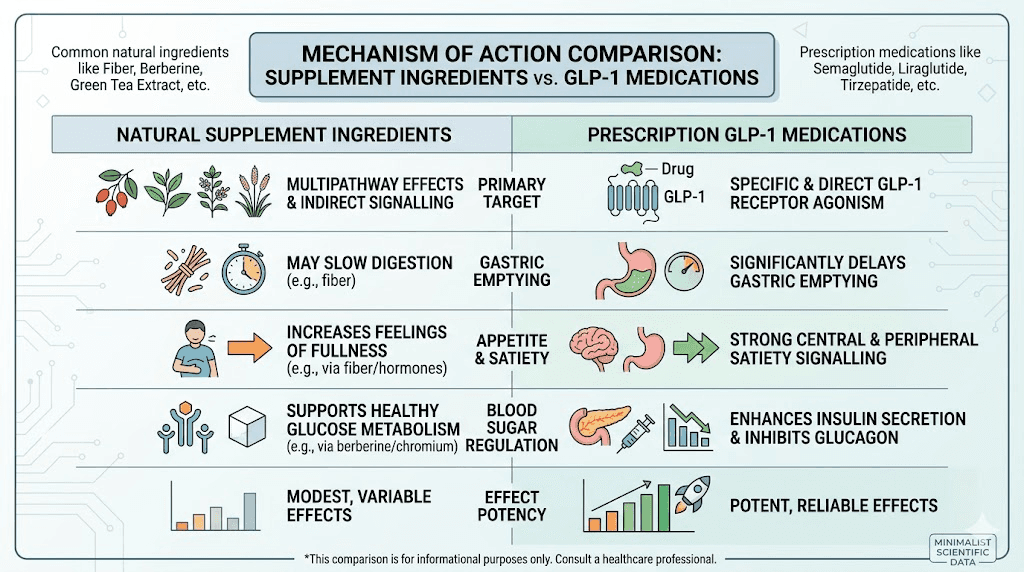
The mechanism matters. Prescription GLP-1 receptor agonists work by directly binding to GLP-1 receptors and activating them continuously. They are engineered molecules designed for this exact purpose, modified to resist enzymatic breakdown and maintain activity for days or even weeks.
Supplements, on the other hand, attempt to nudge your body to produce slightly more of its own GLP-1 or to slow its natural breakdown slightly. Even the most optimistic interpretation of supplement research suggests these effects are minor. Your body has homeostatic mechanisms that regulate GLP-1 production. It resists dramatic changes in hormone levels from dietary inputs, which is actually a protective feature, not a limitation to overcome.
Additionally, most supplement ingredients face bioavailability challenges. Oral supplements must survive stomach acid, pass through the intestinal wall, and reach target tissues in sufficient concentrations to produce effects. Many promising compounds in laboratory studies fail to produce the same results when consumed orally because they simply do not survive the journey. This is why understanding the difference between injectable and oral delivery methods matters so much in the peptide and pharmaceutical world.
The FDA regulatory gap
Under the Dietary Supplement Health and Education Act (DSHEA), supplements operate in a fundamentally different regulatory environment than pharmaceuticals. Drug manufacturers must prove their products are safe and effective before selling them. Supplement manufacturers do not. They cannot claim to treat, cure, or prevent diseases, but they can make "structure/function" claims like "supports metabolism" or "promotes healthy appetite." These vague claims allow products like Peaka GLP-1 to imply pharmaceutical-level benefits without providing pharmaceutical-level evidence.
The FDA can take action against supplements only after they reach the market and cause harm. This reactive approach, rather than the proactive approval process used for drugs, means consumers are essentially conducting their own clinical trials every time they try a new supplement. Without independent testing, there is no guarantee that what is listed on the label matches what is actually in the product.
Peaka GLP-1 user reviews and real experiences
User reviews for Peaka GLP-1 are deeply mixed, and understanding why requires looking beyond star ratings.
Positive experiences
Some users report modest benefits. Reduced bloating is the most common positive reported effect, likely attributable to the peppermint oil and digestive support ingredients. A small number of users report mild appetite reduction. Weight loss of 2-5 pounds over 4-8 weeks appears in some reviews, though these users also typically mention dietary changes and exercise alongside supplement use. Without a control group, it is impossible to determine whether the supplement contributed to these results or whether the lifestyle changes were responsible.
Compare these modest outcomes to the first month results on semaglutide, where users commonly report 4-8 pounds of weight loss alongside significant appetite suppression. Or look at what people experience in their first week on semaglutide. The contrast is stark.
Negative experiences
The negative reviews paint a more concerning picture. Many users report zero noticeable effects after weeks of consistent use. Some describe mild gastrointestinal discomfort, including nausea, bloating, and gas, particularly when starting the supplement or taking it on an empty stomach. These side effects overlap with common complaints about many GLP-1 related digestive issues, though the mechanisms are entirely different.
The most alarming negative reviews involve the purchasing experience itself. Multiple consumers report being enrolled in subscription services without clear consent. Charges appear on credit cards for repeat shipments that were never authorized. Customer service is difficult or impossible to reach. Refund requests go unanswered. These patterns, documented across multiple review platforms, suggest systemic issues with the business practices surrounding Peaka GLP-1 sales.
Review authenticity concerns
Several investigative reviews have flagged the positive testimonials on Peaka websites as potentially fabricated. The photos and stories show patterns consistent with stock imagery and scripted content rather than genuine user submissions. Celebrity endorsements attributed to the product appear to be unauthorized and false. When a product relies on fake social proof rather than real clinical data, it raises serious questions about legitimacy.
Red flags and safety concerns
Multiple independent investigations into Peaka GLP-1 have identified concerning patterns that potential buyers should understand before making a purchase decision.
Fake endorsements and misleading marketing
Peaka GLP-1 marketing materials frequently feature celebrity endorsements and doctor recommendations that appear to be fabricated. Investigative sources have identified these endorsements as unauthorized uses of public figures to lend credibility to an unproven product. Using fake endorsements is not just unethical. It violates FTC guidelines and suggests a company willing to deceive consumers in its marketing, which raises questions about what else might be misrepresented.
Misleading certifications
Some Peaka GLP-1 marketing includes certification logos and seals that suggest FDA approval, GMP compliance, or third-party testing. When verified independently, these certifications often cannot be confirmed. The FDA does not certify or approve dietary supplements, so any marketing suggesting FDA endorsement for this product is inherently misleading. If you are researching GLP-1 related legal developments, understanding the regulatory landscape around these products becomes even more important.
Subscription traps
Perhaps the most frequently reported issue involves unauthorized recurring charges. Customers report ordering a single bottle and later discovering monthly subscription charges on their credit cards. The terms and conditions, if they exist at all, bury subscription details in fine print. Cancellation processes are deliberately complicated or entirely non-functional. This business model, known as a subscription trap or negative option billing, is a well-documented predatory practice.
Manufacturing opacity
The actual manufacturer of Peaka GLP-1 is difficult to identify. Multiple websites sell what appears to be the same product under slightly different branding. Investigative reports suggest the pearls are manufactured generically in China and white-labeled for various sellers. Without clear manufacturing transparency, consumers cannot verify ingredient purity, dosage accuracy, or contamination testing. This stands in stark contrast to compounded GLP-1 medications produced by regulated pharmacies that must meet specific quality standards.
No clinical evidence
Despite bold claims about weight loss and appetite suppression, Peaka GLP-1 has never been the subject of a clinical trial. No peer-reviewed research exists on the specific formulation. No published data demonstrates the product works as advertised. The individual ingredients have varying levels of scientific support, but the complete product has never been tested. This is a critical distinction that separates legitimate supplements backed by research from products that borrow scientific credibility without earning it.
The product claims equivalence with FDA-approved prescription medications. It is not equivalent. The mechanisms are different. The evidence bases are different. The results are different. Making these comparisons in marketing materials is misleading and potentially dangerous if consumers use Peaka GLP-1 as a substitute for medical treatment they actually need.
Peaka GLP-1 vs prescription GLP-1 medications
Comparing Peaka GLP-1 to prescription GLP-1 medications reveals the enormous gulf between supplement marketing claims and pharmaceutical reality. This comparison is not meant to discourage people from exploring natural options. It is meant to set realistic expectations.
Effectiveness comparison
Factor | Peaka GLP-1 | Semaglutide | Tirzepatide |
|---|---|---|---|
Weight loss (average) | 2-5 lbs (user reports) | 10-15% body weight | 15-25% body weight |
Clinical trials | None | Multiple Phase 3 trials | Multiple Phase 3 trials |
FDA approval | Not required | Yes (Wegovy, Ozempic) | Yes (Zepbound, Mounjaro) |
Mechanism | Claims natural GLP-1 boost | Direct GLP-1 receptor agonist | Dual GIP/GLP-1 agonist |
Administration | Oral pearls/drops | Weekly injection | Weekly injection |
Appetite suppression | Minimal (if any) | Significant | Significant |
Duration of action | Hours (if any) | 7 days | 7 days |
Evidence quality | 0/10 | 10/10 | 10/10 |
The numbers speak clearly. If you are considering how fast tirzepatide works or exploring tirzepatide weight loss timelines, the clinical data shows meaningful results within the first few weeks of treatment. Peaka GLP-1 offers no comparable timeline because no clinical data exists to establish one.
How semaglutide actually works
Semaglutide is a modified version of human GLP-1 that resists enzymatic breakdown. When injected, it binds to GLP-1 receptors throughout the body, including in the brain, pancreas, and gut. This produces powerful appetite suppression, delayed gastric emptying, improved insulin sensitivity, and reduced food reward signaling in the brain. The semaglutide dosage is carefully titrated over weeks to minimize side effects while maximizing benefits.
These effects are dose-dependent, measurable, and reproducible across thousands of patients in controlled studies. They persist for the entire week between injections because the drug has been engineered for sustained activity. When people ask how long semaglutide takes to work, the answer is supported by rigorous clinical data showing appetite effects within the first week and significant weight loss by month 2-3.
How tirzepatide differs
Tirzepatide takes the concept further by activating both GLP-1 and GIP receptors simultaneously. This dual mechanism produced even greater weight loss in clinical trials, with some participants losing over 25% of their body weight. Understanding the differences between semaglutide and tirzepatide helps contextualize just how far removed supplement products are from actual pharmaceutical interventions. The comparison between semaglutide, tirzepatide, and retatrutide reveals the rapidly advancing science of GLP-1 based treatments.
Cost comparison
Peaka GLP-1 is marketed as an affordable alternative to expensive prescription medications. A bottle typically costs 30-60 dollars, though subscription traps can make the actual cost much higher. Prescription GLP-1 medications without insurance can cost several hundred dollars per month, although affordable tirzepatide options exist through compounding pharmacies, and insurance coverage for GLP-1 is expanding. When you compare cost per pound of actual weight lost, prescription medications typically deliver dramatically better value despite their higher price point, because they actually work.
Better alternatives to Peaka GLP-1
If Peaka GLP-1 is not the answer, what is? The options depend on your goals, budget, and comfort level with different approaches. Here are the evidence-based alternatives worth considering.
Prescription GLP-1 medications
For people who qualify medically, prescription GLP-1 receptor agonists remain the gold standard for pharmaceutical weight management. Semaglutide and tirzepatide have the strongest evidence bases. Newer options like retatrutide show even more promise in clinical trials.
Getting access is becoming easier. You can learn what to say when requesting GLP-1 options from your doctor. BMI requirements for GLP-1 qualification vary by medication and indication, but many adults with obesity or overweight with comorbidities qualify. Understanding insurance coverage options can make these medications more accessible.
Compounded GLP-1 options
For those seeking lower-cost alternatives to brand-name medications, compounded semaglutide and compounded tirzepatide are available through licensed pharmacies. These are actual GLP-1 receptor agonists, not supplements. They contain the same active ingredients as brand-name drugs but are compounded at different concentrations, often at significantly lower prices. Multiple pharmacy reviews are available, including guides on options from Empower Pharmacy, Empower for tirzepatide, Olympia Pharmacy, and many others.
If you go this route, understanding how to reconstitute semaglutide and how to reconstitute tirzepatide is essential. The peptide reconstitution calculator can help you determine exact measurements for safe preparation.
Oral GLP-1 delivery systems
If needles are the barrier, oral delivery options are advancing rapidly. Oral tirzepatide is in development. Oral semaglutide drops and sublingual semaglutide formulations are available through some compounding pharmacies. Tirzepatide drops and tirzepatide tablets represent additional needle-free options. These contain actual GLP-1 receptor agonists, not the supplement ingredients found in Peaka GLP-1.
GLP-1 supplement brands with better transparency
If you prefer to explore the supplement route despite the limitations, some brands offer better transparency and ingredient sourcing than Peaka GLP-1. The Pendulum GLP-1 Probiotic takes a different approach, using specific probiotic strains (Akkermansia muciniphila) that research suggests may support gut health and GLP-1 production. While still a supplement with modest expected effects, it has more supporting research than most competitors.
Other reviewed options include Advanced Bionutritionals GLP-1 Plus, Tranont GLP-1, RESM GLP-1 Postbiotic, and Replenza GLP-1. Each has different ingredient profiles and varying levels of evidence. None will produce results comparable to prescription medications, but some operate with greater transparency and better ingredient sourcing than Peaka.
The GLP-1 Companion product and platforms like Willow, Thrive, Evolv, and MMIT represent yet more options in this crowded space. Reviews of services like Ellie GLP-1 and Medvi GLP-1 can help you understand the full landscape. Even LifeVantage GLP-1 and CrazyLeaf SMGT GLP-1 offer different approaches worth evaluating. The key is comparing actual evidence, not just marketing promises.
GLP-1 patches
Another product category gaining attention is GLP-1 patches, including Onmorlo GLP-1 patches and Gentle Patches GLP-1. These transdermal products face similar evidence limitations as oral supplements, with the added concern that berberine delivery through the skin has not been well studied. Reports of skin irritation and blisters with some patch products add safety concerns to the effectiveness questions.
Natural ways to support GLP-1 production
While supplements like Peaka GLP-1 promise to boost GLP-1 levels through pills and pearls, the most evidence-based approaches to supporting natural GLP-1 production involve lifestyle factors that cost nothing and carry no risk of subscription traps.
Protein-rich foods
Protein is one of the strongest dietary triggers for GLP-1 release. Research consistently shows that protein-rich meals stimulate significantly more GLP-1 secretion than carbohydrate or fat-dominant meals. Eggs, lean meats, fish, and dairy all demonstrate this effect. For people using GLP-1 medications who want to optimize their response, understanding the best foods to eat on semaglutide provides practical guidance. Similar principles apply to eating on tirzepatide and creating a semaglutide diet plan or tirzepatide diet plan.
A practical approach is simple. Build every meal around a protein source. Aim for 25-40 grams of protein per meal. Prioritize whole food sources over processed options.
Fiber intake
Soluble fiber gets fermented by gut bacteria into short-chain fatty acids, particularly butyrate, which directly stimulates GLP-1 secretion from intestinal L-cells. Foods rich in fermentable fiber include oats, green bananas, legumes, cooled potatoes, and most vegetables. The evidence for fiber supporting GLP-1 production is substantially stronger than the evidence for any supplement ingredient in Peaka GLP-1. People on GLP-1 medications can reference guides on foods to eat on semaglutide for fiber-rich meal ideas.
Healthy fats
Monounsaturated fats and omega-3 fatty acids both stimulate GLP-1 release and slow gastric emptying, which keeps you feeling fuller longer. Olive oil, avocados, nuts, and fatty fish are excellent sources. The combination of healthy fats with protein and fiber creates a synergistic effect on GLP-1 secretion that no single supplement ingredient can match.
Eating order matters
Research shows that the order in which you eat your food affects GLP-1 response. Eating protein and fat before carbohydrates produces greater GLP-1 secretion than eating carbohydrates first. This simple reordering of the same meal, with no changes to actual food choices, can meaningfully impact satiety and blood sugar control. It costs nothing and requires no supplements.
Exercise
Both acute exercise sessions and long-term training programs enhance GLP-1 levels. Moderate-intensity exercise appears particularly effective, with studies showing increased GLP-1 secretion in people with type 2 diabetes following exercise interventions. Regular physical activity supports GLP-1 production, improves insulin sensitivity, and produces weight loss benefits that compound over time. Combined with proper nutrition, exercise is a more effective GLP-1 support strategy than any supplement on the market.
Probiotics and gut health
The gut microbiome plays a role in GLP-1 production, with certain bacterial strains, particularly Akkermansia muciniphila, associated with improved GLP-1 signaling. Fermented foods like yogurt, kefir, kimchi, and sauerkraut support microbiome diversity. Finding the best probiotic for GLP-1 support may provide modest benefits when combined with dietary and exercise changes.
Specific supplement ingredients with some evidence
If you still want to explore supplementation alongside lifestyle changes, the ingredients with the strongest (though still limited) evidence for supporting GLP-1 include berberine (500-1500 mg daily), green tea extract containing EGCG, and curcumin with piperine for enhanced absorption. These are available as standalone supplements from transparent manufacturers at known doses, which is a fundamentally better approach than buying an untested proprietary blend like Peaka GLP-1 where exact ingredient amounts are unknown.
Understanding how berberine interacts with semaglutide and other medications is important if you are combining approaches. Similarly, knowing about supplements to take with tirzepatide ensures you are making informed decisions about what you put in your body.
How to evaluate any GLP-1 supplement
Peaka GLP-1 is just one product in an increasingly crowded market. As more supplements claim GLP-1 benefits, having a framework for evaluation protects you from wasting money on products that cannot deliver. Use these criteria whenever you encounter a new GLP-1 supplement.
Check for clinical trials on the specific product
Not on individual ingredients. On the actual, complete product. Research on berberine in isolation does not validate a multi-ingredient blend that happens to contain some berberine. Look for published, peer-reviewed studies using the exact formulation being sold. If none exist, and for most GLP-1 supplements none do, understand that you are buying based on theoretical potential rather than proven performance.
Verify ingredient transparency
Does the label list exact amounts of each ingredient, or does it hide behind a "proprietary blend"? Proprietary blends allow manufacturers to list ingredients without revealing quantities. This means a product could contain a therapeutically meaningful dose of its key ingredient or a negligible sprinkle for label appeal. You have no way to know. Transparent labeling with specific milligram amounts for each ingredient is the minimum standard for a trustworthy supplement.
Research the manufacturer
Who makes this product? Where is it manufactured? What quality certifications does the facility hold? Can you verify those certifications independently? Products like Peaka GLP-1, where the actual manufacturer is difficult to identify and multiple websites sell what appears to be the same generic product under different names, fail this test completely.
Evaluate the marketing claims
Does the marketing claim equivalence with prescription medications? Does it promise dramatic weight loss? Does it use before-and-after photos that seem too good for a supplement? Does it reference "clinical studies" without linking to them? Does it feature celebrity endorsements? Each of these is a red flag. The more aggressive the marketing, the more skeptical you should be.
Read independent reviews
Look for reviews on platforms the company does not control. Reddit threads, independent review sites, and verified purchase reviews on major retailers provide more reliable feedback than testimonials on the product website. Pay attention to patterns in negative reviews, particularly around billing practices, customer service, and actual results.
Calculate the real cost
Factor in subscription charges, shipping costs, and the opportunity cost of using an unproven supplement instead of pursuing evidence-based alternatives. Use a peptide cost calculator to compare options objectively. Sometimes the "cheaper" option ends up costing more when you factor in months of use without results, hidden subscription fees, and the eventual pivot to something that actually works.
What people on GLP-1 medications should know about supplements
Some people searching for "Peak GLP-1" may already be on prescription GLP-1 medications and looking for supplementary support. If that describes you, understanding the interaction landscape is important.
Managing side effects is a common reason people look for supplements alongside their GLP-1 medications. Semaglutide fatigue and GLP-1 related fatigue can be addressed through proper nutrition, hydration, and electrolyte balance rather than additional supplements. Constipation on semaglutide and constipation on tirzepatide respond well to fiber supplementation and increased water intake.
Other common side effects like bloating, dizziness, headaches, and sulfur burps typically improve with dietary adjustments and time. Knowing which foods to avoid on tirzepatide or foods to avoid on semaglutide often provides more relief than any supplement could.
For people experiencing hair loss on GLP-1 medications, this is typically related to rapid weight loss and caloric deficit rather than the medication itself. Ensuring adequate protein intake and considering biotin supplementation may help, though evidence is limited.
Some evidence-based supplements do pair well with GLP-1 medications. Vitamin B12 with semaglutide can address potential absorption issues. B12 with tirzepatide serves a similar purpose. Glycine combinations and tirzepatide glycine blends may support metabolic function. Protein shakes designed for GLP-1 users help maintain muscle mass during rapid weight loss. These are targeted, evidence-informed supplementation strategies, a very different approach from buying an unproven multi-ingredient blend like Peaka GLP-1.
If your current GLP-1 medication is not working as expected, there are well-documented approaches to troubleshoot. Understanding why you might not be losing weight on semaglutide or exploring why tirzepatide stopped working is more productive than adding unproven supplements to your protocol. Sometimes the answer is addressing a semaglutide plateau through dose adjustment or switching medications rather than stacking supplements on top.
The bigger picture of GLP-1 accessibility
Products like Peaka GLP-1 exist because prescription GLP-1 medications are expensive, require medical supervision, and involve injections. These barriers drive millions of people toward alternatives, even unproven ones. Understanding this context does not excuse misleading marketing, but it does explain the demand.
The good news is that GLP-1 accessibility is improving. Compounded versions through pharmacies like Belmar and Direct Meds offer lower-cost options. Oral formulations are progressing through development pipelines. Oral GLP-1 drugs like orforglipron may eventually provide pill-based alternatives that actually work. These are real advancements that will make effective GLP-1 treatment accessible to more people without the need for dubious supplements.
SeekPeptides tracks these developments closely, providing evidence-based analysis of every major GLP-1 product, service, and advancement as it emerges. Whether you are exploring injection techniques, comparing injection sites for optimal results, or evaluating new delivery methods like six-in-one oral liquids, having access to unbiased, research-backed information is essential for making informed decisions.
The GLP-1 plotter tool and various peptide calculators available through SeekPeptides can help you plan and track your approach regardless of which path you choose. The peptide stack calculator is particularly useful for people exploring combinations of peptides for different health goals.
Dosing and timing considerations for GLP-1 medications
Since many people arrive at Peaka GLP-1 while researching GLP-1 options broadly, understanding proper dosing for actual GLP-1 medications provides useful context for just how precise and regulated these treatments are, compared to the vague dosing instructions on supplement products.
Semaglutide follows a careful titration schedule, typically starting at 0.25 mg weekly and increasing gradually. Understanding semaglutide dosage in units and using proper syringe dosage charts ensures accuracy. Resources covering specific concentration charts and 10mg vial dosing help users navigate precise measurements.
Tirzepatide dosing follows a similar escalation pattern. Detailed resources on tirzepatide units, compound dosage charts, and microdosing approaches reflect the precision required for these medications. Even the timing of your dose and best time for GLP-1 injections can affect your experience.
This level of precision, specific milligram amounts, careful titration schedules, week-by-week adjustments, stands in stark contrast to Peaka GLP-1 instructions that essentially say "take one pearl daily." Real pharmaceutical treatment requires real pharmaceutical precision.
Special considerations and populations
Certain groups should exercise extra caution with any GLP-1 product, whether prescription or supplement.
People with autoimmune conditions exploring GLP-1 use with Hashimoto disease or microdosing GLP-1 for autoimmune conditions need medical guidance. The anti-inflammatory properties of some Peaka GLP-1 ingredients like turmeric might seem appealing for these conditions, but unsupervised supplementation without understanding the full immunological picture is risky.
Breastfeeding mothers researching GLP-1 use while breastfeeding should avoid unregulated supplements like Peaka GLP-1 entirely. The unknown ingredient purity and potential contaminants in unregulated products pose unacceptable risks during lactation.
People with conditions like lipedema or endometriosis exploring GLP-1 options need condition-specific guidance that a generic supplement product cannot provide. These conditions require nuanced medical approaches, not one-size-fits-all supplement pearls.
Meal planning and nutrition on GLP-1
Whether you end up choosing a prescription GLP-1 medication, a supplement, or a lifestyle-only approach, nutrition plays a central role in supporting your goals. Proper meal planning maximizes natural GLP-1 production regardless of what else you are doing.
Breakfast can set the tone for the entire day. GLP-1 friendly breakfast ideas focus on protein-first approaches that stimulate natural GLP-1 secretion. Dinner choices also matter, with GLP-1 dinner ideas emphasizing balanced macronutrients that support overnight metabolic function.
For people on prescription GLP-1 medications, comprehensive meal plans like the tirzepatide meal plan help navigate the appetite changes and nutritional needs that come with these treatments. These structured approaches to eating deliver more reliable GLP-1 support than any supplement pearl ever could.
For researchers serious about understanding every aspect of GLP-1 treatment and optimizing their protocols, SeekPeptides offers the most comprehensive resource available, with evidence-based guides, proven protocols, and a community of thousands who have navigated these exact questions.
Frequently asked questions
Is Peaka GLP-1 FDA approved?
No. Peaka GLP-1 is a dietary supplement, not an FDA-approved medication. The FDA does not approve dietary supplements before they go on sale. Any marketing suggesting FDA approval or endorsement for this product is misleading. For actual FDA-approved GLP-1 medications, products like Ozempic (semaglutide) and Mounjaro (tirzepatide) have gone through rigorous clinical trials and regulatory review.
Does Peaka GLP-1 actually contain GLP-1?
No. Despite the name, Peaka GLP-1 does not contain synthetic GLP-1 or any GLP-1 receptor agonist. It contains natural ingredients like moringa, ACV, NAD+, and turmeric that the manufacturer claims can support the body natural GLP-1 production. This is fundamentally different from prescription GLP-1 peptides that directly activate GLP-1 receptors.
How much weight can you lose with Peaka GLP-1?
User reports suggest 2-5 pounds over 4-8 weeks, though these results cannot be separated from concurrent dietary and exercise changes. There are no clinical trials demonstrating weight loss from this specific product. Compare this to semaglutide results showing average losses of 10-15% body weight in clinical trials.
Is Peaka GLP-1 a scam?
Multiple independent investigations have identified concerning patterns including fake endorsements, misleading certifications, unauthorized subscription charges, and the absence of clinical evidence. Whether you classify it as a "scam" depends on your definition, but the red flags are numerous and well-documented. At minimum, the marketing claims significantly overstate the likely benefits.
What are the side effects of Peaka GLP-1?
Reported side effects are generally mild, including bloating, gas, and digestive discomfort, particularly when first starting the supplement. These are likely related to the ACV and moringa ingredients. However, because the product has not been tested in clinical trials, the complete side effect profile is unknown. This uncertainty is itself a concern, unlike well-documented GLP-1 medication side effects that have been thoroughly studied.
Can I take Peaka GLP-1 with prescription medications?
This is a question for your healthcare provider, not the internet. The individual ingredients in Peaka GLP-1 may interact with certain medications. Turmeric may affect blood clotting. NAD+ precursors can affect cellular metabolism. Taking an unregulated supplement with unknown exact ingredient amounts alongside prescription medications introduces unnecessary risk.
What is the best alternative to Peaka GLP-1 for weight loss?
For significant weight loss, prescription GLP-1 medications like semaglutide and tirzepatide have the strongest evidence. For modest natural GLP-1 support, lifestyle approaches including high-protein diets, fiber intake, exercise, and established supplements like berberine (at known doses from transparent manufacturers) offer better value than Peaka GLP-1.
How long does it take for Peaka GLP-1 to work?
There is no clinical data to answer this question. User reviews suggest some people notice mild appetite changes within a few weeks, while others report no effects even after extended use. Compare this uncertainty to the well-documented timelines for how long GLP-1 medications take to start working, where appetite effects typically begin within the first week of treatment.
External resources
In case I do not see you, good afternoon, good evening, and good night. May your supplement research stay thorough, your health decisions stay informed, and your weight loss journey stay grounded in evidence.