Feb 11, 2026
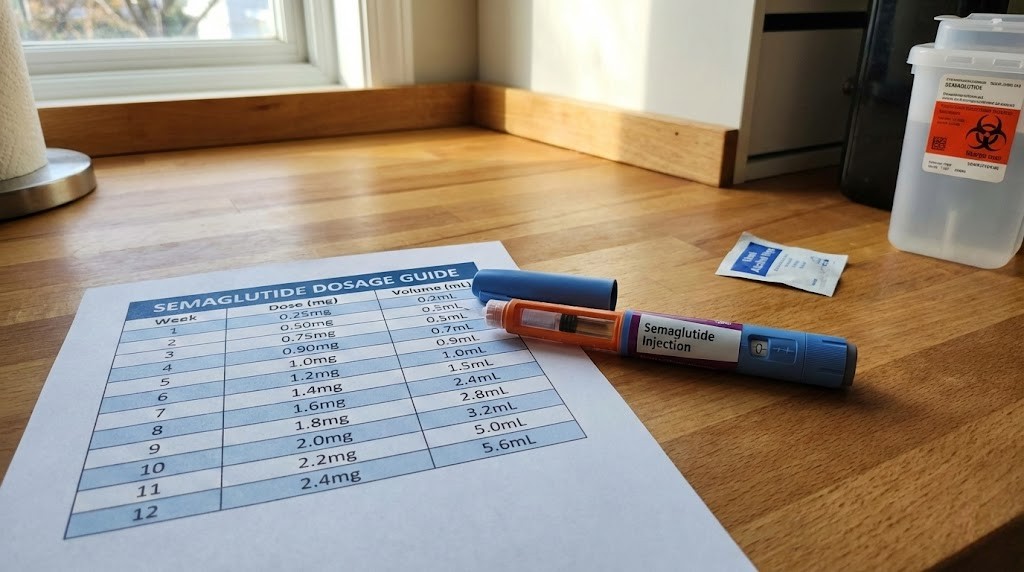
The FDA has documented cases where people accidentally injected five to twenty times their intended semaglutide dose. Not because they were careless. Because the syringe markings confused them, the concentration math tripped them up, and nobody gave them a clear chart to follow. That ends here.
Measuring semaglutide with an insulin syringe should not require a pharmacy degree. But when your vial says 5 mg/mL, your prescription says 0.25 mg, and your syringe shows numbers from 0 to 100, the disconnect becomes dangerous fast. One small misread turns a therapeutic dose into a hospital visit. One decimal error transforms a gentle starting dose into something your body is not ready to handle.
This guide provides the exact semaglutide syringe dosage charts you need for every common concentration. Every conversion. Every syringe size. Every titration step mapped to precise unit markings on your syringe. Whether you are using compounded semaglutide from a multi-dose vial or transitioning between concentrations, the charts below eliminate guesswork entirely. SeekPeptides built this resource because accurate dosing is the foundation of safe and effective peptide research, and too many people are navigating it without proper reference materials.
You will find complete conversion tables for 2 mg/mL, 2.5 mg/mL, 3 mg/mL, 5 mg/mL, and 10 mg/mL concentrations. You will learn how to read every mark on a 30-unit, 50-unit, and 100-unit insulin syringe. You will understand the titration schedule from 0.25 mg through 2.4 mg, with exact syringe measurements at each step. And you will know the five most common dosing mistakes that send people to poison control, so you can avoid every single one.
Understanding insulin syringe measurements for semaglutide
Before looking at any dosage chart, you need to understand what your syringe is actually measuring. This is where most confusion starts, and where most dosing errors originate.
An insulin syringe measures volume in units. One hundred units equals one milliliter. That is the foundational relationship. Every mark, every number, every graduation line on your syringe relates back to this simple fact. When you see "50" on your syringe, you are looking at 0.5 mL. When you see "10," that is 0.1 mL.
But here is what trips people up.
Your semaglutide dose is prescribed in milligrams. Your vial label shows concentration in milligrams per milliliter. Your syringe measures in units, which represent milliliters. Three different measurement systems converging on one tiny injection. Miss the translation between any two of them, and your dose is wrong. Understanding this relationship is critical for anyone learning how to calculate peptide dosages accurately.
The three syringe sizes you will encounter
Insulin syringes come in three standard sizes, and choosing the right one matters more than most people realize.
The 30-unit syringe (0.3 mL) is the smallest option. Each small graduation mark represents half a unit, making it the most precise syringe available. For low-dose semaglutide, particularly during the 0.25 mg starting phase, this syringe offers the clearest markings and the least room for error. If your calculated dose falls at or below 30 units, this is the syringe to use.
The 50-unit syringe (0.5 mL) is the mid-range option. Each graduation mark typically represents one unit. This syringe works well for doses between 10 and 50 units, covering most of the semaglutide titration range for higher concentrations. Many clinics and pharmacies provide this size as their default.
The 100-unit syringe (1.0 mL) is the largest standard insulin syringe. Each graduation mark represents two units on most models, which means less precision for small doses. This syringe is necessary when your calculated dose exceeds 50 units, but for smaller doses, the wider graduation spacing increases misread risk. The concept of semaglutide dosing in units becomes especially important when selecting the right syringe size.
A practical rule: always use the smallest syringe that can hold your dose. Smaller syringes have finer graduation marks, which means more accurate measurements and fewer errors.
How to read the graduation marks
Hold your syringe at eye level with the needle pointing up. The numbers printed on the barrel increase from the needle end toward the plunger. When you draw medication, the plunger moves away from the needle, and the top edge of the black rubber stopper indicates your volume.
On a 100-unit syringe, the major numbered lines appear at 10, 20, 30, 40, 50, 60, 70, 80, 90, and 100. Between each major line, you will see smaller unnumbered lines. On most 100-unit syringes, each small line represents 2 units. So between "10" and "20," you will count four small lines representing 12, 14, 16, and 18 units.
On a 50-unit syringe, the major lines appear at 5, 10, 15, 20, 25, 30, 35, 40, 45, and 50. The small lines between them typically represent 1 unit each. This gives you single-unit precision.
On a 30-unit syringe, you get the finest resolution. Major lines at every 5 units, with small lines representing half-unit increments. This level of precision matters when your dose is 5 units or less. For a thorough exploration of reading syringes for peptide injections, our peptide injections guide covers the fundamentals.
The master conversion formula
Every semaglutide syringe dosage chart builds on one formula. Learn it, and you can calculate any dose for any concentration without looking anything up.
Units on syringe = (dose in mg / concentration in mg per mL) x 100
That is it. Three numbers. One division. One multiplication.
Example: Your prescribed dose is 0.5 mg. Your vial concentration is 5 mg/mL.
Units = (0.5 / 5) x 100 = 10 units
Draw to the 10-unit mark on your insulin syringe. Done.
Another example: Your prescribed dose is 1.0 mg. Your vial concentration is 2.5 mg/mL.
Units = (1.0 / 2.5) x 100 = 40 units
Draw to the 40-unit mark. Done.
The formula works because insulin syringes are calibrated so that 100 units equals 1 mL. When you divide your dose by the concentration, you get the volume in mL. Multiplying by 100 converts that volume to the unit markings on your syringe. For those who prefer automated calculations, the semaglutide dosage calculator handles this math instantly.
You can also express this as:
Volume in mL = dose in mg / concentration in mg per mL
Then multiply by 100 to get units. Same result, two steps instead of one.
Write this formula down. Tape it to your refrigerator next to your vial. Reference it every single time you draw a dose until the calculation becomes automatic. The few seconds it takes to double-check your math could prevent a serious dosing error.
Semaglutide syringe dosage chart for 2 mg/mL concentration
The 2 mg/mL concentration is one of the most common formulations for compounded semaglutide. At this concentration, each milliliter contains 2 milligrams of active ingredient, meaning you will draw relatively larger volumes compared to higher concentrations.
Prescribed dose (mg) | Volume (mL) | Syringe units | Syringe size recommended |
|---|---|---|---|
0.25 mg | 0.125 mL | 12.5 units | 30-unit syringe |
0.5 mg | 0.25 mL | 25 units | 30-unit or 50-unit syringe |
1.0 mg | 0.5 mL | 50 units | 50-unit or 100-unit syringe |
1.7 mg | 0.85 mL | 85 units | 100-unit syringe |
2.0 mg | 1.0 mL | 100 units | 100-unit syringe |
2.4 mg | 1.2 mL | 120 units | Exceeds standard syringe |
Notice something important about this concentration. The 0.25 mg starting dose requires 12.5 units. On a 100-unit syringe, that falls between graduation marks. On a 50-unit syringe, you can get closer but still need to estimate a half-unit. Only a 30-unit syringe with half-unit markings lets you measure 12.5 units precisely.
At the higher end, 2.4 mg requires 120 units, which exceeds the capacity of a standard 100-unit insulin syringe. If your protocol calls for 2.4 mg at this concentration, you would need to either use a 1 mL tuberculin syringe with decimal mL markings or split the dose into two injections. Most practitioners recommend switching to a higher concentration before reaching this point.
This concentration works well for the early titration phases. The larger volumes make small doses easier to measure accurately. But as you progress to higher doses, the volumes become impractical. Many people who start with 2 mg/mL eventually transition to 5 mg/mL concentration as their dose increases, keeping injection volumes manageable. Understanding your semaglutide dosage in units helps smooth that transition.
Semaglutide syringe dosage chart for 2.5 mg/mL concentration
The 2.5 mg/mL concentration appears frequently with compounded semaglutide formulations. It offers a slight step up from the 2 mg/mL version while keeping volumes reasonable for most dose ranges.
Prescribed dose (mg) | Volume (mL) | Syringe units | Syringe size recommended |
|---|---|---|---|
0.25 mg | 0.1 mL | 10 units | 30-unit syringe |
0.5 mg | 0.2 mL | 20 units | 30-unit or 50-unit syringe |
1.0 mg | 0.4 mL | 40 units | 50-unit syringe |
1.7 mg | 0.68 mL | 68 units | 100-unit syringe |
2.0 mg | 0.8 mL | 80 units | 100-unit syringe |
2.4 mg | 0.96 mL | 96 units | 100-unit syringe |
This concentration hits a sweet spot. The starting dose of 0.25 mg lands cleanly at 10 units, which is easy to read on any syringe. Every dose through the full titration range fits within a 100-unit syringe. No awkward half-unit measurements. No split doses required.
The 2.5 mg/mL concentration is particularly popular because the math works out to clean, round numbers at the most common dose points. At 0.5 mg, you draw exactly 20 units. At 1.0 mg, exactly 40 units. These round numbers reduce calculation errors and make it nearly impossible to misread your syringe. If you are comparing this to other GLP-1 receptor agonists, our semaglutide vs tirzepatide comparison breaks down how dosing differs between the two.
One practical note: at the 2.4 mg maintenance dose, you are drawing 96 units. That fills a 100-unit syringe nearly to capacity, leaving very little room for error. Some practitioners prefer the compounded semaglutide dose chart at 5 mg/mL for patients who will reach higher maintenance doses.
Semaglutide syringe dosage chart for 3 mg/mL concentration
Some compounding pharmacies formulate semaglutide at 3 mg/mL. This concentration is less common than 2.5 mg/mL or 5 mg/mL but appears often enough that you need a reference chart for it.
Prescribed dose (mg) | Volume (mL) | Syringe units | Syringe size recommended |
|---|---|---|---|
0.25 mg | 0.083 mL | 8.3 units | 30-unit syringe |
0.5 mg | 0.167 mL | 16.7 units | 30-unit syringe |
1.0 mg | 0.333 mL | 33.3 units | 50-unit syringe |
1.7 mg | 0.567 mL | 56.7 units | 100-unit syringe |
2.0 mg | 0.667 mL | 66.7 units | 100-unit syringe |
2.4 mg | 0.8 mL | 80 units | 100-unit syringe |
The challenge with 3 mg/mL concentration is immediately obvious. Almost every dose produces a decimal that does not align cleanly with syringe markings. The 0.25 mg dose requires 8.3 units. You cannot draw exactly 8.3 units on any standard insulin syringe. The 1.0 mg dose needs 33.3 units. Again, impossible to measure precisely.
When working with this concentration, round to the nearest measurable increment on your syringe. For a 30-unit syringe with half-unit markings, round 8.3 to 8.5 units. For a 50-unit syringe with single-unit markings, round 16.7 to 17 units. The slight difference, typically less than 2 percent of your total dose, is clinically insignificant.
If you find yourself constantly rounding with a 3 mg/mL formulation, discuss switching to a 2.5 mg/mL or 5 mg/mL concentration with your provider. Cleaner numbers mean fewer opportunities for error. The general peptide dosage chart principles apply here, and accuracy always improves when your math produces whole numbers.
Semaglutide syringe dosage chart for 5 mg/mL concentration
The 5 mg/mL concentration is arguably the most widely used formulation for compounded semaglutide. It balances practical injection volumes with the ability to cover the entire titration range using standard syringes. This is the concentration most syringe dosage charts reference, and for good reason.
Prescribed dose (mg) | Volume (mL) | Syringe units | Syringe size recommended |
|---|---|---|---|
0.25 mg | 0.05 mL | 5 units | 30-unit syringe |
0.5 mg | 0.1 mL | 10 units | 30-unit syringe |
1.0 mg | 0.2 mL | 20 units | 30-unit or 50-unit syringe |
1.25 mg | 0.25 mL | 25 units | 30-unit or 50-unit syringe |
1.7 mg | 0.34 mL | 34 units | 50-unit syringe |
2.0 mg | 0.4 mL | 40 units | 50-unit syringe |
2.4 mg | 0.48 mL | 48 units | 50-unit syringe |
This is the chart that most people need. Clean numbers at every standard dose point. Five units for the starting dose. Ten for the second step. Twenty for the 1.0 mg milestone. Every measurement falls on a standard graduation mark.
At 5 mg/mL, the entire dose range from 0.25 mg through 2.4 mg fits comfortably within a 50-unit syringe. You never need the less-precise 100-unit syringe. The volumes stay small enough that injection discomfort is minimal, typically under half a milliliter even at maintenance doses. For a deep dive into this specific formulation, the semaglutide 5 mg/mL dosage chart covers every scenario.
This concentration also makes reconstitution math straightforward if you are working with lyophilized semaglutide. Adding 1 mL of bacteriostatic water to a 5 mg vial gives you exactly 5 mg/mL. Adding 2 mL gives you 2.5 mg/mL. The semaglutide mixing chart walks through every reconstitution scenario, and our peptide reconstitution calculator automates the entire process.
If you are starting semaglutide for the first time and have a choice of concentration, 5 mg/mL is the most practical option for most people. The math is clean, the volumes are comfortable, and you can use precise 30-unit or 50-unit syringes for every dose in the titration schedule.
Semaglutide syringe dosage chart for 10 mg/mL concentration
The 10 mg/mL concentration is the highest commonly available formulation. It packs twice the medication into each milliliter compared to 5 mg/mL, resulting in very small injection volumes. This matters for people at higher doses who want to minimize injection volume, and it is particularly relevant for 10 mg vial dosage protocols.
Prescribed dose (mg) | Volume (mL) | Syringe units | Syringe size recommended |
|---|---|---|---|
0.25 mg | 0.025 mL | 2.5 units | 30-unit syringe only |
0.5 mg | 0.05 mL | 5 units | 30-unit syringe |
1.0 mg | 0.1 mL | 10 units | 30-unit syringe |
1.7 mg | 0.17 mL | 17 units | 30-unit syringe |
2.0 mg | 0.2 mL | 20 units | 30-unit syringe |
2.4 mg | 0.24 mL | 24 units | 30-unit syringe |
The advantage is obvious. Every dose fits within a 30-unit syringe, giving you maximum measurement precision across the entire titration range. Injection volumes never exceed a quarter of a milliliter. Less volume means less injection site discomfort, faster absorption, and smaller fluid deposits under the skin.
But the risk is equally obvious. At 10 mg/mL, small measurement errors become magnified. Drawing 5 extra units does not give you an extra 0.25 mg like it would with a 5 mg/mL vial. It gives you an extra 0.5 mg, a full dose step beyond what you intended. The semaglutide reconstitution chart for 10 mg details how to achieve this concentration accurately through proper reconstitution.
The starting dose of 0.25 mg at this concentration requires just 2.5 units. That is a tiny amount of liquid, barely visible in the syringe barrel. Even with a 30-unit syringe and half-unit markings, you are operating at the very edge of measurable precision. Some practitioners recommend starting with a lower concentration during the titration phase and switching to 10 mg/mL only after reaching a stable maintenance dose, where the slightly larger volumes are easier to measure consistently.
If you use the 10 mg/mL concentration, a 30-unit syringe is not just recommended. It is mandatory. Using a 50-unit or 100-unit syringe at this concentration turns already-small volumes into nearly impossible measurements. The semaglutide mixing chart for 10 mg provides detailed reconstitution instructions for achieving this concentration.
Complete titration schedule with syringe measurements
Semaglutide dosing follows a gradual titration schedule. You start low and increase every four weeks, giving your body time to adjust and minimizing gastrointestinal side effects. The schedule below maps each titration step to exact syringe measurements for the two most common concentrations. Understanding how fast semaglutide works helps set realistic expectations during each titration phase.
Titration for weight management (Wegovy protocol)
Weeks | Dose | Units at 2.5 mg/mL | Units at 5 mg/mL |
|---|---|---|---|
Weeks 1 to 4 | 0.25 mg | 10 units | 5 units |
Weeks 5 to 8 | 0.5 mg | 20 units | 10 units |
Weeks 9 to 12 | 1.0 mg | 40 units | 20 units |
Weeks 13 to 16 | 1.7 mg | 68 units | 34 units |
Week 17 onward | 2.4 mg | 96 units | 48 units |
Titration for type 2 diabetes (Ozempic protocol)
Weeks | Dose | Units at 2.5 mg/mL | Units at 5 mg/mL |
|---|---|---|---|
Weeks 1 to 4 | 0.25 mg | 10 units | 5 units |
Weeks 5 to 8 | 0.5 mg | 20 units | 10 units |
Week 9 onward | 1.0 mg (max) | 40 units | 20 units |
The titration schedule exists for a reason. Semaglutide activates GLP-1 receptors throughout your gastrointestinal tract, and jumping to a high dose without gradual adjustment triggers nausea, vomiting, and diarrhea in most people. The four-week intervals at each dose level give your GLP-1 receptors time to adapt, progressively reducing side effect intensity.
Skipping titration steps is one of the most common mistakes. Someone feels fine at 0.5 mg and jumps straight to 1.7 mg. The result is almost always severe nausea lasting days. Follow the schedule. Your body needs the adjustment period regardless of how well you tolerated the previous dose. If you are curious about how long semaglutide takes to work, the titration phase is part of that timeline.
Some practitioners use intermediate steps not listed in the standard protocols. A 0.75 mg dose between the 0.5 mg and 1.0 mg steps, for example. At 5 mg/mL, that would be 15 units. At 2.5 mg/mL, 30 units. These intermediate steps can help if you experienced significant side effects at a previous dose increase. Discuss any modifications with your healthcare provider before implementing them.
How to draw semaglutide into an insulin syringe step by step
Knowing the right number of units means nothing if your technique introduces air bubbles, contamination, or inaccurate draws. Here is the exact procedure, step by step.
Step 1: Gather your supplies
You need your semaglutide vial, an alcohol swab, the correct size insulin syringe (based on the charts above), and a sharps disposal container. If your semaglutide requires reconstitution with bacteriostatic water, complete that process first and allow the solution to reach room temperature before drawing your dose. Our reconstitution calculator helps you determine exact water volumes.
Step 2: Clean the vial stopper
Wipe the rubber stopper of your vial with an alcohol swab. Let it air dry for a few seconds. Do not blow on it. Do not touch it after cleaning. This step prevents bacteria from entering your multi-dose vial and contaminating the remaining solution. Proper peptide storage between uses keeps your medication effective throughout the vial life.
Step 3: Draw air into the syringe
Before inserting the needle into the vial, pull the plunger back to the number of units you plan to draw. This fills the syringe barrel with air equal to the volume you need. You will inject this air into the vial to equalize pressure, making the medication easier to withdraw.
Step 4: Inject air and draw medication
Insert the needle through the rubber stopper. Push the plunger to inject the air into the vial. Then invert the vial so the needle tip is submerged in the liquid. Slowly pull the plunger back to your target unit marking. Watch the black rubber stopper, not the plunger handle. The top edge of the rubber stopper should align exactly with your target line.
Step 5: Remove air bubbles
With the vial still inverted, tap the syringe barrel firmly with your finger. Air bubbles will float to the top, near the needle. Gently push the plunger up until the air escapes back into the vial. Then re-draw to your target line. Air bubbles do not cause harm if injected subcutaneously, but they displace medication volume, meaning you would inject less than your intended dose.
Step 6: Verify your measurement
Before removing the needle from the vial, double-check your measurement. Is the top of the rubber stopper aligned with the correct graduation mark? Does the number match the chart for your concentration and dose? This two-second verification has prevented countless dosing errors. For comprehensive guidance on injection technique, the peptide injection guide covers everything from preparation to administration.
Step 7: Inject
Choose your injection site: abdomen (at least two inches from the navel), front of the thigh, or the back of the upper arm. Clean the site with an alcohol swab. Pinch a fold of skin, insert the needle at a 90-degree angle, and push the plunger steadily. Hold for 5 to 10 seconds after the plunger is fully depressed before withdrawing the needle. This ensures the full dose is delivered.
Rotate your injection sites weekly. If you inject in your abdomen this week, use your thigh next week, then your upper arm. Rotation prevents lipodystrophy, a condition where repeated injections in the same spot cause fat tissue changes that affect absorption. A consistent rotation schedule ensures each injection absorbs predictably.
Five critical dosing mistakes and how to avoid them
The FDA and poison control centers have documented alarming patterns of semaglutide dosing errors. Published research from the American Association of Poison Control Centers details cases where simple measurement confusion led to five to twenty times the intended dose. These are not theoretical risks. They happen regularly. Here is how to make sure they do not happen to you.
Mistake 1: Confusing units with milligrams
A provider prescribes 0.25 mg. The patient reads "25" on their syringe and draws to the 25-unit mark. At 5 mg/mL, 25 units delivers 1.25 mg, five times the intended dose. This is the single most common error reported to poison control centers.
Prevention: Always convert milligrams to units using the formula before drawing any dose. Never assume the number your provider gives you in milligrams matches the unit number on your syringe. They are different measurement systems. Write your converted dose in units on a sticky note and attach it to your vial. Reference the conversion chart for semaglutide syringe dosage every time.
Mistake 2: Using the wrong concentration in your calculation
You previously used a 2.5 mg/mL vial and drew 10 units for your 0.25 mg dose. Your pharmacy switches you to a 5 mg/mL vial. You draw the same 10 units out of habit. Now you have injected 0.5 mg, double your intended dose.
Prevention: Check the concentration on your vial label EVERY TIME you draw a dose, even if you think you know it. Concentration can change between refills, between pharmacies, or between batches. Recalculate from scratch with each new vial. The semaglutide dosage calculator requires concentration input, forcing you to verify it each time.
Mistake 3: Using a 100-unit syringe for small doses
Your dose is 5 units. You grab a 100-unit syringe because that is what you have. The graduation marks on a 100-unit syringe typically increment by 2 units, making it impossible to accurately measure 5 units. You estimate somewhere between the 4 and 6 marks and hope for the best.
Prevention: Always use the smallest syringe that accommodates your dose. For doses under 30 units, use a 30-unit syringe. For doses between 30 and 50 units, use a 50-unit syringe. Only use a 100-unit syringe when your dose exceeds 50 units. The precision difference is not minor. It is the difference between accurate dosing and guessing.
Mistake 4: Skipping the air injection step
You insert the needle into the vial and start drawing medication without first injecting air. A vacuum forms inside the vial, making it difficult to draw the correct volume. You fight the resistance, the plunger keeps pulling back, and you end up with an inconsistent draw that may include air and less medication than you intended.
Prevention: Always draw air into the syringe equal to your dose volume BEFORE inserting the needle into the vial. Inject the air first, then draw your medication. This equalizes pressure and ensures smooth, accurate draws every time.
Mistake 5: Not accounting for dead space
Some syringes retain a small amount of medication in the needle hub after injection, typically 0.5 to 1 unit. Over time, this "dead space" means you are consistently under-dosing by a small amount.
Prevention: Use low dead space syringes when available. They are designed to minimize retained volume. If using standard syringes, be aware that dead space exists but at typical semaglutide doses (5 to 50 units), the 0.5 to 1 unit loss represents a clinically insignificant percentage of your total dose. Still, it is worth understanding for the sake of precision. Learning about common peptide mistakes helps you avoid these errors from the start.
Concentration comparison: which is right for you
Choosing the right semaglutide concentration depends on where you are in the titration schedule, your comfort with syringe precision, and practical considerations like vial life and cost. This comparison helps you match concentration to your specific situation.
Factor | 2 mg/mL | 2.5 mg/mL | 5 mg/mL | 10 mg/mL |
|---|---|---|---|---|
Starting dose volume | 12.5 units | 10 units | 5 units | 2.5 units |
Max dose volume | 120 units | 96 units | 48 units | 24 units |
Clean math | Some decimals | Mostly clean | All clean | Mostly clean |
Syringe needed (max dose) | Exceeds 100-unit | 100-unit | 50-unit | 30-unit |
Precision at low doses | Good | Good | Moderate | Challenging |
Best for | Early titration only | Full range with larger volumes | Most users, full range | Maintenance doses, experienced users |
For most people, 5 mg/mL is the optimal concentration. It produces clean unit numbers at every standard dose, keeps volumes manageable throughout the titration range, and allows use of precise 30-unit or 50-unit syringes exclusively. The semaglutide 5 mg dosage chart remains the most referenced for this reason.
If you are just starting and want maximum measurement precision at low doses, 2.5 mg/mL is excellent. The slightly larger volumes at the 0.25 mg and 0.5 mg doses are easier to see and measure, especially for people new to self-injection.
If you are at a stable maintenance dose of 1.7 mg or higher and want minimal injection volume, 10 mg/mL delivers your dose in the smallest possible volume. But use a 30-unit syringe exclusively, and double-check every measurement.
The pharmacy-specific dosage charts may vary based on which formulation your particular pharmacy compounds. Always verify your concentration before applying any chart.
Semaglutide with B12: adjusted syringe dosage charts
Many compounded semaglutide formulations include vitamin B12 (cyanocobalamin). The addition of B12 does not change the semaglutide concentration or your syringe measurements. Your dose charts remain identical. The B12 is dissolved into the same solution, so when you draw 10 units for your 0.5 mg semaglutide dose at 5 mg/mL, you automatically receive the proportional amount of B12 in that volume.
However, some pharmacies use different base concentrations for their semaglutide/B12 formulations compared to their plain semaglutide. A pharmacy might offer plain semaglutide at 5 mg/mL but their B12 combination at 3 mg/mL. Always check the label on your specific vial. Do not assume the concentration is the same just because you are getting it from the same pharmacy. The semaglutide B12 dosage chart covers the most common formulations, and the compounded semaglutide with B12 dosage chart provides additional detail for combination products.
The complete guide to semaglutide with B12 explains why pharmacies add B12, what benefits it provides, and how it interacts with semaglutide weight loss protocols.
Switching concentrations mid-protocol
It is common to switch semaglutide concentrations during treatment. Maybe you started with 2.5 mg/mL during titration and want to move to 5 mg/mL now that you have reached your maintenance dose. Maybe your pharmacy changed suppliers. Whatever the reason, concentration switches are where dosing errors spike. Our guide on switching between GLP-1 medications covers similar transition principles.
The golden rule of concentration changes
When your concentration changes, your unit measurement ALWAYS changes, even though your mg dose stays the same.
Example: You have been drawing 20 units from a 2.5 mg/mL vial for your 0.5 mg dose. You switch to 5 mg/mL. Your new draw is 10 units for the same 0.5 mg dose. If you draw 20 units from the new vial out of habit, you inject 1.0 mg instead of 0.5 mg. Double your dose.
Concentration switch checklist
Every time you open a new vial:
1. Read the concentration on the label
2. Recalculate your dose in units using the formula
3. Verify against the appropriate chart in this guide
4. Draw your dose
5. Double-check before injecting
This five-step process takes less than thirty seconds and eliminates the most dangerous type of dosing error. The semaglutide to tirzepatide conversion chart follows similar verification principles for those transitioning between different GLP-1 medications entirely.
Reconstitution and its impact on syringe dosage
If you are working with lyophilized (freeze-dried) semaglutide, the concentration of your final solution depends entirely on how much bacteriostatic water you add. This is where your syringe dosage chart begins, because the reconstitution step determines which chart you will use.
Vial size | Water added | Final concentration |
|---|---|---|
5 mg | 1 mL | 5 mg/mL |
5 mg | 2 mL | 2.5 mg/mL |
10 mg | 1 mL | 10 mg/mL |
10 mg | 2 mL | 5 mg/mL |
10 mg | 4 mL | 2.5 mg/mL |
The relationship is straightforward: concentration equals milligrams divided by milliliters. Add more water, get a lower concentration. Add less water, get a higher concentration. The semaglutide reconstitution chart provides detailed guidance for every standard vial size, and the semaglutide mixing chart covers the practical mixing process.
A critical note: always use bacteriostatic water for peptides, not sterile water or saline, for multi-dose vials. Bacteriostatic water contains 0.9% benzyl alcohol, which inhibits bacterial growth and keeps your solution safe for multiple draws over several weeks. Sterile water has no preservative, making multi-dose use risky. Understanding how much bacteriostatic water to add is essential for achieving your target concentration.
After reconstitution, label your vial with the final concentration, the date of reconstitution, and the expiration date (typically 28 days when refrigerated). Reference your semaglutide refrigeration guide for storage specifics. Never rely on memory for concentration. Always check the label.
Quick reference charts by dose
These quick-reference charts flip the perspective. Instead of organizing by concentration, they organize by dose, showing you how many units to draw at every common concentration for a single dose level. Print the one that matches your current dose and keep it with your supplies.
Quick reference: 0.25 mg dose
Concentration | Volume (mL) | Syringe units |
|---|---|---|
2 mg/mL | 0.125 mL | 12.5 units |
2.5 mg/mL | 0.1 mL | 10 units |
3 mg/mL | 0.083 mL | 8.3 units |
5 mg/mL | 0.05 mL | 5 units |
10 mg/mL | 0.025 mL | 2.5 units |
Quick reference: 0.5 mg dose
Concentration | Volume (mL) | Syringe units |
|---|---|---|
2 mg/mL | 0.25 mL | 25 units |
2.5 mg/mL | 0.2 mL | 20 units |
3 mg/mL | 0.167 mL | 16.7 units |
5 mg/mL | 0.1 mL | 10 units |
10 mg/mL | 0.05 mL | 5 units |
Quick reference: 1.0 mg dose
Concentration | Volume (mL) | Syringe units |
|---|---|---|
2 mg/mL | 0.5 mL | 50 units |
2.5 mg/mL | 0.4 mL | 40 units |
3 mg/mL | 0.333 mL | 33.3 units |
5 mg/mL | 0.2 mL | 20 units |
10 mg/mL | 0.1 mL | 10 units |
Quick reference: 1.7 mg dose
Concentration | Volume (mL) | Syringe units |
|---|---|---|
2 mg/mL | 0.85 mL | 85 units |
2.5 mg/mL | 0.68 mL | 68 units |
3 mg/mL | 0.567 mL | 56.7 units |
5 mg/mL | 0.34 mL | 34 units |
10 mg/mL | 0.17 mL | 17 units |
Quick reference: 2.4 mg dose
Concentration | Volume (mL) | Syringe units |
|---|---|---|
2 mg/mL | 1.2 mL | 120 units |
2.5 mg/mL | 0.96 mL | 96 units |
3 mg/mL | 0.8 mL | 80 units |
5 mg/mL | 0.48 mL | 48 units |
10 mg/mL | 0.24 mL | 24 units |
These reference tables work alongside the unit to milligram conversion guide and the 20 units of semaglutide to mg conversion for quick lookups from either direction. The 40 units conversion guide covers another common reference point.
Managing side effects during titration
Even with perfect dosing, semaglutide produces gastrointestinal side effects in most people during the titration phase. Understanding what to expect, and when to worry, is part of using your syringe dosage chart responsibly.
What to expect at each titration step
Nausea is the most commonly reported side effect, affecting roughly 44% of people at the 2.4 mg dose in clinical trials. It typically peaks during the first one to two weeks after each dose increase, then gradually subsides. Most nausea episodes last about eight days.
The 0.25 mg starting dose produces the mildest effects. Some people feel nothing. Others experience slight appetite reduction and occasional mild nausea, usually around meal times. This is your body adjusting to GLP-1 receptor activation in the gut.
The jump from 0.5 mg to 1.0 mg tends to be the roughest transition for many people. You are doubling your dose, and the GI effects often reflect that. This is the step where many people ask about why they are not losing weight on semaglutide or whether to slow down titration.
The 1.0 mg to 1.7 mg step is another significant increase. By this point, your body has some adaptation, but the jump can still trigger a few days of increased nausea. The final step to 2.4 mg affects some people more than others, often depending on how well they tolerated the previous increases.
Practical management strategies
Eat smaller, more frequent meals. Large meals overwhelm a stomach that semaglutide is deliberately slowing down. Five small meals work better than three large ones during titration. Avoid greasy, fried, and heavily spiced foods. Bland choices like rice, crackers, toast, and broth sit better during the adjustment period.
Stay hydrated, but sip between meals rather than drinking large volumes with food. A stomach full of liquid and food moves even slower under semaglutide influence, increasing nausea risk.
If nausea becomes severe or persistent beyond two weeks at a given dose, your provider may hold you at the current dose for an additional four weeks before increasing. There is no medical requirement to follow the exact four-week titration timeline. Going slower is always acceptable. Skipping ahead is not.
The semaglutide appetite suppression timeline helps set expectations for when the beneficial effects kick in at each dose level. For those experiencing persistent issues, understanding semaglutide withdrawal symptoms provides context for what happens if you need to pause or discontinue.
Weight loss timeline mapped to syringe dose progression
Your syringe dosage chart is not just about measurement accuracy. It maps directly to a predictable weight loss trajectory. Understanding what to expect at each dose level helps you gauge whether your protocol is working.
Weeks 1 to 4 (0.25 mg, 5 units at 5 mg/mL): This is not primarily a weight loss dose. It is an adjustment dose. Most people lose 1 to 3 pounds, mostly from reduced appetite and slight water weight changes. Some lose nothing. Do not be discouraged. The dose is sub-therapeutic for weight loss. It exists to prepare your GI tract for higher doses.
Weeks 5 to 8 (0.5 mg, 10 units at 5 mg/mL): Appetite suppression becomes more noticeable. Cravings diminish. You start eating less without deliberate effort. Typical weight loss during this phase is 3 to 6 pounds cumulative. Some people first notice the characteristic "food noise" reduction, where the constant mental chatter about food quiets down.
Weeks 9 to 12 (1.0 mg, 20 units at 5 mg/mL): This is where most people notice significant changes. Average cumulative weight loss reaches 8 to 12 pounds. Clothes fit differently. Energy levels often improve. The 1.0 mg dose represents the first truly therapeutic dose for weight management.
Weeks 13 to 16 (1.7 mg, 34 units at 5 mg/mL): Weight loss accelerates. Cumulative loss typically reaches 12 to 18 pounds. Metabolic improvements beyond weight, including blood sugar normalization and reduced inflammation, become measurable in lab work.
Week 17 onward (2.4 mg, 48 units at 5 mg/mL): The maintenance dose. Clinical trials show average weight loss of 15 to 17 percent of body weight over one year at this dose. For a 200-pound person, that is 30 to 34 pounds. For a 250-pound person, 37 to 42 pounds. Results vary based on diet, exercise, and individual physiology, but the average is remarkably consistent across studies. For detailed weight management context, explore peptides for weight loss and the best peptides for weight loss.
The semaglutide duration guide covers how long most people remain on treatment and what happens after discontinuation.
Semaglutide syringe dosage for specific unit questions
Some of the most searched questions about semaglutide syringe dosage involve specific unit amounts. People see a number on their prescription or syringe and want to know exactly what it means in milligrams. Here are the most common conversions, organized by unit amount.
How many mg is 5 units of semaglutide?
It depends entirely on your concentration:
At 2.5 mg/mL: 5 units = 0.125 mg
At 5 mg/mL: 5 units = 0.25 mg
At 10 mg/mL: 5 units = 0.5 mg
The same 5 units on your syringe could be 0.125 mg or 0.5 mg depending on what is in your vial. This is exactly why concentration verification matters every single time.
How many mg is 10 units of semaglutide?
At 2.5 mg/mL: 10 units = 0.25 mg
At 5 mg/mL: 10 units = 0.5 mg
At 10 mg/mL: 10 units = 1.0 mg
How many mg is 20 units of semaglutide?
At 2.5 mg/mL: 20 units = 0.5 mg
At 5 mg/mL: 20 units = 1.0 mg
At 10 mg/mL: 20 units = 2.0 mg
This unit amount is one of the most commonly referenced. For a detailed breakdown, our 20 units of semaglutide conversion guide covers every concentration scenario.
How many mg is 25 units of semaglutide?
At 2 mg/mL: 25 units = 0.5 mg
At 2.5 mg/mL: 25 units = 0.625 mg
At 5 mg/mL: 25 units = 1.25 mg
At 10 mg/mL: 25 units = 2.5 mg
How many mg is 50 units of semaglutide?
At 2.5 mg/mL: 50 units = 1.25 mg
At 5 mg/mL: 50 units = 2.5 mg
At 10 mg/mL: 50 units = 5.0 mg
The 50 units of semaglutide conversion guide provides complete context for this commonly referenced amount. At 10 mg/mL, 50 units delivers a massive 5 mg dose, which is more than double the maximum recommended maintenance dose. This illustrates how a simple syringe misread at high concentrations can result in a dangerous overdose.
Semaglutide vs tirzepatide: syringe dosage differences
If you are comparing semaglutide with tirzepatide or considering switching between them, understanding the syringe dosage differences matters. The two medications have completely different dose ranges, titration schedules, and concentration standards.
Semaglutide titrates from 0.25 mg to 2.4 mg. Tirzepatide titrates from 2.5 mg to 15 mg. The doses are not interchangeable. The concentrations are different. The unit calculations are different. Our tirzepatide vs semaglutide dosage chart breaks down these differences side by side.
If you are switching from semaglutide to tirzepatide, the dose conversion chart maps equivalent therapeutic ranges. If moving in the other direction, the tirzepatide to semaglutide conversion chart provides the reverse mapping. The complete switching guide covers the full transition process.
Critical point: NEVER use a semaglutide syringe dosage chart for tirzepatide, or vice versa. They are different medications with different concentrations, different dose ranges, and different pharmacokinetics. Using the wrong chart could result in a massive overdose or a completely sub-therapeutic dose. For tirzepatide-specific guidance, reference the tirzepatide dose chart and tirzepatide dosage chart in mL. The semaglutide vs tirzepatide comparison page provides a broader overview of how these two GLP-1 medications compare.
Storage considerations that affect your syringe dosage
How you store your semaglutide directly impacts dosing accuracy. Degraded medication means reduced potency per milliliter, which means the concentration printed on your vial no longer reflects reality. Your chart becomes unreliable if your medication has lost potency.
Unopened semaglutide vials should be refrigerated at 36 to 46 degrees Fahrenheit (2 to 8 degrees Celsius). Once opened (punctured with a needle), most compounded formulations remain viable for 28 days when refrigerated. Some pharmacies specify shorter timeframes, so check your specific label.
Never freeze semaglutide. Freezing damages the peptide structure and can reduce potency unpredictably. A vial that has been frozen may contain 80% of its labeled concentration, or 50%, or less. There is no way to know without analytical testing, and using a chart based on the labeled concentration with degraded medication means systematic under-dosing. Our guide on semaglutide refrigeration requirements covers proper storage in detail.
Room temperature exposure should be minimized. If you left your vial out overnight, it is likely fine. If it sat on a counter in direct sunlight for a weekend, consider it compromised. The compounded semaglutide shelf life guide and expired semaglutide guide provide detailed storage timelines. General peptide storage principles and understanding post-reconstitution storage apply to semaglutide as well.
When to use a semaglutide dosage calculator instead of a chart
Charts cover the most common scenarios, but they cannot account for every concentration, every dose, and every syringe size. A semaglutide dosage calculator fills the gaps.
Use a calculator when:
Your concentration is not listed in standard charts (e.g., 4 mg/mL or 7.5 mg/mL)
Your prescribed dose is a non-standard increment (e.g., 0.375 mg or 1.25 mg)
You want to double-check your chart-based calculation
You are reconstituting and need to determine what concentration a specific water volume will produce
You are switching concentrations and want to verify the new unit measurement
The SeekPeptides semaglutide calculator handles all of these scenarios. Input your concentration and desired dose, and it returns the exact syringe measurement. No math required. No room for calculation error. The general peptide calculator works for other research peptides beyond semaglutide, and the reconstitution calculator specifically handles the water-to-powder ratio for lyophilized products.
For researchers serious about optimizing their protocols, SeekPeptides provides comprehensive dosing resources, evidence-based guides, and tools that eliminate guesswork from every step of the process.
Frequently asked questions
How many units is 0.25 mg of semaglutide on an insulin syringe?
It depends on your vial concentration. At 5 mg/mL, 0.25 mg equals 5 units. At 2.5 mg/mL, it equals 10 units. At 10 mg/mL, it equals 2.5 units. Always verify your concentration before calculating. Use the semaglutide dosage calculator for instant conversion.
Can I use a regular syringe instead of an insulin syringe for semaglutide?
You can use a tuberculin (TB) syringe, which measures in milliliters rather than units. The markings show 0.1 mL increments. For a 0.25 mg dose at 5 mg/mL, you would draw to the 0.05 mL mark. However, insulin syringes typically have finer graduation marks, making them more precise for the small volumes used in semaglutide dosing. Most providers recommend insulin syringes for this reason.
What happens if I accidentally inject too much semaglutide?
Overdose symptoms include severe nausea, vomiting, diarrhea, and abdominal pain. The FDA has documented cases where patients experienced symptoms lasting several days after accidental overdoses. In severe cases, dehydration from vomiting can require medical attention. If you suspect you injected significantly more than your prescribed dose, contact your healthcare provider or poison control immediately.
Do I need to change my syringe measurement if I switch pharmacies?
Potentially, yes. Different compounding pharmacies may use different concentrations for their semaglutide formulations. A 5 mg/mL vial from one pharmacy requires different unit measurements than a 2.5 mg/mL vial from another. Always check the concentration label on each new vial, even from the same pharmacy, and recalculate accordingly.
How do I know if my semaglutide has gone bad?
Clear semaglutide solution should remain clear and colorless. If it appears cloudy, contains particles, or has changed color, do not use it. Degraded semaglutide may also lose viscosity, appearing thinner than normal. If your medication has been exposed to temperatures above 77 degrees Fahrenheit for extended periods or has been frozen, it may have degraded even if it looks normal. When in doubt, replace it. The expired semaglutide guide covers degradation signs in detail.
Is the syringe dosage chart the same for Ozempic, Wegovy, and compounded semaglutide?
No. Ozempic and Wegovy come in prefilled pens with built-in dose selection, so you do not need a syringe dosage chart for them. Syringe dosage charts apply specifically to compounded semaglutide that comes in multi-dose vials requiring manual measurement. The concentrations in prefilled pens are also different from typical compounded formulations.
Can I prefill syringes for the week ahead?
While some people prefill syringes for convenience, most pharmacists advise against it. Prefilled syringes can introduce contamination risk, and the medication may interact with the syringe materials over time. Insulin syringes are designed for single use and immediate injection. If you must prefill, store the syringes capped and refrigerated, and use within 24 hours.
What is the difference between units and IU for semaglutide?
For insulin syringes, "units" and "IU" (international units) refer to the same thing when measuring volume. One hundred units equals one milliliter. However, IU has a specific pharmacological meaning for some medications (like insulin itself) that relates to biological activity. For semaglutide, the "units" on your syringe are purely a volume measurement (1 unit = 0.01 mL) and have no relationship to biological potency units.
External resources
Administration errors of compounded semaglutide reported to poison control centers (PubMed)
Once-weekly semaglutide for weight management clinical review (PMC)
For researchers committed to mastering their semaglutide protocols, SeekPeptides offers the most comprehensive resource available, with evidence-based guides, precision dosing tools, and a community of thousands who have navigated these exact questions.
In case I do not see you, good afternoon, good evening, and good night. May your measurements stay precise, your calculations stay accurate, and your protocols stay consistent.