Feb 27, 2026
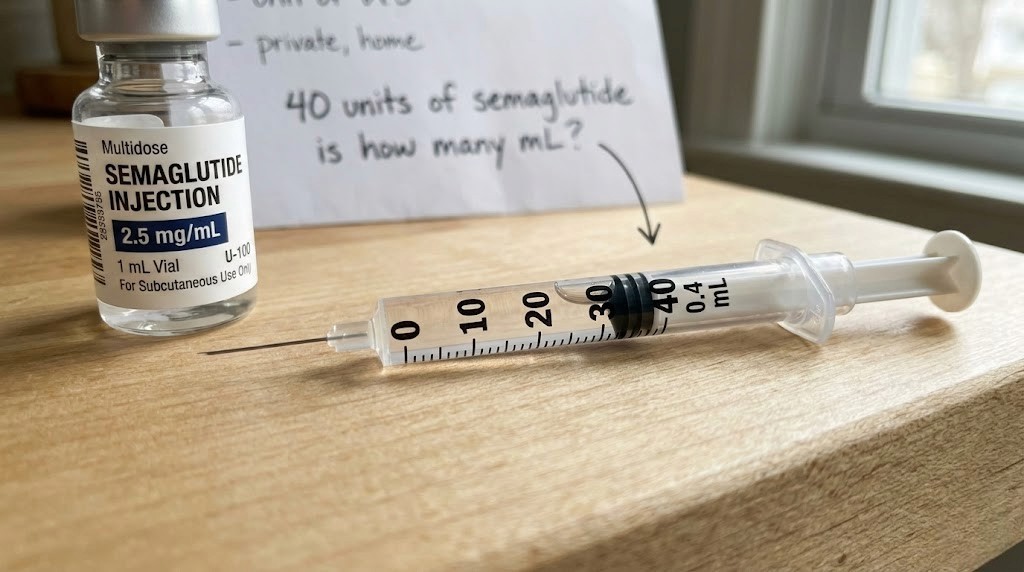
Before you draw up another dose, read this. The difference between 40 units and 0.4 mL might seem like a simple math problem. It is not. One measures volume on a syringe. The other measures the same volume using a different scale. And confusing the two has sent people to the emergency room with five to twenty times their intended dose of semaglutide.
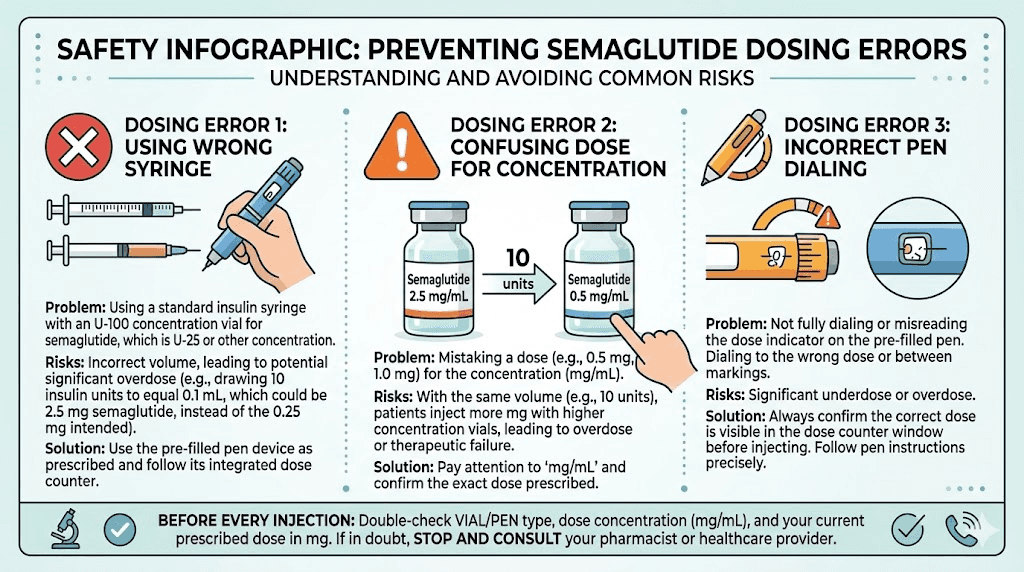
The FDA has issued specific warnings about dosing errors with compounded semaglutide products. Patients have confused units with milligrams. They have mixed up concentrations between vials. They have drawn doses using the wrong syringe type entirely. These are not hypothetical risks. They are documented cases with real consequences, including acute pancreatitis, severe dehydration, and hospitalization.
So here is the straightforward answer: 40 units on a standard U-100 insulin syringe equals exactly 0.4 mL of liquid. Always. Regardless of concentration. Regardless of brand. Regardless of what is dissolved in that liquid. But knowing that 40 units equals 0.4 mL only tells you the volume. It does not tell you how many milligrams of semaglutide you are actually injecting. That depends entirely on the concentration printed on your vial. And that is where most dosing errors begin. This guide breaks down every detail you need to measure 40 units confidently, convert between units and milliliters for any concentration, and avoid the mistakes that lead to dangerous overdoses. SeekPeptides created this resource because accurate dosing is not optional when working with GLP-1 receptor agonists.
The direct answer: 40 units equals 0.4 mL
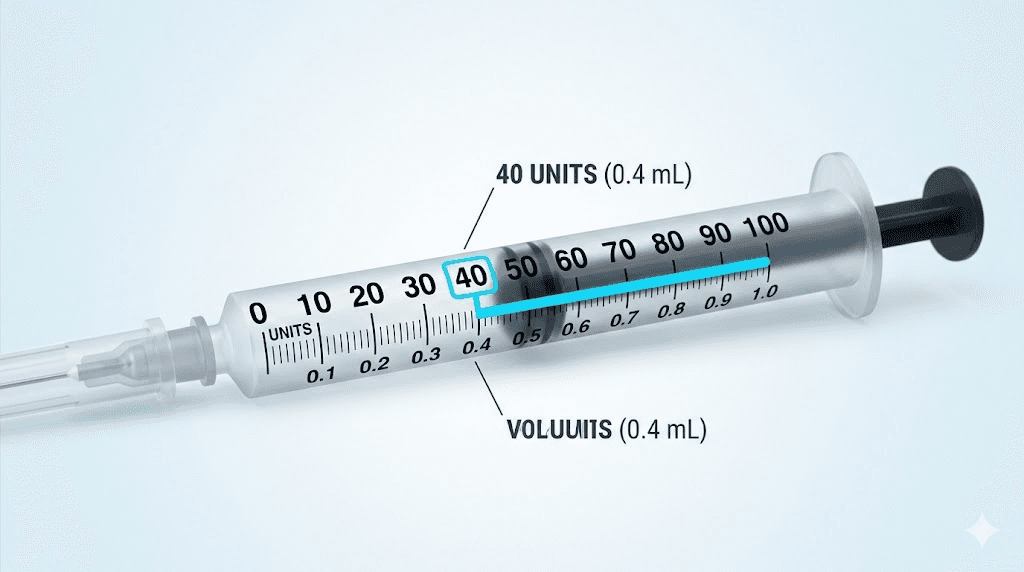
Here is the conversion that brought you to this page. On a standard U-100 insulin syringe, 40 units equals 0.4 mL. Period. This relationship never changes because it is built into the physical design of the syringe itself.
A U-100 syringe holds 1 mL of liquid total. That 1 mL is divided into 100 equal units. Each unit represents 0.01 mL. So 40 of those units equals 40 times 0.01, which gives you 0.4 mL.
Simple math. But here is where people get confused.
The 40 units on your syringe tells you how much liquid you are drawing. It does not tell you how much semaglutide is in that liquid. The milligram dose depends on the concentration of your specific vial. A 40-unit draw from a 5 mg/mL vial delivers a completely different milligram dose than 40 units from a 2.5 mg/mL vial. Same volume. Different medication amount. This distinction matters more than almost anything else in your dosing protocol.
If you have been searching for how many milligrams 40 units delivers rather than the volume conversion, see our dedicated guide on how many mg is 40 units of semaglutide. That article covers the milligram math for every common concentration.
Why units and milliliters measure the same thing differently
Units and milliliters are two ways of describing the same physical volume of liquid. Think of it like inches and centimeters. Both measure length. They just use different scales.
On a U-100 insulin syringe, the barrel is marked in units from 0 to 100. Those 100 units correspond to exactly 1 mL of total volume. The syringe manufacturers designed it this way for insulin dosing, where patients needed to measure in units rather than tiny fractions of a milliliter.
When compounding pharmacies started using these same syringes for semaglutide, the unit markings carried over. But semaglutide is not insulin. It does not come in standardized "units" the way insulin does. The "units" on your syringe are purely a volume measurement when used for semaglutide. They tell you how much liquid you are drawing up. Nothing more.
This is the critical distinction that causes errors. With insulin, 40 units means 40 international units of insulin, a standardized measurement of biological activity. With semaglutide, 40 units just means 0.4 mL of whatever concentration happens to be in your vial. The unit markings have no relationship to the pharmacological dose of semaglutide.
Understanding this difference is essential for anyone following a semaglutide dosage protocol in units. When your provider says "inject 40 units," they are telling you to draw 0.4 mL of liquid. The actual milligram dose has already been calculated based on the concentration of your specific vial. For a thorough overview of how the semaglutide units to mg conversion works, that guide covers the relationship in detail.
You might also find our semaglutide dosage calculator helpful for verifying your specific dose. Plug in your vial concentration and desired milligram dose, and it calculates the exact number of units to draw.
How concentration changes what 40 units actually delivers
Here is the part that matters most for safety. The same 40 units, the same 0.4 mL of liquid, delivers wildly different milligram doses depending on the concentration of your semaglutide vial. Get this wrong and you could inject two, four, or even ten times your intended dose.
The formula is straightforward: milligrams = volume in mL multiplied by concentration in mg/mL. Since 40 units equals 0.4 mL, the calculation becomes 0.4 multiplied by whatever concentration is printed on your vial label.
At 1 mg/mL concentration
Some compounding pharmacies, particularly those preparing low-dose formulations, use a 1 mg/mL concentration. At this concentration, 40 units (0.4 mL) delivers 0.4 mg of semaglutide. This is a relatively modest dose, sitting between the typical starting dose of 0.25 mg and the first escalation dose of 0.5 mg. If you are in the early weeks of your semaglutide journey, this concentration makes small dose adjustments easy because each unit on the syringe equals exactly 0.01 mg.
At 2.5 mg/mL concentration
The 2.5 mg/mL concentration is one of the most common formulations from compounding pharmacies. At this concentration, 40 units (0.4 mL) delivers exactly 1.0 mg of semaglutide. This is a significant dosing milestone, typically reached during the third or fourth month of a standard titration schedule.
This concentration is popular because it maps cleanly onto the standard dose escalation: 10 units equals 0.25 mg, 20 units equals 0.5 mg, 40 units equals 1.0 mg, and 80 units equals 2.0 mg. The math stays clean throughout the entire compounded semaglutide dosing schedule. For a detailed breakdown of this concentration, our semaglutide dosage chart in units walks through every dose step.
At 3 mg/mL concentration
Some pharmacies compound semaglutide at 3 mg/mL. At this concentration, 40 units (0.4 mL) delivers 1.2 mg of semaglutide. This does not align with any standard dose in the typical escalation protocol, which means you need to be especially careful. Drawing "40 units" from a 3 mg/mL vial when you intended to get 1.0 mg would result in a 20% overdose.
If your vial is 3 mg/mL and your target dose is 1.0 mg, you would need approximately 33 units (0.33 mL), not 40 units. Always verify the concentration on your vial label before defaulting to a dose chart that might have been written for a different formulation. The conversion chart for semaglutide dosage in units covers this concentration specifically.
At 5 mg/mL concentration
The 5 mg/mL concentration is common in higher-strength compounded formulations. At this concentration, 40 units (0.4 mL) delivers 2.0 mg of semaglutide. That is a high therapeutic dose, the second-to-last step in the standard escalation schedule.
For someone who was prescribed a 1.0 mg dose but accidentally used a 5 mg/mL vial instead of a 2.5 mg/mL vial, drawing 40 units would deliver double the intended dose. This type of concentration mix-up is exactly what the FDA has flagged in its safety alerts. Our semaglutide 5 mg/mL dosage chart provides the complete unit breakdown for this concentration, and the 5 mg vial dosage chart covers reconstitution from powder form.
At 10 mg/mL concentration
High-concentration vials at 10 mg/mL exist primarily for patients on maintenance doses who want fewer injections per vial. At this concentration, 40 units (0.4 mL) delivers 4.0 mg of semaglutide. That is well above the maximum recommended weekly dose of 2.4 mg for weight management. Drawing 40 units from a 10 mg/mL vial by mistake could result in a dangerous overdose.
For detailed dosing information at this concentration, see our semaglutide 10 mg dosage chart and the 10 mg vial dosage chart. Both cover the proper unit calculations so you draw the correct amount.
Complete conversion table: 40 units at every common concentration
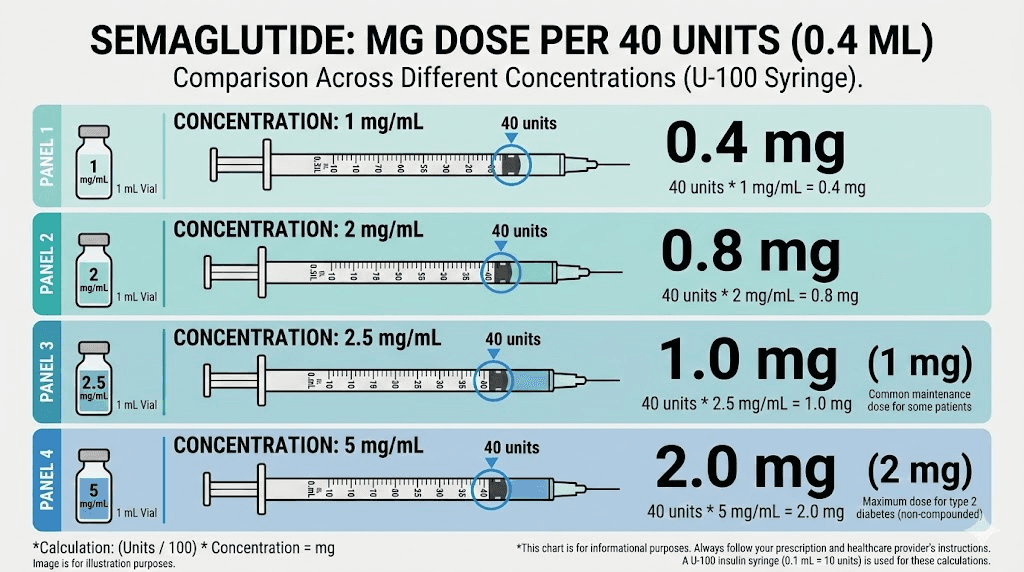
Reference this table whenever you need to verify what 40 units delivers at your specific concentration. Print it out. Tape it to your refrigerator. Refer to it every single time you draw a dose until the math becomes automatic.
Vial concentration | Volume at 40 units | Semaglutide delivered | Standard dose equivalent |
|---|---|---|---|
1 mg/mL | 0.4 mL | 0.4 mg | Between starting dose and first escalation |
2 mg/mL | 0.4 mL | 0.8 mg | Between 0.5 mg and 1.0 mg steps |
2.5 mg/mL | 0.4 mL | 1.0 mg | Third escalation dose |
3 mg/mL | 0.4 mL | 1.2 mg | Non-standard (between 1.0 and 1.7 mg) |
5 mg/mL | 0.4 mL | 2.0 mg | Fourth escalation dose |
10 mg/mL | 0.4 mL | 4.0 mg | Above maximum recommended dose |
Notice how the volume column stays constant at 0.4 mL. That never changes. Only the milligram dose changes based on concentration. This is the single most important concept in semaglutide dosing. The syringe dosage conversion chart provides similar tables for other unit values beyond 40.
If you are working with a concentration not listed above, use the formula: mg = 0.4 mL multiplied by your concentration in mg/mL. For any concentration, the semaglutide dosage calculator handles the math automatically.
How to read 40 units on your insulin syringe
Reading an insulin syringe correctly sounds simple. It is simple, once you know what you are looking at. But the markings can be confusing if you have never used one before, and a misread of even a few units can mean a significant dose difference.
U-100 syringe markings explained
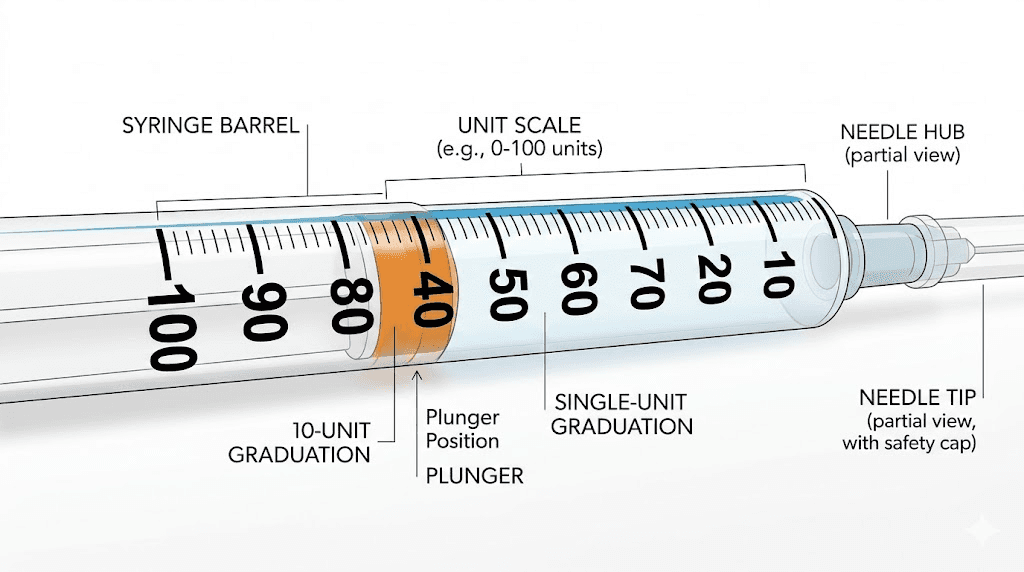
A standard U-100 insulin syringe has numbered markings at every 10-unit increment: 10, 20, 30, 40, 50, 60, 70, 80, 90, and 100. Between each numbered marking, there are smaller lines. On a 1 mL (100-unit) syringe, each small line represents 2 units. On a 0.5 mL (50-unit) syringe, each small line represents 1 unit.
To find 40 units, look for the number "40" printed on the barrel. It will be the fourth numbered marking from the bottom (after 10, 20, and 30). The plunger should be pulled back until the top edge of the rubber stopper aligns exactly with the 40-unit line.
This is where you need to be precise. If you draw to 41 or 42 units, you are injecting 2-5% more than intended. That small difference compounds over weeks. If you are following a semaglutide syringe dosage chart, accuracy at each dose matters for consistent results and for how fast semaglutide works in your body.
Step by step measurement guide
Here is the exact process for drawing 40 units from a semaglutide vial:
Step 1: Wash your hands thoroughly. Clean the rubber stopper on your vial with an alcohol swab. Let it dry.
Step 2: Remove the needle cap from your syringe. Pull the plunger back to the 40-unit mark, drawing air into the syringe.
Step 3: Insert the needle through the rubber stopper and push the plunger down to inject the air into the vial. This equalizes pressure and makes drawing medication easier.
Step 4: Turn the vial upside down with the syringe still inserted. The needle tip should be submerged in the liquid.
Step 5: Slowly pull the plunger back to the 40-unit mark. Watch for air bubbles.
Step 6: If you see air bubbles, tap the syringe barrel gently with your finger to move them toward the needle. Push the plunger slightly to expel the bubbles back into the vial. Then pull back again to exactly 40 units.
Step 7: Hold the syringe at eye level. Confirm the top of the rubber stopper sits exactly at the 40-unit line. Not above it. Not below it. Exactly on the line.
For a visual walkthrough of this process, see our guide on how to give a semaglutide injection with a syringe. That article includes detailed instructions for the entire injection process, from drawing the dose to choosing an injection site.
Common syringe reading mistakes
Three mistakes account for the majority of dosing errors with insulin syringes:
Mistake 1: Parallax error. If you hold the syringe above or below eye level while reading it, the line will appear to be in a slightly different position. Always hold the syringe at eye level, horizontal, with the markings facing you directly. A few degrees of angle can shift your reading by 1-2 units.
Mistake 2: Reading from the wrong edge of the plunger. The rubber stopper on the plunger has a curved top surface. Always read from the flat top edge of the stopper, not from the bottom of the curve. Reading from the wrong edge adds approximately 1-2 units to your actual dose.
Mistake 3: Using the wrong syringe size. A 0.3 mL syringe (30-unit) cannot draw 40 units. It only goes to 30. If someone tries to "estimate" 40 units on a 30-unit syringe, they will either overflow or create a dangerous measurement error. Always use a syringe that can accommodate your full dose. For 40 units, you need at minimum a 0.5 mL (50-unit) syringe, though a 1 mL (100-unit) syringe works perfectly fine.
These details might seem overly cautious. They are not. The semaglutide dosing chart in units only helps if you can actually read the syringe markings correctly. And for those transitioning from pre-filled pens to vials, the learning curve with manual syringes is real.
The universal formula for units to mL conversion
You do not need to memorize conversion tables. One formula handles every possible conversion between units and milliliters on a U-100 syringe:
mL = units divided by 100
That is it. Divide the number of units by 100 and you get milliliters. For 40 units: 40 divided by 100 equals 0.4 mL. For 25 units: 25 divided by 100 equals 0.25 mL. For 10 units: 10 divided by 100 equals 0.1 mL.
Going the other direction: units = mL multiplied by 100
If your provider says "inject 0.4 mL," multiply by 100 to get 40 units on the syringe. If they say "inject 0.25 mL," multiply by 100 to get 25 units.
Now, to find out how many milligrams of semaglutide you are injecting, add the concentration:
mg = (units divided by 100) multiplied by concentration in mg/mL
For 40 units at 2.5 mg/mL: (40/100) x 2.5 = 1.0 mg. For 40 units at 5 mg/mL: (40/100) x 5 = 2.0 mg.
This formula works for every unit value and every concentration. Memorize it or write it on a note card and keep it with your supplies. For other unit conversions, see our guides on 20 units of semaglutide in mg, 25 units in mg, 50 units in mg, and 100 units in mg. Each covers the concentration-specific math in detail.
You can also verify any calculation instantly using the SeekPeptides semaglutide dosage calculator, which handles the math for you and accounts for your specific vial concentration.
Why the FDA specifically warns about semaglutide dosing errors
This is not a theoretical concern. The FDA has issued formal safety communications about dosing errors with compounded injectable semaglutide products. Real patients have been hospitalized. Real harm has occurred.
What actually happened in reported cases
According to the FDA alert, patients have administered five to twenty times more semaglutide than intended. In one documented case, a provider prescribed a 0.25 mg dose (5 units at 5 mg/mL concentration). The patient, unfamiliar with the syringe markings, drew 25 units instead, injecting 1.25 mg instead of the intended 0.25 mg. That is five times the prescribed dose on the very first injection.
In other cases, patients confused the different measurement systems entirely. They read a dosing chart written for one concentration and applied it to a vial with a different concentration. The instructions that accompany compounded semaglutide, when they are provided at all, sometimes use "units" without clearly specifying which concentration those unit values correspond to.
The adverse events from these overdoses have included severe nausea and vomiting, abdominal pain, fainting, headache, dehydration, acute pancreatitis, and gallstones. These are not mild inconveniences. Some required emergency medical treatment and hospitalization.
For anyone managing semaglutide side effects on a normal dose, imagine experiencing those effects at five to twenty times the intensity. That is what a dosing error can produce. Related side effects like bloating, excessive burping, dizziness, and fatigue all intensify dramatically with an overdose.
The three main sources of confusion
The FDA identified three primary factors driving these errors:
Confusion between units, milligrams, and milliliters. Patients hear "take 40 units" and do not understand that units are a volume measurement on the syringe, not a dose measurement of the drug. They might try to find "40 mg" on the syringe, or confuse 0.4 mL with 4.0 mL.
Mismatched dosing charts. A dosing chart created for a 2.5 mg/mL vial will give completely wrong unit values if applied to a 5 mg/mL vial. Yet these charts circulate online without clear concentration labels, and patients sometimes follow whichever chart they find first. Our concentration-specific guides, including the compounded semaglutide dose chart and pharmacy-specific dosage charts, always specify the concentration to prevent this exact error.
Unfamiliarity with syringes. Many patients receiving compounded semaglutide have never drawn medication from a vial using an insulin syringe. The entire process, from injecting air into the vial to reading the tiny markings, is new. Without proper training, mistakes are almost inevitable. For a complete injection guide, see how to inject GLP-1 medications and where to inject GLP-1.
How to protect yourself from dosing errors
Follow these rules every single time you prepare a dose:
Rule 1: Check your vial label before every injection. Read the concentration. Do not assume it is the same as your last vial. Pharmacies can change concentrations between refills.
Rule 2: Only use dosing charts that match your exact concentration. If your vial says 5 mg/mL and your chart was written for 2.5 mg/mL, stop. Find the correct chart or calculate the dose yourself using the formula above.
Rule 3: Verify your math with a calculator or our dosage calculator. Never rely on memory alone when the consequences of a mistake are this serious.
Rule 4: Use the right syringe for your dose. If you need to draw 5 units (0.05 mL), use a 0.3 mL (30-unit) syringe where the markings are larger and easier to read. If you need 40 units, a 0.5 mL or 1 mL syringe works well.
Rule 5: When starting a new vial from a different pharmacy or with a different concentration, have someone double-check your first dose calculation. A second set of eyes catches errors that familiarity breeds.
Where 40 units falls in the standard semaglutide dose escalation
Understanding where your dose sits in the overall treatment protocol helps you gauge your progress and anticipate future adjustments. But the answer depends entirely on your vial concentration.
The standard titration schedule
The standard semaglutide dose escalation for weight management follows this progression:
Month 1: 0.25 mg per week (introductory dose to assess tolerance)
Month 2: 0.5 mg per week (first escalation)
Month 3: 1.0 mg per week (therapeutic range begins)
Month 4: 1.7 mg per week (higher therapeutic dose)
Month 5+: 2.4 mg per week (maximum recommended dose for weight management)
At the most common 2.5 mg/mL concentration, 40 units (1.0 mg) corresponds to the Month 3 dose. This is when many people start to notice significant appetite suppression and measurable weight changes. For a week-by-week breakdown of what to expect, see our semaglutide one month results guide.
At the 5 mg/mL concentration, however, 40 units (2.0 mg) corresponds to a much later stage, nearly the maximum dose. This is another reason why knowing your concentration is not optional.
Typical unit values at 2.5 mg/mL concentration
Dose | Units on syringe | Volume in mL | Typical timing |
|---|---|---|---|
0.25 mg | 10 units | 0.1 mL | Month 1 |
0.5 mg | 20 units | 0.2 mL | Month 2 |
1.0 mg | 40 units | 0.4 mL | Month 3 |
1.7 mg | 68 units | 0.68 mL | Month 4 |
2.0 mg | 80 units | 0.8 mL | Month 4-5 |
2.4 mg | 96 units | 0.96 mL | Month 5+ |
If you are currently at 40 units with a 2.5 mg/mL vial and considering whether to increase, consult with your provider. The decision to escalate depends on your appetite suppression response, weight loss trajectory, and side effect tolerance. Some people achieve excellent results at the 1.0 mg dose and never need to go higher. Others benefit from gradual escalation to 1.7 mg or 2.4 mg.
For those not seeing results at their current dose, our troubleshooting guides cover why you might not be losing weight on semaglutide and what to do after 4 weeks with no weight loss. Often the issue is not the dose but the diet plan or timing. Even something as simple as what time of day you inject can influence how well semaglutide works for you.
Reconstituting semaglutide to get exactly 40 units per dose
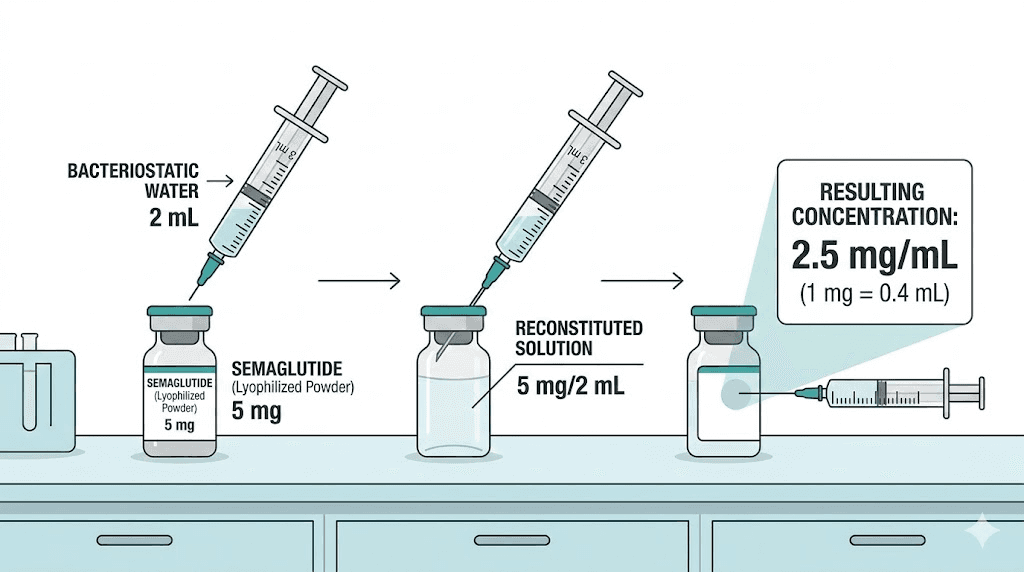
If you are working with lyophilized (freeze-dried) semaglutide powder, the amount of bacteriostatic water you add during reconstitution determines the final concentration. And the concentration determines how many milligrams you get at 40 units.
This is a step most people do not realize they can control. By choosing how much bacteriostatic water to add, you are choosing your concentration, which in turn determines how many units to draw for each dose. For a complete walkthrough, see our semaglutide reconstitution guide.
5 mg vial reconstitution options
With a 5 mg vial, the amount of water you add changes the concentration:
Bacteriostatic water added | Resulting concentration | What 40 units delivers | Number of 40-unit doses per vial |
|---|---|---|---|
1 mL | 5 mg/mL | 2.0 mg | 2.5 doses |
2 mL | 2.5 mg/mL | 1.0 mg | 5 doses |
2.5 mL | 2 mg/mL | 0.8 mg | 6.25 doses |
5 mL | 1 mg/mL | 0.4 mg | 12.5 doses |
If your target dose is 1.0 mg (a common Month 3 dose), adding 2 mL of bacteriostatic water to a 5 mg vial creates a clean 2.5 mg/mL concentration where 40 units delivers exactly 1.0 mg. That gives you 5 weekly doses from one vial, which is clean and convenient. For the specific water measurements, our 5 mg reconstitution guide and 5 mg reconstitution chart have detailed instructions.
The 5 mg mixing chart also provides a visual reference for different water volumes and resulting concentrations.
10 mg vial reconstitution options
Bacteriostatic water added | Resulting concentration | What 40 units delivers | Number of 40-unit doses per vial |
|---|---|---|---|
2 mL | 5 mg/mL | 2.0 mg | 5 doses |
4 mL | 2.5 mg/mL | 1.0 mg | 10 doses |
5 mL | 2 mg/mL | 0.8 mg | 12.5 doses |
10 mL | 1 mg/mL | 0.4 mg | 25 doses |
The 10 mg vial offers more flexibility and better value per milligram. Adding 4 mL of water creates a 2.5 mg/mL concentration that gives you 10 weekly doses at 40 units (1.0 mg) each. That is nearly two and a half months of medication from a single vial. For water measurements and detailed steps, see the 10 mg reconstitution water guide, the 10 mg reconstitution chart, and the 10 mg mixing chart.
For a general overview of the reconstitution process, including equipment needed and technique, our step-by-step reconstitution guide covers everything. The peptide reconstitution calculator can also help you determine the exact water volume for any desired concentration.
Comparing 40 units across different syringe types
Not all syringes are created equal. The type of syringe you use affects how easily you can measure 40 units and how accurately you can draw the dose.
1 mL (100-unit) syringe
This is the most common syringe for semaglutide injections. The 40-unit mark sits at 40% of the barrel length, giving you plenty of visible space to read the markings. Each small graduation line represents 2 units. To draw exactly 40 units, you pull the plunger to the line labeled "40." Straightforward and hard to misread.
The downside is that for small doses (like 5 or 10 units), the markings at the bottom of a 100-unit syringe can feel cramped. But for 40 units, this syringe size is ideal.
0.5 mL (50-unit) syringe
The 50-unit syringe has more precise markings because the same physical barrel length covers fewer units. Each small graduation line represents 1 unit instead of 2. This makes it slightly easier to hit exactly 40 units rather than accidentally drawing 38 or 42.
The trade-off is that 40 units on a 50-unit syringe sits very near the top (80% of capacity). You have less room for error, and if you accidentally pull past 40, you might draw air. For doses up to 40 units, this syringe works well but leaves little margin.
0.3 mL (30-unit) syringe
This syringe cannot draw 40 units. Its maximum capacity is 30 units (0.3 mL). If your prescribed dose is 40 units, do not attempt to use this syringe. You would need to either split the dose into two draws (which introduces additional error) or switch to a larger syringe.
The 30-unit syringe is designed for smaller doses, particularly the starting doses of 5-10 units where precision matters most. For information on those lower doses, see our guides on how many units is 0.25 mg and how many units is 1 mg.
Which syringe should you use for 40 units?
For 40 units specifically, the 1 mL (100-unit) syringe is the best choice. It gives you clear markings at the 40-unit line, enough room above and below to avoid reading errors, and the flexibility to draw larger doses as your protocol progresses without switching syringe types.
If precision is your top priority and you do not plan to increase beyond 50 units, the 0.5 mL (50-unit) syringe offers slightly finer graduation lines. Either option works. The wrong choice is the 30-unit syringe, which physically cannot accommodate a 40-unit draw.
What 40 units means for compounded versus brand-name semaglutide
There is an important distinction between compounded semaglutide drawn from a vial and brand-name semaglutide delivered through a pre-filled pen.
Compounded semaglutide (vial and syringe)
When you draw 40 units from a compounded semaglutide vial, you are measuring 0.4 mL of liquid and the milligram dose depends on the concentration of your specific vial. This is the scenario where the units-to-mL conversion matters most, and where dosing errors are most common.
Compounded formulations come in various concentrations (1 mg/mL, 2.5 mg/mL, 3 mg/mL, 5 mg/mL, and others). The concentration can change between refills if your pharmacy adjusts its formulations. Always check the vial label. For comprehensive information on compounded formulations, see our compounded semaglutide complete guide.
Some compounded formulations include additional ingredients like vitamin B12, methylcobalamin, glycine, niacinamide, or L-carnitine. These additions do not change the units-to-mL conversion, but they are worth noting on your dosing records. The glycine B12 blend guide covers the most common combination formulation.
Brand-name semaglutide (pre-filled pen)
Brand-name semaglutide pens (like those used for Ozempic or Wegovy) have built-in dose selectors. You dial the dose in milligrams, not units. The pen measures the volume internally. You never need to convert between units and milliliters because the pen does it for you.
If you are using a pre-filled pen, the question "40 units is how many mL" does not apply to your situation. The pen handles all the measurement. However, if you are considering switching between pen and vial delivery, or comparing costs, our GLP-1 and Ozempic comparison guide helps clarify the differences between brand-name and compounded options.
Other common unit-to-mL conversions for reference
While you came here for the 40-unit conversion, you will likely need other conversions as your dose changes over time. Here is a quick reference table covering the most common unit values:
Units on syringe | Volume in mL | Common dose at 2.5 mg/mL | Common dose at 5 mg/mL |
|---|---|---|---|
5 units | 0.05 mL | 0.125 mg | 0.25 mg |
10 units | 0.1 mL | 0.25 mg | 0.5 mg |
20 units | 0.2 mL | 0.5 mg | 1.0 mg |
25 units | 0.25 mL | 0.625 mg | 1.25 mg |
40 units | 0.4 mL | 1.0 mg | 2.0 mg |
50 units | 0.5 mL | 1.25 mg | 2.5 mg |
68 units | 0.68 mL | 1.7 mg | 3.4 mg |
80 units | 0.8 mL | 2.0 mg | 4.0 mg |
96 units | 0.96 mL | 2.4 mg | 4.8 mg |
100 units | 1.0 mL | 2.5 mg | 5.0 mg |
For deeper dives into specific conversions, we have dedicated guides for 10 units, 20 units, 20 units in mL, 50 units, and 100 units. Each covers the concentration-specific calculations with full conversion tables. For specific milligram-to-unit lookups, see how many units is 1 mg, how many units is 1.7 mg, how many units is 2.4 mg, and how many units is 2.5 mg.
Whether you are at 20 units wondering if that is too much or at 50 units wondering if that is a lot, the right answer always depends on your concentration and your prescribed dose.
Storing semaglutide after drawing your 40-unit dose
Proper storage protects the potency of your remaining semaglutide between doses. Once you draw 40 units and inject, the vial goes back in the refrigerator with the remaining medication.
Refrigeration requirements
Compounded semaglutide should be stored at 36 to 46 degrees Fahrenheit (2 to 8 degrees Celsius). That is standard refrigerator temperature. Place the vial in the main compartment, not the door (where temperature fluctuates) and not the freezer.
Once reconstituted, most compounded semaglutide vials remain stable for 28 to 90 days when properly refrigerated, depending on the pharmacy and formulation. Check the expiration date on your vial or the documentation from your pharmacy. For detailed storage timelines, our guides on how long semaglutide lasts in the fridge, vial shelf life in the fridge, and compounded semaglutide fridge life cover every scenario.
Wondering whether compounded semaglutide needs refrigeration? The short answer is yes. Always.
What happens if storage goes wrong
If your vial was accidentally left out overnight, the medication may still be usable depending on the temperature and duration. Brief exposure to room temperature (under 86 degrees Fahrenheit for a few hours) typically does not destroy the medication, but prolonged warmth degrades the active ingredient.
If you are wondering what happens if semaglutide gets warm, the peptide begins to degrade. This does not make it dangerous, but it does reduce potency. You might notice reduced appetite suppression or slower results if your medication has lost potency from heat exposure.
For travelers, storing semaglutide during transit requires some planning. Our travel with semaglutide guide covers insulated cases, TSA guidelines, and temperature management tips.
Visual changes in your medication can also indicate storage problems. If you notice discoloration, check our guide on what color semaglutide should be and why semaglutide might turn red. Normal semaglutide is clear and colorless. Any cloudiness, particles, or color change warrants caution.
And if you are uncertain about expired medication, our guide on using expired semaglutide and compounded semaglutide expiration covers the risks and considerations. Generally speaking, expired semaglutide loses potency rather than becoming harmful, but the reduced effectiveness means unreliable dosing.
What to do if you accidentally drew more or less than 40 units
Mistakes happen. Here is what to do for each scenario.
You drew slightly more than 40 units (41-45 units)
If you have not yet injected and you drew 42 or 43 units instead of 40, you have two options. First, you can push the plunger slowly until it reaches exactly 40 units, expelling the extra liquid back into the vial. This is the simplest fix. Second, if you have already removed the needle from the vial, you can push the excess into a clean surface (like an alcohol swab) and then inject the remaining 40 units.
If you already injected 41-45 units, the overdose is minimal (2.5% to 12.5% extra). At a 2.5 mg/mL concentration, the difference between 40 and 45 units is only 0.125 mg. You will likely notice slightly more pronounced effects that week, possibly mild bloating or burping, but nothing dangerous. Monitor your symptoms and return to your correct dose next week.
You drew significantly more than 40 units (50+ units)
If you drew 50 or more units and already injected, you have taken at least 25% more than intended. At a 2.5 mg/mL concentration, 50 units delivers 1.25 mg instead of 1.0 mg. At 80 units, you would have injected 2.0 mg, double your intended dose.
Watch for intensified side effects over the next 24-72 hours: severe nausea, vomiting, dehydration, abdominal pain, or dizziness. Stay hydrated. Eat small, bland meals. If symptoms are severe, particularly if you experience persistent vomiting that prevents hydration, contact your healthcare provider or visit urgent care.
You drew less than 40 units (30-39 units)
An underdose is not dangerous. You will simply receive less semaglutide than intended for that week. At a 2.5 mg/mL concentration, 30 units delivers 0.75 mg instead of 1.0 mg. You might notice slightly less appetite suppression that week. Take your normal 40-unit dose at the next scheduled time. Do not try to "make up" the missed amount by injecting extra.
How 40 units of semaglutide compares to tirzepatide dosing
If you are considering switching medications or simply comparing options, the unit conversions between semaglutide and tirzepatide are not interchangeable. Tirzepatide uses different concentrations, different dose escalation schedules, and different target doses.
40 units of semaglutide at 2.5 mg/mL delivers 1.0 mg. To achieve an equivalent therapeutic effect with tirzepatide, you would typically need 5 mg of tirzepatide (the second dose step), which requires a completely different unit calculation based on the tirzepatide vial concentration. The semaglutide vs tirzepatide dosage chart provides a side-by-side comparison of dose equivalencies.
For those actively considering a transition, our semaglutide to tirzepatide conversion chart and switching guide cover the clinical considerations and dose mapping between the two medications. The side effect comparison is also worth reviewing before making any changes.
Both medications belong to the GLP-1 receptor agonist class, but tirzepatide is a dual GIP/GLP-1 agonist, which means it works through an additional pathway. For a comprehensive comparison of the two, our semaglutide vs tirzepatide page covers mechanisms, efficacy data, and practical considerations. You can also explore the tirzepatide dosage in units guide and tirzepatide dosage chart for detailed tirzepatide unit calculations.
Optimizing your results at the 40-unit dose level
Reaching the 40-unit (1.0 mg at 2.5 mg/mL) dose level marks a transition into the therapeutic range where most people begin seeing meaningful results. Here is how to maximize the effectiveness of your protocol at this dose.
Timing your injection
Consistency matters more than the specific time of day. Pick a day of the week and a general time (morning or evening) and stick with it. Some people prefer morning injections because the initial nausea tends to settle by afternoon. Others prefer evening injections so they sleep through any initial discomfort.
For research on optimal timing, see our guide on best time of day to take semaglutide and the related best time to take GLP-1 shots article. Both cover the evidence around injection timing and meal scheduling.
Supporting your protocol with nutrition
At the 1.0 mg dose, appetite suppression becomes more noticeable. This is the point where intentional nutrition becomes critical. You are eating less overall, which means every calorie needs to count. Protein intake is especially important for preserving muscle mass during weight loss.
Our comprehensive nutrition guides cover semaglutide diet planning, foods to eat on semaglutide, best foods for semaglutide users, and foods to avoid. These guides help you build a nutrition strategy that works with the appetite suppression rather than against it.
For those looking to lose weight on semaglutide without exercise, diet becomes even more important. And for supplement support, see our guide on protein shakes for GLP-1 users.
Managing side effects at this dose
The 1.0 mg dose level is where some people first encounter significant side effects. Common experiences include:
Gastrointestinal effects are the most frequent complaint. Constipation and bloating can be managed with adequate fiber and hydration. Sulfur burps often respond to smaller, more frequent meals and avoiding carbonated beverages.
Fatigue is another common experience, particularly during the first week or two at a new dose. This typically resolves as your body adjusts. If fatigue persists, it may indicate inadequate caloric intake, poor sleep, or dehydration.
Dizziness can occur if blood sugar drops too low, especially if you are not eating enough. Keeping small, protein-rich snacks available helps stabilize blood sugar levels between meals.
Insomnia and increased energy are reported by some users, particularly those injecting in the evening. If sleep disruption becomes an issue, try switching your injection to the morning.
For a comprehensive overview of side effects at various dose levels, see our semaglutide withdrawal symptoms guide (useful if you are considering a break) and the semaglutide plateau troubleshooting guide (for when weight loss stalls despite consistent dosing).
Using calculators to verify your 40-unit dose
Manual calculations are reliable when done carefully. But calculators provide a safety net that catches errors before they become injections.
SeekPeptides offers several free tools that help verify your dose calculations:
The semaglutide dosage calculator lets you input your vial concentration and desired dose, then outputs the exact number of units to draw. Use it every time you prepare a dose until the math becomes second nature.
The peptide reconstitution calculator helps if you are reconstituting from powder. Input the vial size in milligrams and the desired concentration, and it tells you how much bacteriostatic water to add.
The general peptide calculator handles conversions for any peptide, not just semaglutide. And the peptide cost calculator helps you compare the per-dose cost across different vial sizes and concentrations.
These tools are free and available without creating an account. Use them. Double-check your math. The few seconds it takes could prevent a dosing error with real consequences.
Understanding how long your vial lasts at 40 units per dose
Knowing how many doses you can draw from a single vial helps with planning, budgeting, and knowing when to order refills.
Pre-mixed vials from compounding pharmacies
Most compounding pharmacies provide semaglutide in pre-mixed vials, typically containing 2 mL, 3 mL, or 5 mL of liquid. At 40 units (0.4 mL) per dose:
Vial volume | Doses at 40 units each | Weeks of treatment |
|---|---|---|
2 mL | 5 doses | 5 weeks |
3 mL | 7.5 doses | 7-8 weeks |
5 mL | 12.5 doses | 12-13 weeks |
In practice, you will get slightly fewer doses than the math suggests because a small amount of liquid always remains in the vial that you cannot draw (the "dead volume"). Budget for approximately one fewer dose per vial than the calculation shows.
For shelf life considerations, see how long semaglutide stays good and semaglutide shelf life. If your vial provides 12 weeks of doses but only has a 28-day expiration after opening, you will need to account for that timing.
Lyophilized (powder) vials
If you reconstitute a 5 mg powder vial with 2 mL of water (creating a 2.5 mg/mL concentration), you get 5 doses at 40 units. A 10 mg vial reconstituted with 4 mL gives you 10 doses at 40 units. These numbers help you plan how long each vial will last and whether buying larger vials offers better value.
For a deeper analysis of semaglutide costs per dose, the peptide cost calculator can run the numbers for your specific situation.
When your provider changes your dose from 40 units
As you progress through your semaglutide protocol, your provider may adjust your dose up or down. Understanding what these changes mean in terms of mL helps you prepare.
Moving up from 40 units
The next typical step in the escalation is the 1.7 mg dose. At 2.5 mg/mL, that requires 68 units (0.68 mL). This is a significant jump from 40 units and means drawing substantially more liquid. Make sure your syringe can accommodate the higher volume. A 1 mL (100-unit) syringe handles this fine, but a 0.5 mL (50-unit) syringe cannot.
Some providers prescribe intermediate steps, such as 50 or 60 units, before jumping to 68. This more gradual escalation can help manage side effects during the transition. The dosage chart in units shows every common intermediate step.
Adjusting down from 40 units
If side effects are significant at 40 units, your provider might temporarily reduce your dose to 30 units (0.3 mL, delivering 0.75 mg at 2.5 mg/mL). This is not a failure. It is a smart adjustment that gives your body more time to adapt. Many people find that a slower titration leads to better long-term adherence and outcomes.
For anyone struggling with results at any dose level, our guides on troubleshooting weight loss stalls and how long to stay on semaglutide cover the factors that influence outcomes beyond just the dose number.
Combining semaglutide with other supplements at the 40-unit dose
Many people add supplements to support their semaglutide protocol. While the supplements do not change the units-to-mL conversion, they are worth mentioning because some interact with semaglutide absorption or side effects.
Common combinations include semaglutide with vitamin B12 (to address potential B12 depletion from reduced food intake), glycine (for nausea management and muscle preservation), and L-carnitine (for fat metabolism support).
Some people also explore combining semaglutide with other medications like phentermine or berberine. For a comparison of semaglutide and phentermine as standalone options, see our phentermine vs semaglutide analysis. And for those curious about alcohol interactions, our drinking on semaglutide guide covers the practical considerations.
Others wonder about period changes or hormonal effects. Both semaglutide and menstrual cycles and semaglutide and libido are topics our community frequently asks about.
For researchers who want the most comprehensive resource available, SeekPeptides members access detailed protocols, interaction databases, and expert-reviewed guidance that covers combinations, timing, and optimization strategies for every dose level including the 40-unit milestone.
Frequently asked questions
Is 40 units the same as 0.4 mL for every type of syringe?
Yes, on a U-100 insulin syringe, 40 units always equals 0.4 mL. This is true for all U-100 syringe sizes (0.3 mL, 0.5 mL, and 1 mL). However, if you are using a tuberculin (TB) syringe marked in mL instead of units, you would draw to the 0.4 mL line rather than counting units. The volume is identical either way. See our semaglutide syringe dosage chart for visual comparisons between syringe types.
Does 40 units of semaglutide always deliver 1 mg?
No. 40 units delivers 1 mg only if your vial concentration is 2.5 mg/mL. At 5 mg/mL, 40 units delivers 2.0 mg. At 1 mg/mL, it delivers 0.4 mg. Always check the concentration on your vial label. Our how many mg is 40 units guide covers every concentration in detail.
Can I use a tuberculin syringe instead of an insulin syringe to measure 0.4 mL?
Yes. A tuberculin (TB) syringe is marked in mL rather than units. Draw to the 0.4 mL line for the same volume as 40 units on a U-100 insulin syringe. Some people prefer TB syringes because the mL markings feel more intuitive. The medication volume and dose are identical.
What if my dosing chart says 40 units but my vial concentration changed?
Stop and recalculate. If your previous vial was 2.5 mg/mL and your new vial is 5 mg/mL, drawing the same 40 units would deliver double the medication (2.0 mg instead of 1.0 mg). Contact your pharmacy or provider to get updated dosing instructions for your new concentration. The semaglutide dosage calculator can help you determine the correct unit count for any concentration.
How many weeks will my vial last if I draw 40 units weekly?
Divide the total volume of your vial by 0.4 mL. A 2 mL vial gives approximately 5 weeks. A 3 mL vial gives approximately 7 weeks. A 5 mL vial gives approximately 12 weeks. Subtract one dose for dead volume that remains in the vial. For shelf life concerns, see our semaglutide shelf life guide.
Is it dangerous if I accidentally inject 50 units instead of 40?
A 10-unit error (25% overdose) is unlikely to cause serious harm in most cases, but you may experience more intense side effects like nausea, bloating, or fatigue. Monitor your symptoms for 24-72 hours. Stay hydrated. If you experience severe vomiting, abdominal pain, or signs of dehydration, contact your healthcare provider. Return to your normal 40-unit dose at your next scheduled injection.
Should I switch to a different concentration to make 40 units more or less convenient?
This is a conversation to have with your provider. If you are on a dose that requires drawing an awkward number of units (like 33 or 67), switching to a concentration where your dose falls on a round number (like 40 or 50) reduces measurement error. The compounded semaglutide dose chart shows which concentrations align cleanly with standard dose steps.
Can I pre-fill syringes to 40 units for the week ahead?
This is generally not recommended. Pre-filled syringes expose the medication to potential contamination and temperature changes. The rubber stopper on the syringe plunger is not designed for long-term storage the way a vial stopper is. Draw your dose fresh each time from the vial. It takes less than a minute and preserves sterility and potency.
External resources
For researchers serious about optimizing their peptide protocols, SeekPeptides offers the most comprehensive resource available, with evidence-based guides, proven protocols, and a community of thousands who have navigated these exact dosing questions. SeekPeptides members access detailed conversion calculators, concentration-specific dosing charts, and expert guidance for every step of the semaglutide titration process.
In case I do not see you, good afternoon, good evening, and good night. May your syringes stay accurate, your concentrations stay consistent, and your dosing confidence stay unshakable.