Feb 18, 2026
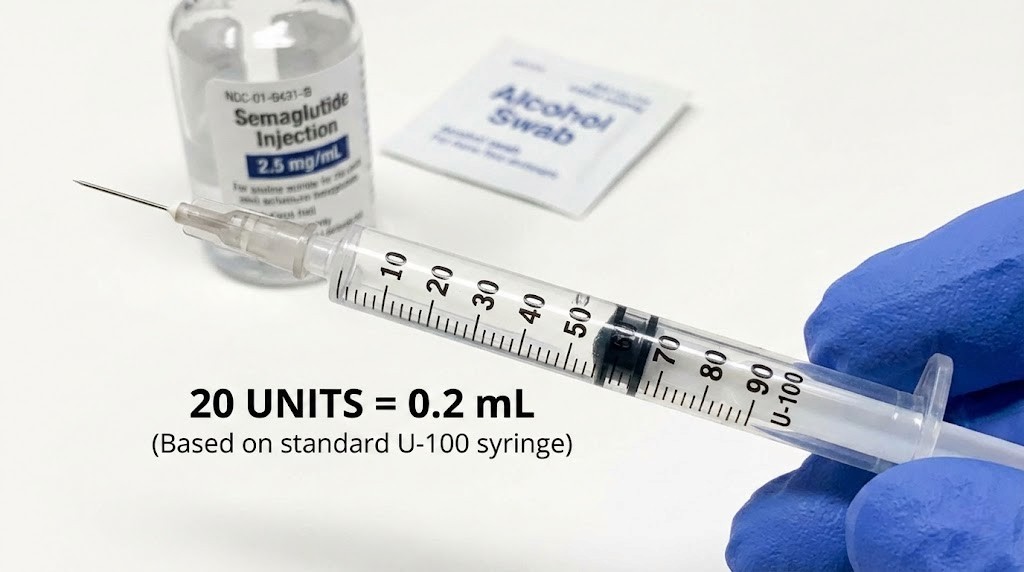
You are probably wasting semaglutide right now. Not because you are careless. Not because you do not understand the medication. But because the measurement system for injectable peptides is one of the most confusing things in modern medicine, and nobody bothered to explain it clearly before handing you a syringe. Here is the question that brings thousands of people to their screens every single month: 20 units of semaglutide is how many ml? The answer is simple. Twenty units on a standard U-100 insulin syringe always equals 0.2 mL. Always. That part never changes regardless of which vial you hold, which pharmacy filled it, or which provider prescribed it.
But that simple answer hides a trap.
Because while 20 units always equals 0.2 mL in volume, the actual milligram dose you receive depends entirely on the concentration of your specific vial. Draw 0.2 mL from a 1 mg/mL vial and you get 0.2 mg of semaglutide. Draw that same 0.2 mL from a 5 mg/mL vial and you get a full 1.0 mg, which is five times the dose from the same syringe reading. That difference matters. It matters for your results, it matters for your side effects, and it matters for your safety. Confusing these numbers has sent people to emergency rooms with severe nausea, vomiting, and dangerously low blood sugar. It has also left others wondering why their semaglutide is not working when they were unknowingly injecting a fraction of their prescribed dose. The semaglutide dosage calculator at SeekPeptides exists precisely because this confusion is so widespread and so dangerous. This guide will break down every piece of this puzzle, with exact numbers, clear charts, and step-by-step instructions so you never second-guess another injection again.
Understanding units, milligrams, and milliliters
Three different measurement systems collide every time you prepare a semaglutide injection. Each one measures something different. Confusing any two of them leads to dosing errors that range from ineffective treatment to genuinely dangerous overdoses. So before we talk about converting 20 units to milliliters, you need to understand what each measurement actually represents.
Units: what your syringe measures
Units are markings on your syringe. That is it. They are not a universal measurement of medication potency. They are not milligrams. They are not a measure of how much semaglutide you are injecting. On a standard U-100 insulin syringe, units correspond directly to volume: 100 units equals 1 mL. This relationship exists because these syringes were originally designed for insulin, where U-100 insulin contains exactly 100 units of insulin per milliliter. When you use these same syringes for semaglutide measured in units, the unit markings simply tell you how much liquid you are drawing up. Twenty units means you are drawing 0.2 mL of whatever liquid is in the vial.
Think of it like a measuring cup. The cup tells you volume. It does not tell you whether you poured water, olive oil, or honey. Same volume, very different contents. The peptide calculator helps bridge this gap between what your syringe shows and what you actually need to inject.
Milliliters: the actual volume
Milliliters measure liquid volume. One milliliter is one thousandth of a liter. When your provider says to inject 0.2 mL of semaglutide, they are telling you exactly how much liquid to draw into your syringe. On a U-100 syringe, 0.2 mL lines up perfectly with the 20-unit mark. On a standard milliliter syringe without unit markings, you would simply draw to the 0.2 mL line.
This is the bridge measurement. It connects what your syringe reads in units to what your body receives in milligrams. Understanding semaglutide dosage in milliliters removes one layer of confusion from the equation entirely.
Milligrams: what your body actually receives
Milligrams measure the mass of the active drug. This is what your doctor prescribes. This is what determines whether you experience appetite suppression or spend the evening over the toilet. When your provider says "inject 0.25 mg of semaglutide this week," the milligrams are the target. But you cannot read milligrams directly on any syringe. You have to convert backward from the concentration of your vial through the volume you draw up to arrive at the correct milligram dose.
That conversion is where most errors happen. A guide to calculating peptide dosages can help you master this process. The formula is straightforward once you understand it, but the consequences of getting it wrong are not.
How the three connect
Here is the chain: your syringe displays units. Units convert to milliliters at a fixed ratio (100 units = 1 mL on U-100 syringes). Milliliters multiplied by your vial concentration (mg/mL) gives you milligrams. Every single dosing calculation for semaglutide follows this chain. Every single one. If you understand this chain, you will never be confused by a semaglutide conversion chart again. The relationship looks like this:
Units / 100 = mL
mL x Concentration (mg/mL) = mg dose
For 20 units: 20 / 100 = 0.2 mL. The milligrams depend on concentration. And that is the entire system. The semaglutide dosage chart in units simply applies these formulas across every common concentration so you do not have to do the math yourself.
The quick answer: 20 units equals 0.2 mL
If you came here for the short answer, here it is.
Twenty units on a U-100 insulin syringe equals 0.2 mL. Period. This is a fixed conversion that never changes. It does not matter what medication is in the syringe. It does not matter what concentration your vial contains. It does not matter which pharmacy compounded it. Twenty units is always, without exception, 0.2 mL of liquid.
The math is dead simple: divide units by 100. That gives you milliliters. So 20 divided by 100 equals 0.2. You can verify this by looking at your syringe. If it is a 1 mL (100-unit) syringe, the 20-unit mark sits exactly one-fifth of the way up. If it is a 0.5 mL (50-unit) syringe, the 20-unit mark sits at roughly two-fifths. If it is a 0.3 mL (30-unit) syringe, the 20-unit mark sits at two-thirds of the total capacity. Different syringes, same volume, same 0.2 mL.
Here is a quick reference for other common unit-to-mL conversions you might encounter alongside your semaglutide dosing:
Units (U-100 syringe) | Milliliters (mL) |
|---|---|
5 units | 0.05 mL |
10 units | 0.10 mL |
15 units | 0.15 mL |
20 units | 0.20 mL |
25 units | 0.25 mL |
30 units | 0.30 mL |
40 units | 0.40 mL |
50 units | 0.50 mL |
100 units | 1.00 mL |
But do not stop here. Knowing the volume is only half the equation. The real question most people should be asking is: 20 units of semaglutide is how many mg? And that answer requires knowing your vial concentration.
Why concentration changes everything
This is where people get hurt.
Two people can both draw 20 units (0.2 mL) from their respective vials. One gets 0.2 mg. The other gets 2.0 mg. Ten times the dose. Same syringe reading. Same volume of liquid. Completely different, and potentially dangerous, outcomes. The variable is concentration.
What concentration means
Concentration tells you how much active semaglutide is dissolved in each milliliter of liquid. A vial labeled 5 mg/mL contains 5 milligrams of semaglutide in every milliliter of solution. A vial labeled 1 mg/mL contains only 1 milligram per milliliter. Both look identical. Both contain the same clear liquid. But one is five times more potent than the other, drop for drop. This is exactly why the compounded semaglutide guide emphasizes checking your vial label before every single injection.
Think of it like coffee. A shot of espresso and a cup of drip coffee might both fill a small cup. But the espresso has far more caffeine per ounce. The volume looks similar. The effect is drastically different. Semaglutide concentrations work the same way.
20 units across different concentrations
Here is what 20 units (0.2 mL) actually delivers at each common concentration:
Vial concentration | Volume drawn (20 units) | Actual semaglutide dose |
|---|---|---|
0.5 mg/mL | 0.2 mL | 0.1 mg |
1 mg/mL | 0.2 mL | 0.2 mg |
2 mg/mL | 0.2 mL | 0.4 mg |
2.5 mg/mL | 0.2 mL | 0.5 mg |
5 mg/mL | 0.2 mL | 1.0 mg |
10 mg/mL | 0.2 mL | 2.0 mg |
Look at that range. From 0.1 mg to 2.0 mg. A twenty-fold difference from the lowest concentration to the highest. If your provider prescribed 0.25 mg and you accidentally draw 20 units from a 5 mg/mL vial, you just injected four times your intended dose. That is not a rounding error. That is a medical event waiting to happen.
The semaglutide mixing chart exists to prevent exactly this type of error. And if you are working with a 5 mg vial specifically, the 5 mg semaglutide mixing chart walks through every combination of bacteriostatic water volume and resulting concentration.
Why concentrations vary so much
Brand-name semaglutide pens (Ozempic, Wegovy) come in fixed concentrations. You do not mix them. You do not choose. The manufacturer pre-loaded the pen with a specific concentration and the dial selects your dose automatically. But compounded semaglutide is different. Compounding pharmacies prepare semaglutide in vials at various concentrations depending on the total amount of lyophilized (freeze-dried) peptide in the vial and how much bacteriostatic water was added during reconstitution.
A 5 mg semaglutide vial reconstituted with 1 mL of bacteriostatic water creates a 5 mg/mL concentration. That same 5 mg vial reconstituted with 2 mL creates a 2.5 mg/mL concentration. Same peptide. Same vial. Different water volume. Different concentration. Different dose at 20 units. This is precisely why understanding how much bacteriostatic water to mix with 5 mg semaglutide is not optional knowledge.
Complete conversion chart for every concentration
Reference charts save lives. Maybe not literally, but they prevent dosing errors that cause miserable side effects and wasted medication. Below you will find complete tables for the most common compounded semaglutide concentrations. Find your vial concentration first, then locate your prescribed dose to see exactly how many units to draw.
1 mg/mL concentration chart
This low concentration is common with 10 mg vials reconstituted with 10 mL of bacteriostatic water, or 5 mg vials mixed with 5 mL. At this concentration, you need larger injection volumes to reach therapeutic doses, which some people find uncomfortable.
Desired dose (mg) | Volume needed (mL) | Units on U-100 syringe |
|---|---|---|
0.125 mg | 0.125 mL | 12.5 units |
0.20 mg | 0.20 mL | 20 units |
0.25 mg | 0.25 mL | 25 units |
0.50 mg | 0.50 mL | 50 units |
1.00 mg | 1.00 mL | 100 units |
At 1 mg/mL, 20 units gives you exactly 0.2 mg of semaglutide. That is slightly below the standard starting dose of 0.25 mg. If your provider prescribed 0.25 mg and your vial is 1 mg/mL, you need 25 units, not 20. Checking a semaglutide syringe dosage chart before every injection eliminates guesswork.
2 mg/mL concentration chart
A middle-range concentration you might see from pharmacies like Empower Pharmacy. This concentration balances manageable injection volumes with reasonable syringe precision.
Desired dose (mg) | Volume needed (mL) | Units on U-100 syringe |
|---|---|---|
0.20 mg | 0.10 mL | 10 units |
0.25 mg | 0.125 mL | 12.5 units |
0.40 mg | 0.20 mL | 20 units |
0.50 mg | 0.25 mL | 25 units |
1.00 mg | 0.50 mL | 50 units |
2.00 mg | 1.00 mL | 100 units |
At 2 mg/mL, 20 units delivers 0.4 mg of semaglutide. That falls between the first and second titration steps in a standard dosing schedule. Some providers prescribe this exact dose as a bridge between the 0.25 mg starting dose and the 0.5 mg step-up. Understanding your units-to-mg conversion helps you follow these protocols precisely.
2.5 mg/mL concentration chart
This concentration appears frequently with 5 mg vials reconstituted with 2 mL of bacteriostatic water. The 5 mg/2 mL semaglutide dosage chart covers this concentration in detail.
Desired dose (mg) | Volume needed (mL) | Units on U-100 syringe |
|---|---|---|
0.25 mg | 0.10 mL | 10 units |
0.50 mg | 0.20 mL | 20 units |
1.00 mg | 0.40 mL | 40 units |
1.70 mg | 0.68 mL | 68 units |
2.40 mg | 0.96 mL | 96 units |
2.50 mg | 1.00 mL | 100 units |
At 2.5 mg/mL, 20 units delivers exactly 0.5 mg of semaglutide. That is the standard second-step dose in the standard titration schedule, which is weeks 5 through 8 for most patients. This concentration and unit combination is one of the most commonly prescribed in compounded semaglutide, so if your provider told you "draw 20 units," there is a reasonable chance your vial is 2.5 mg/mL and your dose is 0.5 mg.
5 mg/mL concentration chart
One of the most common concentrations from compounding pharmacies. Created by reconstituting a 5 mg vial with 1 mL of bacteriostatic water. Higher concentration means smaller injection volumes, which most people prefer.
Desired dose (mg) | Volume needed (mL) | Units on U-100 syringe |
|---|---|---|
0.25 mg | 0.05 mL | 5 units |
0.50 mg | 0.10 mL | 10 units |
1.00 mg | 0.20 mL | 20 units |
1.70 mg | 0.34 mL | 34 units |
2.00 mg | 0.40 mL | 40 units |
2.40 mg | 0.48 mL | 48 units |
At 5 mg/mL, 20 units delivers a full 1.0 mg of semaglutide. That is the standard maintenance dose, typically reached at weeks 9 through 12 of treatment. This is also where concentration errors become especially dangerous. Someone who thinks their vial is 2.5 mg/mL but actually has 5 mg/mL would inject double their intended dose. The syringe dosage conversion chart makes it easy to cross-reference your vial label with your syringe markings.
10 mg/mL concentration chart
The highest common concentration, typically from 10 mg vials reconstituted with 1 mL of water. Very small injection volumes required. Precision is absolutely critical at this concentration.
Desired dose (mg) | Volume needed (mL) | Units on U-100 syringe |
|---|---|---|
0.25 mg | 0.025 mL | 2.5 units |
0.50 mg | 0.05 mL | 5 units |
1.00 mg | 0.10 mL | 10 units |
2.00 mg | 0.20 mL | 20 units |
2.40 mg | 0.24 mL | 24 units |
At 10 mg/mL, 20 units delivers 2.0 mg of semaglutide. That is near the maximum therapeutic dose of 2.4 mg. If you are drawing 20 units from a 10 mg/mL vial, you should be well into your titration schedule and very experienced with injections. A beginner accidentally drawing 20 units from a 10 mg/mL vial could receive eight times their intended starting dose. That is not a hypothetical scenario. It happens. The 40-unit semaglutide conversion guide and 50-unit semaglutide conversion guide can help you cross-reference other common unit amounts at various concentrations.
How to calculate your exact dose step by step
Relying on charts is fine. Understanding the math behind them is better. Once you learn the two-step formula, you can calculate any dose from any concentration on any syringe. No chart needed. No internet needed. Just basic arithmetic.
Step 1: convert units to milliliters
Divide the number of units on your syringe by 100.
Volume (mL) = Units / 100
For 20 units: 20 / 100 = 0.2 mL. For 100 units: 100 / 100 = 1.0 mL. For 10 units: 10 / 100 = 0.1 mL. This formula works for every U-100 syringe, every time, no exceptions.
Step 2: convert milliliters to milligrams
Multiply the volume in milliliters by your vial concentration in mg/mL.
Dose (mg) = Volume (mL) x Concentration (mg/mL)
For 0.2 mL from a 5 mg/mL vial: 0.2 x 5 = 1.0 mg. For 0.2 mL from a 2.5 mg/mL vial: 0.2 x 2.5 = 0.5 mg. The peptide dosage calculation guide walks through dozens of examples using this exact formula for semaglutide and other peptides.
Working backward: dose to units
Most providers prescribe a milligram dose, not a unit count. So you often need to work backward: starting with the desired mg dose, ending with how many units to draw. The process reverses.
Volume (mL) = Desired dose (mg) / Concentration (mg/mL)
Units = Volume (mL) x 100
Example: your provider prescribes 0.5 mg. Your vial is 2.5 mg/mL. Volume = 0.5 / 2.5 = 0.2 mL. Units = 0.2 x 100 = 20 units. Draw to the 20-unit mark.
Another example: your provider prescribes 1.0 mg. Your vial is 5 mg/mL. Volume = 1.0 / 5 = 0.2 mL. Units = 0.2 x 100 = 20 units. Same syringe reading, completely different dose from the previous example because the concentration doubled. The semaglutide dosage calculator automates these calculations so you do not have to do mental math before every injection.
Three practice problems
Test yourself. Work through these before checking the answers.
Problem 1: You have a 5 mg vial reconstituted with 2 mL of bacteriostatic water. Your provider prescribed 0.25 mg. How many units do you draw?
Problem 2: You have a 10 mg vial reconstituted with 2 mL of bacteriostatic water. Your provider prescribed 1.0 mg. How many units do you draw?
Problem 3: You drew 20 units from a vial that is 3 mg/mL. How many milligrams did you inject?
Answers:
Problem 1: Concentration = 5 mg / 2 mL = 2.5 mg/mL. Volume = 0.25 / 2.5 = 0.1 mL. Units = 0.1 x 100 = 10 units.
Problem 2: Concentration = 10 mg / 2 mL = 5 mg/mL. Volume = 1.0 / 5 = 0.2 mL. Units = 0.2 x 100 = 20 units.
Problem 3: Volume = 20 / 100 = 0.2 mL. Dose = 0.2 x 3 = 0.6 mg.
If you got all three correct, you understand semaglutide dosing better than most people who inject it weekly. If any tripped you up, review the formula steps above and try again. Precision matters here. The peptide dosage chart provides additional practice with other peptide calculations.
Common semaglutide vial concentrations explained
Not all semaglutide is created equal. The concentration in your vial depends on where it came from, how it was prepared, and what total peptide amount was used. Understanding the landscape of available concentrations helps you navigate conversations with your provider and verify that you are dosing correctly.
Brand-name semaglutide (Ozempic, Wegovy)
Brand-name products come in pre-filled pens with fixed concentrations. You never handle vials, never reconstitute, and never calculate units-to-mg conversions manually. The pen dial does it all. Ozempic pens come in concentrations of 0.68 mg/mL, 1.34 mg/mL, or 2.68 mg/mL depending on the pen type. Wegovy pens use different fixed concentrations matched to each dose level. Because these are pre-filled and pre-dialed, the 20-units-to-mL question does not typically arise with brand-name products. It becomes relevant when people compare their pen doses to what others describe in unit measurements from compounded vials, which is a comparison that the GLP-1 and Ozempic comparison guide addresses in detail.
Compounded semaglutide vials
Compounded semaglutide comes as a lyophilized (freeze-dried) powder in a vial that you reconstitute with bacteriostatic water. The final concentration depends on two variables: the total peptide in the vial and the volume of water added. Common vial sizes include 2 mg, 5 mg, and 10 mg of total semaglutide.
Here is how reconstitution volume determines concentration for each vial size:
5 mg vial:
Mixed with 1 mL water = 5 mg/mL (see the 5 mg reconstitution chart)
Mixed with 2 mL water = 2.5 mg/mL
Mixed with 2.5 mL water = 2 mg/mL
Mixed with 5 mL water = 1 mg/mL
10 mg vial:
Mixed with 1 mL water = 10 mg/mL (see the 10 mg reconstitution chart)
Mixed with 2 mL water = 5 mg/mL
Mixed with 4 mL water = 2.5 mg/mL
Mixed with 5 mL water = 2 mg/mL
Mixed with 10 mL water = 1 mg/mL
Your pharmacy should clearly label the concentration on the vial. If it does not, call and ask. Never guess. The semaglutide reconstitution chart covers every common combination of vial size and water volume.
Compounded semaglutide with B12
Some compounding pharmacies add vitamin B12 (cyanocobalamin or methylcobalamin) to their semaglutide formulations. The B12 does not change the unit-to-mL conversion, but it may affect the total concentration listed on the vial label. A vial labeled "semaglutide 5 mg/mL + B12 1 mg/mL" still delivers 5 mg of semaglutide per mL. The B12 is an additional ingredient, not a replacement. If you are using a semaglutide with B12 formulation, your dosing calculations for semaglutide remain the same. A specific semaglutide B12 dosage chart can help verify your exact dose, and the semaglutide methylcobalamin guide explains the rationale behind combining these two compounds. Additionally, the compounded semaglutide with B12 dosage chart provides concentration-specific dosing tables.
Pharmacy-specific concentrations
Different compounding pharmacies may use different standard concentrations. Empower Pharmacy typically provides semaglutide at specific concentrations. Olympia Pharmacy may use different ones. Direct Meds has its own formulation standards. The Strive Pharmacy semaglutide dosing and IVIM semaglutide dosing charts provide pharmacy-specific guidance. When switching pharmacies, always verify the concentration of your new vial before assuming it matches your old one. A 20-unit draw from a new pharmacy could deliver a very different dose if the concentration changed.
Reading your insulin syringe correctly
The syringe is your dosing tool. Misreading it is one of the most common sources of error, especially for people new to self-injection. Different syringe sizes have different scale markings, different line spacings, and different levels of precision. Understanding your specific syringe prevents the kind of small measurement errors that compound into significant dosing mistakes over weeks of treatment.
U-100 syringe sizes
Three standard sizes exist for U-100 insulin syringes.
0.3 mL (30-unit) syringe: The smallest common syringe. Each small line typically represents 0.5 units. This gives you incredible precision for small doses but cannot hold more than 0.3 mL. For 20 units, you would fill to two-thirds of this syringe. Ideal for low-concentration vials where your dose falls below 30 units. If you are following the peptide dosing guide, you will find that smaller syringes generally provide more accurate measurements for small volumes.
0.5 mL (50-unit) syringe: The middle option. Each small line typically represents 1 unit. For 20 units, you would fill to a bit less than half. Good for doses between 10 and 50 units. Most people using compounded semaglutide at moderate concentrations find this syringe ideal.
1.0 mL (100-unit) syringe: The largest standard insulin syringe. Each small line represents 2 units, which means you cannot mark individual units with precision. For 20 units, you would fill to just one-fifth of the syringe, making it harder to be precise. Better for larger doses or lower-concentration vials where you need more volume. Learning how to inject GLP-1 medications properly includes choosing the right syringe size for your dose.
Reading the meniscus
Liquid in a syringe forms a slight curve called a meniscus. Always read the measurement at the flat bottom of the meniscus, not the curved edges where the liquid climbs slightly up the syringe wall. Hold the syringe at eye level with the needle pointing up. Read where the flat bottom of the liquid meets the syringe markings. This matters. Reading the top of the meniscus instead of the bottom can add an extra unit or two to your measurement, which at high concentrations could mean significant additional milligrams.
The plunger tip alignment
The rubber plunger tip inside your syringe has a slightly domed shape. Align the front edge (the edge closest to the needle) with your desired unit marking. Not the back edge. Not the middle. The front edge. This is a subtle detail, but it matters when you are trying to hit exactly 20 units. At a 5 mg/mL concentration, being off by just 2 units means you are off by 0.1 mg, which is 10% of a 1.0 mg dose.
Air bubbles and accuracy
Small air bubbles in your syringe displace liquid. A bubble sitting between the plunger and the liquid pushes the liquid forward, making it look like you have drawn more medication than you actually have. Always tap the syringe with the needle pointing up to move bubbles to the top, then gently push the plunger forward until the air escapes and a tiny drop of liquid appears at the needle tip. Then pull back to your desired 20 units. This technique is covered in the peptide injections guide.
Air bubbles do not cause harm if injected subcutaneously. The small volumes involved are far too tiny to cause an embolism. But they do cause inaccurate dosing. You think you drew 20 units of liquid but actually drew 18 units of liquid plus 2 units of air. Over weeks, that adds up to meaningful underdosing and explains some cases of no weight loss after 4 weeks on semaglutide.
Semaglutide dosing schedule and where 20 units fits
Semaglutide is not a fixed-dose medication. You start low and gradually increase over months. This titration schedule exists for a reason: it allows your GI system to adapt to the medication and reduces the severity of side effects like nausea, which is the most common reason people quit treatment early. Understanding where 20 units falls in this schedule depends entirely on your vial concentration.
Standard titration protocol
The standard dose escalation for semaglutide follows this pattern:
Weeks 1 through 4: 0.25 mg once weekly
Weeks 5 through 8: 0.50 mg once weekly
Weeks 9 through 12: 1.0 mg once weekly
Weeks 13 through 16: 1.7 mg once weekly
Week 17 onward: 2.4 mg once weekly (maximum dose for weight management)
Some providers stop at 1.0 mg or 1.7 mg if the patient is seeing adequate results. Others customize the timeline based on tolerance. The guide to semaglutide treatment duration addresses how long people typically remain on each dose level.
Where 20 units falls in the schedule
Here is exactly where 20 units (0.2 mL) corresponds to each titration step:
Dose step | Required concentration for 20 units to deliver that dose |
|---|---|
0.25 mg (starting) | 1.25 mg/mL |
0.50 mg (month 2) | 2.5 mg/mL |
1.0 mg (month 3) | 5 mg/mL |
1.7 mg (month 4) | 8.5 mg/mL |
2.0 mg (high dose) | 10 mg/mL |
2.4 mg (maximum) | 12 mg/mL |
Notice something convenient? At 2.5 mg/mL, 20 units gives you exactly 0.5 mg, which is the month-two dose. At 5 mg/mL, 20 units gives you 1.0 mg, which is the month-three maintenance dose. These are not coincidences. Compounding pharmacies often choose concentrations that make common doses fall on round unit numbers. It reduces errors and makes life easier for everyone involved.
Understanding how quickly semaglutide works helps set expectations for each dose level. And knowing how long semaglutide takes to show results prevents the frustration that leads people to skip titration steps prematurely.
Adjusting within a titration step
Some providers use intermediate doses. Instead of jumping from 0.25 mg directly to 0.5 mg, they might prescribe 0.375 mg for a couple of weeks. With a 2.5 mg/mL vial, that would be 15 units instead of 20. Having the math skills to calculate these intermediate doses gives you flexibility to work with your provider on a custom dosing schedule that minimizes side effects while maintaining progress. The idea is to find the dose where you experience meaningful appetite suppression without debilitating nausea or fatigue.
How to measure 20 units on different syringe sizes
Drawing exactly 20 units sounds simple until you are holding a syringe with tiny markings and your hands are not perfectly steady. Each syringe size presents its own challenges and advantages. Knowing which syringe to use and how to read it properly makes the difference between an accurate dose and a guessing game.
On a 0.3 mL (30-unit) syringe
This is the most precise option for measuring 20 units. Each graduation mark represents 0.5 units, so the 20-unit mark has its own dedicated line. The 20-unit mark sits at two-thirds of the syringe barrel, giving you plenty of visual space both above and below it. Pull the plunger smoothly until the front edge of the rubber tip aligns with the 20-unit line. The downside? You only have 10 more units of capacity above 20, which limits flexibility if your dose increases.
Best for: doses up to 30 units. Great precision for semaglutide at higher concentrations like 5 mg/mL or 10 mg/mL where small unit amounts deliver meaningful doses.
On a 0.5 mL (50-unit) syringe
The sweet spot for most semaglutide users. Each graduation mark typically represents 1 unit, so 20 units is clearly marked. The 20-unit mark sits below the halfway point of the barrel, giving you a comfortable visual reference. You have 30 units of headroom above your dose, which accommodates future dose increases without changing syringe sizes. If you are using the peptide calculator and it returns a result between 10 and 50 units, this is your ideal syringe.
Best for: most compounded semaglutide doses from the starting 0.25 mg through maintenance doses at moderate concentrations.
On a 1.0 mL (100-unit) syringe
The least precise option for measuring 20 units. Each graduation mark represents 2 units, meaning the closest marked lines are 18 and 20. You can hit 20 units, but the marks are closer together and harder to read. The 20-unit mark sits at just one-fifth of the barrel, meaning you are using a tiny fraction of the syringe capacity. For small doses, this syringe introduces unnecessary imprecision. A two-unit error on a 1.0 mL syringe is the same as a two-unit error on a 0.3 mL syringe, but it is much easier to make that error when the marks are closer together.
Best for: lower-concentration vials where your prescribed dose requires more than 50 units of volume. Not ideal for 20-unit doses.
Common measurement mistakes and how to avoid them
People make the same handful of errors repeatedly. Every week, forums, support groups, and provider offices hear the same questions born from the same misunderstandings. Knowing these pitfalls in advance is the cheapest insurance against dosing problems. SeekPeptides compiled these from real-world reports across thousands of users.
Mistake 1: confusing units with milligrams
This is the most dangerous mistake. Someone reads that they should inject 0.5 mg of semaglutide and draws to the 50-unit mark on their syringe, thinking units and milligrams are the same thing. They are not. At a 5 mg/mL concentration, 50 units delivers 2.5 mg, which is five times the intended dose. At 10 mg/mL, it delivers 5 mg, which is beyond any therapeutic dose used in clinical trials. Always convert milligrams to units using your vial concentration before drawing anything.
Mistake 2: assuming all vials have the same concentration
A person on a forum says they draw 20 units for their 0.5 mg dose. You have a different pharmacy, a different vial size, a different concentration. Their 20 units delivers 0.5 mg from a 2.5 mg/mL vial. Your 20 units from a 5 mg/mL vial delivers 1.0 mg. Never copy someone else unit count without first verifying that your concentrations match. The semaglutide reconstitution guide explains how different preparation methods create different concentrations.
Mistake 3: forgetting to account for reconstitution volume
When you reconstitute a 5 mg vial yourself, the amount of bacteriostatic water you add to 5 mg semaglutide determines everything. Adding 1 mL creates 5 mg/mL. Adding 2 mL creates 2.5 mg/mL. Some people eyeball the water instead of measuring it precisely. A reconstitution guide specific to your vial size, like the 5 mg reconstitution guide, prevents this error. The peptide reconstitution calculator also helps determine the exact water volume needed for your desired concentration.
Mistake 4: not removing air bubbles
As discussed earlier, air bubbles reduce your actual medication volume. Two units of air in a 20-unit draw means you actually received 18 units of medication. That is a 10% reduction in your dose. Over four weeks of injections at the starting dose, that could partially explain a lack of weight loss results. Always tap out bubbles before injecting.
Mistake 5: reading the wrong edge of the plunger
The rubber plunger tip has two edges: front (closest to needle) and back (closest to where you push). Reading the back edge instead of the front edge adds roughly 1 to 2 units to your draw. At 10 mg/mL, those 2 extra units add 0.2 mg of semaglutide. Over months of weekly injections, that consistent over-delivery changes your cumulative exposure and may intensify side effects like constipation or other adverse effects.
Mistake 6: using the wrong syringe type
Not all syringes are U-100. U-40 and U-50 syringes exist for veterinary and specialized medical use. On a U-40 syringe, 20 units equals 0.5 mL, not 0.2 mL. That is 2.5 times the volume. If you accidentally used a U-40 syringe and drew to the 20-unit mark thinking you were getting 0.2 mL, you would actually get 0.5 mL. At 5 mg/mL, that is 2.5 mg instead of 1.0 mg. Always verify your syringe says "U-100" on the packaging. Understanding different injection methods including proper syringe selection is part of safe peptide use.
Reconstitution and how it affects your dose
If you are using compounded semaglutide in lyophilized form, you need to reconstitute it before use. This process directly determines the concentration that governs every calculation in this article. Get the reconstitution right and every subsequent measurement falls into place. Get it wrong and no amount of careful syringe reading will save you from an incorrect dose.
The reconstitution process
Reconstitution means adding bacteriostatic water to a vial of freeze-dried semaglutide powder to create an injectable solution. The steps are straightforward but require care. First, clean the rubber stopper on both the bacteriostatic water vial and the semaglutide vial with an alcohol swab. Draw the desired volume of bacteriostatic water into a syringe. Insert the needle through the semaglutide vial stopper and slowly inject the water down the inside wall of the vial. Do not squirt it directly onto the powder. Let it run down the glass. Then gently swirl (never shake) the vial until the powder dissolves completely. The peptide reconstitution guide covers this process in complete detail, and the guide to mixing peptides with bacteriostatic water includes visual walkthroughs.
Choosing your water volume
This is the decision that sets your concentration. The reconstitution calculator makes this easy, but here is the logic. If you want fewer units per injection (smaller volumes, more precision), add less water for a higher concentration. If you want easier-to-read syringe measurements with more room for error, add more water for a lower concentration.
For a 5 mg vial:
1 mL water = 5 mg/mL (20 units = 1.0 mg, a nice round maintenance dose)
2 mL water = 2.5 mg/mL (20 units = 0.5 mg, a nice round step-two dose)
For a 10 mg vial where you want to understand how much bacteriostatic water to use with 10 mg semaglutide:
2 mL water = 5 mg/mL (20 units = 1.0 mg)
4 mL water = 2.5 mg/mL (20 units = 0.5 mg)
5 mL water = 2 mg/mL (20 units = 0.4 mg)
Many people choose a concentration that makes their current dose fall on a round unit number. If you are on 0.5 mg per week, a concentration of 2.5 mg/mL puts you at exactly 20 units, which is easy to read on any syringe. If you are on 1.0 mg per week, a concentration of 5 mg/mL also puts you at exactly 20 units. Planning your reconstitution around your prescribed dose simplifies everything. The general guide for adding bacteriostatic water to peptides provides additional context for this process.
What about pre-mixed compounded semaglutide?
Some pharmacies ship semaglutide already reconstituted in liquid form. You do not add water. You do not choose a concentration. The pharmacy chose it for you. In this case, just read the concentration on the label and proceed directly to the dosing calculations. The storage guide for compounded semaglutide explains proper handling for pre-mixed formulations.
There is also oral semaglutide in drop form, which uses a completely different dosing system. The unit-to-mL conversion discussed in this article applies only to injectable semaglutide, not oral formulations.
Injection technique for accurate dosing
Drawing the right amount is only part of the equation. How you inject also affects whether the full dose actually enters your body. Poor injection technique can leave medication in the syringe, deposit it too shallowly in the skin, or push it into tissue where absorption is inconsistent. For a comprehensive walkthrough, the peptide injection overview covers foundational concepts.
Subcutaneous injection basics
Semaglutide is injected subcutaneously, meaning into the fatty tissue just beneath the skin. Not into muscle. Not into a vein. Not just under the skin surface. The needle should pass through the skin and enter the fat layer, typically requiring a 4 mm to 8 mm needle depending on body composition. Most insulin syringes come with appropriate needle lengths for subcutaneous injection. Knowing where to inject GLP-1 medications ensures optimal absorption and minimal discomfort.
Injection sites
Three primary injection sites work for semaglutide:
Abdomen: The most common site. Inject at least two inches from the belly button. This area typically has adequate subcutaneous fat and offers easy access. Most people report the least pain here.
Front of thigh: The middle third of the outer front thigh. Good for people who prefer not to inject in the abdomen. Absorption rate may differ slightly from abdominal injections.
Upper arm: The back of the upper arm, specifically the fatty area between the shoulder and elbow. Harder to reach yourself. Some people have a partner help with this site.
Rotate between sites weekly. Do not inject the same exact spot twice in a row. Repeated injections in one location can cause lipodystrophy, where the fat tissue breaks down or builds up irregularly, affecting both absorption and appearance. This rotation applies whether you are doing a standard peptide injection or any other subcutaneous medication.
Ensuring you get the full 20 units
After inserting the needle and pressing the plunger all the way down, count to ten before removing the needle. This gives the liquid time to disperse into the tissue and prevents medication from leaking back out through the injection site. If you pull the needle out immediately after pushing the plunger, you may see a small droplet of liquid at the injection site. That droplet is medication you paid for but your body will not absorb. Over weeks, these small losses add up.
Also inspect the syringe after injection. The plunger should be fully depressed. No liquid should remain in the barrel. If you see liquid, the plunger was not pushed far enough. This is more common with thicker-gauge needles that require more force.
Timing your injection
Semaglutide is a once-weekly injection. The best time of day to take semaglutide varies by individual preference and schedule, but consistency matters more than specific timing. Choose a day of the week and a general time. Morning injectors may experience nausea that fades by evening. Evening injectors may sleep through the initial side effects. Many users also find that their side effect pattern influences energy levels throughout the day.
Storage and handling for consistent doses
Semaglutide is a peptide. Peptides degrade. How you store your vial affects whether the last dose from the vial is as potent as the first. A vial that sat on your kitchen counter for three weeks in summer heat does not contain the same active concentration as one properly refrigerated. Even if the label says 5 mg/mL, degradation may have reduced the actual potency, meaning your 20 units delivers less than the expected 1.0 mg.
Refrigeration requirements
Store reconstituted semaglutide at 36 to 46 degrees Fahrenheit (2 to 8 degrees Celsius). That is standard refrigerator temperature. Do not freeze. Freezing causes the peptide to aggregate and lose potency. Do not store on a refrigerator shelf where items might freeze (usually the back wall of the fridge or near the freezer compartment). The middle shelf of your refrigerator door is often ideal. The compounded semaglutide fridge storage guide covers temperature ranges, expiration timelines, and signs of degradation in detail.
How long does reconstituted semaglutide last?
Most compounding pharmacies assign a beyond-use date of 28 to 90 days for reconstituted semaglutide when properly refrigerated. The reconstituted peptide storage timeline provides general guidance. After this window, the peptide may have degraded enough that your 20-unit draw no longer delivers the expected milligram dose. Using expired semaglutide is generally not recommended, although the risk is typically reduced potency rather than toxicity.
The peptide storage guide and peptide refrigeration guide at SeekPeptides provide comprehensive recommendations that apply to semaglutide and all other injectable peptides.
Protecting from light
Semaglutide degrades when exposed to direct light, especially sunlight or strong artificial light. Keep your vial in its original packaging or wrap it in aluminum foil. Store it in a closed container in the refrigerator. Do not leave it on a countertop near a window, even briefly. Light-induced degradation is cumulative: even short exposures add up over the weeks you use a single vial.
Handling during injection preparation
Remove the vial from the refrigerator. Clean the stopper. Draw your dose. Return the vial to the refrigerator immediately. The total time outside the fridge should be minutes, not hours. Some people leave their vial on the bathroom counter while they inject, have breakfast, get dressed, and then remember to put it back. Two hours at room temperature occasionally will not ruin your vial. Two hours at room temperature daily for a month might reduce potency enough to notice. And with appetite suppression timelines depending on consistent dosing, any potency loss can slow your results.
When to adjust from 20 units
Twenty units is not a permanent dose. It is a point on a journey. Depending on your concentration and titration schedule, 20 units may represent your starting dose, your maintenance dose, or a temporary step on the way to a higher or lower dose. Understanding when and why to change from 20 units keeps you aligned with your treatment goals.
Titrating up from 20 units
If 20 units represents your starting dose (which concentration-dependent, as we have covered extensively), your provider will likely increase your dose after four weeks. From a 2.5 mg/mL vial, moving from 0.5 mg to 1.0 mg means going from 20 units to 40 units. From a 5 mg/mL vial, moving from 1.0 mg to 1.7 mg means going from 20 units to 34 units.
Only increase when your provider instructs you to do so. Increasing too quickly leads to side effects that can make the medication intolerable. The standard titration schedule exists because clinical trials determined it produces the best balance of efficacy and tolerability. If you are wondering why you are not losing weight on semaglutide at your current dose, talk to your provider before self-adjusting.
Titrating down from 20 units
Side effects may warrant a temporary dose reduction. Persistent nausea, constipation, or significant fatigue could lead your provider to reduce your dose. From 20 units, you might drop to 15 units or 10 units for a few weeks before attempting to move back up. These intermediate doses are one advantage of compounded semaglutide over pre-filled pens, which only offer fixed dose steps.
Switching concentrations instead of unit counts
Instead of changing how many units you draw, some providers maintain the same unit count but switch to a different concentration vial. This approach works well for people who have established a reliable routine of drawing 20 units and do not want to adjust their syringe technique. Going from 2.5 mg/mL to 5 mg/mL doubles your dose from 0.5 mg to 1.0 mg while keeping your draw at the familiar 20-unit mark. Just make absolutely certain you have the correct vial before injecting. Mixing up concentrations when your unit count stays the same is a recipe for trouble.
Considering combination therapies
Some people combine semaglutide with other compounds. Semaglutide combined with glycine is one such protocol. Others explore combining semaglutide with phentermine, which has its own set of considerations covered in the phentermine versus semaglutide comparison. When using multiple compounds, keeping your semaglutide dosing consistent and accurate becomes even more important because drug interactions can amplify both effects and side effects.
Others consider switching medications entirely. The semaglutide versus tirzepatide comparison is one of the most common decision points, with detailed conversion guidance available in the semaglutide to tirzepatide conversion chart. If switching in the opposite direction, the tirzepatide to semaglutide switching guide covers the process, and tirzepatide dosing follows a different schedule entirely. The tirzepatide dosage in units and tirzepatide dosage chart in units provide the equivalent conversion reference for that medication, including specific unit calculations. Side-effect profiles also differ, as outlined in the semaglutide versus tirzepatide side effects comparison.
Practical tips for consistent weekly dosing
Accuracy week after week requires routine. Not just understanding the math, but building habits that make correct dosing automatic rather than something you have to think hard about every seven days. These practical strategies come from experienced users and clinical recommendations.
Create a dosing station
Designate one clean, well-lit surface for your weekly injection. Keep your supplies together: syringe, alcohol swabs, sharps container, and this dosing reference if needed. Preparing in the same place each time reduces the chance of forgetting a step. It also means you always have good lighting to read your syringe markings, which matters when you are trying to hit exactly 20 units.
Write down your concentration
Tape a small note to your vial or syringe box with your concentration and the corresponding unit count for your dose. "2.5 mg/mL. 0.5 mg = 20 units." You will not need to consult this note most weeks. But on the week you are tired, distracted, or dealing with a new vial from a different batch, that note prevents errors. Many people find the dosage chart in mL useful to print and keep with their supplies.
Use a calendar reminder
Set a recurring weekly reminder on your phone for injection day. Many people choose Friday evening or Saturday morning so that any initial side effects occur over the weekend. Include your dose information in the reminder: "Semaglutide injection, 20 units (0.5 mg), 2.5 mg/mL vial." This serves as a quick verification before you begin.
Track your injections
Keep a simple log: date, injection site, number of units drawn, any side effects. This log becomes valuable when discussing your progress with your provider and helps identify patterns. Did nausea increase after switching from abdomen to thigh? Did appetite suppression change when you moved from 20 units to 25 units? Without a log, these patterns go unnoticed.
Pair your injection with your diet
What you eat around injection time matters. Following a semaglutide diet plan that accounts for injection timing can reduce side effects. A comprehensive list of foods to eat while on semaglutide helps you plan meals that work with the medication rather than against it. Knowing whether you can drink alcohol on semaglutide also matters for weekend injectors who might have social plans.
Understanding the broader context of peptide dosing
Semaglutide is one of many peptides people use for health optimization. The unit-to-mL conversion principles in this guide apply universally to any injectable peptide drawn with a U-100 insulin syringe. Whether you are calculating doses for weight loss peptides, muscle growth peptides, gut health peptides, injury healing peptides, or anti-aging peptides, the math is the same: units divided by 100 equals milliliters, milliliters multiplied by concentration equals milligrams.
Other peptides have their own dosing calculators at SeekPeptides. The BPC-157 dosage calculator handles one of the most popular healing peptides. The TB-500 dosage calculator covers another common recovery compound. The CJC-1295 dosage calculator serves the growth hormone secretagogue community. And the HGH fragment 176-191 calculator handles a specialized fat-loss peptide. Each uses the same fundamental conversion mathematics covered in this article, which the weight loss peptides guide and peptide stacking guide for weight loss discuss in broader context.
The distinction between research-grade and pharmaceutical-grade peptides matters for dosing accuracy as well, since research peptides may have less precise concentrations. Understanding the differences between peptides and SARMs also helps people choose the right compounds for their goals. And the peptide stack calculator helps when combining multiple compounds. The peptide cost calculator can also help you understand the economics of your dosing schedule over time.
GLP-1 receptor agonists like semaglutide have some unique considerations beyond standard peptides. The GLP-1 fatigue guide addresses one of the most common side effects across this medication class. The GLP-1 hair loss guide covers another concern that users frequently raise.
Frequently asked questions
Does 20 units always equal 0.2 mL regardless of the medication?
Yes, on a U-100 insulin syringe. Twenty units always equals 0.2 mL. This is a fixed relationship between the syringe markings and volume. It does not matter what medication is in the syringe. The medication type only determines how many milligrams are contained in that 0.2 mL, which depends on the concentration. The semaglutide dosage in units guide explains this relationship in several practical scenarios.
How many mg is 20 units of semaglutide?
It depends entirely on your vial concentration. At 1 mg/mL, 20 units equals 0.2 mg. At 2.5 mg/mL, it equals 0.5 mg. At 5 mg/mL, it equals 1.0 mg. At 10 mg/mL, it equals 2.0 mg. You must know your vial concentration to answer this question. The 20 units to mg conversion guide covers every common concentration.
Can I use a regular syringe instead of an insulin syringe?
You can use a standard milliliter syringe if it is small enough to measure 0.2 mL accurately. A 1 mL tuberculin syringe with 0.01 mL graduations works well. However, insulin syringes are specifically designed for subcutaneous injection with fine-gauge needles that minimize discomfort. Standard syringes often have larger needles that cause more pain. Most providers recommend sticking with insulin syringes for semaglutide.
What if my syringe does not have a 20-unit mark?
On a 1 mL (100-unit) syringe with 2-unit graduations, 20 units will be clearly marked. On a 0.5 mL (50-unit) syringe with 1-unit graduations, 20 units is also clearly marked. On any properly calibrated U-100 syringe, 20 units should have a visible line. If you cannot find the mark, verify that you are using a U-100 syringe and not a different type.
Is it safe to inject 20 units of semaglutide?
The safety depends on the milligram dose, not the unit count. Twenty units from a 1 mg/mL vial (0.2 mg) is a sub-therapeutic starting dose that is very safe. Twenty units from a 10 mg/mL vial (2.0 mg) is a high therapeutic dose appropriate only for people who have titrated up over many months. Whether 20 units is safe for you depends on your concentration and where you are in your dosing schedule. Always follow your provider prescribing guidance.
Can I split my weekly dose into two 10-unit injections?
Some providers do prescribe split dosing, especially for patients who experience significant nausea or GI side effects from a single weekly injection. Two 10-unit injections spaced 3 to 4 days apart deliver the same total weekly dose as one 20-unit injection. Discuss this option with your provider before making changes.
How do I know my vial concentration?
Check the vial label. It should state the concentration in mg/mL. If you reconstituted the vial yourself, calculate the concentration by dividing the total peptide amount by the volume of water you added. For example, 5 mg of peptide dissolved in 2 mL of water equals 2.5 mg/mL. If your vial does not have a clear label, contact the pharmacy that supplied it. The compounded semaglutide guide helps you identify your specific formulation.
What happens if I accidentally inject 20 units from the wrong concentration vial?
If you received less than your intended dose, the consequence is simply reduced efficacy for that week. Skip the missed amount and continue your normal schedule the following week. If you received more than your intended dose, monitor for increased side effects: nausea, vomiting, diarrhea, or extreme appetite loss. Contact your healthcare provider. Do not skip your next scheduled dose without consulting them. The body processes semaglutide slowly due to its 7-day half-life, so a single overdose will affect you for days, not hours. The semaglutide withdrawal symptoms guide covers what to expect when semaglutide levels fluctuate unexpectedly.
How many doses can I get from a vial if I draw 20 units each time?
Divide the total vial volume by 0.2 mL. A 1 mL vial gives you 5 doses at 20 units each. A 2 mL vial gives you 10 doses. A 3 mL vial gives you 15 doses. In practice, you may lose a small amount to dead space in the syringe and vial, so expect one fewer dose than the math suggests. The peptide cost calculator factors in these practical losses when estimating per-dose costs.
Does the semaglutide with B12 formulation change the 20-unit conversion?
No. The addition of B12 (whether cyanocobalamin or methylcobalamin) does not change the unit-to-mL relationship. Twenty units still equals 0.2 mL. And the semaglutide concentration determines your mg dose as usual. The B12 is an additional ingredient at its own concentration. Your semaglutide dosing math stays exactly the same. The semaglutide with B12 dosage chart confirms this for every common concentration.
External resources
FDA: Medications containing semaglutide - Official safety and prescribing information from the U.S. Food and Drug Administration
NIH: Semaglutide clinical trial data - Peer-reviewed research on semaglutide efficacy and dosing from the National Institutes of Health
WHO: Obesity and overweight fact sheet - Global context on the obesity epidemic and treatment approaches from the World Health Organization
CDC: Diabetes risk factors and prevention - Comprehensive resource on metabolic health and risk reduction from the Centers for Disease Control
Endocrine Society: GLP-1 receptor agonists - Medical society overview of the GLP-1 medication class, mechanism of action, and clinical applications
SeekPeptides members gain access to detailed dosing protocols, concentration-specific calculators, and expert-reviewed guides that go far beyond what any single blog post can cover. If you are serious about accurate, safe semaglutide dosing, and getting the most from every injection, the membership resources provide the depth and precision that turns good results into great ones. From custom semaglutide dosage calculators to comprehensive dosing guides for every major peptide, the platform is built for people who refuse to guess with their health.
In case I do not see you, good afternoon, good evening, and good night.