Feb 11, 2026
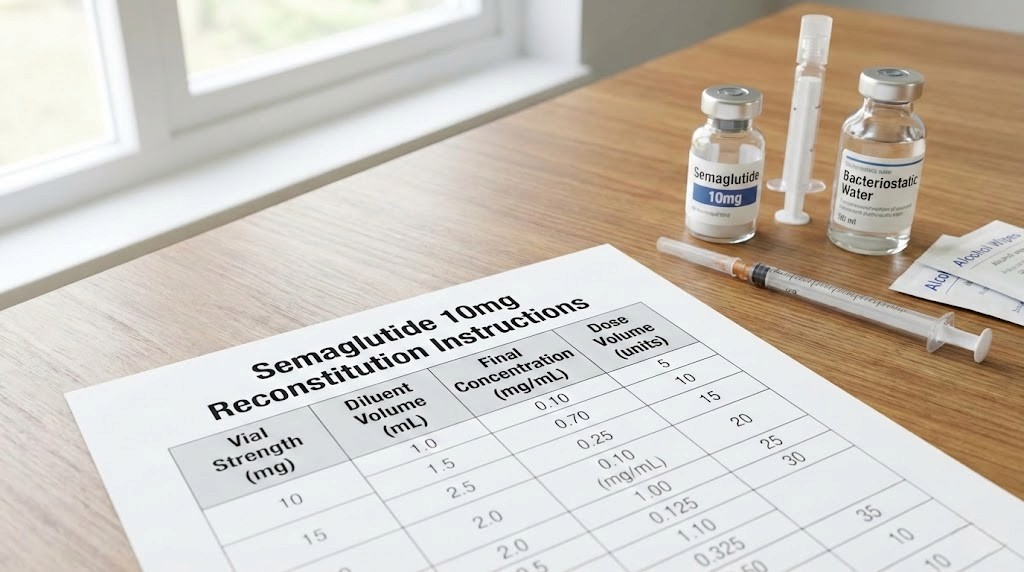
Get the water volume wrong on a 10mg semaglutide vial and you have wasted roughly 40% of your peptide before you even draw the first dose. That is not an exaggeration. The concentration changes everything, from the number of units you pull on an insulin syringe to how many weeks a single vial will actually last. Most reconstitution guides online give you a single water volume and call it a day. They skip the math, ignore the context, and leave you guessing when the syringe markings do not match the chart you found on some forum at two in the morning.
This guide does not do that.
Here you will find every practical reconstitution scenario for a 10mg semaglutide vial, complete concentration tables for different bacteriostatic water volumes, exact syringe unit conversions for every standard dose, a full titration schedule from 0.25mg through 2.4mg, storage timelines, and the specific mistakes that ruin potency before you finish your first month. Whether you are reconstituting your first vial or your fiftieth, the charts below give you the numbers you need without the guesswork. SeekPeptides built this reference so you never have to do the math on scratch paper again.
What semaglutide reconstitution actually means
Semaglutide arrives as a lyophilized powder, a freeze-dried cake sitting at the bottom of a sterile glass vial. In this form it is stable, lightweight, and easy to ship. But you cannot inject powder. You need to add a precise volume of liquid, usually bacteriostatic water, to dissolve the peptide back into an injectable solution. That process is reconstitution.
Simple enough in theory. The complexity comes from one decision: how much water you add.
Add 2mL of bacteriostatic water to a 10mg vial and you get a concentration of 5mg/mL. Add 4mL and you get 2.5mg/mL. Add 10mL and you get 1mg/mL. Each concentration changes how many units you draw on your syringe for every single dose. Get the concentration wrong and you are either under-dosing, over-dosing, or wondering why the numbers on your syringe do not match anything you have read online.
This is why charts matter.
A proper semaglutide reconstitution chart eliminates the mental arithmetic. You look up your water volume, find your target dose, and read the exact number of syringe units. No calculator required. No margin for error on a Tuesday morning when your brain has not fully woken up yet.
Why the 10mg vial is different from 5mg
Most online reconstitution guides focus on 5mg semaglutide vials because that was the standard research size for years. The 10mg vial changes the math entirely. You have twice the peptide, which means you can use the same water volumes and get double the concentration, or you can add more water to keep the concentration manageable. Either approach works. The choice depends on your dosing schedule, your syringe precision, and how long you want a single vial to last.
A 10mg vial at the standard titration schedule of 0.25mg to 2.4mg weekly can last anywhere from 4 weeks to 40 weeks depending on which dose you are on. That is a massive range. Understanding the reconstitution math is not optional, it is the difference between running out of peptide mid-cycle and having plenty to complete a full weight loss protocol.
The role of bacteriostatic water
You will see two options discussed online: bacteriostatic water (BAC water) and sterile water for injection. For a 10mg semaglutide vial, bacteriostatic water is the correct choice. It contains 0.9% benzyl alcohol, which acts as a preservative and prevents bacterial growth after reconstitution. Sterile water lacks this preservative, meaning your solution has a much shorter usable window.
With BAC water, reconstituted semaglutide remains stable for up to 28 days when refrigerated at 2-8 degrees Celsius (36-46 degrees Fahrenheit). Sterile water cuts that timeline dramatically. For a 10mg vial that you plan to use over multiple weeks, the preservative is not a luxury. It is a necessity.
Complete reconstitution chart: 10mg semaglutide with different water volumes
This is the chart you came here for. Every common water volume, the resulting concentration, and the math that connects them.
Water volume added | Final concentration | Units per 0.25mg dose | Units per 0.5mg dose | Units per 1mg dose | Units per 2mg dose | Units per 2.4mg dose |
|---|---|---|---|---|---|---|
1mL | 10mg/mL | 2.5 units | 5 units | 10 units | 20 units | 24 units |
2mL | 5mg/mL | 5 units | 10 units | 20 units | 40 units | 48 units |
3mL | 3.33mg/mL | 7.5 units | 15 units | 30 units | 60 units | 72 units |
4mL | 2.5mg/mL | 10 units | 20 units | 40 units | 80 units | 96 units |
5mL | 2mg/mL | 12.5 units | 25 units | 50 units | 100 units | N/A (exceeds 1mL syringe) |
8mL | 1.25mg/mL | 20 units | 40 units | 80 units | N/A | N/A |
10mL | 1mg/mL | 25 units | 50 units | 100 units | N/A | N/A |
The formula behind this chart is straightforward: Units = (desired dose in mg / concentration in mg per mL) x 100. Every cell in the table above uses that single equation. Once you know it, you can calculate any dose at any concentration without needing a chart at all.
But charts are faster. And faster means fewer mistakes.
Why 2mL is the most popular choice
Adding 2mL of bacteriostatic water to a 10mg vial gives you a concentration of 5mg/mL. This is the sweet spot for most people and here is why. At 5mg/mL, your starting dose of 0.25mg requires just 5 units on an insulin syringe. That is easy to measure accurately. Your maintenance dose of 1mg requires 20 units. Still easy. Even the maximum dose of 2.4mg only needs 48 units, which is well under the 100-unit capacity of a standard insulin syringe.
The 2mL reconstitution also means your total solution volume stays small. Less volume in the vial means less dead space, less waste when you draw, and a more concentrated solution that is simpler to work with. For anyone using a 10mg vial dosage chart alongside their protocol, the 2mL option keeps the math clean.
When to choose 3mL or 4mL instead
Higher water volumes produce lower concentrations. Lower concentrations require more units per dose. More units means easier measurement for low doses. If you are in the early titration phase, spending weeks at 0.25mg, a 2.5 unit dose can be frustrating to measure precisely on a standard 100-unit insulin syringe. The markings are simply too close together.
Reconstituting with 4mL gives you 2.5mg/mL. Now your 0.25mg starting dose is 10 units, which is much easier to see and measure accurately. The trade-off is that higher doses require more volume. At 2.4mg, you would need 96 units, almost filling an entire 1mL syringe. If you plan to stay on lower doses for an extended period, the 4mL reconstitution makes practical sense. If you know you will titrate up to 2mg or beyond, stick with 2mL.
The 3mL option (3.33mg/mL) sits between both approaches. Your 0.25mg dose is 7.5 units, and your 2.4mg dose is 72 units. It works, but the 7.5-unit measurement falls between syringe markings, which introduces a tiny opportunity for imprecision.
Why 1mL reconstitution is risky for beginners
Some guides suggest adding just 1mL of water to maximize concentration at 10mg/mL. On paper, this seems efficient. In practice, it creates problems. Your 0.25mg starting dose would be only 2.5 units on a U-100 insulin syringe. That is an incredibly small volume, roughly 0.025mL. Even experienced researchers struggle to measure this accurately.
At such tiny volumes, the difference between 2 units and 3 units represents a 0.1mg dosing error, which is 40% of your target dose. For a peptide with a precise titration schedule, that margin of error is unacceptable. Unless you have access to specialized low-volume syringes (U-500 or similar), avoid the 1mL reconstitution.
Step-by-step reconstitution process for 10mg semaglutide
Reading a chart is one thing. Actually reconstituting the vial is another. Here is the exact process, step by step, with the specific details that generic guides leave out.
Supplies you need before starting
Gather everything first. Do not start the process and then realize you forgot something halfway through.
10mg semaglutide lyophilized vial (check the label, confirm the weight)
Bacteriostatic water (30mL vial is standard, gives you plenty for multiple reconstitutions)
Insulin syringes (U-100, either 0.5mL or 1mL capacity depending on your dose range)
Alcohol swabs (individually wrapped, sterile)
Mixing syringe (a 3mL or 5mL syringe with needle for drawing and injecting the water)
Clean, flat surface
Label or marker for dating the vial
The reconstitution steps
Step 1: Clean everything. Swab the rubber stopper on both the semaglutide vial and the bacteriostatic water vial with alcohol pads. Let them air dry for 10 seconds. Do not blow on them.
Step 2: Draw the water. Using your mixing syringe, draw your chosen volume of bacteriostatic water. If you decided on 2mL, draw exactly 2mL. Air bubbles in the syringe will throw off your measurement, so tap the syringe barrel and push them out before proceeding. For precise water measurement, refer to our peptide reconstitution calculator for confirmation.
Step 3: Inject the water slowly. Insert the needle into the semaglutide vial through the rubber stopper. Here is the critical detail: aim the needle toward the glass wall of the vial, not directly at the powder. Slowly depress the plunger and let the water roll down the inside wall. This prevents the force of the stream from damaging the peptide and minimizes foaming.
Rushing this step creates bubbles that trap peptide and make the solution harder to mix. Take 15 to 20 seconds to inject the full volume. Patience here saves potency later.
Step 4: Mix gently. Do not shake the vial. Ever. Vigorous shaking creates mechanical stress that can denature the peptide, breaking the molecular structure that makes semaglutide work. Instead, gently swirl the vial in small circles. Tilt it slowly from side to side. Some people roll it between their palms. The goal is a completely clear solution with no visible particles or undissolved powder.
If the powder does not dissolve within 2 to 3 minutes of gentle swirling, let the vial sit at room temperature for 5 minutes and try again. Do not force it. Do not add more water. The peptide will dissolve.
Step 5: Inspect the solution. Hold the vial up to a light source. The liquid should be clear and colorless. If you see particles floating, cloudiness, or discoloration, something went wrong. Do not use a cloudy solution. A properly reconstituted semaglutide vial will look like plain water.
Step 6: Label and store. Write today's date on the vial. This is your day-zero reference. You have 28 days of usable shelf life from this moment, assuming proper refrigeration. Store the vial upright in the refrigerator at 2-8 degrees Celsius. Do not freeze it. Do not leave it on the counter.
Common reconstitution mistakes that destroy potency
The peptide research community has documented the same handful of errors over and over again. Here are the ones that matter most for semaglutide.
Shaking the vial. This is the number one mistake. Semaglutide is a 31-amino-acid peptide with a fatty acid side chain that enables its long half-life. Aggressive shaking causes denaturation through mechanical stress, aggregation of the peptide molecules, and foaming that traps active compound. One hard shake probably will not ruin the entire vial. Repeated shaking over multiple draw sessions will measurably reduce potency. Just swirl.
Spraying water directly onto the powder. The force of the water stream hitting the lyophilized cake can damage the peptide structure. Always aim for the vial wall and let gravity do the work. This is especially important with 10mg vials because the cake is larger and more tightly packed than in smaller vials.
Using the wrong type of water. Tap water, distilled water, and saline are all wrong. Bacteriostatic water is the correct choice for any multi-use vial. The benzyl alcohol preservative prevents bacterial contamination over the 28-day use window. Using sterile water without the preservative means you should ideally use the entire vial in a single session, which is impractical for a 10mg vial on a titration schedule.
Incorrect water measurement. Air bubbles in your mixing syringe throw off the volume. A 0.2mL error in a 2mL reconstitution changes your concentration by 10%. That 10% error cascades into every single dose you draw for the life of that vial. Take the extra 30 seconds to eliminate air bubbles before injecting.
Temperature abuse. Leaving the reconstituted vial on a kitchen counter for a few hours will not immediately destroy it, but repeated temperature excursions add up. Research on semaglutide stability shows accelerated degradation at temperatures above 25 degrees Celsius, with significant potency loss at 40 degrees and near-complete degradation at 60 degrees after 28 days. Keep it cold. Always.
Syringe unit conversion charts for every standard dose
Once your vial is reconstituted, you need to know exactly how many units to draw for each dose. This section gives you complete conversion tables for the three most common reconstitution volumes.
Chart A: 10mg reconstituted with 2mL (5mg/mL concentration)
Weekly dose | Volume to draw | Units on U-100 syringe | Typical phase | Duration at this dose |
|---|---|---|---|---|
0.25mg | 0.05mL | 5 units | Week 1-4 | 4 weeks minimum |
0.5mg | 0.10mL | 10 units | Week 5-8 | 4 weeks minimum |
1.0mg | 0.20mL | 20 units | Week 9-12 | 4 weeks minimum |
1.7mg | 0.34mL | 34 units | Week 13-16 | 4 weeks minimum |
2.0mg | 0.40mL | 40 units | Maintenance | Ongoing |
2.4mg | 0.48mL | 48 units | Maximum dose | Ongoing |
At this concentration, a single 10mg vial contains exactly 2mL of solution. During the 0.25mg phase, each dose uses 0.05mL, meaning the vial provides 40 doses, enough for 40 weeks of injections. At the 2.4mg maximum dose, each injection uses 0.48mL, giving you approximately 4 weekly doses from a single vial. This range shows exactly why understanding your concentration matters for planning.
Chart B: 10mg reconstituted with 3mL (3.33mg/mL concentration)
Weekly dose | Volume to draw | Units on U-100 syringe | Typical phase |
|---|---|---|---|
0.25mg | 0.075mL | 7.5 units | Week 1-4 |
0.5mg | 0.15mL | 15 units | Week 5-8 |
1.0mg | 0.30mL | 30 units | Week 9-12 |
1.7mg | 0.51mL | 51 units | Week 13-16 |
2.0mg | 0.60mL | 60 units | Maintenance |
2.4mg | 0.72mL | 72 units | Maximum dose |
The 3mL reconstitution gives you slightly more volume to work with on low doses, making the 7.5-unit measurement more visible than 5 units. The downside is that 7.5 falls between the marked lines on most syringes. You need to estimate the halfway point between 7 and 8. This is manageable but introduces minor imprecision.
Chart C: 10mg reconstituted with 4mL (2.5mg/mL concentration)
Weekly dose | Volume to draw | Units on U-100 syringe | Typical phase |
|---|---|---|---|
0.25mg | 0.10mL | 10 units | Week 1-4 |
0.5mg | 0.20mL | 20 units | Week 5-8 |
1.0mg | 0.40mL | 40 units | Week 9-12 |
1.7mg | 0.68mL | 68 units | Week 13-16 |
2.0mg | 0.80mL | 80 units | Maintenance |
2.4mg | 0.96mL | 96 units | Maximum dose |
The 4mL option produces clean, round numbers at every standard dose level. Ten units for 0.25mg. Twenty for 0.5mg. Forty for 1mg. If measurement accuracy is your top priority, especially during the early titration weeks, this is the cleanest option. The trade-off is volume. At 2.4mg per week, you are drawing nearly the entire capacity of a 1mL insulin syringe. Not impossible, but tight.
Choosing the right syringe for your concentration
Not all insulin syringes are created equal. The two common sizes are 0.5mL (50-unit) and 1mL (100-unit). Your reconstitution volume determines which one you should use.
If you reconstituted with 2mL (5mg/mL): A 0.5mL syringe works perfectly for doses up to 1mg (20 units). For doses above 1mg, switch to a 1mL syringe. The 2.4mg dose at 48 units fits comfortably in either size, though the 1mL syringe gives you more room.
If you reconstituted with 4mL (2.5mg/mL): You need a 1mL syringe for any dose above 0.5mg. The 0.5mL syringe can only handle the first two titration doses (10 and 20 units). For your syringe dosage conversion, the 1mL is the safer bet.
Smaller syringes have finer graduation marks, meaning each line represents a smaller volume. This improves accuracy for low doses. Use the smallest syringe that fits your dose.
The complete semaglutide titration schedule from a 10mg vial
Reconstitution is only half the equation. The other half is knowing how to dose properly over time. Semaglutide uses a gradual titration protocol, meaning you start at a low dose and increase it in steps over several months. This approach minimizes side effects, particularly the gastrointestinal symptoms that hit hardest when you jump straight to a therapeutic dose.
Standard titration protocol
Phase | Weekly dose | Duration | Purpose |
|---|---|---|---|
Loading | 0.25mg | Weeks 1-4 | GI adaptation, receptor sensitization |
Escalation 1 | 0.5mg | Weeks 5-8 | Begin appetite suppression |
Escalation 2 | 1.0mg | Weeks 9-12 | Therapeutic range entry |
Escalation 3 | 1.7mg | Weeks 13-16 | Enhanced efficacy |
Maximum | 2.4mg | Week 17+ | Full therapeutic dose |
Each escalation step lasts a minimum of four weeks. Some researchers extend individual phases to six or eight weeks if side effects are pronounced. There is no benefit to rushing. The GLP-1 receptor needs time to adapt, and your gastrointestinal tract needs time to adjust to delayed gastric emptying.
If you experience significant nausea, vomiting, or diarrhea at any dose level, stay at that dose for an additional four weeks before attempting the next increase. Some people find their optimal dose at 1mg or 1.7mg and never need to reach 2.4mg. The maximum dose is a ceiling, not a requirement.
How long does a 10mg vial last at each dose?
This is the practical question everyone asks. Here is the answer, calculated for the 2mL reconstitution (5mg/mL).
Weekly dose | Amount used per week | Weeks per 10mg vial | Months per vial |
|---|---|---|---|
0.25mg | 0.25mg | 40 weeks | ~10 months |
0.5mg | 0.5mg | 20 weeks | ~5 months |
1.0mg | 1.0mg | 10 weeks | ~2.5 months |
1.7mg | 1.7mg | ~5.9 weeks | ~1.5 months |
2.0mg | 2.0mg | 5 weeks | ~1.25 months |
2.4mg | 2.4mg | ~4.2 weeks | ~1 month |
Here is the catch. Reconstituted semaglutide has a maximum shelf life of 28 days when refrigerated with bacteriostatic water. If your vial lasts longer than 28 days at your current dose, you cannot use the remaining solution. It must be discarded.
This means at 0.25mg per week, you will only use 1mg of the 10mg in the vial before the 28-day window closes. The remaining 9mg is wasted. At 0.5mg per week, you use 2mg and waste 8mg.
The solution? Only reconstitute what you can use within 28 days. For the early titration phases, consider purchasing 5mg vials instead, or reconstituting with the minimum water volume needed and planning your doses accordingly.
Minimizing waste during titration
Waste is the biggest practical problem with 10mg vials during early dosing. Here are three strategies that experienced researchers use.
Strategy 1: Start with a 5mg vial. Use a 5mg vial for weeks 1 through 8 (the 0.25mg and 0.5mg phases). At 0.25mg per week for 4 weeks plus 0.5mg for 4 weeks, you use exactly 3mg. Still some waste, but far less than with a 10mg vial. Switch to the 10mg vial when you reach the 1mg dose, where the math works better.
Strategy 2: Share the timeline. If you are managing multiple research subjects, stagger reconstitution dates so the vial is fully used within the 28-day window. This only applies to research settings with multiple subjects on similar protocols.
Strategy 3: Reconstitute partially. Some researchers add only enough water to cover their 28-day needs. For example, at 0.25mg per week, you need 1mg over 28 days. You could reconstitute with just 0.2mL of water (creating a 5mg/mL concentration in a tiny volume), draw your weekly doses, and then reconstitute the remaining powder later. This is technically possible but introduces risks: opening and closing the vial multiple times increases contamination chances, and the powder may not dissolve as cleanly the second time.
The cleanest approach remains Strategy 1. Use 5mg vials for low-dose phases. Save the 10mg vials for when your weekly dose justifies the larger volume.
Understanding the math behind the charts
If you want to verify any number in this guide, or calculate doses for non-standard scenarios, you need three formulas. Just three. They cover every possible reconstitution and dosing situation.
Formula 1: Concentration
Concentration (mg/mL) = Total peptide (mg) / Total water volume (mL)
Example: 10mg peptide with 2mL water = 10/2 = 5mg/mL.
This tells you how much semaglutide is in every milliliter of your reconstituted solution.
Formula 2: Volume per dose
Volume to draw (mL) = Desired dose (mg) / Concentration (mg/mL)
Example: 0.5mg dose at 5mg/mL concentration = 0.5/5 = 0.10mL.
This tells you the physical volume of liquid you need to inject.
Formula 3: Syringe units
Units on U-100 syringe = Volume (mL) x 100
Example: 0.10mL x 100 = 10 units.
This converts the volume into the markings you actually read on your insulin syringe. A U-100 insulin syringe means there are 100 units per 1mL. So 10 units = 0.10mL. Fifty units = 0.50mL. Simple division.
You can combine all three formulas into one: Units = (Desired dose / Concentration) x 100. Or even simpler for a 10mg vial: Units = (Desired dose x Water volume x 100) / 10.
Let us walk through a real example. You have a 10mg vial reconstituted with 3mL of bacteriostatic water. You want to inject 1.7mg.
Concentration = 10mg / 3mL = 3.33mg/mL. Volume = 1.7mg / 3.33mg/mL = 0.51mL. Units = 0.51mL x 100 = 51 units.
Check the Chart B table above. It matches exactly. You can use the semaglutide dosage calculator on SeekPeptides to verify any calculation instantly.
The units-to-milligrams confusion
This trips up more people than any other aspect of semaglutide dosing. Units on an insulin syringe are not a universal measurement of drug amount. They are a measurement of volume. On a U-100 syringe, 1 unit = 0.01mL. That is it. The number of milligrams in those units depends entirely on the concentration of your solution.
Twenty units from a 5mg/mL vial contains 1mg of semaglutide. Twenty units from a 2.5mg/mL vial contains only 0.5mg. Same syringe reading, completely different dose. This is why you must know your concentration. Writing it on the vial label right after reconstitution prevents dangerous mix-ups later. For a deeper breakdown, see our guide on how many mg is 50 units of semaglutide.
Storage after reconstitution: what the research says
You have reconstituted your 10mg vial perfectly. The solution is crystal clear. Now you need to keep it that way for up to 28 days. Storage is not complicated, but the details matter more than most people realize.
Temperature requirements
Reconstituted semaglutide must be stored at 2-8 degrees Celsius (36-46 degrees Fahrenheit). That is standard refrigerator temperature. Not the freezer. Not the door shelf (which fluctuates with every opening). The main body of the refrigerator, ideally in a dedicated spot where it will not get knocked around.
Research published in the Journal of Peptide Science examined semaglutide stability across multiple temperature conditions. At 25 degrees Celsius (room temperature), degradation accelerates measurably. At 40 degrees, degradation becomes significant within days. At 60 degrees, the peptide breaks down rapidly. The practical takeaway: every hour your vial spends above 8 degrees Celsius costs you potency. Brief excursions during injection prep are fine. Leaving it on the bathroom counter for an afternoon is not.
If you are traveling and need to transport your reconstituted semaglutide, use an insulated case with a cold pack. Avoid direct contact between the vial and the ice pack (freezing is just as damaging as overheating). A simple lunch-style cooler bag works for trips under 8 hours.
Light exposure
Semaglutide is sensitive to light, particularly UV radiation and direct sunlight. The amber glass used in some pharmaceutical vials provides partial protection. Clear glass vials, which are common with lyophilized research peptides, offer none. Store the vial in its original box or wrap it in aluminum foil if your refrigerator has an interior light that stays on frequently.
Light-induced degradation happens through oxidation of the amino acid residues in the peptide chain. The fatty acid modification on semaglutide (the C18 di-acid that enables its long half-life through albumin binding) is particularly susceptible to oxidative damage. Protect the vial from light and you protect the very modification that makes semaglutide different from other GLP-1 peptides.
The 28-day rule
Twenty-eight days after reconstitution, discard any remaining solution. This is not a guideline. It is a hard rule. Bacteriostatic water suppresses bacterial growth, it does not eliminate it forever. After 28 days, the preservative capacity diminishes, the peptide itself has undergone some natural degradation, and the risk-benefit ratio shifts firmly toward using a fresh vial.
Mark the discard date on your vial when you reconstitute. Not the reconstitution date. The discard date. Four weeks from today. When that date arrives, whatever is left goes in the trash. No exceptions. No "it still looks clear so it is probably fine" rationalizations. Understanding semaglutide expiration timelines keeps your protocol both safe and effective.
Signs your reconstituted semaglutide has gone bad
Even within the 28-day window, certain visual cues indicate degradation.
Cloudiness or haziness. Fresh semaglutide solution is completely clear and colorless. Any cloudiness suggests protein aggregation or bacterial contamination. Discard immediately.
Visible particles. Floaters, specks, or filaments in the solution mean something has precipitated out or contamination has occurred. Do not filter and reuse. Discard.
Color changes. A yellow or brown tint indicates oxidative degradation of the peptide. The fatty acid chain is likely compromised. Discard.
Unusual smell. Bacteriostatic water has a faint benzyl alcohol odor. If the solution smells off, sour, or different from when you reconstituted it, contamination is likely. Discard.
When in doubt, throw it out. A new vial is always cheaper than the consequences of injecting degraded or contaminated solution. For comprehensive peptide storage guidance, review our dedicated storage guide.
How semaglutide works: why reconstitution quality matters
Understanding the mechanism helps explain why proper reconstitution is not just a best practice but a necessity for results.
Semaglutide is a GLP-1 receptor agonist, a synthetic peptide that mimics the glucagon-like peptide-1 hormone naturally produced in the gut. When you eat, your intestines release GLP-1, which signals the pancreas to produce insulin, tells the brain you are full, and slows gastric emptying so food sits in your stomach longer. Natural GLP-1 has a half-life of about 2 minutes because enzymes called DPP-4 break it down almost immediately.
Semaglutide solves that problem with two structural modifications. The first is a fatty acid chain (specifically a C18 di-acid linked through a gamma-glutamic acid and two OEG spacers) that binds to albumin in the blood. This albumin binding shields the peptide from kidney filtration and dramatically extends its circulation time. The second modification protects a specific amino acid position from DPP-4 cleavage. Together, these changes extend the half-life from 2 minutes to approximately 7 days, which is why semaglutide works as a once-weekly injection.
Here is why this matters for reconstitution. Both modifications are fragile relative to the overall molecule. The fatty acid chain can detach through oxidation (accelerated by light and heat). The DPP-4 protection can be compromised by denaturation (caused by mechanical stress like shaking). If either modification fails, you still have an injectable peptide, but it degrades in the body much faster, producing weaker and shorter-lived effects.
Poor reconstitution does not make semaglutide completely inactive. It makes it less effective. And because the degradation is invisible, you cannot tell by looking at the vial whether you have lost 5% potency or 50%. The only protection is doing it right every time. Proper technique is what separates consistent results from inconsistent ones, and SeekPeptides members understand this distinction better than most.
Comparing reconstitution approaches: which is right for you?
Not everyone has the same priorities. Some people value measurement accuracy above all else. Others want to minimize waste. Some want the simplest possible protocol with the fewest decisions. Here is a side-by-side comparison to help you choose.
Factor | 2mL reconstitution (5mg/mL) | 3mL reconstitution (3.33mg/mL) | 4mL reconstitution (2.5mg/mL) |
|---|---|---|---|
Low-dose accuracy | Moderate (5 units for 0.25mg) | Moderate (7.5 units, between markings) | Best (10 units for 0.25mg) |
High-dose practicality | Best (48 units for 2.4mg) | Good (72 units for 2.4mg) | Tight (96 units for 2.4mg) |
Vial dead space | Minimal | Moderate | More significant |
Solution longevity | 28 days (same for all) | 28 days | 28 days |
Best for | Full titration through maximum dose | Mid-range dosing (0.5mg to 2mg) | Extended low-dose phases |
Syringe needed | 0.5mL or 1mL | 1mL | 1mL only |
Overall rating | 9/10 (most versatile) | 7/10 (good compromise) | 8/10 (best for low doses) |
For most researchers planning a full titration from 0.25mg through 2.4mg, the 2mL reconstitution is the most practical choice. It keeps all doses within a comfortable syringe range, minimizes wasted solution volume, and provides adequate measurement accuracy at every dose level. If you are specifically concerned about low-dose accuracy during weeks 1 through 8, the 4mL reconstitution gives you cleaner numbers at the cost of higher-dose inconvenience.
There is no wrong answer here. Any reconstitution volume that gives you a measurable dose on your syringe is a valid approach. The wrong answer is guessing. Use the charts. Do the math. Or let the reconstitution calculator do it for you.
Advanced considerations for experienced researchers
If you have reconstituted peptides before, you already know the basics. This section covers the details that separate adequate protocols from optimized ones.
pH and buffer considerations
Recent preformulation research examined semaglutide stability across different pH ranges, buffer types, molarities, and temperatures. The findings revealed that semaglutide was relatively stable at pH 1.2 but showed higher degradation between pH 4.5 and 5.5. This is significant because the isoelectric point of semaglutide falls at approximately pH 5.4, where the peptide has zero net charge and is most prone to aggregation.
Bacteriostatic water typically has a pH between 4.5 and 7.0, depending on the manufacturer. For optimal stability, the research suggests a finished product pH above 7.0. Most researchers do not have the equipment to measure or adjust pH at home, but you can optimize by choosing bacteriostatic water from reputable manufacturers that provide certificates of analysis with pH values. Higher pH within the safe range generally means better semaglutide stability.
Syringe dead space and cumulative waste
Every time you draw from a reconstituted vial, a tiny amount of solution remains in the syringe needle and hub. This is called dead space, and it typically ranges from 0.02mL to 0.07mL depending on the syringe and needle combination. Over 20 draws from a single vial (common during the low-dose titration phase), dead space waste can total 0.4mL to 1.4mL of solution.
At 5mg/mL concentration, 1mL of wasted solution equals 5mg of wasted semaglutide, half the vial. Low dead-space syringes exist and are worth seeking out for peptide use. They use a different plunger design that minimizes the residual volume. The extra cost per syringe is trivial compared to the peptide they save.
Combining with B12 or other compounds
Some compounded semaglutide formulations include vitamin B12 (cyanocobalamin) or L-carnitine. If you are working with a 10mg semaglutide vial that already contains B12, the reconstitution process is identical. The additional compound dissolves alongside the semaglutide. The presence of B12 does not change the concentration calculations, because the dosing charts reference semaglutide content specifically, not total vial content.
For a comprehensive look at semaglutide with B12 combinations, including B12 dosage charts and compounded semaglutide with B12 dosage references, we have dedicated guides covering every scenario.
Transitioning between vial sizes
If you start with a 5mg vial and switch to 10mg, remember that the concentration changes unless you adjust your water volume proportionally. A 5mg vial with 2mL water gives 2.5mg/mL. A 10mg vial with 2mL water gives 5mg/mL, double the concentration. The same number of syringe units now delivers twice the dose.
This is the single most dangerous error in peptide research: changing vial sizes without recalculating concentrations. Write the concentration on every vial. Verify it before every draw. If you are switching from 5mg vial protocols to 10mg, recalculate everything from scratch using the charts in this guide.
Semaglutide 10mg vs. other vial sizes
Context matters. Here is how the 10mg vial compares to other common sizes in terms of reconstitution, practicality, and cost-efficiency.
Factor | 3mg vial | 5mg vial | 10mg vial |
|---|---|---|---|
Best for dose range | 0.25mg only | 0.25mg to 1mg | 1mg to 2.4mg |
Weeks per vial at 0.25mg | 12 weeks | 20 weeks | 40 weeks |
Weeks per vial at 2.4mg | 1.25 weeks | ~2 weeks | ~4 weeks |
28-day waste at 0.25mg | 2mg wasted | 4mg wasted | 9mg wasted |
28-day waste at 2.4mg | None (used in 9 days) | Minimal | Minimal |
Cost per mg (typical) | Highest | Middle | Lowest |
Practical recommendation | Loading phase only | Titration phases | Maintenance dose |
The 10mg vial offers the best cost-per-milligram ratio, making it the most economical choice for higher maintenance doses. But economy only matters if you actually use the peptide before it expires. The optimal strategy for most researchers is a mix: smaller vials during titration (when weekly usage is low and waste is high) and 10mg vials once weekly dosing reaches 1mg or above (when a vial can be consumed within the 28-day window).
For complete dosage references across all vial sizes, the peptide dosage chart provides a unified view. You can also cross-reference with the semaglutide mixing chart for quick volume lookups and the 10mg specific mixing chart for detailed 10mg scenarios.
Injection technique after reconstitution
Getting the reconstitution perfect means nothing if your injection technique introduces problems. This section covers what happens between drawing the dose and pushing the plunger.
Drawing from the vial
Pull back the plunger of your insulin syringe to your target unit marking, filling the barrel with air equal to the dose volume. Insert the needle through the rubber stopper and inject this air into the vial. This equalizes pressure and makes drawing the solution easier. Invert the vial and pull the plunger back past your target dose, then push it forward to the exact marking while tapping out any air bubbles.
The air injection step prevents a vacuum from forming inside the vial, which becomes progressively more noticeable as you use up the solution. By the last few draws, the negative pressure inside the vial makes it noticeably harder to pull solution without injecting air first.
Eliminating air bubbles
Air bubbles in your syringe reduce the actual dose. A 5-unit bubble in a 20-unit draw means you are only injecting 15 units of solution, a 25% under-dose. After drawing your dose, hold the syringe needle-up and flick the barrel gently to move bubbles to the top. Push the plunger slightly to expel the air, then adjust back to your target dose marking.
This sounds tedious. It takes about 10 seconds. It is the difference between a precise dose and a random one.
Subcutaneous injection sites
Semaglutide is injected subcutaneously, meaning into the fat layer between your skin and muscle. Common injection sites include the abdomen (2 inches from the navel), the front of the thigh, and the upper arm. Rotate between sites weekly to prevent lipodystrophy (changes in fat tissue at repeated injection sites).
Pinch a fold of skin between your thumb and index finger. Insert the needle at a 45 to 90 degree angle (90 degrees for areas with more subcutaneous fat, 45 degrees for leaner areas). Push the plunger slowly and steadily. Hold for 5 to 10 seconds after the plunger is fully depressed to ensure the full dose is delivered. Remove the needle and release the skin fold.
Do not rub the injection site afterward. Do not apply ice before the injection (it can affect absorption). Do not inject into bruised, scarred, or hardened skin. For a complete overview of injection methods, see our peptide injections guide and what is a peptide injection for foundational context.
Troubleshooting common problems
Even with a perfect chart in front of you, things go sideways sometimes. Here are the most common issues and their solutions.
The powder will not dissolve
If gentle swirling for 2 to 3 minutes does not produce a clear solution, do not panic. Let the vial sit upright in the refrigerator for 15 to 30 minutes, then try again. Some lyophilized peptides need time for the water to fully penetrate the compressed cake. Adding more water is not the answer because it changes your concentration and invalidates your dosing charts.
If the powder still will not dissolve after 30 minutes of intermittent gentle swirling, the vial may have been compromised during shipping (temperature excursion) or storage. Contact your supplier.
You added too much water
It happens. You meant to add 2mL and pushed 3mL. Your concentration is now 3.33mg/mL instead of 5mg/mL. This is not a disaster. Recalculate all your doses using the new concentration. Use Chart B from this guide instead of Chart A. Label the vial with the actual concentration (3.33mg/mL, not 5mg/mL). Every dose will require more units, but the peptide itself is unaffected.
Do not try to remove water from the vial. You cannot reverse reconstitution. Work with the concentration you have and adjust your charts accordingly.
You forgot how much water you added
If you did not label the vial and cannot remember the reconstitution volume, you have a problem. There is no way to determine the concentration from a reconstituted vial by visual inspection. The solution looks the same at 2mg/mL as it does at 5mg/mL.
The safest option is to discard the vial and start fresh with a new one. The cost of one wasted vial is less than the cost of weeks of incorrect dosing. This is why labeling immediately after reconstitution is not a recommendation but a requirement. Write the date, the water volume, and the concentration. Every single time.
You notice bubbles in the vial
Small bubbles clinging to the inside of the vial after reconstitution are normal, especially if you injected the water slightly too fast. They will dissipate on their own within an hour. Large foam on top of the solution indicates the water was injected too aggressively or the vial was shaken. Let it sit undisturbed for 30 minutes. The foam will settle. The peptide beneath is likely fine as long as the vial was not violently shaken.
The solution turns cloudy after a few days
Cloudiness that develops after initial reconstitution, not immediately, suggests either bacterial contamination (improper sterile technique during draws) or peptide aggregation (temperature excursion). In either case, discard the vial. Do not attempt to use it. Review your peptide storage practices and technique for the next vial.
Your dose does not match the chart
If the number of units you are drawing does not match any chart you can find online, the issue is almost always a concentration mismatch. Verify: what is the total peptide amount in the vial? What volume of water did you add? Divide the first by the second. That is your concentration. Now use Formula 3 from the math section above to calculate your exact dose in units. If it still does not match a published chart, the chart was probably written for a different vial size or water volume. Trust your math over someone else's chart. Or verify everything with the peptide calculator.
What to expect during the semaglutide titration protocol
The charts and formulas get you to the correct dose. But what actually happens when you start using semaglutide? Understanding the timeline helps you calibrate expectations and recognize normal versus concerning responses.
Weeks 1 through 4: the loading phase (0.25mg)
Most people feel very little at this dose. That is by design. The 0.25mg loading phase exists to let GLP-1 receptors upregulate and your gastrointestinal system adapt to delayed gastric emptying. You might notice mild appetite reduction. You might notice nothing at all. Both responses are normal.
Do not expect weight loss at 0.25mg. This is an adaptation dose, not a therapeutic one. Researchers who abandon their protocol during this phase because "it is not working" are making a mistake. The loading phase is the foundation. Skip it and the side effects at higher doses will be significantly worse.
Weeks 5 through 8: first escalation (0.5mg)
Appetite suppression becomes noticeable for most people at 0.5mg. You eat less without conscious effort. Portions that used to seem normal now feel like too much. Some people report changes in food preferences, with a decreased desire for high-fat or high-sugar foods. Mild nausea is the most common side effect at this stage, typically occurring in the first 24 to 48 hours after injection and resolving by day 3 or 4. For detailed guidance on what to expect, see how fast semaglutide works.
Weeks 9 through 12: therapeutic range (1mg)
One milligram is where most researchers begin to see meaningful results. Weight loss of 1 to 2 pounds per week is typical, driven primarily by reduced caloric intake from appetite suppression. The semaglutide results timeline shows that significant changes in body composition usually become visible around this point.
GI side effects may increase temporarily after each dose escalation. Nausea, constipation, and occasional diarrhea are the big three. They typically peak 24 to 72 hours after injection and diminish within a week. Eating smaller, more frequent meals and avoiding high-fat foods helps manage these symptoms.
Weeks 13 through 16: enhanced efficacy (1.7mg)
At 1.7mg, the dose-response curve steepens. Weight loss accelerates for many people. Appetite suppression is usually pronounced. Some researchers find this is their optimal maintenance dose and choose not to escalate further. If side effects are manageable and results are satisfactory, there is no requirement to reach 2.4mg.
Week 17 and beyond: maximum dose (2.4mg)
The 2.4mg dose represents the ceiling for standard semaglutide protocols. Clinical trials used this as the target dose for weight management, showing average weight loss of approximately 15% of body weight over 68 weeks. Not everyone tolerates 2.4mg. If side effects are intolerable, dropping back to 1.7mg or 2mg is perfectly acceptable.
If you are not losing weight on semaglutide at higher doses, the issue is rarely the dose itself. Diet, activity level, sleep, stress, and metabolic adaptation all play roles. The peptide suppresses appetite and slows gastric emptying. It does not override physics. If caloric intake is not in a deficit, weight loss will not occur regardless of dose.
Related peptide reconstitution references
Semaglutide is not the only peptide that requires careful reconstitution. If you work with multiple compounds, these guides follow the same detailed chart format.
For GLP-1 related protocols, the tirzepatide reconstitution chart covers reconstitution for the dual GIP/GLP-1 agonist, and the tirzepatide reconstitution guide provides step-by-step instructions. The retatrutide reconstitution chart covers the newer triple agonist that has drawn significant research interest.
For those comparing weight loss peptides, our semaglutide vs. tirzepatide comparison breaks down the differences in mechanism, dosing, and results. The tirzepatide vs semaglutide dosage chart puts the numbers side by side, and the semaglutide to tirzepatide dose conversion chart helps if you are switching between the two.
For dosing in units specifically, the semaglutide dosage in units conversion chart and the semaglutide dosing chart in units offer additional reference tables. The 20 units of semaglutide in mg and 40 units of semaglutide in mg guides answer the specific conversion questions that come up most frequently.
General reconstitution fundamentals are covered in how to reconstitute peptides, how to mix peptides with BAC water, and our free peptide reconstitution calculator guide. For calculating peptide dosages across any compound, the universal formula is the same one covered in this article.
And for bacteriostatic water volume guidance across all peptide types, not just semaglutide, we have a comprehensive reference that covers the decision-making process for every common research compound.
Frequently asked questions
How much bacteriostatic water do I add to a 10mg semaglutide vial?
The most common choice is 2mL, which creates a 5mg/mL concentration. This makes dosing straightforward on a standard U-100 insulin syringe, with 5 units equaling 0.25mg and 20 units equaling 1mg. You can add anywhere from 1mL to 10mL depending on your preferred concentration, but 2mL offers the best balance of accuracy and convenience. See the full 10mg semaglutide water volume guide for detailed options.
Can I use sterile water instead of bacteriostatic water?
Technically yes, but it is not recommended for a 10mg vial. Sterile water lacks the 0.9% benzyl alcohol preservative that prevents bacterial growth. Without it, the reconstituted solution must be used within hours rather than the 28 days you get with bacteriostatic water. Since a 10mg vial is designed for multi-week use, the preservative is essential.
How many units is 0.25mg of semaglutide from a 10mg vial?
It depends entirely on your reconstitution volume. With 2mL of water (5mg/mL), 0.25mg equals 5 units. With 4mL of water (2.5mg/mL), 0.25mg equals 10 units. With 3mL of water (3.33mg/mL), 0.25mg equals 7.5 units. Always know your concentration before drawing any dose. Our semaglutide dosage calculator can verify any combination instantly.
How long does reconstituted semaglutide last in the fridge?
Twenty-eight days when stored at 2-8 degrees Celsius with bacteriostatic water. After 28 days, discard any remaining solution regardless of appearance. This timeline is based on preservative effectiveness and peptide stability data. For more storage details, see how long semaglutide lasts in the fridge.
What happens if I accidentally shake the vial?
A single accidental shake is unlikely to cause significant damage. The concern with shaking is cumulative mechanical stress that denatures the peptide over time. If you shook the vial once, let it sit undisturbed for 30 minutes for any foam to settle, then continue use. If you have been shaking it vigorously before every draw for weeks, potency has likely been reduced. Swirl gently from now on.
Can I freeze reconstituted semaglutide to make it last longer?
No. Freezing causes ice crystal formation that physically damages the peptide structure. Even after thawing, the damaged molecules cannot regain their original conformation. A frozen and thawed vial may appear normal but will have reduced potency. If you need long-term storage, keep the peptide in its lyophilized (powder) form, which can remain stable for months when stored properly. See how long peptides last in powder form for specific timelines.
Is the 10mg vial more cost-effective than two 5mg vials?
Per milligram, yes. The 10mg vial almost always offers a lower price per mg than two separate 5mg vials. However, cost-effectiveness only applies if you use the peptide before it expires. During low-dose titration phases (0.25mg to 0.5mg per week), you will waste more from a 10mg vial than from a 5mg vial. The 10mg becomes genuinely more economical once your weekly dose reaches 1mg or higher. Use the peptide cost calculator to compare total costs for your specific protocol timeline.
Do I need different needle gauges for reconstitution versus injection?
Yes. Use an 18 to 21 gauge needle on your mixing syringe to draw bacteriostatic water and inject it into the vial. The larger bore prevents coring the rubber stopper and makes water transfer faster. For actual subcutaneous injections, use a 29 to 31 gauge insulin syringe needle. The smaller gauge minimizes discomfort and tissue trauma at the injection site. Never use the reconstitution needle for injection.
External resources
Semaglutide, a GLP-1 receptor agonist with cardiovascular benefits - PMC
The Discovery and Development of Liraglutide and Semaglutide - Frontiers in Endocrinology
For researchers serious about optimizing their semaglutide protocols, SeekPeptides provides the most comprehensive resource available, with evidence-based guides, proven reconstitution protocols, dosing calculators, and a community of thousands who have navigated these exact questions.
In case I do not see you, good afternoon, good evening, and good night. May your reconstitutions stay precise, your concentrations stay accurate, and your results stay consistent.