Feb 11, 2026
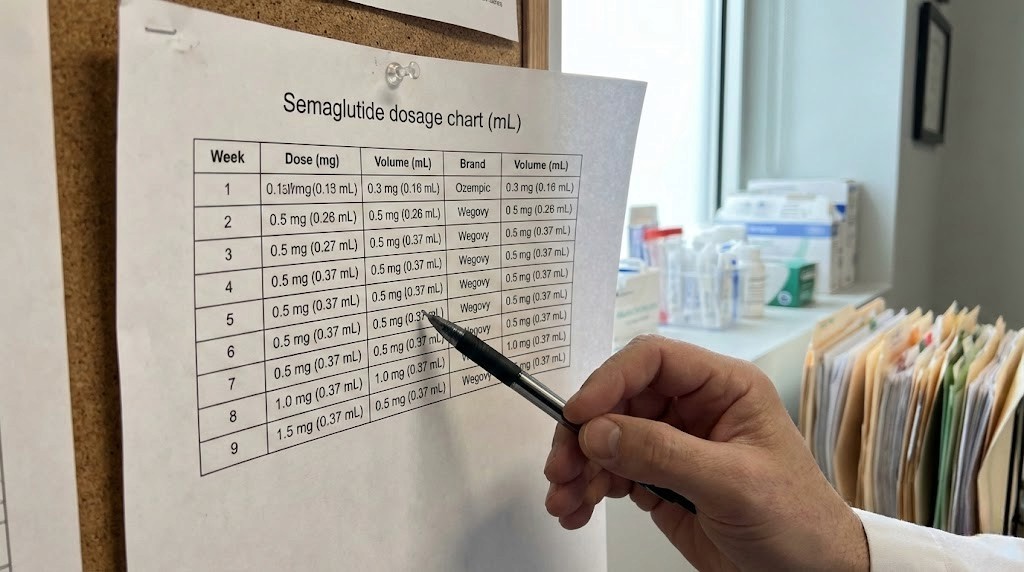
You have the vial. You have the syringe. You have the prescription. But the number your provider gave you is in milligrams, and the syringe in front of you measures in milliliters. That gap between what you were told and what you can actually measure has turned a simple weekly injection into a math problem that makes people nervous. Rightfully so. A dosing error with semaglutide does not just waste medication. It can trigger side effects that derail your progress for weeks, or it can deliver so little that you wonder why you started at all. The confusion multiplies when you realize that compounded semaglutide comes in different concentrations. A 5mg/ml vial requires a completely different milliliter measurement than a 2.5mg/ml vial for the exact same milligram dose. Get the concentration wrong, and you could inject double what you intended. Or half. Neither outcome is acceptable when you are investing in your health.
This guide eliminates that confusion entirely. Every concentration. Every dose level. Every milliliter measurement, laid out in clear charts you can reference before each injection. Whether you are starting at 0.25mg or titrating up to 2.4mg, whether your vial reads 2mg/ml or 10mg/ml, you will find the exact ml measurement here. No guessing. No improvised math at the kitchen counter with shaky hands. SeekPeptides has built these charts from verified conversion formulas so you can inject with confidence every single week. Accurate dosing is not optional. It is the foundation that everything else, the appetite suppression, the metabolic changes, the sustained weight loss, depends on completely.
The conversion formula you need to memorize
Before diving into the charts, understand the single formula that makes all of this work. It is simple. Once you know it, every concentration becomes manageable.
Volume in ml = Desired dose in mg divided by concentration in mg/ml
That is it. Three numbers. One division. The result tells you exactly how many milliliters to draw into your syringe.
Here is how it works in practice. If your provider prescribes 0.5mg and your vial concentration is 5mg/ml, you divide 0.5 by 5. The answer is 0.1ml. If your concentration is 2.5mg/ml instead, you divide 0.5 by 2.5. That gives you 0.2ml. Same dose, different volume, all because the concentration changed. This distinction matters enormously. People who skip this step and assume all vials work the same way end up with the wrong dose every single time. Understanding peptide dosage calculations is the first skill any researcher needs before touching a syringe.
The formula also connects to unit-based measurements. Since standard insulin syringes mark 100 units per 1ml, you can convert ml to units by multiplying by 100. So 0.1ml equals 10 units. And 0.2ml equals 20 units. Both measurement systems describe the same physical volume of liquid. They just use different scales on the syringe barrel.
Why concentration determines everything
Think of concentration like coffee strength. A double espresso and an Americano both contain coffee. But the espresso packs the same caffeine into a much smaller volume. Semaglutide concentrations work identically. A 10mg/ml vial is concentrated. You need very small volumes for each dose. A 2mg/ml vial is dilute. You need larger volumes for the same milligram amount.
This is why a universal dosage chart without specifying concentration is dangerous. Someone reading a chart built for 5mg/ml who actually has a 2.5mg/ml vial would inject half the intended dose. Someone doing the reverse would double it. Neither scenario is theoretical. These mistakes happen regularly, especially with compounded semaglutide where labeling varies between pharmacies. Always, always check your vial label before referencing any chart. The concentration printed on that label is the only number that matters for your specific calculation.
Semaglutide dosage chart in ml for 2mg/ml concentration
The 2mg/ml concentration is one of the most common formulations dispensed by compounding pharmacies. It requires the largest injection volumes among standard concentrations, which means precise syringe selection becomes especially important for smaller starting doses. If you are working with this concentration, a semaglutide dosage calculator can double-check your math before every injection.
Weekly dose (mg) | Volume (ml) | Insulin syringe units | Recommended syringe |
|---|---|---|---|
0.25mg | 0.125ml | 12.5 units | 0.3ml syringe |
0.5mg | 0.25ml | 25 units | 0.3ml or 0.5ml syringe |
1.0mg | 0.5ml | 50 units | 0.5ml or 1ml syringe |
1.7mg | 0.85ml | 85 units | 1ml syringe |
2.0mg | 1.0ml | 100 units | 1ml syringe |
2.4mg | 1.2ml | 120 units | Two injections needed |
Notice something important at the 2.4mg maintenance dose. The volume exceeds 1ml, which means a standard 1ml insulin syringe cannot hold the full dose in a single draw. You would need to split this into two separate injections, perhaps 0.7ml and 0.5ml, administered at different sites. This is not ideal but it is the reality of lower-concentration formulations at higher doses. Many researchers at this dosage level discuss transitioning with their providers to a higher concentration vial to avoid split injections. The semaglutide syringe dosage conversion chart breaks down exactly how to handle these situations.
For the starting dose of 0.25mg, the 0.125ml measurement falls between syringe markings on most standard insulin syringes. A 0.3ml syringe with half-unit markings provides the precision you need here. Do not attempt to eyeball 12.5 units on a 1ml syringe. The markings are too far apart. Accuracy at small volumes demands the right tool.
Escalation schedule for 2mg/ml concentration
The standard semaglutide treatment timeline follows a gradual escalation pattern. Each dose level lasts four weeks before increasing.
Weeks 1 through 4: Draw 0.125ml (12.5 units) once weekly.
Weeks 5 through 8: Draw 0.25ml (25 units) once weekly.
Weeks 9 through 12: Draw 0.5ml (50 units) once weekly.
Weeks 13 through 16: Draw 0.85ml (85 units) once weekly.
Week 17 onward: Draw 1.0ml (100 units) or 1.2ml (120 units, split) once weekly.
The reason for gradual escalation is not arbitrary. Clinical data from the STEP 1 trial demonstrates that starting at full dose dramatically increases gastrointestinal side effects. Nausea affects approximately 44% of participants, but slow titration gives GLP-1 receptors in the gut time to adapt. Rushing this process is the single most common mistake people make with semaglutide. Understanding how fast semaglutide works helps set realistic expectations during this ramp-up phase.
Semaglutide dosage chart in ml for 2.5mg/ml concentration
The 2.5mg/ml concentration is extremely common in compounded formulations. It often ships in 3ml vials containing 7.5mg total, providing enough medication for the initial escalation weeks or several weeks at moderate doses. This concentration strikes a good balance between manageable injection volumes and precise measurement capability. Researchers comparing this formulation to branded options often reference the 5mg/ml dosage chart to understand how concentration changes the volume calculation.
Weekly dose (mg) | Volume (ml) | Insulin syringe units | Recommended syringe |
|---|---|---|---|
0.25mg | 0.1ml | 10 units | 0.3ml syringe |
0.5mg | 0.2ml | 20 units | 0.3ml or 0.5ml syringe |
1.0mg | 0.4ml | 40 units | 0.5ml syringe |
1.7mg | 0.68ml | 68 units | 1ml syringe |
2.0mg | 0.8ml | 80 units | 1ml syringe |
2.4mg | 0.96ml | 96 units | 1ml syringe |
The 2.5mg/ml concentration handles the full escalation range within a single 1ml syringe draw. Even at the maximum 2.4mg dose, you only need 0.96ml. That is a significant advantage over the 2mg/ml formulation. No split injections. No complicated multi-draw protocols. Just one clean measurement and one injection each week.
The 0.1ml starting dose aligns perfectly with the 10-unit marking on any insulin syringe. Clean, easy, no ambiguity. This accessibility at the starting dose reduces anxiety for people giving themselves injections for the first time. Those nervous about the process should review proper peptide injection techniques before their first dose.
How many doses per vial at 2.5mg/ml
A standard 3ml vial at 2.5mg/ml contains 7.5mg total semaglutide. Here is how many weekly doses you get at each level:
At 0.25mg per week: 30 doses (7.5 months of treatment)
At 0.5mg per week: 15 doses (approximately 3.5 months)
At 1.0mg per week: 7.5 doses (approximately 7 weeks)
At 1.7mg per week: approximately 4.4 doses (about 4 weeks)
At 2.4mg per week: approximately 3.1 doses (about 3 weeks)
This math matters for planning. Many providers prescribe vials monthly. If you are escalating through the early doses, one vial can last months. But once you reach maintenance dosing at 1.7mg or 2.4mg, you will need a new vial roughly every month. Planning ahead prevents gaps in treatment, which is critical because consistent semaglutide use over time drives the best outcomes. Interruptions in the dosing schedule can cause appetite to return rapidly.
Semaglutide dosage chart in ml for 5mg/ml concentration
The 5mg/ml concentration is the most widely referenced in compounded semaglutide literature. It requires half the injection volume of the 2.5mg/ml formulation, making it popular for people who prefer smaller injections. Many compounding pharmacies default to this concentration. The semaglutide 5mg dosage chart covers this formulation in extensive detail, but here is the ml-specific breakdown.
Weekly dose (mg) | Volume (ml) | Insulin syringe units | Recommended syringe |
|---|---|---|---|
0.25mg | 0.05ml | 5 units | 0.3ml syringe |
0.5mg | 0.1ml | 10 units | 0.3ml syringe |
1.0mg | 0.2ml | 20 units | 0.3ml or 0.5ml syringe |
1.7mg | 0.34ml | 34 units | 0.5ml syringe |
2.0mg | 0.4ml | 40 units | 0.5ml syringe |
2.4mg | 0.48ml | 48 units | 0.5ml syringe |
The 5mg/ml concentration keeps all dose levels well within comfortable syringe range. The maximum dose of 2.4mg requires only 0.48ml, which fits easily into a 0.5ml syringe. And the starting dose of 0.25mg requires just 0.05ml, or 5 tiny units. This is where syringe selection becomes absolutely critical.
Five units on a 1ml insulin syringe is almost invisible. The line is so thin, so close to the zero mark, that measurement error becomes nearly inevitable. You should use a 0.3ml syringe (sometimes called a 30-unit syringe) for any measurement below 0.15ml. These smaller syringes have wider spacing between unit markings, making small doses far easier to read accurately. If your semaglutide comes in a 10mg vial at this concentration, you have enough medication for the entire escalation schedule in a single vial.
Common measurement mistakes at 5mg/ml
The most dangerous error with this concentration involves confusing units and tenths of a milliliter. Here is what goes wrong. A provider says "take 5 units." The patient looks at a 1ml syringe and draws to the 0.5ml line, thinking that is 5. In reality, 0.5ml on a 100-unit syringe is 50 units. Ten times the intended dose. This is not a hypothetical scenario. Reports of this exact mistake appear in medical safety literature regularly.
How to avoid it. Never assume. Always verify.
Count the markings on your specific syringe. A standard 1ml insulin syringe has 100 markings between 0 and 1ml. Each small line represents 1 unit, which equals 0.01ml. So 5 units means counting exactly 5 tiny marks from zero. Not the first numbered line. Not the 0.5 mark. Five tiny individual lines. If this feels too imprecise, switch to a 0.3ml syringe where those same 5 units span a much wider, much more readable space on the barrel. The semaglutide dosage in units conversion chart maps every unit marking to its ml equivalent for this exact reason.
Semaglutide dosage chart in ml for 10mg/ml concentration
The 10mg/ml concentration is the most potent formulation available from compounding pharmacies. It requires the smallest injection volumes, which some people prefer. But those small volumes demand extreme precision. A measurement error of just 0.01ml at this concentration represents a 0.1mg dosing difference. At lower concentrations, that same 0.01ml error only shifts the dose by 0.02mg to 0.05mg. Higher concentration means higher consequences for imprecision.
Weekly dose (mg) | Volume (ml) | Insulin syringe units | Recommended syringe |
|---|---|---|---|
0.25mg | 0.025ml | 2.5 units | 0.3ml syringe with half-unit markings |
0.5mg | 0.05ml | 5 units | 0.3ml syringe |
1.0mg | 0.1ml | 10 units | 0.3ml syringe |
1.7mg | 0.17ml | 17 units | 0.3ml syringe |
2.0mg | 0.2ml | 20 units | 0.3ml syringe |
2.4mg | 0.24ml | 24 units | 0.3ml syringe |
At this concentration, the starting dose of 0.25mg requires drawing to just 2.5 units. That is a half-unit marking on specialized syringes. Most standard insulin syringes do not even have half-unit markings. If your syringe only shows full unit lines, you are trying to estimate halfway between two marks that are already quite close together. This invites error.
If you have been prescribed 10mg/ml semaglutide, ask your provider or pharmacist about obtaining 0.3ml insulin syringes with half-unit markings. These syringes exist. They cost the same as standard ones. And they transform the 2.5-unit measurement from a guess into a clearly marked line on the barrel. The precision difference is not subtle. For context on working with concentrated peptide solutions, the semaglutide mixing chart explains how reconstitution volumes create these different concentrations.
Who should use 10mg/ml concentration
This concentration makes the most sense for people at maintenance doses of 1.7mg or 2.4mg who want minimal injection volume. At 2.4mg, you only inject 0.24ml. Barely a quarter of a milliliter. The injection is fast, uses minimal tissue, and reduces the chance of medication leaking back out of the injection site, something that can happen with larger volumes.
For people in the early escalation phase at 0.25mg or 0.5mg, this concentration is unnecessarily challenging. The volumes are so small that measurement precision becomes a real concern. Starting with a lower concentration like 2.5mg/ml or 5mg/ml during escalation, then switching to 10mg/ml at maintenance, is a practical approach that many providers recommend. The Strive pharmacy semaglutide dosage chart outlines similar concentration-based recommendations for different treatment phases.
Reconstituted semaglutide: calculating your own concentration in ml
If you are working with lyophilized (freeze-dried) semaglutide powder and reconstituting it yourself with bacteriostatic water, the concentration depends entirely on how much water you add. This gives you control, but it also gives you responsibility. The amount of bacteriostatic water you mix with semaglutide determines every subsequent dosing calculation.
Concentration formula: Total mg in vial divided by total ml of water added = concentration in mg/ml
Here are common reconstitution examples for a 5mg vial:
Bacteriostatic water added | Resulting concentration | 0.25mg dose in ml | 1.0mg dose in ml | 2.4mg dose in ml |
|---|---|---|---|---|
1ml | 5mg/ml | 0.05ml | 0.2ml | 0.48ml |
2ml | 2.5mg/ml | 0.1ml | 0.4ml | 0.96ml |
2.5ml | 2mg/ml | 0.125ml | 0.5ml | 1.2ml |
5ml | 1mg/ml | 0.25ml | 1.0ml | Not feasible (2.4ml) |
For a 10mg vial, the math doubles:
Bacteriostatic water added | Resulting concentration | 0.25mg dose in ml | 1.0mg dose in ml | 2.4mg dose in ml |
|---|---|---|---|---|
1ml | 10mg/ml | 0.025ml | 0.1ml | 0.24ml |
2ml | 5mg/ml | 0.05ml | 0.2ml | 0.48ml |
4ml | 2.5mg/ml | 0.1ml | 0.4ml | 0.96ml |
5ml | 2mg/ml | 0.125ml | 0.5ml | 1.2ml |
The sweet spot for most people is 2ml of water in a 5mg vial (creating 2.5mg/ml) or 2ml in a 10mg vial (creating 5mg/ml). Both concentrations produce injection volumes that are easy to measure with standard insulin syringes across the entire dose escalation range. The full semaglutide reconstitution chart walks through this process step by step, including proper technique for adding water to the vial.
Adding too little water creates concentrations so high that tiny volume differences produce large dose swings. Adding too much creates volumes that may exceed syringe capacity at higher doses. The semaglutide mixing chart for 10mg vials provides detailed guidance for that specific vial size. And the 5mg mixing chart covers the smaller vials with equal precision.
Choosing the right syringe for ml measurements
The syringe you use matters as much as the calculation you perform. An accurate number means nothing if you cannot read it on the barrel. Three syringe sizes dominate semaglutide dosing, and each serves a specific volume range.
0.3ml syringes (30-unit syringes)
Best for doses requiring 0.025ml to 0.3ml. The markings on a 0.3ml syringe are spaced further apart than on larger syringes, making small volumes much easier to read. Each unit marking represents 0.01ml, and many 0.3ml syringes include half-unit markings (0.005ml increments). Use this syringe for:
All doses at 10mg/ml concentration
Starting doses (0.25mg and 0.5mg) at 5mg/ml concentration
Starting doses at 2.5mg/ml concentration
Any measurement below 0.3ml where precision matters
0.5ml syringes (50-unit syringes)
Best for doses requiring 0.1ml to 0.5ml. This syringe bridges the gap between the precision of the 0.3ml and the capacity of the 1ml. It reads more clearly than a 1ml syringe for mid-range volumes. Use this for:
Mid-escalation doses (1.0mg to 2.4mg) at 5mg/ml concentration
Mid-range doses at 2.5mg/ml concentration
Any measurement between 0.15ml and 0.5ml
1ml syringes (100-unit syringes)
Best for doses requiring 0.5ml to 1.0ml. Only necessary for higher doses at lower concentrations. The markings are the most tightly packed, making small volumes hard to read. Use this for:
Higher doses at 2.5mg/ml concentration (1.7mg and above)
All doses at 2mg/ml concentration above 0.5mg
Any measurement between 0.5ml and 1.0ml
A common mistake is using one syringe size for all doses throughout treatment. As you escalate from 0.25mg to 2.4mg, the optimal syringe size may change. Starting with a 0.3ml syringe and switching to a 0.5ml or 1ml syringe as volumes increase ensures accurate measurement at every stage. Having the right tools is as fundamental as having the medication itself. The semaglutide syringe dosage chart maps each dose to its ideal syringe size across all concentrations. For those new to self-injection, the complete peptide injection guide covers technique from start to finish.
Side-by-side comparison: all concentrations at every dose level
This master chart shows every standard dose level across all four common concentrations. Print this out. Tape it to the inside of your medicine cabinet. Reference it every week until the numbers become automatic.
Dose (mg) | 2mg/ml | 2.5mg/ml | 5mg/ml | 10mg/ml |
|---|---|---|---|---|
0.25mg | 0.125ml | 0.1ml | 0.05ml | 0.025ml |
0.5mg | 0.25ml | 0.2ml | 0.1ml | 0.05ml |
1.0mg | 0.5ml | 0.4ml | 0.2ml | 0.1ml |
1.7mg | 0.85ml | 0.68ml | 0.34ml | 0.17ml |
2.0mg | 1.0ml | 0.8ml | 0.4ml | 0.2ml |
2.4mg | 1.2ml | 0.96ml | 0.48ml | 0.24ml |
The pattern is clear. Higher concentration means smaller volume for the same dose. The 10mg/ml column is one-fifth the volume of the 2mg/ml column at every dose level. Both deliver exactly the same amount of semaglutide to your body. The only difference is how much liquid carries it there.
When switching between GLP-1 medications or changing concentrations mid-treatment, recalculate everything from scratch. Do not assume your old ml measurement works with a new vial. Check the concentration. Run the formula. Verify with the chart. This discipline protects you from the most common dosing errors.
The complete dose escalation schedule in ml
The FDA-approved escalation schedule for semaglutide (weight management) moves through five dose tiers over 16 to 20 weeks. Here is that schedule expressed entirely in ml for each concentration, so you never need to convert on the fly.
Phase 1: initiation (weeks 1 through 4)
Dose: 0.25mg once weekly
At 2mg/ml: inject 0.125ml
At 2.5mg/ml: inject 0.1ml
At 5mg/ml: inject 0.05ml
At 10mg/ml: inject 0.025ml
This phase exists solely for gastrointestinal adaptation. Weight loss during weeks 1 through 4 is typically minimal. Most people notice reduced appetite and slightly smaller portions, but dramatic changes are not expected yet. The mechanism is working. GLP-1 receptors are adjusting. Patience here pays enormous dividends later. People who try to accelerate this phase by jumping to higher doses almost invariably experience severe nausea that forces them back down anyway. Understanding appetite suppression timelines helps manage expectations during this initial month.
Phase 2: early escalation (weeks 5 through 8)
Dose: 0.5mg once weekly
At 2mg/ml: inject 0.25ml
At 2.5mg/ml: inject 0.2ml
At 5mg/ml: inject 0.1ml
At 10mg/ml: inject 0.05ml
Most people begin noticing meaningful appetite reduction at this dose. Cravings diminish. Portion sizes decrease naturally. Some researchers report a phenomenon called reduced "food noise," the constant background thoughts about eating that many people experience. Weight loss typically becomes measurable during this phase, with studies showing approximately 3 to 4% body weight reduction by the end of week 8. The semaglutide dosing chart in units provides an alternative measurement reference for this phase if you prefer unit-based tracking.
Phase 3: mid escalation (weeks 9 through 12)
Dose: 1.0mg once weekly
At 2mg/ml: inject 0.5ml
At 2.5mg/ml: inject 0.4ml
At 5mg/ml: inject 0.2ml
At 10mg/ml: inject 0.1ml
This is where significant metabolic effects become apparent. The 1.0mg dose represents a meaningful pharmacological threshold. Appetite suppression is now substantial for most people. Weight loss accelerates. Some providers consider this a "decision point," meaning patients and providers assess whether the response justifies continuing the escalation or whether 1.0mg might serve as a personal maintenance dose. Not everyone needs to reach 2.4mg. The troubleshooting guide for semaglutide weight loss helps identify whether your current dose is working or whether escalation is necessary.
Phase 4: upper escalation (weeks 13 through 16)
Dose: 1.7mg once weekly
At 2mg/ml: inject 0.85ml
At 2.5mg/ml: inject 0.68ml
At 5mg/ml: inject 0.34ml
At 10mg/ml: inject 0.17ml
The 1.7mg dose is actually an approved maintenance dose, not just a stepping stone to 2.4mg. If side effects increase at this level, your provider may keep you here rather than pushing higher. The weight loss difference between 1.7mg and 2.4mg exists, but it is modest compared to the jump from 0.5mg to 1.0mg. Some researchers find 1.7mg provides the best balance between efficacy and tolerability. This is also the phase where understanding semaglutide responses becomes important, as your body has now adapted to significant GLP-1 receptor agonism.
Phase 5: maintenance (week 17 onward)
Dose: 2.4mg once weekly
At 2mg/ml: inject 1.2ml (split into two injections)
At 2.5mg/ml: inject 0.96ml
At 5mg/ml: inject 0.48ml
At 10mg/ml: inject 0.24ml
At the full maintenance dose, participants in the STEP 1 trial achieved an average of 14.9% body weight loss over 68 weeks compared to 2.4% with placebo. That is the number that makes headlines. But it represents an average. Individual responses range from minimal weight loss to over 20% reduction. Factors including diet, activity, genetics, and adherence all influence outcomes. The comprehensive peptides for weight loss guide covers how semaglutide fits into the broader landscape of metabolic support.
Semaglutide with B12: dosage charts in ml
Many compounded semaglutide formulations now include cyanocobalamin (vitamin B12) as an additional ingredient. The B12 does not change the semaglutide concentration or the ml calculation. It is simply dissolved in the same solution. Your dosing in ml remains identical to the charts above based solely on the semaglutide concentration listed on the vial.
However, be aware that some pharmacies label these combination products differently. A vial might read "semaglutide 5mg/ml + B12 1mg/ml" or similar. The relevant number for your dosing chart is the semaglutide concentration only. Ignore the B12 concentration for dosing purposes. It comes along for the ride at whatever volume you draw. The semaglutide B12 dosage chart provides concentration-specific tables for the most common combination formulations.
If you are comparing your compounded B12 combination to a standalone semaglutide product, the compounded semaglutide with B12 dosage guide details how the addition of B12 may influence energy levels and metabolism support during weight loss. Some researchers prefer the combination because B12 supports energy production during caloric restriction. Others see no difference. Either way, the ml measurements remain unchanged.
Converting between semaglutide and tirzepatide: ml differences
Some people switch between semaglutide and tirzepatide during their weight management journey. These are different medications with different dose ranges, different concentrations, and completely different ml charts. There is no direct 1:1 conversion.
The general clinical equivalency guidance suggests:
Semaglutide dose | Approximate tirzepatide equivalent |
|---|---|
0.25mg to 0.5mg | 2.5mg |
1.0mg | 5mg |
1.7mg | 7.5mg to 10mg |
2.4mg | 10mg to 15mg |
These equivalencies are approximate and should only guide conversations with your provider. They should never be used for self-directed switching. The tirzepatide vs semaglutide dosage chart compares both medications side by side. And the semaglutide to tirzepatide dose conversion chart provides detailed transition protocols.
The critical point for ml dosing is this: even if the milligram doses were equivalent (they are not), the concentrations of compounded tirzepatide products differ from semaglutide products. A 5mg/ml semaglutide vial and a 5mg/ml tirzepatide vial require completely different ml measurements because the prescribed milligram doses are different. Never, under any circumstances, use a semaglutide ml chart for tirzepatide dosing. The full conversion chart covers both the milligram equivalencies and the ml calculations for each medication independently. For people considering the switch, the switching from semaglutide to tirzepatide dosage chart walks through the entire transition process.
Injection technique for accurate ml delivery
Getting the right amount into the syringe is only half the equation. The other half is getting that full amount into your body. Poor injection technique can result in medication leaking out of the injection site, pooling under the skin unevenly, or not reaching the subcutaneous tissue layer where absorption occurs. Here is how to ensure every milliliter you draw actually gets delivered.
Step 1: prepare the syringe
Draw slightly more than your target volume. If your dose is 0.2ml, draw to approximately 0.22ml. Then push the plunger slowly until any air bubbles rise to the top of the syringe barrel. Tap the barrel gently to help bubbles migrate upward. Push the plunger until the meniscus (the bottom curve of the liquid surface) sits exactly at your target line. Air bubbles are not dangerous with subcutaneous injections, but they displace volume. A large air bubble means less medication in the syringe than the marking suggests.
Step 2: select and prepare the injection site
Three approved sites: abdomen (at least 2 inches from the navel), front of thigh (middle third), or back of upper arm (with assistance). Rotate between these sites weekly. Clean the area with an alcohol swab and let it air dry completely. Do not blow on it. Do not wipe it. Just wait. Injecting through wet alcohol stings and can interfere with the injection. The peptide injection guide illustrates proper site rotation patterns.
Step 3: inject correctly
Pinch a fold of skin at the injection site. Insert the needle at a 90-degree angle in one smooth motion. Do not hesitate halfway. Push the plunger slowly and steadily until the syringe is completely empty. Wait 5 to 10 seconds with the needle still in the skin before withdrawing. This pause allows the full dose to disperse into the subcutaneous tissue rather than tracking back up the needle path. People who rush this step sometimes see a small droplet of medication appear at the injection site after removing the needle. That droplet represents lost medication and an incomplete dose.
Step 4: post-injection care
Apply gentle pressure with a clean cotton ball or gauze. Do not rub the injection site. Do not massage it. Rubbing can increase bruising and may alter absorption patterns. Some mild redness, slight swelling, or a small bruise at the injection site is normal and resolves within a day or two. Learning proper peptide storage after reconstitution ensures your next dose remains as potent as your first.
Managing side effects during dose escalation
Gastrointestinal side effects are the price of admission with semaglutide. They are not a sign that something is wrong. They are a sign that GLP-1 receptors in your gut are responding to the medication. But managing them well can mean the difference between staying on track and abandoning treatment.
Nausea: the most common side effect
Approximately 44% of participants in clinical trials reported nausea. But here is the important context. Most nausea is mild to moderate. It peaks during the first few days after each dose increase. And it typically fades within 2 to 4 weeks at each new dose level as your body adapts. The pattern repeats at each escalation step: increase dose, experience a few days of nausea, adapt, stabilize, then increase again.
Management strategies that work:
Eat smaller, more frequent meals instead of large ones
Avoid fatty, greasy, or heavily spiced foods during the first week of a new dose
Stay hydrated. Dehydration worsens nausea significantly
Ginger tea or ginger chews can help soothe the stomach
Eat slowly and stop when you feel full, even if the plate is not empty
If nausea becomes severe enough to interfere with daily activities, contact your provider. They may extend the current dose phase to 6 or 8 weeks instead of 4, giving your body more time to adjust before the next increase. They may also prescribe ondansetron (Zofran) for the first few days after each dose bump. The semaglutide vs tirzepatide comparison discusses how side effect profiles differ between these two GLP-1 medications.
Constipation and diarrhea
Both can occur, sometimes alternating. Semaglutide slows gastric emptying, which can lead to constipation in some people. Others experience diarrhea as the gut adapts to altered motility patterns.
For constipation: increase fiber intake gradually, drink plenty of water, and consider a mild osmotic laxative like magnesium citrate if dietary changes are insufficient. For diarrhea: avoid artificial sweeteners and high-fat foods, eat binding foods like rice and bananas, and ensure adequate electrolyte intake. Both symptoms typically improve within 2 to 4 weeks of stable dosing.
Injection site reactions
Mild redness, swelling, or itching at the injection site occurs in approximately 5 to 10% of users. Rotating injection sites minimizes this. If a particular area seems to react more, avoid it for several weeks. Cold compresses applied briefly after injection can reduce local inflammation. If injection site reactions persist or worsen, discuss alternative injection techniques with your provider. Some people find that injecting slowly (over 5 to 10 seconds rather than a quick push) reduces local irritation.
Microdosing semaglutide in ml
Not everyone follows the standard escalation schedule. Some providers prescribe what is informally called "microdosing," which involves starting at doses below the standard 0.25mg or escalating in smaller increments. This approach is typically reserved for people who are particularly sensitive to GLP-1 medications, have a history of severe nausea, or weigh less than average.
Common microdosing protocols in ml:
Microdose (mg) | At 2.5mg/ml | At 5mg/ml | At 10mg/ml |
|---|---|---|---|
0.0625mg | 0.025ml | 0.0125ml | 0.00625ml |
0.125mg | 0.05ml | 0.025ml | 0.0125ml |
0.1875mg | 0.075ml | 0.0375ml | 0.01875ml |
At microdose levels with higher concentrations, the volumes become impossibly small to measure accurately with standard insulin syringes. A 0.00625ml dose at 10mg/ml concentration is less than 1 unit. You physically cannot measure that with any standard syringe. This is why microdosing protocols almost always use lower concentrations (2mg/ml or 2.5mg/ml) where the volumes are actually readable on a syringe.
The semaglutide 5mg/2ml dosage chart is particularly useful for microdosing because the 2.5mg/ml concentration produces volumes that align with standard syringe markings even at fractional doses. For researchers exploring extremely conservative approaches, SeekPeptides members access detailed microdosing protocols with concentration-specific guidance that accounts for syringe precision limitations.
Storage and stability: protecting your measured doses
Accurate dosing means nothing if the medication has degraded. Semaglutide stability depends on storage conditions, and those conditions differ depending on whether the medication has been reconstituted.
Unopened vials
Store at 2 to 8 degrees Celsius (36 to 46 degrees Fahrenheit). The refrigerator door is not ideal because temperature fluctuates every time the door opens. Store vials toward the back of the refrigerator on a middle shelf. Never freeze semaglutide. Freezing damages the peptide structure irreversibly. If you suspect a vial has frozen (ice crystals visible, unusual cloudiness after thawing), discard it. The semaglutide refrigeration guide covers optimal storage conditions in detail.
Reconstituted or opened vials
Once reconstituted with bacteriostatic water or once a rubber stopper has been pierced, semaglutide should be used within 28 to 30 days when stored at 2 to 8 degrees Celsius. The bacteriostatic water contains a preservative (benzyl alcohol) that prevents bacterial growth, but it does not prevent peptide degradation indefinitely. After 28 days, potency may decline. For information on shelf life specifics, the compounded semaglutide fridge life guide provides detailed timelines. And the expired semaglutide safety guide explains what happens when medication passes its use-by date.
Write the reconstitution date on the vial with a permanent marker. This simple habit prevents guessing. When you are four weeks into a vial and cannot remember exactly when you opened it, that marker saves you from using potentially degraded medication. The complete peptide storage guide covers best practices for all peptide formulations, not just semaglutide.
Room temperature stability
Brief periods at room temperature (up to 30 degrees Celsius) are acceptable during preparation and injection. Do not leave reconstituted semaglutide at room temperature for extended periods. If medication was accidentally left out overnight, its potency may be compromised depending on the ambient temperature. When in doubt, discard and use a fresh vial. Understanding peptide room temperature stability helps you make informed decisions about medication that may have experienced temperature excursions.
Troubleshooting common ml dosing problems
Even with perfect charts and clear formulas, problems arise. Here are the most common issues and how to solve them.
Problem: air bubbles keep forming in the syringe
Air bubbles are normal. They form when you puncture the vial stopper and draw medication. The fix is simple. After drawing your dose, hold the syringe needle-up. Tap the barrel to move bubbles to the top. Push the plunger gently to expel air until a tiny drop of liquid appears at the needle tip. Then adjust back to your exact dose volume. If bubbles persist, try warming the vial in your hands for 30 seconds before drawing. Cold medication produces more bubbles.
Problem: you cannot see the dose marking clearly
Switch to a smaller syringe. If you are squinting at a 1ml syringe trying to find 0.05ml, you are using the wrong tool. A 0.3ml syringe will show that same 0.05ml measurement with five times the visual clarity. Good lighting helps too. Hold the syringe at eye level against a light background. The meniscus (bottom curve of the liquid) should align with your target line.
Problem: medication leaks from the injection site after injection
This happens when the plunger is pushed too quickly or the needle is withdrawn too soon. Inject slowly over 5 to 10 seconds. After the plunger reaches the bottom, count to 10 before removing the needle. If leakage persists, try injecting at a slightly deeper angle or into a different area with more subcutaneous tissue (like the abdomen rather than the thigh). A detailed guide on proper peptide handling and injection covers these techniques with step-by-step instructions.
Problem: your dose falls between syringe markings
This happens with concentrations that produce non-standard volumes like 0.125ml (12.5 units) or 0.34ml (34 units). For half-unit doses, use a syringe with half-unit markings. For odd numbers like 34 units, aim for the marking between 30 and 40, counting 4 small lines past the 30 mark. Take your time. There is no rush. The peptide dosing guide includes visual references for reading syringes at non-standard volumes.
Problem: you accidentally drew too much medication
Do not inject it. Push the plunger back to expel the excess into the vial. Then adjust to your correct dose. If you have already injected the excess, note the actual amount injected and tell your provider. A slightly higher single dose is unlikely to cause serious harm, but it may increase gastrointestinal side effects for that week. Do not skip the next dose to compensate. Maintain your regular weekly schedule.
Problem: you missed a weekly dose
If less than 5 days have passed since the missed dose, take it as soon as you remember. If more than 5 days have passed, skip that dose and take the next one on your regular schedule. Do not double up. Two doses in close proximity significantly increases side effect risk without proportional benefit. The unit-based dosing chart can serve as a backup reference if you lose track of your ml-based chart.
Semaglutide dosage chart in ml for diabetes management
While this guide focuses primarily on weight management dosing, semaglutide is also prescribed for type 2 diabetes management under the brand name Ozempic. The diabetes dosing schedule differs from the weight management schedule, with a lower maximum dose.
Diabetes dose (mg) | At 2mg/ml | At 2.5mg/ml | At 5mg/ml | At 10mg/ml |
|---|---|---|---|---|
0.25mg (weeks 1-4) | 0.125ml | 0.1ml | 0.05ml | 0.025ml |
0.5mg (maintenance) | 0.25ml | 0.2ml | 0.1ml | 0.05ml |
1.0mg (if needed) | 0.5ml | 0.4ml | 0.2ml | 0.1ml |
2.0mg (maximum) | 1.0ml | 0.8ml | 0.4ml | 0.2ml |
The key difference: diabetes management maxes out at 2.0mg, while weight management goes to 2.4mg. The escalation pattern is also slightly different, with only three tiers (0.25mg, 0.5mg, 1.0mg) before reaching maintenance, compared to five tiers for weight management. Both use the same four-week intervals between dose increases. If you were prescribed semaglutide for diabetes and are curious about the weight management application, discuss the differences with your provider. The mechanisms overlap, but the clinical protocols and monitoring requirements differ. For a broader understanding of GLP-1 medications, the best peptides for weight loss guide compares semaglutide against other metabolic support options.
Vial yield calculator: how many weeks per vial in ml terms
Knowing how long a vial lasts at your current dose helps you plan refills, avoid treatment gaps, and budget accurately. Here is the math for the most common vial sizes.
5mg vial yields
Weekly dose | ml per dose (at 5mg/ml) | Weeks per vial |
|---|---|---|
0.25mg | 0.05ml | 20 weeks |
0.5mg | 0.1ml | 10 weeks |
1.0mg | 0.2ml | 5 weeks |
1.7mg | 0.34ml | approximately 2.9 weeks |
2.4mg | 0.48ml | approximately 2.1 weeks |
10mg vial yields
Weekly dose | ml per dose (at 5mg/ml with 2ml water) | Weeks per vial |
|---|---|---|
0.25mg | 0.05ml | 40 weeks |
0.5mg | 0.1ml | 20 weeks |
1.0mg | 0.2ml | 10 weeks |
1.7mg | 0.34ml | approximately 5.9 weeks |
2.4mg | 0.48ml | approximately 4.2 weeks |
One important caveat. These calculations assume zero waste, meaning every drop in the vial gets used. In practice, a small amount of medication always remains in the vial and needle hub. This "dead volume" typically amounts to 0.02 to 0.05ml per injection. Over many draws from the same vial, this waste accumulates. Your actual yield may be one dose less than the theoretical calculation suggests. The 10mg semaglutide reconstitution chart accounts for dead volume in its calculations.
The peptide cost calculator on SeekPeptides helps you estimate the actual cost per dose when accounting for vial yield, dead volume, and refill frequency. Understanding true per-dose cost can inform decisions about concentration and vial size.
When to adjust your ml dose
The escalation schedule is a template, not a mandate. Several situations call for adjusting your ml measurement, always in consultation with your provider.
Slow down if
Nausea persists beyond 3 weeks at the current dose
You experience vomiting more than twice per week
Weight loss exceeds 1% of body weight per week consistently
You cannot maintain adequate nutrition or hydration
Gastrointestinal symptoms significantly impair daily activities
In these cases, your provider may extend the current dose phase from 4 weeks to 6 or 8 weeks. They may also step back to the previous dose temporarily. The ml measurement changes accordingly. If you were at 0.2ml (1.0mg at 5mg/ml) and your provider says to step back to 0.5mg, you return to 0.1ml. Simple. No new calculation needed, just reference the chart for your concentration and the adjusted milligram dose.
Stay at current dose if
Weight loss is steady and satisfactory at the current level
Side effects are minimal or manageable
You are achieving clinical goals (blood sugar targets, weight targets)
Higher doses previously caused intolerable side effects
Not everyone needs 2.4mg. Some people achieve their goals at 1.0mg or 1.7mg. Escalating beyond what works adds side effect risk without proportional benefit. If 0.4ml weekly (1.0mg at 2.5mg/ml) is getting the job done, there is no clinical reason to push to 0.96ml (2.4mg at 2.5mg/ml).
Escalate if
Weight loss has plateaued for 4 or more weeks at the current dose
Side effects have resolved and tolerance is good
Clinical targets have not been met
Your provider recommends the next tier
A weight loss plateau at a sub-maximum dose is the most common reason for continued escalation. The body adapts. GLP-1 receptor sensitivity adjusts. A dose that produced robust appetite suppression at week 5 may feel less effective by week 12. Escalation reestablishes the pharmacological signal. Think of it like turning up the volume when the music fades. The best peptide stack for weight loss discusses how some researchers combine semaglutide with complementary compounds for enhanced results.
Quick reference: ml doses for the five most common scenarios
If you do not have time to read through concentration-specific charts, here are the five most common real-world scenarios with their exact ml measurements.
Scenario 1: starting dose from a compounding pharmacy (2.5mg/ml vial)
Your provider says: take 0.25mg weekly.
Draw to 0.1ml (10 units) on an insulin syringe. Use a 0.3ml syringe for best accuracy.
Scenario 2: mid-escalation on a 5mg/ml vial
Your provider says: take 1.0mg weekly.
Draw to 0.2ml (20 units) on an insulin syringe. A 0.3ml or 0.5ml syringe both work well.
Scenario 3: maintenance dose on a 5mg/ml vial
Your provider says: take 2.4mg weekly.
Draw to 0.48ml (48 units) on an insulin syringe. Use a 0.5ml syringe for the cleanest reading.
Scenario 4: reconstituted 10mg vial with 2ml water (5mg/ml result)
Your provider says: take 0.5mg weekly.
Draw to 0.1ml (10 units) on an insulin syringe. Identical to the pre-mixed 5mg/ml chart.
Scenario 5: switching from branded pen to compounded vial
Your provider says: continue at 1.7mg weekly, new vial is 5mg/ml.
Draw to 0.34ml (34 units) on an insulin syringe. Count 4 small markings past the 30-unit line on a 0.5ml or 1ml syringe.
These five scenarios cover the majority of real-world situations. If yours does not match any of these, use the conversion formula (dose in mg divided by concentration in mg/ml) and verify against the concentration-specific chart earlier in this guide. The peptide dosage calculation guide walks through the formula with additional examples for unusual concentrations.
Comparing branded vs compounded semaglutide ml measurements
Branded semaglutide (Ozempic, Wegovy) comes in pre-filled pens that automatically deliver the correct dose. You do not measure ml. You click a dial to the prescribed milligram amount and press the button. The pen handles the volume internally.
Compounded semaglutide comes in multi-dose vials. You measure the dose yourself using an insulin syringe. This is where ml measurements become essential. The entire purpose of a semaglutide dosage chart in ml is to support vial-based dosing.
Key differences:
Feature | Branded pen (Ozempic/Wegovy) | Compounded vial |
|---|---|---|
Dose measurement | Automatic (dial setting) | Manual (ml on syringe) |
Concentration knowledge needed | No | Yes, essential |
Syringe required | No (built-in) | Yes (insulin syringe) |
Dosing flexibility | Limited to preset increments | Any ml increment possible |
Error risk | Low | Higher without proper chart |
Cost | Higher | Lower |
If you are transitioning from a branded pen to a compounded vial, your provider should specify both the milligram dose and the new vial concentration. With those two numbers and the charts in this guide, you can calculate the exact ml measurement. Do not attempt this conversion without provider guidance. The formulations are not identical, and the transition requires medical oversight. For a broader comparison of semaglutide options, the direct meds semaglutide guide explores different sourcing options.
Frequently asked questions
How many ml is 0.25mg of semaglutide?
It depends entirely on the concentration of your vial. At 2.5mg/ml, 0.25mg equals 0.1ml. At 5mg/ml, it equals 0.05ml. At 10mg/ml, it equals 0.025ml. Always check your vial label for the concentration before drawing any dose. The 5mg/ml semaglutide chart covers this concentration specifically.
How many ml is 1mg of semaglutide?
At 2mg/ml concentration, 1mg equals 0.5ml. At 2.5mg/ml, it equals 0.4ml. At 5mg/ml, it equals 0.2ml. At 10mg/ml, it equals 0.1ml. Use the formula: dose in mg divided by concentration in mg/ml.
Can I use a regular syringe instead of an insulin syringe?
Technically yes, but insulin syringes are strongly recommended because they have finer gradations for measuring small volumes. A standard 3ml or 5ml syringe has markings every 0.1ml or 0.2ml, which is far too imprecise for semaglutide starting doses. Insulin syringes mark every 0.01ml (1 unit), giving 10 to 20 times more precision.
What happens if I inject slightly more or less than the exact ml?
Small variations of plus or minus 0.01ml are clinically insignificant at most concentrations. At 5mg/ml, 0.01ml represents only 0.05mg, which is a fraction of the prescribed dose. At 10mg/ml, that same 0.01ml represents 0.1mg, which is more meaningful. Higher concentrations amplify measurement errors, which is another reason to use appropriately sized syringes. The units to mg conversion guide helps quantify exactly how much variation each unit represents at different concentrations.
Do I need to refrigerate my vial between doses?
Yes. Reconstituted and opened semaglutide vials should be stored at 2 to 8 degrees Celsius between uses. Remove the vial from the refrigerator about 15 minutes before injection to allow it to reach room temperature, which makes the injection more comfortable and reduces bubble formation. The semaglutide storage duration guide specifies exactly how long opened vials remain viable.
How do I know if my semaglutide has gone bad?
Clear semaglutide solution should remain clear and colorless. Discard if you see cloudiness, particles, discoloration, or an unusual odor. Also discard if the vial has been at room temperature for more than 48 hours total, if it has been frozen, or if more than 28 to 30 days have passed since reconstitution or first use.
Is there a difference between ml and cc?
No. Milliliters (ml) and cubic centimeters (cc) are identical measurements. 1ml equals 1cc. Some older syringes and medical references use cc. Modern syringes typically use ml. They are perfectly interchangeable for dosing purposes.
Can I pre-fill syringes for the week?
This is generally not recommended. Pre-filled syringes increase contamination risk and may alter medication stability. Draw your dose fresh each week from the refrigerated vial. The entire preparation process takes less than two minutes once you are comfortable with it.
External resources
Drugs.com: Semaglutide dosage guide and maximum dose adjustments
StatPearls (NCBI): Semaglutide clinical pharmacology reference
PMC: Once-weekly semaglutide for weight management clinical review
For researchers serious about optimizing their peptide protocols, SeekPeptides offers the most comprehensive resource available, with evidence-based guides, proven protocols, dosing calculators, and a community of thousands who have navigated these exact questions.
In case I do not see you, good afternoon, good evening, and good night.
May your calculations stay accurate, your syringes stay precise, and your weekly injections stay consistent.