Feb 10, 2026
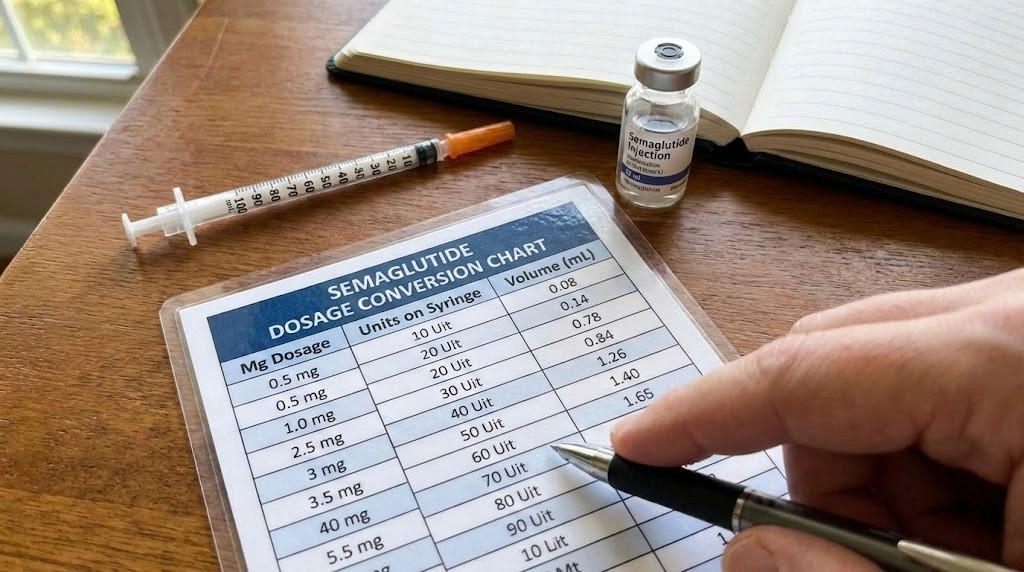
You might be wasting medication with every single injection. Not because your semaglutide is expired or your technique is wrong, but because a simple math error in your syringe conversion is sending too much or too little into your body each week. The numbers on your vial say milligrams. The numbers on your syringe say units. And somewhere between those two measurement systems, thousands of people are getting their dose wrong, sometimes dangerously so.
The FDA has flagged compounded semaglutide dosing errors as a serious safety concern. Poison control calls related to semaglutide have increased by 1,500% in recent years, and 78% of those calls involved incorrect dosing. That is not a small rounding error. That is people confusing 5 units with 50 units, injecting ten times their intended dose, and ending up in emergency rooms with severe nausea, vomiting, and dangerously low blood sugar.
The problem is not that people are careless. The problem is that converting milligrams to syringe units requires knowing your exact concentration, and most guides either skip that step or assume everyone has the same vial.
They do not. Compounded semaglutide comes in concentrations ranging from 2 mg/mL to 10 mg/mL, and the same 0.25 mg dose can mean anywhere from 2.5 units to 12.5 units depending on what you are working with. Get the concentration wrong and every injection after that compounds the mistake.
This guide gives you every conversion chart you need for every common concentration. It walks you through the formula so you understand the math, not just memorize a number. It covers syringe selection, injection technique, titration schedules with unit conversions built in, reconstitution math for lyophilized powder, and the most dangerous mistakes people make. Whether you are starting at 0.25 mg or maintaining at 2.4 mg, the charts below will show you exactly how many units to draw on your insulin syringe. SeekPeptides has built an entire library of semaglutide dosage tools and calculation guides to make this process foolproof, and this article is the most comprehensive conversion resource available anywhere.
Why syringe conversion matters more than you think
A dosing error with semaglutide is not like forgetting a vitamin. This is a potent GLP-1 receptor agonist that suppresses appetite, slows gastric emptying, and affects blood sugar regulation at the physiological level. Too little and you waste weeks waiting for results that never come. Too much and the side effects can be severe enough to land you in a hospital.
Think about it this way. The difference between a standard starting dose of 0.25 mg and the maximum maintenance dose of 2.4 mg is roughly a tenfold increase. On a 5 mg/mL concentration syringe, that is the difference between 5 units and 48 units. Those tiny lines on an insulin syringe are small. They are close together. And in dim lighting, with shaky hands, or without reading glasses, the margin for error shrinks fast.
The consequences are real.
Injecting double your intended dose means double the nausea, double the GI distress, and potentially dangerous drops in blood sugar. The withdrawal symptoms from semaglutide are already challenging enough when tapering properly. An accidental overdose followed by skipping your next dose to compensate creates a rollercoaster your body was never designed to handle. And underdosing is equally problematic. If you are pulling 5 units when you need 10, you are effectively taking half your prescribed amount and wondering why you are not losing weight on semaglutide after months of trying.
The conversion also matters for cost. Semaglutide is expensive. Every wasted unit is wasted money, and every under-measured injection extends the timeline to results, which means buying more medication over a longer period. When you understand the conversion math and use the right syringe for your concentration, you eliminate waste and maximize every milligram you have paid for. The peptide cost calculator at SeekPeptides can help you understand exactly what each dose costs based on your specific setup.
Finally, precision matters for consistency. The clinical trials that demonstrated semaglutide effectiveness used exact doses administered at exact intervals. Replicating those results requires replicating that precision. A dose that varies by 20% from week to week introduces a variable that the studies never accounted for, and your results will reflect that inconsistency.
Understanding the three measurement systems
Before you can convert anything, you need to understand why three different measurement systems exist and what each one actually measures. This is where most confusion starts, and where most guides fail to explain things clearly.
Milligrams: the dose your protocol specifies
Milligrams measure the actual amount of active semaglutide compound. When a protocol says "inject 0.25 mg weekly," it is referring to the weight of the drug itself, not the volume of liquid and not the markings on your syringe. This is the number that matters pharmacologically. It determines how much GLP-1 receptor activation occurs, how strong the appetite suppression will be, and what side effects you might experience. Every semaglutide dosage chart you encounter will list doses in milligrams because that is the universal standard for medication dosing.
The standard titration schedule for semaglutide starts at 0.25 mg and works up to 2.4 mg. Those numbers never change regardless of your concentration, your syringe, or your reconstitution method. The milligram dose is the constant. Everything else is just figuring out how to measure that amount accurately.
Milliliters: the volume of liquid
Milliliters measure how much liquid you draw into your syringe. This is a volume measurement, like measuring water in a cup. One milliliter equals one cubic centimeter. On an insulin syringe, 1 mL corresponds to 100 units, which is a critical conversion factor we will use throughout this guide.
The volume you inject depends entirely on the concentration of your solution. A highly concentrated solution (like 10 mg/mL) requires a tiny volume to deliver a given dose, while a dilute solution (like 2 mg/mL) requires a much larger volume for the same dose. This is why two people taking the exact same milligram dose can inject very different volumes, because their vials have different concentrations. Understanding this relationship is fundamental to using the peptide calculator and interpreting your peptide dosing guide correctly.
Units: what your syringe actually shows
Units are the markings printed on insulin syringes. They were originally designed for insulin, where 1 unit has a very specific biological meaning related to blood sugar reduction. But when you use an insulin syringe for semaglutide, those "units" are simply volume markers. There is no pharmacological significance to the unit markings. They are just tiny divisions of a milliliter.
Here is the key relationship: 100 units on an insulin syringe equals exactly 1 mL of liquid. That is always true, regardless of what is in the syringe. So 50 units equals 0.5 mL. And 10 units equals 0.1 mL. This fixed relationship between units and milliliters is what makes the entire conversion system work.
The confusion arises because people see "20 units" on their syringe and want to know how many milligrams that is. The answer depends entirely on concentration. Twenty units of a 5 mg/mL solution contains 1.0 mg of semaglutide. Twenty units of a 2.5 mg/mL solution contains only 0.5 mg. Same syringe reading, completely different doses. This is exactly why a proper conversion chart organized by concentration is not optional. It is essential.
The universal conversion formula
Every semaglutide syringe conversion comes down to one formula. Learn it, understand it, and you will never need to wonder if your chart is correct because you can verify it yourself.
Units = (Desired dose in mg / Concentration in mg per mL) x 100
That is it. Three numbers plugged into one equation gives you your syringe reading every time.
Let us break it apart. The first step is dividing your desired dose by your concentration. This gives you the volume in milliliters. If you want 0.5 mg from a 5 mg/mL solution, you divide 0.5 by 5 and get 0.1 mL. The second step is converting that volume to syringe units by multiplying by 100, since there are 100 units per milliliter on an insulin syringe. So 0.1 mL times 100 equals 10 units.
Walking through real examples
Let us work through several examples so the formula becomes second nature. These are the exact calculations behind every number in the conversion charts below, and the same math used by the semaglutide dosage calculator.
Example 1: 0.25 mg dose from a 5 mg/mL vial
Units = (0.25 / 5) x 100 = 0.05 x 100 = 5 units
Example 2: 1.0 mg dose from a 2.5 mg/mL vial
Units = (1.0 / 2.5) x 100 = 0.4 x 100 = 40 units
Example 3: 2.4 mg dose from a 3 mg/mL vial
Units = (2.4 / 3) x 100 = 0.8 x 100 = 80 units
Example 4: 1.7 mg dose from a 10 mg/mL vial
Units = (1.7 / 10) x 100 = 0.17 x 100 = 17 units
Notice how dramatically different the unit readings are for the same milligram dose across different concentrations. A 1.0 mg dose is 40 units with a 2.5 mg/mL concentration but only 10 units with a 10 mg/mL concentration. If someone switched vials without recalculating, they could easily inject four times their intended dose. This is precisely how the tenfold overdoses reported to poison control happen, and it is why checking your concentration before every calculation is not paranoia. It is basic safety. For a deeper look at unit to milligram relationships, read the guide on how many milligrams 40 units of semaglutide represents.
Common formula mistakes to avoid
The most frequent error is inverting the formula, dividing concentration by dose instead of dose by concentration. This gives you a number that is wildly wrong. If you divide 5 by 0.25 instead of 0.25 by 5, you get 2,000 units instead of 5 units. Obviously nobody would inject 2,000 units, but partial inversions with less extreme numbers can produce results that seem plausible yet remain dangerously incorrect.
Another common mistake is forgetting to multiply by 100. The first step of the formula gives you milliliters, not units. Skipping the multiplication means you would try to draw 0.05 mL instead of 5 units, and since most insulin syringes do not have milliliter markings that small, you would be guessing. Always complete both steps. Always double-check against the charts. And if the number seems wrong, run it again before drawing anything into your syringe. The peptide dosage calculation guide covers these principles in even greater detail.
Complete conversion charts by concentration
These are the charts you will reference every time you prepare an injection. Find your vial concentration, locate your prescribed dose, and read the corresponding unit number. These charts cover the five most common semaglutide concentrations available from compounding pharmacies. If your concentration is not listed here, use the universal formula from the section above, or use the semaglutide dosage calculator for an instant answer.
Before using any chart, confirm your concentration. It is printed on the vial label, usually expressed as mg/mL. Do not guess. Do not assume. Read the label every single time.
Conversion chart for 2 mg/mL concentration
This is one of the more dilute concentrations, which means larger injection volumes. The advantage is that the higher unit counts make it easier to measure small dose increments precisely. The disadvantage is that higher doses may exceed the capacity of smaller syringes. The full semaglutide dosage chart resource covers additional concentration breakdowns.
Dose (mg) | Volume (mL) | Syringe units | Recommended syringe |
|---|---|---|---|
0.25 mg | 0.125 mL | 12.5 units | 0.3 mL (30 unit) |
0.5 mg | 0.25 mL | 25 units | 0.3 mL or 0.5 mL |
1.0 mg | 0.5 mL | 50 units | 0.5 mL or 1.0 mL |
1.7 mg | 0.85 mL | 85 units | 1.0 mL (100 unit) |
2.4 mg | 1.2 mL | 120 units | Requires larger syringe or split injection |
Notice that the 2.4 mg dose at this concentration requires 120 units, which exceeds the capacity of a standard 100-unit insulin syringe. If you are at this concentration and this dose, you have two options. You can use a 3 mL syringe with unit markings, or you can split the injection into two separate draws, one at 72 units and one at 48 units, administered in different sites. However, most people at the 2.4 mg maintenance dose should discuss switching to a higher concentration with their provider to keep injection volumes manageable. Understanding how long you stay on semaglutide helps you plan for these concentration adjustments over your treatment timeline.
Conversion chart for 2.5 mg/mL concentration
This is a popular concentration from compounding pharmacies. It offers a good balance between injection volume and measurement precision. All standard titration doses fit within a 100-unit syringe at this concentration.
Dose (mg) | Volume (mL) | Syringe units | Recommended syringe |
|---|---|---|---|
0.25 mg | 0.1 mL | 10 units | 0.3 mL (30 unit) |
0.5 mg | 0.2 mL | 20 units | 0.3 mL or 0.5 mL |
1.0 mg | 0.4 mL | 40 units | 0.5 mL (50 unit) |
1.7 mg | 0.68 mL | 68 units | 1.0 mL (100 unit) |
2.4 mg | 0.96 mL | 96 units | 1.0 mL (100 unit) |
This concentration produces clean, round numbers for the starting and mid-range doses, which reduces measurement errors. The 0.25 mg starting dose lands at exactly 10 units, and the 0.5 mg dose lands at exactly 20 units, both easy to read on any insulin syringe. This is one reason compounding pharmacies often use this concentration. It is user-friendly. For additional context on mixing bacteriostatic water with semaglutide, the reconstitution section below covers how to achieve this concentration from powder.
Conversion chart for 3 mg/mL concentration
Some compounding pharmacies use this mid-range concentration. It produces numbers that do not land on whole units for several doses, which means you will need to round carefully.
Dose (mg) | Volume (mL) | Syringe units | Rounding note |
|---|---|---|---|
0.25 mg | 0.083 mL | 8.3 units | Round to 8 units |
0.5 mg | 0.167 mL | 16.7 units | Round to 17 units |
1.0 mg | 0.333 mL | 33.3 units | Round to 33 units |
1.7 mg | 0.567 mL | 56.7 units | Round to 57 units |
2.4 mg | 0.8 mL | 80 units | Exact, no rounding needed |
When rounding, always round to the nearest whole unit. For doses that fall exactly between two units (like 8.3), round down for safety. A slightly lower dose is always safer than a slightly higher one, especially during the initial titration phase when your body is still adjusting to the medication. The difference between 8 and 9 units at this concentration is approximately 0.03 mg, which is clinically insignificant. Do not overthink rounding by fractions of a unit. If you want precision calculators to handle rounding for you, the peptide calculator removes all guesswork.
Conversion chart for 5 mg/mL concentration
This is arguably the most common concentration for compounded semaglutide. It produces small injection volumes, which means less discomfort and less waste, but requires more precision with your syringe readings because you are working with fewer units per dose.
Dose (mg) | Volume (mL) | Syringe units | Recommended syringe |
|---|---|---|---|
0.25 mg | 0.05 mL | 5 units | 0.3 mL (30 unit) for best precision |
0.5 mg | 0.1 mL | 10 units | 0.3 mL (30 unit) |
1.0 mg | 0.2 mL | 20 units | 0.3 mL or 0.5 mL |
1.7 mg | 0.34 mL | 34 units | 0.5 mL (50 unit) |
2.4 mg | 0.48 mL | 48 units | 0.5 mL (50 unit) |
At 5 mg/mL, the starting dose of 0.25 mg is only 5 units. That is a tiny amount of liquid, about one twentieth of a full milliliter. On a standard 100-unit insulin syringe, those five units occupy a very small space at the bottom of the barrel, making them hard to read accurately. This is exactly why a 0.3 mL (30-unit) syringe is strongly recommended for starting doses at this concentration. The markings are spread further apart, giving you much better precision for these small volumes. The detailed 5 mg/mL dosage chart covers this concentration in even greater depth.
One important note about the 1.7 mg dose. The exact calculation gives you 34 units, but some sources round this to 35 units. The difference is 0.05 mg, which is clinically negligible. Use whichever number your healthcare provider specifies, and be consistent.
Conversion chart for 10 mg/mL concentration
This is the highest common concentration. It produces the smallest injection volumes, which is convenient but demands extreme precision. Even a one-unit error represents a full 0.1 mg of semaglutide, compared to only 0.02 mg per unit at the 2 mg/mL concentration.
Dose (mg) | Volume (mL) | Syringe units | Precision warning |
|---|---|---|---|
0.25 mg | 0.025 mL | 2.5 units | Extremely difficult to measure accurately |
0.5 mg | 0.05 mL | 5 units | Use 0.3 mL syringe only |
1.0 mg | 0.1 mL | 10 units | 0.3 mL syringe recommended |
1.7 mg | 0.17 mL | 17 units | 0.3 mL syringe works well |
2.4 mg | 0.24 mL | 24 units | 0.3 mL or 0.5 mL syringe |
The 10 mg/mL concentration creates a significant challenge for the starting dose. 2.5 units sits halfway between two unit markings on most syringes, making it nearly impossible to measure with confidence. If you are starting semaglutide with a 10 mg/mL concentration, consider asking your provider about using a 0.3 mL syringe with half-unit markings, or reconstituting to a lower concentration where the starting dose falls on a whole number. The guide on how much bacteriostatic water to add to peptides explains how adjusting your water volume changes the final concentration.
On the positive side, the 10 mg/mL concentration keeps all doses within a very small syringe. Even the maximum 2.4 mg dose is only 24 units, fitting easily in a 0.3 mL syringe. This minimizes injection volume and injection site discomfort, making it the preferred concentration for people who have been on semaglutide long enough to stabilize on a maintenance dose and value convenience.
How to read an insulin syringe for semaglutide
An insulin syringe is not complicated, but if you have never used one, the markings can be confusing. Understanding each part of the syringe ensures you draw the correct number of units every time.
Anatomy of an insulin syringe
Every insulin syringe has three components. The barrel is the clear cylinder where the medication is visible. The plunger is the part you push and pull. And the needle is the thin point that punctures the vial stopper and then your skin. For peptide injections, including semaglutide, insulin syringes with 29 to 31 gauge needles are standard.
The barrel has numbered markings printed on it. These numbers represent units. On a 100-unit syringe, you will see markings at every 10 units (10, 20, 30, and so on up to 100), with smaller lines between each numbered marking representing individual units. On a 50-unit syringe, the numbered markings appear every 5 units, with individual unit lines between them. On a 30-unit syringe, you will see numbered markings at every 5 units, and on some models, half-unit lines between each unit mark.
The measurement is read at the top edge of the rubber plunger tip, where it contacts the liquid. Not the bottom of the plunger, not the middle. The top edge. This distinction matters because reading from the wrong point can shift your measurement by 1 to 2 units, which at high concentrations represents a meaningful dosage difference.
Reading small volumes accurately
Small doses at high concentrations require extraordinary precision. Five units on a 100-unit syringe occupies a space roughly 2 millimeters long. Your eyes need to distinguish between 4 units and 5 units across a distance smaller than the width of a pencil lead.
Here are strategies for accurate readings. Hold the syringe at eye level, not angled up or down, because parallax error causes you to misread the plunger position. Use good lighting. Natural daylight is ideal, but a bright desk lamp works. If you wear reading glasses, wear them. Tap the barrel gently to dislodge any air bubbles that sit below the plunger, as they displace liquid and make it appear you have drawn more than you actually have. And count the lines carefully. Do not estimate by looking at the general fill level. Count each line from zero up to your target number.
If you consistently struggle to read small volumes, switch to a smaller syringe. A 0.3 mL syringe spreads the same 5-unit measurement over a much larger physical distance on the barrel, making it dramatically easier to read. This one change eliminates the most common source of dosing errors with concentrated semaglutide solutions. For a thorough walkthrough of injection technique and syringe handling, see the complete guide to peptide injections.
Dealing with air bubbles
Air bubbles are the enemy of accurate measurement. A bubble taking up 2 units of space inside your syringe means you are injecting 2 fewer units of medication than you think, even though the plunger appears to be at the right line.
After drawing your dose, hold the syringe with the needle pointing up. Flick the barrel firmly with your finger several times. This forces bubbles to float to the top near the needle. Then gently push the plunger until the bubbles are expelled and a tiny drop of liquid appears at the needle tip. You may lose half a unit of liquid during this process. If precision is critical, draw slightly more than your target, remove the bubbles, then carefully push the plunger to exactly your target reading. The peptide reconstitution guide covers the full process of drawing from a vial cleanly, and the common mistakes guide highlights air bubble issues as one of the top errors new users make.
Syringe types and which one to choose
Not all insulin syringes are created equal. The size you choose directly impacts your measurement accuracy, and choosing the wrong one is a guaranteed path to dosing errors. This is a foundational decision that affects every injection you give yourself, so get it right from the start.
The 0.3 mL (30 unit) syringe
This is the best syringe for starting doses and high-concentration solutions. With only 30 units across its full length, each unit marking is physically larger and easier to read than on bigger syringes. Many 0.3 mL syringes also include half-unit markings, giving you precision down to 0.5 units, which is critical for the 2.5-unit starting dose at 10 mg/mL concentration.
Use the 0.3 mL syringe when your required dose falls at or below 30 units. For the 5 mg/mL concentration, this covers doses up to 1.5 mg. For the 10 mg/mL concentration, it covers the entire titration schedule through the maximum 2.4 mg dose. If you are on a structured peptide dosage protocol, this syringe size offers the best accuracy for lower unit counts.
The 0.5 mL (50 unit) syringe
This is the versatile middle option. It handles moderate doses well while still offering reasonable precision. Each unit marking is slightly smaller than on the 0.3 mL syringe but still readable for most people. This is a good choice when your dose falls between 20 and 50 units, which covers most of the titration schedule at the 5 mg/mL concentration and mid-range doses at 2.5 mg/mL.
The 0.5 mL syringe is often the best single-syringe solution for people who are in the middle of their titration. It handles both the lower transition doses and the higher maintenance doses without needing to switch syringe sizes. If you want one syringe to use throughout most of your semaglutide course, this is the practical choice.
The 1.0 mL (100 unit) syringe
This is the full-size option that accommodates any dose from any concentration, as long as the required units do not exceed 100. The drawback is reduced precision for small doses. Each unit marking occupies less physical space, making it harder to distinguish between 5 units and 6 units at the bottom of the barrel.
Use the 1.0 mL syringe only when your required dose exceeds 50 units, which happens with lower concentration solutions at higher titration levels. For example, the 2.5 mg/mL concentration at the 2.4 mg dose requires 96 units, which only fits in a 1.0 mL syringe. For the 40-unit dose scenarios, either a 0.5 mL or 1.0 mL syringe works, but the 0.5 mL will be easier to read.
Choosing the right syringe for your situation
Concentration | Starting dose (0.25 mg) | Mid-range (1.0 mg) | Max dose (2.4 mg) |
|---|---|---|---|
2 mg/mL | 0.3 mL syringe (12.5 units) | 0.5 mL or 1.0 mL (50 units) | Split injection needed (120 units) |
2.5 mg/mL | 0.3 mL syringe (10 units) | 0.5 mL syringe (40 units) | 1.0 mL syringe (96 units) |
3 mg/mL | 0.3 mL syringe (8 units) | 0.5 mL syringe (33 units) | 1.0 mL syringe (80 units) |
5 mg/mL | 0.3 mL syringe (5 units) | 0.3 mL syringe (20 units) | 0.5 mL syringe (48 units) |
10 mg/mL | 0.3 mL syringe (2.5 units) | 0.3 mL syringe (10 units) | 0.3 mL syringe (24 units) |
A simple rule: always use the smallest syringe that fits your dose. Smaller syringes are more precise. You can find additional syringe selection advice in the peptide injection pen guide, which compares syringes to pen-style injectors and helps you decide which delivery method works best for your lifestyle.
Step-by-step injection guide using your conversion chart
Knowing the math is one thing. Executing a clean, accurate injection is another. This section walks you through the entire process from vial to injection site, with conversion chart references at each decision point. For the full injection technique breakdown, the peptide injections guide covers everything from needle selection to post-injection care.
Preparation and supplies
Gather everything before you start. You will need your semaglutide vial, your insulin syringe (correct size for your dose, as determined from the syringe selection chart above), alcohol swabs, a sharps container, and your conversion chart. Keep the chart printed or saved on your phone where you can reference it without fumbling through vials and syringes with wet hands.
Wash your hands thoroughly with soap and water. Dry them completely. Moisture on your hands can transfer to the vial stopper and contaminate the solution, which affects how long your compounded semaglutide lasts after opening.
Drawing your dose
Step one. Check the vial label. Confirm the concentration. If it says 5 mg/mL, use the 5 mg/mL chart. If it says anything else, use the corresponding chart. Do not rely on memory from last week. Check every time.
Step two. Clean the rubber stopper with an alcohol swab. Let it dry for 10 seconds. Do not blow on it.
Step three. Draw air into your syringe equal to your intended dose volume. If you need 10 units of liquid, pull the plunger back to the 10-unit line and inject that air into the vial. This equalizes pressure inside the vial and makes drawing liquid easier. Skip this step and you will fight against a vacuum, which leads to inconsistent draws.
Step four. With the needle in the vial, invert the vial so it is upside down. Pull the plunger back slowly past your target to draw slightly more than needed. Then push forward to your exact target number. This approach ensures accuracy because it is easier to push excess out than to pull in a precise amount.
Step five. With the needle still in the inverted vial, check for air bubbles. Tap the barrel to move any bubbles to the top, then push them back into the vial. Verify your plunger is at the correct unit marking.
Step six. Remove the needle from the vial. Do not let the needle touch anything except the vial stopper and your injection site.
Choosing and preparing your injection site
Semaglutide is a subcutaneous injection, meaning it goes into the fat layer just beneath the skin. The three approved injection sites are the abdomen (at least two inches away from the navel in any direction), the front of the thigh (middle third of the upper leg), and the back of the upper arm (the fleshy area you cannot easily pinch yourself, which may require assistance).
Rotate your injection site each week. If you inject into the abdomen this week, use the thigh next week. Rotating prevents lipodystrophy, a condition where repeated injections in the same spot cause the fat tissue to harden or pit, which can affect medication absorption. For a comprehensive injection site rotation strategy, see the getting started with peptides guide, which covers site selection in detail.
Clean the chosen injection site with a new alcohol swab. Let it dry completely. Injecting into wet alcohol stings.
Performing the injection
Pinch a fold of skin at the injection site between your thumb and index finger. This lifts the fat layer away from the muscle beneath it. With your other hand, insert the needle at a 90-degree angle in one smooth, steady motion. Do not jab or stab. Think of it as a deliberate, confident push.
Once the needle is fully inserted, release the skin fold. Push the plunger slowly and steadily. Rushing the injection can cause more discomfort and less even medication distribution. After the plunger reaches the bottom, hold the needle in place for 5 to 10 seconds. This allows the full dose to disperse into the tissue before you withdraw.
Pull the needle straight out at the same angle you inserted it. Do not twist or wiggle. Apply gentle pressure with a clean cotton ball or gauze if there is any bleeding, but do not rub the site. Rubbing can push medication out of the injection site and cause bruising. Dispose of the used syringe in a proper sharps container. Never recap a used needle, and never reuse syringes. The peptide safety guide covers disposal protocols and why reusing needles is a serious infection risk.
The standard semaglutide titration schedule with unit conversions
The titration schedule exists for one reason: to minimize side effects. Semaglutide works by activating GLP-1 receptors, which slows gastric emptying and suppresses appetite. Introducing the full dose immediately would overwhelm your GI system, causing severe nausea, vomiting, and diarrhea that could make you quit the medication entirely. Slow titration gives your body time to adapt. Between 20% and 50% of semaglutide users experience nausea, and slow titration has been shown to reduce that rate by approximately 30%.
The standard schedule follows the Wegovy titration protocol. Here it is with syringe unit conversions for every common concentration, so you never have to calculate on injection day. Understanding how fast semaglutide works helps set realistic expectations for each phase of the titration.
Weeks 1 through 4: the 0.25 mg phase
This is the introduction phase. The dose is intentionally low, not meant to produce significant weight loss but to let your GLP-1 receptors adjust to consistent stimulation. Most people notice mild appetite reduction and possibly slight nausea during this phase. If you feel nothing, that is normal. The medication is working at the receptor level even before you notice obvious effects. For a timeline of what to expect, see the detailed article on how long semaglutide takes to work.
0.25 mg unit conversions by concentration:
2 mg/mL: 12.5 units
2.5 mg/mL: 10 units
3 mg/mL: 8 units (rounded down from 8.3)
5 mg/mL: 5 units
10 mg/mL: 2.5 units
Inject once weekly, on the same day each week. It does not matter which day, but consistency matters. Pick a day you will remember and stick with it throughout your treatment.
Weeks 5 through 8: the 0.5 mg phase
The dose doubles. This is where most people start to notice meaningful appetite suppression. Meals feel more satisfying with less food. Cravings, especially for high-calorie foods, begin to diminish. You may also notice that appetite suppression intensifies throughout this phase as tissue levels build.
0.5 mg unit conversions by concentration:
2 mg/mL: 25 units
2.5 mg/mL: 20 units
3 mg/mL: 17 units (rounded from 16.7)
5 mg/mL: 10 units
10 mg/mL: 5 units
If nausea was manageable at 0.25 mg, it may intensify slightly at 0.5 mg. Eat bland, low-fat foods in small frequent meals during the first week of each dose increase. Fatty and greasy foods trigger the worst GI symptoms because semaglutide slows how quickly your stomach empties them. The resource on drinking alcohol while on semaglutide is worth reading during this phase, as alcohol tolerance often changes significantly.
Weeks 9 through 12: the 1.0 mg phase
Now you are at a therapeutically significant dose. Weight loss typically accelerates during this phase. The clinical trials that established semaglutide effectiveness used 1.0 mg as a lower therapeutic dose and saw meaningful results even without advancing further. Some people find this dose sufficient and stay here.
1.0 mg unit conversions by concentration:
2 mg/mL: 50 units
2.5 mg/mL: 40 units
3 mg/mL: 33 units (rounded from 33.3)
5 mg/mL: 20 units
10 mg/mL: 10 units
At the 2 mg/mL concentration, the 1.0 mg dose requires 50 units. If you have been using a 0.3 mL (30-unit) syringe, you will need to switch to a 0.5 mL syringe at this point. Plan the switch in advance so you are not scrambling on injection day. Also review our guide on peptide cycle planning to understand how titration fits into a broader protocol timeline.
Weeks 13 through 16: the 1.7 mg phase
This is the intermediate dose between therapeutic and maximum. Not everyone needs to advance to 2.4 mg, and your healthcare provider may keep you at 1.7 mg if your results are satisfactory and you are tolerating the medication well.
1.7 mg unit conversions by concentration:
2 mg/mL: 85 units
2.5 mg/mL: 68 units
3 mg/mL: 57 units (rounded from 56.7)
5 mg/mL: 34 units
10 mg/mL: 17 units
Watch your syringe size carefully at this dose. The 2 mg/mL concentration requires 85 units, which means you need a 1.0 mL syringe. The 2.5 mg/mL concentration at 68 units also requires at least a 1.0 mL syringe. Higher concentrations still fit in smaller syringes. Make sure you have the right supplies before injection day. The injectable peptides resource includes supply checklists for different protocols.
Week 17 and beyond: the 2.4 mg maintenance phase
This is the maximum dose and the target maintenance dose for weight management. Clinical trials used 2.4 mg as the primary endpoint dose, where participants lost an average of 14.9% of body weight over 68 weeks. This is where you stay unless side effects require stepping back to 1.7 mg.
2.4 mg unit conversions by concentration:
2 mg/mL: 120 units (exceeds standard syringe, split injection required)
2.5 mg/mL: 96 units
3 mg/mL: 80 units
5 mg/mL: 48 units
10 mg/mL: 24 units
The difference in convenience between concentrations is stark at this dose. With a 10 mg/mL concentration, your maintenance injection is just 24 units in a tiny syringe. With a 2 mg/mL concentration, you need to split into two injections. If you are reaching the maintenance phase and find your injection volumes cumbersome, talk to your provider about switching to a higher concentration. For perspective on how this dose compares to similar medications, the tirzepatide versus semaglutide dosage comparison is a valuable read.
Reconstitution and how it affects your conversion math
If you are working with lyophilized (freeze-dried) semaglutide powder rather than pre-mixed liquid, your concentration depends entirely on how much bacteriostatic water you add during reconstitution. This gives you control over your final concentration, which directly changes every number on your conversion chart. The peptide reconstitution calculator handles this math automatically, but understanding the principles ensures you never make a catastrophic mixing error.
The reconstitution formula
Concentration = Powder amount in mg / Water volume in mL
That is it. If you add 2 mL of bacteriostatic water to a 10 mg vial of semaglutide powder, you get 10 / 2 = 5 mg/mL. Add 4 mL to the same vial and you get 10 / 4 = 2.5 mg/mL. The amount of semaglutide does not change. You are just diluting it into more or less liquid, which changes how many units you need per dose.
Common reconstitution scenarios
Vial size | Water added | Final concentration | Units for 0.25 mg | Units for 1.0 mg | Units for 2.4 mg |
|---|---|---|---|---|---|
10 mg | 2 mL | 5 mg/mL | 5 units | 20 units | 48 units |
10 mg | 4 mL | 2.5 mg/mL | 10 units | 40 units | 96 units |
5 mg | 2 mL | 2.5 mg/mL | 10 units | 40 units | 96 units |
5 mg | 1 mL | 5 mg/mL | 5 units | 20 units | 48 units |
Notice a pattern. The 10 mg vial with 2 mL water and the 5 mg vial with 1 mL water both produce 5 mg/mL. The 10 mg vial with 4 mL water and the 5 mg vial with 2 mL water both produce 2.5 mg/mL. The same concentration can be reached from different starting points. What matters is the ratio, not the absolute amounts.
Choosing your reconstitution volume
The decision comes down to a tradeoff between precision and convenience. More water means a lower concentration, which means more units per dose, which means easier measurement. Less water means a higher concentration, which means fewer units, smaller injection volumes, and a vial that produces more doses before running out.
For people starting semaglutide, a lower concentration like 2.5 mg/mL is ideal because the starting dose (10 units) falls on a clear, easy-to-read syringe marking. For people on maintenance doses who value small injection volumes, 5 mg/mL strikes a good balance. The guide to mixing peptides with bacteriostatic water walks through the physical reconstitution technique, while the bacteriostatic water guide explains why BAC water specifically is required rather than sterile water.
Critical reconstitution mistakes
The most dangerous reconstitution error is miscounting the water volume. Using a 1 mL syringe to add water and accidentally adding 1 mL instead of 2 mL creates a solution that is twice as concentrated as intended. Every dose from that vial will be double what you think it is. This is how people end up on accidental 2.4 mg doses when they think they are taking 1.2 mg.
Always use a separate syringe for reconstitution, never the same one you will use for injection. Measure the water carefully. Some people use a 3 mL or 5 mL syringe for adding water because the larger markings make it easier to measure 2 or 4 mL accurately. After adding water, swirl the vial gently. Do not shake it. Shaking can damage the peptide structure and reduce potency. The solution should become clear within 1 to 2 minutes of gentle swirling. If it remains cloudy or has visible particles, do not use it. The complete reconstitution guide includes video-style step-by-step instructions for the entire process.
Label your vial immediately after reconstitution with the date, the concentration, and the amount of semaglutide it contains. A vial sitting in your fridge without a label is an accident waiting to happen, especially if you have multiple peptides stored. The peptide storage guide covers labeling best practices alongside temperature and light exposure requirements.
The most dangerous dosing mistakes and how to avoid them
This section could save you a trip to the emergency room. That is not exaggeration. The 1,500% increase in semaglutide-related poison control calls is driven by a handful of predictable, preventable errors. Know them. Avoid them. Share them with anyone else you know who is using semaglutide.
Mistake 1: confusing units with milligrams
This is the single most dangerous error and the one responsible for the reported tenfold overdoses. Someone reads "take 5 units" but their provider meant "take 0.5 mg." At a 5 mg/mL concentration, 0.5 mg equals 10 units. But the patient draws to the 50-unit line because they read "5" and pulled to the line marked "50" (confusing the line for 5 with the line marked 50 on a 100-unit syringe). They have just injected 2.5 mg, which is the maximum therapeutic dose, when they meant to take one-fifth of that.
Prevention: Always confirm your dose in milligrams first, then convert to units using your concentration-specific chart. Never accept a dose instruction that only says "units" without specifying the concentration it was calculated for. If someone tells you "inject 20 units," your immediate question should be "at what concentration?" Because 20 units at 2.5 mg/mL is 0.5 mg, but 20 units at 10 mg/mL is 2.0 mg, a fourfold difference. Resources like the 20 units conversion guide exist specifically because this confusion is so common.
Mistake 2: using the wrong concentration chart
You mixed your semaglutide at 5 mg/mL last month but your new vial from a different pharmacy is 2.5 mg/mL. You use the same unit dosing as last month without checking the label. Suddenly you are getting half your intended dose and wondering why the medication stopped working.
Or worse, the reverse scenario. Your new vial is more concentrated than the old one, and you are now getting double your dose. The compounded semaglutide guide discusses how concentrations can vary between pharmacies and why checking labels is non-negotiable.
Prevention: Read your vial label before every single injection. Write the concentration on a sticky note and attach it to your syringe bag. If you switch pharmacies or receive a new batch, assume nothing. Check the concentration and recalculate.
Mistake 3: misreading the syringe
On a 100-unit syringe, the numbered markings are at 10, 20, 30, and so on. Each small unmarked line between them represents either 1 unit or 2 units depending on the syringe brand. Some 100-unit syringes have markings at every unit (100 lines). Others have markings at every 2 units (50 lines). If you assume each line is 1 unit but your syringe counts by 2s, every dose you draw will be double what you intended.
Prevention: Before using a new box of syringes, count the lines between 0 and 10. If there are 10 lines, each represents 1 unit. If there are 5 lines, each represents 2 units. Know your syringe. Review the common mistakes beginners make for additional syringe reading pitfalls.
Mistake 4: not accounting for dead space
Every syringe has a small amount of "dead space" in the hub where the needle connects to the barrel. This space holds liquid that does not get injected. For standard insulin syringes, this dead space is approximately 0.5 to 1 unit. For low dead-space syringes (often labeled as such), it is much less.
At low doses and high concentrations, one unit of dead space is significant. If your dose is 5 units and 1 unit stays in the hub, you are only injecting 4 units, which is 20% less than intended. Over a month of weekly injections, that adds up to nearly a full missed dose.
Prevention: Use low dead-space syringes when working with high concentrations and small doses. If using standard syringes, add the known dead space to your draw volume and accept that a small amount will be wasted with each injection. Factor this waste into how many doses your vial will provide.
Mistake 5: sharing conversion information without specifying concentration
Online forums are full of people saying "I take 20 units of semaglutide." Without knowing their concentration, this information is useless at best and dangerous at worst. Someone on a 2 mg/mL solution reading advice from someone on 10 mg/mL will draw a dose five times lower than intended if they copy the unit count directly.
Prevention: Never share or follow dosing information expressed only in units. Always express doses in milligrams and include the concentration when discussing unit conversions. This applies to conversations with friends, forum posts, and even notes to yourself. The peptide safety guide has an entire section on safe information sharing practices.
Troubleshooting common conversion problems
Even with the charts above and the formula memorized, you will encounter situations that do not fit neatly into a standard table. Here are the most common scenarios and how to handle them.
Your dose falls between unit markings
At 3 mg/mL concentration, the 0.25 mg dose is 8.3 units. You cannot draw exactly 8.3 units on a standard syringe. Round to the nearest whole unit (8 units in this case) or to the nearest half-unit if your syringe has half-unit markings (8.5 units). The small difference (0.01 mg) is clinically meaningless. Your body will not notice the difference between 0.24 mg and 0.25 mg.
If precision truly matters to you, consider switching to a concentration that produces clean, whole-number conversions for your prescribed dose. The 2.5 mg/mL and 5 mg/mL concentrations produce the roundest numbers across the standard dose range.
Your vial label does not list concentration in mg/mL
Some compounding pharmacy labels express total content differently. You might see "5 mg in 2 mL" rather than "2.5 mg/mL." These are the same thing. Divide the total milligrams by the total volume to get your concentration. 5 mg / 2 mL = 2.5 mg/mL. Now you can use the 2.5 mg/mL chart.
Occasionally you will see labels that say "5 mg per vial" without specifying volume. In this case, you need to know how much total liquid is in the vial. If the vial contains 2 mL of liquid total, the concentration is 2.5 mg/mL. If it contains 1 mL, the concentration is 5 mg/mL. If the label is unclear, contact the pharmacy directly. Do not guess. The free reconstitution calculator can help you verify concentrations from various label formats.
You need to switch concentrations mid-treatment
Maybe your pharmacy ran out of your usual concentration. Maybe you switched providers. Whatever the reason, you need to recalculate your dose completely when the concentration changes. Do not make the mistake of drawing the same number of units from the new vial.
Write down your current dose in milligrams. Find the new concentration on your vial label. Use the formula or the appropriate chart from this guide. Draw the new unit count. Simple process, but it requires conscious attention every time. Setting a phone reminder for your injection day that includes your current milligram dose and the concentration to check against can prevent autopilot errors.
Your syringe has different graduation marks than expected
Not all syringes from all manufacturers have identical markings. Some 0.3 mL syringes graduate in whole units. Others graduate in half units. Some 1.0 mL syringes graduate in 1-unit increments. Others use 2-unit increments. Before using any new syringe brand, examine the markings under good lighting and count the lines to confirm what each one represents.
A good test: draw plain water to the 10-unit mark and visually confirm it looks correct against a known reference. If you have an old syringe from a brand you trust, compare the fill levels side by side. This takes 30 seconds and can prevent weeks of incorrect dosing. The water for peptides guide is useful background reading for anyone handling syringes and reconstitution supplies regularly.
You accidentally drew too much
If you pulled the plunger past your target before removing the needle from the vial, simply push the excess back into the vial and re-draw to your target line. No harm done.
If you already removed the needle from the vial and realize you drew too much, carefully push the plunger to your target line while holding the syringe with the needle pointing up. The excess liquid will bead at the needle tip. Touch the bead to a clean tissue to absorb it. Then proceed with your injection. Do not push excess back into the vial with a needle that has been exposed to air, as this can introduce contaminants.
Comparing semaglutide and tirzepatide conversions
Many people considering or using semaglutide are also exploring tirzepatide, and some may switch between the two. Understanding how their conversion math differs is important because the doses, concentrations, and titration schedules are completely different. You cannot apply a semaglutide chart to tirzepatide or vice versa.
Why the conversions are not interchangeable
Semaglutide and tirzepatide are different molecules with different potencies. Tirzepatide is a dual GIP/GLP-1 receptor agonist, while semaglutide only targets GLP-1. The standard starting dose for tirzepatide is 2.5 mg (ten times the semaglutide starting dose of 0.25 mg), and the maximum dose is 15 mg (over six times the semaglutide maximum of 2.4 mg). These higher milligram amounts do not mean tirzepatide is stronger. It simply requires more of the molecule to achieve its effects. The detailed semaglutide versus tirzepatide comparison page explains the pharmacological differences in depth.
Because tirzepatide doses are higher in milligrams, the unit counts on a syringe will be very different even at the same concentration. At a 5 mg/mL concentration, a 2.5 mg dose of tirzepatide requires 50 units, while a 0.25 mg dose of semaglutide at the same concentration requires only 5 units. If someone accidentally uses a semaglutide chart for their tirzepatide dose, they would draw a fraction of what they need, rendering the medication ineffective. For tirzepatide-specific charts, see the tirzepatide dose chart and the tirzepatide dosing in units guide.
Key differences in titration schedules
The semaglutide titration takes 16 weeks to reach the maximum dose. Tirzepatide titration can take 20 weeks or longer. The step sizes are also different. Semaglutide roughly doubles at each step (0.25 to 0.5 to 1.0), while tirzepatide increases by 2.5 mg increments (2.5 to 5 to 7.5 to 10 to 12.5 to 15). People switching from tirzepatide to semaglutide need to understand these differences to avoid dangerous dosing translations between the two medications.
The tirzepatide conversion math uses the exact same formula (Units = Dose / Concentration x 100), but the numbers you plug in are entirely different. The tirzepatide compound dosage chart and the tirzepatide reconstitution guide provide the tirzepatide-specific tables and instructions. There are also dedicated resources for specific dose points like 5 mg of tirzepatide in units, 2.5 mg in units, 20 units in milligrams, and 40 units in milligrams.
Newer alternatives on the horizon
The GLP-1 receptor agonist landscape is expanding rapidly. Retatrutide, a triple-receptor agonist targeting GLP-1, GIP, and glucagon receptors, has shown remarkable weight loss results in clinical trials. It uses its own titration schedule and conversion math, covered in the retatrutide dosage chart and the retatrutide dose schedule. The retatrutide versus semaglutide comparison breaks down how these next-generation compounds compare.
Combination approaches like cagrilintide and semaglutide (known as CagriSema) represent another frontier, with their own unique dosing protocols. Even delivery methods are evolving, with GLP-1 patches and oral tirzepatide potentially eliminating the need for syringe conversions altogether. For a broader view of the entire amylin receptor agonist category, the science is moving quickly.
Storage, handling, and maintaining accuracy
Your conversion chart is only as reliable as the medication you are measuring. Degraded semaglutide does not deliver the expected potency per milligram, which means your carefully calculated dose of 0.5 mg might only deliver the equivalent of 0.3 mg if the medication has broken down. Proper storage is not a nice-to-have. It is a dosing accuracy requirement.
Temperature requirements
Reconstituted semaglutide must be stored in the refrigerator at 36 to 46 degrees Fahrenheit (2 to 8 degrees Celsius). Do not freeze it. Freezing causes ice crystals to form in the solution, which can damage the peptide structure and create uneven concentration distribution throughout the vial. If your semaglutide has been frozen, do not use it. The refrigeration requirements guide covers temperature specifics, and the fridge storage duration article explains how long your vial remains viable.
Unreconstituted (powder) semaglutide is more stable and can be stored at room temperature, though refrigeration extends shelf life. Once reconstituted, the clock starts ticking. Most compounding pharmacies recommend using reconstituted semaglutide within 28 to 30 days. For broader peptide storage principles, the post-reconstitution storage guide and the fridge duration guide are essential references. The reconstituted peptide shelf life article goes deeper into degradation timelines.
Light exposure
Semaglutide degrades when exposed to direct light. Store your vial in its original packaging or wrap it in aluminum foil. Do not leave it on a countertop near a window. Do not leave it out during your injection longer than necessary. Draw your dose and return the vial to the refrigerator promptly.
Handling the vial between injections
Every time you pierce the rubber stopper with a needle, you create a tiny pathway for contamination. Use a fresh alcohol swab on the stopper before every draw. Never touch the stopper with your fingers after cleaning it. And inspect the solution before every injection. It should be clear and colorless. If you see cloudiness, particles, or discoloration, do not use it. The expired semaglutide guide covers what degradation looks like and when to discard a vial. The peptide expiration guide provides broader context on how peptides degrade over time.
Maintaining syringe accuracy
Syringes are single-use devices. Never reuse them. The needle becomes dull after a single puncture, which makes subsequent injections more painful and increases tissue damage. More importantly, the graduated markings on the barrel can wear or distort slightly with handling, and residual medication from a previous draw can contaminate your next dose. Use a fresh syringe every time, and store unused syringes in their original sealed packaging.
Managing side effects during titration
Understanding your conversion chart is essential, but so is knowing what to expect as you move through each dose level. Side effects are the number one reason people discontinue semaglutide prematurely, and most of those side effects are manageable with the right strategies. Between 20% and 50% of users experience nausea, which is the most commonly reported side effect. But the severity and duration vary enormously depending on how you titrate and what you eat.
Why slow titration reduces side effects
The standard four-week intervals between dose increases exist because research shows that slow titration reduces nausea by approximately 30% compared to faster escalation. Each dose level gives your GLP-1 receptors time to adjust to the new stimulation level. Skipping a dose level or increasing before four weeks is up saves time but dramatically increases side effect severity. If your current dose is tolerable and you are seeing results, there is no rush to increase. Some people stay at 1.0 mg or 1.7 mg indefinitely because it works and the side effects are minimal. The article on semaglutide treatment duration discusses this flexible approach to maintenance dosing.
Practical nausea management
Eat small meals more frequently rather than two or three large ones. Avoid fatty, greasy, and fried foods, especially during the first week after a dose increase. Semaglutide slows gastric emptying, which means rich foods sit in your stomach longer, intensifying nausea. Bland foods like toast, rice, crackers, and broth are your allies during adjustment periods.
Stay hydrated. Dehydration worsens nausea and headaches, two of the most common side effects. Sip water throughout the day rather than gulping large amounts at once, which can trigger fullness-related nausea. Ginger tea, peppermint tea, and sparkling water (in small amounts) can help settle the stomach.
Time your injection strategically. Many people find that injecting in the evening, just before bed, allows the worst of the initial side effects to pass while they sleep. Others prefer morning injections to have the appetite suppression effect during waking hours when they are most tempted to eat. Experiment to find what works for you, but be consistent once you choose a time. The speed of semaglutide response article discusses timing optimization in greater detail.
When to contact your healthcare provider
Some side effects require medical attention. Severe vomiting that prevents you from keeping liquids down for more than 24 hours. Persistent abdominal pain that does not resolve with rest and bland food. Signs of pancreatitis, which includes sudden severe abdominal pain radiating to the back. Signs of hypoglycemia if you are also taking insulin or sulfonylureas, including shakiness, sweating, confusion, and rapid heartbeat. Any allergic reaction symptoms like hives, swelling, or difficulty breathing.
These are not common, but they are serious. Do not adjust your dose or discontinue the medication without consulting your provider first, as abrupt cessation can cause its own set of issues. The semaglutide withdrawal guide covers what happens when you stop and how to taper safely.
Weight loss context and realistic expectations
Semaglutide is not a magic injection. It is a pharmacological tool that works best alongside dietary changes, physical activity, and behavioral modifications. The conversion chart gives you dosing precision. But precision alone does not determine outcomes. Understanding what realistic results look like keeps you motivated during the gradual titration process and helps you avoid the frustration of unrealistic expectations.
Clinical trial participants on 2.4 mg weekly semaglutide lost an average of 14.9% of their body weight over 68 weeks. That is roughly a year and a quarter. For a 200-pound person, that translates to about 30 pounds. But it did not happen in the first month. Most weight loss accelerates between weeks 12 and 20, after reaching therapeutically effective doses. The early titration weeks are preparation, not the main event.
If you feel like semaglutide is not working during the 0.25 mg or 0.5 mg phases, that is expected. These are starter doses designed to minimize side effects, not maximize weight loss. The real effects become apparent at 1.0 mg and above. For people feeling frustrated early on, the troubleshooting guide for semaglutide weight loss addresses the most common reasons progress stalls and what to do about each one.
Combining semaglutide with other weight management strategies amplifies results. The peptides for fat loss resource covers complementary approaches, while the best peptides for weight loss guide discusses how different compounds target different aspects of body composition. Some people explore peptide stacks for weight loss, while others focus on semaglutide alone. The general weight loss peptides overview provides the broadest perspective, and specialized guides like peptides for women, fat burning peptides for men, peptides for belly fat, and visceral fat loss peptides help narrow the focus. Even menopause-specific weight loss strategies have dedicated resources.
Advanced considerations for experienced users
Semaglutide with B12 formulations
Some compounding pharmacies add vitamin B12 to their semaglutide formulations. This does not change the conversion math for the semaglutide component, but it does mean you are getting supplemental B12 with each injection. The concentration listed on the label still refers to semaglutide, not the total active ingredients. Use your charts as normal. The semaglutide with B12 guide explains what B12 adds to the formulation and whether it matters for your goals.
Understanding bioavailability and absorption
Subcutaneous injection gives semaglutide approximately 89% bioavailability, meaning 89% of what you inject reaches systemic circulation. This is already factored into the clinical dosing recommendations, so you do not need to adjust for it. But it does mean that injection technique matters. Injecting too shallow (intradermally) or too deep (intramuscularly) changes absorption kinetics and can affect both onset and duration of the medication effect.
Injection site also matters slightly. Abdominal injections tend to have the most consistent absorption. Thigh injections can be slightly slower due to lower blood flow in that area. Upper arm injections fall somewhere in between. These differences are small, generally within 10% to 15%, but for people who notice different side effect profiles depending on injection site, absorption rate is the likely explanation. The injectable versus oral peptides comparison discusses bioavailability differences across delivery methods if you are curious about alternatives.
Peptide stacking considerations
Some users combine semaglutide with other peptides. If you are also using BPC-157 for gut health support (a common combination given semaglutide GI side effects), or Lipo-C for additional fat metabolism support, each peptide has its own separate conversion chart and concentration. Never mix different peptides in the same syringe unless specifically instructed by your provider, and never use one peptide conversion chart for another. The peptide stack calculator helps manage multi-peptide protocols, and the stacking guide covers compatibility and timing. If you are wondering how many peptides you can take at once or how to cycle different peptides, those guides provide protocol-level detail.
Legal and practical considerations
Compounded semaglutide exists in a regulatory gray area. The FDA has issued alerts about compounded versions, particularly regarding dosing errors and contamination risks. Understanding where your semaglutide comes from, whether it is a brand-name product like Wegovy or Ozempic, or a compounded version, affects what conversion resources apply. Brand-name products come in pre-filled pens with fixed concentrations and built-in dose selection, eliminating the need for syringe conversion entirely. Compounded products require the manual conversion process detailed in this guide. For those exploring alternatives to brand-name products, the Ozempic alternatives guide covers the landscape. Broader questions about peptide legality, drug testing, and vendor selection are covered in their respective guides.
Cost considerations and getting the most from your vial
Understanding your conversion chart directly impacts cost efficiency. A 10 mg vial at 5 mg/mL concentration contains 2 mL of solution, which is 200 units. If your weekly dose is 20 units (1.0 mg), that vial provides 10 weeks of treatment. If your weekly dose is 48 units (2.4 mg), that same vial lasts just over 4 weeks.
Dead space waste compounds over time. If you lose 1 unit per injection to dead space, that is 4 units per month, or roughly 0.2 mg per month at 5 mg/mL. Over a year, that is 2.4 mg wasted, equivalent to an entire extra dose at the maintenance level. Low dead-space syringes cost slightly more per unit but save medication over time. The peptide cost calculator helps you model these tradeoffs, and the peptide therapy cost guide provides a comprehensive breakdown of all expenses involved. The peptide pricing overview covers the broader market. For those exploring professional guidance options, the peptide therapy near me guide and the online peptide therapy guide discuss provider options and what to expect from each.
Building your personal conversion reference card
Rather than referencing this guide every injection day, create a simple reference card that lives with your supplies. Write down only the information relevant to your specific situation.
Your reference card should include:
Your current concentration (confirmed from vial label)
Your current dose in milligrams
Your current dose in units (from the appropriate chart)
Your next dose level in milligrams (when you titrate up)
Your next dose level in units
Your syringe size
Your injection day
Your injection site rotation schedule
Update this card every time you change dose levels. Update it immediately if you receive a vial with a different concentration. Keep the old card so you have a record of your titration history, which is useful when discussing your protocol with your healthcare provider. For a digital version of this kind of reference, SeekPeptides members access personalized protocol trackers, dose calculators, and titration schedules that update automatically as you progress through your treatment plan.
Understanding the broader peptide landscape
Semaglutide is one compound in a rapidly growing field. Whether you are using it specifically for weight management or as part of a broader health optimization protocol, understanding where it fits in the peptide ecosystem helps you make more informed decisions about your health.
For general peptide education, what are peptides provides the foundational overview, while how peptides work explains the mechanisms. The complete peptide list catalogs every compound currently used in research, and the getting started guide is the recommended starting point for anyone new to this space.
Beyond weight loss, peptides serve diverse research purposes. The muscle growth category covers growth hormone secretagogues and related compounds. The anti-aging category explores longevity peptides like GHK-Cu and Epitalon. The gut health category covers BPC-157 and related healing peptides. And the athletic performance category and injury healing resources serve those focused on recovery and physical optimization. Even specialized topics like GLP-1 and hair loss and the emerging GLP-3 peptide research have dedicated resources.
The sublingual peptides guide explores non-injectable delivery methods for those who prefer alternatives to syringes, and the broader comparison between research and pharmaceutical grade peptides helps you understand quality differences. Whether you are exploring peptides versus other compounds like SARMs or comparing delivery formats like lyophilized versus liquid, the information is available to help you make evidence-based decisions.
For specific peptide calculators beyond semaglutide, the BPC-157 calculator, TB-500 calculator, HGH Fragment calculator, CJC-1295 calculator, and weight loss peptide calculator each handle the unique conversion math for their respective compounds. Comparisons like BPC-157 versus TB-500 and Ipamorelin versus CJC-1295 help when evaluating which compounds to add to a protocol. And if you are wondering how long peptides take to work in general, that guide sets realistic timelines across the entire category. The bioactive precision peptides article explores the cutting edge of targeted weight management compounds, and the mazdutide versus tirzepatide comparison covers another next-generation option.
Frequently asked questions
How many units is 0.25 mg of semaglutide?
It depends entirely on your concentration. At 2 mg/mL, 0.25 mg equals 12.5 units. At 2.5 mg/mL, it equals 10 units. At 5 mg/mL, it equals 5 units. At 10 mg/mL, it equals 2.5 units. Always check your vial label for the concentration before calculating. Use the semaglutide dosage calculator for instant conversions at any concentration.
Can I use the same syringe for different concentrations?
Yes, insulin syringes work with any concentration because they measure volume, not drug amount. However, you must change the number of units you draw based on the concentration. The syringe itself is concentration-agnostic. The math you use with it is not. Refer to the dosage calculation guide for the formula that works with any concentration.
What happens if I accidentally inject too much semaglutide?
An overdose of semaglutide typically causes severe nausea, vomiting, and diarrhea. In serious cases, it can cause dangerous drops in blood sugar (hypoglycemia), especially if you also take diabetes medications. If you suspect a significant overdose, contact your healthcare provider or poison control immediately. Do not try to "compensate" by skipping your next dose without medical guidance. The peptide safety resource covers emergency protocols in detail.
Do I need to change syringes when I increase my dose?
You may need to. If your higher dose requires more units than your current syringe can hold, you must switch to a larger syringe. For example, if you are using a 0.3 mL (30-unit) syringe and your next dose is 40 units, you need at least a 0.5 mL (50-unit) syringe. Plan ahead by checking the conversion chart for your next dose level before you run out of your current syringe supply.
Is it okay to round my dose to the nearest unit?
Yes. Rounding to the nearest whole unit or half unit creates a difference of 0.01 to 0.05 mg depending on your concentration, which is clinically insignificant. Always round down rather than up for safety, especially during the early titration phases. The peptide dosage chart provides pre-rounded values for the most common scenarios.
How do I know if my compounded semaglutide is the correct concentration?
The concentration should be clearly printed on the vial label from the compounding pharmacy. If the label is unclear, damaged, or missing, do not use the vial. Contact the pharmacy for clarification or a replacement. Reputable compounding pharmacies include a certificate of analysis with each batch, listing the exact concentration, purity, and sterility testing results. The vendor evaluation guide explains what to look for when assessing pharmacy quality.
Can I use the same conversion chart for Ozempic and Wegovy?
No. Ozempic and Wegovy come in pre-filled pen injectors with built-in dose selection dials. You do not need to convert milligrams to syringe units because the pen does it for you. The conversion charts in this guide are specifically for compounded semaglutide vials used with insulin syringes. If you are using a brand-name pen device, follow the instructions that came with the product. The injection pen guide covers how pen devices work.
What if my semaglutide is a different concentration than any chart I can find?
Use the universal formula: Units = (Dose in mg / Concentration in mg per mL) x 100. This works for any concentration, including unusual ones like 4 mg/mL or 8 mg/mL that you may not find in standard charts. The peptide calculator handles custom concentrations automatically.
External resources
For researchers serious about getting their semaglutide protocol exactly right, SeekPeptides offers the most comprehensive resource available, with evidence-based dosing guides, personalized protocol builders, and a community of thousands who have navigated these exact conversion challenges. Members access detailed titration trackers, concentration-specific calculators, and expert support that eliminates the guesswork from every injection.
In case I do not see you, good afternoon, good evening, and good night. May your conversions stay accurate, your syringes stay precise, and your results stay consistent.