Feb 11, 2026
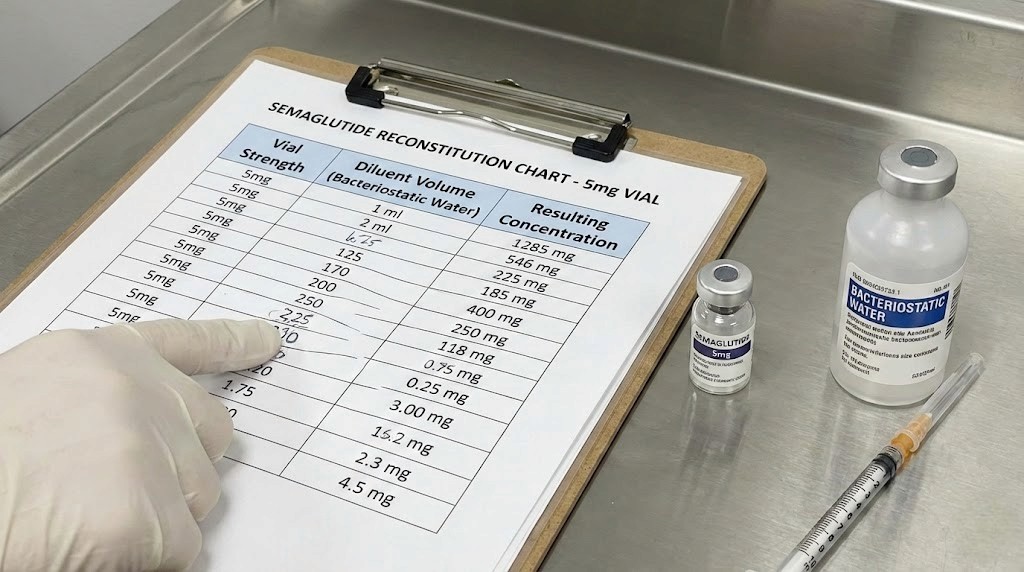
You are wasting peptide. Right now. With every vial you reconstitute incorrectly, you throw away money and potency that you will never recover. The numbers are not small. A single miscalculation in bacteriostatic water volume can reduce your effective semaglutide concentration by 30 to 40 percent, turning what should be a precise weekly dose into a guessing game that undermines your entire protocol. And the worst part? Most people have no idea they are doing it wrong.
This is not a minor inconvenience. Semaglutide is not cheap. A 5mg vial represents a significant investment, and every microgram matters when you are following a titration schedule that spans months. The difference between adding 1 mL and 2 mL of bacteriostatic water changes everything about how you measure your doses, how long your vial lasts, and whether your syringe markings actually correspond to the milligrams you think you are injecting.
That is exactly why a proper semaglutide reconstitution chart for 5mg vials matters more than almost any other resource in your research toolkit. Get this step right, and every dose that follows is accurate. Get it wrong, and you are building your entire protocol on a foundation of bad math. SeekPeptides built its peptide reconstitution calculator specifically to eliminate these errors, because precision at this stage determines everything that comes after it. This guide walks through every water volume option, every unit conversion, every dosing scenario, and every storage requirement so that your 5mg vial delivers exactly what it should.
What reconstitution means for a semaglutide 5mg vial
Reconstitution is the process of dissolving lyophilized (freeze-dried) semaglutide powder back into a liquid solution that can be measured and injected with an insulin syringe. The 5mg vial you receive contains a dry, stable powder that must be mixed with bacteriostatic water before use. This is not optional. You cannot inject the powder directly, and you cannot use just any liquid to dissolve it.
The science behind this matters.
Semaglutide is a GLP-1 receptor agonist with a molecular weight of approximately 4,113.58 daltons. It shares 94 percent amino acid homology with native human GLP-1, but includes structural modifications that extend its half-life to roughly seven days. Those modifications, a fatty acid chain and specific amino acid substitutions, are what make weekly dosing possible. But they also make the molecule sensitive to how it is handled during reconstitution. Aggressive mixing, wrong water types, and improper temperatures can all damage the peptide structure through a process called denaturation, which permanently reduces or eliminates biological activity. For a deeper look at how these molecules function, our guide on how peptides work covers the fundamentals.
When you add bacteriostatic water to your 5mg vial, you create a solution with a specific concentration measured in milligrams per milliliter (mg/mL). That concentration determines how many units on your insulin syringe equal a given dose in milligrams. Change the water volume, and you change every measurement that follows. This is why the reconstitution process is the single most important step in your entire protocol.
Understanding lyophilized versus liquid peptides helps clarify why powder form is preferred for storage and shipping. Lyophilized semaglutide remains stable at -20C (-4F) for extended periods, while reconstituted solutions must be refrigerated and used within 28 days. The powder form is not inferior. It is actually the more stable format, and reconstituting it yourself gives you control over the concentration.
Before mixing anything, you need to understand what supplies are required, what concentration you want to achieve, and how that concentration translates to measurable doses on your syringe. The semaglutide dosage calculator can handle these conversions automatically, but knowing the math yourself is essential for catching errors and understanding your protocol at a fundamental level. The bacteriostatic water guide explains why this specific type of water, which contains 0.9 percent benzyl alcohol as a preservative, is critical for multi-dose vials that will be accessed multiple times over weeks.
Complete semaglutide reconstitution chart for 5mg vials
This is the chart you need. Every number below has been calculated from the base formula: concentration equals peptide mass divided by water volume. For a 5mg vial, the math is straightforward once you choose your water volume. But choosing the wrong volume creates a cascade of measurement errors that can persist for weeks before you notice something is off.
Here is the complete reference.
Bacteriostatic water added | Concentration (mg/mL) | 1 insulin unit equals | Units for 0.25mg dose | Units for 0.5mg dose | Units for 1.0mg dose |
|---|---|---|---|---|---|
1.0 mL | 5.0 mg/mL | 50 mcg | 5 units | 10 units | 20 units |
1.5 mL | 3.33 mg/mL | 33.3 mcg | 7.5 units | 15 units | 30 units |
2.0 mL | 2.5 mg/mL | 25 mcg | 10 units | 20 units | 40 units |
2.5 mL | 2.0 mg/mL | 20 mcg | 12.5 units | 25 units | 50 units |
3.0 mL | 1.67 mg/mL | 16.7 mcg | 15 units | 30 units | 60 units |
The most commonly used volume is 2.0 mL. There is a reason for that.
At 2.0 mL, the concentration lands at 2.5 mg/mL. This creates clean, easy-to-read measurements on a standard U-100 insulin syringe. Each unit equals exactly 25 micrograms of semaglutide. Ten units equals 0.25mg. Twenty units equals 0.5mg. Forty units equals 1.0mg. No fractional units, no mental gymnastics, no room for error. For a thorough breakdown of these conversions, our semaglutide dosage chart in units covers every dose level.
Using 1.0 mL creates a more concentrated solution at 5.0 mg/mL. This means smaller injection volumes, which some people prefer. But the units become trickier. Five units for a 0.25mg dose leaves very little room for measurement error, especially on syringes where the graduations between units are small. The 5mg/mL dosage chart provides detailed unit markings for this concentration.
Going the other direction, 3.0 mL of bacteriostatic water gives you 1.67 mg/mL. Doses require more units to draw, which actually makes them easier to measure precisely. But you use more syringe volume per dose, and your vial may not last as many weeks if you are drawing larger volumes each time. The semaglutide mixing chart for 5mg explores these tradeoffs in more detail.
Which volume should you choose? It depends on your dose level and your comfort with precision.
For standard titration starting at 0.25mg per week, the 2.0 mL option provides the best balance of measurement accuracy and vial longevity. If you are on higher doses above 1.0mg and want to minimize injection volume, 1.0 mL works but demands very careful measurement. If you are new to mixing peptides with bacteriostatic water and want the most forgiving setup, 2.5 mL or 3.0 mL gives you larger unit counts that are harder to misread. The reconstitution calculator can show you the exact unit counts for any dose at any water volume.
One critical note: whatever volume you choose, write it down. Label your vial. Mixing 2.0 mL but later thinking you added 1.5 mL means every dose for the remaining life of that vial will be wrong. Documentation is not optional. It is the backbone of accurate dosing, and resources like our general semaglutide reconstitution chart can serve as a quick reference to keep near your supplies.
Step by step reconstitution process for 5mg semaglutide
Knowing the chart is half the battle. Executing the reconstitution correctly is the other half. Every step matters, and skipping even one can compromise your entire vial. This process applies whether you are using 1.0 mL, 2.0 mL, or any other volume from the chart above.
Gather your supplies
Before you begin, assemble everything you need in one place. You will need your semaglutide 5mg vial (still sealed with lyophilized powder inside), a vial of bacteriostatic water, alcohol swabs, and a sterile syringe for drawing and transferring the water. Many people use a separate syringe for reconstitution and a fresh insulin syringe for dosing. This prevents contamination and keeps your dosing syringe sterile.
Do not use tap water. Do not use distilled water from the grocery store. Do not use saline unless specifically directed by a protocol. Bacteriostatic water contains 0.9 percent benzyl alcohol, which inhibits bacterial growth in multi-dose vials. Without this preservative, each time you insert a needle to draw a dose, you risk introducing bacteria into an unprotected solution. Our guide on how much bacteriostatic water to add to peptides clarifies the ratios for various vial sizes.
Prepare your workspace
Clean hands are non-negotiable. Wash thoroughly with soap and water, then dry with a clean towel. Wipe down your work surface. Peptide reconstitution is not surgery, but basic hygiene prevents contamination that could render your solution unsafe or ineffective.
Swab the rubber stopper of both your semaglutide vial and your bacteriostatic water vial with alcohol pads. Let them air dry for 10 to 15 seconds. Do not blow on them to speed drying. Your breath introduces bacteria.
Draw the bacteriostatic water
Using a sterile syringe, draw your chosen volume of bacteriostatic water. If you are following the 2.0 mL recommendation from our chart, draw exactly 2.0 mL. Precision here sets the foundation for every dose measurement that follows. If you draw 1.8 mL instead of 2.0 mL, your actual concentration will be 2.78 mg/mL instead of the expected 2.5 mg/mL. That 11 percent difference compounds with every dose. The water to mix with peptides guide walks through the selection criteria for reconstitution fluids.
Check for air bubbles in your syringe. Tap the barrel gently and push small bubbles out. Air bubbles reduce the actual volume of water you transfer, creating the same concentration error described above.
Add water to the semaglutide vial
This step requires patience.
Insert the needle through the rubber stopper of the semaglutide vial. Angle the needle so it points toward the glass wall, not directly at the powder cake. Press the plunger slowly, letting the water trickle down the inside wall of the vial. This technique is important. Shooting water directly onto the powder creates foam and can damage the peptide through mechanical stress. Semaglutide, like most peptides, is sensitive to agitation. The reconstitution guide illustrates the correct needle angle for gentle dissolution.
Do not rush this. Thirty seconds of patience here protects an entire vial of peptide.
Dissolve the powder
After adding the water, do not shake the vial. This point cannot be overstated. Shaking creates mechanical stress that can denature the semaglutide molecule, breaking the structural bonds that give it biological activity. A denatured peptide looks the same in solution but does nothing in your body.
Instead, gently swirl the vial in a circular motion. Tilt it slightly and roll it between your palms. The powder should dissolve within one to three minutes. If small particles remain, set the vial on your counter and wait. Check again in five minutes. Most lyophilized semaglutide dissolves readily. If particles persist after 10 minutes of gentle swirling, something may be wrong with the vial. Do not force dissolution by shaking harder. The common mistakes guide covers what to do if your powder will not dissolve.
Inspect the solution
Your reconstituted semaglutide should be clear and colorless. No visible particles. No cloudiness. No discoloration. If the solution appears cloudy, yellow, or contains floating matter, do not use it. Cloudiness can indicate denatured protein, bacterial contamination, or incompatible reconstitution fluid. For information on solution quality indicators, our peptide safety guide explains what to look for.
Label your vial
Write the following on a small piece of tape and attach it to the vial: the reconstitution date, the amount of water added, and the resulting concentration. For example: "Feb 11, 2.0 mL BAC, 2.5 mg/mL." This label prevents dosing errors for the life of the vial and ensures anyone else handling it knows exactly what is inside. Proper documentation ties directly into proper peptide storage practices.
Refrigerate immediately
Place your reconstituted vial in the refrigerator at 2 to 8 degrees Celsius (36 to 46 degrees Fahrenheit). Do not freeze reconstituted semaglutide. Freezing can form ice crystals that physically damage the peptide structure. Do not leave it at room temperature. Our guide on how to store peptides after reconstitution provides complete temperature guidelines, and the semaglutide refrigeration guide answers common cold-storage questions.
How to read your insulin syringe after reconstitution
Here is where most errors happen. You have reconstituted your vial correctly, the concentration is exactly what the chart says, but then you draw the wrong number of units because you misread your syringe or misunderstand the relationship between units and milligrams. This section eliminates that confusion entirely.
Understanding U-100 insulin syringes
Standard insulin syringes are calibrated as U-100, meaning they measure 100 units per 1 mL of liquid. Each "unit" on the syringe is 0.01 mL. This is a volume measurement, not a dose measurement. The actual amount of semaglutide in each unit depends entirely on your reconstitution concentration.
Think of it this way. The syringe measures volume. Your concentration converts that volume into milligrams. Change the concentration, and the same number of units delivers a different dose. This fundamental relationship is covered extensively in our conversion chart for semaglutide dosage in units.
Unit-to-milligram conversion at 2.5 mg/mL (2.0 mL water)
This is the most common setup. If you added 2.0 mL of bacteriostatic water to your 5mg vial, here is exactly what each syringe reading means.
Syringe units | Volume (mL) | Semaglutide dose (mg) | Semaglutide dose (mcg) |
|---|---|---|---|
5 units | 0.05 mL | 0.125 mg | 125 mcg |
10 units | 0.10 mL | 0.25 mg | 250 mcg |
15 units | 0.15 mL | 0.375 mg | 375 mcg |
20 units | 0.20 mL | 0.5 mg | 500 mcg |
25 units | 0.25 mL | 0.625 mg | 625 mcg |
30 units | 0.30 mL | 0.75 mg | 750 mcg |
40 units | 0.40 mL | 1.0 mg | 1,000 mcg |
50 units | 0.50 mL | 1.25 mg | 1,250 mcg |
60 units | 0.60 mL | 1.5 mg | 1,500 mcg |
68 units | 0.68 mL | 1.7 mg | 1,700 mcg |
80 units | 0.80 mL | 2.0 mg | 2,000 mcg |
96 units | 0.96 mL | 2.4 mg | 2,400 mcg |
Notice the pattern. At 2.5 mg/mL, the math is remarkably clean. Every 4 units equals 0.1mg. Every 10 units equals 0.25mg. These round numbers are precisely why 2.0 mL is the preferred water volume for 5mg vials. More detailed unit breakdowns appear in the semaglutide syringe dosage chart and the dosage chart in milliliters.
Unit-to-milligram conversion at 5.0 mg/mL (1.0 mL water)
If you chose the more concentrated option of 1.0 mL water, each unit on your syringe contains twice as much semaglutide compared to the 2.5 mg/mL setup.
Syringe units | Volume (mL) | Semaglutide dose (mg) |
|---|---|---|
5 units | 0.05 mL | 0.25 mg |
10 units | 0.10 mL | 0.5 mg |
20 units | 0.20 mL | 1.0 mg |
34 units | 0.34 mL | 1.7 mg |
48 units | 0.48 mL | 2.4 mg |
The advantage is smaller injection volumes. The disadvantage is that a one-unit misread equals a 50 mcg error instead of 25 mcg. For people on early-stage doses of 0.25mg, drawing exactly 5 units requires careful attention to the syringe markings. At that scale, even half a unit off translates to a 10 percent dosing error. Our article on 20 units of semaglutide in milligrams helps contextualize unit-to-dose relationships for multiple concentrations.
Unit-to-milligram conversion at 1.67 mg/mL (3.0 mL water)
The dilute option gives you more units per dose, which some beginners find easier to measure accurately.
Syringe units | Volume (mL) | Semaglutide dose (mg) |
|---|---|---|
15 units | 0.15 mL | 0.25 mg |
30 units | 0.30 mL | 0.5 mg |
60 units | 0.60 mL | 1.0 mg |
Drawing 15 units is considerably easier than drawing 5 units. The larger volume on the syringe gives you more graduation marks to work with and more visible confirmation that you have the right amount. But this comes at a cost. Larger draws mean you use more liquid per dose, which means your vial empties faster. At 1.0mg doses, you are drawing 0.60 mL per week, which significantly reduces the number of doses per vial. The peptide dosage calculation guide walks through these volume tradeoffs in more detail, and the syringe dosage conversion chart gives you a visual reference for reading your syringe correctly.
The dead space problem
Every syringe has "dead space," a small amount of liquid that remains in the needle hub after injection. This dead space is typically 0.02 to 0.07 mL. At 2.5 mg/mL, that means 0.05 to 0.175mg of semaglutide gets trapped every time you inject.
Over a 10-dose vial cycle, dead space can waste 0.5 to 1.75mg. That is 10 to 35 percent of your total vial content. Low dead space syringes reduce this loss significantly and are worth the small extra cost. For more on minimizing waste during injection, check the peptide injections guide and the peptide injection basics overview.
Dosing from your reconstituted 5mg vial
Now that your vial is reconstituted and you understand how to read your syringe, the next question is straightforward: how much should you inject each week? Semaglutide uses a gradual titration approach, starting at a low dose and increasing over time. This approach minimizes gastrointestinal side effects, which are the most common complaint among new users.
Standard titration schedule
The established titration protocol, based on clinical trials including the landmark STEP 1 study, follows this progression.
Phase | Weeks | Weekly dose | Units at 2.5 mg/mL | Units at 5.0 mg/mL |
|---|---|---|---|---|
Initiation | 1-4 | 0.25 mg | 10 units | 5 units |
Early escalation | 5-8 | 0.5 mg | 20 units | 10 units |
Mid escalation | 9-12 | 1.0 mg | 40 units | 20 units |
Upper escalation | 13-16 | 1.7 mg | 68 units | 34 units |
Maintenance | 17+ | 2.4 mg | 96 units | 48 units |
Not everyone reaches 2.4mg. Some people achieve their goals at 1.0mg or 1.7mg and stay there. The titration schedule is a maximum framework, not a mandatory escalation. Your response, your side effects, and your specific goals determine your optimal maintenance dose. The semaglutide 5mg dosage chart provides a complete week-by-week breakdown with unit measurements for multiple water volumes.
The STEP 1 trial, published in the New England Journal of Medicine, demonstrated 14.9 percent mean body weight reduction with the 2.4mg weekly dose over 68 weeks, compared to just 2.4 percent with placebo. The STEP 5 trial extended this data, showing sustained weight loss of 15.2 percent over 104 weeks. These results established semaglutide as one of the most effective weight management peptides available. For broader context on how semaglutide compares to other options, our peptides for weight loss overview and the detailed best peptides for weight loss ranking provide comprehensive comparisons.
Why gradual titration matters
Semaglutide works through multiple mechanisms. It activates GLP-1 receptors in the brain to reduce appetite and increase satiety. It slows gastric emptying, making you feel full longer. And it affects glucagon secretion to improve metabolic regulation. These effects are powerful. Jumping straight to a high dose overwhelms the gastrointestinal system before it has time to adapt.
Nausea is the most frequently reported side effect, especially during dose increases. Starting at 0.25mg for four weeks gives the body time to adjust. Most nausea resolves within the first two weeks at each dose level. Rushing the titration does not accelerate results. It just makes the process miserable and increases the risk of discontinuation. The how fast semaglutide works guide sets realistic timelines, and our article on why some people do not lose weight on semaglutide addresses common protocol issues that can stall progress.
For those considering how semaglutide fits within a broader peptide approach, the peptide stack calculator helps evaluate compatibility with other compounds, and the peptide stacks guide covers combination strategies. The cycle planning guide provides frameworks for structuring long-term protocols.
How many doses you get from one 5mg vial
This is one of the most practical questions anyone working with semaglutide asks, and the answer depends entirely on your dose level and how much dead space your syringes waste. Understanding vial yield helps you plan supply purchases and budget your protocol accurately. The peptide cost calculator can model these scenarios with your specific pricing.
Theoretical doses per 5mg vial
In a perfect world with zero waste, here is how many weekly doses each 5mg vial provides.
Weekly dose | Doses per 5mg vial | Weeks of supply |
|---|---|---|
0.25 mg | 20 doses | 20 weeks |
0.5 mg | 10 doses | 10 weeks |
1.0 mg | 5 doses | 5 weeks |
1.7 mg | 2.9 doses | ~3 weeks |
2.4 mg | 2.08 doses | ~2 weeks |
The math is simple: 5mg divided by your weekly dose equals the number of doses. But reality is not this clean.
Real-world yield accounting for waste
Between syringe dead space, imperfect draws, and the small amount of liquid that invariably sticks to the vial walls, most people lose 5 to 15 percent of their total vial content. At 0.25mg doses where you are drawing tiny volumes, waste as a percentage is relatively small. At 2.4mg doses where you are drawing nearly half the vial each week, there is less opportunity for waste but more impact from each imperfect draw.
Practical estimate: plan for about 90 percent yield from each vial. That means a 5mg vial effectively contains about 4.5mg of usable semaglutide. Adjust your supply calculations accordingly. The peptide cost breakdown factors in these real-world waste percentages, and the peptide therapy cost guide covers full protocol budgeting.
Planning across the titration schedule
If you are following the standard titration from 0.25mg to 2.4mg, here is approximately how many 5mg vials you need for the first 20 weeks.
Weeks 1 through 4 at 0.25mg: 1.0mg total. Weeks 5 through 8 at 0.5mg: 2.0mg total. Weeks 9 through 12 at 1.0mg: 4.0mg total. Weeks 13 through 16 at 1.7mg: 6.8mg total. Weeks 17 through 20 at 2.4mg: 9.6mg total. Grand total through week 20: 23.4mg, or approximately five 5mg vials.
However, remember the 28-day rule. Once reconstituted, each vial must be used within 28 days. If you are on 0.25mg and your vial contains 20 weeks of doses, you cannot use it all. You will need to discard whatever remains after day 28. This means you either reconstitute smaller vials, add less water and use the concentrated portions faster, or accept some waste during the low-dose phases. The how long reconstituted peptides last article explains why 28 days is the safety boundary. The 5mg with 2mL dosage chart lays out the specific weekly draw volumes for each titration phase.
Storage and stability after reconstitution
Storage mistakes are the silent killer of semaglutide potency. You can reconstitute perfectly, measure your doses with surgical precision, and still get suboptimal results because your storage conditions are degrading the peptide between doses.
Temperature requirements
Reconstituted semaglutide must be stored at 2 to 8 degrees Celsius (36 to 46 degrees Fahrenheit). This is standard refrigerator temperature. Place the vial in the main body of your refrigerator, not in the door (which experiences temperature fluctuations every time you open it) and not in the back where it might accidentally freeze.
Do not freeze reconstituted semaglutide. Freezing creates ice crystals that physically puncture peptide molecules, causing irreversible damage. Do not leave it at room temperature for extended periods. Extended exposure above 8C accelerates degradation. Brief periods at room temperature during dosing (a few minutes) are acceptable, but return the vial to the refrigerator immediately after drawing your dose. For detailed temperature guidance, the peptide fridge storage guide covers optimal placement, and the room temperature stability article explains exactly how much exposure is too much.
The 28-day rule
Once reconstituted, semaglutide should be used within 28 days. After that point, even with proper refrigeration, the peptide degrades below guaranteed potency levels. Bacteriostatic water slows bacterial growth but does not eliminate it entirely over extended periods. The compounded semaglutide fridge life article dives deeper into stability timelines, and our piece on whether you can use expired semaglutide addresses what happens beyond this window.
Write the discard date on your vial label. If you reconstituted on February 11, your discard date is March 11. Do not try to stretch it. The cost of a partially used vial is far less than the cost of injecting degraded peptide that does nothing.
Light protection
Semaglutide is sensitive to light exposure. Store the vial in its original box if possible, or wrap it in aluminum foil to block light. Refrigerator interior lights that turn on each time you open the door provide minimal exposure, but if your vial sits near the front of the shelf and you open the refrigerator frequently, the cumulative light exposure over 28 days can contribute to degradation.
Unreconstituted powder storage
Lyophilized semaglutide powder, the dry form before you add water, is far more stable than the reconstituted solution. Store unreconstituted vials at -20C (-4F) for maximum shelf life. If -20C storage is not available, keeping them at 2 to 8C in the refrigerator is acceptable for shorter periods. The key is avoiding repeated temperature cycling. Do not take a vial out, let it warm up, then put it back multiple times. The peptide powder storage guide and the do peptides expire article cover long-term storage strategies. The broader peptide storage guide serves as a comprehensive reference for all storage scenarios.
Common reconstitution mistakes that destroy potency
Every mistake on this list has been made by someone who thought they were doing it right. Some of these errors waste a few percent of your peptide. Others destroy the entire vial. Knowing what to avoid is just as important as knowing the correct procedure, and our common peptide mistakes guide expands on each of these with detailed prevention strategies.
Mistake 1: Shaking the vial
This is the most common and most damaging error. Shaking introduces violent mechanical forces that can break the bonds holding the semaglutide molecule in its active conformation. The result is denatured protein that dissolves in the water and looks perfectly fine but has reduced or zero biological activity. You will inject it, measure it correctly, follow your schedule exactly, and wonder why nothing is happening.
Always swirl. Never shake.
Mistake 2: Using the wrong water
Bacteriostatic water is not just any sterile water. It contains 0.9 percent benzyl alcohol as a preservative. Using sterile water for injection (without preservative) means your multi-dose vial has no protection against bacterial growth after the first needle puncture. Using distilled water, tap water, or saline introduces contaminants or changes the solution chemistry in ways that can damage the peptide or cause adverse reactions. The bacteriostatic water guide for semaglutide clarifies which water types are safe.
Mistake 3: Inaccurate water measurement
Adding 1.8 mL instead of 2.0 mL. Eyeballing the syringe markings. Ignoring air bubbles that displace liquid. These "close enough" habits create concentration errors that persist for every dose drawn from that vial. If you intend to draw 10 units for a 0.25mg dose at 2.5 mg/mL, but your actual concentration is 2.78 mg/mL because you only added 1.8 mL, you are actually injecting 0.278mg. That is 11 percent more than intended. Scale that error to higher doses and it becomes clinically significant. Use the reconstitution calculator to double-check your math before adding water.
Mistake 4: Spraying water directly onto the powder
Directing the stream of bacteriostatic water straight into the powder cake creates localized high concentrations and foam. The foam traps air and makes it difficult to achieve complete dissolution. More importantly, the force of the stream against the powder can damage the peptide at the contact point. Always aim the needle at the vial wall and let the water trickle down gently. The mixing guide shows the correct technique with visual references.
Mistake 5: Not labeling the vial
Two weeks from now, you will not remember whether you added 1.5 mL or 2.0 mL. Your memory is not as reliable as you think it is, especially when you are managing multiple vials or peptides. An unlabeled vial is a dosing accident waiting to happen. Write the date, the water volume, and the concentration. Every time.
Mistake 6: Improper storage temperature
Leaving the reconstituted vial on your bathroom counter. Storing it in a mini-fridge that does not maintain consistent temperature. Putting it in the freezer. Each of these scenarios degrades your semaglutide faster than proper refrigeration. The difference between 4C and 25C storage can mean the difference between a vial lasting its full 28 days and losing significant potency within a week. The room temperature stability data makes this impact very clear.
Mistake 7: Reusing syringes
Reusing a syringe to draw from your vial introduces bacteria through the rubber stopper. The benzyl alcohol in bacteriostatic water provides some protection, but it is not a substitute for sterile technique. Use a fresh syringe for every draw. The injection pen guide discusses alternative delivery methods that can reduce contamination risk, and the injections guide covers proper aseptic technique for syringe users.
Mistake 8: Ignoring the 28-day discard date
Peptide solutions degrade. Bacteriostatic preservative slows bacterial growth but does not stop chemical degradation of the semaglutide molecule itself. Using a vial beyond 28 days means injecting a solution with unknown potency and potentially elevated bacterial contamination. If cost is a concern, adjust your reconstitution volume so the vial is used up within 28 days at your current dose level rather than stretching an old vial. The therapy cost guide helps with budgeting strategies to avoid this temptation.
Comparing 5mg vials to 10mg vials
The 5mg vial is not the only option. Many suppliers also offer 10mg vials, and understanding the differences helps you choose the right format for your specific situation. The choice is not purely about having more peptide. It affects concentration, vial longevity, waste, and cost efficiency.
Side-by-side comparison
Factor | 5mg vial | 10mg vial |
|---|---|---|
Total peptide | 5mg | 10mg |
Common water volume | 2.0 mL | 2.0-3.0 mL |
Concentration at 2.0 mL | 2.5 mg/mL | 5.0 mg/mL |
Weeks at 0.25mg | 20 weeks (theoretical) | 40 weeks (theoretical) |
Weeks at 1.0mg | 5 weeks | 10 weeks |
Weeks at 2.4mg | ~2 weeks | ~4 weeks |
28-day rule impact | Manageable at mid-high doses | Must use quickly or waste |
Cost per mg | Usually higher | Usually lower |
Best for | Low-dose phases, beginners | Maintenance doses, experienced users |
The 28-day rule creates a practical problem for 10mg vials during the early titration phases. At 0.25mg per week, a 10mg vial contains 40 weeks of doses. But you must discard the vial after 28 days, which means you use only 1.0mg of the 10mg and throw away the rest. That is 90 percent waste. For low-dose phases, the 5mg vial is usually the more practical choice. Our 10mg reconstitution chart covers the specific math for larger vials, and the 10mg vial dosage chart provides complete unit conversion tables.
At higher maintenance doses like 1.7mg or 2.4mg per week, the 10mg vial becomes more economical. You use the vial within or close to the 28-day window, waste is minimal, and the cost per milligram is typically lower for the larger vial size. The compounded semaglutide dose chart covers pricing and dosing for compounded formulations, and the Strive Pharmacy dosage chart provides a specific real-world example.
Many experienced users buy both sizes. They use 5mg vials during the titration phase when doses are low and switch to 10mg vials once they reach their maintenance dose. This strategy minimizes both waste and cost. The cost calculator can model the financial impact of each approach based on your specific supplier pricing.
When to consider switching concentrations
Your reconstitution concentration is not a permanent decision. As your dose changes through the titration schedule, the optimal concentration may change with it. Recognizing when to adjust your water volume saves money and improves dosing accuracy.
Signs your current concentration is too high
If you are drawing fewer than 5 units per dose, your concentration may be too high for reliable measurement. At that scale, the difference between 4 units and 5 units represents a 20 percent dosing error. A single graduation mark on your syringe becomes the margin between accurate and inaccurate. Consider adding more water to your next vial to create a lower concentration with larger, easier-to-read unit counts.
This typically happens when people use 1.0 mL of water (5.0 mg/mL) for low doses like 0.25mg. The math works, but the practical measurement is extremely difficult. Switching to 2.0 mL doubles your unit count for the same dose and makes measurement significantly easier.
Signs your current concentration is too low
If you are drawing more than 80 units per dose, your concentration may be too low. At that point, you are using a large portion of your syringe capacity for a single dose, and you are depleting your vial faster than necessary. More importantly, if you are using a 1 mL (100 unit) syringe, there is very little room for higher doses.
This scenario arises when people use 3.0 mL of water (1.67 mg/mL) at higher doses like 1.7mg or 2.4mg. The 1.7mg dose requires just over 100 units, which exceeds the capacity of a standard 1 mL insulin syringe. Switching to 2.0 mL or even 1.0 mL of water for subsequent vials brings the unit count back into a manageable range.
Adjusting mid-protocol
When you reconstitute a new vial, you can choose a different water volume than the previous one. There is no requirement to maintain the same concentration across vials. The only rule is to label each vial clearly and update your dosing calculations for the new concentration. The semaglutide dosage calculator instantly recalculates units for any new concentration, and the free reconstitution calculator article walks through the interface step by step.
Do not change the concentration of a vial that has already been reconstituted. You cannot add more water or remove water from an existing solution and expect accurate concentrations. The only way to change concentration is with a new, unreconstituted vial. Make your concentration decision before the water touches the powder. The semaglutide mixing chart provides a printable reference to keep with your supplies.
For those who are also exploring other peptides that require reconstitution, the techniques and principles covered here transfer directly to other compounds. The tirzepatide reconstitution chart, retatrutide reconstitution chart, and the tirzepatide reconstitution guide follow the same fundamental approach with compound-specific details. Understanding injectable versus oral peptide differences also helps contextualize why reconstitution skills matter for the injectable route specifically.
The role of semaglutide in broader peptide protocols
Semaglutide does not exist in isolation. Many researchers incorporate it alongside other peptides for complementary effects. Understanding how it fits into the broader landscape of peptide research helps you make informed decisions about concentration management across multiple compounds. The general peptide calculator handles reconstitution math for any peptide, not just semaglutide, and the peptide dosage chart provides universal reference tables.
Weight management peptides like semaglutide often complement other goals. Some researchers combine GLP-1 agonists with compounds targeting muscle growth or injury recovery. Others pair semaglutide with protocols focused on anti-aging or athletic performance. The guide on combining multiple peptides covers safety considerations for multi-compound protocols.
Semaglutide compared to other GLP-1 options
If you are working with a 5mg semaglutide vial, you have likely also considered alternatives. Tirzepatide is the most direct comparison, operating as a dual GIP/GLP-1 receptor agonist. Understanding how these compounds differ helps you evaluate whether your current reconstitution setup serves your long-term goals.
The semaglutide versus tirzepatide comparison page provides the most detailed breakdown available. For dosing equivalencies, the dose conversion chart and the conversion chart map corresponding doses between the two compounds. If you are considering a switch, the switching guide walks through the transition process, and the dosage comparison chart puts the numbers side by side.
Other options in the GLP-1 space include combination approaches. The cagrilintide and semaglutide combination and CagriSema dosing guide cover emerging dual-agonist strategies. For those exploring alternatives entirely, the Ozempic alternatives article surveys the full landscape, and the retatrutide dosage chart covers the triple-agonist approach.
Semaglutide with B12 is another popular compounded formulation. The complete semaglutide B12 guide and the B12 dosage chart explain how the addition of vitamin B12 affects reconstitution and dosing. The compounded semaglutide with B12 chart provides specific concentration tables for these combination formulations.
What remains consistent across all these options is the foundational importance of proper reconstitution. Whether you choose semaglutide, tirzepatide, or a compounded blend, the principles of sterile technique, accurate water measurement, gentle mixing, and proper storage apply universally. Master them once with your 5mg semaglutide vial, and you have the skills for any reconstituted peptide. The getting started guide provides a comprehensive orientation for those building their first protocol, and the peptide dosing guide covers universal principles that apply regardless of the compound.
Understanding semaglutide within the larger weight loss context
SeekPeptides members frequently ask how to position semaglutide within a comprehensive protocol. The peptides for fat loss overview maps out the full spectrum of weight management compounds. For women specifically, the peptides for weight loss in women article addresses hormonal considerations that affect protocol design. And for those curious about bioactive formulations, the bioactive precision peptides article explores next-generation approaches.
The best peptide stack for weight loss article is especially relevant for those on semaglutide who want to add complementary compounds. And the peptide calculator for weight loss helps with the math for multi-compound protocols. The duration of semaglutide use article addresses one of the most common questions about long-term protocol planning, while the withdrawal symptoms guide covers what to expect when discontinuing.
Advanced considerations for your 5mg protocol
Once you have mastered the basics of reconstitution and dosing, several advanced topics can further optimize your protocol. These considerations separate competent practitioners from exceptional ones.
Injection timing and consistency
Semaglutide has a half-life of approximately seven days, which supports weekly dosing. But consistency matters. Inject on the same day each week, at approximately the same time. The half-life means the drug accumulates to steady state over four to five weeks at a given dose. Irregular timing disrupts this accumulation and can cause fluctuations in appetite suppression and blood glucose regulation.
Choose a day that works reliably for your schedule. Most people pick a day when they are home and can administer the injection without rushing. Some prefer morning injections, others evening. The research does not show a significant difference in efficacy based on time of day, so choose whatever promotes consistency. The semaglutide onset timeline article explains the pharmacokinetics in more detail.
Managing side effects during titration
Nausea, reduced appetite, and occasional constipation are the most reported side effects, particularly during the first two weeks at each new dose level. These are generally signs that the medication is working, not that something is wrong. The GLP-1 receptor activation that reduces appetite also slows gastric motility, which causes the sensation of fullness and sometimes nausea.
If side effects are severe at a given dose, you have options. Stay at the current dose for an extra two to four weeks before escalating. Reduce the dose temporarily and re-attempt the increase later. Or split the weekly dose into two smaller injections (for example, two 0.125mg injections instead of one 0.25mg injection). Some practitioners find that subcutaneous injection in the abdomen produces fewer GI side effects than thigh injections, though this is anecdotal rather than evidence-based.
The interaction between semaglutide and alcohol is worth understanding too. The guide on drinking while on semaglutide covers the practical considerations and metabolic interactions. And for those using compounded formulations, the Direct Meds semaglutide guide covers source-specific protocols and considerations.
Calculating units for non-standard doses
The titration schedule uses standard dose levels (0.25, 0.5, 1.0, 1.7, 2.4 mg), but your protocol might call for different amounts. Calculating units for any dose at any concentration uses one formula:
Units = (desired dose in mg / concentration in mg per mL) x 100
For example, at 2.5 mg/mL concentration, a 0.375mg dose would be: (0.375 / 2.5) x 100 = 15 units.
Or at 5.0 mg/mL, a 1.25mg dose would be: (1.25 / 5.0) x 100 = 25 units.
The 50 units to milligrams conversion and 40 units to milligrams conversion articles pre-calculate common unit-to-milligram translations. The semaglutide dosage calculator handles any arbitrary dose and concentration combination instantly.
When to involve professional guidance
Self-directed peptide research carries inherent responsibility. If you experience persistent side effects beyond the normal adjustment period, if your results plateau significantly despite proper dosing, or if you have pre-existing medical conditions that interact with GLP-1 receptor agonists, consulting with a knowledgeable healthcare professional is not just advisable but essential. The peptide safety and risks guide outlines specific scenarios that warrant professional consultation, and our peptide legality overview covers the regulatory landscape you should understand.
Testing your peptide source is another advanced consideration that serious researchers should not overlook. The testing labs guide explains how third-party testing works, and the best vendors guide covers quality indicators to look for when sourcing your semaglutide. Understanding the difference between research and pharmaceutical grade peptides adds context to why testing matters. The regulation news page tracks evolving rules that affect peptide availability.
For researchers who want structured, expert-reviewed protocols rather than piecing together information from multiple sources, SeekPeptides provides comprehensive protocol guides, dosing calculators, and community support from experienced practitioners who have navigated these exact questions. The platform was built specifically to eliminate the guesswork and reduce the risks associated with self-directed research.
Quick reference: the math behind every concentration
For those who want to understand the formula rather than just following a chart, here is the math that drives every number in this guide.
The base formula is: concentration (mg/mL) = total peptide (mg) / total water volume (mL).
For a 5mg vial with 2.0 mL water: 5 / 2.0 = 2.5 mg/mL.
To convert concentration to units on a U-100 syringe: units = (desired dose in mg / concentration in mg/mL) x 100.
For a 0.5mg dose at 2.5 mg/mL: (0.5 / 2.5) x 100 = 20 units.
To find how much semaglutide any number of units contains: dose in mg = (units / 100) x concentration in mg/mL.
For 40 units at 2.5 mg/mL: (40 / 100) x 2.5 = 1.0 mg.
These three formulas, and nothing more, generate every number in every reconstitution chart and dosing table. Memorize them, and you will never need to rely on a chart alone. The dosing chart in units pre-calculates common scenarios, but knowing the formulas means you can verify any number and calculate custom doses that fall outside standard tables. For a broader mathematical framework covering all peptides, the peptide dosage calculation guide is an essential resource, and the peptide vial research article provides context on vial labeling conventions and volume considerations.
The tirzepatide dosing guide uses identical math with different peptide masses, demonstrating how transferable these skills are across compounds. Whether you are working with BPC-157, TB-500, CJC-1295, HGH Fragment 176-191, or semaglutide, the reconstitution math remains the same. Understanding the complete list of injectable peptides helps you see the full scope of compounds that use this same approach. And for those interested in exploring gut health peptides alongside their semaglutide protocol, the reconstitution skills you build here apply directly.
Practical tips from experienced researchers
Beyond the standard procedures, seasoned researchers have developed practical habits that make the entire reconstitution and dosing process smoother. These are the kinds of details that never appear in the clinical literature but make a real difference in daily practice.
Keep a dosing log. Write down every injection date, the number of units drawn, the dose in milligrams, the injection site, and any notes about side effects or observations. This log becomes invaluable when adjusting doses, troubleshooting issues, or planning vial purchases. A simple notebook works. A spreadsheet works better. Whatever you will actually use consistently is the right answer.
Rotate injection sites. Use a different area of the abdomen or thigh each week. Repeated injections in the same spot can cause lipodystrophy, the formation of hard or lumpy tissue that affects absorption. A simple rotation pattern like upper-left abdomen, upper-right, lower-left, lower-right gives you a four-week cycle before returning to the first site.
Buy syringes in bulk. Running out of syringes is an easily preventable problem that disrupts dosing consistency. A box of 100 insulin syringes costs very little and lasts months. The list of injectable peptides covers syringe selection for various compounds, and the injection pen guide discusses alternatives to traditional syringes.
Store backup vials properly. If you buy multiple 5mg vials at once, keep the unopened ones in their original packaging at the recommended storage temperature (-20C for long-term, 2-8C for shorter periods). Only reconstitute the vial you are currently using. This maximizes shelf life and ensures each vial is as fresh as possible when you begin using it.
Consider your syringe size carefully. For low doses (0.25-0.5mg at 2.5 mg/mL), a 0.3 mL (30 unit) syringe provides larger graduation marks that are easier to read than a 1 mL (100 unit) syringe. The smaller barrel makes small volumes more visible and precise. For higher doses requiring 40+ units, the standard 1 mL syringe is more practical. The syringe dosage chart can help you match syringe sizes to dose volumes for maximum readability. And the cycling different peptides article provides context for those managing multiple reconstituted vials simultaneously.
Frequently asked questions
How much bacteriostatic water do I add to a 5mg semaglutide vial?
The most commonly recommended volume is 2.0 mL, which creates a concentration of 2.5 mg/mL. This allows for clean unit measurements on standard insulin syringes, where 10 units equals 0.25mg and 20 units equals 0.5mg. You can also use 1.0 mL for a more concentrated 5.0 mg/mL solution or 3.0 mL for a more dilute 1.67 mg/mL solution. The reconstitution calculator shows the exact unit counts for any water volume you choose.
How many units of semaglutide is 0.25mg from a 5mg vial?
It depends on your reconstitution concentration. If you added 2.0 mL of bacteriostatic water (2.5 mg/mL), 0.25mg equals 10 units. If you added 1.0 mL (5.0 mg/mL), 0.25mg equals 5 units. If you added 3.0 mL (1.67 mg/mL), 0.25mg equals approximately 15 units. Always verify your specific concentration before drawing. The dosage chart in units provides comprehensive tables for all common concentrations.
Can I use sterile water instead of bacteriostatic water?
Sterile water for injection can be used for single-dose vials that will be used immediately. However, for multi-dose vials like a 5mg semaglutide vial that will be accessed over multiple weeks, bacteriostatic water is strongly recommended. The benzyl alcohol preservative in bacteriostatic water inhibits bacterial growth that would otherwise occur each time a needle pierces the rubber stopper.
How long does reconstituted semaglutide last in the refrigerator?
Reconstituted semaglutide should be used within 28 days when stored at 2-8 degrees Celsius (36-46 degrees Fahrenheit). After 28 days, potency begins to decline and bacterial contamination risk increases beyond acceptable levels. The compounded semaglutide fridge life guide provides additional context on stability factors.
What happens if I shake the vial instead of swirling it?
Shaking creates mechanical stress that can denature the semaglutide molecule, permanently reducing or eliminating its biological activity. The solution will still appear clear and will dissolve normally, but the denatured peptide will not function as intended. Always gently swirl or roll the vial between your palms. If you accidentally shook a vial, the peptide safety guide discusses how to assess potential damage.
Can I reconstitute a 5mg vial, use half, and freeze the rest?
Freezing reconstituted semaglutide is not recommended. Ice crystal formation damages peptide molecules at a structural level, reducing potency in unpredictable ways. If you do not need the full vial within 28 days, consider using less water to create a more concentrated solution that allows you to use the vial faster, or accept some waste. Understanding proper storage after reconstitution is essential for maintaining potency.
Why do my semaglutide results vary between vials?
Inconsistent results between vials usually trace back to reconstitution variables: slightly different water volumes, different storage conditions, or different ages of the reconstituted solution. Standardize your process by using the exact same water volume every time, measuring carefully, labeling every vial, and using them within the 28-day window. Peptide source quality can also vary. The testing labs guide covers how to verify what you are actually receiving.
Is a 5mg vial enough for the full titration schedule?
No. The standard titration from 0.25mg to 2.4mg over 16+ weeks requires approximately 23.4mg of semaglutide. That is roughly five 5mg vials. During the early low-dose phases, one 5mg vial contains many more doses than you can use within 28 days, so some waste is inevitable. The therapy cost guide helps budget for the full protocol, and the cost calculator can model scenarios with your specific supplier pricing.
External resources
STEP 5 Trial: Two-year effects of semaglutide in adults with overweight or obesity (Nature Medicine)
Semaglutide overview (StatPearls, NCBI Bookshelf)
For researchers serious about optimizing their peptide protocols, SeekPeptides offers the most comprehensive resource available, with evidence-based guides, proven dosing protocols, and a community of thousands who have navigated these exact questions. Members access detailed reconstitution charts, personalized protocol builders, and expert-reviewed dosing guidance that accounts for individual factors most free resources ignore.
In case I do not see you, good afternoon, good evening, and good night. May your reconstitutions stay sterile, your concentrations stay accurate, and your results stay consistent.