Feb 10, 2026
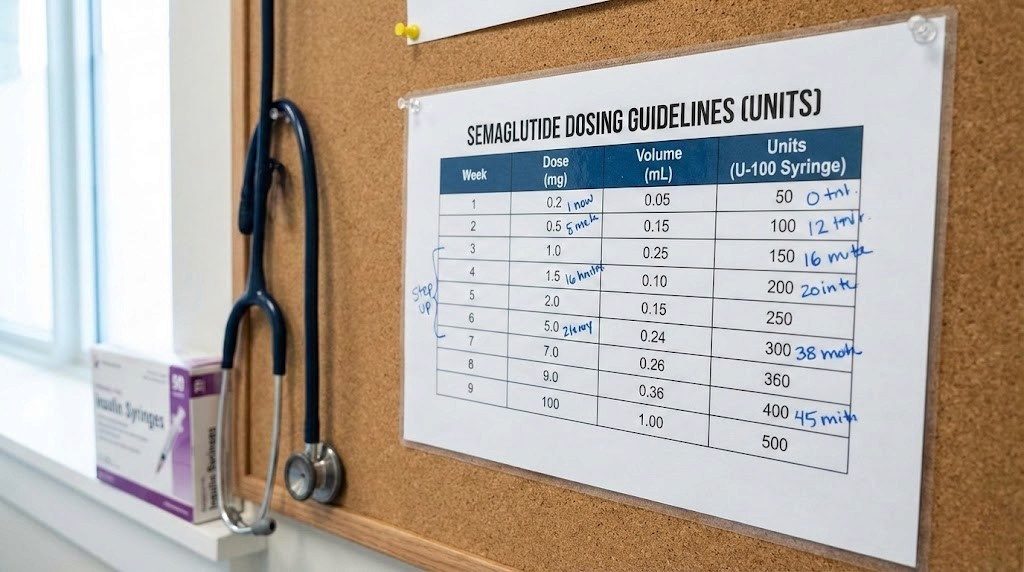
Fifty units. That is what the syringe says. But how many milligrams is that? And does the answer change depending on which vial you are holding? Yes. It absolutely does. The gap between understanding milligrams on a prescription and reading units on an insulin syringe has confused more people than any other single aspect of semaglutide therapy. Get it wrong and you inject double the intended dose, or half. Neither outcome is acceptable when the medication produces real physiological effects that scale directly with the amount administered.
Here is the core problem. Compounded semaglutide arrives in vials with different concentrations. A 5mg/mL vial and a 2.5mg/mL vial look identical on the shelf. The syringes are identical too. But drawing 10 units from one vial delivers twice the medication as drawing 10 units from the other. That single detail, concentration, determines everything about how you read your semaglutide dosage chart in units. And most guides skip right past it.
This guide covers every concentration you will encounter. Every dose level from the smallest microdose to the highest therapeutic amount. Every conversion between milligrams, milliliters, and insulin syringe units. Complete charts you can reference each week without doing mental math. The goal is simple: you look at your vial, find the matching chart, locate your prescribed dose, and draw exactly the right number of units. No second-guessing. No calculator needed. SeekPeptides built this resource because accurate dosing is the foundation of safe, effective semaglutide use, and confusion about units is the most common barrier people face.
Understanding units, milligrams, and milliliters
Before touching a single chart, you need to understand three measurement systems that overlap in semaglutide dosing. They are not interchangeable. They measure fundamentally different things. And confusing them is where dosing errors begin.
What milligrams actually measure
Milligrams measure the weight of the active drug. When your prescription says 0.25mg, 0.5mg, or 1mg, it describes how much semaglutide peptide enters your body. This is the therapeutic dose. It determines the biological effect. Clinical trials like STEP 1 established that 2.4mg weekly produces approximately 14.9% body weight reduction over 68 weeks. The dose in milligrams drives outcomes.
Your prescriber thinks in milligrams. Research papers report in milligrams. Dosage calculators output milligrams. This is the universal language of semaglutide dosing.
What milliliters actually measure
Milliliters measure the volume of liquid you draw into the syringe. One milliliter equals one cubic centimeter of fluid. This is a volume measurement, not a weight measurement. The critical insight is that the same volume of liquid can contain vastly different amounts of semaglutide depending on how concentrated the solution is.
Think of it like coffee. One cup of espresso and one cup of drip coffee have the same volume. Very different caffeine content. Same principle applies to semaglutide vials with different concentrations. A 0.1mL draw from a 5mg/mL vial contains 0.5mg. That same 0.1mL draw from a 2.5mg/mL vial contains only 0.25mg. Same volume. Half the drug.
What units actually measure on an insulin syringe
Units on an insulin syringe are simply a finer way to measure volume. A standard U-100 insulin syringe divides each milliliter into 100 units. That is all. One hundred units equals one milliliter. Ten units equals 0.1mL. Five units equals 0.05mL. The markings on the syringe barrel show units because insulin syringes were designed for insulin, where the standard concentration is 100 units per mL.
For semaglutide, these unit markings are purely volume indicators. They tell you how much liquid you are drawing. They do not tell you how many milligrams of drug you are drawing. That depends entirely on concentration.
The formula that connects all three
One formula governs every conversion in this entire guide. Memorize it or bookmark it.
Units = (Dose in mg / Concentration in mg per mL) x 100
That is it. Divide the dose you want by the concentration printed on your vial, then multiply by 100 to convert milliliters to syringe units. Every chart below is built from this single equation. If you ever lose the charts, you can reconstruct any conversion with this formula and a reconstitution calculator.
Example: You need 0.5mg from a 5mg/mL vial. Divide 0.5 by 5, which gives 0.1mL. Multiply by 100, which gives 10 units. Draw to the 10-unit line on your syringe.
Semaglutide dosing chart for 2mg/mL concentration
The 2mg/mL concentration is one of the most common formulations from compounding pharmacies. Each milliliter of solution contains 2 milligrams of semaglutide. At this concentration, the volumes drawn are relatively larger compared to more concentrated vials, which actually makes precise dosing easier since the unit increments are bigger and more forgiving on the syringe.
Complete conversion table for 2mg/mL
Dose (mg) | Volume (mL) | Insulin Syringe Units |
|---|---|---|
0.0625 | 0.031 | 3 units |
0.125 | 0.063 | 6 units |
0.25 | 0.125 | 12.5 units |
0.375 | 0.188 | 19 units |
0.5 | 0.25 | 25 units |
0.75 | 0.375 | 37.5 units |
1.0 | 0.5 | 50 units |
1.25 | 0.625 | 62.5 units |
1.5 | 0.75 | 75 units |
1.7 | 0.85 | 85 units |
2.0 | 1.0 | 100 units (full syringe) |
2.4 | 1.2 | 120 units (requires larger syringe) |
Several things stand out immediately with this concentration. The starting dose of 0.25mg requires drawing to 12.5 units, which falls between the 12 and 13 unit marks on most syringes. Some people find this imprecise, and that is a valid concern. For exact precision at this concentration, a peptide injection pen with finer graduations can help. Alternatively, drawing to the nearest whole unit (12 or 13 units) produces a dose of approximately 0.24mg or 0.26mg, both clinically insignificant variations from the 0.25mg target.
At the maximum therapeutic dose of 2.4mg, you would need 120 units, which exceeds the capacity of a standard 1mL (100-unit) insulin syringe. This means the 2mg/mL concentration is not ideal for people on the highest doses unless they use a larger syringe or split the dose into two injections. For most of the dose escalation schedule, however, this concentration works well.
Who typically receives the 2mg/mL concentration
This concentration appears frequently in early prescriptions and lower-dose maintenance protocols. If your provider has you on 0.25mg to 1.0mg weekly, the 2mg/mL vial provides excellent precision. It is also common in semaglutide with B12 formulations from compounding pharmacies, where the additional B12 adds volume to the solution.
Semaglutide dosing chart for 2.5mg/mL concentration
The 2.5mg/mL concentration is the other widely prescribed lower-concentration formulation. It offers a neat mathematical relationship: one full milliliter contains exactly 2.5mg, which means 100 units on the syringe equals 2.5mg. This makes many common doses fall on clean unit numbers.
Complete conversion table for 2.5mg/mL
Dose (mg) | Volume (mL) | Insulin Syringe Units |
|---|---|---|
0.0625 | 0.025 | 2.5 units |
0.125 | 0.05 | 5 units |
0.25 | 0.1 | 10 units |
0.375 | 0.15 | 15 units |
0.5 | 0.2 | 20 units |
0.75 | 0.3 | 30 units |
1.0 | 0.4 | 40 units |
1.25 | 0.5 | 50 units |
1.5 | 0.6 | 60 units |
1.7 | 0.68 | 68 units |
2.0 | 0.8 | 80 units |
2.4 | 0.96 | 96 units |
2.5 | 1.0 | 100 units (full syringe) |
Notice how the standard escalation doses land on clean numbers. The starting 0.25mg dose equals exactly 10 units. The second step of 0.5mg equals exactly 20 units. The 1mg dose equals 40 units. These are easy to read on any insulin syringe without squinting between hash marks. This mathematical convenience is one reason many providers and pharmacies favor the 2.5mg/mL concentration.
Even the maximum weight loss dose of 2.4mg fits within a single 100-unit syringe at 96 units. No splitting required. No oversized syringe needed. You draw almost to the top, and you have your full dose.
Reading the syringe accurately at this concentration
With a 2.5mg/mL vial and a U-100 insulin syringe, each single unit line on the syringe represents 0.025mg of semaglutide. Each group of 10 units represents 0.25mg. This makes the major markings on the syringe (10, 20, 30, 40, etc.) correspond directly to standard dose steps. When your prescriber says to increase by 0.25mg, you simply move 10 units higher on the syringe. Clean. Predictable. Hard to mess up.
For those tracking their dose escalation week by week, this concentration simplifies the entire process. You do not need to do any math once you know the base conversion: 10 units per 0.25mg.
Semaglutide dosing chart for 5mg/mL concentration
The 5mg/mL concentration is the most commonly discussed concentration online and one of the most widely dispensed by compounding pharmacies. It doubles the drug content per milliliter compared to 2.5mg/mL, which means every dose requires exactly half the volume. Smaller injection volumes. Less liquid under the skin. Many people prefer this for comfort.
Complete conversion table for 5mg/mL
Dose (mg) | Volume (mL) | Insulin Syringe Units |
|---|---|---|
0.0625 | 0.0125 | 1.25 units |
0.125 | 0.025 | 2.5 units |
0.25 | 0.05 | 5 units |
0.375 | 0.075 | 7.5 units |
0.5 | 0.1 | 10 units |
0.75 | 0.15 | 15 units |
1.0 | 0.2 | 20 units |
1.25 | 0.25 | 25 units |
1.5 | 0.3 | 30 units |
1.7 | 0.34 | 34 units |
2.0 | 0.4 | 40 units |
2.4 | 0.48 | 48 units |
2.5 | 0.5 | 50 units (half syringe) |
This concentration offers an excellent balance. The starting dose of 0.25mg requires just 5 units, easily readable on any syringe. The 0.5mg step-up equals 10 units. The full 2.4mg therapeutic maximum sits at just 48 units, well under half the syringe capacity. You will never run into volume limitations with this concentration.
Many guides, including the semaglutide syringe conversion chart, reference this concentration as the standard. If someone shares a dosing chart online without specifying concentration, there is a reasonable chance they are talking about 5mg/mL. But you should never assume. Always verify the concentration printed on your vial before drawing any dose.
Why the 5mg/mL concentration dominates
Three practical advantages make this concentration popular. First, the small injection volumes (5 to 48 units for the full dose range) mean less discomfort at the injection site. Second, a single 1mL vial contains 5mg of semaglutide total, which covers multiple weeks of dosing at lower levels. A person on 0.5mg weekly gets 10 weeks from one vial. That is cost efficient. Third, the unit numbers for standard doses fall on or very near whole numbers, which reduces measurement error.
The semaglutide dosage calculator on our site uses this concentration as one of the default options because of its prevalence. If you are using a different concentration, simply adjust in the calculator dropdown.
Semaglutide dosing chart for 10mg/mL concentration
The 10mg/mL concentration is the highest strength commonly available from compounding pharmacies. It packs twice the semaglutide per milliliter compared to the 5mg/mL vial. Injection volumes become extremely small, which appeals to people who dislike the sensation of larger fluid volumes under the skin. However, the precision demands increase significantly.
Complete conversion table for 10mg/mL
Dose (mg) | Volume (mL) | Insulin Syringe Units |
|---|---|---|
0.125 | 0.0125 | 1.25 units |
0.25 | 0.025 | 2.5 units |
0.375 | 0.0375 | 3.75 units |
0.5 | 0.05 | 5 units |
0.75 | 0.075 | 7.5 units |
1.0 | 0.1 | 10 units |
1.25 | 0.125 | 12.5 units |
1.5 | 0.15 | 15 units |
1.7 | 0.17 | 17 units |
2.0 | 0.2 | 20 units |
2.4 | 0.24 | 24 units |
2.5 | 0.25 | 25 units |
At 10mg/mL, the starting dose of 0.25mg is just 2.5 units. That is a tiny amount of liquid. On a standard 100-unit insulin syringe, 2.5 units barely registers visually. This is where accuracy becomes critical. A single unit of error at this concentration represents 0.1mg of semaglutide, a meaningful difference especially at lower doses where 0.1mg is a 40% overshoot on a 0.25mg target.
For people using the 10mg/mL concentration at lower doses, consider a 0.3mL (30-unit) insulin syringe instead of the standard 1mL (100-unit) syringe. The smaller syringe has finer graduation marks that make drawing 2.5 or 5 units substantially easier and more accurate. Your pharmacy or prescribing clinic can provide these smaller syringes on request.
When the 10mg/mL concentration makes sense
This concentration shines at higher doses. Someone on 2.4mg weekly draws only 24 units, a tiny, comfortable injection. The vial also lasts longer since each milliliter contains more drug. A 2mL vial at 10mg/mL holds 20mg total, enough for over 8 weeks at the maximum 2.4mg dose.
It is less ideal for dose initiation and low-dose maintenance. The tiny volumes required at 0.25mg and 0.5mg (2.5 and 5 units) push the limits of what standard insulin syringes can accurately deliver. If you are prescribed this concentration and starting at low doses, talk to your provider about precision measurement strategies or whether a lower concentration vial might be available for the initiation phase.
The standard dose escalation schedule in units
Now that you understand the conversions, here is the complete dose escalation schedule that most prescribers follow, translated into units for every concentration. This is the chart you will reference week after week as you titrate upward.
FDA-approved escalation for weight management (Wegovy protocol)
Phase | Weeks | Dose (mg) | 2mg/mL Units | 2.5mg/mL Units | 5mg/mL Units | 10mg/mL Units |
|---|---|---|---|---|---|---|
Initiation | 1-4 | 0.25 | 12.5 | 10 | 5 | 2.5 |
Step 2 | 5-8 | 0.5 | 25 | 20 | 10 | 5 |
Step 3 | 9-12 | 1.0 | 50 | 40 | 20 | 10 |
Step 4 | 13-16 | 1.7 | 85 | 68 | 34 | 17 |
Maintenance | 17+ | 2.4 | 120* | 96 | 48 | 24 |
*Exceeds standard 100-unit syringe capacity. Requires 1.5mL or 3mL syringe, or split into two injections.
Each phase lasts a minimum of four weeks. The purpose of this gradual increase is to allow your body to adapt to the medication, reducing gastrointestinal side effects that commonly occur with rapid dose increases. Nausea affects approximately 44% of people on the 2.4mg dose in clinical trials. Slower titration significantly reduces both the severity and duration of these side effects.
FDA-approved escalation for type 2 diabetes (Ozempic protocol)
Phase | Weeks | Dose (mg) | 2mg/mL Units | 2.5mg/mL Units | 5mg/mL Units | 10mg/mL Units |
|---|---|---|---|---|---|---|
Initiation | 1-4 | 0.25 | 12.5 | 10 | 5 | 2.5 |
Step 2 | 5-8 | 0.5 | 25 | 20 | 10 | 5 |
Step 3 | 9+ | 1.0 | 50 | 40 | 20 | 10 |
Optional | 13+ | 2.0 | 100 | 80 | 40 | 20 |
The Ozempic protocol maxes out at 2.0mg rather than 2.4mg. Not everyone reaches or needs the maximum dose. Many people achieve excellent glycemic control or weight loss results at 1.0mg or 1.7mg. Your prescriber will assess your response at each level before recommending an increase.
Slower escalation options
Some providers extend the escalation timeline, keeping patients at each dose level for 6 to 8 weeks instead of 4. This is particularly common for people who experience significant nausea at each step-up. There is no clinical requirement to follow the minimum four-week schedule. Going slower is always acceptable. Going faster is not recommended.
If you experience persistent nausea at a new dose, the standard medical recommendation is to stay at that dose level (or even drop back to the previous one) for an additional 4 weeks before attempting to increase again. This is not a failure. It is responsible dose management. The medication works at lower doses too, just with potentially less dramatic effects.
How to read an insulin syringe for semaglutide
You have the charts. You know your concentration. Now you need to actually draw the right amount into a syringe without making errors. This section walks through the practical mechanics that injection guides often gloss over.
Anatomy of a U-100 insulin syringe
The most common insulin syringe holds 1mL of liquid and is marked from 0 to 100 units. The barrel is narrow and clear, allowing you to see the liquid level against the numbered scale. Major markings appear every 10 units (10, 20, 30, etc.). Minor markings appear every 1 or 2 units depending on the syringe manufacturer.
Some syringes have markings every single unit. Others show every 2 units. This matters. If your target dose is an odd number of units (like 5, 15, or 25) and your syringe only marks even numbers, you need to draw to the midpoint between two lines. This is manageable but requires attention. If you find yourself needing odd-unit precision frequently, request syringes with single-unit graduations from your pharmacy.
The plunger reading technique
Hold the syringe at eye level with the needle pointing up. The black rubber stopper at the end of the plunger has two edges, a top edge and a bottom edge. Always read from the top edge of the plunger (the edge closest to the needle). This is the same technique used for reading any graduated cylinder in a laboratory setting.
Common mistake: reading from the bottom edge of the plunger adds approximately 1 to 2 units of error. At a 5mg/mL concentration, 2 extra units equals 0.1mg of additional semaglutide. Small but real, especially at lower doses where it represents a larger percentage of the intended amount.
Removing air bubbles
Air bubbles are not dangerous in a subcutaneous injection, but they do reduce accuracy. A bubble occupying 3 units of space means you have drawn 3 fewer units of medication than the syringe appears to show. After drawing your dose, hold the syringe needle-up and flick the barrel gently. The bubbles will rise to the top near the needle. Push the plunger slightly until the air escapes and a tiny drop of liquid appears at the needle tip. Then recheck your volume and adjust if needed.
This step matters more with concentrated solutions. At 10mg/mL, a 3-unit air bubble means you are short 0.3mg of semaglutide, which is more than a full starting dose. At 2.5mg/mL, the same bubble costs you only 0.075mg. Always clear the bubbles regardless of concentration, but know that the stakes scale with how concentrated your vial is.
Drawing from the vial correctly
Clean the rubber stopper of your semaglutide vial with an alcohol swab. Draw air into the syringe equal to your intended dose volume. Insert the needle through the stopper and push the air in (this equalizes pressure and makes drawing easier). Invert the vial so the needle tip is submerged in liquid. Pull the plunger slowly to your target number of units.
Pull slowly. Rushing creates bubbles and makes it harder to stop at the exact line. If you overshoot, push the plunger back slightly while the needle is still in the vial. The excess returns to the vial. Adjust until the top edge of the plunger aligns perfectly with your target unit line.
Common dosing scenarios solved with units
Theory is useful. Practical scenarios are better. Here are the situations people actually encounter, solved with specific unit numbers for every concentration.
Scenario 1: Starting semaglutide for the first time
Your prescription says 0.25mg once weekly. Your vial says 5mg/mL.
Look at the 5mg/mL chart. Find 0.25mg. The answer is 5 units. Draw to the 5-unit line on your syringe. Inject subcutaneously in the abdomen, thigh, or upper arm. Done.
If your vial instead says 2.5mg/mL, the same 0.25mg dose becomes 10 units. Different vial, different number on the syringe, same amount of drug entering your body. The concentration on the vial label dictates everything.
Scenario 2: Increasing from 0.5mg to 1mg
You have been on 0.5mg for four weeks with tolerable side effects. Your provider approves the increase to 1mg. Your vial is 5mg/mL.
From the chart: 0.5mg was 10 units. Now 1mg is 20 units. You are doubling the volume drawn. This is a significant jump. Watch for increased gastrointestinal effects in the first week at the new dose. Smaller, more frequent meals help. Avoiding fatty foods helps more. If nausea is severe, your provider may suggest an intermediate step of 0.75mg (15 units at 5mg/mL) before reaching the full 1mg.
Scenario 3: Prescribed a dose not on the standard chart
Some providers prescribe non-standard doses like 0.375mg, 0.625mg, or 1.25mg. These intermediate steps allow finer-grained titration. Use the formula:
Units = (Dose in mg / Concentration in mg per mL) x 100
For 0.375mg from a 5mg/mL vial: (0.375 / 5) x 100 = 7.5 units. Draw halfway between the 7 and 8 unit marks.
For 0.625mg from a 2.5mg/mL vial: (0.625 / 2.5) x 100 = 25 units. Draw to the 25 unit mark.
The peptide calculator handles these non-standard doses automatically if you prefer not to do the math manually.
Scenario 4: Switching vial concentrations mid-treatment
Your pharmacy sends a 5mg/mL vial one month and a 2.5mg/mL vial the next. Your dose stays at 1mg. This is the most dangerous transition because your muscle memory says "draw to 20 units" from last month, but with the new concentration, 20 units now delivers only 0.5mg instead of 1mg.
Always, always check the vial label before drawing. Read the concentration. Find the matching chart. Confirm your unit number. This takes ten seconds and prevents the most common dosing error people report online. If you are switching between concentrations, consider writing the correct unit number on a piece of tape stuck to the new vial as a visual reminder.
Scenario 5: Calculating how long a vial will last
Your vial contains 2mL of 5mg/mL semaglutide. That is 10mg total. You are on 1mg per week.
10mg divided by 1mg per week equals 10 weeks. The vial lasts 10 weeks. But you also need to account for the beyond-use date printed on the vial. If the beyond-use date is 28 days from the time you first puncture the stopper, and your dose schedule would take the vial beyond that date, you may need to discard remaining medication. This is a common source of waste that catches people off guard.
Plan your refills around both your dose consumption rate and the beyond-use date. If you are on a lower dose and the vial would last longer than its beyond-use date allows, ask your provider about getting smaller vials or adjusting the schedule so less medication goes to waste.
Semaglutide with B12: dosing charts in units
Many compounding pharmacies offer semaglutide combined with vitamin B12 (cyanocobalamin). This combination changes the concentration calculation slightly because the total volume includes both active ingredients. However, the semaglutide concentration listed on the vial already accounts for this. The conversion formula remains exactly the same.
Common B12 combination concentrations
The most frequently dispensed semaglutide with B12 formulations use the same semaglutide concentrations as standalone vials (2.5mg/mL or 5mg/mL of semaglutide, plus a specified amount of B12). The B12 component does not change how many units you draw for your semaglutide dose. It simply rides along in the same injection.
When reading your vial label, focus on the semaglutide concentration. If it says "Semaglutide 5mg/mL + B12 1mg/mL," you use the 5mg/mL chart above for your semaglutide dose. The B12 dosing takes care of itself proportionally.
If your vial has a different combined concentration, or if the label format confuses you, call the compounding pharmacy that prepared it. They can tell you exactly how many units to draw for each dose level. Better to ask a question than to guess wrong. This is especially important with the newer compounded semaglutide with B12 formulations that may use non-standard concentrations.
Microdosing semaglutide in units
Microdosing has gained attention as an approach for people who are extremely sensitive to GLP-1 side effects or who want to start even more conservatively than the standard 0.25mg initiation dose. This is not an FDA-approved protocol. No clinical trials have validated microdosing semaglutide. It exists primarily as a clinician-directed, patient-tolerated approach that some prescribers use off-label.
Common microdosing levels in units
Microdose (mg) | 2.5mg/mL Units | 5mg/mL Units | 10mg/mL Units |
|---|---|---|---|
0.05 | 2 units | 1 unit | 0.5 units* |
0.0625 | 2.5 units | 1.25 units | 0.625 units* |
0.1 | 4 units | 2 units | 1 unit |
0.125 | 5 units | 2.5 units | 1.25 units |
*Extremely difficult to measure accurately with a standard insulin syringe.
The challenge with microdosing at higher concentrations is immediately apparent. A 0.05mg microdose from a 10mg/mL vial requires 0.5 units, half a unit line on the syringe. This is functionally impossible to measure with standard equipment. Even at 5mg/mL, 0.05mg requires just 1 unit, the absolute minimum meaningful mark on the syringe.
If you and your provider decide to explore microdosing, the 2.5mg/mL concentration gives you the most workable unit numbers. A 0.125mg microdose requires 5 units, easily readable. A 0.05mg microdose requires 2 units, tight but achievable.
For precise microdosing, some providers recommend reconstituting lyophilized semaglutide with a specific volume of bacteriostatic water to create a custom concentration that yields more practical unit measurements at very low doses. This approach requires a provider who is experienced with compounding calculations and should never be attempted without professional guidance.
Troubleshooting common unit conversion mistakes
Errors happen. Knowing the most common ones helps you catch them before they become problems.
Mistake 1: Using the wrong concentration chart
This is the single most common error. Someone bookmarks a chart for 5mg/mL, receives a 2.5mg/mL vial, and draws the same number of units. Result: they get half the intended dose. Or worse, someone with a 10mg/mL vial uses a 5mg/mL chart and gets double the dose.
Prevention: Check. The. Vial. Label. Every. Single. Time. Before every injection, read the concentration printed on the vial and match it to the correct chart. Consider putting a label or sticker on your vial with your dose in units, written clearly, confirmed against the correct chart. Some people take a photo of the vial label next to the correct chart and keep it on their phone for quick reference.
Mistake 2: Confusing units with milligrams
Units and milligrams are not the same thing. When your prescription says 0.5mg, it does not mean 0.5 units on the syringe. At 5mg/mL, 0.5mg equals 10 units. At 2.5mg/mL, it equals 20 units. If you draw 0.5 units thinking you are taking 0.5mg, you are taking a tiny fraction of your dose.
This confusion often arises when people discuss doses online without specifying the measurement type. "I take 10 units" tells you nothing without knowing the concentration. "I take 0.5mg" is universally meaningful. When discussing doses, always specify milligrams for clarity, or include both: "I take 0.5mg, which is 10 units from my 5mg/mL vial."
Mistake 3: Not accounting for dead space in the syringe
Every syringe has a small amount of "dead space" in the hub where the needle connects to the barrel. Medication trapped in this space is not injected. The amount is typically 0.01 to 0.07mL (1 to 7 units) depending on the syringe design.
Low dead space syringes exist specifically to minimize this waste. For semaglutide, where every unit matters at higher concentrations, using low dead space syringes is a worthwhile investment. Ask your pharmacist about them when picking up your supplies. This is especially relevant when cost optimization matters, since wasted medication in the syringe hub is wasted money.
Mistake 4: Shaking the vial before drawing
Semaglutide is a peptide. Vigorous shaking can damage the molecular structure through a process called denaturation. The standard protocol is to gently roll the vial between your palms for 10 to 15 seconds to mix the contents without creating bubbles or damaging the peptide. Never shake. If you see foam after shaking, let it sit for several minutes until the foam dissipates before drawing your dose.
Proper peptide handling and storage preserves the medication integrity so that the milligrams stated on the label actually deliver the expected therapeutic effect. A damaged peptide might technically contain the right number of milligrams by weight, but with reduced biological activity.
Mistake 5: Reusing syringes
Each syringe is designed for single use. Reusing dulls the needle (causing more pain and tissue damage), introduces bacteria (increasing infection risk), and can affect measurement accuracy as the plunger rubber deteriorates. The safety considerations outweigh any perceived convenience or cost savings. Use a fresh syringe for every injection without exception.
Semaglutide dosing chart for specific injection days
Some people want a weekly reference sheet rather than a standalone chart. Here is how the dosing looks mapped to a typical weekly injection schedule across the full escalation protocol for the most common 5mg/mL concentration.
Week-by-week injection log (5mg/mL concentration)
Week | Dose (mg) | Units to Draw | Notes |
|---|---|---|---|
1 | 0.25 | 5 units | Starting dose. Expect possible mild nausea. |
2 | 0.25 | 5 units | Body adjusting. GI effects often peak this week. |
3 | 0.25 | 5 units | Nausea typically improving. Appetite changes begin. |
4 | 0.25 | 5 units | Last week at starting dose. |
5 | 0.5 | 10 units | First increase. Watch for returning nausea. |
6 | 0.5 | 10 units | Appetite suppression usually more noticeable. |
7 | 0.5 | 10 units | Most people well-adapted by now. |
8 | 0.5 | 10 units | Last week at 0.5mg. |
9 | 1.0 | 20 units | Significant step up. GI effects may return. |
10 | 1.0 | 20 units | Weight loss typically accelerating. |
11 | 1.0 | 20 units | Steady state levels building. |
12 | 1.0 | 20 units | Last week at 1mg. Evaluate response. |
13 | 1.7 | 34 units | Major increase. Diet modification important. |
14 | 1.7 | 34 units | Peak side effect period for many. |
15 | 1.7 | 34 units | Adaptation improving. |
16 | 1.7 | 34 units | Last week at 1.7mg. |
17+ | 2.4 | 48 units | Maintenance dose. Maximum therapeutic effect. |
Print this chart. Put it next to your vial. Check it every week. It takes the guesswork out of the entire process. You do not have to remember what week you are on or what dose comes next. Just follow the schedule your provider outlined and match the week to the units column.
For the other concentrations, apply the same week structure but swap the units column using the conversion tables above. Or use the SeekPeptides peptide calculator to generate a personalized weekly schedule for your specific concentration.
How concentration affects vial life and cost
Understanding the relationship between concentration, dose volume, and vial longevity helps you make informed decisions about which formulation to request from your provider or pharmacy.
Vial duration by concentration and dose
Concentration | Vial Size | Total Drug | Dose (mg/week) | Weeks per Vial |
|---|---|---|---|---|
2mg/mL | 2mL | 4mg | 0.25 | 16 weeks |
2mg/mL | 2mL | 4mg | 1.0 | 4 weeks |
2mg/mL | 2mL | 4mg | 2.4 | 1.7 weeks |
2.5mg/mL | 2mL | 5mg | 0.25 | 20 weeks |
2.5mg/mL | 2mL | 5mg | 1.0 | 5 weeks |
2.5mg/mL | 2mL | 5mg | 2.4 | 2.1 weeks |
5mg/mL | 1mL | 5mg | 0.25 | 20 weeks |
5mg/mL | 1mL | 5mg | 1.0 | 5 weeks |
5mg/mL | 1mL | 5mg | 2.4 | 2.1 weeks |
5mg/mL | 2mL | 10mg | 0.25 | 40 weeks |
5mg/mL | 2mL | 10mg | 1.0 | 10 weeks |
5mg/mL | 2mL | 10mg | 2.4 | 4.2 weeks |
10mg/mL | 2mL | 20mg | 0.25 | 80 weeks |
10mg/mL | 2mL | 20mg | 1.0 | 20 weeks |
10mg/mL | 2mL | 20mg | 2.4 | 8.3 weeks |
The theoretical vial life must be weighed against the beyond-use date. A 10mg/mL vial at 0.25mg per week contains enough drug for 80 weeks, but the compounded medication typically expires in 28 to 90 days after first puncture. You would waste the vast majority of that vial. This is why matching concentration to dose range matters, not just for measurement precision but for practical economy.
The peptide cost calculator can help you compare the per-dose cost across different concentration and vial size combinations from various pharmacies. Sometimes a seemingly more expensive vial actually delivers a lower cost per dose when you account for waste.
Storage requirements across all concentrations
All semaglutide concentrations follow the same basic storage protocol. Refrigerate between 36 and 46 degrees Fahrenheit (2 to 8 degrees Celsius). Do not freeze. After first use, most compounded vials remain stable for 28 days in the refrigerator, though some pharmacies with rigorous stability testing issue longer beyond-use dates of up to 90 or even 120 days.
Unopened vials from some compounding pharmacies can tolerate room temperature (up to 86 degrees Fahrenheit or 30 degrees Celsius) for limited periods during shipping. However, once opened, consistent refrigeration is essential. Protect from light. Store upright. Do not leave on the refrigerator door where temperature fluctuates with opening and closing.
Converting between semaglutide and tirzepatide doses in units
People switching between semaglutide and tirzepatide need to understand that these are different medications with different dose ranges, different concentrations, and completely different unit conversions. There is no direct 1:1 dose equivalency. However, approximate equivalencies based on clinical trial outcomes exist.
Approximate dose equivalencies
Semaglutide Dose | Approximate Tirzepatide Equivalent | Rationale |
|---|---|---|
0.25mg | 2.5mg | Both are initiation doses |
0.5mg | 5mg | First therapeutic step for both |
1.0mg | 5-7.5mg | Mid-range doses with similar efficacy |
1.7mg | 10mg | Upper mid-range |
2.4mg | 10-15mg | Near-maximum therapeutic doses |
These are rough approximations. Your provider will determine the appropriate switching dose based on your individual response, side effect profile, and treatment goals. The conversion charts on our site go into much greater detail on this topic.
The key point for this guide: if you switch medications, you need a completely new dosing chart. Your semaglutide unit numbers are irrelevant for tirzepatide. Different drug, different concentration, different units. Start fresh with the tirzepatide dosing chart in units for your new vial concentration.
When to contact your provider about dosing
Having a chart does not replace medical guidance. Contact your prescriber in any of these situations.
Situations requiring provider input
Your vial concentration does not match any chart you can find. This can happen with custom compounded formulations. Your provider or the compounding pharmacy can create a personalized unit conversion chart for your specific concentration.
You accidentally injected the wrong dose. Whether too much or too little, inform your provider. A single over-dose of semaglutide is unlikely to cause serious harm, but your provider should know so they can monitor for exaggerated side effects and adjust the following week schedule.
You missed a dose. If you miss your weekly injection by 1 to 2 days, take it as soon as you remember and resume your regular schedule. If more than 5 days have passed since the missed dose, skip it and take the next one on your regular day. Do not double up. Your provider may have specific guidance that overrides this general recommendation.
Side effects are intolerable at your current dose. Persistent vomiting, severe nausea lasting more than 3 days, or inability to eat or drink are signals to contact your provider promptly. They may reduce your dose, extend the time at the current level, or prescribe supportive medications like ondansetron for nausea management.
You are switching concentrations or pharmacies. Any time the vial that arrives looks different from what you expected, verify with your provider before injecting. Different pharmacies may use different concentrations, different vial sizes, or different B12 combinations, all of which change the unit conversion.
Building your personal dosing reference card
Rather than memorizing charts or constantly checking guides, create a simple reference card that lives next to your semaglutide supply. Here is what to include.
What goes on the card
Write down your name, prescriber name, and prescriber phone number. Then add your vial concentration (read directly from the vial label). List your current prescribed dose in milligrams. Calculate and write the corresponding units for your concentration. Note the day of the week you inject. Include the beyond-use date of your current vial. And write the date of your next dose increase if you are still escalating.
Update this card every time you refill, change doses, or receive a new vial. It takes two minutes and eliminates the possibility of drawing the wrong amount from a momentary lapse in attention. Experienced users who have been injecting for months sometimes get complacent and skip the verification step. That is precisely when errors happen.
Example reference card
Field | Value |
|---|---|
Concentration | 5mg/mL |
Current dose | 1.0mg weekly |
Units to draw | 20 units |
Injection day | Monday |
Vial opened | Feb 1 |
Beyond-use date | Mar 1 |
Next dose increase | Feb 24 (to 1.7mg = 34 units) |
SeekPeptides members access printable reference cards, personalized dose escalation schedules, and tools that automatically calculate unit conversions for any vial concentration. Having a system removes the cognitive load from what should be a simple weekly routine.
Advanced considerations for long-term users
Once you have the basics down, several nuances become relevant for sustained semaglutide use.
Dose plateaus and what to do
Some people reach a dose where weight loss stalls despite consistent use. This is called a plateau. It does not necessarily mean the medication stopped working. Semaglutide continues to provide metabolic benefits even when the scale stops moving. However, if your provider determines that a dose increase is warranted, knowing your unit conversion in advance lets you adjust smoothly.
The STEP 5 trial demonstrated that mean weight loss of approximately 15% was maintained at week 104 with continued use of 2.4mg. The medication maintains its effect long-term when adhered to consistently. If you are experiencing a weight loss plateau on semaglutide, the solution is rarely a dose issue alone. Diet, activity, sleep, and stress all play roles.
Switching from pre-filled pens to vials
Brand-name semaglutide products like Ozempic and Wegovy come in pre-filled injection pens that handle the dose measurement internally. You turn a dial to your dose, and the pen delivers the correct amount. If you switch from pens to compounded vials, you are now responsible for the measurement. This guide exists for exactly that transition.
The most important thing to understand is that the pen doses and vial doses are measured in the same milligrams. If you were on 1mg from an Ozempic pen, you need 1mg from your vial. The milligram target does not change. Only the method of measuring changes, from a mechanical dial to reading units on a syringe. Use the appropriate concentration chart above, and the transition is straightforward.
Handling dose-dependent side effect patterns
Side effects tend to correlate with both the absolute dose and the magnitude of dose increases. The jump from 1mg to 1.7mg (a 70% increase) typically produces more side effects than the jump from 0.25mg to 0.5mg (a 100% increase but from a much lower base). At the higher dose levels, each milligram increase has a proportionally smaller impact on side effects.
Knowing this pattern helps you prepare. Stock up on bland foods before the 1mg to 1.7mg transition. Reduce meal portions proactively. Stay hydrated. Many providers recommend starting the new dose on a day when you can rest if needed, rather than on a busy workday.
Quick reference summary charts
Here are simplified quick-reference tables for the two most common concentrations, formatted for easy printing or screenshotting.
Quick reference: 2.5mg/mL concentration
Dose | Units |
|---|---|
0.25mg | 10 |
0.5mg | 20 |
1.0mg | 40 |
1.7mg | 68 |
2.4mg | 96 |
Remember: 10 units per 0.25mg. Count by tens.
Quick reference: 5mg/mL concentration
Dose | Units |
|---|---|
0.25mg | 5 |
0.5mg | 10 |
1.0mg | 20 |
1.7mg | 34 |
2.4mg | 48 |
Remember: 5 units per 0.25mg. Count by fives.
These two charts cover the majority of compounded semaglutide prescriptions. If your vial matches one of these concentrations, you can use these simplified tables for your weekly dosing and refer back to the detailed charts above for non-standard doses or special situations.
Frequently asked questions
How many units is 0.25mg of semaglutide?
It depends on your vial concentration. At 2.5mg/mL, 0.25mg equals 10 units. At 5mg/mL, it equals 5 units. At 10mg/mL, it equals 2.5 units. Always check your vial label for the concentration before drawing. The semaglutide dosage calculator can confirm the conversion for any concentration.
How many units is 1mg of semaglutide?
At 2.5mg/mL, 1mg equals 40 units. At 5mg/mL, it equals 20 units. At 10mg/mL, it equals 10 units. At 2mg/mL, it equals 50 units. The concentration on your vial determines the answer. Use the syringe conversion chart for your specific formulation.
How many units is 2.4mg of semaglutide?
At 2.5mg/mL, 2.4mg equals 96 units, which fits in a standard 100-unit syringe. At 5mg/mL, it equals 48 units. At 10mg/mL, it equals 24 units. At 2mg/mL, it requires 120 units, which exceeds a standard syringe and needs a larger syringe or split injection.
Can I use any insulin syringe for semaglutide?
Use a U-100 insulin syringe, which is the standard type where 100 units equals 1mL. Avoid U-40 or U-500 syringes, which have different unit-to-volume ratios and will give you the wrong dose. Most pharmacies dispense U-100 syringes by default, but verify the packaging says "U-100" before use.
What happens if I accidentally inject too many units?
Contact your provider. A single over-dose is unlikely to cause dangerous effects, but may produce more pronounced nausea, vomiting, or gastrointestinal discomfort. Do not take additional medication to "compensate" for an overdose. Simply resume your normal dose the following week unless your provider advises otherwise. Monitor for severe symptoms and seek medical attention if you experience persistent vomiting or inability to keep fluids down.
Why does my pharmacy keep changing concentrations?
Compounding pharmacies adjust concentrations based on ingredient availability, production schedules, and clinical protocols. This is normal but requires you to re-verify your unit conversion each time. Always check the vial label. If the concentration changed, your unit number changes too, even though your milligram dose stays the same.
Is 20 units of semaglutide the same as 20mg?
No. Units measure volume on the syringe. Milligrams measure drug weight. Twenty units from a 5mg/mL vial contains 1mg of semaglutide. Twenty units from a 2.5mg/mL vial contains 0.5mg. Twenty units from a 10mg/mL vial contains 2mg. The number of units is identical, but the amount of drug is completely different. See our detailed guide on what 20 units of semaglutide equals in milligrams.
Should I switch to a more concentrated vial to inject less liquid?
Higher concentrations mean smaller injection volumes, which some people prefer for comfort. However, measurement precision becomes more critical with concentrated solutions since each unit contains more drug. Discuss with your provider. If you are on a stable dose above 1mg, a higher concentration vial may be practical. If you are still in the early escalation phase at lower doses, a less concentrated vial offers easier measurement.
External resources
For researchers serious about optimizing their semaglutide protocols, SeekPeptides offers the most comprehensive resource available, with evidence-based guides, proven protocols, personalized dosing tools, and a community of thousands who have navigated these exact questions.
In case I do not see you, good afternoon, good evening, and good night. May your conversions stay accurate, your doses stay consistent, and your results stay rewarding.