Mar 25, 2026

Tired of conflicting information about where to get semaglutide online? You are not alone. Hundreds of telehealth platforms now claim to offer legitimate semaglutide programs, and every single one of them calls itself the best.
The marketing is loud. The promises are bold. And the differences between providers are almost impossible to spot from the outside.
Here is the reality. Not all semaglutide providers are created equal. Some pair you with board-certified physicians who monitor your progress, adjust your dosing, and actually answer your questions. Others hand you a prescription after a five-minute questionnaire and disappear entirely. The gap between a great provider and a dangerous one can mean the difference between steady, sustainable weight loss and a medical emergency caused by semaglutide side effects that nobody bothered to manage.
The FDA has issued more than 50 warning letters to companies selling questionable GLP-1 products. Nearly half of online pharmacies selling weight loss drugs operate illegally. That is not a statistic you can afford to ignore when choosing someone to prescribe compounded semaglutide or manage your semaglutide dosing protocol. This guide breaks down every major digital health provider for semaglutide, examines the safety criteria that actually matter, and gives you a decision framework that goes beyond flashy websites and celebrity endorsements. Because your health deserves more than a guess.
What makes a digital health provider top rated for semaglutide
Before comparing specific platforms, you need to understand what separates a genuinely excellent semaglutide provider from one that just spends heavily on advertising. The criteria matter. They matter a lot. And most comparison articles skip right past them to get to affiliate links.
A top rated provider checks six boxes. Every single time.
Clinical governance is the foundation. This means licensed physicians or nurse practitioners who are board-certified in relevant specialties, actively review your medical history, and remain available for follow-up questions. Not chatbots. Not automated approval systems. Actual clinicians who understand how semaglutide works in your body and can adjust your protocol based on how you respond. A provider that prescribes semaglutide without genuine medical oversight is not a healthcare company. It is a pharmacy with a checkout page.
Medication legitimacy comes next. You need to know exactly where your medication comes from, whether the pharmacy is FDA-registered, whether purity testing happens, and whether the formulation matches what was prescribed. The distinction between legitimate 503B compounding pharmacies and unregulated overseas suppliers is the difference between a medication that works and one that could hospitalize you. Some providers use salt forms like semaglutide sodium or semaglutide acetate, which the FDA has flagged as different active ingredients than those in approved drugs.
Dosing and titration discipline separates the serious providers from the reckless ones. Semaglutide requires careful dose escalation. Most protocols start at 0.25mg weekly for the first four weeks, then increase to 0.5mg, then 1mg, and potentially higher depending on response and tolerance. A provider that skips titration steps or starts you at a high dose is cutting corners that could result in severe gastrointestinal side effects, persistent fatigue, or worse. You can use a semaglutide dosage calculator to verify that what your provider recommends actually aligns with established protocols.
Monitoring and follow-up cadence determines whether your provider catches problems early or ignores them until they become emergencies. Top rated platforms schedule regular check-ins, request labs at appropriate intervals, track your weight loss trajectory, and adjust your protocol based on actual data rather than assumptions. If your provider does not ask about constipation, dizziness, sleep disruption, or acid reflux during follow-ups, they are not doing their job.
Shipping and storage reliability matters more than most people realize. Semaglutide is a peptide that degrades when exposed to heat. If your medication arrives warm, sits on a porch in July, or ships without cold packing, you could be injecting a degraded product with reduced efficacy. Our guide on what happens when semaglutide gets warm explains exactly why this matters. Top providers use insulated packaging, include ice packs, and offer expedited shipping options.
Pricing transparency is the final pillar. Hidden consultation fees, mandatory lab packages billed separately, and dose-dependent price increases that nobody mentioned during signup, these tactics are rampant in the telehealth weight loss space. A top rated provider tells you exactly what you will pay before you commit. Period.
The highest rated semaglutide providers compared
Now let us examine the providers that consistently earn the highest marks across all six criteria. This is not a ranking based on advertising budgets. It is an honest assessment based on clinical standards, patient reviews, pricing structures, and regulatory compliance. Every provider on this list has been evaluated against the framework above.
Hims and Hers
Hims and Hers has become one of the most recognizable names in telehealth weight management. The platform offers compounded semaglutide through a straightforward process that starts with an online medical intake, continues through a licensed provider consultation, and includes regular follow-up touchpoints. Pricing starts around $199 per month and includes medication, clinical oversight, and shipping with no surprise fees at checkout.
What sets Hims apart is consistency. Provider credentials are generally strong, the platform is well-established, and patient reviews consistently mention clear communication and reliable medication delivery. The interface is clean and user-friendly, which matters when you are tracking your semaglutide results week by week and need quick access to support.
The downside? Customization can feel limited. If you want a deeply personalized protocol with extensive provider interaction, the scale of the Hims platform means your clinician may be managing hundreds of patients simultaneously. For straightforward cases, this works fine. For complex medical histories that require nuanced dosage adjustments, you might want a more boutique option.
Ro (Roman Health)
Ro has built a reputation for clinical rigor that exceeds what many telehealth competitors offer. The platform requires a thorough medical evaluation, often including lab work, before prescribing semaglutide. Monthly costs range from approximately $190 to $300 depending on your dose and medical plan, which places Ro in the mid-to-premium tier.
The strength here is medical oversight. Ro takes titration seriously and structures its programs around gradual dose escalation that aligns with FDA-approved Wegovy protocols. If you are concerned about how quickly semaglutide suppresses appetite and want a provider that will not rush your dosing, Ro is worth considering. The platform also integrates with insurance for some patients, which can significantly reduce out-of-pocket costs.
Where Ro falls short is flexibility. The program is structured with less room for patient-driven customization, and some users report that switching formulations or adjusting protocols requires more back-and-forth than expected. If you prefer a provider who adapts quickly to your feedback, this structure might feel restrictive.
ShedRx
ShedRx has emerged as a standout for patients who want options. The platform offers compounded semaglutide and tirzepatide in multiple formats including weekly injections, daily sublingual drops, and dissolvable lozenges. This variety alone sets ShedRx apart from providers that only offer injectable semaglutide.
The weight loss guarantee is notable. ShedRx promises at least 10% body weight loss within nine months for eligible new users, or a full refund. That level of confidence is rare in the industry and signals that the company believes its protocols and support structure actually deliver results. For patients wondering whether semaglutide works right away or takes time, ShedRx sets realistic expectations from day one.
Optional coaching support adds another layer. Not everyone needs it, but for patients who struggle with diet planning on semaglutide or choosing the right foods, having a coach available can make the difference between hitting a semaglutide plateau and pushing through it.
Eden Health
Eden Health targets patients who want predictable costs and built-in coaching without the surprise fees that plague other platforms. The first month on a three-month plan runs around $129 for compounded semaglutide, and that price includes everything: medication, consultation, and shipping. The price does not jump when you move to higher doses, which is a significant advantage over providers that charge more as your dosage increases.
Patient reviews highlight responsive customer service and a caring attitude from the clinical team. The platform holds a 3.8 out of 5 on Trustpilot across nearly 2,000 reviews, with consistent praise for reliable medication delivery and supportive follow-ups. For someone starting their first week on semaglutide, that kind of support can make the experience far less stressful.
All compounded GLP-1 medications prescribed through Eden come from licensed, US-based compounding pharmacies that undergo third-party testing. HIPAA compliance is maintained throughout, and board-certified physicians write all prescriptions. This is the baseline that every provider should meet, but not every provider does.
MEDVi
MEDVi positions itself as the budget-friendly option that does not sacrifice quality. Compounded semaglutide runs approximately $179 per month, which undercuts most competitors by $20 to $70 without requiring insurance. The platform offers both oral semaglutide options and injectable formulations, giving patients flexibility in how they administer their medication.
Our detailed MEDVi GLP-1 review covers the platform in depth, including patient experiences, pricing breakdowns, and comparisons to alternatives. Month-to-month flexibility is a key advantage here. You are not locked into a long-term contract, which means you can pause or cancel if semaglutide is not the right fit or if you need to restart after a break.
The trade-off with MEDVi is that the lower price point sometimes translates to less intensive follow-up care. If you need significant hand-holding during your titration process or have complex medical needs, you may want to supplement MEDVi with additional support from your primary care physician.
CoreAge Rx
CoreAge Rx earned recognition as both the top semaglutide and top tirzepatide provider for its combination of licensed healthcare oversight, transparent pricing, and convenient telemedicine services. The platform emphasizes medically supervised weight management with an approach that goes beyond simply prescribing medication.
For patients who want a provider that treats the whole picture rather than just writing prescriptions, CoreAge Rx deserves serious consideration. The clinical team reviews your eligibility for semaglutide thoroughly before prescribing, and the follow-up protocol ensures dosing adjustments happen at appropriate intervals. This matters tremendously when you are navigating the early stages of treatment and trying to manage when side effects typically appear.
SkinnyRx
SkinnyRx boasts the highest Trustpilot rating in the telehealth weight loss space at 4.8 out of 5 stars across more than 4,000 verified customer reviews. That is not a small sample size. When thousands of patients consistently rate a provider that highly, the signal is strong.
The platform ships faster than most competitors and offers compounded semaglutide and tirzepatide in three formulations: injectable, sublingual, and tablet. Multi-month pricing is competitive, starting at $199 per month. For patients who prefer non-injectable options, having multiple formulation choices from a single provider simplifies the process considerably.
Speed is the differentiator here. If you have already done your research, understand semaglutide syringe dosing, and just need a reliable provider that delivers quickly and consistently, SkinnyRx excels in that lane.
Mochi Health
Mochi Health takes a different approach by specializing in personalized obesity care. Rather than offering semaglutide as a standalone product, Mochi provides direct access to board-certified clinicians who create customized dosing plans and monitor your progress with ongoing medical oversight.
This is the provider for patients with complex medical histories. If you take other medications, have thyroid conditions, or need careful coordination between your semaglutide and metformin, or between semaglutide and phentermine, Mochi ability to create truly personalized protocols stands out. The clinical team adjusts dosing based on your specific response patterns rather than following a generic escalation chart.
The premium service comes with premium pricing, and Mochi may not be the best fit for patients who simply want affordable access to compounded semaglutide without extensive clinical involvement.
Walgreens weight management
Walgreens brings something no pure telehealth company can match: the trust and infrastructure of a legacy pharmacy chain. The Walgreens weight management program offers GLP-1 medications through an established healthcare network with physical locations across the country.
For patients who value the comfort of a recognized brand name and want the option of in-person pharmacy support alongside their telehealth consultations, Walgreens provides that bridge. The program integrates with insurance more seamlessly than most startup telehealth platforms, which can make a significant cost difference for patients whose plans cover GLP-1 medications.
The limitation is innovation. Walgreens is unlikely to offer the cutting-edge formulations, flexible dosing options, or aggressive pricing that smaller, more agile competitors provide. You trade novelty for stability.
Strut Health
Strut takes a simple, transparent approach. Licensed doctors, online consultations, and pricing listed upfront. No games. In an industry where hidden fees and unclear medication sourcing run rampant, Strut commitment to straightforward communication resonates with patients who have been burned by other providers.
The platform is particularly well-suited for patients who already understand how semaglutide makes you feel, know what to expect from treatment, and simply want a reliable, honest provider without the bells and whistles. Not everyone needs coaching add-ons or fancy apps. Sometimes the best provider is the one that does the basics exceptionally well.
Safety checklist before choosing any provider
No matter which provider catches your eye, you need to verify certain safety standards before handing over your credit card and your health. This is non-negotiable. Every shortcut here is a gamble with your body.
Start with pharmacy verification. The pharmacy dispensing your semaglutide should be either a state-licensed 503A pharmacy or an FDA-registered 503B outsourcing facility. Ask directly. If the provider cannot tell you the name, license number, and location of their pharmacy partner, walk away. Our guide on 503B compounding pharmacies explains the regulatory framework in detail.
Check for NABP accreditation. The National Association of Boards of Pharmacy accredits pharmacies that comply with USP chapters 795, 797, and 800 for compounding standards. This accreditation is not mandatory, but pharmacies that have it demonstrate a higher commitment to quality control, sterility protocols, and potency testing.
Verify that the provider requires a genuine medical consultation. Not a checkbox questionnaire. Not a chatbot that approves everyone. A real interaction with a licensed clinician who reviews your medical history, asks about current medications, considers contraindications, and makes a professional judgment about whether semaglutide is appropriate for you. If you can get from signup to prescription in under 10 minutes with no real provider interaction, that is a red flag the size of a billboard.
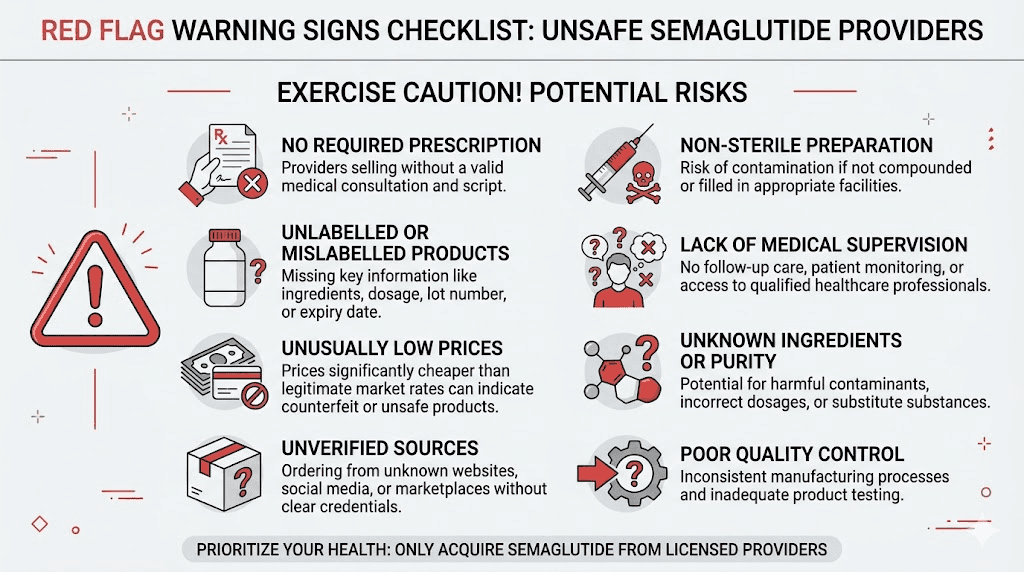
Confirm third-party testing. Legitimate compounding pharmacies test their products for potency, sterility, and endotoxins. Ask your provider whether their pharmacy partner conducts independent testing and whether certificates of analysis are available. This step alone eliminates a significant portion of questionable operators who rely on you never asking.
Review the follow-up protocol before committing. How often will you speak with a clinician? What happens if you experience symptoms after stopping semaglutide? What is the process for adjusting your dose? Can you reach a provider between scheduled appointments if something goes wrong? A provider that disappears after writing the initial prescription is not a provider. It is a vending machine.
Finally, check their medication sourcing transparency. You want to confirm that your semaglutide is the base form of the compound, not a salt variation. The FDA has explicitly warned that semaglutide sodium and semaglutide acetate are different active ingredients than those used in FDA-approved drugs like Wegovy and Ozempic. If your provider cannot clarify which form they use, consider that a deal-breaker.
How FDA regulations affect your semaglutide options
The regulatory landscape for compounded semaglutide has shifted dramatically, and understanding these changes is essential for choosing a provider that will still be operating six months from now. This is not background noise. It directly determines what you can access, from whom, and at what cost.
The FDA declared the semaglutide shortage resolved in February of the previous year, citing data from Novo Nordisk showing supply now meets or exceeds demand. That declaration triggered a critical enforcement timeline. Because compounding is only legally permitted when an FDA-approved drug is not commercially available, this resolution meant compounding pharmacies had a countdown to wind down their semaglutide products. 503A pharmacies had 60 days. 503B outsourcing facilities had 90 days.
What happened next is messy. Approximately 80% of compounded semaglutide and tirzepatide prescriptions now include supplemental ingredients like B vitamins. This is not because B12 or B12 enhances semaglutide in some revolutionary way. It is because adding supplemental ingredients allows compounders to argue their product is not a copy of the FDA-approved drug, which creates a legal pathway to continue compounding. Our detailed guide on semaglutide with methylcobalamin covers this combination in depth.
The FDA has pushed back. The agency sent more than 50 warning letters to companies compounding or manufacturing GLP-1 products, targeting claims that compounded versions are generic equivalents or contain the same active ingredient as FDA-approved drugs. The agency considers these claims false or misleading, and enforcement actions continue to escalate.
For you as a patient, this means several things. First, the provider you choose today may face regulatory pressure tomorrow. Selecting a provider with strong legal compliance and transparent sourcing reduces the risk of suddenly losing access to your medication. Second, the addition of supplemental ingredients to your semaglutide formulation is often regulatory strategy, not medical strategy. Ask your provider why those ingredients are included and whether they serve a clinical purpose for your specific situation.
Third, the FDA has identified serious safety issues with some compounded products, including dosing errors that resulted in hospitalizations. These errors stemmed from patients measuring incorrect doses and healthcare professionals miscalculating concentrations. Understanding how to properly administer semaglutide injections and using tools like semaglutide mixing charts can help prevent these errors regardless of which provider you choose.
The regulatory environment is still evolving. Providers that maintain strong compliance departments, work with accredited pharmacies, and stay ahead of FDA guidance changes are the ones most likely to remain operational and safe long-term.
Compounded vs brand-name semaglutide through digital providers
One of the most important decisions you will make when choosing a provider is whether to pursue compounded or brand-name semaglutide. This choice affects cost, safety, convenience, and long-term access. Neither option is universally better. The right choice depends on your situation.
Brand-name semaglutide (Wegovy for weight loss, Ozempic for diabetes) is manufactured by Novo Nordisk, undergoes rigorous FDA approval processes, and comes in pre-filled injection pens with standardized dosing. You do not need to reconstitute anything, measure anything, or worry about potency. The trade-off is cost. Without insurance, brand-name semaglutide can run $1,000 or more per month. With insurance, co-pays vary wildly depending on your plan.
Some digital providers like Ro and Walgreens can facilitate brand-name prescriptions and work with your insurance to reduce costs. If your insurance covers Wegovy, going the brand-name route through one of these providers is often the simplest and safest path.
Compounded semaglutide is manufactured by compounding pharmacies using the same active ingredient and typically costs $129 to $299 per month without insurance. This is significantly more accessible for patients without GLP-1 coverage. However, compounded products are not FDA-approved, come in vials that require reconstitution and manual dosing with syringes, and vary in quality depending on the pharmacy.
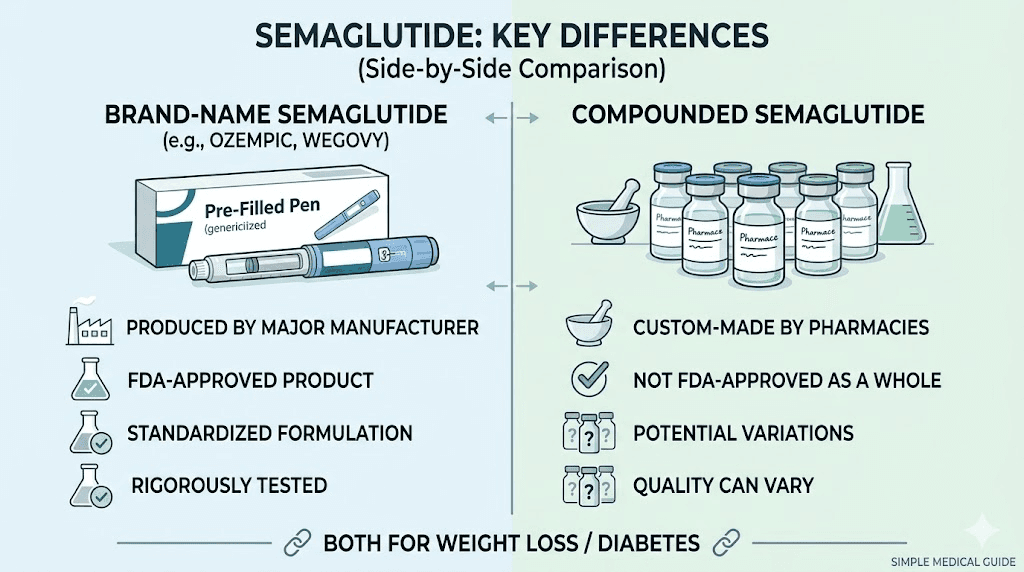
If you choose the compounded route, your provider selection becomes even more critical. The pharmacy matters enormously. Empower Pharmacy, Olympia Pharmacy, and Strive Pharmacy are among the larger compounding operations that many telehealth platforms partner with. Each has different strengths in terms of formulation options, testing protocols, and turnaround times.
Understanding how to mix your semaglutide properly is essential if you go the compounded route. Incorrect reconstitution is one of the leading causes of dosing errors the FDA has flagged. Use a semaglutide reconstitution chart every single time until the process becomes second nature, and even then, double-check your math.
Some providers now offer sublingual semaglutide and oral semaglutide drops as alternatives to injections. These formulations bypass the injection process entirely, which appeals to patients with needle anxiety. However, bioavailability differs between administration routes, and semaglutide troches may require different dosing protocols than injectable forms. Discuss this with your provider before switching.
Red flags that signal an unreliable semaglutide provider
The FBI has warned the public about fraudulent compounding practices involving weight loss drugs that claim to contain semaglutide but actually use unknown drug mixtures, drugs with high impurity levels, or unapproved substances. This is not hypothetical. People have been hospitalized. Some providers that look professional on the surface are anything but.
Here are the red flags. Memorize them.
No prescription required. If a website sells semaglutide without requiring a prescription or medical consultation, it is operating illegally. Full stop. A study found that approximately 42% of online pharmacies selling semaglutide operate without valid licenses. These are not providers. They are black market operations with good web design.
Suspiciously low pricing. Semaglutide costs money to produce, compound, test, and ship properly. If a provider charges dramatically less than the $129 to $299 range that legitimate compounders operate in, ask yourself what corners they are cutting. Are they skipping potency testing? Using untested raw materials? Shipping without cold chain protocols? There is always a reason the price is too good to be true.
No identifiable pharmacy. The FDA has discovered fraudulent compounded semaglutide products where the pharmacy names on labels either do not exist or did not actually produce the products. If your provider cannot tell you exactly which pharmacy compounds their medication and you cannot independently verify that pharmacy license, do not proceed. Check the pharmacy name against grey market indicators and state board of pharmacy databases.
Rubber-stamp approvals. If every patient who applies gets approved, regardless of medical history, BMI, or contraindications, the clinical oversight is performative. Semaglutide is not appropriate for everyone. A provider that never says no is a provider that prioritizes revenue over patient safety.
No follow-up protocol. Writing a prescription and disappearing is not healthcare. If the provider has no structured plan for monitoring your progress, adjusting your dose, or managing side effects like sulfur burps, menstrual changes, or leg cramps, you are essentially self-medicating with a prescription drug. That is a recipe for problems.
Pressure tactics. Urgency marketing, claims of limited supply, mandatory multi-month purchases, aggressive upselling of supplements or add-ons, these are sales techniques, not medical practices. A good provider gives you information and time to make an informed decision. A bad one pressures you to buy before you have a chance to ask questions.
Salt form ambiguity. If the provider cannot clearly tell you whether their semaglutide is the base peptide form or a salt form (sodium, acetate), that is a serious transparency failure. The FDA has specifically flagged salt forms as different active ingredients. You deserve to know exactly what you are putting in your body.
What to expect from your first telehealth semaglutide consultation
Knowing what a legitimate consultation looks like helps you evaluate providers in real time. If your experience deviates significantly from this framework, consider it a warning sign.
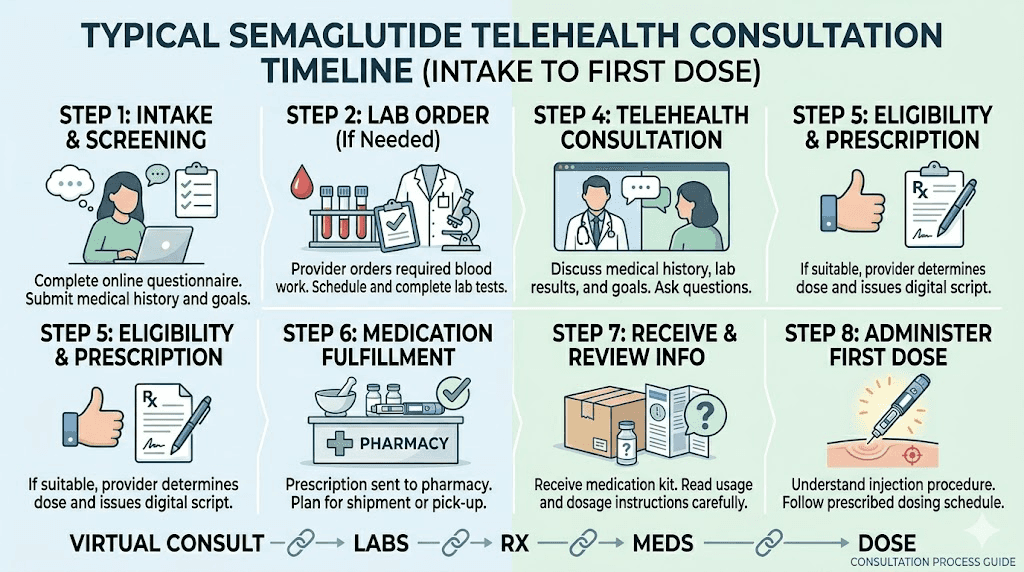
A quality initial consultation takes 15 to 30 minutes. Not five minutes. Not a questionnaire with an auto-approval at the end. An actual conversation with a licensed clinician who asks questions, listens to answers, and exercises clinical judgment.
The clinician should review your complete medical history. This includes current medications, past surgeries, family history of medullary thyroid carcinoma or MEN 2 syndrome (both contraindications for GLP-1 medications), history of pancreatitis, kidney function, and any previous experience with weight loss medications. If you have used phentermine before, they should ask about that experience and discuss how semaglutide differs.
They should assess your BMI and eligibility honestly. Semaglutide for weight loss is generally indicated for adults with a BMI of 30 or higher, or 27 or higher with at least one weight-related comorbidity. A provider that prescribes to patients who do not meet these criteria is not practicing evidence-based medicine.
Expect questions about your diet and exercise habits. Not because exercise is required for semaglutide to work (it works without exercise for many patients), but because understanding your baseline lifestyle helps the clinician set realistic expectations and identify potential nutritional gaps. Many patients struggle with adequate protein intake on semaglutide due to reduced appetite, and a good provider will address protein requirements and calorie targets proactively.
The clinician should explain the titration schedule clearly. Most protocols follow a pattern similar to this: four weeks at 0.25mg, four weeks at 0.5mg, and then gradual increases based on response and tolerability. They should tell you what side effects to expect, when those side effects typically peak, and exactly when and how to contact them if something feels wrong.
Before the consultation ends, you should understand your complete cost commitment, the shipping timeline for your first medication delivery, when and how to take your first dose, what the follow-up schedule looks like, and who to contact for urgent concerns. If you leave the consultation with unanswered questions about any of these topics, the provider did not do their job thoroughly.
Dosing and titration support across top providers
Titration is where the difference between a mediocre and excellent provider becomes most apparent. Semaglutide is not a medication you can start at full dose. The gastrointestinal side effects at higher doses without titration can be severe, including persistent nausea, vomiting, diarrhea, and in rare cases, pancreatitis. Every reputable provider follows a staged escalation protocol, but the quality of support around that protocol varies dramatically.
The standard titration schedule for compounded semaglutide typically looks like this:
Weeks 1 through 4: 0.25mg once weekly. This is the acclimation phase. Most patients experience mild nausea and reduced appetite. Your provider should check in at least once during this period to assess tolerability.
Weeks 5 through 8: 0.5mg once weekly. Side effects may intensify briefly before the body adapts. This is where many patients start seeing meaningful weight loss results. A good provider monitors your response and decides whether to continue escalating or hold at this dose.
Weeks 9 through 12: 1.0mg once weekly. At this dose, appetite suppression is typically significant. Your provider should be tracking your weight trajectory, asking about side effects, and discussing whether further increases are warranted based on your goals and tolerance.
Beyond week 12: Doses may increase to 1.7mg or 2.4mg for patients who tolerate lower doses well but need additional appetite suppression. Not every patient needs to reach the maximum dose. A thoughtful provider adjusts based on your individual response rather than following a rigid escalation calendar.
The best providers supplement titration schedules with dosing tools and resources. Semaglutide dosage calculators help you verify your provider recommended dose against established protocols. Dosage charts for 10mg vials and 5mg vial charts help you draw the correct amount from multi-dose vials. And understanding how to convert between units and milligrams prevents the measurement errors that have led to FDA safety warnings.
If your provider prescribes a dose without explaining exactly how to measure it, what syringe to use, and how many units correspond to your prescribed milligram amount, that is a gap in care you should not tolerate. Reference our guides on specific unit conversions like 40 units in mg, 50 units in mg, or 0.25mg in units to double-check your own calculations.
Cost comparison and hidden fees to watch for
Price is often the deciding factor for patients choosing between semaglutide providers, but the sticker price rarely tells the full story. Hidden fees, dose-dependent pricing increases, mandatory add-ons, and unclear cancellation policies can turn what seems like a budget-friendly option into an expensive mistake.
Here is what the actual cost landscape looks like across major providers:
Provider | Monthly cost | Includes | Insurance option | Contract required |
|---|---|---|---|---|
Eden Health | $129 (3-month plan) | Medication, consult, shipping | No | 3-month minimum |
MEDVi | $179 | Medication, consult | No | No |
Hims/Hers | $199 | Medication, consult, shipping | No | Varies |
SkinnyRx | $199 | Medication, consult, shipping | No | Multi-month discounts |
ShedRx | $199 to $299 | Medication, consult, coaching (optional) | No | No |
Ro | $190 to $300 | Medication, consult, labs | Yes (some plans) | Varies |
Walgreens | Varies | Depends on plan | Yes | No |
Now here is what the table does not show. Many providers charge differently at different doses. A plan that costs $179 per month at 0.25mg might cost $249 at 1.0mg and $349 at 2.4mg. Ask explicitly: does the price change as my dose increases? If the answer is yes, calculate your projected cost at your expected maintenance dose, not just the starting price.
Lab work is another hidden cost. Some providers include baseline labs in their program fee. Others require labs but bill them separately, sometimes through third-party lab companies that charge $150 to $300 per panel. Ask upfront: are labs required, and if so, who pays for them?
Shipping fees can add up over time. Most top providers include shipping, but some charge $10 to $25 per shipment, especially for expedited delivery. Given that semaglutide requires cold chain shipping to maintain potency, cutting costs on shipping is a bad trade-off. Verify that your provider uses insulated packaging and cold packs, and that this is included in the advertised price.
Cancellation policies vary wildly. Some providers allow month-to-month flexibility with no penalties. Others lock you into three-month or six-month commitments with significant cancellation fees. Read the terms of service before signing up. If semaglutide does not work for you after the first month, you do not want to be locked into five more months of payments.
Finally, watch for supplement upsells. Some providers aggressively push add-on supplements, vitamin packages, or coaching bundles that significantly increase your monthly total.
These may or may not provide value. Evaluate them separately from your core semaglutide program rather than bundling everything together and losing visibility into what you are actually paying for.
How to evaluate patient reviews and testimonials
Patient reviews are useful, but they require critical reading. Not all positive reviews are genuine, and not all negative reviews are fair. Here is how to extract real signal from the noise.
Look at volume first. A provider with 50 five-star reviews is less informative than one with 4,000 reviews averaging 4.2 stars. Small sample sizes are easy to manipulate. Large ones are much harder to fake.
Read the negative reviews carefully. One-star reviews that mention shipping delays or app glitches are very different from one-star reviews that mention incorrect dosing, adverse reactions, or inability to reach a clinician during an emergency. The first category reflects operational growing pains. The second category reflects fundamental safety problems.
Check the dates. A provider that had excellent reviews two years ago but has accumulated complaints recently may have changed ownership, pharmacy partners, or clinical protocols. The most recent reviews are the most relevant, especially given medication storage challenges and evolving FDA regulations.
Be skeptical of reviews that read like marketing copy. Real patient reviews mention specific details: how long shipping took, what their provider interaction felt like, which side effects they experienced, how the dose escalation process went. Generic praise without specifics often indicates planted reviews.
Cross-reference across platforms. Check Trustpilot, Google Reviews, Reddit communities, and the Better Business Bureau. A provider with glowing Trustpilot reviews but numerous BBB complaints tells a different story than the reviews alone suggest. SeekPeptides provides detailed reviews of many individual providers, including Brello, Levity, Belle Health, WeightCare, and many others to help you compare firsthand accounts alongside clinical criteria.
What happens after you choose a provider
Selecting a provider is step one. What comes next determines whether your semaglutide experience succeeds or stalls.
Your first shipment should arrive within 3 to 7 business days for most providers. When it arrives, inspect the packaging immediately. The medication should be cool to the touch, properly labeled with clear concentration and expiration information, and accompanied by instructions. If anything looks off, contact your provider before using the medication. Our guide on what to do if your semaglutide arrives warm walks you through the assessment process.
Store your semaglutide properly from day one. Unreconstituted vials typically go in the refrigerator at 36 to 46 degrees Fahrenheit. Once reconstituted, the clock starts ticking on shelf life. Different formulations and concentrations have different stability windows, so consult your provider documentation and reference our semaglutide fridge storage guide for detailed timelines.
Choose your injection site carefully and rotate between sites with each dose. The abdomen, thigh, and upper arm are the three standard injection areas. Rotating sites reduces the risk of lipodystrophy and injection site reactions. If you have never self-injected before, our injection guide provides step-by-step instructions with visual references.

Track your progress systematically.
Weekly weigh-ins at the same time of day, photos monthly, and a brief journal noting energy levels, appetite changes, and any side effects give you and your provider concrete data to work with during follow-ups. Knowing whether you are experiencing normal responses or something that requires intervention depends on having this information available.
Adjust your nutrition strategy as your appetite changes. Semaglutide dramatically reduces hunger for most patients, which is the primary mechanism of weight loss. But reduced calorie intake also means reduced nutrient intake. Focus on nutrient-dense foods, prioritize protein to preserve muscle mass, and consider whether your current supplement routine needs updating. Many patients benefit from reviewing diet strategies specific to semaglutide during the early weeks when appetite changes are most dramatic.
If your provider offers coaching or dietary guidance, use it during the first three months. This is when habits form, when side effects are most likely, and when having expert support makes the biggest difference. After you have established a routine and understand how your body responds, you may find you need less hand-holding. But early investment in support pays dividends in long-term outcomes.
When to consider switching providers
Sometimes the provider you chose is not the right fit. Recognizing when to switch can save you months of frustration, wasted money, and suboptimal results.
Switch if you cannot reach your clinician when you need them. Delayed responses to urgent questions about side effects, dosing concerns, or adverse reactions are unacceptable. If you are experiencing lightheadedness, kidney pain, or concerning symptoms and cannot get a timely response, your provider is failing at the most fundamental level.
Switch if your medication quality seems inconsistent. If different shipments look different (color, clarity, viscosity), produce different effects, or arrive at different temperatures, your pharmacy partner may have quality control issues. Our guide on what color semaglutide should be and why semaglutide sometimes looks pink helps you identify visual red flags.
Switch if the titration process feels rushed or rigid. Some providers push patients to increase doses faster than recommended to accelerate results. Others refuse to adjust dosing downward when side effects are severe. Neither approach serves your interests. A good provider listens to your experience and adapts the protocol accordingly.
Switch if hidden costs keep appearing. If your monthly bill consistently exceeds what was quoted during signup, if new fees appear without explanation, or if the provider changes pricing terms mid-treatment, your trust has been violated. You should not have to audit your healthcare bill every month.
And switch if you simply do not feel heard. Medicine is a relationship. If your provider dismisses your concerns, provides generic responses to specific questions, or makes you feel like a number rather than a patient, there are better options available. The providers listed in this guide all demonstrate higher standards. You deserve one that meets them.
Building a complete support system beyond your provider
Even the best digital health provider cannot address every aspect of successful semaglutide treatment. Building a support ecosystem around your provider relationship dramatically improves outcomes.
Consider maintaining a relationship with your primary care physician in addition to your telehealth semaglutide provider. Your PCP can order and interpret comprehensive lab work, monitor for interactions with other medications, and provide a medical home that your telehealth provider cannot fully replace. This is especially important if you take medications that may interact with semaglutide, like berberine, metformin, or bupropion.
Nutritional guidance matters. As your appetite decreases, making every calorie count becomes critical. Working with a registered dietitian, even for just a few sessions, can help you build a sustainable eating pattern that maintains muscle, provides adequate micronutrients, and supports long-term weight management after you reach your goal weight.
Community support should not be underestimated. Online forums, patient communities, and peer groups provide practical tips, emotional support, and real-world experience reports that no provider or article can fully replicate. Hearing from someone who navigated the same constipation challenges or managed early side effects successfully can make a tremendous difference on difficult days.
SeekPeptides serves as a comprehensive resource for patients navigating the world of GLP-1 medications. With detailed guides on semaglutide timelines, practical tips, dosing charts, and hundreds of provider reviews, the platform gives you the information you need to make confident decisions at every stage of your treatment. Members access detailed protocols, personalized guidance, and a community of experienced researchers who have navigated these exact questions.
What top providers are doing differently in the current landscape
The digital health landscape for semaglutide is evolving rapidly, and the best providers are adapting in ways that matter to patients.
Multi-format medication options are becoming standard. The top providers now offer injectable, sublingual, and oral formulations, recognizing that patient preferences and tolerability vary significantly. If injectable semaglutide causes persistent injection site reactions for you, having the option to switch to oral drops without changing providers is a significant advantage.
Integrated wellness programs are replacing simple prescription services. Leading providers now offer nutrition coaching, exercise guidance, progress tracking tools, and behavioral health support alongside medication management. This holistic approach recognizes that semaglutide is most effective as part of a comprehensive lifestyle strategy, not as a standalone solution.
Transition planning is a newer differentiator. The best providers are not just focused on getting you on semaglutide. They are planning for what happens when you reach your goal weight. How do you taper? How do you maintain weight loss after stopping? What if you experience withdrawal symptoms? Providers who address the full treatment lifecycle, including the exit strategy, demonstrate a level of care that transactional providers simply do not offer.
Transparency about regulatory changes is another distinguishing factor. Providers who proactively communicate about FDA guidance changes, explain how those changes affect their patients, and have contingency plans for supply disruptions earn trust that fair-weather providers lose when the regulatory landscape shifts.
For patients who want the most comprehensive peptide education available, SeekPeptides offers evidence-based guides, proven protocols, and a community of thousands who have navigated the full spectrum of GLP-1 treatment decisions.
Comparing semaglutide providers to tirzepatide providers
Many patients who research semaglutide providers eventually ask whether tirzepatide might be a better option. The comparison is worth exploring because many digital health platforms now offer both medications, and your choice of provider may depend on which GLP-1 you ultimately decide to use.
Tirzepatide (the active ingredient in Mounjaro and Zepbound) is a dual GIP/GLP-1 receptor agonist, meaning it targets two pathways instead of one. Clinical trials have shown greater average weight loss with tirzepatide compared to semaglutide, though individual responses vary. Our detailed side effect comparison helps you understand the differences in tolerability profiles.
Providers that offer both medications give you a significant advantage: the ability to switch without changing platforms. If semaglutide is not producing the results you expected, or if side effects become unmanageable, transitioning to tirzepatide through the same provider streamlines the process. Our conversion chart explains how providers typically manage this transition.
Some patients even ask about newer options like retatrutide, which targets three receptors (GLP-1, GIP, and glucagon) and has shown promising results in clinical trials. While retatrutide is not yet FDA-approved, some compounding pharmacies offer it. Our three-way comparison covers how these medications stack up against each other.
When evaluating providers, ask whether they offer both semaglutide and tirzepatide, what their protocol is for switching between medications, and whether their clinical team has experience managing patients on multiple GLP-1 platforms. Flexibility matters, especially as the science evolves and new treatment options become available.
Special considerations for specific patient populations
Not every patient fits neatly into the standard semaglutide protocol. Certain populations need providers with specific expertise and experience.
Women of reproductive age face unique considerations. Semaglutide can increase fertility in some patients by improving ovulation in those with obesity-related anovulation. Some women have become unexpectedly pregnant while on GLP-1 medications. A good provider discusses contraception proactively and has clear protocols for managing medication during potential or confirmed pregnancy. Questions about breastfeeding and GLP-1 medications should be addressed directly rather than deflected.
Patients with thyroid conditions need providers who understand the relationship between GLP-1 medications and thyroid function. If you have Hashimoto disease, you should be working with a provider familiar with GLP-1 medications and autoimmune thyroid conditions and monitoring your thyroid levels throughout treatment.
Patients taking multiple medications need providers who can identify and manage drug interactions. Semaglutide affects gastric emptying, which can alter the absorption of oral medications. If you take thyroid medication, metformin, blood pressure medications, or other drugs that require consistent absorption timing, your semaglutide provider needs to coordinate with your other prescribers.
Patients considering combination therapy represent a growing population. Some individuals use semaglutide alongside other compounds for enhanced results. Whether you are exploring semaglutide with L-carnitine, semaglutide with glycine, or glycine and B12 blends, your provider should be able to discuss the evidence behind these combinations and help you make informed decisions rather than simply adding ingredients without clinical justification.
Patients who have plateaued need providers who can troubleshoot. If you are not losing weight on semaglutide despite following your protocol, a skilled provider investigates the root cause rather than simply increasing the dose. Plateau management requires assessing diet, exercise, sleep, stress, medication timing, and sometimes switching to a different GLP-1 medication entirely.
The future of digital semaglutide prescribing
The landscape is shifting fast. Understanding where things are headed helps you choose a provider positioned for the future, not just the present.
Brand-name oral semaglutide (Rybelsus) is already FDA-approved for diabetes, and an oral formulation for weight loss is expanding access for patients who prefer pills over injections. This development may reduce the demand for compounded semaglutide formulations and shift the competitive dynamics among providers. Platforms that can offer both injectable and oral brand-name options will have an advantage.
Regulatory enforcement will continue to tighten. The FDA has made it clear that compounded GLP-1 products face increasing scrutiny, and providers that cut corners on pharmacy partnerships, medication quality, or clinical oversight will face consequences. Choosing a provider with strong regulatory compliance today protects you from disruptions tomorrow.
Personalization will become the key differentiator. As the market matures, the providers that win will be those offering genuinely personalized protocols based on genetic factors, metabolic testing, and individual response patterns rather than one-size-fits-all dose escalation schedules. Early movers in this direction are already demonstrating better outcomes and higher patient satisfaction.
Integration with broader health management platforms will accelerate. The best semaglutide providers will not exist in isolation. They will connect with primary care, mental health, nutritional coaching, and fitness platforms to provide comprehensive weight management that treats the whole person rather than just prescribing a medication.
For researchers and patients who want to stay ahead of these developments, SeekPeptides offers the most comprehensive resource available, with evidence-based guides, proven protocols, and a community of thousands who navigate these decisions daily.
Frequently asked questions
What is the safest way to get semaglutide online?
The safest approach is through a licensed telehealth provider that requires a genuine medical consultation, uses an FDA-registered or state-licensed compounding pharmacy, and provides ongoing follow-up care. Verify the pharmacy license independently and confirm that third-party potency testing is performed on each batch.
How much should I expect to pay for semaglutide through a digital health provider?
Legitimate compounded semaglutide from top providers typically costs between $129 and $299 per month. Brand-name Wegovy can exceed $1,000 without insurance. Be wary of prices significantly below the $129 floor, as they may indicate compromised quality or grey market sourcing.
Can I switch semaglutide providers mid-treatment?
Yes. You can switch providers at any point during treatment. Your new provider will need your current dose, medical history, and how long you have been on semaglutide. There should be no gap in medication. Time the switch so your new provider shipment arrives before your current supply runs out.
What is the difference between compounded and brand-name semaglutide?
Brand-name semaglutide (Wegovy, Ozempic) is FDA-approved and manufactured by Novo Nordisk. Compounded semaglutide is produced by compounding pharmacies using the same active ingredient but is not FDA-approved. Compounded versions are significantly cheaper but require more patient involvement in preparation and administration.
How do I know if my semaglutide provider is legitimate?
Verify that the provider requires a real medical consultation with a licensed clinician, can name and license-verify their pharmacy partner, offers structured follow-up care, does not prescribe without a prescription, and maintains transparent pricing. Cross-reference reviews on Trustpilot, Google, and the Better Business Bureau.
Should I choose a provider that offers both semaglutide and tirzepatide?
If possible, yes. Having access to both medications through a single provider gives you flexibility to switch if semaglutide alone does not produce adequate results. Our semaglutide vs tirzepatide comparison can help you understand the differences before your consultation.
What should I do if my semaglutide arrives warm or damaged?
Do not use medication that may have been temperature-compromised. Contact your provider immediately, document the packaging condition with photos, and request a replacement shipment. Our guide on semaglutide temperature exposure explains what heat does to the medication and how to assess whether it is still viable.
How long should I stay with a semaglutide provider before evaluating results?
Give your provider and the medication at least 8 to 12 weeks before making a judgment. Semaglutide requires titration, and meaningful results typically appear after reaching a therapeutic dose. Our guide on how long semaglutide takes to work provides detailed timelines for what to expect at each stage.
External resources
FDA concerns with unapproved GLP-1 drugs used for weight loss
FBI Internet Crime Complaint Center: safety concerns related to fraudulent compounding practices
American Journal of Managed Care: navigating compounded semaglutide
PubMed Central: safety and risk assessment of no-prescription online semaglutide purchases
In case I do not see you, good afternoon, good evening, and good night. May your providers stay legitimate, your dosing stay accurate, and your results stay consistent.