Feb 10, 2026
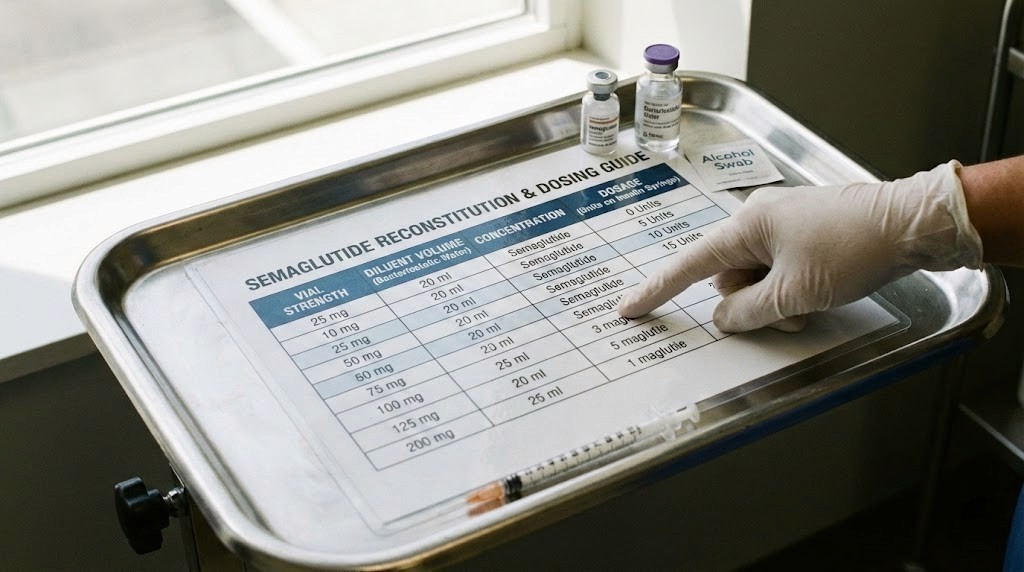
You have a vial of lyophilized semaglutide sitting on your counter. A bottle of bacteriostatic water beside it. An insulin syringe still in its wrapper. And absolutely no idea how much water goes into that vial. The pharmacy instructions say one thing. The internet says another. Your friend who has been on semaglutide for six months swears by a ratio you have never seen mentioned anywhere else. So you guess. You add what feels like the right amount, draw up what looks like the right dose, and inject something that may or may not be delivering what you think it is.
This is how most reconstitution mistakes happen. Not through carelessness, but through confusion. The math behind mixing semaglutide is not complicated once you understand it. But the consequences of getting it wrong are real. Too much bacteriostatic water and your dose is weaker than intended. Too little and you are injecting a higher concentration than your body expects. Both scenarios create problems that compound over weeks of a protocol.
This guide provides the complete semaglutide mixing chart for every common vial size, from 2mg all the way through 10mg. Every ratio. Every concentration. Every unit conversion. Whether you are new to compounded semaglutide or switching to a different vial strength, the charts and step-by-step instructions below will take the guesswork out of reconstitution entirely. SeekPeptides members consistently report that getting reconstitution right from day one is the single biggest factor in achieving consistent, predictable results throughout their protocol.
Understanding semaglutide reconstitution basics before you mix
Before touching a syringe, you need to understand what reconstitution actually does and why the ratios matter. Semaglutide arrives as a lyophilized powder, which means the water has been removed through freeze-drying to keep the peptide stable during storage and shipping. The powder itself cannot be injected. You need to add a precise amount of liquid to dissolve it back into an injectable solution.
The liquid you add is bacteriostatic water. This is sterile water containing 0.9% benzyl alcohol, which prevents bacterial growth in the solution after reconstitution. Regular sterile water works in a pinch, but bacteriostatic water extends the usable life of your reconstituted vial from days to weeks.
Here is the critical concept. The amount of bacteriostatic water you add determines the concentration of your solution. More water means a lower concentration, which means you need to draw up a larger volume for each dose. Less water means a higher concentration, which means smaller injection volumes but less room for measurement error.
Neither approach is inherently better. The right concentration depends on your prescribed dose, your syringe type, and your personal preference. What matters is knowing exactly what concentration you created so every dose is accurate.
The concentration formula
Concentration equals the total peptide amount divided by the total volume of liquid. If you have a 5mg vial and add 2ml of bacteriostatic water, your concentration is 5mg divided by 2ml, which equals 2.5mg per ml. Simple math. But this single number controls everything about your dosing accuracy for the life of that vial.
Why concentration matters for your insulin syringe
A standard U-100 insulin syringe holds 1ml and is marked in 100 units. Each unit equals 0.01ml. When your concentration is 2.5mg/ml, each unit on the syringe contains 0.025mg (25mcg) of semaglutide. Change the concentration to 5mg/ml, and each unit now contains 0.05mg (50mcg). Same syringe. Same unit markings. Completely different dose per unit.
This is where mistakes happen. Someone reads a mixing chart for a 2.5mg/ml concentration, then applies those unit numbers to a vial they mixed at 5mg/ml. They end up injecting double their intended dose. Or they use a chart designed for a higher concentration with a more dilute solution and get half the dose they need. Either way, the results are frustrating. And preventable.
The SeekPeptides reconstitution calculator eliminates this risk by calculating exact volumes based on your specific vial size and desired concentration.
Complete semaglutide mixing chart: every vial size
Below are the complete mixing charts for the four most common compounded semaglutide vial sizes. Each chart includes the bacteriostatic water volume, resulting concentration, and the exact number of units to draw for standard weekly doses using a U-100 insulin syringe.
2mg semaglutide vial mixing chart
The 2mg vial is the smallest commonly available size, typically used for shorter protocols or lower-dose maintenance phases. Add 1ml of bacteriostatic water to create a concentration of 2mg/ml.
Bacteriostatic water added | Concentration | 0.25mg dose | 0.5mg dose | 1mg dose |
|---|---|---|---|---|
0.5ml | 4mg/ml | 6.25 units | 12.5 units | 25 units |
1ml | 2mg/ml | 12.5 units | 25 units | 50 units |
2ml | 1mg/ml | 25 units | 50 units | 100 units |
At the recommended 1ml water volume, this vial provides enough semaglutide for 8 weeks at 0.25mg per week, or 4 weeks at 0.5mg per week. For most starting protocols, a 2mg vial covers the initial titration phase comfortably.
One important detail. At higher concentrations like 4mg/ml, the unit measurements become very small. Drawing exactly 6.25 units on an insulin syringe is nearly impossible. For smaller vials, adding more water gives you more readable syringe measurements, even though it means larger injection volumes.
3mg semaglutide vial mixing chart
The 3mg vial is a middle-ground option. Some compounding pharmacies offer this size specifically for patients who want enough supply for a full month of lower-dose treatment without the excess of a larger vial. Add 1ml of bacteriostatic water for a clean 3mg/ml concentration.
Bacteriostatic water added | Concentration | 0.25mg dose | 0.5mg dose | 1mg dose |
|---|---|---|---|---|
1ml | 3mg/ml | 8.3 units | 16.7 units | 33.3 units |
1.5ml | 2mg/ml | 12.5 units | 25 units | 50 units |
3ml | 1mg/ml | 25 units | 50 units | 100 units |
Notice the fractional units at 3mg/ml concentration. Drawing exactly 8.3 units or 16.7 units requires careful attention. Many researchers prefer adding 1.5ml of water instead to get a clean 2mg/ml concentration with whole-number measurements at the 0.25mg and 0.5mg dose levels. The tradeoff is a slightly larger injection volume, which most people find negligible.
5mg semaglutide vial mixing chart
The 5mg vial is the most popular size for compounded semaglutide. It provides enough peptide for a full titration from the starting dose through several weeks of higher dosing, all from a single vial. The standard reconstitution uses 2ml of bacteriostatic water for a concentration of 2.5mg/ml.
Bacteriostatic water added | Concentration | 0.25mg dose | 0.5mg dose | 1mg dose | 1.7mg dose | 2.4mg dose |
|---|---|---|---|---|---|---|
1ml | 5mg/ml | 5 units | 10 units | 20 units | 34 units | 48 units |
2ml | 2.5mg/ml | 10 units | 20 units | 40 units | 68 units | 96 units |
2.5ml | 2mg/ml | 12.5 units | 25 units | 50 units | 85 units | N/A (exceeds syringe) |
5ml | 1mg/ml | 25 units | 50 units | 100 units | N/A | N/A |
The 2ml water option is the sweet spot for most people. At 2.5mg/ml, the unit measurements are clean and easy to read on a standard insulin syringe. A 0.25mg starting dose is just 10 units. A 0.5mg dose is 20 units. Even at 1mg, you are only drawing 40 units, which is well within the readable range of most syringes.
At the 5mg/ml concentration (1ml of water), the measurements are very small. Drawing exactly 5 units requires precision that many people find difficult, especially with standard insulin syringes. This concentration works best for experienced users who are comfortable with very small volumes and want to minimize injection volume.
At 1mg/ml (5ml of water), the measurements are large and easy to read, but you run into syringe capacity limits at higher doses. A 1mg dose fills the entire syringe. Doses above 1mg would require multiple injections, which is impractical.
For reference, here is the complete semaglutide 5mg/ml dosage chart with week-by-week titration schedules.
10mg semaglutide vial mixing chart
The 10mg vial is the largest commonly available size and offers the best value per milligram for longer protocols. Standard reconstitution uses 3ml of bacteriostatic water for a concentration of approximately 3.33mg/ml. Some researchers prefer 2ml for a 5mg/ml concentration, or 4ml for a cleaner 2.5mg/ml ratio.
Bacteriostatic water added | Concentration | 0.25mg dose | 0.5mg dose | 1mg dose | 1.7mg dose | 2.4mg dose |
|---|---|---|---|---|---|---|
2ml | 5mg/ml | 5 units | 10 units | 20 units | 34 units | 48 units |
3ml | 3.33mg/ml | 7.5 units | 15 units | 30 units | 51 units | 72 units |
4ml | 2.5mg/ml | 10 units | 20 units | 40 units | 68 units | 96 units |
5ml | 2mg/ml | 12.5 units | 25 units | 50 units | 85 units | N/A (exceeds syringe) |
For the 10mg vial, the 4ml water option is often the best choice. It creates the same clean 2.5mg/ml concentration as the standard 5mg vial reconstitution, which means the same unit-to-dose conversions apply. If you have been using a 5mg vial at 2.5mg/ml and switch to a 10mg vial, adding 4ml of water keeps your dosing math identical.
The 3ml option (3.33mg/ml) is the most commonly cited in pharmacy instructions. It works well but produces fractional unit measurements at some dose levels. At 7.5 units for a 0.25mg dose, you are splitting the difference between two unit markings on the syringe. Not impossible, but it introduces a small margin of error that accumulates over weeks of dosing.
A 10mg vial reconstituted with 4ml of bacteriostatic water provides enough semaglutide for approximately 10 weeks at the 1mg dose level, or about 4 weeks at the highest maintenance dose of 2.4mg. This makes it the most economical choice for long-term protocols, especially when cost per milligram is a consideration.
Step-by-step reconstitution instructions
The mixing charts above tell you what to do. This section tells you how to do it. Follow these steps exactly, and your reconstitution will produce a clean, accurate solution every time.
What you need
Gather everything before you start. You will need your lyophilized semaglutide vial, a vial or ampule of bacteriostatic water, a sterile 3ml syringe with needle (for drawing the water), alcohol swabs, and a clean, flat workspace. Having everything ready prevents the need to set down a needle mid-process, which is a contamination risk.
Step 1: clean the vial tops
Use an alcohol swab to wipe the rubber stopper on both the semaglutide vial and the bacteriostatic water vial. Let the alcohol dry completely before piercing. This takes about 15 seconds. Skipping this step is one of the most common causes of contamination in multi-dose vials.
Step 2: draw the bacteriostatic water
Using your 3ml syringe, pierce the rubber stopper of the bacteriostatic water vial. Turn the vial upside down and slowly draw the exact amount of water specified in your mixing chart. For a 5mg vial at 2.5mg/ml, that is exactly 2ml. For a 10mg vial at 2.5mg/ml, that is 4ml.
Precision matters here. If you intend to add 2ml and actually add 2.3ml, your concentration drops from 2.5mg/ml to 2.17mg/ml. Every dose for the life of that vial will be approximately 13% weaker than intended. Over a 4-week titration period, that adds up to nearly a full missed dose worth of peptide.
Step 3: inject the water into the semaglutide vial
Pierce the rubber stopper of the semaglutide vial. This is the step where most people make their biggest mistake. Do NOT squirt the water directly onto the powder cake. Instead, angle the needle so the tip touches the inside wall of the vial, near the top. Slowly press the plunger, letting the water trickle down the glass wall and pool at the bottom around the powder.
Why does this matter? Semaglutide is a delicate peptide. Direct pressure from a stream of water can damage the molecular structure. Foaming introduces air bubbles that trap peptide and make accurate dosing difficult. The gentle wall-trickle method dissolves the powder without creating foam or damaging the peptide bonds.
Step 4: dissolve the powder
Once all the water is in the vial, gently swirl it. Roll the vial between your palms. Tilt it slowly back and forth. What you should never do is shake it. Shaking creates foam, introduces air bubbles, and can denature the peptide through mechanical stress.
The powder should dissolve within 30 to 60 seconds of gentle swirling. If small particles remain after a minute, set the vial on a flat surface and wait. Check again in 5 minutes. Most residual particles dissolve on their own with time. If the solution remains cloudy or particles persist after 15 minutes, something may be wrong with the peptide. Do not use a solution that does not dissolve completely.
A properly reconstituted semaglutide solution is perfectly clear and colorless, like water. Any cloudiness, haziness, or visible particles indicate a problem.
Step 5: label and store
Write the date of reconstitution and the concentration on the vial or on a piece of tape attached to the vial. This seems unnecessary until you have two vials in the fridge and cannot remember which was mixed when or at what concentration.
Store the reconstituted vial in the refrigerator immediately, between 36 and 46 degrees Fahrenheit (2 to 8 degrees Celsius). Refer to our complete semaglutide storage guide for specific placement recommendations and temperature monitoring. Use the reconstituted solution within 28 days.
The unit conversion chart you actually need
This is the chart that brings everything together. Once you know your concentration, this table tells you exactly how many units to draw on a U-100 insulin syringe for any standard semaglutide dose.
Desired dose | 1mg/ml | 2mg/ml | 2.5mg/ml | 3.33mg/ml | 5mg/ml |
|---|---|---|---|---|---|
0.25mg | 25 units | 12.5 units | 10 units | 7.5 units | 5 units |
0.5mg | 50 units | 25 units | 20 units | 15 units | 10 units |
1mg | 100 units | 50 units | 40 units | 30 units | 20 units |
1.7mg | N/A | 85 units | 68 units | 51 units | 34 units |
2.4mg | N/A | N/A | 96 units | 72 units | 48 units |
Bookmark this chart. Print it. Tape it to your fridge. The unit numbers only work when matched to the correct concentration. Using the 2.5mg/ml column when your vial is actually mixed at 5mg/ml means you inject double every dose. Using the 5mg/ml column with a 2.5mg/ml solution means you get half. This single table, combined with knowing your concentration, is all you need for accurate dosing.
For an even more detailed breakdown including milligram-to-unit conversions at every dose level, see our semaglutide unit conversion guide and our 20 units of semaglutide guide.
Weekly titration schedule matched to your mixing chart
Semaglutide is not a medication you start at full dose. The standard protocol follows a gradual titration schedule that increases the dose every four weeks. This slow ramp allows your body to adjust and minimizes gastrointestinal side effects that are common when starting too aggressively.
Below is the standard titration schedule with units calculated at the most common 2.5mg/ml concentration (the standard for a 5mg vial with 2ml water, or a 10mg vial with 4ml water).
Weeks | Weekly dose | Units at 2.5mg/ml | Volume (ml) | Injection frequency |
|---|---|---|---|---|
1 to 4 | 0.25mg | 10 units | 0.10ml | Once weekly |
5 to 8 | 0.5mg | 20 units | 0.20ml | Once weekly |
9 to 12 | 1mg | 40 units | 0.40ml | Once weekly |
13 to 16 | 1.7mg | 68 units | 0.68ml | Once weekly |
17 and beyond | 2.4mg | 96 units | 0.96ml | Once weekly |
Several things to notice about this schedule. The first month uses a very small amount of peptide, just 1mg total across four injections. This means a single 5mg vial reconstituted at 2.5mg/ml provides enough semaglutide for the entire first month with 4mg remaining. By the time you reach maintenance dosing at 2.4mg per week, you are using nearly one full syringe (96 units out of 100) per injection.
Most people find their effective dose somewhere between 1mg and 2.4mg per week. Not everyone needs to reach the maximum. Your appetite suppression response, weight loss progress, and side effect tolerance all factor into finding the right maintenance dose.
How many vials do you need?
This depends on your vial size, concentration, and how high you titrate. Here is a practical supply estimate using the standard titration above.
Duration | Total semaglutide needed | 5mg vials | 10mg vials |
|---|---|---|---|
Weeks 1 to 4 | 1mg | 1 vial (4mg remaining) | 1 vial (9mg remaining) |
Weeks 1 to 8 | 3mg | 1 vial (2mg remaining) | 1 vial (7mg remaining) |
Weeks 1 to 12 | 7mg | 2 vials | 1 vial (3mg remaining) |
Weeks 1 to 16 | 13.8mg | 3 vials | 2 vials |
Weeks 1 to 20 | 23.4mg | 5 vials | 3 vials |
An important caveat. Each reconstituted vial should be used within 28 days. If you are on a low dose and your vial contains more semaglutide than you will use in 28 days, some will go to waste. For example, a 10mg vial at week 1 to 4 dosing (0.25mg per week) means you only use 1mg in 28 days. The remaining 9mg in that vial either needs to be used or discarded when the 28-day window closes. Planning your reconstitution timing around your dose phase prevents waste and saves money.
Choosing the right concentration for your situation
The mixing charts above offer multiple water volumes for each vial size. So which concentration should you actually use? The answer depends on three factors.
Factor 1: your current dose level
If you are in the early titration phase at 0.25mg or 0.5mg per week, a lower concentration (1mg/ml or 2mg/ml) gives you larger, easier-to-measure volumes on the syringe. Drawing 25 units is much easier than drawing 5 units accurately.
If you are at maintenance dosing of 1.7mg or 2.4mg per week, you need a higher concentration (2.5mg/ml or higher) to keep the injection volume within a single syringe. At 1mg/ml, a 2.4mg dose would require 240 units, which is more than two full syringes. Impractical.
Factor 2: your syringe type
Standard U-100 insulin syringes come in three sizes: 0.3ml (30 units), 0.5ml (50 units), and 1ml (100 units). The smaller syringes have finer graduation marks, making them easier to read for small doses. If you use a 0.3ml syringe, you are limited to 30 units per injection, which means you need a concentration of at least 2.5mg/ml to deliver a 0.5mg dose (20 units) with room to spare.
Match your syringe to your dose and concentration. Trying to draw 5 units on a 1ml syringe with coarse markings is a recipe for dosing errors. Use the peptide calculator to determine the right syringe and concentration combination for your specific protocol.
Factor 3: vial waste considerations
Remember the 28-day rule. Once reconstituted, the solution must be used within 28 days. If your dose level means you will only use a fraction of the vial in that window, consider using a smaller vial or a higher concentration (less water) so the total volume is smaller and depletes faster.
Conversely, if you are at a higher dose and will use the entire vial within 28 days, a lower concentration gives you the precision advantage without waste concerns.
The seven most common mixing mistakes and how to avoid them
Every one of these mistakes happens regularly. Some are obvious. Others are subtle enough that people make them for months without realizing. Understanding what can go wrong is the best defense against it going wrong.
Mistake 1: shaking the vial
This is the most common error. You add the water, see the powder sitting at the bottom, and instinctively shake it like a protein shake. The result is a frothy, bubbly mess that takes 20 minutes to settle. Worse, the mechanical force can denature the semaglutide peptide, reducing its biological activity before you even draw your first dose.
The fix is simple. Swirl. Roll. Tilt. Never shake. Patience dissolves the powder just as effectively as violence, without the collateral damage.
Mistake 2: squirting water directly onto the powder
Forcing bacteriostatic water straight down onto the lyophilized cake creates a localized high-pressure zone that can damage the peptide. It also splashes solution up the walls of the vial, potentially losing small amounts of peptide that never make it back into solution.
Always aim the needle at the glass wall above the powder. Let gravity and surface tension deliver the water gently to the powder below.
Mistake 3: using the wrong amount of bacteriostatic water
This is the silent killer of accurate dosing. Adding 2.3ml instead of 2ml to a 5mg vial changes your concentration from 2.5mg/ml to 2.17mg/ml. Every dose you draw using the 2.5mg/ml chart will now be approximately 13% weaker than intended.
Over four weeks at what you think is 0.25mg per week, you are actually getting 0.217mg per week. Not enough to cause obvious problems, but enough to slow your results. And you have no idea why your progress has stalled.
Use a 3ml syringe with clear markings. Double-check the volume before injecting into the vial. Once water is in the vial, there is no going back.
Mistake 4: using regular sterile water instead of bacteriostatic water
Sterile water is fine for single-use reconstitution. But compounded semaglutide vials are multi-dose. You will pierce the stopper multiple times over 28 days. Without the 0.9% benzyl alcohol preservative in bacteriostatic water, bacterial contamination becomes a real risk after the first few punctures.
Always use bacteriostatic water for multi-dose vials. The cost difference is negligible. The contamination risk difference is enormous. Read our complete bacteriostatic water guide for sourcing and handling instructions.
Mistake 5: not cleaning the vial stopper before every draw
You cleaned it before reconstitution. Good. But do you clean it before every subsequent dose? Every time a needle pierces the stopper, it can push surface bacteria into the solution. And every time the stopper is exposed to air (fridge door opening, sitting on the counter during injection prep), bacteria can land on it.
An alcohol swab before every draw takes three seconds. It should be as automatic as breathing.
Mistake 6: mixing at the wrong temperature
Some people take the bacteriostatic water straight from the fridge and inject ice-cold water onto room-temperature powder. Or they let the water warm to room temperature but mix it with a vial straight from the freezer (lyophilized peptides are sometimes shipped frozen). Temperature differentials can affect dissolution and, in extreme cases, cause thermal stress to the peptide.
The ideal approach: both the bacteriostatic water and the lyophilized vial should be at room temperature when you mix them. Remove both from cold storage 15 to 20 minutes before reconstitution. This allows gentle, even dissolution without thermal shock.
Mistake 7: reusing syringes
Never reuse a syringe or needle. Not for drawing water. Not for drawing your dose. Not even once. Used needles are dulled (making injection more painful), contaminated (introducing bacteria), and imprecise (bent tips do not pierce stoppers cleanly). A box of 100 insulin syringes costs a few dollars. There is zero justification for reuse.
Mixing semaglutide with B12: what changes
Some compounding pharmacies offer semaglutide combined with vitamin B12 (cyanocobalamin). This combination aims to offset potential B12 deficiency that can occur with GLP-1 receptor agonists and to provide additional energy support during calorie-restricted periods.
When mixing a semaglutide-B12 combination vial, the reconstitution process is identical to standard semaglutide. The bacteriostatic water ratios, concentrations, and unit conversions all apply the same way. The B12 component is already incorporated into the lyophilized powder at the pharmacy level.
What changes is the labeling. Your vial might read something like "Semaglutide 5mg / B12 1mg" or similar. The concentration you care about for dosing purposes is still the semaglutide concentration. If you add 2ml of bacteriostatic water to a 5mg semaglutide/1mg B12 vial, your semaglutide concentration is 2.5mg/ml, and you dose exactly as shown in the 5mg mixing chart above. The B12 comes along for the ride in proportion to the semaglutide dose.
One consideration: some semaglutide-B12 formulations may have slightly different dissolution characteristics. The B12 can give the solution a very faint pink or reddish tint, which is normal. If you are used to seeing perfectly clear, colorless semaglutide solution, this color change can be alarming. Check with your pharmacy to confirm what color the B12 formulation should be.
Differences between lyophilized powder and pre-mixed liquid semaglutide
Not all compounded semaglutide requires reconstitution. Many compounding pharmacies now ship pre-mixed liquid semaglutide that arrives ready to inject. Understanding the difference affects whether you need a mixing chart at all.
Lyophilized (freeze-dried) powder
This is what the mixing charts in this guide are designed for. You receive a vial containing a small cake or powder of dried semaglutide. You add bacteriostatic water, dissolve the powder, and create your injectable solution. The advantage is that unreconstituted powder is extremely stable, lasting up to 36 months refrigerated. The disadvantage is that reconstitution introduces the possibility of errors in concentration and sterility.
Pre-mixed liquid
Pre-mixed liquid semaglutide arrives at a predetermined concentration, usually 2.5mg/ml or 5mg/ml. The pharmacy has already handled reconstitution. You simply draw your dose and inject. The advantage is zero reconstitution error. The concentration is exactly what the label says. The disadvantage is a shorter overall shelf life, since the clock starts ticking the moment the pharmacy mixes it, not when you receive it.
If you receive pre-mixed liquid semaglutide, skip the reconstitution steps and go straight to the unit conversion charts. Find your concentration on the label, match it to the correct column in the universal conversion table above, and draw your dose. No mixing required.
For a deeper comparison of peptide formulations, including stability and storage differences, see our lyophilized vs. liquid peptides guide.
How to verify your concentration is correct
You mixed the vial. You think you added the right amount of water. But how do you know for sure? There is no home test for semaglutide concentration. However, there are indirect methods to check your work.
The volume check
After reconstitution, draw the entire contents of the vial into a clean syringe. The total volume should equal the amount of bacteriostatic water you added. If you added 2ml and can only draw 1.7ml back out, some water may have remained in the syringe used for mixing, or the powder displaced less volume than expected. A discrepancy of more than 0.1ml suggests a measurement error during mixing.
The dissolution check
Hold the vial up to a bright light. The solution should be perfectly clear and colorless (or very faintly tinted if B12 is included). Any cloudiness, floating particles, or undissolved material suggests the peptide was damaged during mixing, the vial was stored improperly before reconstitution, or the bacteriostatic water was contaminated.
The response check
After a few doses, you should notice the expected effects at your dose level: mild appetite suppression at 0.25mg, more noticeable suppression at 0.5mg, and significant appetite changes at 1mg. If you are at a dose that should be producing noticeable effects and feel nothing, your concentration may be lower than intended. If side effects are stronger than expected at a given dose, your concentration may be higher. Neither is definitive proof, but both are worth noting.
The reconstitution calculator on SeekPeptides helps you double-check your math before mixing, eliminating the most common source of concentration errors.
Semaglutide mixing chart for different syringe types
Not everyone uses a standard 1ml U-100 insulin syringe. Some pharmacies provide 0.3ml or 0.5ml syringes, which have finer graduation marks and are easier to read for small volumes. Others provide standard 3ml syringes for reconstitution. Here is how syringe type affects your dosing.
U-100 insulin syringe (1ml / 100 units)
This is the standard. All mixing charts in this guide use U-100 unit measurements. One unit equals 0.01ml. The syringe is marked in increments of 1 or 2 units, depending on the brand. Best for doses between 10 and 100 units.
U-100 insulin syringe (0.5ml / 50 units)
Same unit-to-volume ratio as the 1ml syringe (1 unit equals 0.01ml), but the barrel is narrower. This means the graduation marks are more spread out, making small doses easier to read accurately. Best for doses between 5 and 50 units. Ideal for the first two titration phases (0.25mg and 0.5mg) when precision matters most.
U-100 insulin syringe (0.3ml / 30 units)
The finest graduation available. Excellent for very small doses. At a 2.5mg/ml concentration, a 0.25mg dose is 10 units, which is easy to measure on this syringe. However, anything above 30 units requires a larger syringe. This limits its usefulness to the first two to three dose levels, depending on your concentration.
For information on choosing and using injection equipment, see our peptide injection pen guide and our complete peptide injection guide.
Storage after mixing: protecting your reconstituted semaglutide
You have mixed your vial correctly. The concentration is right. The solution is clear. Now the single biggest threat to your investment is improper storage. Reconstituted semaglutide is far more fragile than the lyophilized powder it came from.
Temperature
Refrigerate immediately after reconstitution. The target range is 36 to 46 degrees Fahrenheit (2 to 8 degrees Celsius). Place the vial on a middle shelf, away from the back wall (which can freeze) and away from the door (which fluctuates in temperature). Our complete storage guide covers placement, temperature monitoring, and emergency protocols in detail.
Light
Keep the vial in its box or wrapped in aluminum foil. UV and visible light accelerate degradation of the peptide. Some compounding pharmacies ship semaglutide in amber-tinted vials for this reason. Even with amber glass, additional light protection does no harm.
Time
Use the reconstituted solution within 28 days. After 28 days, degradation may have reduced potency below reliable levels, even with perfect temperature and light control. Mark the reconstitution date on the vial. Set a calendar reminder for day 28. If any solution remains at that point, discard it.
Contamination prevention
Never touch the rubber stopper with your fingers. Always swab with alcohol before drawing a dose. Use a new sterile needle for every draw. These practices extend the safe-use window and protect you from injection-site infections. For comprehensive post-reconstitution storage protocols, see our dedicated guide.
How mixing affects your results: the concentration-response relationship
Getting the mixing right is not a technicality. It directly determines whether your semaglutide protocol works as intended or falls short. Here is the practical impact of mixing accuracy on real-world outcomes.
Underdosing from over-dilution
If you add too much bacteriostatic water, every dose is weaker than intended. At 0.25mg per week, the difference between accurate dosing and 15% underdosing might not feel significant. But at 1mg per week, that same 15% error means you are only getting 0.85mg. Your body expects 1mg. Your titration schedule assumes 1mg. Your expected results timeline is based on 1mg.
The consequence is slower progress than expected, which often leads to premature dose increases. You move to 1.7mg because 1mg "was not working," when in reality you never actually reached 1mg. Then when you switch to a correctly mixed vial, 1.7mg hits harder than anticipated, and the side effects surprise you.
Overdosing from under-dilution
Adding too little water creates a concentration higher than intended. A 0.25mg starting dose becomes 0.30mg or 0.35mg. This might sound harmless, but the titration schedule exists specifically to give your GI system time to adapt. Nausea, vomiting, and constipation are dose-dependent. Even small overages at the starting dose can trigger side effects that discourage people from continuing their protocol.
Dose inconsistency from syringe errors
Even with perfect mixing, drawing the wrong number of units creates the same problems. This is why concentration and syringe choice matter together. If you need 10 units and accidentally draw 12, you have overdosed by 20%. If you need 68 units and draw 65, you have underdosed by 4.4%. The larger the unit number, the smaller the percentage error from a given inaccuracy. This is another reason why moderate concentrations (2 to 2.5mg/ml) are preferred, as they produce unit measurements in a range where small drawing errors have proportionally less impact.
Comparing semaglutide mixing with tirzepatide mixing
If you are researching both semaglutide and tirzepatide, you might assume the mixing process is identical. It is similar, but there are differences worth noting.
Factor | Semaglutide | Tirzepatide |
|---|---|---|
Common vial sizes | 2mg, 3mg, 5mg, 10mg | 5mg, 10mg, 15mg, 30mg |
Popular concentration | 2.5mg/ml | 5mg/ml or 10mg/ml |
Bacteriostatic water | Required for multi-dose | Required for multi-dose |
Dissolution time | 30-60 seconds | 30-120 seconds (more stubborn) |
Stability after mixing | 28 days refrigerated | 28 days refrigerated |
Starting dose | 0.25mg weekly | 2.5mg weekly |
Injection frequency | Once weekly | Once weekly |
The biggest difference is the dose magnitude. Semaglutide starts at 0.25mg and maxes at 2.4mg. Tirzepatide starts at 2.5mg and can go up to 15mg. This means tirzepatide vials tend to be larger (15mg or 30mg), and the bacteriostatic water volumes are different. The mixing technique, however, is identical: gentle, wall-directed, no shaking.
For side-by-side dosing comparisons between the two peptides, see our tirzepatide vs semaglutide dosage chart. If you are considering switching between the two, the mixing charts in this guide apply specifically to semaglutide. See our tirzepatide compound dosage chart for tirzepatide-specific reconstitution ratios and our microdosing tirzepatide chart for lower-dose protocols.
Quick reference: semaglutide mixing chart by vial size
For fast reference, here are the recommended standard reconstitution ratios for each vial size. These are the most commonly used concentrations that balance measurement accuracy with practical injection volumes.
Vial size | Recommended BAC water | Resulting concentration | 0.25mg dose in units | Best for |
|---|---|---|---|---|
2mg | 1ml | 2mg/ml | 12.5 units | Short protocols, low doses |
3mg | 1.5ml | 2mg/ml | 12.5 units | 4-week supply at low dose |
5mg | 2ml | 2.5mg/ml | 10 units | Full titration (most popular) |
10mg | 4ml | 2.5mg/ml | 10 units | Long-term protocols (best value) |
Print this chart. Keep it with your supplies. If you ever second-guess how much water to add, this table gives you the standard answer for every vial size. For personalized calculations based on your specific dose and preferences, the SeekPeptides reconstitution calculator handles the math instantly.
What to do if you mixed your semaglutide wrong
Mistakes happen. Maybe you added 3ml of water to a 5mg vial instead of 2ml. Maybe you realized mid-injection that you used the wrong column on the dosing chart. Here is what to do for each scenario.
You added too much bacteriostatic water
Your concentration is lower than intended. The peptide is not damaged, just more dilute. You have two options. First, you can recalculate your unit conversions based on the actual concentration. If you added 3ml instead of 2ml to a 5mg vial, your concentration is 1.67mg/ml instead of 2.5mg/ml. Use the formula: units equals dose in mg divided by concentration in mg per ml, multiplied by 100. For a 0.25mg dose at 1.67mg/ml, that is 15 units instead of 10.
Second, you can simply accept the lower concentration and adjust your unit draws accordingly for the life of that vial. The peptide is fine. Only the math changes.
You added too little bacteriostatic water
Your concentration is higher than intended. The peptide is fine. But do not try to add more water after the fact. Opening the vial again introduces contamination risk and makes the total volume uncertain (the rubber stopper absorbs some liquid over time, and some remains in the needle from the first injection).
Instead, recalculate your unit conversions based on the actual (higher) concentration. If you added 1.5ml instead of 2ml to a 5mg vial, your concentration is 3.33mg/ml. For a 0.25mg dose, draw 7.5 units instead of 10.
You used the wrong dosing chart
If you injected the wrong number of units, assess the magnitude of the error. Did you inject 20 units when you should have injected 10 (double dose)? Or 12 units instead of 10 (20% over)? Small overages at low doses are generally well-tolerated. Large overages at higher doses may cause more intense side effects, particularly nausea and gastrointestinal discomfort. There is no antidote. The semaglutide will run its course over the next 7 days. Monitor for side effects and adjust your next dose to the correct amount.
If you significantly underdosed, do not take a "catch-up" dose. Simply resume at the correct dose on your next scheduled injection day. One underdosed week will not significantly impact your overall protocol. Consistency matters more than perfection in any individual dose.
Frequently asked questions
Can I use regular sterile water instead of bacteriostatic water to mix semaglutide?
You can, but you should not if the vial is multi-dose. Regular sterile water lacks the 0.9% benzyl alcohol preservative that prevents bacterial growth. Without it, the solution becomes vulnerable to contamination after the first needle puncture. If you only plan to use the entire vial in a single dose (unlikely with semaglutide), sterile water is acceptable. For multi-dose use over days or weeks, bacteriostatic water is essential.
How long does semaglutide take to dissolve after adding water?
Most lyophilized semaglutide dissolves within 30 to 60 seconds of gentle swirling. Some batches may take up to 5 minutes, especially if the powder cake is dense or the water is cold. If particles remain after 15 minutes of periodic gentle swirling, do not use the solution. Contact your pharmacy about a possible quality issue with that batch.
What happens if I accidentally shake the vial during mixing?
Gentle shaking is unlikely to cause significant damage. Vigorous, prolonged shaking can denature the peptide through mechanical stress and create persistent foam that traps peptide and makes accurate dosing difficult. If you shook the vial once or twice, let the foam settle completely (15 to 30 minutes) before drawing your dose. The solution underneath the foam should still be usable. If foam persists or the solution appears cloudy after settling, potency may be compromised.
Can I mix semaglutide and store it at room temperature?
No. Reconstituted semaglutide must be refrigerated at 36 to 46 degrees Fahrenheit (2 to 8 degrees Celsius) at all times. Room temperature storage accelerates degradation through oxidation, hydrolysis, and potential bacterial growth. Even a few hours at room temperature can reduce potency. See our semaglutide refrigeration guide for specific temperature protocols and emergency handling procedures.
Is the mixing process different for semaglutide with B12?
The process is identical. The only difference is that B12-containing formulations may produce a slightly pink or reddish tint to the solution, which is normal. The bacteriostatic water ratios, technique, and storage requirements are the same as standard semaglutide. For more details on the combination formulation, see our semaglutide with B12 guide.
What concentration should I use if I am just starting semaglutide?
For beginners at the 0.25mg starting dose, a concentration of 2 to 2.5mg/ml is ideal. At 2.5mg/ml, your starting dose is 10 units on the syringe, which is easy to measure accurately. Lower concentrations (1mg/ml) give even larger, easier-to-read measurements but use syringe capacity faster at higher doses. The standard recommendation for a 5mg vial is 2ml of bacteriostatic water (2.5mg/ml).
My pharmacy sent pre-mixed liquid semaglutide. Do I still need this mixing chart?
You do not need the mixing charts, but the unit conversion table is still essential. Check the concentration on your vial label (usually printed as mg/ml), find that concentration in the universal conversion chart above, and use the corresponding unit measurements for your dose. No reconstitution required, but the correct units still need to be calculated based on the specific concentration of your pre-mixed formulation.
How do I know if my semaglutide has gone bad after mixing?
A properly mixed semaglutide solution is clear, colorless (or very faint pink if B12 is included), and free of particles. Signs of degradation include cloudiness or haziness, floating particles, yellow or brown discoloration, sediment at the bottom of the vial, or an unusual odor. Any of these signs means the solution should be discarded. For a comprehensive checklist, see our expired semaglutide safety guide.
Putting it all together: your complete mixing checklist
Here is everything in one actionable sequence. Follow these steps from start to finish, and your semaglutide reconstitution will be accurate, sterile, and reliable.
Before mixing:
Confirm your vial size (check the label: 2mg, 3mg, 5mg, or 10mg)
Determine the bacteriostatic water volume from the mixing chart above
Bring the semaglutide vial and bacteriostatic water to room temperature (15 to 20 minutes out of the fridge)
Gather your supplies: 3ml syringe, alcohol swabs, clean workspace
During mixing:
Clean both vial stoppers with alcohol swabs
Draw the exact amount of bacteriostatic water (double-check the volume)
Inject slowly along the inside wall of the semaglutide vial
Gently swirl until completely dissolved (30 to 60 seconds)
Verify the solution is clear and colorless
After mixing:
Label the vial with the date, concentration, and your name
Refrigerate immediately (36 to 46 degrees Fahrenheit)
Set a 28-day reminder for the expiration date
Use the unit conversion chart for every dose draw
Clean the stopper with alcohol before every subsequent draw
For researchers serious about optimizing every aspect of their semaglutide protocol, SeekPeptides offers the most comprehensive resource available. Members access detailed protocols, personalized dosing calculators, evidence-based guides, and a community of thousands who have navigated these exact questions.
External resources
In case I do not see you, good afternoon, good evening, and good night. May your concentrations stay accurate, your solutions stay clear, and your results stay consistent.