Feb 10, 2026
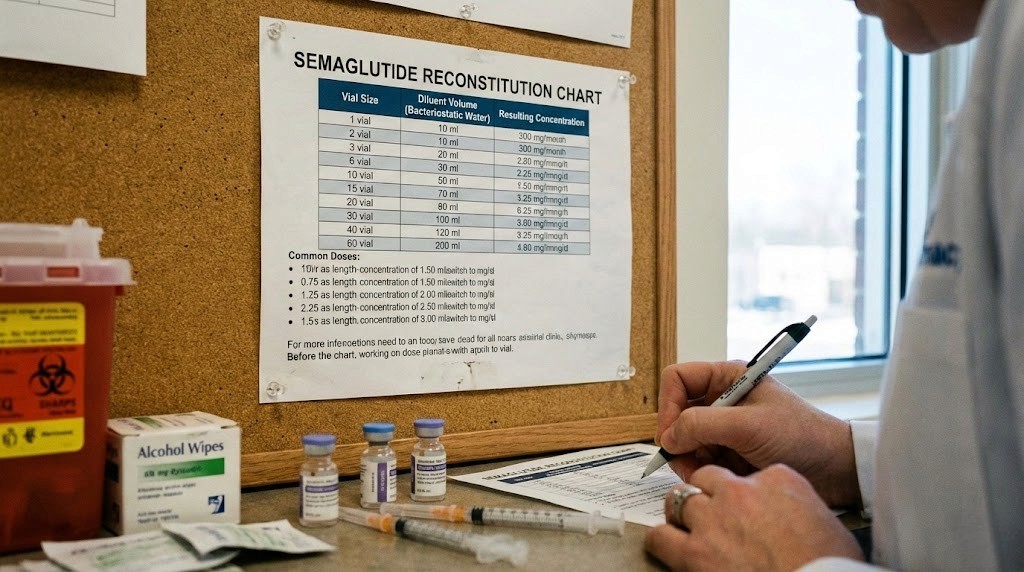
You are wasting semaglutide. Right now. Every single time you draw from that vial, you are pulling the wrong dose because the concentration is off. And the concentration is off because you added the wrong volume of water during reconstitution. This is not a small error. Adding 2 mL of bacteriostatic water to a 5 mg vial gives you 2.5 mg/mL. Adding 2.5 mL to that same vial gives you 2 mg/mL. That difference, just half a milliliter of water, changes every dose you draw for the entire life of that vial. Multiply that across weeks of injections, and you are either underdosing (wasting time) or overdosing (wasting product and inviting side effects). The semaglutide mixing chart you found online probably did not explain this clearly enough. Most do not. They throw numbers at you without explaining the relationship between water volume, concentration, and the markings on your insulin syringe. That is where the real confusion lives, in the gap between knowing your dose in milligrams and translating it to units on a syringe. This guide closes that gap completely.
What you will find here is a complete semaglutide reconstitution chart covering every common vial size: 2 mg, 3 mg, 5 mg, and 10 mg. You will see exact concentrations for different water volumes, unit conversion tables for U-100 insulin syringes, and a step-by-step reconstitution process that protects the peptide from degradation. SeekPeptides built this reference guide because accurate reconstitution is the foundation of every successful protocol. Get it wrong here, and nothing else matters. Not your dosing schedule, not your storage approach, not even the quality of the peptide itself. The math has to be right first.
What semaglutide reconstitution actually means
Reconstitution is the process of adding a liquid diluent to a freeze-dried powder to create an injectable solution. That is it. Nothing fancy. But understanding why this step exists, and why it matters so much, requires knowing a few things about semaglutide itself and the form it arrives in.
Semaglutide is a GLP-1 receptor agonist. It shares 94% structural homology with native human GLP-1, the incretin hormone your body produces after eating. But native GLP-1 has a problem. It gets destroyed by an enzyme called DPP-4 within one to two minutes of being released. That makes it essentially useless as a medication. Semaglutide solves this through two critical structural modifications. First, at position 8, an alanine amino acid is swapped for alpha-aminoisobutyric acid. This substitution makes the molecule resistant to DPP-4 degradation. Second, at position 26, a C-18 fatty di-acid chain is attached through a linker. This chain binds strongly to albumin in the blood, which acts like a slow-release mechanism that keeps semaglutide circulating for roughly 165 hours, about one week. A third change at position 34, swapping lysine for arginine, ensures the fatty acid chain attaches at the correct location. These modifications are what make semaglutide effective as a once-weekly injection rather than something you would need multiple times per day.
Why the powder form exists
Semaglutide in solution is less stable than semaglutide in powder form. Peptides degrade faster when dissolved. Temperature fluctuations, light exposure, and bacterial contamination all accelerate this degradation. Lyophilization, which is the technical term for freeze-drying, removes all water from the peptide while preserving its molecular structure. The result is a white to off-white powder that can remain stable for months or even years when stored properly, far longer than any liquid formulation.
This is why compounded semaglutide typically arrives as lyophilized powder. It needs to be shelf-stable during shipping and storage. Brand-name products like Ozempic and Wegovy come prefilled in injection pens because they use specialized preservative systems and undergo extensive stability testing at the manufacturing level. But compounded semaglutide? You are the one who prepares it. You are the one responsible for getting the concentration right. That responsibility starts with the reconstitution process.
The difference between reconstitution and dilution
People confuse these terms constantly. Reconstitution means adding liquid to a dry powder to create a solution for the first time. Dilution means adding more liquid to an already-dissolved solution to reduce its concentration. You reconstitute semaglutide once. You do not dilute it afterward unless you are following a very specific protocol that calls for it. If you need a lower concentration, you achieve that by adding more water during the initial reconstitution step, not by diluting an already-mixed solution later. Understanding this distinction prevents a common mistake where researchers add extra water to an already-reconstituted vial, which introduces contamination risk and makes concentration tracking nearly impossible.
Complete supplies checklist before you start
Gathering everything before you begin is not just convenient. It is a safety requirement. Once you open a sterile vial, every second it sits exposed increases contamination risk. You do not want to be hunting for alcohol swabs while your vial sits open on the counter.
Here is what you need.
The semaglutide vial
Compounded semaglutide comes in several vial sizes. The most common are 2 mg, 3 mg, 5 mg, and 10 mg. The vial size you choose depends on your dosing protocol and how long you want a single vial to last. A 10 mg vial at a 0.5 mg weekly dose will last roughly 20 weeks, which is nearly five months from a single reconstitution. A 2 mg vial at the same dose lasts only four weeks. Keep the vial refrigerated before reconstitution and check the expiration date printed on the label. The powder should appear white or off-white with no discoloration.
Bacteriostatic water
Bacteriostatic water is sterile water that contains 0.9% benzyl alcohol as a preservative. This preservative inhibits bacterial growth, which is critical because you will be drawing from the vial multiple times over several weeks. Do not use plain sterile water for multi-dose vials. Sterile water contains no preservative, meaning bacteria can grow freely in the solution between uses. Single-use applications can use sterile water, but for any vial you plan to draw from more than once, bacteriostatic water is the correct choice. For a thorough explanation of why this matters, see our guide on mixing peptides with bac water.
Insulin syringes
Use U-100 insulin syringes. These syringes are marked in "units" where 100 units equals 1 mL. They come in several sizes: 0.3 mL (30 units), 0.5 mL (50 units), and 1 mL (100 units). For semaglutide dosing, the 0.5 mL or 1 mL syringes work best because your draw volumes will typically fall between 4 and 50 units depending on your concentration and dose. A peptide injection guide can help you understand the differences between needle gauges and syringe types. For drawing bacteriostatic water from its vial, a separate larger syringe (3 mL with an 18-22 gauge needle) makes the process faster and more accurate.
Alcohol swabs
You need at least two per reconstitution session. One for the semaglutide vial stopper. One for the bacteriostatic water vial stopper. Some researchers use a third for the injection site. These should be individually wrapped, 70% isopropyl alcohol prep pads. Do not skip this step. Contamination from an unswabbed vial top is one of the most common causes of reconstitution problems.
Sharps container
Used needles and syringes go into a proper sharps container. Never recap used needles. Never throw them in regular trash. A dedicated sharps container keeps everyone safe and is legally required in most jurisdictions.
Labels
After reconstitution, label your vial with the date, the concentration (mg/mL), and the contents. This sounds trivial. It is not. Four weeks from now, you will not remember whether you added 1 mL or 2 mL of water. Labeling eliminates guesswork and prevents dosing errors for the entire life of the vial.
Semaglutide reconstitution chart by vial size
This is the core reference section. Each table below shows the relationship between water volume and resulting concentration for a specific vial size. The concentration determines how many units you need to draw for a given dose, which is covered in the dosage calculation section below. The formula is simple: concentration equals the amount of peptide in the vial divided by the volume of water added. For example, 5 mg divided by 2 mL equals 2.5 mg/mL. Every calculation in every table below follows this same formula. You can verify any number using the peptide reconstitution calculator on our site.
2 mg vial reconstitution chart
The 2 mg vial is the smallest common size. It works best for researchers who are just starting with low doses and want a vial that will be used up before the 28-day expiration window closes. Here are the concentrations you get with different water volumes.
Water volume added | Concentration (mg/mL) | mcg per unit on U-100 syringe | Best for |
|---|---|---|---|
0.5 mL | 4 mg/mL | 40 mcg per unit | Experienced researchers needing small volumes |
1 mL | 2 mg/mL | 20 mcg per unit | Standard concentration, easy math |
2 mL | 1 mg/mL | 10 mcg per unit | Low-dose protocols, maximum precision |
With a 2 mg vial reconstituted at 1 mg/mL (2 mL water), drawing 25 units gives you exactly 0.25 mg. That is the standard starting dose. Clean numbers like these reduce calculation errors, which is why 1 mg/mL is a popular concentration choice for this vial size. If you are following the standard dosage chart, this concentration makes the first four weeks of titration straightforward.
3 mg vial reconstitution chart
The 3 mg vial is less common but still available from many compounding pharmacies. The extra milligram gives you slightly more flexibility in concentration choices.
Water volume added | Concentration (mg/mL) | mcg per unit on U-100 syringe | Best for |
|---|---|---|---|
0.5 mL | 6 mg/mL | 60 mcg per unit | Small volume injections |
1 mL | 3 mg/mL | 30 mcg per unit | Moderate concentration |
1.5 mL | 2 mg/mL | 20 mcg per unit | Standard concentration |
2 mL | 1.5 mg/mL | 15 mcg per unit | Lower concentration, easier fine-tuning |
3 mL | 1 mg/mL | 10 mcg per unit | Maximum precision for low doses |
The 1.5 mL option creating a 2 mg/mL concentration is a sweet spot for many researchers. It matches the concentration you get from a 10 mg vial with 5 mL of water, meaning the same dosing charts apply to both. Consistency across vial sizes reduces confusion when you switch between them.
5 mg vial reconstitution chart
This is the most popular vial size for semaglutide. It provides enough peptide for a meaningful protocol duration while keeping the vial size manageable. Most reconstitution guides focus on this size because it is what the majority of researchers are working with.
Water volume added | Concentration (mg/mL) | mcg per unit on U-100 syringe | Units for 0.25 mg dose | Units for 0.5 mg dose | Units for 1.0 mg dose |
|---|---|---|---|---|---|
1 mL | 5 mg/mL | 50 mcg per unit | 5 units | 10 units | 20 units |
2 mL | 2.5 mg/mL | 25 mcg per unit | 10 units | 20 units | 40 units |
2.5 mL | 2 mg/mL | 20 mcg per unit | 12.5 units | 25 units | 50 units |
5 mL | 1 mg/mL | 10 mcg per unit | 25 units | 50 units | 100 units |
The 2 mL option (creating 2.5 mg/mL) is the most commonly recommended concentration for 5 mg vials. At this concentration, each unit on a U-100 syringe equals exactly 25 mcg, or 0.025 mg. The math stays clean throughout the entire dosing schedule. Drawing 10 units gives you 0.25 mg. Drawing 20 units gives you 0.5 mg. No fractions, no difficult calculations, just straightforward doubling as you titrate upward.
However, the 2.5 mL option (creating 2 mg/mL) has its own advantage. This concentration matches the standard used across many dosing references and reconstitution calculators, making cross-referencing easier. The trade-off is a half-unit measurement for the 0.25 mg starting dose (12.5 units), which some syringes cannot measure precisely.
10 mg vial reconstitution chart
The 10 mg vial is the most economical choice per milligram. A single vial can last five months at a 0.5 mg weekly dose, though you should note the 28-day stability window after reconstitution. Some researchers split the powder between two reconstitution sessions to work around this limitation, though this requires advanced technique and introduces additional contamination risk. For detailed guidance on the 10 mg vial specifically, see our complete 10 mg mixing guide.
Water volume added | Concentration (mg/mL) | mcg per unit on U-100 syringe | Units for 0.25 mg dose | Units for 0.5 mg dose | Units for 1.0 mg dose | Units for 2.4 mg dose |
|---|---|---|---|---|---|---|
2 mL | 5 mg/mL | 50 mcg per unit | 5 units | 10 units | 20 units | 48 units |
2.5 mL | 4 mg/mL | 40 mcg per unit | 6.25 units | 12.5 units | 25 units | 60 units |
4 mL | 2.5 mg/mL | 25 mcg per unit | 10 units | 20 units | 40 units | 96 units |
5 mL | 2 mg/mL | 20 mcg per unit | 12.5 units | 25 units | 50 units | 120 units* |
10 mL | 1 mg/mL | 10 mcg per unit | 25 units | 50 units | 100 units | 240 units* |
*Note: Values marked with an asterisk exceed the capacity of a standard 1 mL (100-unit) insulin syringe. You would need to split the dose into two injections or use a higher concentration.
For 10 mg vials, the 2 mL and 4 mL water volumes tend to work best. The 2 mL option (5 mg/mL) keeps volumes small, which means less discomfort at the injection site and more precise measurements. But the draw volumes for starting doses are tiny, just 5 units for 0.25 mg, which can be difficult to measure accurately on some syringes. The 4 mL option (2.5 mg/mL) provides a good balance between manageable draw volumes and the ability to handle higher maintenance doses without exceeding syringe capacity. This is also why using a peptide calculator is so helpful. You can enter your specific vial size, water volume, and desired dose to see the exact number of units to draw.
Step-by-step reconstitution process
Knowing the math is half the battle. The other half is technique. Poor reconstitution technique can degrade the peptide, introduce contamination, or create an inconsistent solution where some draws are more concentrated than others. Follow these steps exactly.
Step 1: prepare your workspace
Clean a flat surface with disinfecting solution. Wipe down the area where you will be working. Wash your hands thoroughly with soap and water for at least 20 seconds. Dry with a clean towel. Some researchers wear nitrile gloves for additional protection, though clean hands are sufficient for personal use. Gather all supplies listed in the checklist above so everything is within reach. If you need a refresher on general peptide preparation, our getting started guide covers the fundamentals.
Step 2: inspect your materials
Check the semaglutide vial. The powder should be white or off-white. If it appears yellow, brown, or has visible moisture inside the sealed vial, do not use it. Check the expiration date. Inspect the vial cap and rubber stopper for any signs of tampering or damage. Do the same for your bacteriostatic water vial. The water should be completely clear with no particles floating in it. Understanding peptide expiration helps you know when a product is no longer safe to use.
Step 3: swab the vial stoppers
Take an alcohol swab and wipe the rubber stopper of the semaglutide vial. Use a firm circular motion covering the entire stopper surface. Let it air dry for about 10 seconds. Do not blow on it. Repeat with a fresh alcohol swab on the bacteriostatic water vial. This step removes any surface contamination that could enter the solution when you push the needle through.
Step 4: draw the bacteriostatic water
Using a larger syringe (1 mL or 3 mL with an 18-22 gauge needle), draw air equal to the volume of water you plan to extract. Push this air into the bacteriostatic water vial, this equalizes pressure and makes drawing easier. Invert the vial and draw your predetermined volume of water slowly. Remove any large air bubbles by tapping the syringe and pushing them back into the vial. The exact volume you draw determines your final concentration, so be precise. Double-check against the reconstitution chart above before proceeding.
Step 5: add water to the semaglutide vial
This step requires patience. Push the needle through the center of the semaglutide vial stopper at a slight angle. Do not inject the water directly onto the powder cake at the bottom of the vial. Instead, aim the needle tip at the inside wall of the vial, near the top. Depress the plunger slowly, allowing the water to trickle down the glass wall and pool at the bottom around the powder. This gentle introduction prevents the powder from splashing, foaming, or being forced against the glass, all of which can damage the peptide structure. Think of it as pouring water down the inside of a glass rather than splashing it into a bowl.
This is the single most important technical step in the entire process. Rushing it is one of the top mistakes beginners make with peptide reconstitution.
Step 6: gentle swirling, never shaking
Never shake a reconstituted peptide vial. Never. Shaking creates foam and micro-bubbles that indicate protein denaturation, which means you are destroying the very molecules you are trying to use. Instead, hold the vial between your palms and roll it gently. Or pick it up and swirl it in small circular motions. The goal is to let the water dissolve the powder through gentle movement. This may take two to five minutes for complete dissolution. Some peptide formulations dissolve faster than others. Semaglutide typically dissolves within a few minutes of gentle swirling.
Be patient.
If you see undissolved particles after five minutes of gentle swirling, let the vial sit in the refrigerator for 15 to 30 minutes and then swirl again. Do not escalate to shaking. Most dissolution issues resolve with time and patience.
Step 7: check for clarity
Hold the vial up to a light source and examine the solution. Properly reconstituted semaglutide should be completely clear and colorless. It should look like water. If you see cloudiness, floating particles, discoloration, or fibers, the solution may be contaminated or degraded. A cloudy solution should not be used. This is a hard rule. If your solution does not look right, see the troubleshooting section below before deciding whether to proceed or discard. Understanding how to assess reconstituted peptide quality helps you make informed decisions about whether a vial is still safe to use.
Step 8: label and store
Write the following on a label and attach it to the vial: the date of reconstitution, the concentration in mg/mL, and the contents (semaglutide). Place the vial in the refrigerator at 2 to 8 degrees Celsius (36 to 46 degrees Fahrenheit). The vial should be used within 28 days of reconstitution. Mark the 28-day expiration date on your label as well. For detailed information on storage timelines, our peptide refrigerator storage guide covers everything you need to know.
Unit conversion charts: from milligrams to syringe markings
This is where most people get lost. You know your dose in milligrams. Your syringe is marked in units. The bridge between these two is concentration. Once you know the concentration of your reconstituted solution, a simple formula converts any milligram dose into the exact number of units to draw.
The conversion formula
Here it is. The formula that makes everything work.
Units to draw = (Desired dose in mg / Concentration in mg per mL) x 100
That is it. Three numbers, one division, one multiplication, and you have your answer. The "times 100" converts milliliters to units on a U-100 syringe, because 100 units equals 1 mL. Let us walk through an example. You have a 5 mg vial reconstituted with 2 mL of bacteriostatic water, giving you 2.5 mg/mL. You want a 0.25 mg dose.
Units = (0.25 / 2.5) x 100 = 0.1 x 100 = 10 units.
Draw to the 10-unit line on your syringe. Done. If you find manual calculations tedious, the semaglutide dosage calculator does this automatically. Enter your vial size, water volume, and desired dose, and it shows you the exact number of units instantly.
How to read a U-100 insulin syringe
A U-100 insulin syringe has markings from 0 to 100 (on a 1 mL syringe), 0 to 50 (on a 0.5 mL syringe), or 0 to 30 (on a 0.3 mL syringe). Each small line typically represents 1 unit on a 0.3 mL syringe and 2 units on a 1 mL syringe. Larger syringes sacrifice precision for capacity, so choose the smallest syringe that can hold your required dose.
Key relationships to remember:
100 units = 1 mL = 1 cc
50 units = 0.5 mL
10 units = 0.1 mL
1 unit = 0.01 mL
When you see articles discussing semaglutide in terms of units, like 20 units of semaglutide is how many mg, the answer always depends on concentration. Twenty units of a 2.5 mg/mL solution is 0.5 mg. Twenty units of a 5 mg/mL solution is 1.0 mg. Same number of units, different concentration, completely different dose. This is why labeling your vial with the concentration is so important.
Complete unit conversion table at 2.5 mg/mL (most common)
This concentration results from adding 2 mL of water to a 5 mg vial, or 4 mL to a 10 mg vial. It is the most widely referenced concentration in online dosing charts and guides.
Desired dose (mg) | Volume to draw (mL) | Units on U-100 syringe |
|---|---|---|
0.125 mg | 0.05 mL | 5 units |
0.25 mg | 0.10 mL | 10 units |
0.375 mg | 0.15 mL | 15 units |
0.5 mg | 0.20 mL | 20 units |
0.75 mg | 0.30 mL | 30 units |
1.0 mg | 0.40 mL | 40 units |
1.25 mg | 0.50 mL | 50 units |
1.5 mg | 0.60 mL | 60 units |
1.7 mg | 0.68 mL | 68 units |
2.0 mg | 0.80 mL | 80 units |
2.4 mg | 0.96 mL | 96 units |
Notice how the numbers stay clean and manageable at this concentration. The 0.25 mg starting dose is a clean 10 units. The 0.5 mg dose is a clean 20 units. Even the 2.4 mg maintenance dose, 96 units, fits within a standard 100-unit syringe. This is not an accident. The 2.5 mg/mL concentration was designed specifically to work well with U-100 syringes across the entire titration range. For a similar reference covering the 40 units to mg conversion, see our dedicated guide.
Unit conversion table at 5 mg/mL
This concentration results from adding 1 mL of water to a 5 mg vial, or 2 mL to a 10 mg vial. It creates smaller injection volumes but requires more precision when measuring.
Desired dose (mg) | Volume to draw (mL) | Units on U-100 syringe |
|---|---|---|
0.25 mg | 0.05 mL | 5 units |
0.5 mg | 0.10 mL | 10 units |
1.0 mg | 0.20 mL | 20 units |
1.7 mg | 0.34 mL | 34 units |
2.0 mg | 0.40 mL | 40 units |
2.4 mg | 0.48 mL | 48 units |
At 5 mg/mL, the volumes are exactly half of what you would draw at 2.5 mg/mL. The advantage is smaller injection volume, which can mean less discomfort. The disadvantage is that your starting dose of 0.25 mg requires drawing only 5 units, which is a very small amount that can be difficult to measure precisely on larger syringes. A 0.3 mL (30-unit) syringe with single-unit markings gives the best precision at this concentration.
Unit conversion table at 2 mg/mL
This concentration results from adding 2.5 mL to a 5 mg vial, or 5 mL to a 10 mg vial.
Desired dose (mg) | Volume to draw (mL) | Units on U-100 syringe |
|---|---|---|
0.25 mg | 0.125 mL | 12.5 units |
0.5 mg | 0.25 mL | 25 units |
1.0 mg | 0.50 mL | 50 units |
1.7 mg | 0.85 mL | 85 units |
2.0 mg | 1.00 mL | 100 units |
2.4 mg | 1.20 mL | 120 units* |
*Exceeds 1 mL syringe capacity. Would require two injections or a different concentration.
The 2 mg/mL concentration works well for the low and middle ranges of the titration schedule but runs into syringe capacity issues at the higher maintenance doses. If you plan to titrate up to 2.0 mg or 2.4 mg, this concentration is not ideal. Choose a higher concentration from the start, or plan to reconstitute a new vial at a different concentration when you reach those dose levels.
Unit conversion table at 1 mg/mL
This is the lowest common concentration, resulting from adding 5 mL of water to a 5 mg vial or 10 mL to a 10 mg vial.
Desired dose (mg) | Volume to draw (mL) | Units on U-100 syringe |
|---|---|---|
0.25 mg | 0.25 mL | 25 units |
0.5 mg | 0.50 mL | 50 units |
1.0 mg | 1.00 mL | 100 units |
At 1 mg/mL, you get maximum precision for low doses but hit the syringe capacity ceiling at just 1.0 mg. This concentration is only practical for the early titration phase at 0.25 mg and 0.5 mg. Beyond that, the volumes become too large for standard insulin syringes. Most researchers avoid this concentration unless they are exclusively running low-dose protocols and need the absolute highest measurement precision.
Dosing schedule and titration protocol
Semaglutide titration follows a stepped approach designed to minimize gastrointestinal side effects. You start low, assess tolerance, and increase gradually. Jumping straight to a high dose is a recipe for severe nausea, vomiting, and potentially abandoning the protocol altogether. The body needs time to adapt to GLP-1 receptor activation, and rushing this process creates unnecessary complications.
Standard titration schedule
Phase | Weeks | Weekly dose | Units at 2.5 mg/mL | Purpose |
|---|---|---|---|---|
Phase 1 | Weeks 1 through 4 | 0.25 mg | 10 units | Initial tolerance assessment |
Phase 2 | Weeks 5 through 8 | 0.5 mg | 20 units | Appetite suppression begins |
Phase 3 | Weeks 9 through 12 | 1.0 mg | 40 units | Therapeutic effects increase |
Phase 4 | Weeks 13 through 16 | 1.7 mg | 68 units | Near-maximum therapeutic range |
Phase 5 | Week 17 onward | 2.4 mg | 96 units | Full maintenance dose |
This schedule mirrors the titration used in clinical trials for the branded weight management formulation. Not everyone needs to reach 2.4 mg. Some people experience adequate appetite suppression at 1.0 mg or 1.7 mg. The titration schedule is a framework, not a mandate. Individual response varies significantly.
When to increase and when to hold
Increase your dose only when you are tolerating the current dose well. "Tolerating well" means minimal or no nausea, no vomiting, and no significant gastrointestinal distress. If you are experiencing significant side effects at your current dose, do not increase. Stay at that dose for an additional two to four weeks until symptoms subside. Some researchers even drop back to the previous dose temporarily before trying the increase again. The goal is sustainable progress, not speed.
This patience-first approach is especially important for researchers wondering how long semaglutide takes to work. The answer depends partly on reaching an effective dose, but rushing to get there creates more problems than it solves. Meaningful results typically appear within the first eight weeks as doses reach the 0.5 to 1.0 mg range, with significant outcomes developing over three to six months of sustained use. For those tracking progress closely, our detailed guide on semaglutide protocol duration provides research-backed timelines.
Vial planning across the titration schedule
Planning which vial size to use for each phase prevents waste. Here is how the math works out using the standard titration schedule.
Phase 1 (0.25 mg x 4 weeks) uses 1 mg total. Phase 2 (0.5 mg x 4 weeks) uses 2 mg total. Phase 3 (1.0 mg x 4 weeks) uses 4 mg total. Phase 4 (1.7 mg x 4 weeks) uses 6.8 mg total. Phase 5 at 2.4 mg per week uses 2.4 mg per week ongoing. The first 16 weeks alone require 13.8 mg of semaglutide. Each subsequent month at maintenance requires 9.6 mg. This is where the peptide cost calculator becomes invaluable for planning purchases.
A 5 mg vial will cover Phases 1 and 2 entirely, with 2 mg remaining. A 10 mg vial will cover Phases 1 through 3 with 3 mg remaining. For the full titration through to maintenance dosing, most researchers need at least two to three vials depending on size.
Storage after reconstitution
Reconstitution is the beginning of a countdown. From the moment water meets powder, degradation begins. Proper storage slows this process dramatically, but it does not stop it. The rules here are non-negotiable. Breaking any of them compromises the peptide, reduces potency, and can introduce safety concerns.
Temperature requirements
Store reconstituted semaglutide at 2 to 8 degrees Celsius, which is 36 to 46 degrees Fahrenheit. This is standard refrigerator temperature. Place the vial in the main body of the refrigerator, not in the door (where temperature fluctuates with opening and closing) and not in the back near the cooling element (where it could freeze). The middle shelf toward the back is ideal. For researchers managing multiple peptides, our complete peptide storage guide covers organization strategies for maintaining multiple vials at proper temperature.
The 28-day window
Use reconstituted semaglutide within 28 days. This is not an arbitrary number. It is based on stability testing that shows peptide potency remains acceptable for approximately four weeks under refrigerated conditions when reconstituted with bacteriostatic water. After 28 days, potency degrades to a point where dose accuracy can no longer be guaranteed. The benzyl alcohol preservative in bacteriostatic water helps prevent bacterial contamination during this period, but it does not prevent chemical degradation of the peptide itself.
What happens if you go past 28 days? Potentially nothing visible. The solution may still look clear. But the amount of active semaglutide in each draw decreases unpredictably after this point. You might be getting 90% of your intended dose. You might be getting 60%. There is no way to know without laboratory testing. This is why planning your vial size around your dosing schedule matters. You do not want to discard half a vial because the 28-day window closed before you could use it all. If you are concerned about expiration timelines, this guide on expired semaglutide explains the risks in more detail. For compounded formulations specifically, check out our guide on how long compounded semaglutide lasts in refrigerated storage.
Never freeze reconstituted semaglutide
Freezing creates ice crystals that physically damage the peptide structure. When water freezes, it expands. Those expanding ice crystals tear through the delicate three-dimensional structure that semaglutide needs to bind to GLP-1 receptors. Even if the solution looks fine after thawing, the molecular damage is done. Potency is compromised. This applies to accidental freezing as well. If your refrigerator has cold spots that occasionally dip below freezing, keep the vial away from those areas. Understanding peptide temperature sensitivity helps you avoid common storage mistakes.
Protect from light
UV light accelerates peptide degradation. Keep the vial in its original box or wrap it in aluminum foil if the box is not available. Do not leave it sitting on a counter near a window, under kitchen lights, or in any location with direct light exposure. Most researchers store vials in a small opaque container in the refrigerator, which handles both temperature and light protection simultaneously.
Signs of degradation
Check the solution before every draw. Look for these warning signs:
Cloudiness where the solution was previously clear indicates protein aggregation or contamination
Floating particles suggest precipitation, contamination, or degradation
Color change from clear to yellow or amber indicates chemical breakdown
Unusual smell when drawing from the vial suggests bacterial contamination
Foam that does not dissipate after gentle swirling may indicate denatured protein
If you observe any of these signs, do not use the solution. Discard the vial and reconstitute a fresh one. The cost of replacing a vial is always less than the cost of injecting a degraded or contaminated product.
Does compounded semaglutide need refrigeration before reconstitution?
Lyophilized (powder form) semaglutide is more stable than reconstituted semaglutide, but refrigeration is still recommended. Room temperature storage is acceptable for short periods during shipping and handling, but long-term storage should be refrigerated. The powder form can typically withstand room temperature for days to weeks without significant degradation, but once reconstituted, refrigeration is mandatory. For a deeper dive into compounded semaglutide refrigeration requirements, see our dedicated article. And if you are curious about powder form stability specifically, we have a guide for that too.
Common reconstitution mistakes and how to avoid them
Mistakes during reconstitution compound over the entire life of the vial. A single error does not just affect one dose. It affects every dose drawn from that vial for the next four weeks. Knowing what not to do is just as important as knowing the correct procedure.
Mistake 1: shaking the vial
This is the most common mistake. It is also the most damaging. Shaking creates violent agitation that denatures proteins through a process called foaming degradation. Semaglutide molecules get trapped in the air-liquid interface of bubbles, where they unfold and lose their biological activity. The solution may look fine to the naked eye, but the active peptide concentration drops with every vigorous shake. Gentle swirling. Always. No exceptions.
Mistake 2: using the wrong water volume
This mistake makes every subsequent dose wrong. If you intend to add 2 mL but accidentally add 2.5 mL, your concentration is 20% lower than expected. Every dose you draw from that vial will be 20% lower than what you think you are taking. Over a four-week phase, that error adds up significantly. Always double-check your water volume before injecting it into the vial. Once it is in, you cannot take it back. A reconstitution calculator helps verify your math before committing.
Mistake 3: using the wrong diluent
Bacteriostatic water is the correct choice for multi-dose vials. Sterile water lacks the benzyl alcohol preservative, meaning bacteria can colonize the solution between draws. Saline solution can sometimes cause precipitation depending on the peptide formulation. Tap water is never acceptable. Neither is distilled water from the grocery store. Only use water specifically designated for injection, and for multi-dose vials, only bacteriostatic water.
Mistake 4: injecting water directly onto the powder
Forcefully spraying water onto the lyophilized powder cake creates localized high-concentration zones, trapped air pockets, and potential foaming. The powder cake is fragile. Think of it as a dried sponge. If you blast it with water, pieces break off and float. If you let water slowly seep in from the side, it dissolves evenly. Always aim the needle at the vial wall and let water trickle down gently.
Mistake 5: not labeling vials
Week three. You have two vials in the fridge. One is semaglutide. One is another peptide. Or maybe they are both semaglutide at different concentrations. You cannot remember. This is not hypothetical, it happens constantly. Label every vial immediately after reconstitution with the contents, concentration, and date. Use a permanent marker or adhesive label that will not smear from refrigerator condensation.
Mistake 6: leaving reconstituted vials at room temperature
Some researchers draw their dose and then forget to return the vial to the refrigerator. An hour at room temperature is unlikely to cause significant degradation. But leaving a vial on the counter overnight, or in a warm car, or in a non-climate-controlled room can cause measurable potency loss. Make it a habit: draw your dose, then immediately return the vial to the refrigerator. The entire draw process should take less than two minutes. For an in-depth analysis of temperature impacts, see how long peptides last at room temperature.
Mistake 7: reusing needles
Using the same needle for multiple draws introduces contamination. Needles dull after a single use, making subsequent punctures of the vial stopper more likely to create rubber cores (small rubber particles that fall into the solution). Each new draw should use a fresh, sterile needle. The peptide injections guide covers proper needle hygiene in more detail.
Compounded versus brand-name semaglutide: reconstitution differences
Not all semaglutide is created equal, and the reconstitution process differs significantly depending on which form you are working with. Understanding these differences prevents confusion and ensures you are following the right procedure for your specific product.
Brand-name semaglutide (Ozempic and Wegovy)
Ozempic (for type 2 diabetes) and Wegovy (for weight management) both contain FDA-approved semaglutide. They come as prefilled injection pens. No reconstitution is required. You click the pen, dial your dose, and inject. The convenience is the primary appeal, along with the assurance of pharmaceutical-grade manufacturing, precise dosing, and extensive quality testing. These products contain semaglutide base, the specific active pharmaceutical ingredient that has been through rigorous clinical trials and FDA review. For a detailed comparison of how semaglutide stacks up against other GLP-1 options, see our semaglutide vs tirzepatide comparison.
Compounded semaglutide
Compounded semaglutide is produced by compounding pharmacies and typically arrives as lyophilized powder that requires reconstitution, which is what this entire guide is about. There are several important distinctions from brand-name products.
First, the active ingredient may be different at the molecular level. Brand-name products use semaglutide base. Some compounding pharmacies use semaglutide acetate or other salt forms. The FDA has explicitly stated that semaglutide salts are not the same as semaglutide base and should not be substituted interchangeably. This does not necessarily mean compounded products are ineffective, but it means the pharmacology may differ in subtle ways that have not been fully studied.
Second, compounded products do not undergo FDA review for safety, efficacy, or manufacturing quality. Quality can vary between pharmacies. This places additional responsibility on the researcher to verify the reputation and licensing of their compounding pharmacy. Sourcing matters. The difference between a well-regulated compounding pharmacy and a questionable one is the difference between a reliable product and a risky gamble. For guidance on evaluating sources, our best peptide vendors guide provides evaluation criteria.
Third, compounded semaglutide sometimes includes additional ingredients like vitamin B12, B6, or L-carnitine. These additions are not part of the FDA-approved formulation and may affect the reconstitution process, stability, and overall experience. If your compounded semaglutide includes additional ingredients, follow the compounding pharmacy specific instructions rather than the generic charts in this guide. The semaglutide with B12 guide covers these combination products in detail, and the B12 dosage chart provides specific mixing ratios for those formulations.
Choosing the right reconstitution approach
If you have Ozempic or Wegovy, you do not need to reconstitute anything. Follow the manufacturer instructions included with the pen.
If you have compounded semaglutide as lyophilized powder, this guide is for you. Follow the charts, steps, and conversion tables above.
If you have compounded semaglutide that arrives pre-mixed in a liquid vial, reconstitution has already been done for you by the pharmacy. You only need to verify the concentration listed on the label and calculate your draw volume accordingly. The semaglutide dosage calculator handles this calculation instantly.
How to choose the right concentration for your protocol
With all these options for water volume and concentration, how do you decide which one to use? The answer depends on three factors: your current dose, your planned maximum dose, and how long you want the vial to last.
For starting doses (0.25 to 0.5 mg)
Lower concentrations (1 to 2 mg/mL) work best for starting doses because the draw volumes are larger and easier to measure accurately. At 1 mg/mL, a 0.25 mg dose requires 25 units, which is easy to see on any syringe. At 5 mg/mL, that same dose requires only 5 units, which is a tiny amount that can be difficult to measure precisely.
For maintenance doses (1.0 to 2.4 mg)
Higher concentrations (2.5 to 5 mg/mL) work better for maintenance doses because the draw volumes stay within syringe capacity. At 1 mg/mL, a 2.4 mg dose would require 240 units, far beyond what any standard insulin syringe can hold. At 2.5 mg/mL, that same dose requires just 96 units, fitting comfortably in a 1 mL syringe. This is one of the key considerations covered in the peptide dosing guide.
The "one concentration for the whole protocol" approach
Many researchers choose 2.5 mg/mL as their universal concentration because it works reasonably well across the entire titration range. Starting doses are small (10 units for 0.25 mg) but still measurable. Maintenance doses are large (96 units for 2.4 mg) but within syringe capacity. This approach eliminates the need to reconstitute different vials at different concentrations as you progress through the titration schedule, simplifying the entire process. If you are planning a peptide cycle, consistent concentration choices make long-term management much simpler.
Troubleshooting reconstitution problems
Even with careful technique, problems can occur. This section covers the most common issues and how to resolve them. Knowing when to troubleshoot and when to discard is an essential skill for any researcher working with peptides.
The powder is not dissolving
Stop. Do not add more water. Do not shake. The most common reason powder does not dissolve immediately is impatience. Semaglutide lyophilized powder can take several minutes to fully dissolve, especially if the water is cold (straight from the refrigerator). Let the vial sit at room temperature for 10 to 15 minutes, then try gentle swirling again. If the powder still has not dissolved after 30 minutes of periodic gentle swirling, the powder may have degraded from improper storage (exposure to heat, moisture, or extended room temperature storage). In this case, contact your supplier.
The solution is cloudy
A properly reconstituted semaglutide solution should be clear and colorless, like water. Cloudiness indicates one of several problems. Protein aggregation from shaking or temperature extremes is the most common cause. Bacterial contamination from unswabbed vial stoppers or non-sterile technique is another possibility. Incompatible diluent (using something other than bacteriostatic water or sterile water for injection) can also cause precipitation. Regardless of the cause, a cloudy solution should not be used. Discard it and start fresh with a new vial. There is no way to "fix" cloudiness, and injecting a cloudy solution introduces unknown risks.
Bubbles in the syringe
Air bubbles in the syringe are cosmetically concerning but not dangerous for subcutaneous injections. A small air bubble in a subcutaneous injection will simply be absorbed by the body without issue. However, bubbles can affect dose accuracy because the air displaces liquid, meaning you are drawing slightly less semaglutide than the syringe markings suggest. To remove bubbles, hold the syringe needle-up and tap the barrel firmly with your finger. Bubbles will rise to the top near the needle. Gently push the plunger until the bubbles are expelled, then readjust your draw to the correct number of units.
Foam after mixing
A thin layer of foam on top of the solution is normal if you swirled with slightly too much vigor. Let the vial sit undisturbed for five to ten minutes and the foam will dissipate on its own. Excessive foam that does not dissipate, or foam that reappears after settling, suggests the peptide has been denatured (damaged). This usually happens from shaking or from injecting water directly and forcefully onto the powder. Minor foam is cosmetic. Persistent heavy foam is a warning sign. The principles of peptide safety always err on the side of caution when the solution does not look right.
Rubber core in the solution
If you see a small piece of rubber floating in the solution, it was likely cored from the vial stopper by the needle. This happens when needles are dull (from reuse), when the needle is too large gauge, or when the needle enters the stopper at a sharp angle. The rubber particle contaminates the solution. Unfortunately, there is no practical way to remove it without introducing more contamination. The safest approach is to discard the vial and start over with a fresh one, using a new, sharp needle inserted straight through the stopper center.
Advanced topics: calculating vial life and cost efficiency
Understanding how many doses you can get from a single vial helps with budgeting and prevents waste. This matters because reconstituted semaglutide must be used within 28 days, so buying a larger vial only saves money if you can actually use it within that window.
Vial life calculator
The formula is straightforward: Vial life in weeks = Total mg in vial / Weekly dose in mg.
Vial size | At 0.25 mg/week | At 0.5 mg/week | At 1.0 mg/week | At 2.4 mg/week |
|---|---|---|---|---|
2 mg | 8 weeks | 4 weeks | 2 weeks | Less than 1 week |
3 mg | 12 weeks | 6 weeks | 3 weeks | 1.25 weeks |
5 mg | 20 weeks | 10 weeks | 5 weeks | 2 weeks |
10 mg | 40 weeks | 20 weeks | 10 weeks | 4.2 weeks |
The 28-day (4-week) stability window is the limiting factor. At the 0.25 mg starting dose, even a 2 mg vial lasts 8 weeks, but you can only safely use it for 4 weeks. That means 1 mg of a 2 mg vial goes to waste at this dose level. The peptide cost calculator factors in this waste when calculating true cost per dose.
This is why vial selection should match your dose phase. Use smaller vials during low-dose titration phases when you will not use much product in 28 days. Switch to larger vials when you reach higher doses that consume more product within the stability window. It takes a bit more planning, but it can reduce waste by 30 to 50% compared to using a one-size-fits-all vial approach. Every milligram that gets discarded because it expired is money thrown away. For a broader look at optimizing peptide costs, the peptide cost analysis covers strategies for getting the most value from your research budget.
Dead volume considerations
Every syringe has a "dead volume," which is the small amount of liquid that remains in the needle hub and cannot be injected. For standard insulin syringes, this dead volume is approximately 0.005 to 0.01 mL per draw. Over 20 draws from a vial, this adds up to 0.1 to 0.2 mL of lost solution. At 2.5 mg/mL, that is 0.25 to 0.5 mg of semaglutide lost to dead volume alone. Low-dead-volume syringes minimize this waste but are not always available. Factor dead volume losses into your vial life calculations for the most accurate planning.
Semaglutide reconstitution compared to other peptides
If you work with multiple peptides, understanding how semaglutide reconstitution compares to other peptides helps you apply your skills across your research. The basic process is identical. The concentrations and dose ranges differ.
Semaglutide versus tirzepatide reconstitution
Tirzepatide is a dual GIP/GLP-1 receptor agonist that also comes as lyophilized powder from compounding pharmacies. The reconstitution technique is identical to semaglutide: bacteriostatic water, gentle swirling, refrigerated storage. However, the dose ranges differ. Tirzepatide titrates from 2.5 mg up to 15 mg weekly, which means higher concentrations are needed to keep injection volumes manageable. For a complete side-by-side, see the tirzepatide reconstitution chart. If you are considering switching between the two, the dosage chart comparison maps equivalent doses. Our tirzepatide dosing guide and tirzepatide dose chart provide the same level of detail for that peptide as this guide provides for semaglutide. Additional resources include the compounded tirzepatide chart, tirzepatide mL chart, compound dosage chart, tirzepatide reconstitution guide, and microdosing chart.
Semaglutide versus BPC-157 reconstitution
BPC-157 is a healing peptide used for injury recovery. Its reconstitution process is mechanically the same, but the doses are measured in micrograms (mcg) rather than milligrams (mg). A typical BPC-157 dose is 250 to 500 mcg, which is 0.25 to 0.5 mg. At first glance this seems similar to semaglutide starting doses, but BPC-157 is typically administered daily or twice daily rather than weekly. This means vial consumption is much faster, and the math around vial life looks completely different. The BPC-157 dosage calculator handles these calculations. For those researching what BPC-157 is and how it works, the principles of reconstitution transfer directly from semaglutide.
General peptide reconstitution principles that apply across all peptides
No matter which peptide you are working with, certain rules never change. Use bacteriostatic water for multi-dose vials. Never shake. Add water to the vial wall, not the powder. Swirl gently. Store refrigerated. Use within 28 days. Label everything. These are universal principles covered in our how to reconstitute peptides master guide. The specific concentrations, doses, and injection frequencies vary by peptide, but the technique remains the same across all peptide types. Whether you are working with TB-500 for recovery, weight loss peptides, or longevity peptides, the reconstitution fundamentals apply universally.
Injection technique after reconstitution
Reconstitution puts the semaglutide into solution. Injection gets it into the body. These are two separate skills, and doing one correctly does not guarantee the other. The most perfectly reconstituted vial is useless if the injection technique is wrong.
Subcutaneous injection sites
Semaglutide is administered subcutaneously, meaning into the fat layer just beneath the skin. The three standard injection sites are the abdomen (at least 2 inches from the navel), the front of the thigh (middle third), and the back of the upper arm. Rotate between these sites with each injection to prevent lipodystrophy, which is the development of hard lumps or fat loss at repeatedly used injection sites. A comprehensive peptide injection overview covers site selection in more detail.
Drawing from the vial
Swab the vial stopper with alcohol. Draw air into your insulin syringe equal to your dose volume. Push this air into the vial (this prevents vacuum formation that makes drawing difficult). Invert the vial and slowly pull back the plunger to your desired number of units. Check for bubbles. Remove them by tapping and re-adjusting. Withdraw the needle and proceed to injection. The injection pen guide covers an alternative delivery method for those who prefer pen-style devices.
Timing considerations
Semaglutide is injected once weekly, on the same day each week. The specific time of day does not significantly affect efficacy, but consistency helps establish a routine. Some researchers prefer morning injections, others prefer evening. If gastrointestinal side effects are an issue, some researchers find that injecting before bed allows them to sleep through the initial nausea. Regarding interactions with food and drink, our guide on alcohol and semaglutide addresses a common question.
Understanding weight management context
Semaglutide reconstitution is a means to an end. The purpose is to enable accurate dosing for research protocols. Understanding the broader context of how semaglutide fits into weight management research helps you make informed decisions about dosing, titration, and protocol design.
As a GLP-1 receptor agonist, semaglutide works by mimicking the incretin hormone GLP-1. This hormone signals satiety to the brain, slows gastric emptying, and influences insulin secretion. The result is reduced appetite and, over time, significant weight reduction in clinical studies. Research participants on semaglutide at maintenance doses showed an average of 15 to 17% body weight reduction over 68 weeks in the landmark clinical trials. But these results depend entirely on accurate dosing, which circles back to proper reconstitution and precise measurement.
For researchers exploring the broader landscape of peptides for fat loss, semaglutide is one option among several. The best peptides for weight loss guide compares different GLP-1 agonists, growth hormone secretagogues, and other peptide categories. For women specifically, the peptides for weight loss in women guide addresses hormone-specific considerations. Stacking strategies are covered in the best peptide stack for weight loss guide. And for specific fat distribution concerns, guides on peptides for belly fat, best fat-burning peptides, and visceral fat loss provide targeted information.
Researchers who are not seeing expected results should review the why not losing weight on semaglutide troubleshooting guide before assuming the protocol itself is at fault. Reconstitution errors that create inaccurate concentrations are a frequent hidden cause of disappointing outcomes.
Building a complete semaglutide research toolkit
SeekPeptides provides the most comprehensive suite of tools for semaglutide researchers. Here is how to use them together for a complete, error-free protocol.
Start with the peptide reconstitution calculator to determine your water volume and resulting concentration. This eliminates the need for manual math and reduces errors. Input your vial size, desired concentration, and the calculator outputs the exact water volume to add.
Next, use the semaglutide dosage calculator to convert your prescribed dose in milligrams to units on your syringe. This calculator accounts for your specific concentration and gives you a precise number to draw to.
For cost planning, the peptide cost calculator breaks down your per-dose and per-week costs based on vial size, pricing, and dosing schedule. This helps you choose the most economical vial size for your protocol phase. If you are also researching other peptides, the peptide stack calculator helps you plan multi-peptide protocols, and the general peptide calculator handles reconstitution math for any peptide type.
Together, these tools transform what could be a confusing, error-prone process into a streamlined workflow. And because accuracy matters with every single draw, having verified calculations eliminates the risk of mental math errors that plague manual approaches. For researchers managing complex protocols across multiple peptides, SeekPeptides members access detailed protocol builders, stacking guides, and community knowledge that makes optimization significantly easier.
Alternative delivery forms and emerging options
While this guide focuses on reconstitution of lyophilized powder, semaglutide is available in other forms that do not require reconstitution. Understanding these alternatives helps you evaluate which form best suits your research needs.
Prefilled injection pens
Ozempic and Wegovy are prefilled pens that require no reconstitution. You dial the dose and inject. The convenience factor is significant, but these products are prescription-only and typically more expensive per milligram than compounded alternatives. Our Ozempic alternatives guide explores other options for researchers interested in GLP-1 agonists beyond the brand-name products.
Pre-mixed liquid formulations
Some compounding pharmacies offer semaglutide already reconstituted in liquid form. These arrive ready to draw and inject, with the concentration printed on the label. No mixing required. The trade-off is shorter shelf life from the moment you receive the product, since the stability clock started ticking when the pharmacy mixed it, not when you open it.
Oral semaglutide
Rybelsus is an oral formulation of semaglutide that comes as a tablet. No injection, no reconstitution. However, oral bioavailability is much lower than injectable, meaning the doses are higher (3 mg, 7 mg, and 14 mg tablets compared to the 0.25 to 2.4 mg injectable range). The comparison between injectable versus oral peptide delivery explains the pharmacokinetic differences between these routes.
Nasal and sublingual options
Research into alternative delivery routes for GLP-1 agonists is ongoing. Nasal spray peptides and sublingual peptides represent emerging delivery methods that may eventually apply to semaglutide or related compounds. Peptide capsules are another format gaining attention in the research community. These are worth monitoring for future developments, though lyophilized reconstitution remains the standard for compounded formulations today.
Related compounds and next-generation GLP-1 agonists
The GLP-1 agonist landscape is evolving rapidly. Researchers working with semaglutide should be aware of related compounds that may affect their research direction.
Cagrilintide combined with semaglutide (CagriSema) is an investigational combination that pairs semaglutide with an amylin receptor agonist. Early trials show enhanced weight loss compared to semaglutide alone. The amylin receptor agonist class represents a complementary mechanism of action that may synergize with GLP-1 agonism.
Retatrutide is a triple agonist targeting GIP, GLP-1, and glucagon receptors. It represents the next generation beyond dual agonists like tirzepatide. Our retatrutide versus semaglutide comparison covers the key differences. And the GLP-3 peptide research is opening entirely new territory in incretin-based therapeutics.
Even the emerging protocols for switching between tirzepatide and semaglutide require solid reconstitution skills. The technical process of mixing and measuring stays the same regardless of which GLP-1 agonist you are working with.
Safety considerations for semaglutide research
Reconstitution is a practical skill, but it sits within a broader context of research safety that deserves attention. Proper preparation protects both the peptide and the researcher.
Always verify the legality of your peptide research in your jurisdiction. Regulations vary by country and state. Our peptide legality guide provides an overview, but local laws should always be confirmed independently.
Never use visually degraded products. If the powder looks wrong before reconstitution or the solution looks wrong after, trust your eyes. Discard and replace.
Store sharps safely and dispose of them properly. Needlestick injuries from improperly disposed needles are a real and preventable safety hazard.
Keep reconstituted peptides away from children and unauthorized users. Label vials clearly and store them in a designated area of the refrigerator.
If you experience unexpected side effects or adverse reactions, discontinue use and consult a healthcare professional. The peptide safety and risks guide covers common concerns. Understanding research versus pharmaceutical-grade peptides helps you evaluate the quality of what you are working with. And for general peptide research context, our comprehensive resource library provides evidence-based information across all major peptide categories.
Helpful educational resources and learning paths
Semaglutide reconstitution is often the first peptide skill researchers develop, but it opens the door to a much broader field. If you are new to peptides entirely, the what are peptides introduction covers the fundamentals. From there, how peptides work explains the mechanisms behind these molecules. The what are peptides used for guide maps the full landscape of peptide research applications.
For researchers who want to explore beyond weight management, the world of peptides includes muscle growth applications, gut health protocols, anti-aging research, and athletic performance optimization. Each application area has its own set of peptides, reconstitution requirements, and dosing protocols. The complete peptide list catalogs every major peptide currently in research use, and the injectable peptides list focuses specifically on peptides that require the reconstitution skills covered in this guide.
Managing multiple peptides simultaneously is a common next step. The how many peptides at once guide addresses this question directly, and the peptide stacking guide provides frameworks for combining peptides effectively. For even more advanced planning, the peptide formula guide covers the science behind peptide selection and protocol design.
Whether you are here for semaglutide specifically or as an entry point into the broader peptide research world, the reconstitution skills you develop now will serve you across every peptide you ever work with. The technique is universal. Only the numbers change.
Frequently asked questions
How much bacteriostatic water do I add to a 5 mg semaglutide vial?
The amount of water depends on your desired concentration. Adding 2 mL creates a 2.5 mg/mL concentration, which is the most commonly recommended option because it produces clean numbers on U-100 insulin syringes. Adding 1 mL creates 5 mg/mL for smaller injection volumes, and adding 5 mL creates 1 mg/mL for maximum precision at low doses. Use the peptide reconstitution calculator to determine the best volume for your specific dosing needs.
Can I use sterile water instead of bacteriostatic water for semaglutide?
Sterile water can be used for single-dose vials that will be used immediately and then discarded. However, for multi-dose vials (which most semaglutide vials are), bacteriostatic water is required. The 0.9% benzyl alcohol preservative in bacteriostatic water prevents bacterial growth between draws. Without this preservative, bacteria can colonize the solution within hours, creating a serious contamination risk with repeated needle punctures over 28 days.
How long does reconstituted semaglutide last in the refrigerator?
Reconstituted semaglutide remains stable for approximately 28 days when stored at 2 to 8 degrees Celsius (36 to 46 degrees Fahrenheit) in the refrigerator. After 28 days, potency cannot be guaranteed regardless of how the solution looks. For a detailed discussion of stability timelines across different storage conditions, see our guide on how long reconstituted peptides last in the fridge.
What does 20 units of semaglutide equal in milligrams?
It depends entirely on your concentration. At 2.5 mg/mL, 20 units equals 0.5 mg. At 5 mg/mL, 20 units equals 1.0 mg. At 2 mg/mL, 20 units equals 0.4 mg. This is why labeling your vial with the concentration after reconstitution is so important. For specific unit-to-milligram conversions, see our 20 units semaglutide conversion guide.
Can I freeze reconstituted semaglutide to make it last longer?
No. Never freeze reconstituted semaglutide. Freezing creates ice crystals that physically damage the peptide molecular structure, destroying its ability to bind to GLP-1 receptors. Even if the solution looks normal after thawing, the biological activity has been compromised. If you cannot use a vial within 28 days, reconstitute a smaller amount or use a smaller vial size. The peptide post-reconstitution storage guide covers all the dos and do nots of peptide storage.
What if my semaglutide solution turns cloudy after a few days?
Discard it immediately. Cloudiness that develops after initially clear reconstitution indicates either bacterial contamination or protein aggregation. Both render the solution unsafe or ineffective. Common causes include contaminated vial stoppers (not swabbed with alcohol before drawing), exposure to temperature extremes, or inadvertent shaking. When starting over, review the reconstitution process carefully and ensure strict sterile technique throughout.
Is there a difference between semaglutide base and semaglutide acetate for reconstitution?
Semaglutide base is the active ingredient in FDA-approved products (Ozempic, Wegovy, Rybelsus). Semaglutide acetate is a salt form sometimes used by compounding pharmacies. The reconstitution technique is the same for both, but the FDA has noted that these are not identical molecules. The salt form has additional molecular weight from the acetate component, which can slightly affect concentration calculations if the labeled weight includes the salt rather than just the active base. When in doubt, follow your compounding pharmacy specific instructions for reconstitution volumes.
How do I calculate my dose if my pharmacy sent a different concentration than expected?
Use the universal formula: Units = (Dose in mg / Concentration in mg per mL) x 100. If your pharmacy sent a 3 mg/mL pre-mixed solution and you need 0.5 mg, the calculation is (0.5 / 3) x 100 = 16.67 units, which you would round to 17 units on your syringe. The semaglutide dosage calculator handles any concentration, including non-standard ones.
External resources
Semaglutide clinical pharmacology overview, StatPearls, National Library of Medicine
Semaglutide as a GLP-1 receptor agonist with cardiovascular benefits, PubMed Central
For researchers serious about getting every detail right, from reconstitution math to injection technique to long-term protocol optimization, SeekPeptides offers the most comprehensive resource available. Members access detailed protocol builders, verified dosing calculators, expert-reviewed guides, and a community of thousands of experienced researchers who have navigated these exact questions. Whether you are reconstituting your first vial or your fiftieth, having a trusted reference, combined with tools that eliminate calculation errors, makes every protocol more precise and every result more reliable.
In case I do not see you, good afternoon, good evening, and good night. May your reconstitutions stay clear, your concentrations stay accurate, and your protocols stay consistent.