Dec 26, 2025
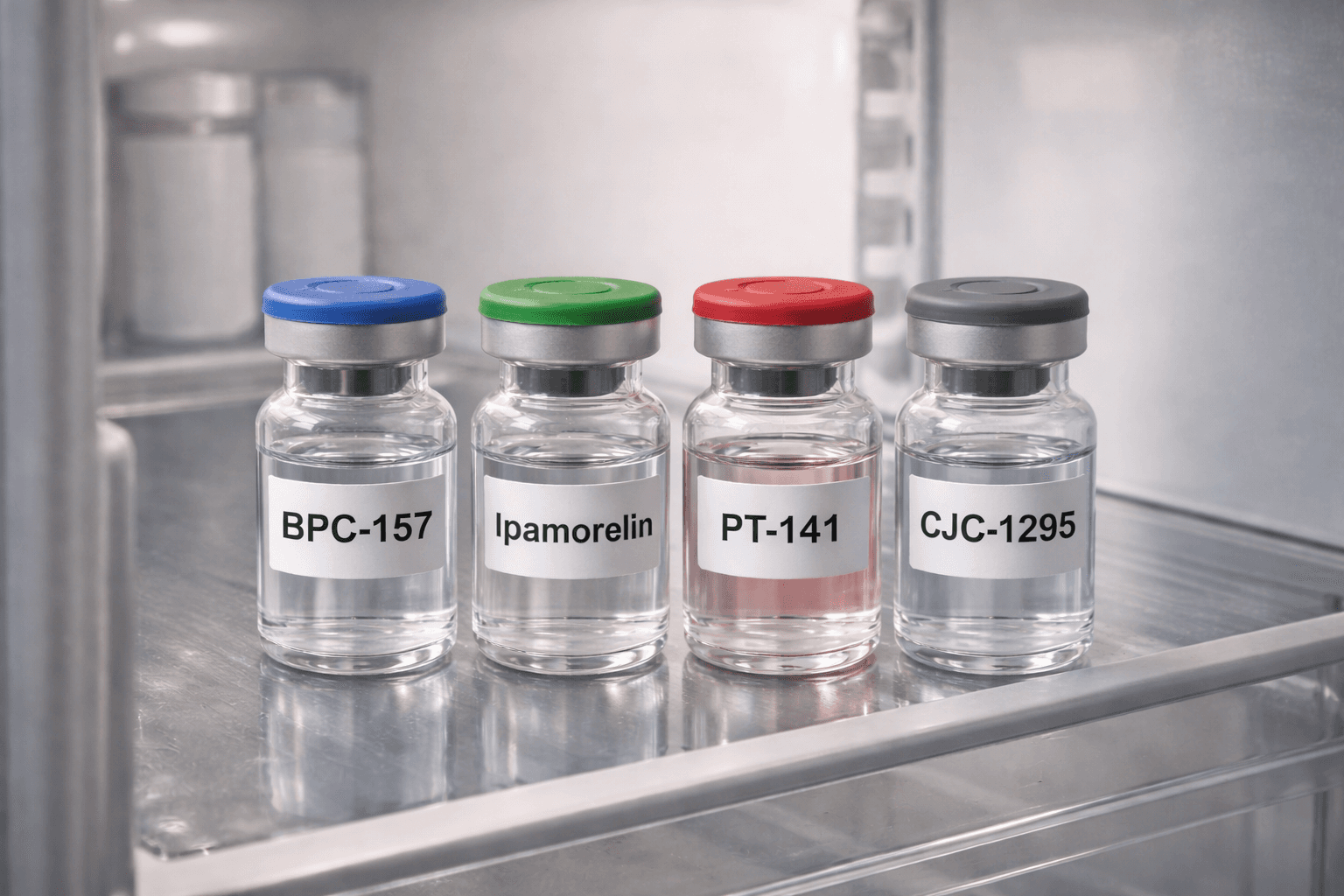
Most reconstituted peptides last 28-30 days when properly refrigerated, but it varies by peptide type, water used, storage conditions, and preservative content.
GLP-1 peptides like semaglutide may last longer (30-45 days).
Growth hormone peptides typically last 28-30 days.
Some peptides without preservatives degrade faster.
Understanding these differences prevents wasted money and ensures effective treatment.
This guide breaks down exact shelf life for each major peptide category, what factors affect longevity, how to recognize degradation, optimal storage practices, and when to mix fresh batches.
You'll know precisely how long your specific reconstituted peptide lasts refrigerated.
Let's start with the general rule, then dive into peptide-specific timelines.
General rule: 28-30 days for most reconstituted peptides
When peptides are reconstituted with bacteriostatic water and properly refrigerated, the standard shelf life is approximately one month.
Why 28-30 days is the standard
Bacteriostatic water preservation: Bacteriostatic water contains 0.9% benzyl alcohol, which inhibits bacterial growth. This preservative remains effective for about 28 days after opening or mixing. After that, bacterial contamination becomes more likely even with refrigeration.
Peptide stability in solution: Once dissolved in water, peptide bonds can slowly hydrolyze. Temperature slows but doesn't stop this process. After 30 days, even refrigerated peptides begin losing potency measurably.
Conservative recommendation: Manufacturers and clinics typically recommend 28-30 days because it balances safety (bacterial growth risk) with peptide stability. Most peptides retain 90-95% potency at 28 days, dropping to 80-85% by 60 days.
FDA guidelines for reconstituted medications: Pharmacy standards for reconstituted injectable medications typically cite 28 days as maximum when using bacteriostatic water, even with refrigeration.
Factors that extend or shorten shelf life
Extends shelf life:
Proper refrigeration (consistent 2-8°C)
Minimal light exposure
Sterile reconstitution technique
Quality bacteriostatic water
Sealed vial (rubber stopper intact)
Shortens shelf life:
Temperature fluctuations
Light exposure
Contamination during drawing
Low-quality water
Damaged vial seal
Bottom line: 28-30 days is safe, conservative timeline for nearly all peptides when stored properly. Some peptides tolerate slightly longer, but 30 days is the reliable maximum.
Shelf life by peptide category
Different peptides have different stability profiles.
Healing peptides (BPC-157, TB-500, KPV)
These are among the most stable peptides after reconstitution.
BPC-157:
Standard shelf life: 28-30 days refrigerated
Maximum (if necessary): 45 days, expect 10-15% potency loss
Very stable peptide due to short sequence
Shows minimal degradation in first month
TB-500 (Thymosin Beta-4):
Standard shelf life: 28-30 days refrigerated
Maximum: 45-60 days, expect 15-20% potency loss
Relatively stable in solution
Longer peptide chain but still maintains structure well
KPV:
Standard shelf life: 28-30 days refrigerated
Maximum: 30-40 days
Tripeptide (very short), highly stable
Minimal degradation within first month
Recommendation: Follow 28-30 day rule for these healing peptides. They remain effective throughout this window.
See our BPC-157 guide and TB-500 guide for complete protocols. Use our BPC-157 dosage calculator and TB-500 dosage calculator.
Growth hormone peptides (CJC-1295, Ipamorelin, GHRP-6, GHRP-2)
Growth hormone releasing peptides are moderately stable.
CJC-1295 (with or without DAC):
Standard shelf life: 28-30 days refrigerated
Maximum: 35-40 days, expect some potency loss
Stable peptide, no special concerns
Ipamorelin:
Standard shelf life: 28-30 days refrigerated
Maximum: 35 days
Very stable GHRP
GHRP-6 and GHRP-2:
Standard shelf life: 28-30 days refrigerated
Maximum: 30-35 days
Similar stability to Ipamorelin
IGF-1 LR3:
Standard shelf life: 28 days refrigerated
Maximum: 30 days (do not push longer)
More sensitive to degradation than other peptides
Loses potency faster after 28 days
Hexarelin:
Standard shelf life: 28-30 days refrigerated
Maximum: 35 days
Recommendation: Stick to 28-30 days for all growth hormone peptides. IGF-1 LR3 should not exceed 28 days.
Learn more in our best peptides for muscle growth guide.
GLP-1 agonists (Semaglutide, Tirzepatide)
These FDA-approved medications have longer shelf life data.
Semaglutide:
Standard shelf life: 30-45 days refrigerated
Maximum: 56 days (some clinical protocols allow)
More stable than research peptides
Pharmaceutical-grade formulations include additional stabilizers
Tirzepatide:
Standard shelf life: 30-45 days refrigerated
Maximum: 56 days
Similar stability to semaglutide
Important note: Research chemical versions of semaglutide/tirzepatide may be less stable than pharmaceutical versions. Follow 28-30 day rule if using research peptides.
Recommendation: Pharmaceutical semaglutide/tirzepatide can last 30-45 days. Research versions should follow 28-30 day rule.
See our semaglutide vs tirzepatide guide and use our semaglutide dosage calculator.
Fat loss peptides (AOD 9604, Tesamorelin)
AOD 9604 (HGH Fragment 176-191):
Standard shelf life: 28-30 days refrigerated
Maximum: 35 days
Fragment of growth hormone, reasonably stable
Tesamorelin:
Standard shelf life: 30 days refrigerated
Maximum: 45 days (pharmaceutical formulations)
FDA-approved, includes stabilizers
Recommendation: Follow 28-30 days for research versions, 30-45 days for pharmaceutical Tesamorelin.
Anti-aging and longevity peptides
Epithalon:
Standard shelf life: 28-30 days refrigerated
Maximum: 30-35 days
Short peptide sequence, stable
Thymosin Alpha-1:
Standard shelf life: 28-30 days refrigerated
Maximum: 45 days (pharmaceutical grade)
Relatively stable peptide
Semax and Selank:
Standard shelf life: 28-30 days refrigerated
Maximum: 30-35 days
Short peptides, stable
Sexual health peptides
PT-141 (Bremelanotide):
Standard shelf life: 28-30 days refrigerated
Maximum: 45 days (pharmaceutical Vyleesi)
Stable peptide
Melanotan II:
Standard shelf life: 28-30 days refrigerated
Maximum: 35-40 days
Relatively stable
Copper peptides (GHK-Cu)
GHK-Cu injectable:
Standard shelf life: 28-30 days refrigerated
Maximum: 30 days (copper can catalyze oxidation)
More sensitive than other peptides due to copper ion
Special note: Copper peptides may show visible degradation (color change to greenish/blue) if stored too long. Discard if color changes.
See our copper peptides storage guide and GHK-Cu complete guide.
Reconstituted peptide shelf life table
Quick reference for all major peptides:
Peptide | Standard Shelf Life (Refrigerated) | Maximum Shelf Life | Notes |
|---|---|---|---|
BPC-157 | 28-30 days | 45 days | Very stable |
TB-500 | 28-30 days | 45-60 days | Stable |
KPV | 28-30 days | 30-40 days | Tripeptide, stable |
CJC-1295 | 28-30 days | 35-40 days | Stable |
Ipamorelin | 28-30 days | 35 days | Stable |
GHRP-6/GHRP-2 | 28-30 days | 30-35 days | Stable |
IGF-1 LR3 | 28 days | 30 days MAX | More sensitive |
Semaglutide (pharma) | 30-45 days | 56 days | Pharmaceutical grade |
Semaglutide (research) | 28-30 days | 30-35 days | Less stable |
Tirzepatide (pharma) | 30-45 days | 56 days | Pharmaceutical grade |
AOD 9604 | 28-30 days | 35 days | Fragment, stable |
Tesamorelin | 30 days | 45 days | FDA-approved |
Epithalon | 28-30 days | 30-35 days | Stable |
Thymosin Alpha-1 | 28-30 days | 45 days | Stable |
PT-141 | 28-30 days | 45 days | Stable |
Melanotan II | 28-30 days | 35-40 days | Stable |
GHK-Cu | 28-30 days | 30 days | Copper = less stable |
Key:
Standard shelf life = Safe, reliable timeline with minimal potency loss
Maximum shelf life = Upper limit before significant degradation (expect 10-20% potency loss)
What happens to peptides after 30 days in fridge
Understanding degradation helps you make informed decisions.
Gradual potency loss
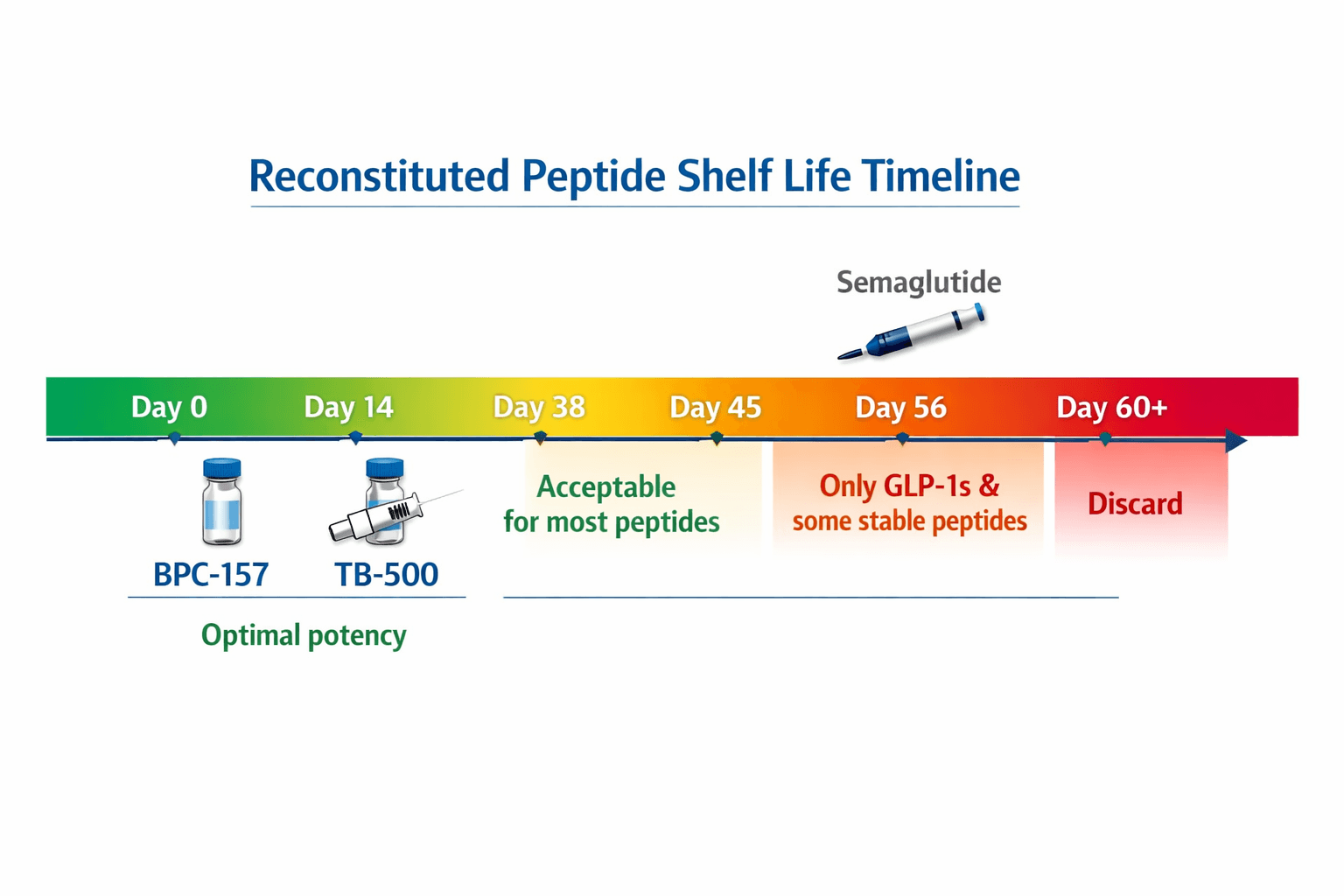
Days 1-28: Minimal degradation. Peptides retain 95-100% potency. This is the safe zone.
Days 28-45: Gradual decline. Most peptides retain 85-95% potency. Still effective but losing strength.
Days 45-60: Noticeable degradation. Peptides may retain only 70-85% potency. Results become inconsistent.
Beyond 60 days: Significant degradation. Potency drops below 70%. Not recommended to use.
Bacterial contamination risk
Bacteriostatic water's preservative effect diminishes over time.
Weeks 1-4: Bacterial inhibition strong. Contamination risk minimal with proper handling.
Weeks 4-6: Preservative weakening. Contamination possible if poor handling or temperature abuse.
Beyond 6 weeks: Preservative largely ineffective. Bacterial growth likely if any contamination occurred during reconstitution or drawing doses.
Signs of bacterial contamination:
Cloudiness (should be clear)
Particles or floating material
Unusual odor
Color change
Physical degradation signs
Visual changes indicating degradation:
Clear solution becomes cloudy
Color change (especially copper peptides)
Precipitation or crystals forming
Separation of layers
When in doubt: Discard. Don't risk injecting degraded or contaminated peptides.
Factors that affect refrigerated shelf life
Several variables influence how long your reconstituted peptides last.
Storage temperature consistency
Optimal: 2-8°C (36-46°F) constant
Temperature fluctuations shorten shelf life:
Frequent door opening warms vials temporarily
Power outages or fridge malfunctions
Storing in fridge door (warmest, most variable location)
Best practice:
Store in main fridge section (not door)
Middle or back of shelf (most stable temperature)
Away from freezer section (avoid freezing)
Avoid frequent removal for extended periods
Light exposure
Peptides degrade faster with light exposure, especially UV light.
Protection strategies:
Keep vial in original box
Wrap in aluminum foil
Store in opaque container
Refrigerator naturally limits light, but protect during removal
Amber vials: Some peptide suppliers use amber glass vials for light protection. This extends shelf life slightly.
Water quality and preservative content
Not all bacteriostatic water is equal.
Quality bacteriostatic water (0.9% benzyl alcohol):
Inhibits bacterial growth effectively
Standard for peptide reconstitution
28-30 day shelf life reliable
Sterile water (no preservative):
MUCH shorter shelf life: 3-7 days maximum
Bacterial growth risk high
Only use if consuming entire vial within days
Lower quality bacteriostatic water:
Preservative concentration may be lower
Contamination during manufacturing
Shorter shelf life than premium water
Recommendation: Always use pharmaceutical-grade bacteriostatic water from reputable suppliers.
See our bacteriostatic water guide for sourcing quality water.
Reconstitution technique and sterility
Contamination during mixing shortens shelf life dramatically.
Proper sterile technique:
Clean hands thoroughly
Wipe vial tops with alcohol before every needle insertion
Use sterile needles and syringes
Don't touch needle to any non-sterile surface
Inject water slowly down side of vial (not directly onto powder)
Don't shake, swirl gently
Poor technique consequences:
Bacterial contamination introduced during mixing
Peptide degradation from vigorous shaking
Shorter shelf life even with proper refrigeration
Learn complete reconstitution technique in our how to reconstitute peptides guide.
Vial seal integrity
Once vial seal is compromised, shelf life decreases.
Multi-dose vials:
Each needle puncture creates potential entry point for contaminants
After 10-15 punctures, seal integrity weakens
Recommendation: Use vial within 28 days even if seal appears intact
Single-dose draws:
If drawing entire vial in one session, seal integrity not an issue
Can preload syringes for convenience (store in fridge, use within week)
Extending shelf life: tips and tricks
While 28-30 days is standard, these practices maximize longevity.
Mix smaller batches more frequently
Strategy: Instead of reconstituting entire 10mg vial to last 8 weeks, reconstitute 5mg to last 4 weeks.
Benefits:
Always using fresh peptides
No worry about degradation
Can adjust doses without wasting partially-used vials
Trade-off: Slightly more frequent mixing (minor inconvenience for better quality).
Freeze individual doses (controversial)
Some users pre-load syringes and freeze them individually.
Potential benefits:
Extends beyond 30 days
Convenient pre-measured doses
Significant risks:
Ice crystal formation can damage peptide structure
Unknown potency loss during freezing/thawing
No clinical data supporting this practice
Recommendation: Not advised. Better to mix fresh batches than freeze reconstituted peptides.
Store in original packaging
Vials that come in boxes or protective packaging should remain there.
Why it helps:
Protects from light
Adds insulation against temperature fluctuations
Keeps vials organized with reconstitution dates
Label with reconstitution date
Essential practice: Write reconstitution date on vial or box immediately after mixing.
Why it matters:
Easy to track 28-day window
No guessing when peptides expire
Multiple peptides? Never confuse which was mixed when
Use waterproof marker or label: Refrigerator condensation can smudge ink.
Minimize vial removal time
Each time you remove vial to draw dose:
Take out vial
Draw dose quickly (1-2 minutes)
Return to fridge immediately
Don't:
Leave vial on counter for 30+ minutes
Warm to room temperature before drawing (unnecessary for most peptides)
Forget to return to fridge (happens more than you'd think)
How to tell if your reconstituted peptides have gone bad
Recognition prevents using ineffective or unsafe peptides.
Visual inspection
Clear solution should remain clear:
Any cloudiness = discard
Particles floating = discard
Color change = discard (especially important for copper peptides)
Separation or layers = discard
Exception: Some peptides may have slight natural color. What matters is CHANGE from when first mixed.
Smell test
Normal: Faint medicinal smell or no smell at all.
Warning signs:
Sour smell
Rancid odor
Any unusual smell different from when first mixed
If smells off: Discard. Don't risk injecting.
Effectiveness loss
Subjective but important indicator:
Peptide stopped working as well
Need higher doses for same effect
Complete loss of expected benefits
Example: BPC-157 was reducing pain, but suddenly stops helping. Peptide may be degraded.
Date check (most reliable)
Simplest method: If it's been more than 30 days since reconstitution, discard regardless of appearance.
Why: Degradation may not be visible. Bacterial contamination may not show obvious signs. Better safe than sorry.
Special cases: peptides that differ from standard timeline
Peptides reconstituted with sterile water (no preservative)
Shelf life: 3-7 days maximum, refrigerated
Why so short: No bacteriostatic preservative. Bacterial growth can occur despite refrigeration.
When this happens:
Pharmacy compounds without bacteriostatic water
User mistakenly uses sterile water instead
Specific medical reason to avoid benzyl alcohol preservative
Recommendation: Only use sterile water if consuming entire vial within 3-5 days. Otherwise, always use bacteriostatic water.
Pharmaceutical-grade pre-filled pens (Ozempic, Wegovy, Mounjaro, Zepbound)
Different rules apply for pharma products:
Ozempic pen: 56 days after first use (per FDA label)
Wegovy pen: 28 days after first use
Mounjaro/Zepbound pen: 28 days after first use
Why longer: Pharmaceutical formulations include additional stabilizers not present in research peptides. FDA-tested stability data supports longer timelines.
Important: These timelines only apply to authentic pharmaceutical products, NOT research chemical versions.
Peptides with added preservatives or stabilizers
Some compounding pharmacies add extra preservatives or stabilizers.
May extend shelf life to:
45-60 days depending on formulation
Pharmacy should provide specific expiration guidance
If unsure: Follow standard 28-30 day rule.
Cost-benefit analysis: using peptides near expiration
Should you use peptides at day 35? Day 40? Day 50?
Financial consideration
Scenario: You have expensive peptide vial at day 35. Half remains. Discard or continue?
Option 1: Discard and mix fresh
Cost: Price of new vial
Benefit: Guaranteed full potency
Risk: None (besides cost)
Option 2: Continue using
Cost: None (already paid for)
Benefit: Don't waste remaining peptide
Risk: 10-15% potency loss means 10-15% less effectiveness
Calculation: If vial costs $50 and you're at day 35 with half remaining, you're deciding whether to waste $25 to guarantee full potency, or accept 10-15% reduced effectiveness.
When to extend timeline
Consider using beyond 30 days when:
Peptide is very expensive (TB-500, pharmaceutical GLP-1s)
You're close to finishing vial (only 2-3 doses remain)
Peptide appears perfect (clear, no smell, stored optimally)
You're using for non-critical purpose (anti-aging vs acute injury)
Financial hardship makes wasting difficult
Maximum extension: 45 days for most stable peptides (BPC-157, TB-500, semaglutide). Not recommended beyond this.
When to strictly follow 28-30 days
Always discard at 30 days when:
Using for critical healing (serious injury, surgical recovery)
Peptide shows any signs of degradation
Storage conditions were suboptimal (power outage, left out, etc.)
Peptide is sensitive (IGF-1 LR3, copper peptides)
You can afford fresh vial without financial strain
Reconstituted peptide shelf life FAQs
Can I refreeze reconstituted peptides?
No. Never freeze reconstituted peptides. Ice crystals damage peptide structure. If you must travel without refrigeration, use insulated cooler with ice packs, but avoid freezing.
Can I store reconstituted peptides at room temperature?
Only very briefly. Room temperature dramatically accelerates degradation. Refrigeration is mandatory for shelf life beyond a few days.
Short-term room temp tolerance:
15-30 minutes: Fine (drawing dose)
2-4 hours: Acceptable if necessary (traveling short distance)
24+ hours: Significant degradation, bacterial risk increases
Never intentionally store reconstituted peptides at room temperature.
Does freezing peptides before reconstitution extend shelf life?
Yes. Lyophilized (freeze-dried) powder can be frozen for 24-36 months before reconstitution. This is different from freezing AFTER reconstitution (which is harmful).
Freezing powder:
Safe and effective
Extends shelf life beyond room temp or refrigerated storage
Thaw completely before reconstituting
What if my refrigerator lost power?
Timeline matters:
Power outage <4 hours: Peptides likely fine if fridge stayed closed. Continue using if they appear normal.
Power outage 4-12 hours: Peptides may have warmed significantly. If they still look clear and normal, can probably use but consider discarding soon.
Power outage >12 hours: Discard. Temperature abuse significantly shortens shelf life and increases contamination risk.
Can I mix peptides from same vial over time?
Question: Reconstitute half vial now, add more water to other half later?
Answer: No, don't do this. Once vial is opened and exposed to air/moisture, the entire contents begin degrading. Reconstitute full vial or transfer unused powder to new sterile vial immediately (difficult to do properly).
How you can use SeekPeptides for optimal peptide storage and protocols
Maximizing peptide effectiveness requires more than just knowing shelf life - you need personalized protocols, accurate dosing, and expert guidance on storage.
SeekPeptides provides everything you need to use reconstituted peptides safely and effectively.
Personalized peptide protocols with optimal reconstitution schedules: SeekPeptides creates custom protocols showing exactly when to reconstitute each peptide based on your dosing frequency.
Know whether to mix a full 10mg vial to last 6 weeks or split into two 5mg reconstitutions for maximum freshness. Get precise timelines for your specific peptide stack, so you're never guessing whether your month-old BPC-157 is still effective or if it's time to mix fresh.
AI peptide advisor for storage questions: Wondering if your semaglutide that's been in the fridge for 35 days is still good? Need to know if you can travel with reconstituted TB-500 for a week? Curious whether that slightly cloudy BPC-157 is safe or should be discarded? Get instant expert answers about storage, shelf life, degradation signs, and whether to continue using or mix fresh.
Ask about optimal reconstitution timing, batch sizing, or troubleshooting storage issues - anytime you need help.
Complete research library for peptide stability: Access comprehensive guides on peptide degradation mechanisms, bacteriostatic water chemistry, optimal storage conditions, and stability data for specific peptides.
Understand exactly why temperature matters, how preservatives work, and what factors accelerate or prevent degradation.
See the science behind shelf life recommendations and make informed decisions about extending timelines when necessary.
Reconstitution calculators and tracking: Our peptide reconstitution calculator shows exactly how much bacteriostatic water to add for your target concentration, how many doses you'll get from each vial, and when you'll need to reconstitute fresh batches. Track your reconstitution dates, get reminders when peptides approach expiration, and never waste money on forgotten vials that sat too long.
Storage optimization guidance: Learn proper refrigeration techniques, how to identify quality bacteriostatic water, sterile reconstitution methods that prevent contamination, and travel storage solutions. Know exactly how to maximize shelf life through optimal storage practices while maintaining safety and effectiveness.
Cost-benefit analysis tools: Our peptide cost calculator helps you determine whether mixing full vials or smaller batches more frequently makes financial sense for your protocol. Calculate the true cost of discarding partially-used vials versus the risk of reduced potency from extended storage.
Protocol adjustments for reconstitution timing: SeekPeptides optimizes your dosing schedule around reconstitution windows. If you're stacking BPC-157, TB-500, and CJC-1295, get a schedule showing when to reconstitute each peptide to minimize waste while ensuring maximum potency. Know whether to sync reconstitution dates or stagger them for convenience.
SeekPeptides takes the guesswork out of peptide storage and reconstitution timing. Instead of worrying whether your peptides are still effective or wasting money discarding good peptides too early, you get personalized protocols with clear timelines, storage guidance, and expert AI support whenever questions arise.
Stop losing sleep over shelf life concerns, just know exactly when your peptides expire and when to mix fresh batches.
Final thoughts
How long do reconstituted peptides last in the fridge? For most peptides, 28-30 days is the safe, reliable answer.
Some peptides tolerate slightly longer - BPC-157, TB-500, and pharmaceutical GLP-1s can last 35-45 days. Others require stricter timelines - IGF-1 LR3 and copper peptides should stay within 28-30 days.
The critical factor is using bacteriostatic water and maintaining consistent refrigeration at 2-8°C.
Beyond 30 days, you're accepting gradual potency loss and increased contamination risk.
For most users, mixing fresh batches every 28-30 days provides peace of mind and guaranteed effectiveness.
The cost of occasionally discarding partially-used vials is small compared to the cost of using degraded peptides that don't work.
Store in main fridge section, protect from light, maintain sterile technique, label with reconstitution date, and discard at 30 days unless you have specific reason to extend.
These simple practices ensure your reconstituted peptides remain safe and effective throughout their use.
Your peptides are an investment in your health. Proper storage and timely replacement protect that investment and ensure you get the results you're paying for.
Helpful resources for peptide storage
Peptide storage guide: complete protocols - Comprehensive storage information
How to reconstitute peptides: step-by-step - Proper mixing technique
Peptide reconstitution calculator - Calculate water amounts and doses
Bacteriostatic water guide - Choose quality water
Related guides worth reading
Should copper peptides be refrigerated: storage guide - Copper peptide specifics
BPC-157 complete guide: healing protocols - BPC-157 information
TB-500 guide: recovery protocols - TB-500 details
In case I don’t see you, good afternoon, good evening, and good night.