Feb 2, 2026
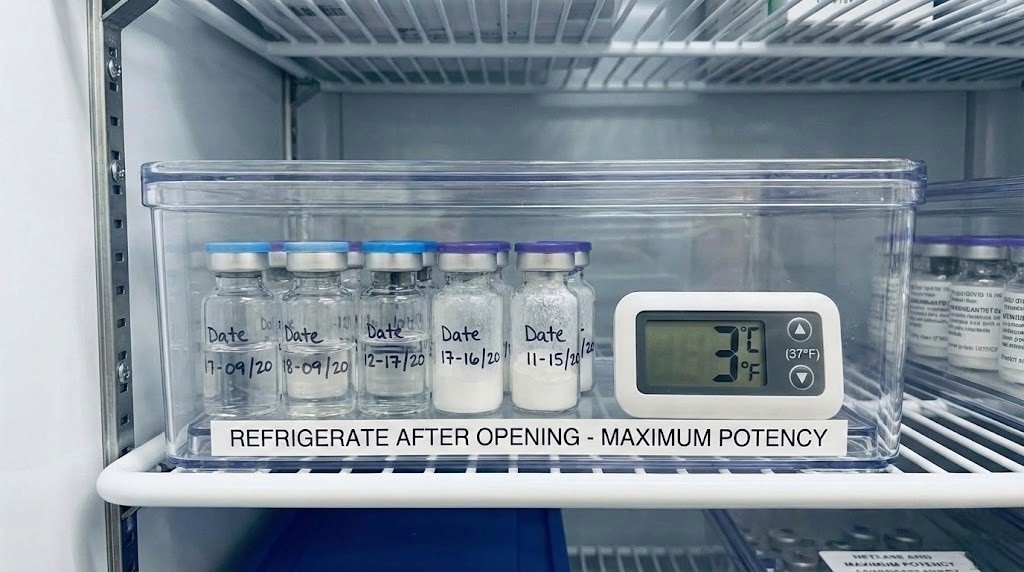
You are wasting peptides. Right now. And you probably do not even know it.
The average researcher loses between 30% and 50% of reconstituted peptide potency through improper storage alone. That is not a guess. That is the reality of peptide chemistry meeting real-world handling mistakes. Every vial sitting at the wrong temperature, every container exposing the solution to light, every unnecessary puncture introducing oxygen, all of it chips away at the compound you carefully reconstituted. The money adds up fast. A single vial of research-grade peptide can cost anywhere from $30 to $150 or more. Multiply that loss across a multi-week protocol, and you are looking at hundreds of dollars dissolving into degraded, inactive fragments.
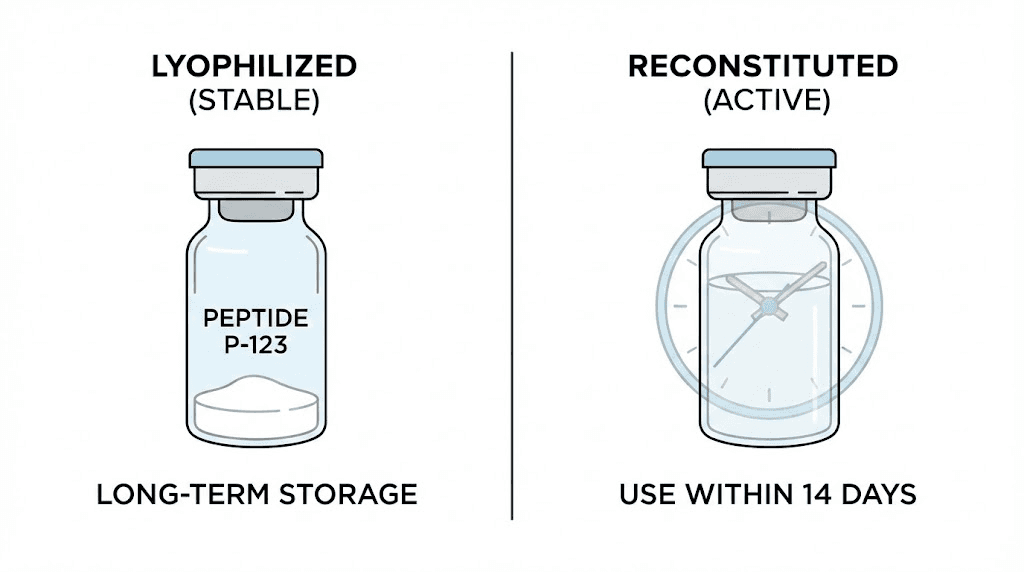
The problem is not the peptides themselves. Most peptides are remarkably stable in their lyophilized powder form. The problem starts the moment water hits that powder. Reconstitution activates the clock. From that point forward, every decision you make about temperature, containers, light exposure, and handling technique either preserves or destroys what you paid for.
This guide covers everything. You will learn the exact temperatures required for short-term and long-term storage, why your container choice matters more than you think, how bacteriostatic water extends shelf life compared to sterile water, and which specific peptides demand special attention. You will also learn the science behind degradation, so you understand not just what to do but why each step matters. Whether you are running a planned peptide cycle or storing reconstituted vials for ongoing research, the protocols here will protect your investment and keep your compounds potent from the first dose to the last.
Why proper storage matters after reconstitution
Lyophilized peptides are forgiving. They sit on shelves for months, even years, with minimal degradation. Refrigerated powder can last one to two years. Frozen powder at -20C can remain viable for two to five years or longer. The freeze-drying process removes water, and without water, the chemical reactions that break down peptide bonds essentially stop.
Reconstitution changes everything.
The moment you add water to your peptide, you reintroduce the very molecule that drives degradation. Water is not just a solvent here. It is an active participant in hydrolysis, the chemical reaction that cleaves peptide bonds one by one. It facilitates deamidation, where asparagine and glutamine residues convert into different amino acids. It enables oxidation by dissolving oxygen that attacks vulnerable residues like methionine and cysteine. And it provides the medium where bacteria can grow, introducing biological contamination on top of chemical degradation.
Think of it this way. Your lyophilized peptide is a book sealed in a vacuum-packed bag. It can sit there indefinitely. Reconstitution is like opening that bag and leaving the book in the rain. The clock starts ticking immediately.
The difference between a researcher who gets consistent, potent results across a full protocol and one who sees diminishing effects by week three often comes down to storage. Not the peptide source. Not the dosing protocol. Storage. Because a perfectly dosed injection of degraded peptide delivers a fraction of what it should. Sometimes it delivers nothing at all. And you would never know the difference by looking at the vial, because most degradation happens at the molecular level, invisible to the naked eye.
The hidden cost of poor storage
Consider a standard BPC-157 and TB-500 stack. A typical research protocol runs four to six weeks. If improper storage degrades your reconstituted peptide by even 10% per week, you are losing nearly half the potency by week four. That means the second half of your cycle delivers dramatically less compound than the first half. Your results look inconsistent. You might blame the peptide quality, the vendor, or your own biology. But the real culprit was sitting in your refrigerator the whole time.
Proper storage is not complicated. It requires attention to a handful of factors. But those factors are non-negotiable. Temperature. Container type. Light exposure. Air exposure. Sterile technique. Each one matters. And when you stack multiple storage mistakes on top of each other, the degradation compounds rapidly.
What happens at the molecular level
When a peptide degrades, it does not simply become "weaker." The peptide chain, a specific sequence of amino acids connected by peptide bonds, physically breaks apart or chemically transforms. A peptide formula is precise for a reason. Change one amino acid, cleave one bond, oxidize one residue, and the entire three-dimensional structure shifts. The peptide may no longer bind to its target receptor. It may fold incorrectly. It may aggregate into clumps that the body cannot use. In some cases, degradation products can actually interfere with the activity of whatever intact peptide remains.
This is why storage protocols exist. Not as suggestions or nice-to-haves, but as essential requirements for anyone who wants their peptides to actually work.
The complete temperature guide for reconstituted peptides
Temperature is the single most important factor in reconstituted peptide storage. Get this wrong and nothing else matters. Not your container, not your bacteriostatic water, not your sterile technique. Heat accelerates every degradation pathway. Every ten-degree increase in temperature roughly doubles the rate of chemical degradation. That is not an approximation. It is a well-established principle in chemistry called the Arrhenius equation, and it applies directly to peptides in solution.
Refrigerator storage: 2-8C (36-46F)
This is your default. Every reconstituted peptide that you plan to use within the next 28 to 30 days should live in a refrigerator at 2 to 8 degrees Celsius. This temperature range slows degradation dramatically compared to room temperature while keeping the solution in liquid form for easy withdrawal.
But not all spots in your refrigerator are equal.
The middle shelf provides the most consistent temperature. The door is the worst location. Every time you open the refrigerator, the door experiences the largest temperature swing. Back and forth, warm to cool, warm to cool. Those fluctuations stress peptide bonds and accelerate degradation. The bottom shelf near the back tends to be coldest but can sometimes approach freezing, which creates its own problems.
Place your vials on the middle shelf, toward the back, away from the door. If you have a dedicated mini-fridge for research supplies, even better. Fewer openings mean more stable temperatures. Some researchers use a small thermometer inside the fridge to monitor actual temperatures, because the dial setting and the actual internal temperature do not always match.
Freezer storage: -20C and -80C
For reconstituted peptides you will not use for weeks or months, freezer storage extends shelf life significantly. At -20C, reconstituted peptides can remain stable for several months. At -80C, stability extends even longer, potentially a year or more depending on the specific compound.
There is a critical caveat. Freeze-thaw cycles destroy peptides.
Each time you freeze a peptide solution, ice crystals form. Those crystals can physically damage the peptide structure. When you thaw the solution to withdraw a dose, then refreeze it, the damage compounds. After three or four freeze-thaw cycles, significant degradation has occurred. This is why aliquoting, the practice of dividing your reconstituted solution into smaller single-use or few-use vials before freezing, is so important. We will cover that in detail later in the peptide vial section of this guide.
Room temperature: the danger zone
Room temperature, typically 20 to 25C (68 to 77F), is hostile to reconstituted peptides. At these temperatures, degradation pathways accelerate significantly. Hydrolysis happens faster. Oxidation happens faster. Bacterial growth, even in bacteriostatic water, increases. The general consensus among researchers is that reconstituted peptides should not remain at room temperature for more than a few hours at most.
Some protocols call for 24 hours maximum at room temperature. That is a ceiling, not a target. Ideally, you remove the vial from the refrigerator, withdraw your dose, and return it within minutes. Not hours. Minutes. Treat every moment at room temperature as degradation time, because that is exactly what it is.
If you are preparing injections, get everything ready before you take the vial out. Have your syringe, alcohol swabs, and injection site prepared. Remove the vial, draw your dose, return the vial. The entire process should take less than two minutes of exposure.
Temperature reference table
Storage condition | Temperature | Expected stability | Best for |
|---|---|---|---|
Refrigerator | 2-8C (36-46F) | 28-60 days | Active protocols, daily use |
Standard freezer | -20C (-4F) | 3-6 months | Aliquoted reserves |
Deep freezer | -80C (-112F) | 6-12+ months | Long-term storage |
Room temperature | 20-25C (68-77F) | Less than 24 hours | Temporary use only |
This table represents general guidelines. Individual peptides vary based on their amino acid sequence, and some are far more sensitive than others. Peptides containing methionine, cysteine, tryptophan, or asparagine residues tend to degrade faster in solution. If your peptide calculator shows you are working with a particularly sensitive compound, err on the side of colder storage and shorter shelf-life assumptions.
Choosing the right container for reconstituted peptides
The vial your peptide sits in matters more than most researchers realize. Container material, closure type, and light exposure all influence degradation rates. A perfectly temperature-controlled peptide in the wrong container will still degrade faster than necessary.
Glass versus plastic
Glass wins. Every time.
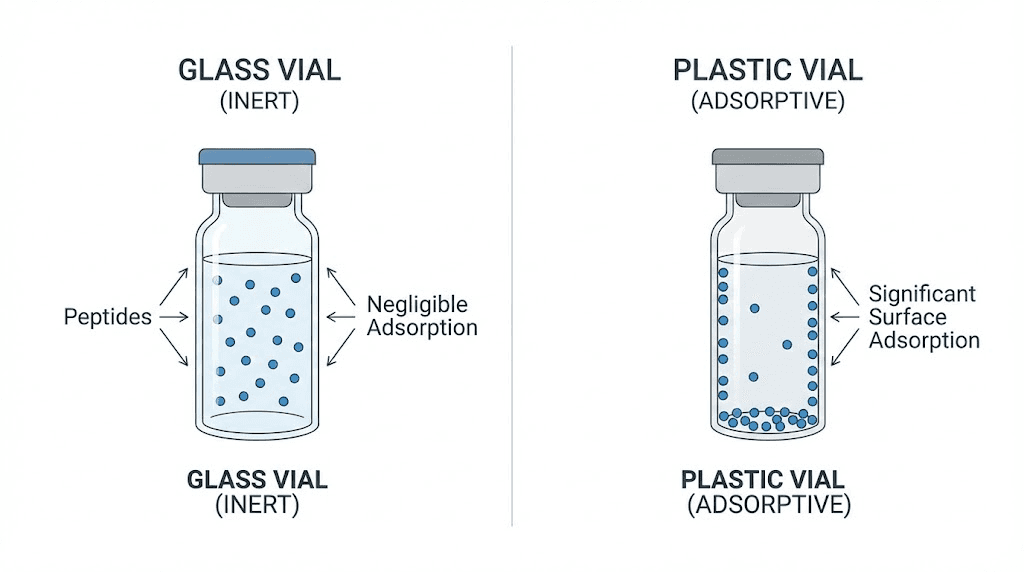
Borosilicate glass vials are the gold standard for peptide storage. Glass is chemically inert, meaning it does not react with the peptide solution. It does not leach chemicals into the solution. And critically, peptides do not bind to glass surfaces the way they bind to plastic.
Plastic containers, including polypropylene and polystyrene, present a real problem called surface adsorption. Peptides are sticky molecules. Many contain hydrophobic regions that readily bind to plastic surfaces, pulling active peptide out of solution and depositing it on the container walls. Over days and weeks, this binding effect can reduce the effective concentration of your solution significantly. You think you are withdrawing a full dose, but a meaningful percentage of your peptide is stuck to the inside of the container where it cannot be drawn out.
This effect is particularly pronounced with low-concentration solutions. If you are working with dilute peptide preparations, plastic containers can absorb an even higher percentage of your total peptide. At higher concentrations, the relative loss is smaller, but it still occurs. For anyone running a precise dosing protocol, these seemingly small losses compound over time.
Use the glass vials your peptide arrived in whenever possible. If you need to transfer to new containers for aliquoting, use sterile borosilicate glass vials with rubber stoppers.
Light protection
Light degrades peptides. Ultraviolet radiation in particular drives photodegradation, a process where light energy breaks chemical bonds and generates reactive oxygen species that attack vulnerable amino acid residues. Tryptophan is especially sensitive to light. So is tyrosine. Histidine can also undergo photo-oxidation.
Amber glass vials provide built-in light protection. The amber tint filters out most UV and visible light wavelengths that drive photodegradation. If your vials are clear glass, wrap them in aluminum foil. This simple step can meaningfully extend shelf life, especially if your refrigerator has an internal light that turns on every time you open the door.
Some researchers store their vials inside opaque containers or boxes within the refrigerator. A small cardboard box works fine. The goal is darkness. Complete, consistent darkness whenever the vial is in storage.
Closure and seal integrity
The rubber stopper on your vial serves two critical functions. It keeps contaminants out. And it minimizes air exchange. Every time you puncture that stopper with a needle, you create a tiny channel that can allow air to enter the vial. Oxygen is a primary driver of oxidation, one of the major degradation pathways for peptides.
Use the smallest gauge needle that allows you to withdraw your dose efficiently. Smaller needles create smaller holes. Fewer punctures mean less oxygen exposure. This is another reason aliquoting into smaller vials makes sense for multi-week protocols. Instead of puncturing the same stopper 30 or 40 times over a month, you puncture each smaller vial only a few times.
Bacteriostatic water and its role in peptide preservation
The water you use to reconstitute your peptide is not just a delivery vehicle. It is an active component of your storage strategy. The difference between bacteriostatic water and sterile water can mean the difference between a vial that stays usable for weeks and one that becomes contaminated within hours.
What makes bacteriostatic water special
Bacteriostatic water contains 0.9% benzyl alcohol. That small percentage of preservative inhibits bacterial growth, keeping the solution relatively free from microbial contamination over multiple uses. It does not kill bacteria. It stops them from multiplying. This distinction matters because it means existing contamination still poses a risk. Sterile technique during reconstitution remains essential even when using bacteriostatic water.
The benzyl alcohol preservative is what makes multi-dose vials possible. Without it, every time you puncture the stopper and insert a needle, you risk introducing bacteria into a growth-friendly, nutrient-rich solution. With bacteriostatic water, those bacteria cannot establish a colony. The solution stays safe for repeated use.
If you are unfamiliar with the reconstitution process, understanding the water choice is step one. And if you need help calculating how much water to add, the peptide reconstitution calculator takes the guesswork out of the math.
Bacteriostatic water versus sterile water
Sterile water is exactly what it sounds like. Water that has been sterilized to remove all microorganisms. It contains no preservatives. Once opened, it is a single-use product. Any peptide reconstituted with sterile water should be used immediately or within 24 hours at most, even under refrigeration.
The difference is stark.
Factor | Bacteriostatic water | Sterile water |
|---|---|---|
Preservative | 0.9% benzyl alcohol | None |
Multi-dose use | Yes, up to 28 days | No, single use only |
Reconstituted shelf life | 28-60 days refrigerated | Less than 24 hours |
Bacterial protection | Inhibits growth | None after opening |
Cost per vial | Slightly higher | Lower |
Best for | Multi-dose protocols | Single-use preparations |
For virtually all peptide research protocols that span multiple days or weeks, bacteriostatic water is the correct choice. Sterile water only makes sense if you are reconstituting and using the entire vial in a single session, which is rare for most injectable peptide protocols.
The 28-day rule
Once you open a vial of bacteriostatic water, its effectiveness as a preservative begins to diminish. The generally accepted guideline is 28 days from first puncture. After 28 days, the benzyl alcohol concentration may have decreased enough that bacterial inhibition is no longer reliable. This does not mean your peptide solution becomes dangerous on day 29. It means the safety margin narrows. The preservative may still be working. But the guarantee is gone.
This 28-day window is one of the most important numbers to remember in peptide storage. It sets an outer boundary for how long your reconstituted peptide can safely remain in multi-dose use. Some peptides degrade chemically before the 28-day mark, making the peptide itself the limiting factor rather than the bacteriostatic water. Others remain chemically stable well beyond 28 days, but the preservative expiration becomes the ceiling.
Label your vials with the reconstitution date. Every single time. This simple habit prevents you from using a vial that has been sitting in the refrigerator for six weeks when you thought it had only been three.
Proper reconstitution technique for maximum shelf life
How you reconstitute affects how long your peptide lasts in solution. The process matters. Let the lyophilized vial and your bacteriostatic water reach room temperature before mixing. Cold-to-cold mixing can cause incomplete dissolution. Slowly add the water along the inside wall of the vial, allowing it to gently roll down onto the powder. Do not squirt it directly onto the cake of lyophilized peptide. The pressure can damage the peptide structure.
Never shake the vial. Shaking creates foam, and foam means air exposure. Air means oxygen. Oxygen means oxidation. Gently swirl the vial instead, or simply let it sit for a few minutes. Most well-made lyophilized peptides dissolve readily with minimal agitation. If the powder does not dissolve within a few minutes of gentle swirling, something may be wrong with the peptide itself. Learn more about the complete process in our guide to mixing peptides with bacteriostatic water.
How long reconstituted peptides actually last
This is the question everyone asks. And the answer, frustratingly, is "it depends." Different peptides have different shelf lives in solution. Their amino acid sequences determine their vulnerability to specific degradation pathways. A peptide loaded with methionine residues will oxidize faster than one without. A peptide with asparagine-glycine sequences will deamidate faster. A large, hydrophobic peptide may aggregate more readily.
But general guidelines do exist. And they are useful.
General reconstituted shelf life guidelines
Most reconstituted peptides stored at 2-8C in bacteriostatic water remain stable for 28 to 30 days. This is the safe, conservative number that applies to the majority of common research peptides. Some last longer. Few last shorter when properly handled. But 28 to 30 days gives you a reliable baseline to build your protocols around.
For a deeper dive into refrigerator-specific timelines, the complete guide to how long reconstituted peptides last in the fridge covers this topic extensively.
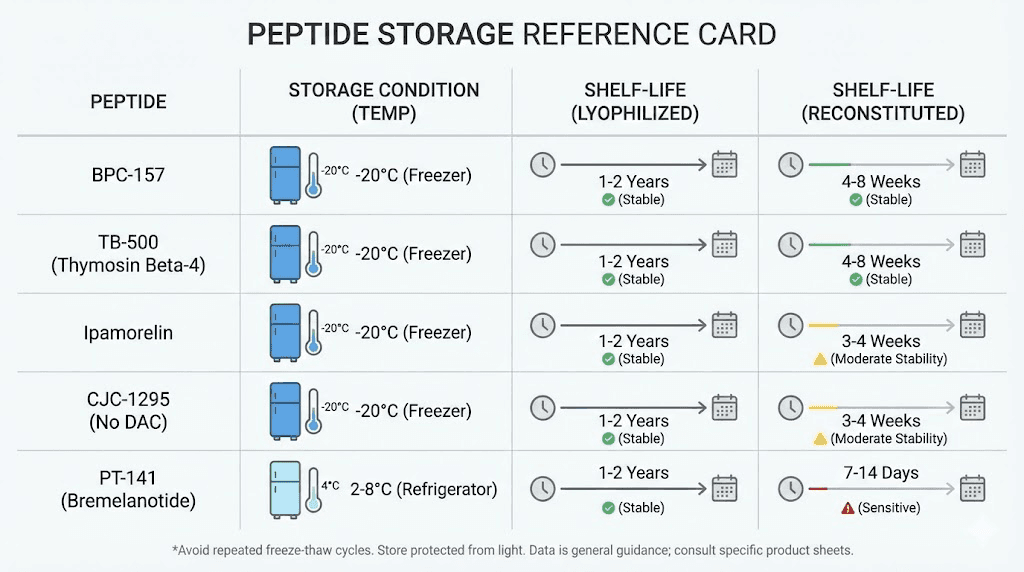
Peptide-specific shelf life table
Peptide | Reconstituted shelf life (refrigerated) | Key sensitivity | Notes |
|---|---|---|---|
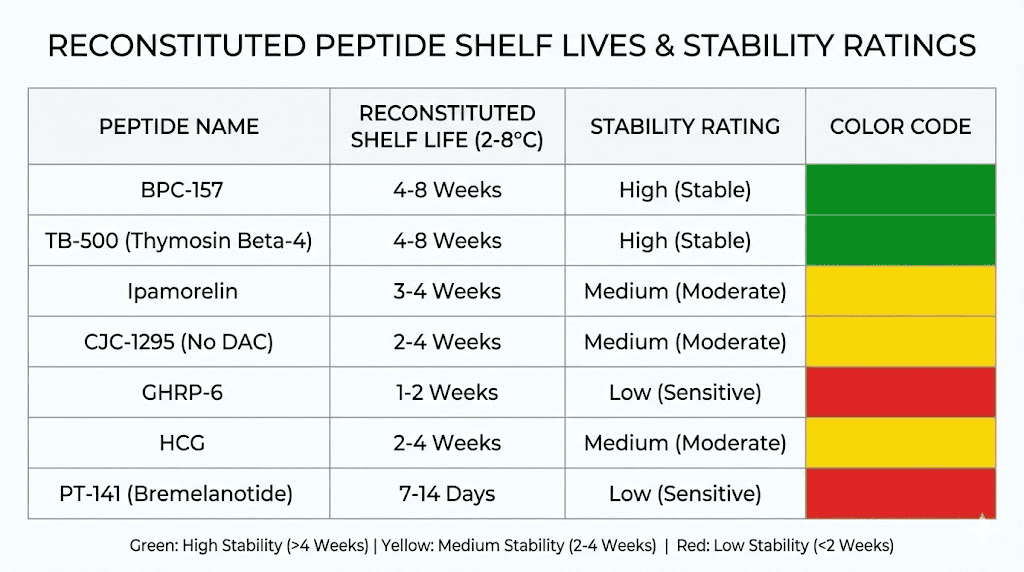
BPC-157 | 4-6 weeks | Moderate | Relatively stable in solution |
TB-500 | 3-6 weeks | Moderate | Store away from light |
Semaglutide (pharma) | 30-45 days | Moderate | Manufacturer specified |
Semaglutide (research) | 28-30 days | Moderate | Conservative estimate |
GHK-Cu | 21-28 days | Higher (Cu oxidation) | Copper complex is sensitive |
Ipamorelin | 28-30 days | Moderate | Standard shelf life |
CJC-1295 | 21-28 days | Moderate-high | DAC variant may differ |
Sermorelin | 21-28 days | Higher | Contains sensitive residues |
Epitalon | 28-30 days | Low-moderate | Short sequence, fairly stable |
DSIP | 21-28 days | Moderate-high | Contains Trp residue |
PT-141 | 28-30 days | Moderate | Standard storage protocol |
AOD-9604 | 21-28 days | Moderate | Monitor for cloudiness |
Semax | 28-30 days | Moderate | Nasal formulations may differ |
Selank | 28-30 days | Moderate | Similar to Semax stability |
KPV | 28-30 days | Low-moderate | Tripeptide, relatively stable |
MOTS-c | 21-28 days | Higher | Contains Met, sensitive to oxidation |
These numbers assume proper storage at 2-8C in bacteriostatic water with appropriate sterile handling. Deviations from these conditions will shorten shelf life, sometimes dramatically. If you leave a vial out at room temperature for a few hours, subtract days from the expected shelf life. If you are using sterile water instead of bacteriostatic water, cut the timeline to 24 hours or less.
For more on general peptide fridge storage timelines, the dedicated guide provides additional context. And if you are curious about how long peptides last in powder form before reconstitution, that comparison helps frame why the reconstituted state is so much more fragile.
Why some peptides last longer than others
Shelf life is not random. It is dictated by the amino acid sequence. Peptides containing methionine residues are prone to oxidation because methionine readily converts to methionine sulfoxide when exposed to oxygen. This conversion is essentially irreversible under normal conditions. Once it happens, the methionine residue has permanently changed, and the peptide may no longer function as intended.
Cysteine residues pose a similar challenge. At higher pH levels, cysteine can form disulfide bonds with other cysteine residues in the same peptide or even in neighboring peptide molecules. This cross-linking can lead to aggregation, where individual peptide molecules clump together into larger, inactive structures.
Tryptophan is light-sensitive. Asparagine, especially when followed by glycine in the sequence (Asn-Gly), is a "hot spot" for deamidation. Glutamine at the N-terminus can cyclize to form pyroglutamic acid. Each of these vulnerabilities translates directly into shorter shelf life for peptides that contain these residues.
Understanding your specific peptide amino acid composition helps you predict its storage behavior. A short, simple peptide like KPV (just three amino acids) tends to be more stable than a longer, complex peptide with multiple sensitive residues. This is why blanket storage guidelines are helpful as starting points but should not replace peptide-specific knowledge.
The science of peptide degradation in solution
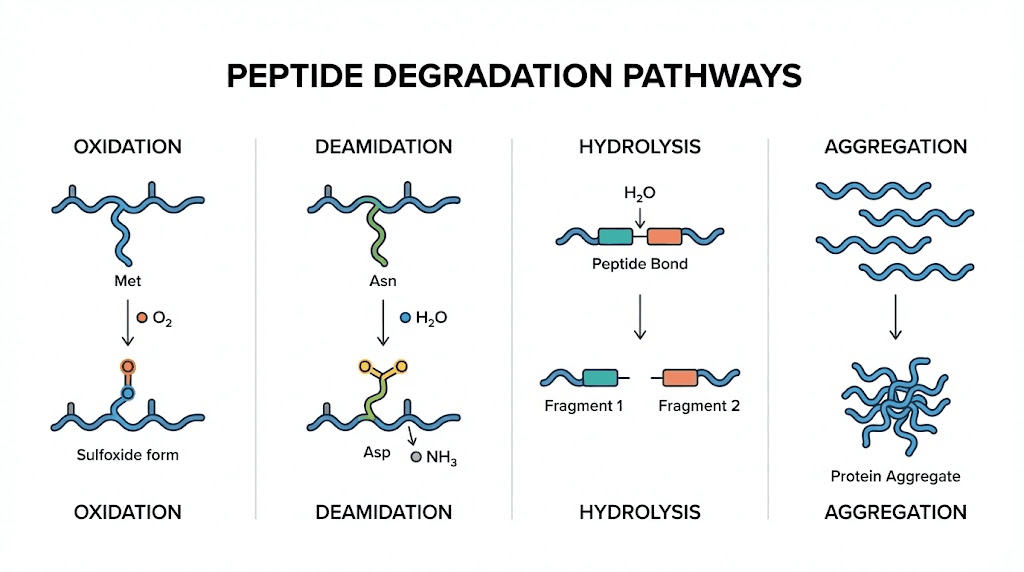
If you understand why peptides degrade, you can prevent it more effectively. This section digs into the four major degradation pathways that affect reconstituted peptides. You do not need a chemistry degree to follow along. But this knowledge will make every storage decision you make more informed and more effective.
Oxidation
Oxidation is the most common degradation pathway for peptides in solution. It happens when oxygen reacts with vulnerable amino acid side chains, altering their chemical structure. The amino acids most susceptible to oxidation are methionine, cysteine, tryptophan, histidine, and tyrosine.
Methionine is the primary target. When methionine oxidizes, it forms methionine sulfoxide. Under more severe conditions, it can further oxidize to methionine sulfone. Both modifications are essentially irreversible under normal storage conditions. Once methionine oxidizes, the peptide has permanently changed. If that methionine residue plays a role in receptor binding or biological activity, oxidation can reduce or eliminate the peptide effect entirely.
Cysteine oxidation takes a different form. Instead of a simple side-chain modification, cysteine residues can form disulfide bonds with each other. In peptides that rely on specific disulfide bonding patterns for their three-dimensional structure, uncontrolled disulfide formation can scramble the structure. This scrambling, called disulfide exchange, produces misfolded peptides that do not function properly.
Every time you open a vial, you introduce fresh oxygen. Every time air bubbles form during withdrawal, oxygen dissolves into the solution. This is why minimizing vial punctures and avoiding shaking are so important. Some advanced researchers even purge vials with nitrogen or argon gas after each use, displacing the oxygen with inert gas. This is not necessary for most protocols, but it demonstrates how seriously oxidation is taken in professional settings.
For peptides like MOTS-c, which contains methionine in its sequence, oxidation protection is especially important. Store these compounds with extra care and use them promptly after reconstitution.
Deamidation
Deamidation occurs when asparagine (Asn) or glutamine (Gln) residues in the peptide chain lose their amide group and convert to aspartic acid or glutamic acid respectively. This changes the charge and structure of the peptide at that position, potentially disrupting biological activity.
The rate of deamidation depends heavily on the neighboring amino acids. Asparagine followed by glycine (Asn-Gly) is the fastest-deamidating sequence known. Asparagine followed by larger amino acids deamidates more slowly because the larger side chains sterically hinder the cyclization reaction that drives deamidation.
pH matters enormously. At neutral to alkaline pH (above 7), deamidation proceeds through a cyclic imide intermediate that produces a mixture of normal and isomerized products. At acidic pH (below 5), deamidation occurs through direct hydrolysis and is generally slower. This is why some formulation scientists recommend slightly acidic buffer solutions for peptide storage when long-term stability is needed.
Temperature accelerates deamidation just like every other degradation pathway. Keeping reconstituted peptides cold is your primary defense. But for peptides with known Asn-Gly sequences, extra vigilance is warranted. These peptides may degrade faster than the general guidelines suggest.
Hydrolysis
Hydrolysis is the direct cleavage of peptide bonds by water. It is the most fundamental degradation pathway because water is the very medium the peptide sits in after reconstitution. Every peptide bond is theoretically susceptible to hydrolysis, but some are more vulnerable than others.
Aspartic acid (Asp) residues are particularly prone to hydrolysis-related degradation. Asp can form a cyclic imide intermediate that either regenerates the original amino acid or converts to iso-aspartate, an isomer with different properties. In sequences containing Asp-Pro, the cyclic imide formation can actually cleave the peptide backbone entirely, splitting the peptide into two fragments.
Temperature and pH are the primary drivers of hydrolysis rate. Low temperatures slow it dramatically. Neutral pH is generally safest for most peptides, which is convenient because bacteriostatic water has a near-neutral pH. Extreme acid or alkaline conditions massively accelerate hydrolysis and should never be used for storage.
The key practical takeaway is this: water is both necessary and destructive. You need it to dissolve the peptide for use. But its presence immediately begins breaking the peptide down. Every storage strategy is fundamentally about slowing this inevitable process as much as possible. For comprehensive coverage of how peptides fare at room temperature, that guide demonstrates just how quickly hydrolysis accelerates when temperature control is lost.
Aggregation
Aggregation is when individual peptide molecules stick together, forming larger structures ranging from small dimers (two molecules) to large, visible clumps. Aggregated peptides are essentially non-functional. They cannot bind to receptors properly, cannot be absorbed efficiently, and in some cases can provoke unwanted immune responses.
Hydrophobic peptides are the most prone to aggregation. Peptides with large hydrophobic regions tend to bury those regions together, much like oil droplets merging in water. Beta-sheet-prone sequences are also at higher risk because beta-sheet structures naturally self-associate into larger aggregates.
Temperature fluctuations, freeze-thaw cycles, shaking, and high concentrations all promote aggregation. Keeping your peptide solution at a stable, cold temperature with minimal physical disturbance is the best prevention. If you ever see visible particles, cloudiness, or gel-like material in your reconstituted peptide, aggregation has likely occurred. That vial should be discarded.
Understanding these four pathways, oxidation, deamidation, hydrolysis, and aggregation, gives you the complete picture of why reconstituted peptides have limited shelf lives. Every storage recommendation in this guide targets one or more of these pathways. Cold temperatures slow all four. Bacteriostatic water addresses bacterial contamination. Glass vials prevent surface binding. Light protection prevents photodegradation. And sterile technique prevents contamination that accelerates biological degradation on top of the chemical pathways.
Step-by-step storage protocol after reconstitution
Theory is valuable. But protocols save peptides. Here is the exact sequence to follow every time you reconstitute a peptide and prepare it for storage. Each step addresses specific degradation risks.
Before reconstitution
Step 1: Gather supplies. You need your lyophilized peptide vial, bacteriostatic water, an appropriately sized syringe, alcohol swabs, and labels or a marker for dating. Having everything ready minimizes the time your peptide spends at room temperature during the process.
Step 2: Allow vials to warm. Remove both the peptide vial and bacteriostatic water from cold storage and let them reach room temperature. This takes about 15 to 20 minutes. Cold solutions can cause incomplete dissolution and increase the risk of the peptide precipitating out of solution. Do not rush this step by heating the vials. Passive warming at room temperature is the correct approach.
Step 3: Clean everything. Wipe the stoppers of both vials with fresh alcohol swabs. Let the alcohol dry completely before puncturing. Wet alcohol can contaminate the solution. This step takes seconds but prevents bacterial introduction that could compromise the entire vial over its storage life.
During reconstitution
Step 4: Calculate your water volume. Use the reconstitution calculator to determine exactly how much bacteriostatic water to add. The volume determines your concentration, which determines how much you draw for each dose. Getting this right means accurate dosing throughout the vial life. Common volumes are 1 mL or 2 mL, but the correct amount depends on the peptide quantity and your desired concentration per unit.
Step 5: Add water slowly along the vial wall. Draw the calculated amount of bacteriostatic water into your syringe. Insert the needle into the peptide vial and press the plunger slowly, aiming the stream at the inside wall of the vial. Let the water trickle down the glass and onto the lyophilized cake. Do not inject directly onto the powder. Do not squirt forcefully. Gentle and slow preserves peptide structure.
Step 6: Dissolve without shaking. Once the water is added, gently swirl the vial in a circular motion. Never shake it. Shaking introduces air bubbles, which means oxygen exposure and potential foaming. Most peptides dissolve within one to five minutes of gentle swirling. If the solution is not clear after five minutes, let it sit at room temperature for up to 30 minutes. If it still has not dissolved, there may be an issue with the peptide or the reconstitution method. Our complete mixing guide covers troubleshooting for difficult-to-dissolve peptides.
After reconstitution
Step 7: Label the vial immediately. Write the reconstitution date on the vial. Include the peptide name, concentration, and the date. Some researchers also note the bacteriostatic water lot number and the number of punctures over time. At minimum, the date is essential. Memory is unreliable. Labels are not.
Step 8: Decide on aliquoting. If your protocol spans more than two weeks, consider dividing the reconstituted solution into smaller vials now, before storage. We cover aliquoting strategies in detail in the next section. This decision should be made immediately after reconstitution, while the peptide is freshest and before any degradation has begun.
Step 9: Store immediately. Place the vial (or aliquots) into the refrigerator or freezer within minutes. Every minute at room temperature counts. The middle shelf of the refrigerator, toward the back, away from the door, in a dark container or wrapped in foil. These details matter. They compound over 28 to 30 days of storage to make a real difference in potency.
Step 10: Document everything. In a research log or simple spreadsheet, note the peptide name, reconstitution date, bacteriostatic water used, volume added, resulting concentration, storage location, and expected discard date. This documentation habit becomes invaluable when you are running multiple concurrent peptide cycles or stacking protocols.
Aliquoting strategies for multi-week protocols
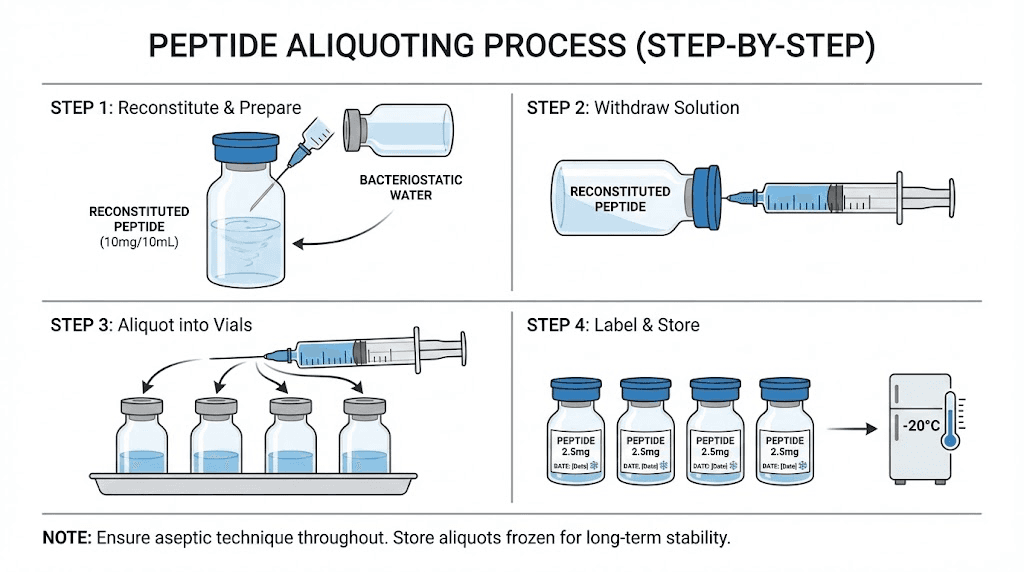
Aliquoting is the practice of dividing a large reconstituted volume into smaller, single-use or few-use portions before storage. It is one of the most effective strategies for preserving peptide potency over extended protocols. Yet most researchers skip it because it seems like extra work. It is extra work. And it is worth every minute.
Why aliquoting matters
Every time you puncture a vial stopper, you introduce a tiny amount of air. Every time you withdraw solution, you disturb the liquid and potentially create air bubbles. Every time the vial sits at room temperature while you prepare your injection, the peptide degrades a little more. Over a 30-day protocol with daily dosing, that single vial gets punctured 30 times, exposed to room temperature 30 times, and receives 30 doses of fresh oxygen.
Aliquoting dramatically reduces these exposures. Instead of one vial punctured 30 times, you might have six vials punctured five times each, with five of those vials remaining sealed in the refrigerator or freezer until needed. The vials you are not actively using stay sealed, cold, and protected from every form of degradation except the slow, baseline chemical processes that cold temperatures already minimize.
How to aliquot reconstituted peptides
Step 1: Reconstitute the full vial as described in the protocol above.
Step 2: While the solution is fresh and fully dissolved, calculate how many doses each smaller vial needs to hold. For example, if your protocol calls for 250mcg daily for 30 days, and you reconstituted with 2 mL of bacteriostatic water, each 0.1 mL withdrawal contains a specific amount. Divide the total into portions that represent five to seven days of dosing each.
Step 3: Using a sterile syringe, carefully transfer the calculated volume into pre-sterilized glass vials. Use fresh, alcohol-swabbed stoppers for each vial. Work quickly but carefully to minimize room-temperature exposure.
Step 4: Label every aliquot vial with the peptide name, concentration, volume, and date.
Step 5: Place the aliquot you will use first in the refrigerator. Place the remaining aliquots in the freezer at -20C. As you finish each refrigerated aliquot (after five to seven days), move the next frozen aliquot to the refrigerator to thaw overnight before use.
Aliquoting for different protocol lengths
Protocol length | Recommended aliquots | Days per aliquot | Storage for unused aliquots |
|---|---|---|---|
2 weeks | 2 | 7 each | Refrigerator |
4 weeks | 4 | 7 each | Freezer (-20C) |
6 weeks | 6 | 7 each | Freezer (-20C) |
8+ weeks | 8+ | 7 each | Deep freezer (-80C) if available |
The seven-day aliquot size hits a sweet spot. It is long enough to avoid the hassle of swapping vials every day or two. But it is short enough that each aliquot only gets punctured five to seven times and spends less than a week in the fluctuating environment of an active refrigerator.
If your protocol involves multiple peptides simultaneously, aliquoting becomes even more important. Managing several vials in various stages of use without aliquoting creates chaos. With aliquoting, each peptide has a clear rotation schedule. When researchers use the peptide stack calculator to plan multi-compound protocols, incorporating aliquoting into the plan from the start prevents waste and ensures consistent dosing throughout.
Freeze-thaw considerations
When you move a frozen aliquot to the refrigerator, you are performing one controlled thaw. One. This is acceptable for most peptides and causes minimal degradation. The damage from freeze-thaw cycles comes from repeated freezing and thawing of the same solution, where ice crystals form, melt, reform, and melt again, each cycle physically stressing the peptide molecules.
Never refreeze a thawed aliquot. Once it is in the refrigerator, use it within seven days and then discard any remainder. This discipline is what makes aliquoting work. Each aliquot gets one freeze, one thaw, and one use period. Clean and simple.
Common storage mistakes that destroy peptide potency
Knowing what to do is half the battle. Knowing what not to do is the other half. These are the mistakes that researchers make most often, ranked roughly by how much damage they cause. Some of them might surprise you.
Mistake 1: storing vials on the refrigerator door
The refrigerator door is the worst place for any temperature-sensitive compound. Every opening creates a temperature swing of several degrees. Over the course of a day, with multiple openings, the door temperature can fluctuate between 4C and 12C or higher. Those fluctuations accelerate every degradation pathway. Move your peptides to the middle shelf, near the back.
Mistake 2: using sterile water for multi-dose vials
This mistake renders the entire vial unsafe within 24 hours. Sterile water has no preservative. Without the benzyl alcohol in bacteriostatic water, bacteria can colonize the solution rapidly, especially in a warm environment. If you have reconstituted with sterile water by mistake and cannot use the entire vial within 24 hours, the safest approach is to discard it and start fresh with bacteriostatic water.
Mistake 3: shaking the vial to dissolve
Vigorous shaking introduces massive amounts of air into the solution. Air means oxygen. Oxygen means oxidation. Shaking also creates foam, which dramatically increases the surface area exposed to air and can physically denature proteins and larger peptides through the mechanical forces at bubble interfaces. Always swirl gently. Never shake.
Mistake 4: leaving vials at room temperature
This happens more often than people admit. You take the vial out to draw a dose, get distracted, and the vial sits on the counter for 30 minutes. Or an hour. Or longer. Each occurrence chips away at potency. Develop the habit of returning the vial immediately after use. Set a timer if you need to. The discipline of rapid return to cold storage is one of the simplest and most effective potency-preserving habits you can develop.
Mistake 5: ignoring light exposure
Most refrigerators have an internal light that activates every time the door opens. If your vials sit uncovered on an open shelf, they receive pulses of light throughout the day. UV and visible light drive photodegradation in peptides containing tryptophan, tyrosine, and phenylalanine. Wrap vials in aluminum foil or store them in an opaque box inside the refrigerator. This takes 30 seconds and protects against an entirely preventable degradation pathway.
Mistake 6: reusing bacteriostatic water past 28 days
The bacteriostatic water itself has a shelf life after opening. After 28 days, the benzyl alcohol preservative may not be effective enough to prevent bacterial growth. If you open a new vial of bacteriostatic water, date it, and discard the remainder after 28 days, regardless of how much is left. Using expired bacteriostatic water introduces contamination risk to every peptide you reconstitute with it.
Mistake 7: not labeling vials
It seems obvious. But skipping the label leads to confusion, double-dosing, wrong-peptide dosing, and using vials well past their safe storage window. Every vial should have the peptide name, concentration, reconstitution date, and expected discard date clearly written on it. Use waterproof labels or markers, because condensation in the refrigerator can smear regular ink.
Mistake 8: frequent unnecessary punctures
Each needle puncture through the stopper introduces a small amount of air and creates a slightly larger pathway for future air entry. If you are drawing doses twice daily from the same vial for 30 days, that stopper gets punctured 60 times. By the end, air exchange through those accumulated micro-channels is significant. Aliquoting, as discussed earlier, is the most effective countermeasure.
Mistake 9: storing different peptides in the same area without labels
When running a peptide stack, multiple vials sit in the same refrigerator section. Without clear labeling and organization, it is easy to grab the wrong vial. Administering TB-500 when you meant to draw ipamorelin is not just a waste. It disrupts your protocol entirely. Keep vials organized, clearly labeled, and arranged in a consistent order.
Mistake 10: reconstituting more than you can use
If your protocol calls for a 28-day supply and your vial contains enough peptide for 60 days of dosing at your chosen concentration, do not reconstitute the entire vial at once. Reconstitute only what you can use within the stability window, or plan to aliquot and freeze the excess immediately. Keeping peptide in lyophilized form is always the safest storage option. Learn more about powder-form stability to understand why this matters so much.
How to tell if your reconstituted peptides have gone bad
Here is the difficult truth. Most peptide degradation is invisible.
Chemical degradation, the kind caused by oxidation, deamidation, and hydrolysis, happens at the molecular level. A methionine residue oxidizes. An asparagine converts to aspartate. A peptide bond cleaves. None of these events change the appearance of the solution. The liquid looks exactly the same. Clear. Colorless. Normal. But the peptide inside has fundamentally changed.
This means that visual inspection is a useful but incomplete tool. It can tell you when something has definitely gone wrong. It cannot tell you when everything is fine. The absence of visible problems does not guarantee the peptide is still potent.
Visible signs of degradation
Cloudiness or haziness. A solution that was clear at reconstitution but has become cloudy likely contains aggregated peptide. Aggregation produces particles large enough to scatter light, creating visible turbidity. A cloudy solution should not be used.
Visible particles or floaters. Distinct particles floating in the solution or settled at the bottom indicate either aggregation, precipitation, or contamination. Any of these make the vial unusable.
Discoloration. Reconstituted peptides should be colorless to very slightly yellow. Significant yellowing, browning, or any other color change suggests chemical degradation has occurred. The exception is peptides containing copper, like GHK-Cu, which naturally has a blue tint. But even for colored peptides, a change from the original color is a warning sign.
Unusual smell. Most peptide solutions are odorless or have a very faint smell from the benzyl alcohol in bacteriostatic water. A strong, unusual, or foul odor suggests bacterial contamination. Discard immediately.
Gel-like consistency. If the solution has thickened or developed a gel-like texture, significant aggregation or degradation has occurred. Normal reconstituted peptides should have the consistency of water.
Invisible degradation markers
These are the degradation events you cannot see but should assume are happening based on time and conditions.
If a vial has been stored for longer than the recommended shelf life, degradation has almost certainly occurred even if the solution looks perfect. If the vial was exposed to room temperature for extended periods, degradation accelerated during those exposures even if the solution appears unchanged. If sterile technique was compromised, bacterial growth may be present even in a clear solution, especially in the early stages before the colony is large enough to cause visible turbidity.
The practical rule is simple. Trust the timeline and storage conditions more than visual appearance. If a vial has exceeded its recommended shelf life, discard it regardless of how it looks. For critical research where potency matters, analytical testing through peptide testing labs can confirm whether a given vial still contains active, intact peptide. But for most researchers, following strict storage protocols and adhering to shelf-life guidelines is the more practical approach.
When to discard without question
Throw it away if you see any visible particles, cloudiness, or discoloration. Throw it away if the vial has been at room temperature for more than a few hours. Throw it away if the reconstitution date is past the recommended shelf life. Throw it away if you reconstituted with sterile water more than 24 hours ago. Throw it away if you detect any unusual odor. And throw it away if you have any doubt whatsoever.
Peptides are not worth the risk of using degraded material. The cost of a new vial is always less than the cost of a compromised protocol that delivers inconsistent or zero results over weeks. Researchers who understand this replace questionable vials without hesitation. Those who try to stretch every last day out of a vial end up with data they cannot trust.
Storing specific peptides after reconstitution
While general guidelines apply broadly, individual peptides have specific characteristics that influence their ideal storage conditions. Here we will cover the most commonly used research peptides and what you need to know about storing each one after reconstitution.
BPC-157 storage
BPC-157 is one of the more forgiving peptides when it comes to reconstituted storage. As a 15-amino-acid peptide derived from human gastric juice, it demonstrates reasonable stability in solution. Reconstituted BPC-157 stored at 2-8C in bacteriostatic water typically remains viable for four to six weeks.
The relatively compact size of BPC-157 works in its favor. Smaller peptides have fewer vulnerable residues and less complex three-dimensional structures that can unfold. That said, standard precautions still apply. Keep it cold. Keep it dark. Minimize air exposure. If your BPC-157 protocol runs longer than four weeks, aliquoting is strongly recommended.
Researchers often use BPC-157 for injury healing protocols that target specific tissues. Whether you are researching its effects on tendon repair, joint pain, or gut health, consistent potency throughout the protocol depends on proper storage. Many BPC-157 protocols pair it with TB-500 for enhanced results, which means you may be storing both peptides simultaneously and need to manage both shelf lives carefully.
TB-500 storage
TB-500 (Thymosin Beta-4) has a reconstituted shelf life of three to six weeks at 2-8C. It is a 43-amino-acid peptide, larger than BPC-157, which makes it slightly more susceptible to structural changes in solution. The extended chain means more potential points for degradation.
TB-500 is particularly light-sensitive. Store it in amber glass or wrapped in foil. If you notice any cloudiness developing during storage, aggregation may have begun, and the vial should be replaced. The TB-500 dosage calculator can help you plan your reconstitution volumes to match your protocol length, minimizing waste from expired vials.
Protocols using the Wolverine stack or Wolverine peptide combinations involving TB-500 should plan for the TB-500 shelf life as the limiting factor when pairing with more stable peptides.
Semaglutide storage
Semaglutide requires careful attention to storage because of its widespread use in weight loss and body composition research. Pharmaceutical-grade semaglutide in pre-filled pens has manufacturer-specified shelf lives of 30 to 45 days after first use, stored at 2-8C. Research-grade semaglutide reconstituted in bacteriostatic water typically follows the conservative 28-to-30-day guideline.
Semaglutide protocols tend to be longer than many peptide cycles, often spanning 12 weeks or more with gradual dose escalation. This extended timeline makes proper storage and aliquoting especially important. Reconstituting only enough for four weeks at a time and keeping the remainder as lyophilized powder is the optimal approach.
When comparing semaglutide storage to tirzepatide storage, both follow similar general principles. The key difference is in the specific formulations and their stability profiles, which vary by manufacturer and preparation method. Similar storage considerations apply to newer compounds like retatrutide and cagrilintide.
GHK-Cu storage
GHK-Cu presents unique storage challenges because of its copper ion. The GHK-Cu peptide is a copper-binding tripeptide, and that copper atom adds an extra dimension of instability. Copper can catalyze oxidation reactions, potentially accelerating the degradation of the peptide it is bound to and even neighboring molecules.
Reconstituted GHK-Cu should be stored at 2-8C and used within 21 to 28 days. Light protection is critical because copper complexes can undergo photochemical reactions. If you are using GHK-Cu for skin applications, hair growth, or anti-aging research, the slightly shorter shelf life means tighter protocol planning.
Growth hormone releasing peptides
Peptides like ipamorelin, CJC-1295, and sermorelin are among the most commonly reconstituted peptides for muscle growth and performance research. Their storage requirements follow the general 21-to-28-day guideline when reconstituted, with sermorelin on the shorter end due to its somewhat more sensitive sequence.
These peptides are frequently used in ipamorelin and CJC-1295 combinations, which means managing two vials simultaneously. When stacking growth hormone releasing peptides, label each vial distinctively. Color-coded tape or different label styles help prevent mix-ups during early morning or late evening dosing when attention may be lower.
For growth hormone releasing peptide protocols, the CJC-1295 dosage calculator and the general peptide calculator help plan reconstitution volumes that align with storage windows. Reconstituting to a concentration where your protocol uses the entire volume within 21 to 28 days eliminates the problem of leftover, aging peptide solution.
Bioregulator peptides
Bioregulator peptides, including epitalon, thymalin, vesugen, cardiogen, and other Khavinson peptides, are generally short-sequence compounds of two to four amino acids. Their small size often confers greater stability in solution compared to longer peptides. Epitalon dosage protocols typically span 10 to 20 days, which falls comfortably within the standard storage window.
These peptides still require standard temperature and light precautions. But their compact sequences mean fewer vulnerable residues and less structural complexity to maintain. Reconstituted bioregulator peptides generally last 28 to 30 days refrigerated, and the limiting factor is often the bacteriostatic water preservative rather than the peptide stability itself.
Neuropeptides
Peptides used in brain and nervous system research, including semax, selank, DSIP, and cerebrolysin, have varying stability profiles. DSIP contains a tryptophan residue that makes it more light-sensitive, so extra attention to UV protection is warranted. Semax and selank, often used in nasal spray formulations, follow standard storage guidelines when reconstituted for injection use.
For researchers focused on cognitive enhancement peptides or anxiety-related peptide research, maintaining consistent potency is especially important because the effects being measured are often subtle. Even small potency reductions from poor storage can make it difficult to distinguish real effects from degradation-related variability.
Specialty and emerging peptides
Newer compounds like SS-31, 5-amino-1MQ, tesofensine, and kisspeptin may have less well-established storage data compared to legacy compounds. When working with newer peptides, default to the conservative 21-day shelf life in solution at 2-8C unless manufacturer data suggests otherwise. Err on the side of shorter storage rather than longer, and aliquot whenever possible.
The broader peptide solutions landscape continues to expand with new compounds entering research regularly. Consistent storage fundamentals apply across all of them, even when peptide-specific data is limited. Cold, dark, sealed, and sterile. Those four principles protect every peptide, regardless of how new or specialized it is.
Advanced storage considerations
pH and buffer considerations
Most researchers reconstitute with bacteriostatic water, which has a near-neutral pH around 5.7 to 7.0. This is acceptable for the majority of peptides. However, some peptides are more stable at slightly acidic pH values. Research has shown that buffer solutions at pH 3 to 5 can reduce deamidation, slow oxidation, and protect disulfide bridges from exchange reactions.
For standard research protocols using bacteriostatic water, pH adjustment is usually unnecessary. The neutral pH of bacteriostatic water provides a reasonable balance across multiple degradation pathways. But for researchers working with particularly sensitive peptides or planning extended storage, consulting the literature on optimal pH for your specific compound can yield meaningful stability improvements.
Excipients and stabilizers
Professional pharmaceutical formulations often include excipients that improve peptide stability. Sugars like mannitol, trehalose, and sucrose can stabilize peptide structure in solution. Amino acid excipients like histidine and methionine can act as antioxidant buffers, sacrificing themselves to oxidation before the active peptide is affected. Surfactants like polysorbate 80 can reduce surface adsorption to container walls and prevent aggregation at air-liquid interfaces.
These additives are rarely used in standard research settings where bacteriostatic water is the reconstitution medium. But understanding that they exist explains why pharmaceutical-grade pre-filled products sometimes have longer shelf lives than researcher-reconstituted versions of the same peptide. The difference is not necessarily the peptide quality. It is the formulation science surrounding it.
Lyophilized versus reconstituted comparison
For the clearest perspective on why proper post-reconstitution storage matters so much, compare the shelf lives of the same peptide in lyophilized versus liquid form.
Storage condition | Lyophilized (powder) | Reconstituted (solution) |
|---|---|---|
Room temperature | Weeks to months | Less than 24 hours |
Refrigerated (2-8C) | 1-2 years | 28-60 days |
Frozen (-20C) | 2-5+ years | 3-6 months (aliquoted) |
Deep frozen (-80C) | 5+ years | 6-12+ months (aliquoted) |
The contrast is dramatic. A lyophilized peptide that survives years in the freezer may last only weeks once reconstituted. This table alone should convince any researcher that storage after reconstitution deserves serious attention. The compound did not become less valuable when you added water. It became more vulnerable. Treating that vulnerability with proper storage is what separates researchers who get consistent results from those who wonder why their peptides stopped working halfway through a protocol.
Interactions with injection equipment
Even after perfect storage, the final step before administration, drawing the dose into a syringe, introduces potential issues. Some peptides can bind to syringe barrel surfaces, particularly if the syringe is made of certain plastics. Using low-binding syringes can help, especially for expensive peptides where every microgram matters.
Additionally, the dead space in a syringe (the volume that remains in the hub after the plunger is fully depressed) represents lost peptide. Low-dead-space syringes minimize this loss. For researchers running expensive protocols with peptides like growth hormone secretagogues or specialized compounds, these small losses add up over a month of daily dosing. The peptide cost calculator can help quantify these losses in dollar terms, making the investment in better equipment easier to justify.
For a comprehensive overview of injection equipment and technique, the peptide injection pen guide covers device options that simplify the dosing process while minimizing waste.
Building a complete peptide storage system
Proper storage is not about a single decision. It is a system. Each component reinforces the others. Here is what a complete storage setup looks like for someone running regular peptide research protocols.
Essential equipment
Dedicated mini-fridge. A small, separate refrigerator used only for research compounds. Fewer openings mean more stable temperatures. No food contamination risk. Consistent internal conditions. This single purchase is the most impactful storage upgrade you can make.
Thermometer. A simple digital thermometer placed inside the fridge to verify actual temperatures. Set it to 4C and check it periodically. Some dedicated research mini-fridges have built-in displays, but an independent thermometer provides backup verification.
Amber glass vials with rubber stoppers. For aliquoting purposes, having a supply of sterile amber glass vials ensures you always have the right container available. These are inexpensive and available from laboratory supply companies.
Aluminum foil. For wrapping clear glass vials that did not come in amber glass. Simple, cheap, effective light protection.
Waterproof labels and permanent markers. For dating and identifying every vial without risk of ink smearing from refrigerator condensation.
Opaque storage box. A small cardboard or plastic box that sits on the middle shelf of the refrigerator, holding all vials in darkness and organized in one place.
Standard operating procedure
Develop a personal standard operating procedure (SOP) and follow it every time. Consistency eliminates errors. Here is a template.
Reconstitution day: Calculate volumes. Reconstitute. Aliquot if needed. Label everything. Store immediately. Document in log.
Dosing days: Open fridge. Remove vial. Swab stopper. Draw dose. Return vial immediately. Close fridge. Total vial exposure time under two minutes.
Weekly check: Verify fridge temperature. Inspect active vials for cloudiness or discoloration. Check dates. Discard anything past its window.
Rotation day (for aliquoted protocols): Move next frozen aliquot to fridge the evening before the current aliquot runs out. Allow overnight thaw. Begin using in the morning.
This systematic approach to handling is what SeekPeptides emphasizes across all of its storage guides and protocol resources. Consistency beats perfection. A researcher who follows a simple, repeatable protocol every single time will preserve more potency than one who occasionally does everything perfectly but is inconsistent.
Traveling with reconstituted peptides
For researchers who travel or need to transport reconstituted peptides, maintaining the cold chain is critical. An insulated cooler bag with ice packs can maintain 2-8C for several hours. For longer transport, gel packs specifically designed for pharmaceutical transport provide more reliable temperature control than improvised solutions.
Never leave reconstituted peptides in a hot car, even for minutes. Vehicle interiors can reach 50C or higher in warm weather. That kind of temperature spike can destroy a reconstituted peptide in minutes, not hours. Plan your transport with the same care you give to storage at home.
If your travel lasts more than 24 hours, consider whether it is more practical to bring lyophilized powder and reconstitute at your destination. This avoids the cold-chain challenge entirely. You would need to travel with bacteriostatic water and reconstitution supplies, but these are far less temperature-sensitive than reconstituted solution. The comparison between injectable and oral peptides is relevant here, as oral formulations, where available, eliminate the storage complexity of reconstituted solutions entirely, though they come with their own set of bioavailability considerations as discussed in the peptide capsules guide.
The economics of proper storage
Let us talk numbers. They matter.
A typical 5mg vial of research-grade BPC-157 costs approximately $30 to $50. If improper storage degrades 30% of the peptide over a four-week cycle, you have wasted $9 to $15. Scale that across a BPC-157 and TB-500 stack where you are running both compounds for six weeks, and the waste reaches $30 to $60 easily. Now factor in more expensive peptides. Research-grade growth hormone releasing peptides and specialty compounds can cost $75 to $200 per vial. Losing 30% of a $150 vial is $45 gone.
Over a year of regular peptide research, poor storage habits can cost hundreds of dollars in wasted compound. The investment in proper storage, a mini-fridge, glass vials, foil, labels, totals perhaps $100 to $200 as a one-time purchase. That investment pays for itself within the first few months of preserved potency.
Use the peptide cost calculator to quantify what your specific protocols cost. Then consider what percentage of that investment you are willing to lose to preventable degradation. The answer, for any rational researcher, is zero.
Beyond the direct financial cost, there is the opportunity cost. A compromised protocol does not just waste peptide. It wastes time. Six weeks of a carefully planned cycle with degraded peptides produces uncertain results. You might conclude the compound does not work for you when in reality your storage was the problem. That misattribution can lead you away from effective peptide research entirely, a far greater loss than the dollar value of the wasted compound.
Long-term storage planning
If you purchase peptides in bulk, either to save money or to ensure supply, long-term storage planning becomes essential. The strategy is straightforward. Keep everything in lyophilized form for as long as possible. Reconstitute only what you need for the immediate protocol window. And when you do reconstitute, follow every protocol in this guide to maximize the usable life of the solution.
Lyophilized peptides stored at -20C or below in their original sealed vials can last for years. Some manufacturers report stability of five years or more at -80C. This means you can safely stock several months of research supply without worrying about degradation, as long as the powder remains dry and sealed.
When you are ready to start a new protocol, remove only the vials you need. Let them warm to room temperature. Reconstitute. Aliquot. Store. Use. Repeat. The rest of your stock stays frozen and pristine, waiting for whenever you need it.
For researchers managing multiple compounds, an organized inventory system prevents waste from forgotten or expired stock. A simple spreadsheet tracking peptide name, vial count, storage location, receipt date, and expiration estimate keeps everything visible. This level of organization is what separates casual users from serious researchers who protect their investments. SeekPeptides members access detailed protocol management tools and storage tracking resources that simplify this process considerably.
Frequently asked questions
Can I freeze reconstituted peptides?
Yes, but only if you aliquot them into single-use or few-use portions first. Freezing a full multi-dose vial and thawing it repeatedly will destroy the peptide through freeze-thaw damage. Aliquot into smaller vials, freeze at -20C, and thaw each aliquot only once when you are ready to use it over five to seven days.
How do I know if my peptide has degraded?
Visible signs include cloudiness, particles, discoloration, or unusual smell. However, most degradation is invisible at the molecular level. Follow storage timelines strictly and discard any vial that has exceeded its recommended shelf life, regardless of appearance. For verification, peptide testing labs can analyze purity and potency.
Does it matter what water I use for reconstitution?
Absolutely. Bacteriostatic water is required for any peptide that will be stored and used over multiple days. Sterile water should only be used if the entire vial will be consumed within 24 hours. The 0.9% benzyl alcohol preservative in bacteriostatic water is what makes multi-dose storage safe.
Can I store reconstituted peptides at room temperature?
Only for the brief minutes needed to withdraw a dose. Reconstituted peptides left at room temperature degrade rapidly through accelerated hydrolysis, oxidation, and bacterial growth. Even a few hours can reduce potency noticeably. Refrigerate immediately after each use.
How many times can I puncture a vial stopper?
There is no absolute limit, but each puncture introduces air and creates micro-channels in the rubber. After 20 to 30 punctures, the stopper integrity degrades and air exchange increases. Aliquoting into smaller vials with fewer punctures per vial is the best strategy for protocols requiring many doses.
Should I use amber glass vials or clear glass?
Amber glass is preferable because it blocks UV and visible light that cause photodegradation. If your vials are clear glass, wrap them in aluminum foil to achieve the same protection. Either approach works as long as consistent light blocking is maintained.
What happens if I accidentally left my peptide out overnight?
Significant degradation has likely occurred over 8 to 12 hours at room temperature. The peptide may still contain some active compound, but potency is reduced. For critical research, discard and reconstitute a fresh vial. For less critical applications, you may continue but should expect reduced effects. Shorten the remaining shelf life estimate by several days to account for the temperature exposure.
Can I reconstitute, freeze, and thaw weekly portions?
Yes, this is essentially the aliquoting strategy described in this guide. Reconstitute the full amount, divide into weekly aliquots in sterile glass vials, freeze all except the current week portion, and thaw one new aliquot each week. This is one of the most effective storage strategies for multi-week peptide cycles.
Is there a difference in storage between injectable and nasal spray peptides?
Nasal spray peptide solutions follow the same fundamental storage principles: cold, dark, sealed, and sterile. The delivery mechanism differs, but the peptide stability considerations are identical. Some nasal spray formulations include additional excipients that may extend shelf life slightly, but the baseline rules remain the same.
Do oral peptides need the same storage care?
Peptide capsules and oral formulations are typically more stable than reconstituted solutions because they remain in a dry state until consumption. Standard storage at room temperature or in a cool, dry place is usually sufficient. The storage challenges described in this guide apply primarily to reconstituted liquid peptide preparations.
External resources
Sigma-Aldrich - Peptide stability and potential degradation pathways
PubMed Central - Factors affecting physical stability of peptide therapeutics
For researchers serious about protecting their peptide investments and optimizing every protocol, SeekPeptides provides comprehensive storage guides, stability databases, and handling protocols for members. From reconstitution to final dose, having access to peptide-specific storage data eliminates guesswork and ensures consistent results across every cycle.
In case I do not see you, good afternoon, good evening, and good night. May your peptides stay potent, your storage stay optimal, and your protocols stay effective. Join SeekPeptides.