Dec 16, 2025
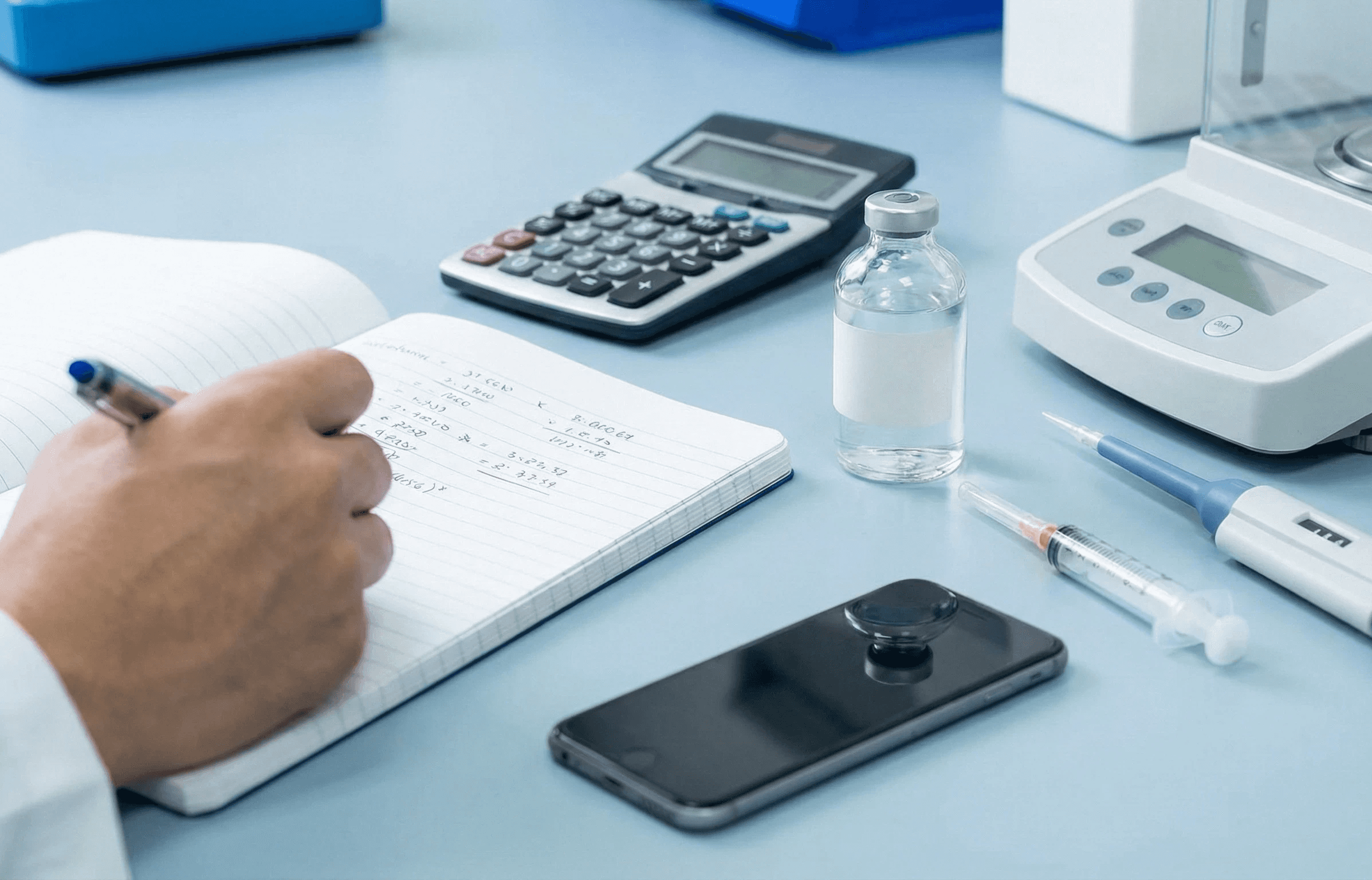
You've got your peptide powder. You've mixed it with bacteriostatic water. Now you're staring at a syringe.
How much do you inject?
The vial says 5mg. Your protocol says 250mcg. The syringe measures in units. Nothing matches up.
You need to convert mg to mcg. Calculate concentration. Figure out injection volume. One mistake and you're either underdosing (wasting money) or overdosing (risking side effects).
Let me show you the exact math. No confusion, no guessing, no mistakes.
Why dosage calculation matters
Peptide dosing isn't like taking a pill. You're dealing with:
Powder measured in milligrams (mg)
Water measured in milliliters (ml)
Doses measured in micrograms (mcg)
Syringes marked in units (IU)
Get any calculation wrong and your entire protocol is off.
Too little peptide:
Waste money on ineffective dosing
Won't see results
Frustration and quitting
Too much peptide:
Increased side effects
Wasted peptide (more isn't better)
Safety concerns
Depleting vials too quickly
Accurate dosing ensures you get results safely and efficiently.
Understanding the units
First, let's clarify what each measurement means.
Milligrams (mg)
This is how peptide powder is measured. Your vial label shows mg.
Common vial sizes:
2mg vials
5mg vials (most common)
10mg vials
The powder inside is 2mg, 5mg, or 10mg of actual peptide.
Micrograms (mcg or μg)
This is how doses are measured. Your protocol will specify mcg.
Critical conversion: 1mg = 1,000mcg
So:
5mg vial = 5,000mcg total
2mg vial = 2,000mcg total
10mg vial = 10,000mcg total
Milliliters (ml)
This is how bacteriostatic water is measured.
Common amounts added:
1ml
2ml (most common)
3ml
Units (IU)
This is how insulin syringes are marked.
Critical conversion: 100 units = 1ml
So:
10 units = 0.1ml
20 units = 0.2ml
50 units = 0.5ml
The concentration formula
When you add water to peptide powder, you create a concentration.
Formula: Concentration (mcg/ml) = Total peptide (mcg) ÷ Water added (ml)
Example 1:
Vial: 5mg (5,000mcg)
Water: 2ml
Concentration: 5,000mcg ÷ 2ml = 2,500mcg/ml
Example 2:
Vial: 5mg (5,000mcg)
Water: 1ml
Concentration: 5,000mcg ÷ 1ml = 5,000mcg/ml
Example 3:
Vial: 2mg (2,000mcg)
Water: 2ml
Concentration: 2,000mcg ÷ 2ml = 1,000mcg/ml
The concentration tells you how many micrograms of peptide are in each milliliter of solution.
The dose volume formula
Once you know concentration, calculate how much to inject.
Formula: Injection volume (ml) = Dose needed (mcg) ÷ Concentration (mcg/ml)
Example 1: BPC-157
Need: 250mcg
Concentration: 2,500mcg/ml
Volume: 250 ÷ 2,500 = 0.1ml (10 units)
Example 2: TB-500
Need: 2,500mcg (2.5mg)
Concentration: 2,500mcg/ml
Volume: 2,500 ÷ 2,500 = 1ml (100 units)
Example 3: Ipamorelin
Need: 200mcg
Concentration: 2,500mcg/ml
Volume: 200 ÷ 2,500 = 0.08ml (8 units)
This tells you exactly how much liquid to draw from your vial for each injection.
Converting ml to syringe units
Insulin syringes measure in units, not ml. You need to convert.
The conversion:
1ml = 100 units
0.1ml = 10 units
0.01ml = 1 unit
Quick reference chart:
ml | Units |
|---|---|
0.05 | 5 |
0.08 | 8 |
0.1 | 10 |
0.15 | 15 |
0.2 | 20 |
0.25 | 25 |
0.3 | 30 |
0.5 | 50 |
1.0 | 100 |
To convert: ml × 100 = units
Examples:
0.12ml × 100 = 12 units
0.33ml × 100 = 33 units
0.75ml × 100 = 75 units
Step-by-step calculation process
Let's work through a complete example from start to finish.
Scenario: You have a 5mg vial of BPC-157. Your protocol calls for 250mcg twice daily.
You're adding 2ml of bacteriostatic water.
Step 1: Convert vial size to mcg 5mg × 1,000 = 5,000mcg total peptide
Step 2: Calculate concentration 5,000mcg ÷ 2ml = 2,500mcg/ml
Step 3: Calculate injection volume 250mcg ÷ 2,500mcg/ml = 0.1ml per dose
Step 4: Convert to syringe units 0.1ml × 100 = 10 units on insulin syringe
Step 5: Calculate doses per vial 5,000mcg total ÷ 250mcg per dose = 20 doses
Step 6: Calculate vial duration 20 doses ÷ 2 daily = 10 days per vial
Answer: Inject 0.1ml (10 units) twice daily. Each vial lasts 10 days.
Our peptide dosage calculator does all these steps automatically - just enter your vial size, water amount, and desired dose.
Common peptide dosage examples
Let's calculate doses for the most popular peptides.
BPC-157 dosage calculation
Standard protocol: 250mcg twice daily
Setup:
Vial: 5mg (5,000mcg)
Water: 2ml
Concentration: 2,500mcg/ml
Calculation:
250mcg ÷ 2,500mcg/ml = 0.1ml
0.1ml = 10 units
Result: Inject 10 units twice daily
For detailed BPC-157 protocols based on injury type, see our complete BPC-157 guide.
TB-500 dosage calculation
Loading phase: 5mg twice weekly
Setup:
Vial: 5mg (5,000mcg)
Water: 2ml
Concentration: 2,500mcg/ml
Calculation:
5,000mcg ÷ 2,500mcg/ml = 2ml
2ml = 200 units (entire vial)
Result: Use entire vial per injection (2ml split across two syringes if using 1ml syringes)
For complete TB-500 protocols, read our TB-500 guide.
Semaglutide dosage calculation
Starting dose: 0.25mg (250mcg) weekly
Setup:
Vial: 5mg (5,000mcg)
Water: 2ml
Concentration: 2,500mcg/ml
Calculation:
250mcg ÷ 2,500mcg/ml = 0.1ml
0.1ml = 10 units
Result: Inject 10 units once weekly
Titration doses:
0.5mg = 0.2ml (20 units)
1mg = 0.4ml (40 units)
1.7mg = 0.68ml (68 units)
2.4mg = 0.96ml (96 units)
Use our semaglutide dosage calculator for complete titration schedules. For comparison with tirzepatide, read semaglutide vs tirzepatide.
Ipamorelin dosage calculation
Standard protocol: 200mcg 2-3x daily
Setup:
Vial: 5mg (5,000mcg)
Water: 2ml
Concentration: 2,500mcg/ml
Calculation:
200mcg ÷ 2,500mcg/ml = 0.08ml
0.08ml = 8 units
Result: Inject 8 units 2-3 times daily
For complete muscle-building protocols with Ipamorelin, see best peptides for muscle growth.
HGH Fragment 176-191 calculation
Fat loss protocol: 250mcg daily fasted
Setup:
Vial: 5mg (5,000mcg)
Water: 2ml
Concentration: 2,500mcg/ml
Calculation:
250mcg ÷ 2,500mcg/ml = 0.1ml
0.1ml = 10 units
Result: Inject 10 units each morning before fasted cardio
Use our HGH fragment calculator for body weight-adjusted protocols.
Adjusting for different water amounts
You can use different amounts of water. This changes concentration but not total peptide.
5mg vial with different water amounts:
Water | Concentration | 250mcg dose | 500mcg dose |
|---|---|---|---|
1ml | 5,000mcg/ml | 0.05ml (5 units) | 0.1ml (10 units) |
2ml | 2,500mcg/ml | 0.1ml (10 units) | 0.2ml (20 units) |
3ml | 1,667mcg/ml | 0.15ml (15 units) | 0.3ml (30 units) |
More water (2-3ml):
Easier to measure small doses
Larger injection volumes
More injections per vial
Less water (1ml):
Higher concentration
Smaller injection volumes
Fewer injections per vial
Neither is better - choose based on your comfort with injection volumes.
For complete reconstitution instructions, read how to reconstitute peptides.
Calculating doses per vial
Know how long your vial lasts before you run out.
Formula: Doses per vial = Total peptide (mcg) ÷ Dose per injection (mcg)
Example 1: BPC-157 twice daily
Total: 5,000mcg
Dose: 250mcg × 2 daily = 500mcg/day
Days per vial: 5,000 ÷ 500 = 10 days
Example 2: Ipamorelin 3x daily
Total: 5,000mcg
Dose: 200mcg × 3 daily = 600mcg/day
Days per vial: 5,000 ÷ 600 = 8.3 days
Example 3: Semaglutide weekly
Total: 5,000mcg
Dose: 1,000mcg (1mg) weekly
Weeks per vial: 5,000 ÷ 1,000 = 5 weeks
Calculating vials needed for protocols
Plan ahead so you don't run out mid-cycle.
Formula: Vials needed = (Total days × Daily dose) ÷ Vial size
Example 1: BPC-157 8-week protocol
Protocol: 250mcg twice daily for 56 days
Daily dose: 500mcg
Total needed: 56 × 500 = 28,000mcg (28mg)
Vials: 28mg ÷ 5mg = 5.6 vials
Order: 6 vials
Example 2: TB-500 12-week protocol
Loading: 5mg twice weekly × 4 weeks = 40mg
Maintenance: 2.5mg weekly × 8 weeks = 20mg
Total: 60mg
Vials: 60mg ÷ 5mg = 12 vials
Order: 12 vials
Example 3: Ipamorelin + CJC stack
Ipamorelin: 200mcg 3x daily × 84 days = 50.4mg (11 vials)
CJC-1295: 200mcg 2x weekly × 12 weeks = 4.8mg (1 vial)
Total order: 11 Ipamorelin + 1 CJC vials
Use our peptide cost calculator to calculate exact vial quantities and total costs for any protocol.
Weight-based dosing calculations
Some peptides dose by body weight (mcg/kg).
Formula: Dose (mcg) = Body weight (kg) × mcg per kg
Example: BPC-157 at 4mcg/kg
Person weighs 180 lbs:
Convert to kg: 180 ÷ 2.20462 = 81.6kg
Calculate dose: 81.6kg × 4mcg/kg = 326mcg
Round to: 325mcg per injection
Then calculate injection volume:
Concentration: 2,500mcg/ml
Volume: 325mcg ÷ 2,500 = 0.13ml (13 units)
Common weight-based peptides:
BPC-157: 2.5-4 mcg/kg
TB-500: 30-60 mcg/kg (loading dose)
Growth hormone peptides: 2-3 mcg/kg
Our BPC-157 dosage calculator and TB-500 dosage calculator automatically adjust for body weight.
Common calculation mistakes
Let's address what people get wrong.
Mistake 1: Forgetting to convert mg to mcg
Wrong: 5mg vial ÷ 2ml = 2.5mg/ml 250mg dose needed 250 ÷ 2.5 = 100ml to inject (impossible!)
Right: 5mg = 5,000mcg 5,000mcg ÷ 2ml = 2,500mcg/ml 250mcg ÷ 2,500 = 0.1ml (10 units)
Always convert mg to mcg by multiplying by 1,000.
Mistake 2: Using wrong peptide amount
Wrong: Assuming all vials are 5mg when you have 2mg or 10mg
Right: Check your vial label every time Calculate based on actual vial size Label reconstituted vials with concentration
Mistake 3: Mixing up units and ml
Wrong: "I need 0.2ml so I'll draw to the 20 mark" (If using 1ml syringe marked to 100 units)
Right: 0.2ml = 20 units on a 100-unit syringe Always convert: ml × 100 = units
Mistake 4: Not tracking doses remaining
Wrong: Injecting until vial is empty, unsure if you're getting full doses
Right: Calculate total doses when you reconstitute Mark vial with date and track injections Discard after 28 days even if liquid remains
Mistake 5: Rounding incorrectly
Wrong: 0.083ml = "about 10 units I guess"
Right: 0.083ml × 100 = 8.3 units Round to 8 units (slightly underdosed) or 9 units (slightly overdosed) Be consistent with your rounding
Troubleshooting dosing issues
Problems happen. Here's how to fix them.
Problem: Can't draw exact calculated amount
Example: Calculator says 8.3 units but syringe only has 1-unit marks
Solution:
Round to nearest unit (8 or 9)
Be consistent - always round the same way
Small variations (1-2 units) won't affect results
Problem: Dose requires more than one syringe
Example: TB-500 dose is 2ml but you have 1ml syringes
Solution:
Use two syringes, draw 1ml in each
Inject both (two injection sites)
Or get 2ml-3ml syringes for larger volumes
Problem: Not sure if calculation is correct
Solution:
Double-check each step
Use our peptide reconstitution calculator to verify
Start with lower dose if uncertain (can always increase)
Better to slightly underdose than overdose
Problem: Vial concentration unknown
Example: Forgot to label reconstituted vial
Solution:
If uncertain, discard and start fresh
Never guess at concentration
Always label immediately after reconstitution
Write: peptide name, concentration, date mixed
Using calculators vs manual math
You can calculate manually or use our tools. Both work.
Manual calculation benefits:
Understand the math
Can calculate anywhere
No internet needed
Calculator benefits:
Eliminates math errors
Faster for complex protocols
Shows IU and ml automatically
Calculates costs and vial quantities
Recommended approach:
Learn the math (read this guide)
Use calculators for daily dosing (faster, more accurate)
Double-check with manual math if result seems wrong
Our free calculators:
Peptide dosage calculator - all peptides
Peptide reconstitution calculator - concentration and volumes
BPC-157 calculator - injury-specific protocols
TB-500 calculator - loading and maintenance
Semaglutide calculator - complete titration
HGH Fragment calculator - fat loss protocols
Stack calculator - multiple peptides
Cost calculator - budget planning
Quick reference formulas
Save these for quick calculations.
Basic conversions:
1mg = 1,000mcg
1ml = 100 units
Weight (kg) = Weight (lbs) ÷ 2.20462
Core formulas:
Concentration = Total mcg ÷ ml of water
Injection volume (ml) = Dose (mcg) ÷ Concentration (mcg/ml)
Injection volume (units) = Injection volume (ml) × 100
Doses per vial = Total mcg ÷ Dose per injection (mcg)
Standard concentrations (5mg vial):
With 1ml water: 5,000mcg/ml
With 2ml water: 2,500mcg/ml
With 3ml water: 1,667mcg/ml
The bottom line
Peptide dosing math is straightforward once you understand the units.
The key steps:
Convert vial mg to mcg (multiply by 1,000)
Calculate concentration (mcg ÷ ml of water)
Calculate injection volume (dose ÷ concentration)
Convert ml to units (multiply by 100)
Master these calculations and you'll dose accurately every time.
Or use our free calculators and skip the math entirely. Both approaches work.
The important thing: accurate dosing means better results, fewer side effects, and optimized peptide use.
Calculate right. Dose right. Get results.
Related guides
How to reconstitute peptides - Complete mixing guide before calculating doses
BPC-157 vs TB-500 - Compare dosing protocols for both peptides
Best peptides for injury recovery - Specific dosing by injury type
Best peptides for weight loss - Calculate doses for GLP-1 and fat loss peptides
Best peptides for muscle growth - Dosing for growth hormone peptides
In case I don’t see you, good afternoon, good evening, and good night. Cheers.