Apr 4, 2026
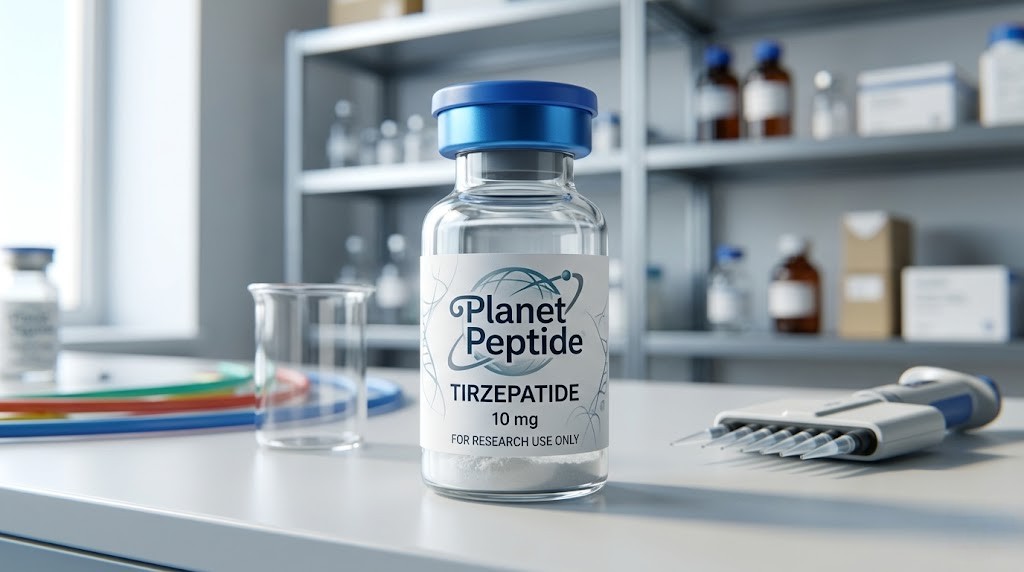
After analyzing 18 independent lab tests, hundreds of forum posts, and months of community feedback, one pattern keeps emerging with Planet Peptide tirzepatide. The product works. But the story behind those test results, the pricing structure, and the occasional controversy tell a more complicated tale than most vendor reviews bother explaining.
Planet Peptide operates as a domestic research peptide vendor, selling lyophilized tirzepatide in 10mg, 30mg, and 60mg vials.
Their tirzepatide has earned a Finnrick Rating of B across those 18 samples, with purity levels ranging from 98.25% to 99.94%. Numbers that look solid on paper. But dig deeper into the individual test scores, and you will find variance that matters, overfilling patterns that raise questions, and a pricing structure that divides the research community right down the middle.
This guide breaks down every data point available on Planet Peptide tirzepatide, from the raw lab numbers to real researcher experiences, from the vial options to the value calculation against competitors. Whether you are considering Planet Peptide for your first tirzepatide protocol or evaluating whether to switch from your current source, the data here will help you make an informed decision. SeekPeptides has compiled everything researchers need to evaluate this vendor objectively.
What Planet Peptide sells: the tirzepatide product lineup
Planet Peptide offers tirzepatide as a research use only (RUO) compound, supplied as freeze-dried lyophilized powder in sealed, sterile vials. The vendor currently stocks three individual vial sizes and corresponding bulk options for researchers running longer protocols.
The 10mg vial represents their entry-level option. Researchers new to tirzepatide or those running microdosing protocols typically start here. During sales, pricing drops to roughly $25-35 per vial, making it one of the more accessible entry points in the research peptide market. At standard pricing, expect closer to $45-55.
The 30mg vial is their mid-range offering and arguably the sweet spot for most researchers. This size works well for standard tirzepatide dosing protocols and reduces the per-milligram cost compared to the 10mg option. Standard pricing hovers around $55-99 depending on current promotions.
The 60mg vial is the largest individual option. Researchers running extended protocols or higher-dose regimens will find better value here, though the upfront cost is naturally higher. This size received the highest individual test score in the Finnrick database, a 9.8 out of 10 on a February 2026 test.
Bulk purchasing is available for all three sizes. Planet Peptide sells 10-vial packs of each concentration, with meaningful discounts over individual vial pricing. The bulk 60mg option (10 vials at 60mg each, totaling 600mg) represents the best per-milligram value for researchers committed to longer research timelines.
All Planet Peptide tirzepatide vials require reconstitution with bacteriostatic water before use. The lyophilized powder format offers superior stability compared to pre-mixed liquid formulations, which is why most research peptide vendors use this format. Storage requirements follow standard peptide protocols. Keep unreconstituted vials refrigerated for optimal shelf life, and once reconstituted, use within the standard tirzepatide refrigeration window.
One detail worth noting. Planet Peptide labels everything as RUO, research use only. This is standard practice across the domestic research peptide market and has specific legal implications that separate these products from compounded pharmacy tirzepatide or pharmaceutical-grade brand-name Zepbound.
Independent lab test results: breaking down the Finnrick data
Independent testing is the single most important factor when evaluating any research peptide vendor. Claims on a website mean nothing without third-party verification. Planet Peptide tirzepatide has been tested 18 times through the Finnrick testing platform between December 2024 and February 2026, earning an overall B rating, which Finnrick categorizes as "Good."
Here is what the aggregate numbers show. The average score across all 18 tests lands at 7.6 out of 10. The minimum score recorded was 5.5. The maximum was a near-perfect 10.0. Purity levels across every single test ranged from 98.25% to 99.94%, meaning the raw material itself is consistently high quality regardless of the fill accuracy.
But averages hide important details. Let us walk through the individual test results chronologically, because the trend matters more than any single number.
Early testing period (December 2024 to May 2025)
The earliest test from December 2024 showed a 10mg vial containing 11.81mg of actual content, a +2.1% overfill with 99.60% purity, earning an 8.3 score. A respectable start. But the tests that followed in early 2025 revealed a pattern that concerned some researchers.
February 2025 saw two 10mg vials tested. One contained 10.39mg (+3.9%, score 7.3) and the other 10.66mg (+6.6%, score 6.7). Purity was slightly lower at 98.25-98.26%, the lowest in the entire testing history. These results suggested acceptable but not exceptional quality during this period.
April 2025 produced the single most alarming result. A 10mg vial tested at 14.88mg, a staggering +48.8% overfill. The score dropped to 6.4 despite 99.82% purity. While overfilling means researchers get more product than advertised (not less), a 48.8% variance indicates significant dosing accuracy concerns. If you calculated your milligrams per unit based on the labeled 10mg and the actual content was nearly 15mg, every injection would deliver roughly 50% more than intended.
May 2025 brought a cluster of tests, eight samples across multiple labs. Results varied significantly. Two samples from Lab D showed +15.9% and +17.0% overfill (scores 6.2 and 5.6). Two samples from Lab E showed the opposite trend, with underfilling at -9.1% and -14.3% (scores 8.3 and 7.2). Four samples from Lab C all showed overfilling between +12.1% and +15.2%, with scores ranging from 7.5 to 7.6.
This early period painted a picture of inconsistent fill volumes, even when purity remained high. The tirzepatide itself was clean. The question was how much of it ended up in each vial.
Improvement period (June 2025 to February 2026)
The later testing period tells a noticeably different story. A June 2025 test showed a 30mg vial at 33.17mg (+10.6%, score 6.9), still overfilled but less dramatically than the April outlier. September 2025 delivered the single best result in the entire dataset: a 30mg vial testing at 29.3mg (-2.3%, score 10.0). Near-perfect accuracy with 99.92% purity.
December 2025 continued the improvement. A 30mg vial tested at 30.5mg, just +0.8% over label, with 99.87% purity and an 8.9 score. January 2026 showed a 10mg vial at 10.3mg (+3.0%, score 9.5). And the most recent test from February 2026 showed the 60mg vial at 59.5mg, only -0.8% under label, scoring 9.8 with 99.83% purity.
The trend is clear. Planet Peptide appears to have significantly improved their fill accuracy over time. Early batches showed wild variance (anywhere from -14% to +49%). Recent batches consistently hit within a few percentage points of the label claim. This matters enormously for researchers calculating precise tirzepatide dosing charts or following specific dosage calculator protocols.
What the B rating actually means
Finnrick uses a letter grade system where A represents "Great," B represents "Good," C represents "Okay," and D represents "Poor." Planet Peptide tirzepatide landing at B puts it in solidly acceptable territory, not exceptional, not concerning.
For context, Planet Peptide earned A ratings on some other products. Their ipamorelin scored an average of 8.7 across 4 samples. Their mazdutide averaged 8.2 across 3 samples. Their semaglutide averaged 7.5 across 8 samples (also rated A). The tirzepatide B rating at 7.6 average is only marginally lower than the semaglutide A rating at 7.5, which suggests the letter grade boundaries may be where the tirzepatide falls rather than indicating a meaningful quality difference.
On the other end, their CJC-1295 earned a D rating with a 4.4 average, and their retatrutide earned a C at 6.6 average. The tirzepatide sits comfortably in the upper half of their product lineup.
Purity versus accuracy: understanding what matters
Every single Planet Peptide tirzepatide test showed purity above 98%. Most exceeded 99.5%. This is genuinely excellent. The purity number tells you what percentage of the substance in the vial is actually tirzepatide versus contaminants or degradation products. Anything above 98% is considered research-grade quality.
The issue was never purity. It was accuracy, specifically how much tirzepatide ends up in each vial versus what the label claims. A vial labeled 10mg that contains 14.88mg has pure tirzepatide, but the wrong amount of it. This distinction matters for anyone following a structured tirzepatide dosage protocol, because your calculations assume the label is correct.
The good news, as the data shows, is that recent production appears to have addressed this accuracy issue substantially.
Community feedback: what researchers actually report
Lab tests provide objective data. Community experiences add subjective context. Both matter when evaluating a vendor. Planet Peptide tirzepatide generates mixed but generally positive feedback across research forums and review platforms.
Positive experiences
Multiple researchers report consistent appetite suppression and expected metabolic effects from Planet Peptide tirzepatide. Some users have purchased repeatedly over the span of a year or more, describing the product as reliably effective. Customer service and shipping speed receive frequent praise, with orders typically arriving within a few business days of purchase.
The sale pricing earns particular appreciation. When Planet Peptide runs promotions, their per-milligram cost drops to levels that compete with or beat most domestic vendors. Researchers running longer tirzepatide weight loss timelines or those exploring weight maintenance protocols value the cost savings that come with bulk purchasing during sales.
Several forum members specifically note that the 30mg vials offer the best balance of value and convenience. Reconstituting a 30mg vial provides enough product for several weeks of standard dosing without the handling concerns that come with storing a reconstituted vial for extended periods.
Negative experiences and controversies
The most serious allegation against Planet Peptide involves claims of mislabeling. Some forum users report that 10mg tirzepatide vials were sold with 30mg labels, inflating the perceived value significantly. If true, a product worth roughly $25-35 was being sold at 30mg pricing. When confronted, the vendor allegedly did not respond to the customer.
This allegation has not been independently verified, and it is worth noting that the Finnrick testing data does not show a pattern consistent with systematic mislabeling. The 30mg vials that were tested did contain approximately 30mg of product. However, the allegation itself exists in the community and deserves mention for transparency.
A second recurring complaint involves fatigue. One researcher reported experiencing significantly more tiredness on Planet Peptide tirzepatide compared to their previous source, even at the same dosage. They switched back after two weeks. While individual responses to tirzepatide and fatigue vary widely and depend on numerous factors, including caloric intake, supplementation, and sleep quality, source-dependent variation in effects is a legitimate concern.
Pricing complaints also surface regularly. Some researchers consider Planet Peptide overpriced at standard (non-sale) pricing, particularly for the 10mg vials. The research peptide market is fiercely competitive, and vendors like Peptide Sciences, Simple Peptide, and others offer comparable products at similar or lower price points. The value equation shifts dramatically during Planet Peptide sales, which is why experienced researchers often recommend buying only during promotional periods.
The overpricing debate
Whether Planet Peptide is overpriced depends entirely on when you buy. At full retail, their per-milligram pricing sits above market average for domestic research peptide vendors. During sales, it drops to competitive or even below-average levels. This feast-or-famine pricing strategy frustrates researchers who need consistent supply but benefits those who can plan purchases around promotions.
For comparison, compounded pharmacy tirzepatide from licensed 503B facilities typically runs $149-459 per month depending on dose. Research peptide tirzepatide from domestic vendors ranges from roughly $2-8 per milligram at standard pricing, with sales dropping that to $1-4 per milligram. Planet Peptide falls within this range, positioning toward the higher end at full price and the lower end during promotions.
The total cost of tirzepatide extends beyond the vial price. Researchers also need bacteriostatic water for reconstitution, appropriate syringes and needles, and proper storage equipment. These ancillary costs remain constant regardless of vendor, so the vial price is where the real comparison happens.
How to evaluate any research peptide vendor
Planet Peptide is one vendor among many. Understanding how to evaluate any source helps researchers make better decisions. The framework below applies whether you are looking at Planet Peptide, BPI Labs, VitaStir, or any other vendor.
Third-party testing transparency
The single most important factor. Does the vendor have independent lab results available through platforms like Finnrick? How many samples have been tested? What is the variance between tests? A vendor with two tests scoring 9.0 is less reliable than a vendor with 18 tests averaging 7.6, because sample size reveals consistency (or lack thereof).
Planet Peptide scores reasonably well here with 18 tirzepatide samples tested, providing a meaningful dataset. Compare this to vendors with only 2-3 tests, where a single good or bad result skews the entire picture. The grey market tirzepatide landscape includes vendors with zero independent testing, which is an immediate disqualifier for safety-conscious researchers.
Fill accuracy trends
As discussed in the test results section, fill accuracy matters as much as purity. A vendor that consistently delivers within 5% of the label claim is more trustworthy than one bouncing between -14% and +49%, even if the purity is identical. Check for improvement trends. A vendor that started inconsistent but improved over time (like Planet Peptide) may actually be a better choice than one with limited recent testing data.
Researchers following precise tirzepatide unit calculations or using a dosage calculator need accurate fill volumes. If a vial contains significantly more or less than labeled, every subsequent calculation is off.
Community reputation over time
Check multiple forums and review platforms. Look for patterns rather than individual reviews. A single negative review could be a competitor, a single positive review could be the vendor themselves. Patterns across dozens of reports tell the real story. Planet Peptide has enough community history, spanning more than a year of active forum discussion, to establish a meaningful reputation baseline.
Product range and specialization
Vendors specializing in fewer products sometimes deliver higher quality than those trying to stock everything. Planet Peptide stocks 9 products across their catalog. Their tirzepatide and semaglutide perform well. Their CJC-1295 does not. This product-specific variation reinforces why per-product evaluation matters more than overall vendor ratings.
Response to issues
How a vendor handles problems reveals more than how they handle routine orders. The mislabeling allegation against Planet Peptide, regardless of its accuracy, highlighted a communication gap. Vendors that respond transparently to concerns, offer replacements for quality issues, and engage constructively with community feedback earn deeper trust over time.
Comparing Planet Peptide tirzepatide to alternatives
No vendor evaluation exists in a vacuum. Researchers choosing Planet Peptide tirzepatide are implicitly choosing it over dozens of alternatives. Here is how the key comparison points stack up.
Research peptide vendors
The domestic research peptide market for tirzepatide includes numerous competitors. Peptide Sciences maintains a strong reputation with extensive testing history. BPI Labs offers competitive pricing with growing test data. Strive, ProRx, and Red Rock Pharmacy each occupy different niches in the market.
Planet Peptide position: mid-tier at full price, competitive during sales. Their 18-sample testing dataset is above average for the market, and the B rating places them in the upper third of tested vendors. Researchers prioritizing data transparency will appreciate the testing volume. Those prioritizing consistent low pricing may find better options elsewhere.
Compounded pharmacy tirzepatide
Compounded tirzepatide from licensed 503B outsourcing facilities offers pharmaceutical-grade quality with regulatory oversight. Vendors like Empower Pharmacy, South Lake Pharmacy, and Southend Pharmacy operate under FDA registration and USP 797 compliance standards. Monthly costs typically run $149-459 depending on dose and provider.
The trade-off is clear. Compounded pharmacy products cost significantly more but come with regulatory oversight, standardized compounding practices, and legal clarity. Research peptide vendors like Planet Peptide cost less but operate in a regulatory grey area with quality dependent entirely on the individual vendor. For researchers who want detailed comparisons, our guides on affordable tirzepatide options and tirzepatide alternatives cover the full spectrum.
Other vendor reviews on SeekPeptides
The general Planet Peptides vendor review covers their full product range beyond just tirzepatide. For researchers evaluating multiple vendors, SeekPeptides maintains detailed reviews of dozens of providers including Lavender Sky, Orderly Meds, Citizen Meds, Shed, Trava, IVIM, Dr. Well, and GoByMeds.
Reconstitution and handling for Planet Peptide tirzepatide
Lyophilized tirzepatide from Planet Peptide follows the same reconstitution process as any other lyophilized peptide. The powder needs to be mixed with bacteriostatic water before use. Getting this step right is critical, because improper reconstitution can destroy the peptide or create dosing inaccuracies on top of any existing fill variance.
Step-by-step reconstitution
For a 10mg vial, the most common approach uses 1ml of bacteriostatic water. This creates a concentration of 10mg/ml, making unit-to-milligram calculations straightforward. Add the bacteriostatic water slowly, directing the stream against the glass wall of the vial rather than directly onto the lyophilized cake. Swirl gently. Never shake.
For the 30mg vial, researchers typically use 1.5-3ml of bacteriostatic water depending on their preferred concentration. A 2ml reconstitution creates a 15mg/ml concentration. A 3ml reconstitution creates 10mg/ml. The lower concentration offers easier syringe measurement accuracy but means larger injection volumes.
The 60mg vial works best with 2-3ml of bacteriostatic water. A 2ml reconstitution yields 30mg/ml. A 3ml reconstitution yields 20mg/ml. Our detailed bacteriostatic water mixing guide covers the math for every common concentration.
Critical note on the fill accuracy issue. If you are using a Planet Peptide vial from an older batch (before mid-2025), the actual content may differ from the label by 10-15% or more based on historical test data. More recent batches appear much more accurate. Researchers should consider this when calculating their dosing protocols.
Storage after reconstitution
Once reconstituted, Planet Peptide tirzepatide follows standard peptide storage guidelines. Refrigerate at 36-46 degrees Fahrenheit (2-8 degrees Celsius). Do not freeze. Most researchers report reconstituted tirzepatide remaining stable for 4-8 weeks when properly refrigerated, though potency begins to gradually decline after the first few weeks.
Unreconstituted lyophilized powder is far more stable. Stored in a freezer, it can maintain potency for months or even years. This is one advantage of the lyophilized format, it allows researchers to buy in bulk during sales without worrying about expiration concerns as long as the powder stays dry and cold. For travel situations, our guide on traveling with tirzepatide covers the logistics of maintaining the cold chain.
If a reconstituted vial is accidentally left out of the fridge, the damage depends on duration and temperature. Brief exposure (under an hour at room temperature) is generally fine. Extended exposure degrades the peptide. Our guide on tirzepatide temperature exposure explains the science behind thermal degradation and how to assess whether a compromised vial is still usable.
Dosing considerations specific to Planet Peptide vials
Dosing tirzepatide from research vials requires a different approach than using pre-filled pharmaceutical pens. Researchers need to understand concentrations, calculate volumes, and draw accurate measurements using insulin syringes.
Calculating your dose
The basic formula is simple. Divide your desired dose by the concentration to get the injection volume. If you reconstituted a 10mg vial with 1ml of water, the concentration is 10mg/ml. To inject 2.5mg, you would draw 0.25ml, which equals 25 units on a standard insulin syringe.
Standard tirzepatide research protocols typically follow a titration schedule. Starting at 2.5mg weekly for 4 weeks, then increasing to 5mg weekly for 4 weeks, with subsequent increases to 7.5mg, 10mg, 12.5mg, and 15mg as tolerated. The complete tirzepatide dosing guide in units walks through every calculation for standard concentrations.
For researchers considering microdosing approaches, the 10mg vial reconstituted with 2ml of water creates a 5mg/ml concentration, making sub-milligram doses easier to measure accurately. The microdose tirzepatide schedule covers specific protocols for this approach.
Injection technique
Planet Peptide tirzepatide is administered subcutaneously, meaning into the fat layer just under the skin. Common injection sites include the abdomen, the thigh, and the upper arm. Rotate injection sites to minimize site reactions and improve absorption consistency. Our guide on injecting tirzepatide with a syringe covers the complete technique.
The timing of injections matters for some researchers. Many prefer morning injections to manage any sleep-related effects. Others inject in the evening to let initial gastrointestinal effects occur during sleep. There is no definitively "best" time, so consistency matters more than the specific hour chosen.
Managing potential side effects
Tirzepatide side effects are not vendor-specific, they occur regardless of whether the source is Planet Peptide, a compounding pharmacy, or brand-name Zepbound. However, fill accuracy issues can amplify side effects if a researcher unknowingly takes a higher dose than intended due to overfilled vials.
Common effects and management
The most frequently reported effects involve the gastrointestinal system. Nausea, particularly during the first weeks or after dose increases, affects a significant percentage of tirzepatide users. Avoiding certain trigger foods and following a tirzepatide-optimized diet plan helps manage this. Starting at lower doses and titrating slowly is the most effective preventive strategy.
Constipation is another common complaint. GLP-1 receptor agonists slow gastric emptying, which can reduce bowel frequency. Adequate fiber intake, hydration, and sometimes fiber supplementation address this for most researchers. Our guide on what to eat while on tirzepatide covers dietary strategies in detail.
Diarrhea occurs in some researchers, sometimes alternating with constipation. This typically resolves within the first 2-4 weeks of a new dose level. Bloating and dry mouth are also reported frequently.
Fatigue deserves special mention given the community reports about Planet Peptide specifically. Tirzepatide-related fatigue is well-documented across all sources and typically relates to reduced caloric intake rather than the peptide itself. Researchers experiencing unusual fatigue should evaluate their daily caloric intake, protein consumption, and electrolyte balance before attributing the issue to the vendor.
Less common effects
Some researchers report headaches, body aches, hair thinning, and brain fog during tirzepatide protocols. Muscle pain is occasionally reported, particularly at higher doses. Anxiety and joint pain appear in a smaller subset of reports.
These effects are dose-dependent. If you suspect an overfilled Planet Peptide vial is contributing to stronger-than-expected effects, consider having the batch independently tested or switching to a source with tighter fill accuracy for comparison. The tirzepatide tapering guide covers how to safely reduce dosing if needed.
Planet Peptide versus compounded tirzepatide: which makes sense
The choice between research peptide vendors like Planet Peptide and compounded pharmacy tirzepatide involves trade-offs across cost, quality assurance, legal status, and convenience.
Cost comparison
Planet Peptide tirzepatide at sale pricing delivers research-grade product at roughly $1-4 per milligram. A researcher using 5mg weekly would spend approximately $20-80 per month during sales. At full retail, that figure climbs to $40-160 per month depending on vial size.
Compounded pharmacy tirzepatide starts around $149 per month for lower doses and can exceed $450 for higher doses. The cost difference is substantial, often 3-10x between the two categories. For researchers on a budget, the affordable tirzepatide guide covers every cost-saving strategy available.
Quality assurance differences
Compounded pharmacies operating as 503B outsourcing facilities must follow current Good Manufacturing Practices (cGMP) under FDA oversight. They submit to regular inspections, maintain sterility testing protocols, and operate under pharmaceutical licensing requirements.
Research peptide vendors like Planet Peptide operate outside this regulatory framework. Quality depends entirely on the individual vendor, with independent testing platforms like Finnrick serving as the primary quality verification mechanism. The B rating for Planet Peptide tirzepatide provides meaningful assurance, but it is not equivalent to FDA-regulated manufacturing oversight.
Legal considerations
Research peptides are sold explicitly for laboratory research purposes. Compounded tirzepatide requires a prescription from a licensed healthcare provider. The legal landscape here is complex and varies by jurisdiction. Researchers should understand the regulatory framework in their area before making sourcing decisions.
When to choose Planet Peptide tirzepatide
Based on the aggregate data, Planet Peptide tirzepatide makes the most sense for specific researcher profiles.
Budget-conscious researchers who can time purchases around sales will find genuine value. The combination of B-rated quality and promotional pricing creates a solid cost-to-quality ratio during sale periods. Stocking up during promotions and storing lyophilized powder in the freezer stretches the savings further.
Experienced researchers who already understand dosing calculations, reconstitution procedures, and storage requirements will navigate the nuances of research peptide sourcing more confidently. Beginners might prefer the more standardized experience of compounded pharmacy products.
Researchers who value testing transparency should appreciate Planet Peptide having 18 tirzepatide samples in the Finnrick database. This level of testing data is above average for the market and provides meaningful quality assurance. The improving trend in fill accuracy adds confidence, particularly for vials produced after mid-2025.
When to look elsewhere
Researchers needing absolute dosing precision should consider sources with tighter fill accuracy or compounded pharmacy products. While Planet Peptide has improved dramatically, the historical variance may concern those following strict titration protocols.
First-time tirzepatide researchers may find the reconstitution, dosing calculation, and storage requirements of research peptides overwhelming. Our guide on what to expect from your first tirzepatide dose can help, but compounded pharmacy products with pre-calculated doses eliminate several potential error points.
Researchers with negative experiences should listen to their results. If a specific batch from any vendor produces unexpected effects, switching sources is a reasonable response. The switch to alternative GLP-1 options or trying a different tirzepatide source are both valid paths forward.
Tips for getting the best experience with Planet Peptide
Researchers who choose Planet Peptide tirzepatide can optimize their experience with a few strategic decisions.
Buy during sales. This cannot be overstated. The price difference between full retail and promotional pricing is significant enough to change the entire value calculation. Follow their website or sign up for notifications to catch promotions.
Start with a single vial before committing to bulk. Despite the per-milligram savings of bulk purchasing, testing a product from any new vendor with a small order first is simply good practice. Verify that the product performs as expected before investing in a larger supply.
Reconstitute carefully and calculate doses based on your specific vial. If you are using the tirzepatide dosage calculator, input the labeled amount. If you notice effects stronger or weaker than expected, consider that fill accuracy may vary from the label, particularly with older production batches.
Store unreconstituted vials in the freezer for maximum shelf life. Once reconstituted, refrigerate and use within 4-6 weeks for optimal potency. Keep reconstituted vials away from light and temperature fluctuations. The tirzepatide shelf life guide covers every nuance of peptide storage.
Document your experience. Note the batch, date of purchase, reconstitution details, and effects. If you encounter quality issues, having detailed records helps when contacting the vendor or contributing to independent testing databases. This documentation also helps track your research progress over time.
The broader vendor landscape: context for Planet Peptide
The research peptide market for tirzepatide has grown enormously over the past two years. What was once a niche corner of the peptide market is now one of the most actively traded research compounds, driven by the massive success of pharmaceutical GLP-1 receptor agonists like Ozempic and Mounjaro.
This growth has attracted both legitimate vendors and questionable operators. The range of quality across the market is enormous. Some vendors consistently deliver pharmaceutical-adjacent quality with extensive testing documentation. Others sell product with no verification whatsoever. Planet Peptide, with its B-rated tirzepatide and 18-sample testing dataset, sits in the upper middle of this spectrum.
For researchers exploring the broader GLP-1 research landscape, understanding the differences between semaglutide and tirzepatide is essential foundational knowledge. Those considering next-generation options should explore retatrutide, which activates three receptors instead of two, or survodutide, another dual-agonist with a different receptor profile. The three-way comparison guide breaks down how these compounds differ.
SeekPeptides tracks the research peptide vendor landscape continuously, updating vendor reviews as new test data becomes available and community experiences accumulate. For researchers who want to stay current on vendor quality shifts, peptide research developments, and protocol optimization, the SeekPeptides membership provides access to continuously updated guides, community discussions, and expert-reviewed protocols.
Frequently asked questions
Is Planet Peptide tirzepatide legit?
Based on 18 independent lab tests through Finnrick, Planet Peptide tirzepatide earns a B (Good) rating with an average score of 7.6 out of 10 and purity levels consistently above 98%. The product is legitimate research-grade tirzepatide. Fill accuracy has improved significantly in recent production batches.
How much does Planet Peptide tirzepatide cost?
Standard pricing ranges from approximately $35-99 per vial depending on size (10mg, 30mg, or 60mg). During sales, prices drop to $25-55 range. Bulk purchasing (10-vial packs) offers additional savings. The tirzepatide cost comparison guide breaks down pricing across all source types.
What sizes does Planet Peptide tirzepatide come in?
Three individual vial sizes: 10mg, 30mg, and 60mg. Each size is also available in bulk 10-vial packs. All are lyophilized powder requiring reconstitution with bacteriostatic water before use.
Is Planet Peptide the same as a compounding pharmacy?
No. Planet Peptide is a research peptide vendor, not a licensed pharmacy. Their products are labeled RUO (Research Use Only). Compounding pharmacies like Empower or South Lake operate under FDA regulation and require prescriptions.
Why do some researchers report different effects from Planet Peptide versus other sources?
Fill accuracy variation is the most likely explanation. Historical tests showed some vials containing 10-49% more tirzepatide than labeled. A researcher taking what they believe is 5mg might actually be taking 6-7mg from an overfilled vial. Recent batches show much tighter accuracy. Individual response variation, storage conditions, and reconstitution accuracy also contribute to perceived differences between sources.
How should I store Planet Peptide tirzepatide vials?
Unreconstituted lyophilized powder stores best in a freezer for long-term storage or refrigerator for shorter periods. Once reconstituted, keep refrigerated at 36-46 degrees Fahrenheit and use within 4-6 weeks. Never freeze reconstituted peptide solution.
Can I switch to Planet Peptide from another tirzepatide source?
Yes. When switching sources, continue your current dose rather than restarting from the beginning. Monitor for any differences in effect intensity that might indicate fill accuracy variation between sources. The tirzepatide conversion guide helps researchers switching between different GLP-1 compounds entirely.
External resources
Finnrick Analytics - Planet Peptide vendor profile and test results
USP - General Chapter 797 Pharmaceutical Compounding Standards
In case I do not see you, good afternoon, good evening, and good night. May your vials stay pure, your calculations stay accurate, and your research stay productive.