Apr 4, 2026
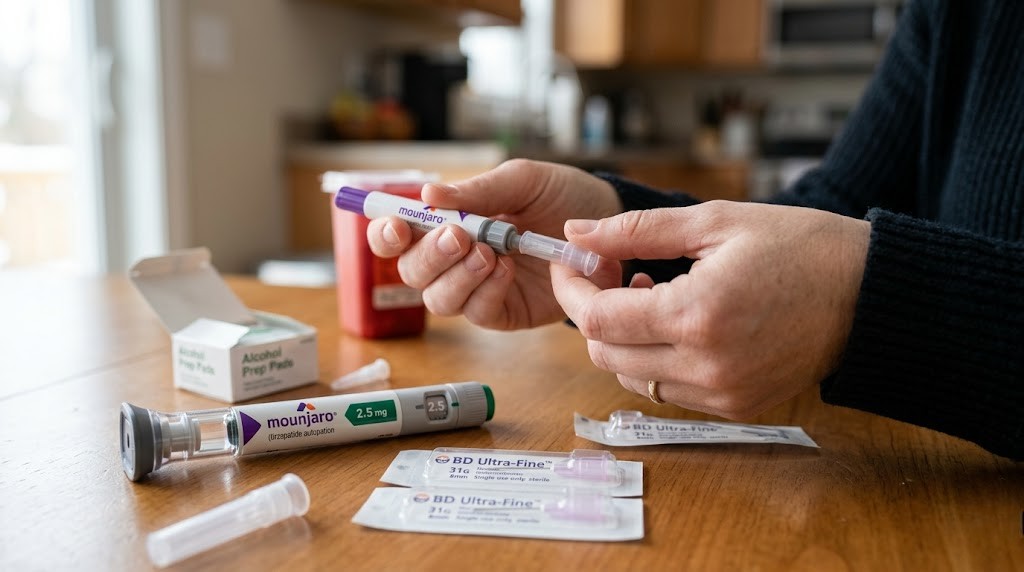
You bought the tirzepatide. You reconstituted it perfectly. You even picked the right injection site. But the needle you grabbed from the drawer? Wrong gauge. Wrong length. And now you are wondering why the injection stung, why there is a red bump forming, or why you could barely push the liquid through at all.
Needle selection sounds like such a small detail. It is not. The wrong needle turns a painless 10-second injection into a frustrating, uncomfortable ordeal that makes you dread your weekly dose. The right needle makes the whole process so smooth you barely notice it happened. And the difference between those two experiences comes down to understanding three numbers: gauge, length, and syringe volume.
This guide covers everything you need to know about choosing needles for tirzepatide injections. From the specific gauge and length combinations that work best for subcutaneous delivery, to the syringe sizes that match your dose, to the brands that experienced users consistently recommend, to the disposal protocols that keep you and everyone around you safe. Whether you are using a Mounjaro KwikPen, a compounded tirzepatide vial, or lyophilized tirzepatide that you reconstitute yourself, the needle principles remain the same. SeekPeptides has put together this resource so you never have to guess about needle selection again.
Why needle selection matters more than most people think
Most guides about tirzepatide injection technique focus on where to inject and how to hold the syringe. They skip the needle entirely. That is a mistake.
The needle determines three things that directly affect your experience and your results.
Comfort. A 29-gauge needle has a diameter of 0.33 millimeters. A 31-gauge needle measures 0.26 millimeters. A 32-gauge needle is just 0.23 millimeters across. That might not sound like much of a difference on paper, but the jump from 29G to 32G reduces the cross-sectional area of the needle by roughly half. Less tissue displacement means less pain. Users who switch from 29G to 31G or 32G needles consistently report that their injections go from noticeable to nearly invisible.
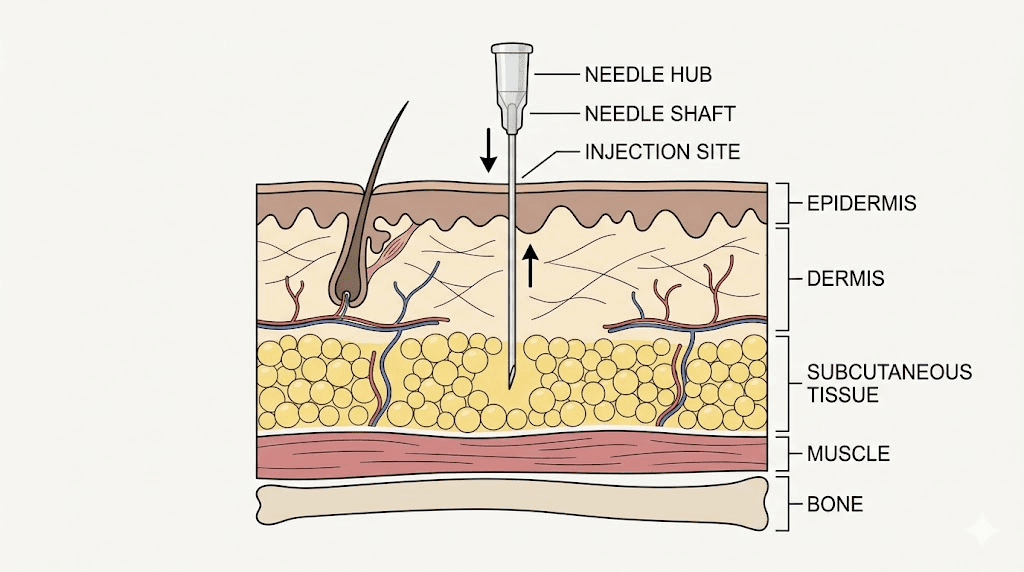
Medication delivery. Tirzepatide is a subcutaneous injection. That means the medication needs to reach the fatty tissue layer just beneath the skin, not the muscle beneath it. A needle that is too long pushes through the subcutaneous layer and delivers the medication into muscle tissue, which changes how the drug absorbs and can cause more soreness. A needle that is too short may not penetrate deep enough, leading to intradermal injection, leaking, or incomplete delivery. The correct dose only works if it actually reaches the right tissue layer.
Injection site reactions. Using a dull, reused, or poorly manufactured needle increases friction during insertion. That friction causes more tissue trauma, which leads to injection site reactions, redness, and bruising. The red and itchy injection sites that some users report often trace back to needle quality or needle reuse rather than the medication itself.
Understanding needle gauge: the thickness that changes everything
Needle gauge measures diameter. Higher numbers mean thinner needles. This is the single most important specification for injection comfort.
Here is what each common gauge actually means in practice:
Gauge | Diameter (mm) | Pain level | Flow rate | Best for |
|---|---|---|---|---|
29G | 0.33 mm | Mild | Fastest | Higher viscosity compounds, users who prioritize speed |
30G | 0.30 mm | Low | Moderate | Good all-around balance of comfort and flow |
31G | 0.26 mm | Very low | Slower | Most popular for tirzepatide, excellent comfort |
32G | 0.23 mm | Minimal | Slowest | Maximum comfort, thin solutions only |
The sweet spot for most tirzepatide users is 31G. It is thin enough that the insertion is nearly painless but wide enough that the medication flows through without excessive pressure on the plunger. Users on forums and in communities consistently rate 31G as the best balance between comfort and practicality.
A 32G needle works beautifully for very thin solutions. But some compounded tirzepatide formulations, especially those with added B12, glycine, or niacinamide, can be slightly more viscous. If you find yourself really fighting the plunger with a 32G needle, step down to 31G. The comfort difference between 31G and 32G is minimal. The frustration difference when pushing thicker liquid through is significant.
A 29G needle is what many people start with because it is the most common gauge included in insulin syringe multipacks. It works fine. But once you try 31G, you will probably not go back.
The gauge misconception that trips people up
New users often assume that a lower gauge number means a smaller needle. It does not. Gauge numbers work in reverse. A 29G needle is thicker than a 31G needle. A 31G is thicker than a 32G.
Think of it this way. The gauge number roughly corresponds to how many needles of that diameter would fit inside a standard reference tube. More needles fitting means each one is thinner. So higher gauge equals thinner needle equals less pain.
If your pharmacy or supplier asks what gauge you want, remember: higher gauge number means thinner needle means more comfort. For tirzepatide subcutaneous injections, you want 29G to 32G, with 31G being the most commonly recommended.
Needle length: why shorter is usually better for tirzepatide
Length determines how deep the needle penetrates. Since tirzepatide is a subcutaneous injection, you need the tip to sit in the fatty layer beneath the skin but above the muscle. That layer is typically 4 to 15 millimeters thick depending on your body composition and injection site.
The most common needle lengths for tirzepatide:
Length | Imperial | Best for | Notes |
|---|---|---|---|
4 mm | 5/32 inch | Lean individuals, low body fat areas | Recommended starting point for most adults |
5 mm | 3/16 inch | Average body composition | Good all-around choice |
6 mm | 1/4 inch | Moderate subcutaneous tissue | Popular with abdominal injections |
8 mm | 5/16 inch | Thicker subcutaneous tissue | Standard insulin syringe length, widely available |
12.7 mm | 1/2 inch | Higher body fat | Less common for subcutaneous, risk of intramuscular injection |
For most adults administering tirzepatide, a needle between 4 mm and 8 mm is appropriate. The FDA and most clinical guidelines suggest that a 4 mm needle is sufficient for subcutaneous injection regardless of body mass index when injected at a 90-degree angle. Research shows that even a 4 mm needle reliably reaches the subcutaneous layer in the vast majority of adults.
That said, the 8 mm (5/16 inch) needle is the most widely available because it is the standard length on insulin syringes. And for most people injecting into the abdomen or thigh, 8 mm works perfectly well. The subcutaneous layer in these areas is typically thick enough to accommodate it.
When needle length really matters
Length becomes critical in two scenarios.
Very lean individuals. If you have low body fat, particularly in the injection area, an 8 mm needle can punch through the subcutaneous layer and hit muscle. That changes how tirzepatide absorbs. Intramuscular injection leads to faster absorption, which can intensify side effects and alter the pharmacokinetic profile. If you are lean, stick to 4 mm or 5 mm needles and inject at a 90-degree angle. If you are very lean, some providers recommend pinching the skin and injecting at a 45-degree angle with a slightly longer needle.
If you have ever accidentally injected into muscle with a GLP-1 medication, you already know the difference. The soreness is worse, the absorption pattern changes, and the medication does not work the way it should.
Upper arm injections. The subcutaneous layer on the back of the upper arm is thinner than on the abdomen or thigh for most people. Use a 4 mm to 6 mm needle for arm injections. Avoid 12.7 mm needles in this area entirely.
Syringe sizes: matching volume to your tirzepatide dose
If you are using compounded tirzepatide from a vial rather than a pre-filled pen, you need to choose both a needle and a syringe. The syringe size affects how accurately you can measure your dose.
Three insulin syringe sizes cover virtually all tirzepatide dosing needs:
Syringe size | Markings | Best for doses | Precision |
|---|---|---|---|
0.3 mL (30 units) | Each line = 0.5 units | Up to 30 units | Highest precision |
0.5 mL (50 units) | Each line = 1 unit | Up to 50 units | Good precision |
1.0 mL (100 units) | Each line = 2 units | Up to 100 units | Adequate for larger doses |
The rule is simple. Use the smallest syringe that fits your dose. A 0.3 mL syringe gives you finer graduation marks, which means more accurate dosing. If your dose in units is 20 units, a 0.3 mL syringe lets you measure that with more precision than a 1.0 mL syringe where each line represents 2 units.
Most tirzepatide users at standard starting doses will find a 0.5 mL syringe ideal. It covers doses up to 50 units with 1-unit precision, which is more than sufficient for most protocols. You can use the peptide calculator on SeekPeptides to determine exactly how many units your dose translates to based on your reconstitution ratio.
Understanding unit markings on insulin syringes
Insulin syringes are marked in "units" that correspond to insulin concentrations (100 units per mL). When you use these syringes for tirzepatide, the unit markings still correspond to volume. Each "unit" on the syringe equals 0.01 mL. So 10 units equals 0.1 mL, 50 units equals 0.5 mL, and 100 units equals 1.0 mL.
This matters when you are calculating your tirzepatide dose. If you reconstituted a 10 mg vial with 1 mL of bacteriostatic water, you have a concentration of 10 mg/mL. To draw 2.5 mg, you need 0.25 mL, which is 25 units on the syringe. Our tirzepatide dosage calculator does this math for you, but understanding the relationship between milligrams, milliliters, and syringe units prevents dosing errors.
If you want to understand exactly how many units 2.5 mg of tirzepatide represents, or how many units 5 mg translates to, or any other dose conversion, those guides break it down step by step. The conversion depends entirely on your reconstitution volume, so getting it right matters.
Fixed needle vs detachable needle syringes
Insulin syringes come in two styles.
Fixed needle syringes have the needle permanently attached to the syringe barrel. These are the most common and most convenient for tirzepatide injection. No dead space between the needle and syringe means no wasted medication. They come ready to use straight from the package.
Detachable needle syringes (also called Luer-lock or Luer-slip syringes) allow you to attach different needles. These are useful if you want to use one needle gauge for drawing medication from the vial and a different gauge for injecting. Some users prefer to draw with an 18G to 21G needle (wide, fast) and then swap to a 31G needle for injection. This approach preserves the sharpness of the injection needle since it never contacts the rubber stopper of the vial.
For most people, a fixed-needle insulin syringe in 31G is the simplest and most practical option. But if you inject frequently and want the absolute sharpest needle for every injection, the two-needle technique with a detachable system is worth considering.
The two-needle technique for vial-based tirzepatide
Experienced users who reconstitute their own tirzepatide from lyophilized powder often use two different needles for each injection session. One for drawing. One for injecting.
Here is the protocol:
Step 1: Reconstitution (if needed). If you are reconstituting from powder, use an 18G to 21G needle on a 1 mL to 3 mL syringe to draw bacteriostatic water and inject it into the vial. The wide gauge makes drawing and injecting the water fast and easy. Follow proper reconstitution technique by directing the stream along the vial wall, not directly onto the powder.
Step 2: Drawing your dose. Using a fresh 25G to 27G needle on a syringe, draw your measured dose from the reconstituted vial. The moderately thin gauge passes through the rubber stopper without difficulty while being thick enough to draw the liquid quickly. Some users prefer to draw with the same 29G to 31G needle they will inject with, using a single fixed-needle insulin syringe. This works too, it just takes a bit more patience when drawing.
Step 3: Switching needles. If you used a detachable needle to draw, remove it and attach a fresh 31G or 32G needle for injection. This injection needle has never touched a rubber stopper, so it is at maximum sharpness.
Step 4: Inject. Follow your standard injection technique. Clean the site with an alcohol swab, insert at 90 degrees, push the plunger steadily, wait 5 to 10 seconds before withdrawing, and apply gentle pressure with gauze.
Is this technique necessary? No. Millions of people use a single fixed-needle insulin syringe for drawing and injecting with no issues at all. But if you are sensitive to needle insertion or if you inject multiple times per week (like with split dosing), the two-needle approach makes a real difference in comfort.
Best needle and syringe brands for tirzepatide
Not all needles are created equal. Manufacturing quality affects sharpness, lubrication, and consistency. Here are the brands that tirzepatide users most frequently recommend:
BD Ultra-Fine
BD (Becton Dickinson) makes the most widely used insulin syringes in the United States. Their Ultra-Fine line features a multi-bevel needle tip and lubrication coating that makes insertion noticeably smoother than budget alternatives. Available in 29G, 30G, and 31G with lengths from 5/16 inch (8 mm) to 1/2 inch (12.7 mm).
Strengths: Consistently sharp, minimal air bubble formation when drawing, widely available at pharmacies. BD Ultra-Fine 31G 5/16 inch is arguably the gold standard for subcutaneous peptide injection.
Drawback: More expensive per unit than generic alternatives. A box of 100 BD Ultra-Fine syringes typically costs two to three times more than budget brands.
Easy Touch
Easy Touch has built a strong reputation among the peptide and GLP-1 community specifically. Independent testing by STR, a worldwide research laboratory, scored Easy Touch a perfect 10 out of 10 against BD in categories including needle sharpness, tensile strength, glue strength, and product finish.
Strengths: Excellent sharpness, surgical stainless steel with lubricant coating, significantly more affordable than BD. Available in 29G, 30G, and 31G. Users on GLP-1 forums report painless injections roughly 8 out of 10 times.
Drawback: Some users report slightly more air bubbles when drawing compared to BD. This is easily managed by tapping the syringe.
Sure Comfort
A budget-friendly option that gets the job done. Sure Comfort syringes use tri-beveled needles and a silicone lubricant coating. Available in most common gauge and length combinations.
Strengths: Lowest price point among quality brands, widely available online.
Drawback: Some users report slightly less consistent sharpness compared to BD and Easy Touch. A few needles per box might feel slightly duller.
UltiCare
Made by UltiMed, these syringes feature a micro-polished needle point. They are a common choice in clinical settings and pharmacy distribution.
Strengths: Consistent quality, micro-polished tips, good price-to-quality ratio.
Drawback: Less widely available in retail pharmacies compared to BD.
Quick brand comparison
Brand | Sharpness | Comfort | Price | Availability | Best for |
|---|---|---|---|---|---|
BD Ultra-Fine | Excellent | Excellent | $$$ | Everywhere | Users who want the best, price no concern |
Easy Touch | Excellent | Very good | $$ | Online, some pharmacies | Best value for quality |
Sure Comfort | Good | Good | $ | Online | Budget-conscious users |
UltiCare | Very good | Very good | $$ | Clinical, online | Consistent mid-range option |
If you are new to tirzepatide injections and want a specific recommendation: start with Easy Touch 31G 5/16 inch (8 mm) 0.5 mL insulin syringes. They offer excellent quality at a reasonable price, and 31G at 8 mm works for the vast majority of users injecting into the abdomen or thigh. If budget is not a concern, BD Ultra-Fine in the same specifications is the premium choice.
Pen needles for Mounjaro and Zepbound
If you are using the brand-name Mounjaro (tirzepatide) KwikPen or Zepbound auto-injector rather than a compounded vial, you do not need a syringe. But you do need pen needles.
The Mounjaro KwikPen is compatible with any pen needle that meets the ISO 11608-2 standard, which includes products from BD, Novo Nordisk, Owen Mumford, Ypsomed, and Terumo. The medication ships separately from the needles, so you choose your own.
Recommended pen needles
BD Nano Ultra-Fine Pen Needles (32G x 4 mm): The thinnest, shortest option available. Excellent for most body types. Studies show 4 mm pen needles provide equivalent drug delivery to longer needles across all BMI ranges when injected at 90 degrees.
BD Micro-Fine+ Pen Needles (31G x 5 mm): A step up in length for users who want slightly more penetration depth. Barely any difference in comfort compared to 4 mm.
Novo Fine Plus (32G x 4 mm): Novo Nordisk makes excellent pen needles with their proprietary thin-wall technology, which maintains flow rate despite the ultra-thin gauge.
Owen Mumford UniSafe (30G x 5 mm): A safety pen needle with a built-in shield that covers the needle after use. Good for users who are nervous about needle sticks during disposal.
The general rule for pen needles is the same as for syringes. Go as thin and short as practical. A 32G x 4 mm pen needle provides the most comfortable injection experience for the majority of users. Your healthcare provider or pharmacist can recommend the best option for your specific situation.
How to use pen needles
Attach a new pen needle before each injection. Do not store the pen with a needle attached, as this can cause air bubbles, contamination, and medication leaking. After injection, remove and dispose of the pen needle in a sharps container. The pen itself is reusable until the medication runs out.
Body composition and needle selection
Your body fat percentage and where you carry that fat directly influence which needle length works best. This is not one-size-fits-all.
Lower body fat (under 20% for men, under 25% for women)
The subcutaneous layer is thinner, especially in areas like the upper arm and outer thigh. Use 4 mm to 5 mm needles. At these lengths, you can inject at a 90-degree angle into most sites without risk of hitting muscle. If injecting into an area with very little fat, pinch the skin to create a fold and inject at a 45-degree angle.
Lean individuals who use 8 mm needles, particularly in the thigh, sometimes report more soreness and body aches than expected. This can be a sign of intramuscular injection. Switching to a shorter needle often resolves the issue.
Average body fat (20-30% for men, 25-35% for women)
Most needle lengths work well. The 5 mm to 8 mm range covers all standard injection sites. The abdomen typically has the thickest subcutaneous layer, so 8 mm needles are perfectly safe there. For thigh and arm injections, 5 mm to 6 mm is ideal.
Higher body fat (over 30% for men, over 35% for women)
You have a thicker subcutaneous layer, which means 6 mm to 8 mm needles are appropriate for all injection sites. The 4 mm needle is still clinically validated for this group when injected at 90 degrees, but some users prefer slightly longer needles for confidence that the medication reaches deep enough into the subcutaneous tissue.
Regardless of body composition, choosing the right injection site matters just as much as choosing the right needle. The abdomen (at least 2 inches from the navel) generally has the thickest and most consistent subcutaneous layer, making it the most forgiving site for needle length selection.
Pain reduction: making tirzepatide injections as comfortable as possible
Even with the perfect needle, small technique adjustments can make injections virtually painless. These tips come from experienced users, pharmacists, and clinical guidelines.
Before the injection
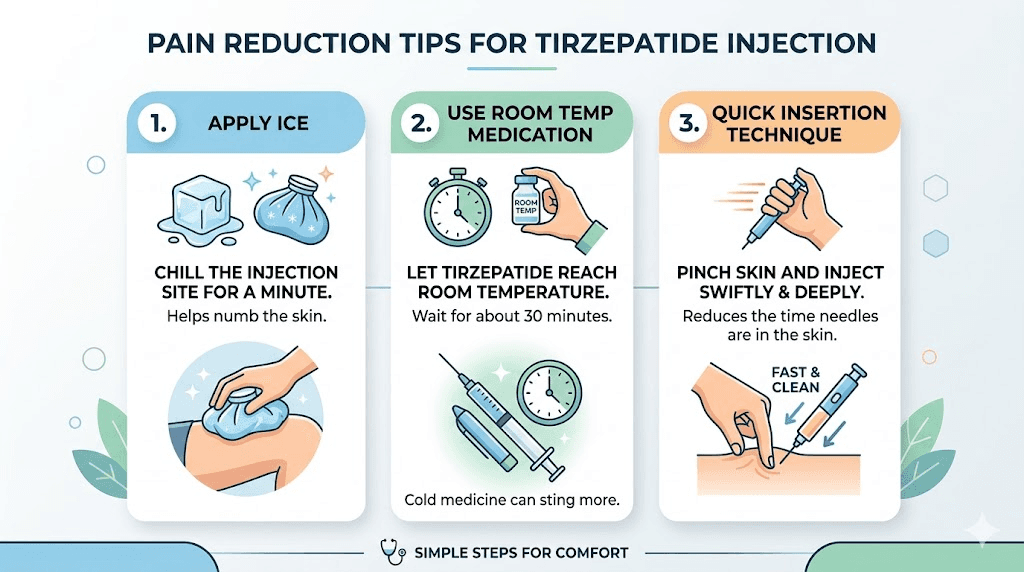
Let the medication warm up slightly. If your tirzepatide has been refrigerated, take it out 15 to 20 minutes before injection. Cold liquid causes more discomfort during injection. Do not heat it, do not microwave it, do not hold it under hot water. Just let it sit at room temperature. If you are concerned about how long it can be out, our guide on how long tirzepatide can be unrefrigerated covers the safe timeframes.
Numb the area with ice. Hold an ice cube or ice pack on the injection site for 30 to 60 seconds before injecting. This numbs the skin surface and significantly reduces the sensation of needle insertion. Some users wrap an ice cube in a paper towel and hold it on the spot while they prepare the syringe.
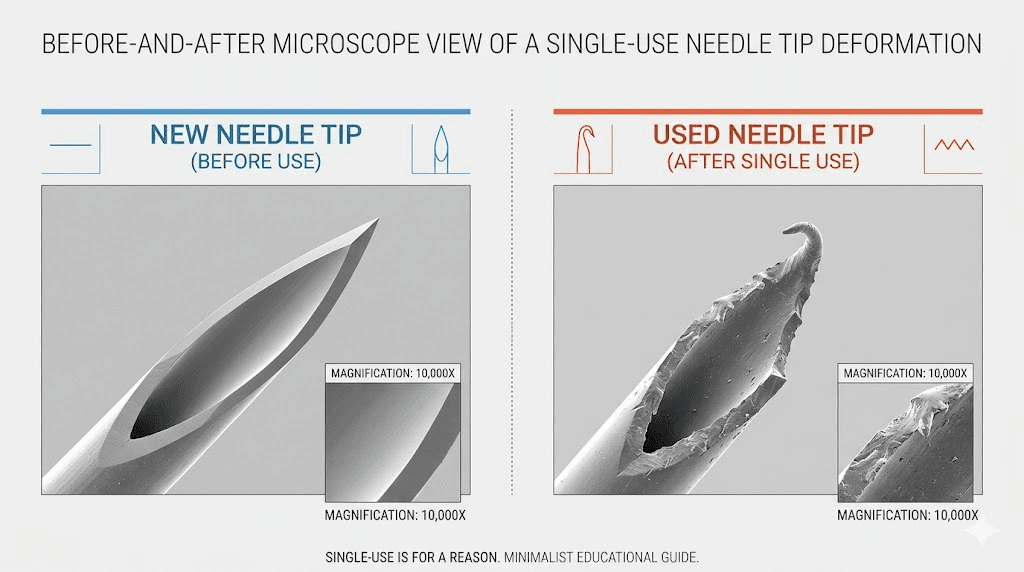
Use a fresh needle every single time. Needles are designed for single use. After one insertion, the tip begins to dull and the lubricant coating degrades. A second use results in a measurably duller point that requires more force to penetrate the skin. This causes more pain, more bruising, and increases infection risk.
During the injection
Clean with alcohol, then wait. Swab the injection site with an alcohol prep pad and let it dry completely before inserting the needle. Injecting through wet alcohol stings. Waiting 15 to 30 seconds for it to evaporate eliminates that sting entirely.
Insert quickly and confidently. A slow, tentative insertion hurts more than a quick, decisive one. Do not hesitate at the skin surface. Push through in one smooth motion. Think of it like removing a bandage: fast is better.
Inject slowly. Once the needle is in, push the plunger at a slow, steady pace. Injecting too quickly forces the medication into the tissue faster than it can absorb, creating a pressure sensation that some people find uncomfortable. Take 5 to 10 seconds to push the full dose.
Wait before withdrawing. After pushing the plunger all the way down, hold the needle in place for 5 to 10 seconds. This allows the medication to disperse into the tissue and prevents it from leaking back out through the needle track when you withdraw.
After the injection
Apply gentle pressure. Press a cotton ball or gauze pad over the injection site for a few seconds after withdrawing the needle. Do not rub. Rubbing can spread the medication and increase bruising. Gentle pressure is enough.
Rotate your injection sites. Using the same spot repeatedly causes tissue hardening (lipodystrophy) that makes injections more painful over time and can affect medication absorption. Rotate between the left and right abdomen, left and right thigh, and upper arms. Keep track of where you last injected. Our guides on where to inject tirzepatide and thigh injection technique cover site rotation in detail.
If you consistently experience injection site reactions despite following these steps, the issue may be the needle brand rather than your technique. Some users have skin that reacts to the lubricant coating on certain needle brands. Switching brands can resolve the problem.
Needle supplies checklist: everything you need for tirzepatide injection
Whether you are just starting tirzepatide or switching from a pen to vial-based injection, here is the complete list of supplies you need.
For compounded tirzepatide vials
Essential supplies:
Insulin syringes in your chosen gauge and size (31G, 0.5 mL recommended for most users)
Alcohol prep pads (individually wrapped, 70% isopropyl alcohol)
Bacteriostatic water for reconstitution (if using lyophilized tirzepatide)
Reconstitution syringe with 18G to 21G needle (if reconstituting from powder)
FDA-cleared sharps disposal container
Cotton balls or sterile gauze pads
Optional but helpful:
Ice pack for pre-injection numbing
Adhesive bandages
Needle disposal mail-back service subscription (for convenient disposal)
Small cooler or insulated pouch for travel with tirzepatide
For Mounjaro or Zepbound pens
Essential supplies:
ISO 11608-2 compatible pen needles (32G x 4 mm recommended)
Alcohol prep pads
FDA-cleared sharps disposal container
Cotton balls or sterile gauze pads
One important note: never prefill syringes and store them for later use. Each syringe should be drawn and injected in the same session. Pre-filled syringes risk contamination, dosing inaccuracy, and medication degradation.
How many needles to buy
Tirzepatide is typically injected once per week. That means you need a minimum of 4 to 5 needles per month. Most experienced users buy in quantities of 100, which provides roughly a 6-month supply at weekly dosing. Buying in bulk reduces cost per needle significantly.
If you use the two-needle technique (one for drawing, one for injecting), double that number. And always keep a few extras on hand in case you need to adjust your schedule or if a needle is defective.
Reconstitution needles vs injection needles: key differences
When working with lyophilized tirzepatide, you deal with two separate needle tasks that have very different requirements.
Reconstitution needle (for mixing)
The reconstitution needle transfers bacteriostatic water from its vial into the tirzepatide vial. You want a needle that is:
Wide gauge (18G to 21G): Draws water quickly and passes through rubber stoppers easily
Longer (1 inch to 1.5 inches): Reaches the bottom of the vial to draw water completely
On a standard Luer-lock syringe (1 mL to 3 mL): Gives you enough volume and a secure needle connection
You use this needle once per reconstitution session (which might be once per month or once every few weeks depending on your vial size and dose). It does not touch your skin.
Injection needle (for administering your dose)
This is the needle that actually enters your skin. You want it to be:
Thin gauge (29G to 32G): Minimizes pain
Short (4 mm to 8 mm): Appropriate for subcutaneous depth
On an insulin syringe (0.3 mL to 1.0 mL): Matches your dose volume with precise markings
You use a new injection needle every single time you inject. Never reuse.
The peptide reconstitution calculator on SeekPeptides helps you determine exactly how much bacteriostatic water to add based on your desired concentration. Once you know the concentration, the syringe dosage guide shows you exactly how many units to draw for each dose.
Common needle mistakes and how to avoid them
After reviewing thousands of user experiences in peptide communities, these are the most frequent needle-related errors people make with tirzepatide.
Mistake 1: Reusing needles
It saves a few cents. It costs you comfort and safety. A needle that has been through skin once has a measurably bent and dulled tip. Microscopic photos show dramatic deformation after even a single use. The lubricant coating is also gone. Second use means more pain, more tissue damage, and increased infection risk.
The cost of a single needle is between $0.05 and $0.20. Your weekly tirzepatide dose costs many times more than that. Do not compromise the injection experience to save pennies.
Mistake 2: Using the wrong gauge for the solution viscosity
Some compounded tirzepatide formulations, especially those containing glycine and B12 or levocarnitine blends, are slightly thicker than plain tirzepatide in bacteriostatic water. If you are pushing hard on the plunger and the liquid barely moves through a 32G needle, the solution viscosity is too high for that gauge. Switch to 31G or 30G. Forcing liquid through a too-thin needle creates back pressure that can cause the syringe to pop apart, waste medication, or result in an inconsistent dose.
Mistake 3: Leaving the needle on the pen between uses
If you use a Mounjaro pen, always remove the pen needle after injection. A needle left attached allows air to enter the cartridge and medication to leak out. Over time, this creates air bubbles that affect your next dose and wastes expensive medication.
Mistake 4: Not checking for air bubbles
After drawing your dose from a vial, hold the syringe with the needle pointing up and tap the barrel to move any air bubbles to the top. Then slowly push the plunger until the air is expelled and a tiny drop appears at the needle tip. Air bubbles in the syringe mean you are injecting less medication than you measured.
This is especially important for small doses. A 5-unit air bubble in a 50-unit dose is only a 10% error. But a 5-unit air bubble in a 10-unit microdose is a 50% error. Precision matters more at lower doses.
Mistake 5: Injecting at the wrong angle
Subcutaneous injection requires a 90-degree angle to the skin surface for needles 4 mm to 8 mm in length. Injecting at too shallow an angle can result in intradermal injection (too shallow, medication stays in the skin) or the needle glancing off rather than penetrating cleanly. For longer needles (12.7 mm) or very lean individuals, a 45-degree angle with a skin pinch may be more appropriate.
Mistake 6: Choosing length based on body weight alone
Body weight does not directly correlate with subcutaneous tissue thickness at every injection site. A 200-pound person who carries weight primarily in their legs might have very little subcutaneous fat on their abdomen. And a 150-pound person might have a generous fat layer on their stomach but very little on their arms. Choose needle length based on the subcutaneous thickness at your specific injection site, not your overall weight.
Safe needle disposal: protecting yourself and others
Used needles are medical sharps. They cannot go in the regular trash, recycling bin, or down the drain. Every jurisdiction has regulations about proper sharps disposal, and ignoring them puts sanitation workers, household members, and pets at risk.
Sharps containers
The FDA recommends placing used needles immediately into an FDA-cleared sharps disposal container after each injection. These containers are puncture-resistant, leak-proof, and have a secure lid that prevents needles from falling out.
You can purchase sharps containers at any pharmacy, medical supply store, or online. They typically cost between $5 and $15 and last for months of weekly injections. When the container is three-quarters full, seal it and dispose of it according to your local regulations.
If you do not have a sharps container
In a pinch, you can use a heavy-duty household container such as an empty laundry detergent bottle or a thick plastic container with a screw-on lid. The FDA specifies that household alternatives should be puncture-resistant, have a tight-fitting lid, remain upright during use, and be labeled "Do Not Recycle" or "Used Sharps."
Do not use glass containers, thin plastic bottles, or any container that a child could open. And never recap a used needle with two hands. If you must recap before disposal, use the one-handed scoop technique to reduce needlestick risk.
Disposal options
Drop-off locations. Many pharmacies, hospitals, and public health departments accept filled sharps containers for free. Some fire stations and police stations also accept them.
Mail-back programs. Companies like Stericycle and MedPro offer mail-back sharps disposal kits. You receive a container, fill it, and mail it back in a prepaid box. Convenient for people without nearby drop-off locations.
Home needle destruction devices. Some users purchase countertop needle destruction devices that melt or cut the needle tip immediately after use, rendering it safe for regular trash. These cost between $20 and $50 and are a one-time investment.
Whatever method you choose, never throw loose needles in the garbage, never flush needles down the toilet, and never break needles by hand before disposal.
Needle selection for different tirzepatide compounds
Not all tirzepatide formulations inject the same way. The compound mixed with your tirzepatide affects solution viscosity, which in turn affects which needle gauge works best.
Plain tirzepatide in bacteriostatic water
The simplest formulation. Thin, water-like consistency. Any gauge from 29G to 32G works perfectly. This is where 32G truly shines because the solution offers no resistance.
Tirzepatide with B12
Tirzepatide with B12 (cyanocobalamin or methylcobalamin) has a slightly pink or red color and marginally higher viscosity. A 31G needle handles it without difficulty. A 32G will work but may require slightly more plunger pressure.
Tirzepatide with glycine and B12
The glycine B12 compound is one of the most popular compounded formulations. Glycine adds a stabilizing effect but can increase viscosity slightly. Stick with 30G to 31G for the best balance of flow and comfort.
Tirzepatide with niacinamide
Tirzepatide niacinamide compounds vary in viscosity depending on the concentration. Most users report 31G works well. If the compound is especially thick, 30G ensures smooth delivery.
Tirzepatide with levocarnitine
Tirzepatide levocarnitine blends can have higher volumes per dose since levocarnitine concentrations require more liquid. Make sure your syringe size accommodates the full dose volume. A 1.0 mL syringe may be necessary for higher-volume compound injections.
Tirzepatide with B6
Tirzepatide with B6 (pyridoxine) is another vitamin-enhanced compound. Viscosity is similar to B12 compounds. A 31G needle works well for this formulation.
The general rule: if the liquid flows easily when you tip the vial, 31G or 32G is fine. If it moves slowly, like slightly thick water, use 30G or 31G. If it seems genuinely viscous, step down to 29G. Your pharmacy can also advise on the best gauge for their specific compound formulation.
Frequently asked questions
What is the best needle size for tirzepatide injections?
A 31G x 8 mm (5/16 inch) insulin syringe is the most commonly recommended and most versatile option for tirzepatide subcutaneous injections. It provides an excellent balance of comfort and medication flow. For maximum comfort, a 32G x 4 mm needle works well for thin solutions and most body types.
Can I use the same needle for drawing and injecting?
Yes, most people use a single fixed-needle insulin syringe for both drawing from the vial and injecting. This works perfectly well. Some experienced users prefer the two-needle technique, using a larger gauge to draw and a finer gauge to inject, for slightly more comfort.
How often should I change needles?
Every single injection. Never reuse a needle. The tip dulls after one use, the lubrication coating is gone, and the risk of infection increases. If you are splitting your tirzepatide dose to twice per week, that means two new needles per week.
Why is my tirzepatide injection painful?
Common causes include using a gauge that is too thick (try moving from 29G to 31G), injecting cold medication (let it warm to room temperature first), injecting through wet alcohol (wait for it to dry), using a dull or previously used needle, or injecting too quickly. Our guide on injection site reaction treatment covers troubleshooting in detail.
Do I need a prescription to buy insulin syringes?
In most US states, insulin syringes are available over the counter without a prescription. Some states require a prescription or proof of a medical condition. Check your state regulations. Online medical supply retailers like Amazon, ADW Diabetes, and Diabetic Warehouse ship insulin syringes to most locations.
What needle gauge do pharmacies typically include with compounded tirzepatide?
Most compounding pharmacies include 29G or 30G insulin syringes with compounded tirzepatide orders. Some include 31G. If your pharmacy includes a gauge you find uncomfortable, you can purchase your preferred gauge separately.
Is a 29G needle too thick for tirzepatide?
Not at all. A 29G needle works perfectly well for tirzepatide. It is the standard gauge on many insulin syringes and millions of people use it without issues. However, if you are sensitive to needle insertion, upgrading to 31G or 32G provides noticeably more comfort.
What size syringe do I need for a 2.5 mg dose of tirzepatide?
That depends on your reconstitution volume. If you reconstituted 10 mg with 1 mL of bacteriostatic water, a 2.5 mg dose equals 0.25 mL (25 units). A 0.3 mL or 0.5 mL syringe is perfect for this volume. Use the 2.5 mg unit conversion guide or the peptide calculator for exact measurements based on your specific reconstitution ratio.
Where to buy needles and syringes for tirzepatide
Sourcing the right needles is straightforward once you know what to look for. Here are the most common purchasing options.
Your compounding pharmacy. Many pharmacies that supply compounded tirzepatide also sell or include syringes. Ask if they carry your preferred gauge and brand. Pharmacies like Empower, Boothwyn, South Lake, and Red Rock typically include injection supplies with their compounded orders.
Local pharmacies. CVS, Walgreens, Walmart, and most independent pharmacies carry insulin syringes. Availability of specific gauges varies by location. BD Ultra-Fine is the most commonly stocked brand.
Online retailers. Amazon, ADW Diabetes, Diabetic Warehouse, and medical supply stores offer the widest selection. Online purchasing gives you access to every gauge, length, and brand combination. Prices are generally lower online, especially when buying in bulk (boxes of 100).
Medical supply distributors. For the best per-unit pricing, medical supply distributors sell in cases of 500 or more. This only makes sense if you inject frequently or want to stock up long-term.
When ordering online, verify that the seller ships from a legitimate medical supply source. Check reviews and ensure the product has not been repackaged or tampered with. Needles should arrive in sealed, manufacturer-original packaging.
Needle selection for other GLP-1 peptides
If you use other peptides alongside or instead of tirzepatide, the same needle principles apply. Subcutaneous peptide injection uses the same gauge and length ranges regardless of the specific medication.
Semaglutide. The same 29G to 32G, 4 mm to 8 mm needles work for semaglutide injection. The solution viscosity is similar to plain tirzepatide. Check the best injection sites for semaglutide and semaglutide dosage in units for medication-specific guidance.
Retatrutide. Retatrutide injection follows the same subcutaneous protocol. Use the same gauge and length as tirzepatide. The reconstitution process is similar, so the same reconstitution needles (18G to 21G) apply. Our guide on bacteriostatic water for retatrutide covers the mixing specifics.
BPC-157 and other research peptides. For subcutaneous BPC-157, TB-500, and similar peptides, the same 29G to 31G insulin syringes work. These peptides are typically dissolved in bacteriostatic water and have a thin, water-like consistency that flows easily through even 32G needles.
The bottom line: once you find a needle setup you like for tirzepatide, it works for virtually every subcutaneous peptide you might use. Your investment in finding the right gauge, length, and brand pays dividends across your entire protocol.
Quick reference: needle selection decision guide
If you want the simplest possible answer, use this decision tree.
Using a Mounjaro or Zepbound pen? Buy 32G x 4 mm pen needles (BD Nano or Novo Fine Plus).
Using compounded tirzepatide from a vial? Buy 31G x 5/16 inch (8 mm) insulin syringes in 0.5 mL. Easy Touch or BD Ultra-Fine.
On a budget? Easy Touch 31G 0.5 mL is the best value. Sure Comfort is the cheapest acceptable option.
Lean body type? Switch to 4 mm or 5 mm needle length. Keep the 31G gauge.
Thick compound with B12 or additives? Use 30G or 31G instead of 32G for better flow.
Want maximum comfort? 32G x 4 mm for thin solutions, ice the site before injection, let the medication reach room temperature, and use the two-needle technique if drawing from a vial.
For researchers serious about optimizing every aspect of their peptide protocol, SeekPeptides offers comprehensive dosing calculators, detailed injection guides, and a community of experienced users who have tested every needle combination imaginable. The peptide calculator, reconstitution calculator, and cost calculator help you dial in every variable so the only thing left to worry about is which arm of the couch to rest on while the injection does its work.
External resources
In case I do not see you, good afternoon, good evening, and good night. May your needles stay sharp, your injections stay painless, and your tirzepatide stay potent.