Feb 11, 2026
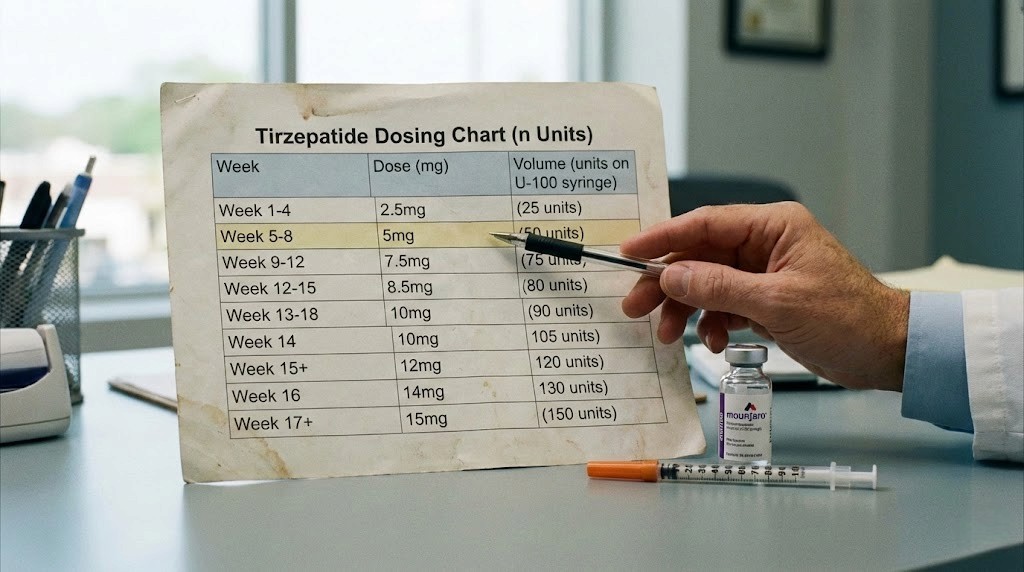
Every wasted unit costs you money. And when it comes to tirzepatide, the wrong unit calculation does not just waste medication. It throws off your entire dose. You draw 50 units expecting 5 mg, but your vial concentration is 20 mg/mL, not 10 mg/mL. That means you just injected 10 mg instead of 5 mg, double the intended amount. Or you draw 25 units from a 5 mg/mL vial thinking you have your starting dose, but you actually pulled just 1.25 mg, half of what you needed. These mistakes happen constantly, and they happen because the relationship between milligrams, milliliters, and syringe units confuses nearly everyone at first.
The confusion is understandable. Tirzepatide vials come in multiple concentrations. Compounding pharmacies use 10 mg/mL, 20 mg/mL, and sometimes 40 mg/mL formulations. Brand-name Zepbound vials sit at 5 mg/mL. Each concentration produces completely different unit measurements for the exact same milligram dose, and no universal chart exists that covers every scenario in one place. Until now. This guide provides complete tirzepatide dosing charts in units for every major concentration, walks through the conversion formula step by step, and covers the full FDA dose escalation schedule translated into syringe units. Whether you are working with a compounded tirzepatide formulation or a brand-name vial, you will find the exact unit measurement you need. SeekPeptides built this resource because accurate dosing is the foundation of everything that follows, from results to safety to consistent outcomes week after week.
Understanding units on an insulin syringe
Before you touch a tirzepatide vial, you need to understand what the numbers on your syringe actually mean. This is where most dosing errors begin. Not with bad math, but with a fundamental misunderstanding of what a "unit" represents on an insulin syringe.
An insulin syringe measures volume in units. One hundred units equals one milliliter. That is the universal standard across all insulin syringes, regardless of brand, size, or country of manufacture. When you see "100 units" printed on the syringe barrel, it means the syringe holds exactly 1 mL of liquid. Fifty units equals 0.5 mL. Twenty-five units equals 0.25 mL. The markings are simply a way to measure volume in very small, precise increments.
Here is the critical distinction. The units on an insulin syringe are NOT the same as "units of tirzepatide." This trips people up constantly. When someone asks how many units is 2.5 mg of tirzepatide, the answer depends entirely on the concentration of the solution. The syringe units only measure volume. How much tirzepatide that volume contains depends on how concentrated the liquid is.
Think of it like coffee. A tablespoon of espresso contains far more caffeine than a tablespoon of regular drip coffee. Same volume, vastly different strength. Tirzepatide works the same way. Drawing 25 units from a 10 mg/mL vial gives you 2.5 mg. Drawing 25 units from a 20 mg/mL vial gives you 5 mg. Same syringe reading. Double the dose.
Most people use standard U-100 insulin syringes, which come in three common sizes. The 0.3 mL syringe holds up to 30 units. The 0.5 mL syringe holds up to 50 units. The 1 mL syringe holds up to 100 units. For tirzepatide dosing, the 1 mL syringe is often the most practical because higher doses at lower concentrations can require more than 50 units of volume. If you are working with a 20 mg/mL concentration, a 0.5 mL syringe handles most doses comfortably. But with a 10 mg/mL concentration, you may need the full 1 mL syringe even for moderate doses.
The syringe needle gauge also matters for comfort, though it does not affect dosing accuracy. Most people prefer 29-gauge or 31-gauge needles for subcutaneous peptide injections. Thinner needles mean less discomfort at the injection site.
The universal conversion formula for tirzepatide
Forget memorizing charts. Learn this one formula, and you can calculate the correct units for any tirzepatide concentration, any dose, any time.
Units = (Dose in mg / Concentration in mg per mL) x 100
That is it. Three numbers, one division, one multiplication. Let us break it down with a real example so you see exactly how it works.
Say you need 5 mg of tirzepatide from a 10 mg/mL vial. Plug in the numbers. Five divided by ten equals 0.5. Multiply by 100. You get 50 units. Draw 50 units on your insulin syringe, and you have exactly 5 mg of tirzepatide.
Now try the same 5 mg dose from a 20 mg/mL vial. Five divided by twenty equals 0.25. Multiply by 100. You get 25 units. Same dose in milligrams, half the volume on the syringe. This is why concentration matters so much, and why using the wrong chart for your vial can lead to serious dosing errors.
One more example. You need 7.5 mg from a 20 mg/mL vial. Seven point five divided by twenty equals 0.375. Multiply by 100. You get 37.5 units. On a standard insulin syringe, 37.5 falls between the 37 and 38 unit marks. Most syringes have markings every 2 units, so you would draw to the line halfway between 36 and 38. If your syringe has markings every unit, draw to halfway between 37 and 38.
Understanding this formula means you will never be dependent on a single chart again. You can verify any chart you find online. You can adapt to any concentration a pharmacy provides. And you can double-check your work before every injection, which is exactly what proper peptide dosage calculation requires. The SeekPeptides peptide calculator automates this process if you prefer a tool that handles the math, but knowing the formula gives you confidence and a backup verification method.
A quick reference table for the formula in action:
Dose (mg) | Concentration | Formula | Units to draw |
|---|---|---|---|
2.5 mg | 10 mg/mL | (2.5 / 10) x 100 | 25 units |
2.5 mg | 20 mg/mL | (2.5 / 20) x 100 | 12.5 units |
5 mg | 10 mg/mL | (5 / 10) x 100 | 50 units |
5 mg | 20 mg/mL | (5 / 20) x 100 | 25 units |
10 mg | 10 mg/mL | (10 / 10) x 100 | 100 units |
10 mg | 20 mg/mL | (10 / 20) x 100 | 50 units |
Notice the pattern. When the concentration doubles, the units you draw get cut in half. When the concentration is halved, the units double. This inverse relationship is the key concept behind every tirzepatide dosing chart.
Complete tirzepatide dosing chart in units by concentration
This section contains the charts you came here for. Each table covers a specific concentration of tirzepatide and translates every standard dose into exact syringe units. Find the concentration printed on your vial label, go to that chart, and look up your prescribed dose. If you need help identifying your vial concentration, the section after these charts walks you through reading the label.
Every chart below aligns with the standard tirzepatide dose chart used in clinical practice. The doses follow the FDA-approved escalation schedule from 2.5 mg through 15 mg. For weight loss dosing in units, these same charts apply because the clinical protocol is the same regardless of indication.
10 mg/mL concentration chart
The 10 mg/mL concentration is one of the most common formulations from compounding pharmacies. It offers a good balance between precision and volume. Most doses fall within a comfortable syringe range, though higher doses like 12.5 mg and 15 mg exceed a standard 1 mL syringe.
Dose (mg) | Units to draw | Volume (mL) | Syringe needed |
|---|---|---|---|
2.5 mg | 25 units | 0.25 mL | 0.3 mL or larger |
5 mg | 50 units | 0.50 mL | 0.5 mL or larger |
7.5 mg | 75 units | 0.75 mL | 1 mL |
10 mg | 100 units | 1.0 mL | 1 mL (full syringe) |
12.5 mg | 125 units | 1.25 mL | Needs larger syringe or split injection |
15 mg | 150 units | 1.50 mL | Needs larger syringe or split injection |
At 10 mg/mL, the numbers are clean and easy to work with. The starting dose of 2.5 mg equals exactly 25 units. No half-unit marks to worry about. No ambiguous syringe lines. This makes the 10 mg/mL concentration particularly beginner-friendly for people just getting started with peptides.
The challenge comes at higher doses. At 12.5 mg, you need 125 units, which exceeds a standard 1 mL insulin syringe. You have two options. Use a 3 mL syringe, which has larger volume markings and slightly less precision. Or split the injection into two separate doses, for instance drawing 75 units for one injection and 50 units for a second. Many people find split injections more comfortable at these volumes anyway, since injecting more than 1 mL subcutaneously can cause discomfort at the injection site.
If you are using this concentration and planning to escalate to the higher doses, discuss your syringe options with your prescriber early. Planning ahead prevents scrambling for supplies mid-protocol. For detailed reconstitution guidance at this concentration, see the tirzepatide reconstitution chart.
20 mg/mL concentration chart
The 20 mg/mL concentration is increasingly popular because it allows every standard dose to fit within a 1 mL insulin syringe. This makes it the most practical option for the full dose escalation schedule. Many compounded tirzepatide providers now offer this concentration as their default.
Dose (mg) | Units to draw | Volume (mL) | Syringe needed |
|---|---|---|---|
2.5 mg | 12.5 units | 0.125 mL | 0.3 mL |
5 mg | 25 units | 0.25 mL | 0.3 mL or larger |
7.5 mg | 37.5 units | 0.375 mL | 0.5 mL or larger |
10 mg | 50 units | 0.50 mL | 0.5 mL or larger |
12.5 mg | 62.5 units | 0.625 mL | 1 mL |
15 mg | 75 units | 0.75 mL | 1 mL |
Notice the trade-off. Half-unit measurements. At 2.5 mg, you need 12.5 units. At 7.5 mg, you need 37.5 units. At 12.5 mg, you need 62.5 units. These half-unit readings require careful syringe technique. On a syringe with markings every 2 units, 12.5 falls directly between the 12 and 14 marks. On a syringe marked every unit, it falls at the midpoint between 12 and 13.
For this reason, some people prefer the 10 mg/mL concentration at lower doses where precision in the early stages matters most, then switch to 20 mg/mL at higher doses where the volume becomes the bigger concern. Either approach works. The key is consistency, meaning you should use the same concentration throughout a given dose level and only switch between escalation phases if needed.
If you want to explore how the 20 mg/mL concentration maps across the entire escalation schedule, the 20 mg/mL tirzepatide dosing chart covers the full protocol in greater detail.
5 mg/mL concentration chart (Zepbound vials)
Zepbound, the brand-name tirzepatide product for weight management, uses a 5 mg/mL concentration in its multi-dose vials. This lower concentration means higher volumes for every dose, but the unit numbers are straightforward and easy to measure.
Dose (mg) | Units to draw | Volume (mL) | Syringe needed |
|---|---|---|---|
2.5 mg | 50 units | 0.50 mL | 0.5 mL or larger |
5 mg | 100 units | 1.0 mL | 1 mL (full syringe) |
7.5 mg | 150 units | 1.50 mL | Needs larger syringe or split injection |
10 mg | 200 units | 2.0 mL | Needs larger syringe or split injection |
At 5 mg/mL, the volume required is substantial. Just the starting dose of 2.5 mg needs 50 units, half a milliliter. By the time you reach 5 mg, you are filling an entire 1 mL syringe. Anything above 5 mg requires either a larger syringe or splitting the dose across two injection sites.
This is the main drawback of the 5 mg/mL concentration. While the math is simple and the unit marks are easy to read, the volumes become impractical at higher doses. Injecting 2 mL subcutaneously in a single site is uncomfortable and can lead to localized reactions, swelling, or poor absorption. For anyone expecting to escalate beyond 5 mg, a higher concentration is generally more practical.
For a more detailed look at how brand-name products compare to compounded versions, check the tirzepatide conversion chart.
40 mg/mL concentration chart
Some compounding pharmacies offer a 40 mg/mL concentration, which packs the most tirzepatide into the smallest volume. This is the highest concentration commonly available and is especially useful for people on higher maintenance doses who want minimal injection volume.
Dose (mg) | Units to draw | Volume (mL) | Syringe needed |
|---|---|---|---|
2.5 mg | 6.25 units | 0.0625 mL | 0.3 mL (very precise markings needed) |
5 mg | 12.5 units | 0.125 mL | 0.3 mL |
7.5 mg | 18.75 units | 0.1875 mL | 0.3 mL |
10 mg | 25 units | 0.25 mL | 0.3 mL |
12.5 mg | 31.25 units | 0.3125 mL | 0.5 mL |
15 mg | 37.5 units | 0.375 mL | 0.5 mL |
The precision challenge here is obvious. Drawing 6.25 units accurately on a standard insulin syringe is extremely difficult. Even 18.75 units requires hitting a mark that falls three-quarters of the way between two whole-unit lines. At this concentration, small errors in volume translate to large errors in dose because the solution is so concentrated.
For this reason, the 40 mg/mL concentration is best suited for intermediate and advanced doses, specifically 10 mg and above, where the unit measurements land on cleaner numbers. At 10 mg, you need 25 units. At 15 mg, you need 37.5 units. Both of these are manageable on a well-marked syringe. The starting doses of 2.5 mg and 5 mg, however, are easier and safer to measure from a 10 or 20 mg/mL compounded formulation.
This is an important lesson in avoiding common peptide mistakes. Higher concentration does not always mean better. The best concentration is the one that gives you clean, readable unit measurements for your current dose level.
The FDA dose escalation schedule in units
The FDA approved a specific dose escalation protocol for tirzepatide. Understanding this protocol is essential because jumping doses or escalating too quickly leads to worse side effects without better results. The schedule exists for a reason. Slow, steady titration gives your body time to adapt to each dose level before moving to the next.
Here is the FDA-approved escalation schedule, translated into syringe units for the two most common compounded concentrations:
Weeks | Dose (mg) | Units at 10 mg/mL | Units at 20 mg/mL | Purpose |
|---|---|---|---|---|
1-4 | 2.5 mg | 25 units | 12.5 units | Starting dose, assess tolerance |
5-8 | 5 mg | 50 units | 25 units | First therapeutic increase |
9-12 | 7.5 mg (optional) | 75 units | 37.5 units | Optional increase |
13-16 | 10 mg (optional) | 100 units | 50 units | Optional increase |
17-20 | 12.5 mg (optional) | 125 units | 62.5 units | Optional increase |
21+ | 15 mg (maximum) | 150 units | 75 units | Maximum approved dose |
Several things stand out in this table. First, the schedule increases by exactly 2.5 mg every four weeks. No exceptions. The minimum time between dose escalations is four weeks. Trying to escalate every two or three weeks, even if you feel fine, defeats the purpose of titration and significantly increases your risk of gastrointestinal side effects.
Second, every dose above 5 mg is optional. Not everyone needs to reach 15 mg. Many people achieve their goals at 5 mg or 7.5 mg and stay there. The clinical trials showed meaningful results at every dose level, and going higher is only necessary if your response plateaus and your clinician agrees that escalation is appropriate.
Third, look at how manageable the unit measurements are at 20 mg/mL. The entire schedule, from 2.5 mg through 15 mg, fits within a 0.75 mL volume. Even the maximum dose only requires 75 units. This is why the 20 mg/mL concentration has become the preferred choice for many people running the full escalation protocol. It keeps every dose within comfortable syringe territory without requiring split injections or oversized syringes. For more detail on tirzepatide dosing for weight loss, the conversion chart lays out additional scenarios.
The unit-based dosing approach matters because your syringe is the tool you interact with directly. You do not inject milligrams. You inject units. And knowing exactly how many units corresponds to your dose at your specific concentration is the only way to ensure accuracy every single week.
How to read your vial label and match it to the correct chart
Picking the wrong chart is arguably worse than having no chart at all. A chart gives you false confidence. You think you are accurate, but you are injecting the wrong dose, every single week, without realizing it. Reading your vial label correctly is therefore non-negotiable.
Every tirzepatide vial label contains three essential pieces of information. The total amount of tirzepatide in the vial, measured in milligrams. The total volume of liquid in the vial, measured in milliliters. And the concentration, measured in milligrams per milliliter. The concentration is the only number you need for the dosing charts. It is usually printed as "mg/mL" somewhere on the label.
Here is what different vial configurations look like:
10 mg in 1 mL = 10 mg/mL concentration. Use the 10 mg/mL chart.
20 mg in 1 mL = 20 mg/mL concentration. Use the 20 mg/mL chart.
30 mg in 1.5 mL = 20 mg/mL concentration. Use the 20 mg/mL chart.
60 mg in 3 mL = 20 mg/mL concentration. Use the 20 mg/mL chart.
10 mg in 2 mL = 5 mg/mL concentration. Use the 5 mg/mL chart.
40 mg in 1 mL = 40 mg/mL concentration. Use the 40 mg/mL chart.
Notice the second and third examples. A 20 mg vial and a 30 mg vial can have the same concentration if the volumes are different. A 20 mg vial in 1 mL and a 30 mg vial in 1.5 mL both have a 20 mg/mL concentration. The total milligrams in the vial tells you how many total doses the vial contains, but it does not change the unit measurement per dose. A 30 mg vial just lasts longer than a 20 mg vial. Each individual injection still follows the same chart.
If your label does not clearly state the concentration, calculate it yourself. Divide the total milligrams by the total milliliters. A vial labeled "60 mg / 3 mL" gives you 60 divided by 3, which equals 20 mg/mL. Simple. If you need help with these calculations, the peptide reconstitution calculator at SeekPeptides makes this process even faster.
Some compounding pharmacies label their vials with the reconstitution instructions already included, meaning the concentration listed assumes you have added the specified amount of bacteriostatic water. Always confirm you have reconstituted with the exact volume specified before using any dosing chart. Adding more or less water than directed will change the concentration and make every chart inaccurate.
Week by week dosing protocol with unit measurements
Knowing the charts is one thing. Knowing exactly what to do each week, how many units to draw, when to increase, and what to watch for is another thing entirely. This section walks through the full protocol week by week, using the 20 mg/mL concentration as the primary example because it covers the full dose range within a standard syringe.
Weeks 1-4: starting dose
Draw 12.5 units from your 20 mg/mL vial. This gives you 2.5 mg, the standard starting dose. Inject once weekly, on the same day each week. Many people choose a day early in the weekend so they can rest if side effects appear.
The 2.5 mg dose is not a therapeutic dose for most people. It is a tolerance dose. Its primary purpose is to let your gastrointestinal system adapt to tirzepatide gradually. GLP-1 and GIP receptor agonism slows gastric emptying and alters appetite signaling in ways your body has never experienced before. Jumping straight to a higher dose dramatically increases nausea, vomiting, and diarrhea risk.
During these four weeks, pay attention to how your body responds. Some appetite suppression is normal and expected. Mild nausea in the first 24 to 48 hours after injection is common and typically resolves on its own. If you experience severe or persistent nausea, this is important information for your clinician before you escalate to the next dose. For a complete breakdown of the 2.5 mg starting experience, see the 25 units tirzepatide dosage guide.
At the 10 mg/mL concentration, the starting dose equals 25 units, which is an easy, clean measurement. If you are working with this concentration, it might feel more comfortable during the first month because there is no ambiguity in the syringe reading. You pull to the 25-unit line, and you are done.
Weeks 5-8: first increase
Draw 25 units from your 20 mg/mL vial. This gives you 5 mg. At the 10 mg/mL concentration, draw 50 units.
Week five is when most people feel tirzepatide "turn on." The jump from 2.5 to 5 mg often produces noticeably stronger appetite suppression. Food noise, that constant background chatter about eating, may quiet significantly. Some people describe it as the first time they have ever felt truly neutral about food.
This is also when tirzepatide starts working in a visible way for weight management. The SURMOUNT-1 trial showed that participants on 5 mg lost an average of 16 percent of their body weight, roughly 35 pounds or 16 kilograms. That is significant, and many people achieve satisfactory results at this level without ever needing to go higher.
Gastrointestinal side effects may increase temporarily at this dose. Nausea is the most commonly reported issue, followed by fatigue and changes in bowel habits. These effects usually peak in the first one to two weeks at the new dose and then fade. Eating smaller, more frequent meals and staying hydrated helps. Avoiding high-fat, greasy foods during the adjustment period also reduces nausea.
If side effects are manageable and you have not yet reached your goal, you and your clinician may decide to continue escalating after four full weeks at 5 mg. If side effects are significant, holding at 5 mg for another four weeks before attempting escalation is perfectly reasonable. The four-week minimum is a floor, not a ceiling. You can stay at any dose level for as long as it continues working.
Weeks 9-12 and beyond
This is where the optional escalation phases begin. Each increase adds 2.5 mg every four weeks, and each level brings incrementally stronger effects along with incrementally higher side effect potential.
Weeks 9-12 at 7.5 mg: Draw 37.5 units from a 20 mg/mL vial or 75 units from a 10 mg/mL vial. This is an optional intermediate step. The 7.5 mg dose does not appear in the Mounjaro or Zepbound autoinjector lineup, which jumps from 5 to 10 mg. But the dose is available from compounding pharmacies, and many clinicians use it as a stepping stone for patients who find the jump from 5 to 10 mg too aggressive.
Weeks 13-16 at 10 mg: Draw 50 units from a 20 mg/mL vial or 100 units (full syringe) from a 10 mg/mL vial. The SURMOUNT-1 data shows 10 mg participants lost an average of 21.4 percent of body weight, around 49 pounds or 22 kilograms. Fifty percent of participants at this dose lost 20 percent or more of their starting weight. These are transformative numbers. For many people, 10 mg is the sweet spot, offering substantial results with tolerable side effects. The tirzepatide before and after results often reflect this dose range.
Weeks 17-20 at 12.5 mg: Draw 62.5 units from a 20 mg/mL vial. At 10 mg/mL, you would need 125 units, which requires a larger syringe or split injection. The 12.5 mg dose brings you close to the maximum, and the incremental weight loss benefit over 10 mg is smaller. Going from 5 to 10 mg roughly doubles the result. Going from 10 to 12.5 mg adds only a modest additional percentage.
Weeks 21+ at 15 mg (maximum): Draw 75 units from a 20 mg/mL vial. This is the highest approved dose. SURMOUNT-1 participants at 15 mg lost an average of 22.5 percent of body weight, roughly 52 pounds or 24 kilograms, with 57 percent losing 20 percent or more. The difference between 10 and 15 mg in the trial was about 1.1 percentage points of additional body weight loss, meaningful but not dramatic. This dose is reserved for people who have not achieved adequate response at lower levels.
Throughout this escalation, the principle remains the same. Match your dose to the correct number of units for your specific concentration. Never assume units from one concentration apply to another. And always verify your math before drawing the dose, especially during the transition weeks when you are moving to a new unit measurement for the first time. For a complete printable version of this escalation schedule, the tirzepatide reconstitution chart PDF provides a downloadable reference.
Common unit mistakes and how to avoid them
Dosing errors with tirzepatide almost always come from one of five predictable mistakes. Knowing what they are prevents them entirely.
Mistake 1: Using the wrong concentration chart. This is the most dangerous error. You look up your dose on a 10 mg/mL chart, but your vial is 20 mg/mL. Every dose you draw is double what you intended. Or the reverse, you use a 20 mg/mL chart with a 10 mg/mL vial and underdose by half. Always, without exception, verify the concentration on your vial before looking at any dosing chart. This single habit prevents the most serious dosing errors.
Mistake 2: Confusing total vial content with concentration. A label that says "30 mg" does not mean the concentration is 30 mg/mL. That 30 mg might be dissolved in 1.5 mL, making it 20 mg/mL. Or in 3 mL, making it 10 mg/mL. The total milligrams tells you how much tirzepatide is in the entire vial. The concentration tells you how much is in each milliliter. Only the concentration determines how many units to draw.
Mistake 3: Not accounting for half-unit measurements. At 20 mg/mL, the 2.5 mg dose requires 12.5 units. If your syringe has markings every 2 units, finding the exact midpoint between 12 and 14 requires careful technique. Some people round to 12 or 13 units instead, which means they are either underdosing by 4 percent or overdosing by 4 percent. Over weeks, these small errors compound. Using a syringe with single-unit markings, or even half-unit markings, significantly improves accuracy at these in-between measurements.
Mistake 4: Changing concentrations without recalculating units. You have been drawing 25 units every week. Your pharmacy switches your concentration from 10 mg/mL to 20 mg/mL. If you keep drawing 25 units, you just doubled your dose from 2.5 mg to 5 mg. Every time you receive a new vial, check the concentration and recalculate. This applies even if you are getting refills from the same pharmacy, because formulations can change between batches.
Mistake 5: Air bubbles inflating the apparent volume. A small air bubble trapped in the syringe barrel can make it look like you have drawn more than you actually have. This leads to underdosing. Always tap the syringe to move air bubbles to the top, push them out, and then verify your volume reading before injecting. The peptide injection guide covers proper technique for eliminating air bubbles.
These five mistakes account for the vast majority of tirzepatide dosing errors. Every one of them is preventable with a simple 30-second pre-injection checklist. Verify concentration. Calculate units. Draw carefully. Check for bubbles. Confirm the reading. That is the process. Every time.
Switching concentrations without changing your dose in mg
Life happens. Your pharmacy changes formulations. You switch providers. Your clinician recommends a different concentration. Whatever the reason, switching tirzepatide concentrations mid-protocol is common and straightforward, as long as you recalculate your units correctly.
The milligram dose stays the same. Only the units change.
Here is a conversion table for the most common switch, moving from 10 mg/mL to 20 mg/mL:
Your dose | Old units (10 mg/mL) | New units (20 mg/mL) | Change |
|---|---|---|---|
2.5 mg | 25 units | 12.5 units | Draw half as much |
5 mg | 50 units | 25 units | Draw half as much |
7.5 mg | 75 units | 37.5 units | Draw half as much |
10 mg | 100 units | 50 units | Draw half as much |
12.5 mg | 125 units | 62.5 units | Draw half as much |
15 mg | 150 units | 75 units | Draw half as much |
The pattern is clean. Doubling the concentration halves the units. Halving the concentration doubles the units. If you can remember this one rule, you can switch between any two concentrations quickly.
For less common switches, use the universal formula. Say you are moving from a 10 mg/mL vial to a 40 mg/mL vial. You are on 10 mg. Old units: (10 / 10) x 100 = 100 units. New units: (10 / 40) x 100 = 25 units. You go from a full syringe to just a quarter of one. The dose in milligrams has not changed at all.
A few practical tips for switching day:
Calculate your new units BEFORE your injection day so you are not doing math under pressure
Write the new unit number on a note and keep it with your supplies
Do a practice draw with the new concentration (without injecting) to make sure the volume looks correct
If possible, finish your current vial before switching rather than switching mid-vial
For people switching between tirzepatide and semaglutide rather than between concentrations, the calculation is different because the medications are not interchangeable milligram-for-milligram. The tirzepatide to semaglutide conversion chart and the semaglutide to tirzepatide conversion chart cover those scenarios in detail. If you are considering a switch between medications, the switching from semaglutide to tirzepatide dosage chart provides the step-by-step protocol.
What the clinical research shows about each dose level
Charts and formulas are necessary. But they do not answer the question everyone actually wants answered. What results can you expect at each dose? The SURMOUNT-1 trial, the landmark study that led to tirzepatide FDA approval for weight management, provides the clearest data.
SURMOUNT-1 enrolled 2,539 adults with obesity or overweight with at least one weight-related comorbidity. Participants received tirzepatide at 5 mg, 10 mg, or 15 mg, or placebo, via weekly subcutaneous injection for 72 weeks. The results were striking.
At 5 mg (50 units at 10 mg/mL, 25 units at 20 mg/mL): Average weight loss was 16.0 percent of body weight. For someone starting at 220 pounds, that translates to approximately 35 pounds. 85 percent of participants lost at least 5 percent of their body weight. Nearly one in three lost 20 percent or more. This is the first therapeutic dose, and it already outperformed every GLP-1 receptor agonist that came before it, including semaglutide at its standard doses.
At 10 mg (100 units at 10 mg/mL, 50 units at 20 mg/mL): Average weight loss was 21.4 percent, roughly 49 pounds or 22 kilograms. 89 percent achieved at least 5 percent weight loss. 50 percent lost 20 percent or more. Half. That number is important because 20 percent body weight loss was historically associated only with bariatric surgery. Tirzepatide at 10 mg matched surgical outcomes for half its participants. The before and after tirzepatide weight loss results reflect these clinical averages.
At 15 mg (150 units at 10 mg/mL, 75 units at 20 mg/mL): Average weight loss was 22.5 percent, approximately 52 pounds or 24 kilograms. 91 percent achieved at least 5 percent weight loss, and 57 percent lost 20 percent or more. The maximum dose produced the highest average results, but the incremental benefit over 10 mg was relatively modest, about 1.1 additional percentage points of body weight loss.
Placebo comparison: The placebo group lost 2.4 percent of body weight, roughly 5 pounds or 2 kilograms. This underscores that tirzepatide effects are pharmacological, not merely the result of lifestyle changes in a clinical trial setting.
These numbers represent averages. Individual results vary considerably based on starting weight, dietary habits, physical activity, metabolic health, and genetic factors. Some people respond strongly at 5 mg and never need to escalate. Others require 15 mg to see meaningful results. The data tells you what is possible across a population, and your individual experience will fall somewhere on that spectrum.
What the research does not show is a strong dose-response curve beyond 10 mg. The jump from 5 to 10 mg produces a significant improvement in outcomes. The jump from 10 to 15 mg produces a much smaller one. This suggests that for many people, optimizing their protocol at 10 mg, through dietary adjustments, physical activity, and adherence consistency, may produce better results than simply increasing the dose to 15 mg. To understand how long tirzepatide takes to work, most clinical data points to measurable changes beginning within the first four to eight weeks.
For a broader perspective on how tirzepatide stacks up against other options in the GLP-1 class, see the detailed semaglutide vs tirzepatide comparison. And if you are curious about newer compounds that are still in clinical trials, the retatrutide vs tirzepatide comparison explores what the next generation of multi-receptor agonists may offer.
Side effects at each dose level in units
Side effects follow a predictable pattern with tirzepatide. They tend to be worst during the first one to two weeks after each dose escalation and then improve as your body adapts. Understanding what to expect at each dose level helps you distinguish normal adjustment symptoms from signals that something needs attention.
At 2.5 mg (25 units at 10 mg/mL): Most people tolerate this dose well. Mild nausea affects some people in the first few days. Appetite suppression is subtle or absent at this level. Occasional constipation or loose stools may occur. Significant side effects at 2.5 mg are uncommon. If you experience severe symptoms at this dose, it is important to discuss this with your clinician before any escalation.
At 5 mg (50 units at 10 mg/mL): Side effects become more noticeable. Nausea is the most commonly reported symptom, occurring in approximately 20 to 30 percent of people. Diarrhea and constipation may alternate. Appetite suppression strengthens noticeably. Some people report feeling fullness after very small meals, sometimes uncomfortably so if they eat too quickly. The key at 5 mg is meal modification, eating smaller portions more frequently and chewing thoroughly.
At 7.5 to 10 mg (75-100 units at 10 mg/mL): This is the range where gastrointestinal side effects peak for most people. Nausea, if it occurs, tends to be strongest in the first week at a new dose within this range. Vomiting is possible, particularly if you eat large meals or high-fat foods. Some people experience acid reflux or heartburn that was not present at lower doses. Anxiety-like symptoms have also been reported by some individuals at these higher doses, though the mechanism is not fully understood.
At 12.5 to 15 mg (62.5-75 units at 20 mg/mL): The highest doses carry the highest side effect burden, but most people who reach these levels have already adapted through the escalation process. New symptoms are less common than worsening of existing ones. The most important thing to watch for at these doses is dehydration from reduced fluid intake, since extreme appetite suppression can also reduce thirst. Adequate water intake becomes a deliberate habit rather than an intuitive one.
Across all dose levels, serious side effects are rare but require immediate medical attention:
Pancreatitis: Severe, persistent abdominal pain that radiates to the back, especially after eating. This is rare but serious. Stop the medication and seek medical care immediately.
Gallbladder issues: Right upper abdominal pain, especially after fatty meals. Rapid weight loss increases gallstone risk independently.
Vision changes: Any sudden changes in vision, particularly in people with diabetic retinopathy, should be evaluated promptly.
Severe allergic reactions: Rash, swelling, difficulty breathing. Extremely rare but requires emergency care.
For a deeper understanding of what specific side effects feel like and how to manage them, the peptide safety and risks guide provides comprehensive coverage. And if fatigue is your primary concern, the guide on whether tirzepatide causes tiredness explores the mechanisms and solutions.
When to hold your dose and when to escalate
Not every dose escalation is a good idea. And not every side effect means you should stop. The decision about whether to increase, hold, or reduce your dose requires balancing multiple factors. Here is a practical framework.
Hold your current dose when:
You are still losing weight consistently (1-2 pounds per week) at your current dose
Side effects from the last increase have not fully resolved after four weeks
Your appetite suppression is adequate for your dietary goals
You have been at your current dose for less than four weeks
You are managing comorbidities (like blood sugar) effectively at this level
Consider escalating when:
Weight loss has stalled for two or more consecutive weeks despite dietary adherence
Appetite suppression has diminished noticeably
You have been at your current dose for at least four weeks with minimal side effects
Your clinician agrees that escalation is appropriate
You have not yet reached your weight management goal
Consider reducing or pausing when:
Severe nausea or vomiting persists beyond two weeks at the new dose
You are unable to maintain adequate nutrition or hydration
You experience signs of pancreatitis or gallbladder issues
Weight loss is occurring too rapidly (more than 3-4 pounds per week consistently)
New symptoms appear that concern you or your clinician
The most common mistake is escalating on schedule regardless of how you feel. The four-week intervals in the FDA protocol are minimums. You can stay at any dose level for months or even indefinitely if it is working. There is no requirement to reach 15 mg. Many people achieve outstanding results at 5 or 10 mg and maintain those results long-term without ever increasing further.
Conversely, some people plateau at lower doses and genuinely need to escalate. If you are following your dietary plan, staying active, and your weight has not budged in three to four weeks, and you are tolerating your current dose well, escalation may be the right move. The key is making this decision collaboratively with your prescriber, not unilaterally based on impatience. If you are not losing weight on tirzepatide, the first step is always to evaluate your protocol before increasing the dose.
Missed dose protocol by unit level
Missing a dose happens. Travel, illness, pharmacy delays, simple forgetfulness. The important thing is knowing exactly how to handle it. The protocol depends on how much time has passed since your missed injection.
Within 4 days of missed dose: Take the injection as soon as possible at your regular unit dose. Then resume your normal weekly schedule. If this means your next two injections are less than seven days apart, that is acceptable for a one-time correction. For example, if you normally inject on Mondays and miss your dose until Thursday, inject on Thursday and then go back to the following Monday.
More than 4 days past missed dose: Skip it. Do not double up. Simply take your next scheduled dose at the regular time and regular units. Doubling the units to "make up" for a missed dose is dangerous and unnecessary. Your body does not work that way, and twice the units means twice the medication, which means dramatically increased side effect risk.
Extended gap of 2-3 weeks: You can typically resume at your current dose if the gap is only two to three weeks. Some people experience slightly stronger side effects when resuming after a break, similar to what they felt when they first started that dose level. This is normal and usually resolves within a few days.
Extended gap of 4+ weeks: Consult your clinician. A gap of a month or more may require restarting at a lower dose and re-titrating upward. This depends on how long you were on tirzepatide before the break, what dose you were at, and why the gap occurred. Your prescriber will assess whether a dose reduction and re-escalation is appropriate.
Here is a quick reference table for missed doses at common unit levels using a 20 mg/mL concentration:
Your current dose | Units (20 mg/mL) | Within 4 days | Beyond 4 days | After 4+ week gap |
|---|---|---|---|---|
2.5 mg | 12.5 units | Take 12.5 units now | Skip, take 12.5 next week | Resume at 12.5 units |
5 mg | 25 units | Take 25 units now | Skip, take 25 next week | Consult clinician |
7.5 mg | 37.5 units | Take 37.5 units now | Skip, take 37.5 next week | Consult clinician |
10 mg | 50 units | Take 50 units now | Skip, take 50 next week | Restart lower, re-titrate |
12.5 mg | 62.5 units | Take 62.5 units now | Skip, take 62.5 next week | Restart lower, re-titrate |
15 mg | 75 units | Take 75 units now | Skip, take 75 next week | Restart lower, re-titrate |
The golden rule with missed doses is simple. Never double up. Never guess. When in doubt, take less rather than more and consult your prescriber. One missed dose will not undo weeks of progress. One doubled dose can create days of miserable side effects.
Injection technique for drawing the correct units
Accurate unit measurement requires proper injection technique from start to finish. Here is the step-by-step process for drawing and injecting the correct number of units.
Step 1: Gather your supplies. You need your tirzepatide vial, an alcohol swab, a new insulin syringe (never reuse syringes), and a sharps container for disposal. Set everything on a clean surface.
Step 2: Verify the concentration. Check the vial label. Confirm the mg/mL concentration. Look up the correct number of units for your dose at that concentration. Write it down if needed.
Step 3: Clean the vial stopper. Wipe the rubber stopper on top of the vial with an alcohol swab. Let it air dry for a few seconds. Do not blow on it. This prevents contamination.
Step 4: Draw air into the syringe. Pull the plunger back to the number of units you plan to draw. This fills the syringe with air equal to the volume of liquid you need. Then insert the needle through the vial stopper and push the air into the vial. This equalizes pressure and makes drawing liquid easier.
Step 5: Draw the medication. With the needle still in the vial, turn the vial upside down so the needle tip is submerged in the liquid. Pull the plunger back slowly until you reach your target unit mark. Draw slightly past your target to account for any bubbles.
Step 6: Remove air bubbles. Keep the vial inverted. Tap the syringe barrel gently with your finger to move any air bubbles to the top (near the needle). Push the plunger forward slowly to push the air bubbles back into the vial. Then pull back to your exact target unit mark. Repeat if needed until no visible bubbles remain.
Step 7: Verify the measurement. Hold the syringe at eye level. The top of the plunger rubber seal should align exactly with your target unit line. Not the bottom of the seal, the top. This is where many measurement errors happen, so take an extra moment to confirm.
Step 8: Choose your injection site. Tirzepatide is injected subcutaneously. The three approved sites are the abdomen (at least two inches from the belly button), the front of the thigh, and the back of the upper arm. Rotate sites weekly to prevent lipodystrophy, a condition where repeated injections in the same spot cause tissue changes. For comprehensive peptide injection guidance, the complete injection guide covers site rotation in detail.
Step 9: Inject. Pinch a fold of skin at your chosen site. Insert the needle at a 45 to 90 degree angle. A 90 degree angle works for most people with adequate subcutaneous tissue. Push the plunger steadily until all the medication is injected. Hold the needle in place for 5 to 10 seconds after injection to prevent medication from leaking out. Remove the needle and release the skin fold.
Step 10: Dispose safely. Place the used syringe directly into a sharps container. Do not recap the needle, as this increases the risk of needlestick injury. Never dispose of syringes in regular trash.
One additional note about mixing peptides with bacteriostatic water. If you are working with a lyophilized (freeze-dried) tirzepatide product that requires reconstitution before use, the mixing step happens before everything described above. You must add the specified amount of bacteriostatic water to the vial, gently swirl until dissolved, and only then proceed with drawing your dose. The concentration of the final solution depends entirely on how much water you add, which is why following reconstitution instructions precisely is critical.
Storing your tirzepatide and how long each vial lasts
Proper storage directly affects how many usable doses you get from each vial. Store it wrong, and you are wasting medication, which means wasting money and potentially compromising your results.
Tirzepatide should be refrigerated at 36 to 46 degrees Fahrenheit (2 to 8 degrees Celsius). This is standard refrigerator temperature. Store the vial upright, away from the back wall of the fridge where temperatures can dip below freezing. Never freeze tirzepatide. Freezing can damage the peptide structure and render the medication ineffective. If you accidentally freeze a vial, do not use it.
Once punctured with a needle, a tirzepatide vial has a limited shelf life even under proper refrigeration. Most compounded tirzepatide products should be used within 28 to 42 days after first puncture, depending on the pharmacy formulation and preservative content. Brand-name products (Mounjaro, Zepbound) in multi-dose vial form typically specify 21 days after first use. Always check the specific instructions that came with your product. For more detail, the guide on how long tirzepatide lasts in the fridge covers storage timelines comprehensively.
Room temperature storage is acceptable for short periods. Most tirzepatide formulations can remain at room temperature (up to 77 to 86 degrees Fahrenheit, or 25 to 30 degrees Celsius) for up to 48 hours without significant degradation. This is useful for travel or if you need to bring a vial to a different location. However, cumulative room temperature exposure should be minimized. Every hour outside the fridge reduces potency slightly. The guide on how long compounded tirzepatide can be out of the fridge provides specific timelines.
How long a vial lasts in terms of number of doses depends on the vial size and your dose:
Vial size | Concentration | Doses at 2.5 mg | Doses at 5 mg | Doses at 10 mg | Doses at 15 mg |
|---|---|---|---|---|---|
10 mg / 1 mL | 10 mg/mL | 4 doses | 2 doses | 1 dose | N/A |
20 mg / 1 mL | 20 mg/mL | 8 doses | 4 doses | 2 doses | 1.3 doses |
30 mg / 1.5 mL | 20 mg/mL | 12 doses | 6 doses | 3 doses | 2 doses |
60 mg / 3 mL | 20 mg/mL | 24 doses | 12 doses | 6 doses | 4 doses |
At lower doses, larger vials are more economical but carry the risk of expiring before you use all the medication. At higher doses, you go through vials faster, but waste is minimal. Choosing the right vial size for your dose level is part of peptide cycle planning that many people overlook.
Protect your vial from light. While most tirzepatide formulations are packaged in amber or opaque vials, extended light exposure can still degrade the peptide. Keep your vial in its original box inside the fridge. The general peptide storage guide and post-reconstitution storage guide cover these principles across all peptide types. And for those curious about whether refrigeration is strictly necessary, this article covers the specifics.
Comparing tirzepatide units to semaglutide units
If you have experience with semaglutide, you might expect tirzepatide dosing to work similarly. The syringe mechanics are the same. The subcutaneous injection technique is the same. But the doses, concentrations, and escalation schedules differ significantly. Understanding these differences prevents confusion, especially if you are switching between the two medications.
Here is a side-by-side comparison of how units compare at similar concentrations:
Medication | Starting dose | Units at 10 mg/mL | Maximum dose | Units at 10 mg/mL |
|---|---|---|---|---|
Tirzepatide | 2.5 mg | 25 units | 15 mg | 150 units |
Semaglutide | 0.25 mg | 2.5 units | 2.4 mg | 24 units |
The difference is enormous. Tirzepatide doses are measured in milligrams. Semaglutide doses are measured in fractions of milligrams. At the same 10 mg/mL concentration, tirzepatide starting dose requires 25 units while semaglutide starting dose requires only 2.5 units. This means you cannot simply swap one medication chart for the other. They are completely different dose ranges with completely different unit volumes.
For semaglutide dosing in units, the concentrations are typically different from tirzepatide as well. Semaglutide is commonly available at 2.5 mg/mL, 5 mg/mL, and 10 mg/mL from compounding pharmacies. The semaglutide unit conversion chart breaks these down in the same format as the tirzepatide charts in this guide.
The escalation schedules also differ substantially. Semaglutide starts at 0.25 mg and escalates by 0.25 to 0.5 mg increments. Tirzepatide starts at 2.5 mg and escalates by 2.5 mg increments. The total treatment duration to reach maximum dose is similar, around 16 to 20 weeks, but the milligram numbers are an order of magnitude apart.
Why do the doses differ so much? Potency and receptor binding. Tirzepatide is a dual GIP/GLP-1 receptor agonist, meaning it activates two different metabolic pathways simultaneously. Semaglutide targets only GLP-1 receptors. The dual mechanism allows tirzepatide to achieve comparable or superior results at higher absolute doses but with different pharmacokinetics. The medications are not interchangeable on a milligram-for-milligram basis, and the dose conversion chart between the two accounts for these pharmacological differences.
For a thorough comparison beyond just dosing, the tirzepatide vs semaglutide dosage chart covers efficacy, side effects, and cost considerations. And if you are comparing semaglutide-specific concentrations, resources like the semaglutide 5 mg dosage chart, semaglutide 10 mg chart, and compounded semaglutide dose chart provide concentration-specific guidance. The semaglutide dosage calculator handles the math automatically if you prefer a tool-based approach.
Frequently asked questions
How many units is 2.5 mg of tirzepatide?
It depends on your vial concentration. At 10 mg/mL, 2.5 mg equals 25 units. At 20 mg/mL, it equals 12.5 units. At 5 mg/mL, it equals 50 units. Always check your vial label for the concentration before drawing. The full breakdown of 2.5 mg in units covers every common concentration.
How many units is 5 mg of tirzepatide?
At 10 mg/mL, 5 mg equals 50 units. At 20 mg/mL, it equals 25 units. At 5 mg/mL, it equals 100 units (a full 1 mL syringe). The formula is always the same: divide the dose by the concentration, then multiply by 100. For a detailed explanation, see how many units is 5 mg of tirzepatide.
How many mg is 40 units of tirzepatide?
Again, concentration determines the answer. At 10 mg/mL, 40 units equals 4 mg. At 20 mg/mL, 40 units equals 8 mg. At 5 mg/mL, 40 units equals 2 mg. To find your answer, multiply the units by the concentration and divide by 100. The detailed answer with calculation examples walks through this step by step.
How many mg is 20 units of tirzepatide?
At 10 mg/mL, 20 units contains 2 mg. At 20 mg/mL, 20 units contains 4 mg. At 40 mg/mL, 20 units contains 8 mg. The reverse formula is: mg = (units x concentration) / 100. Check the guide for 20 units of tirzepatide for a complete chart across all concentrations.
Can I use the same syringe for tirzepatide as I use for insulin?
Yes. Standard U-100 insulin syringes work perfectly for tirzepatide. The unit markings are identical because both medications use the same volume measurement system. The only consideration is syringe size. If your tirzepatide dose requires more than 100 units of volume, you will need a larger syringe, typically a 3 mL syringe available at most pharmacies.
What happens if I draw too many units?
If you realize the error before injecting, simply push the excess back into the vial and redraw to the correct mark. If you have already injected too much, do not inject a corrective dose. Monitor for increased side effects, particularly nausea and gastrointestinal symptoms. Contact your clinician to report the error. A single mild overdose is unlikely to cause serious harm but should be documented.
Do I need different syringes for different concentrations?
Not necessarily. The same insulin syringe works for any concentration. What changes is the number of units you draw. However, choosing the right syringe size for your dose volume improves accuracy. If your dose requires only 12.5 units, a 0.3 mL syringe with fine markings provides better precision than a 1 mL syringe where 12.5 units is a tiny fraction of the total barrel. Match your syringe size to your dose volume for the most accurate measurements.
How long does it take for tirzepatide to suppress appetite?
Most people notice appetite changes within the first one to two weeks. The effect strengthens as you escalate through the dose schedule. At the starting dose of 2.5 mg, appetite suppression may be mild or barely noticeable. By 5 mg, most people report significant changes in hunger and food noise. The full timeline is covered in the guide on how long tirzepatide takes to suppress appetite.
Putting it all together
Tirzepatide dosing in units is not complicated once you understand the relationship between milligrams, concentration, and syringe markings. The formula is straightforward. The charts are consistent. The escalation schedule is predictable. What makes it feel overwhelming is the number of variables, different concentrations, different syringe sizes, half-unit measurements, and the real consequence of getting it wrong.
Start with the basics. Know your concentration. Apply the formula. Verify with the chart. Draw carefully. Check for bubbles. Confirm before injecting. This process takes less than two minutes and eliminates virtually all dosing errors.
Then layer in the context. Understand the escalation schedule. Know when to hold and when to increase. Track your response at each dose level. Manage side effects proactively rather than reactively. Communicate with your clinician about what you are experiencing.
The resources available through SeekPeptides go deeper than any single article can. Members access the peptide calculator for instant unit conversions, detailed peptide dosage charts across multiple compounds, and comprehensive dosing guides built on clinical evidence. Whether you are comparing the best peptides for weight loss, exploring peptide stacking strategies, or seeking clarity on injectable peptide options, the platform covers it all.
For those serious about optimizing their tirzepatide protocol with evidence-based precision, SeekPeptides provides the most comprehensive resource available, with detailed dosing protocols, interactive calculators, community insights, and expert-reviewed guides that account for the variables most resources skip entirely.
External resources
In case I do not see you, good afternoon, good evening, and good night. May your units stay accurate, your escalation stay smooth, and your results stay consistent.