Feb 9, 2026
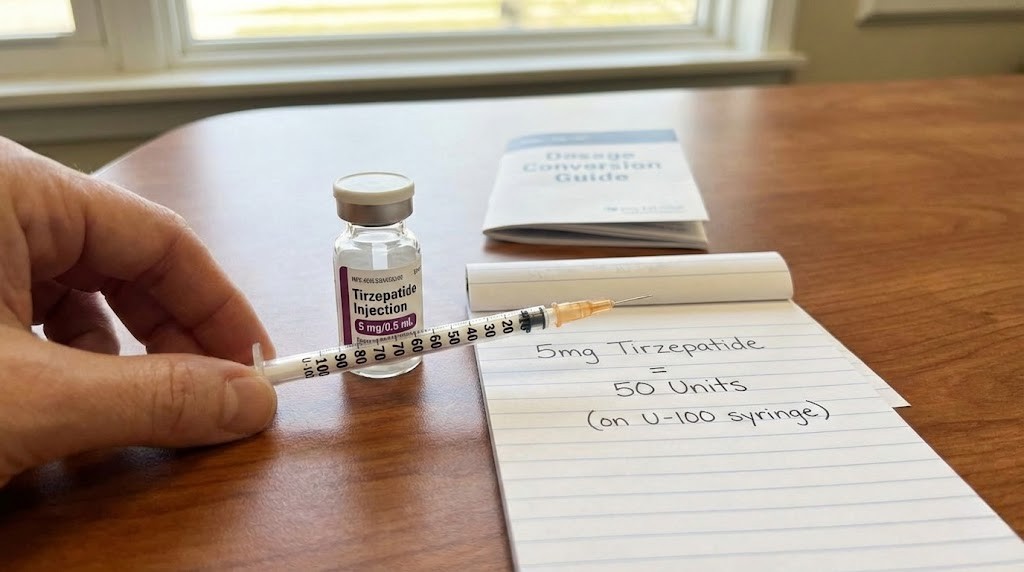
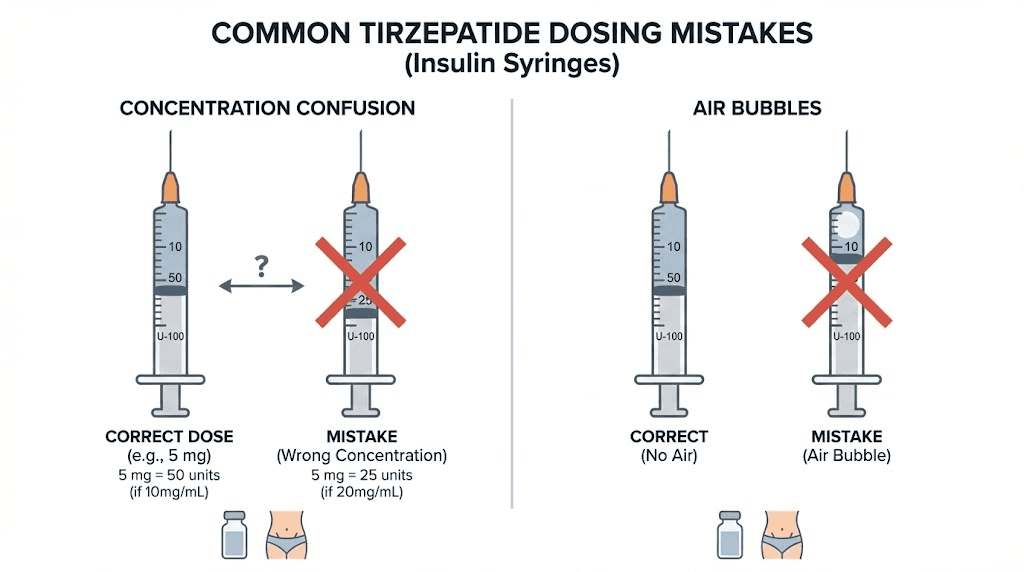
You drew up 50 units. You thought that was 5mg. But your vial says 20mg/mL, which means you just administered 10mg, double what you intended. This is not a hypothetical scenario. It happens every single day to people who confuse tirzepatide units with milligrams, and the consequences range from brutal nausea to emergency room visits.
The answer to "how many units is 5mg of tirzepatide" is not one number. It depends entirely on your vial concentration. With a 10mg/mL vial, 5mg equals 50 units. With a 20mg/mL vial, 5mg equals 25 units. With a 30mg/mL vial, 5mg equals just 16.7 units. Same dose. Completely different syringe readings. Get it wrong and you either waste your peptide or overdose yourself.
This guide breaks down every concentration you will encounter, walks you through the exact math, gives you reference charts you can bookmark, and explains the most common mistakes that lead to dosing errors. Whether you are using brand-name Mounjaro, Zepbound, or a compounded formulation, the conversion principles are identical. The math does not lie. But you have to know which numbers to plug in, and that is where most people get lost.
SeekPeptides members already have access to dosing calculators that handle these conversions automatically. But understanding the math behind the calculator makes you a safer, more confident researcher. So let us walk through every detail.
The fundamental formula for converting milligrams to units
Before looking at any chart, you need to understand one formula. It is simple. It is universal. And it works for every peptide, every concentration, every vial you will ever encounter.
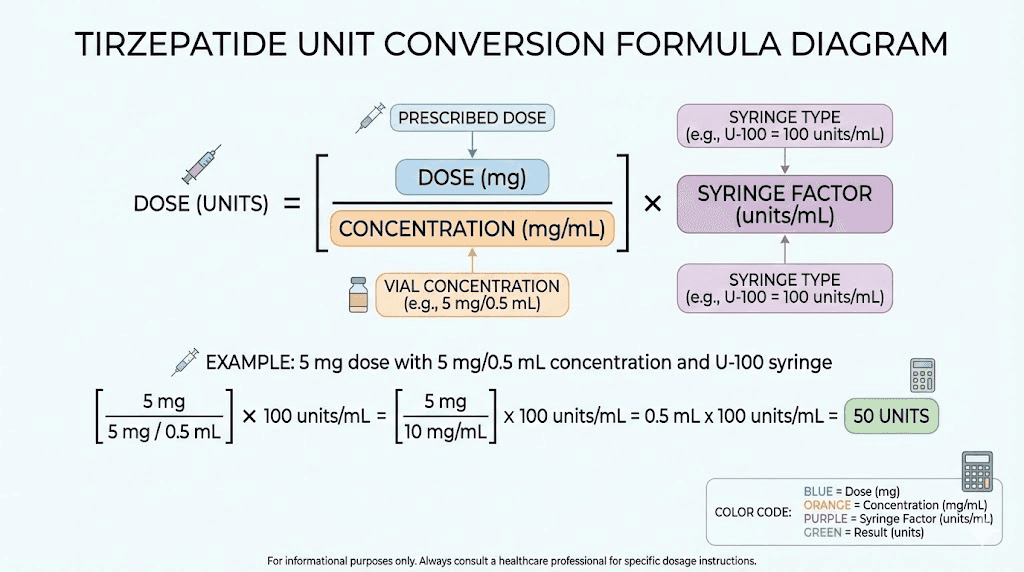
Units = (Desired dose in mg / Concentration in mg per mL) x 100
That is it. Three numbers. One division. One multiplication. The "100" comes from the fact that a standard U-100 insulin syringe holds 100 units per milliliter. Every single mark on that syringe represents 0.01 mL of liquid. So when you draw to the 50-unit line, you are pulling 0.5 mL. When you draw to 25 units, you are pulling 0.25 mL. The syringe measures volume, not medication strength.
For 5mg of tirzepatide at 10mg/mL concentration:
Units = (5 / 10) x 100 = 50 units
For 5mg of tirzepatide at 20mg/mL concentration:
Units = (5 / 20) x 100 = 25 units
For 5mg at 30mg/mL concentration:
Units = (5 / 30) x 100 = 16.7 units
Simple math. Life-changing when you get it right. Dangerous when you do not.
Why the answer changes based on vial concentration
Here is where people get confused. They think 5mg always equals the same number of units. It does not. Not even close.
Think of it like coffee. A shot of espresso and a mug of drip coffee can both contain 100mg of caffeine. But the espresso is 1 ounce and the drip is 8 ounces. Same caffeine, wildly different volumes. Tirzepatide works the same way. A highly concentrated vial packs more medication into less liquid. So you need fewer units on your syringe to get the same dose in milligrams.
The concentration tells you how many milligrams of tirzepatide are dissolved in each milliliter of liquid. A 10mg/mL vial has 10 milligrams per milliliter. A 20mg/mL vial has twice as much medication in the same volume. This is why switching between concentrations without recalculating is dangerous. Someone accustomed to drawing 50 units from a 10mg/mL vial who switches to 20mg/mL and draws the same 50 units just took 10mg instead of 5mg. That is a significant overdose that can cause severe nausea, vomiting, and other gastrointestinal distress.
Brand-name Mounjaro and Zepbound come in pre-filled pens, so concentration confusion is rare with those products. But compounded tirzepatide is a different story. Compounding pharmacies use various concentrations, often 10mg/mL, 17mg/mL, or 20mg/mL. Some use even higher concentrations. Every time you receive a new vial, check the label. Read the concentration. Then calculate your units.
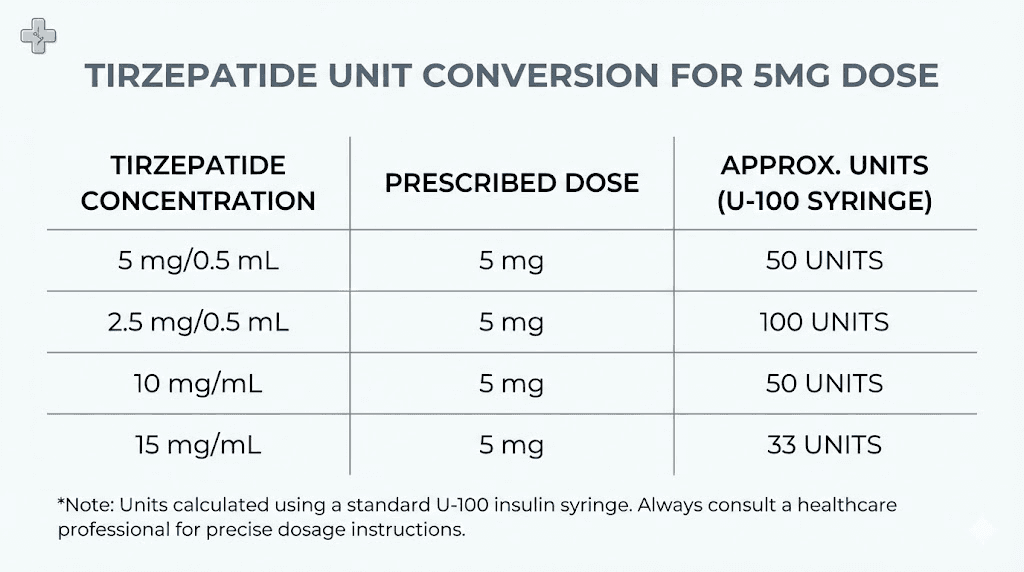
Complete conversion chart for 5mg of tirzepatide at every concentration
This is the chart you bookmark. Print it. Tape it to your refrigerator. Save it on your phone. Reference it every single time you draw up a dose until the numbers become second nature.
Vial concentration | Units for 5mg dose | Volume in mL | Common source |
|---|---|---|---|
5mg/mL | 100 units | 1.0 mL | Some compounded vials, lyophilized reconstitution |
8mg/mL | 62.5 units | 0.625 mL | Select compounding pharmacies |
10mg/mL | 50 units | 0.5 mL | Common compounded concentration |
12.5mg/mL | 40 units | 0.4 mL | Some compounding pharmacies |
15mg/mL | 33.3 units | 0.333 mL | Select compounding pharmacies |
17mg/mL | 29.4 units | 0.294 mL | Empower Pharmacy formulations |
20mg/mL | 25 units | 0.25 mL | Common high-concentration compounded |
30mg/mL | 16.7 units | 0.167 mL | Ultra-concentrated compounded |
Notice the massive range. At 5mg/mL, you need a full 100 units, the entire syringe. At 30mg/mL, you need just 16.7 units. If you grabbed the wrong number from this chart because you did not check your concentration, you could be administering anywhere from one-sixth to six times your intended dose. This is why accurate dosing starts with reading your vial label.
How to read your insulin syringe correctly
The syringe is not complicated. But if you have never used one, the markings can look intimidating. Understanding what each line means is essential for accurate tirzepatide dosing.
U-100 insulin syringe basics
A standard U-100 insulin syringe has 100 unit markings. Each unit equals 0.01 mL. The syringe typically comes in three sizes: 30 units (0.3 mL), 50 units (0.5 mL), and 100 units (1.0 mL). For a 5mg dose of tirzepatide, the syringe size you need depends on your concentration.
If your concentration is 20mg/mL, you need 25 units. A 30-unit or 50-unit syringe works perfectly. The smaller the syringe, the easier it is to read the markings precisely. If your concentration is 10mg/mL, you need 50 units. A 50-unit or 100-unit syringe will do. If your concentration is 5mg/mL, you need the full 100 units, so you must use a 1 mL syringe.
Reading the markings
On a 100-unit syringe, the major numbered lines typically appear at 10, 20, 30, 40, 50, 60, 70, 80, 90, and 100. Between each major line, you will find smaller marks representing 2-unit increments. So between the 20 and 30 lines, you will see marks at 22, 24, 26, and 28.
On a 50-unit syringe, every unit gets its own line. The numbered marks appear at 5, 10, 15, 20, 25, 30, 35, 40, 45, and 50. Individual lines between each number represent single units. This makes the 50-unit syringe significantly easier to read for precise dosing.
When drawing your dose, pull the plunger back slowly. Watch the black rubber tip of the plunger, not the plunger handle. The top edge of the rubber tip should align with your target unit line. If you draw past your target, do not push the plunger back into the vial, as this can introduce air bubbles. Instead, remove the needle, expel the excess into a clean surface, and start over with a fresh injection technique.
Common syringe reading mistakes
The most frequent error is reading from the wrong part of the plunger. Always read from the top edge of the rubber stopper, not the bottom. Depending on the syringe brand, this can represent a 1-3 unit difference, which may not sound like much but at high concentrations translates to meaningful dosing variations.
Another common mistake involves air bubbles. Small bubbles sitting at the top of the syringe can make it look like you have drawn more liquid than you actually have. Tap the syringe with your finger to move bubbles to the top, then gently push the plunger until the bubbles are expelled. The liquid should fill the syringe with no visible air gaps.
5mg tirzepatide at 10mg/mL concentration: the most common scenario
If you are using compounded tirzepatide, there is a good chance your vial is 10mg/mL. This has been one of the most widely available concentrations from compounding pharmacies, and the math is straightforward.
5mg at 10mg/mL = 50 units = 0.5 mL
Draw your syringe to the 50-unit mark. That gives you exactly half a milliliter of liquid containing 5 milligrams of tirzepatide. If you are using a 100-unit syringe, the 50-unit mark sits right at the halfway point. Hard to miss. Easy to verify.
This concentration is popular for a reason. The math is clean. The volumes are manageable. And dosing across the standard escalation schedule produces round numbers that are easy to draw:
Dose | Units at 10mg/mL | Volume |
|---|---|---|
2.5mg (starting) | 25 units | 0.25 mL |
5mg | 50 units | 0.5 mL |
7.5mg | 75 units | 0.75 mL |
10mg | 100 units | 1.0 mL |
Clean, whole numbers at every dose level. No fractions, no half-marks to estimate. This is one reason many clinicians prefer prescribing 10mg/mL formulations for patients who are new to self-injection. The simplicity reduces errors. For higher doses like 12.5mg or 15mg, you would need more than 100 units, which means drawing from the vial twice or using a larger syringe. Most people at those dose levels switch to a higher concentration vial instead.
5mg tirzepatide at 20mg/mL concentration: the higher concentration option
As tirzepatide dosing became more common, pharmacies started offering higher concentrations to reduce injection volume. A 20mg/mL vial is twice as potent per milliliter, meaning you need half the volume for any given dose.
5mg at 20mg/mL = 25 units = 0.25 mL
Just 25 units. A quarter of a milliliter. On a 50-unit syringe, you draw to the halfway mark. On a 100-unit syringe, you draw to the quarter mark. The smaller injection volume means less liquid under the skin, which many people find more comfortable. Less volume often means less injection site irritation.
Here is the complete dosing schedule at 20mg/mL:
Dose | Units at 20mg/mL | Volume |
|---|---|---|
2.5mg | 12.5 units | 0.125 mL |
5mg | 25 units | 0.25 mL |
7.5mg | 37.5 units | 0.375 mL |
10mg | 50 units | 0.5 mL |
12.5mg | 62.5 units | 0.625 mL |
15mg | 75 units | 0.75 mL |
Notice the half-unit values at 2.5mg and 7.5mg doses. Drawing exactly 12.5 units or 37.5 units requires precision. On a 50-unit syringe where individual units are marked, hitting the half-unit line is manageable. On a 100-unit syringe with 2-unit increments, estimating half units becomes less reliable. This is where a peptide calculator combined with a high-quality syringe makes a real difference.
The advantage of 20mg/mL shows at higher doses. A 15mg dose requires only 75 units, well within a single 100-unit syringe draw. With 10mg/mL, that same 15mg dose would require 150 units, which means two separate draws and two injection sites.
5mg tirzepatide from a reconstituted research vial
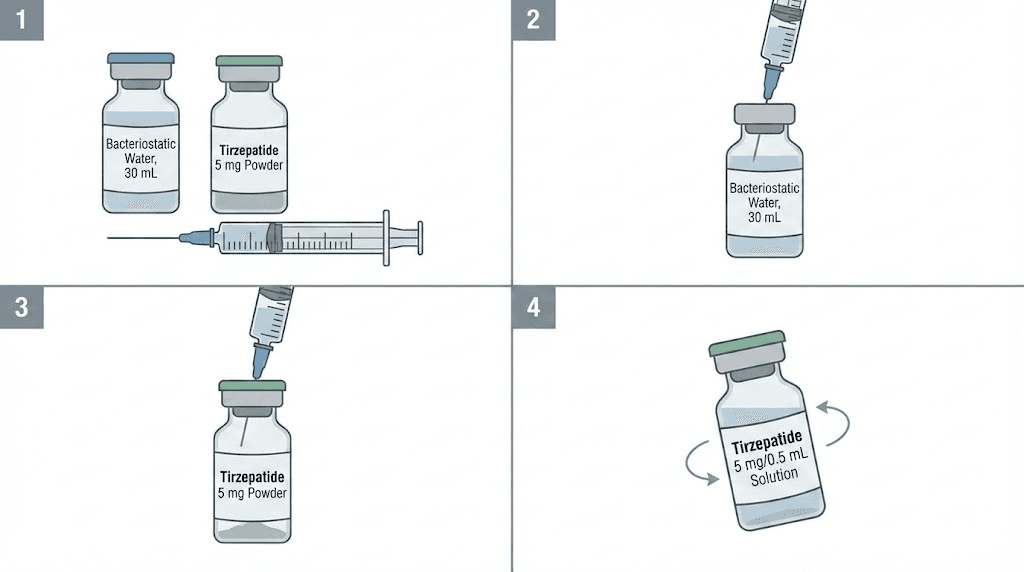
If you are reconstituting lyophilized tirzepatide powder with bacteriostatic water, the concentration is entirely in your hands. You choose how much water to add, and that choice determines your units-per-dose calculation.
Standard reconstitution for a 5mg vial
A 5mg vial of lyophilized tirzepatide powder contains exactly 5 milligrams of peptide. The amount of bacteriostatic water you add determines the concentration:
Water added to 5mg vial | Resulting concentration | Units for full 5mg |
|---|---|---|
0.5 mL | 10mg/mL | 50 units |
1.0 mL | 5mg/mL | 100 units |
2.0 mL | 2.5mg/mL | 200 units (2 draws) |
For a 5mg vial where you want the entire contents in one injection, adding 0.5 mL of bacteriostatic water gives you 10mg/mL. Draw 50 units and you have the full 5mg. Simple. But if you want to split the vial into two 2.5mg doses, adding 1.0 mL gives you 5mg/mL. Each 50-unit draw delivers 2.5mg. Two draws and the vial is empty.
Standard reconstitution for a 10mg vial
More commonly, you might have a larger research vial containing 10mg, 20mg, or even 30mg of lyophilized tirzepatide. Here is how reconstitution math works for a 10mg vial:
Water added to 10mg vial | Resulting concentration | Units for 5mg dose | Number of 5mg doses per vial |
|---|---|---|---|
1.0 mL | 10mg/mL | 50 units | 2 doses |
2.0 mL | 5mg/mL | 100 units | 2 doses |
Adding 1.0 mL to a 10mg vial creates a 10mg/mL solution. Each 50-unit draw gives you 5mg, and the vial provides two full doses. Adding 2.0 mL creates a 5mg/mL solution. You need 100 units for each 5mg dose. Same number of doses from the vial, but each draw is larger.
The general recommendation is to add enough water for easy measurement without creating volumes so large that accuracy suffers. For most researchers, 1-2 mL per 5-10mg of peptide is the sweet spot. The reconstitution calculator at SeekPeptides handles this math automatically.
The dose escalation schedule and where 5mg fits
Five milligrams is not a starting dose. It is the second step in the standard tirzepatide escalation schedule. Understanding where it falls in the progression helps you plan your dosing timeline and manage expectations around results and side effects.
The standard FDA-approved schedule
Tirzepatide follows a gradual dose escalation to minimize gastrointestinal side effects:
Weeks 1-4: 2.5mg once weekly (starting dose for tolerance assessment)
Weeks 5-8: 5mg once weekly (first therapeutic dose)
Weeks 9-12: 7.5mg once weekly (if additional efficacy needed)
Weeks 13-16: 10mg once weekly (moderate-high dose)
Weeks 17-20: 12.5mg once weekly (high dose)
Week 21+: 15mg once weekly (maximum dose)
The 2.5mg starting dose is not really about weight loss. It is about letting your body adjust. Most people experience minimal appetite suppression at 2.5mg. The magic starts at 5mg. Clinical trial data from the SURMOUNT-1 study showed that participants on 5mg weekly lost an average of 15% of their body weight over 72 weeks. That translates to roughly 34 pounds for someone starting at 230 pounds.
Five milligrams is where many people first notice real appetite changes. Food thoughts quiet down. Portions shrink naturally. Cravings for high-calorie foods diminish. The GLP-1 and GIP receptor activation reaches therapeutic levels at this dose, and for some people, 5mg provides all the efficacy they need without escalating further.
Why some people stay at 5mg
Not everyone needs 15mg. The clinical trials tested escalation to maximum dose, but in practice, many researchers find their sweet spot at 5mg or 7.5mg. If you are losing weight steadily, appetite is controlled, and side effects are manageable, there is no clinical requirement to increase. Higher doses mean more medication consumed, higher cost, and potentially more side effects without proportionally more benefit.
The SURMOUNT-1 trial data is revealing. The 5mg group lost 15% of body weight. The 10mg group lost 19.5%. The 15mg group lost 20.9%. The jump from 5mg to 10mg provided 4.5 percentage points of additional weight loss. The jump from 10mg to 15mg provided only 1.4 additional percentage points. Diminishing returns. For many people, the cost-benefit analysis favors staying at a lower effective dose.
Common dosing mistakes and how to avoid them
Dosing errors with tirzepatide are disturbingly common. Most of them come down to the same handful of mistakes. Knowing what they are protects you from making them.
Mistake 1: assuming units equal milligrams
This is the most dangerous misconception. Units and milligrams measure completely different things. Units measure volume on the syringe. Milligrams measure the amount of active medication. The concentration of your vial is the bridge between them.
If someone tells you "take 50 units of tirzepatide" without specifying the concentration, that advice is meaningless and potentially dangerous. Fifty units from a 10mg/mL vial is 5mg. Fifty units from a 20mg/mL vial is 10mg. Fifty units from a 5mg/mL vial is 2.5mg. The same "50 units" delivers three completely different doses depending on what is in your vial.
Mistake 2: switching concentrations without recalculating
This happens when a pharmacy changes your formulation. You have been drawing 50 units from a 10mg/mL vial for weeks. Everything is going well. Then your new shipment arrives and the vial says 20mg/mL. You draw the same 50 units out of habit. Congratulations, you just took 10mg instead of 5mg.
Every new vial, every new batch, every new pharmacy, check the concentration label. Make it a ritual. Before the needle touches the vial, read the label. Then calculate. Then draw.
Mistake 3: using the wrong syringe type
Not all syringes are U-100 insulin syringes. Tuberculin syringes, while similar in appearance, measure in milliliters with different markings. A chart designed for insulin syringe units produces incorrect doses when read on a tuberculin syringe. Always confirm you are using a standard U-100 insulin syringe for tirzepatide. The packaging will say "U-100" or "100 units/mL" somewhere on the label.
Mistake 4: not accounting for dead space
Standard syringes have a small amount of dead space in the hub where the needle attaches. This means the last few units of liquid in a vial may be inaccessible. Low dead space syringes reduce this waste, but if you are trying to extract every last unit from a vial, factor in approximately 2-5 units of liquid that will remain in the syringe hub. Over the course of a multi-dose vial, this adds up. A 10mg/mL vial with 2 mL total should provide 200 units. But with dead space losses of 3-5 units per draw, you might only get 185-190 usable units from the vial.
Mistake 5: ignoring air bubbles
Air bubbles displace liquid in the syringe. If you have a large air bubble at the 10-unit mark and you draw to 50 units, you do not have 50 units of tirzepatide. You have roughly 40 units of tirzepatide and 10 units of air. Flick the syringe to move bubbles to the top, then push the plunger gently until the air is expelled and a small drop of liquid appears at the needle tip. Now draw to your target again.
Brand-name tirzepatide versus compounded: how the units differ
There are two fundamentally different ways people get tirzepatide, and the unit conversion works differently for each.
Mounjaro and Zepbound pre-filled pens
Brand-name tirzepatide from Eli Lilly comes in pre-filled, single-dose injector pens. Each pen contains one specific dose. The 5mg pen delivers exactly 5mg. You do not need to calculate units because the pen does it for you. There is no vial to draw from, no syringe to read, no concentration to verify.
The branded pen uses a fixed concentration where 5mg is delivered in 0.5 mL. You click the pen, press it against your skin, and the entire dose is administered automatically. For people who want simplicity and zero math, the branded pen eliminates all conversion confusion. But it also comes at a significantly higher price point, which is why many people turn to compounded alternatives.
Compounded tirzepatide multi-dose vials
Compounded tirzepatide comes in multi-dose vials that require you to draw up your own doses using an insulin syringe. This is where all the unit conversion math becomes critical. Every compounding pharmacy may use a different concentration, and even the same pharmacy might change concentrations between batches.
Common compounded concentrations include:
5mg/mL (lower concentration, larger injection volume)
10mg/mL (most common, balanced concentration)
17mg/mL (used by some specialty pharmacies)
20mg/mL (higher concentration, smaller injection volume)
Some compounded formulations include additional ingredients like niacinamide, vitamin B12, or glycine. These additions do not change the concentration math. The tirzepatide concentration is always listed separately on the vial label, regardless of what else is in the solution.
How 5mg of tirzepatide compares to other common doses
Perspective helps. Knowing where 5mg sits relative to other doses, and relative to semaglutide equivalents, gives you a clearer picture of what to expect.
Tirzepatide dose comparison with unit values
Dose | Units at 10mg/mL | Units at 20mg/mL | Clinical context |
|---|---|---|---|
2.5mg | 25 units | 12.5 units | Starting dose, tolerance building only |
5mg | 50 units | 25 units | First therapeutic dose, 15% average weight loss |
7.5mg | 75 units | 37.5 units | Mid-range, moderate escalation |
10mg | 100 units | 50 units | Higher efficacy, 19.5% average weight loss |
12.5mg | 125 units (2 draws) | 62.5 units | High dose |
15mg | 150 units (2 draws) | 75 units | Maximum dose, 20.9% average weight loss |
At 10mg/mL, doses above 10mg require more than a single 100-unit syringe draw. This is a practical limitation that pushes many users toward 20mg/mL concentration at higher dose levels. At 20mg/mL, even the maximum 15mg dose fits comfortably in a single draw at 75 units.
Tirzepatide 5mg versus semaglutide dose equivalence
People often ask how 5mg of tirzepatide compares to semaglutide doses. The medications are not directly interchangeable, but the clinical data suggests rough equivalencies:
Tirzepatide 5mg produces weight loss roughly comparable to semaglutide 1.7-2.4mg
Tirzepatide 10mg produces weight loss roughly comparable to semaglutide 2.4mg
Tirzepatide 15mg exceeds the weight loss seen at semaglutide 2.4mg (the maximum approved dose)
This comparison matters for people switching between medications. If you were on semaglutide 1mg and transitioning to tirzepatide, starting at 2.5mg and escalating to 5mg would put you in a roughly equivalent therapeutic range.
Using the SeekPeptides calculator for instant conversions
Manual math works. But humans make arithmetic errors, especially when they are nervous about self-injection. Calculator tools eliminate that risk.
The peptide dosage calculator at SeekPeptides does the conversion in seconds. Enter your vial concentration, enter your desired dose in milligrams, and it outputs the exact number of units to draw. No formula to remember. No mental math. Just accurate numbers every time.
For tirzepatide specifically, the calculator accounts for common concentrations and provides visual syringe diagrams showing exactly where to draw. It also works for reconstituted peptides where you need to calculate concentration based on the amount of bacteriostatic water added.
If you are reconstituting a lyophilized vial, the reconstitution calculator tells you exactly how much water to add to achieve your target concentration. Plug in the vial size (5mg, 10mg, 20mg, etc.), enter your desired concentration, and it calculates the water volume. From there, the dosage calculator converts milligrams to units. Two tools, zero guesswork.
What to expect at the 5mg dose level
Knowing the unit conversion is only half the picture. Understanding what 5mg of tirzepatide actually does in your body helps you gauge whether your dose is working as expected.
Appetite and hunger changes
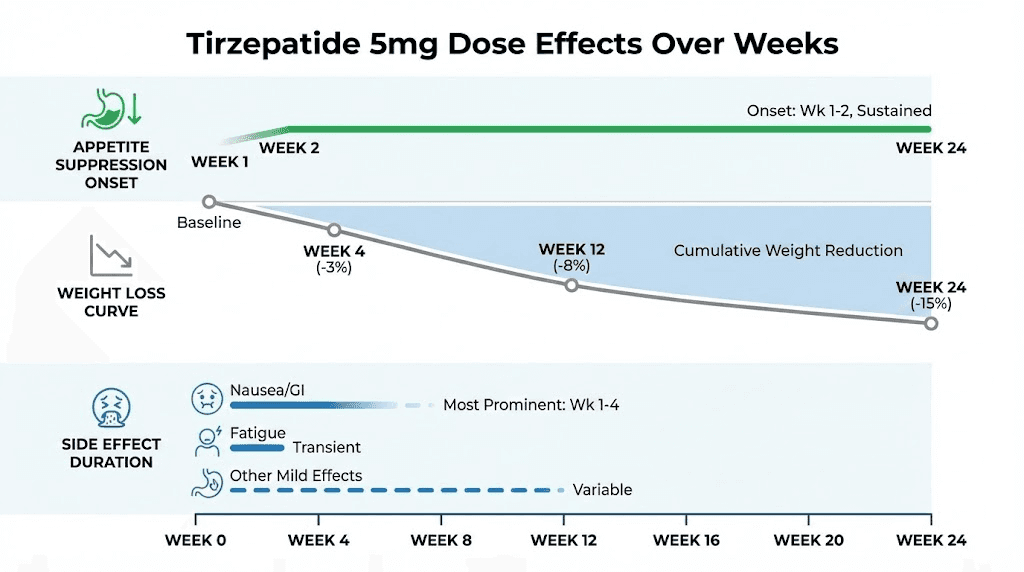
At 5mg, most people experience noticeable appetite suppression within the first 1-2 weeks. The dual GIP and GLP-1 receptor activation slows gastric emptying, meaning food stays in your stomach longer. You feel full sooner. You stay full longer. The constant background hum of hunger that many people live with starts to quiet.
Some people describe it as food noise disappearing. The constant mental calculations about meals, snacks, and cravings fade. You eat because you need to, not because you are driven by compulsive hunger. This effect was present but weaker at 2.5mg. At 5mg, it becomes undeniable for most people.
Weight loss trajectory
The SURMOUNT-1 clinical trial tracked 5mg participants for 72 weeks. Average weight loss followed a predictable curve. Minimal change in weeks 1-4 during the 2.5mg starting period. Noticeable loss beginning weeks 5-8 at 5mg. Steady progression through months 2-6. Weight loss rate gradually slowing as the body approaches a new equilibrium. The average endpoint was 15% of starting body weight.
But averages hide individual variation. Some 5mg participants lost 20% or more. Others lost 8-10%. Factors influencing response include starting weight, dietary choices, physical activity, metabolic health, and genetic factors related to receptor sensitivity. If you are not seeing expected results at 5mg, the troubleshooting guide covers common reasons and solutions.
Side effects at 5mg
Gastrointestinal side effects are most common during dose transitions. Moving from 2.5mg to 5mg represents a doubling of the dose, and many people experience temporary nausea, reduced appetite beyond what is therapeutic, and sometimes diarrhea or constipation. These effects typically peak during the first 1-2 weeks at the new dose and then subside.
In the SURMOUNT-1 trial, nausea affected approximately 24% of participants in the 5mg group. About 80% of those cases were mild to moderate and resolved without treatment. Fewer than 5% of participants discontinued due to side effects at this dose level. Eating smaller meals, avoiding greasy or heavily processed foods, and staying hydrated helps manage gastrointestinal symptoms during the adjustment period.
Fatigue is another commonly reported effect at the 5mg dose. The reduced caloric intake combined with metabolic changes can leave people feeling low-energy, especially in the first few weeks. Adequate protein intake, hydration, and a B12 supplement help counteract this.
Step-by-step guide to drawing up exactly 5mg
Theory is useful. Practice is what keeps you safe. Here is the complete sequence for drawing and administering 5mg of tirzepatide from a multi-dose vial.
Before you start
Wash your hands thoroughly with soap and water
Gather supplies: alcohol swabs, insulin syringe, tirzepatide vial
Check the vial label for concentration (mg/mL)
Calculate your units: (5 / concentration) x 100
Verify the math, then verify it again
Check the solution for particles or discoloration (it should be clear)
Drawing the dose
Clean the vial stopper with an alcohol swab and let it dry
Remove the syringe cap and pull the plunger back to your target unit mark, filling the syringe with air
Insert the needle through the vial stopper and push the air into the vial (this equalizes pressure and makes drawing easier)
Invert the vial so the needle tip is submerged in liquid
Pull the plunger back slowly, past your target by 5-10 units
Tap the syringe barrel to move air bubbles to the top
Push the plunger gently to expel air and excess liquid until you reach exactly your target unit mark
Remove the needle from the vial
Administering the injection
Choose your injection site. The three approved areas are the abdomen (at least 2 inches from the navel), the front of the thigh, or the back of the upper arm. Rotate sites weekly to prevent lipodystrophy. Clean the injection site with an alcohol swab and let it dry completely.
Pinch the skin at your injection site. Insert the needle at a 90-degree angle in one smooth motion. Release the skin pinch. Push the plunger steadily until the syringe is empty. Wait 5-10 seconds with the needle still inserted, then withdraw in one smooth motion. Apply gentle pressure with a clean cotton ball or gauze if there is any bleeding. Do not rub the injection site.
Dispose of the syringe in a proper sharps container. Never recap, bend, or break used needles. Record your dose, the date, the injection site, and any observations about side effects in your tracking log.
Tirzepatide storage and how it affects your dosing accuracy
Storage impacts potency. Reduced potency means your 5mg dose might not actually deliver 5mg of active medication. Understanding proper storage protects your investment and your results.
Unopened vials
Store unopened tirzepatide vials in the refrigerator at 2-8 degrees Celsius (36-46 degrees Fahrenheit). Keep them away from light. Do not freeze. Lyophilized powder is more stable than reconstituted solution and can tolerate brief temperature excursions, but refrigeration is always preferred.
After opening or reconstitution
Once you puncture a vial or reconstitute a lyophilized powder, the clock starts ticking. Most compounded tirzepatide should be used within 28 days of first use. Reconstituted lyophilized tirzepatide with bacteriostatic water typically lasts 28 days refrigerated. Store opened vials upright in the refrigerator. Mark the vial with the date opened using a permanent marker.
Never leave tirzepatide at room temperature for extended periods. Brief excursions during injection preparation (15-30 minutes) are fine. But leaving a vial on the counter overnight or in a warm car can degrade the peptide. You will still draw the same number of units, but the actual active medication in those units may be reduced. This is one reason people experience diminished results without changing their dose, degraded medication from improper storage.
How to verify you are getting the right amount
Trust but verify. Here are practical methods to confirm your 5mg dose is accurate.
The weight method
A precision scale accurate to 0.01 grams can verify your draw volume. Water weighs 1 gram per mL. So a 0.5 mL draw should weigh approximately 0.5 grams. The actual weight will be slightly different since tirzepatide solutions are not pure water, but this provides a ballpark verification. If you draw what should be 50 units (0.5 mL) and it weighs 0.3 grams, something is wrong, likely air bubbles or a misread syringe.
The visual verification method
Hold the filled syringe at eye level against a white background. The liquid line should be clean and sharp at your target unit mark. If the line appears curved (meniscus effect), read from the bottom of the curve. The liquid should be uniform in color with no visible particles, separation, or cloudiness.
The count method
For multi-dose vials, track how many doses you extract. A 10mg/mL vial containing 2 mL should provide exactly four 5mg doses (50 units each). If you get three doses and find the fourth draw comes up short, you are either drawing too much each time or losing significant amounts to dead space. Adjust accordingly for future vials.
When 5mg is not working and dose adjustment considerations
Sometimes 5mg is not enough. Sometimes it is too much. Understanding when and how to adjust requires nuance.
Signs you may need a higher dose
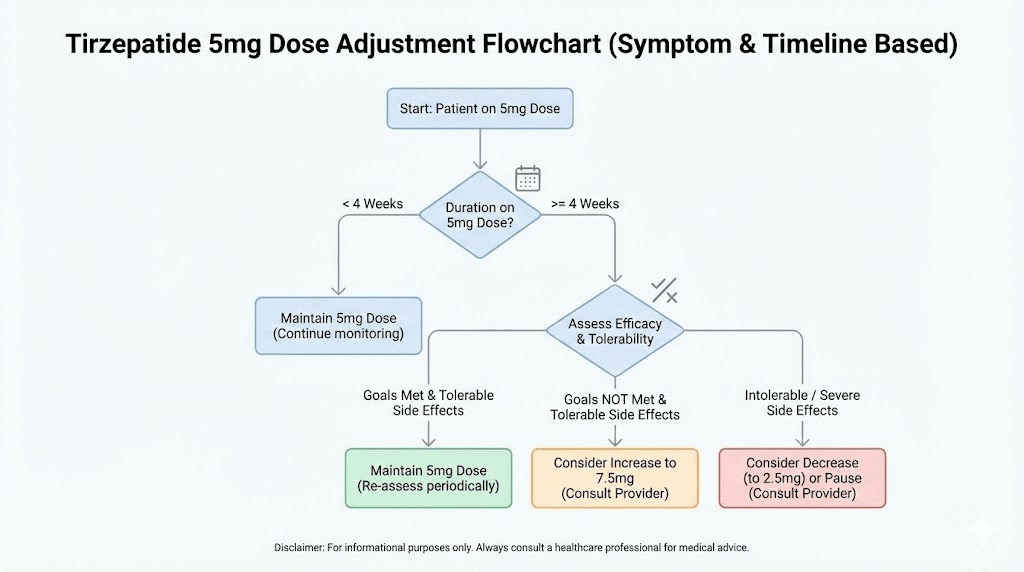
If you have been on 5mg for at least 4 weeks and experience minimal appetite suppression, no meaningful weight change, and no gastrointestinal side effects at all, your body may require a higher dose to achieve therapeutic levels. Some people metabolize tirzepatide more quickly, reducing its effective duration between weekly doses. Escalation to 7.5mg after a minimum of 4 weeks at 5mg is standard protocol.
Signs 5mg may be too much
Severe, persistent nausea that lasts beyond the first 2 weeks. Vomiting after most meals. Complete inability to eat. Significant fatigue that interferes with daily activities. These suggest 5mg may be hitting too hard. A microdosing approach, dropping to 3.75mg or even returning to 2.5mg temporarily, allows your receptors to adjust more gradually.
At 10mg/mL concentration, 3.75mg equals 37.5 units. At 20mg/mL, it equals 18.75 units. These non-standard doses are not available in brand-name pens but are easily achieved with compounded vials and a syringe. This dosing flexibility is one of the primary advantages of compounded formulations.
The role of timing
When you inject matters. Most people find that injecting in the evening reduces next-day nausea because the initial peak occurs during sleep. Others prefer morning injections to align with their activity schedule. There is no universally correct time. But if side effects at 5mg are problematic, switching your injection time can make a meaningful difference before considering a dose change.
Frequently asked questions
Is 5mg of tirzepatide the same as 50 units?
Only if your vial concentration is 10mg/mL. At 20mg/mL, 5mg equals 25 units. At 5mg/mL, 5mg equals 100 units. Always check your vial concentration before converting milligrams to units.
Can I use a regular syringe instead of an insulin syringe?
You can use a tuberculin syringe marked in milliliters, but you would measure in mL rather than units. For 5mg at 10mg/mL, you would draw 0.5 mL. However, U-100 insulin syringes provide finer graduation marks that make precise dosing easier, especially at smaller volumes.
What happens if I accidentally take too many units?
Taking more than intended causes increased gastrointestinal side effects, primarily nausea, vomiting, and diarrhea. If you realize the error immediately, contact your healthcare provider. Do not attempt to "compensate" by skipping your next dose. Stay hydrated, eat bland foods if tolerated, and monitor your symptoms. Most side effects from a single overdose resolve within 48-72 hours.
Does the brand-name Mounjaro 5mg pen use the same number of units?
The Mounjaro pen delivers 5mg in a fixed 0.5 mL volume, which is equivalent to 50 units if measured on an insulin syringe. But you cannot draw from the pen with a syringe, and you should not attempt to. The pen is designed for single-use delivery of one pre-measured dose.
How do I convert 5mg to units if my vial has a concentration not listed in the chart?
Use the universal formula: Units = (5 / your concentration in mg per mL) x 100. For example, if your vial says 12mg/mL: Units = (5 / 12) x 100 = 41.7 units. The peptide calculator handles any concentration automatically.
Is 5mg of tirzepatide effective for weight loss?
Yes. The SURMOUNT-1 clinical trial demonstrated 15% average body weight loss with 5mg weekly over 72 weeks. Approximately 85% of participants on 5mg achieved at least 5% weight loss, and 69% achieved at least 10%. This makes 5mg a clinically meaningful dose, not just a stepping stone to higher doses.
Should I round up or down when the units calculation gives a decimal?
Round to the nearest unit mark you can confidently draw on your syringe. For 16.7 units, drawing to 17 gives you slightly more than 5mg. Drawing to 16 gives you slightly less. On a 50-unit syringe with individual unit markings, you can split the difference. On a 100-unit syringe with 2-unit increments, choose the nearest even number. The difference of one unit at any concentration is clinically insignificant.
How many 5mg doses can I get from a typical compounded vial?
It depends on the total vial volume and concentration. A 2 mL vial at 10mg/mL contains 20mg total, which provides four 5mg doses. A 4 mL vial at 20mg/mL contains 80mg total, which provides sixteen 5mg doses. Always check both the concentration and total volume on your vial label to plan your supply duration.
Quick reference card: 5mg tirzepatide at every concentration
Save this section. Screenshot it. Bookmark it. Use it every time you draw a dose.
Your vial says | Draw this many units for 5mg | That equals this many mL |
|---|---|---|
5mg/mL | 100 units | 1.0 mL |
8mg/mL | 62.5 units | 0.625 mL |
10mg/mL | 50 units | 0.5 mL |
12.5mg/mL | 40 units | 0.4 mL |
15mg/mL | 33 units | 0.33 mL |
17mg/mL | 29 units | 0.29 mL |
20mg/mL | 25 units | 0.25 mL |
25mg/mL | 20 units | 0.2 mL |
30mg/mL | 17 units | 0.17 mL |
The formula never changes: Units = (5 / concentration) x 100. Memorize it. Tattoo it. Whatever it takes.
For researchers serious about accuracy, safety, and optimized protocols, SeekPeptides provides comprehensive dosing calculators, expert-reviewed guides, and a community of thousands who have navigated these exact questions. Every dosing decision becomes simpler with the right tools and the right knowledge behind it.
External resources
In case I do not see you, good afternoon, good evening, and good night. May your conversions stay accurate, your syringes stay precise, and your results stay consistent.