Feb 11, 2026
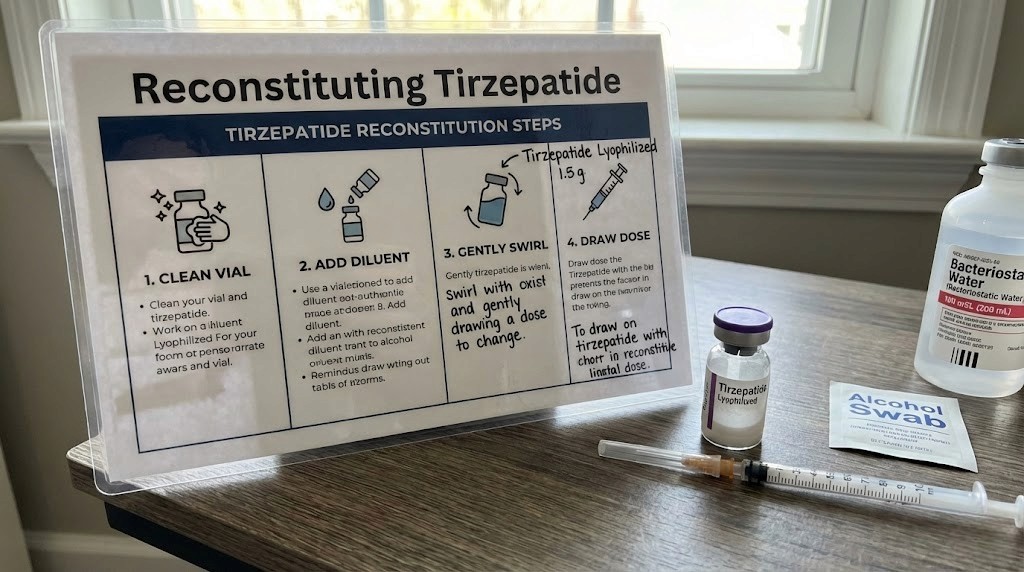
You are staring at a vial of lyophilized tirzepatide powder, a syringe in one hand and a bottle of bacteriostatic water in the other, and absolutely nothing about this process feels intuitive. The numbers do not add up. The online forums contradict each other. One source says add 1 mL of water. Another says 2 mL. A third says it depends on the concentration you want, but never actually explains what concentration means in practical terms. Meanwhile, the powder just sits there, expensive and fragile, waiting for you to either get it right or waste the entire vial on a math error.
This is not an uncommon problem. Reconstituting tirzepatide intimidates even experienced researchers, and for good reason. Unlike pre-filled injection pens that arrive ready to use, compounded tirzepatide in lyophilized form requires precise mixing before it becomes usable. The amount of bacteriostatic water you add determines the concentration. The concentration determines how many units you draw. And the units determine whether you are getting 2.5 mg or accidentally injecting 7.5 mg. One miscalculation cascades into another.
What most guides get wrong is assuming you already understand the relationship between milligrams, milliliters, and syringe units. They skip the foundational math and jump straight to instructions that only make sense if you have done this before. This guide does not make that assumption. Every reconstitution chart below includes the exact water volume, resulting concentration, and unit-by-unit breakdown for standard insulin syringes. Whether you have a 5 mg vial or a 30 mg vial, whether you want a simple concentration or a specific one for microdosing, the charts cover it. SeekPeptides has built these reference tables from the most commonly used reconstitution protocols, cross-referenced with standard dosing schedules, so you can mix with confidence and dose with precision.
What reconstituting tirzepatide actually means
Reconstitution is the process of adding a liquid solvent to a freeze-dried powder to create an injectable solution. Tirzepatide in its compounded form arrives as a lyophilized cake or powder inside a sealed glass vial. This lyophilized format preserves the peptide structure during shipping and storage, giving it a much longer shelf life than a pre-mixed liquid would have. But it cannot be injected as a powder. You need to dissolve it first.
The liquid you use matters enormously.
Bacteriostatic water contains 0.9% benzyl alcohol, which inhibits bacterial growth and allows you to safely draw from the same vial multiple times over several weeks. Sterile water, by contrast, contains no preservative. Once you puncture a vial mixed with sterile water, it becomes a single-use container. Any leftover solution must be discarded within 24 hours. For most researchers working with compounded tirzepatide, bacteriostatic water is the correct and preferred choice because it extends the usable life of each vial to approximately 28 days when refrigerated properly.
The reconstitution process itself is straightforward in theory. You draw a specific volume of bacteriostatic water into a syringe, inject it slowly into the vial, and gently mix until the powder dissolves completely. But the details matter. How you inject the water, how you mix, how much water you use, and how you store the result all determine whether your tirzepatide retains its potency or degrades into an expensive, useless liquid.
Why concentration matters more than you think
Here is where most people get confused. The amount of water you add to your vial does not change how much tirzepatide is in the vial. A 10 mg vial contains 10 mg of tirzepatide regardless of whether you add 1 mL or 2 mL of water. What changes is the concentration, the amount of tirzepatide per milliliter of solution.
Think of it like mixing a drink. You have one scoop of powder. Add a small glass of water and you get a strong, concentrated drink. Add a large glass and you get a diluted one. Same amount of powder either way. The difference is how much you need to drink to get the full scoop.
With tirzepatide, concentration directly determines how many syringe units you need to draw for your target dose. A higher concentration means you draw less liquid for the same milligram dose. A lower concentration means you draw more. Neither is inherently better. Higher concentrations are convenient for larger doses because they require less injection volume. Lower concentrations are easier for precise microdosing because each unit on the syringe represents a smaller amount of tirzepatide, giving you finer control.
The dosage charts throughout this guide present multiple concentration options for each vial size so you can choose the one that best matches your dosing protocol.
Essential supplies for reconstituting tirzepatide
Before you touch the vial, gather everything you need. Stopping midway through reconstitution to search for a missing item introduces contamination risk and breaks your sterile workflow.
Required supplies
You will need your tirzepatide vial (lyophilized powder), bacteriostatic water (not sterile water, not saline), alcohol swabs (70% isopropyl), insulin syringes (U-100 type, typically 1 mL or 0.5 mL), and a clean, flat workspace. Some researchers also keep a sharps container for used needles and a small notepad to record the date of reconstitution and the concentration created.
Insulin syringes deserve special attention here. The U-100 designation means the syringe is calibrated so that 100 units equals 1 mL of liquid. This is critical for the unit conversion charts below. Every chart in this guide assumes you are using a standard U-100 insulin syringe. If you use a different syringe type, the unit markings will not match the calculations, and your doses will be wrong.
For smaller doses, a 0.5 mL syringe (50 units max) offers better precision because the unit markings are more spread out and easier to read. For larger doses or when working with low concentrations that require drawing more than 50 units, use a 1 mL syringe (100 units max). Some researchers keep both sizes on hand.
What NOT to use
Do not use normal saline (0.9% sodium chloride) as your diluent. Saline can cause precipitation and peptide inactivation with certain peptides, including tirzepatide. Do not use tap water, distilled water from a grocery store, or any non-pharmaceutical grade liquid. Do not reuse syringes. Do not use bacteriostatic water that has been open for more than 28 days or shows any cloudiness or particles.
The reconstitution process: step by step
This is the actual procedure. Read through all the steps once before starting. Having the full picture in your mind prevents hesitation and errors during the process itself.
Step 1: Clean your workspace
Wipe down your surface with isopropyl alcohol. Wash your hands thoroughly with soap and warm water for at least 20 seconds. Some researchers wear disposable nitrile gloves, which is a good practice but not strictly required if your hands are freshly washed. The goal is minimizing bacterial contamination at every point of contact.
Step 2: Prepare the vial
Remove the plastic flip-off cap from the tirzepatide vial. You will see a rubber stopper underneath. Swab the rubber stopper thoroughly with an alcohol pad and let it air dry for 10 to 15 seconds. Do not blow on it. Do not wipe it dry. Let the alcohol evaporate naturally. This creates a sterile entry point for your syringe needle.
Step 3: Draw the bacteriostatic water
Swab the top of your bacteriostatic water vial with a fresh alcohol pad. Using a clean syringe, draw the exact amount of water specified in the reconstitution chart for your desired concentration. Pull the plunger back slowly to avoid introducing air bubbles. If you see bubbles, tap the syringe gently and push the air out before proceeding.
Precision matters here. If the chart says 1 mL (100 units), draw exactly 100 units. If it says 2 mL (200 units), you may need to draw twice with a 1 mL syringe. Even small deviations in water volume change your concentration and throw off every subsequent dose calculation.
Step 4: Inject the water into the tirzepatide vial
This is the step where most mistakes happen.
Insert the needle through the rubber stopper at a slight angle. Do not aim the stream of water directly at the powder cake. Instead, direct the water toward the inside wall of the vial, letting it trickle down the glass and pool at the bottom. Inject slowly. Take 15 to 30 seconds for the full volume. Rushing creates foam, and foam means denatured peptide.
Why does this matter so much? Tirzepatide is a large peptide molecule with a specific three-dimensional structure that determines its biological activity. Aggressive force, rapid injection, or vigorous agitation can disrupt this structure through a process called mechanical denaturation. The peptide still exists in the vial, but its shape has changed enough that it no longer binds properly to GIP and GLP-1 receptors. You cannot see denaturation. The solution looks the same. But it has lost potency.
Step 5: Mix gently
After injecting all the water, do not shake the vial. Ever. Shaking creates thousands of tiny air bubbles that violently batter the peptide molecules, accelerating denaturation. Instead, gently roll the vial between your palms using a slow, horizontal rolling motion. Think of it like rolling a pencil back and forth. Apply minimal pressure. Roll for 30 to 60 seconds.
If the powder has not fully dissolved, let the vial sit upright in the refrigerator for 5 to 10 minutes, then roll again. Some vials dissolve in seconds. Others take a few minutes. Patience here preserves potency.
Step 6: Inspect the solution
Hold the vial up to a light source and examine the solution carefully. It should be completely clear and colorless. No particles floating. No cloudiness. No visible chunks of undissolved powder. If you see any of these, continue gentle rolling. If the solution remains cloudy after 15 minutes of intermittent gentle mixing, something may be wrong with the peptide, the water, or the process. Do not use a cloudy solution.
Reconstituting tirzepatide chart: 5 mg vial
The 5 mg vial is one of the smaller sizes available and works well for researchers on lower-dose protocols or those just beginning a tirzepatide dosing schedule. The chart below shows three common reconstitution options with the resulting concentration and unit breakdowns for standard doses.
5 mg vial reconstitution chart
Bacteriostatic water added | Resulting concentration | 2.5 mg dose (units) | 5 mg dose (units) |
|---|---|---|---|
0.5 mL (50 units) | 10 mg/mL | 25 units | 50 units |
1.0 mL (100 units) | 5 mg/mL | 50 units | 100 units |
2.0 mL (200 units) | 2.5 mg/mL | 100 units | Full vial |
At 10 mg/mL (0.5 mL water), each 10 units on your syringe delivers 1 mg of tirzepatide. This is the most concentrated option and works well when you want smaller injection volumes. But it leaves less room for fine-tuning doses since each unit represents a larger amount of the peptide.
At 5 mg/mL (1.0 mL water), each 10 units delivers 0.5 mg. This is the most popular choice for the 5 mg vial because it balances injection volume with dosing precision. A 2.5 mg dose requires exactly 50 units, which is easy to measure on either a 0.5 mL or 1 mL syringe.
At 2.5 mg/mL (2.0 mL water), each 10 units delivers 0.25 mg. This dilute concentration is ideal for microdosing protocols where you need granular control over tiny dose adjustments. Researchers working with doses below 1 mg often prefer this ratio because it makes sub-milligram measurements practical.
Which concentration to choose for a 5 mg vial
If you are following a standard dosing protocol starting at 2.5 mg per week, the 5 mg/mL concentration (1.0 mL water) is the most practical. You get two doses per vial, each at 50 units, with clear markings on any standard syringe. For microdosing at doses like 0.5 mg or 1 mg, go with 2.5 mg/mL. You lose nothing by diluting more. The tirzepatide is the same amount regardless.
Reconstituting tirzepatide chart: 10 mg vial
The 10 mg vial is the most commonly used size for compounded tirzepatide. It provides enough peptide for multiple doses at standard starting amounts and offers flexibility across several concentration options. This is the vial size that most compounded tirzepatide users will encounter.
10 mg vial reconstitution chart
Bacteriostatic water added | Resulting concentration | 2.5 mg dose | 5 mg dose | 7.5 mg dose | 10 mg dose |
|---|---|---|---|---|---|
1.0 mL (100 units) | 10 mg/mL | 25 units | 50 units | 75 units | 100 units |
2.0 mL (200 units) | 5 mg/mL | 50 units | 100 units | 150 units | 200 units |
2.5 mL (250 units) | 4 mg/mL | 62.5 units | 125 units | 187.5 units | 250 units |
The 10 mg/mL concentration (1.0 mL water) is the cleanest option mathematically. Every 10 units equals exactly 1 mg. A 2.5 mg dose is 25 units. A 5 mg dose is 50 units. No fractions, no guessing. This makes it the preferred concentration for most researchers using the 10 mg vial, and it is the ratio you will see referenced most often in tirzepatide dosage charts across the board.
The 5 mg/mL concentration (2.0 mL water) doubles the volume, cutting the amount per unit in half. Each 10 units now delivers 0.5 mg. This is useful for researchers who need finer dosing control but do not need the extreme dilution of lower concentrations. The drawback is that higher doses (7.5 mg and above) require drawing more than 100 units, which means you may need multiple syringe draws or a larger syringe.
The 4 mg/mL concentration (2.5 mL water) is less common but appears in some compounding pharmacy protocols. It creates slightly awkward unit numbers for standard doses (62.5 units for 2.5 mg), which makes it harder to measure precisely. Unless your provider specifically recommends this concentration, stick with 10 mg/mL or 5 mg/mL for simplicity.
The math behind unit conversions
Understanding the formula prevents you from ever needing to memorize a chart. Here it is.
Units to draw = (desired dose in mg / concentration in mg per mL) x 100
That is the entire formula. Let us walk through an example. You have a 10 mg vial reconstituted with 1 mL of water, giving you a 10 mg/mL concentration. You want a 2.5 mg dose.
Units = (2.5 / 10) x 100 = 25 units.
Another example. Same vial, but you added 2 mL of water instead, creating a 5 mg/mL concentration. Same 2.5 mg target dose.
Units = (2.5 / 5) x 100 = 50 units.
Same amount of tirzepatide in both cases. Just different volumes drawn from the syringe. The peptide reconstitution calculator on our site can run these calculations instantly for any vial size and water volume combination, but knowing the formula gives you confidence that the numbers make sense.
Reconstituting tirzepatide chart: 15 mg vial
The 15 mg vial sits in a useful middle ground between the standard 10 mg and the larger 30 mg options. It works particularly well for researchers on moderate-dose protocols who want multiple weeks of supply from a single vial without the larger commitment (and cost) of a 30 mg vial.
15 mg vial reconstitution chart
Bacteriostatic water added | Resulting concentration | 2.5 mg dose | 5 mg dose | 7.5 mg dose | 10 mg dose | 15 mg dose |
|---|---|---|---|---|---|---|
1.5 mL (150 units) | 10 mg/mL | 25 units | 50 units | 75 units | 100 units | 150 units |
2.0 mL (200 units) | 7.5 mg/mL | 33 units | 67 units | 100 units | 133 units | 200 units |
3.0 mL (300 units) | 5 mg/mL | 50 units | 100 units | 150 units | 200 units | 300 units |
For the 15 mg vial, the 10 mg/mL concentration (1.5 mL water) keeps the math clean and consistent with the 10 mg vial charts above. If you titrate from 2.5 mg to 5 mg to 7.5 mg over the first several weeks, a single 15 mg vial at this concentration gives you six doses at 2.5 mg, three doses at 5 mg, or two doses at 7.5 mg. That flexibility makes it a strong choice for the standard titration schedule.
The 7.5 mg/mL concentration (2.0 mL water) creates an interesting option. A 7.5 mg dose becomes exactly 100 units, which is a full 1 mL syringe. This is convenient if 7.5 mg is your maintenance dose because you simply draw to the top line every time. But for other doses, the unit numbers are less clean (33 units for 2.5 mg requires careful measurement).
The 5 mg/mL concentration (3.0 mL water) provides the most granular control but results in larger injection volumes for higher doses. This is the best option if you are splitting your 15 mg vial into many small doses or if you need precise sub-milligram adjustments as part of a milliliter-based dosing protocol.
Reconstituting tirzepatide chart: 30 mg vial
The 30 mg vial is the largest commonly available size for compounded tirzepatide. It provides the best value per milligram for researchers on higher-dose protocols or those who want to minimize the number of vials they go through each month. At maintenance doses of 10 to 15 mg per week, a single 30 mg vial lasts two to three weeks.
30 mg vial reconstitution chart
Bacteriostatic water added | Resulting concentration | 2.5 mg dose | 5 mg dose | 7.5 mg dose | 10 mg dose | 12.5 mg dose | 15 mg dose |
|---|---|---|---|---|---|---|---|
2.0 mL (200 units) | 15 mg/mL | 17 units | 33 units | 50 units | 67 units | 83 units | 100 units |
3.0 mL (300 units) | 10 mg/mL | 25 units | 50 units | 75 units | 100 units | 125 units | 150 units |
6.0 mL (600 units) | 5 mg/mL | 50 units | 100 units | 150 units | 200 units | 250 units | 300 units |
For the 30 mg vial, the 10 mg/mL concentration (3.0 mL water) is the gold standard. It maintains the same easy math as the smaller vials: 10 units = 1 mg, 25 units = 2.5 mg, 50 units = 5 mg. Consistency across vial sizes eliminates confusion when you switch between them or compare notes with others using different vial sizes. Most compounding pharmacies and compounded tirzepatide dosing guides default to this ratio for the 30 mg vial.
The 15 mg/mL concentration (2.0 mL water) is the most concentrated practical option for this vial size. It minimizes injection volume, which some researchers prefer for subcutaneous comfort. A 15 mg dose becomes exactly 100 units, one full 1 mL syringe. But the trade-off is less precise measurement at lower doses. At 2.5 mg, you need only 17 units, and the difference between 16 and 18 units on an insulin syringe represents a meaningful dosing error at this concentration.
The 5 mg/mL concentration (6.0 mL water) is primarily for researchers who need maximum dosing precision or who are running microdosing protocols. The volume is large, which means drawing higher doses requires multiple syringe loads. But for low-dose applications, the granularity is excellent.
Universal reconstituting tirzepatide quick-reference chart
This master chart consolidates the most practical concentration for each vial size into a single reference. Pin this, bookmark it, or print it. Every entry uses the 10 mg/mL concentration because it offers the cleanest math across all vial sizes and maintains consistency whether you switch between a 10 mg and 30 mg vial next month.
Quick-reference chart (all vials at 10 mg/mL)
Vial size | Water to add | 2.5 mg | 5 mg | 7.5 mg | 10 mg | 12.5 mg | 15 mg |
|---|---|---|---|---|---|---|---|
5 mg | 0.5 mL | 25 units | 50 units | N/A | N/A | N/A | N/A |
10 mg | 1.0 mL | 25 units | 50 units | 75 units | 100 units | N/A | N/A |
15 mg | 1.5 mL | 25 units | 50 units | 75 units | 100 units | N/A | 150 units |
30 mg | 3.0 mL | 25 units | 50 units | 75 units | 100 units | 125 units | 150 units |
Notice the pattern. At 10 mg/mL, the unit numbers for each dose are identical regardless of vial size. 2.5 mg is always 25 units. 5 mg is always 50 units. The only thing that changes is how much water you add to achieve that concentration, which depends on how much tirzepatide powder is in the vial. This consistency is precisely why 10 mg/mL is the recommended starting concentration for anyone new to reconstituting tirzepatide.
SeekPeptides members access even more detailed protocol charts that include weekly titration schedules mapped to specific vial sizes, showing exactly when to open a new vial and how many doses each one provides at every stage of a standard escalation protocol.
Reading your insulin syringe correctly
The most precise reconstitution chart in the world becomes useless if you cannot accurately read the syringe you are drawing from. This sounds basic. It trips up more people than you would expect.
Understanding U-100 syringes
A U-100 insulin syringe has markings that divide 1 mL into 100 equal units. On a 1 mL (100-unit) syringe, each small line typically represents 2 units. The longer lines usually mark every 10 units. On a 0.5 mL (50-unit) syringe, each small line represents 1 unit, giving you twice the precision for the same range.
This is why the 0.5 mL syringe is recommended for doses under 50 units. When your target is 25 units (2.5 mg at 10 mg/mL), reading the 25th line on a 0.5 mL syringe is much easier and more accurate than trying to hit the midpoint between 24 and 26 on a 1 mL syringe where lines are spaced closer together.
How to read the meniscus
When liquid sits in a syringe, its surface curves slightly at the edges. This curve is called the meniscus. Always read the measurement at the bottom of the meniscus, where the liquid surface is flattest. Reading at the top of the curve adds approximately 1 to 2 units of error, which at high concentrations could represent 0.1 to 0.2 mg of tirzepatide.
Hold the syringe at eye level. Do not look down at it from above or up at it from below. Parallax, the optical illusion created by viewing at an angle, creates additional reading errors. Straight on, at eye level, reading the bottom of the meniscus. That is the accurate way.
Air bubbles and how to handle them
Small air bubbles in your syringe are not dangerous for subcutaneous injections. They will not cause an air embolism at these volumes. However, they do displace liquid, meaning you are injecting less tirzepatide than the syringe markings suggest. A 5-unit air bubble in a 25-unit draw means you are only injecting 20 units of actual solution.
To remove bubbles, hold the syringe needle-up and tap the barrel firmly with your fingernail. The bubbles will rise to the top near the needle. Push the plunger gently until a tiny droplet appears at the needle tip, expelling the air. Then re-measure and adjust to your target units. This takes an extra 10 seconds and ensures accurate unit-based dosing.
How different concentrations affect your dosing protocol
Choosing between concentrations is not just a convenience decision. It has practical implications for your entire tirzepatide dosing protocol, from how long each vial lasts to how precisely you can adjust doses during titration.
High concentration (10 mg/mL): fewer units, less precision
At 10 mg/mL, each unit on a U-100 syringe represents 0.1 mg of tirzepatide. This is fine for standard dose increments (2.5 mg, 5 mg, 7.5 mg) where you are drawing whole multiples of 25 units. But if you want to dose at, say, 3.75 mg (halfway between 2.5 and 5), you would need 37.5 units. That half-unit is essentially impossible to measure accurately on most syringes.
For standard weekly dosing following the typical titration schedule for weight loss, 10 mg/mL works perfectly. The standard doses align with clean unit numbers.
Medium concentration (5 mg/mL): balanced approach
At 5 mg/mL, each unit represents 0.05 mg. That 3.75 mg dose becomes 75 units, easy to measure. Microdoses of 0.5 mg become 10 units, also easy. The trade-off is that higher doses require more units. A 15 mg dose needs 300 units, which means three full 1 mL syringe draws. For researchers on higher maintenance doses, this gets tedious.
This concentration shines during the titration phase when you might want to adjust in smaller increments than the standard 2.5 mg jumps. Some protocols suggest increasing by 1.25 mg when side effects are a concern, and at 5 mg/mL, that 1.25 mg increase is a clean 25-unit adjustment.
Low concentration (2.5 mg/mL): maximum precision, high volume
At 2.5 mg/mL, each unit represents just 0.025 mg. This level of precision is overkill for standard dosing but invaluable for microdosing protocols where researchers work with doses of 0.25 mg to 1 mg. Sub-milligram adjustments become practical and measurable.
The obvious downside is volume. Even a modest 5 mg dose requires 200 units, which is 2 mL of liquid and two full syringe draws. At 10 mg, you are looking at 400 units, four separate draws. This is impractical for maintenance dosing but the right choice for research protocols that demand fine-grained dose control.
Common reconstitution mistakes and how to avoid them
These mistakes account for the vast majority of reconstitution failures. Each one either wastes peptide, reduces potency, or creates a safety risk. Learn them before they cost you a vial.
Mistake 1: Spraying water directly onto the powder
The powder cake in a lyophilized vial looks solid, but it is actually a delicate, porous structure. Blasting it with a jet of water from the syringe breaks it apart aggressively, creating foam and increasing the surface area exposed to mechanical stress. This accelerates denaturation.
Fix: Aim the water at the inside wall of the vial. Let gravity do the work. The water runs down the glass and pools beneath the powder, which then dissolves from the bottom up. Slow and gentle.
Mistake 2: Shaking the vial
Shaking feels intuitive. You shake orange juice. You shake protein shakes. But peptides are not orange juice. The violent agitation creates a vortex of air bubbles that physically damages peptide molecules through a process called interfacial stress. The air-liquid interfaces generated by shaking unfold the peptide chains.
Fix: Roll, never shake. Gentle horizontal rolling between your palms for 30 to 60 seconds. If undissolved particles remain, refrigerate for 5 minutes, then roll again. Repeat until clear. Patience preserves potency.
Mistake 3: Using the wrong diluent
Sterile water when you meant to use bacteriostatic water. Saline because someone on a forum said it works. Tap water because nothing else was available. Each of these creates a different problem. Sterile water has no preservative, limiting your vial to a single use. Saline can precipitate certain peptides. Tap water introduces bacteria, minerals, and chemicals that degrade the peptide and create infection risk.
Fix: Use pharmaceutical-grade bacteriostatic water. Always. Every time. No substitutes.
Mistake 4: Measuring water volume incorrectly
Adding 0.8 mL instead of 1.0 mL changes your concentration from 10 mg/mL to 12.5 mg/mL. Now every dose you draw is 25% stronger than intended. Over a four-week titration, that error compounds. Conversely, adding 1.2 mL instead of 1.0 mL dilutes to 8.33 mg/mL, and every dose is about 17% weaker than planned.
Fix: Draw the water slowly, watching the unit markings as the plunger moves. Verify twice before injecting into the vial. Use a syringe with clear markings. If you overshoot, push the excess back into the water vial. If you undershoot, draw more. Getting the water volume right is the single most important step in reconstitution.
Mistake 5: Using an expired or contaminated vial
Bacteriostatic water has a 28-day use window once punctured. Lyophilized tirzepatide has an expiration date on the vial. Using either past their date means unpredictable potency and potential bacterial contamination. Researchers sometimes push the boundaries on these timelines. The peptide does not suddenly become useless on day 29. But degradation accelerates, and bacterial risk increases with every additional puncture and day past the recommended window.
Fix: Write the date of first puncture on both the bacteriostatic water vial and the reconstituted tirzepatide vial. Replace bacteriostatic water every 28 days. Use reconstituted tirzepatide within 28 days.
Mistake 6: Storing reconstituted tirzepatide improperly
Room temperature storage degrades reconstituted tirzepatide significantly faster than refrigeration. At 25 degrees Celsius (77 degrees Fahrenheit), the peptide begins losing measurable potency within days. At refrigerated temperatures of 2 to 8 degrees Celsius (36 to 46 degrees Fahrenheit), stability extends to the full 28-day window. And freezing, while it preserves the unreconstituted powder, destroys the reconstituted solution by forming ice crystals that shear peptide molecules apart.
Fix: Refrigerate immediately after reconstitution. Store upright. Keep away from the freezer compartment. If your refrigerator runs cold, place the vial on a middle shelf rather than against the back wall where temperatures can dip below 2 degrees Celsius. For more on proper storage, our peptide storage guide covers temperature management in detail. Check also whether tirzepatide needs refrigeration and how long tirzepatide lasts in the fridge for specific timelines.
Bacteriostatic water vs. sterile water: which to use
This question comes up constantly. The answer is almost always bacteriostatic water, but understanding why helps you make informed decisions in edge cases.
Bacteriostatic water
Contains: 0.9% benzyl alcohol as a preservative.
Multi-use: Yes. The benzyl alcohol inhibits bacterial growth, allowing safe repeated needle punctures over 28 days.
Shelf life after opening: 28 days when stored at room temperature or refrigerated.
Best for: Any vial that will be used for multiple doses, which is virtually every reconstituted tirzepatide vial since a single vial contains enough peptide for 2 to 12 doses depending on vial size and dose amount.
Sterile water
Contains: Nothing. Pure water, sterilized.
Multi-use: No. Single puncture, single use.
Shelf life after opening: Use immediately. 24 hours maximum if refrigerated.
Best for: Situations where you will use the entire vial contents in one draw. Rarely applicable for tirzepatide.
What about saline?
Normal saline (0.9% sodium chloride) is sometimes suggested online, but it is not recommended for peptide reconstitution. The sodium chloride can interact with certain peptide formulations, potentially causing aggregation or precipitation. Some compounded tirzepatide formulations may tolerate saline, but unless your compounding pharmacy specifically instructs you to use it, default to bacteriostatic water. It is the safest and most universally appropriate choice.
Storage after reconstitution: keeping your tirzepatide potent
You have done the hard part. The vial is mixed, the solution is clear, and your chart tells you exactly how many units to draw. Now comes the part people neglect: storage.
Temperature guidelines
Reconstituted tirzepatide should be stored at 2 to 8 degrees Celsius (36 to 46 degrees Fahrenheit). This is standard refrigerator temperature. Place the vial upright on a shelf, not in the door where temperature fluctuates every time you open the fridge. Not in the back where it might touch the cooling element and freeze. Not on top of other items where it could fall.
If you need to transport your vial, a small insulated cooler with an ice pack works for trips under a few hours. Do not let the vial sit in direct contact with the ice pack, as this can freeze the solution. Wrap the vial in a paper towel or place it in a small bag to provide a buffer. For extended travel considerations, our guide on how long tirzepatide can be out of the fridge provides specific time windows at various temperatures.
Light exposure
Peptides degrade faster when exposed to light, particularly UV light. Keep your vial in its original box if one was provided, or store it in a small opaque container inside the fridge. Do not leave it sitting on the counter under kitchen lights or near a window. Even refrigerator lights, which turn on every time you open the door, contribute to cumulative light exposure. This matters more for vials you keep for the full 28-day window.
The 28-day rule
Once reconstituted with bacteriostatic water, tirzepatide should be used within 28 days. This is not an arbitrary number. It represents the point at which bacterial inhibition from the benzyl alcohol begins to weaken, and peptide degradation from repeated temperature fluctuations (each time you take the vial out to draw a dose) accumulates to meaningful levels.
Write the reconstitution date on the vial with a marker. Set a phone reminder for 28 days out. When the date arrives, discard any remaining solution. Yes, even if there is peptide left. Using degraded tirzepatide does not save money. It wastes it, because you are injecting solution with reduced or unpredictable potency and calling it a full dose.
Dosing schedules that align with reconstitution charts
The reconstitution charts above tell you how to mix and how many units to draw. But they do not tell you when to inject or how to progress through the standard dose escalation. This section connects the charts to actual dosing protocols.
Standard titration schedule
The clinical titration protocol for tirzepatide follows a monthly escalation pattern designed to minimize gastrointestinal side effects. Each dose level is maintained for at least four weeks before increasing.
Weeks | Dose | Units at 10 mg/mL | Units at 5 mg/mL |
|---|---|---|---|
1 to 4 | 2.5 mg | 25 units | 50 units |
5 to 8 | 5 mg | 50 units | 100 units |
9 to 12 | 7.5 mg | 75 units | 150 units |
13 to 16 | 10 mg | 100 units | 200 units |
17 to 20 | 12.5 mg | 125 units | 250 units |
21+ | 15 mg | 150 units | 300 units |
This schedule, documented across SURPASS clinical trials, starts at the lowest therapeutic dose and increases by 2.5 mg every four weeks. Not every researcher reaches 15 mg. Many find their effective maintenance dose at 5 mg, 7.5 mg, or 10 mg and stay there. The goal is finding the minimum effective dose, not automatically climbing to the maximum.
For detailed guidance on how this schedule interacts with different body weights and goals, the tirzepatide dosage chart in units and tirzepatide dosage chart in mL articles provide additional context.
Vial planning based on your dose
Here is a practical consideration that most guides skip. How many vials do you need per month, and which size is most economical at your current dose?
Weekly dose | Monthly total | Best vial choice | Vials per month |
|---|---|---|---|
2.5 mg | 10 mg | 10 mg vial | 1 |
5 mg | 20 mg | 10 mg vial | 2 |
7.5 mg | 30 mg | 30 mg vial | 1 |
10 mg | 40 mg | 30 mg vial + 10 mg vial | 1 + 1 |
12.5 mg | 50 mg | 30 mg vials | 2 |
15 mg | 60 mg | 30 mg vials | 2 |
This planning prevents the common problem of having a partially used vial that expires before you finish it. A 30 mg vial at a 2.5 mg weekly dose lasts 12 weeks, well beyond the 28-day reconstituted shelf life. In that scenario, a 10 mg vial (four doses at 2.5 mg) is a much better match. Use our peptide cost calculator to compare pricing across vial sizes for your specific protocol.
How tirzepatide works: why proper reconstitution matters for results
Understanding what tirzepatide does inside your body explains why getting the reconstitution right is not just about precision. It is about results.
Tirzepatide is a dual GIP/GLP-1 receptor agonist. That sentence contains a lot of jargon, so let us break it down. Your body produces two hormones called GIP (glucose-dependent insulinotropic polypeptide) and GLP-1 (glucagon-like peptide-1) that regulate blood sugar, appetite, and fat metabolism. Most GLP-1 medications like semaglutide only activate one of these receptors. Tirzepatide activates both simultaneously.
This dual mechanism is why the SURPASS and SURMOUNT clinical trials showed unprecedented results. In the SURMOUNT-1 trial with 2,539 adults with obesity, participants on the highest tirzepatide dose (15 mg weekly) lost an average of 20.9% of their body weight over 72 weeks. That is roughly double what semaglutide achieves at comparable doses. The 5 mg dose produced 15% weight loss. The 10 mg dose produced 19.5%. Even the lowest dose outperformed existing alternatives.
Here is where reconstitution connects to outcomes. Improperly reconstituted tirzepatide, whether from mechanical denaturation (shaking), incorrect concentration (wrong water volume), or degradation (poor storage), delivers less active peptide than the label suggests. You think you are injecting 5 mg, but the effective dose might be 3.5 mg or 4 mg because some of the peptide molecules no longer function. This means slower results, inconsistent week-to-week responses, and the frustrating sense that the protocol is not working when the real problem is preparation.
Proper reconstitution is not optional for optimal outcomes. It is foundational. The timeline for tirzepatide to work depends on consistent, accurate dosing, which depends on correct reconstitution, which depends on following the charts and procedures in this guide precisely.
Reconstituting tirzepatide chart for microdosing protocols
Microdosing tirzepatide, using doses below the standard 2.5 mg starting point, has gained significant interest among researchers looking to minimize side effects during initial exposure or to use tirzepatide at sub-therapeutic doses for specific research purposes. The standard reconstitution charts above work for conventional doses, but microdosing requires different concentrations to maintain measurable accuracy.
Microdosing reconstitution chart (10 mg vial)
Bacteriostatic water added | Concentration | 0.25 mg dose | 0.5 mg dose | 1 mg dose | 1.5 mg dose | 2 mg dose |
|---|---|---|---|---|---|---|
2.0 mL | 5 mg/mL | 5 units | 10 units | 20 units | 30 units | 40 units |
4.0 mL | 2.5 mg/mL | 10 units | 20 units | 40 units | 60 units | 80 units |
5.0 mL | 2 mg/mL | 12.5 units | 25 units | 50 units | 75 units | 100 units |
For microdosing, the 2.5 mg/mL concentration is the sweet spot. At this concentration, 10 units equals 0.25 mg, giving you meaningful resolution on a standard insulin syringe. Even a 0.5 mg dose (20 units) is easy to measure with confidence. Compare this to a 10 mg/mL concentration where 0.5 mg is only 5 units, nearly impossible to measure accurately.
If you are following a microdosing tirzepatide protocol, a 10 mg vial at 2.5 mg/mL gives you enough peptide for 20 doses at 0.5 mg or 40 doses at 0.25 mg. At once-weekly dosing, that is 20 to 40 weeks from a single vial. However, remember the 28-day rule. You cannot use a single reconstituted vial for 40 weeks. You would need to reconstitute smaller amounts or use a milliliter-based dosing chart to plan your usage within each 28-day window.
Switching between vial sizes: what changes and what stays the same
Many researchers start with smaller vials during the titration phase and move to larger vials once they find their maintenance dose. This transition is simpler than it appears, but a few things trip people up.
What stays the same
If you maintain the same concentration across vial sizes (which is why we recommend 10 mg/mL for everything), then the number of units you draw for any given dose never changes. 2.5 mg is always 25 units at 10 mg/mL, whether that solution came from a 5 mg vial or a 30 mg vial. The tirzepatide molecules do not know what size vial they came from.
What changes
The volume of water you add changes. The number of doses per vial changes. The cost per dose may change. And the amount of time before a vial expires changes. These logistical factors affect planning but not the actual dosing process.
If you are switching from a 10 mg dosage chart to a 30 mg dosage chart, the key adjustment is water volume. Triple the peptide, triple the water, same concentration. Your syringe technique, your dose in units, and your injection process all remain identical. For a detailed comparison of the dosing math when transitioning between concentrations or vial sizes, the tirzepatide conversion chart maps every common scenario.
Reconstituting tirzepatide chart compared to other peptides
If you have experience reconstituting other peptides, tirzepatide follows the same fundamental process with a few differences worth noting.
Tirzepatide vs. semaglutide reconstitution
Both are GLP-1 receptor agonists used in weight management research. Both arrive as lyophilized powder in compounded form. The reconstitution process is essentially identical: add bacteriostatic water, mix gently, store cold. The main differences are vial sizes (semaglutide commonly comes in 5 mg and 10 mg vials) and dosing ranges (semaglutide doses run 0.25 mg to 2.4 mg, lower than tirzepatide). If you have used a semaglutide mixing chart before, the tirzepatide process will feel familiar.
The semaglutide reconstitution chart for 10 mg vials uses the same concentration math. The formula, units = (dose / concentration) x 100, applies identically to both peptides. What differs is the numbers you plug in.
Tirzepatide vs. retatrutide reconstitution
Retatrutide, the triple GIP/GLP-1/glucagon receptor agonist, follows the same lyophilized reconstitution process. Same water, same mixing technique, same storage rules. Retatrutide vials typically come in similar sizes to tirzepatide (5 mg, 10 mg, 20 mg), and the same concentration principles apply. The retatrutide dosage chart and the reconstituting tirzepatide chart in this guide use the same mathematical framework.
Tirzepatide vs. BPC-157 or TB-500 reconstitution
Healing peptides like BPC-157 and TB-500 use much smaller doses (measured in micrograms, not milligrams) and typically come in smaller vials (5 mg is common). The reconstitution technique is the same, but the concentration calculations produce very different numbers. A 5 mg vial of BPC-157 reconstituted with 2 mL of water yields 2.5 mg/mL, and a typical 250 mcg dose is only 10 units. The scale is different, but the math works the same way. Our peptide reconstitution calculator handles all of these peptides with the same formula.
Troubleshooting reconstitution problems
Even with perfect technique, problems occasionally arise. Here is how to identify and address the most common issues.
The powder will not dissolve
If gentle rolling for 2 to 3 minutes leaves visible particles or chunks, first confirm you added enough water. Insufficient water makes dissolution slower and sometimes incomplete. If the water volume is correct, refrigerate the vial for 10 to 15 minutes, then try rolling again. Some batches of lyophilized tirzepatide take longer to dissolve than others depending on the lyophilization process used by the compounding pharmacy.
If particles persist after 30 minutes of intermittent gentle mixing, contact the pharmacy. The powder may have been damaged during shipping (exposure to heat or excessive vibration) or may have a manufacturing defect. Do not inject a solution with visible undissolved particles.
The solution is cloudy
Cloudiness indicates one of several problems: bacterial contamination, peptide aggregation from heat exposure, or an incompatible diluent. A properly reconstituted tirzepatide solution should be completely clear, like water. If yours is cloudy, do not use it. Discard the vial and start fresh with a new one.
You accidentally added too much water
This is a non-catastrophic error. If you added 2 mL to a 10 mg vial instead of 1 mL, your concentration is now 5 mg/mL instead of 10 mg/mL. The tirzepatide is not ruined. You simply need to recalculate your dose using the correct concentration. At 5 mg/mL, a 2.5 mg dose is 50 units instead of 25. Use the tirzepatide dosage chart in mL or the reconstitution formula (units = dose / concentration x 100) to recalculate every dose going forward. Write the actual concentration on the vial so you do not forget.
You accidentally added too little water
Same principle in reverse. Less water means higher concentration. If you added 0.7 mL to a 10 mg vial instead of 1.0 mL, your concentration is approximately 14.3 mg/mL. You can either add the remaining 0.3 mL to reach your target concentration, or recalculate doses based on the actual concentration. Adding more water after the initial reconstitution is acceptable as long as you maintain sterile technique (alcohol swab, clean syringe).
You are not sure if you added the right amount
If there is any doubt about the water volume, measure the total solution volume by drawing it all back into a syringe. The total volume minus the original water volume you intended gives you the deviation. In practice, if you meant to add 1 mL and the total solution volume is 1.1 mL (the extra 0.1 mL accounts for the reconstituted powder volume), you are on track. If the total is significantly more or less, recalculate your concentration accordingly.
Advanced reconstitution considerations
These topics go beyond the basics and address questions that come up as researchers gain experience with tirzepatide protocols.
Dead volume in syringes
Every syringe retains a small amount of liquid in the hub (the space between the plunger at zero and the needle base) after injection. This dead volume, typically 0.02 to 0.07 mL depending on the syringe, means you lose a small amount of solution with each draw. Over the life of a vial, this adds up. On a 10 mg vial split into four 2.5 mg doses, dead volume can account for the loss of 0.1 to 0.3 mg of tirzepatide total. Low-dead-volume syringes exist and reduce this loss by 50 to 80%, which may be worth the investment for expensive peptides.
Reconstituting multiple vials at once
Some researchers reconstitute two or three vials at once to save time. This is acceptable as long as each vial is treated independently (separate sterile technique for each) and all vials are immediately refrigerated. The risk is that you now have multiple open vials aging simultaneously, and if your dosing schedule does not consume them all within 28 days, you waste peptide. Generally, reconstitute one vial at a time unless your weekly consumption justifies having multiple active vials.
Transferring solution between vials
Occasionally a researcher wants to combine the remaining solution from two partially used vials into one. This is technically possible but introduces contamination risk with every additional needle puncture and transfer. If you do this, use a fresh syringe for the transfer, swab all stoppers, and record the combined volume and total tirzepatide content so you can calculate the new concentration accurately.
SeekPeptides members access detailed protocol management guides that cover these advanced scenarios, including vial rotation strategies, dead volume calculations, and multi-peptide reconstitution workflows.
Tirzepatide reconstitution for specific compounding pharmacy formats
Different compounding pharmacies send tirzepatide in different formats, and the reconstitution approach varies slightly depending on what you receive.
Standard lyophilized powder in a vial
This is the most common format and the one covered throughout this guide. A glass vial containing freeze-dried tirzepatide powder, sealed with a rubber stopper and metal crimp cap. You add bacteriostatic water, mix, and draw doses. All the charts above apply directly to this format.
Pre-mixed liquid tirzepatide
Some compounding pharmacies ship tirzepatide already reconstituted in liquid form. These vials require no mixing. They arrive at a specific concentration (commonly 10 mg/mL or 20 mg/mL) with the dosing math already determined. Simply draw the appropriate units for your dose and inject. The advantage is eliminated reconstitution error. The disadvantage is no flexibility to choose your own concentration, and the solution begins degrading from the moment it is mixed at the pharmacy, not from when you open it.
Compounded sublingual tirzepatide
Sublingual tirzepatide comes as a liquid formulated for under-the-tongue administration. It does not require reconstitution and uses a different dosing mechanism (drops or spray rather than syringe units). The reconstitution charts in this guide do not apply to sublingual formulations. See our dedicated oral tirzepatide guide for that format.
Frequently asked questions
How much bacteriostatic water do I add to a 10 mg tirzepatide vial?
For a 10 mg/mL concentration (the most common and recommended), add exactly 1.0 mL (100 units on a U-100 syringe) of bacteriostatic water. For a 5 mg/mL concentration, add 2.0 mL. The amount you add determines the concentration, which determines how many units to draw for each dose. Use the reconstitution chart for your specific vial size to match water volume to your desired concentration.
Can I use sterile water instead of bacteriostatic water?
Technically yes, but it is not recommended for multi-dose vials. Sterile water contains no preservative, meaning bacteria can grow freely after the first needle puncture. With bacteriostatic water, the 0.9% benzyl alcohol inhibits bacterial growth for up to 28 days. Since most tirzepatide vials provide multiple doses, bacteriostatic water is the correct choice for virtually all reconstitution scenarios.
How long does reconstituted tirzepatide last?
When reconstituted with bacteriostatic water and stored refrigerated at 2 to 8 degrees Celsius, tirzepatide maintains its potency for approximately 28 days. Some sources cite up to 60 days under optimal conditions, but 28 days is the conservative guideline most compounding pharmacies recommend. After 28 days, discard any remaining solution. Read more about tirzepatide shelf life in the fridge.
What happens if I shake the vial instead of rolling it?
Shaking creates aggressive air-liquid interfaces that can denature (unfold) the tirzepatide peptide molecules. The solution may still appear clear, but its potency could be reduced by an unknown amount. A gently rolled vial preserves the peptide three-dimensional structure that allows it to bind to GIP and GLP-1 receptors effectively. Always roll, never shake.
What if my solution has bubbles after reconstitution?
Small bubbles from the reconstitution process are normal and harmless. They will dissipate naturally within a few minutes if you let the vial sit upright. Bubbles in the vial do not indicate a problem. Bubbles in your syringe, however, displace liquid and reduce your actual dose. Tap the syringe, push air out, and re-measure before injecting.
Can I reconstitute tirzepatide and store it in the freezer?
No. Freezing reconstituted tirzepatide destroys the peptide. Ice crystals form within the solution and physically shear apart the peptide molecules, permanently damaging their structure. Only unreconstituted (lyophilized powder) tirzepatide can be frozen. Once mixed, refrigerate only. Never freeze. Check our tirzepatide refrigeration guide for complete storage instructions.
I added the wrong amount of water. Is my vial ruined?
No. The tirzepatide is still intact. Adding more or less water than intended simply changes the concentration. Recalculate your concentration based on the actual water volume added (concentration = total mg / total mL of water), then adjust your dose in units accordingly using the formula: units = (desired dose in mg / actual concentration) x 100. You can also add more water to reach your target concentration if you initially added too little.
What does 25 units on an insulin syringe equal in mg of tirzepatide?
It depends entirely on the concentration. At 10 mg/mL, 25 units = 2.5 mg. At 5 mg/mL, 25 units = 1.25 mg. At 2.5 mg/mL, 25 units = 0.625 mg. The unit markings on insulin syringes measure volume, not drug amount. You must know your solution concentration to convert units to milligrams. The tirzepatide dosage chart in units covers this conversion for all standard concentrations.
External resources
For researchers serious about optimizing their tirzepatide protocols, SeekPeptides offers the most comprehensive resource available, with evidence-based guides, proven protocols, and a community of thousands who have navigated these exact questions.
In case I do not see you, good afternoon, good evening, and good night. May your reconstitutions stay precise, your concentrations stay accurate, and your results stay consistent.