Feb 10, 2026
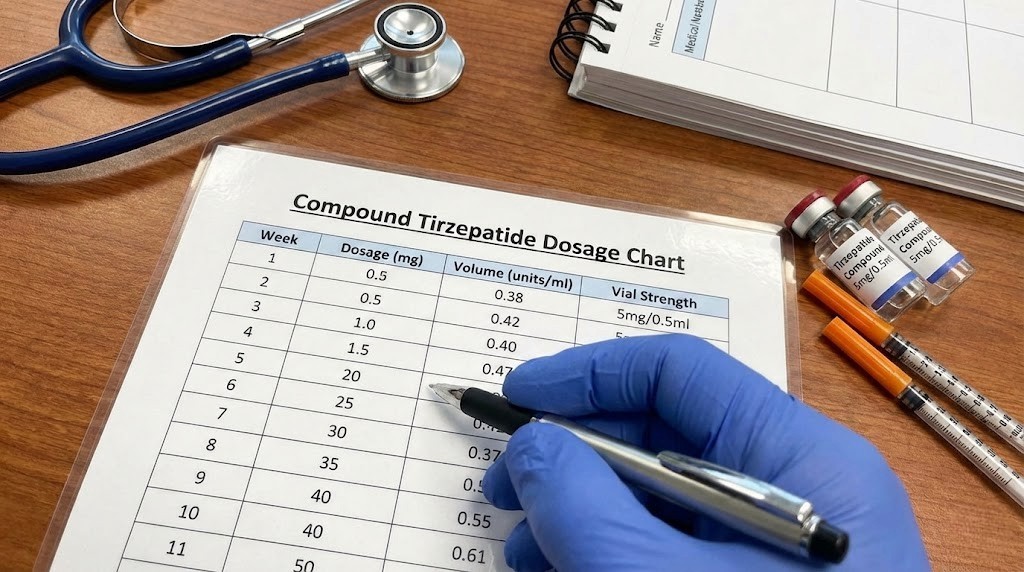
Your compounding pharmacy just shipped a vial labeled 10mg/mL. Your provider prescribed 2.5mg weekly. And now you are staring at an insulin syringe wondering how many units to draw. This is the exact moment where compound tirzepatide gets confusing, where the gap between what your provider wrote on the prescription and what you actually need to inject feels impossibly wide. Brand-name Mounjaro and Zepbound come in pre-filled pens. You click a button. Done. Compounded tirzepatide demands that you understand concentrations, unit conversions, and volume calculations before you inject a single dose.
And most dosage charts online assume you already know all of this.
They list milligram doses without explaining how those milligrams translate to syringe units at your specific vial concentration. They reference the FDA-approved titration schedule without acknowledging that compounding pharmacies often use different concentrations, different vial sizes, and sometimes different escalation protocols altogether. The result is a confusing mess of numbers that leaves you second-guessing every injection.
This guide fixes that problem completely. Every concentration. Every vial size. Every unit conversion. Every weekly protocol from start to maintenance, mapped out in charts you can actually use with the syringe in your hand. Whether your pharmacy sent a 5mg/mL vial, a 10mg/mL vial, a 17mg/mL vial, or a 20mg/mL formulation, you will find your exact dosing chart below. SeekPeptides built this reference because accurate dosing is not optional with compounded tirzepatide. It is the difference between results and wasted medication.
How compound tirzepatide concentrations work
Before touching a single dosage chart, you need to understand what the numbers on your vial actually mean. This is where most confusion starts and where most dosing errors happen.
Concentration tells you how many milligrams of tirzepatide are dissolved in each milliliter of liquid. A vial labeled 10mg/mL contains 10 milligrams of active tirzepatide per milliliter of solution. A 20mg/mL vial contains twice as much medication in the same volume of liquid. This distinction matters enormously because the same milligram dose requires completely different syringe volumes depending on concentration.
Think of it like coffee. A regular brew might have 100mg of caffeine per cup. An espresso has 200mg in half the volume. Same caffeine, different concentrations, different serving sizes. Compounded tirzepatide works the same way.
Common compounding pharmacy concentrations
Compounding pharmacies do not standardize their concentrations the way brand-name manufacturers do. Different pharmacies use different concentrations based on their formulation preferences, stability testing, and the dose ranges they intend to cover. Here are the most common concentrations you will encounter.
5mg/mL concentration. This lower concentration is typically used for starting doses. It makes measuring small amounts easier because you need more volume per dose, meaning the difference between correct and incorrect is easier to see on a syringe. Some pharmacies use this concentration exclusively for the 2.5mg and 5mg dose phases, then switch patients to higher concentrations as doses increase.
8mg/mL concentration. Less common but used by several pharmacies. This intermediate concentration provides a balance between measuring accuracy at lower doses and reasonable injection volumes at mid-range doses like 7.5mg and 10mg.
10mg/mL concentration. One of the most widely used compounding concentrations. It offers clean, easy math for most dose levels and works well across the entire tirzepatide titration schedule. A 2.5mg dose equals exactly 25 units on a standard insulin syringe. Simple. Memorable.
15mg/mL concentration. Designed for patients at higher maintenance doses who want smaller injection volumes. At this concentration, even a 15mg dose requires only 1mL (100 units), keeping injections compact.
17mg/mL concentration. Used by several major compounding pharmacies including some of the largest 503B outsourcing facilities. This concentration often comes paired with niacinamide (vitamin B3) at 2mg/mL as an added ingredient.
20mg/mL concentration. The highest common concentration. Ideal for maintenance doses above 10mg because it keeps injection volumes small. However, measuring accuracy at lower doses becomes challenging. Drawing 12.5 units for a 2.5mg dose on a standard insulin syringe requires precision that not everyone can achieve consistently.
The math behind every conversion
Every concentration-to-unit conversion follows one formula. Memorize it and you will never need to search for a dosage chart again.
Units = (desired dose in mg / concentration in mg per mL) x 100
Here is why. A standard U-100 insulin syringe holds 1mL of liquid, divided into 100 units. So 100 units equals 1mL. If your vial is 10mg/mL and you need 5mg, you need 0.5mL, which equals 50 units.
The formula works for every concentration.
At 5mg/mL: 2.5mg = (2.5 / 5) x 100 = 50 units
At 10mg/mL: 2.5mg = (2.5 / 10) x 100 = 25 units
At 17mg/mL: 2.5mg = (2.5 / 17) x 100 = 14.7 units
At 20mg/mL: 2.5mg = (2.5 / 20) x 100 = 12.5 units
The SeekPeptides peptide calculator automates this math for you. Enter your vial concentration, desired dose, and it returns exact syringe units. But understanding the formula yourself is essential because you need to verify every calculation before injecting.
Complete dosage charts by concentration
Here are the complete dosage charts for every common compound tirzepatide concentration. Find your vial concentration, find your prescribed dose, and read across to your syringe units. These charts follow the standard tirzepatide escalation protocol with 2.5mg increases every four weeks minimum.
5mg/mL concentration dosage chart
Phase | Weekly dose | Syringe units | Volume (mL) | Duration |
|---|---|---|---|---|
Starting | 2.5mg | 50 units | 0.50mL | Weeks 1-4 |
Escalation 1 | 5mg | 100 units | 1.00mL | Weeks 5-8 |
Escalation 2 | 7.5mg | 150 units | 1.50mL | Weeks 9-12 |
Important note about the 5mg/mL concentration. Once you reach 7.5mg, the injection volume exceeds 1mL. Most insulin syringes hold a maximum of 1mL (100 units). At 7.5mg, you would need 150 units, meaning you either need a larger syringe or must split the injection into two separate shots. This is why most pharmacies transition patients to a higher concentration vial once doses move beyond 5mg. Ask your provider about switching to a 10mg/mL or higher concentration before you reach this point.
10mg/mL concentration dosage chart
Phase | Weekly dose | Syringe units | Volume (mL) | Duration |
|---|---|---|---|---|
Starting | 2.5mg | 25 units | 0.25mL | Weeks 1-4 |
Escalation 1 | 5mg | 50 units | 0.50mL | Weeks 5-8 |
Escalation 2 | 7.5mg | 75 units | 0.75mL | Weeks 9-12 |
Escalation 3 | 10mg | 100 units | 1.00mL | Weeks 13-16 |
The 10mg/mL concentration works cleanly through the first four dose levels. Every conversion produces a round number. 25, 50, 75, 100. No decimal units to worry about. This is why many providers prefer this concentration for tirzepatide dosing protocols. At 12.5mg however, you would need 125 units, which again exceeds a standard 1mL syringe. Patients reaching doses above 10mg on this concentration should discuss transitioning to 15mg/mL or 20mg/mL vials.
15mg/mL concentration dosage chart
Phase | Weekly dose | Syringe units | Volume (mL) | Duration |
|---|---|---|---|---|
Starting | 2.5mg | 16.7 units | 0.167mL | Weeks 1-4 |
Escalation 1 | 5mg | 33.3 units | 0.333mL | Weeks 5-8 |
Escalation 2 | 7.5mg | 50 units | 0.50mL | Weeks 9-12 |
Escalation 3 | 10mg | 66.7 units | 0.667mL | Weeks 13-16 |
Escalation 4 | 12.5mg | 83.3 units | 0.833mL | Weeks 17-20 |
Maximum | 15mg | 100 units | 1.00mL | Week 21+ |
The 15mg/mL concentration covers the entire FDA-approved dose range within a single 1mL syringe. The maximum 15mg dose equals exactly 100 units. The tradeoff is accuracy at lower doses. Drawing exactly 16.7 units for the starting 2.5mg dose requires careful technique. Most insulin syringes have markings at every 2 units, meaning you need to estimate between the 16 and 18 unit lines. A half-unit error at this volume changes your dose by about 7.5%, which is not clinically significant but worth being aware of.
17mg/mL concentration dosage chart
Phase | Weekly dose | Syringe units | Volume (mL) | Duration |
|---|---|---|---|---|
Starting | 2.5mg | 14.7 units | 0.147mL | Weeks 1-4 |
Escalation 1 | 5mg | 29.4 units | 0.294mL | Weeks 5-8 |
Escalation 2 | 7.5mg | 44.1 units | 0.441mL | Weeks 9-12 |
Escalation 3 | 10mg | 58.8 units | 0.588mL | Weeks 13-16 |
Escalation 4 | 12.5mg | 73.5 units | 0.735mL | Weeks 17-20 |
Maximum | 15mg | 88.2 units | 0.882mL | Week 21+ |
The 17mg/mL concentration produces decimal unit values at every dose level. None of the conversions land on clean numbers. This means every injection requires careful syringe reading. If your pharmacy uses this concentration, consider using syringes with 0.5-unit markings (available as 30-unit or 50-unit insulin syringes) for better precision at lower doses. The reconstitution calculator on SeekPeptides can verify your calculations for any 17mg/mL vial.
20mg/mL concentration dosage chart
Phase | Weekly dose | Syringe units | Volume (mL) | Duration |
|---|---|---|---|---|
Starting | 2.5mg | 12.5 units | 0.125mL | Weeks 1-4 |
Escalation 1 | 5mg | 25 units | 0.25mL | Weeks 5-8 |
Escalation 2 | 7.5mg | 37.5 units | 0.375mL | Weeks 9-12 |
Escalation 3 | 10mg | 50 units | 0.50mL | Weeks 13-16 |
Escalation 4 | 12.5mg | 62.5 units | 0.625mL | Weeks 17-20 |
Maximum | 15mg | 75 units | 0.75mL | Week 21+ |
The 20mg/mL concentration is ideal for patients at higher maintenance doses. The maximum 15mg dose requires only 75 units, keeping injection volume compact and comfortable. The challenge is at the starting dose. Drawing exactly 12.5 units demands precision. If your syringe has 2-unit markings, 12.5 falls between the 12 and 14 lines. This is manageable but requires attention. Some providers start patients on a lower concentration for the first month, then switch to 20mg/mL as doses increase.
The standard titration schedule for compound tirzepatide
The FDA-approved titration schedule for tirzepatide establishes the baseline protocol that compounding providers generally follow. Understanding this schedule matters because it dictates how long each vial lasts, when you need refills, and how your costs change over time.
Week-by-week standard protocol
Weeks 1 through 4: 2.5mg once weekly. This is not a therapeutic dose. It exists solely to let your body adjust to the GLP-1 and GIP receptor activation that tirzepatide triggers. Most people experience minimal weight loss during this phase. Gastrointestinal side effects are typically mild. Appetite suppression may or may not be noticeable. Do not increase the dose early, even if you feel fine. The acclimation period matters.
Weeks 5 through 8: 5mg once weekly. The first therapeutic dose. This is where appetite suppression typically becomes noticeable. Most people start experiencing reduced hunger within the first week at 5mg. Weight loss begins in earnest. Nausea may increase temporarily, usually peaking in the first few days after the dose increase and improving by week 2 at this level. Clinical trials showed that participants on 5mg achieved an average of 16% body weight reduction over 72 weeks.
Weeks 9 through 12: 7.5mg once weekly. An intermediate step that many providers include in compounded protocols, even though brand-name tirzepatide has this as a standard dose tier. At this level, appetite suppression is typically strong. Food noise, that constant background chatter about what to eat next, quiets significantly. Some people find this dose is their maintenance sweet spot and never need to go higher.
Weeks 13 through 16: 10mg once weekly. For many patients, 10mg represents the optimal balance between effectiveness and tolerability. The SURMOUNT-1 trial showed that 10mg produced an average of 19.5% body weight reduction. Gastrointestinal side effects at this level can be significant if the titration was rushed. Patients who took the full four weeks at each previous dose generally tolerate 10mg well.
Weeks 17 through 20: 12.5mg once weekly. Relatively few patients need this dose to achieve their weight loss goals. Providers typically reserve this escalation for patients who have plateaued at 10mg for several weeks and still have significant weight to lose. Side effects at this level track closely with those at 10mg in most patients.
Week 21 onward: 15mg once weekly (maximum). The highest approved dose. The SURMOUNT trials demonstrated average weight loss of 22.5% at this level, with 63% of participants losing at least 20% of their body weight. This dose should only be reached after a full 20 weeks of gradual escalation. Jumping to 15mg from a lower dose without adequate titration significantly increases the risk of severe side effects including fatigue, nausea, vomiting, and diarrhea.
Modified titration schedules for compound tirzepatide
Compounding providers sometimes modify the standard schedule. Here are the most common variations and why they exist.
Slow-start protocol. Some providers begin at 1.5mg or even 1mg for the first two to four weeks before moving to 2.5mg. This ultra-low starting dose is designed for patients with high sensitivity to GLP-1 medications, those who have experienced severe side effects on semaglutide or other GLP-1 medications, or patients who want the most gradual possible introduction. The compounded format makes this possible because brand-name pens do not offer doses below 2.5mg.
Extended plateau protocol. Instead of increasing every four weeks, some providers keep patients at each dose for six to eight weeks. This approach prioritizes tolerability over speed. Patients on extended plateaus report fewer side effects and often find their maintenance dose is lower than those who escalate quickly. The trade-off is a slower timeline to full therapeutic effect.
Microdosing protocol. Microdosing tirzepatide involves starting at doses as low as 0.25mg to 1mg and escalating in smaller increments. This approach has gained popularity among patients seeking to minimize side effects entirely. Compounded tirzepatide is essential for microdosing because brand-name pens cannot deliver sub-2.5mg doses. While there are no clinical trials specifically studying microdosed tirzepatide, anecdotal reports suggest it can be effective for some patients at lower total dose exposure.
Protocol type | Starting dose | Escalation interval | Time to 10mg | Best for |
|---|---|---|---|---|
Standard | 2.5mg | Every 4 weeks | 16 weeks | Most patients |
Slow-start | 1-1.5mg | Every 4 weeks | 20-24 weeks | Sensitive patients |
Extended plateau | 2.5mg | Every 6-8 weeks | 24-32 weeks | Side effect management |
Microdosing | 0.25-1mg | Variable | Variable | Ultra-cautious approach |
Compounding pharmacy formulations explained
Your compound tirzepatide is not just tirzepatide. Most compounding pharmacies add ingredients to their formulations, and understanding what is in your vial matters for both safety and effectiveness.
Tirzepatide with niacinamide
Tirzepatide with niacinamide is the most common compound formulation. Niacinamide, also known as nicotinamide or vitamin B3, serves two purposes in the formulation. First, it may help stabilize the tirzepatide molecule in solution, potentially extending shelf life and maintaining potency. Second, some providers report that niacinamide reduces injection site reactions, specifically the redness and swelling that some patients experience with compounded injectable tirzepatide.
The typical concentration is 2mg/mL of niacinamide alongside the tirzepatide. This is a relatively low dose of niacinamide and is generally well-tolerated. Common formulations from major pharmacies include 17mg/mL tirzepatide with 2mg/mL niacinamide in 4mL or 2mL vials.
Tirzepatide with B12
Tirzepatide with B12 addresses a known consequence of GLP-1 receptor agonists. These medications can reduce vitamin B12 absorption over time by slowing gastric emptying and altering gut bacteria composition. Adding cyanocobalamin (B12) directly to the injection bypasses the gastrointestinal absorption issue entirely. Some formulations combine tirzepatide with both glycine and B12 for stability and nutritional support.
Tirzepatide with glycine
Glycine is an amino acid added to some formulations as a stabilizer. It helps maintain the pH of the solution and may improve the shelf life of reconstituted tirzepatide. Glycine itself has minimal pharmacological effects at the concentrations used in these formulations.
Plain tirzepatide
Some compounding pharmacies offer tirzepatide without any additives. This is the simplest formulation, containing only tirzepatide and the necessary solution components (typically bacteriostatic water with benzyl alcohol as a preservative). Patients who want the closest analog to the active ingredient in brand-name products often prefer plain formulations.
How to read your compound tirzepatide prescription
When your compounding pharmacy sends your tirzepatide, the label contains critical information that dictates exactly how to dose. Here is how to decode every element.
Vial label elements
Medication name and concentration. This will say something like "Tirzepatide 10mg/mL" or "Tirzepatide/Niacinamide 17mg/2mg per mL." The first number is always the tirzepatide concentration. If a second number appears, it indicates the concentration of the added ingredient.
Total vial volume. Usually 2mL, 2.5mL, 4mL, or 5mL. This tells you the total amount of liquid in the vial. Combined with the concentration, you can calculate how many total milligrams of tirzepatide the vial contains. A 4mL vial at 10mg/mL contains 40mg total. A 2mL vial at 17mg/mL contains 34mg total.
Beyond-use date (BUD). This is not the same as an expiration date. The beyond-use date tells you how long the pharmacy guarantees the medication remains potent and sterile after preparation. For most compounded tirzepatide, this is 28 to 90 days depending on the pharmacy and formulation. Always check this date before your first injection. If the BUD has passed, do not use the vial.
Lot number. This identifies the specific batch your vial came from. Record this number. If you experience unexpected side effects or potency issues, the lot number helps your pharmacy and provider investigate whether there was a batch-specific problem.
Storage instructions. Almost always "Refrigerate at 36-46F (2-8C)." Compounded tirzepatide must be stored in the refrigerator. Room temperature exposure should be minimized. Unlike brand-name Mounjaro pens, which can tolerate up to 30 days at room temperature before first use, compounded vials generally need continuous refrigeration.
Calculating how long each vial lasts
This calculation prevents you from running out of medication mid-protocol. It also helps with budgeting.
Total mg in vial = concentration (mg/mL) x total volume (mL)
Weeks per vial = total mg / weekly dose
Example: You have a 4mL vial at 10mg/mL. That is 40mg total. At 2.5mg per week, the vial lasts 16 weeks. At 5mg per week, it lasts 8 weeks. At 10mg per week, it lasts 4 weeks.
Vial size | Concentration | Total mg | Weeks at 2.5mg | Weeks at 5mg | Weeks at 10mg | Weeks at 15mg |
|---|---|---|---|---|---|---|
2mL | 10mg/mL | 20mg | 8 | 4 | 2 | 1.3 |
2mL | 17mg/mL | 34mg | 13.6 | 6.8 | 3.4 | 2.3 |
2.5mL | 8mg/mL | 20mg | 8 | 4 | 2 | 1.3 |
4mL | 10mg/mL | 40mg | 16 | 8 | 4 | 2.7 |
4mL | 17mg/mL | 68mg | 27.2 | 13.6 | 6.8 | 4.5 |
5mL | 10mg/mL | 50mg | 20 | 10 | 5 | 3.3 |
5mL | 20mg/mL | 100mg | 40 | 20 | 10 | 6.7 |
Critical consideration. Even if a vial contains enough medication for 20 weeks, the beyond-use date may expire before you finish the vial. A 5mL vial at 10mg/mL contains 50mg, enough for 20 weeks at 2.5mg. But if the BUD is 28 days, you can only use the vial for 4 weeks regardless of remaining volume. This means you would waste 35mg of medication. Factor this into your cost calculations and discuss with your provider whether larger vials make economic sense at your dose level.
Injection technique for compound tirzepatide
Brand-name tirzepatide comes in auto-injector pens that handle depth, speed, and volume automatically. Compounded tirzepatide requires you to manage every aspect of the injection yourself. Proper technique directly affects both safety and absorption consistency.
Syringe selection
Use a U-100 insulin syringe. The gauge (needle thickness) and length matter.
For subcutaneous injection in most patients: 29-31 gauge, 1/2 inch (12.7mm) needle. This is thin enough to minimize pain and long enough to reach subcutaneous tissue in most body compositions.
For patients with lower body fat: 30-31 gauge, 5/16 inch (8mm) needle. The shorter length prevents injection into muscle tissue, which is not desired for tirzepatide.
For larger injection volumes (above 50 units): Consider 28-29 gauge for slightly faster delivery. Thinner needles require more pressure to push larger volumes through, which can cause hand fatigue and uneven delivery.
Syringe capacity matters too. If your dose requires more than 50 units, use a 1mL (100-unit) syringe. If your dose is 30 units or less, a 0.3mL (30-unit) syringe provides better precision because the unit markings are spaced further apart. For the best measuring accuracy, use the smallest syringe that fits your dose.
Step-by-step injection process
1. Prepare your workspace. Clean a flat surface with isopropyl alcohol. Gather your vial, a new sealed syringe, alcohol prep pads, and a sharps container. Wash your hands thoroughly with soap and water for at least 20 seconds.
2. Inspect the vial. Hold it up to light. The solution should be clear and free of particles. If you see cloudiness, discoloration, or floating material, do not use it. Check the beyond-use date. Verify the concentration matches your dosing chart.
3. Clean the vial stopper. Wipe the rubber stopper with an alcohol prep pad. Let it air dry for at least 10 seconds. Do not blow on it or wipe it dry.
4. Draw air into the syringe. Pull the plunger back to the number of units you plan to draw. This air will replace the liquid you remove from the vial, preventing a vacuum that makes future draws difficult.
5. Insert the needle and inject air. Push the needle through the rubber stopper. Inject the air into the vial. This step is important for multi-dose vials because it maintains positive pressure inside.
6. Invert the vial and draw medication. With the needle still in the vial, turn the vial upside down. Pull the plunger slowly to draw your prescribed number of units. Go slightly past your target, then push back to the exact number. This ensures accuracy.
7. Remove air bubbles. While the syringe is still in the inverted vial, tap the syringe barrel gently to move any air bubbles to the needle end. Push the plunger slightly to expel the air back into the vial. Verify your dose volume is still correct. If not, draw a bit more.
8. Remove the syringe from the vial. Pull straight out to avoid bending the needle. Set the vial down and recap it for refrigerator storage.
9. Select and clean your injection site. The three approved sites are the abdomen (at least 2 inches from the navel), the front of the thigh (middle third), and the back of the upper arm (if someone else is administering). Clean the site with a fresh alcohol prep pad and let it dry completely. Injecting through wet alcohol causes stinging.
10. Inject. Pinch a fold of skin at the injection site. Insert the needle at a 90-degree angle (for 1/2 inch needles) or 45-degree angle (for shorter needles or lean individuals). Push the plunger slowly and steadily. Rushing creates more pressure at the injection site and may increase discomfort. After the plunger is fully depressed, count to 5 before removing the needle.
11. Post-injection. Apply gentle pressure with a clean gauze pad if there is any bleeding. Do not rub the site. Dispose of the used syringe immediately in your sharps container. Never recap a used needle. Record the date, dose, injection site, and any observations in a log.
Injection site rotation schedule
Rotating injection sites prevents lipodystrophy, a condition where repeated injections in the same area cause changes in the subcutaneous fat tissue. These changes can alter absorption rates and create cosmetic concerns.
Week | Injection site | Specific location |
|---|---|---|
Week 1 | Left abdomen | 2 inches left of navel |
Week 2 | Right thigh | Middle third, front |
Week 3 | Right abdomen | 2 inches right of navel |
Week 4 | Left thigh | Middle third, front |
Week 5 | Left abdomen (lower) | 3 inches below navel, left |
Week 6 | Right thigh (lateral) | Outer middle third |
This six-week rotation covers six distinct sites before repeating. By the time you return to a site, six weeks of healing have occurred. For more injection guidance including complete peptide injection techniques, check our dedicated guide.
Managing side effects during dose escalation
Gastrointestinal side effects are the most common reason people abandon tirzepatide before reaching therapeutic doses. Understanding what to expect and how to manage each symptom keeps you on protocol long enough to see results.
Nausea management
Nausea affects roughly 20-30% of tirzepatide users during dose escalation. It typically peaks in the first 48-72 hours after a dose increase and diminishes over the following 1-2 weeks as your body adjusts.
Eat smaller, more frequent meals. Five to six small meals instead of three large ones reduces the volume of food sitting in your stomach at any given time. Tirzepatide slows gastric emptying, meaning food stays in your stomach longer than usual. Large meals combined with delayed emptying is the primary trigger for nausea.
Avoid high-fat foods during escalation. Fat takes the longest to digest. During dose increases, minimize fried foods, heavy sauces, and fatty meats. Lean proteins, fruits, vegetables, and whole grains move through your digestive system more efficiently.
Stay hydrated between meals, not during. Drinking large amounts of liquid with meals adds volume to an already slow-emptying stomach. Sip water throughout the day but minimize fluid intake for 30 minutes before and after meals.
Timing your injection strategically. Some patients find that injecting in the evening before bed allows them to sleep through the peak nausea window. Others prefer morning injections so the worst effects hit during the day when they can manage symptoms actively. Experiment to find what works for you. Keep your injection day consistent regardless of timing.
Constipation management
Tirzepatide slows the entire gastrointestinal tract, not just the stomach. This deceleration can cause constipation, particularly at higher doses. It is one of the most common ongoing side effects, persisting beyond the escalation period for some patients.
Fiber intake must be deliberate. When you are eating less overall, your fiber intake drops proportionally. Aim for 25-30 grams of fiber daily from vegetables, fruits, whole grains, and if necessary, a psyllium husk supplement. Introduce fiber gradually to avoid worsening gastrointestinal discomfort.
Hydration is non-negotiable. Fiber without adequate water makes constipation worse. Target 80-100 ounces of water daily. If you are exercising or in a hot climate, increase this amount.
Movement helps. Regular physical activity stimulates intestinal motility. Even a 20-minute daily walk can significantly improve bowel regularity. This is one of many reasons why exercise is not optional during tirzepatide weight loss protocols.
When to contact your provider
Some symptoms require medical attention regardless of where you are in the dosing protocol.
Severe, persistent vomiting. If you cannot keep food or liquids down for more than 24 hours, contact your provider. Dehydration from prolonged vomiting can lead to acute kidney injury, which is a documented serious adverse event with GLP-1 medications.
Severe abdominal pain radiating to the back. This could indicate pancreatitis, a rare but serious side effect. Do not wait to see if it improves. Seek medical evaluation immediately.
Signs of an allergic reaction. Hives, facial swelling, difficulty breathing, or rapid heartbeat after injection require emergency medical attention.
Injection site reactions that worsen. Mild redness and itching are normal. Expanding redness, warmth, swelling, or pus suggest infection at the injection site and need medical evaluation.
Blood sugar symptoms. If you are also taking other medications that affect blood sugar, watch for signs of hypoglycemia: shakiness, sweating, confusion, rapid heartbeat, or extreme hunger. Tirzepatide alone rarely causes dangerously low blood sugar, but combined with insulin or sulfonylureas, the risk increases.
Compound tirzepatide versus brand-name: the dosing differences
The active ingredient is the same. The dosing concepts are the same. But the practical experience of dosing compound tirzepatide differs from brand-name in several meaningful ways that affect your daily protocol.
Dosing precision
Brand-name Mounjaro and Zepbound deliver exactly the prescribed dose every time. The manufacturing process calibrates each pen to within extremely tight tolerances. You press a button and receive your dose. No math. No measuring. No room for user error.
Compound tirzepatide requires you to calculate your dose, draw it accurately, and inject it correctly. At common concentrations, small measuring errors change your dose. Drawing 26 units instead of 25 units from a 10mg/mL vial gives you 2.6mg instead of 2.5mg. That is a 4% overdose. Not clinically dangerous, but over weeks and months of injections, consistent overdosing or underdosing compounds. This is why double-checking your unit-to-milligram conversions before every injection is critical.
Dose flexibility
This is where compound tirzepatide has a genuine advantage. Brand-name pens come in fixed doses: 2.5mg, 5mg, 7.5mg, 10mg, 12.5mg, and 15mg. If you need 3mg, 6mg, or 8mg, you cannot get it from a brand-name pen. Compounded tirzepatide allows any dose your provider prescribes. This flexibility supports custom titration schedules, microdosing approaches, and dose-finding protocols that would be impossible with pre-filled pens.
Some patients find that 8mg or 9mg is their ideal maintenance dose. With brand-name products, they would need to choose between 7.5mg and 10mg. With compounded tirzepatide, they get exactly the dose that works best for their body.
Cost per dose comparison
Dose | Brand-name monthly cost | Compound monthly cost (estimate) | Savings |
|---|---|---|---|
2.5mg | $299 (LillyDirect) | $150-250 | $49-149 |
5mg | $449 (LillyDirect) | $175-300 | $149-274 |
10mg | $449 (LillyDirect) | $250-400 | $49-199 |
15mg | $449 (LillyDirect) | $300-450 | $0-149 |
At higher doses, the cost difference between compounded and brand-name narrows significantly. The compounded tirzepatide cost advantage is most dramatic at lower doses where vials last longer. At the maximum 15mg dose, some compounded options actually cost more than the LillyDirect self-pay program when you factor in provider visits and shipping.
Quality and consistency
Brand-name tirzepatide is manufactured under strict FDA Good Manufacturing Practices. Every batch undergoes rigorous testing for potency, purity, sterility, and endotoxins. The consistency between one pen and the next is exceptional.
Compound tirzepatide quality varies by pharmacy. 503B outsourcing facilities undergo more FDA oversight than 503A pharmacies and generally maintain higher quality standards. But even the best compounding pharmacy operates under different quality control frameworks than a major pharmaceutical manufacturer. This does not mean compounded tirzepatide is unsafe. It means the consistency is inherently more variable. Requesting certificates of analysis and choosing pharmacies with strong third-party testing practices mitigates this risk.
How to switch concentrations safely during titration
Many compounding pharmacy protocols involve switching from a lower concentration vial to a higher concentration vial as your dose increases. This is the most common source of dosing errors with compound tirzepatide, and it is almost entirely preventable with proper awareness.
The danger of automatic dosing
You have been drawing 50 units every week for a month at 10mg/mL (5mg dose). Your pharmacy sends a new vial at 20mg/mL for your next escalation. If you reflexively draw 50 units from the new vial, you inject 10mg instead of 7.5mg. That is a 33% overdose, skipping an entire dose tier. This mistake happens frequently because the muscle memory of drawing a specific number of units can override the awareness that the concentration has changed.
Concentration switch protocol
1. Verify the new vial concentration before your first draw. Read the label three times. Compare it to your previous vial. If the concentration is different, recalculate your dose using the formula.
2. Write your new syringe units on a note and attach it to the vial. A small piece of tape with "7.5mg = 37.5 units" written on it prevents confusion for every subsequent draw.
3. Recalculate and verify with a calculator. Do not do concentration math in your head. Use the peptide calculator or a standard calculator to verify your conversion every time you switch concentrations.
4. Discard the old vial only after confirming the new one. Keep the old vial in the fridge until you have successfully drawn and injected from the new vial at least once. If there is a problem with the new vial, having the old one available prevents a gap in treatment.
Common concentration transition points
Transition point | From concentration | To concentration | Reason |
|---|---|---|---|
Moving past 5mg dose | 5mg/mL | 10mg/mL | 5mg/mL volumes become too large above 5mg |
Moving past 10mg dose | 10mg/mL | 20mg/mL | 10mg/mL exceeds 100 units above 10mg |
Cost optimization | Any lower | 17mg/mL or 20mg/mL | Higher concentrations mean fewer vials purchased |
Storage and handling for compound tirzepatide vials
How you store your compound tirzepatide directly affects its potency, safety, and longevity. Unlike brand-name pens that come with validated storage instructions backed by extensive stability testing, compounded vials rely on general pharmaceutical guidelines that may not capture tirzepatide-specific degradation patterns.
Refrigeration requirements
Compound tirzepatide must be refrigerated at 36-46 degrees Fahrenheit (2-8 degrees Celsius). Store it in the main body of the refrigerator, not in the door where temperature fluctuates with each opening. Never store it in the freezer. Freezing can denature the tirzepatide protein structure, rendering it ineffective even if the solution looks normal after thawing.
Designate a specific spot in your refrigerator for your medication. The back of a middle shelf maintains the most consistent temperature. Keep the vial in its original packaging or in a small container to prevent it from being knocked over or exposed to light.
Room temperature exposure limits
Compounded tirzepatide can tolerate brief room temperature exposure, generally up to 21 days at temperatures below 86 degrees Fahrenheit (30 degrees Celsius). However, this tolerance is not unlimited and each episode of warming is cumulative. Extended room temperature exposure accelerates degradation.
Practical approach: remove the vial from the refrigerator, draw your dose, and return it immediately. Total time out of the fridge should be under 10 minutes per injection. This conservative approach maximizes potency throughout the vial life.
Travel with compound tirzepatide
Traveling with compounded injectable medication requires planning. Use an insulated medication travel case with gel ice packs. These cases maintain refrigerator temperatures for 12-24 hours depending on ambient conditions. For longer travel, hotel mini-fridges work acceptably, though temperature control is less precise than a standard refrigerator.
Air travel with injectable medications is legal and common. Carry your tirzepatide, syringes, and sharps container in your carry-on bag with a copy of your prescription. TSA allows injectable medications and associated supplies. Checked baggage holds are not temperature controlled and can reach freezing temperatures at cruising altitude, making them unsuitable for tirzepatide storage.
Troubleshooting common compound tirzepatide dosing issues
Even with perfect charts and careful technique, issues arise. Here are the most common problems and their solutions.
Air bubbles in the syringe
Small air bubbles are cosmetically concerning but not medically dangerous for subcutaneous injections. A tiny air bubble injected subcutaneously is harmlessly absorbed by the body. However, air bubbles do displace medication, meaning your actual dose is slightly less than what the syringe appears to show. To remove bubbles: hold the syringe with the needle pointing up. Tap the barrel firmly with your fingernail. The bubbles will rise to the top. Push the plunger gently until a tiny drop of liquid appears at the needle tip.
Cloudy or discolored solution
Clear solution is essential. Cloudiness can indicate bacterial contamination, protein aggregation, or chemical degradation. Do not inject cloudy tirzepatide. Contact your pharmacy for a replacement. A slightly yellowish tint is normal for some tirzepatide formulations, but dramatic color changes (dark yellow, brown, pink) indicate degradation.
Difficulty drawing from the vial
If pulling the plunger becomes difficult, the vial may have a vacuum. Remove the syringe, draw air equal to your dose volume, reinsert, inject the air, and try drawing again. If the rubber stopper has been punctured many times, it may have cored (a small piece of rubber breaks off into the solution). Inspect the vial carefully. Cored rubber is a contamination risk.
Medication leaking after injection
A small drop of liquid at the injection site after removing the needle is normal and usually represents less than 0.02mL of medication, an insignificant amount. To minimize leakage, count to 5-10 after the plunger is fully depressed before removing the needle. This allows the subcutaneous tissue to absorb the liquid.
Missed dose
If you miss your weekly injection, take it as soon as you remember, provided it is at least 72 hours before your next scheduled dose. If less than 72 hours remain until your next dose, skip the missed dose and return to your regular schedule. Never double up to compensate for a missed injection. Missing a single dose does not significantly impact long-term results, and tirzepatide stays active in your system for several days after each injection due to its long half-life of approximately 5 days.
The regulatory landscape for compound tirzepatide
Understanding the legal status of compounded tirzepatide matters because it directly affects your access, your provider choices, and the long-term viability of your treatment plan.
The shortage framework
Compounding pharmacies were permitted to produce tirzepatide under FDA enforcement discretion during a nationwide shortage of brand-name Mounjaro and Zepbound. This was not an approval or endorsement. It was a practical allowance because patients with legitimate medical needs could not access the medication through normal channels.
In October of the prior year, the FDA determined that the tirzepatide shortage was resolved. Eli Lilly demonstrated adequate supply capacity. The FDA then established phase-out deadlines. Section 503A pharmacies, which compound individual prescriptions, had until February 19 of the following year. Section 503B outsourcing facilities had until March 19.
Current legal status
In the current framework, compounded tirzepatide is only legally available when a patient has a documented medical need that cannot be met by FDA-approved formulations. The most common qualifying scenario is a verified allergy to an inactive ingredient in Mounjaro or Zepbound. General reasons like cost, convenience, or preference do not meet the legal threshold.
Several compounding pharmacies and advocacy groups challenged the FDA decision in court. Most legal challenges have been resolved in favor of the FDA position, though some state-level variations exist. The practical reality is that some providers continue to prescribe compound tirzepatide through various regulatory interpretations, but the pathway is significantly more restricted than during the shortage period.
What this means for your dosing protocol
If you are currently on compound tirzepatide, the regulatory uncertainty creates practical concerns. Your supply could be interrupted if your provider or pharmacy changes their practices in response to enforcement actions. Having a transition plan to alternative medications or brand-name tirzepatide is prudent regardless of your current access situation.
Optimizing results at every dose level
The dosage chart gets you the right amount of medication. But medication alone does not produce optimal results. What you do between injections determines whether you achieve the 15-22% body weight reduction seen in clinical trials or fall short of your goals.
Protein targets by dose level
As your dose increases and appetite decreases, maintaining adequate protein becomes progressively more challenging. Here is what to aim for at each stage.
Dose level | Typical daily calories | Protein target | Strategy |
|---|---|---|---|
2.5mg | 1,600-2,000 | 100-130g | Normal eating with protein focus |
5mg | 1,200-1,600 | 100-130g | Protein-first at every meal |
7.5-10mg | 1,000-1,400 | 90-120g | Protein shakes, small frequent meals |
12.5-15mg | 800-1,200 | 80-110g | Protein shakes essential, fortified foods |
At higher doses, protein shakes become almost mandatory. When your appetite allows only 1,000 calories per day, getting 100g of protein from solid food alone requires eating almost exclusively protein sources. A 30g protein shake takes 60 seconds to consume and does not require appetite.
Exercise integration
Resistance training 3-4 times per week is the single most important non-medication intervention for preserving muscle during tirzepatide-assisted weight loss. The muscle preservation benefits of strength training are well-documented and become more critical as caloric intake decreases at higher tirzepatide doses.
Walking 7,000-10,000 steps daily provides cardiovascular benefits without excessive fatigue. During dose escalation periods, when energy levels may be lower, prioritize strength training over cardio. You can always walk more. You cannot easily replace the muscle-preserving stimulus of progressive resistance training.
Hydration monitoring
Dehydration is the most preventable serious risk on tirzepatide. At minimum, consume 80-100 ounces of water daily. Monitor your hydration through urine color (pale yellow is ideal), energy levels, and any signs of dizziness or lightheadedness. Electrolyte supplementation with sodium, potassium, and magnesium helps maintain hydration balance when food intake is significantly reduced.
SeekPeptides members access detailed nutrition protocols, dose-specific meal plans, and hydration tracking tools designed specifically for GLP-1 medication users. The combination of precise dosing and optimized nutrition produces dramatically better outcomes than medication alone.
Frequently asked questions
How many units of compound tirzepatide is 2.5mg?
It depends entirely on your vial concentration. At 5mg/mL, 2.5mg equals 50 units. At 10mg/mL, 2.5mg equals 25 units. At 17mg/mL, 2.5mg equals approximately 14.7 units. At 20mg/mL, 2.5mg equals 12.5 units. Always verify your specific vial concentration before calculating. The formula is: units = (dose in mg / concentration in mg per mL) x 100. For a complete unit breakdown, see our 2.5mg tirzepatide unit conversion guide.
Can I use a different concentration vial than my pharmacy originally prescribed?
Only with your provider approval. Different concentrations require completely different syringe volumes for the same dose. Switching concentrations without recalculating can result in significant overdosing or underdosing. If your pharmacy sends a different concentration than expected, contact your provider before injecting and recalculate your dose in units based on the new concentration.
How long does a compound tirzepatide vial last?
It depends on three factors: vial volume, concentration, and your weekly dose. A 4mL vial at 10mg/mL contains 40mg total and lasts 16 weeks at 2.5mg weekly, 8 weeks at 5mg weekly, or 4 weeks at 10mg weekly. However, the beyond-use date may expire before you finish the vial. Most compounded tirzepatide has a 28-day BUD. Always use the vial before the BUD regardless of remaining volume. See our guide on tirzepatide refrigerator storage duration for detailed timelines.
What if my compound tirzepatide looks cloudy?
Do not use it. Properly formulated tirzepatide should be clear and colorless to slightly yellowish. Cloudiness can indicate bacterial contamination, protein aggregation from improper storage, or chemical degradation. Contact your pharmacy for a replacement vial. Using degraded medication risks both reduced effectiveness and potential adverse reactions.
Is compound tirzepatide as effective as Mounjaro or Zepbound?
If the compounded product contains the correct amount of properly formulated tirzepatide, the mechanism of action is identical. However, no clinical trials have specifically studied compounded tirzepatide formulations. All effectiveness data comes from brand-name trials. Variables like potency consistency, formulation stability, and added ingredients mean that real-world results with compounded versions may differ from clinical trial outcomes. For a detailed comparison, see our tirzepatide dosage comparison guide.
Can I adjust my compound tirzepatide dose without provider approval?
No. Never self-adjust your tirzepatide dose. Dose changes should always be discussed with your prescribing provider. If you are experiencing intolerable side effects, contact your provider about potentially staying at your current dose longer before escalating, or adjusting your protocol in other ways. Self-adjusting risks either underdosing (reducing effectiveness) or overdosing (increasing side effects and safety risks).
What insulin syringe should I use for compound tirzepatide?
Use a U-100 insulin syringe with a 29-31 gauge needle, 1/2 inch length for most patients. For doses under 30 units, use a 0.3mL (30-unit) syringe for better precision. For doses between 30-50 units, a 0.5mL (50-unit) syringe works well. For doses above 50 units, use a standard 1mL (100-unit) syringe. Always use a new sterile syringe for each injection. Never reuse needles.
How do I know if my compound tirzepatide is working?
Most people notice appetite suppression within the first 1-2 weeks of reaching a therapeutic dose (typically 5mg). Weight loss typically begins within the first 4-8 weeks of treatment. Track your weekly weight at the same time of day, wearing similar clothing, using the same scale. A loss of 0.5-2 pounds per week is a healthy and sustainable rate. If you see no changes after 8-12 weeks at a therapeutic dose, discuss with your provider. Our guide on tirzepatide onset timelines provides detailed week-by-week expectations.
External resources
For researchers serious about optimizing their compound tirzepatide protocols, SeekPeptides provides the most comprehensive dosing resource available, with concentration calculators, detailed protocol libraries, and a community of thousands who have navigated these exact dosing decisions.
In case I do not see you, good afternoon, good evening, and good night. May your concentrations stay accurate, your injections stay precise, and your results stay consistent.