Feb 11, 2026
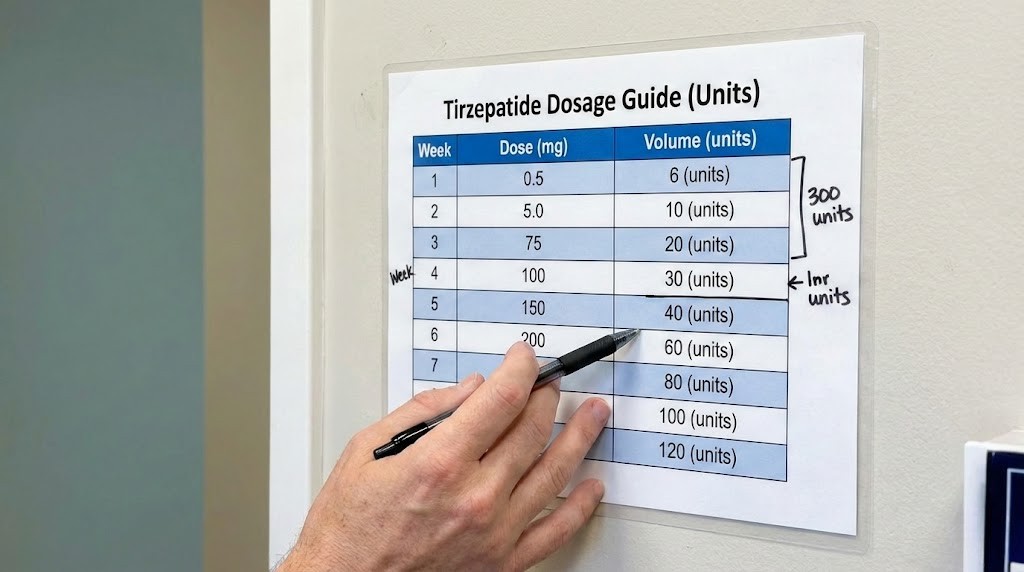
You are staring at a vial of tirzepatide, an insulin syringe in your other hand, and the label says 10mg/ml. Your provider told you to take 2.5mg this week. But the syringe does not say milligrams anywhere. It says units. And right now, standing in your bathroom with a needle you have never used before, that gap between milligrams and units feels enormous. You are not alone in this confusion. Thousands of people every week face this exact moment, where the numbers on the vial do not match the numbers on the syringe, and one wrong calculation could mean injecting double the intended dose or barely half of it.
The core problem is simple but critical. Tirzepatide is prescribed in milligrams. Insulin syringes measure in units. These are not the same measurement. Converting between them requires knowing your vial concentration, understanding basic math, and having a reliable reference chart you can trust. That is exactly what this guide provides.
What makes tirzepatide unit conversion particularly tricky is that compounded vials come in different concentrations. A 5mg/ml vial requires completely different unit measurements than a 20mg/ml vial for the same milligram dose. Get the concentration wrong, and every calculation that follows will be wrong too. This guide covers every common concentration with complete tirzepatide dosage charts in units, the exact conversion formula you need, step-by-step syringe reading instructions, and troubleshooting for the most common mistakes people make. SeekPeptides built this resource because accurate dosing is the foundation of safe, effective research, and no one should have to guess when it comes to injection volumes.
Understanding units on an insulin syringe
Before touching a single conversion chart, you need to understand what units actually mean. This is where most confusion starts, and where most dosing errors originate.
An insulin syringe measures volume. That is it. The word "units" on an insulin syringe refers to the volume of liquid being drawn up, not the potency or strength of the medication inside. A standard U-100 insulin syringe holds 1 milliliter (ml) of liquid total, divided into 100 equal marks. Each mark represents one unit.
So 100 units equals 1 ml. Fifty units equals 0.5 ml. Twenty-five units equals 0.25 ml. The relationship is always the same.
Here is the critical distinction that trips people up. With actual insulin, one unit of insulin means one standardized dose of the hormone. The U-100 designation means there are 100 units of insulin per milliliter. So for insulin, the volume measurement and the dose measurement align perfectly.
Tirzepatide is not insulin. When you draw 25 units of liquid from a tirzepatide vial, you are drawing 0.25 ml of liquid. How many milligrams of tirzepatide are in that 0.25 ml depends entirely on the concentration of your compounded tirzepatide. A 10mg/ml vial contains 2.5mg in those 25 units. A 20mg/ml vial contains 5mg in those same 25 units. Same syringe reading, completely different doses.
This is why knowing your concentration is not optional. It is the single most important number in the entire dosing process. If you learn nothing else from this guide, learn this: always check the concentration on your vial label before calculating anything.
Common syringe sizes and their markings
Insulin syringes come in three standard sizes. Each one measures units differently, and choosing the right syringe for your dose matters for accuracy.
The 0.3 ml syringe (30 units total) is the smallest option. It has markings every half unit or every unit, making it the most precise for small doses. If your calculated dose falls under 30 units, this syringe gives you the clearest readings. Researchers using microdosing tirzepatide protocols often prefer this size for its precision.
The 0.5 ml syringe (50 units total) is the mid-range option. Markings typically appear every unit, and it works well for doses between 20 and 50 units. This is the most popular choice for standard tirzepatide dosing in the 2.5mg to 7.5mg range at a 10mg/ml concentration.
The 1 ml syringe (100 units total) holds the most volume. Markings appear every two units, which means it is slightly less precise for very small doses. But it covers the full range of tirzepatide dosing up to 15mg at most concentrations. If your dose requires more than 50 units of liquid, you need this syringe.
For the best accuracy, always use the smallest syringe that fits your dose. Drawing 13 units on a 100-unit syringe is harder to read precisely than drawing 13 units on a 30-unit syringe. The smaller syringe has wider spacing between unit marks, making your measurement cleaner. This principle applies whether you are working with tirzepatide dosage calculations in ml or converting directly to units.
The universal tirzepatide conversion formula
Every tirzepatide unit conversion uses the same formula. Memorize this and you can calculate any dose at any concentration without looking at a chart.
Units = (Dose in mg / Concentration in mg per ml) x 100
That is it. Three numbers. One division. One multiplication. Let us break it down with a real example.
Say your provider prescribed 5mg of tirzepatide. Your vial concentration is 10mg/ml.
Step one: divide the dose by the concentration. 5mg divided by 10mg/ml equals 0.5 ml.
Step two: multiply by 100 to convert ml to units. 0.5 ml times 100 equals 50 units.
So you draw 50 units on your insulin syringe. That gives you exactly 5mg of tirzepatide from a 10mg/ml vial.
Now the same 5mg dose from a 20mg/ml vial.
Step one: 5mg divided by 20mg/ml equals 0.25 ml.
Step two: 0.25 ml times 100 equals 25 units.
Half the volume. Same dose. This is why concentration changes everything. People who switch vials without recalculating can accidentally double or halve their dose overnight. If you are switching from semaglutide to tirzepatide, the same principle applies. Different medications and different concentrations mean completely different unit readings for equivalent therapeutic doses.
Reverse calculation: units to milligrams
Sometimes you need to go the other direction. You know how many units you drew, and you want to confirm how many milligrams that represents.
Milligrams = (Units / 100) x Concentration in mg per ml
Example: you drew 35 units from a 20mg/ml vial.
35 divided by 100 equals 0.35 ml. Multiply 0.35 ml by 20mg/ml. That gives you 7mg of tirzepatide.
This reverse check is worth doing every time, especially when starting a new vial or adjusting doses. If you have previously calculated how many mg is 40 units of tirzepatide or how many mg is 20 units of tirzepatide, this reverse formula is exactly how those numbers are determined.
Complete tirzepatide dosage chart for 5mg/ml concentration
The 5mg/ml concentration is one of the less common formulations, but some compounding pharmacies do provide it. This lower concentration means larger injection volumes for the same dose, which can be an advantage for people who want more precise measurements at lower doses. It can also mean the vial runs out faster since you are drawing more liquid per injection.
Here is the complete conversion chart for 5mg/ml tirzepatide.
Dose (mg) | Volume (ml) | Units on syringe | Syringe size needed |
|---|---|---|---|
1.25mg | 0.25 ml | 25 units | 0.3 ml or 0.5 ml |
2.5mg | 0.50 ml | 50 units | 0.5 ml or 1 ml |
5mg | 1.00 ml | 100 units | 1 ml |
7.5mg | 1.50 ml | 150 units | Two injections needed |
10mg | 2.00 ml | 200 units | Two injections needed |
Notice the problem with higher doses at this concentration. Once you exceed 5mg, you need more than 1 ml of liquid per dose. A standard insulin syringe only holds 1 ml (100 units). This means splitting the injection into two separate draws and two separate injection sites. For doses of 7.5mg or higher with a 5mg/ml concentration, many researchers find it more practical to switch to a higher concentration vial.
The 5mg/ml concentration does offer one clear advantage: precision at the starting dose. Drawing 50 units for a 2.5mg dose is very easy to measure accurately. Compare that to drawing 12.5 units for the same 2.5mg dose from a 20mg/ml vial, where even a tiny measurement error represents a significant percentage of the total dose.
If you are working with tirzepatide dose charts for the first time, starting with a lower concentration can build confidence in your measuring technique before moving to more concentrated formulations.
Complete tirzepatide dosage chart for 10mg/ml concentration
This is the most widely used concentration for compounded tirzepatide. Most compounding pharmacies default to 10mg/ml, and most dosing instructions from clinics reference this concentration. If your label does not clearly state the concentration, ask your provider. Never assume.
Dose (mg) | Volume (ml) | Units on syringe | Syringe size needed |
|---|---|---|---|
1.25mg | 0.125 ml | 12.5 units | 0.3 ml |
2.5mg | 0.25 ml | 25 units | 0.3 ml or 0.5 ml |
5mg | 0.50 ml | 50 units | 0.5 ml or 1 ml |
7.5mg | 0.75 ml | 75 units | 1 ml |
10mg | 1.00 ml | 100 units | 1 ml |
12.5mg | 1.25 ml | 125 units | Two injections needed |
15mg | 1.50 ml | 150 units | Two injections needed |
The 10mg/ml concentration hits the sweet spot for most users. Every standard dose from 2.5mg through 10mg fits within a single 1 ml syringe. The unit readings are clean, round numbers that are easy to identify on the syringe barrel. And the injection volumes stay small enough to be comfortable at every dose level through 10mg.
The challenge appears at 12.5mg and 15mg, where the volume exceeds 1 ml. At these higher doses, you either need to split into two injections or switch to a higher concentration vial. Many providers address this by starting patients on 10mg/ml vials and transitioning to 20mg/ml vials once they reach the 10mg dose level. This approach maintains a single injection per week while avoiding unnecessarily small volumes at lower doses.
If you have been following a compounded tirzepatide dosage chart or your clinic provided Empower pharmacy tirzepatide dosing instructions, the numbers above should match closely. Small variations can occur depending on rounding conventions, but the underlying math is identical.
For researchers tracking their dosing, SeekPeptides provides detailed protocol tracking tools and dosage calculators that handle these conversions automatically. Knowing the manual math is essential, but having a backup calculator prevents arithmetic mistakes during early morning injections when your brain is still waking up.
Complete tirzepatide dosage chart for 20mg/ml concentration
The 20mg/ml concentration is the second most common formulation. It is typically prescribed when patients reach higher doses (7.5mg and above) to keep injection volumes manageable. Some clinics start everyone on 20mg/ml from the beginning, which means smaller volumes at every dose level.
Dose (mg) | Volume (ml) | Units on syringe | Syringe size needed |
|---|---|---|---|
1.25mg | 0.0625 ml | 6.25 units | 0.3 ml |
2.5mg | 0.125 ml | 12.5 units | 0.3 ml |
5mg | 0.25 ml | 25 units | 0.3 ml or 0.5 ml |
7.5mg | 0.375 ml | 37.5 units | 0.5 ml |
10mg | 0.50 ml | 50 units | 0.5 ml or 1 ml |
12.5mg | 0.625 ml | 62.5 units | 1 ml |
15mg | 0.75 ml | 75 units | 1 ml |
The major advantage here is obvious. Every dose from 2.5mg through 15mg fits within a single 1 ml syringe. No split injections needed at any dose level. This is why many providers prefer 20mg/ml for patients they expect to titrate to higher doses.
The disadvantage is precision at lower doses. Drawing 12.5 units for a 2.5mg starting dose requires careful technique. On a 100-unit syringe, 12.5 units is a tiny amount of liquid. The difference between 12 units and 13 units represents a 0.2mg dosing variance, which is roughly 8% of the total dose. That matters. Use a 0.3 ml (30-unit) syringe for doses under 25 units whenever possible.
Notice the half-unit readings at several dose levels (6.25, 12.5, 37.5, 62.5). Not all syringes mark half units clearly. If your syringe only shows whole units, draw to the nearest whole number and accept the minor variance. The difference is clinically insignificant for most people. However, if precision matters to your protocol, investing in half-unit marked syringes is worthwhile.
Those working with tirzepatide 20mg/ml dosing charts specifically will find these numbers familiar. The compound tirzepatide dosage calculations remain identical regardless of the pharmacy that produced the vial, as long as the concentration matches.
Complete tirzepatide dosage chart for 40mg/ml concentration
The 40mg/ml concentration is the highest commonly available formulation. It is typically reserved for patients on higher maintenance doses who want the smallest possible injection volume. Some specialty compounding pharmacies offer this concentration, though it is less widely available than 10mg/ml or 20mg/ml.
Dose (mg) | Volume (ml) | Units on syringe | Syringe size needed |
|---|---|---|---|
2.5mg | 0.0625 ml | 6.25 units | 0.3 ml |
5mg | 0.125 ml | 12.5 units | 0.3 ml |
7.5mg | 0.1875 ml | 18.75 units | 0.3 ml |
10mg | 0.25 ml | 25 units | 0.3 ml or 0.5 ml |
12.5mg | 0.3125 ml | 31.25 units | 0.5 ml |
15mg | 0.375 ml | 37.5 units | 0.5 ml |
At 40mg/ml, the injection volumes become very small. Even the maximum 15mg dose requires only 37.5 units, which is barely a third of a full 1 ml syringe. This means less liquid under the skin, potentially less injection site discomfort, and faster absorption.
But the precision challenge intensifies. At this concentration, each unit on the syringe represents 0.4mg of tirzepatide. Drawing one unit too many or too few changes your dose by nearly half a milligram. For a 2.5mg starting dose, that one-unit error represents a 16% dose change. This is significant.
If your pharmacy provides 40mg/ml tirzepatide, use a 0.3 ml syringe with half-unit markings. This is not a suggestion. It is a necessity for safe, accurate dosing at this concentration. The wider spacing between marks on a smaller syringe makes precise measurement far more achievable.
A useful cross-reference: if you have been looking at tirzepatide 10mg dosage charts, notice that 10mg at 40mg/ml concentration is only 25 units. Compare that to 100 units at 10mg/ml concentration. Same medication. Same dose. Completely different syringe reading. This is precisely why identifying your concentration before calculating units is non-negotiable.
The standard tirzepatide titration schedule in units
Tirzepatide follows a specific dose escalation pattern. You do not start at your target dose. Instead, you begin low and increase gradually over weeks or months. This titration minimizes side effects, particularly the nausea and gastrointestinal discomfort that comes with GLP-1 receptor agonists.
The standard titration schedule, based on tirzepatide dosing for weight loss protocols, follows this pattern.
Weeks 1 through 4: starting dose of 2.5mg
Every tirzepatide protocol begins here. The 2.5mg dose is not therapeutic for weight loss. It exists solely to let your body adjust to the medication. Think of it as the onboarding phase.
At this dose level, here is what you draw for each concentration:
5mg/ml: 50 units
10mg/ml: 25 units
20mg/ml: 12.5 units
40mg/ml: 6.25 units
Most people experience minimal side effects at 2.5mg. Some notice reduced appetite within the first week. Others feel nothing at all. Both responses are normal. The medication is building up in your system. Tirzepatide has a half-life of approximately five days, meaning it takes about four to five weeks of consistent dosing to reach steady-state levels in your blood. This is why the minimum time at each dose is four weeks.
If you experience nausea during this initial phase, it tends to be mild. Eating smaller, more frequent meals helps. Avoiding greasy, heavy, or excessively spicy food reduces symptoms substantially. Staying hydrated is essential because tirzepatide can reduce your natural thirst signals while simultaneously increasing water needs through its metabolic effects.
Weeks 5 through 8: first therapeutic dose of 5mg
At week five, most providers increase to 5mg. This is where therapeutic effects begin. Weight loss typically starts becoming noticeable, appetite suppression increases, and blood sugar regulation improves significantly for those with insulin resistance.
Unit measurements at 5mg:
5mg/ml: 100 units (full 1 ml syringe)
10mg/ml: 50 units
20mg/ml: 25 units
40mg/ml: 12.5 units
The jump from 2.5mg to 5mg is where gastrointestinal side effects are most commonly reported. Clinical trial data from the SURMOUNT-1 study showed that up to 29% of participants on tirzepatide for weight loss experienced nausea, primarily during dose escalation phases. The nausea typically peaks in the first one to two weeks after a dose increase, then gradually subsides.
For detailed information about managing these transitions, our guide on tirzepatide side effects covers what to expect and how to handle it. Some researchers find that combining tirzepatide with B12 helps manage energy levels during the adjustment period.
Weeks 9 through 12: escalation to 7.5mg
If 5mg is tolerated well but results plateau, the next step is 7.5mg. Not everyone needs to go above 5mg. Clinical trials showed significant weight loss at every dose level, with 5mg producing an average of 16% body weight reduction in the SURMOUNT-1 trial. If you are losing weight steadily at 5mg and tolerating it well, there may be no reason to increase.
Unit measurements at 7.5mg:
5mg/ml: 150 units (requires two injections)
10mg/ml: 75 units
20mg/ml: 37.5 units
40mg/ml: 18.75 units
This dose level is where concentration choice starts to matter practically. At 5mg/ml, you would need to split the 7.5mg dose into two separate injections since 150 units exceeds the capacity of a standard insulin syringe. At 10mg/ml, you are drawing 75 units, which is manageable but getting close to the upper end. At 20mg/ml, the 37.5 units is comfortable and precise.
Weeks 13 through 16: increase to 10mg
The 10mg dose represents a significant jump in therapeutic effect. SURMOUNT-1 showed average weight loss of 21.4% at 10mg over 72 weeks. This is where many people find their maintenance dose, the sweet spot between maximum results and tolerable side effects.
Unit measurements at 10mg:
5mg/ml: 200 units (requires two injections)
10mg/ml: 100 units (full 1 ml syringe)
20mg/ml: 50 units
40mg/ml: 25 units
At 10mg from a 10mg/ml vial, you are drawing a full syringe. This is the maximum dose possible from a single injection with this concentration. If your provider plans to increase beyond 10mg, this is typically when they switch you to a 20mg/ml vial.
For researchers comparing tirzepatide to other GLP-1 options, our semaglutide vs tirzepatide comparison provides a detailed head-to-head analysis including dosing differences and equivalent therapeutic levels. The semaglutide to tirzepatide dose conversion chart can also help if you are transitioning between medications.
Weeks 17 through 20: escalation to 12.5mg
Few people need 12.5mg. This dose is typically reserved for those who respond to tirzepatide but have not reached their target weight at 10mg after adequate time. The additional 2.5mg increment provides meaningful additional appetite suppression and metabolic effects without the full jump to the maximum dose.
Unit measurements at 12.5mg:
10mg/ml: 125 units (requires two injections)
20mg/ml: 62.5 units
40mg/ml: 31.25 units
At 12.5mg, the 20mg/ml concentration becomes the practical minimum for single-injection dosing. The 10mg/ml concentration requires splitting into two injections. This is another reason providers transition patients to higher concentration vials as they titrate up.
Weeks 21 and beyond: maximum dose of 15mg
The 15mg dose is the maximum approved weekly dose of tirzepatide. SURMOUNT-1 data showed 22.5% average body weight reduction at this dose over 72 weeks. In the SURMOUNT-5 head-to-head trial against semaglutide, tirzepatide at maximum dose produced 20.2% weight loss compared to semaglutide at 13.7%.
Unit measurements at 15mg:
10mg/ml: 150 units (requires two injections)
20mg/ml: 75 units
40mg/ml: 37.5 units
At the maximum dose, the 20mg/ml and 40mg/ml concentrations offer the most practical injection volumes. The 75 units at 20mg/ml is easy to measure and comfortable to inject. The 37.5 units at 40mg/ml is the smallest possible volume, which some people prefer.
For comprehensive tirzepatide dosage information at higher concentrations, including 30mg vials and specialized protocols, we have dedicated guides covering every scenario. The key principle never changes: verify your concentration, apply the formula, and double-check your math.
How to read your insulin syringe correctly
Knowing the right number of units means nothing if you cannot read the syringe accurately. This section walks through the physical process of measuring your dose.
Step-by-step syringe reading
Step 1: Identify your syringe size. Look at the maximum number printed on the barrel. It will say 30, 50, or 100. This tells you the total capacity and the scale of the markings.
Step 2: Identify the marking intervals. Count the lines between two numbered markings. On a 100-unit syringe, the numbered marks typically appear at 10, 20, 30, and so on. Between each numbered mark, there are usually 5 lines, meaning each small line represents 2 units. On a 50-unit syringe, the small lines usually represent 1 unit each. On a 30-unit syringe with half-unit markings, each small line represents 0.5 units.
Step 3: Draw the medication. Insert the needle into the vial, invert the vial, and slowly pull the plunger to your target number. Draw slightly past your target, then push the plunger forward to the exact mark. This eliminates any air bubbles that may have entered during the draw.
Step 4: Read at eye level. Hold the syringe horizontally at eye level. The top of the plunger rubber stopper (the flat edge closest to the needle) should align with your target unit line. Do not read the syringe at an angle. Looking down at the syringe makes the plunger appear higher than it actually is. Looking up makes it appear lower. Eye level gives the true reading.
Step 5: Check for air bubbles. Air bubbles take up space in the syringe barrel, displacing medication. A large air bubble means you are injecting less medication than the syringe reading suggests. Flick the syringe gently with your finger to move bubbles to the top (near the needle), then push the plunger slightly to expel them. Recheck your unit reading after removing bubbles.
This process is identical whether you are preparing a reconstituted tirzepatide injection or drawing from a pre-mixed compounded vial. The syringe mechanics do not change based on the medication inside.
Common syringe reading mistakes
The number one mistake is parallax error. Reading the syringe from above instead of straight on. This consistently causes people to draw slightly less than intended because the plunger appears higher from above.
The second most common mistake is ignoring air bubbles. A 5-unit air bubble in a 25-unit draw means you are only injecting 20 units of actual medication. That is a 20% dose reduction. Always remove air bubbles before injecting.
Third is using the wrong syringe size. Drawing 12 units on a 100-unit syringe is nearly impossible to do precisely. The markings are too close together. Switch to a 30-unit syringe and those same 12 units occupy a much larger portion of the barrel, making precise measurement straightforward.
Fourth is confusion between TB syringes and insulin syringes. TB syringes (tuberculin syringes) are marked in milliliters, not units. They look similar to insulin syringes but the numbers mean something completely different. A TB syringe marked at "0.25" means 0.25 ml (equivalent to 25 units on an insulin syringe). If you accidentally use a TB syringe thinking the markings are units, you will inject 10 times the intended dose. Always confirm you are using a U-100 insulin syringe.
Concentration comparison: choosing the right vial for your dose
Not all concentrations are equal in practicality. The right concentration depends on your current dose, your titration plan, and your comfort with small-volume measurements. Here is a direct comparison to help you and your provider choose.
Factor | 5mg/ml | 10mg/ml | 20mg/ml | 40mg/ml |
|---|---|---|---|---|
Best for doses | 1.25-5mg | 2.5-10mg | 5-15mg | 7.5-15mg |
Starting dose (2.5mg) units | 50 units | 25 units | 12.5 units | 6.25 units |
Max single-injection dose | 5mg | 10mg | 15mg+ | 15mg+ |
Precision at low doses | Excellent | Good | Fair | Challenging |
Precision at high doses | Poor (split needed) | Fair | Good | Excellent |
Vial longevity | Shortest | Moderate | Longer | Longest |
Most common | Rare | Most common | Common | Less common |
The pattern is clear. Lower concentrations excel at precision for small doses but struggle with volume at higher doses. Higher concentrations are space-efficient and practical at higher doses but demand careful technique for small doses.
Most people will encounter 10mg/ml or 20mg/ml concentrations. If your compounding pharmacy or provider gives you a choice, consider where you are in the titration schedule. Starting at 2.5mg? The 10mg/ml concentration makes measuring easier. Already at 10mg and expecting to go higher? The 20mg/ml concentration eliminates the need for split injections.
For researchers comparing these options against other medications, our tirzepatide vs semaglutide dosage comparison shows how the concentration and unit calculations differ between these two GLP-1 medications. The semaglutide to tirzepatide conversion chart is particularly helpful for people switching between the two.
What the clinical trials tell us about tirzepatide dosing
Understanding the clinical evidence behind tirzepatide dosing adds context to the numbers on your chart. These are not arbitrary doses. They were tested extensively in large-scale clinical trials involving thousands of participants.
The SURMOUNT program
The SURMOUNT trials represent the largest body of clinical evidence for tirzepatide in weight management. Here are the key findings by dose level.
SURMOUNT-1 enrolled 2,539 adults with obesity or overweight. After 72 weeks, average weight loss was 16.0% at 5mg, 21.4% at 10mg, and 22.5% at 15mg. The placebo group lost 3.1%. These are extraordinary numbers by any historical standard. No previous GLP-1 medication had achieved 20%+ weight loss in clinical trials.
SURMOUNT-4 examined what happens when you stop tirzepatide. Participants who had been on the medication for 36 weeks (average weight loss of 20.9%) were then randomized to continue or switch to placebo. Those who continued lost an additional 5.5% over the next year. Those who stopped regained 14% of their body weight. This data underscores why maintenance dosing matters and why understanding your tirzepatide protocol for the long term is essential.
SURMOUNT-5 was the head-to-head trial against semaglutide (the active ingredient in Wegovy and Ozempic). After 72 weeks, tirzepatide at maximum dose produced 20.2% weight loss compared to 13.7% for semaglutide at maximum dose. This 6.5 percentage point difference is clinically meaningful and represents one of the primary reasons people choose tirzepatide over semaglutide.
Why the titration schedule exists
The gradual dose escalation is not arbitrary. The SURMOUNT trials tested specific titration speeds and found that slower escalation significantly reduced gastrointestinal side effects. Nausea occurred in approximately 24-33% of participants across all tirzepatide doses, but it was most common during dose escalation phases and typically resolved within two to three weeks of stabilizing at a new dose.
The four-week minimum at each dose level allows the body to adapt to the increased GLP-1 and GIP receptor activation. Tirzepatide works as a dual agonist, activating both GLP-1 and GIP receptors simultaneously. This dual mechanism is what makes it more effective than single-agonist medications, but it also means the body needs adequate time to adjust to each dose increase.
Rushing the titration rarely produces better results. In fact, it often produces worse outcomes because severe nausea leads to dehydration, nutritional deficiency, and sometimes medication discontinuation. Patience with the titration schedule, combined with accurate unit dosing from your tirzepatide dosage chart, produces the best long-term results.
Reconstitution and unit calculations
If you are working with lyophilized (freeze-dried) tirzepatide rather than pre-mixed compounded liquid, there is an additional step before you can calculate units. You need to reconstitute the powder by adding bacteriostatic water, and the amount of water you add determines the final concentration.
This is where many people introduce errors. The amount of water added to the vial determines the concentration, and the concentration determines everything else.
How reconstitution affects concentration
Say you have a vial containing 10mg of tirzepatide powder. The concentration you achieve depends entirely on how much water you add.
Water added | Resulting concentration | Units for 2.5mg dose | Units for 5mg dose |
|---|---|---|---|
0.25 ml | 40mg/ml | 6.25 units | 12.5 units |
0.5 ml | 20mg/ml | 12.5 units | 25 units |
1.0 ml | 10mg/ml | 25 units | 50 units |
2.0 ml | 5mg/ml | 50 units | 100 units |
The formula is straightforward. Concentration equals the total milligrams in the vial divided by the total milliliters of water added. For a 10mg vial with 1 ml of water, that is 10mg divided by 1 ml, which gives you 10mg/ml. Identical to a pre-mixed compounded vial at the same concentration.
Our detailed tirzepatide reconstitution chart covers every common vial size with recommended water volumes. The peptide reconstitution calculator on SeekPeptides handles the math automatically for any vial size and desired concentration.
Tips for accurate reconstitution
Use bacteriostatic water, not sterile water. Bacteriostatic water contains a preservative (benzyl alcohol at 0.9%) that prevents bacterial growth. Since multi-dose vials are accessed multiple times over several weeks, this preservative is essential for safety. Sterile water has no preservative and should only be used for single-use preparations.
Add water slowly. Direct the water stream down the inside wall of the vial, not directly onto the powder. Forceful water injection can denature the peptide and reduce potency. Gentle addition preserves the molecular structure.
Do not shake the vial. Swirl gently or roll between your palms. Vigorous shaking creates foam, which introduces air and can damage the peptide through mechanical stress. The solution should be clear and colorless when fully dissolved. If it appears cloudy or contains particles, do not use it.
Record the concentration immediately after reconstitution. Write it on the vial label with a marker. Write it in your protocol log. This seems trivial until you have multiple vials and cannot remember which one is 10mg/ml and which is 20mg/ml. Mislabeled vials are a common source of dosing errors.
For comprehensive storage guidance after reconstitution, our tirzepatide refrigeration guide and stability guide for compounded tirzepatide cover temperature requirements and shelf life in detail.
Quick reference conversion tables by dose
Sometimes you just need a fast answer. These quick-reference tables organize the data by dose level so you can find your specific number in seconds.
2.5mg dose (starting dose)
Concentration | Volume (ml) | Units | Best syringe |
|---|---|---|---|
5mg/ml | 0.50 | 50 | 0.5 ml or 1 ml |
10mg/ml | 0.25 | 25 | 0.3 ml or 0.5 ml |
20mg/ml | 0.125 | 12.5 | 0.3 ml |
40mg/ml | 0.0625 | 6.25 | 0.3 ml |
This starting dose is where the question of how many units equals 2.5mg of tirzepatide comes up most often. The answer, as this table shows, depends entirely on your concentration. There is no universal answer because there is no universal concentration.
5mg dose
Concentration | Volume (ml) | Units | Best syringe |
|---|---|---|---|
5mg/ml | 1.00 | 100 | 1 ml |
10mg/ml | 0.50 | 50 | 0.5 ml or 1 ml |
20mg/ml | 0.25 | 25 | 0.3 ml or 0.5 ml |
40mg/ml | 0.125 | 12.5 | 0.3 ml |
At 5mg, the numbers are clean across most concentrations. Fifty units from a 10mg/ml vial is one of the easiest measurements to make. Half the syringe, right on a major marking line. For people who want simplicity, the 10mg/ml concentration at 5mg dose is ideal. Related guides covering how many units 5mg of tirzepatide equals walk through this same math in extended detail.
7.5mg dose
Concentration | Volume (ml) | Units | Best syringe |
|---|---|---|---|
10mg/ml | 0.75 | 75 | 1 ml |
20mg/ml | 0.375 | 37.5 | 0.5 ml |
40mg/ml | 0.1875 | 18.75 | 0.3 ml |
10mg dose
Concentration | Volume (ml) | Units | Best syringe |
|---|---|---|---|
10mg/ml | 1.00 | 100 | 1 ml |
20mg/ml | 0.50 | 50 | 0.5 ml or 1 ml |
40mg/ml | 0.25 | 25 | 0.3 ml or 0.5 ml |
12.5mg dose
Concentration | Volume (ml) | Units | Best syringe |
|---|---|---|---|
20mg/ml | 0.625 | 62.5 | 1 ml |
40mg/ml | 0.3125 | 31.25 | 0.5 ml |
15mg dose (maximum)
Concentration | Volume (ml) | Units | Best syringe |
|---|---|---|---|
20mg/ml | 0.75 | 75 | 1 ml |
40mg/ml | 0.375 | 37.5 | 0.5 ml |
These quick-reference tables complement the full concentration charts above. Print them, save them, bookmark this page. Having a trusted reference eliminates the need for mental math during your weekly injection, which reduces errors and builds confidence in your protocol.
Microdosing tirzepatide in units
Microdosing has gained significant attention as a strategy for minimizing side effects while still receiving therapeutic benefit. Instead of following the standard titration schedule, microdosing involves starting at sub-therapeutic doses, often 0.5mg to 1.25mg, and increasing in very small increments.
The unit calculations for microdoses require extra precision because the volumes are extremely small.
Microdose (mg) | 10mg/ml units | 20mg/ml units | 40mg/ml units |
|---|---|---|---|
0.5mg | 5 units | 2.5 units | 1.25 units |
0.75mg | 7.5 units | 3.75 units | 1.875 units |
1.0mg | 10 units | 5 units | 2.5 units |
1.25mg | 12.5 units | 6.25 units | 3.125 units |
1.5mg | 15 units | 7.5 units | 3.75 units |
Look at those numbers for the 40mg/ml concentration. Drawing 1.25 units on any syringe is virtually impossible with acceptable accuracy. Even 2.5 units on a standard syringe pushes the limits of precise measurement. This is why microdosing protocols almost always require the 10mg/ml concentration, where the volumes are large enough to measure reliably.
For detailed microdosing protocols, our microdosing tirzepatide chart provides a complete titration schedule with unit conversions at every step. The benefits of microdosing include reduced nausea, more gradual adaptation, and the ability to find the lowest effective dose for your individual response.
Some researchers report that microdosing at 1.0mg to 1.25mg weekly produces meaningful appetite suppression with virtually no gastrointestinal side effects. This approach takes longer to reach full therapeutic doses but can be particularly valuable for people who had severe reactions to GLP-1 medications at standard starting doses.
Special considerations for branded tirzepatide (Mounjaro and Zepbound)
If you are using branded Mounjaro or Zepbound rather than compounded tirzepatide, the unit conversion discussion does not apply in the same way. Branded tirzepatide comes in single-dose auto-injector pens. Each pen delivers a fixed, pre-measured dose. You do not need an insulin syringe, you do not need to calculate units, and you do not need to worry about concentration.
The available pen doses are 2.5mg, 5mg, 7.5mg, 10mg, 12.5mg, and 15mg. Each pen delivers its labeled dose in a fixed volume that you cannot adjust.
However, some people prescribed branded pens still ask about units for one specific reason. They want to understand what they are injecting in volumetric terms, often for comparison with their previous experience on compounded formulations. For reference, Mounjaro and Zepbound pens use a proprietary concentration and delivery mechanism. The exact concentration is not publicly specified in the same way compounded vials are labeled because the pen handles all measurement internally.
If you are transitioning from compounded tirzepatide (measured in units with an insulin syringe) to branded pens (fixed dose auto-injectors), the switch is straightforward. Match the milligram dose. If you were taking 7.5mg from a vial, you switch to the 7.5mg pen. The milligram dose is what matters therapeutically, not the volume or units.
For those comparing the economics and practicality, our guide on compounded tirzepatide options covers the full landscape. The tirzepatide before and after results page shows outcomes from both branded and compounded protocols.
Safety checks and double-verification protocol
Accurate dosing is not just about math. It is about building habits that prevent errors even when you are tired, distracted, or rushing. Here is a five-point verification protocol that takes less than 30 seconds and can prevent serious dosing mistakes.
The five-point check
Check 1: Verify the vial label. Read the concentration. Say it out loud. "This vial is 10 milligrams per milliliter." If the label is unclear, smudged, or does not clearly state the concentration, do not use the vial until you confirm with your pharmacy.
Check 2: Confirm your prescribed dose. "My dose this week is 5 milligrams." If you are escalating, double-check with your provider instructions. Do not self-escalate without guidance.
Check 3: Calculate units. 5mg divided by 10mg/ml equals 0.5 ml. Multiply by 100 equals 50 units. Do this calculation fresh every time. Do not rely on memory from last week, especially if your dose or vial has changed.
Check 4: Draw and read. Draw to 50 units. Hold at eye level. Confirm the plunger edge aligns with the 50-unit mark. Check for air bubbles.
Check 5: Reverse verify. 50 units equals 0.5 ml. 0.5 ml times 10mg/ml equals 5mg. Does that match your prescribed dose? Yes. Proceed.
This takes 20 to 30 seconds. It catches concentration mix-ups, arithmetic errors, syringe misreads, and dose escalation mistakes. Building this into your weekly routine transforms dosing from a source of anxiety into a confident, mechanical process.
For a printable version of this verification process alongside your complete dosing chart, SeekPeptides members access downloadable protocol sheets tailored to their specific concentration and dose level. Having a physical reference at your injection station eliminates the need to pull up digital resources while holding a syringe.
Common dosing errors and how to avoid them
After reviewing thousands of dosing questions across forums and communities, certain errors appear repeatedly. Knowing these in advance helps you avoid them entirely.
Error 1: using the old concentration with a new vial
This is the most dangerous mistake. You have been drawing 25 units from a 10mg/ml vial for your 2.5mg dose. Your pharmacy sends a 20mg/ml vial this month. You draw 25 units out of habit. You just injected 5mg instead of 2.5mg. Double the intended dose.
Prevention: Always read the vial label before every injection. Always recalculate when receiving a new vial, even if you think it is the same concentration. Write the concentration and your calculated units on a sticky note attached to the vial.
Error 2: confusing TB syringes with insulin syringes
TB syringes measure in milliliters. Insulin syringes measure in units. They look almost identical. If you draw "25" on a TB syringe thinking it means 25 units, you actually draw 0.25 ml. On a TB syringe marked in tenths, "25" means 2.5 ml, which is 250 units. That would be a catastrophic overdose.
Prevention: Only use U-100 insulin syringes for tirzepatide. Check the syringe packaging. It should clearly state "U-100" or "insulin syringe." If the barrel markings show decimal values (0.1, 0.2, 0.3) rather than whole numbers (10, 20, 30), you likely have a TB syringe.
Error 3: not accounting for air bubbles
A visible air bubble in your syringe displaces medication. If you draw 50 units but 5 units of that is air, you are only injecting 45 units of medication. Over time, these small discrepancies add up and can explain inconsistent results.
Prevention: After drawing your dose, hold the syringe needle-up. Flick the barrel to move bubbles to the top. Push the plunger gently until the bubble exits and a tiny drop of liquid appears at the needle tip. Recheck your unit reading and adjust if needed.
Error 4: self-escalating without adequate time at current dose
Impatience drives this one. You have been at 5mg for three weeks and want faster results, so you jump to 10mg. Skipping the 7.5mg step and reducing time at each level increases the risk of severe nausea, vomiting, and dehydration. The clinical trials showed that at least four weeks at each dose level is necessary for the body to adapt.
Prevention: Follow your provider prescribed titration schedule. If you want to adjust, discuss it with them first. The tirzepatide timeline for results can help set realistic expectations for each dose level.
Error 5: injecting daily instead of weekly
This sounds unlikely, but it happens. People coming from daily injectable medications (like certain insulin protocols or BPC-157) sometimes carry the daily injection habit into their tirzepatide protocol. Tirzepatide is a once-weekly medication. Its half-life of approximately five days means it stays active in your system throughout the week. Daily injection would cause rapid accumulation to dangerous levels.
Prevention: Set a recurring weekly calendar reminder for your injection day. Most providers recommend picking the same day each week. If you miss a day, inject as soon as you remember unless your next scheduled dose is within four days, in which case skip the missed dose and resume your normal schedule.
Tirzepatide dosage units compared across GLP-1 medications
Tirzepatide is not the only injectable weight loss medication that uses milligram dosing with insulin syringes. Comparing unit calculations across medications helps prevent confusion for people who switch between them.
Medication | Common dose range | Typical concentration | Units for mid-range dose |
|---|---|---|---|
Tirzepatide | 2.5-15mg weekly | 10mg/ml or 20mg/ml | 50 units (5mg at 10mg/ml) |
Semaglutide | 0.25-2.4mg weekly | 5mg/ml | 20 units (1mg at 5mg/ml) |
Retatrutide | 1-12mg weekly | Varies | Varies by concentration |
The key difference is that semaglutide operates at much lower milligram doses than tirzepatide. Someone switching from semaglutide 2.4mg to tirzepatide 5mg might expect similar unit readings, but the concentrations are completely different. The switching from semaglutide to tirzepatide dosage chart and the semaglutide to tirzepatide conversion chart handle these cross-medication calculations in detail.
For those considering retatrutide versus tirzepatide dosage comparisons, the same principles apply. Different medication, different concentration, different unit reading for equivalent therapeutic effect. The formula never changes. Only the inputs change.
Understanding semaglutide dosing in units alongside tirzepatide dosing gives you flexibility if your provider recommends switching medications. The semaglutide syringe dosage conversion chart and the semaglutide dosage in units conversion chart use the exact same formula methodology covered in this guide.
Troubleshooting common tirzepatide dosing questions
My syringe does not have half-unit markings. How do I draw 12.5 units?
Draw to the line between 12 and 13. On most insulin syringes, this means positioning the plunger edge exactly halfway between the two nearest marks. While not perfectly precise, the 0.5-unit difference represents only 0.05 ml, which is a negligible dosing variance. If this concerns you, purchase 0.3 ml syringes with half-unit markings, which are available at most pharmacies without a prescription.
I accidentally drew too much. Can I push some back into the vial?
Yes, but with caution. If you drew too much, push the excess back into the vial before removing the needle. The risk is that you introduce a tiny air bubble into the vial, which is usually harmless but can affect measurements for subsequent draws. The bigger risk is contamination if the needle has touched anything other than the inside of the vial. If the needle touched your skin or any surface, do not push medication back. Use a new needle and draw again.
My calculated dose falls between unit markings. What do I do?
Round to the nearest whole or half unit. For doses where the calculated units end in .25 or .75, round to the nearest .5 if your syringe has half-unit markings, or to the nearest whole unit if it does not. The dosing variance from rounding is clinically insignificant. A difference of 0.25 units at 10mg/ml concentration equals only 0.025mg of tirzepatide, which is less than 1% of even the smallest standard dose.
I changed pharmacies and the new vial looks different. Are the units the same?
The units are the same IF the concentration is the same. Different pharmacies use different vial sizes, labels, and even liquid colors (some add B12 or other additives that change appearance). The critical number is the concentration printed on the label. If both vials say 10mg/ml, then 25 units from either vial delivers 2.5mg of tirzepatide. If the concentration is different, you must recalculate.
Our guide on tirzepatide with niacinamide and tirzepatide with B12 covers how additives affect concentration calculations. The compound tirzepatide dosing chart accounts for these variations in its calculations.
My provider said take 25 units. How do I know the milligrams?
You need the concentration. If your provider only said "25 units" without specifying concentration, call them back. Twenty-five units from a 10mg/ml vial is 2.5mg. Twenty-five units from a 20mg/ml vial is 5mg. Twenty-five units from a 40mg/ml vial is 10mg. These are dramatically different doses with dramatically different effects. Never inject based on units alone without confirming the concentration of your specific vial.
Building a long-term dosing protocol
Accurate unit measurement is the foundation, but a complete tirzepatide protocol involves more than just knowing your weekly number. Here is what a comprehensive dosing plan looks like.
Week-by-week tracking template
For each injection, record the following:
Date and time of injection
Dose in mg (prescribed amount)
Concentration of vial (mg/ml)
Units drawn on syringe
Injection site (rotate between abdomen, thigh, upper arm)
Side effects (none, mild, moderate, severe)
Weight (weekly, same scale, same conditions)
Notes (food tolerance, energy levels, appetite changes)
This data becomes invaluable when making titration decisions with your provider. Instead of saying "I think the last dose was okay," you can say "I had mild nausea for two days after each of my last four injections at 7.5mg, but appetite suppression is strong and weight is trending down 1.2 pounds per week." That level of detail leads to better clinical decisions.
When to increase your dose
Dose increases should be guided by three factors.
Factor 1: tolerance. Are you managing side effects at your current dose? If nausea or gastrointestinal issues are still significant after four full weeks, staying at the current dose longer is often better than escalating.
Factor 2: results. Is weight loss occurring at a meaningful rate? Clinical trials showed an average of 1-2 pounds per week across all dose levels. If you are losing weight steadily at your current dose, there may be no benefit to increasing.
Factor 3: time. You must spend a minimum of four weeks at each dose level. This is not a suggestion. This is the minimum timeframe established by clinical trial protocols for safe dose escalation.
The decision to increase should always involve your healthcare provider. Self-escalation without medical guidance increases risk and may compromise results. For those working through the titration on their own, our tirzepatide dosing for weight loss in units guide provides additional context for each escalation point.
Injection site rotation
Rotating injection sites prevents lipodystrophy (tissue changes at injection sites) and ensures consistent absorption. The three approved injection areas for subcutaneous injection are the abdomen (at least 2 inches from the navel), the front of the thigh (middle third), and the back of the upper arm.
A simple rotation pattern: Week 1 left abdomen, Week 2 right thigh, Week 3 left thigh, Week 4 right abdomen. Repeat. This gives each site a full month to recover between injections.
Absorption rates can vary slightly between sites. The abdomen generally provides the fastest absorption, while the thigh is slightly slower. For consistency, try to use the same general area for at least one full dose cycle (four weeks at the same dose) before switching sites. This eliminates injection site variability as a factor when evaluating dose effectiveness.
Storing your tirzepatide properly
Proper storage directly affects potency. If your tirzepatide degrades due to poor storage, the actual milligrams you inject may be less than what you calculated, regardless of how accurate your unit measurement was.
Refrigerate between 36 and 46 degrees Fahrenheit (2 to 8 degrees Celsius). This applies to both reconstituted vials and pre-mixed compounded vials. Do not freeze. Freezing destroys the peptide structure and renders the medication ineffective.
Once reconstituted, most sources recommend using the vial within 28 days. Some compounded formulations with preservatives may last longer. Check with your pharmacy for specific guidance on your product.
Protect from light. Store in the original box or wrap the vial in aluminum foil. UV exposure degrades tirzepatide over time.
If your vial has been at room temperature for more than 48 hours, its stability may be compromised. Brief periods at room temperature (during injection preparation) are fine, but prolonged exposure accelerates degradation.
For detailed storage protocols, our guides on whether tirzepatide needs refrigeration and how long tirzepatide lasts in the fridge cover every scenario including travel storage, power outages, and shipping considerations.
Frequently asked questions
How many units is 2.5mg of tirzepatide?
It depends on the concentration. At 10mg/ml, 2.5mg equals 25 units. At 20mg/ml, 2.5mg equals 12.5 units. At 40mg/ml, 2.5mg equals 6.25 units. Always verify your vial concentration before calculating. For a complete breakdown, see our detailed 2.5mg unit conversion guide.
How many units is 5mg of tirzepatide?
At 10mg/ml concentration, 5mg equals 50 units. At 20mg/ml, it equals 25 units. At 40mg/ml, it equals 12.5 units. The formula is always (mg dose / concentration) x 100 = units. Our 5mg tirzepatide unit conversion page covers this in full detail.
What is the difference between units and milligrams?
Units measure volume on an insulin syringe (100 units = 1 ml). Milligrams measure the weight of the active medication. They are converted through the concentration of your vial. A 10mg/ml vial means each milliliter (100 units) contains 10mg of tirzepatide.
Can I use the same syringe for tirzepatide and insulin?
You can use the same type of syringe (U-100 insulin syringe), but never the same physical syringe for both medications in the same injection session. Each medication requires a fresh, sterile syringe. The unit calculations will be different for each medication even if you use the same syringe size.
What happens if I inject the wrong number of units?
If you injected less than intended, you may experience reduced effectiveness that week. There is no need to take a supplemental dose. Wait until your next scheduled injection and draw the correct amount. If you injected more than intended, monitor for increased side effects (nausea, vomiting, diarrhea) and contact your healthcare provider. A single slightly higher dose is unlikely to cause serious harm, but your provider should be aware.
Do I need a prescription for insulin syringes?
In most US states, insulin syringes are available over the counter without a prescription. Some states require a prescription. Check your local pharmacy or state regulations. Online medical supply companies also sell insulin syringes, often at lower prices than retail pharmacies.
How do I know if my vial is 10mg/ml or 20mg/ml?
The concentration is printed on the vial label. It will typically say something like "Tirzepatide 10mg/ml" or "10mg per ml" or "Concentration: 10mg/ml." If you cannot find this information on the label, contact your pharmacy before using the vial. Never guess the concentration.
Is 40 units of tirzepatide the same as 40 units of insulin?
No. Forty units of any liquid in an insulin syringe is the same volume (0.4 ml). But 40 units of tirzepatide and 40 units of insulin contain completely different medications at completely different potencies. The volume is identical. The medication is completely different. Never substitute one for the other or assume equivalency. For tirzepatide specifically, 40 units equals different mg doses depending on concentration.
External resources
For researchers serious about optimizing their tirzepatide protocols, SeekPeptides offers the most comprehensive resource available, with evidence-based guides, proven protocols, dosage calculators, and a community of thousands who have navigated these exact questions.
In case I do not see you, good afternoon, good evening, and good night. May your calculations stay accurate, your concentrations stay verified, and your results stay consistent.