Feb 10, 2026
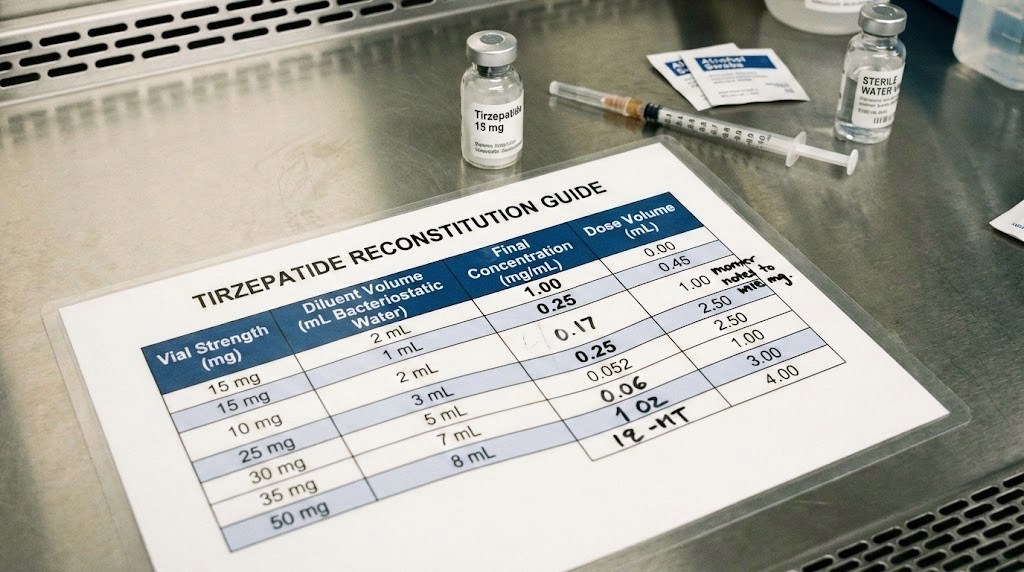
One wrong measurement. That is all it takes. You add too much bacteriostatic water, your concentration drops, and suddenly every dose you draw falls short. You add too little, and the solution becomes so concentrated that measuring a precise 2.5mg dose with an insulin syringe becomes nearly impossible. Either way, you are wasting tirzepatide, wasting money, and getting inconsistent results from a peptide that demands precision.
The frustration compounds quickly. You search online for a simple reconstitution chart and find conflicting information everywhere. One source says add 1mL to a 10mg vial. Another says 2mL. A third recommends 3mL for easier dosing. Nobody explains why the amount of water you choose actually matters, or how it changes every single dose you draw from that vial. And when you factor in different vial sizes, from 5mg all the way up to 60mg, the confusion multiplies.
This guide eliminates that confusion entirely. Every chart you need lives here. Every vial size. Every common bacteriostatic water volume. Every resulting concentration with the exact number of units to draw on a standard insulin syringe for doses ranging from 1mg up to 15mg. Whether you are working with a 5mg research vial or a 60mg multi-dose vial, the charts below give you a single reference point that removes guesswork from the process. SeekPeptides built this resource because reconstitution errors are the number one cause of inconsistent tirzepatide dosing, and accurate dosing is everything when it comes to this peptide.
The reconstitution formula every researcher needs to memorize
Before jumping into the charts, you need to understand the single formula that governs every reconstitution calculation. It is not complicated. But getting it wrong changes everything downstream.
Concentration (mg/mL) = Peptide Amount (mg) / Bacteriostatic Water Volume (mL)
That is it. If you have a 10mg vial and add 2mL of bacteriostatic water, your concentration is 10 divided by 2, which equals 5mg/mL. Every milliliter of solution now contains 5mg of tirzepatide. Simple division.
The second formula you need determines how much solution to draw for any given dose:
Volume to Draw (mL) = Desired Dose (mg) / Concentration (mg/mL)
Want 2.5mg from that 5mg/mL solution? Draw 0.5mL. Need 5mg? Draw 1.0mL. These two formulas unlock every chart below. But you do not need to do the math yourself. The charts handle it.
Why the amount of water you add changes everything
Here is where most people make their first mistake. They assume there is one correct amount of bacteriostatic water for each vial size. There is not. The amount of water you add is a choice, and that choice creates trade-offs.
Less water means higher concentration. Higher concentration means smaller injection volumes, which can be more comfortable. But smaller volumes are harder to measure accurately on an insulin syringe. The difference between 5 units and 7 units on a syringe is tiny, and that small measurement error could mean a 40% dosing difference.
More water means lower concentration. Lower concentration means larger injection volumes, which are easier to measure precisely. The difference between 25 units and 35 units is much easier to see and draw accurately. But larger volumes mean bigger injections.
The sweet spot for most researchers? A concentration that puts common doses between 10 and 50 units on an insulin syringe. That range offers the best balance of measurement accuracy and injection comfort. The charts below are built around this principle.
Understanding insulin syringe units
This trips up more people than any other aspect of tirzepatide reconstitution. A standard U-100 insulin syringe has markings from 0 to 100 units. Those 100 units equal exactly 1mL of liquid. So every unit is 0.01mL.
The key insight: units on the syringe measure volume, not drug amount. When someone says "draw 25 units," they mean draw 0.25mL. How much tirzepatide that 0.25mL contains depends entirely on your concentration. At 10mg/mL, 25 units delivers 2.5mg. At 5mg/mL, those same 25 units only deliver 1.25mg. Same volume. Different dose. This is why concentration matters so much, and why getting the reconstitution right is the foundation of accurate tirzepatide dosing in units.
Complete reconstitution chart: 5mg tirzepatide vial
The 5mg vial is the smallest commonly available size. It is ideal for researchers just starting out or those running short protocols at lower doses. Because the total peptide amount is small, your water volume choices are more limited. Add too much water and the concentration becomes so low that you use the entire vial in just one or two doses.
5mg vial concentration reference
Bacteriostatic Water Added | Concentration | Best For |
|---|---|---|
0.5mL | 10mg/mL | Higher doses (5mg+), experienced users |
1.0mL | 5mg/mL | Standard dosing, good measurement accuracy |
2.0mL | 2.5mg/mL | Low-dose protocols, maximum accuracy |
5mg vial dosing chart (units to draw on U-100 insulin syringe)
Desired Dose | 0.5mL Water (10mg/mL) | 1.0mL Water (5mg/mL) | 2.0mL Water (2.5mg/mL) |
|---|---|---|---|
1.0mg | 10 units | 20 units | 40 units |
1.25mg | 12.5 units | 25 units | 50 units |
2.0mg | 20 units | 40 units | 80 units |
2.5mg | 25 units | 50 units | 100 units (full syringe) |
5.0mg | 50 units | 100 units (full syringe) | N/A (exceeds syringe) |
Recommendation for 5mg vials: Use 1.0mL of bacteriostatic water. This gives you a clean 5mg/mL concentration where each 10 units equals 0.5mg. Common starting doses like 2.5mg require exactly 50 units, which is easy to measure on any insulin syringe.
At this concentration, the entire vial contains two 2.5mg doses or one 5mg dose. Plan your tirzepatide dose schedule accordingly. For researchers doing microdosing tirzepatide protocols, the 2.0mL dilution provides the best accuracy for sub-milligram doses.
Complete reconstitution chart: 10mg tirzepatide vial
The 10mg vial is arguably the most popular size for individual research protocols. It provides enough tirzepatide for a full month at lower doses or about two weeks at moderate doses. The math works cleanly with several water volumes, giving you flexibility in concentration.
10mg vial concentration reference
Bacteriostatic Water Added | Concentration | Best For |
|---|---|---|
1.0mL | 10mg/mL | Easy math, moderate volumes |
2.0mL | 5mg/mL | Best accuracy for standard doses |
3.0mL | 3.33mg/mL | Low-dose protocols, high accuracy |
10mg vial dosing chart (units to draw on U-100 insulin syringe)
Desired Dose | 1.0mL Water (10mg/mL) | 2.0mL Water (5mg/mL) | 3.0mL Water (3.33mg/mL) |
|---|---|---|---|
1.0mg | 10 units | 20 units | 30 units |
2.0mg | 20 units | 40 units | 60 units |
2.5mg | 25 units | 50 units | 75 units |
5.0mg | 50 units | 100 units | N/A (exceeds syringe) |
7.5mg | 75 units | N/A | N/A |
10.0mg | 100 units | N/A | N/A |
Recommendation for 10mg vials: Use 1.0mL for the cleanest math. At 10mg/mL, every 10 units on your syringe equals exactly 1mg. A 2.5mg dose is 25 units. A 5mg dose is 50 units. No decimals, no guesswork. This is the "base 10" approach that most experienced researchers prefer because the mental math becomes effortless.
However, if you are running a compounded tirzepatide protocol that requires precision at lower doses like 1mg or 1.25mg, the 2.0mL dilution provides better measurement accuracy. At 5mg/mL, a 1mg dose requires 20 units instead of 10, and that extra granularity helps when every fraction of a milligram counts.
Complete reconstitution chart: 15mg tirzepatide vial
The 15mg vial sits in a practical middle ground. It offers enough peptide for moderate-length protocols without the complexity of managing very large volumes. The math does not divide as cleanly as the 10mg vial, but certain water volumes still produce workable concentrations.
15mg vial concentration reference
Bacteriostatic Water Added | Concentration | Best For |
|---|---|---|
1.0mL | 15mg/mL | Compact volume, higher doses |
1.5mL | 10mg/mL | Clean math, easy unit conversion |
3.0mL | 5mg/mL | Standard accuracy, lower doses |
15mg vial dosing chart (units to draw on U-100 insulin syringe)
Desired Dose | 1.0mL Water (15mg/mL) | 1.5mL Water (10mg/mL) | 3.0mL Water (5mg/mL) |
|---|---|---|---|
1.0mg | 6.7 units | 10 units | 20 units |
2.5mg | 16.7 units | 25 units | 50 units |
5.0mg | 33.3 units | 50 units | 100 units |
7.5mg | 50 units | 75 units | N/A |
10.0mg | 66.7 units | 100 units | N/A |
15.0mg | 100 units | N/A | N/A |
Recommendation for 15mg vials: Use 1.5mL to achieve the familiar 10mg/mL concentration. This keeps unit conversion identical to the 10mg vial with 1.0mL water. Every 10 units equals 1mg. The consistency across vial sizes reduces confusion when switching between protocols or vial batches.
Notice how the 1.0mL option creates a 15mg/mL concentration with awkward decimal units for most common doses. While it works, the fractional units make accurate drawing more difficult. For beginners or anyone prioritizing accuracy, the 1.5mL or 3.0mL options are safer choices. You can explore similar concentration principles in our units to milligrams conversion guide.
Complete reconstitution chart: 30mg tirzepatide vial
The 30mg vial is the workhorse of longer research protocols. It provides enough tirzepatide for approximately 4 to 6 weeks at standard titration doses, making it cost-effective for extended studies. Larger vials also mean more flexibility in concentration choices, since you have more peptide to work with.
30mg vial concentration reference
Bacteriostatic Water Added | Concentration | Best For |
|---|---|---|
1.5mL | 20mg/mL | Compact volume, advanced users only |
2.0mL | 15mg/mL | Moderate volume, higher doses |
3.0mL | 10mg/mL | Clean math, recommended for most |
6.0mL | 5mg/mL | Maximum accuracy, lower doses |
30mg vial dosing chart (units to draw on U-100 insulin syringe)
Desired Dose | 1.5mL Water (20mg/mL) | 3.0mL Water (10mg/mL) | 6.0mL Water (5mg/mL) |
|---|---|---|---|
2.5mg | 12.5 units | 25 units | 50 units |
5.0mg | 25 units | 50 units | 100 units |
7.5mg | 37.5 units | 75 units | N/A |
10.0mg | 50 units | 100 units | N/A |
12.5mg | 62.5 units | N/A | N/A |
15.0mg | 75 units | N/A | N/A |
Recommendation for 30mg vials: Use 3.0mL for the standard 10mg/mL concentration. This keeps the math identical to every other vial size using the base-10 approach, where each 10 units equals 1mg. The 30mg vial at this concentration provides 3mL of total solution, enough for multiple weeks of dosing without wasting reconstituted peptide before the 28-day expiration.
For researchers titrating up through the standard tirzepatide dosing schedule from 2.5mg to 5mg to 7.5mg and beyond, the 10mg/mL concentration handles every tier cleanly. Compare this approach against semaglutide dosing to see how the two peptides differ in their titration structure.
Complete reconstitution chart: 60mg tirzepatide vial
The 60mg vial is the largest commonly available size. It is designed for extended protocols or higher-dose research where going through multiple smaller vials becomes impractical. With this much peptide, concentration management becomes critical. Too concentrated and you cannot measure small doses. Too dilute and you have more liquid than a single vial can hold or use within the 28-day stability window.
60mg vial concentration reference
Bacteriostatic Water Added | Concentration | Best For |
|---|---|---|
2.0mL | 30mg/mL | Ultra-compact, high doses only |
3.0mL | 20mg/mL | Higher doses, experienced users |
4.0mL | 15mg/mL | Balanced approach |
6.0mL | 10mg/mL | Clean math, easiest dosing |
60mg vial dosing chart (units to draw on U-100 insulin syringe)
Desired Dose | 3.0mL Water (20mg/mL) | 4.0mL Water (15mg/mL) | 6.0mL Water (10mg/mL) |
|---|---|---|---|
2.5mg | 12.5 units | 16.7 units | 25 units |
5.0mg | 25 units | 33.3 units | 50 units |
7.5mg | 37.5 units | 50 units | 75 units |
10.0mg | 50 units | 66.7 units | 100 units |
12.5mg | 62.5 units | 83.3 units | N/A |
15.0mg | 75 units | 100 units | N/A |
Recommendation for 60mg vials: Use 3.0mL for a 20mg/mL concentration if you are dosing at 5mg or above. At this concentration, a 5mg dose is a clean 25 units and a 10mg dose is 50 units. For lower starting doses, use 6.0mL to get the standard 10mg/mL. The trade-off with 6mL is having more reconstituted solution than you may use within 28 days at lower doses, so plan your protocol timeline carefully.
Calculate your exact volumes using the peptide reconstitution calculator to verify these numbers for your specific setup. You can also cross-reference with the general peptide calculator for dose-volume conversions.
The universal 10mg/mL reference chart
If you want one concentration to memorize, one chart to print and tape to your refrigerator, this is it. A 10mg/mL concentration works with every vial size and makes the math almost unnecessary.
At 10mg/mL, each unit on a U-100 insulin syringe equals exactly 0.1mg. Each 10 units equals exactly 1mg. This is the simplest possible conversion.
How to achieve 10mg/mL with any vial size
Vial Size | Bacteriostatic Water to Add | Resulting Concentration |
|---|---|---|
5mg | 0.5mL | 10mg/mL |
10mg | 1.0mL | 10mg/mL |
15mg | 1.5mL | 10mg/mL |
30mg | 3.0mL | 10mg/mL |
60mg | 6.0mL | 10mg/mL |
Universal dosing at 10mg/mL
Desired Dose | Units to Draw | Volume (mL) |
|---|---|---|
0.5mg | 5 units | 0.05mL |
1.0mg | 10 units | 0.10mL |
1.5mg | 15 units | 0.15mL |
2.0mg | 20 units | 0.20mL |
2.5mg | 25 units | 0.25mL |
3.0mg | 30 units | 0.30mL |
5.0mg | 50 units | 0.50mL |
7.5mg | 75 units | 0.75mL |
10.0mg | 100 units | 1.00mL |
This is the chart. Print it. Save it. Bookmark it. At 10mg/mL, dosing tirzepatide becomes pure multiplication. Whatever milligram dose you want, multiply by 10 to get units. Done.
Researchers who maintain this consistent concentration across vial sizes eliminate a major source of dosing errors. When you switch from a 10mg vial to a 30mg vial, the units-per-dose stay identical. No recalculation. No confusion. No risk of accidentally tripling your dose because you forgot you changed vials. For a deeper look at how milligrams translate to units across different scenarios, read our guide on converting 20 units of tirzepatide to milligrams and our breakdown of 40 units in milligrams.
Compounded tirzepatide concentration chart
Compounded tirzepatide arrives pre-mixed, not as a lyophilized powder. This means someone else already chose the concentration for you. The two most common compounded concentrations are 10mg/mL and 20mg/mL, and mixing them up is one of the most dangerous dosing errors you can make.
10mg/mL compounded tirzepatide dosing
Desired Dose | Units to Draw | Volume (mL) |
|---|---|---|
2.5mg | 25 units | 0.25mL |
5.0mg | 50 units | 0.50mL |
7.5mg | 75 units | 0.75mL |
10.0mg | 100 units | 1.00mL |
20mg/mL compounded tirzepatide dosing
Desired Dose | Units to Draw | Volume (mL) |
|---|---|---|
2.5mg | 12.5 units | 0.125mL |
5.0mg | 25 units | 0.25mL |
7.5mg | 37.5 units | 0.375mL |
10.0mg | 50 units | 0.50mL |
12.5mg | 62.5 units | 0.625mL |
15.0mg | 75 units | 0.75mL |
See the danger? At 10mg/mL, a 5mg dose requires 50 units. At 20mg/mL, those same 50 units deliver 10mg, double the intended dose. Researchers switching between compounded sources or pharmacies must check the vial label concentration every single time. This is not a mistake you can afford to make twice.
Our detailed compounded tirzepatide dosage chart covers additional concentrations and pharmacy-specific protocols. If you are comparing compounded tirzepatide costs and options, the compounded tirzepatide buying guide breaks down what to look for.
Step-by-step reconstitution protocol
Charts are only useful if your reconstitution technique is correct. A perfect concentration calculation means nothing if you denature the peptide during mixing. Here is the protocol that protects your tirzepatide from the moment you open the package.
What you need before starting
Gather everything first. Interrupting the process to find supplies increases contamination risk.
Tirzepatide vial (lyophilized powder, check the mg amount on the label)
Bacteriostatic water (not sterile water, not saline, not tap water)
Insulin syringes (U-100, choose 0.5mL or 1.0mL based on your water volume)
Alcohol swabs (70% isopropyl alcohol prep pads)
Clean, flat surface (disinfected with alcohol wipe)
A note on water types for peptide mixing: bacteriostatic water contains 0.9% benzyl alcohol, which prevents bacterial growth and allows the vial to be used over multiple doses across up to 28 days. Sterile water lacks this preservative. Use sterile water only for single-use reconstitutions that will be administered immediately.
The reconstitution process
Step 1: Clean everything. Wipe the top of both the tirzepatide vial and the bacteriostatic water vial with alcohol swabs. Let them air dry for 10 seconds. Do not blow on them.
Step 2: Draw your chosen water volume. Refer to the charts above. Insert the syringe needle into the bacteriostatic water vial and draw the exact amount you have chosen for your target concentration. Remove air bubbles by gently tapping the syringe and pushing them out.
Step 3: Add water to the tirzepatide vial slowly. This is the most critical step. Insert the needle into the tirzepatide vial at an angle so the tip touches the glass wall near the top. Slowly depress the plunger so the water trickles down the inside wall of the vial. Do not spray water directly onto the lyophilized powder cake. The force can damage the peptide structure through a process called mechanical denaturation.
Step 4: Let it dissolve naturally. After adding the water, set the vial on a flat surface and wait. Most tirzepatide will dissolve on its own within 2 to 5 minutes. If undissolved powder remains, gently roll the vial between your palms. Roll horizontally, like you are rolling a pencil between your hands. Never shake. Never swirl aggressively. Never vortex.
Step 5: Inspect the solution. The reconstituted solution should be clear and colorless. No particles. No cloudiness. No foam that does not dissipate. If the solution appears cloudy or contains visible particles after 10 minutes of gentle rolling, something went wrong. Do not use it.
Step 6: Label and refrigerate. Write the reconstitution date, concentration, and vial contents on a small label or directly on the vial. Refrigerate immediately at 2 to 8 degrees Celsius (36 to 46 degrees Fahrenheit). The clock starts now. You have 28 days before the reconstituted solution should be discarded.
For a visual walkthrough of this same process applied to other peptides, our guide to mixing peptides with bac water covers the universal technique. The bacteriostatic water volume guide also explains the rationale behind different dilution approaches.
Tirzepatide titration schedule with reconstitution volumes
Tirzepatide protocols typically follow a structured titration, starting low and increasing the dose over weeks to minimize side effects. The standard research titration mirrors what clinical trials established. Here is how it maps to reconstitution volumes at a 10mg/mL concentration.
Standard titration with 10mg/mL reconstitution
Phase | Weekly Dose | Units to Draw | Duration | Purpose |
|---|---|---|---|---|
Phase 1 | 2.5mg | 25 units | 4 weeks | Initial tolerance assessment |
Phase 2 | 5.0mg | 50 units | 4 weeks | Dose escalation |
Phase 3 | 7.5mg | 75 units | 4 weeks | Continued titration |
Phase 4 | 10.0mg | 100 units | 4 weeks | Standard maintenance |
Phase 5 | 12.5mg | Use 5mg/mL: 25 units from second draw | 4 weeks | Higher dose if needed |
Phase 6 | 15.0mg | Use 5mg/mL: 30 units from second draw | 4+ weeks | Maximum maintenance |
Notice what happens at 12.5mg and above with a 10mg/mL concentration. A single 1mL syringe cannot hold enough solution for the full dose. You have two options. First, you can use a lower concentration like 5mg/mL so that higher doses fit in one syringe draw. Second, you can split the dose across two syringe draws from the same vial. Most researchers prefer the first option for simplicity.
Vial planning for a full titration
Understanding how many vials you need for a complete titration prevents running out mid-protocol. Here is the math for the first 16 weeks of standard titration.
Weeks | Dose | Total Tirzepatide Used | Vials Needed (10mg) | Vials Needed (30mg) |
|---|---|---|---|---|
Weeks 1-4 | 2.5mg/week | 10mg | 1 | Partial |
Weeks 5-8 | 5.0mg/week | 20mg | 2 | Partial |
Weeks 9-12 | 7.5mg/week | 30mg | 3 | 1 |
Weeks 13-16 | 10.0mg/week | 40mg | 4 | 1.33 |
16-Week Total | 100mg | 10 vials | 3.33 vials |
The 30mg vial becomes significantly more cost-effective for protocols lasting longer than 4 weeks. A single 30mg vial can cover weeks 1 through 6 of a standard titration (10mg + 20mg = 30mg), while the same coverage requires 3 separate 10mg vials. Fewer vials also means fewer reconstitutions, fewer contamination opportunities, and less wasted peptide from partially used vials that expire.
Track your protocol carefully using a structured peptide cycle planning approach. Understanding how quickly tirzepatide produces results can also help you set realistic expectations for each titration phase. Many researchers wonder about overall timelines, and the answer depends heavily on proper dose escalation through each phase.
Storage and stability after reconstitution
You have mixed your vial perfectly. The concentration is exact. The solution is clear. Now the second challenge begins: keeping it that way.
Reconstituted tirzepatide is a peptide in solution, and peptides in solution degrade. They do not degrade instantly, but the clock is running from the moment water hits the powder. Temperature, light exposure, bacterial contamination, and physical agitation all accelerate the process.
Critical storage parameters
Factor | Requirement | What Happens If Violated |
|---|---|---|
Temperature | 2-8 C (36-46 F), refrigerated | Accelerated degradation above 8 C |
Light exposure | Keep in original box or wrapped in foil | UV-induced peptide bond breakdown |
Maximum room temp time | Up to 21 days at or below 30 C (86 F) | Potency loss, possible denaturation |
Freezing | Never freeze reconstituted solution | Ice crystal formation damages peptide structure |
Shelf life (reconstituted) | 28 days from reconstitution date | Bacterial growth risk, reduced potency |
Shelf life (lyophilized) | Check manufacturer expiration | Reduced potency, potential degradation |
One detail that catches researchers off guard: degradation can happen without any visible change to the solution. It stays clear. It stays colorless. But the peptide bonds are slowly breaking down, reducing potency with each passing day above optimal temperature. You cannot see a 10% potency loss. You can only feel it through reduced effectiveness.
Learn more about proper peptide storage in our comprehensive post-reconstitution storage guide. For specifics on tirzepatide refrigeration requirements, see does tirzepatide need to be refrigerated and our analysis of how long tirzepatide lasts in the fridge. If you work with compounded versions, our article on compounded tirzepatide out of the fridge covers the specific stability profile for pre-mixed formulations.
The 28-day planning problem
Here is a practical issue the charts alone do not solve. If you reconstitute a 30mg vial at 10mg/mL and your weekly dose is 2.5mg, you have 12 weeks of product in that vial. But the solution only lasts 28 days once mixed.
The math does not work. You will waste 22.5mg of tirzepatide because you cannot use it before it expires.
Solutions to this problem:
First, match your vial size to your dose rate. At 2.5mg per week, a 10mg vial lasts exactly 4 weeks, which fits within the 28-day window. At 5mg per week, a 10mg vial lasts 2 weeks. At 10mg per week, a 30mg vial lasts about 3 weeks. All within the safety window.
Second, if you must use a larger vial at a lower dose, some researchers split the reconstitution. They add water to only a portion of the powder, though this is technically imprecise and not recommended for exact dosing. The better approach is simply choosing the right vial size.
For more on how long reconstituted peptides last in the fridge across different types, and details on peptide expiration in general, these resources cover stability science in depth.
Common reconstitution mistakes and how to avoid them
Mistakes during reconstitution are not theoretical. They happen constantly, even among experienced researchers. Each one wastes product, compromises results, or creates safety risks. Here are the seven most common errors, in order of frequency.
Mistake 1: spraying water directly onto the powder
This is the most common error. The lyophilized powder cake in your vial is fragile. Hitting it with a high-pressure stream of water creates mechanical stress that can denature the peptide. Denatured tirzepatide is inactive tirzepatide. It still dissolves. It still looks normal. But it does not work.
The fix is simple. Angle your needle so the water runs down the glass wall. Let gravity do the work. The water will reach the powder naturally and dissolve it without damage.
Mistake 2: shaking the vial
Peptides are proteins, and proteins hate agitation. Shaking creates foam, and foam means air-liquid interfaces where peptide molecules unfold and lose their three-dimensional structure. Shaking also introduces microscopic air bubbles throughout the solution that can persist for hours.
Gentle rolling is the only acceptable mixing technique. Hold the vial horizontally between your palms and roll it back and forth. Patience produces perfect dissolution. Rushing produces damaged peptide.
Mistake 3: using the wrong water type
Saline solution can cause precipitation and inactivation. Tap water introduces contaminants and bacteria. Distilled water lacks the preservative needed for multi-dose vials. Only bacteriostatic water (for multi-dose use) or sterile water for injection (for immediate single-use) should ever enter a tirzepatide vial. Our complete guide on water types for peptide mixing explains each option in detail.
Mistake 4: forgetting to clean the vial tops
Vial stoppers are not sterile out of the box. They have been handled, shipped, and stored in non-sterile environments. Every needle insertion through an uncleaned stopper introduces potential contaminants directly into your peptide solution. A 2-second alcohol swab prevents weeks of contamination risk.
Mistake 5: calculating concentration wrong when switching vials
You finish a 10mg vial and open a 30mg vial. You add 1mL of water because that is what you always add. But 30mg in 1mL gives you 30mg/mL, three times your previous concentration. Your usual 25-unit draw now delivers 7.5mg instead of 2.5mg.
This is the most dangerous mistake on this list. Always recalculate concentration when changing vial sizes. Better yet, standardize on 10mg/mL across all vial sizes using the chart above, adjusting only the water volume.
Mistake 6: using a reconstituted vial past 28 days
Bacteriostatic water inhibits bacterial growth, but it does not prevent it indefinitely. After 28 days, the risk of bacterial contamination increases significantly. Peptide degradation also accumulates over time, even at proper refrigeration temperatures. Using expired reconstituted solution means injecting a product of unknown potency and questionable sterility.
Label every vial with the reconstitution date. Set a phone reminder for day 28. Discard without exception.
Mistake 7: freezing reconstituted tirzepatide
Some researchers assume that freezing extends shelf life, like it does with food. It does not. When water freezes, it forms ice crystals. Those crystals expand and physically tear apart peptide structures. Thawed tirzepatide may look fine but will have significantly reduced potency. Lyophilized (freeze-dried) powder is stable because all water has been removed under vacuum. Reconstituted solution with water still present behaves very differently when frozen.
Store reconstituted tirzepatide in the refrigerator. Never the freezer. For broader guidance on peptide storage best practices, including both powder and reconstituted forms, our comprehensive peptide refrigeration guide covers every scenario. Understanding powder shelf life and room temperature stability helps you plan purchases and storage strategically.
Reconstitution for different tirzepatide formulations
Not all tirzepatide arrives in the same form. The reconstitution process and charts above apply specifically to lyophilized (freeze-dried) tirzepatide powder. But researchers encounter other formulations too, and understanding the differences prevents serious errors.
Lyophilized powder (requires reconstitution)
This is the standard form that all charts in this article address. You receive a vial containing a dry powder cake or loose powder. You add bacteriostatic water. You calculate concentration. You draw doses with an insulin syringe. The entire process is in your hands.
Advantages: longest shelf life in powder form, ability to choose your concentration, typically the most cost-effective option.
Disadvantages: requires supplies and technique, room for calculation errors, 28-day window after mixing.
Pre-mixed compounded liquid
Compounded tirzepatide arrives already dissolved at a set concentration, typically 10mg/mL or 20mg/mL. No reconstitution required. You just need to verify the concentration on the label and draw the correct volume.
Advantages: no mixing required, concentration is pre-set and verified by pharmacy, less room for reconstitution errors.
Disadvantages: shorter shelf life from date of compounding, you cannot choose your concentration, typically more expensive per milligram.
For detailed guidance on compounded formulations, including tirzepatide with B12 blends and tirzepatide with niacinamide, our specialized guides cover the unique considerations for each formulation.
Sublingual tirzepatide
An emerging formulation that bypasses injection entirely. Oral tirzepatide and sublingual peptide formats have different absorption profiles and do not require reconstitution. Dosing for these forms follows manufacturer guidelines rather than the reconstitution charts in this article.
Syringe selection and measurement accuracy
The syringe you use determines how accurately you can measure your calculated dose. This is not a trivial consideration. The wrong syringe size can introduce 10 to 20% dosing errors on every injection.
U-100 insulin syringe sizes
Syringe Size | Total Capacity | Smallest Graduation | Best For |
|---|---|---|---|
0.3mL (30 unit) | 30 units / 0.3mL | 0.5 units (half-unit markings) | Doses under 3mg at 10mg/mL |
0.5mL (50 unit) | 50 units / 0.5mL | 1 unit | Doses 2.5-5mg at 10mg/mL |
1.0mL (100 unit) | 100 units / 1.0mL | 2 units | Doses 5-10mg at 10mg/mL |
The key insight here involves the graduation marks. A 0.3mL syringe with half-unit markings lets you measure to within 0.5 units, which at 10mg/mL equals 0.05mg precision. A 1.0mL syringe with 2-unit markings only measures to 2 units, which at 10mg/mL equals 0.2mg precision. Four times less precise.
For the starting dose of 2.5mg at 10mg/mL (25 units), a 0.5mL syringe offers the best balance. The dose sits at the midpoint of the syringe, where markings are easiest to read and air bubbles are easiest to eliminate. A 0.3mL syringe works too, though 25 units sits near the top of its range.
For higher doses like 7.5mg or 10mg at 10mg/mL, you need the 1.0mL syringe. There is no way to fit 75 or 100 units into a smaller syringe. The reduced precision at this syringe size is partially offset by the larger dose, where a 2-unit variation represents a smaller percentage error.
Understanding syringe mechanics is part of learning how to calculate peptide dosages correctly. Our guide on peptide injection technique covers the practical aspects of drawing and administering doses, while the peptide injection pen guide explores automated alternatives to manual syringes.
Tirzepatide versus semaglutide reconstitution comparison
Researchers often work with both tirzepatide and semaglutide. While the reconstitution process is essentially identical for any lyophilized peptide, the dosing schedules and common vial sizes differ. Understanding these differences prevents cross-contamination of protocols.
Factor | Tirzepatide | Semaglutide |
|---|---|---|
Common vial sizes | 5mg, 10mg, 15mg, 30mg, 60mg | 3mg, 5mg, 10mg |
Starting dose | 2.5mg weekly | 0.25mg weekly |
Maintenance dose range | 5-15mg weekly | 0.5-2.4mg weekly |
Recommended concentration | 10mg/mL (most vial sizes) | 5mg/mL (for lower dose precision) |
Reconstitution water | Bacteriostatic water | Bacteriostatic water |
Stability after mixing | 28 days refrigerated | 28 days refrigerated |
Dosing frequency | Once weekly | Once weekly |
The most important difference: semaglutide doses are roughly 10 times lower than tirzepatide doses. A 2.5mg starting dose of tirzepatide requires 25 units at 10mg/mL. A 0.25mg starting dose of semaglutide at the same concentration would require only 2.5 units, which is essentially impossible to measure on most syringes. This is why semaglutide is typically reconstituted at lower concentrations like 2.5mg/mL or 5mg/mL, where starting doses require 10 to 50 units.
For detailed semaglutide reconstitution guidance, see our semaglutide mixing chart, the 5mg/mL dosage chart, and our guide on mixing 10mg semaglutide with bacteriostatic water. If you are considering switching between these peptides, our switching guide and dosage comparison chart cover the transition process.
Reconstitution math for non-standard doses
The standard titration covers 2.5mg, 5mg, 7.5mg, 10mg, 12.5mg, and 15mg. But research protocols sometimes call for non-standard doses. Microdosing protocols might use 0.5mg or 1mg. Dose adjustments might land on 3mg or 6mg. The charts above do not always cover these precisely, so here is how to calculate any dose at any concentration.
The three-step calculation for any dose
Step 1: Know your concentration. If you followed the charts, you already know this number. Let us say 10mg/mL.
Step 2: Divide your desired dose by the concentration. Want 3mg? That is 3 divided by 10, which equals 0.3mL.
Step 3: Convert mL to units. Multiply by 100 (since 1mL = 100 units on a U-100 syringe). So 0.3mL times 100 equals 30 units.
That is the entire process. For 6mg at 10mg/mL: 6 divided by 10 = 0.6mL = 60 units. For 0.5mg at 10mg/mL: 0.5 divided by 10 = 0.05mL = 5 units.
At 5 units, you are pushing the limits of syringe accuracy. A 0.3mL syringe with half-unit markings can handle it. A 1.0mL syringe cannot. If your calculated units fall below 10, consider using a more dilute concentration to push the measurement into a more accurate range.
Quick reference for microdosing protocols
Microdosing tirzepatide has gained attention for researchers exploring lower-dose effects. Here is a dedicated chart for sub-standard doses at a 5mg/mL concentration, which provides better measurement accuracy for smaller amounts.
Microdose | Units at 5mg/mL | Units at 2.5mg/mL |
|---|---|---|
0.25mg | 5 units | 10 units |
0.5mg | 10 units | 20 units |
0.75mg | 15 units | 30 units |
1.0mg | 20 units | 40 units |
1.25mg | 25 units | 50 units |
1.5mg | 30 units | 60 units |
For in-depth microdosing protocols, our microdosing tirzepatide chart provides complete guidance on protocol design, expected outcomes, and titration strategies for sub-2.5mg doses. You can also use the peptide dosage calculator to verify any custom dose calculation before drawing.
Reconstitution troubleshooting guide
Even with perfect technique, things sometimes go sideways. Here is what to do when they do.
The powder will not dissolve
Wait longer. Some tirzepatide formulations take 10 to 15 minutes to fully dissolve. Gently roll the vial between your palms every 2 to 3 minutes. If undissolved particles remain after 20 minutes of periodic gentle rolling, the powder may have been damaged during shipping or storage.
Check the lyophilized powder before adding water. It should appear as a white to off-white cake or powder. If it looks discolored, wet, or collapsed before you add water, the product may have been compromised by heat or moisture during transit.
The solution is cloudy or has particles
Do not use it. Cloudiness indicates protein aggregation, which means denatured peptide. Visible particles mean incomplete dissolution or contamination. In either case, the product is not suitable for use. Discard the vial and start with a fresh one.
Foam formed during mixing
Small amounts of foam are normal and will dissipate on their own within a few minutes. Set the vial down and wait. Do not try to shake the foam away, as this creates more foam. If excessive foam persists for more than 10 minutes, you likely injected the water too forcefully or shook the vial. The peptide in the foam may be partially denatured, but the solution below may still be usable. Let all foam settle before drawing any doses.
You added the wrong amount of water
This depends on whether you added too much or too little. If you added too much water, your concentration is lower than intended. This is not dangerous, but your dose volumes will be larger than expected. Recalculate your concentration using the actual amount of water you added, then adjust your units accordingly.
If you added too little water, you can carefully add more to reach your target volume. Draw the additional water in a fresh syringe, clean the vial top again, and add it slowly down the wall. Gently roll to mix. Your final concentration is based on the total water volume added.
You are not sure if you already added water
If the vial contains liquid, water has been added. If the powder cake looks intact and dry, it has not. If you are genuinely unsure, err on the side of caution. Use a new vial and track your process more carefully next time. Labeling vials immediately after reconstitution prevents this scenario entirely.
For broader beginner mistakes to avoid across all peptide types, and a primer on getting started with peptides safely, these guides provide essential context for new researchers.
Advanced reconstitution considerations
Once you have mastered the basics, a few advanced concepts can further improve your reconstitution outcomes.
Dead volume and actual yield
Every time you insert a needle into a vial and draw solution, a small amount of liquid remains in the needle hub, in the rubber stopper, and coating the glass walls. This dead volume is typically 0.04 to 0.07mL per draw. Over 4 to 6 draws from a single vial, you can lose 0.2 to 0.4mL of solution, which at 10mg/mL represents 2 to 4mg of tirzepatide.
Low dead-space syringes minimize this loss. They feature a needle design that reduces the amount of solution trapped in the hub after injection. If you are using multi-dose vials and accuracy is critical, low dead-space syringes can recover 5 to 10% more product from each vial.
Temperature equilibration
Cold bacteriostatic water dissolves lyophilized powder more slowly than room-temperature water. If your bacteriostatic water is refrigerated, let it sit at room temperature for 15 to 20 minutes before use. This speeds dissolution and reduces the chance of visible particles that are actually just slow-dissolving peptide rather than damaged product.
The tirzepatide vial itself should remain at room temperature during reconstitution. Do not try to reconstitute a vial that has been sitting in a freezer for shipping. Let it equilibrate to room temperature naturally (not in a microwave, not in hot water) before adding bacteriostatic water.
Air management
When adding water to a sealed vial, the liquid displaces air inside. This creates positive pressure that can push liquid back out through the needle as you inject. Two techniques manage this. You can pull an equal volume of air out of the vial before injecting water, or you can inject more slowly to allow air to escape around the needle naturally. The first method is more reliable and prevents spraying or loss of solution.
For researchers handling multiple peptide types simultaneously, our guides on general peptide reconstitution and mixing peptides with bacteriostatic water provide the universal technique that applies across all compounds. Learning the foundational principles from the free reconstitution calculator tool also helps verify your manual calculations.
Reconstitution chart for tirzepatide with B12 and other blends
Some researchers use tirzepatide in combination with vitamin B12, niacinamide, or other compounds. These blends introduce additional considerations for reconstitution, since the added compounds may affect solubility, stability, or pH.
Tirzepatide plus B12 blends
Compounded tirzepatide with B12 typically arrives pre-mixed at a specified concentration. No reconstitution required. The concentration refers to the tirzepatide content, not the B12. Dose the same way you would dose plain tirzepatide at that concentration.
Key consideration: B12 (cyanocobalamin) can give the solution a pinkish or reddish tint. This is normal. Do not confuse B12 coloring with contamination or degradation. A clear red or pink solution is expected.
Tirzepatide plus niacinamide blends
Niacinamide-enhanced tirzepatide also typically arrives pre-mixed. The reconstitution charts in this article do not apply to pre-mixed formulations. Use the concentration stated on the pharmacy label and calculate units accordingly.
For complete information on these combination formulations, read our dedicated guides on tirzepatide with B12 and tirzepatide with niacinamide.
How to verify your reconstitution is correct
Trust but verify. After reconstitution, run through this checklist to confirm everything is right before drawing your first dose.
Visual check: Solution should be clear, colorless (unless B12 is present), and free of visible particles. Hold the vial up to a light source and look through it from the side.
Volume check: The total liquid volume in the vial should match the amount of water you added, plus the negligible volume of the dissolved peptide. If the volume looks significantly more or less than expected, you may have an air bubble giving a false reading or may have added the wrong amount of water.
Math check: Before drawing any dose, recalculate your concentration one more time. Vial size divided by water volume. Then calculate units needed for your target dose. Cross-reference against the charts in this article.
Label check: Is the vial labeled with the date, concentration, and contents? If not, label it now. Unlabeled vials lead to dangerous confusion, especially if you work with multiple peptides like BPC-157, TB-500, or semaglutide simultaneously.
Syringe check: Are you using the right syringe size for your dose volume? Review the syringe selection chart above. Drawing 25 units on a 1.0mL syringe is less accurate than drawing 25 units on a 0.5mL syringe.
For researchers managing multiple peptides at once, our guide on combining multiple peptides and the peptide stacking guide cover how to organize multi-compound protocols without confusion.
Printable reconstitution quick reference
Here is a condensed version of every critical number from this article, designed to be saved or printed as a single-page reference.
Water volume for 10mg/mL concentration (recommended)
Vial | Water | Concentration |
|---|---|---|
5mg | 0.5mL | 10mg/mL |
10mg | 1.0mL | 10mg/mL |
15mg | 1.5mL | 10mg/mL |
30mg | 3.0mL | 10mg/mL |
60mg | 6.0mL | 10mg/mL |
Dose to units at 10mg/mL
Dose | Units |
|---|---|
1mg | 10 |
2.5mg | 25 |
5mg | 50 |
7.5mg | 75 |
10mg | 100 |
Key rules
Water goes down the glass wall, never directly on powder
Roll gently, never shake
Refrigerate at 2-8 C immediately after mixing
Use within 28 days
Never freeze reconstituted solution
Always clean vial tops with alcohol before needle insertion
Bookmark this page or use the SeekPeptides reconstitution calculator for instant calculations on any vial size and water volume combination. SeekPeptides members access even more detailed protocol tools, including weight-based dosing calculators, peptide dosage calculators, and expert-reviewed guides that go beyond what any single reference chart can cover.
When reconstitution goes right: what to expect from proper tirzepatide protocols
Accurate reconstitution is the foundation, but it is not the goal. The goal is consistent, effective dosing that produces predictable research outcomes. When your reconstitution is correct and your doses are accurate, tirzepatide follows a relatively predictable trajectory that research has documented extensively.
At the starting dose of 2.5mg, most research protocols observe initial appetite suppression effects within the first 1 to 2 weeks. Dose escalation through 5mg and 7.5mg typically produces more pronounced effects. Full protocol outcomes usually become apparent by week 8 to 12 for most researchers. Our analysis of how quickly tirzepatide works breaks down the timeline in detail.
If you are not seeing expected results despite accurate dosing, the problem may not be reconstitution at all. Our troubleshooting guide for tirzepatide not producing results covers the other variables, from timing and injection site to individual metabolic factors, that affect outcomes independent of reconstitution accuracy.
Side effects also follow dose-dependent patterns. Anxiety considerations and fatigue are among the commonly reported experiences at higher doses. Proper titration, which requires accurate reconstitution, helps manage these by allowing gradual dose escalation rather than sudden jumps. The before and after research outcomes documented across various protocols consistently show that precision in the reconstitution phase correlates with consistency in results.
Researchers interested in understanding the broader context of GLP-1 receptor agonist research can explore how tirzepatide compares to other compounds in this class through our semaglutide versus tirzepatide comparison, the mazdutide comparison, and our overview of peptides for weight loss more broadly. For those exploring alternatives, our guides on Ozempic alternatives and the best weight loss peptides provide comprehensive comparisons.
Frequently asked questions
How much bacteriostatic water do I add to a 10mg vial of tirzepatide?
For the simplest math, add 1.0mL of bacteriostatic water to create a 10mg/mL concentration. At this concentration, every 10 units on a U-100 insulin syringe equals exactly 1mg. A 2.5mg dose requires 25 units. You can also add 2.0mL for a 5mg/mL concentration that provides better accuracy for lower doses.
Can I use sterile water instead of bacteriostatic water?
You can, but only for single-use reconstitution. Sterile water does not contain preservatives, so it cannot prevent bacterial growth in a multi-dose vial. If you plan to draw multiple doses from the same vial over days or weeks, you must use bacteriostatic water. Sterile water reconstitutions should be used within 24 hours.
How long does reconstituted tirzepatide last?
Reconstituted tirzepatide with bacteriostatic water lasts up to 28 days when stored properly at 2-8 degrees Celsius in the refrigerator. After 28 days, discard the vial regardless of how much solution remains. Read our complete guide on tirzepatide fridge storage duration for more details.
What happens if I shake the vial during mixing?
Shaking creates foam and air-liquid interfaces that can denature the peptide. Denatured tirzepatide loses its biological activity. If you accidentally shook the vial, let it sit undisturbed for 15 to 20 minutes. If the foam dissipates and the solution becomes clear, it may still be usable. If cloudiness persists, the peptide is likely damaged.
Is 10mg/mL or 5mg/mL better for tirzepatide?
It depends on your dose. For standard doses of 2.5mg and above, 10mg/mL provides the easiest math (dose in mg times 10 equals units to draw). For microdosing protocols below 2mg, 5mg/mL provides better syringe measurement accuracy. Our microdosing chart covers this in detail.
Can I add more water to a vial if I used too little?
Yes. Clean the vial top again with an alcohol swab, draw the additional water in a fresh syringe, and add it slowly down the glass wall. Then gently roll to mix. Calculate your final concentration based on the total water volume added, not just the second addition.
How do I convert tirzepatide units to milligrams?
Units on an insulin syringe measure volume, not drug amount. To convert, you need to know your concentration. At 10mg/mL, divide units by 10 to get milligrams (25 units = 2.5mg). At 5mg/mL, divide units by 20 (25 units = 1.25mg). See our guide on converting 2.5mg to units for more examples.
Why does my tirzepatide look different from batch to batch?
Lyophilized peptide appearance can vary between manufacturers and batches. The powder cake may be compact or loose, flat or domed, pure white or slightly off-white. These variations are normal and do not affect potency as long as the powder is dry and undamaged. After reconstitution, all properly prepared solutions should be clear and colorless.
External resources
For researchers serious about optimizing their peptide protocols, SeekPeptides offers the most comprehensive resource available, with evidence-based guides, proven protocols, dosing calculators, and a community of thousands who have navigated these exact reconstitution questions.
In case I do not see you, good afternoon, good evening, and good night. May your reconstitutions stay precise, your concentrations stay accurate, and your protocols stay consistent.