Jan 18, 2026
Your peptide arrived. Now what?
That lyophilized powder sitting in your freezer is useless until you transform it into a peptide solution. Get the reconstitution wrong, and you've wasted your investment. Use the wrong solvent, and your peptide degrades before you can use it. Store it incorrectly, and bacterial contamination ruins everything.
Peptide solutions aren't complicated once you understand the fundamentals. But most guides skip the details that actually matter, the ones that make the difference between a stable, potent solution and an expensive bottle of cloudy liquid.
This guide covers everything you need to know about peptide solutions. We'll walk through reconstitution techniques, explain when to use bacteriostatic water versus other solvents, show you how to calculate concentrations correctly, and teach you to recognize when a solution has gone bad. Whether you're working with BPC-157, GHK-Cu, or any other research peptide, proper solution preparation is the foundation of good results.
What exactly is a peptide solution?
A peptide solution is simply a peptide dissolved in a liquid solvent. Most research peptides arrive as lyophilized (freeze-dried) powder because this form is stable during shipping and storage. But you can't use powder directly. It needs to be reconstituted, dissolved into solution, before administration.
The reconstitution process transforms that stable powder into a usable liquid. Simple in concept. Critical in execution.
Once reconstituted, the peptide becomes vulnerable. The protective stability of the lyophilized form disappears. The solution now faces threats from bacterial contamination, temperature fluctuations, pH changes, and time itself. Understanding these vulnerabilities is the first step toward proper handling.
Why lyophilization matters
Peptide manufacturers don't ship solutions for good reason. Lyophilized peptides can remain stable for months or even years when stored properly. Solutions typically last weeks at best.
The lyophilization process removes water through sublimation, leaving behind a porous cake or powder of pure peptide. This dry form prevents the chemical reactions that degrade peptides in solution. It also eliminates the environment bacteria need to grow.
When you add solvent to reconstitute, you're reversing this protection. The clock starts ticking. Your handling from this point forward determines how long that peptide remains viable.
The components of a peptide solution
Every peptide solution contains two essential components: the peptide itself and the solvent (also called the diluent or reconstitution solution). The choice of solvent dramatically impacts both immediate solubility and long-term stability.
Most common research peptides dissolve readily in water-based solvents. But not all peptides behave the same way. Hydrophobic (water-fearing) peptides may require organic solvents or pH adjustments to achieve proper dissolution.
The solvent you choose depends on:
The peptide's amino acid composition
How quickly you'll use the solution
Whether you need multi-dose capability
Any sensitivities to preservatives
Getting this right from the start prevents the frustration of cloudy solutions, precipitates, or lost potency.
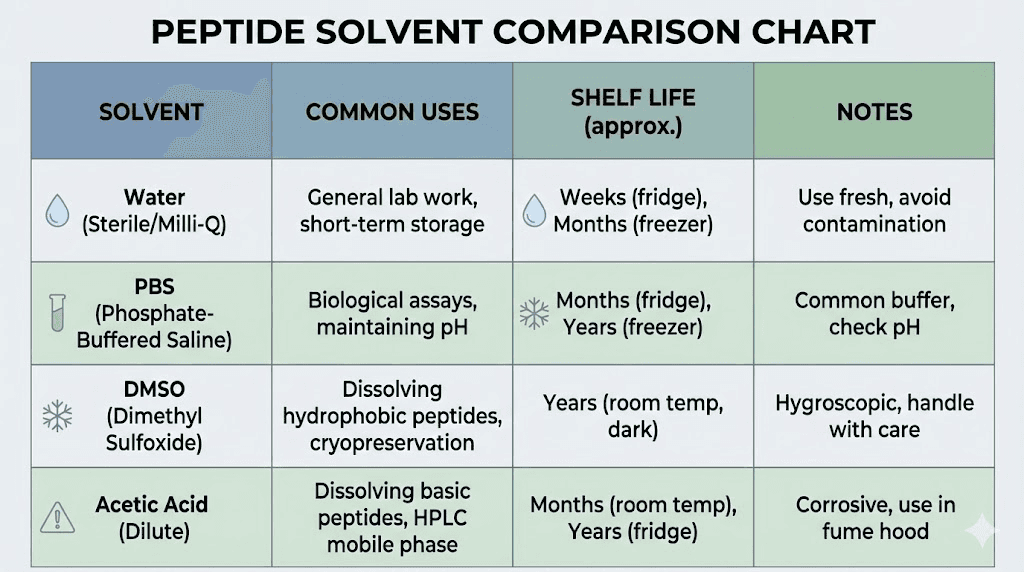
Types of peptide solvents and when to use each
Not all solvents work for all peptides. Understanding your options helps you make the right choice for each specific compound.
Bacteriostatic water: the preferred choice
Bacteriostatic water is the gold standard for most peptide reconstitution. It contains 0.9% benzyl alcohol, a preservative that inhibits bacterial growth without damaging most peptides.
The benefits are substantial. Reconstituted solutions remain usable for approximately 28 days when refrigerated. The preservative provides a margin of safety against contamination from repeated needle punctures. The pH (typically 5.7, ranging from 4.5 to 7.0) actually improves stability for many peptides.
Use bacteriostatic water for:
Most standard research peptides (BPC-157, TB-500, Sermorelin, etc.)
Solutions you'll use over multiple days or weeks
Multi-dose vials requiring repeated access
Situations where sterile technique may not be perfect
The main limitation is benzyl alcohol sensitivity. Some individuals react to this preservative. If you experience unusual injection site reactions beyond what's typical for a given peptide, consider switching to preservative-free alternatives.
Sterile water: for immediate use only
Sterile water contains no preservatives. It's as pure as water gets, nothing that could interfere with peptide structure or biological activity.
This purity comes with a critical limitation. Without preservatives, sterile water cannot suppress microbial growth. Once opened, the vial becomes vulnerable to contamination. Any peptide reconstituted with sterile water should be used within 24 hours, even when refrigerated.
Use sterile water when:
You'll use the entire reconstituted solution immediately
The subject is allergic to benzyl alcohol
The peptide is incompatible with bacteriostatic water
Single-use preparation is acceptable
For most researchers working with peptides over multiple days, sterile water creates unnecessary risk and waste. Bacteriostatic water is almost always the better choice.
Normal saline (0.9% sodium chloride)
Normal saline is sometimes used for peptide reconstitution, particularly in clinical settings. It's isotonic with body fluids, which can reduce injection site irritation for some peptides.
However, the salt content can interfere with certain peptides. Copper-containing peptides like GHK-Cu may experience disrupted copper chelation in high-salt environments. Check compatibility before using saline with any peptide.
Saline is available in both bacteriostatic and sterile forms. If using saline, choose the bacteriostatic version for multi-day use.
DMSO (dimethyl sulfoxide)
DMSO is a powerful organic solvent reserved for peptides that won't dissolve in water-based solutions. Highly hydrophobic peptides, those rich in amino acids like leucine, isoleucine, valine, phenylalanine, and tryptophan, sometimes require DMSO to achieve dissolution.
The approach is usually stepwise. First, dissolve the peptide in a small amount of DMSO. Then dilute this concentrated solution with bacteriostatic water or saline to achieve the final working concentration. This keeps DMSO content low while achieving initial solubilization.
Important warnings about DMSO:
It's cytotoxic at high concentrations
It can interfere with biological assays
Peptides containing cysteine (C) or methionine (M) are unstable in DMSO
Final DMSO concentration should typically stay below 10%
Most common research peptides don't require DMSO. If you're having trouble dissolving a peptide in water, check the manufacturer's recommendations before reaching for organic solvents.
Acetic acid solutions
For basic peptides (those with a net positive charge, typically rich in lysine, arginine, or histidine), adding a small percentage of acetic acid can dramatically improve solubility. The acid protonates amino groups, increasing the peptide's overall charge and water solubility.
Common approaches include:
10% acetic acid in water
0.1% trifluoroacetic acid (TFA)
0.1% formic acid
After initial dissolution, the acidified solution can often be diluted with plain water or buffer. The peptide may remain soluble even as pH rises.
Basic solutions (ammonium bicarbonate, dilute NaOH)
Acidic peptides (net negative charge, rich in aspartic acid or glutamic acid) benefit from slightly basic conditions. Reconstituting in 0.1 M ammonium bicarbonate or adding a few drops of dilute sodium hydroxide deprotonates acidic residues, improving solubility.
Caution: avoid strong basic conditions with peptides containing cysteine or methionine. These amino acids undergo side reactions at high pH.
How to reconstitute peptides properly
Proper reconstitution technique protects your investment and ensures accurate dosing. Rushing this process or skipping steps leads to degraded peptides and unreliable results.
Before you begin
Remove both the peptide vial and reconstitution solvent from cold storage. Allow them to reach room temperature before opening. This step is often skipped, but it matters.
Cold peptide powder exposed to warm, humid air can absorb moisture before you add solvent. This moisture introduces variables into your concentration calculations and can initiate degradation. Room-temperature equilibration takes 15-20 minutes. It's worth the wait.
While waiting, gather your supplies:
Alcohol swabs for sterilization
Insulin syringe (typically 29-31 gauge)
Your chosen reconstitution solvent
Clean work surface
Step-by-step reconstitution
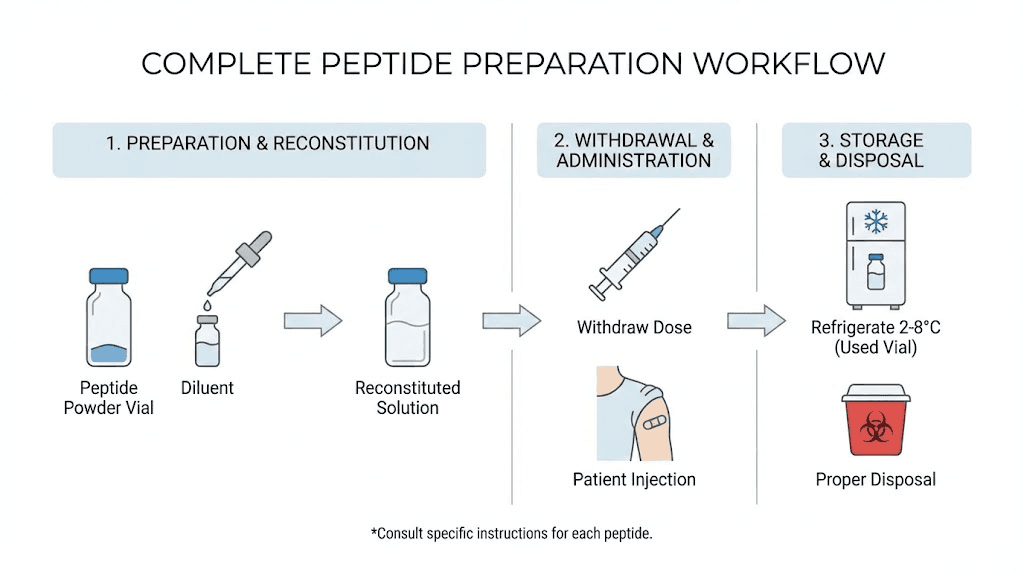
Step 1: Sterilize. Wipe the rubber stopper of both the peptide vial and solvent vial with separate alcohol swabs. Allow the alcohol to evaporate completely before proceeding. Wet stoppers can introduce contaminants.
Step 2: Draw the solvent. Using your insulin syringe, draw up the calculated amount of bacteriostatic water or other solvent. The amount depends on your desired concentration, which we'll cover in the next section.
Step 3: Inject at an angle. This is crucial. Insert the needle into the peptide vial at an angle, directing the stream of solvent against the glass wall. Never spray directly onto the peptide powder.
Why does this matter? Direct force on the lyophilized cake can damage peptide bonds. The gentle stream running down the glass wall gradually dissolves the powder without mechanical stress.
Step 4: Let it dissolve. Once all solvent is added, wait. Many peptides dissolve completely within a few minutes without any intervention. If the peptide is particularly stubborn, gently swirl or roll the vial.
Never shake. Vigorous shaking creates foam at air-liquid interfaces, causing peptide denaturation and irreversible aggregation. The resulting cloudy solution might look "mixed," but the peptide structure has been destroyed.
Step 5: Verify clarity. A properly reconstituted peptide solution should be clear and colorless (or match the expected color for that specific peptide). Any cloudiness, particles, or unusual color indicates a problem.
Troubleshooting difficult peptides
Most peptides dissolve easily in bacteriostatic water. When they don't, systematic troubleshooting helps identify the solution.
Peptide won't dissolve at all: Check whether it's hydrophobic. Peptides with more than 50% hydrophobic residues often need organic solvents. Try adding 10% DMSO or acetonitrile first, then diluting with water.
Solution is cloudy: Several possibilities exist. The concentration might be too high (near solubility limit). The temperature might be wrong. Or the peptide might be damaged. Try adding more solvent to reduce concentration. If cloudiness persists, the peptide may be degraded.
Precipitation after refrigeration: Some peptides precipitate at cold temperatures even when they dissolve at room temperature. Allow the vial to warm before use, and gently swirl to redissolve any precipitate.
Gel-like consistency: Certain peptides, particularly those with many hydrogen-bonding residues, can form gel networks. Adding chaotropic agents like guanidine hydrochloride or urea can disrupt these hydrogen bonds.
When in doubt, check the manufacturer's recommendations. Quality vendors provide peptide-specific reconstitution guidance.
Calculating peptide solution concentrations
Accurate concentration calculations ensure consistent dosing. Mistakes here compound with every injection, leading to under- or over-dosing that skews results.
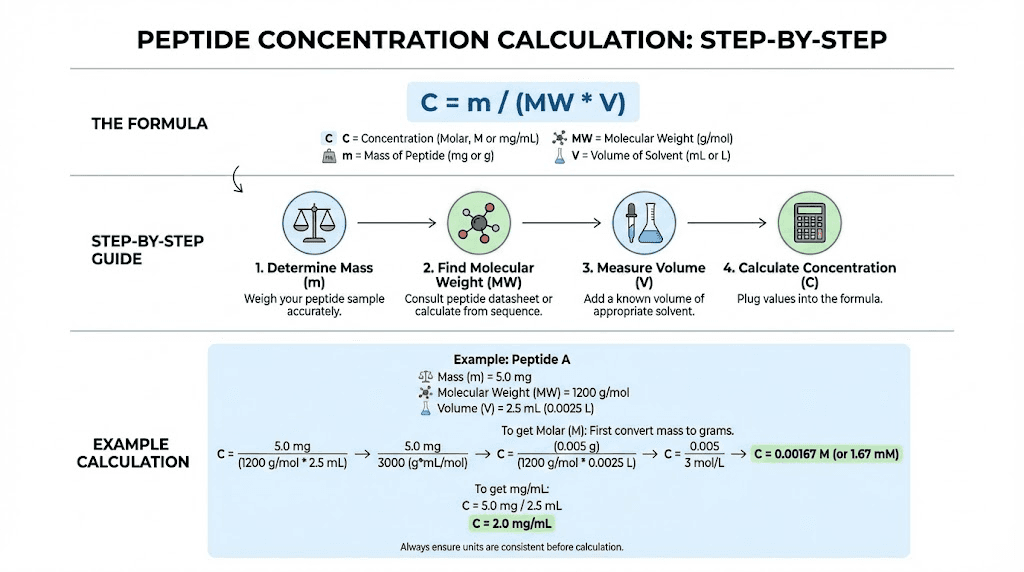
The basic formula
Peptide concentration equals the total peptide amount divided by the total volume of solution:
Concentration (mg/mL) = Total peptide (mg) ÷ Total solvent volume (mL)
For example, adding 2mL of bacteriostatic water to a 5mg peptide vial creates a 2.5 mg/mL solution:
5mg ÷ 2mL = 2.5 mg/mL
Since most peptide doses are measured in micrograms (μg or mcg), it helps to convert:
2.5 mg/mL = 2,500 mcg/mL = 2,500 mcg per 100 units on an insulin syringe
Choosing your concentration
The concentration you create determines how much liquid you draw per dose. Higher concentrations mean smaller injection volumes but less measurement precision. Lower concentrations mean larger volumes but easier accurate measurement.
Consider a 5mg vial with a 250mcg daily dose:
Option 1: Reconstitute with 1mL
Concentration: 5,000 mcg/mL
Dose volume: 5 units (0.05mL) per 250mcg
Pro: Small injection volume
Con: Hard to measure precisely on a 100-unit syringe
Option 2: Reconstitute with 2mL
Concentration: 2,500 mcg/mL
Dose volume: 10 units (0.1mL) per 250mcg
Pro: Easier to measure
Con: Slightly larger injection
Option 3: Reconstitute with 5mL
Concentration: 1,000 mcg/mL
Dose volume: 25 units (0.25mL) per 250mcg
Pro: Very easy to measure precisely
Con: Large injection volume, solution may not last as long
Most researchers find 2-3mL reconstitution provides the best balance between measurement accuracy and practical injection volumes.
Use our peptide reconstitution calculator to quickly determine concentrations for any peptide and solvent combination.
Converting between units
Peptide dosing involves multiple unit systems. Keeping them straight prevents errors.
Weight conversions:
1 mg = 1,000 mcg (micrograms)
1 mg = 1,000,000 ng (nanograms)
Volume conversions:
1 mL = 100 units on a standard insulin syringe
0.1 mL = 10 units
0.01 mL = 1 unit
The general peptide calculator can help with these conversions and dose calculations.
Practical dosing example
Let's work through a complete example with BPC-157:
Given:
Peptide vial: 5mg BPC-157
Desired dose: 250mcg twice daily
Reconstitution: 2mL bacteriostatic water
Calculate concentration:
5mg ÷ 2mL = 2.5 mg/mL = 2,500 mcg/mL
Calculate dose volume:
250mcg ÷ 2,500 mcg/mL = 0.1mL = 10 units
Calculate vial duration:
5,000mcg total ÷ 500mcg/day = 10 days of doses
At 10 units twice daily, the 2mL solution provides 10 days of doses. Since bacteriostatic water solutions remain stable for approximately 28 days refrigerated, this timeline works well.
Storing peptide solutions correctly
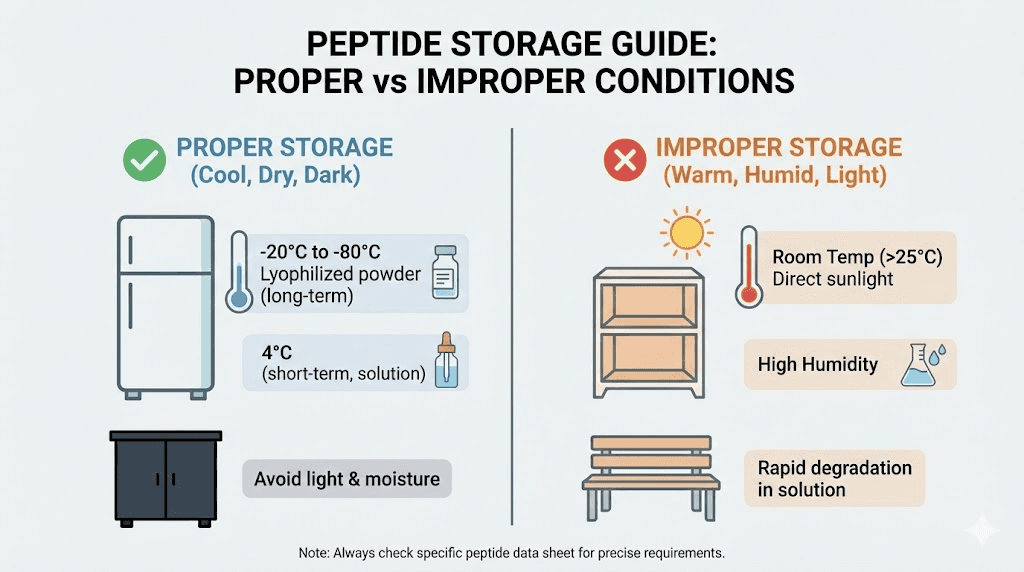
Proper peptide storage directly impacts potency and safety. The rules differ significantly between lyophilized peptides and reconstituted solutions.
Lyophilized peptide storage
Unreconstituted peptide powder is remarkably stable when stored correctly:
Optimal: -80°C in a deep freezer
Acceptable: -20°C in a standard freezer
Short-term: 2-8°C refrigerated (weeks to months)
Avoid: Room temperature storage
At -20°C or lower, lyophilized peptides typically remain stable for 12-24 months or longer. Keep vials tightly sealed in dry conditions, protected from light.
Before reconstituting, always allow the vial to reach room temperature. Opening a cold vial allows moisture to condense on the peptide powder, which can initiate degradation before you even add solvent.
Reconstituted solution storage
Once reconstituted, the rules change dramatically. Peptide solutions are far less stable than powder:
Refrigerated (2-8°C): Stable for approximately 4 weeks with bacteriostatic water
Frozen (-20°C): Stable for 3-4 months (but freezing has risks)
Deep frozen (-80°C): Stable for up to 1 year
Room temperature: Rapid degradation, avoid entirely
Refrigeration at 2-8°C is the standard for working solutions. This temperature slows degradation while keeping the solution liquid and ready to use.
The freezing debate
Can you freeze reconstituted peptide solutions? The answer is complicated.
Freezing can extend storage life significantly. But ice crystal formation during freezing and thawing can damage peptide structure. Each freeze-thaw cycle increases this risk.
If you must freeze reconstituted solutions:
Aliquot into single-use portions before freezing
Use a standard freezer (-20°C), not a frost-free freezer
Thaw completely at room temperature before use
Never refreeze a thawed solution
Use within 1-2 weeks after thawing
Frost-free freezers cycle through defrost periods that cause repeated temperature fluctuations. These fluctuations are particularly damaging to peptides.
For most researchers, the better approach is reconstituting smaller amounts more frequently rather than freezing large batches.
Light and air exposure
Both light and air can degrade peptide solutions. Light-sensitive peptides (particularly those containing tryptophan) should be stored in amber vials or wrapped in foil.
Air exposure introduces oxygen, which can oxidize susceptible amino acids like cysteine, methionine, and tryptophan. Minimize air exposure by:
Using appropriate reconstitution volumes (don't leave excessive headspace)
Limiting the number of needle punctures
Purging vials with inert gas (nitrogen or argon) if available
How long do peptide solutions actually last?
Peptide stability in the fridge depends on the specific peptide and how it was prepared. General guidelines:
Most peptides in bacteriostatic water: 4 weeks at 2-8°C
Unstable peptides (Cys, Met, Trp-containing): 1-2 weeks at 2-8°C
Sterile water reconstitution: 24 hours maximum
When in doubt, reconstitute only what you'll use within 2-3 weeks. It's better to waste a small amount of powder than to inject degraded peptide.
Recognizing degraded peptide solutions
Knowing when a peptide solution has gone bad prevents wasted time and potentially harmful injections.
Visual signs of degradation
A properly reconstituted peptide solution should be:
Clear (transparent)
Colorless (or matching expected color for that peptide)
Free of particles
Homogeneous (no layers or separation)
Warning signs include:
Cloudiness: Indicates peptide aggregation or bacterial contamination. Slightly cloudy solutions immediately after mixing sometimes clear on their own. Persistent cloudiness that develops over time always indicates a problem.
Particles or floaters: Visible particles suggest precipitation or contamination. Don't use solutions with visible particulate matter.
Color changes: Most peptides are colorless in solution. Yellow, brown, or pink discoloration indicates oxidation or degradation.
Gel formation: Some peptides can form gels, especially at higher concentrations. This usually indicates the peptide is no longer in proper solution.
Functional signs of degradation
Sometimes degraded peptides look fine but don't work properly. Signs include:
Reduced or absent expected effects
Inconsistent results between doses from the same vial
Unusual injection site reactions
If you suspect degradation, compare results with a freshly reconstituted vial from a different lot. Consistent differences confirm the original solution was compromised.
What causes peptide degradation?
Understanding degradation mechanisms helps prevent them:
Microbial contamination: Bacteria consume peptides and produce toxins. This is why preservatives and sterile technique matter.
Oxidation: Oxygen reacts with certain amino acids (Cys, Met, Trp), altering structure and function.
Hydrolysis: Water molecules can break peptide bonds over time, fragmenting the chain.
Aggregation: Peptides can clump together, forming inactive aggregates. Mechanical stress (shaking) accelerates this.
Deamidation: Asparagine and glutamine residues can lose their amide groups, changing the peptide's properties.
pH extremes: Both very acidic and very basic conditions can destabilize peptides.
Temperature fluctuations: Repeated warming and cooling stress peptide structure.
Peptide-specific solution considerations
Different peptides have different quirks. Here's guidance for some commonly used compounds.
BPC-157
BPC-157 is stable and easy to work with. Standard bacteriostatic water reconstitution works well. The peptide dissolves readily and remains stable for 4 weeks refrigerated.
No special handling required. This is often recommended as a first peptide for new researchers because of its forgiving nature.
TB-500
TB-500 (thymosin beta-4 fragment) also reconstitutes easily in bacteriostatic water. Some users report mild injection site reactions. Rotating sites helps.
The BPC-157 and TB-500 stack can be reconstituted in the same vial if using a premixed blend, or drawn from separate vials and combined in the syringe.
GHK-Cu (copper peptide)
GHK-Cu requires more attention. The copper component can interact with certain solvents and containers. Follow these guidelines from our GHK-Cu reconstitution guide:
Use bacteriostatic water, not saline (salt can interfere with copper chelation)
Avoid mixing with acidic solutions like vitamin C
Expect mild stinging at injection sites (this is normal for copper peptides)
GHK-Cu stability is good when stored properly
Semaglutide and other GLP-1 agonists
These peptides are typically supplied pre-reconstituted from manufacturers or compounding pharmacies. If handling lyophilized forms, standard bacteriostatic water reconstitution works.
Use our semaglutide dosage calculator for accurate dosing of these compounds.
Growth hormone secretagogues
Peptides like Sermorelin, Ipamorelin, and CJC-1295 follow standard reconstitution protocols. They're generally stable and easy to work with.
Some researchers prefer to store these at -20°C after reconstitution for extended stability, but refrigeration is adequate for typical use periods.
Selank and Semax
Nasal spray peptides like Selank and Semax require different considerations. They're often reconstituted in water specifically designed for nasal administration. Check manufacturer instructions for these compounds.
Common peptide solution mistakes to avoid
Learning from others' errors prevents repeating them. These are the most common mistakes researchers make with peptide solutions.
Shaking the vial
This is the number one mistake. Instinct says shake to mix. But shaking creates foam at air-liquid interfaces, and proteins (including peptides) denature at these interfaces.
Once a peptide is denatured, it cannot be restored. That cloudy, well-shaken solution is permanently damaged.
Always swirl gently. Let time and gentle motion do the work.
Spraying solvent directly onto powder
High-velocity liquid hitting the lyophilized cake can mechanically damage peptide structure. Direct the stream against the glass wall, letting it run down gently onto the powder.
Using the wrong solvent
Not all peptides dissolve in bacteriostatic water. Not all peptides tolerate the preservatives. And some solvent combinations are incompatible with specific amino acids.
Check the peptide's specifications before reconstituting. When unsure, start with a small test amount.
Reconstituting cold peptides
Opening a cold vial exposes the peptide to atmospheric moisture before you add solvent.
This moisture can initiate degradation and throws off concentration calculations.
Always allow vials to reach room temperature before opening.
Ignoring storage requirements
Leaving reconstituted peptides at room temperature, even briefly, accelerates degradation. The refrigerator isn't optional. It's essential.
Peptides left out during use should be returned to the refrigerator immediately after drawing doses.
Overconcentrating solutions
Adding too little solvent creates supersaturated solutions that may precipitate over time or when refrigerated. If you notice cloudiness after refrigeration, try adding more solvent to reduce concentration.
Repeated needle punctures
Each needle puncture introduces potential contamination. Even with bacteriostatic water, excessive punctures increase risk. Use appropriate reconstitution volumes so you're not accessing the vial hundreds of times.
Using expired bacteriostatic water
Bacteriostatic water has a 28-day shelf life once opened. Using expired diluent means the preservative may no longer be effective. Check dates and replace as needed.
Advanced solution preparation techniques
For researchers working with challenging peptides or requiring extended storage, these advanced techniques can help.
pH optimization
Different peptides have optimal pH ranges for stability. While bacteriostatic water's pH (approximately 5.7) works for most peptides, some benefit from adjustment.
Peptides containing:
Basic residues (Lys, Arg, His): Often more stable at slightly acidic pH
Acidic residues (Asp, Glu): May prefer neutral to slightly basic pH
Asparagine or glutamine: More stable at acidic pH (reduces deamidation)
pH adjustment requires buffers and pH testing equipment. Most researchers don't need this level of optimization, but it's available when needed.
Aliquoting for long-term storage
If you must store reconstituted peptides for extended periods, aliquoting into single-use portions minimizes freeze-thaw damage and contamination risk.
The procedure:
Reconstitute the full vial
Immediately divide into single-dose aliquots using sterile microcentrifuge tubes
Flash-freeze if possible (dry ice or liquid nitrogen)
Store at -80°C if available, otherwise -20°C
Thaw one aliquot at a time as needed
Never refreeze a thawed aliquot
Inert atmosphere storage
For peptides particularly sensitive to oxidation, purging vials with nitrogen or argon gas before sealing removes oxygen. This requires specialized equipment but can significantly extend stability for susceptible compounds.
Carrier proteins and stabilizers
In research settings, adding carrier proteins like bovine serum albumin (BSA) at low concentrations can prevent peptide adsorption to plastic and glass surfaces. This is particularly useful for very dilute solutions.
For most practical applications, this isn't necessary, but it's worth knowing about for specialized research.
Choosing peptide solution supplies
The quality of your supplies affects your results. Here's what to look for.
Bacteriostatic water
Purchase USP-grade bacteriostatic water from reputable medical suppliers. Avoid products of unknown origin. The preservative concentration should be clearly stated (0.9% benzyl alcohol is standard).
Check expiration dates before purchase. Bacteriostatic water has limited shelf life even unopened.
Syringes
Insulin syringes in 29-31 gauge with 0.5" needles work well for most subcutaneous peptide injections. The smaller gauges reduce pain but still allow easy drawing and injection of peptide solutions.
For very small doses, consider 0.3mL (30-unit) syringes for greater precision. Standard 1mL (100-unit) syringes work for typical doses.
Alcohol swabs
Individual sterile alcohol swabs are essential for proper aseptic technique. Don't skip this step, and don't reuse swabs.
Storage containers
If aliquoting, use sterile microcentrifuge tubes designed for freezer storage. Standard tubes can crack at freezer temperatures. Low-retention tubes reduce peptide adsorption to surfaces.
Building a complete peptide protocol
Proper solution preparation is just one component of successful peptide research. SeekPeptides provides comprehensive resources covering every aspect of peptide use.
From solution to injection
Once your solution is prepared, proper injection technique ensures the peptide reaches its target. Subcutaneous injection into fatty tissue is standard for most peptides.
Review our guides on how to take BPC-157 or how to use PT-141 for peptide-specific administration guidance.
Dosing considerations
Each peptide has optimal dosing ranges based on research. Our peptide dosage chart provides starting points, while calculators like the BPC-157 dosage calculator and TB-500 dosage calculator help with specific compounds.
Stacking peptides
Many researchers use peptide stacks, combining multiple peptides for synergistic effects. Blends like the glow stack and Wolverine stack are popular combinations.
When stacking, you can often combine peptides in the same syringe (though not necessarily the same storage vial). Check compatibility before mixing.
Cycling and timing
Peptide cycling prevents receptor desensitization and allows evaluation of results. Most protocols use 4-6 weeks on followed by equal time off.
Our cycle planning guide covers timing strategies for various goals.
Safety first
Always review peptide safety information before starting any protocol. Understand legal status in your jurisdiction and source from reputable vendors.
SeekPeptides members access comprehensive protocols, personalized guidance, and community support for navigating peptide research safely and effectively.
Frequently asked questions
How long does reconstituted peptide last in the refrigerator?
Peptides reconstituted with bacteriostatic water typically remain stable for 4 weeks at 2-8°C. Peptides containing oxidation-sensitive amino acids (cysteine, methionine, tryptophan) may have shorter stability of 1-2 weeks. Solutions made with sterile water should be used within 24 hours. For detailed storage guidance, see our reconstituted peptide storage guide.
Can I use regular water to reconstitute peptides?
No. Tap water or bottled drinking water contains minerals, chlorine, and potentially bacteria that can damage peptides and cause contamination.
Always use bacteriostatic water or sterile water specifically designed for injection.
Our guide on which water to mix with peptides covers this in detail.
My peptide solution turned cloudy. Is it still usable?
Generally no. Cloudiness indicates aggregation, precipitation, or bacterial contamination. Slightly cloudy solutions that clear quickly after gentle swirling may be acceptable, but persistent cloudiness means the peptide is likely compromised.
When in doubt, discard and reconstitute a fresh vial.
How much bacteriostatic water should I add to my peptide?
This depends on your desired concentration and dose. Common volumes are 1-3mL. Adding more water creates more dilute solutions requiring larger injection volumes but allowing more precise measurement. Use our peptide reconstitution calculator to determine the right amount for your specific needs.
Can I freeze reconstituted peptides?
Yes, but with caution. Freezing can extend storage life but ice crystal formation may damage peptide structure. If freezing, aliquot into single-use portions first, freeze quickly at -20°C or lower, and never refreeze after thawing. Refrigeration is usually preferable for solutions you'll use within 4 weeks.
Why does my GHK-Cu sting when I inject it?
The copper component of GHK-Cu causes mild local irritation in most users. This stinging typically subsides within minutes and is not a sign of degradation. Rotating injection sites helps minimize discomfort. Persistent or severe reactions may indicate sensitivity to the peptide.
What's the difference between bacteriostatic water and normal saline?
Bacteriostatic water contains 0.9% benzyl alcohol as a preservative. Normal saline contains 0.9% sodium chloride (salt). Both are available in bacteriostatic (preserved) and sterile (unpreserved) forms. Saline may be better tolerated at injection sites but can interfere with some peptides. Bacteriostatic water is the standard choice for most peptide reconstitution.
Do peptides expire?
Yes. Peptides do expire. Lyophilized peptides stored properly at -20°C typically remain stable for 12-24 months. Reconstituted solutions have much shorter shelf lives of days to weeks depending on storage conditions. Always check and respect expiration dates.