Feb 10, 2026
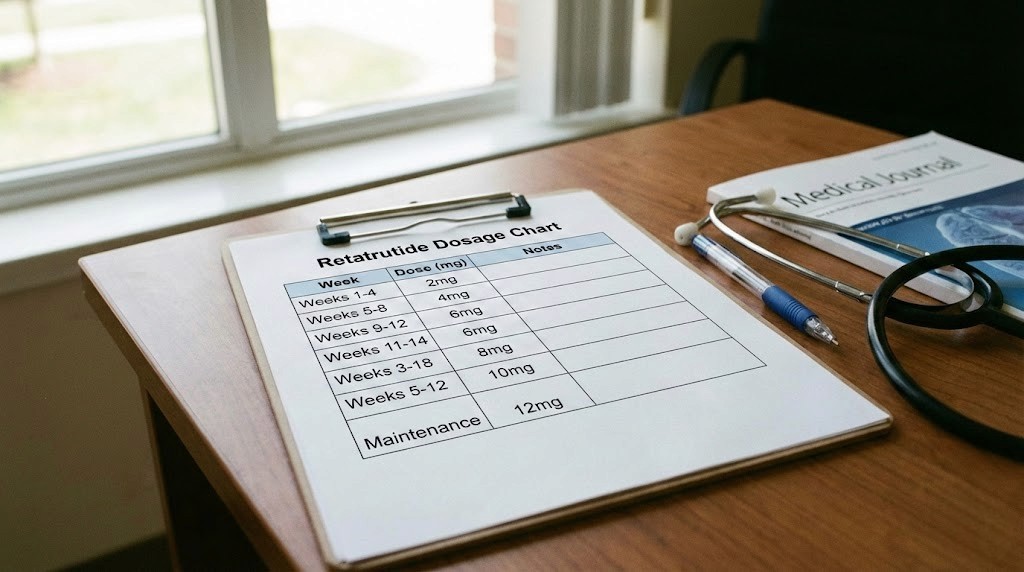
You are wasting peptide. Maybe not a lot. Maybe just a few units every injection. But over a 20-week titration cycle, those small errors compound into something painful: lost milligrams, inconsistent blood levels, and money dissolved into nothing. The math behind retatrutide dosing is not complicated. A 10mg vial, 2mL of bacteriostatic water, a U-100 insulin syringe. Simple tools. But the number of researchers who draw 0.4mL when they need 0.8mL, or who cannot translate "4mg" into syringe units at their specific concentration, is staggering. One miscalculation at the 8mg dose and you have either underdosed an entire week or wasted half a vial in a single draw.
That is what this page exists to fix.
This is not a general overview of retatrutide. You will not find paragraphs explaining what GLP-1 means or how triple-agonist peptides were discovered. If you need that background, read the complete retatrutide guide or the retatrutide dosage chart overview. What you will find here are tables. Concentration-specific tables. Vial-specific tables. Phase-specific tables with exact syringe markings for every dose at every common reconstitution volume. The kind of reference you tape to the inside of a cabinet door and use every single injection day. No guessing. No mental math at the kitchen counter with a syringe in your hand. Just the number you need, exactly when you need it. SeekPeptides built this resource because accurate dosing is not optional. It is the difference between a successful protocol and an expensive experiment in frustration. Whether you are working with a 5mg vial or a 20mg vial, whether your concentration is 2.5mg/mL or 10mg/mL, every number you need is on this page. Bookmark it. Print it. Refer to it every week until the conversions become second nature.
How retatrutide dosing works and why charts matter
Retatrutide (LY3437943) is a 39-amino-acid peptide that activates three receptors simultaneously: GLP-1, GIP, and glucagon. That triple-agonist mechanism is what separates it from semaglutide (single agonist) and tirzepatide (dual agonist). The peptide carries a C20 fatty diacid moiety that extends its half-life, allowing once-weekly administration. It demonstrates higher potency at the GIP receptor, with comparatively lower potency at GLP-1 and glucagon receptors relative to their natural hormones. This pharmacological profile creates a dose-dependent weight loss curve that, in clinical trials, reached 24.2% at the 12mg weekly dose over 48 weeks and an astonishing 28.7% at 12mg over 68 weeks in the TRIUMPH-4 phase 3 trial.
Those numbers are not abstract.
For a 250-pound individual, 28.7% body weight loss translates to roughly 71 pounds. But here is the critical detail that makes dose charts essential: retatrutide requires a slow titration from 1mg or 2mg up to the maintenance dose of 8mg or 12mg over many weeks. Each step in that titration demands a different volume draw from the syringe. And that volume changes depending on how much bacteriostatic water you added during reconstitution. A 4mg dose from a 5mg/mL solution is 0.80mL. That same 4mg dose from a 10mg/mL solution is 0.40mL. Draw the wrong amount and you have either doubled your dose or cut it in half. Neither outcome is acceptable during a carefully planned escalation protocol. Researchers working with peptide reconstitution tools already understand this, but having a printed chart eliminates the possibility of error entirely.
The charts in this article cover every common vial size (5mg, 10mg, 15mg, and 20mg), every standard reconstitution volume, every titration phase, and every syringe marking you will encounter. They also include split-dose references for the 8mg and 12mg doses that exceed comfortable single-injection volumes at certain concentrations. Use the peptide calculator if you need to run custom numbers for an unusual reconstitution volume, but for the four most common setups, everything is right here.
Retatrutide dose chart by vial size
This is the section you will use most often. Each table below corresponds to a specific vial size and reconstitution volume. Find your vial, find your concentration, and read across to the dose you need. The "units" column refers to markings on a standard U-100 insulin syringe, where 100 units equals 1.00mL. If you are unfamiliar with syringe unit conversions, review that concept before proceeding. Every number below assumes accurate reconstitution, so measure your bacteriostatic water carefully using a reconstitution calculator before your first draw.
5mg vial dose charts
5mg vial + 1mL bacteriostatic water = 5mg/mL
Target dose | Volume to draw (mL) | Syringe units (U-100) | Doses per vial |
|---|---|---|---|
0.5mg | 0.10 | 10 units | 10 |
1mg | 0.20 | 20 units | 5 |
2mg | 0.40 | 40 units | 2.5 |
4mg | 0.80 | 80 units | 1.25 |
5mg | 1.00 | 100 units | 1 |
At this concentration, a 5mg vial gives you five weeks of coverage at the 1mg initiation dose, or just over two weeks at 2mg. Higher doses like 4mg consume nearly the entire vial in a single injection. Researchers on a budget often start their titration with 5mg vials and transition to larger vials once they reach the escalation phases. This approach avoids waste during the low-dose period where you only need 1mg or 2mg per week. If you want to compare retatrutide costs across vial sizes, the math favors larger vials at maintenance doses but smaller vials during initiation.
5mg vial + 2mL bacteriostatic water = 2.5mg/mL
Target dose | Volume to draw (mL) | Syringe units (U-100) | Doses per vial |
|---|---|---|---|
0.5mg | 0.20 | 20 units | 10 |
1mg | 0.40 | 40 units | 5 |
2mg | 0.80 | 80 units | 2.5 |
2.5mg | 1.00 | 100 units | 2 |
The lower 2.5mg/mL concentration makes precision easier at very small doses. Drawing 20 units is more accurate than drawing 10, and the wider markings give you better control. The tradeoff is obvious: more volume per injection and fewer doses per vial. This concentration is ideal for the initiation and early escalation phases only. Do not attempt a 4mg dose at this concentration because 1.60mL exceeds what a standard 1mL insulin syringe can hold, and the injection volume itself becomes uncomfortable. For anything above 2.5mg per dose, switch to a higher concentration or a larger vial. Many researchers find that understanding the relationship between lyophilized and liquid peptide forms helps them choose the right reconstitution strategy from the start.
10mg vial dose charts
The 10mg vial is the most common size for retatrutide research. It offers enough peptide for multiple weeks across most dose levels and works well with both 1mL and 2mL reconstitution volumes. This is the vial size referenced in most retatrutide dosage guides and the one used in the majority of community protocols.
10mg vial + 1mL bacteriostatic water = 10mg/mL
Target dose | Volume to draw (mL) | Syringe units (U-100) | Doses per vial |
|---|---|---|---|
1mg | 0.10 | 10 units | 10 |
2mg | 0.20 | 20 units | 5 |
4mg | 0.40 | 40 units | 2.5 |
8mg | 0.80 | 80 units | 1.25 |
10mg | 1.00 | 100 units | 1 |
12mg | 1.20 | 120 units | 0.83 |
This is the highest practical concentration for a 10mg vial. At 10mg/mL, even the 8mg maintenance dose requires only 80 units, which fits comfortably in a standard 1mL syringe. The 12mg dose at 120 units is technically more than a 1mL syringe can hold, so you will need either a split injection or a syringe rated for at least 1.2mL. Most researchers who plan to reach the 12mg maintenance dose reconstitute with 2mL instead, which brings the injection volume down to a more manageable range. Understanding how injectable peptide administration works helps clarify why volume matters for subcutaneous comfort.
10mg vial + 2mL bacteriostatic water = 5mg/mL
Target dose | Volume to draw (mL) | Syringe units (U-100) | Doses per vial |
|---|---|---|---|
1mg | 0.20 | 20 units | 10 |
2mg | 0.40 | 40 units | 5 |
4mg | 0.80 | 80 units | 2.5 |
8mg | 1.60 | 160 units | 1.25 |
12mg | 2.40 | 240 units | 0.83 |
Here is where things get tricky. At 5mg/mL, the low doses are perfectly manageable: 20 units for 1mg, 40 units for 2mg. But once you reach the 8mg escalation dose, you need 160 units (1.60mL), which exceeds a 1mL syringe. The 12mg maintenance dose requires 240 units (2.40mL), which absolutely demands a split injection. This is not a flaw in your protocol. It is simply what happens when you combine moderate concentrations with high doses. The split-dose charts later in this article show exactly how to divide these injections. If you have used our semaglutide dosage calculator or general peptide calculator before, the same unit-conversion logic applies here.
15mg vial dose chart
15mg vial + 3mL bacteriostatic water = 5mg/mL
Target dose | Volume to draw (mL) | Syringe units (U-100) | Doses per vial |
|---|---|---|---|
1mg | 0.20 | 20 units | 15 |
2mg | 0.40 | 40 units | 7.5 |
4mg | 0.80 | 80 units | 3.75 |
8mg | 1.60 | 160 units (split) | 1.88 |
12mg | 2.40 | 240 units (split) | 1.25 |
15mg vial + 1.5mL bacteriostatic water = 10mg/mL
Target dose | Volume to draw (mL) | Syringe units (U-100) | Doses per vial |
|---|---|---|---|
1mg | 0.10 | 10 units | 15 |
2mg | 0.20 | 20 units | 7.5 |
4mg | 0.40 | 40 units | 3.75 |
8mg | 0.80 | 80 units | 1.88 |
12mg | 1.20 | 120 units (may need split) | 1.25 |
The 15mg vial is less common but offers excellent value for researchers running extended protocols. At 10mg/mL, you get 15 weeks of initiation dosing at 1mg, nearly 8 weeks at 2mg, and almost 4 weeks at the 4mg escalation dose. That means a single 15mg vial can cover the entire initiation and early escalation phases of a conservative protocol before you even open a second vial. Researchers tracking their peptide costs consistently find that buying fewer, larger vials reduces the per-milligram price. The full retatrutide cost breakdown covers this in detail.
20mg vial dose charts
The 20mg vial is the best option for researchers who know they will reach the 8mg or 12mg maintenance dose. It holds enough peptide for sustained use at high doses and works particularly well at the 10mg/mL concentration, where even the 8mg dose is a single comfortable draw.
20mg vial + 2mL bacteriostatic water = 10mg/mL
Target dose | Volume to draw (mL) | Syringe units (U-100) | Doses per vial |
|---|---|---|---|
1mg | 0.10 | 10 units | 20 |
2mg | 0.20 | 20 units | 10 |
4mg | 0.40 | 40 units | 5 |
8mg | 0.80 | 80 units | 2.5 |
12mg | 1.20 | 120 units (may need split) | 1.67 |
20mg vial + 4mL bacteriostatic water = 5mg/mL
Target dose | Volume to draw (mL) | Syringe units (U-100) | Doses per vial |
|---|---|---|---|
1mg | 0.20 | 20 units | 20 |
2mg | 0.40 | 40 units | 10 |
4mg | 0.80 | 80 units | 5 |
8mg | 1.60 | 160 units (split) | 2.5 |
12mg | 2.40 | 240 units (split) | 1.67 |
At the 10mg/mL concentration, a single 20mg vial provides 2.5 weeks of coverage at the 8mg dose and about 1.67 weeks at 12mg. For a full 20-week protocol that includes initiation, escalation, and maintenance, most researchers need three to five 20mg vials depending on their chosen titration speed. The 20mg retatrutide dosing guide walks through complete vial planning for extended cycles. Researchers who compare retatrutide to other GLP-1 agonists will notice that the tirzepatide dosage chart in units follows a similar volume-based logic, just at different concentrations and dose levels.
Unit conversion reference for every concentration
This section answers the single most common question in peptide dosing: "I need X milligrams. How many units is that on my syringe?" The answer depends entirely on your concentration, which itself depends on how much bacteriostatic water you added. If you have ever searched for something like how many mg is 40 units, you already understand why this table exists.
Conversion at 2.5mg/mL
Syringe units | Volume (mL) | Milligrams |
|---|---|---|
5 units | 0.05 | 0.125mg |
10 units | 0.10 | 0.25mg |
20 units | 0.20 | 0.50mg |
40 units | 0.40 | 1.00mg |
80 units | 0.80 | 2.00mg |
100 units | 1.00 | 2.50mg |
At 2.5mg/mL, each unit on your syringe contains 0.025mg (25 micrograms). This is the lowest practical concentration for retatrutide. It provides the most precision at very small doses, which makes it attractive for the initiation phase when you only need 1mg per week. But once doses climb above 2.5mg, the injection volume becomes unwieldy. Think of this as your "starter concentration," similar to how researchers reconstitute semaglutide at 5mg/mL for granular low-dose control.
Conversion at 5mg/mL
Syringe units | Volume (mL) | Milligrams |
|---|---|---|
5 units | 0.05 | 0.25mg |
10 units | 0.10 | 0.50mg |
20 units | 0.20 | 1.00mg |
40 units | 0.40 | 2.00mg |
60 units | 0.60 | 3.00mg |
80 units | 0.80 | 4.00mg |
100 units | 1.00 | 5.00mg |
The 5mg/mL concentration is arguably the most versatile for retatrutide. Each unit delivers 0.05mg (50 micrograms). The 1mg initiation dose is a clean 20 units. The 4mg escalation dose is a clean 80 units. Those round numbers make this concentration easy to work with across most of the titration schedule. The exception is the 8mg and 12mg doses, which require 160 and 240 units respectively, both exceeding a 1mL syringe capacity. For dose calculations at this concentration that involve other peptides in a stack, the peptide stack calculator can help you plan volumes across multiple compounds.
Conversion at 10mg/mL
Syringe units | Volume (mL) | Milligrams |
|---|---|---|
5 units | 0.05 | 0.50mg |
10 units | 0.10 | 1.00mg |
20 units | 0.20 | 2.00mg |
40 units | 0.40 | 4.00mg |
60 units | 0.60 | 6.00mg |
80 units | 0.80 | 8.00mg |
100 units | 1.00 | 10.00mg |
120 units | 1.20 | 12.00mg |
At 10mg/mL, each unit on your syringe delivers 0.10mg (100 micrograms). This is the concentration that experienced researchers prefer because it keeps injection volumes low even at high doses. The 8mg dose requires only 80 units, which sits comfortably below the 1mL mark on any standard insulin syringe. Even the 12mg dose at 120 units is only slightly above a full syringe, manageable with either a 1.2mL syringe or a simple split into two injections. The same logic behind converting tirzepatide units to milligrams applies here, just with different concentration values. If you want to explore how researchers handle similar conversions for other peptides, the tirzepatide dosing in units reference follows the same framework.
Quick conversion formula
If your concentration is not listed above, use this formula:
Units = (desired dose in mg / concentration in mg per mL) x 100
For example, if you want 6mg at a concentration of 10mg/mL: (6 / 10) x 100 = 60 units. If you want 3mg at 5mg/mL: (3 / 5) x 100 = 60 units. Same units, different milligrams, because the concentration changed. That is exactly why charts matter. The peptide calculator automates this formula for any combination of vial size and water volume.
Week-by-week titration dose chart
Retatrutide is not a peptide you start at full dose. The triple-receptor mechanism produces significant gastrointestinal effects, particularly nausea, when doses increase too quickly. Clinical trials used structured titration schedules to minimize these side effects while allowing the body to adapt. Two protocols dominate the research community. Protocol A is conservative, starting at 1mg and escalating in 4-week blocks. Protocol B is moderate, starting at 2mg with faster escalation. Both reach the same 12mg maintenance dose but on different timelines. Your choice depends on your tolerance for side effects during the ramp-up period and how quickly you want to reach full therapeutic levels.
Protocol A: conservative titration (20+ weeks)
Weeks | Weekly dose | Units at 5mg/mL | Units at 10mg/mL | Phase |
|---|---|---|---|---|
1-4 | 1mg | 20 units | 10 units | Initiation |
5-8 | 2mg | 40 units | 20 units | Early escalation |
9-12 | 4mg | 80 units | 40 units | Mid escalation |
13-16 | 8mg | 160 units (split) | 80 units | Late escalation |
17+ | 12mg | 240 units (split) | 120 units | Maintenance |
The conservative protocol takes 16 full weeks before you reach the 12mg maintenance dose. That might feel slow. It is slow on purpose. Each 4-week block gives the GLP-1, GIP, and glucagon receptors time to adjust, which significantly reduces the nausea, vomiting, and diarrhea that many researchers experience during dose increases. Phase 2 clinical data showed that starting at lower doses (1-2mg) partially mitigated gastrointestinal side effects compared to more aggressive starting doses. Researchers who struggle with GI symptoms at any point in the escalation can extend a particular dose block from 4 weeks to 6 or even 8 weeks before moving up. The protocol is a guideline, not a mandate. If you experience persistent nausea at 4mg, there is nothing wrong with staying at 4mg for an additional month before advancing to 8mg.
For context on how this titration compares to other GLP-1 peptides, the compound tirzepatide dosing chart shows a similar step-wise approach, and the compounded semaglutide with B12 dosage chart illustrates the same concept for semaglutide.
Protocol B: moderate titration (12+ weeks)
Weeks | Weekly dose | Units at 5mg/mL | Units at 10mg/mL | Phase |
|---|---|---|---|---|
1-4 | 2mg | 40 units | 20 units | Initiation |
5-8 | 4mg | 80 units | 40 units | Escalation |
9-12 | 8mg | 160 units (split) | 80 units | Late escalation |
13+ | 12mg | 240 units (split) | 120 units | Maintenance |
Protocol B reaches maintenance dose four weeks sooner. The 2mg starting dose was used in several arms of the phase 2 trial, where it produced -8.7% body weight loss even without further escalation. By skipping the 1mg initiation block, researchers who tolerate GLP-1 agonists well can accelerate their timeline without taking unnecessary risk. This protocol makes the most sense for individuals who have already completed a cycle of semaglutide or tirzepatide and know they handle GLP-1 receptor activation without severe GI distress. If you are coming from another GLP-1 agonist, reading the semaglutide to tirzepatide conversion chart or the switching dosage chart can help you decide where in the retatrutide titration to begin.
What the clinical trials actually showed
The numbers behind these protocols come from real data. In the 48-week phase 2 trial published in the New England Journal of Medicine, retatrutide at the 12mg weekly dose produced an average body weight reduction of 24.2%. Lower doses were tested as well: 1mg achieved 8.7%, 4mg achieved 17.1%, and 8mg achieved 22.8%. The placebo group lost just 2.1%. More recently, the TRIUMPH-4 phase 3 trial at 68 weeks showed the 12mg dose producing an average of 28.7% body weight reduction, which translates to roughly 71.2 pounds of loss for the average participant. The trial also documented a reduction in WOMAC pain scores by up to 75.8%, improvements in non-HDL cholesterol, and reductions in systolic blood pressure.
These results are dose-dependent. That is the entire point of having a dose chart. The difference between 4mg and 12mg is not incremental. It is the difference between 17.1% and 24.2% body weight loss. Every milligram matters. Every syringe unit matters. The retatrutide dosage calculator helps researchers model these outcomes based on their specific vial and reconstitution setup. For those weighing retatrutide against other options, the semaglutide vs tirzepatide comparison provides useful context, as does the retatrutide vs tirzepatide dosage chart for side-by-side dose analysis.
Split-dose charts for higher doses
At certain concentrations, the 8mg and 12mg doses require more liquid than a standard 1mL insulin syringe can hold. The solution is straightforward: split the dose into two injections administered at different sites within the same session. This is not a modified protocol. It is the same total dose delivered in two smaller volumes. The half-life of retatrutide allows both portions to absorb and reach peak levels together, so splitting the injection does not reduce effectiveness.
When to split
You need a split injection when your calculated volume exceeds 1.00mL (100 units on a U-100 syringe). Here is a quick reference:
Concentration | Dose requiring split | Total volume | Split into |
|---|---|---|---|
2.5mg/mL | 4mg and above | 1.60mL+ | Two equal draws |
5mg/mL | 8mg and above | 1.60mL+ | Two equal draws |
10mg/mL | 12mg (borderline) | 1.20mL | Two draws or 1.2mL syringe |
Split-dose reference: 8mg at 5mg/mL
Injection | Volume | Syringe units | Milligrams per injection |
|---|---|---|---|
First injection | 0.80mL | 80 units | 4mg |
Second injection | 0.80mL | 80 units | 4mg |
Total | 1.60mL | 160 units | 8mg |
Split-dose reference: 12mg at 5mg/mL
Injection | Volume | Syringe units | Milligrams per injection |
|---|---|---|---|
First injection | 1.00mL | 100 units | 5mg |
Second injection | 0.80mL | 80 units | 4mg |
Third injection | 0.60mL | 60 units | 3mg |
Total | 2.40mL | 240 units | 12mg |
Wait. That table shows three injections, not two. Here is why. At 2.40mL total volume, you can split it two ways: two injections of 1.20mL each (which still requires a larger syringe) or three injections using a standard 1mL syringe. Most researchers prefer the two-injection split using equal 1.20mL draws if they have a syringe that holds at least 1.2mL. If they only have standard 1mL syringes, the three-way split above works perfectly. Either approach delivers the same total dose.
An alternative two-way split for 12mg at 5mg/mL:
Injection | Volume | Syringe units | Milligrams per injection |
|---|---|---|---|
First injection | 1.00mL | 100 units | 5mg |
Second injection | 1.00mL | 100 units | 5mg |
Top-up (same syringe, second draw) | 0.40mL | 40 units | 2mg |
Total | 2.40mL | 240 units | 12mg |
In practice, many researchers simply reconstitute at 10mg/mL to avoid the need for splits entirely at the 8mg dose. At 10mg/mL, the 8mg dose requires only 80 units (0.80mL), comfortable and precise. The 12mg dose at 120 units (1.20mL) is borderline and can be handled with a single draw using a syringe rated for at least 1.2mL, or a clean 60/60 unit split using two standard syringes. The reconstitution decision you make at the beginning of your protocol determines whether you will need to split doses later. Plan ahead. If you are working with peptide vials for the first time, understanding the relationship between water volume and concentration prevents these problems before they start.
Split-dose reference: 12mg at 10mg/mL
Injection | Volume | Syringe units | Milligrams per injection |
|---|---|---|---|
First injection | 0.60mL | 60 units | 6mg |
Second injection | 0.60mL | 60 units | 6mg |
Total | 1.20mL | 120 units | 12mg |
Clean. Symmetrical. No ambiguity. That is why 10mg/mL is the preferred concentration for researchers targeting the 12mg maintenance dose. Each injection is exactly 60 units, well within the comfortable range for subcutaneous administration. Use separate injection sites, at least 2 inches apart, typically alternating sides of the abdomen or using one abdominal site and one thigh site. The retatrutide peptide dosage chart covers injection site rotation in more detail.
How to read your syringe for retatrutide doses
A U-100 insulin syringe has 100 graduation marks, each representing 1 unit or 0.01mL. The syringe holds a maximum of 1.00mL. Every 10 units is typically marked with a longer line and a number. The 50-unit mark sits at the halfway point. Understanding these markings is fundamental to accurate dosing of any reconstituted peptide, whether you are working with retatrutide, tirzepatide, semaglutide, or BPC-157.
Syringe marking guide for common retatrutide doses
At 10mg/mL concentration:
Dose | Draw to this line | Visual landmark |
|---|---|---|
1mg | 10 units | First numbered mark |
2mg | 20 units | Second numbered mark |
4mg | 40 units | Just below halfway |
8mg | 80 units | Fourth-fifths full |
12mg | 120 units | Full syringe + 20 units (needs split or larger syringe) |
At 5mg/mL concentration:
Dose | Draw to this line | Visual landmark |
|---|---|---|
1mg | 20 units | Second numbered mark |
2mg | 40 units | Just below halfway |
4mg | 80 units | Fourth-fifths full |
8mg | 160 units | Exceeds syringe (split required) |
12mg | 240 units | Exceeds syringe (split required) |
Reading tips for accuracy
Hold the syringe at eye level. Look at the bottom of the meniscus, which is the curved surface of the liquid inside the barrel. The bottom of that curve should align with your target line. Do not read from above or below, as parallax error can shift your reading by 2-5 units, which at 10mg/mL represents 0.2-0.5mg of peptide. That matters.
Air bubbles are another common source of error. Small bubbles trapped in the liquid push the plunger reading higher than the actual volume of peptide drawn. Flick the barrel gently to send bubbles to the top, then push the plunger forward until a tiny drop appears at the needle tip. Now re-draw to your target line. The entire process takes 10 seconds and eliminates what might otherwise be a 5-10% dosing error. Researchers who have worked with the semaglutide reconstitution chart or the semaglutide mixing chart will recognize this technique. It is universal across all reconstituted peptides.
One more thing. Never re-use syringes. The needle dulls after a single puncture through a vial stopper, and a second use introduces both a contamination risk and a less comfortable injection. Insulin syringes are inexpensive. Use a fresh one every time.
Reconstitution quick-reference chart
Before you can use any of the dose charts above, you need to reconstitute your lyophilized retatrutide powder. This chart summarizes every common vial-and-water combination with the resulting concentration and what one unit on your syringe will contain. If you need detailed step-by-step reconstitution instructions, the bacteriostatic water guide covers the entire process.
Vial size | BAC water added | Concentration | mcg per unit | mg per 10 units |
|---|---|---|---|---|
5mg | 1mL | 5mg/mL | 50mcg | 0.5mg |
5mg | 2mL | 2.5mg/mL | 25mcg | 0.25mg |
10mg | 1mL | 10mg/mL | 100mcg | 1.0mg |
10mg | 2mL | 5mg/mL | 50mcg | 0.5mg |
15mg | 1.5mL | 10mg/mL | 100mcg | 1.0mg |
15mg | 3mL | 5mg/mL | 50mcg | 0.5mg |
20mg | 2mL | 10mg/mL | 100mcg | 1.0mg |
20mg | 4mL | 5mg/mL | 50mcg | 0.5mg |
Notice the pattern. Every vial size can be reconstituted to either 5mg/mL or 10mg/mL by adjusting the water volume. The 5mg/mL option uses twice the water, giving you easier precision at low doses but larger injection volumes at high doses. The 10mg/mL option uses half the water, keeping volumes small but requiring more careful measurement at low doses since each unit carries more peptide. Choose based on your current titration phase and your comfort level with precision at small syringe markings.
Researchers who are new to the reconstitution process should add bacteriostatic water slowly, directing the stream against the glass wall of the vial rather than directly onto the powder. Let the liquid slide down and dissolve the lyophilized cake gently. Do not shake. Swirl. The peptide should dissolve into a clear, colorless solution within 2-5 minutes. If it remains cloudy after gentle swirling, allow it to sit in the refrigerator for 30 minutes and check again. Persistent cloudiness or visible particles indicate a problem. Understanding proper handling is part of the same knowledge base that covers post-reconstitution storage and peptide shelf life in powder form.
Storage and stability reference
Dosing accuracy means nothing if your peptide has degraded before you use it. Retatrutide is a 39-amino-acid peptide with a fatty acid modification, which gives it reasonable stability but also specific storage requirements that you need to follow precisely.
Storage chart
Form | Temperature | Duration | Light protection |
|---|---|---|---|
Lyophilized (powder) | -20C or colder | 12+ months | Required |
Lyophilized (powder) | 2-8C (refrigerator) | 3-6 months | Required |
Reconstituted | 2-8C (refrigerator) | 2-4 weeks | Required |
Reconstituted | Room temperature | 48-72 hours max | Required |
The powder form is forgiving. Stored at -20C in a freezer, lyophilized retatrutide remains stable for well over a year. Even in a standard refrigerator at 2-8C, the powder holds its potency for several months. The critical moment is after reconstitution. Once you add bacteriostatic water, the clock starts. Use the vial within 2-4 weeks, keeping it refrigerated at all times. Every hour at room temperature accelerates degradation. If you accidentally leave a reconstituted vial out overnight, it may still be usable, but potency loss is almost certain. Researchers who study peptide stability in detail can reference the room temperature stability guide for specific degradation timelines.
Light sensitivity is often overlooked. Retatrutide degrades under UV exposure. Store vials in amber glass when possible, or wrap clear vials in aluminum foil. Keep them in a dark section of the refrigerator, away from the light that activates when the door opens. These are small steps that preserve potency across an entire multi-week titration cycle. Many of the same storage principles apply to other peptides in your research library, from tirzepatide refrigeration requirements to compounded semaglutide storage and fridge shelf life for compounded formulations.
Never freeze a reconstituted solution. The freeze-thaw cycle creates ice crystals that can physically shear the peptide chains, destroying active structure. Lyophilized powder can be stored frozen because it contains no water. Once water is added, freezing is off limits. And never refreeze a vial that has been thawed and reconstituted. Plan your reconstitution around your dose schedule so that you use the entire vial within the 2-4 week window. If you are using a 20mg vial at a 2mg weekly dose and will need 10 weeks to consume it, reconstitute only half the vial and store the remaining powder in the freezer until you need it. The expired peptide guide covers what happens when storage timelines are exceeded.
Side effect management by dose level
Side effects from retatrutide are dose-dependent and predictable. The most common are gastrointestinal: nausea, vomiting, diarrhea, and constipation. Their incidence increases with dose but typically decreases over time as the body adapts to receptor activation. Knowing what to expect at each dose level allows you to prepare and manage symptoms proactively rather than reactively.
Side effect incidence by dose
Dose | Nausea incidence | Severity | Typical duration |
|---|---|---|---|
1mg | ~14% | Mild | 1-3 days post-injection |
2mg | ~20% | Mild to moderate | 1-3 days |
4mg | ~35% | Moderate | 2-4 days |
8mg | ~45% | Moderate to significant | 2-5 days |
12mg | ~60% | Significant initially, improving | 3-5 days initially, fading |
The pattern is clear. At 1mg, most researchers experience no nausea at all. By 4mg, about a third report it. At the full 12mg maintenance dose, the majority experience some degree of nausea during the first few weeks, though this typically fades substantially by weeks 8-12 at that dose level. The key phrase is "at that dose level." Each time you escalate, expect a temporary return of GI symptoms that diminishes as your body adapts to the new level of receptor activation.
Management strategies by dose phase
Initiation phase (1-2mg): Most researchers report minimal or no side effects at these doses. No special management is typically needed. If mild nausea occurs, eating smaller, more frequent meals throughout the day resolves it for most people. Avoid large fatty meals on injection day. Stay hydrated.
Escalation phase (4-8mg): This is where management becomes important. Nausea peaks 24-48 hours after injection and fades over the following 2-3 days. Strategies include eating bland foods (rice, crackers, bananas, toast) on the day after injection, sipping ginger tea or ginger ale, avoiding spicy and high-fat foods for 48 hours post-injection, and staying well-hydrated with small sips throughout the day rather than large gulps. Some researchers report that taking the injection in the evening and sleeping through the initial peak reduces perceived nausea. If vomiting occurs at the 4mg dose, it is reasonable to extend the 4mg phase by 2-4 additional weeks before advancing to 8mg.
Maintenance phase (12mg): By the time you reach 12mg, your body has had 12-16 weeks of gradual adaptation. Most GI symptoms are significantly milder than they were during the 4mg and 8mg escalation phases, even though the absolute dose is higher. The receptor desensitization that occurs during slow titration is the entire reason for the multi-week ramp-up. Researchers who jumped straight to high doses in early trial arms experienced substantially more severe GI effects. If persistent nausea remains at 12mg after 4+ weeks, some researchers step back to a 9mg dose, which research showed produces nearly comparable weight loss with improved tolerability.
Beyond GI effects, clinical trials documented dose-dependent heart rate increases that peaked at approximately 24 weeks and then declined. These were generally mild, in the range of 2-4 beats per minute at lower doses and up to 6-8 BPM at 12mg, and did not produce clinical symptoms in most participants. For researchers monitoring cardiovascular markers, this is worth tracking. The GLP-1 and hair loss guide covers another commonly discussed side effect associated with rapid weight loss from GLP-1 agonists, including retatrutide. Fatigue is another experience some researchers report, similar to what is documented in the tirzepatide fatigue guide. And for researchers concerned about psychological effects, the tirzepatide anxiety resource discusses similar GLP-1-related mechanisms that may apply to retatrutide as well.
Retatrutide vs tirzepatide vs semaglutide dose comparison
Researchers frequently evaluate retatrutide in the context of the two most established GLP-1 weight loss peptides. The comparison is useful because many researchers transition from semaglutide or tirzepatide to retatrutide, and understanding relative dose equivalences helps inform that decision. The full retatrutide vs semaglutide comparison covers this in depth, as does the retatrutide vs tirzepatide dosage chart.
Parameter | Semaglutide | Tirzepatide | Retatrutide |
|---|---|---|---|
Receptor targets | GLP-1 only | GLP-1 + GIP | GLP-1 + GIP + Glucagon |
Max studied dose | 2.4mg weekly | 15mg weekly | 12mg weekly |
Max weight loss (trial) | ~14% | ~18% | 24.2-28.7% |
Initiation dose | 0.25mg | 2.5mg | 1-2mg |
Maintenance dose | 2.4mg | 10-15mg | 8-12mg |
Titration duration | 16-20 weeks | 16-20 weeks | 12-20 weeks |
Injection frequency | Weekly | Weekly | Weekly |
The weight loss numbers tell a clear story. Semaglutide, as a single GLP-1 agonist, achieves meaningful but moderate weight loss at its maximum 2.4mg dose. Tirzepatide adds GIP receptor activation, pushing results higher. Retatrutide adds glucagon receptor activation on top of that, producing the most significant weight loss of any peptide studied to date. The glucagon component is the critical differentiator. It promotes lipid mobilization from adipose tissue, enhances hepatic glucose modulation, and increases energy expenditure in ways that the GLP-1/GIP combination alone does not fully achieve.
For researchers considering which peptide to use, the choice often comes down to experience level and goals. Semaglutide has the longest track record and the most real-world data. Its long-term usage guidelines are well-established. Tirzepatide offers a step up in efficacy with a manageable side effect profile, and resources like the tirzepatide dosage chart in units and unit-to-mg conversions for tirzepatide make dosing straightforward. Retatrutide is the newest and most potent option but has a shorter research history. Each comes with its own dosing curve, and researchers who have worked through one titration protocol will find the structure familiar when they approach another.
Researchers switching between compounds may find the tirzepatide to semaglutide switching guide or the semaglutide to tirzepatide conversion chart helpful for understanding how dose levels translate across compounds. The tirzepatide vs semaglutide dosage chart provides another angle on this comparison. Understanding the broader peptide landscape for weight loss and muscle gain helps researchers contextualize where retatrutide fits in a comprehensive research program.
Common dosing mistakes and how to avoid them
After reviewing thousands of community-reported protocols, certain errors appear repeatedly. Each one costs researchers either potency, money, or both. Here are the most common mistakes, ranked by how frequently they occur and how much damage they cause.
Mistake 1: using the wrong concentration in calculations
This is the most dangerous error. A researcher reconstitutes a 10mg vial with 2mL of water (making 5mg/mL) but uses a dose chart written for 10mg/mL. The result: they draw half the volume they need and receive 50% of their intended dose. Or worse, they look at a chart for a different concentration and draw double. Always verify your concentration before every draw. Write it on the vial with a permanent marker. This single habit prevents the most catastrophic dosing errors.
Mistake 2: not accounting for dead space in the syringe
Insulin syringes have a small volume of dead space at the hub where the needle meets the barrel. Most modern low-dead-space syringes minimize this to 2-5 microliters, which is negligible. But older or cheaper syringes can trap 10-15 microliters per draw. Over 20 injections from the same vial, that adds up to 200-300 microliters of peptide solution that never gets injected. At 10mg/mL, that is 2-3mg of lost retatrutide, roughly one full dose at the initiation level. Use low-dead-space syringes. They cost marginally more but save significant peptide over a full cycle.
Mistake 3: injecting too fast
Subcutaneous injections should be slow. A 0.5mL injection should take about 5-10 seconds. A 1.0mL injection should take 10-15 seconds. Injecting too fast forces a large bolus of liquid into a small subcutaneous space, which can cause pain, lump formation, and potentially altered absorption kinetics. The needle should remain in the skin for 5-10 seconds after the plunger reaches the bottom to allow the liquid to distribute and prevent backflow when the needle is withdrawn.
Mistake 4: inconsistent injection timing
Retatrutide is a once-weekly injection. That means roughly every 7 days, give or take. Injecting every 5 days one week and every 9 days the next creates fluctuating blood levels that can worsen side effects and reduce consistent receptor activation. Pick a day. Pick a time. Stick to it within a 24-hour window. If you miss your scheduled day, you can still take the injection within 5 days. Beyond 5 days, skip that dose entirely and resume on your regular schedule the following week. Do not double up. The semaglutide withdrawal symptoms guide discusses what happens when GLP-1 agonist levels fluctuate, and similar principles apply to retatrutide.
Mistake 5: reconstituting with too little water for the dose phase
Researchers sometimes add minimal water (1mL to a 20mg vial, creating 20mg/mL) to keep volumes small. The problem is precision. At 20mg/mL, a 1mg dose requires only 5 units on the syringe, which is a tiny mark and extremely easy to misread. A 1-unit error at this concentration represents 0.2mg, a 20% dosing error. For the initiation phase, where you need 1-2mg, reconstituting at 5mg/mL or 10mg/mL is far more accurate. If you want to know more about optimizing reconstitution for different phases, the bacteriostatic water volume guide provides a complete framework.
Mistake 6: storing the vial upside down or on its side
After reconstitution, always store the vial upright with the stopper facing up. Storing it sideways allows the rubber stopper to remain in prolonged contact with the peptide solution, which can introduce rubber particulates over time. It also makes the vial harder to access cleanly when drawing doses. This is a minor point compared to the others, but it costs nothing to do correctly.
Mistake 7: skipping the air bubble removal step
We covered this in the syringe reading section, but it deserves repetition here. Air bubbles in the syringe barrel displace liquid volume. A 5-unit air bubble means you have drawn 5 fewer units of peptide solution than the plunger position indicates. At 10mg/mL, that is 0.5mg less peptide. Remove all visible bubbles before injection, every time. The process takes 10 seconds and costs nothing.
For researchers new to peptide handling more broadly, the grey market peptides guide covers sourcing considerations, and the research vs pharmaceutical peptides comparison helps set expectations for quality and consistency across different sources. Understanding the broader peptide ecosystem, including current regulations and community forums, adds context to individual dosing decisions.
Concentration comparison chart
Sometimes the simplest tool is a side-by-side view that lets you compare what happens when you change just one variable: the amount of water added. The following chart shows how the same dose changes in syringe units across three common concentrations. Every researcher should understand this relationship because it is the single concept that underlies every dose chart on this page.
Target dose | Units at 2.5mg/mL | Units at 5mg/mL | Units at 10mg/mL |
|---|---|---|---|
1mg | 40 units | 20 units | 10 units |
2mg | 80 units | 40 units | 20 units |
4mg | 160 units (split) | 80 units | 40 units |
8mg | 320 units (split) | 160 units (split) | 80 units |
12mg | 480 units (split) | 240 units (split) | 120 units |
Reading across any row makes the relationship obvious. Doubling the concentration cuts the required units in half. At 2.5mg/mL, even the 4mg dose requires a split injection. At 10mg/mL, you do not need to split anything until you reach 12mg, and even then it is barely over the 100-unit threshold. This is why most experienced researchers gravitate toward 10mg/mL for their maintenance phase and may use 5mg/mL during initiation for added precision at the 1mg and 2mg doses.
If you run stacks that combine retatrutide with other peptides, such as tirzepatide with B12, tirzepatide with niacinamide, or semaglutide with B12, keeping consistent concentration logic across all your vials prevents confusion during multi-compound dosing sessions. The peptide stack calculator helps manage these more complex setups.
Missed dose protocol
Life happens. Schedules shift. Travel disrupts routines. Knowing exactly what to do when you miss a retatrutide dose prevents the two most common reactions: panic and overcompensation.
Within 5 days of your scheduled injection day: Take your normal dose as soon as you remember. Then adjust your schedule so the next injection falls approximately 7 days later. For example, if your regular day is Monday but you forgot and remember on Wednesday, inject on Wednesday and move your next dose to the following Wednesday. After one or two weeks, you can shift back to Monday if preferred.
More than 5 days past your scheduled day: Skip the missed dose entirely. Do not attempt to compensate by injecting a larger dose. Resume your normal dose on your next regularly scheduled day. The half-life of retatrutide means that some active peptide remains in your system for several days after a single injection, so missing one dose does not reset your progress entirely.
Never double a dose. Two weeks of 12mg injected in a single session is 24mg. That is double the highest dose studied in any clinical trial, and the gastrointestinal consequences alone would be severe. If you miss a dose, accept it and move forward. One missed injection across a 20+ week protocol has minimal impact on overall outcomes. The peptide timeline guide explains why consistency over weeks matters more than any single dose.
Vial planning for a full protocol cycle
Buying the right number of vials before starting a protocol prevents interruptions. Running out mid-cycle means either a gap in dosing (which disrupts progress) or a rushed order (which may compromise source quality). Here is the total peptide required for each protocol, rounded up to account for dead space loss and drawing imprecision.
Protocol A total peptide requirement
Phase | Weeks | Weekly dose | Subtotal |
|---|---|---|---|
Initiation | 4 | 1mg | 4mg |
Early escalation | 4 | 2mg | 8mg |
Mid escalation | 4 | 4mg | 16mg |
Late escalation | 4 | 8mg | 32mg |
Maintenance (12 weeks) | 12 | 12mg | 144mg |
Total (28 weeks) | 28 | 204mg |
For a 28-week Protocol A cycle with 12 weeks of maintenance at 12mg, you need approximately 204mg of retatrutide. Add 10% for waste and imprecision, and budget 225mg. That is either eleven 20mg vials, fifteen 15mg vials, or twenty-three 10mg vials. The peptide cost calculator can estimate the financial outlay based on your source pricing. The retatrutide cost guide provides additional pricing context and tips for managing the expense across a full cycle.
Many researchers do not run 12 weeks at maintenance. Some achieve their weight loss targets in 8 weeks at 12mg. Others extend to 20+ weeks. Adjust the maintenance block to match your goals and budget. The core titration requires 60mg regardless of how long you spend at maintenance, so your first three 20mg vials cover the escalation phases with room to spare.
Weight loss results from retatrutide are dramatic enough that some researchers reach their goals during the escalation phases and never need to spend extended time at 12mg. The before and after weight loss results from tirzepatide users offer a rough preview of what GLP-1 agonist results look like in practice, and retatrutide results tend to be even more pronounced at equivalent timepoints. For those focused specifically on abdominal fat, the peptides for belly fat resource and the best peptide for visceral fat loss guide provide additional context on how GLP-1 and GIP agonists target different fat depots.
Advanced considerations
Combining retatrutide with other peptides
Retatrutide covers the GLP-1, GIP, and glucagon receptor pathways comprehensively. Stacking it with another GLP-1 agonist like semaglutide would be redundant and increase side effects without proportional benefit. However, researchers sometimes combine it with peptides that target entirely different pathways. Recovery peptides like BPC-157 (which you can calculate using the BPC-157 dosage calculator) or TB-500 target tissue repair rather than metabolic receptors and operate through non-overlapping mechanisms. Growth hormone secretagogues like those covered in the ipamorelin vs CJC-1295 comparison or calculated using the CJC-1295 dosage calculator also work through distinct receptor systems.
The peptide stack calculator helps researchers plan multi-compound protocols, but the fundamental rule is straightforward: do not double up on the same receptor pathway. Retatrutide already covers three. Adding a fourth receptor target from a different class is reasonable. Adding another GLP-1 agonist is not. Researchers exploring muscle preservation during aggressive weight loss may find the peptides for muscle growth category worth reviewing, as the muscle-sparing effects of growth hormone peptides can complement the fat loss focus of retatrutide. Similarly, the peptides for athletic performance page covers compounds that support training capacity during caloric deficit.
Retatrutide and the broader GLP-1 landscape
The triple-agonist approach that retatrutide represents is part of a broader wave of multi-receptor metabolic peptides. Understanding the landscape helps researchers make informed decisions. The amylin receptor agonist guide covers another receptor target being studied for weight management. The cagrilintide side effects profile and cagrilintide for men resource discuss an amylin analog that is sometimes discussed alongside retatrutide. The GLP-3 peptide overview examines emerging receptor targets that may further expand the toolkit. And delivery innovations like GLP-1 patches and oral tirzepatide are changing how these compounds reach the body.
For researchers who track broader trends in peptide regulation and access, the peptide regulation news resource stays current on legal and availability changes that affect the research landscape. The MMIT GLP-1 guide provides additional market context.
Body composition beyond the scale
Weight loss is the headline metric, but body composition changes matter more for long-term health. Retatrutide clinical trials documented reductions in non-HDL cholesterol and systolic blood pressure alongside weight loss. The glucagon receptor component promotes lipid mobilization specifically from adipose tissue, which contributes to improved metabolic markers beyond what the scale shows. Researchers interested in the fat-specific effects of peptides can explore the peptides for fat loss category, the fat burning peptides for men guide, and the FTPP peptide (adipotide) guide for compounds that specifically target adipose tissue through different mechanisms. The 5-amino-1MQ guide covers another compound studied for metabolic enhancement.
Women navigating weight management during hormonal transitions may find retatrutide research particularly relevant. The peptides for menopause weight loss resource discusses the unique considerations for this population. Regardless of demographics, tracking body composition (not just body weight) provides a more complete picture of progress. The TRIUMPH-4 trial data showing improved pain scores and metabolic markers alongside weight loss underscores that the benefits of these peptides extend well beyond the number on a scale. For a broader perspective on what peptides cost and how to budget for extended protocols, the complete peptide cost guide provides practical financial planning advice.
Sourcing considerations
A dose chart is only as useful as the peptide it references. If the vial contains less retatrutide than labeled, or if the peptide has degraded due to poor handling during shipping, every calculation on this page produces the wrong result. Source quality is the invisible variable that most dose charts ignore entirely.
Third-party testing via mass spectrometry or HPLC confirms both identity and purity. Reputable sources provide certificates of analysis (COAs) for every batch. Researchers who are new to peptide sourcing can review the retatrutide buying guide, the peptide purchasing reference, and source-specific reviews like the Paradigm Peptides retatrutide review and the ZLZ Peptide retatrutide review. For tirzepatide sourcing, the affordable compounded tirzepatide guide, Lavender Sky tirzepatide review, and Peptide Sciences tirzepatide review follow the same evaluation framework.
The peptides near me guide discusses the distinction between local compounding pharmacies and online research peptide sources, and the grey market peptides guide covers the regulatory nuances that every researcher should understand before their first purchase.
Frequently asked questions
How many units of retatrutide is 4mg?
It depends on your concentration. At 10mg/mL, 4mg equals 40 units. At 5mg/mL, 4mg equals 80 units. At 2.5mg/mL, 4mg equals 160 units (requiring a split injection). Always verify your concentration before calculating. The peptide calculator handles this conversion instantly for any concentration.
What concentration should I reconstitute retatrutide at?
For most researchers, 10mg/mL is the best all-around choice. It keeps injection volumes low even at the 8mg dose (80 units) and only requires a split at 12mg. If you are in the initiation phase and want maximum precision at the 1mg dose, 5mg/mL gives you 20 units per milligram instead of 10, making the markings easier to read. The reconstitution calculator helps you determine the exact water volume for your target concentration.
Do I need to split the 12mg dose?
At 10mg/mL, the 12mg dose requires 1.20mL (120 units), which slightly exceeds a standard 1mL syringe. You can either use a 1.2mL or 3mL syringe for a single injection, or split it into two equal injections of 60 units each at different sites. At 5mg/mL, the 12mg dose requires 2.40mL, which absolutely must be split into at least two injections. The split-dose tables in this article show the exact breakdown for each scenario.
Can I switch concentrations mid-cycle?
Yes. If you started with a 5mg/mL reconstitution for the initiation phase and want to switch to 10mg/mL for the maintenance phase, simply reconstitute your next vial with less water. The key is to recalculate your syringe units for the new concentration before your first draw. Drawing 80 units out of habit when your concentration has changed from 5mg/mL to 10mg/mL means injecting 8mg instead of 4mg. Always label your vials with concentration and date.
What happens if I miss a retatrutide dose?
If fewer than 5 days have passed since your scheduled injection, take your normal dose immediately and adjust your schedule forward. If more than 5 days have passed, skip the dose and resume on your next regularly scheduled day. Never double up on doses. The dose schedule guide covers missed-dose protocols in detail.
How long does a 10mg vial last at the 12mg dose?
A 10mg vial contains less peptide than a single 12mg dose. At the maintenance dose of 12mg weekly, you would need more than one vial per week. This is why 20mg vials are strongly recommended for the maintenance phase. A 20mg vial provides approximately 1.67 weekly doses at 12mg, meaning you need about 3 vials for every 5 weeks of maintenance. See the vial planning section above for complete cycle calculations.
Is retatrutide more effective than tirzepatide?
In clinical trials, retatrutide at the 12mg dose produced greater average weight loss (24.2-28.7%) than tirzepatide at 15mg (~18%). The addition of glucagon receptor activation is the primary driver of this difference. However, tirzepatide has a longer track record and more extensive safety data. The retatrutide vs tirzepatide comparison covers the full analysis including side effect profiles, dosing complexity, and cost considerations.
How do I know if my retatrutide has degraded?
After reconstitution, the solution should be clear and colorless. Cloudiness, visible particles, or discoloration indicate potential degradation. If the vial has been stored at room temperature for more than 48-72 hours, potency loss is likely even if the solution appears clear. Always check the storage guidelines and discard any vial that shows visible changes or has exceeded its storage timeline.
Can I use retatrutide with other weight loss peptides?
Combining retatrutide with another GLP-1 agonist (semaglutide, tirzepatide) is not recommended because the receptor overlap increases side effects without proportional benefit. Combining it with peptides that target entirely different pathways (BPC-157 for injury recovery, growth hormone secretagogues for muscle preservation) is a different matter and is discussed in community protocols. The peptide stack calculator helps plan multi-compound setups, and the peptides vs TRT guide covers another common combination question.
What does Joe Rogan say about peptides like retatrutide?
Public figures including Joe Rogan have discussed GLP-1 agonists and peptides on their platforms, contributing to broader awareness. The Joe Rogan peptides discussion summary covers the key points from those conversations. Regardless of media coverage, dosing decisions should always be based on clinical data and individual response, not celebrity endorsement.
Does retatrutide cause hair loss?
Rapid weight loss from any mechanism can trigger telogen effluvium, a temporary form of hair shedding. This is not specific to retatrutide but occurs with any aggressive caloric deficit or weight loss intervention. The retatrutide and hair loss guide covers this topic in detail, including prevention strategies and the timeline for regrowth. The GLP-1 hair loss comprehensive guide provides broader context across the entire GLP-1 agonist class.
Is collagen helpful during a retatrutide protocol?
Some researchers supplement with collagen peptides during aggressive weight loss to support skin elasticity and connective tissue. The evidence is mixed, and the collagen peptides and weight loss guide evaluates the current research. Collagen peptides operate through entirely different mechanisms than retatrutide and do not interact with GLP-1, GIP, or glucagon receptors.
External resources
New England Journal of Medicine - Retatrutide phase 2 trial results
World Health Organization - Obesity and overweight fact sheet
For researchers serious about optimizing their peptide protocols, SeekPeptides offers the most comprehensive resource available, with evidence-based dosing guides, reconstitution tools, community-verified protocols, and a membership community of thousands who have navigated these exact questions. Whether you are working through your first retatrutide titration or planning your third cycle, SeekPeptides members access detailed protocol builders, weight-based calculators, and expert guidance that accounts for the individual variables most dose charts completely ignore.
In case I do not see you, good afternoon, good evening, and good night. May your concentrations stay accurate, your titrations stay smooth, and your vials stay potent.