Feb 10, 2026
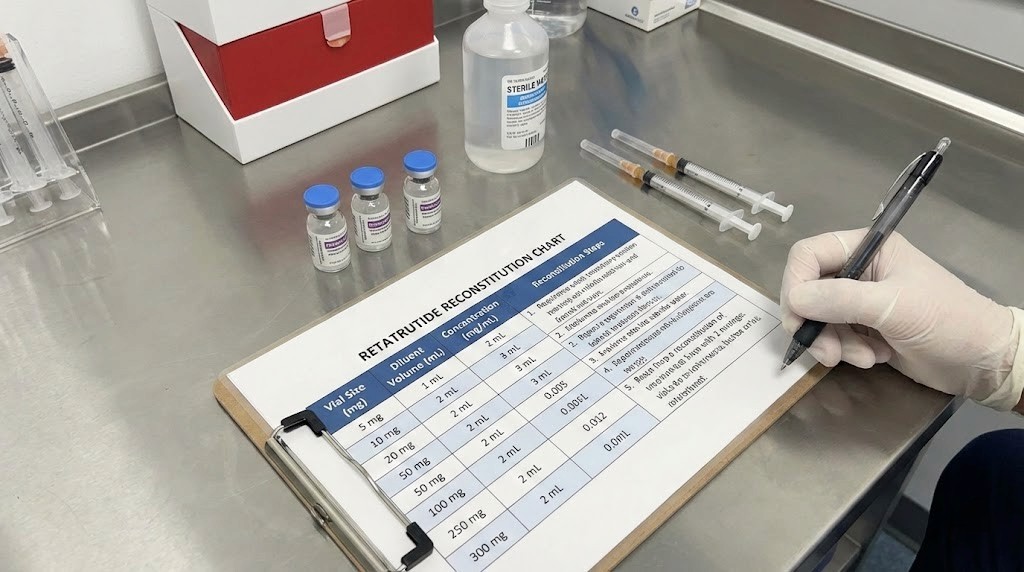
You are staring at a vial of white powder. Beside it sits a bottle of bacteriostatic water, an insulin syringe, and an alcohol swab. The math should be simple. Add water. Draw dose. Inject.
It is not simple.
Retatrutide comes in multiple vial sizes. The amount of water you add changes the concentration. The concentration determines how many units you draw. And one wrong number cascades through your entire protocol, turning weeks of careful research into a frustrating guessing game. A researcher who adds 2mL of water to a 10mg vial gets a completely different concentration than someone who adds 1mL to that same vial. Miss that distinction and you could be injecting twice your intended dose, or half of it, without ever knowing.
This is why a retatrutide reconstitution chart exists. Not as a luxury. As a necessity. The chart eliminates the mental math, the second-guessing, the late-night recalculations after you realize something might be off. It gives you one place to look, confirm your numbers, and move forward with confidence. SeekPeptides built its reconstitution calculator around exactly this problem, because too many researchers were making avoidable errors that undermined months of careful work.
This guide provides complete reconstitution charts for every common retatrutide vial size, from 5mg through 30mg. You will find exact water volumes, resulting concentrations, syringe units per dose at every escalation level, and step-by-step instructions for the physical reconstitution process. Whether you are mixing your first vial or your fiftieth, these charts give you the reference you need to get every dose right, every time.
The reconstitution formula that drives every chart
Every number in every reconstitution chart reduces to one formula. Learn it once and you never need to memorize a chart again. The chart simply becomes a faster way to access what the formula already tells you.
Concentration = Peptide Amount (mg) / Water Volume (mL)
That is the entire foundation. A 10mg vial plus 2mL of bacteriostatic water gives you 10 / 2 = 5mg/mL. A 20mg vial plus 1mL gives you 20 / 1 = 20mg/mL. Every chart entry is just this formula applied to different input numbers.
But here is where it gets practical. You do not inject in milligrams. You inject in syringe units. And the bridge between concentration and syringe units requires one more piece of knowledge that trips up even experienced researchers.
Understanding insulin syringe units
A standard U-100 insulin syringe holds 1mL total and has 100 unit markings. Each unit equals 0.01mL. That is it. No hidden conversion. No special peptide math. One hundred units equals one milliliter.
So when your peptide calculator tells you to draw 40 units, it means draw 0.4mL. When it says 20 units, that is 0.2mL. The unit markings on the syringe are simply a more readable way to measure tiny volumes of liquid.
Connecting this to your concentration: if your reconstituted retatrutide is 5mg/mL and you need 2mg, the math goes 2 / 5 = 0.4mL = 40 units. For 4mg from the same solution: 4 / 5 = 0.8mL = 80 units. For 8mg: 8 / 5 = 1.6mL = 160 units, which exceeds a standard 1mL syringe and requires either a split draw or a different reconstitution volume.
This syringe capacity issue is exactly why the water volume you choose matters from the very start. Choose too much water and higher doses become impractically large volumes. Choose too little and lower starting doses become impossibly tiny draws that are hard to measure accurately. The reconstitution charts below account for both problems, giving you the ideal water volumes for each vial size and dose range.
Converting between mg, mcg, mL, and units
The four units you will encounter in retatrutide reconstitution are milligrams, micrograms, milliliters, and syringe units. Here is how they relate:
1mg = 1,000mcg (milligrams to micrograms)
1mL = 100 units (on a U-100 insulin syringe)
Units to draw = (Dose in mg / Concentration in mg per mL) x 100
Or equivalently: Units to draw = Dose in mcg / (Concentration in mcg per mL / 100)
Some researchers find it easier to work entirely in micrograms because it eliminates decimals. A 2mg dose becomes 2,000mcg. A 5mg/mL concentration becomes 5,000mcg/mL. Then 2,000 / 5,000 = 0.4mL = 40 units. Same answer, no decimal confusion. The peptide dosage calculation guide covers these conversions in more detail if the notation still feels unfamiliar.
Complete retatrutide reconstitution chart: 5mg vial
The 5mg vial is the smallest common size for retatrutide. It works best during the early escalation phase when weekly doses are 1mg or 2mg. At higher doses, the vial empties quickly, making larger vials more practical and cost-effective.
5mg vial reconstitution reference
Water Added | Concentration | mcg per Unit | 1mg Dose | 2mg Dose | 4mg Dose | Total Doses at 2mg |
|---|---|---|---|---|---|---|
0.5mL | 10mg/mL | 100mcg | 10 units | 20 units | 40 units | 2.5 |
1.0mL | 5mg/mL | 50mcg | 20 units | 40 units | 80 units | 2.5 |
2.0mL | 2.5mg/mL | 25mcg | 40 units | 80 units | 160 units* | 2.5 |
*Exceeds 1mL syringe capacity. Requires split draw or different reconstitution volume.
The sweet spot for most researchers using a 5mg vial is 1.0mL of bacteriostatic water. This creates a 5mg/mL concentration where a 1mg starting dose requires 20 units (easy to read on any syringe) and a 2mg dose requires 40 units (clean, precise marking). The 0.5mL option works if you have a high-quality syringe with clear markings at the 10-unit level, but cheaper syringes can make that small volume harder to measure accurately.
At 2mg per week, a single 5mg vial provides exactly 2.5 weekly doses. That covers roughly two and a half weeks of your initial escalation phase. Most researchers beginning retatrutide start with one or two 5mg vials for the first month, then transition to 10mg or 20mg vials as the dose escalates. This approach matches standard retatrutide dosage protocols while keeping initial costs manageable.
One important consideration: a 5mg vial reconstituted with 2mL of water gives you excellent measurement precision at the 1mg dose level (40 units, very easy to read), but the 4mg dose would require 160 units, far exceeding the syringe. If you plan to use the same vial through a dose escalation to 4mg, the 2mL reconstitution becomes impractical. Plan your water volume around your highest anticipated dose from that specific vial.
Complete retatrutide reconstitution chart: 10mg vial
The 10mg vial is the workhorse of most retatrutide research protocols. It provides enough peptide for multiple weeks at lower doses and offers the most flexibility in reconstitution options. This is the vial size most researchers start with, and many continue using it through the 4mg escalation phase.
10mg vial reconstitution reference
Water Added | Concentration | mcg per Unit | 1mg Dose | 2mg Dose | 4mg Dose | 8mg Dose | Total Doses at 4mg |
|---|---|---|---|---|---|---|---|
1.0mL | 10mg/mL | 100mcg | 10 units | 20 units | 40 units | 80 units | 2.5 |
2.0mL | 5mg/mL | 50mcg | 20 units | 40 units | 80 units | 160 units* | 2.5 |
2.5mL | 4mg/mL | 40mcg | 25 units | 50 units | 100 units | 200 units* | 2.5 |
*Exceeds 1mL syringe capacity. Requires split draw.
The optimal reconstitution for a 10mg vial depends entirely on your current and planned dose range.
Best for 2mg through 8mg range: 1.0mL of water. This creates a 10mg/mL concentration where even the 8mg maintenance dose requires only 80 units, comfortably within a single syringe draw. The trade-off is that the 1mg starting dose becomes just 10 units, which can be difficult to measure precisely on a standard syringe. If you are starting at 2mg (the more common approach), 20 units is manageable on most syringes.
Best for 1mg through 4mg range: 2.0mL of water. This creates a 5mg/mL concentration with excellent readability at the lower dose levels. A 2mg dose at 40 units and a 4mg dose at 80 units are both clean, easy-to-read volumes. However, the 8mg dose requires 160 units (1.6mL), necessitating a split into two separate draws. Many researchers who plan to escalate beyond 4mg switch to a new vial with 1mL reconstitution at that point rather than splitting draws.
Understanding these options is what separates researchers who get consistent results from those who wonder why their retatrutide protocol seems inconsistent. The reconstitution calculator on SeekPeptides automates this math, but knowing the logic behind the numbers means you can spot errors before they affect your research.
Complete retatrutide reconstitution chart: 20mg vial
The 20mg vial becomes essential once your dose escalation moves past 4mg weekly. At higher doses, smaller vials empty too quickly, requiring frequent reconstitution events that introduce contamination risk and inconvenience. The 20mg vial provides enough peptide for practical multi-week use even at maintenance doses.
20mg vial reconstitution reference
Water Added | Concentration | mcg per Unit | 4mg Dose | 8mg Dose | 12mg Dose | Total Doses at 8mg |
|---|---|---|---|---|---|---|
1.0mL | 20mg/mL | 200mcg | 20 units | 40 units | 60 units | 2.5 |
2.0mL | 10mg/mL | 100mcg | 40 units | 80 units | 120 units* | 2.5 |
4.0mL | 5mg/mL | 50mcg | 80 units | 160 units* | 240 units* | 2.5 |
*Exceeds 1mL syringe capacity. Requires split draw.
For the 20mg vial, the choice is clear for most researchers.
Best for escalation and maintenance (4mg through 12mg): 1.0mL of water. At 20mg/mL, every dose from 4mg through 12mg fits in a single syringe draw. The 12mg maintenance dose requires only 60 units, leaving room on the syringe and making measurement straightforward. This is the most popular reconstitution volume among experienced researchers who have moved past the initial titration phase.
The 2.0mL option works well for the 4mg and 8mg phases but forces a split at 12mg. Some researchers prefer this because the slightly lower concentration gives them more precision, especially if they are doing half-step escalations like 6mg or 10mg between the standard protocol doses. The 4.0mL option is rarely used because it creates impractically large injection volumes at 8mg and above.
At 20mg/mL concentration with the 1.0mL reconstitution, each unit on your syringe delivers exactly 200mcg. This makes mental math easy. A 4mg dose? That is 4,000mcg divided by 200mcg per unit = 20 units. An 8mg dose? 8,000 / 200 = 40 units. A 12mg dose? 12,000 / 200 = 60 units. Clean numbers, minimal room for error.
The 20mg vial at 8mg per week provides 2.5 weekly doses, covering about two and a half weeks per vial. At 12mg per week, you get roughly 1.67 weekly doses, meaning you need a new vial approximately every 10-11 days. Planning your retatrutide supply purchases around these timelines prevents protocol gaps.
Complete retatrutide reconstitution chart: 30mg vial
The 30mg vial is ideal for researchers on maintenance doses who want to minimize how often they reconstitute. Every reconstitution event carries a small risk of contamination or measurement error, so fewer events means more consistent results across your protocol.
30mg vial reconstitution reference
Water Added | Concentration | mcg per Unit | 4mg Dose | 8mg Dose | 12mg Dose | Total Doses at 12mg |
|---|---|---|---|---|---|---|
1.5mL | 20mg/mL | 200mcg | 20 units | 40 units | 60 units | 2.5 |
3.0mL | 10mg/mL | 100mcg | 40 units | 80 units | 120 units* | 2.5 |
*Exceeds 1mL syringe capacity. Requires split draw.
Recommended: 1.5mL of water for 20mg/mL concentration. This matches the 20mg vial sweet spot (200mcg per unit) while providing 2.5 weeks of peptide at the maximum 12mg dose. A single 30mg vial at 12mg weekly lasts longer than a 20mg vial, reducing your reconstitution frequency and keeping your protocol cleaner.
The 3.0mL option creates a 10mg/mL concentration that works for the 4mg and 8mg dose levels but requires splitting at 12mg. Unless you have a specific reason to prefer a lower concentration (such as needing half-step doses like 3mg or 5mg during a customized escalation), the 1.5mL reconstitution is the better choice for 30mg vials.
For researchers running extended maintenance phases at 8mg or 12mg weekly, the 30mg vial provides the best balance of convenience, cost per milligram, and reconstitution frequency. Two 30mg vials cover approximately 5 weeks at 12mg per week, compared to three 20mg vials for the same duration.
Step-by-step reconstitution process
Having the chart numbers is only half the equation. The physical reconstitution process matters just as much. Poor technique can degrade the peptide, introduce contamination, or create an inconsistent solution, all of which make your carefully calculated doses meaningless.
Materials you need
Gather everything before you start. Interrupting the process to search for supplies increases contamination risk.
Required items:
Retatrutide lyophilized vial (your chosen size)
Bacteriostatic water (0.9% benzyl alcohol preserved)
Sterile insulin syringe for adding water (1mL or 3mL depending on volume needed)
Separate sterile insulin syringe for drawing doses (do not reuse the mixing syringe)
Alcohol swabs
Clean, flat work surface
Permanent marker for labeling
A quick note on water type: you must use bacteriostatic water, not sterile water for injection, for any vial you plan to use more than once. Bacteriostatic water contains benzyl alcohol as a preservative that prevents bacterial growth after the first needle puncture. Sterile water lacks this preservative and should only be used for single-dose reconstitution. Since retatrutide vials typically provide multiple weekly doses, bacteriostatic water is non-negotiable. Our guide on water types for peptide mixing explains the differences in detail.
The reconstitution process
Step 1: Clean everything. Wipe the rubber stoppers of both the retatrutide vial and the bacteriostatic water vial with alcohol swabs. Let them air dry for 10 seconds. Do not blow on them or wipe them dry. The alcohol needs brief contact time to disinfect effectively.
Step 2: Draw the water. Using a sterile syringe, insert the needle through the rubber stopper of the bacteriostatic water vial. Invert the vial and draw your calculated water volume. For a 10mg vial reconstitution with 1mL of water, draw exactly to the 100-unit mark on a 1mL syringe. Check for air bubbles. Tap the syringe gently to move any bubbles to the top, then push the plunger slightly to expel them.
Step 3: Add water to the peptide vial. Insert the needle through the rubber stopper of the retatrutide vial. Here is the critical technique: inject the water slowly down the inside wall of the vial. Do not squirt it directly onto the powder. Direct force can damage the peptide bonds through mechanical stress. Let the water trickle down the glass wall and contact the powder gently from below.
Step 4: Allow initial contact. Let the vial sit undisturbed for 30 seconds after adding the water. The lyophilized powder will begin to dissolve on its own as the water saturates it. This passive dissolution is gentler on the peptide than immediate agitation.
Step 5: Swirl gently. Pick up the vial and roll it between your palms or swirl it in small circles. Do not shake it. Vigorous shaking creates foam, which means air is being forced into the solution, and the mechanical stress of bubble formation can denature the peptide. Gentle swirling for 30 to 60 seconds should produce a clear, colorless solution.
Step 6: Inspect the solution. Hold the vial up to light and look through it. The solution should be completely clear with no visible particles, cloudiness, or discoloration. If small particles remain, continue gentle swirling for another 30-60 seconds. If the solution remains cloudy after 3-5 minutes of gentle swirling, something may be wrong. The peptide could be degraded, the water could be contaminated, or the vial temperature may have caused precipitation. Do not use a solution that will not clarify.
Step 7: Label and store. Write the concentration (e.g., "10mg/mL"), the date, and optionally the mcg-per-unit value on the vial with a permanent marker. Place the vial in the refrigerator at 2 to 8 degrees Celsius (36 to 46 degrees Fahrenheit). Store it upright, away from the freezer compartment and door shelves where temperature fluctuates most. The back of a middle shelf is the most stable location.
The entire process takes about 3 to 5 minutes. Rushing it saves seconds and risks the entire vial. Take your time. Our complete guide to mixing peptides with bacteriostatic water includes additional tips for handling difficult reconstitutions and common technique mistakes.
Retatrutide dose escalation and how it connects to your chart
Reconstitution gets you a solution. The dose escalation schedule tells you how much of that solution to use each week. These two systems are inseparable, because the dose changes every four weeks and each change means a different number of syringe units.
Standard clinical escalation protocol
The Phase 2 trial published in the New England Journal of Medicine established the titration schedule that most researchers follow. The gradual increase lets your body adapt to triple-receptor activation incrementally, reducing side effects that would be severe at full dose from day one.
Weeks 1 through 4: 2mg once weekly. This is receptor adaptation, not a results phase. GLP-1 activation begins at this level, producing mild appetite changes in most researchers. Some notice nothing at all. That is normal and expected.
Weeks 5 through 8: 4mg once weekly. The first meaningful escalation. GIP receptor engagement increases noticeably. Appetite suppression typically becomes stronger. Gastrointestinal effects, if they appear, usually show up during this transition.
Weeks 9 through 12: 8mg once weekly. This is where retatrutide separates itself from single and dual receptor agonists. The glucagon receptor component activates meaningfully, increasing thermogenesis and metabolic rate. The Phase 2 trial showed 22.8% average body weight reduction at 48 weeks in the 8mg group.
Weeks 13 onward: 12mg once weekly (maximum studied dose). The highest efficacy dose from Phase 2, producing up to 24.2% average weight loss at 48 weeks. Not every researcher needs to reach 12mg. Some find 8mg sufficient with fewer side effects.
An alternative conservative start uses 1mg for the first four weeks before moving to 2mg. This adds time to the protocol but can significantly reduce initial GI symptoms, especially for those who have had rough experiences with other weight loss peptides.
Master reconstitution-to-dose chart
This chart combines reconstitution with the escalation schedule. Find your vial size and water volume on the left, then read across to see exactly how many units to draw at each escalation phase.
Vial / Water | Concentration | 1mg | 2mg | 4mg | 8mg | 12mg |
|---|---|---|---|---|---|---|
5mg / 1mL | 5mg/mL | 20 units | 40 units | 80 units | N/A | N/A |
10mg / 1mL | 10mg/mL | 10 units | 20 units | 40 units | 80 units | 120* |
10mg / 2mL | 5mg/mL | 20 units | 40 units | 80 units | 160* | 240* |
20mg / 1mL | 20mg/mL | 5 units | 10 units | 20 units | 40 units | 60 units |
20mg / 2mL | 10mg/mL | 10 units | 20 units | 40 units | 80 units | 120* |
30mg / 1.5mL | 20mg/mL | 5 units | 10 units | 20 units | 40 units | 60 units |
30mg / 3mL | 10mg/mL | 10 units | 20 units | 40 units | 80 units | 120* |
*Exceeds 100 units (1mL). Requires split into two syringe draws.
This single table replaces all four individual charts when you need a quick cross-reference. Print it. Save a screenshot. Tape it to your refrigerator. This is the chart that prevents every dose calculation error in your protocol.
Notice the pattern: 20mg/mL concentrations (from 20mg/1mL, 30mg/1.5mL configurations) keep every dose from 1mg through 12mg within a single syringe draw. If you want the simplest possible dosing experience across the entire escalation schedule, aim for a 20mg/mL concentration regardless of vial size. The retatrutide dosage chart provides additional context on how these doses translate to clinical outcomes.
Choosing the right reconstitution volume for your protocol
The charts give you options. But which option should you actually choose? The answer depends on three factors: your current dose, your highest planned dose, and your syringe quality.
Decision framework
Factor 1: Your highest planned weekly dose must fit in a single syringe draw. This is the most important rule. If you plan to reach 12mg, you need a concentration where 12mg requires 100 units or less. That means 12mg/mL or higher. A 20mg/mL concentration puts 12mg at just 60 units, comfortable and precise.
Factor 2: Your lowest dose must be measurable on your syringe. At 20mg/mL, a 1mg dose is only 5 units. On a standard 1mL syringe, the markings between 0 and 10 units can be hard to read accurately. If you are starting at 1mg, a lower concentration (5mg/mL or 10mg/mL) gives you a more readable volume. Alternatively, use a 0.3mL low-dead-space syringe for the starting phase, where the finer graduation marks make 5-unit draws more precise.
Factor 3: Balance convenience against precision. Higher concentrations mean smaller injection volumes (more convenient, less discomfort) but require more precision in measurement. Lower concentrations mean larger volumes (slightly less convenient) but are more forgiving of small measurement variations.
Recommended reconstitution by protocol phase
Protocol Phase | Dose Range | Best Vial | Best Water Volume | Why |
|---|---|---|---|---|
Initiation (wks 1-4) | 1-2mg | 5mg or 10mg | 1mL (5mg) or 2mL (10mg) | Readable volumes at low doses |
Early escalation (wks 5-8) | 4mg | 10mg | 1mL | 40 units per dose, clean and easy |
Mid escalation (wks 9-12) | 8mg | 20mg | 1mL | 40 units per dose, single draw |
Maintenance (wks 13+) | 12mg | 20mg or 30mg | 1mL or 1.5mL | 60 units per dose, maximum convenience |
This phased approach uses different vial sizes at different stages, matching the vial to the dose rather than forcing one size to work across all phases. It is slightly more complex than using a single vial size throughout, but it optimizes both measurement precision and syringe convenience at every stage.
Researchers who prefer simplicity can use 10mg vials with 1mL reconstitution throughout the first 8-12 weeks (covering doses from 2mg through 8mg within a single draw), then switch to 20mg vials with 1mL reconstitution for the 8mg and 12mg maintenance phases. This two-vial-size approach covers the entire protocol with minimal reconstitution math. Use the retatrutide dosage calculator to verify your specific numbers before each phase transition.
Common reconstitution mistakes and how the chart prevents them
Even with a chart in front of you, certain errors persist because they are conceptual rather than mathematical. Understanding these mistakes makes the chart more useful, because you know not just what to do, but what to avoid.
Mistake 1: adding water too fast
Squirting bacteriostatic water directly onto the lyophilized powder creates foam and mechanical stress that can denature the peptide. The reconstitution chart assumes your peptide is intact. If you damaged it during mixing, the calculated dose delivers less active compound than expected. Always inject water slowly down the vial wall. Think of it as pouring, not squirting.
Mistake 2: shaking instead of swirling
Shaking introduces air bubbles into the solution. These bubbles create foam on the surface and can make it difficult to draw an accurate volume, because air pockets in the syringe displace liquid. Gentle swirling dissolves the powder just as effectively without the bubble problem. If you see foam after shaking, let the vial sit in the refrigerator for 15 minutes for the bubbles to dissipate before drawing your first dose.
Mistake 3: using the wrong water volume
This is the most impactful error because it changes your concentration, which changes every single dose you draw from that vial. If you intended to add 1mL but accidentally added 2mL, your concentration is half of what you planned. Every dose from that vial will be 50% of your target unless you recalculate.
The fix is simple but often forgotten: recalculate using the actual water volume you added. The peptide is fine. The math just changes. Plug the real water volume into the formula (or the reconstitution calculator) and update your units-per-dose accordingly. You can also add more bacteriostatic water to reach your intended volume, as long as you note the new total and recalculate.
Mistake 4: not labeling the vial
You reconstitute a vial, put it in the fridge, and a week later you cannot remember whether you added 1mL or 2mL. Was it the 10mg or the 20mg vial? The concentration could be 5mg/mL, 10mg/mL, or 20mg/mL, and each one changes how many units you draw.
Write on the vial. Immediately. Before it goes in the refrigerator. Include the concentration, the reconstitution date, and optionally the mcg-per-unit value. This 15-second step prevents days of uncertainty later.
Mistake 5: confusing vial sizes
If you have multiple vials of different sizes in your refrigerator, grabbing the wrong one means drawing from a different concentration. A 20-unit draw from a 10mg/mL vial gives you 2mg. The same 20-unit draw from a 20mg/mL vial gives you 4mg. Double the dose from an identical syringe reading.
Color-coded labels or physically separating different vial concentrations prevents this. Some researchers use different colored tape, small stickers, or designated positions on different refrigerator shelves to keep vials distinct. For those managing multiple peptide stacks, this organizational system becomes even more critical.
Mistake 6: forgetting dose escalation adjustments
You calculate 40 units for your 2mg starting dose, set a weekly reminder, and draw 40 units every week for months. Except your dose was supposed to increase to 4mg at week 5, which means 80 units from the same vial. The chart on your refrigerator prevents this, but only if you reference it at each escalation point.
Create a complete schedule before you begin. Write down the exact units for each week across the entire protocol. When the dose changes, the units change, and you need a deliberate moment of updating your routine, not hoping you remember to do more math at the right time.
How retatrutide reconstitution compares to other peptides
If you have experience with semaglutide or tirzepatide reconstitution, some of those skills transfer directly. The formula is identical. The syringe mechanics are the same. But the dose ranges differ significantly, which means the optimal reconstitution volumes are different.
Comparison chart
Parameter | Semaglutide | Tirzepatide | Retatrutide |
|---|---|---|---|
Typical vial sizes | 5mg, 10mg | 5mg, 10mg, 15mg, 30mg | 5mg, 10mg, 20mg, 30mg |
Starting dose | 0.25mg | 2.5mg | 1-2mg |
Maintenance range | 1.0-2.4mg | 5-15mg | 8-12mg |
Optimal concentration | 2.5-5mg/mL | 10-20mg/mL | 10-20mg/mL |
Escalation interval | 4 weeks | 4 weeks | 4 weeks |
Receptor targets | GLP-1 | GLP-1 + GIP | GLP-1 + GIP + Glucagon |
Peak trial weight loss | ~15-17% | ~21% | ~24.2% |
Notice that semaglutide operates in much lower dose ranges (sub-milligram to low milligram), which means it requires lower reconstitution concentrations for measurable volumes. Tirzepatide and retatrutide share similar dose ranges and concentration needs, making the reconstitution approach similar for both. If you have a tirzepatide reconstitution chart that you are familiar with, the retatrutide charts follow the same logic at comparable concentrations.
The critical distinction is that you cannot apply semaglutide reconstitution logic to retatrutide. A researcher accustomed to semaglutide concentrations of 2.5mg/mL who reconstitutes retatrutide the same way would need to draw impractically large volumes for maintenance doses. Similarly, applying retatrutide concentrations to semaglutide would create volumes so small they are nearly impossible to measure. Each peptide needs its own chart, and the general reconstitution guide covers the principles that apply universally.
For researchers considering switching between these compounds, the retatrutide versus semaglutide comparison provides detailed analysis of efficacy differences, while the tirzepatide versus semaglutide dosage chart covers the other common comparison. Understanding how reconstitution differs between these peptides prevents the most common calculation errors researchers make when transitioning protocols.
Storage and stability after reconstitution
Your reconstitution chart is useless if the peptide degrades before you finish the vial. Proper storage preserves the potency of every dose from first to last.
Temperature requirements
Reconstituted retatrutide: Store at 2 to 8 degrees Celsius (36 to 46 degrees Fahrenheit). This is standard refrigerator temperature. Place the vial upright in a consistent location, away from temperature fluctuations near the door or freezer compartment.
Unreconstituted (lyophilized) retatrutide: Store at -20 degrees Celsius (-4 degrees Fahrenheit) or colder for long-term storage. The powder form can maintain potency for 12 to 24 months when frozen. If you purchase vials in advance, keep them frozen until you are ready to reconstitute.
Do not freeze reconstituted retatrutide. Ice crystal formation can damage the peptide structure and reduce potency. If your refrigerator has a tendency to freeze items near the back wall, position the vial in a warmer zone or use a small insulated container as a buffer.
Shelf life after reconstitution
Reconstituted retatrutide in bacteriostatic water maintains potency for approximately 28 to 30 days when stored properly at 2 to 8 degrees Celsius. This means you need to plan your reconstitution timing so that you finish the vial within about four weeks.
Here is how that aligns with the charts:
Vial Size | Weekly Dose | Doses per Vial | Weeks to Empty | Within 28-Day Limit? |
|---|---|---|---|---|
5mg | 2mg | 2.5 | ~2.5 weeks | Yes |
10mg | 2mg | 5 | ~5 weeks | Borderline |
10mg | 4mg | 2.5 | ~2.5 weeks | Yes |
20mg | 8mg | 2.5 | ~2.5 weeks | Yes |
20mg | 12mg | ~1.7 | ~12 days | Yes |
30mg | 12mg | 2.5 | ~2.5 weeks | Yes |
The one potential concern: a 10mg vial at the 2mg dose provides 5 weekly doses, spanning roughly 5 weeks. That slightly exceeds the recommended 28-day stability window. Most researchers report no noticeable potency issues at the 5-week mark, but conservative protocols suggest using the vial within 4 weeks and discarding any remainder. This is a small waste relative to the risk of using degraded peptide.
For comprehensive peptide refrigeration guidelines, including how to assess whether stored peptide has degraded, and for guidance on powder-form shelf life, the full storage guides cover these topics comprehensively.
Supply planning for a complete retatrutide protocol
Running out of peptide mid-escalation is not just inconvenient. It disrupts your protocol timing, potentially requiring a restart of the current escalation phase if the gap extends beyond a week. Proper supply planning uses the reconstitution charts to calculate exactly how many vials you need before day one.
Total peptide needed by protocol length
Protocol | Weeks 1-4 (2mg/wk) | Weeks 5-8 (4mg/wk) | Weeks 9-12 (8mg/wk) | Weeks 13-16 (12mg/wk) | Total mg |
|---|---|---|---|---|---|
12 weeks (to 8mg) | 8mg | 16mg | 32mg | N/A | 56mg |
16 weeks (to 12mg) | 8mg | 16mg | 32mg | 48mg | 104mg |
24 weeks (extended) | 8mg | 16mg | 32mg | 48mg + 96mg | 200mg |
Now translate those totals into vials.
For 12-week protocol (56mg total): Six 10mg vials. Or three 20mg vials. Budget one extra vial for waste and errors.
For 16-week protocol (104mg total): Eleven 10mg vials. Or five 20mg vials plus one 10mg vial. Or three 10mg vials (weeks 1-8) plus three 30mg vials (weeks 9-16). Budget 10-15% extra for waste.
For 24-week extended protocol (200mg total): Ten 20mg vials. Or seven 30mg vials. Planning this far ahead means purchasing in stages, keeping future vials frozen in proper storage until needed.
The peptide cost calculator helps compare the total expense of different vial size strategies. Larger vials typically cost less per milligram, even if the sticker price per vial is higher. For detailed retatrutide pricing analysis, our cost guide breaks down the numbers across multiple vendors and vial configurations.
Advanced reconstitution considerations
Once you have mastered the basic charts and process, several nuanced factors can further optimize your protocol. These details matter most for researchers running extended protocols or working with precise dose requirements.
pH and stability optimization
Retatrutide peptide stability is influenced by the pH of the reconstituted solution. Bacteriostatic water typically has a pH around 5.0 to 7.0, which falls within an acceptable range for most peptides. Research indicates that retatrutide solutions are most stable at pH 4 to 5. The standard bacteriostatic water reconstitution generally works well without pH adjustment, but researchers working with very long reconstitution-to-use timelines (approaching the 28-day limit) may benefit from knowing that lower pH within the acceptable range tends to preserve potency better.
For the vast majority of researchers, standard bacteriostatic water reconstitution provides adequate stability throughout the usable window. pH adjustment is an advanced technique that most protocols do not require.
Dead space considerations
Every syringe has a small volume trapped in the needle hub that does not get expelled when you push the plunger completely. This dead space typically ranges from 0.5 to 2 units depending on the syringe brand and needle type. Over a single dose, the loss is negligible. Over an entire vial, the cumulative dead space can mean your last dose comes up slightly short.
For a 10mg vial providing 5 doses at 2mg each, dead space losses of approximately 1 unit per draw mean roughly 5 units (50mcg at 10mg/mL) lost total. That is about 0.5% of the vial, truly negligible. But at higher concentrations like 20mg/mL, 1 unit of dead space equals 200mcg, and 5 draws waste 1,000mcg (1mg), which is 5% of a 20mg vial. Over a multi-month protocol with many vials, this adds up.
Low-dead-space syringes (sometimes called "fixed needle" or "zero dead space" syringes) minimize this waste. They cost slightly more but save peptide over the course of a long protocol. For researchers who want to optimize every milligram, especially when using expensive 20mg and 30mg vials, investing in low-dead-space syringes pays for itself. The injection guide covers syringe selection in more detail.
Injection volume and comfort
The reconstitution volume you choose determines your injection volume, which directly affects comfort. Larger subcutaneous injection volumes (above 0.5mL) can cause more local discomfort, swelling, and slower absorption. Smaller volumes (below 0.2mL) inject quickly with minimal sensation but require more precise measurement.
At a 20mg/mL concentration, maintenance doses stay in the comfortable range: 8mg requires 0.4mL (40 units) and 12mg requires 0.6mL (60 units). Both inject cleanly and absorb efficiently when administered subcutaneously in the abdomen, thigh, or upper arm.
At 5mg/mL concentration, an 8mg dose requires 1.6mL, which is a large subcutaneous injection. Some researchers report visible welts or delayed absorption at volumes this high. This is another reason why higher concentrations (10-20mg/mL) are preferred for higher doses, and why the reconstitution charts emphasize these concentrations for the escalation and maintenance phases.
Splitting doses across multiple injections
Some researchers split their weekly dose into two administrations spaced 3 to 4 days apart. Instead of one 12mg injection, they do two 6mg injections (Monday and Thursday, for example). The total weekly dose remains the same, but the peak plasma concentration is lower, which can reduce gastrointestinal side effects.
The reconstitution chart accommodates this easily. At 20mg/mL concentration, a 6mg split dose requires 30 units per injection, well within syringe range and easy to measure. A 4mg split dose (from an 8mg weekly total) requires 20 units per injection. The concentration does not change. Only the draw volume per injection changes.
Split dosing does use the vial faster because you puncture the stopper more frequently, increasing contamination exposure slightly. But for researchers who find the GI effects of full weekly doses difficult to manage, the trade-off is often worth it.
Using the SeekPeptides calculator alongside the chart
The reconstitution charts in this guide give you fixed reference points for the most common configurations. But what if your vial size, water volume, or target dose does not match exactly? What if you need a half-step dose like 3mg or 6mg during a customized escalation?
This is where the SeekPeptides reconstitution calculator extends the charts. Enter any vial amount, any water volume, and any target dose, and the calculator returns your exact concentration, volume per dose, syringe units, and total doses per vial. It handles the formula application so you can focus on protocol decisions rather than arithmetic.
Practical workflow combining chart and calculator
Before reconstitution: Use the chart to select your vial size and water volume. The chart gives you the established configurations that experienced researchers have validated.
During reconstitution: Follow the step-by-step process above. Add the water volume specified by your chosen chart row.
Before each dose: Reference the chart column for your current escalation dose. Confirm the syringe units. If you are between standard doses (half-steps, custom adjustments), use the calculator for the precise number.
At each escalation point: Move to the next dose column on the chart. Generate a new calculator screenshot for your phone so you have a quick reference for the next four weeks.
This combined approach gives you the speed of a chart for routine dosing and the precision of a calculator for anything non-standard. For researchers managing complex multi-peptide protocols, the peptide stack calculator extends this further by organizing calculations across multiple compounds simultaneously.
Retatrutide reconstitution for specific research goals
The same vial and water combination serves different purposes depending on your research objectives. Understanding how your goals influence your reconstitution decisions helps you choose the most practical configuration from the charts.
Weight management research
If weight management is the primary objective, you will likely escalate to 8mg or 12mg maintenance. This means you need concentrations that support single-draw dosing at these levels. The 20mg/mL configuration (20mg vial with 1mL, or 30mg vial with 1.5mL) is optimal. Every dose from 2mg through 12mg fits in one syringe draw, and the 60-unit maximum for 12mg leaves comfortable room on the syringe.
The Phase 2 NEJM trial showed 24.2% average body weight reduction at 48 weeks in the 12mg group. The 8mg group achieved 22.8%. For researchers who tolerate 8mg well and want to minimize side effects while still targeting significant fat loss, maintaining at 8mg rather than escalating to 12mg is a legitimate choice, and the 20mg/mL concentration serves both maintenance levels equally well.
Metabolic health research
Beyond weight loss, retatrutide demonstrated remarkable metabolic improvements in clinical trials. Fasting glucose normalization, improved insulin sensitivity, and better lipid profiles were observed across dose groups, with particular significance at 4mg and above. For researchers focused primarily on metabolic markers, the 4mg to 8mg range appears to provide strong metabolic benefit with a favorable side effect profile.
The 10mg/mL concentration works well for this goal: 4mg requires 40 units and 8mg requires 80 units, both clean readings on a standard syringe. A 10mg vial with 1mL reconstitution or a 20mg vial with 2mL reconstitution both achieve this concentration. Choosing the vial size depends on how many weeks you plan to maintain at each dose level.
Body composition research
Researchers interested in the ratio of fat loss to lean mass preservation may use customized escalation schedules with intermediate doses. The glucagon receptor activation at 8mg and above drives significant lipolysis and fat oxidation, which, combined with adequate protein intake and resistance training, may preserve lean tissue better than lower doses. Some body composition protocols include half-step doses like 3mg, 6mg, or 10mg.
For half-step doses, the charts may not have an exact match. This is where the calculator becomes essential. At 10mg/mL concentration: 3mg = 30 units, 6mg = 60 units, 10mg = 100 units. At 20mg/mL: 3mg = 15 units, 6mg = 30 units, 10mg = 50 units. Both work within syringe range, but the 10mg/mL option provides more readable volumes for these non-standard doses.
Troubleshooting reconstitution problems
Sometimes the process does not go smoothly. Here are the most common problems and their solutions, connected back to the charts and formulas so you can recover without wasting the vial.
Problem: solution will not clarify
You added the water, swirled for several minutes, and the solution is still cloudy with visible particles.
First, confirm you are using the right vial. Retatrutide lyophilized powder should dissolve readily in bacteriostatic water at room temperature. If it does not dissolve after 5 minutes of gentle swirling, possible causes include: degraded peptide (check storage history and expiration status), contaminated water (use a fresh vial of bacteriostatic water), or water temperature (cold water from the refrigerator dissolves peptides more slowly than room temperature water). Try letting the vial warm to room temperature for 10 to 15 minutes, then swirl again. If it still will not clarify, the peptide may be compromised.
Problem: you added the wrong amount of water
You intended 1mL but realized after mixing that you added 2mL. Or the syringe leaked slightly during transfer. Either way, the actual volume does not match your chart.
The solution: use the formula to recalculate with the actual volume. If you added 2mL to a 10mg vial instead of 1mL, your concentration is 5mg/mL instead of 10mg/mL. Everything in the 10mg vial / 2mL row of the chart now applies. A 2mg dose is 40 units instead of 20. A 4mg dose is 80 units instead of 40. The peptide is unaffected. Only the math changes.
You can also add more bacteriostatic water to bring the total to a round number. If you accidentally added 1.3mL to a 10mg vial, adding another 0.7mL brings the total to 2.0mL, which matches the chart. Then use the 5mg/mL concentration row normally.
Problem: air bubbles in the syringe when drawing the dose
Air bubbles in the syringe displace liquid, which means you draw less peptide solution than the syringe markings indicate. A syringe showing 40 units with an air bubble might actually contain only 35 units of solution.
The fix: hold the syringe with the needle pointing up. Tap the barrel gently to move bubbles to the top (near the needle). Push the plunger slightly to expel the air. Then check your volume and adjust. If you pushed out too much solution, draw more from the vial to reach your target units.
Problem: the vial seems to run out sooner than expected
Your chart says a 10mg vial at 4mg per week should provide 2.5 doses, enough for about 2.5 weeks. But you are running short during the second week.
Possible causes: dead space accumulation (discussed above), inaccurate water volume at reconstitution (more water means more dilute, means more volume per dose, means fewer doses from the same amount of peptide), or air in the vial displacing solution. If you are consistently getting fewer doses than calculated, switch to low-dead-space syringes and verify your reconstitution water volume with precision for the next vial.
Reconstitution record keeping
A chart gives you the right numbers. A record keeps you accountable to those numbers. Maintaining a simple log takes seconds per entry and prevents the most common long-term protocol errors.
What to record for each reconstitution
Date: When you added water to the vial. This starts the 28-day stability clock.
Vial size: The milligram content from the label.
Water volume added: The exact amount of bacteriostatic water you used.
Resulting concentration: Calculated or confirmed via the chart.
mcg per unit: A quick reference for converting doses to syringe units.
Vial number: A sequential identifier so you can track which vial you are using.
What to record for each injection
Date and time: Establishes your weekly rhythm and catches scheduling drift.
Current dose (mg): Tracks your escalation progress.
Units drawn: Confirms you translated the dose correctly.
Injection site: Tracks your rotation schedule (abdomen, thigh, upper arm).
Notes: Any observations about side effects, appetite changes, or other responses.
This documentation takes about 60 seconds per entry. Over a 16-week protocol, that is less than 20 minutes of total time in exchange for a complete, analyzable research record. Members of the SeekPeptides community regularly share insights from this kind of careful documentation, contributing to collective knowledge about retatrutide reconstitution best practices and protocol optimization.
The complete quick-reference reconstitution guide
For researchers who want a condensed version they can print and post near their peptide storage area, here is the essential information from this entire guide in one section.
The formula
Concentration (mg/mL) = Vial Amount (mg) / Water Added (mL)
Units to Draw = (Target Dose mg / Concentration mg per mL) x 100
Best configurations by dose range
For 1-4mg doses: 10mg vial + 2mL water = 5mg/mL. Draw 20-80 units.
For 2-8mg doses: 10mg vial + 1mL water = 10mg/mL. Draw 20-80 units.
For 4-12mg doses: 20mg vial + 1mL water = 20mg/mL. Draw 20-60 units.
For 8-12mg maintenance: 30mg vial + 1.5mL water = 20mg/mL. Draw 40-60 units.
The reconstitution process (abbreviated)
Swab both vial tops with alcohol
Draw calculated water volume into syringe
Inject water slowly down vial wall (not onto powder)
Wait 30 seconds, then swirl gently (no shaking)
Inspect for clarity (clear = good, cloudy = problem)
Label vial with concentration and date
Refrigerate at 2-8 degrees Celsius
Use within 28 days
Critical reminders
Use bacteriostatic water, never sterile water for multi-dose vials. Label every vial immediately after reconstitution. Verify units before every injection. Update units at every dose escalation. Keep vials refrigerated, never frozen after reconstitution. Discard any reconstituted solution older than 28 days.
Frequently asked questions
How much bacteriostatic water do I add to a 10mg vial of retatrutide?
For a 10mg vial, 1mL of bacteriostatic water creates a 10mg/mL concentration suitable for doses from 2mg (20 units) through 8mg (80 units). Alternatively, 2mL creates a 5mg/mL concentration better suited for lower doses of 1mg through 4mg. Choose based on the highest dose you plan to draw from that vial.
What concentration should I aim for when reconstituting retatrutide?
For most researchers, 10mg/mL or 20mg/mL provides the best balance of measurement precision and syringe compatibility. At 10mg/mL, doses from 2mg to 8mg stay within a single syringe draw. At 20mg/mL, doses from 2mg to 12mg all fit in one draw, making it the most versatile concentration for a full dose escalation schedule.
Can I add more water after initial reconstitution?
Yes. If you accidentally added too little water, you can add more bacteriostatic water to reach your intended total volume. Use sterile technique, swirl gently to mix, and then recalculate your concentration using the new total water volume. The peptide is not affected by adding water in stages.
How do I know how many units to draw for my dose?
Use the formula: Units = (Target Dose in mg / Concentration in mg per mL) x 100. For example, at 10mg/mL concentration, a 4mg dose requires (4 / 10) x 100 = 40 units. The peptide calculator automates this calculation for any vial and dose combination.
What happens if I shake the vial during reconstitution?
Shaking creates foam and air bubbles that can denature the peptide through mechanical stress. If you accidentally shook the vial, place it in the refrigerator for 15 to 30 minutes to let the foam settle. The solution may still be usable, but future reconstitutions should use gentle swirling only.
How long does reconstituted retatrutide last?
Approximately 28 to 30 days when stored at 2 to 8 degrees Celsius in bacteriostatic water. Unreconstituted powder stored frozen at -20 degrees Celsius can last 12 to 24 months. See our peptide storage guide for detailed stability timelines.
Why does the same dose require different units depending on reconstitution volume?
Because the concentration changes. A 10mg vial with 1mL water is 10mg/mL. The same vial with 2mL water is 5mg/mL. At 10mg/mL, a 2mg dose is 20 units. At 5mg/mL, the same 2mg dose is 40 units. The peptide amount in each dose is identical, you are just drawing it from a more or less concentrated solution.
Can I use the same reconstitution chart for tirzepatide or semaglutide?
The formula is identical, but the dose ranges are different. Semaglutide uses much lower doses (0.25mg to 2.4mg), requiring different concentrations. Tirzepatide uses a similar dose range to retatrutide but with different escalation steps. Each peptide needs its own chart. See our tirzepatide reconstitution chart and semaglutide mixing chart for those specific references.
External resources
For researchers serious about optimizing their retatrutide protocols, SeekPeptides offers the most comprehensive resource available, with evidence-based guides, proven dosage charts, reconstitution calculators, and a community of thousands who have navigated these exact questions.
In case I do not see you, good afternoon, good evening, and good night. May your reconstitutions stay precise, your concentrations stay accurate, and your protocols stay consistent.