Dec 29, 2025
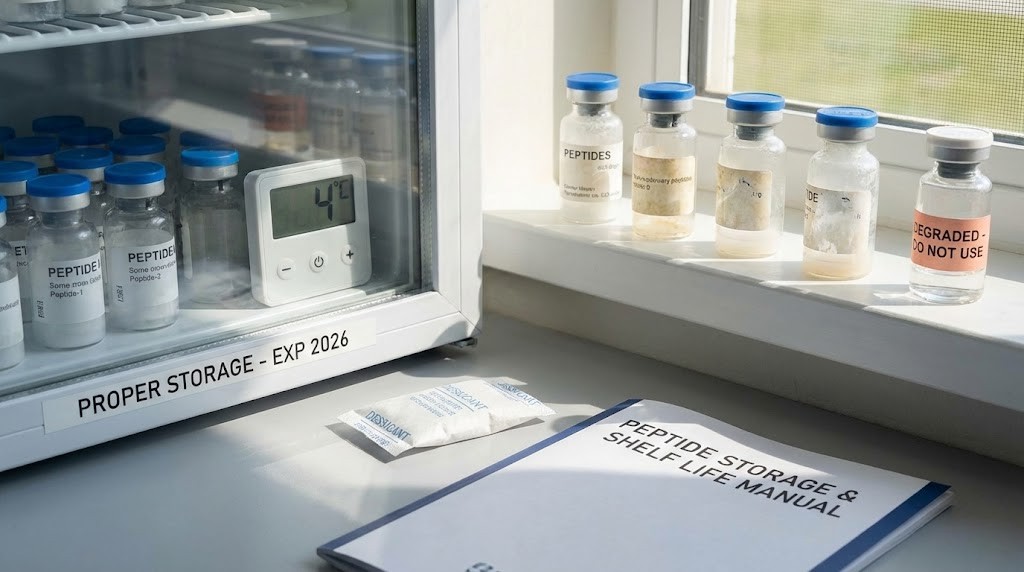
Peptides absolutely expire, but shelf life varies dramatically based on form (lyophilized powder vs reconstituted liquid), storage conditions (freezer vs refrigerator vs room temperature), peptide type (some are more stable than others), and handling (contamination, light exposure, temperature fluctuations). Lyophilized peptides properly frozen can last 2-5 years.
The same peptides reconstituted with bacteriostatic water last 28-30 days refrigerated. Room temperature storage reduces shelf life to mere days or hours.
This guide covers exactly how long different peptides last, proper storage temperatures for maximum shelf life, signs your peptides have degraded (visual inspection, smell, effectiveness), differences between lyophilized vs liquid peptides, bacteriostatic vs sterile water impact on shelf life, and specific storage guidelines for common peptides (BPC-157, semaglutide, GHK-Cu, CJC-1295).
Understanding peptide expiration protects your investment and ensures effective treatment.
How peptides degrade over time
The chemistry behind peptide shelf life.
Peptide structure and stability
What peptides are:
Chains of amino acids
Held together by peptide bonds
Specific 3D structure required for function
Fragile molecules compared to small molecule drugs
Why peptides are unstable:
Peptide bonds susceptible to hydrolysis (water breaks bonds)
Oxidation damages certain amino acids
Temperature accelerates degradation
Light exposure causes photo-degradation
pH changes denature structure
Bacterial contamination introduces enzymes that break peptides
Degradation mechanisms:
Degradation Type | Cause | Impact | Prevention |
|---|---|---|---|
Hydrolysis | Water molecules breaking peptide bonds | Fragments instead of intact peptide | Store as dry powder, use bacteriostatic water |
Oxidation | Oxygen reacting with amino acids (Met, Cys, Trp) | Loss of activity, discoloration | Store in sealed vials, minimize air exposure |
Aggregation | Peptides clumping together | Reduced solubility, lost function | Proper reconstitution technique, avoid shaking |
Deamidation | Asparagine/glutamine side chains changing | Altered structure, reduced potency | Cool storage, avoid pH extremes |
Photo-degradation | Light energy breaking bonds | Structural damage, inactive peptides | Store in amber vials or boxes, protect from light |
Bacterial degradation | Enzymes from bacteria breaking peptides | Complete loss, contamination | Sterile technique, bacteriostatic water |
Temperature's exponential effect:
Every 10°C temperature increase roughly doubles degradation rate
Room temperature (25°C): Rapid degradation (days)
Refrigerated (2-8°C): Slow degradation (weeks-months)
Frozen (-20°C): Very slow degradation (years)
Ultra-frozen (-80°C): Minimal degradation (5+ years)
Learn peptide fundamentals at SeekPeptides - explore what are peptides, how peptides work, and getting started with peptides.
Lyophilized vs liquid peptide stability
Lyophilized (freeze-dried) powder:
Most peptides sold in this form
Moisture removed via freeze-drying
Very stable when dry
Can last years if stored properly
Requires reconstitution before use
Lyophilized stability:
Freezer (-20°C): 2-5+ years for most peptides
Refrigerator (2-8°C): 1-2 years typical
Room temperature: Weeks to months (varies by peptide)
Key factor: Keeping it DRY (moisture is enemy)
Liquid (reconstituted) peptides:
Peptide dissolved in water
Much less stable than powder
Water enables hydrolysis
Bacterial contamination risk higher
Limited shelf life
Liquid stability:
Refrigerated with bacteriostatic water: 28-30 days typical
Refrigerated with sterile water: 5-7 days maximum
Room temperature: Hours to 1-2 days only
Frozen (reconstituted): DO NOT FREEZE liquid peptides
Key principle: Keep peptides as dry powder until needed, then use reconstituted solution within recommended timeframe.
See our lyophilized vs liquid peptides comparison and peptide storage guide.
Factors that accelerate expiration
Temperature fluctuations:
Repeated freeze-thaw cycles very damaging
Each thaw = period of degradation
One freeze-thaw: Minor impact
Multiple cycles: Significant loss of potency
Keep frozen continuously until ready to reconstitute
Light exposure:
UV and visible light degrade peptides
Some peptides more photosensitive (GHK-Cu)
Amber vials protect partially
Keep vials in boxes or dark storage
Air exposure:
Oxygen causes oxidation
Minimize time vial is open
Don't store without cap
Use quickly after reconstitution
Moisture exposure (for powder):
Even atmospheric humidity can start degradation
Keep in sealed vials always
Don't open unnecessarily
Store in dry environment
Contamination:
Non-sterile technique introduces bacteria
Bacterial enzymes destroy peptides rapidly
Always use alcohol wipes
Never touch rubber stopper
Use bacteriostatic water to inhibit growth
pH extremes:
Some peptides unstable at wrong pH
Reconstitute with appropriate solution
Bacteriostatic water usually optimal (slightly acidic)
Don't mix with other substances without knowledge
Shelf life before reconstitution (lyophilized powder)
How long dry peptides last in different conditions.
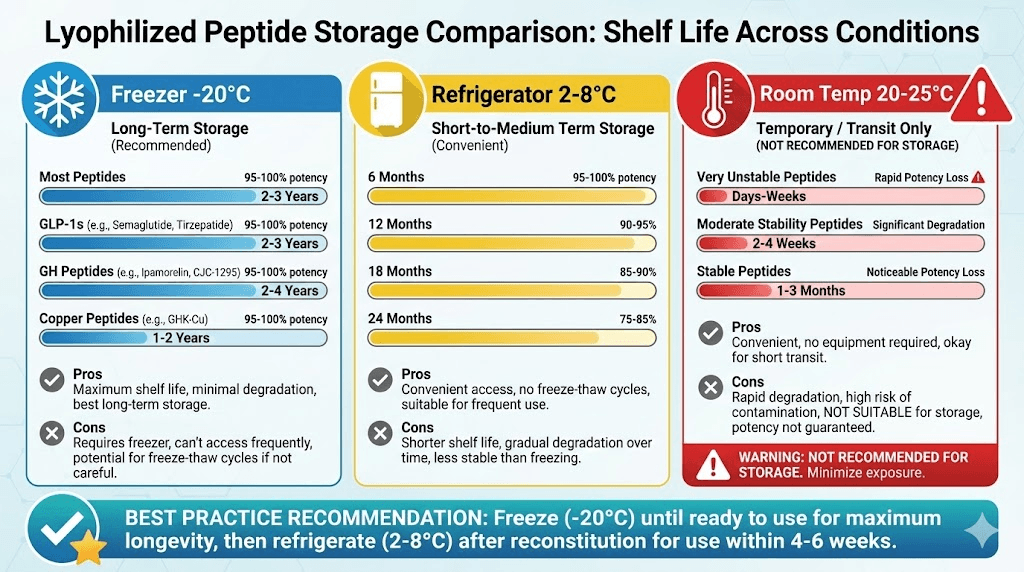
Freezer storage (-20°C): maximum shelf life
Typical shelf life frozen:
Peptide Type | Freezer Shelf Life | Notes |
|---|---|---|
Most common peptides | 2-3 years | BPC-157, TB-500, CJC-1295, Ipamorelin, etc. |
GLP-1 agonists | 2-3 years | Semaglutide, tirzepatide stable when frozen |
Growth hormone peptides | 2-4 years | Very stable as powder |
Copper peptides | 1-2 years | GHK-Cu less stable, oxidation concern |
Fragment peptides | 2-3 years | AOD 9604, HGH Fragment standard stability |
Cognitive peptides | 2-3 years | Semax, Selank stable |
Why freezing works:
Virtually stops all chemical reactions
Prevents bacterial growth completely
Minimizes oxidation
Maintains dry state
Freezer storage best practices:
Use standard freezer (-20°C or -18°C home freezer fine)
Keep in original sealed vial
Store in box to protect from light
Minimize opening freezer (temperature stability)
Label with receipt date and peptide name
Ultra-freezer (-80°C) extends to 5-10 years if available
Real-world considerations:
Manufacturers often claim 2 years frozen
Reality: Most peptides remain 80-90%+ potent at 3-4 years
Testing expensive, so conservative dates given
Properly stored peptides often good well beyond stated date
Refrigerator storage (2-8°C): moderate shelf life
Typical shelf life refrigerated (unopened powder):
Storage Duration | Expected Potency | Suitability |
|---|---|---|
0-6 months | 95-100% | Excellent, no concerns |
6-12 months | 90-95% | Very good, use with confidence |
12-18 months | 85-90% | Good, slight degradation possible |
18-24 months | 75-85% | Fair, noticeable degradation likely |
24+ months | <75% | Poor, significant degradation expected |
When refrigerator storage makes sense:
Planning to use within 6-12 months
No freezer available
Vendor shipped refrigerated (already at this temp)
Regular use (accessing frequently)
Refrigerator storage tips:
Store in back (most stable temperature)
Not in door (temperature fluctuates with opening)
Keep in sealed vial and box
Avoid moisture exposure
Label clearly with date and peptide
Vendor shipping:
Many vendors ship refrigerated with ice packs
This is acceptable if received cold
Don't refreeze after refrigerated shipping
Use within refrigerated timeframe
See our peptide storage guide and should copper peptides be refrigerated.
Room temperature storage: short shelf life
Room temperature stability (lyophilized powder):
Peptide Category | Room Temp Shelf Life | Degradation Speed |
|---|---|---|
Very unstable peptides | Days to 1-2 weeks | Rapid (GHK-Cu, some growth factors) |
Moderately stable | 2-4 weeks | Moderate (most common peptides) |
Relatively stable | 1-3 months | Slower (some well-designed peptides) |
Why room temperature is risky:
Degradation accelerates dramatically
10°C warmer = 2x faster degradation
20°C warmer (room temp vs freezer) = 4x faster
Moisture in air can affect powder
Bacterial spores can colonize
When peptides are at room temperature:
During shipping (1-3 days typically)
After delivery before refrigerating
When reconstituting (brief exposure)
Minimize room temp exposure:
Refrigerate or freeze immediately upon receipt
Don't leave out while reconstituting (work quickly)
If traveling, use cooler with ice packs
Never store at room temp intentionally
Shipping concerns:
Most peptides survive 1-3 days room temp shipping
Hot summer shipping can damage peptides
Request cold packing in summer
Overnight shipping better than standard
Use SeekPeptides to track peptide storage duration and get alerts when approaching expiration. Our platform helps maximize your peptide investments.
Manufacturer expiration dates vs reality
What expiration dates mean:
Conservative estimate of guaranteed potency
Usually based on accelerated stability testing
Designed to ensure 90-100% potency through date
Regulatory and liability considerations
Why stated dates are conservative:
Expensive to test long-term (years)
Manufacturers want safety margin
Better to underestimate than overestimate
Varies by company (research chemicals vs pharma)
Research peptide "expiration":
Often no formal expiration date
COA (Certificate of Analysis) shows testing date
General rule: 2 years from COA date if frozen
6-12 months from COA if refrigerated
Real-world peptide longevity:
Frozen peptides often remain 80%+ potent at 3-5 years
Refrigerated peptides good 12-18+ months if properly stored
Much depends on storage conditions and handling
When to trust peptides past "expiration":
Stored frozen continuously: Very likely still good
Stored refrigerated: Probably good if within 1-2 years
Room temp storage: Don't trust past weeks
Visual inspection passes (see below)
COA relatively recent (within 2-3 years)
When to discard despite date:
Visible discoloration or changes
Exposed to heat or temperature extremes
Stored at room temperature for extended period
Seal broken (contamination risk)
Smell or visual contamination
Shelf life after reconstitution (liquid peptides)
Reconstituted peptides have much shorter lifespans.
Bacteriostatic water: 28-30 day shelf life
Why bacteriostatic water extends shelf life:
Contains 0.9% benzyl alcohol
Benzyl alcohol inhibits bacterial growth
Doesn't kill all bacteria, just prevents multiplication
Allows multi-dose use safely
Standard for peptide reconstitution
Typical shelf life with bacteriostatic water:
Timeframe | Expected Potency | Bacterial Safety | Usage Status |
|---|---|---|---|
Days 1-7 | 95-100% | Excellent | Ideal use window |
Days 8-14 | 90-95% | Excellent | Very good, use confidently |
Days 15-21 | 85-90% | Very good | Good, minor degradation starting |
Days 22-28 | 80-85% | Good | Acceptable, approaching limit |
Days 29-30 | 75-80% | Fair | Maximum recommended timeframe |
Days 31+ | <75% | Risk increasing | Discard, degradation significant |
Why 28-30 days is the limit:
Peptide hydrolysis continues in solution
Benzyl alcohol effectiveness decreases over time
Bacterial contamination risk increases
Most peptides show measurable degradation by day 30
Conservative limit ensures safety and efficacy
Storage during 30-day period:
Refrigerate continuously (2-8°C)
Never freeze reconstituted peptides
Protect from light (keep in box or amber vial)
Minimize temperature fluctuations
Use sterile technique every time
See our bacteriostatic water for peptides, water to mix with peptides, and how long reconstituted peptides last in fridge.
Sterile water: 5-7 day shelf life maximum
Why sterile water has shorter shelf life:
No preservatives (no benzyl alcohol)
Bacteria can multiply freely if contaminated
Higher contamination risk
Designed for single-use vials
Should only use for immediate injection (pharma standard)
Shelf life with sterile water:
Days 1-3: 95-100% potency, low contamination risk
Days 4-5: 90-95% potency, moderate risk
Days 6-7: 85-90% potency, higher risk
Days 8+: Not recommended, high contamination risk
When to use sterile water:
Single-dose vials (use entire vial immediately)
Don't have bacteriostatic water available
Allergic to benzyl alcohol (rare)
Pharmaceutical peptides intended for single use
Why bacteriostatic is better:
4x longer shelf life (28 days vs 7 days)
Much safer for multi-dose vials
Standard in research peptide community
Allows reconstituting full vial, using over weeks
Converting to bacteriostatic:
If you have sterile water, get bacteriostatic water
Reconstitute with bacteriostatic for standard shelf life
Small investment for much better results
Never freeze reconstituted peptides
Why freezing liquid peptides is bad:
Ice crystals form during freezing
Ice crystals physically damage peptide structure
Peptides denature (unfold) during freeze
Aggregation occurs when thawed
Significant potency loss (30-50%+)
Can make peptide completely inactive
The myth:
Some people think freezing = preserving
True for lyophilized powder (no water)
False for reconstituted liquid (water present)
Water freezing is the problem
If you accidentally froze reconstituted:
Likely 50-70% potency loss
May still have some effect
Visual inspection: Cloudiness or particles = bad
If clear after thawing, might work partially
Better to discard and reconstitute fresh
Proper long-term storage:
Keep peptides as lyophilized powder frozen
Reconstitute only what you'll use in 30 days
Don't reconstitute entire supply at once
Plan doses based on 30-day window
Use our free peptide calculator at SeekPeptides to calculate how much to reconstitute for your protocol duration.
Specific peptide reconstitution shelf lives
Variations by peptide type:
Peptide | Bacteriostatic Water Shelf Life | Sterile Water | Special Considerations |
|---|---|---|---|
BPC-157 | 28-30 days | 5-7 days | Very stable, reliable 30 days |
TB-500 | 28-30 days | 5-7 days | Stable, full 30-day usage |
Semaglutide | 28-30 days | 7 days | Pharmaceutical pens designed for 30 days |
Tirzepatide | 28-30 days | 7 days | Same as semaglutide |
CJC-1295 | 28-30 days | 5-7 days | Stable, full timeframe |
Ipamorelin | 28-30 days | 5-7 days | Stable peptide |
GHK-Cu | 21-28 days | 3-5 days | Oxidation concern, use within 3 weeks safer |
Semax/Selank | 28-30 days | 7 days | Stable with bacteriostatic water |
HGH | 14-21 days | 3-5 days | Shorter than most peptides |
Cagrilintide | 28-30 days | 7 days | New peptide, limited data but likely standard |
GHK-Cu special note:
Copper peptides more susceptible to oxidation
Some recommend using within 21 days reconstituted
Blue color deepening or browning = degradation
Still likely works at 28 days but may prefer shorter
See our GHK-Cu 50mg copper peptide dosage and copper peptides GHK-Cu guide.
Signs your peptides have expired or degraded
How to tell if peptides are still good.
Visual inspection (most important)
For lyophilized powder (before reconstitution):
Good signs:
White, off-white, or expected color
Fluffy cake or compact puck (freeze-dried appearance)
No moisture visible
Clean inside vial
Intact seal
Bad signs (degradation or contamination):
Visual Issue | What It Means | Action |
|---|---|---|
Discoloration (yellow, brown, gray) | Oxidation, degradation | Probably degraded, don't use |
Moisture/condensation | Seal broken, hydrolysis starting | Don't use, compromised |
Particles or debris | Contamination | Discard immediately |
Collapsed or melted appearance | Exposed to heat | Likely degraded, discard |
Strong chemical smell | Severe degradation | Discard |
For reconstituted liquid:
Good signs:
Clear solution (most peptides)
Slight blue tint (GHK-Cu normal)
No particles or cloudiness
No smell (or very faint)
Bad signs:
Visual Issue | What It Means | Action |
|---|---|---|
Cloudiness | Aggregation, contamination, or freeze damage | Discard, don't inject |
Particles/floaters | Contamination or aggregates | Discard immediately |
Color change | Degradation or contamination | Discard |
Foul smell | Bacterial contamination | Discard immediately, serious |
Film or growth | Bacterial/fungal growth | Discard, major contamination |
Smell test (secondary indicator)
What peptides should smell like:
Fresh peptides: Nearly odorless or very faint chemical smell
Reconstituted: Smell of bacteriostatic water (slight benzyl alcohol)
Should not have strong odor
Warning smells:
Foul or rotten smell = bacterial contamination (discard immediately)
Strong chemical smell = severe degradation
Ammonia-like smell = breakdown products
Limitations of smell test:
Not all degradation produces smell
Some peptides naturally have faint odors
Use visual inspection primarily
Smell is backup check
Loss of effectiveness (ultimate test)
Monitoring effectiveness:
Track results consistently
Compare to initial effects
Same dose producing weaker results = possible degradation
Signs of degraded peptides:
Previously effective dose no longer working
Gradual loss of benefits over time
No effect at expected timeframe
Need higher doses for same effect
Confounding factors:
Body tolerance/adaptation (some peptides)
Expectations vs reality
Other health changes
Improper dosing technique
When reduced effectiveness indicates degradation:
Sudden loss of effect (not gradual adaptation)
Multiple vials from same batch all weak
Known poor storage (heat exposure, old date)
Visual signs of degradation also present
What to do if peptides seem weak:
Check storage conditions (temperature, duration)
Inspect vial visually
Try fresh vial from reliable source
Compare with known good batch
Assess dosing technique
Testing degradation scientifically
Professional testing methods:
HPLC (High Performance Liquid Chromatography) - shows purity
Mass spectrometry - confirms molecular weight
Both expensive ($100-300 per test)
Not practical for most users
When scientific testing makes sense:
Large batch purchase (testing sample)
Vendor verification
Research purposes
Legal/regulatory requirements
For most users:
Visual inspection sufficient
Trust storage practices
Replace at recommended intervals
Don't try to extend too far past limits
Access our best peptide vendors guide at SeekPeptides for quality sourcing with proper testing and storage.
Storage best practices for maximum shelf life
Implementing proper storage protocols.
Proper storage temperatures
Storage temperature table:
Storage Location | Temperature Range | Best For | Maximum Shelf Life |
|---|---|---|---|
Ultra-freezer | -80°C | Long-term powder (years) | 5-10+ years |
Standard freezer | -20 to -18°C | Lyophilized powder | 2-5 years |
Refrigerator | 2-8°C | Powder (months) or reconstituted liquid | 1-2 years powder / 28 days liquid |
Room temperature | 20-25°C | Short-term only (shipping) | Days to weeks powder / Hours liquid |
Heat exposure | >30°C | Never acceptable | Immediate degradation |
Freezer storage protocol:
Home freezer (-18 to -20°C) perfect for most users
Store in back (most stable temperature)
Minimize opening and closing
Keep vials in sealed bags (extra moisture protection)
Label clearly (peptide name, date, dose)
Store in box to protect from light
Refrigerator storage protocol:
Use for reconstituted peptides always
Can use for powder if using within months
Back of fridge (avoid door - temp fluctuates)
Keep in original vial and box
Separate from food to avoid contamination risk
Temperature monitoring:
Freezer thermometer recommended
Ensure consistent -18°C or colder
Power outage: Keep freezer closed (stays cold 24-48 hours)
If thawed: Don't refreeze powder (use or refrigerate)
Protecting from light and oxidation
Light damage prevention:
Most peptides photosensitive to some degree
UV light most damaging
Visible light can also degrade
Amber vials provide some protection
Best practices:
Store vials in original boxes (blocks light)
Keep in dark place (drawer, closed cabinet)
Minimize light exposure during reconstitution
Work in normal room light (not direct sunlight)
Don't store near windows
Oxidation prevention:
Oxygen exposure accelerates degradation
Keep vials sealed when not in use
Minimize time vial is open
Don't transfer to other containers
Use quickly after reconstituting
Vacuum-sealed storage (advanced):
Some users vacuum-seal lyophilized vials
Removes oxygen for long-term freezer storage
Not necessary but can extend shelf life
Most benefit for 3-5+ year storage
Preventing contamination
Sterile technique essentials:
Every time you access vial:
Wash hands thoroughly
Clean rubber stopper with alcohol wipe
Let alcohol dry completely (30-60 seconds)
Use sterile syringe and needle
Don't touch needle or stopper with fingers
Minimize time vial is open
Recap vial immediately
Common contamination sources:
Touching rubber stopper with fingers
Reusing needles or syringes
Not cleaning stopper before each use
Storing vial without cap
Using non-sterile water for reconstitution
Introducing air repeatedly
Contamination signs:
Cloudiness (bacterial growth)
Particles or film
Foul smell
Color change
Slime or visible growth
If contamination suspected:
Discard immediately
Do not inject contaminated peptide
Risk of serious infection
Not worth saving money
See our peptide injections guide, how to reconstitute peptides, and common peptide mistakes beginners make.
Reconstitution timing strategies
Reconstitute based on usage:
Daily use peptides (BPC-157, TB-500, GH peptides):
Reconstitute 2-4 week supply
Example: BPC-157 500mcg twice daily
5mg vial = 10 days supply
Reconstitute every 10 days
Weekly use peptides (semaglutide, tirzepatide, CJC-1295):
Reconstitute 4-week supply
Example: Semaglutide 2.4mg weekly
5mg vial = 2 weeks supply
Reconstitute every 2 weeks
Occasional use peptides:
Reconstitute only when needed
Keep powder frozen until use
Small vial sizes better (2.5mg vs 10mg)
Avoiding waste:
Calculate how much you'll use in 28 days
Reconstitute that amount only
Keep excess as frozen powder
Better to reconstitute twice than waste
Reconstitution schedule table:
Peptide | Typical Dose | Daily Use | 28-Day Amount Needed | Reconstitution Frequency |
|---|---|---|---|---|
BPC-157 | 500mcg 2x daily | 1mg daily | 28mg needed | Reconstitute 5mg every 5 days |
Semaglutide | 2.4mg weekly | ~0.34mg daily | ~10mg needed | Reconstitute 5mg every 2 weeks |
CJC-1295 | 200mcg 5x weekly | ~140mcg daily | ~4mg needed | Reconstitute 5mg every 5 weeks |
TB-500 | 5mg weekly | ~0.7mg daily | ~20mg needed | Reconstitute 5mg weekly |
Use SeekPeptides to plan optimal reconstitution schedules based on your protocol. Our peptide reconstitution calculator helps determine ideal vial sizes.
Peptide-specific storage guidelines
Different peptides have unique requirements.
BPC-157 and TB-500 (healing peptides)
BPC-157 stability:
Very stable peptide
Lyophilized: 2-3 years frozen
Reconstituted: Full 28-30 days with bacteriostatic water
Relatively forgiving of brief temp fluctuations
Copper-free (unlike GHK-Cu, no oxidation concerns)
TB-500 stability:
Similar stability to BPC-157
Lyophilized: 2-3 years frozen
Reconstituted: 28-30 days
Stable and reliable
Storage recommendations:
Freeze powder until needed
Reconstitute 2-4 week supply
Refrigerate reconstituted vial
Standard sterile technique
No special precautions needed
See our BPC-157 guide, BPC-157 5mg dosing guide, TB-500 guide, TB-500 benefits, and BPC-157 vs TB-500.
Semaglutide and tirzepatide (GLP-1 agonists)
Semaglutide stability:
Lyophilized: 2-3 years frozen
Reconstituted: 28-30 days refrigerated
Pharmaceutical pens (Ozempic/Wegovy) designed for 30 days refrigerated
Very stable in solution
Tirzepatide stability:
Similar to semaglutide
2-3 years frozen (powder)
28-30 days refrigerated (liquid)
Pharmaceutical pens also 30-day rating
Weight loss peptide storage:
Both very forgiving
Weekly dosing = reconstitute 4-week supply
5mg vial typically lasts 2-4 weeks depending on dose
No special temperature requirements beyond standard
See our semaglutide dosage calculator, tirzepatide dosing guide, semaglutide vs tirzepatide, and peptides for weight loss.
GHK-Cu (copper peptides)
GHK-Cu special considerations:
Contains copper = oxidation concern
More sensitive than most peptides
Color changes indicate degradation
Shelf life:
Lyophilized frozen: 1-2 years (shorter than most)
Lyophilized refrigerated: 6-12 months
Reconstituted: 21-28 days (some say 21 days safer)
Color monitoring:
Fresh GHK-Cu: Light blue or clear with blue tint
Acceptable: Maintained blue color
Degrading: Deepening blue or turning brown/green
Bad: Brown, green, or black = severely degraded
Storage best practices:
Freeze powder (very important for GHK-Cu)
Protect from light religiously (amber vials ideal)
Reconstitute smaller amounts (2-3 weeks vs 4 weeks)
Monitor color weekly
Discard if color darkens significantly
See our GHK-Cu 50mg copper peptide dosage, copper peptides GHK-Cu guide, and should copper peptides be refrigerated.
Growth hormone peptides (CJC-1295, Ipamorelin, etc.)
Stability profile:
Very stable peptide class
Lyophilized: 2-4 years frozen (longer than average)
Reconstituted: 28-30 days
Minimal degradation concerns
Storage:
Freeze until needed
Reconstitute based on usage frequency
CJC-1295: Often used 5x weekly, reconstitute 4-6 week supply
Ipamorelin: Similar usage, 4-6 week supply
Very forgiving peptides
See CJC-1295 dosage calculator, Ipamorelin benefits, Ipamorelin vs CJC-1295, and peptides for muscle growth.
Cognitive peptides (Semax, Selank)
Stability:
Lyophilized: 2-3 years frozen
Reconstituted: 28-30 days refrigerated
Intranasal use = frequent access to vial
Storage tips:
Reconstitute 2-4 week supply
Keep refrigerated between uses
Nasal spray bottles: Replace every 2-3 weeks
Protect from light
See our Semax peptide dosage guide, Selank peptide injection dosage, peptides for anxiety, and best peptide for energy and focus.
How you can use SeekPeptides for peptide management
SeekPeptides helps you track peptide expiration dates, storage conditions, and reconstitution timing. Get alerts when peptides approach expiration, recommendations for optimal reconstitution schedules based on your protocol, and guidance on proper storage for each specific peptide.
Our platform calculates how much to reconstitute based on your dosing frequency, tracks when vials were reconstituted (automatic 28-day countdown), and suggests when to discard and reconstitute fresh batches. Never waste peptides by reconstituting too much or risk using expired peptides.
Access our storage guides - peptide storage guide, how long reconstituted peptides last in fridge, lyophilized vs liquid peptides, bacteriostatic water for peptides, water to mix with peptides.
Use our calculators - peptide calculator, peptide reconstitution calculator, free peptide reconstitution calculator, peptide cost calculator - for optimal peptide management.
Learn proper handling through our guides - how to reconstitute peptides, peptide injections guide, getting started with peptides, common peptide mistakes beginners make.
Final thoughts
Peptides absolutely expire, with shelf life ranging from 2-5 years for lyophilized powder stored frozen to just 28-30 days for reconstituted liquid refrigerated.
The most critical factor determining longevity is storage temperature - every 10°C increase roughly doubles degradation rate, making freezer storage (-20°C) essential for long-term powder storage and refrigeration (2-8°C) mandatory for reconstituted peptides.
Bacteriostatic water extends reconstituted peptide shelf life to 28-30 days versus only 5-7 days with sterile water, making it the clear choice for multi-dose vials. Never freeze reconstituted peptides as ice crystal formation denatures the delicate peptide structure, causing 30-50%+ potency loss.
Visual inspection remains the most practical quality check - discoloration, cloudiness, particles, or foul smell indicate degradation or contamination requiring immediate disposal.
While manufacturer expiration dates provide conservative guidelines, properly frozen peptides often remain 80-90%+ potent well beyond stated dates when storage conditions are ideal.
Maximizing peptide shelf life requires freezing lyophilized powder immediately upon receipt, reconstituting only what you'll use within 28 days, maintaining strict refrigeration for reconstituted vials, protecting from light exposure, and using sterile technique every time you access the vial to prevent bacterial contamination.
Your peptide investment deserves proper storage - the difference between frozen and room temperature storage could mean 2-3 years of usable peptides versus complete degradation in weeks. Understanding expiration timelines, recognizing degradation signs, and implementing proper storage protocols ensures effective treatment and prevents wasted money on inactive peptides.
Helpful resources for peptide storage
Peptide storage guide - Complete storage protocols
How long reconstituted peptides last in fridge - Refrigeration guide
Bacteriostatic water for peptides - Reconstitution water
Take care of yourself. Cheers